Back to blog
Research

How Do I Prioritize Features When Building a Web3 MVP?

Learn effective strategies for prioritizing features in your Web3 MVP using proven frameworks, community input, and security best practices to ensure success.
Token Metrics Team
10 min read
Want Smarter Crypto Picks—Free?
See unbiased Token Metrics Ratings for BTC, ETH, and top alts.
Thank you! Your submission has been received!
Oops! Something went wrong while submitting the form.
 No credit card | 1-click unsubscribe

Building a Web3 minimum viable product presents unique challenges that traditional software development doesn't face. You're not just creating an application—you're architecting an ecosystem where technology, economics, and community coordination intersect. With blockchain's immutable nature and the complexity of decentralized systems, knowing which features to prioritize can mean the difference between launching a successful project and wasting months building the wrong things.

In 2025, Web3 MVP development requires more than technical skills. It demands speed, clarity, and the ability to learn from real users fast. This comprehensive guide will walk you through proven prioritization strategies specifically designed for Web3 projects, helping you make informed decisions that maximize your chances of achieving product-market fit.

Understanding the Web3 MVP Challenge

A minimum viable product is a simplified version of your product that includes only the core features necessary to meet the needs of early adopters. In Web3, an MVP allows startups to explore decentralized applications and blockchain functionalities without committing extensive resources upfront.

The stakes are uniquely high in Web3. Smart contract immutability means you can't easily patch bugs after deployment. Scope creep poses existential dangers since adding features often requires complete system overhauls rather than simple updates. Security vulnerabilities aren't just reputational problems—they're existential threats that can drain millions in seconds.

Before diving into feature prioritization, understand what makes Web3 MVP development different from traditional software. You're simultaneously solving technical problems, fostering communities, creating economic systems through tokenomics, and building foundational infrastructure for a decentralized internet.

The Foundation: Identifying Core Value

Before applying any prioritization framework, you must answer one fundamental question: What specific problem does your Web3 project solve, and for whom? Conduct thorough market research to identify your target audience, assess viability, gauge problem-solving potential, and devise strategies to align your product with customer requirements.

In crypto, understanding the optimal approach for delivering value and effectively communicating benefits is paramount. Define precise, unambiguous metrics that will quantitatively evaluate the efficacy of your launch. For Web3 applications, this might include the number of wallet connections, transaction volume, total value locked, or active community members.

Successful projects like Uniswap demonstrate this principle perfectly. Starting in 2018 with under $50,000, no CEO, and no marketing blitz—just a smart contract on Ethereum and a vision for trustless token swaps—Uniswap focused exclusively on solving one problem: enabling decentralized token exchanges. By 2025, it has surpassed $3 trillion in total trading volume by maintaining laser focus on core functionality before expanding.

The MoSCoW Prioritization Framework for Web3

The MoSCoW method creates a hierarchy for your feature requests based on their importance. Developed by Dai Clegg while working at Oracle in 1994, this framework divides features into four unambiguous categories, particularly useful in conjunction with fixed timeframes.

  • Must Have (M): These are non-negotiable requirements to launch your product. An easy way to identify Must Have features is asking: "What happens if this requirement isn't met?" If the answer is "cancel the project," it's a Must Have. For a Web3 DEX, Must Haves might include wallet connection, token swapping functionality, basic liquidity pool creation, and essential smart contract security audits. These are the features that define your product's core value proposition.
  • Should Have (S): These features are important but not immediately critical. They significantly enhance user experience and can be included in the first release if resources permit, but the product can launch without them. For our DEX example, Should Haves might include advanced trading features like limit orders, portfolio tracking, or multi-chain support for additional networks beyond your primary blockchain.
  • Could Have (C): These are desirable enhancements that would improve user satisfaction but aren't necessary for launch. Often called "nice-to-haves," they're the first to be removed if timelines or resources become constrained. Could Have features might include advanced analytics dashboards, social features, gamification elements, or integrations with other DeFi protocols.
  • Won't Have (W): These features are explicitly excluded from the current iteration. They may be reconsidered for future releases, but are intentionally deferred to maintain focus and prevent scope creep.

The MoSCoW framework ensures you build a genuine minimum viable product by prioritizing Must Have features while creating contingency within requirements. This approach is particularly effective in Web3 where resource constraints and technical complexity demand ruthless prioritization.

Value vs. Complexity Analysis

Another powerful prioritization technique for Web3 MVPs involves plotting features on a two-dimensional matrix: Value against Complexity (or Effort). Value represents the benefit your customers and business receive from a feature. Does it alleviate customer pain points? Will it drive user adoption? Does it strengthen your competitive position? In Web3, value might also include community building potential, network effects, or tokenomic alignment.

Complexity encompasses what it takes for your organization to deliver the feature: development time, required expertise, infrastructure costs, security audit requirements, gas optimization needs, and ongoing maintenance burden.

Plot each potential feature on a 2x2 grid:

  • High Value, Low Complexity: These are your quick wins. Prioritize these features first—they deliver maximum impact with minimal investment. Examples might include integrating a widely-used wallet provider or implementing standard ERC-20 token support.
  • High Value, High Complexity: These are strategic initiatives that define your competitive advantage. Plan these carefully, break them into smaller deliverables, and build them after quick wins demonstrate traction. Examples might include novel AMM algorithms or cross-chain bridging infrastructure.
  • Low Value, Low Complexity: These are fill-in tasks suitable when waiting for dependencies or during low-activity periods. Don't let these distract from higher priorities.
  • Low Value, High Complexity: Avoid these entirely—they're resource drains that won't move the needle on user adoption or business success.

Community-Driven Prioritization in Web3

Unlike traditional software, Web3 projects succeed by building active communities from day one. Your community becomes both your testing ground and marketing engine, making community-driven prioritization essential.

Create dedicated Discord channels for testing feedback. Run community polls to validate feature prioritization decisions. Use governance forums to gather input on economic parameter changes and roadmap decisions.

This community involvement serves multiple purposes beyond feature validation. It provides extensive testing coverage no internal team could match, builds community investment in your project's success, and creates feedback loops that traditional QA processes miss.

However, maintain roadmap discipline. Active communities generate constant feature requests and suggestions. While input is valuable, allowing every suggestion to influence your roadmap leads to scope creep and delayed launches. Communicate priorities and reasoning regularly, and use governance forums to discuss potential changes transparently.

Security and Audit Prioritization

In Web3, security isn't just another feature—it's the foundation everything else builds upon. Hacks are existential threats, not merely reputational problems. Design smart contracts as modular systems from the beginning. Use proxy patterns that allow upgrades while maintaining security. Plan clear upgrade paths for adding functionality without compromising existing security guarantees.

Prioritize comprehensive security audits for all smart contracts before mainnet deployment. Budget 15-25% of development resources for security reviews, formal verification where appropriate, and bug bounty programs. This isn't optional—it's the price of admission in Web3.

Progressive Decentralization Strategy

Don't try to build fully autonomous organizations from the start. Launch with appropriate centralized control and create clear roadmaps for progressive decentralization. Your initial MVP should prioritize functionality and security over complete decentralization.

Many successful Web3 projects launched with admin keys and centralized control, then gradually transferred governance to the community as the system matured and edge cases were addressed. Premature decentralization often leads to governance paralysis, inability to respond to emergencies, and security vulnerabilities. Plan your decentralization roadmap as carefully as your feature roadmap.

Real-World Data: Learning from Token Metrics

Token Metrics exemplifies smart feature prioritization in Web3 analytics platforms. Rather than trying to build every possible crypto analysis tool simultaneously, Token Metrics focused on core value propositions first: AI-powered token ratings, smart contract audits, and comprehensive market analytics.

As the premier crypto trading and analytics platform, Token Metrics demonstrates how strategic feature prioritization creates competitive advantages. The platform started with essential Must Have features—reliable data feeds, AI rating algorithms, and intuitive interfaces—before expanding to Should Have capabilities like automated trading indices and cross-chain analytics.

In March 2025, Token Metrics launched integrated on-chain trading, transforming from an analytics platform into an end-to-end solution. This strategic expansion came only after establishing market leadership in analytics, demonstrating smart sequencing of high-value features.

Token Metrics' approach illustrates several key prioritization principles for Web3 builders: Start with data quality and reliability as non-negotiable Must Haves. Without accurate, real-time blockchain data, no analytics features matter. Build AI-powered insights as differentiators once core data infrastructure is solid. Token Metrics' Trader Grades (0-100) and Investor Grades provide unique value that competing platforms lack. Layer on convenience features like integrated trading only after achieving product-market fit with core analytics. This sequencing prevents premature complexity while building toward a comprehensive platform. Continuously gather user feedback to validate feature priorities. Token Metrics evolved from pure analytics to trading integration based on customer requests for a direct path from research to execution.

For Web3 builders, Token Metrics' journey offers valuable lessons. Prioritize features that deliver immediate, measurable value to early adopters. Build trust through reliability and security before expanding functionality. Listen to your community but maintain roadmap discipline. Sequence features strategically, ensuring each addition builds on proven foundations.

AI-Assisted Prioritization in 2025

Web3 development in 2025 increasingly leverages AI tools for smarter feature prioritization. AI-driven user analytics can predict which features will drive adoption, while AI-generated feature scoring helps teams make data-driven decisions faster.

Use AI to analyze competitor offerings, identify gaps in the market, and predict user behavior patterns. These tools shave weeks off development timelines and reduce human bias in prioritization decisions. However, AI should inform human judgment, not replace it. Your understanding of community needs, technical constraints, and strategic vision remains irreplaceable.

Practical Implementation Timeline

A realistic Web3 MVP development timeline might look like:

  1. Week 1-2: Problem interviews and hypothesis development. Validate that your identified problem is real and your proposed solution resonates with potential users.
  2. Week 3-4: No-code or low-code prototype to validate user flow. Collect 20-50 user responses before writing a single line of smart contract code.
  3. Week 5-8: Build lean MVP prototype focusing exclusively on Must Have features. Instrument analytics and set clear KPIs for measuring success.
  4. Week 9-12: Iterate based on user data. Deploy to testnet and expand testing to broader community. Begin security audit processes for smart contracts.
  5. Week 13-16: Security hardening, audit remediation, and mainnet deployment preparation.

This aggressive timeline requires ruthless feature prioritization. Every feature not classified as Must Have gets deferred—no exceptions.

Common Prioritization Mistakes to Avoid

  • Overloading Must Haves: Teams often classify too many features as Must Haves, leading to extended timelines and resource depletion. Be ruthless—if launching without it won't invalidate your core value proposition, it's not truly a Must Have.
  • Ignoring technical debt: Choosing quick implementations that create maintenance nightmares undermines long-term success. Balance speed with code quality, especially for immutable smart contracts.
  • Feature parity battles: Trying to match every competitor feature leads to unfocused products that don't excel at anything. Identify your unique value proposition and double down.
  • Neglecting tokenomics: In Web3, your economic model isn't just a fundraising mechanism—it's a core product feature requiring the same design rigor as smart contracts. Poor tokenomics kills promising projects.
  • Building in isolation: Launching without community building leads to products nobody uses. Start community engagement on day one, before you have a product to show.

Conclusion

Prioritizing features for a Web3 MVP requires balancing technical constraints, community needs, security requirements, and business objectives. The most successful projects use structured frameworks like MoSCoW alongside value-complexity analysis, while maintaining flexibility to adapt as they learn from real users.

Discover Crypto Gems with Token Metrics AI

Platforms like Token Metrics demonstrate how strategic feature prioritization creates sustainable competitive advantages. By focusing relentlessly on core value propositions—accurate data, AI-powered insights, and user-friendly interfaces—before expanding to integrated trading, Token Metrics built the premier crypto analytics platform through disciplined execution.

Your Web3 MVP journey begins with identifying the single most important problem you're solving and the minimum feature set required to solve it. Apply proven prioritization frameworks, engage your community early, prioritize security above all else, and plan for progressive decentralization. Most importantly, launch quickly to start the learning cycle—market feedback is the only true validation of your priorities.

The future belongs to Web3 builders who recognize they're not just creating products, but architecting ecosystems. Master feature prioritization, and you'll dramatically increase your odds of building something users actually want in the decentralized internet of tomorrow.

Build Smarter Crypto Apps &
AI Agents in Minutes, Not Months
Real-time prices, trading signals, and on-chain insights all from one powerful API.
Grab a Free API Key
About Token Metrics
Token Metrics: AI-powered crypto research and ratings platform. We help investors make smarter decisions with unbiased Token Metrics Ratings, on-chain analytics, and editor-curated “Top 10” guides. Our platform distills thousands of data points into clear scores, trends, and alerts you can act on.
30 Employees
analysts, data scientists, and crypto engineers
Daily Briefings
concise market insights and “Top Picks”
Transparent & Compliant
Sponsored ≠ Ratings; research remains independent
Want Smarter Crypto Picks—Free?
See unbiased Token Metrics Ratings for BTC, ETH, and top alts.
Thank you! Your submission has been received!
Oops! Something went wrong while submitting the form.
 No credit card | 1-click unsubscribe
Token Metrics Team
Token Metrics Team

Recent Posts

Research

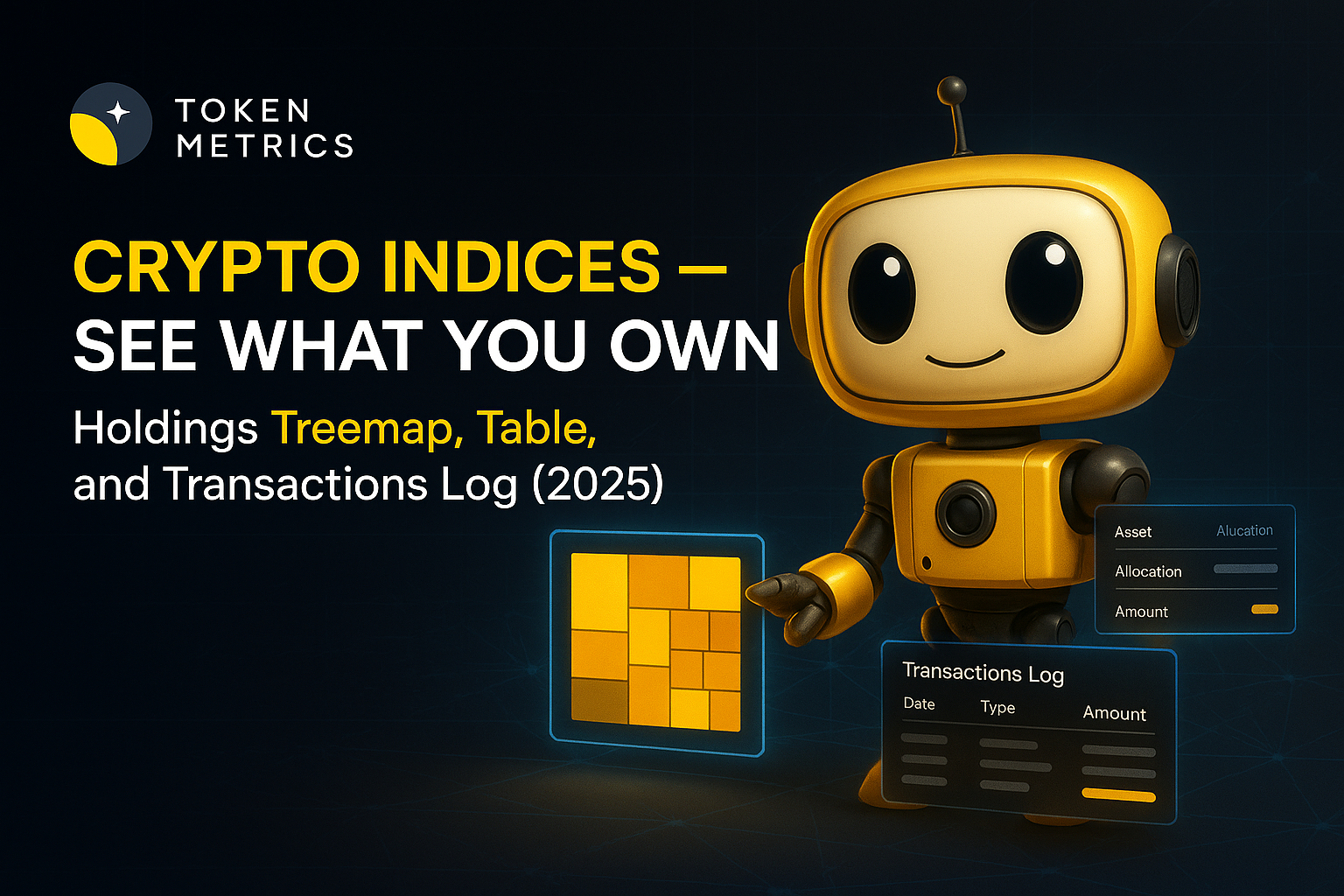
Crypto Indices - See What You Own: Holdings Treemap, Table, and Transactions Log (2025)

Token Metrics Team
5

If you’ve ever bought a “basket” of coins and then wondered what you actually hold, you’re not alone. The Token Metrics Global 100 solves that by pairing a rules-based strategy with radical visibility: an interactive holdings treemap, sortable table, and a real-time transactions log—so you can see what you own at all times. This transparency sits on top of a simple idea: a top-100 crypto index when markets are bullish and stablecoins when they’re not, with weekly rebalancing and one-click buy at launch. The result is clarity for hands-off allocators and discipline for active traders—without spreadsheets or manual rebalances.

→ Join the waitlist to be first to trade TM Global 100.

Why Transparency Matters in October 2025

Today’s crypto investor expects more than a chart and a headline weight. You want to audit your index: which coins, what size, and what changed after each rebalance. That’s exactly why we ship three visibility layers on day one: Gauge → Treemap → Transactions Log—plus a classic holdings table for power users.

In practical terms, a holdings treemap shows proportional weights at a glance, a table lets you sort and export details, and a transactions log chronicles every add/trim/exit during rebalances and regime switches. Together, they answer the search intent behind “crypto index holdings” and “weekly rebalancing” with an immediately scannable source of truth.

How the TM Global 100 Index Works (Plain English)

  • Regime switching: When our market signal is bullish, the index holds the top 100 assets by market cap. When bearish, it exits to stablecoins and waits for a re-entry signal.
  • Weekly rebalancing: We adjust constituents and weights weekly to reflect updated rankings—so the index stays aligned with the market.
  • Transparency: You’ll see a Strategy modal (rules at a glance), a market signal gauge, an interactive Holdings treemap & table, and a Transactions log that records rebalances and regime shifts.

What you’ll see on launch: A price tile, “tokens: 100,” “rebalances weekly,” and a Buy Index flow that can complete in about 90 seconds, end-to-end.

See the strategy and rules. (TM Global 100 strategy)

Benefits at a Glance (Why This Beats DIY)

  • Time saved: Skip ranking lists, manual screeners, and cross-exchange rebalances.
  • Lower execution drag: A single indexed flow helps reduce the slippage and fees you’d pay hopping between many tokens.
  • No missed cycles: Weekly rebalances help capture changes in the top-100 while the regime switch avoids guesswork when markets turn.
  • Full visibility: Treemap + table + transactions let you see exactly what changed and why—no black boxes.
  • Rules over vibes: A consistent methodology can reduce emotional decisions during drawdowns and market euphoria.

Step-by-Step: How to Get Early Access (Waitlist)

  1. Open the Indices hub and select TM Global 100. (Token Metrics Indices hub)
  2. Join the waitlist with your email to get launch-day access and updates.
  3. (Optional) Connect your wallet so you’re ready to buy at launch.
  4. On launch: Open TM Global 100, review the Gauge → Treemap → Transactions, and tap Buy Index.
  5. Confirm the buy: You’ll see estimates for fees/slippage and the current token mix.
  6. Track your position: Your holdings and every rebalance appear in My Indices and the Transactions Log.

→ Join the waitlist to be first to trade TM Global 100.

Decision Guide: Is This Right for You?

  • Hands-Off Allocator: Want “own the market” exposure and automatic upkeep. Consider if you dislike micromanaging.
  • Active Trader: Want a disciplined core that moves to stablecoins in bears while you take satellite bets elsewhere.
  • TM Member/Prospect: Already trust Token Metrics research and want rules-based execution with full visibility.
  • Starter Portfolio Builder: Prefer a single decision over 20+ token buys and periodic DIY reweights.
  • Transparency Seeker: You won’t tolerate black-box products; you want a real transactions log and holdings you can audit.
  • Tax-Aware Rebalancer: You’d rather not run frequent piecemeal trades yourself.
  • Mobile-First User: Want a fast, on-page buy flow instead of tab-hopping across venues.
  • Analytics Fan: Enjoy comparing weights and changes in the treemap after each weekly rebalance.

FAQs

What is a crypto index with a holdings treemap?

It’s a rules-based basket of cryptocurrencies where you can visually inspect weights via an interactive treemap, alongside a sortable table and a transactions log that records every rebalance and regime switch.

It’s a rules-based basket of cryptocurrencies where you can visually inspect weights via an interactive treemap, alongside a sortable table and a transactions log that records every rebalance and regime switch.

Weekly. Rebalances update constituents/weights to reflect current top-100 rankings; separate regime switches can also move the portfolio between tokens and stablecoins when the market signal changes.

What triggers the move to stablecoins?

A proprietary market signal. When bearish, the index exits tokens to stablecoins; when bullish resumes, it re-enters the top-100 basket.

Can I fund with USDC or fiat?

At launch, funding/settlement options surface based on your connected wallet and supported chains. USDC payout is supported on selling; fiat on-ramps may be added later.

Is the wallet custodial?

No. The embedded wallet is self-custodial—you control your funds.

How are fees shown?

Before you confirm, the buy flow surfaces estimated gas, platform fee, max slippage, and min expected value.

How do I join the waitlist?

Open the Indices hub, navigate to TM Global 100, and add your email. You’ll be notified on launch with a direct link to buy.

Security, Risk & Transparency

  • Self-custody: Embedded smart wallet with user control.
  • Operational clarity: Weekly rebalances; regime logic documented in the Strategy modal.
  • Fee & slippage preview: All surfaced before you confirm a trade.
  • Data integrity: Holdings treemap + table and transactions log reflect each executed change.

Regional notes: Availability and on-ramps can vary by jurisdiction. Crypto is volatile and can lose value. Past performance is not indicative of future results. This article is for research/education, not financial advice.

Conclusion

Token Metrics Global 100 is built for investors who want broad market exposure and the receipts to prove what they hold—treemap, table, and transactions on every rebalance. If you value rules, discipline, and transparency, join the waitlist and be ready on launch day.

Click here to get early access to Token Metrics indices.

Research

Crypto Index vs DIY Basket: Time, Slippage, and Missed Rebalances (2025)

Token Metrics Team
5

Building your own crypto basket sounds simple—until you’re juggling 10–50 tickers, spreadsheets, rebalance rules, spreads across chains, and the constant fear of missing regime turns. A crypto index removes that manual grind: TM Global 100 holds the top 100 assets when the market is bullish and moves fully to stablecoins when it’s not, with weekly rebalancing and full transparency of holdings and transactions. One click to buy, zero maintenance to keep up.

→ Join the waitlist to be first to trade TM Global 100.

Why Indices Matters in October 2025

In 2025, time and execution quality are alpha. Manually maintaining a DIY basket multiplies complexity: fragmented liquidity, multiple wallets, chain fees, and coordination across exchanges—all while markets move. A rules-based index compresses that overhead into a single, auditable product with pre-declared logic and scheduled upkeep.

Definition (snippet-ready): A crypto index is a rules-based basket of digital assets that rebalances on a set schedule and/or when market conditions change, so you don’t have to micromanage individual coins.

Traders searching “DIY crypto basket,” “regime switching,” or “weekly rebalancing” usually want one thing: broad exposure without the constant maintenance and the regret of missed rebalances. That’s the exact problem Token Metrics Global 100 addresses with weekly updates and regime switching to stablecoins when signals turn bearish.

How the TM Global 100 Index Works (Plain English)

  • Regime switching: When signals are bullish, the index holds the top 100 by market cap; when bearish, it exits fully to stablecoins to wait for re-entry.
  • Weekly rebalancing: Aligns weights and constituents with updated rankings; regime changes can also trigger full portfolio shifts.
  • Transparency: Strategy modal explains selection & rebalancing rules; Holdings show a treemap/table; Index Transactions log all changes.

What you’ll see on launch: Price tile, signal gauge, tokens=100, “rebalances weekly,” contract address, and a Buy Index button with a ~90-second live demo flow showcased in launch content.

→ See the strategy and rules. (TM Global 100 strategy)

Benefits at a Glance (Why This Beats DIY)

  • Time saved: Replace multi-exchange shopping, wallet hops, and manual allocations with one click.
  • Fewer missed rebalances: Weekly cadence + visible transactions log reduce the cost of “I’ll do it tomorrow.”
  • Slippage discipline: Centralized execution with declared slippage/fee previews helps contain surprises vs piecemeal orders.
  • Regime switching: Codified “risk-off” behavior into stablecoins during bears, so you don’t have to white-knuckle exits. (No performance promises.)
  • Transparency: Strategy modal → Holdings treemap/table → Transactions log—see exactly what you hold and when it changed.

Proof cues (What you’ll see): Gauge (market signal) → Treemap (allocations) → Transactions Log → ~90-second Buy flow.

Step-by-Step: How to Get Early Access (Waitlist)

  1. Open the Token Metrics Indices hub and select TM Global 100.
  2. Add your email to the waitlist so you’re first in line at launch.
  3. (Optional) Connect your wallet—our embedded, self-custodial smart wallet supports major chains.
  4. On launch day, you’ll see the price tile, signal gauge, and “Buy Index.”
  5. Review the strategy, expected fees/slippage, and holdings; confirm to purchase.
  6. Track your position in My Indices; rebalances and any regime switches will appear in the transactions log.
→ Join the waitlist to be first to trade TM Global 100.

Decision Guide: Is This Right for You?

  • Hands-Off Allocator: Want broad exposure without micromanaging? Consider a rules-based core that updates weekly.
  • Active Trader: Keep your bets, but use an index core that may step to stablecoins during bears.
  • TM Member/Prospect: Prefer transparent holdings, logs, and a simple buy/sell flow.
  • Time-Strapped Professional: Reduce ops work (wallets, slippage math, spreadsheets) to nearly zero.
  • New to Crypto: Learn with training wheels—strategy modal, tooltips, and clear risk language.
  • DIY Purist: If you enjoy tinkering with weights daily, DIY could still fit—just know weekly index upkeep is handled for you.

FAQs

What is a crypto index?

A rules-based basket of assets with scheduled rebalancing and, in TM Global 100’s case, a regime switch between top-100 exposure and stablecoins.

How often does the index rebalance?

Weekly, with additional full-portfolio switches when the market regime changes.

What triggers the move to stablecoins?

A proprietary market signal. When bearish, the index exits tokens into stablecoins and waits for a bullish re-entry.

Can I fund with USDC or fiat?

Funding options surface based on your connected wallet and supported chains; USDC payouts are supported on selling. (Stablecoin entry may come later.)

Is the wallet custodial?

No. The embedded wallet is self-custodial; you control funds.

How are fees shown?

The Buy flow shows estimated gas, platform fee, max slippage, and minimum expected value before you confirm.

How do I join the waitlist?

Visit the Indices hub → TM Global 100 → enter your email to get notified and first access at launch.

Security, Risk & Transparency

  • Self-custody: You transact via an embedded, self-custodial smart wallet.
  • Visibility: Strategy modal, Holdings treemap/table, and Transactions log make changes auditable.
  • Fee & slippage preview: See estimated gas, platform fee, max slippage, and minimum expected value before confirming.
  • Regime logic limits: Signals can be wrong; markets can gap; weekly rebalances can’t eliminate risk.
  • Region/chain notes: Supported chains surface in-product; availability and options may vary.

Crypto is volatile and can lose value. Past performance is not indicative of future results. This article is for research/education, not financial advice.

Conclusion

If you’ve ever missed a rebalance or watched slippage eat into returns, Token Metrics Global 100 can help standardize the work: rules-based logic, weekly updates, and a visible log of everything that changed. Join the waitlist to be first to trade, and make a disciplined index your core.

→ Join the waitlist to be first to trade TM Global 100.
Research

Regime Switching in Crypto: Participate in Upside, Sit Out Drawdowns (2025)

Token Metrics Team
5

Timing crypto cycles is inherently challenging. Volatility in the crypto markets can lead to sharp swings—either capturing gains during bull runs or avoiding deep drawdowns during unfavorable trends. A regime switching crypto index offers a systematic way to adapt to changing market conditions, using rules-based allocations that switch between risk-on assets and stablecoins accordingly. Token Metrics offers tools to help analyze these strategies with transparency and real-time insights.

Why Indices Matter in October 2025

Crypto markets tend to operate in distinct regimes—periods of momentum followed by corrections that can reverse gains quickly. Investors and analysts seeking to implement regime switching or weekly rebalancing frameworks value simplicity and clarity. These approaches help in maintaining discipline, managing risks, and capturing market trends effectively.

Definition of Regime Switching in Crypto

Regime switching in crypto refers to a rules-based investment method that adjusts portfolio exposure based on prevailing market conditions. Typically, this involves rotating into a diversified basket of tokens in bullish phases and shifting into stablecoins during bearish trends, thus managing risk while seeking to ride upward trends.

Why Now: The Rationale for Regime Switching

  • Cycle Asymmetry: Capturing upward trends while limiting downside drawdowns can influence long-term outcomes positively.
  • Operational Efficiency: Automated, rules-based rebalancing reduces errors and slippage tied to manual adjustments across multiple tokens or exchanges.
  • Transparency: Real-time insight into holdings, rebalancing rationale, and transaction history fosters trust and clarity.

How the TM Global 100 Index Works (Plain English)

This index employs regime switching principles: during bullish periods, it holds the top 100 crypto assets by market cap; during bearish times, it exits into stablecoins and waits for buy signals. The index performs weekly rebalancing based on updated rankings, liquidity, and supply metrics. Transparency is maintained through clear strategy rules, gauges, Treemap views, and detailed transaction logs.

Benefits at a Glance (Why This Beats DIY)

  • Rules, not vibes: Automated logic minimizes emotional decision-making.
  • Fewer operational mistakes: Single, streamlined flows replace manual multi-step trades.
  • Discipline in switching: Full rotation into stablecoins at bearish signals reduces hesitation and second-guessing.
  • Cost visibility: Estimated gas, platform fees, and expected minimum value are shown upfront.
  • Full transparency: Holdings treemaps and transaction histories keep you informed.
  • Consistent cadence: Weekly updates ensure alignment with market trends.

Step-by-Step: How to Get Early Access (Waitlist)

  1. Visit the Token Metrics Indices hub.
  2. Find the TM Global 100 index card and tap “Join Waitlist”.
  3. Add your email to receive launch notifications.
  4. Optionally, connect your wallet in advance to streamline onboarding on launch day.
  5. On launch day, you will receive an email when the index opens for trading. The interface features gauges, strategy details, and holdings for instant review.
  6. Complete the purchase of the index in about 90 seconds by confirming your wallet, reviewing potential fees, and confirming the buy.
  7. Track your position within “My Indices” once active.

Join the waitlist to be first to trade TM Global 100.

Decision Guide: Is This Right for You?

  • Hands-Off Allocator: Ideal for those seeking broad market exposure with minimal management.
  • Active Trader: Useful as a core strategy with rules-based rebalancing, supporting satellite bets.
  • Token Metrics Member/Prospect: For users who value transparent, research-backed rules over discretionary choices.
  • Crypto Newcomer: Simplifies entry with one-button buy, weekly updates, and clear rules.
  • Time-Constrained Pro: Reduces operational overhead while maintaining clarity and predictability.
  • Skeptical of Forecasts: Prefers systematic processes over relying on predictions or forecasts.

FAQs

What is a regime switching crypto index?

A rules-based portfolio that allocates to a diversified token basket during bullish phases and switches to stablecoins during bearish conditions, based on predefined signals. Token Metrics implements this with a top-100 universe and full stablecoin rotation in downturns.

How often does the index rebalance?

It rebalances weekly to reflect changes in rankings and liquidity. Significant regime changes can occur outside the schedule when market signals trigger a switch.

What triggers the move to stablecoins?

A proprietary market signal prompts the index to exit token positions and move into stablecoins during bearish phases, waiting for a bullish signal to re-enter.

Can I fund with USDC or fiat?

Funding occurs via an embedded, self-custodial wallet supporting major chains. USDC payouts are supported when selling. Funding options depend on your wallet and region.

Is the wallet custodial?

No. It is self-custodial, giving you control of keys and funds.

How are fees shown?

Before confirming a trade, estimated gas, platform fee, slippage, and expected minimum value are displayed.

How do I join the waitlist?

Visit the Token Metrics Indices hub, open TM Global 100, and tap “Join Waitlist”. You will be notified at launch.

Security, Risk & Transparency

  • Self-custody is prioritized: You control your keys and funds.
  • Transparency is built into the process: Fees, holdings, and transaction logs are visible before and after trades.
  • Market signals are based on rules; sudden gaps and spreads can impact outcomes.
  • Supported regions and asset options may vary due to geography.

Crypto markets are volatile and can fluctuate rapidly. Past performance does not predict future results. This article aims to educate and inform, not provide financial advice.

Conclusion

For a disciplined, transparent approach to broad crypto exposure that adapts to market regimes, the TM Global 100 index offers a rules-based platform with weekly rebalancing and full visibility. It enables investors to focus on allocation without the stress of micromanagement.

Join the waitlist to be first to trade TM Global 100.

Choose from Platinum, Gold, and Silver packages
Reach with 25–30% open rates and 0.5–1% CTR
Craft your own custom ad—from banners to tailored copy
Perfect for Crypto Exchanges, SaaS Tools, DeFi, and AI Products