Back to blog
Research

How Do I Prioritize Features When Building a Web3 MVP?

Learn effective strategies for prioritizing features in your Web3 MVP using proven frameworks, community input, and security best practices to ensure success.
Token Metrics Team
10 min read
Want Smarter Crypto Picks—Free?
See unbiased Token Metrics Ratings for BTC, ETH, and top alts.
Thank you! Your submission has been received!
Oops! Something went wrong while submitting the form.
 No credit card | 1-click unsubscribe

Building a Web3 minimum viable product presents unique challenges that traditional software development doesn't face. You're not just creating an application—you're architecting an ecosystem where technology, economics, and community coordination intersect. With blockchain's immutable nature and the complexity of decentralized systems, knowing which features to prioritize can mean the difference between launching a successful project and wasting months building the wrong things.

In 2025, Web3 MVP development requires more than technical skills. It demands speed, clarity, and the ability to learn from real users fast. This comprehensive guide will walk you through proven prioritization strategies specifically designed for Web3 projects, helping you make informed decisions that maximize your chances of achieving product-market fit.

Understanding the Web3 MVP Challenge

A minimum viable product is a simplified version of your product that includes only the core features necessary to meet the needs of early adopters. In Web3, an MVP allows startups to explore decentralized applications and blockchain functionalities without committing extensive resources upfront.

The stakes are uniquely high in Web3. Smart contract immutability means you can't easily patch bugs after deployment. Scope creep poses existential dangers since adding features often requires complete system overhauls rather than simple updates. Security vulnerabilities aren't just reputational problems—they're existential threats that can drain millions in seconds.

Before diving into feature prioritization, understand what makes Web3 MVP development different from traditional software. You're simultaneously solving technical problems, fostering communities, creating economic systems through tokenomics, and building foundational infrastructure for a decentralized internet.

The Foundation: Identifying Core Value

Before applying any prioritization framework, you must answer one fundamental question: What specific problem does your Web3 project solve, and for whom? Conduct thorough market research to identify your target audience, assess viability, gauge problem-solving potential, and devise strategies to align your product with customer requirements.

In crypto, understanding the optimal approach for delivering value and effectively communicating benefits is paramount. Define precise, unambiguous metrics that will quantitatively evaluate the efficacy of your launch. For Web3 applications, this might include the number of wallet connections, transaction volume, total value locked, or active community members.

Successful projects like Uniswap demonstrate this principle perfectly. Starting in 2018 with under $50,000, no CEO, and no marketing blitz—just a smart contract on Ethereum and a vision for trustless token swaps—Uniswap focused exclusively on solving one problem: enabling decentralized token exchanges. By 2025, it has surpassed $3 trillion in total trading volume by maintaining laser focus on core functionality before expanding.

The MoSCoW Prioritization Framework for Web3

The MoSCoW method creates a hierarchy for your feature requests based on their importance. Developed by Dai Clegg while working at Oracle in 1994, this framework divides features into four unambiguous categories, particularly useful in conjunction with fixed timeframes.

  • Must Have (M): These are non-negotiable requirements to launch your product. An easy way to identify Must Have features is asking: "What happens if this requirement isn't met?" If the answer is "cancel the project," it's a Must Have. For a Web3 DEX, Must Haves might include wallet connection, token swapping functionality, basic liquidity pool creation, and essential smart contract security audits. These are the features that define your product's core value proposition.
  • Should Have (S): These features are important but not immediately critical. They significantly enhance user experience and can be included in the first release if resources permit, but the product can launch without them. For our DEX example, Should Haves might include advanced trading features like limit orders, portfolio tracking, or multi-chain support for additional networks beyond your primary blockchain.
  • Could Have (C): These are desirable enhancements that would improve user satisfaction but aren't necessary for launch. Often called "nice-to-haves," they're the first to be removed if timelines or resources become constrained. Could Have features might include advanced analytics dashboards, social features, gamification elements, or integrations with other DeFi protocols.
  • Won't Have (W): These features are explicitly excluded from the current iteration. They may be reconsidered for future releases, but are intentionally deferred to maintain focus and prevent scope creep.

The MoSCoW framework ensures you build a genuine minimum viable product by prioritizing Must Have features while creating contingency within requirements. This approach is particularly effective in Web3 where resource constraints and technical complexity demand ruthless prioritization.

Value vs. Complexity Analysis

Another powerful prioritization technique for Web3 MVPs involves plotting features on a two-dimensional matrix: Value against Complexity (or Effort). Value represents the benefit your customers and business receive from a feature. Does it alleviate customer pain points? Will it drive user adoption? Does it strengthen your competitive position? In Web3, value might also include community building potential, network effects, or tokenomic alignment.

Complexity encompasses what it takes for your organization to deliver the feature: development time, required expertise, infrastructure costs, security audit requirements, gas optimization needs, and ongoing maintenance burden.

Plot each potential feature on a 2x2 grid:

  • High Value, Low Complexity: These are your quick wins. Prioritize these features first—they deliver maximum impact with minimal investment. Examples might include integrating a widely-used wallet provider or implementing standard ERC-20 token support.
  • High Value, High Complexity: These are strategic initiatives that define your competitive advantage. Plan these carefully, break them into smaller deliverables, and build them after quick wins demonstrate traction. Examples might include novel AMM algorithms or cross-chain bridging infrastructure.
  • Low Value, Low Complexity: These are fill-in tasks suitable when waiting for dependencies or during low-activity periods. Don't let these distract from higher priorities.
  • Low Value, High Complexity: Avoid these entirely—they're resource drains that won't move the needle on user adoption or business success.

Community-Driven Prioritization in Web3

Unlike traditional software, Web3 projects succeed by building active communities from day one. Your community becomes both your testing ground and marketing engine, making community-driven prioritization essential.

Create dedicated Discord channels for testing feedback. Run community polls to validate feature prioritization decisions. Use governance forums to gather input on economic parameter changes and roadmap decisions.

This community involvement serves multiple purposes beyond feature validation. It provides extensive testing coverage no internal team could match, builds community investment in your project's success, and creates feedback loops that traditional QA processes miss.

However, maintain roadmap discipline. Active communities generate constant feature requests and suggestions. While input is valuable, allowing every suggestion to influence your roadmap leads to scope creep and delayed launches. Communicate priorities and reasoning regularly, and use governance forums to discuss potential changes transparently.

Security and Audit Prioritization

In Web3, security isn't just another feature—it's the foundation everything else builds upon. Hacks are existential threats, not merely reputational problems. Design smart contracts as modular systems from the beginning. Use proxy patterns that allow upgrades while maintaining security. Plan clear upgrade paths for adding functionality without compromising existing security guarantees.

Prioritize comprehensive security audits for all smart contracts before mainnet deployment. Budget 15-25% of development resources for security reviews, formal verification where appropriate, and bug bounty programs. This isn't optional—it's the price of admission in Web3.

Progressive Decentralization Strategy

Don't try to build fully autonomous organizations from the start. Launch with appropriate centralized control and create clear roadmaps for progressive decentralization. Your initial MVP should prioritize functionality and security over complete decentralization.

Many successful Web3 projects launched with admin keys and centralized control, then gradually transferred governance to the community as the system matured and edge cases were addressed. Premature decentralization often leads to governance paralysis, inability to respond to emergencies, and security vulnerabilities. Plan your decentralization roadmap as carefully as your feature roadmap.

Real-World Data: Learning from Token Metrics

Token Metrics exemplifies smart feature prioritization in Web3 analytics platforms. Rather than trying to build every possible crypto analysis tool simultaneously, Token Metrics focused on core value propositions first: AI-powered token ratings, smart contract audits, and comprehensive market analytics.

As the premier crypto trading and analytics platform, Token Metrics demonstrates how strategic feature prioritization creates competitive advantages. The platform started with essential Must Have features—reliable data feeds, AI rating algorithms, and intuitive interfaces—before expanding to Should Have capabilities like automated trading indices and cross-chain analytics.

In March 2025, Token Metrics launched integrated on-chain trading, transforming from an analytics platform into an end-to-end solution. This strategic expansion came only after establishing market leadership in analytics, demonstrating smart sequencing of high-value features.

Token Metrics' approach illustrates several key prioritization principles for Web3 builders: Start with data quality and reliability as non-negotiable Must Haves. Without accurate, real-time blockchain data, no analytics features matter. Build AI-powered insights as differentiators once core data infrastructure is solid. Token Metrics' Trader Grades (0-100) and Investor Grades provide unique value that competing platforms lack. Layer on convenience features like integrated trading only after achieving product-market fit with core analytics. This sequencing prevents premature complexity while building toward a comprehensive platform. Continuously gather user feedback to validate feature priorities. Token Metrics evolved from pure analytics to trading integration based on customer requests for a direct path from research to execution.

For Web3 builders, Token Metrics' journey offers valuable lessons. Prioritize features that deliver immediate, measurable value to early adopters. Build trust through reliability and security before expanding functionality. Listen to your community but maintain roadmap discipline. Sequence features strategically, ensuring each addition builds on proven foundations.

AI-Assisted Prioritization in 2025

Web3 development in 2025 increasingly leverages AI tools for smarter feature prioritization. AI-driven user analytics can predict which features will drive adoption, while AI-generated feature scoring helps teams make data-driven decisions faster.

Use AI to analyze competitor offerings, identify gaps in the market, and predict user behavior patterns. These tools shave weeks off development timelines and reduce human bias in prioritization decisions. However, AI should inform human judgment, not replace it. Your understanding of community needs, technical constraints, and strategic vision remains irreplaceable.

Practical Implementation Timeline

A realistic Web3 MVP development timeline might look like:

  1. Week 1-2: Problem interviews and hypothesis development. Validate that your identified problem is real and your proposed solution resonates with potential users.
  2. Week 3-4: No-code or low-code prototype to validate user flow. Collect 20-50 user responses before writing a single line of smart contract code.
  3. Week 5-8: Build lean MVP prototype focusing exclusively on Must Have features. Instrument analytics and set clear KPIs for measuring success.
  4. Week 9-12: Iterate based on user data. Deploy to testnet and expand testing to broader community. Begin security audit processes for smart contracts.
  5. Week 13-16: Security hardening, audit remediation, and mainnet deployment preparation.

This aggressive timeline requires ruthless feature prioritization. Every feature not classified as Must Have gets deferred—no exceptions.

Common Prioritization Mistakes to Avoid

  • Overloading Must Haves: Teams often classify too many features as Must Haves, leading to extended timelines and resource depletion. Be ruthless—if launching without it won't invalidate your core value proposition, it's not truly a Must Have.
  • Ignoring technical debt: Choosing quick implementations that create maintenance nightmares undermines long-term success. Balance speed with code quality, especially for immutable smart contracts.
  • Feature parity battles: Trying to match every competitor feature leads to unfocused products that don't excel at anything. Identify your unique value proposition and double down.
  • Neglecting tokenomics: In Web3, your economic model isn't just a fundraising mechanism—it's a core product feature requiring the same design rigor as smart contracts. Poor tokenomics kills promising projects.
  • Building in isolation: Launching without community building leads to products nobody uses. Start community engagement on day one, before you have a product to show.

Conclusion

Prioritizing features for a Web3 MVP requires balancing technical constraints, community needs, security requirements, and business objectives. The most successful projects use structured frameworks like MoSCoW alongside value-complexity analysis, while maintaining flexibility to adapt as they learn from real users.

Discover Crypto Gems with Token Metrics AI

Platforms like Token Metrics demonstrate how strategic feature prioritization creates sustainable competitive advantages. By focusing relentlessly on core value propositions—accurate data, AI-powered insights, and user-friendly interfaces—before expanding to integrated trading, Token Metrics built the premier crypto analytics platform through disciplined execution.

Your Web3 MVP journey begins with identifying the single most important problem you're solving and the minimum feature set required to solve it. Apply proven prioritization frameworks, engage your community early, prioritize security above all else, and plan for progressive decentralization. Most importantly, launch quickly to start the learning cycle—market feedback is the only true validation of your priorities.

The future belongs to Web3 builders who recognize they're not just creating products, but architecting ecosystems. Master feature prioritization, and you'll dramatically increase your odds of building something users actually want in the decentralized internet of tomorrow.

Build Smarter Crypto Apps &
AI Agents in Minutes, Not Months
Real-time prices, trading signals, and on-chain insights all from one powerful API.
Grab a Free API Key
About Token Metrics
Token Metrics: AI-powered crypto research and ratings platform. We help investors make smarter decisions with unbiased Token Metrics Ratings, on-chain analytics, and editor-curated “Top 10” guides. Our platform distills thousands of data points into clear scores, trends, and alerts you can act on.
30 Employees
analysts, data scientists, and crypto engineers
Daily Briefings
concise market insights and “Top Picks”
Transparent & Compliant
Sponsored ≠ Ratings; research remains independent
Want Smarter Crypto Picks—Free?
See unbiased Token Metrics Ratings for BTC, ETH, and top alts.
Thank you! Your submission has been received!
Oops! Something went wrong while submitting the form.
 No credit card | 1-click unsubscribe
Token Metrics Team
Token Metrics Team

Recent Posts

Research

Bittensor Price Prediction 2025-2027 | TAO Forecast & Analysis

Token Metrics Team
7 min read

Understanding Bittensor's Speculative Nature

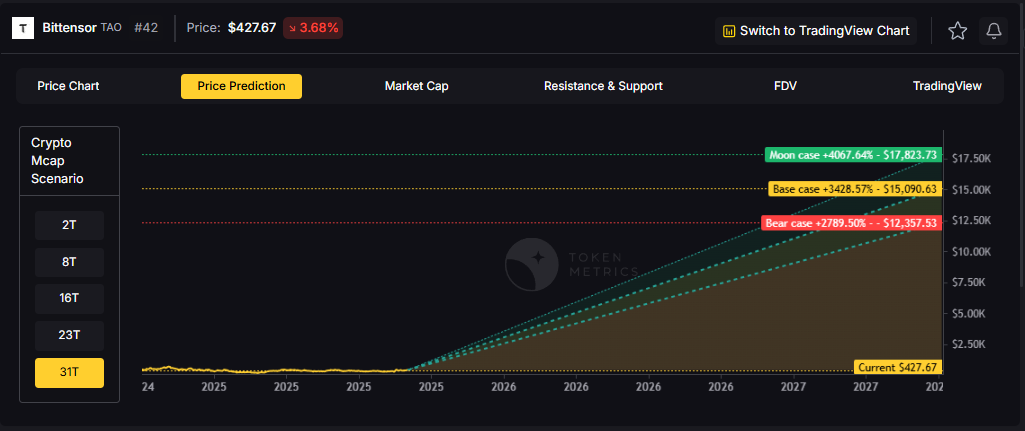
Bittensor operates as a community-driven token where price action stems primarily from social sentiment, attention cycles, and speculative trading rather than fundamental value drivers. TAO exhibits extreme volatility with no defensive characteristics or revenue-generating mechanisms typical of utility tokens. Token Metrics price prediction scenarios below provide technical forecasts across different market cap environments, though meme and speculative tokens correlate more strongly with viral trends and community engagement than systematic market cap models. Positions in TAO should be sized as high-risk speculative bets with potential for total loss.


Disclosure
Educational purposes only, not financial advice. Crypto is volatile, do your own research and manage risk.

How to read our price prediction methodology: Each band blends cycle analogues and market-cap share math with TA guardrails. Base assumes steady adoption and neutral or positive macro. Moon layers in a liquidity boom. Bear assumes muted flows and tighter liquidity. For speculative tokens, actual price prediction outcomes depend heavily on social trends and community momentum beyond what market cap models capture.

Bittensor (TAO) Price Prediction: TM Agent Baseline

Token Metrics long term price prediction view for Bittensor, cashtag $TAO. Lead metric first, Token Metrics TM Grade is 62%, Hold, and the trading signal is bullish, indicating modest project fundamentals and short-term upward momentum. Market context, Bitcoin direction and appetite for AI and research-oriented crypto projects determine capital flows into niche tokens like $TAO, so broader risk-on conditions would help sustained gains.

Concise 12-month price prediction numeric view: Token Metrics scenarios cluster roughly between $0.45 and $2.20, with a base case near $1.05, reflecting current network usage, developer activity, and token supply dynamics. Implication, if AI crypto interest and on-chain usage grow materially $TAO could approach the upper bound, while in a risk-off market or if network adoption stalls it would likely move toward the lower bound.

  • 16T: At 16 trillion, the range is $5,539.08, $6,710.41, and $7,881.74.

Token Details 

Key Takeaways

  • Highly speculative asset driven by sentiment and attention rather than fundamentals.
  • Scenario driven price predictions, outcomes hinge on total crypto market cap and viral momentum.
  • Extreme volatility characteristic - TAO can experience double-digit percentage moves daily.
  • TM Agent gist: conditions and usage growth could expand the upper range, risk-off or weak adoption could compress outcomes.
  • Entertainment risk only, not financial advice.

Bittensor Price Prediction: Scenario Analysis

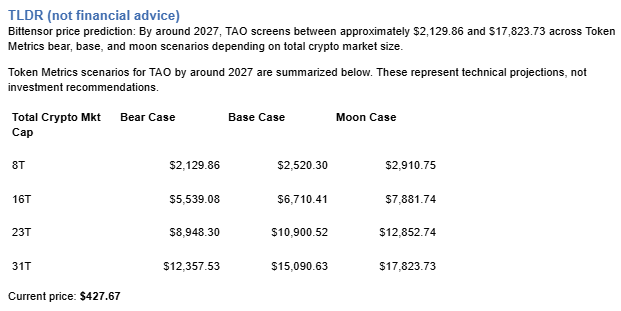
Token Metrics price prediction scenarios provide technical price bands across market cap tiers:

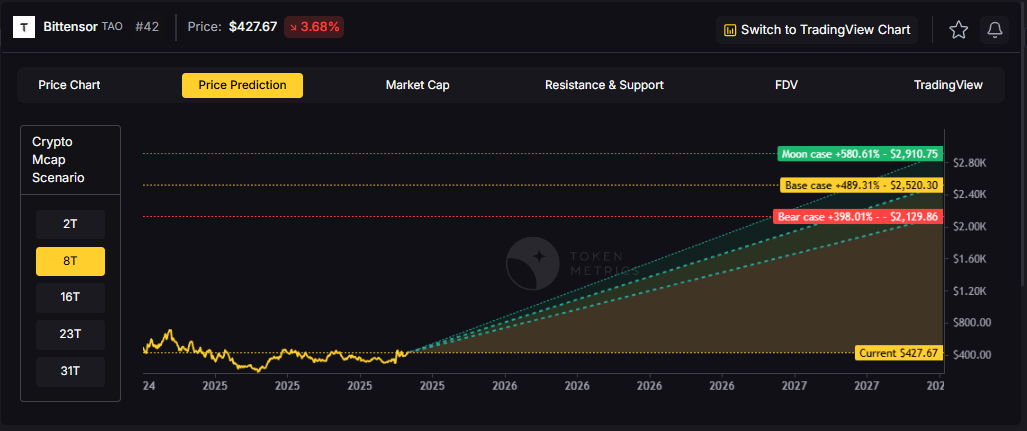
  • 8T Price Prediction: At 8 trillion total crypto market cap, TAO projects to $2,129.86 (bear), $2,520.30 (base), and $2,910.75 (moon).
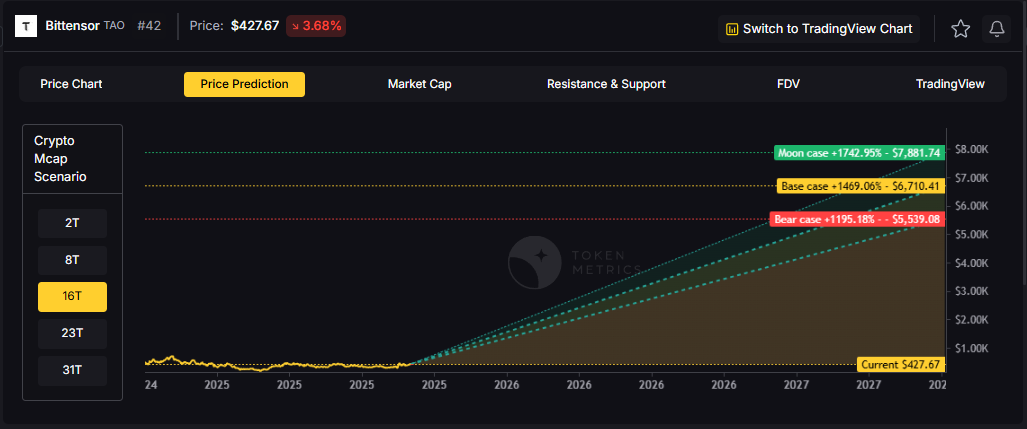
  • 16T Price Prediction: At 16 trillion, the range is $5,539.08, $6,710.41, and $7,881.74.
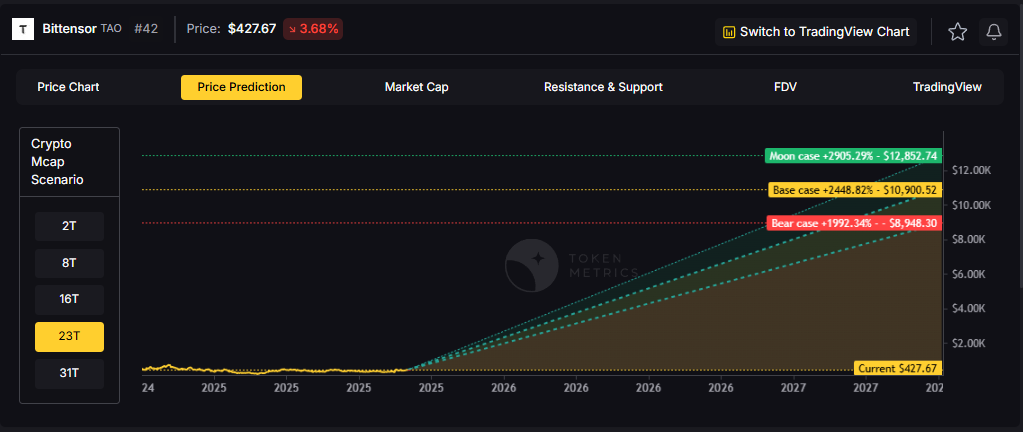
  • 23T Price Prediction: At 23 trillion, scenarios show $8,948.30, $10,900.52, and $12,852.74.
  • 31T Price Prediction: At 31 trillion, projections reach $12,357.53, $15,090.63, or $17,823.73.

These technical price prediction ranges assume speculative tokens maintain market cap share proportional to overall crypto growth. Actual outcomes for speculative tokens typically exhibit higher variance and stronger correlation to social trends than these models predict.

What Is Bittensor?

Bittensor is a decentralized network focused on machine learning markets, where participants contribute and consume AI services. Unlike utility tokens with broad real-world use cases, TAO operates in a niche AI context and often trades as a speculative community symbol.

TAO is the network token used for incentives and participation. Market performance depends heavily on broader interest in AI‑related crypto themes and community engagement around the project.

Risks That Skew Bearish on TAO Price Predictions

  • Extreme volatility from pure sentiment-driven price action with no fundamental support.
  • Attention cycles shift rapidly, leaving early viral tokens abandoned as new memes emerge.
  • Liquidity can evaporate quickly during downturns, creating severe slippage and exit difficulty.
  • Regulatory scrutiny may target speculative tokens as securities or gambling instruments.
  • Macro risk-off environments hit speculative assets hardest, with meme coins showing largest drawdowns.
  • Community fragmentation or developer abandonment can eliminate remaining narrative support.

FAQs About Bittensor Price Prediction

Will TAO 10x from here?

Yes, at a current price of $427.67, a 10x reaches $4,276.70. This level appears in the 16T bear and above price prediction scenarios. Meme and speculative tokens can 10x rapidly during viral moments but can also lose 90%+ just as quickly. Position sizing for potential total loss is critical. Not financial advice.

What are the biggest risks to TAO price predictions?

Primary risks include attention shifting to newer narratives, community fragmentation, developer abandonment, regulatory crackdowns, and liquidity collapse during downturns. Unlike utility tokens with defensive characteristics, TAO has no fundamental floor. Price can approach zero if community interest disappears. Total loss is a realistic outcome.


Next Steps

Disclosure

Educational purposes only, not financial advice. TAO is a highly speculative asset with extreme volatility and high risk of total loss. Speculative tokens operate as entertainment and gambling instruments rather than investments. Only allocate capital you can afford to lose entirely. Do your own research and manage risk appropriately.

About Token Metrics

Token Metrics is a cutting-edge crypto analytics and research platform that offers ratings, price predictions, and unique AI-driven insights for investors.

Research

Polkadot Price Prediction 2027 | DOT Forecast & Scenarios

Token Metrics Team
7 min read

Understanding Polkadot's 2027 Potential

The Layer 1 competitive landscape is consolidating as markets reward specialization over undifferentiated "Ethereum killers". Polkadot positions itself in a multi-chain world through shared security and parachain interoperability. Infrastructure maturity around custody and bridges makes alternate L1s more accessible into 2026.

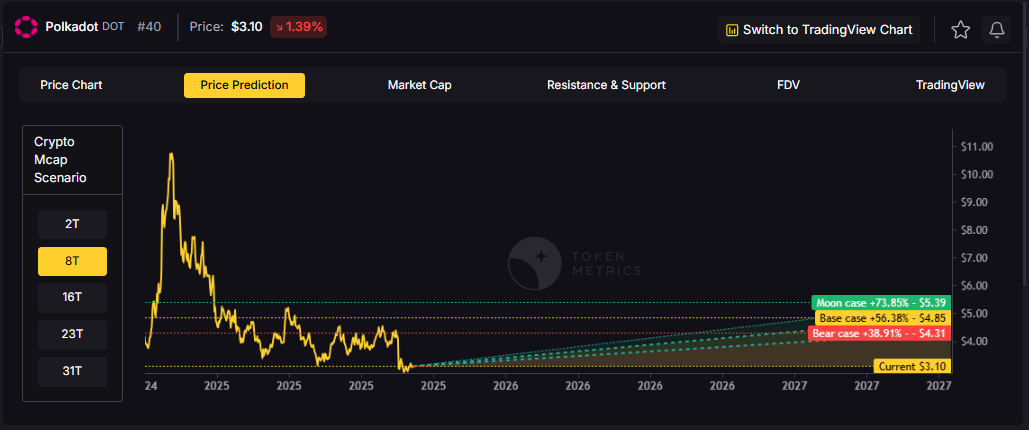
The price prediction scenario projections below map different market share outcomes for DOT across varying total crypto market sizes. Base cases assume Polkadot maintains current ecosystem momentum, while moon scenarios factor in accelerated adoption, and bear cases reflect increased competitive pressure.


Disclosure
Educational purposes only, not financial advice. Crypto is volatile, do your own research and manage risk.

How to read our price prediction methodology:
Each band blends cycle analogues and market-cap share math with TA guardrails. Base assumes steady adoption and neutral or positive macro. Moon layers in a liquidity boom. Bear assumes muted flows and tighter liquidity.

Polkadot (DOT) Price Prediction: TM Agent Baseline

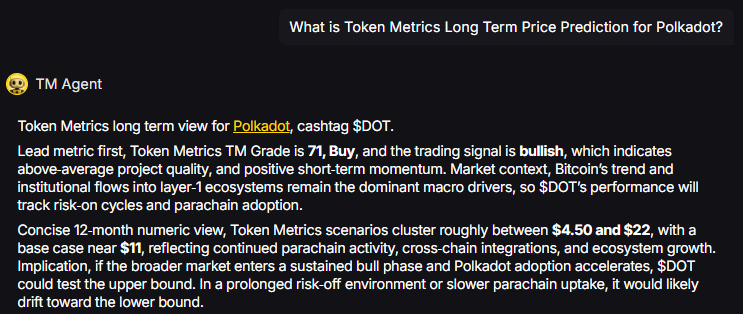
Token Metrics long term price prediction view for Polkadot, cashtag $DOT. Lead metric first, Token Metrics TM Grade is 71%, Buy, and the trading signal is bullish, which indicates above-average project quality, and positive short-term momentum. Market context, Bitcoin's trend and institutional flows into layer-1 ecosystems remain the dominant macro drivers, so $DOT's performance will track risk-on cycles and parachain adoption.

Concise 12-month price prediction numeric view: Token Metrics scenarios cluster roughly between $4.50 and $22, with a base case near $11, reflecting continued parachain activity, cross-chain integrations, and ecosystem growth. Implication, if the broader market enters a sustained bull phase and Polkadot adoption accelerates, $DOT could test the upper bound. In a prolonged risk-off environment or slower parachain uptake, it would likely drift toward the lower bound.

Polkadot Token Details 

Buy DOT on Gemini

Affiliate Disclosure: We may earn a commission from qualifying purchases made via this link, at no extra cost to you.

Key Takeaways

  • Scenario driven price predictions, outcomes hinge on total crypto market cap, higher liquidity and adoption lift the bands.
  • TM Agent gist: range $4.50 to $22 with a base near $11, upside requires adoption and liquidity, downside ties to risk-off.
  • Education only, not financial advice.

Polkadot Price Prediction: Scenario Analysis

Token Metrics price prediction scenarios span four market cap tiers, each representing different levels of crypto market maturity and liquidity:

  • 8T Price Prediction: At an eight trillion dollar total crypto market cap, DOT projects to $4.31 in bear conditions, $4.85 in the base case, and $5.39 in bullish scenarios.
  • 16T Price Prediction: Doubling the market to sixteen trillion expands the range to $6.82 (bear), $8.44 (base), and $10.07 (moon).
  • 23T Price Prediction: At twenty-three trillion, the scenarios show $9.33, $12.04, and $14.75 respectively.
  • 31T Price Prediction: In the maximum liquidity scenario of thirty-one trillion, DOT could reach $11.84 (bear), $15.63 (base), or $19.43 (moon).

Each tier assumes progressively stronger market conditions, with the base case reflecting steady growth and the moon case requiring sustained bull market dynamics.

Why Consider the Indices with Top-100 Exposure

Polkadot represents one opportunity among hundreds in crypto markets. Token Metrics Indices bundle DOT with top one hundred assets for systematic exposure to the strongest projects. Single tokens face idiosyncratic risks that diversified baskets mitigate.

Historical index performance demonstrates the value of systematic diversification versus concentrated positions. Join the early access list

Join the early access list

What Is Polkadot?

Polkadot is a network designed to connect specialized blockchains, called parachains, to a central Relay Chain for shared security and interoperability. Its architecture aims to enable cross-chain messaging and upgrades without hard forks.

DOT is the native token, used for staking to secure the network, on-chain governance, and bonding to add new parachains. Developers and users interact across parachains for use cases spanning DeFi, infrastructure, and cross-chain applications.

Token Metrics AI Analysis

Token Metrics AI provides comprehensive context on Polkadot's positioning and challenges.

Vision: Polkadot's vision is to create a decentralized web where independent blockchains can operate securely while communicating and sharing data across networks. It aims to enable a fully interoperable and scalable ecosystem that supports innovation in decentralized technologies.

Problem: The blockchain space faces fragmentation, with networks operating in isolation, limiting data and value transfer. This siloed structure hampers scalability, security, and user experience. Polkadot addresses the need for cross-chain communication and shared security, allowing blockchains to benefit from collective strength without sacrificing autonomy.

Solution: Polkadot uses a relay chain to coordinate a network of parachains, each with specialized functionality. It employs a nominated proof-of-stake (NPoS) consensus mechanism to secure the network and enable governance. Parachains lease slots via auctions, allowing projects to build custom blockchains with shared security and interoperability. The system supports cross-chain message passing, enabling data and asset transfers between different blockchains.

Market Analysis: Polkadot operates in the layer-0 and interoperability segment, competing with platforms like Cosmos and emerging multi-chain ecosystems. It differentiates itself through shared security, on-chain governance, and a robust parachain model. Adoption is driven by developer interest, parachain diversity, and integration with DeFi, NFTs, and enterprise solutions. Market conditions for Polkadot are influenced by broader crypto trends, regulatory developments, and execution of its technological roadmap. While it ranks among major smart contract platforms, it faces strong competition from Ethereum and high-throughput chains like Solana. Price and adoption depend on network usage, ecosystem growth, and macroeconomic factors in the crypto market.

Catalysts That Skew Bullish for DOT Price Predictions

  • Institutional and retail access expands with ETFs, listings, and integrations.
  • Macro tailwinds from lower real rates and improving liquidity.
  • Product or roadmap milestones such as upgrades, scaling, or partnerships.

Risks That Skew Bearish on DOT Price Predictions

  • Macro risk-off from tightening or liquidity shocks.
  • Regulatory actions or infrastructure outages.
  • Concentration or validator economics and competitive displacement.

FAQs About Polkadot Price Prediction

Will DOT hit $15 by 2027?

The 31T base case price prediction shows DOT at $15.63, which exceeds $15. The 23T moon case at $14.75 does not reach $15. Outcome depends on total crypto market cap growth and Polkadot maintaining market share. Not financial advice.

Can DOT 10x from current levels?

At current price of $3.10, a 10x would reach $31.0. None of the price prediction scenarios, with a high of $19.43 in the 31T moon case, reaches that level by 2027. 10x returns would require substantially greater market cap expansion. Not financial advice.

What price could DOT reach in the moon case?

Moon case price predictions range from $5.39 at 8T to $19.43 at 31T. These scenarios assume maximum liquidity expansion and strong Polkadot adoption. Not financial advice.

Next Steps

Disclosure

Educational purposes only, not financial advice. Crypto is volatile, do your own research and manage risk.

Why Use Token Metrics for Polkadot Price Prediction Investing?

Actionable AI-driven Ratings: Access live Token Metrics grades and signals for Polkadot and hundreds of crypto assets.

Scenario Forecasting: Visualize DOT upside and downside with rigorous price prediction scenario math, not unsubstantiated hype.

Portfolio Diversification: Token Metrics Indices let you systematically diversify among top projects, mitigating single-token risk.

Start your Polkadot price prediction research with institutional-grade tools from Token Metrics.

Research

Mantle (MNT) Price Prediction 2027 | Token Metrics Analysis

Token Metrics Team
7 min read

Mantle (MNT) Price Prediction: Portfolio Context for MNT - Diversification in the 2027 Landscape

Layer 2 tokens like Mantle offer exposure to Ethereum's scaling roadmap, but with concentration risk around one specific L2's adoption trajectory. MNT performance depends heavily on Mantle winning rollup market share against competing L2s. Diversified L2 exposure or broader L1 and L2 baskets reduce the risk of backing the wrong scaling solution.

Token Metrics price prediction scenarios below project MNT ranges across market environments. These outcomes assume Mantle maintains relevance as Ethereum scales, but portfolio theory suggests hedging this bet by holding multiple L2s or allocating to Ethereum itself, which benefits from L2 success regardless of which specific rollup dominates.

Disclosure

Educational purposes only, not financial advice. Crypto is volatile, do your own research and manage risk.

How to read it: Each band blends cycle analogues and market-cap share math with TA guardrails. Base assumes steady adoption and neutral or positive macro. Moon layers in a liquidity boom. Bear assumes muted flows and tighter liquidity.

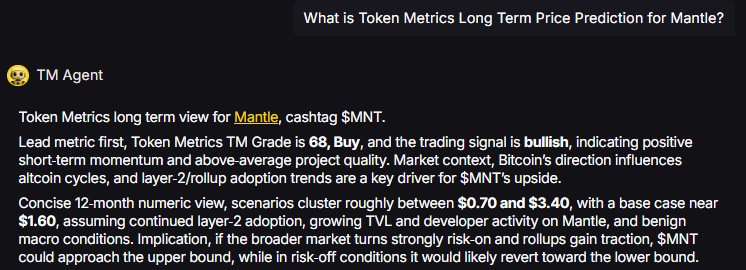
TM Agent baseline: Token Metrics long term view for Mantle, cashtag $MNT. Lead metric first, Token Metrics TM Grade is 68%, Buy, and the trading signal is bullish, indicating positive short-term momentum and above-average project quality. Concise 12-month numeric view, price prediction scenarios cluster roughly between $0.70 and $3.40, with a base case near $1.60.

Token Details 

Key Takeaways

  • Scenario driven, outcomes hinge on total crypto market cap, higher liquidity and adoption lift the bands.
  • Single-asset concentration amplifies both upside and downside versus diversified approaches.
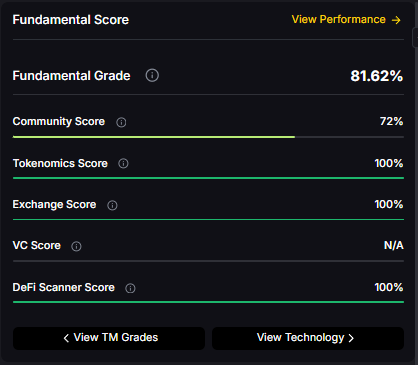
  • Fundamentals: Fundamental Grade 81.62% (Community 72%, Tokenomics 100%, Exchange 100%, VC —, DeFi Scanner 100%).
  • Technology: Technology Grade 78.22% (Activity 64%, Repository 70%, Collaboration 71%, Security —, DeFi Scanner 100%).
  • TM Agent gist: bullish signal, 12‑month range roughly $0.70 to $3.40 with base near $1.60.
  • Education only, not financial advice.

Scenario Analysis - MNT Price Prediction Models

Token Metrics price prediction scenarios span four market cap tiers, each representing different levels of crypto market maturity and liquidity:

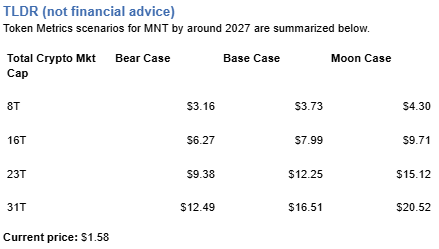
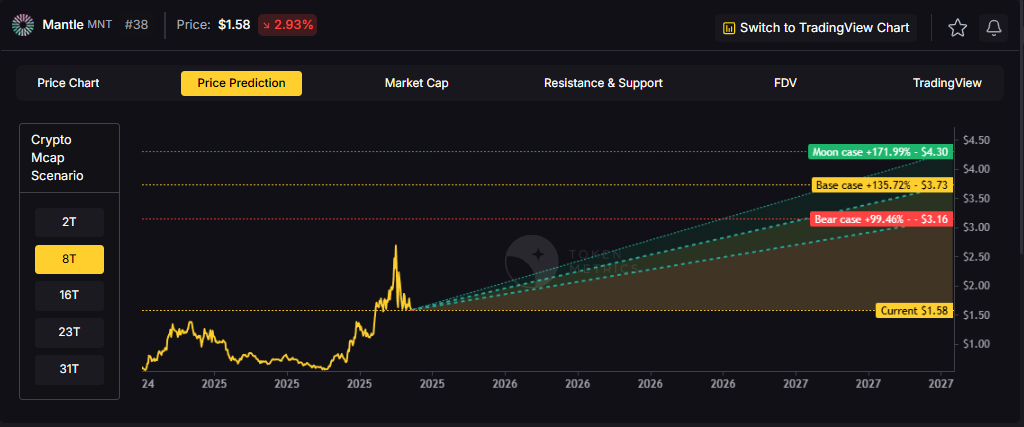
  • 8T: At an 8 trillion dollar total crypto market cap, MNT projects to $3.16 in bear conditions, $3.73 in the base case, and $4.30 in bullish scenarios.
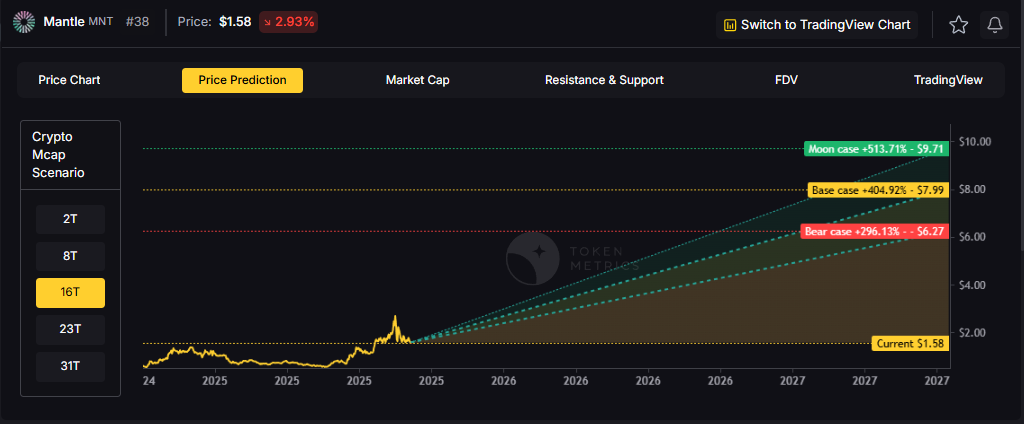
  • 16T: Doubling the market to 16 trillion expands the price prediction range to $6.27 (bear), $7.99 (base), and $9.71 (moon).
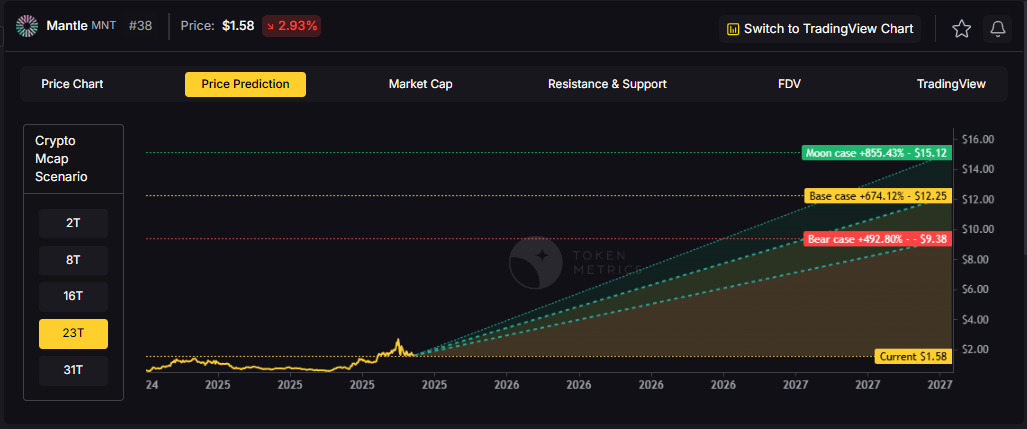
  • 23T: At 23 trillion, the price prediction scenarios show $9.38, $12.25, and $15.12 respectively.
  • 31T: In the maximum liquidity scenario of 31 trillion, MNT price prediction could reach $12.49 (bear), $16.51 (base), or $20.52 (moon).

These ranges illustrate potential outcomes for concentrated MNT positions, but investors should weigh whether single-asset exposure matches their risk tolerance or whether diversified strategies better suit their objectives.

The Case for Diversified Index Exposure

Portfolio theory teaches that diversification is the only free lunch in investing. MNT concentration violates this principle by tying your crypto returns to one protocol's fate. Token Metrics Indices blend Mantle with the top one hundred tokens, providing broad exposure to crypto's growth while smoothing volatility through cross-asset diversification. This approach captures market-wide tailwinds without overweighting any single point of failure.

Systematic rebalancing within index strategies creates an additional return source that concentrated positions lack. As some tokens outperform and others lag, regular rebalancing mechanically sells winners and buys laggards, exploiting mean reversion and volatility. Single-token holders miss this rebalancing alpha and often watch concentrated gains evaporate during corrections while index strategies preserve more gains through automated profit-taking.

Beyond returns, diversified indices improve the investor experience by reducing emotional decision-making. Concentrated MNT positions subject you to severe drawdowns that trigger panic selling at bottoms. Indices smooth the ride through natural diversification, making it easier to maintain exposure through full market cycles.

Get early access

What Is Mantle?

Mantle is a blockchain project focused on scaling Ethereum via layer 2 rollup technology. The goal is to enable faster and cheaper transactions while inheriting Ethereum security. It targets scalable and efficient infrastructure for decentralized applications and financial services.

The MNT token powers network economics such as fees, incentives, or governance depending on implementation. Users interact with dApps and bridges within the ecosystem, and Mantle competes among leading Ethereum scaling solutions.

Token Metrics AI Analysis

  • Vision: Mantle aims to build a scalable, secure, and self-sustaining blockchain ecosystem that leverages decentralized governance and treasury-backed financial innovation. Its vision emphasizes capital efficiency, leveraging restaking for security, and fostering long-term sustainability through community-driven development and treasury utilization.
  • Problem: Many blockchain platforms face trade-offs between scalability, security, and capital efficiency. High transaction costs and network congestion on Ethereum, combined with fragmented liquidity and underutilized treasury assets in DAOs, create friction for developers and users. Mantle addresses the challenge of efficiently deploying capital while maintaining robust security and enabling rapid, low-cost transactions for decentralized applications.
  • Solution: Mantle implements an Ethereum Layer 2 network using optimistic rollup technology to reduce fees and increase throughput. It integrates EigenLayer for security via restaking, allowing its treasury to earn yield and contribute to network validation. The ecosystem supports native governance through its token and funds development via a large DAO-managed treasury, aiming to create a self-sustaining cycle of innovation and user incentives.
  • Market Analysis: Mantle operates in the competitive Layer 2 and modular blockchain space, competing with established networks like Arbitrum, Optimism, and emerging restaking platforms. Its differentiation lies in the integration of a large treasury with restaking, aiming to bootstrap security and ecosystem growth simultaneously. Adoption is driven by developer activity, yield opportunities, and strategic partnerships within the broader Ethereum ecosystem. Market risks include execution challenges in treasury management, regulatory scrutiny on DAO structures, and strong competition from other scaling solutions. While not a market leader like Ethereum or Bitcoin, Mantle participates in the broader narrative of modular, restaked, and treasury-driven blockchains, which have gained traction in 2024-2025.

Fundamental and Technology Snapshot from Token Metrics

  • Fundamental Grade: 81.62% (Community 72%, Tokenomics 100%, Exchange 100%, VC —, DeFi Scanner 100%).
  • Technology Grade: 78.22% (Activity 64%, Repository 70%, Collaboration 71%, Security —, DeFi Scanner 100%).

Catalysts That Skew Bullish

  • Institutional and retail access expands with ETFs, listings, and integrations.
  • Macro tailwinds from lower real rates and improving liquidity.
  • Product or roadmap milestones such as upgrades, scaling, or partnerships.

Risks That Skew Bearish

  • Macro risk-off from tightening or liquidity shocks.
  • Regulatory actions or infrastructure outages.
  • Concentration or validator economics and competitive displacement.
  • Protocol-specific execution risk and competitive pressure from alternatives.

FAQs

Can MNT reach $10?

Based on the price prediction scenarios, MNT could reach $10 in the higher tiers. The 23T tier projects $12.25 in the base case, and the 31T tier shows $12.49 (bear), $16.51 (base), and $20.52 (moon). Achieving this requires both broad market cap expansion and Mantle maintaining competitive position. Not financial advice.

What's the risk/reward profile for MNT?

Risk and reward spans from $3.16 at 8T bear to $20.52 at 31T moon. Downside risks include competitive pressure among L2s and execution challenges, while upside drivers include adoption growth and liquidity expansion. Concentrated positions amplify both tails, while diversified strategies smooth outcomes.

What gives MNT value?

MNT accrues value through network usage, fees, incentives, and governance tied to Mantle's L2 ecosystem. Demand drivers include dApp activity, bridging, and security via restaking integrations. While these fundamentals matter, diversified portfolios capture value accrual across multiple tokens rather than betting on one protocol's success.

Where can I find Mantle price predictions?

Token Metrics provides comprehensive Mantle (MNT) price predictions through scenario-based analysis spanning multiple market cap tiers. Our data-driven price prediction models incorporate fundamental grades, technology scores, and market conditions to project potential MNT price targets across bear, base, and moon scenarios.

Next Steps

Disclosure

Educational purposes only, not financial advice. Crypto is volatile, concentration amplifies risk, and diversification is a fundamental principle of prudent portfolio construction. Do your own research and manage risk appropriately.

Why Investors Choose Token Metrics

Token Metrics provides data-driven crypto ratings, on-chain grades, and scenario-based targets—empowering you to make informed investment decisions with confidence. Accelerate your research with unique AI-powered analysis and risk management tools.

Choose from Platinum, Gold, and Silver packages
Reach with 25–30% open rates and 0.5–1% CTR
Craft your own custom ad—from banners to tailored copy
Perfect for Crypto Exchanges, SaaS Tools, DeFi, and AI Products