Back to blog
Research

How Do I Start a Career in Web3: Your Complete Guide to Success in 2025

Discover practical steps to kickstart your career in Web3. Explore opportunities and insights to navigate this evolving landscape. Read the guide now!
Talha Ahmad
5 min
Want Smarter Crypto Picks—Free?
See unbiased Token Metrics Ratings for BTC, ETH, and top alts.
Thank you! Your submission has been received!
Oops! Something went wrong while submitting the form.
 No credit card | 1-click unsubscribe

The digital revolution has ushered in an era of unprecedented opportunity, and nowhere is this more evident than in the rapidly expanding Web3 ecosystem. As we navigate through 2025, the landscape of decentralized technologies, blockchain applications, and crypto innovations continues to evolve at breakneck speed, creating a wealth of career opportunities for forward-thinking professionals. If you're wondering how do I start a career in Web3, this comprehensive guide will provide you with the essential knowledge, skills, and strategies to build a successful career in this exciting and constantly evolving industry.

Understanding the Web3 Revolution

Web3 represents the third iteration of the internet as we know it—a decentralized web built on principles of trust, transparency, and individual ownership. Unlike the centralized nature of Web2, where tech giants control data and platforms, Web3 leverages blockchain technology, smart contracts, and cryptography to facilitate peer-to-peer interactions and create more robust, transparent systems. This paradigm shift empowers users with control over their data and digital assets, enabling new forms of interaction through decentralized applications (dApps) and decentralized autonomous organizations (DAOs).

The Web3 career landscape has fundamentally shifted as well. According to the 2025 Web3.Career Intelligence Report, job postings have reached all-time highs, reflecting an industry that has matured beyond experimentation into execution. This maturation has drastically changed the skills that matter most, especially with the rise of hybrid work models and geographic arbitrage opportunities. For anyone eyeing a career in Web3, understanding this revolution is the first step toward success.

The Current State of Web3 Careers in 2025

The Web3 job market is experiencing explosive growth across both technical and non-technical domains. Since 2023, the market has seen a staggering 300% surge in job openings by 2025. This growth is fueled by the industry’s transition from speculative hype to building practical, real-world blockchain projects and blockchain based applications that solve tangible problems.

Key market insights include:

  • Web3 Jobs currently lists over 66,000 active positions, ranging from blockchain developers and smart contract developers to community managers and tokenomics specialists.
  • Contrary to popular belief, non-technical jobs are now rising faster than technical roles, highlighting the diverse career paths available.
  • There has been a 50% reduction in fully remote jobs year-over-year, signaling a structural shift toward hybrid work models.

Salary and compensation in Web3 can vary significantly depending on the specific job role, with some roles commanding much higher pay due to specialized skills or responsibilities. The explosive growth in the Web3 job market is influenced by various factors such as skills, experience, and regional demand.

This growing demand reflects the high demand for skilled professionals who possess a solid understanding of Web3 technologies and business models.

Essential Skills for Web3 Success

Technical Skills

To build a successful career in Web3, acquiring the right technical skills is crucial.

  • Blockchain Fundamentals: A solid foundation in blockchain technology is essential. This includes understanding decentralized systems, consensus algorithms, and the architecture of peer-to-peer networks.
  • Programming Languages: Proficiency in certain programming languages is highly sought after. These include:
    • Solidity for smart contract development on Ethereum.
    • Rust for high-performance blockchain systems.
    • JavaScript for frontend web development and Web3 integration.
    • Python for backend development and blockchain data analysis. Learning a programming language such as Solidity or Vyper is crucial for developing smart contracts and decentralized applications, as these languages directly impact smart contract security, readability, and functionality.
  • Smart Contract Development: Since smart contracts are the backbone of many Web3 applications, mastering Solidity and understanding how to write, deploy, and audit smart contracts is vital. This skill opens doors to roles such as smart contract developer and blockchain developer.
  • Web3 Libraries and Frameworks: Familiarity with tools like Web3.js, ethers.js, and frontend frameworks such as React is important for building user-friendly decentralized apps.

If you are new to JavaScript, you can learn JavaScript through online platforms like freeCodeCamp, Codecademy, or Udemy, which offer courses tailored for Web3 and blockchain development.

Non-Technical Skills

Web3 careers are not limited to coding. Several non-technical skills are equally important:

  • Understanding the Web3 Ecosystem: A good understanding of decentralized finance (DeFi), non-fungible tokens (NFTs), the metaverse, and various types of decentralized applications is essential for many roles. While NFTs are often associated with digital art, their applications extend far beyond, impacting creative industries and marketing strategies.
  • Community Management: Given the decentralized nature of Web3, community building and engagement are critical. Being active in online communities and managing blockchain communities can lead to roles like community manager or content creator.
  • Analytics and Research: The ability to analyze market trends, token performance, and blockchain data is increasingly valuable, especially for roles like crypto analyst or tokenomics specialist.

Top Web3 Career Opportunities in 2025

Technical Roles

  1. Blockchain Developer: These professionals design and build decentralized systems and blockchain based applications. dApp developers in this role are responsible for designing and implementing a decentralized application, which requires programming skills in languages like Solidity and experience with frameworks such as Web3.js for seamless blockchain integration. Their responsibilities include writing code, managing data structures, and ensuring security. Salaries range from $80,000 to over $200,000 depending on experience and location.
  2. Smart Contract Developer: Writing and deploying smart contracts on platforms like Ethereum is a core function. This role requires strong programming skills and an understanding of decentralized applications architecture, including the ability to implement a decentralized application using Solidity and frameworks like Web3.js.
  3. Web3 Frontend Developer: Creating responsive, intuitive interfaces that interact with blockchain backends is key. Knowledge of JavaScript and Web3 libraries is essential.

Non-Technical Roles

  1. Crypto Analyst: Professionals who analyze token economies, decentralized finance protocols, and market trends to provide actionable insights.
  2. Community Manager: Building and maintaining engaged communities around Web3 projects is a vital role given the emphasis on decentralization.
  3. Web3 Project Manager: Overseeing blockchain product development from conception to launch, requiring skills in project management and understanding of the Web3 ecosystem.
  4. Tokenomics Specialist: Designing and analyzing economic models for token ecosystems, critical for sustainable project growth.

The Role of Token Metrics in Web3 Career Success

For professionals entering the Web3 space, understanding the crypto market and developing analytical skills is crucial. Token Metrics is an AI-powered crypto analytics platform that provides cutting edge technology and market intelligence essential for career development.

Advanced Market Intelligence

Token Metrics helps you identify promising tokens early by leveraging AI analytics that combine technical analysis, on-chain data, sentiment analysis, and more. This insight is invaluable for roles such as crypto analyst, tokenomics specialist, and blockchain developer.

Professional Development Tools

The platform supports career growth by enabling users to:

  • Develop market expertise through daily scans of over 6,000 tokens.
  • Build analytical skills with AI-powered rating systems that teach systematic project evaluation.
  • Stay current with real-time signals and alerts to keep up with new trends.

Career-Enhancing Features

Token Metrics consolidates research, portfolio management, and trading into a unified interface, providing:

  • AI-powered analytics for both retail and institutional users.
  • Comprehensive scoring systems that evaluate tokens’ short-term and long-term viability.
  • Sector-specific analysis that builds expertise valuable across diverse Web3 roles.

Your Step-by-Step Web3 Career Roadmap

Phase 1: Foundation Building (1-3 months)

Start by building a basic understanding of blockchain and web development fundamentals:

  1. Learn blockchain basics such as decentralized networks, consensus algorithms, and smart contracts.
  2. Master the fundamentals of web development including HTML, CSS, and JavaScript.
  3. Begin using tools like Token Metrics to grasp market dynamics and develop analytical thinking.

Phase 2: Skill Development (3-6 months)

  1. Dive deeper into smart contract development by studying Ethereum’s architecture, the Ethereum Virtual Machine (EVM), and Solidity.
  2. Build simple decentralized applications (dApps) or smart contracts to gain hands on experience.
  3. Engage with online communities on Discord, Twitter Spaces, and community forums to learn from industry professionals.

Phase 3: Professional Development (6-12 months)

  1. Contribute to open source projects related to Web3 to gain practical experience and showcase your skills.
  2. Network actively by attending meetups, hackathons, and conferences. While sharing your LinkedIn profile can be helpful, authentic engagement and meaningful participation in Web3 communities often precede formal connections and are more valuable for building trust.
  3. Specialize in an area such as decentralized finance, non fungible tokens, or decentralized autonomous organizations to deepen your expertise.

Creating a Professional Portfolio for Web3

Building a professional portfolio is a critical step toward a successful career in Web3. In this constantly evolving industry, your portfolio serves as a showcase of your skills, creativity, and hands-on experience with blockchain technologies. To stand out in the competitive Web3 job market, highlight your proficiency in key programming languages such as Solidity, JavaScript, and Python—these are essential for smart contract development and building decentralized applications.

Include detailed examples of your work, such as deployed smart contracts, decentralized finance projects, or contributions to decentralized autonomous organizations. If you’ve participated in open source blockchain projects or created your own decentralized applications, be sure to feature these prominently. Demonstrate your understanding of the broader Web3 ecosystem by including projects that touch on decentralized finance, governance, or innovative uses of blockchain technology.

A strong portfolio not only displays your technical skills but also your ability to solve real-world problems using decentralized technologies. By curating a collection of relevant projects and achievements, you’ll position yourself as a capable and motivated candidate ready to thrive in the exciting industry of Web3.

Crafting a Compelling Web3 Cover Letter

A compelling cover letter can set you apart in the Web3 job market, serving as your personal introduction to hiring managers and project leads. When applying for a job in this industry, your cover letter should clearly communicate your passion for blockchain technologies, your strong programming skills, and your relevant experience with smart contracts and decentralized applications.

Start by thoroughly researching the company and carefully reviewing the job description. Tailor your cover letter to address the specific skills and qualifications they are seeking, using language that mirrors the job posting. Highlight your experience with smart contract development, your familiarity with blockchain technologies, and any notable projects or achievements that demonstrate your expertise.

Be sure to emphasize your ability to adapt to new trends and your enthusiasm for contributing to the company’s mission within the rapidly changing Web3 landscape. A well-crafted cover letter that showcases your skills, relevant experience, and genuine interest in the industry can make a significant impact, increasing your chances of landing an interview and advancing your career in Web3.

Exploring Content Creation and Writing Careers in Web3

The Web3 industry is not just for developers—there is a high demand for skilled content creators and writers who can translate complex concepts like smart contracts, blockchain technology, and decentralized finance into engaging, accessible content. As blockchain technologies and decentralized autonomous organizations continue to grow, top companies and projects are seeking professionals who can educate, inform, and inspire their communities.

To build a successful career in content creation and writing within Web3, focus on developing a strong understanding of the industry’s core concepts and trends. Hone your writing and storytelling skills, and learn to communicate technical information in a user-friendly way. Experiment with different formats, such as blog posts, articles, social media threads, and video scripts, to showcase your versatility.

Engage with online communities and connect with industry professionals to stay updated on the latest developments and opportunities. By building a portfolio of high-quality content and actively participating in the Web3 ecosystem, you can establish yourself as a go-to resource for blockchain-based projects, decentralized autonomous organizations, and top companies in this exciting industry. With the right skills and network, content creation offers a dynamic and rewarding path in the world of Web3 careers.

Overcoming Common Challenges

Breaking into Web3 Without Experience

Starting a Web3 career without prior experience can be daunting, but several strategies can improve your chances:

  • Build a strong portfolio on GitHub featuring personal projects and contributions to open source.
  • Engage in continuous learning to stay updated with the latest developments in blockchain technology and Web3.
  • Use analytics tools like Token Metrics to demonstrate your market understanding during job applications and interviews.

Geographic Opportunities

An important trend is the dramatic geographic salary differences, creating unprecedented opportunities. Web3 professionals in emerging markets can earn 3-10 times local rates, and many companies hiring offer the flexibility to work remotely, broadening access to exciting career opportunities worldwide.

Salary Expectations and Growth Potential

Web3 careers offer competitive compensation that often surpasses traditional tech roles:

  • Entry-level positions typically pay between $50,000 and $80,000.
  • Mid-level roles range from $80,000 to $150,000.
  • Senior positions can command $150,000 to $300,000 or more.
  • Specialized roles, especially in high-demand areas, can exceed $500,000.

Many jobs also offer equity or token compensation, which can significantly increase total earnings.

The Future of Web3 Careers

The Web3 ecosystem continues to mature, with several key trends shaping future career opportunities:

  1. Integration with Traditional Industries: Blockchain is increasingly used beyond cryptocurrency, including supply chain, healthcare, and media sectors.
  2. AI Integration: Combining Web3 and AI skills will be highly valuable as AI becomes mandatory in many applications.
  3. Regulatory Clarity: Clearer regulations will encourage more traditional companies to enter the Web3 space, expanding job opportunities.

Building Your Professional Network

Success in Web3 heavily depends on community engagement and networking:

  • Join blockchain communities on Discord, Telegram, and Twitter.
  • Attend industry events such as conferences, hackathons, and meetups.
  • Contribute to discussions by writing articles on platforms like Medium or Mirror.
  • Engage actively with projects, as many hire from their communities.

Continuous Learning and Adaptation

Given the constantly evolving nature of Web3, continuous learning is essential:

  • Stay updated by following industry publications, podcasts, and thought leaders.
  • Experiment with new protocols, DeFi platforms, NFT marketplaces, and decentralized apps.
  • Use professional tools like Token Metrics to keep pace with market trends and deepen your expertise.

Conclusion: Your Web3 Journey Starts Now

The Web3 revolution is creating unprecedented opportunities for professionals willing to embrace decentralized technologies and innovative business models. Working in Web3 offers the chance to engage with cutting edge technology, develop new skills, and participate in an exciting industry with vast growth potential.

Success requires a combination of technical proficiency, market understanding, and active community involvement. Platforms like Token Metrics provide the analytical foundation needed to navigate the complex crypto landscape, making your journey smoother and more informed.

Whether you aspire to be a developer, analyst, marketer, or entrepreneur, the decentralized future has a place for your talents. Start today by learning, building personal projects, and contributing to the ecosystem. The future is decentralized, and it’s being built by professionals like you. Your Web3 career journey begins with the first step—embrace the revolution and unlock your potential in this dynamic and rewarding field.

Build Smarter Crypto Apps &
AI Agents in Minutes, Not Months
Real-time prices, trading signals, and on-chain insights all from one powerful API.
Grab a Free API Key
About Token Metrics
Token Metrics: AI-powered crypto research and ratings platform. We help investors make smarter decisions with unbiased Token Metrics Ratings, on-chain analytics, and editor-curated “Top 10” guides. Our platform distills thousands of data points into clear scores, trends, and alerts you can act on.
30 Employees
analysts, data scientists, and crypto engineers
Daily Briefings
concise market insights and “Top Picks”
Transparent & Compliant
Sponsored ≠ Ratings; research remains independent
Want Smarter Crypto Picks—Free?
See unbiased Token Metrics Ratings for BTC, ETH, and top alts.
Thank you! Your submission has been received!
Oops! Something went wrong while submitting the form.
 No credit card | 1-click unsubscribe
Token Metrics Team
Token Metrics Team

Recent Posts

Crypto Basics

Bitcoin vs Ethereum: An in-depth Comparison between BTC and ETH

Marcus K
7 Minutes

Bitcoin (BTC) and Ethereum (ETH) are undeniably the top cryptocurrencies that have played a significant role in the development of the crypto industry. 

BTC, being the pioneer of cryptocurrencies, is often referred to as the digital equivalent of gold. On the other hand, ETH can be viewed as a decentralized computing platform that can revolutionize various industries.

In this article, we will take an in-depth look at the differences between Bitcoin and Ethereum. So, let's start with a brief overview of Bitcoin and Ethereum.

What is Bitcoin?

Bitcoin(BTC) was the first cryptocurrency, created in 2009 by an anonymous individual or group of individuals using the pseudonym Satoshi Nakamoto. Bitcoin is a decentralized digital currency that operates on a peer-to-peer network, allowing for secure, anonymous transactions without the need for intermediaries.

One of the key features of Bitcoin is its limited supply. There will only ever be 21 million bitcoins in circulation, which helps to ensure that the value of each bitcoin is protected and can increase over time as demand grows. The process of generating new bitcoins is called mining, and it involves solving complex mathematical equations using specialized computer hardware.

What is Ethereum?

Ethereum, on the other hand, is a decentralized computing platform that was introduced in 2015 by Vitalik Buterin. Ethereum's blockchain technology allows developers to create and deploy smart contracts, which are self-executing contracts with the terms of the agreement between buyer and seller being directly written into lines of code.

Ethereum also has its own cryptocurrency, called Ether (ETH), which is used to pay for transactions and computational services on the Ethereum network. Unlike Bitcoin, there is no limit to the number of Ethers that can be created. 

Bitcoin vs Ethereum - Key Differences

Although Bitcoin and Ethereum share the fundamental principles of distributed ledger technology and encryption, they differ greatly in terms of technical specifications. Let's delve into the technical and operational differences that set Bitcoin and Ethereum apart.

1. Transaction Speed and Cost

Bitcoin's transaction speed is slower than Ethereum's due to its block size limit of 1MB, which restricts the number of transactions that can be processed per block. As a result, Bitcoin transactions can take up to 10 minutes to be confirmed, while Ethereum transactions are typically confirmed in under a minute.

The cost of Bitcoin transactions can also be higher than Ethereum's due to its popularity and limited block size, which can lead to network congestion and higher fees. Ethereum's transaction fees are generally lower due to its larger block size and more efficient use of the network.

2. Mining - Proof of Work vs. Proof of Stake

Both Bitcoin and Ethereum use a consensus mechanism to verify transactions and maintain the integrity of the blockchain. However, they use different methods to achieve this.

Bitcoin uses a proof-of-work (PoW) consensus algorithm, which requires miners to solve complex mathematical problems to validate transactions and add new blocks to the blockchain. This process requires significant computational power and energy consumption, making it costly and environmentally unfriendly.

Ethereum is currently in the process of transitioning from a proof-of-work (PoW) consensus algorithm to a proof-of-stake (PoS) algorithm. Proof of stake requires validators to hold a certain amount of cryptocurrency to validate transactions, eliminating the need for energy-intensive mining. This is expected to make Ethereum more environmentally friendly and cost-effective.

3. Smart Contracts and Decentralized Applications

One of Ethereum's main advantages over Bitcoin is its ability to support smart contracts and decentralized applications (dapps). Smart contracts are self-executing contracts with the terms of the agreement between buyer and seller being directly written into lines of code. This allows for secure, automated transactions without the need for intermediaries.

Ethereum's support for smart contracts has led to the development of a wide range of decentralized applications, including decentralized finance (DeFi) platforms, non-fungible token marketplaces, and more.

Bitcoin, on the other hand, does not currently support smart contracts or dapps. While some developers have created solutions to enable smart contracts on the Bitcoin blockchain, these solutions are not as widely adopted as Ethereum's smart contract capabilities.

Ethereum vs Bitcoin - Comparison

Let's take a closer look at how Ethereum and Bitcoin stack up against each other. Here is an in-depth comparison of ETH and BTC -

Ethereum Bitcoin
Creator Vitaly Dmitrievich Buterin Satoshi Nakamoto
Launch date July 30, 2015 9 January 2009
Supply Infinite 21 Million BTC
Transactions per Second 30 per Second 7 per Second
Consensus algorithm Proof of Work moves to Proof of Stake Proof of Work
Block Time 15 Seconds on Average 10 Minutes on Average

Similarities Between BTC and ETH?

Bitcoin and Ethereum have many similarities. They are both decentralized currencies that operate on blockchain technology. 

BTC and ETH can be used as payment or stored as a form of investment, and they have strong developer communities. They are also volatile and vulnerable to market fluctuations, but have attracted significant attention from institutional investors.

Despite some differences, their similarities suggest that both cryptocurrencies have the potential to remain relevant and valuable in the long term. Investors should carefully evaluate their risk tolerance and investment goals before making any investment related decision..

Development and Future Prospects of BTC and ETH

Both Bitcoin and Ethereum have large and dedicated development communities working to improve and evolve their respective technologies. Bitcoin has a more established development community and has been around longer, which has allowed it to gain wider acceptance and adoption.

Ethereum, on the other hand, has a more active development community, thanks in part to its support for smart contracts and dapps. This has led to a wider range of innovations and use cases for Ethereum, making it a more versatile and adaptable platform.

Looking to the future, both Bitcoin and Ethereum have strong prospects. Bitcoin is likely to continue to be the dominant cryptocurrency, thanks to its first-mover advantage and widespread adoption.

Ethereum, meanwhile, is likely to continue to grow and evolve, thanks to its smart contract capabilities and active development community.

Also Read - Is Bitcoin Dead? - Complete Analysis for BTC Investors

ETH or BTC - Which one is better to buy for long term investment?

When deciding whether to invest in ETH or BTC for the long term, it's important to consider several factors. Both cryptocurrencies have shown potential for growth and acceptance, but they have their differences. 

Bitcoin is the more established and mainstream of the two, making it a relatively safer investment option. Ethereum, on the other hand, is newer and slightly riskier, but it offers more diverse use cases beyond just being a digital currency. 

Ultimately, the decision comes down to an investor's risk tolerance and investment goals. Those looking for a more stable investment option may prefer Bitcoin, while those seeking potentially higher rewards and a more diverse range of applications may choose Ethereum. It's essential to conduct thorough research and seek expert advice before making any investment decisions.

Conclusion

Bitcoin and Ethereum are two of the most well-known cryptocurrencies in the world, with unique features and advantages. While Bitcoin has gained widespread adoption and is the more established cryptocurrency, Ethereum has been driving innovation through its support for smart contracts and decentralized applications.

It is important for investors and users to understand the differences between Bitcoin and Ethereum to make informed decisions in the cryptocurrency market. Bitcoin's dominant position and reputation for stability make it a safer investment option, while Ethereum's versatility and adaptability make it a platform for new and innovative blockchain projects.

Disclaimer

The information provided on this website does not constitute investment advice, financial advice, trading advice, or any other sort of advice and you should not treat any of the website's content as such.

Token Metrics does not recommend that any cryptocurrency should be bought, sold, or held by you. Do conduct your own due diligence and consult your financial advisor before making any investment decisions.

Crypto Basics

What is Crypto Arbitrage and How to Start Arbitrage Trading?

S. Vishwa
8 Minutes

As the world of cryptocurrency continues to evolve, new opportunities for investment and profit are emerging. One such opportunity is crypto arbitrage, a trading strategy that can yield significant returns for savvy investors. 

In this article, we'll explain what crypto arbitrage is, how it works, and why it's become an increasingly popular investment strategy in crypto space.

What is Crypto Arbitrage?

Crypto arbitrage involves taking advantage of price differences for a cryptocurrency on different exchanges. Cryptocurrencies are traded on many different exchanges, and the prices for each currency can vary significantly between these exchanges.

This creates an opportunity for arbitrageurs to buy a currency on one exchange where the price is low and then sell it on another exchange where the price is high. The difference between the buy and sell price is the profit.

Types of Crypto Arbitrage

There are several types of crypto arbitrage, each with its own unique characteristics and risks. Let's explore some of them.

Exchange Arbitrage - Exchange arbitrage is the most common type of crypto arbitrage. It involves buying a cryptocurrency on one exchange where it is priced lower and selling it on another exchange where the price is higher. 

This type of arbitrage is possible because different exchanges have different prices for the same cryptocurrency due to differences in supply and demand, trading volumes, and market manipulation.

Triangular Arbitrage - Triangular arbitrage is a more complex type of crypto arbitrage that involves taking advantage of price differences between three cryptocurrencies on different exchanges. 

For example, you could buy Bitcoin on Exchange A, trade it for Ethereum on Exchange B, and then trade the Ethereum for Litecoin on Exchange C, and then sell the Litecoin back for Bitcoin on Exchange A. This type of arbitrage requires a lot of research, expertise, and quick decision-making to execute successfully.

Statistical Arbitrage - Statistical arbitrage involves using mathematical models and statistical analysis to identify mispricing's in the market. This type of arbitrage is often used in the stock market but can also be applied to cryptocurrencies. Statistical arbitrage requires extensive data analysis and algorithmic trading strategies to take advantage of the market inefficiencies.

Inter-Exchange Arbitrage - Inter-exchange arbitrage involves taking advantage of price differences between different exchanges by buying and selling cryptocurrencies simultaneously. 

This type of arbitrage requires access to multiple exchanges, high-speed internet, and advanced trading tools to execute quickly and effectively.

Cross-Currency Arbitrage - Cross-currency arbitrage involves buying and selling different cryptocurrencies denominated in different currencies. 

For example, you could buy Bitcoin in USD on one exchange and sell it for Bitcoin in EUR on another exchange. This type of arbitrage requires a deep understanding of the currency markets and exchange rates.

How Arbitrage Trading Works?

The concept of arbitrage trading is based on the idea that the price of an asset can vary in different markets due to various factors such as supply and demand, transaction costs, and currency exchange rates. 

The goal of arbitrage trading is to purchase an asset in one market at a lower price and sell it in another market at a higher price, making a profit from the price difference. 

To execute an arbitrage trade, traders need to be quick and efficient in analyzing the markets and executing trades. In recent years, technology has played a significant role in enabling traders to execute arbitrage trades in real-time by using automated trading systems that can quickly identify price discrepancies and execute trades. 

Overall, arbitrage trading is a sophisticated trading strategy that requires expertise in analyzing markets and executing trades efficiently.

How to Start Arbitrage Trading?

Arbitrage trading can be a lucrative trading strategy for those with the skills and knowledge to execute it successfully. Here are some important things to know before starting the arbitrage trading -

Understand the concept: Before starting arbitrage trading, it is essential to understand the basic concept of the strategy. This includes understanding the factors that can lead to price differences between markets and the techniques used to exploit them.

Choose the markets: The next step is to identify the markets and exchanges to trade in. This can include different asset classes such as stocks, commodities, and currencies. It is important to research and analyze the markets thoroughly before making any trades.

Analyze the markets: Analyzing the markets involves looking for price discrepancies and opportunities to make a profit. Traders need to use various tools and techniques such as chart analysis, technical indicators, and fundamental analysis to identify potential trades.

Develop a trading strategy: Once traders have identified potential trades, they need to develop a trading strategy. This involves deciding on the entry and exit points, the size of the trade, and the risk management strategy.

Execute the trades: After developing a trading strategy, traders need to execute the trades. This involves using trading platforms and brokers to place the trades and monitor them in real-time.

Monitor the trades: Monitoring the trades is an essential part of arbitrage trading. Traders need to track the prices of the assets in both markets and make adjustments to their trades as needed.

Keep learning and adapting: Arbitrage trading is a complex trading strategy that requires continuous learning and adaptation. Traders need to stay up to date with the latest trends and developments in the markets and adjust their trading strategies accordingly.

Crypto Arbitrage: Benefits and Risks

Here are some detailed pointers to understand the benefits and risks associated with crypto arbitrage trading:

Benefits of Arbitrage Trading

Arbitrage trading offers several benefits to traders, including:

  • Low risk: Arbitrage trading is a low-risk investment strategy as it involves buying and selling assets in different markets simultaneously to profit from the price difference.
  • High returns: Arbitrage trading can offer high returns as the price difference between the two markets represents the profit that the trader can make.
  • Diversification: Arbitrage trading allows traders to diversify their portfolio by investing in different markets simultaneously.
  • Liquidity: Arbitrage trading offers high liquidity as traders can buy and sell assets quickly in different markets.

Risks Associated with Arbitrage Trading

These are few risks, associated with arbitrage trading:

  • Technical issues: Crypto arbitrage requires real-time monitoring of multiple exchanges and execution of trades. Technical issues such as slow execution times or system failures can result in missed opportunities or losses.
  • Security risks: Cryptocurrency exchanges are often targets for cyber attacks, which can result in the loss of funds. Traders need to ensure they use reputable exchanges and implement security measures such as two-factor authentication to protect their assets.
  • Regulatory risks: The lack of regulation in the cryptocurrency markets can lead to regulatory risks. Traders need to be aware of any legal or regulatory issues that may arise and the potential impact on their trades.
  • Market volatility: Cryptocurrency markets are highly volatile, and price discrepancies can change quickly. Traders need to be prepared for sudden market shifts that could result in losses.

Is Crypto Arbitrage Still Profitable?

The profitability of crypto arbitrage depends on various factors such as current market conditions, trading fees charged by exchanges, speed of execution, and the amount of capital available. 

If there are significant price discrepancies between exchanges, traders can potentially make a profit. However, if the price discrepancies are minimal, the potential profit margins may not be worth the effort. 

Additionally, traders need to carefully consider the fees charged by exchanges, execute trades quickly and efficiently, and have enough capital to cover trading fees and take advantage of profitable trades. By continuously monitoring the markets and weighing these factors, traders can increase their chances of success in crypto arbitrage trading.

Is Crypto Arbitrage Legal?

The legality of crypto arbitrage varies from country to country. In general, crypto arbitrage is legal in most countries, but traders should be aware of local regulations and laws governing cryptocurrencies and financial trading. 

In the United States, arbitrage trading is considered legal, and it is even encouraged as it helps to increase market efficiency. In addition to that, arbitrageurs play a crucial role in providing liquidity in different markets and acting as intermediaries between buyers and sellers.

It is recommended that traders consult with legal and financial experts and conduct thorough research before engaging in crypto arbitrage trading to ensure compliance with local laws and regulations.

The Bottom Line

Arbitrage opportunities are commonly found in financial markets, where the same asset is traded at different prices in various locations, including stocks, bonds, and commodities. 

Since the cryptocurrency market is complicated, devising successful arbitrage strategies can be challenging. Nevertheless, the practice is legal, and it has the potential to yield substantial returns, while also exposing investors to significant risks.

With the right knowledge, research and expertise, traders can potentially benefit from crypto arbitrage and contribute to the overall efficiency and liquidity of cryptocurrency markets in 2024 and beyond.

Disclaimer

The information provided on this website does not constitute investment advice, financial advice, trading advice, or any other sort of advice and you should not treat any of the website's content as such.

Token Metrics does not recommend that any cryptocurrency should be bought, sold, or held by you. Do conduct your own due diligence and consult your financial advisor before making any investment decisions.

Crypto Basics

Crypto Lending Explained - Benefits, Risks and Top Lending Platforms in 2023

Sumit Meghani
8 Minutes

Are you looking for a new way to invest your cryptocurrency? Or perhaps you're in need of a loan, but tired of dealing with traditional financial institutions. If so, you may want to consider crypto lending.

Crypto lending is a relatively new phenomenon that's gaining popularity among investors and borrowers alike. It's a form of peer-to-peer lending where individuals or institutions can lend or borrow cryptocurrency, such as Bitcoin or Ethereum, using a decentralized platform.

In this article, we will cover a comprehensive overview of crypto lending, including its functionality, benefits, risks, and the leading platforms for crypto lending in 2023.

What is Crypto Lending?

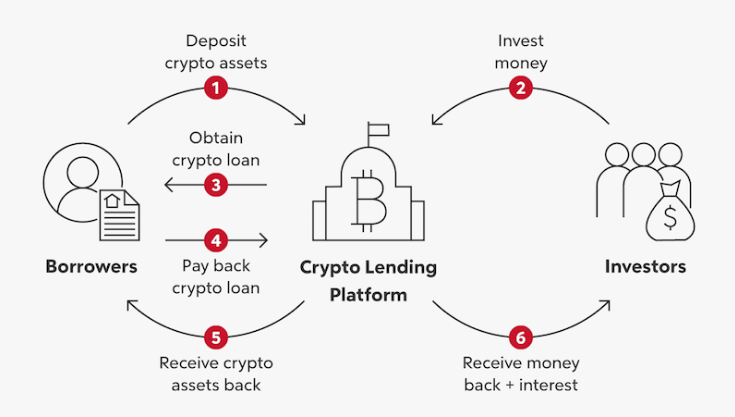
Crypto lending is a service within the decentralized finance (DeFi) ecosystem that enables investors to lend out their cryptocurrency holdings to borrowers. As a lender, you earn regular interest payments on your crypto deposits, similar to how you would earn interest in a traditional savings account.

Image Resource: www.rocketmortgage.com/learn/what-is-crypto-lending

Crypto lending platforms can either be centralized or decentralized, and they offer varying interest rates depending on the platform and other factors.

On the other hand, borrowers can use cryptocurrency lending platforms to obtain cash loans by collateralizing their crypto holdings. By posting collateral, borrowers can access funds without having to sell their crypto holdings, which can be beneficial during market downturns. 

How Does Crypto Lending Work?

To participate in crypto lending, you'll need to find a reputable platform that offers this service. There are several platforms out there, such as Nexo, BlockFi, and Celsius Network, to name a few.

Once you've found a platform you trust, the process is fairly straightforward. Here's a step-by-step guide to how crypto lending works:

Step 1: Create an Account - The first step in crypto lending is to create an account on the platform of your choice. This usually involves providing some personal information (KYC), such as your name and email address, and creating a password.

Step 2: Deposit Cryptocurrency - Next, you'll need to deposit cryptocurrency into your account. This will be the cryptocurrency that you use to lend or borrow funds.

Step 3: Choose a Lending or Borrowing Option - Once your account is set up and your cryptocurrency is deposited, you can choose whether you want to lend or borrow funds. If you're looking to lend, you can select a lending option that meets your needs. This may involve choosing the cryptocurrency you want to lend, the interest rate you want to charge, and the length of the loan term.

If you're looking to borrow, you can select a borrowing option that meets your needs. This may involve choosing the cryptocurrency you want to borrow, the interest rate you're willing to pay, and the length of the loan term.

Step 4: Wait for Approval - Once you've selected your lending or borrowing option, you'll need to wait for approval. This may involve a credit check or other verification process, depending on the platform you're using.

Step 5: Receive Funds - If you're approved, you'll receive the funds in your account. If you're lending, the borrower will receive the cryptocurrency they've borrowed. If you're borrowing, you'll receive the cryptocurrency you've borrowed.

Step 6: Make Payments - If you're borrowing, you'll need to make regular payments to repay the loan. This will usually involve paying interest on a monthly basis. If you're lending, you'll receive regular payments from the borrower, which will include the interest you've charged.

Step 7: Close the Loan - Once the loan term is over, you'll need to repay the full amount of the loan, plus any outstanding interest. If you're lending, you'll receive your cryptocurrency back, along with the interest you've earned. If you're borrowing, you'll need to repay the cryptocurrency you've borrowed. 

How to Make Money with Crypto Lending?

Crypto lending can be an effective way to earn passive income with your cryptocurrency holdings. Here are some important things to know, to make money with crypto lending:

  • Choose a reputable crypto lending platform: Selecting a reliable platform is crucial for successful crypto lending. Look for platforms with a proven track record, solid security measures, and transparent lending terms.
  • Determine your lending strategy: Decide on the amount of crypto you want to lend out and for how long. Longer lending periods often yield higher returns, but also carry more risk.
  • Set competitive interest rates: Set an interest rate that's competitive with other lending platforms. A higher rate may attract more borrowers, but also increases the risk of defaults.
  • Manage your risk: Conduct thorough due diligence on potential borrowers and keep a diversified portfolio to mitigate risk. Additionally, consider collateral requirements and loan-to-value ratios when selecting borrowers.
  • Reinvest your earnings: Reinvesting your earned interest can compound your returns over time, increasing your overall profits.

By following these tips, you can effectively make money with crypto lending while managing your risk and ensuring a stable return on your investment.

Also Read: How to Make Money with Cryptocurrency in 2023

Best Crypto Lending Platforms in 2023

Identifying the ideal lending platform that caters to your requirements can be a daunting task, given the vast number of options available in the market. To help you make an informed decision, we have curated a list of the best crypto lending platforms that you can consider in 2023.

Celsius Network: With over $20 billion in crypto assets under management, Celsius Network is a trusted and well-established platform for crypto lending. It offers competitive interest rates, ranging from 2.5% to 13.99%, depending on the cryptocurrency you lend and the loan duration.

BlockFi: BlockFi is another leading crypto lending platform that offers interest rates ranging from 0.5% to 8.6%, depending on the cryptocurrency and loan terms. It also provides additional services such as crypto-backed loans and a Bitcoin rewards credit card.

Nexo: Nexo is a popular platform for instant crypto loans, and it allows users to earn up to 12% interest on their crypto assets. It also provides a range of other features, such as crypto-backed loans and a credit card.

Crypto.com: Crypto.com is a leading cryptocurrency platform that offers interest rates of up to 8.5% on a range of cryptocurrencies, including Bitcoin, Ethereum, and stablecoins. It also provides other features such as a crypto debit card and an exchange platform.

When choosing a crypto lending platform, it's essential to consider factors such as the interest rates offered, the loan terms, and the platform's overall reputation and security measures. By selecting a reliable and trustworthy platform, you can ensure that your crypto lending investments are safe and profitable.

Benefits and Risks of Crypto Lending

Crypto lending has been gaining significant traction lately due to the potential benefits it offers to both lenders and borrowers. However, like any financial activity, there are also some inherent risks involved. 

Lets understand the benefits and risks associated with crypto lending in detail.

Crypto Lending Benefits

Here are some benefits of crypto lending:

High returns: One of the most significant advantages of crypto lending is the potential for high returns. Many lending platforms offer APYs upwards of 10%, which is significantly higher than traditional savings accounts.

Diversification: Crypto lending provides an opportunity for diversification in your investment portfolio, which can help mitigate risks.

Flexibility: Crypto lending platforms offer more flexibility than traditional financial institutions, with features such as short-term lending, early withdrawal options, and customized loan terms.

Risks Associated with Crypto Lending

Here are some risks associated with crypto lending:

Volatility: The crypto market is known for its volatility, which can impact the value of your investments and potentially lead to losses.

Counterparty risk: When lending your crypto assets to borrowers, there is always a risk that they may default on their loan, leading to a loss of your funds.

Security risks: Crypto lending platforms are not immune to hacking attempts, which can result in the loss of your funds.

The Bottom Line

Overall, crypto lending provides a win-win solution for both lenders and borrowers in the DeFi ecosystem. Lenders earn passive income on their crypto deposits, while borrowers can access much-needed funds without liquidating their cryptocurrency investments.

In conclusion, the crypto lending industry is rapidly expanding, and there are plenty of great options available for investors looking to earn passive income on their crypto holdings. Whether you choose Celsius Network, BlockFi, Nexo, YouHodler, or Crypto.com, it's crucial to conduct your due diligence and select a platform that meets your specific needs and goals.

Disclaimer

The information provided on this website does not constitute investment advice, financial advice, trading advice, or any other sort of advice and you should not treat any of the website's content as such.

Token Metrics does not recommend that any cryptocurrency should be bought, sold, or held by you. Do conduct your own due diligence and consult your financial advisor before making any investment decisions.

Choose from Platinum, Gold, and Silver packages
Reach with 25–30% open rates and 0.5–1% CTR
Craft your own custom ad—from banners to tailored copy
Perfect for Crypto Exchanges, SaaS Tools, DeFi, and AI Products