Back to blog
Research

How Do You Implement Multi-Signature Wallets? A Complete 2025 Guide

Learn how to implement multi-signature wallets securely with our comprehensive guide, enhancing your crypto asset protection through strategic configurations and best practices.
Token Metrics Team
8
Want Smarter Crypto Picks—Free?
See unbiased Token Metrics Ratings for BTC, ETH, and top alts.
Thank you! Your submission has been received!
Oops! Something went wrong while submitting the form.
 No credit card | 1-click unsubscribe

Multi-signature wallets represent one of the most powerful security innovations in cryptocurrency, providing enhanced protection against theft, loss, and unauthorized access. As digital assets become increasingly valuable and institutional adoption accelerates, understanding how to implement multi-signature (multisig) solutions has become essential for serious cryptocurrency holders. Whether you're managing organizational treasury funds, protecting family wealth, or simply seeking maximum security for substantial holdings, multisig wallets offer unparalleled control and redundancy.

Understanding Multi-Signature Wallet Technology

A multi-signature wallet requires multiple private keys to authorize a transaction, rather than the single key used in standard wallets. This distributed control model is typically expressed as "M-of-N," where N represents the total number of keys and M represents the minimum number required to authorize transactions.

For example, a 2-of-3 multisig wallet has three total keys, but only two are needed to move funds. This configuration provides security against single key compromise while offering recovery options if one key is lost. The cryptographic implementation occurs at the blockchain protocol level, meaning transaction authorization requirements are enforced by the network itself, not by centralized services.

The beauty of multisig lies in eliminating single points of failure. Even if an attacker compromises one key through hacking, phishing, or physical theft, they cannot access funds without obtaining additional keys stored in separate locations with different security measures.

Common Multi-Signature Configurations

  • 2-of-2 Multisig: This configuration requires both keys to authorize transactions, providing maximum security but no redundancy. Suitable for partnerships where both parties must approve every transaction. However, losing either key permanently locks funds, making this setup risky without proper backup strategies.
  • 2-of-3 Multisig: The most popular configuration balances security and practicality. You might keep one key on a hardware wallet at home, another in a safe deposit box, and a third with a trusted family member or professional custodian. Any two keys authorize transactions, so losing one key doesn't create catastrophic loss. This setup protects against theft (attacker needs two separate keys) while providing recovery options.
  • 3-of-5 Multisig: Organizations often use this configuration, distributing keys among multiple executives or board members. It requires broader consensus for transactions while tolerating loss of up to two keys. The increased complexity matches the higher stakes of organizational treasury management.
  • Advanced Custom Configurations: Advanced users implement schemes like 4-of-7 or 5-of-9 for maximum security and redundancy. These complex arrangements suit high-value holdings, institutional custody, or scenarios requiring distributed governance. However, operational complexity increases proportionally—more keys mean more coordination and management overhead.

Choosing the Right Multi-Signature Wallet Solution

Hardware-Based Solutions

Ledger and Trezor both support multisig configurations, allowing you to use multiple hardware wallets as cosigners. This approach keeps private keys isolated on secure hardware while enabling distributed control. Setting up hardware-based multisig typically involves initializing multiple devices, creating a multisig wallet through compatible software, and registering each hardware wallet as a cosigner.

Coldcard particularly excels for Bitcoin multisig, offering air-gapped security and extensive multisig features. Its advanced capabilities suit security-conscious users willing to navigate more complex setup procedures for maximum protection.

Software Coordinators

While keys should reside on hardware wallets, coordinator software manages multisig wallet creation and transaction building. Electrum provides robust Bitcoin multisig support with straightforward setup procedures. Sparrow Wallet offers excellent multisig features with superior user experience and advanced capabilities.

For Ethereum and ERC-20 tokens, Gnosis Safe (formerly Gnosis Multisig) has become the industry standard, particularly for DeFi treasury management. Its web interface simplifies multisig operations while maintaining security through hardware wallet integration.

Blockchain-Specific Considerations

Bitcoin's native multisig support through P2SH (Pay-to-Script-Hash) and P2WSH (Pay-to-Witness-Script-Hash) addresses provides robust, time-tested functionality. Ethereum implements multisig through smart contracts, offering more flexibility but requiring gas for deployment and transactions.

Other blockchains like Solana, Cardano, and Polkadot each have unique multisig implementations. Research your specific blockchain's multisig capabilities before committing to particular solutions.

Step-by-Step Implementation Process

Planning Your Configuration

Begin by determining the appropriate M-of-N configuration for your needs. Consider security requirements, number of parties involved, operational frequency, and recovery scenarios. Document your security model clearly, including who controls which keys and under what circumstances transactions should be authorized.

Acquiring Hardware Wallets

Purchase the necessary hardware wallets directly from manufacturers. For a 2-of-3 setup, you need three separate hardware wallets. Never reuse the same device or seed phrase—each cosigner must have completely independent keys.

Initializing Individual Wallets

Set up each hardware wallet independently, generating unique seed phrases for each device. Record seed phrases on durable materials and store them in separate secure locations. Never digitize seed phrases or store multiple phrases together.

Creating the Multisig Wallet

Using your chosen coordinator software, create the multisig wallet by registering each hardware wallet as a cosigner. The software will request the public key or extended public key (xpub) from each device—note that you're sharing public keys only, not private keys.

The coordinator generates the multisig address where funds will be stored. This address is cryptographically linked to all registered cosigner public keys, ensuring only transactions signed with the required number of private keys will be accepted by the blockchain.

Testing with Small Amounts

Before transferring substantial funds, thoroughly test your multisig setup. Send a small amount to the multisig address, then practice creating and signing transactions with the required number of keys. Verify you can successfully move funds out of the wallet before trusting it with significant amounts.

Test recovery scenarios by attempting to transact using different combinations of keys. Ensure you understand the complete transaction signing workflow and that all cosigners can successfully participate.

Making Strategic Decisions with Professional Analytics

Implementing multisig security is just one component of successful cryptocurrency management. Making informed decisions about which assets to hold, when to rebalance, and how to optimize your portfolio requires sophisticated analytical capabilities.

Discover Crypto Gems with Token Metrics AI

Operational Best Practices

Key Distribution Strategy

Distribute keys across multiple physical locations with different security profiles. Never store multiple keys in the same location—this defeats the purpose of multisig. Consider geographic distribution to protect against localized disasters like fires or floods.

For keys held by different individuals, ensure clear communication protocols exist. Everyone involved should understand their responsibilities, how to recognize legitimate transaction requests, and procedures for emergency situations.

Transaction Workflow

Establish clear processes for initiating, reviewing, and signing transactions. Who can propose transactions? What review occurs before cosigners add signatures? How are urgent situations handled? Documented workflows prevent confusion and ensure all parties understand their roles.

Use the coordinator software to create transactions, which are then presented to cosigners for review and signature. Each cosigner independently verifies transaction details before signing with their private key. Only after collecting the required number of signatures is the transaction broadcast to the blockchain.

Regular Audits and Drills

Periodically verify all keys remain accessible and functional. Practice the complete transaction signing process quarterly or semi-annually to ensure everyone remembers procedures and that all hardware and software remain compatible and updated.

Test recovery scenarios where one or more keys become unavailable. Verify you can still access funds using alternative key combinations. These drills identify potential issues before emergencies occur.

Security Considerations

Protecting Against Internal Threats

While multisig protects against external attackers, consider internal threats. In a 2-of-3 configuration, any two key holders could collude to steal funds. Select cosigners carefully and consider configurations requiring more keys for higher-value holdings.

Software and Hardware Updates

Keep coordinator software and hardware wallet firmware updated to patch security vulnerabilities. However, test updates on small amounts before applying them to wallets holding substantial funds. Occasionally, updates introduce compatibility issues that could temporarily lock access.

Backup and Recovery Documentation

Create comprehensive documentation of your multisig setup, including the configuration type, which hardware wallets serve as cosigners, extended public keys, and the multisig address itself. Store this information separately from seed phrases—someone recovering your wallet needs this metadata to reconstruct the multisig configuration.

Common Pitfalls to Avoid

Never store multiple seed phrases together, as this recreates single point of failure vulnerabilities. Don't skip testing phases—discover operational issues with small amounts rather than substantial holdings. Avoid overly complex configurations that create operational difficulties, and ensure at least one other trusted person understands your multisig setup for inheritance purposes.

Advanced Features and Future Developments

Modern multisig solutions increasingly incorporate time-locks, spending limits, and white-listing features. Smart contract-based multisig wallets on Ethereum offer programmable conditions like daily spending caps, recovery mechanisms after extended inactivity, and role-based permissions.

Emerging developments include social recovery mechanisms where trusted contacts can help recover wallets, threshold signature schemes (TSS) that improve privacy and efficiency compared to traditional multisig, and standardization efforts making multisig more accessible across different blockchains and wallet providers.

Conclusion

Implementing multi-signature wallets significantly enhances cryptocurrency security by eliminating single points of failure and providing recovery options. While setup requires more effort than standard wallets, the protection multisig offers for substantial holdings justifies the additional complexity.

By carefully planning your configuration, using quality hardware wallets, following proper operational procedures, and leveraging professional platforms like Token Metrics for strategic decision-making, you can build a robust security framework that protects your digital assets while maintaining practical accessibility.

In an ecosystem where theft and loss are permanent and irreversible, multisig represents best practice for serious cryptocurrency holders who refuse to gamble with their financial future.

Build Smarter Crypto Apps &
AI Agents in Minutes, Not Months
Real-time prices, trading signals, and on-chain insights all from one powerful API.
Grab a Free API Key
About Token Metrics
Token Metrics: AI-powered crypto research and ratings platform. We help investors make smarter decisions with unbiased Token Metrics Ratings, on-chain analytics, and editor-curated “Top 10” guides. Our platform distills thousands of data points into clear scores, trends, and alerts you can act on.
30 Employees
analysts, data scientists, and crypto engineers
Daily Briefings
concise market insights and “Top Picks”
Transparent & Compliant
Sponsored ≠ Ratings; research remains independent
Want Smarter Crypto Picks—Free?
See unbiased Token Metrics Ratings for BTC, ETH, and top alts.
Thank you! Your submission has been received!
Oops! Something went wrong while submitting the form.
 No credit card | 1-click unsubscribe
Token Metrics Team
Token Metrics Team

Recent Posts

Crypto Basics

Understanding the Altcoin Season Index: Your Complete Guide to Altcoin Market Dominance

Token Metrics Team
6 min

Click here to trade cryptos at MEXC!

The cryptocurrency market operates in distinct cycles, with periods where Bitcoin dominates and others where alternative cryptocurrencies (altcoins) take center stage. Understanding when these shifts occur is crucial for successful crypto trading and investment. The Altcoin Season Index has emerged as the definitive metric for identifying these market transitions, providing traders and investors with essential insights into optimal timing for altcoin investments.

What is the Altcoin Season Index?

The Altcoin Season Index is a sophisticated metric that measures the relative performance of altcoins compared to Bitcoin over specific time periods. This indicator serves as a market sentiment gauge, helping traders identify when alternative cryptocurrencies are outperforming Bitcoin and whether the market has entered what's known as "Altcoin Season."

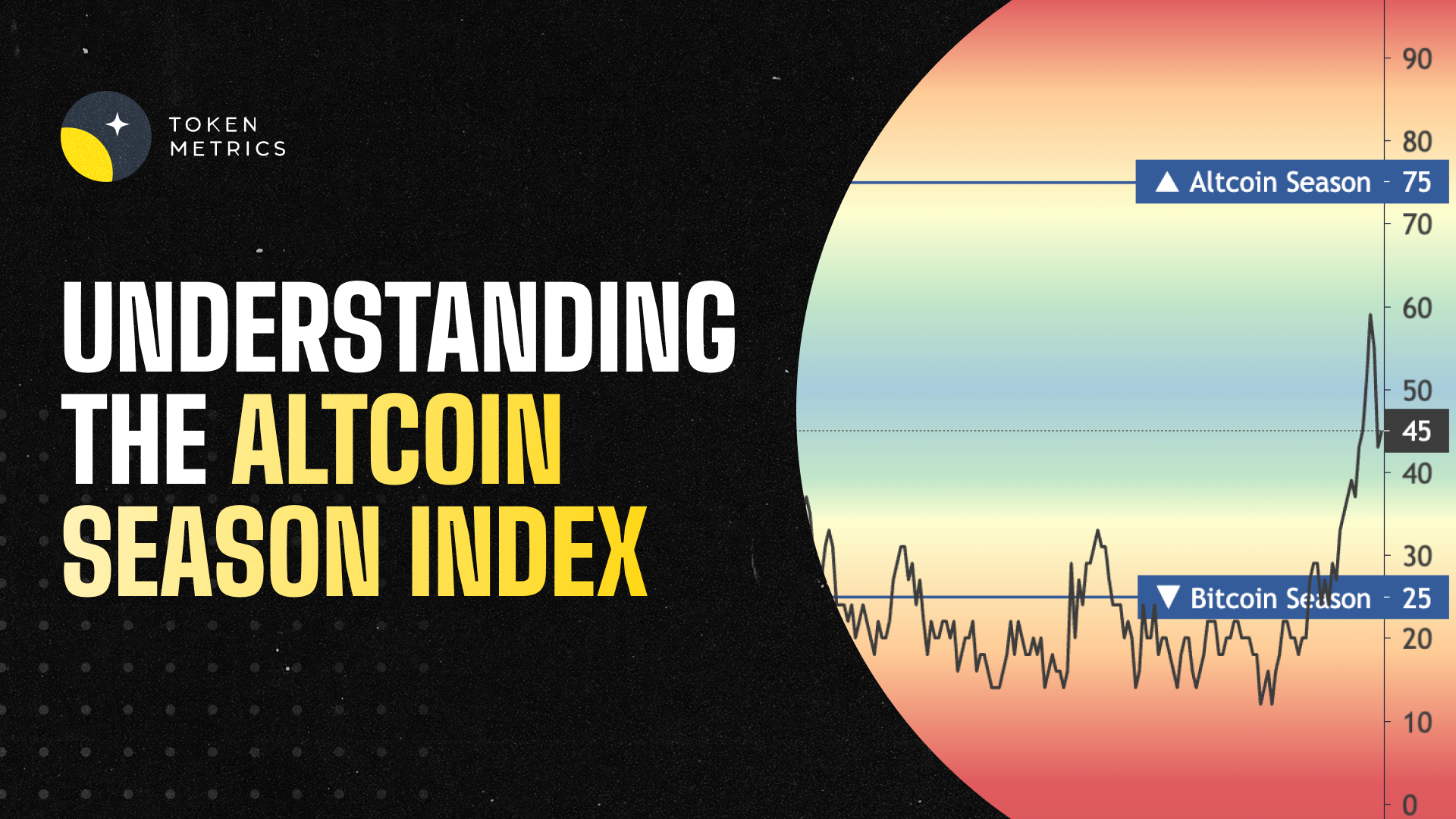
The index uses the top 100 coins ranked on CMC (excluding stablecoins and wrapped tokens) and compares them based on their rolling 90-day price performances. If 75% of the top 100 coins outperform Bitcoin in the last 90 days, it's Altcoin Season. Conversely, if only 25% or fewer altcoins outperform Bitcoin, the market is considered to be in "Bitcoin Season."

The methodology behind this index is straightforward yet effective. By analyzing the performance of the top-ranked cryptocurrencies against Bitcoin's price movements, the index creates a percentage score ranging from 0 to 100. A score above 75 indicates strong altcoin dominance, while a score below 25 suggests Bitcoin is leading the market.

How the Altcoin Season Index Works?

The calculation process involves several key components that ensure accuracy and relevance. Stablecoins like Tether and DAI, as well as asset-backed tokens (e.g., WBTC, stETH, cLINK), are excluded. This exclusion ensures that the index focuses on genuine price appreciation rather than pegged assets or derivatives.

Different platforms may use slightly varying methodologies. If 75% of the Top 50 coins performed better than Bitcoin over the last season (90 days) it is Altcoin Season. Some platforms focus on the top 50 cryptocurrencies, while others extend to the top 100, but the core principle remains consistent across all implementations.

The 90-day rolling window provides sufficient data to identify meaningful trends while remaining responsive to recent market movements. This timeframe helps filter out short-term volatility and focuses on sustained performance patterns that indicate genuine market shifts.

Current Market Status and Recent Trends

As of mid-2025, the cryptocurrency market is experiencing significant dynamics that reflect the utility of the Altcoin Season Index. The cryptocurrency market shows strong bullish momentum halfway through 2025, with Bitcoin reaching record highs near $122,946.00. This unprecedented Bitcoin performance has created interesting market conditions for altcoin investors.

Recent data shows varying altcoin performance across different categories. As of July 21, 2025, Stellar (XLM) is leading the pack, surging 74% for the week to trade at $0.527. Cardano (ADA) is up 23% at $1.004, and Ripple (XRP) has gained 21% this week to reach $3.92. These gains demonstrate that certain altcoins can achieve significant outperformance even during periods of strong Bitcoin dominance.

The market appears to be in a transitional phase. BTC dominance: ~60–61.5%—declining but not yet low enough. There is a strong interest in major alternative cryptocurrencies (alts) and large-cap coins. Into early/mid-phase alt season, not for quick whale-level meme pumps yet. This suggests that while we're not in full altcoin season, the conditions are developing for increased altcoin outperformance.

Click here to trade cryptos at MEXC!

Historical Context and Market Cycles

Understanding historical altcoin seasons provides valuable context for current market conditions. The most notable altcoin season occurred in 2021, when the convergence of multiple factors created optimal conditions for alternative cryptocurrency growth. During this period, BTC's market dominance dropped from 70% to 38%, while the total market capitalization doubled from 30% to 62%. The altcoin season index hit 98 on April 16, 2021.

This historical precedent demonstrates the potential magnitude of altcoin seasons. When market conditions align, the shift from Bitcoin dominance to altcoin outperformance can be dramatic and sustained. The 2021 altcoin season was fueled by institutional adoption, decentralized finance (DeFi) growth, and the NFT boom, creating a perfect storm for alternative cryptocurrency appreciation.

Recent market activity has shown signs of renewed altcoin interest. The Altcoin Season Index, a widely tracked metric on CoinMarketCap (CMC), surged seven points to reach 84 on December 3, 2024. While this was a temporary spike, it demonstrated that altcoin seasons can emerge quickly when market conditions shift.

The Role of AI and Advanced Analytics in Altcoin Trading

Modern altcoin trading has been revolutionized by artificial intelligence and advanced analytics platforms. Token Metrics stands at the forefront of this technological evolution, providing traders with unprecedented insights into altcoin markets. Trade and invest crypto with Token Metrics—your AI-powered platform for crypto trading, research, and data analytics.

The platform's sophisticated approach to market analysis sets it apart from traditional trading tools. Token Metrics scans 6,000+ tokens daily and gives each one a score based on technical analysis, on-chain data, fundamental metrics, sentiment and social data, and exchange data. This comprehensive analysis ensures that traders have access to multi-dimensional insights that go far beyond simple price movements.

Token Metrics' AI-driven methodology provides particular value during altcoin seasons. Token Metrics has developed an AI-powered rating system that scans the market 24/7, analyzing over 80 data points per token. Their Moonshots tab is designed specifically for users looking to spot early-stage altcoins before they break out. This capability is crucial for capitalizing on altcoin season opportunities, as the window for maximum gains often occurs in the early stages of market shifts.

Strategic Applications for Traders and Investors

The Altcoin Season Index serves multiple strategic purposes for different types of market participants. For swing traders, the index provides timing signals for portfolio rebalancing. When the index begins climbing toward 75, it may signal an opportune time to increase altcoin exposure while reducing Bitcoin allocation.

Long-term investors can use the index to identify accumulation opportunities. During Bitcoin seasons (index below 25), quality altcoins often trade at relative discounts, presenting attractive entry points for patient investors. This contrarian approach can be particularly effective when combined with fundamental analysis of individual projects.

Day traders benefit from understanding index trends to gauge market sentiment and momentum. Token Metrics' AI-driven platform exemplifies this shift, enabling traders to analyze market sentiment and identify patterns that human traders might overlook. Real-time sentiment analysis becomes crucial during transitional periods when the index hovers around the 50 mark.

Portfolio managers can use the index as a risk management tool. Sharp increases in the index during established bull markets may signal overheated conditions, suggesting the need for profit-taking or risk reduction. Conversely, low index readings during bear markets might indicate oversold conditions and potential accumulation opportunities.

Click here to trade cryptos at MEXC!

Risk Management and Market Considerations

While the Altcoin Season Index provides valuable insights, it should not be used in isolation. Market conditions can change rapidly, and the 90-day rolling window means the index may lag sudden market shifts. Traders should combine index signals with other technical and fundamental analysis tools for comprehensive market assessment.

Regulatory developments, macroeconomic factors, and technological breakthroughs can all influence altcoin performance independently of historical patterns. The index should be viewed as one component of a broader analytical framework rather than a definitive trading signal.

Market manipulation and coordinated activities can temporarily skew individual altcoin performance, potentially affecting index calculations. This risk is mitigated by focusing on the top-ranked cryptocurrencies, but traders should remain aware of potential anomalies in index readings.

The Future of Altcoin Season Analysis

The evolution of altcoin markets continues to accelerate, driven by technological innovation and institutional adoption. AI-powered platforms like Token Metrics are becoming essential tools for navigating this complexity. Token Metrics, an AI-powered platform, consolidates research, portfolio management, and trading signals into a unified ecosystem.

As the cryptocurrency market matures, the dynamics underlying altcoin seasons may evolve. Increased institutional participation, regulatory clarity, and technological developments in blockchain infrastructure could create new patterns in altcoin performance cycles. The Altcoin Season Index will likely adapt to incorporate these changing market dynamics.

The integration of artificial intelligence and machine learning into market analysis represents the next frontier in cryptocurrency trading. These technologies can process vast amounts of data in real-time, identifying subtle patterns and correlations that human analysts might miss. This capability becomes particularly valuable during volatile market conditions when rapid decision-making is crucial.

Conclusion

The Altcoin Season Index has established itself as an indispensable tool for cryptocurrency traders and investors seeking to optimize their market timing and portfolio allocation. By providing clear, quantifiable metrics for measuring altcoin performance relative to Bitcoin, the index removes much of the guesswork from market cycle identification.

Success in altcoin trading requires more than just understanding market cycles; it demands sophisticated analytical tools and real-time data processing capabilities. Token Metrics represents the pinnacle of AI-driven cryptocurrency analysis, offering traders the advanced insights necessary to capitalize on altcoin season opportunities.

As the cryptocurrency market continues to evolve and mature, the combination of proven indicators like the Altcoin Season Index with cutting-edge AI analysis platforms will become increasingly important for sustained trading success. The future belongs to traders who can effectively combine traditional market wisdom with modern technological capabilities, positioning themselves to capture the significant opportunities that altcoin seasons provide.

Whether you're a seasoned trader or new to cryptocurrency markets, understanding and utilizing the Altcoin Season Index, supported by advanced analytics platforms like Token Metrics, will be crucial for navigating the complex and rewarding world of altcoin investing. The key lies in combining these powerful tools with sound risk management principles and a deep understanding of the underlying market dynamics that drive cryptocurrency performance cycles.

Click here to trade cryptos at MEXC!

Crypto Basics

What Are Altcoins? A Complete Guide to Alternative Cryptocurrencies in 2025

Token Metrics Team
6 min

The cryptocurrency landscape has evolved dramatically since Bitcoin's inception in 2009. While Bitcoin remains the dominant digital currency, thousands of alternative cryptocurrencies, commonly known as "altcoins," have emerged to challenge its supremacy and offer unique solutions to various blockchain problems. Understanding altcoins is crucial for anyone looking to navigate the complex world of digital assets and cryptocurrency investing.

What Are Altcoins? Definition and Basic Concepts

Altcoins, short for "alternative coins," refer to any cryptocurrency that is not Bitcoin. The term encompasses all digital currencies developed after Bitcoin, regardless of their underlying technology, purpose, or market capitalization. From Ethereum's smart contract capabilities to Dogecoin's meme-inspired origins, altcoins represent the diverse evolution of blockchain technology beyond Bitcoin's original peer-to-peer electronic cash system.

The altcoin ecosystem emerged as developers recognized Bitcoin's limitations and sought to create improved versions or entirely different applications of blockchain technology. While Bitcoin established the foundation for decentralized digital currency, altcoins have expanded the possibilities to include smart contracts, faster transaction speeds, enhanced privacy features, and specialized use cases across various industries.

The History and Evolution of Altcoins

The first altcoin, Namecoin, launched in April 2011, introducing the concept of a decentralized domain name system. This marked the beginning of cryptocurrency diversification beyond Bitcoin's monetary focus. Litecoin followed in October 2011, promising faster transaction times and a different mining algorithm, earning the nickname "silver to Bitcoin's gold."

The real altcoin revolution began with Ethereum's launch in 2015, introducing smart contracts and enabling developers to build decentralized applications (dApps) on its blockchain. This innovation sparked the creation of thousands of new altcoins, each attempting to solve specific problems or serve particular market segments. The Initial Coin Offering (ICO) boom of 2017 further accelerated altcoin development, though it also led to numerous failed projects and regulatory scrutiny.

Types of Altcoins: Understanding the Categories

Utility Tokens

Utility tokens provide access to specific services or functions within a blockchain ecosystem. Examples include Chainlink (LINK), which powers decentralized oracle networks, and Basic Attention Token (BAT), used within the Brave browser ecosystem. These tokens derive value from their practical applications rather than serving primarily as stores of value.

Security Tokens

Security tokens represent ownership stakes in real-world assets or companies, similar to traditional securities but issued on blockchain platforms. They're subject to securities regulations and often provide dividends or voting rights to holders.

Stablecoins

Stablecoins are designed to maintain stable value by pegging to external assets like the US dollar, gold, or other commodities. Popular examples include Tether (USDT), USD Coin (USDC), and DAI. These coins serve as bridges between traditional finance and cryptocurrency markets, providing stability for trading and commerce.

Privacy Coins

Privacy-focused altcoins like Monero (XMR) and Zcash (ZEC) offer enhanced anonymity features, making transactions more difficult to trace compared to Bitcoin's pseudo-anonymous nature. These coins use advanced cryptographic techniques to protect user privacy.

Meme Coins

Meme coins like Dogecoin (DOGE) and Shiba Inu (SHIB) originated from internet memes but have gained significant market value and community support. While often dismissed as jokes, some meme coins have developed legitimate use cases and ecosystems.

How Altcoins Differ from Bitcoin

While Bitcoin focuses primarily on being a decentralized digital currency and store of value, altcoins often target specific problems or improvements. Key differences include:

Transaction Speed and Scalability: Many altcoins offer faster transaction processing times than Bitcoin's 10-minute block time. Solana can process thousands of transactions per second, while Bitcoin handles approximately seven.

Energy Efficiency: Bitcoin's Proof-of-Work consensus mechanism requires significant energy consumption. Many altcoins use alternative consensus mechanisms like Proof-of-Stake, which consume far less energy.

Smart Contract Functionality: Unlike Bitcoin's limited scripting capabilities, platforms like Ethereum, Cardano, and Solana enable complex smart contracts and decentralized applications.

Governance Models: Some altcoins incorporate on-chain governance systems, allowing token holders to vote on protocol changes and upgrades directly.

Popular Altcoins and Their Use Cases

Ethereum (ETH)

Ethereum remains the second-largest cryptocurrency by market capitalization and the leading smart contract platform. Its ecosystem hosts thousands of decentralized applications, from decentralized finance (DeFi) protocols to non-fungible token (NFT) marketplaces.

Binance Coin (BNB)

Originally created as a utility token for the Binance exchange, BNB has evolved into the native token of the BNB Chain ecosystem, supporting various DeFi applications and services.

Cardano (ADA)

Cardano positions itself as a research-driven blockchain platform focusing on sustainability, scalability, and peer-reviewed development. It uses a Proof-of-Stake consensus mechanism and emphasizes formal verification methods.

Solana (SOL)

Solana has gained attention for its high-speed, low-cost transactions, making it popular for DeFi applications, NFTs, and Web3 projects. Its unique Proof-of-History consensus mechanism enables exceptional throughput.

Polkadot (DOT)

Polkadot focuses on interoperability, allowing different blockchains to communicate and share information. Its parachain architecture enables specialized blockchains to connect to the main Polkadot network.

Benefits and Advantages of Altcoins

Altcoins offer several advantages over Bitcoin and traditional financial systems:

Innovation and Specialization: Altcoins can focus on specific use cases, from supply chain management to gaming, offering tailored solutions for various industries.

Lower Transaction Costs: Many altcoins provide significantly lower transaction fees compared to Bitcoin, making them more practical for everyday use and microtransactions.

Faster Processing Times: Improved consensus mechanisms and network architectures enable faster transaction confirmation times.

Enhanced Features: Smart contract capabilities, privacy features, and governance mechanisms expand the possibilities beyond simple value transfer.

Investment Opportunities: The altcoin market offers diverse investment opportunities with potentially higher returns, though with correspondingly higher risks.

Risks and Challenges of Investing in Altcoins

While altcoins present exciting opportunities, they also carry significant risks:

Higher Volatility: Altcoins often experience more dramatic price swings than Bitcoin, leading to potential for both substantial gains and losses.

Lower Liquidity: Many altcoins have lower trading volumes, making it potentially difficult to buy or sell large amounts without affecting the price.

Regulatory Uncertainty: Changing regulations could significantly impact altcoin values and usability, particularly for privacy coins and utility tokens.

Technology Risks: Newer blockchain technologies may contain bugs, vulnerabilities, or design flaws that could compromise security or functionality.

Market Manipulation: Smaller market capitalizations make some altcoins susceptible to manipulation by large holders or coordinated trading groups.

How to Evaluate and Choose Altcoins

When considering altcoin investments, several factors deserve careful evaluation:

Project Fundamentals: Examine the underlying technology, use case, and problem the altcoin aims to solve. Strong fundamentals indicate long-term viability.

Development Team: Research the experience and track record of the development team and advisors behind the project.

Community and Adoption: Active communities and real-world adoption indicate healthy project ecosystems and potential for growth.

Market Metrics: Analyze market capitalization, trading volume, and token distribution to understand the project's market position.

Partnerships and Integrations: Strategic partnerships with established companies or platforms can indicate legitimacy and growth potential.

The Future of Altcoins

The altcoin landscape continues evolving as blockchain technology matures and finds new applications. Key trends shaping the future include:

Interoperability Solutions: Projects focusing on connecting different blockchains will likely gain importance as the multi-chain future develops.

Central Bank Digital Currencies (CBDCs): Government-issued digital currencies may compete with or complement existing altcoins.

Environmental Sustainability: Eco-friendly consensus mechanisms and carbon-neutral projects will likely become increasingly important.

Institutional Adoption: As institutions embrace cryptocurrency, they may diversify beyond Bitcoin into altcoins with specific utility or superior technology.

Regulatory Clarity: Clear regulations will help legitimate projects thrive while eliminating fraudulent or non-compliant tokens.

Conclusion

Altcoins represent the innovative frontier of cryptocurrency, offering diverse solutions beyond Bitcoin's original vision of peer-to-peer electronic cash. From Ethereum's smart contracts to Solana's high-speed transactions, altcoins continue pushing the boundaries of blockchain technology and digital asset utility.

While altcoins present exciting opportunities for innovation and investment, they also carry significant risks that require careful consideration. Success in the altcoin space demands thorough research, risk management, and understanding of the underlying technologies and market dynamics.

As the cryptocurrency ecosystem matures, altcoins will likely play crucial roles in shaping the future of finance, technology, and digital interaction. Whether you're an investor, developer, or simply curious about cryptocurrency evolution, understanding altcoins is essential for navigating the digital asset landscape of tomorrow.

Crypto Basics

Crypto Trading: Understanding the Price of Altcoins

Token Metrics Team
6 min

In the dynamic world of crypto trading, understanding the price of altcoins is crucial for anyone looking to trade cryptocurrency effectively. Altcoins, or alternative cryptocurrencies to Bitcoin, play a significant role in the cryptocurrency market, offering diverse opportunities for traders and investors. Cryptocurrency is a digital or virtual currency that operates on distributed ledger technology called a blockchain and uses cryptography for security. This article will explore the factors influencing altcoin prices, how traders can predict price movements, and the strategies to trade crypto assets successfully on various crypto platforms.

Factors Influencing the Price of Altcoins

The price of altcoins is influenced by multiple factors that interact within the broader cryptocurrency market. Unlike traditional currencies issued by a central bank, altcoins operate on decentralized blockchain technology, which adds a unique layer of complexity to their value changes. One of the primary drivers of altcoin prices is market trends, which reflect the overall sentiment and behavior of traders in the crypto market.

Cryptocurrency trading is notoriously volatile, meaning price trends can shift rapidly due to news, regulatory changes, technological developments, or shifts in market conditions. For example, the launch of new features on a blockchain network or advancements in cryptocurrency mining can create opportunities arise for altcoins to gain value. Additionally, the liquidity of an altcoin on cryptocurrency exchanges affects its price; altcoins with high liquidity tend to have more stable price movements compared to those with low liquidity.

Another critical factor is the comparison to traditional markets and fiat currency values such as the US dollar. Since altcoins are often traded against fiat currencies or major cryptocurrencies like bitcoin and bitcoin cash, fluctuations in these values can directly impact altcoin prices. Traders also need to consider the impact of supply and demand dynamics within the crypto exchange platforms where these digital assets are bought and sold.

Predicting Price Movements in Altcoin Trading

To trade crypto effectively, it is essential to predict price movements accurately. Day traders and other market participants use various methods to recognize patterns and forecast price trends. Technical analysis is one of the most widely used tools, involving the study of historical price data, chart patterns, and indicators to identify optimal entry and exit points in the market.

By analyzing price trends and market conditions, traders can place limit orders on a crypto exchange to buy or sell altcoins at desired prices, helping manage risk and maximize profits. Effective risk management strategies are necessary to mitigate potential losses in trading. A good understanding of how value changes in digital currency markets occur can help traders develop strategies that align with their risk tolerance and investment goals.

Unlike traditional currencies, the crypto market operates 24/7, providing continuous opportunities for trading. This round-the-clock nature, combined with the high volatility of altcoins, means that traders must stay vigilant and informed to capitalize on favorable price movements.

Strategies for Trading Altcoins on Crypto Platforms

Successfully trading altcoins requires a combination of knowledge, strategy, and the right tools. First and foremost, traders need to select a reliable crypto platform or cryptocurrency exchange that offers low fees, high liquidity, and robust security measures to protect their crypto account and digital assets. Trusted platforms like Gemini, Binance, and Coinbase adhere to local and international laws, providing secure and legal trading environments.

Day trading is a popular approach in the crypto market, where traders buy and sell altcoins within short time frames to capitalize on price volatility. Day trading is the business of trading assets within the same day to gain small profits from temporary price fluctuations. This strategy demands a high risk tolerance and the ability to quickly analyze market trends and execute trades efficiently.

For those new to cryptocurrency trading, it is advisable to dive deeper into understanding the fundamentals of blockchain technology and how different altcoins function within their respective blockchain networks. Successful traders often invest in their education and practice to refine their strategies and skills. This knowledge can provide insights into the potential long-term value of various crypto assets.

Moreover, traders should diversify their portfolios by including multiple altcoins alongside well-established cryptocurrencies like bitcoin. This diversification helps mitigate risk and take advantage of different market opportunities.

Conclusion

The price of altcoins in the cryptocurrency market is influenced by a complex interplay of factors ranging from market trends and liquidity to technological developments and regulatory environments. To trade crypto successfully, it is essential to develop a good understanding of these elements, utilize technical analysis to predict price movements, and adopt strategies that suit individual risk tolerance and market conditions.

Whether you are looking to buy cryptocurrencies for the first time or are an experienced trader aiming to optimize your crypto journey, staying informed and choosing the right crypto platform can significantly enhance your ability to earn rewards and profits in this notoriously volatile market. By recognizing patterns, managing risk, and leveraging the unique features of digital currencies, traders can navigate the exciting world of altcoin trading with confidence and success.

Choose from Platinum, Gold, and Silver packages
Reach with 25–30% open rates and 0.5–1% CTR
Craft your own custom ad—from banners to tailored copy
Perfect for Crypto Exchanges, SaaS Tools, DeFi, and AI Products