Token Metrics API

How to Build Crypto Trading Dashboard Using the Token Metrics Crypto Data API on Dune

Use the Token Metrics Crypto Data API with Dune to create live trading dashboards using the best crypto API. Analyze top tokens, bullish signals, and trading alpha today.
Token Metrics Team
8 min
MIN

In today’s fast-paced crypto world, real-time data isn’t a luxury—it’s a necessity. For traders, analysts, and developers, being able to access live, actionable insights can mean the difference between profit and loss. That’s why the integration of the Token Metrics Crypto Data API with Dune is a game-changer for anyone seeking to create live dashboards backed by intelligent trading data.

In this post, we’ll walk through how to use this top crypto API to build dynamic dashboards on Dune. Whether you’re tracking bullish signals, backtesting trading strategies, or identifying top-performing tokens, this integration makes it possible—without any paid license.

Let’s dive into how you can use the best free crypto API available today to transform your trading.

What Is the Token Metrics Crypto Data API?

The Token Metrics Crypto Data API is a developer-focused gateway to powerful, AI-driven crypto data. It’s one of the top crypto APIs in 2025, giving you access to:

  • Real-time and historical trading signals
  • Proprietary trader and investor grades
  • Alpha metrics comparing trading vs. holding performance
  • Bullish and bearish token flags

This API is used by both professional quant traders and beginners seeking to automate insights. And the best part? Token Metrics provides free crypto API access to selected datasets, allowing you to create powerful dashboards without spending a dime.

Why Dune + Token Metrics API = Power Tools for Traders

Dune is a blockchain analytics platform that allows you to write SQL queries and create dashboards using on-chain and off-chain data. Now that Token Metrics datasets are available on Dune, you can combine the best of both worlds:

  • Free access to high-signal proprietary metrics
  • Real-time data visualizations via Dune’s drag-and-drop dashboard builder
  • Actionable insights based on AI-driven trading intelligence

This integration unlocks a whole new level of transparency and utility for crypto analysts, portfolio managers, and DeFi enthusiasts.

Getting Started: Accessing Token Metrics Data on Dune

To begin, create a free Dune account. Once logged in, navigate to the Token Metrics datasets. These are publicly accessible and updated regularly. You’ll find tables for:

  • trading_signals
  • trader_grades
  • investors_grades
  • tokens

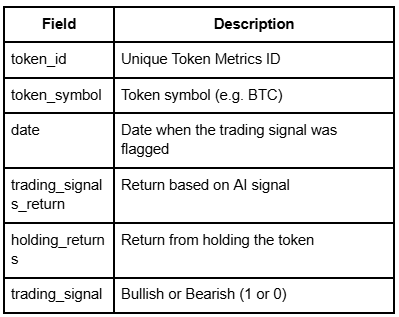
Start a new SQL query and choose the dataset you want to explore. Here’s what you’ll find in the trading signals table:
‍

‍

Step-by-Step: Creating an Actionable Dashboard with Token Metrics Data

1. Query the Trading Signal Returns

Write a SQL query to calculate the average return of trading vs. holding strategies. For example:
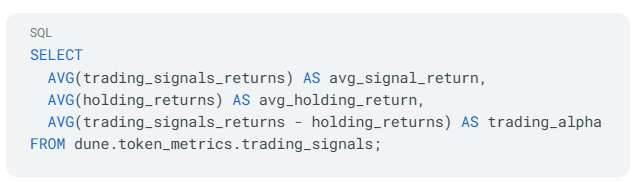
This gives you the alpha—how much better the Token Metrics strategy performs compared to just HODLing.

In one real example, the average signal return across all tokens was 1630%, while holding returned just 400%. That’s a 12X improvement powered by this top crypto API.

2. Identify Top-Performing Tokens

Now let’s list tokens with the highest average alpha:
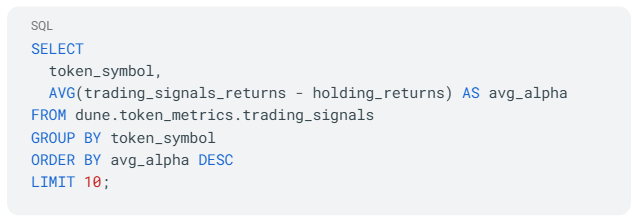
Tokens like BTC, ETH, BNB, and even newer ones like Virtuals stand out due to exceptional alpha performance.

3. Visualize Trader Grades vs. Alpha

The trader grade is a proprietary score from Token Metrics that predicts how favorable a token is for short-term traders.

Use a scatter plot to correlate trader grades with average alpha:

  • X-axis: Trader Grade
  • Y-axis: Average Alpha
  • Group by: Token Symbol

This helps you visually determine which tokens score high and offer exceptional returns—an essential tool for making actionable trading decisions.

4. Track the Latest Bullish Signals

Want to know which tokens are bullish right now? Here’s a query to find the most recent tokens flagged as bullish:
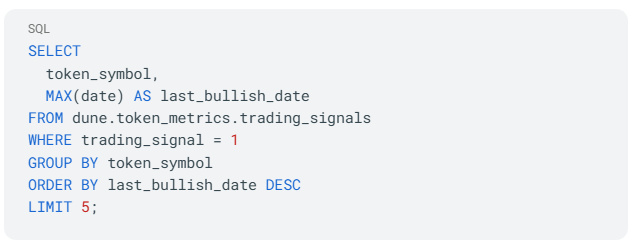
For example, on July 4th, tokens like BNB, XRP, and BTC were among the most recent bullish signals—perfect for immediate trade setups.

5. Build and Share Your Dashboard

Once you’ve run your queries:

  • Click “Add Visualization” in Dune
  • Choose from chart types (bar, scatter, progress bar, etc.)
  • Customize colors and filters
  • Combine multiple charts into a single dashboard

Your final product will be a real-time dashboard powered by the best crypto API, delivering insights that you—and your team—can act on instantly.

Why Token Metrics Is the Best Free Crypto API for Traders

Here’s why Token Metrics stands out among other APIs:

âś… AI-Driven Signals

Most APIs deliver raw data. Token Metrics provides curated signals, generated from machine learning models trained on market cycles, indicators, and price action.

âś… Proprietary Metrics

Access unique indicators like trader grade and investor grade, unavailable anywhere else.

âś… Real Historical Alpha

Use the API to backtest strategies. In the example shown, the AI strategy outperformed the market by over 1000X for some tokens.

âś… Seamless Integration

Whether you're using Dune, Zapier, OpenAI, or Eliza OS, Token Metrics is easy to integrate and query—making it the top crypto API for developers and analysts alike.

Final Thoughts

The combination of Token Metrics’ intelligent data and Dune’s visualization tools puts immense power in your hands. Whether you’re tracking market trends, building bots, or guiding portfolio decisions, this integration gives you everything you need to trade smarter.

With free access to real-time trading signals, alpha comparisons, and powerful visualizations, Token Metrics proves why it's the best crypto API for today’s data-driven investor.

Ready to try it out?
👉 Explore the Free Crypto API
👉 Start Building on Dune

Build Smarter Crypto Apps &
AI Agents in Minutes, Not Months
Real-time prices, trading signals, and on-chain insights all from one powerful API.
Grab a Free API Key
Token Metrics Team
Token Metrics Team

Recent Posts

Research

Fast, Reliable APIs with FastAPI

Token Metrics Team
5
MIN

Fast API design is no longer just about response time — it’s about developer ergonomics, safety, observability, and the ability to integrate modern AI services. FastAPI (commonly referenced by the search phrase "fast api") has become a favored framework in Python for building high-performance, async-ready APIs with built-in validation. This article explains the core concepts, best practices, and deployment patterns to help engineering teams build reliable, maintainable APIs that scale.

Overview: What makes FastAPI distinct?

FastAPI is a Python web framework built on top of ASGI standards (like Starlette and Uvicorn) that emphasizes developer speed and runtime performance. Key differentiators include automatic request validation via Pydantic, type-driven documentation (OpenAPI/Swagger UI generated automatically), and first-class async support. Practically, that means less boilerplate, clearer contracts between clients and servers, and competitive throughput for I/O-bound workloads.

Async model and performance considerations

At the heart of FastAPI’s performance is asynchronous concurrency. By leveraging async/await, FastAPI handles many simultaneous connections efficiently, especially when endpoints perform non-blocking I/O such as database queries, HTTP calls to third-party services, or interactions with AI models. Important performance factors to evaluate:

  • ASGI server choice: Uvicorn and Hypercorn are common; tuning workers and loop settings affects latency and throughput.
  • Blocking calls: Avoid CPU-bound work inside async endpoints; offload heavy computation to worker processes or task queues.
  • Connection pooling: Use async database drivers and HTTP clients (e.g., asyncpg, httpx) with pooled connections to reduce latency.
  • Metrics and profiling: Collect request duration, error rates, and concurrency metrics to identify hotspots.

Design patterns: validation, schemas, and dependency injection

FastAPI’s integration with Pydantic makes data validation explicit and type-driven. Use Pydantic models for request and response schemas to ensure inputs are sanitized and outputs are predictable. Recommended patterns:

  • Separate DTOs and domain models: Keep Pydantic models for I/O distinct from internal database or business models to avoid tight coupling.
  • Dependencies: FastAPI’s dependency injection simplifies authentication, database sessions, and configuration handling while keeping endpoints concise.
  • Versioning and contracts: Expose clear OpenAPI contracts and consider semantic versioning for breaking changes.

Integration with AI services and external APIs

Many modern APIs act as orchestrators for AI models or third-party data services. FastAPI’s async-first design pairs well with calling model inference endpoints or streaming responses. Practical tips when integrating AI services:

  • Use async clients to call external inference or data APIs to prevent blocking the event loop.
  • Implement robust timeouts, retries with backoff, and circuit breakers to handle intermittent failures gracefully.
  • Cache deterministic responses where appropriate, and use paginated or streaming responses for large outputs to reduce memory pressure.

Deployment, scaling, and observability

Deploying FastAPI to production typically involves containerized ASGI servers, an API gateway, and autoscaling infrastructure. Core operational considerations include:

  • Process model: Run multiple Uvicorn workers per host for CPU-bound workloads or use worker pools for synchronous tasks.
  • Autoscaling: Configure horizontal scaling based on request latency and queue length rather than CPU alone for I/O-bound services.
  • Logging and tracing: Integrate structured logs, distributed tracing (OpenTelemetry), and request/response sampling to diagnose issues.
  • Security: Enforce input validation, rate limiting, authentication layers, and secure secrets management.

Build Smarter Crypto Apps & AI Agents with Token Metrics

Token Metrics provides real-time prices, trading signals, and on-chain insights all from one powerful API. Grab a Free API Key

What is the difference between FastAPI and Flask?

FastAPI is built for the async ASGI ecosystem and emphasizes type-driven validation and automatic OpenAPI documentation. Flask is a synchronous WSGI framework that is lightweight and flexible but requires more manual setup for async support, validation, and schema generation. Choose based on concurrency needs, existing ecosystem, and developer preference.

When should I use async endpoints in FastAPI?

Use async endpoints when your handler performs non-blocking I/O such as database queries with async drivers, external HTTP requests, or calls to async message brokers. For CPU-heavy tasks, prefer background workers or separate services to avoid blocking the event loop.

How do Pydantic models help with API reliability?

Pydantic enforces input types and constraints at the boundary of your application, reducing runtime errors and making APIs self-documenting. It also provides clear error messages, supports complex nested structures, and integrates tightly with FastAPI’s automatic documentation.

What are common deployment pitfalls for FastAPI?

Common issues include running blocking code in async endpoints, inadequate connection pooling, missing rate limiting, and insufficient observability. Ensure proper worker/process models, async drivers, and graceful shutdown handling when deploying to production.

How can I test FastAPI applications effectively?

Use FastAPI’s TestClient (based on Starlette’s testing utilities) for endpoint tests and pytest for unit and integration tests. Mock external services and use testing databases or fixtures for repeatable test runs. Also include load testing to validate performance under expected concurrency.

Is FastAPI suitable for production-grade microservices?

Yes. When combined with proper patterns—type-driven design, async-safe libraries, containerization, observability, and scalable deployment—FastAPI is well-suited for production microservices focused on I/O-bound workloads and integrations with AI or external APIs.

Disclaimer

This article is for educational and informational purposes only. It does not constitute professional, legal, or investment advice. Evaluate tools and architectures according to your organization’s requirements and consult qualified professionals when needed.

Research

Free APIs: Practical Guide for Crypto & AI Developers

Token Metrics Team
5
MIN

Free APIs unlock data and functionality for rapid prototyping, research, and lightweight production use. Whether you’re building an AI agent, visualizing on-chain metrics, or ingesting market snapshots, understanding how to evaluate and integrate a free API is essential to building reliable systems without hidden costs.

What a "Free API" Really Means

Not all "free" APIs are created equal. The term generally refers to services that allow access to endpoints without an upfront fee, but differences appear across rate limits, data freshness, feature scope, and licensing. A clear framework for assessment is: access model, usage limits, data latency, security, and terms of service.

  • Access model: API key, OAuth, or anonymous endpoints determine how you authenticate and control usage.
  • Usage limits: Calls per minute/day, concurrency limits, and burst policies affect feasibility for real-time applications.
  • Data latency and granularity: Historical snapshots versus streaming updates change how you design ingestion and caching.
  • Licensing and redistribution: Check whether you can store, display, or redistribute data; free tiers often restrict commercial redistribution.
  • Support and SLA: Free tiers rarely carry guarantees—plan for graceful degradation and rate-limit handling.

How to Evaluate Free APIs: A Practical Checklist

Use a methodical approach to compare options. Below is a pragmatic checklist that helps prioritize trade-offs between cost and capability.

  1. Define requirements: identify throughput, freshness, and fields required. A small set of critical fields reduces bandwidth and simplifies caching.
  2. Measure performance: run latency and error-rate tests from your target regions. Free endpoints can be geo-constrained.
  3. Examine rate limits: build sample load tests to confirm call quotas and how the provider enforces throttling.
  4. Check data provenance: verify how data is sourced and updated; for derived metrics, inspect calculation methods and versioning.
  5. Review terms: confirm allowed use cases, retention rights, and attribution requirements.
  6. Plan fallbacks: design multi-source strategies and caching layers to mitigate outages or caps.

For crypto-specific datasets, platforms such as Token Metrics illustrate how integrated analytics and API endpoints can complement raw data feeds by adding model-driven signals and normalized asset metadata.

Integration Patterns and Best Practices

Free APIs are most effective when integrated with resilient patterns. Below are recommended practices for teams and solo developers alike.

  • Client-side throttling: implement token buckets or leaky buckets to smooth bursts and reduce 429 errors.
  • Edge caching: cache responses at the CDN or application edge, with TTLs determined by acceptable staleness.
  • Incremental syncs: prefer delta queries where supported to limit payload sizes and conserve rate limits.
  • Graceful degradation: show cached or approximate data when the API is unavailable to preserve UX continuity.
  • Monitoring & observability: track request counts, error rates, and latency; alert on policy limit warnings rather than only on failures.
  • Security: never embed API keys in public repositories; use vaults or server-side proxies for authentication.

Use Cases and Scenario Analysis

Understanding where a free API fits in your architecture depends on the scenario. Consider three common patterns:

  1. Rapid prototyping: Free API tiers let teams validate hypotheses quickly. Favor simplicity and low setup friction here; strict rate limits are acceptable for early tests.
  2. Research and backtesting: Historical endpoints with bulk download capabilities are valuable. For reproducible experiments, verify dataset completeness and snapshot timestamps.
  3. Light production workloads: Small applications can rely on free tiers if architects combine caching, retry strategies, and multi-source redundancy to manage availability risks.

When working with AI agents or automated analytics, instrument data flows and label data quality explicitly. AI-driven research tools can accelerate dataset discovery and normalization, but you should always audit automated outputs and maintain provenance records.

Build Smarter Crypto Apps & AI Agents with Token Metrics

Token Metrics provides real-time prices, trading signals, and on-chain insights all from one powerful API. Grab a Free API Key

FAQ: Common Questions About Free APIs

What limits should I expect on a free API?

Limits vary by provider but often include reduced daily/monthly call quotas, limited concurrency, and delayed data freshness. Review the provider’s rate-limit policy and test in your deployment region.

Can I use free APIs in production?

Yes for low-volume or non-critical paths, provided you incorporate caching, retries, and fallback logic. For mission-critical systems, evaluate paid tiers for SLAs and enhanced support.

How do I secure API keys for free tiers?

Store keys in environment-specific vaults, avoid client-side exposure, and rotate keys periodically. Use proxy layers to inject keys server-side when integrating client apps.

Are free APIs reliable for historical data needs?

Some free APIs provide robust historical endpoints, but completeness and retention policies differ. Validate by sampling known events and comparing across providers before depending on the dataset.

How can AI tools help when using free APIs?

AI tools can assist with data cleaning, anomaly detection, and feature extraction, making it easier to derive insight from limited free data. Always verify model outputs and maintain traceability to source calls.

What should I monitor after integrating a free API?

Track request volume, error rates (429/5xx), latency, and data staleness metrics. Set alerts for approaching throughput caps and automate graceful fallbacks to preserve user experience.

Is it legal to store and redistribute data from a free API?

Legal permissions depend on the provider’s terms. Some allow caching for display but prohibit redistribution or commercial resale. Always consult the API’s terms of service before storing or sharing data.

How do I plan for scale from a free tier?

Design with decoupled ingestion, caching, and multi-source redundancy so you can swap to paid tiers or alternative providers without significant refactoring.

Can multiple free APIs be combined?

Yes. Combining multiple sources improves resilience and data quality, but requires normalization, reconciliation logic, and latency-aware merging rules.

Disclaimer

This article is educational and informational only. It does not constitute financial, legal, or investment advice. Evaluate services and make decisions based on your own research and compliance requirements.

Research

Understanding REST APIs: Design, Security & Best Practices

Token Metrics Team
5
MIN

Modern web and mobile applications rely heavily on REST APIs to exchange data, integrate services, and enable automation. Whether you're building a microservice, connecting to a third-party data feed, or wiring AI agents to live systems, a clear understanding of REST API fundamentals helps you design robust, secure, and maintainable interfaces.

What is a REST API?

REST (Representational State Transfer) is an architectural style for distributed systems. A REST API exposes resources—often represented as JSON or XML—using URLs and standard HTTP methods. REST is not a protocol but a set of constraints that favor statelessness, resource orientation, and a uniform interface.

Key benefits include simplicity, broad client support, and easy caching, which makes REST a default choice for many public and internal APIs. Use-case examples include content delivery, telemetry ingestion, authentication services, and integrations between backend services and AI models that require data access.

Core Principles & HTTP Methods

Understanding core REST principles helps you map business entities to API resources and choose appropriate operations:

  • Resources: Model nouns (e.g., /users, /orders) rather than actions.
  • Statelessness: Every request should contain all information to process it; avoid server-side session state.
  • Representation: Use consistent formats such as JSON:API or HAL for predictable payloads.
  • HTTP Verbs: GET for retrieval, POST to create, PUT/PATCH to update, DELETE to remove. Idempotency and safety semantics matter when designing retries and error handling.
  • Status Codes: Use standard HTTP status codes (200, 201, 204, 400, 401, 403, 404, 429, 500) to communicate outcomes clearly to clients.

Adhering to these constraints makes integrations easier, especially when connecting analytics, monitoring, or AI-driven agents that rely on predictable behavior and clear failure modes.

Design Patterns and Best Practices

Building a usable REST API involves choices beyond the basics. Consider these patterns and practices:

  • Versioning: Use URI (e.g., /v1/) or header-based versioning to avoid breaking clients when evolving schemas.
  • Pagination and Filtering: Support limit/offset or cursor-based pagination and flexible query filters to keep responses performant.
  • Hypermedia (HATEOAS): Optionally include links to related resources to improve discoverability for advanced clients.
  • Idempotency Keys: For non-idempotent operations, accept idempotency keys so retries don’t create duplicates.
  • Documentation and SDKs: Maintain OpenAPI/Swagger specs and generate client SDKs to reduce integration friction.

For teams building APIs that feed ML or AI pipelines, consistent schemas and semantic versioning are particularly important. They minimize downstream data drift and make model retraining and validation repeatable.

Security, Monitoring, and Scaling

Security and operational visibility are core to production APIs:

  • Authentication & Authorization: Use OAuth 2.0, JWTs, or API keys depending on risk profile. Apply least-privilege principles to tokens and scopes.
  • Transport Security: Enforce TLS for all traffic and HSTS where applicable.
  • Rate Limiting & Throttling: Protect against abuse and ensure fair usage. Return clear retry-after headers to guide clients.
  • Observability: Emit structured logs, request IDs, and metrics (latency, error rates) and hook them into dashboards and alerting systems.
  • Schema Validation: Validate payloads at the boundary to prevent invalid data from propagating into downstream services.

Scaling often combines stateless application design, caching (CDNs or reverse proxies), and horizontal autoscaling behind load balancers. For APIs used by data-hungry AI agents, consider async patterns (webhooks, message queues) to decouple long-running tasks from synchronous request flows.

Build Smarter Crypto Apps & AI Agents with Token Metrics

Token Metrics provides real-time prices, trading signals, and on-chain insights all from one powerful API. Grab a Free API Key

FAQs

What distinguishes REST from other API styles like GraphQL?

REST emphasizes resources and uses HTTP verbs and status codes. GraphQL exposes a flexible query language letting clients request only needed fields. REST is often simpler to cache and monitor, while GraphQL can reduce over-fetching for complex nested data. Choose based on client needs, caching, and complexity.

How should I version a REST API without breaking clients?

Common strategies include URI versioning (/v1/) and header-based versioning. Maintain backward compatibility whenever possible, provide deprecation notices, and publish migration guides. Semantic versioning of your API contract helps client teams plan upgrades.

What are practical steps to secure a public REST API?

Require TLS, use strong authentication (OAuth 2.0 or signed tokens), validate inputs, enforce rate limits, and monitor anomalous traffic. Regularly audit access controls and rotate secrets. Security posture should be part of the API lifecycle.

How can REST APIs support AI-driven workflows?

APIs can supply training data, feature stores, and live inference endpoints. Design predictable schemas, low-latency endpoints, and asynchronous jobs for heavy computations. Tooling and observability help detect data drift, which is critical for reliable AI systems. Platforms like Token Metrics illustrate how API-led data can support model-informed insights.

When should I use synchronous vs asynchronous API patterns?

Use synchronous APIs for short, fast operations with immediate results. For long-running tasks (batch processing, complex model inference), use asynchronous patterns: accept a request, return a job ID, and provide status endpoints or webhooks to report completion.

Disclaimer

This article is educational and technical in nature. It does not constitute investment, legal, or professional advice. Evaluate tools and architectures against your requirements and risks before deployment.

Choose from Platinum, Gold, and Silver packages
Reach with 25–30% open rates and 0.5–1% CTR
Craft your own custom ad—from banners to tailored copy
Perfect for Crypto Exchanges, SaaS Tools, DeFi, and AI Products