Research

How To Find New Crypto Coins? Finding Cryptocurrency Projects

A guide on how to find new crypto coins before they explode.
Token Metrics Team
6 minutes
MIN

If you are wondering how to find new crypto coins, this is the place to be.

Finding new crypto coins has become important since the rise of Bitcoin and the wealth gained by early investors. The crypto market has experienced a surge of new investors who hope to find the next big coin, but many are unsure of how to navigate the space and identify new coins. It can be exciting to discover new coins, but it's important to beware of scams like the Squid token that exploited the popularity of the Squid Game movie series. Before looking for new crypto coins, here are some points to consider before making an investment decision.

Checklist Before Investing:

A project's whitepaper is a good starting point for researching a new crypto project. Most new crypto projects have a whitepaper or official document that includes information such as the project's use case, tokenomics, team members, and roadmap. The presence or absence of a whitepaper can tell you a lot about the project's seriousness. While reading a project's whitepaper, there are a few things to look out for:

Use case: This is the main problem that the crypto project is trying to solve, or its unique function. For example, there are several Layer 2 projects that aim to improve the low latency and transaction times of traditional blockchains without compromising security and decentralization.

Tokenomics / Token Economics: This is the basic plan for how the project's new crypto tokens will be distributed. This includes how many tokens will go to the founding team, advisors, how many will be available for sale to the community, how many will be in the treasury, and what type of token it will be (deflationary or inflationary, with a limited or unlimited supply).

Lock-up period: This is the period of time that the founding team agrees to lock up their tokens before they can access them. A longer lock-up period can give investors more confidence in the project's long-term commitment.

Founding team: It's important to check the background of the project's founding team. Are they experienced, do their backgrounds match the project, and do they have any fraudulent history with past projects? The profiles of the advisors and investors/backers of the project can also be useful.

Social virality: Decentralization is at the core of crypto, so projects are often community-driven. The growth of the project's community can be a good indicator of investor confidence. Twitter, Telegram, and Discord are popular platforms for building crypto communities.

Roadmap: The project's roadmap contains its major plans and timeline. This can indicate the project's seriousness, especially when compared to what they have accomplished. Have they achieved any of the earlier plans on the roadmap within the specified timeline?

In addition, looking at the number of people on the project's watchlist, and whether it is listed on CoinMarketCap.com or CoinGecko, can also be a good confidence booster.

How to Find New Crypto Coins

Before new crypto coins are listed on exchanges, they are often first offered as Initial Coin Offerings (ICOs), Initial Exchange Offerings (IEOs), or Initial Dex Offerings (IDOs). These offerings give investors the opportunity to get in early on projects before they go mainstream. This is where early investors can get into major projects before they are listed on crypto exchanges.

There are several platforms that feature upcoming crypto projects, including:

  • Top ICO List: This website provides white papers and one-pagers of ICOs of new crypto coins. You can find a comprehensive list of ICOs and information on some of the best ICOs in the market, as well as information on past ICOs to use as a benchmark for evaluating the performance of ICOs you are considering.
  • CoinGecko: This is a useful tool for crypto traders and investors to stay up to date with the market. It provides real-time prices of cryptocurrencies from multiple exchanges, as well as other important information about different cryptocurrencies, such as their historic performance data, community, and insights into the coin development. CoinGecko also provides an ICO list of new crypto coins with relevant information about the new crypto coin/project.
  • CoinMarketCap: Like CoinGecko, CoinMarketCap is an alternative that some investors use to find new crypto coins. It provides a list of ICOs and relevant information, as well as information on hundreds of other crypto projects and actionable data. The watchlist feature is also useful for seeing how many people are interested in a project.
  • ICO Bench: This is a useful tool for finding new crypto coins. ICO Bench is an ICO grading website that uses crowdsourced ratings from crypto traders and experts. The experts evaluate projects using various parameters and grade them accordingly.
  • Token Metrics: Token Metrics is another great resource for finding new cryptocurrencies with its research, deep dives, AI, and more. The best part is that you can use Token Metrics to evaluate whether the newly found project is good or bad and decide whether you should spend more time researching it further.

With over 10,000+ crypto coins, there are many opportunities out there. But there are also many shady platforms and crypto projects, so it's important to know how to find crypto with potential and make sure the projects are viable. Using the tips above can help you do that.

Build Smarter Crypto Apps &
AI Agents in Minutes, Not Months
Real-time prices, trading signals, and on-chain insights all from one powerful API.
Grab a Free API Key
Token Metrics Team
Token Metrics Team

Recent Posts

Research

A Complete Guide to Writing Smart Contracts

Token Metrics Team
4
MIN

Introduction

Smart contracts are self-executing contracts with the terms of the agreement directly written into lines of code. They run on blockchain platforms, such as Ethereum, enabling decentralized, automated agreements that do not require intermediaries. Understanding how to write a smart contract involves familiarity with blockchain principles, programming languages, and best practices for secure and efficient development.

Understanding Smart Contracts

Before diving into development, it is essential to grasp what smart contracts are and how they function within blockchain ecosystems. Essentially, smart contracts enable conditional transactions that automatically execute when predefined conditions are met, providing transparency and reducing dependency on third parties.

These programs are stored and executed on blockchain platforms, making them immutable and distributed, which adds security and reliability to the contract's terms.

Choosing the Right Platform

Writing a smart contract starts with selecting an appropriate blockchain platform. Ethereum is among the most widely used platforms with robust support for smart contracts, primarily written in Solidity—a statically-typed, contract-oriented programming language.

Other platforms like Binance Smart Chain, Polkadot, and Solana also support smart contracts with differing languages and frameworks. Selecting a platform depends on the project requirements, intended network compatibility, and resource accessibility.

Learning the Programming Language

The most commonly used language for writing Ethereum smart contracts is Solidity. It is designed to implement smart contracts with syntax similar to JavaScript, making it approachable for developers familiar with web programming languages.

Other languages include Vyper, a pythonic language focusing on security and simplicity, and Rust or C++ for platforms like Solana. Learning the syntax, data types, functions, and event handling of the chosen language is foundational.

Setting Up Development Environment

Development of smart contracts typically requires a suite of tools for editing, compiling, testing, and deploying code:

  • IDEs: Integrated Development Environments such as Remix (web-based for Solidity) or Visual Studio Code with plugins.
  • Frameworks: Tools like Truffle or Hardhat enable local blockchain simulation, automated testing, and deployment scripts.
  • Node and Wallet: Connecting to blockchain networks often requires running a node or leveraging services like Infura, along with digital wallets (e.g., MetaMask) for transaction signing.

Writing the Smart Contract Code

Writing a smart contract involves structuring the code to define its variables, functions, and modifiers. Key steps include:

  1. Define the contract: Use the keyword contract to declare the contract and its name.
  2. Declare state variables: Define data stored on the blockchain, such as balances or ownership details.
  3. Write functions: Implement logic that changes state variables or triggers events.
  4. Use modifiers: Add conditional checks like access restrictions (e.g., only the owner can execute certain functions).
  5. Emit events: Use events to log significant contract operations for off-chain monitoring.

Example snippet in Solidity:

pragma solidity ^0.8.0;

contract SimpleStorage {
  uint storedData;

  function set(uint x) public {
    storedData = x;
  }

  function get() public view returns (uint) {
    return storedData;
  }
}

Testing and Debugging

Testing is crucial to ensure smart contracts operate as intended and to prevent bugs or vulnerabilities. Strategies include:

  • Writing unit tests using frameworks like Truffle or Hardhat.
  • Running tests on local blockchains (Ganache) before deploying.
  • Using linters and analysis tools to detect common security issues.

Adopting rigorous testing can reduce the risk of exploits or loss of funds caused by contract errors.

Deploying the Smart Contract

Deployment involves publishing the compiled smart contract bytecode to the blockchain. This includes:

  • Compiling the contract into bytecode.
  • Connecting to the desired blockchain network (testnet or mainnet) usually via wallet integration.
  • Submitting a deployment transaction, which requires gas fees for execution.

Using test networks like Ropsten, Rinkeby, or Goerli is recommended for initial deployment to validate functionality without incurring real costs.

Using AI Tools for Smart Contract Research

Emerging AI-driven platforms can assist developers and analysts with smart contract evaluation, security analysis, and market sentiment interpretation. For instance, tools like Token Metrics provide algorithmic research that can support understanding of blockchain projects and smart contract implications in the ecosystem.

Integrating these tools along with manual audits aids comprehensive assessments for better development decisions.

Best Practices and Security Considerations

Writing secure smart contracts requires awareness of common vulnerabilities such as reentrancy attacks, integer overflows, and improper access controls. Best practices include:

  • Following established design patterns and standards (e.g., OpenZeppelin contracts).
  • Performing thorough code reviews and external audits.
  • Keeping contracts as simple and modular as possible.

Robust security practices are critical due to the immutable nature of deployed smart contracts on blockchain.

Conclusion

Writing a smart contract involves a combination of blockchain knowledge, programming skills, and adherence to security best practices. From choosing a platform and language to coding, testing, and deploying, each step plays an important role in the development lifecycle.

Leveraging AI-powered tools like Token Metrics can add valuable insights for developers aiming to enhance their understanding and approach to smart contract projects.

Disclaimer

All information provided in this article is for educational purposes only and does not constitute financial or investment advice. Readers should conduct their own research and consult professional sources where appropriate.

Research

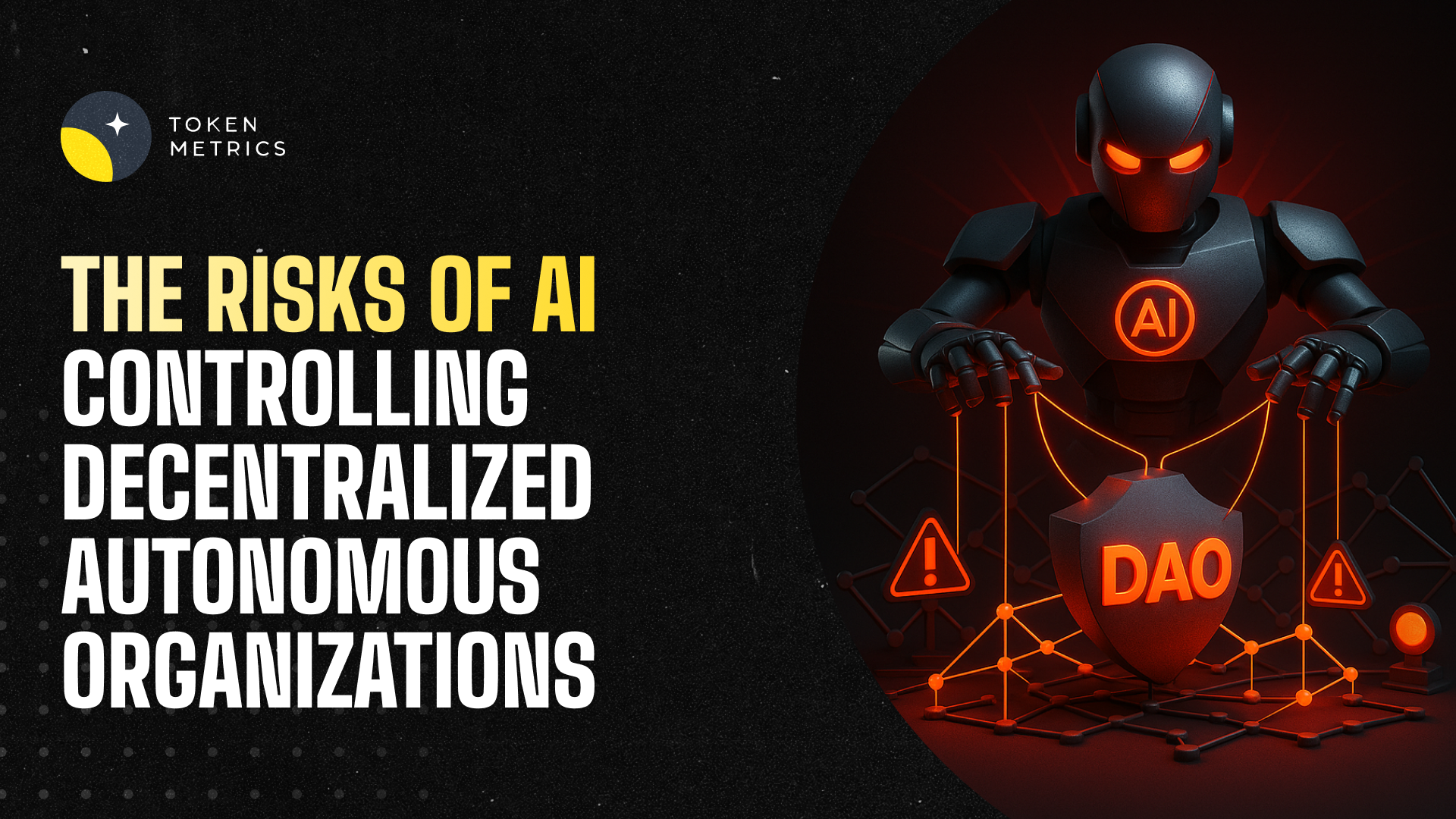
Understanding the Risks of AI Controlling Decentralized Autonomous Organizations

Token Metrics Team
4
MIN

Introduction

Decentralized Autonomous Organizations (DAOs) represent an innovative model for decentralized governance and decision-making in the blockchain space. With the increasing integration of artificial intelligence (AI) into DAOs for automating processes and enhancing efficiency, it is vital to understand the risks associated with allowing AI to control or heavily influence DAOs. This article provides a comprehensive analysis of these risks, exploring technical, ethical, and systemic factors. Additionally, it outlines how analytical platforms like Token Metrics can support informed research around such emerging intersections.

DAO and AI Basics

DAOs are blockchain-based entities designed to operate autonomously through smart contracts and collective governance, without centralized control. AI technologies can offer advanced capabilities by automating proposal evaluation, voting mechanisms, or resource allocation within these organizations. While this combination promises increased efficiency and responsiveness, it also introduces complexities and novel risks.

Technical Vulnerabilities

One significant category of risks involves technical vulnerabilities arising from AI integration into DAOs:

  • Smart Contract Exploits: AI-driven decision-making typically operates on smart contracts. Flaws or bugs in the smart contract code can be exploited, possibly amplified by AI’s autonomous execution.
  • Data Integrity and Quality: AI requires reliable data inputs to function correctly. Malicious actors might inject false or biased data, leading to misguided AI decisions that could harm DAO operations.
  • Algorithmic Errors: AI algorithms might contain bugs, incorrect assumptions, or be insufficiently tested, which could result in unintended behaviors or decisions with negative consequences.

Governance and Control Challenges

Integrating AI into DAO governance raises complex questions around control, transparency, and accountability:

  • Lack of Transparency: AI algorithms, especially those using complex machine learning models, can be opaque, making it difficult for stakeholders to audit decisions or understand governance processes fully.
  • Centralization Risks: AI models are often developed and maintained by specific teams or organizations, which could inadvertently introduce centralization points contrary to the decentralized ethos of DAOs.
  • Unintended Bias: AI systems trained on biased datasets may propagate or exacerbate existing biases within DAO decision-making, risking unfair or harmful outcomes.

Security and Manipulation Risks

The autonomous nature of AI presents unique security concerns:

  • Manipulation Attacks: Adversaries might target the AI’s learning process or input data channels to manipulate outcomes toward malicious goals.
  • Autonomy Exploits: An AI controlling critical DAO functions autonomously could make decisions that are difficult to reverse or disrupt, leading to lasting damage if exploited.
  • Emergent Behavior: Complex AI systems might develop unexpected behaviors in dynamic environments, creating risks hard to anticipate or control within DAO frameworks.

Ethical and Regulatory Concerns

Beyond technical risks, the interaction between AI and DAOs also introduces ethical and regulatory considerations:

  • Accountability Gaps: Determining liability for AI-driven decisions within DAOs is challenging, potentially leading to accountability voids in cases of harm or disputes.
  • Compliance Complexity: Evolving regulatory landscapes surrounding both AI and blockchain could create overlapping or conflicting requirements for AI-controlled DAOs.
  • User Consent and Autonomy: Members participating in DAOs may have concerns over how AI influences governance and whether adequate consent frameworks are in place.

Mitigating Risks with Analytical Tools

Understanding and managing these risks require robust research and analytical frameworks. Platforms such as Token Metrics provide data-driven insights supporting comprehensive evaluation of blockchain projects, governance models, and emerging technologies combining AI and DAOs.

  • Thorough Technical Reviews: Regular audits and reviews of AI algorithms and smart contracts can detect vulnerabilities early.
  • Transparency Initiatives: Employing explainable AI methods enhances trust and allows stakeholder scrutiny.
  • Scenario Analysis: Exploring potential failure modes and adversarial scenarios helps prepare for unexpected outcomes.
  • Community Engagement: Active and informed participation in DAO governance ensures more robust checks and balances.

Conclusion

The fusion of AI and DAOs promises innovative decentralized governance but comes with substantial risks. Technical vulnerabilities, governance challenges, security threats, and ethical concerns highlight the need for vigilant risk assessment and careful integration. Utilizing advanced research platforms like Token Metrics enables more informed and analytical approaches for stakeholders navigating this evolving landscape.

Disclaimer

This article is for educational purposes only and does not constitute financial, legal, or investment advice. Readers should perform their own due diligence and consult professionals where appropriate.

Research

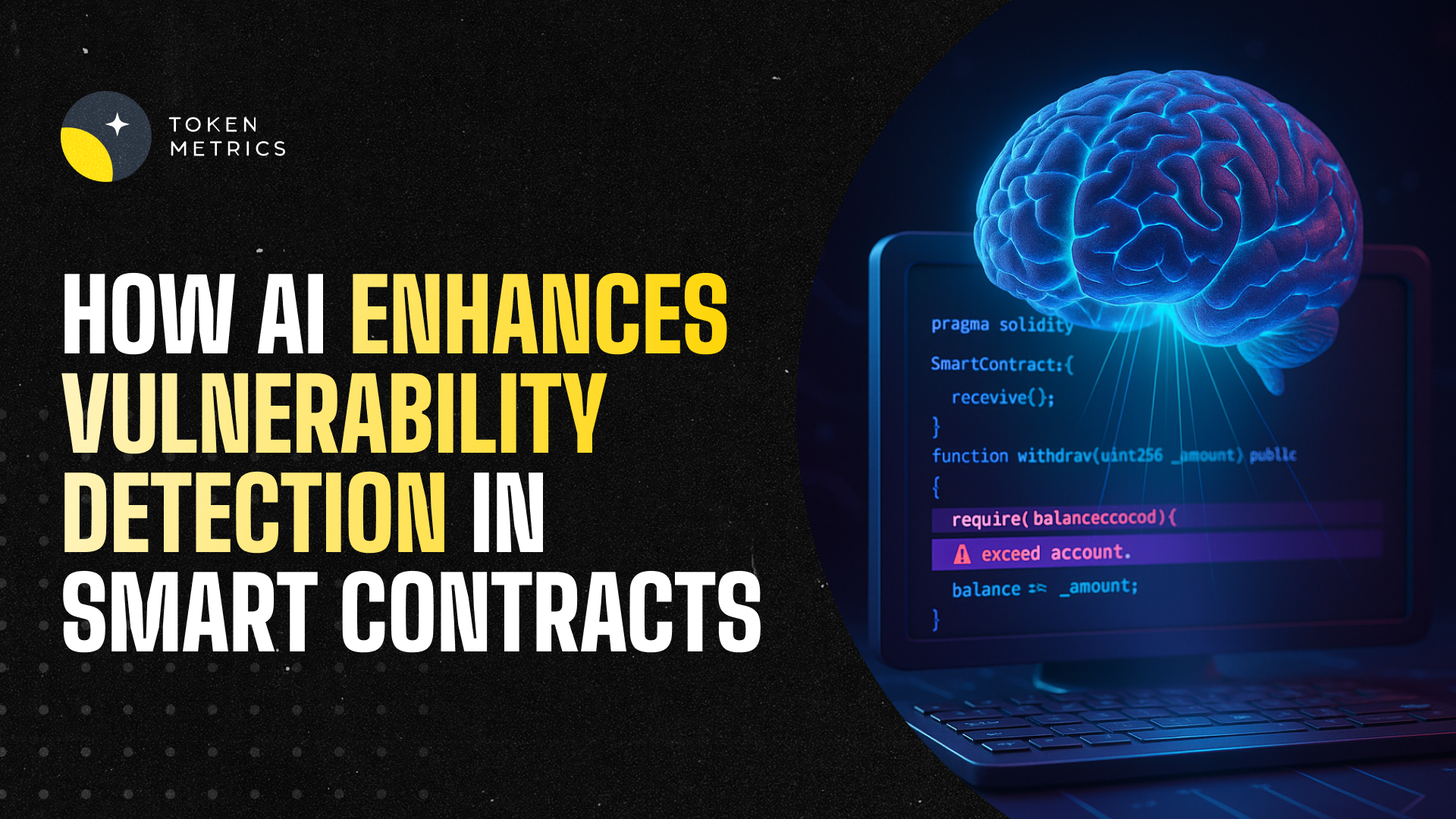
How AI Enhances Vulnerability Detection in Smart Contracts

Token Metrics Team
4
MIN

Introduction: The Growing Concern of Smart Contract Vulnerabilities

Smart contracts are self-executing contracts with the terms directly written into code, widely used across blockchain platforms to automate decentralized applications (DApps) and financial protocols. However, despite their innovation and efficiency, vulnerabilities in smart contracts pose significant risks, potentially leading to loss of funds, exploits, or unauthorized actions.

With the increasing complexity and volume of smart contracts being deployed, traditional manual auditing methods struggle to keep pace. This has sparked interest in leveraging Artificial Intelligence (AI) to enhance the identification and mitigation of vulnerabilities in smart contracts.

Understanding Smart Contract Vulnerabilities

Smart contract vulnerabilities typically arise from coding errors, logic flaws, or insufficient access controls. Common categories include reentrancy attacks, integer overflows, timestamp dependencies, and unchecked external calls. Identifying such vulnerabilities requires deep code analysis, often across millions of lines of code in decentralized ecosystems.

Manual audits by security experts are thorough but time-consuming and expensive. Moreover, the human factor can result in missed weaknesses, especially in complex contracts. As the blockchain ecosystem evolves, utilizing AI to assist in this process has become a promising approach.

The Role of AI in Vulnerability Detection

AI techniques, particularly machine learning (ML) and natural language processing (NLP), can analyze smart contract code by learning from vast datasets of previously identified vulnerabilities and exploits. The primary roles of AI here include:

  • Automated Code Analysis: AI models can scan codebases rapidly to detect patterns indicative of security flaws.
  • Anomaly Detection: AI can recognize atypical or suspicious contract behaviors that deviate from standard practices.
  • Predictive Assessment: By using historical vulnerability data, AI can predict potential risk points in new contracts.
  • Continuous Learning: AI systems can improve over time by incorporating feedback from newly discovered vulnerabilities.

Techniques and Tools Used in AI-Driven Smart Contract Analysis

Several AI-based methodologies have been adopted to aid vulnerability detection:

  1. Static Code Analysis: AI algorithms break down smart contract code without execution, identifying syntactic and structural weaknesses.
  2. Dynamic Analysis and Fuzzing: Leveraging AI to simulate contract execution in varied scenarios to uncover hidden vulnerabilities.
  3. Graph Neural Networks (GNNs): Applied to model relational data within smart contract structures, improving detection of complex vulnerabilities.
  4. Transformer Models: Adapted from NLP, these analyze code semantics to spot nuanced issues beyond basic syntax errors.

Some emerging platforms integrate such AI techniques to provide developers and security teams with enhanced vulnerability scanning capabilities.

Advantages of AI Over Traditional Auditing Methods

Compared to manual or rule-based approaches, AI provides several notable benefits:

  • Scalability: AI can analyze thousands of contracts quickly, which manual teams cannot feasibly match.
  • Consistency: AI reduces human error and subjective assessment variability in vulnerability identification.
  • Real-Time Analysis: AI-powered systems can run continuous scans and provide rapid alerts for emerging threats.
  • Cost Efficiency: Automating portions of the audit process can reduce resource expenditure over time.

Despite these advantages, AI is complementary to expert review rather than a replacement, as audits require contextual understanding and judgment that AI currently cannot fully replicate.

Challenges and Limitations of AI in Smart Contract Security

While promising, AI application in this domain faces several hurdles:

  • Data Quality and Availability: Training AI models requires large, well-labeled datasets of smart contract vulnerabilities, which are limited due to the relative novelty of the field.
  • Complexity of Smart Contracts: Diverse programming languages and design patterns complicate uniform AI analysis.
  • False Positives/Negatives: AI may generate incorrect alerts or miss subtle vulnerabilities, requiring human validation.
  • Adversarial Adaptation: Malicious actors may develop exploits specifically designed to evade AI detection models.

How to Use AI Tools Effectively for Smart Contract Security

Developers and security practitioners can optimize the benefits of AI by:

  • Integrating AI Reviews Early: Employ AI analysis during development cycles to detect vulnerabilities before deployment.
  • Combining with Manual Audits: Use AI as a preliminary screening tool, followed by detailed human assessments.
  • Continuous Monitoring: Monitor deployed contracts with AI tools to detect emergent risks or unexpected behaviors.
  • Leveraging Platforms: Utilizing platforms such as Token Metrics that provide AI-driven analytics for comprehensive research on smart contracts and related assets.

Conclusion & Future Outlook

AI has a growing and important role in identifying vulnerabilities within smart contracts by providing scalable, consistent, and efficient analysis. While challenges remain, the combined application of AI tools with expert audits paves the way for stronger blockchain security.

As AI models and training data improve, and as platforms integrate these capabilities more seamlessly, users can expect increasingly proactive and precise identification of risks in smart contracts.

Disclaimer

This article is for educational and informational purposes only. It does not constitute financial, investment, or legal advice. Always conduct your own research and consider consulting professionals when dealing with blockchain security.

Choose from Platinum, Gold, and Silver packages
Reach with 25–30% open rates and 0.5–1% CTR
Craft your own custom ad—from banners to tailored copy
Perfect for Crypto Exchanges, SaaS Tools, DeFi, and AI Products