Crypto Basics

10 Best Ways to Make Money with Bitcoin

Discover 10 best ways for making money with Bitcoin in this comprehensive guide. Maximize your crypto earnings with proven methods.
S. Vishwa
11 Minutes
MIN

Bitcoin, the pioneer cryptocurrency, has experienced a remarkable surge in value and recognition since its debut in 2009. With the global acceptance of digital currencies, many are seeking ways to capitalize on Bitcoin's potential. 

To aid in this endeavor, here's a detailed guide outlining 10 impactful ways to derive profits from Bitcoin.

How to Make Money with Bitcoin?

As Bitcoin continues its meteoric rise, diverse avenues to profit from this digital gold emerge. Whether you're a seasoned trader, tech enthusiast, or a curious newcomer, there's a Bitcoin money-making method tailored for you. Dive in to explore these lucrative pathways and kickstart your crypto journey.

1. HODLing - The Long-Term Approach

The term 'HODL' might seem like a misspelling, but it's a deliberate term popularized within the crypto space. It stands for "Hold On for Dear Life" and represents a steadfast approach to Bitcoin investment. 

HODLing isn't about chasing quick profits; it's about recognizing Bitcoin's long-term potential and resisting the urge to sell during short-term market downturns. Historically, Bitcoin has witnessed periods of volatility, but its overarching trajectory has trended upward. 

HODLers often benefit from these long-term gains, demonstrating the value of patience in the dynamic crypto marketplace. If you're considering this strategy, invest only what you're prepared to keep in the game for years.

Why it works: Historical data shows that despite periodic dips, Bitcoin's overall trajectory has been upward. Long-term investors have often seen significant returns.

Actionable advice: Diversify your assets, stay informed, and cultivate a strong, patient mindset. This way, temporary market dips won't deter your long-term vision.

2. Day Trading - The Game of Quick Returns

Day trading in the world of Bitcoin is akin to riding the rapid currents of a vast ocean. It's the art and science of leveraging Bitcoin's frequent price fluctuations for profit. 

Instead of adopting a long-term stance, day traders thrive on short-lived market movements, buying and selling Bitcoin often within hours or even minutes. 

To excel in this space, one must master technical analysis, stay attuned to market news, and develop an instinct for anticipating price shifts. 

A reliable cryptocurrency exchange is essential, as is setting clear, disciplined boundaries for entry and exit points. While the potential for gains is significant, it's crucial to remember that day trading also carries heightened risks. Preparedness and continuous learning are key.

Why it works: Volatility in the crypto market can lead to profitable short-term trading opportunities.

Actionable advice: Familiarize yourself with market analysis techniques, set clear entry and exit strategies, and always use a reliable cryptocurrency exchange.

3. Mining - Earning through Network Support

Mining forms the backbone of Bitcoin's decentralized network. By leveraging powerful computer hardware, miners work tirelessly to solve intricate mathematical puzzles. Successfully cracking these ensures the blockchain's transactions are validated and secure. 

As a token of appreciation, the Bitcoin protocol rewards miners with freshly minted Bitcoin for every block they add. But it's not a simple gold rush; as the network grows, so does the mining complexity. Increased competition and surging energy costs have made solo endeavors less profitable. 

Thus, many opt for mining pools, combining resources to enhance success rates. If diving into traditional mining feels daunting, cloud mining services offer an alternative pathway to participate in this essential Bitcoin operation.

Why it works: For every block mined, miners are rewarded with newly minted Bitcoin.

Actionable advice: Mining is no longer as profitable for individual miners due to increased competition and energy costs. Consider joining a mining pool or investing in cloud mining.

4. Bitcoin Affiliate Programs

Diving into Bitcoin affiliate programs offers a lucrative avenue for those well-versed in the crypto ecosystem. Numerous platforms seek to expand their user base by incentivizing current users to bring in newcomers. 

Here's the proposition: share a unique affiliate link to potential users, and when they sign up and transact, you earn a commission in Bitcoin. 

As the crypto realm burgeons, more novices seek trusted platforms, making your recommendations highly valuable. To truly flourish, align with credible platforms that offer transparent and generous reward structures. 

Sharing your experiences, crafting compelling reviews, and guiding newcomers via blogs or social media can transform your affiliate endeavors from mere referrals to a steady income stream.

Why it works: With the growing interest in Bitcoin, there's a huge market of newcomers seeking reliable platforms and services.

Actionable advice: Choose reputable programs, promote your affiliate links through blogs, videos, or social media, and ensure you offer genuine value to your audience.

5. Accepting Bitcoin as Payment

In an evolving digital age, integrating Bitcoin as a payment mode showcases a business's forward-thinking approach. Embracing this decentralized currency not only caters to a tech-savvy clientele but also broadens global market reach, eliminating traditional banking barriers. 

It's a move towards financial modernization, offering faster transaction times and reduced fees. However, venturing into this domain requires a bit of groundwork. Utilize established payment gateways, like BitPay or Coinbase Commerce, to streamline the process and provide a seamless experience for your customers. 

And, while Bitcoin's allure is undeniable, it's prudent to stay updated on tax implications and regulatory guidelines specific to your region to ensure smooth sailing.

Why it works: It attracts a broader customer base, especially from the tech-savvy demographic.

Actionable advice: Use trusted payment gateways like BitPay or Coinbase Commerce, and always be aware of the tax implications in your jurisdiction.

6. Staking and Earning Interest

Harnessing the power of staking offers a dual advantage for Bitcoin holders: enhancing network security and earning passive income. By "staking" or locking up a portion of your Bitcoin in a cryptocurrency wallet, you support network operations and, in return, receive interest. 

Think of it as a high-tech savings account. Some platforms even elevate these returns by lending staked assets, multiplying the passive income potential. It's crucial, however, to choose your staking platform wisely. 

Look for established names that offer transparent terms and robust security measures. While staking is an attractive proposition, always assess lock-in periods, ensuring you have liquidity when needed.

Why it works: It's a passive way of earning additional Bitcoin on your existing holdings.

Actionable advice: Research platforms for their credibility, understand the terms, and avoid locking your funds if you anticipate needing them soon.

7. Arbitrage - Profiting from Price Differences

In the multifaceted world of crypto exchanges, price discrepancies for Bitcoin can occasionally emerge. Arbitrage traders are the eagle-eyed individuals who spot these variations and swiftly buy Bitcoin at a lower price on one exchange, only to sell it at a higher price on another. 

These discrepancies arise due to factors like liquidity variations, regional demands, or transient lag in exchange rate updates. Successful arbitrage demands swift actions, given the rapidly adjusting markets. 

While the concept sounds straightforward, it’s vital to factor in transaction fees and potential transfer delays. The key is a combination of vigilance, a deep understanding of multiple exchanges, and a readiness to act with precision.

Why it works: Price discrepancies exist due to localized demand, liquidity, or regulatory factors.

Actionable advice: Act quickly, consider transaction fees, and stay updated on different exchange rates.

8. Bitcoin Faucets

Bitcoin faucets serve as introductory gateways for newcomers to the crypto universe. These web platforms dispense minuscule Bitcoin amounts, often termed 'satoshis', as rewards for completing straightforward tasks, like viewing advertisements or solving captchas. 

It’s a no-investment method to acquire a taste of Bitcoin. As the crypto industry burgeons, faucet platforms proliferate, enticing users with these micro-rewards. However, caution is paramount. It's vital to engage only with reputed faucets to avoid scams or excessive ad bombardments. 

While earnings are typically modest, consistent engagement and referrals can accumulate into substantial sums. For those keen on a crypto journey without initial capital outlay, faucets are a viable starting point.

Why it works: It's an entry point for those looking to get a taste of Bitcoin without an initial investment.

Actionable advice: Always use trusted faucet sites, be wary of excessive ads, and never provide personal or financial details.

9. Lending Bitcoin

The crypto realm has innovatively adapted traditional lending models to suit its digital nature. By lending your Bitcoin holdings through platforms like BlockFi or Celsius, you can turn your dormant assets into consistent interest earners. 

These platforms work similarly to banks, lending your Bitcoin to vetted borrowers while ensuring you get competitive returns. The allure lies in the potential to garner passive income with relatively low effort. 

However, as with any financial venture, due diligence is paramount. Opt for platforms with transparent lending policies, robust security measures, and preferably, insurance options for deposited assets. This ensures you're not just earning interest but also safeguarding your principal.

Why it works: It generates passive income, much like a traditional bank savings account, but with potentially higher returns.

Actionable advice: Use reputable platforms, understand the terms of lending, and consider insurance options for larger amounts.

10. Educating and Consulting

As Bitcoin and cryptocurrency continue their ascent in global relevance, the demand for knowledgeable guides in this intricate maze intensifies. By positioning oneself as a crypto consultant or educator, one can monetize this expertise. 

Whether it's conducting workshops, creating online courses, or offering one-on-one consultancy, there's a hungry audience seeking clarity. Your deep-rooted understanding can help newcomers navigate investment pitfalls, understand blockchain's nuances, or make strategic trading decisions. 

While this avenue is potentially lucrative, maintaining up-to-date knowledge and ensuring impartiality in advice is paramount. By merging credibility with effective communication, consultants can carve a niche in this expanding domain.

Why it works: The increasing interest in Bitcoin means a demand for knowledgeable guides.

Actionable advice: Keep updated with the latest industry trends, offer genuine value, and establish your brand authority.

Bonus - Using a Credit Card for Bitcoin Rewards

With financial institutions adapting to crypto's rising popularity, a fresh avenue has emerged: credit cards offering Bitcoin rewards. Instead of traditional points or cashback, users earn a percentage back in Bitcoin on their purchases. 

Why it works - It integrates Bitcoin acquisition into everyday spending, acting as a seamless bridge between fiat and crypto economies. 

Actionable advice: Research cards with the best reward rates and lowest fees. Opt for those associated with well-known financial institutions for added security. 

As you spend, monitor your Bitcoin rewards, and consider consolidating them in a secure wallet, maximizing potential appreciation. It's a subtle yet efficient method to grow your Bitcoin holdings without extra investment.

Frequently Asked Questions

Q1. Is it too late to start investing in Bitcoin?

No, the crypto market continually evolves. While Bitcoin's early days saw massive growth percentages, its long-term potential and adoption still make it an investment worth considering.

Q2. How secure is my investment in Bitcoin?

While Bitcoin uses secure blockchain technology, market volatility and potential threats from hackers mean one should always employ best security practices and diversify investments.

Q3. Do I need a lot of money to start with Bitcoin?

Not necessarily. Many platforms allow buying fractional Bitcoins, so you can start with a small amount and gradually increase your holdings.

Q4. How do I store my Bitcoin safely?

Hardware wallets like Trezor or Ledger are considered the safest. They store Bitcoin offline, reducing the risk of online hacks.

Q5. Can I earn Bitcoin without buying it?

Absolutely! Faucets, consulting, and affiliate programs are just a few ways to earn Bitcoin without making a direct purchase.

Q6. Are there taxes on Bitcoin profits?

In many countries, Bitcoin profits are taxable events. It's essential to consult with a tax professional regarding local regulations and obligations.

Q7. What if my country bans Bitcoin?

Regulatory landscapes can change. If your country bans Bitcoin, you might still retain them, but converting to fiat or using them could become challenging. Always stay updated with your country's regulations.

Q8. Can I transfer my Bitcoin to someone else?

Yes, Bitcoin is a decentralized currency, and you can send or receive it from anyone worldwide using appropriate wallet addresses.

Conclusion

Bitcoin presents a myriad of opportunities for those looking to profit in the digital currency landscape. With proper research, a solid strategy, and the application of the knowledge presented here, you can pave your way to successful Bitcoin ventures. 

Remember, the crypto space is dynamic, and while opportunities abound, so do risks. Always invest time in continuous learning and risk management to maximize your Bitcoin profits.

Disclaimer

The information provided on this website does not constitute investment advice, financial advice, trading advice, or any other sort of advice and you should not treat any of the website's content as such.

Token Metrics does not recommend that any cryptocurrency should be bought, sold, or held by you. Do conduct your own due diligence and consult your financial advisor before making any investment decisions.

Build Smarter Crypto Apps &
AI Agents in Minutes, Not Months
Real-time prices, trading signals, and on-chain insights all from one powerful API.
Grab a Free API Key
Token Metrics Team
Token Metrics Team

Recent Posts

Crypto Basics

How Cryptos and Meme Coins Are Shaping the 2025 Crypto Market

Token Metrics Team
5 min
MIN

Introduction
With Bitcoin in price discovery and meme coins dominating short-term trends, crypto markets in 2025 are in a new phase of the cycle. At Token Metrics, we’ve been tracking smart money, emerging tokens, and high-conviction sectors like DeFi, AI, and meme assets. This post breaks down what we’re seeing—and how traders are adapting.

Current Market Sentiment

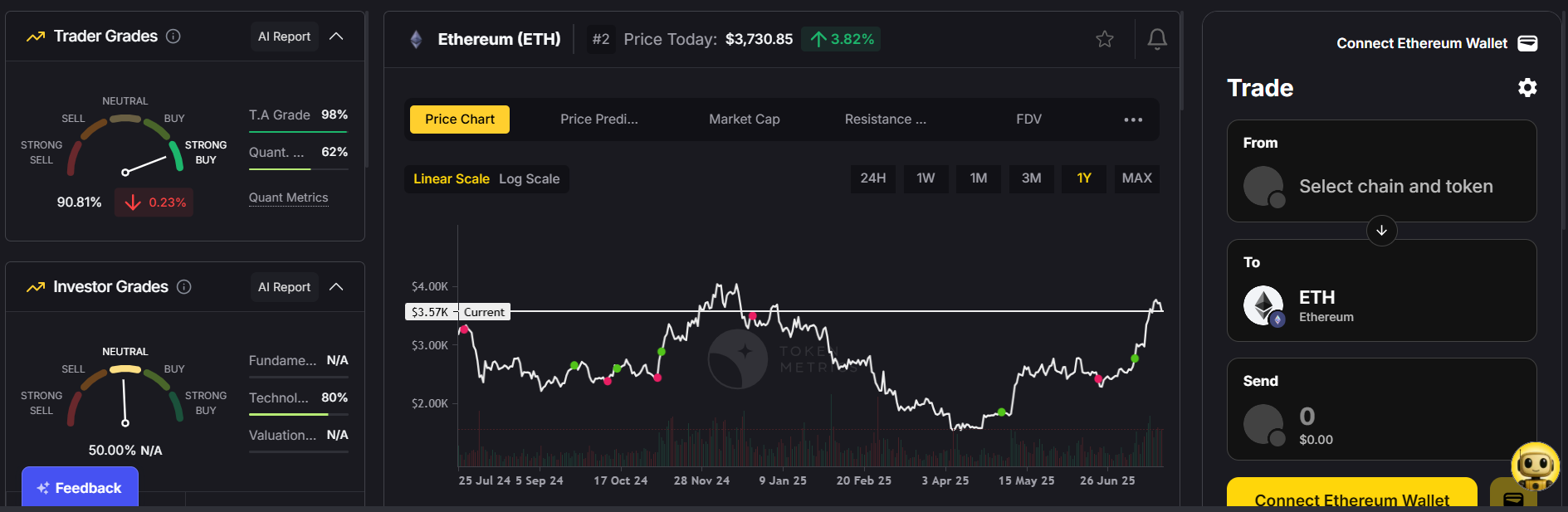
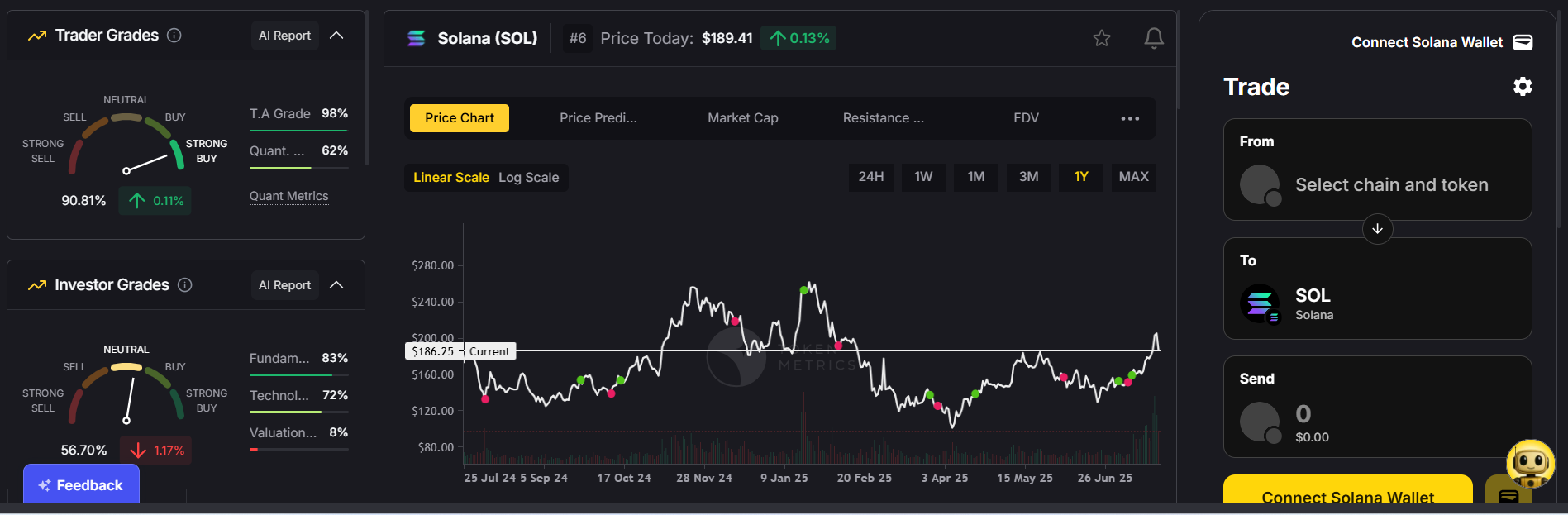
Bitcoin remains strong, with ETH and SOL following closely. Our models suggest:

  • ETH base case: $5,700

‍

  • SOL base case: $630

‍

  • Market cap projection: $8–14 trillion

Despite regulatory noise, crypto’s fundamentals—liquidity, user growth, and capital rotation—remain bullish.

Meme Coin Resurgence

Meme coins are leading short-term market action. Among the top gainers:

  • LoFi (SUI Ecosystem): Under $50M FTV, high liquidity, listed on Kraken and KuCoin
  • Sign, Gradient, Zerebro: Mixed quality; require caution

While volatility is high, top-performing meme coins on new chains often yield strong short-term returns—especially when backed by rising ecosystems like SUI.

Smart Money Tracking with Nansen

We’ve doubled down on using platforms like Nansen to follow profitable wallet cohorts. These tools help us identify early-stage tokens with smart money inflows. Key indicators:

  • Positive net inflow from smart wallets
  • Low concentration in top 100 holders
  • Distribution to non-suspicious fresh wallets
  • Whale cohort accumulation

We also track wallet activity over time to confirm whether top-performing wallets are accumulating or exiting positions.

Deep Dives Over Speculation

While meme coins grab headlines, we’re also analyzing sectors with long-term viability:

  • AI Agents (e.g., Fractal AI, Swarms)
  • Real-World Asset Stablecoins (e.g., USUAL with 9% APY)
  • Narrative Ecosystems (e.g., Hedera’s DEX activity surge)

We balance high-risk meme trades with deep fundamental research into projects gaining traction on-chain and in product development.

Sector Watch: Hedera Ecosystem

The Hedera (HBAR) ecosystem recently saw a 5x spike in DEX volume. Tokens like:

  • SaucerSwap (DEX)
  • HashPack (wallet)
  • Bonzo (lending)

are trending upward. While TVL remains low, increased volume may spark price momentum.

We’re not rotating capital aggressively here yet, but we’re watching closely for sustained on-chain activity.

Capital Flow Outlook

Altcoin rotation often follows BTC consolidation. With BTC and ETH leading the charge, we expect:

  • Meme coins and DeFi tokens to lead early-stage alt rotations
  • AI and DePin narratives to pick up mid-cycle
  • ETH and SOL outperformance in layer-1 competition

Internal price models and momentum indicators support further upside, assuming macro remains stable and regulatory conditions don’t sharply deteriorate.

Conclusion

The current cycle rewards those who combine quantitative analysis, on-chain tracking, and strong narrative awareness. Whether trading LoFi for a quick flip or accumulating tokens like Fractal AI or USUAL for a thesis-driven hold, the key is staying ahead of trends without abandoning discipline.

Crypto Basics

What Is a Moonshot? The Ultimate Guide to High-Risk, High-Reward Gems in Crypto (2025)

Token Metrics Team
6 min
MIN

The term “moonshot” is everywhere in the crypto world—but what does it really mean? In 2025, as the search for the next 100x token intensifies, understanding the concept of a crypto moonshot is more important than ever. Moonshots offer massive upside potential, but they also come with high risk. So how do you find them, and more importantly, how do you separate hype from real opportunity?

In this guide, we’ll break down what a moonshot is, why it matters, how to identify one, and how tools like Token Metrics are helping investors discover the next big thing in crypto—before it takes off.

🚀 What Is a Moonshot in Crypto?

In crypto, a moonshot refers to a low-cap, high-potential cryptocurrency that could deliver outsized returns, typically 10x, 50x, or even 100x your initial investment. The term comes from the idea that a token is going “to the moon”—crypto slang for an explosive price increase.

Unlike established cryptocurrencies like Bitcoin and Ethereum, moonshots are usually early-stage projects with small market caps, limited trading volume, and a high level of speculation. These tokens often sit under the radar, only gaining traction once a specific narrative, innovation, or market trend brings them into the spotlight.

🧠 Characteristics of a Moonshot Token

While no one can guarantee a moonshot, successful ones often share several key traits:

1. Low Market Cap

Most moonshots start with a market cap under $50 million, sometimes even under $10 million. This gives them room to grow exponentially as adoption increases.

2. Strong Narrative or Trend Alignment

Moonshots usually align with emerging crypto narratives, such as:

  • AI in crypto (e.g., TMAI)
  • Real-world assets (RWA)
  • Decentralized infrastructure (DePIN)
  • ZK rollups and Layer-2s
  • On-chain gaming and modular blockchains

‍

3. Innovative Technology or Unique Use Case

They bring new ideas or solve real problems, giving them the potential to disrupt existing models.

4. Early Community Traction

Even if small, moonshots typically have loyal, vocal communities that drive awareness and support adoption.

5. Token Utility

Tokens that play a critical role in a product’s functionality (staking, access, governance) are more likely to gain value as adoption grows.

6. Exchange Listings

Getting listed on a major CEX (centralized exchange) or DEX (decentralized exchange) often serves as a catalyst for price surges.

⚠️ Moonshot = High Risk, High Reward

While the upside is massive, moonshots come with serious risks:

  • Volatility: Prices can swing wildly in hours or minutes.
  • Scams and rug pulls: Many low-cap tokens are created with malicious intent.
  • Illiquidity: It may be hard to buy or sell large amounts.
  • Overhype: Narratives can fizzle out quickly, leaving bag holders behind.
  • Lack of product-market fit: Many projects never deliver a working product.

Risk management is essential. Only allocate a small portion of your portfolio to moonshots and always do your own research.

🔍 How to Identify Crypto Moonshots

Finding true moonshots is part art, part science. Here are practical steps to help spot them:

1. Use Token Metrics Moonshots Feature

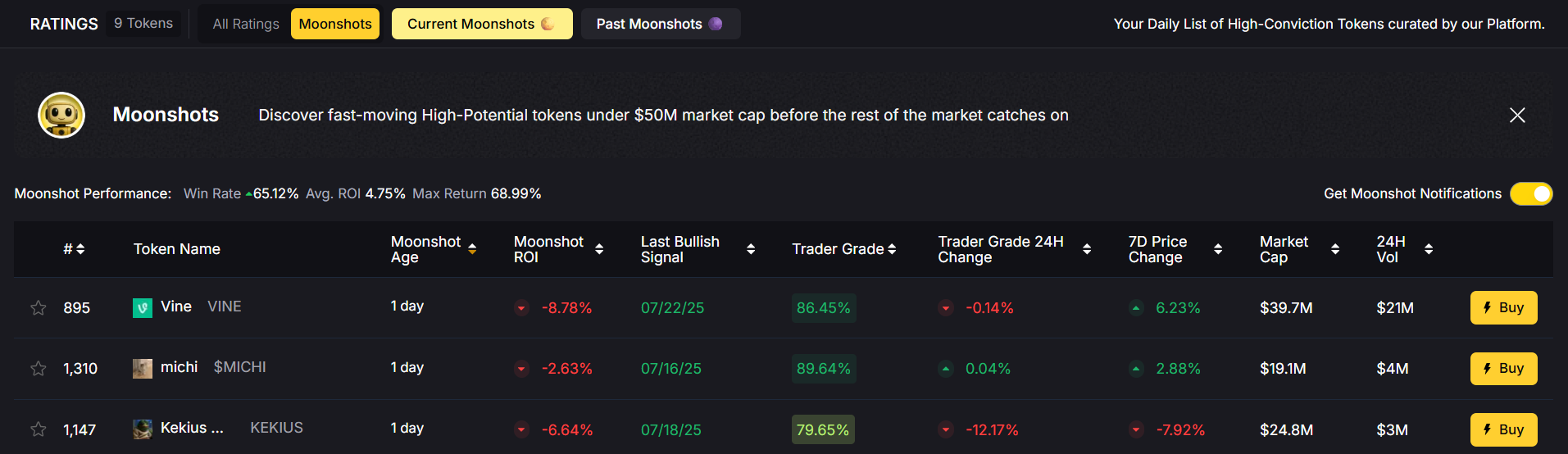
Token Metrics, the leading AI-powered crypto research platform, features a dedicated Moonshots tab that helps users discover early-stage altcoins with massive potential.

Token Metrics uses AI models to:

  • Scan over 6,000+ tokens
  • Analyze 80+ on-chain and off-chain data points
  • Score tokens based on Investor Grade (long-term) and Trader Grade (short-term)
  • Highlight tokens before they hit mainstream radar

2. Follow Emerging Narratives

Pay attention to sectors gaining momentum—AI, DePIN, L2s, gaming, and RWA are hot in 2025. Moonshots often emerge at the intersection of narrative and innovation.

3. Explore Crypto Twitter and Discord

Many early-stage gems are discussed by small communities, KOLs (key opinion leaders), and early investors before any mainstream media coverage.

4. Check Tokenomics

A great idea can’t succeed with poor tokenomics. Look for:

  • Fair initial distribution
  • Deflationary or limited supply
  • Lock-up periods for team/investors
  • Strong incentive alignment with users

5. Monitor DEX Launchpads and On-Chain Metrics

Platforms like Uniswap, Camelot, or Base-native DEXs are where most moonshots launch first. Analyze:

  • Wallet distribution (whale vs retail)
  • Volume and liquidity
  • Holder growth

🔬 How Token Metrics Helps You Find the Next Moonshot

Token Metrics is the ultimate tool for discovering and validating moonshot opportunities. Here’s how:

🧠 AI-Driven Token Ratings

Get real-time Investor Grade and Trader Grade scores, generated by AI models trained on historical altcoin performance.

📈 Bullish & Bearish Signals

Get alerts when a token shows strong upside or downside momentum based on quantitative signals.

🚀 Moonshots Section

A curated feed of low-cap, high-potential tokens filtered by market cap, sector, risk level, and on-chain traction.

📊 Backtesting & Risk Analysis

Use simulation tools to see how a moonshot would have performed in different market conditions, helping you gauge timing and position sizing.

👉 Try Token Metrics with a 7-day free trial and start exploring moonshots with data, not just hype.

✅ Examples of Real Moonshots

In previous years, several tokens started as moonshots and delivered massive gains:

  • Polygon (MATIC) – Launched below $0.01, surged to over $2.50 at peak

  • Axie Infinity (AXS) – Went from cents to $165 during the 2021 gaming boom

  • Pepe (PEPE) – Meme coin that turned thousands into millions in 2023

  • VIRTUAL (SPX6900) – Token Metrics alerted this 55x trade before the crowd

In 2025, emerging moonshots include AI-powered tokens like $TMAI (Token Metrics AI)—positioned at the forefront of AI + crypto convergence.

🛡️ Tips for Safely Investing in Moonshots

  • Only use risk capital (money you can afford to lose)
  • Start small and scale positions after traction
  • Set profit targets and stop-losses
  • Diversify across 5–10 moonshot tokens
  • Use non-custodial wallets and keep private keys secure
  • Don’t chase pumps—enter early or not at all

Moonshot investing isn’t about certainty—it’s about asymmetrical bets with defined downside and massive upside.

Final Thoughts

Moonshots are the heartbeat of crypto innovation. They represent the bold, risky, and visionary projects that could reshape entire industries—or fade into obscurity.

In 2025, the opportunity to find the next Solana, MATIC, or PEPE still exists—but success comes from informed decisions, not hype-driven FOMO. That’s why platforms like Token Metrics are critical. With AI-powered research, curated moonshot lists, and real-time trading signals, Token Metrics helps you spot the gems before they moon.

So, what’s your next moonshot?

Crypto Basics

Understanding Cryptocurrency Danger: What Investors Need to Know

Token Metrics Team
6 min
MIN

Introduction to Cryptocurrency

Cryptocurrency is a form of digital currency secured by cryptography, making it nearly impossible to counterfeit or double-spend. As a type of crypto asset, cryptocurrencies operate on decentralized networks powered by blockchain technology—a distributed public ledger maintained by multiple computers worldwide. This decentralized nature sets cryptocurrencies apart from traditional finance systems, which rely heavily on centralized financial institutions and central banks.

Most cryptocurrencies are not issued or regulated by any central authority, which makes them resistant to government interference or manipulation. While this independence offers certain freedoms, it also means that cryptocurrency investments carry substantial risk. The underlying cryptography and blockchain technology are generally secure, but their complexity can be challenging for new users to navigate. Additionally, the market value of cryptocurrencies is often affected by media hype and investor opinion, further contributing to their volatility. Understanding cryptocurrency danger involves exploring both the innovative technology behind it and the volatile market dynamics that influence its value.

Cryptocurrency Exchanges

Cryptocurrency exchanges play a crucial role as crypto asset service providers, allowing investors to buy and sell cryptocurrencies like Bitcoin and other cryptocurrencies at market prices. These exchanges function similarly to stock markets but operate 24/7, reflecting the highly volatile nature of the crypto market. However, many cryptocurrency exchanges lack a high level of governmental oversight or auditability compared to traditional banks, which can expose users to additional risks.

Once purchased, cryptocurrencies must be stored securely, either in digital wallets controlled by the user or through third-party services such as Coinbase, which assist with storing crypto assets safely. Some brokerage platforms, like Robinhood, provide access to cryptocurrency investments but may impose restrictions on withdrawals, limiting how investors can transfer or sell cryptocurrencies. This highlights the importance of understanding the terms and risks associated with each platform.

For those seeking exposure to the crypto asset class without directly holding digital wallets, crypto ETFs offer a more traditional investment vehicle. These funds track the market value of cryptocurrencies and can be bought and sold through conventional brokerage accounts, bridging the gap between digital assets and traditional finance.

Cybersecurity Risks

One of the most significant cryptocurrency dangers lies in cybersecurity risks. Despite the security of blockchain technology, crypto investments are vulnerable to scams, hacks, software bugs, and the highly volatile price swings inherent in the market. The private key—a unique cryptographic code—is the sole access point to an investor’s digital wallet and cryptocurrency holdings. Losing this private key means losing access to the entire investment permanently, with no recourse. If a private key is stolen, there is no way to retrieve it, similar to having a credit card with no authentication check.

Technical challenges and market speculation add layers of risk that investors must carefully consider. Hackers frequently target digital wallets and cryptocurrency exchanges, attempting to steal digital assets. Numerous exchanges have suffered massive security breaches, leading to substantial losses for users. To mitigate these risks, many investors use offline hardware wallets or cold storage solutions, which keep private keys disconnected from the internet connection and significantly reduce the chances of theft.

Evaluating Cryptocurrency as an Investment

Cryptocurrency investments are highly speculative and carry substantial risk, making them unsuitable for risk-averse investors. The market’s high price volatility can lead to rapid gains but also significant losses, and investors should only commit funds they can afford to lose. Cryptocurrencies can potentially yield high returns, attracting speculative investors. Unlike traditional finance, where financial institutions and regulatory bodies provide certain protections, cryptocurrency markets operate with limited oversight, increasing the potential for market manipulation and fraud.

Understanding one’s personal risk tolerance is crucial before deciding to invest in cryptocurrencies. The lack of regulatory control means that how funds are used or managed may be opaque, and the risk of losing money is real and significant. Investors should approach cryptocurrency investments with caution and seek advice from qualified investment advisors to navigate these complexities.

Benefits and Advantages of Cryptocurrency

Despite the risks, cryptocurrencies offer unique advantages. By removing reliance on centralized intermediaries such as banks or credit card companies, cryptocurrencies reduce systemic financial risks and enable more direct, peer-to-peer transactions. Transfers between parties are secured through public and private key cryptography and validated by consensus mechanisms like proof of work or proof of stake, which underpin blockchain technology.

Crypto transfers can often be faster than traditional money transfers, especially in cross-border remittances where converting fiat currency typically involves multiple intermediaries. Decentralized finance innovations like flash loans demonstrate how cryptocurrency transactions can occur almost instantaneously, providing new opportunities for investment and trading.

Risks and Challenges

However, cryptocurrencies also pose significant risks and challenges. While transactions are pseudonymous, digital trails remain traceable by law enforcement agencies such as the Federal Bureau of Investigation (FBI). Cryptocurrencies have been exploited for illicit activities including money laundering, dark web transactions, and ransomware payments. China has banned cryptocurrency exchanges, transactions, and mining, although it has developed a Central Bank Digital Currency (CBDC).

The concentration of wealth in the crypto space is increasing, with large companies and investment funds accumulating substantial holdings. Additionally, cryptocurrency mining demands significant energy consumption, often concentrating mining power among a few large firms with vast resources.

Off-chain security issues, such as vulnerabilities in third-party platforms, and the inherent price volatility continue to challenge the practical implementation of cryptocurrencies. The ideal of a fully decentralized system is often compromised by market manipulation and fraud, underscoring the cryptocurrency danger investors face.

Cryptocurrency and the Law

Unlike fiat currency, which is government-issued legal tender, cryptocurrencies lack official issuance and their legal status varies widely across jurisdictions. In the United States, the Internal Revenue Service (IRS) treats cryptocurrencies as financial assets or property for tax purposes, requiring capital gains taxes on sales or trades.

U.S. courts have classified cryptocurrencies as securities for institutional buyers but not for retail investors trading on exchanges, reflecting the complex regulatory environment. In July 2023, U.S. courts ruled that cryptocurrencies are considered securities when purchased by institutional buyers but not by retail investors on exchanges. Similarly, cryptocurrency regulations in Asia differ significantly by country, demonstrating the global uncertainty surrounding digital assets.

Investors must stay informed about evolving legal frameworks to understand the implications of investing in cryptocurrencies and ensure compliance with tax and regulatory requirements.

Common Scams and How to Avoid Them

The irreversible nature of cryptocurrency transactions and limited regulatory oversight make the space ripe for scams. Fraudsters often use fake endorsements, pressure tactics, and misleading schemes to steal money from unsuspecting investors. For example, some have lost substantial sums—like Rhett, who lost $97,000 to a fraudulent Bitcoin trading scheme.

To avoid falling victim to scams, investors should exercise caution, conduct thorough research, and verify the legitimacy of any investment opportunity. Consulting with reputable investment advisors and relying on trusted sources can help mitigate the risk of fraud and ensure safer participation in the crypto market.

Best Practices for Cryptocurrency Users

Despite the inherent risks, many individuals are drawn to cryptocurrency for its potential gains and innovative technology. To protect digital currency assets, users must adopt proactive security measures. Understanding cybersecurity risks is essential to safeguarding crypto investments from hackers and bad actors.

Best practices include using hardware wallets like Ledger or Trezor, which provide enhanced security by keeping private keys offline. Investors should create duplicate hardware wallets and store backups in secure locations to prevent permanent loss of access. Staying vigilant against phishing attacks and avoiding sharing private keys or sensitive information is critical for maintaining control over digital assets.

Conclusion and Final Thoughts

Cryptocurrencies remain a highly speculative and risky asset class characterized by substantial price volatility and cybersecurity dangers. Investment advisors often recommend treating crypto investments as trading instruments rather than long-term holdings due to their unpredictable nature.

Cryptocurrency products carry risks including illiquidity and the potential for total loss of the entire investment. Investors should only allocate funds they can afford to lose and fully understand the technical complexities and market dynamics before engaging in cryptocurrency trading.

By staying informed, exercising caution, and following best security practices, investors can navigate the cryptocurrency landscape more safely. However, the cryptocurrency danger remains real, and careful consideration is essential before investing in this rapidly evolving digital asset space. Understanding the security and risks related to cryptocurrency requires a much higher level of engagement than traditional investments.

Choose from Platinum, Gold, and Silver packages
Reach with 25–30% open rates and 0.5–1% CTR
Craft your own custom ad—from banners to tailored copy
Perfect for Crypto Exchanges, SaaS Tools, DeFi, and AI Products