Back to blog
Crypto Basics

How to Short Bitcoin? - 5 Easy Methods to Try in 2023

Learn how to short Bitcoin with advanced strategies and check what risks are involved in shorting BTC with examples in this descriptive guide.
Token Metrics Team
9 Minutes
Want Smarter Crypto Picks—Free?
See unbiased Token Metrics Ratings for BTC, ETH, and top alts.
Thank you! Your submission has been received!
Oops! Something went wrong while submitting the form.
 No credit card | 1-click unsubscribe

Bitcoin has gained significant attention and popularity in recent years as a decentralized digital currency. While many people invest in Bitcoin for long-term gains, others may be interested in profiting from its price decline. 

This article aims to provide a comprehensive guide on how to short Bitcoin, allowing you to potentially capitalize on downward price movements. 

By understanding the concept of shorting and implementing the right strategies, you can navigate the volatile nature of Bitcoin and make informed investment decisions.

What is the Process of Crypto Shorting?

Shorting, also known as short selling, is an investment strategy that involves betting on the decline in the price of an asset. 

For example, when you short Bitcoin, you're essentially borrowing Bitcoin from a lender and selling it at the current market price. The goal is to buy back the Bitcoin at a lower price in the future, return it to the lender, and profit from the price difference.

How to Short Bitcoin?

Shorting Bitcoin allows you to potentially benefit from downward price movements, even in a bear market. However, it's crucial to note that shorting comes with its own set of risks and considerations.

How to Short Bitcoin?

The method of shorting Bitcoin relies on various factors, such as your inclination towards risk, the funds you have at hand, your level of expertise, and other relevant considerations. Let's explore few widely used methods to short BTC -

1. Leveraging Margin Trading: Margin trading allows you to amplify your trading position by borrowing funds from a cryptocurrency exchange. By utilizing leverage, you can open larger short positions with a smaller initial investment. 

However, it is crucial to exercise caution when using leverage, as it also magnifies potential losses. Proper risk management and setting stop-loss orders are essential to protect your capital.

2. Utilizing Options and Futures: Advanced traders often utilize options and futures contracts to short Bitcoin effectively. Options provide the right, but not the obligation, to sell Bitcoin at a predetermined price within a specified time frame. 

Futures contracts, on the other hand, obligate the parties involved to buy or sell Bitcoin at a predetermined price and date. These derivatives can be employed to hedge positions, manage risk, and execute more complex shorting strategies.

3. Algorithmic Trading: Algorithmic trading has gained popularity in recent years, offering advanced tools for shorting Bitcoin. By using computer algorithms, traders can automate their strategies, execute trades at high speeds, and capitalize on even the smallest price differentials. 

Algorithmic trading requires in-depth programming knowledge and a comprehensive understanding of market dynamics, but it can provide a significant advantage for experienced traders.

4. Shorting Bitcoin on Exchanges: Shorting Bitcoin can be accomplished by creating an account on a cryptocurrency exchange that supports this functionality. 

Several exchanges, such as Kraken, Bitmex, Bitfinex, eToro, and Binance, offer the ability to borrow Bitcoin, sell it at the current market price, and repurchase it later at a potentially lower price. 

However, it's important to note that not all exchanges facilitate short selling of cryptocurrencies.

5. Using Bitcoin CFDs: A financial technique known as a contract for differences (CFD) offers a way to profit from variances in prices between the opening and closing of a trade. 

Bitcoin CFDs operate similarly to Bitcoin futures, as they involve speculating on the price of the cryptocurrency. When you acquire a CFD with the expectation of price decline, you essentially take a short position on Bitcoin. 

Compared to Bitcoin futures, CFDs provide greater flexibility in terms of settlement duration since they don't have predetermined settlement dates.

Moreover, in specific Bitcoin CFD markets, traders can enter into agreements based on Bitcoin's overall performance or its performance relative to fiat currency or another cryptocurrency.

Bitcoin Shorting Strategy

Here is a compilation of factors to consider when contemplating short selling Bitcoin using various shorting strategies:.

In-Depth Technical Analysis

To successfully short Bitcoin, it is crucial to have a solid grasp of technical analysis. This involves analyzing historical price data, chart patterns, and indicators to identify potential entry and exit points.

By utilizing advanced technical analysis tools, such as moving averages, Bollinger Bands, and Fibonacci retracements, you can gain a competitive edge in predicting market trends and making informed shorting decisions.

Monitoring Market Sentiment

Understanding market sentiment is another key aspect of successful Bitcoin shorting. Keeping a close eye on news, social media trends, and influential figures' opinions can provide valuable insights into the market's overall mood. 

By monitoring sentiment indicators, you can gauge market expectations and position yourself strategically to capitalize on potential price drops.

Monitoring Whales and Institutional Investors

Large investors, commonly referred to as "whales," and institutional players have a significant impact on Bitcoin's price movements. By monitoring their activities, such as large-scale sell-offs or accumulations, you can gain insights into potential market trends. 

Various platforms provide whale tracking tools that allow you to track these influential market participants and adjust your shorting strategies accordingly.

Fundamental Analysis

Fundamental indicators, such as Bitcoin's adoption rate, network activity, and overall market capitalization, can help in assessing the long-term value and potential price trends of the cryptocurrency. 

By staying informed about these indicators and market trends, you can make more informed decisions when shorting Bitcoin.

Factors to Consider While Shorting Bitcoin

When engaging in Bitcoin shorting, it is crucial to have a thorough understanding of the key factors that significantly impact the strategy's effectiveness

Market Analysis: Conduct a thorough analysis of the Bitcoin market, examining price trends, historical data, and market indicators. This will help you identify potential opportunities for short selling.

Risk Assessment: Evaluate the risks associated with short selling Bitcoin, including market volatility, regulatory changes, and potential price fluctuations. Assessing and managing these risks is crucial for successful short selling.

Timing: Timing is key when short selling Bitcoin. Identify potential entry and exit points based on market conditions, news events, and technical analysis indicators. A well-timed short position can maximize your profits.

Stop Loss and Take Profit Orders: Set up stop loss and take profit orders to manage your risk and protect your investment. These orders automatically trigger a trade closure when the price reaches a specified level, ensuring you exit the trade at a desirable point.

Diversification: Consider diversifying your short positions by including other cryptocurrencies or financial instruments in your strategy. This can help mitigate risk and optimize your portfolio's performance.

Monitoring and Adjustments: Continuously monitor the market conditions and your short positions. Stay vigilant and be prepared to make adjustments to your strategy if market dynamics change. Regularly reassess your positions based on new information and market trends.

Professional Guidance: Consider seeking guidance from experienced traders or financial advisors who specialize in cryptocurrency investments. Their expertise can provide valuable insights and help you navigate the complexities of short selling Bitcoin.

Popular Examples of Shorting Bitcoin

These are few popular and real life examples of shorting BTC -

Example 1: The Bitcoin Bubble Burst of 2017

The cryptocurrency market experienced unprecedented growth in 2017, driven primarily by the surge in Bitcoin's price. However, this euphoria was short-lived. 

In December of that year, Bitcoin's price experienced a dramatic correction, plunging from its all-time high of nearly $20,000 to around $3,000 within a year. 

Many investors who had shorted Bitcoin during this period saw substantial profits as the market sentiment turned bearish.

Example 2: The China Ban on Cryptocurrency

China, a significant player in the cryptocurrency space, has often made headlines with its regulatory actions. In 2017, the Chinese government announced a ban on initial coin offerings (ICOs) and shut down numerous cryptocurrency exchanges. 

These actions led to a significant drop in Bitcoin's price as market participants anticipated a decline in demand. Traders who were short on Bitcoin during this period benefited from the downward trend caused by the ban.

Example 3: The Tesla Short Squeeze

In early 2021, Tesla, the electric vehicle manufacturer led by Elon Musk, announced a $1.5 billion investment in Bitcoin. This move sparked a rally in Bitcoin's price and caught many short sellers off guard. 

However, a few months later, Tesla announced that it would no longer accept Bitcoin as payment, causing the cryptocurrency's price to plummet. Short sellers who had anticipated the reversal profited from this volatility in the market.

These examples demonstrate the diverse range of events and circumstances where shorting Bitcoin has been a profitable strategy.

Is Shorting Bitcoin Risky?

Shorting Bitcoin carries significant risks due to its unpredictable price fluctuations. Traders who short Bitcoin borrow and sell it with the expectation of buying it back at a lower price. 

However, if the price rises instead, losses can occur. Bitcoin's decentralized nature and susceptibility to market manipulation increase the risk further. 

To mitigate these risks, traders should assess their risk tolerance and employ robust risk management strategies, such as setting stop-loss orders and diversifying their portfolios.

Frequently Asked Questions

Q1. Can I short Bitcoin without using a broker?

Shorting Bitcoin typically requires using a broker as they facilitate the borrowing and selling of the cryptocurrency. Brokers provide the necessary infrastructure and regulatory compliance to execute short trades effectively.

Q2. What risks are associated with shorting Bitcoin?

Shorting Bitcoin carries several risks, including potential losses if the price rises instead of falling. Additionally, market volatility and unexpected events can lead to significant price fluctuations, making it crucial to carefully manage your position and implement risk management strategies.

Q3. Can I short Bitcoin using leverage?

Yes, many brokers offer leverage, allowing traders to amplify their short positions. However, it's important to exercise caution when using leverage, as it also increases the potential for losses.

Q4. Are there any tax implications when shorting Bitcoin?

Tax regulations regarding shorting Bitcoin vary across different jurisdictions. It's crucial to consult with a tax professional to understand the specific tax obligations and implications associated with shorting Bitcoin in your country.

Q5. Is shorting Bitcoin suitable for beginners?

Shorting Bitcoin can be complex and involves a certain level of risk. It's generally recommended for experienced traders who have a solid understanding of market dynamics and risk management strategies. 

Beginners are advised to first gain a thorough understanding of cryptocurrency trading before attempting to short Bitcoin.

Conclusion

Shorting Bitcoin in 2023 can be a profitable strategy if executed with careful planning and a comprehensive understanding of market dynamics. 

Remember to choose a reliable broker, conduct thorough market analysis, and employ risk management strategies to protect your investments. 

However, it's crucial to note that shorting Bitcoin carries inherent risks, and traders should only risk what they can afford to lose.

Disclaimer

The information provided on this website does not constitute investment advice, financial advice, trading advice, or any other sort of advice and you should not treat any of the website's content as such.

Token Metrics does not recommend that any cryptocurrency should be bought, sold, or held by you. Do conduct your own due diligence and consult your financial advisor before making any investment decisions.

Build Smarter Crypto Apps &
AI Agents in Minutes, Not Months
Real-time prices, trading signals, and on-chain insights all from one powerful API.
Grab a Free API Key
About Token Metrics
Token Metrics: AI-powered crypto research and ratings platform. We help investors make smarter decisions with unbiased Token Metrics Ratings, on-chain analytics, and editor-curated “Top 10” guides. Our platform distills thousands of data points into clear scores, trends, and alerts you can act on.
30 Employees
analysts, data scientists, and crypto engineers
Daily Briefings
concise market insights and “Top Picks”
Transparent & Compliant
Sponsored ≠ Ratings; research remains independent
Want Smarter Crypto Picks—Free?
See unbiased Token Metrics Ratings for BTC, ETH, and top alts.
Thank you! Your submission has been received!
Oops! Something went wrong while submitting the form.
 No credit card | 1-click unsubscribe
Token Metrics Team
Token Metrics Team

Recent Posts

Crypto Basics

What Is Cryptocurrency Market Cap? A Comprehensive Guide

Token Metrics Team
6 min

Understanding the cryptocurrency market cap is fundamental for anyone interested in investing or trading digital currencies. Market capitalization, often referred to as market cap, is a key metric that reflects the total value of a cryptocurrency in the market. Cryptocurrency market capitalization represents the total value of all coins that have been mined for a specific cryptocurrency or all cryptocurrencies combined. This article will explore what cryptocurrency market cap means, how it is calculated, and why it matters for investors navigating the dynamic crypto market.

Introduction to Market Capitalization

Market capitalization represents the total value of a cryptocurrency's circulating coins in the market. It is a crucial metric used by investors and professionals to gauge the relative size and importance of a digital currency within the crypto ecosystem. Understanding market cap is essential for making informed investment decisions, as it provides a snapshot of a cryptocurrency’s size, popularity, and growth potential.

The market cap of a cryptocurrency is calculated by multiplying its current price by the number of coins in circulation. This simple formula offers insight into the cryptocurrency’s total value and helps investors compare different crypto assets effectively. By knowing the market cap, investors can better understand a cryptocurrency’s position in the market and assess its potential for future growth.

Crypto Market Cap and Circulating Supply

To fully grasp the concept of crypto market cap, it is important to understand the role of circulating supply. The circulating supply refers to the number of coins currently available and actively traded in the market. It is this supply that determines the crypto market cap when multiplied by the cryptocurrency’s current price.

Circulating supply is distinct from total supply, which includes all coins that have been created, including those not yet available for trading or locked in reserves. For example, some projects may have a large total supply but a smaller circulating supply due to tokens held by the development team or locked in smart contracts. Recognizing the difference between circulating supply and total supply is vital when evaluating a cryptocurrency’s market capitalization and its potential impact on price and growth.

Calculation and Importance

Market cap is calculated by multiplying the current price of a cryptocurrency by its circulating supply, providing a real-time measure of the asset's total value in dollars or other fiat currencies. This calculation is dynamic, as both price and circulating supply can fluctuate, causing the market cap to change rapidly.

This metric is important because it helps investors assess the size and value of a cryptocurrency relative to others in the crypto market. A higher market cap often indicates a more established and widely adopted cryptocurrency, such as Bitcoin or Ethereum, which tend to have greater network security and liquidity. Conversely, a low market cap may signal a newer or more speculative digital asset, often associated with higher risk and volatility.

Understanding market cap allows investors to make informed choices by comparing the total value of different cryptocurrencies and evaluating their potential for growth or decline.

Investment Strategies and Market Trends

Market capitalization plays a significant role in shaping investment strategies within the crypto market. It influences the level of risk investors are willing to take and the potential returns they might expect. Cryptocurrencies are categorized into three market cap sizes: large-cap (over $10 billion), mid-cap ($1 billion to $10 billion), and small-cap (under $1 billion). Large cap cryptocurrencies, typically those with a market cap exceeding $10 billion, are generally less volatile and more stable. These assets are favored by conservative investors who prioritize security and steady growth.

On the other hand, mid cap and small cap cryptocurrencies often present higher growth potential but come with increased risk and price volatility. Small cap cryptocurrencies may be more susceptible to market fluctuations and liquidity challenges but can offer substantial returns if their underlying projects succeed.

Staying informed about market trends and understanding how market cap affects demand, liquidity, and price movements are essential for developing effective investment strategies. Investors who respond appropriately to these factors are better positioned to capitalize on opportunities and mitigate risks.

Characteristics of a Liquid Market

A liquid market is characterized by the ability to quickly buy or sell assets without causing significant price changes. In the crypto market, liquidity is a critical factor affecting volatility and trading volume. High liquidity means that there is a large number of buyers and sellers, facilitating smooth transactions and reducing price manipulation risks.

Cryptocurrencies with a high market cap tend to have more liquid markets due to their popularity and widespread adoption. This liquidity attracts institutional investors and traders who require the ability to enter and exit positions efficiently. Conversely, small cap cryptocurrencies may suffer from low liquidity, leading to higher volatility and wider bid-ask spreads.

A liquid market with high trading volume provides better price stability and more trading opportunities, making it more attractive for both short-term traders and long-term investors.

The Crypto Market Ecosystem

The crypto market ecosystem is a complex and evolving environment influenced by various factors beyond market cap. Blockchain technology underpins all cryptocurrencies, providing the decentralized infrastructure that ensures transparency and security. Network security, driven by consensus mechanisms and the number of active nodes, plays a crucial role in maintaining trust and stability in the market.

Institutional investors have increasingly entered the crypto market, bringing greater capital, legitimacy, and scrutiny. Their participation often affects market trends and can lead to increased liquidity and reduced volatility in large cap cryptocurrencies.

Understanding this ecosystem and the interplay of technology, investor behavior, and market dynamics is essential for anyone looking to navigate the crypto market successfully. The market is constantly responding to new technologies, regulatory developments, and shifts in investor sentiment.

Large Cap Cryptocurrencies

Large cap cryptocurrencies, such as Bitcoin and Ethereum, dominate the crypto market with market caps exceeding $10 billion. These digital assets are widely regarded as more stable and less volatile compared to smaller cryptocurrencies. Their established track records and strong network security make them attractive safe havens during periods of market uncertainty.

Large cap cryptocurrencies benefit from high liquidity and trading volume, which contribute to better price stability and ease of trading. However, because of their already substantial market capitalization, these assets may experience slower price growth compared to mid or small cap cryptocurrencies.

Investors often include large cap cryptocurrencies in their portfolios to provide balance and reduce overall risk.

Growth Potential and Analysis

While large cap cryptocurrencies offer stability, mid cap and small cap cryptocurrencies often present greater growth potential. These smaller crypto assets may be in earlier stages of development, with innovative projects and technologies that can lead to significant price appreciation.

Analyzing growth potential involves examining a cryptocurrency’s market cap, trading volume, underlying blockchain technology, and the strength of its project or business model. Investors also consider factors such as tokenomics, total supply, and network security to assess long-term viability.

However, higher growth potential comes with increased risk, including higher volatility and liquidity challenges. Investors must carefully weigh these factors and conduct thorough research before committing to investments in smaller cap cryptocurrencies.

Developing Effective Investment Strategies

Crafting effective investment strategies in the crypto market requires a comprehensive understanding of market trends, risk management, and portfolio diversification. Investors should clearly define their investment goals and risk tolerance before entering the market.

Market capitalization is a critical consideration in strategy development, as it affects liquidity, volatility, and potential returns. Diversifying investments across large cap, mid cap, and small cap cryptocurrencies can help balance risk while capturing growth opportunities.

Staying informed about the latest market trends, technological advancements, and regulatory changes is essential. Investors should be prepared to adapt their strategies as the crypto market evolves, responding to shifts in demand, supply, and broader economic factors.

In conclusion, understanding what cryptocurrency market cap is and how it influences the crypto market is vital for making informed investment decisions. By considering market cap alongside other metrics such as circulating supply, trading volume, and network security, investors can navigate the complex world of digital assets with greater confidence and success.

Announcements

Introducing the New Moonshots API Endpoint: Access High‑Potential Tokens Programmatically

Token Metrics Team
5 min

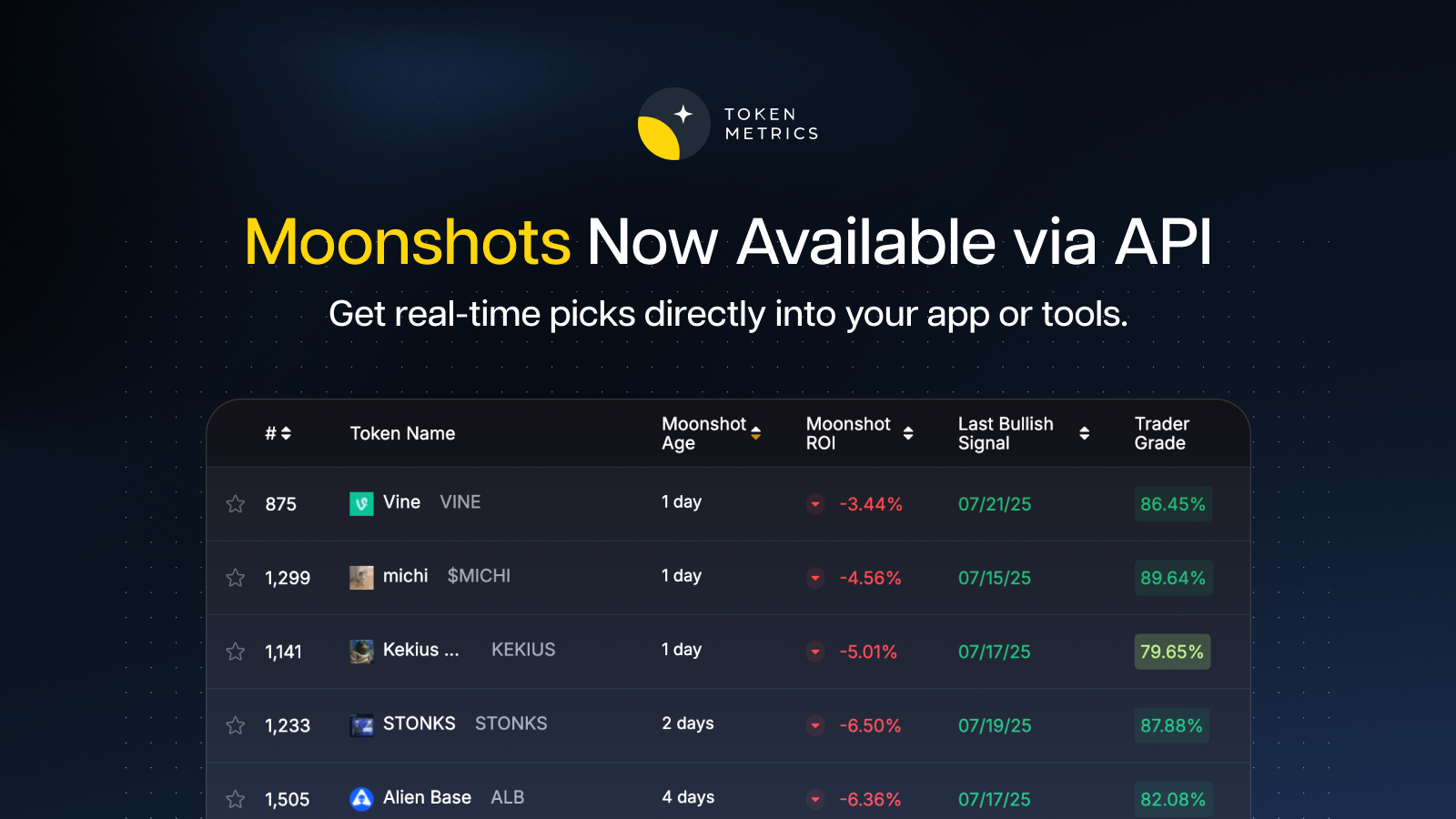
The crypto market moves fast, and staying ahead requires more than just watching charts — it takes actionable data, delivered in real‑time. That’s why we’re excited to announce a major upgrade for developers, traders, and analysts: the Moonshots feature is now live as a Token Metrics API endpoint.

This new endpoint brings the same powerful insights from our Premium Moonshots dashboard directly into your apps, dashboards, and trading systems — programmatically. Whether you’re building a crypto trading bot, creating dynamic watchlists, or backtesting new strategies, the Moonshots API gives you everything you need to make smarter, faster decisions.

What Are Moonshots?

In crypto, “moonshots” are low‑cap tokens with high upside potential — the kind of high‑risk, high‑reward plays that can deliver outsized returns when identified early. At Token Metrics, our Moonshots aren’t just random picks.

They are:

  • Hand‑picked by AI: Our proprietary algorithms scan thousands of tokens daily.
  • Backtested for performance: Only tokens that meet strict historical success criteria make the cut.
  • Continuously updated: Live insights reflect evolving market conditions in real time.

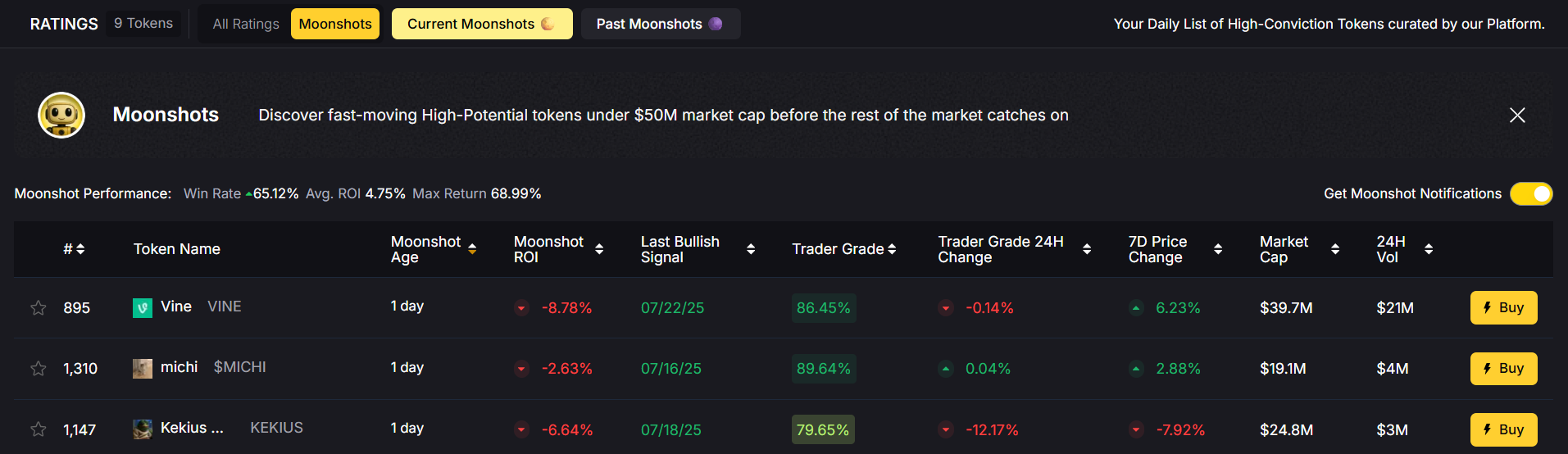
Since launch, Moonshots have surfaced 43 tokens with a 65 % win rate across trades. The max single‑token return so far? 68 % — and counting.

For developers, this is no longer just data you view in our dashboard. It’s now available via API, ready to integrate into your workflows.

Why Use the Token Metrics Moonshots API?

1. Programmatic Access to High‑Potential Trades
Get direct access to live Moonshot signals without needing to log into the platform. Perfect for apps, analytics dashboards, or automated trading systems.

2. Build Smarter Watchlists
Automatically populate your app or dashboard with AI‑curated, high‑potential tokens.

3. Trigger Bots in Real Time
Integrate the Moonshots feed into your trading bots so they can act instantly when a new token surfaces.

What’s in the API Response?

When you call the /v2/moonshot-tokens endpoint, you’ll get:

  • Token name & ticker – For easy identification.
  • Return on Investment (ROI) – Performance since the signal went live.
  • Trader Grade – Token Metrics’ proprietary grade indicating trade potential.
  • Market Cap – So you can quickly gauge token size and liquidity.
  • Signal Date – When the Moonshot was flagged.

Want to see how these signals have performed over time? Use /v2/moonshots-tokens with type=past param for detailed past performance data.

Who Is This For?

The Moonshots API is designed for:

  • Developers: Integrate AI‑curated trading intelligence into your products.
  • Quant Traders: Automate your strategies with real‑time Moonshot signals.
  • Portfolio Managers: Discover high‑potential small‑cap tokens before the crowd.

How to Get Started

  1. Upgrade to the Advanced Plan
    Moonshots is part of our premium trading‑signal suite, available with the Advanced Plan.

  2. Get Your API Key
    Once upgraded, grab your API key from the Token Metrics API dashboard.

  3. Call the Endpoint

    • Live Moonshots: GET /v2/moonshot-tokens
    • Past Moonshots: GET /v2/moonshot-tokens with type=past

  4. Build and Deploy
    Use the data to feed your dashboards, bots, or applications.

Your code could be live in minutes.

Example Use Cases

1. Auto‑Populate Watchlists

Give your users instant access to a curated list of high‑potential tokens. No manual updates — just live, programmatic signals from the API.

2. Trading Bot Triggers

Connect Moonshots to your algorithmic trading strategies. When a new Moonshot signal appears, your bot can take action immediately.

Why Moonshots API Is a Game‑Changer

The Moonshots API takes one of our most popular Premium features and makes it actionable for builders and advanced traders. No more copy‑pasting token names from dashboards. No more manually tracking new signals. With programmatic access, you can:

  • React faster to new opportunities.
  • Automate trading or alert systems.
  • Enhance your products with cutting‑edge AI‑curated token lists.

This is the same data powering our Premium dashboards — now unlocked for programmatic use.

Performance at a Glance

Here’s what you can expect from Moonshots based on recent data:

  • Tokens surfaced: 43
  • Win rate: 65 %
  • Max single‑token return: 68 %
  • Average holding period: Short‑ to mid‑term trades (active monitoring recommended)

The Bottom Line

The new Moonshots API endpoint lets you turn insights into action. Whether you’re an individual trader looking to build a personal watchlist, a quant team running algorithmic strategies, or a product developer building the next great crypto platform, the Moonshots API provides a direct pipeline to AI‑curated, backtested token picks with a proven track record.

Don’t just watch the next big move — catch it before it becomes hindsight.

How to Access the Moonshots API

  1. Upgrade to Advanced Plan to unlock trading‑signal endpoints.
  2. Get your API key from the Token Metrics dashboard.
  3. Start calling /v2/moonshot-tokens today.

Have questions? Our team is available on Telegram (@tokenmetricsapi) to help you get up and running.

Crypto Basics

Understanding Bitcoins: A Practical Guide to Buying and Using Crypto

Token Metrics Team
8 min

Introduction to Bitcoin

Bitcoins represent a revolutionary form of virtual currency that operates without reliance on any central authority or trusted third party. Introduced in 2009 by the enigmatic Satoshi Nakamoto, bitcoins were designed as a decentralized digital currency and cryptocurrency aimed at enabling money and payment transactions directly between peers. Bitcoin is the first decentralized cryptocurrency, setting the stage for a new era in digital finance. This is made possible through the innovative use of blockchain technology, a distributed ledger that records bitcoin transactions securely and transparently. The bitcoin network itself is maintained by a peer-to-peer system of computers, each verifying and broadcasting transactions to ensure the integrity and continuity of the ledger. This decentralized approach eliminates the need for financial institutions or banks to act as intermediaries, making bitcoins a unique asset in the realm of digital currencies. According to the European Central Bank, the decentralization of money offered by bitcoin has roots in the Austrian school of economics.

History of Bitcoin

The story of bitcoins began in August 2008 with the registration of the domain bitcoin.org, signaling the start of a new era in digital money. Shortly thereafter, on January 3, 2009, Satoshi Nakamoto mined the first bitcoin block, known as Block 0 or the genesis block, marking the inception of the bitcoin blockchain. Bitcoin's use as a currency began in 2009 with the release of its open-source implementation, allowing users to participate in this decentralized system. Bitcoin was introduced in response to the global financial crisis to restore trust in transactions outside of traditional systems. Bitcoin started gaining traction in 2010, highlighted by the first commercial transaction where bitcoins were used to purchase goods. Since then, bitcoin prices have experienced significant volatility, with sharp rises and falls reflecting market sentiment, adoption rates, and regulatory developments. Despite its fluctuations, bitcoin has established itself as a pioneering digital currency and a key player in the broader ecosystem of cryptocurrencies.

Bitcoin Fundamentals

At its core, bitcoin is built on a decentralized system that leverages cryptographic techniques to secure transactions and maintain trust without a central authority. The blockchain serves as a chronological chain of blocks, each block containing data stored in a way that includes a hash of the previous block. Everyone on the Bitcoin network has access to an independent copy of the blockchain for transaction verification, ensuring transparency and trust. The blockchain is implemented as an ordered list of blocks, where each block contains a hash of the previous block. This linkage ensures the integrity and immutability of the blockchain, as any alteration to previous blocks would be immediately apparent. Miners play a crucial role in this system by using computational power to solve complex mathematical problems that verify bitcoin transactions. Once validated, these transactions are grouped into new blocks and added to the bitcoin blockchain. An interesting feature of bitcoins is their divisibility; each bitcoin can be broken down into eight decimal places, with the smallest unit known as a satoshi, allowing for microtransactions and flexible usage.

Buying and Using Bitcoin

For those interested in entering the world of bitcoins, purchasing them typically involves using cryptocurrency exchanges where bitcoin can be bought using fiat currencies such as the US dollar. To buy bitcoin, users must first create a bitcoin address, which acts as a digital wallet for storing and sending bitcoins. Once an account is funded on an exchange, users can execute buy bitcoin orders and begin accumulating this digital asset. As of 2023, River Financial estimated that bitcoin had around 81.7 million users globally. As of 2021, Bitcoin is only recognized as legal tender in El Salvador, showcasing its limited but significant adoption as a national currency. Bitcoins are not only an investment but also a medium of exchange accepted by various merchants and businesses for payments. Additionally, users can sell bitcoin on exchanges or use it for donations and other financial services, highlighting its growing utility as a form of money in the digital age.

Regulatory Environment

Regulating bitcoin presents unique challenges due to its decentralized nature and absence of a central bank or authority. Governments and financial institutions worldwide are still grappling with how best to regulate bitcoin and other digital currencies. While some countries have outright banned bitcoin, others have taken steps to implement frameworks that govern its use, aiming to protect consumers and prevent illicit activities. Legal frameworks for Bitcoin vary significantly across jurisdictions, complicating investment decisions. The regulatory environment remains fluid, with ongoing debates about legal tender status, taxation, and compliance requirements. Understanding these evolving regulations is essential for users and businesses to navigate the legal landscape surrounding bitcoins safely and effectively.

Investing in Bitcoin

Investing in bitcoins offers both opportunities and risks that potential investors must carefully consider. The market for bitcoins is known for its high fees and significant volatility in bitcoin prices, which can lead to rapid gains or losses. Some investors liken bitcoin to gold, viewing it as a digital store of value and a hedge against inflation and currency devaluation. Investment in bitcoins can be conducted through cryptocurrency exchanges or specialized investment funds that provide exposure to this asset. However, thorough research and a solid understanding of the market dynamics are crucial before committing funds, as bitcoin lacks intrinsic value and is subject to speculative bubbles.

Security and Privacy

Bitcoin transactions are secured through advanced cryptographic techniques that verify and protect the integrity of each payment made on the network. Despite this robust security at the protocol level, bitcoin exchanges and wallets remain vulnerable to hacking and other cyber threats. Users must adopt stringent security measures such as using strong passwords, enabling two-factor authentication, and safeguarding private keys to protect their bitcoins. The decentralized nature of the bitcoin network, combined with the use of private keys, also provides a certain degree of privacy and anonymity, distinguishing it from traditional financial systems that rely on trusted third parties.

Mining and Consensus

Bitcoin mining is the fundamental process through which new transactions are verified and new blocks are added to the blockchain. Miners employ significant computational power to solve complex mathematical puzzles, a process that requires substantial energy consumption and specialized hardware. A new block in the blockchain is created approximately every 10 minutes for transaction processing, ensuring a steady and predictable flow of new blocks. This mining activity not only secures the network but also enables the creation of new bitcoins, rewarded to miners as a block reward. The bitcoin network operates on a consensus mechanism, ensuring that all nodes agree on the blockchain’s current state, maintaining data consistency across the peer-to-peer network. Many miners join mining pools to combine their computational resources, increasing their chances of successfully mining new blocks and earning rewards.

Challenges and Limitations

Despite its innovative design, bitcoin faces several challenges that impact its scalability and adoption. The bitcoin network can experience slow transaction times, often taking up to 10 minutes to confirm payments, which can be a drawback for everyday use. High fees during periods of network congestion further complicate its practicality for small transactions. Bitcoin is rarely used in regular transactions due to high costs, price volatility, and transaction times, limiting its utility as a day-to-day currency. Additionally, bitcoin’s decentralized structure complicates regulatory oversight and governance. Concerns also arise from the use of bitcoins in illicit activities such as money laundering and terrorist financing, prompting calls for enhanced monitoring and regulation. These limitations highlight the need for ongoing development and dialogue to address bitcoin’s shortcomings.

Risks and Considerations

Investing and using bitcoins come with inherent risks that must be acknowledged. The value of bitcoins can fluctuate dramatically, sometimes by thousands of dollars within short periods, exposing investors to potential significant losses. The absence of intrinsic value and the speculative nature of the market raise concerns about the possibility of a bitcoin bubble. Users should mitigate these risks by diversifying their investments and employing secure wallets to protect their funds. Awareness of market volatility and prudent management strategies are essential for anyone engaging with bitcoins as an asset or means of payment.

Best Practices for Bitcoin Users

To maximize benefits and minimize risks, bitcoin users should prioritize education about the technology, market, and associated risks. Using secure wallets and reputable exchanges is fundamental, along with enabling two-factor authentication to enhance account security. Staying informed about the regulatory environment and compliance requirements helps users avoid legal pitfalls. Regularly updating bitcoin software and employing strong passwords further safeguard against security breaches. Adhering to these best practices ensures a safer and more reliable experience when buying, selling, or transacting with bitcoins.

Conclusion

Bitcoin is a complex and rapidly evolving digital currency that has transformed the financial landscape by introducing a decentralized alternative to traditional money. Understanding the fundamentals of bitcoins, from their blockchain technology to their market dynamics and regulatory challenges, is crucial for users, investors, and policymakers alike. While the future of bitcoins and other cryptocurrencies remains uncertain, their growing adoption underscores their potential to reshape how value is exchanged globally. Staying informed and adaptable will be key as bitcoins continue to influence the future of money, payments, and investment.

Choose from Platinum, Gold, and Silver packages
Reach with 25–30% open rates and 0.5–1% CTR
Craft your own custom ad—from banners to tailored copy
Perfect for Crypto Exchanges, SaaS Tools, DeFi, and AI Products