Back to blog
Crypto Basics

How to Short Bitcoin? - 5 Easy Methods to Try in 2023

Learn how to short Bitcoin with advanced strategies and check what risks are involved in shorting BTC with examples in this descriptive guide.
Token Metrics Team
9 Minutes
Want Smarter Crypto Picks—Free?
See unbiased Token Metrics Ratings for BTC, ETH, and top alts.
Thank you! Your submission has been received!
Oops! Something went wrong while submitting the form.
 No credit card | 1-click unsubscribe

Bitcoin has gained significant attention and popularity in recent years as a decentralized digital currency. While many people invest in Bitcoin for long-term gains, others may be interested in profiting from its price decline. 

This article aims to provide a comprehensive guide on how to short Bitcoin, allowing you to potentially capitalize on downward price movements. 

By understanding the concept of shorting and implementing the right strategies, you can navigate the volatile nature of Bitcoin and make informed investment decisions.

What is the Process of Crypto Shorting?

Shorting, also known as short selling, is an investment strategy that involves betting on the decline in the price of an asset. 

For example, when you short Bitcoin, you're essentially borrowing Bitcoin from a lender and selling it at the current market price. The goal is to buy back the Bitcoin at a lower price in the future, return it to the lender, and profit from the price difference.

How to Short Bitcoin?

Shorting Bitcoin allows you to potentially benefit from downward price movements, even in a bear market. However, it's crucial to note that shorting comes with its own set of risks and considerations.

How to Short Bitcoin?

The method of shorting Bitcoin relies on various factors, such as your inclination towards risk, the funds you have at hand, your level of expertise, and other relevant considerations. Let's explore few widely used methods to short BTC -

1. Leveraging Margin Trading: Margin trading allows you to amplify your trading position by borrowing funds from a cryptocurrency exchange. By utilizing leverage, you can open larger short positions with a smaller initial investment. 

However, it is crucial to exercise caution when using leverage, as it also magnifies potential losses. Proper risk management and setting stop-loss orders are essential to protect your capital.

2. Utilizing Options and Futures: Advanced traders often utilize options and futures contracts to short Bitcoin effectively. Options provide the right, but not the obligation, to sell Bitcoin at a predetermined price within a specified time frame. 

Futures contracts, on the other hand, obligate the parties involved to buy or sell Bitcoin at a predetermined price and date. These derivatives can be employed to hedge positions, manage risk, and execute more complex shorting strategies.

3. Algorithmic Trading: Algorithmic trading has gained popularity in recent years, offering advanced tools for shorting Bitcoin. By using computer algorithms, traders can automate their strategies, execute trades at high speeds, and capitalize on even the smallest price differentials. 

Algorithmic trading requires in-depth programming knowledge and a comprehensive understanding of market dynamics, but it can provide a significant advantage for experienced traders.

4. Shorting Bitcoin on Exchanges: Shorting Bitcoin can be accomplished by creating an account on a cryptocurrency exchange that supports this functionality. 

Several exchanges, such as Kraken, Bitmex, Bitfinex, eToro, and Binance, offer the ability to borrow Bitcoin, sell it at the current market price, and repurchase it later at a potentially lower price. 

However, it's important to note that not all exchanges facilitate short selling of cryptocurrencies.

5. Using Bitcoin CFDs: A financial technique known as a contract for differences (CFD) offers a way to profit from variances in prices between the opening and closing of a trade. 

Bitcoin CFDs operate similarly to Bitcoin futures, as they involve speculating on the price of the cryptocurrency. When you acquire a CFD with the expectation of price decline, you essentially take a short position on Bitcoin. 

Compared to Bitcoin futures, CFDs provide greater flexibility in terms of settlement duration since they don't have predetermined settlement dates.

Moreover, in specific Bitcoin CFD markets, traders can enter into agreements based on Bitcoin's overall performance or its performance relative to fiat currency or another cryptocurrency.

Bitcoin Shorting Strategy

Here is a compilation of factors to consider when contemplating short selling Bitcoin using various shorting strategies:.

In-Depth Technical Analysis

To successfully short Bitcoin, it is crucial to have a solid grasp of technical analysis. This involves analyzing historical price data, chart patterns, and indicators to identify potential entry and exit points.

By utilizing advanced technical analysis tools, such as moving averages, Bollinger Bands, and Fibonacci retracements, you can gain a competitive edge in predicting market trends and making informed shorting decisions.

Monitoring Market Sentiment

Understanding market sentiment is another key aspect of successful Bitcoin shorting. Keeping a close eye on news, social media trends, and influential figures' opinions can provide valuable insights into the market's overall mood. 

By monitoring sentiment indicators, you can gauge market expectations and position yourself strategically to capitalize on potential price drops.

Monitoring Whales and Institutional Investors

Large investors, commonly referred to as "whales," and institutional players have a significant impact on Bitcoin's price movements. By monitoring their activities, such as large-scale sell-offs or accumulations, you can gain insights into potential market trends. 

Various platforms provide whale tracking tools that allow you to track these influential market participants and adjust your shorting strategies accordingly.

Fundamental Analysis

Fundamental indicators, such as Bitcoin's adoption rate, network activity, and overall market capitalization, can help in assessing the long-term value and potential price trends of the cryptocurrency. 

By staying informed about these indicators and market trends, you can make more informed decisions when shorting Bitcoin.

Factors to Consider While Shorting Bitcoin

When engaging in Bitcoin shorting, it is crucial to have a thorough understanding of the key factors that significantly impact the strategy's effectiveness

Market Analysis: Conduct a thorough analysis of the Bitcoin market, examining price trends, historical data, and market indicators. This will help you identify potential opportunities for short selling.

Risk Assessment: Evaluate the risks associated with short selling Bitcoin, including market volatility, regulatory changes, and potential price fluctuations. Assessing and managing these risks is crucial for successful short selling.

Timing: Timing is key when short selling Bitcoin. Identify potential entry and exit points based on market conditions, news events, and technical analysis indicators. A well-timed short position can maximize your profits.

Stop Loss and Take Profit Orders: Set up stop loss and take profit orders to manage your risk and protect your investment. These orders automatically trigger a trade closure when the price reaches a specified level, ensuring you exit the trade at a desirable point.

Diversification: Consider diversifying your short positions by including other cryptocurrencies or financial instruments in your strategy. This can help mitigate risk and optimize your portfolio's performance.

Monitoring and Adjustments: Continuously monitor the market conditions and your short positions. Stay vigilant and be prepared to make adjustments to your strategy if market dynamics change. Regularly reassess your positions based on new information and market trends.

Professional Guidance: Consider seeking guidance from experienced traders or financial advisors who specialize in cryptocurrency investments. Their expertise can provide valuable insights and help you navigate the complexities of short selling Bitcoin.

Popular Examples of Shorting Bitcoin

These are few popular and real life examples of shorting BTC -

Example 1: The Bitcoin Bubble Burst of 2017

The cryptocurrency market experienced unprecedented growth in 2017, driven primarily by the surge in Bitcoin's price. However, this euphoria was short-lived. 

In December of that year, Bitcoin's price experienced a dramatic correction, plunging from its all-time high of nearly $20,000 to around $3,000 within a year. 

Many investors who had shorted Bitcoin during this period saw substantial profits as the market sentiment turned bearish.

Example 2: The China Ban on Cryptocurrency

China, a significant player in the cryptocurrency space, has often made headlines with its regulatory actions. In 2017, the Chinese government announced a ban on initial coin offerings (ICOs) and shut down numerous cryptocurrency exchanges. 

These actions led to a significant drop in Bitcoin's price as market participants anticipated a decline in demand. Traders who were short on Bitcoin during this period benefited from the downward trend caused by the ban.

Example 3: The Tesla Short Squeeze

In early 2021, Tesla, the electric vehicle manufacturer led by Elon Musk, announced a $1.5 billion investment in Bitcoin. This move sparked a rally in Bitcoin's price and caught many short sellers off guard. 

However, a few months later, Tesla announced that it would no longer accept Bitcoin as payment, causing the cryptocurrency's price to plummet. Short sellers who had anticipated the reversal profited from this volatility in the market.

These examples demonstrate the diverse range of events and circumstances where shorting Bitcoin has been a profitable strategy.

Is Shorting Bitcoin Risky?

Shorting Bitcoin carries significant risks due to its unpredictable price fluctuations. Traders who short Bitcoin borrow and sell it with the expectation of buying it back at a lower price. 

However, if the price rises instead, losses can occur. Bitcoin's decentralized nature and susceptibility to market manipulation increase the risk further. 

To mitigate these risks, traders should assess their risk tolerance and employ robust risk management strategies, such as setting stop-loss orders and diversifying their portfolios.

Frequently Asked Questions

Q1. Can I short Bitcoin without using a broker?

Shorting Bitcoin typically requires using a broker as they facilitate the borrowing and selling of the cryptocurrency. Brokers provide the necessary infrastructure and regulatory compliance to execute short trades effectively.

Q2. What risks are associated with shorting Bitcoin?

Shorting Bitcoin carries several risks, including potential losses if the price rises instead of falling. Additionally, market volatility and unexpected events can lead to significant price fluctuations, making it crucial to carefully manage your position and implement risk management strategies.

Q3. Can I short Bitcoin using leverage?

Yes, many brokers offer leverage, allowing traders to amplify their short positions. However, it's important to exercise caution when using leverage, as it also increases the potential for losses.

Q4. Are there any tax implications when shorting Bitcoin?

Tax regulations regarding shorting Bitcoin vary across different jurisdictions. It's crucial to consult with a tax professional to understand the specific tax obligations and implications associated with shorting Bitcoin in your country.

Q5. Is shorting Bitcoin suitable for beginners?

Shorting Bitcoin can be complex and involves a certain level of risk. It's generally recommended for experienced traders who have a solid understanding of market dynamics and risk management strategies. 

Beginners are advised to first gain a thorough understanding of cryptocurrency trading before attempting to short Bitcoin.

Conclusion

Shorting Bitcoin in 2023 can be a profitable strategy if executed with careful planning and a comprehensive understanding of market dynamics. 

Remember to choose a reliable broker, conduct thorough market analysis, and employ risk management strategies to protect your investments. 

However, it's crucial to note that shorting Bitcoin carries inherent risks, and traders should only risk what they can afford to lose.

Disclaimer

The information provided on this website does not constitute investment advice, financial advice, trading advice, or any other sort of advice and you should not treat any of the website's content as such.

Token Metrics does not recommend that any cryptocurrency should be bought, sold, or held by you. Do conduct your own due diligence and consult your financial advisor before making any investment decisions.

Build Smarter Crypto Apps &
AI Agents in Minutes, Not Months
Real-time prices, trading signals, and on-chain insights all from one powerful API.
Grab a Free API Key
About Token Metrics
Token Metrics: AI-powered crypto research and ratings platform. We help investors make smarter decisions with unbiased Token Metrics Ratings, on-chain analytics, and editor-curated “Top 10” guides. Our platform distills thousands of data points into clear scores, trends, and alerts you can act on.
30 Employees
analysts, data scientists, and crypto engineers
Daily Briefings
concise market insights and “Top Picks”
Transparent & Compliant
Sponsored ≠ Ratings; research remains independent
Want Smarter Crypto Picks—Free?
See unbiased Token Metrics Ratings for BTC, ETH, and top alts.
Thank you! Your submission has been received!
Oops! Something went wrong while submitting the form.
 No credit card | 1-click unsubscribe
Token Metrics Team
Token Metrics Team

Recent Posts

Research

How Do You Implement Multi-Signature Wallets? A Complete 2025 Guide

Token Metrics Team
8

Multi-signature wallets represent one of the most powerful security innovations in cryptocurrency, providing enhanced protection against theft, loss, and unauthorized access. As digital assets become increasingly valuable and institutional adoption accelerates, understanding how to implement multi-signature (multisig) solutions has become essential for serious cryptocurrency holders. Whether you're managing organizational treasury funds, protecting family wealth, or simply seeking maximum security for substantial holdings, multisig wallets offer unparalleled control and redundancy.

Understanding Multi-Signature Wallet Technology

A multi-signature wallet requires multiple private keys to authorize a transaction, rather than the single key used in standard wallets. This distributed control model is typically expressed as "M-of-N," where N represents the total number of keys and M represents the minimum number required to authorize transactions.

For example, a 2-of-3 multisig wallet has three total keys, but only two are needed to move funds. This configuration provides security against single key compromise while offering recovery options if one key is lost. The cryptographic implementation occurs at the blockchain protocol level, meaning transaction authorization requirements are enforced by the network itself, not by centralized services.

The beauty of multisig lies in eliminating single points of failure. Even if an attacker compromises one key through hacking, phishing, or physical theft, they cannot access funds without obtaining additional keys stored in separate locations with different security measures.

Common Multi-Signature Configurations

  • 2-of-2 Multisig: This configuration requires both keys to authorize transactions, providing maximum security but no redundancy. Suitable for partnerships where both parties must approve every transaction. However, losing either key permanently locks funds, making this setup risky without proper backup strategies.
  • 2-of-3 Multisig: The most popular configuration balances security and practicality. You might keep one key on a hardware wallet at home, another in a safe deposit box, and a third with a trusted family member or professional custodian. Any two keys authorize transactions, so losing one key doesn't create catastrophic loss. This setup protects against theft (attacker needs two separate keys) while providing recovery options.
  • 3-of-5 Multisig: Organizations often use this configuration, distributing keys among multiple executives or board members. It requires broader consensus for transactions while tolerating loss of up to two keys. The increased complexity matches the higher stakes of organizational treasury management.
  • Advanced Custom Configurations: Advanced users implement schemes like 4-of-7 or 5-of-9 for maximum security and redundancy. These complex arrangements suit high-value holdings, institutional custody, or scenarios requiring distributed governance. However, operational complexity increases proportionally—more keys mean more coordination and management overhead.

Choosing the Right Multi-Signature Wallet Solution

Hardware-Based Solutions

Ledger and Trezor both support multisig configurations, allowing you to use multiple hardware wallets as cosigners. This approach keeps private keys isolated on secure hardware while enabling distributed control. Setting up hardware-based multisig typically involves initializing multiple devices, creating a multisig wallet through compatible software, and registering each hardware wallet as a cosigner.

Coldcard particularly excels for Bitcoin multisig, offering air-gapped security and extensive multisig features. Its advanced capabilities suit security-conscious users willing to navigate more complex setup procedures for maximum protection.

Software Coordinators

While keys should reside on hardware wallets, coordinator software manages multisig wallet creation and transaction building. Electrum provides robust Bitcoin multisig support with straightforward setup procedures. Sparrow Wallet offers excellent multisig features with superior user experience and advanced capabilities.

For Ethereum and ERC-20 tokens, Gnosis Safe (formerly Gnosis Multisig) has become the industry standard, particularly for DeFi treasury management. Its web interface simplifies multisig operations while maintaining security through hardware wallet integration.

Blockchain-Specific Considerations

Bitcoin's native multisig support through P2SH (Pay-to-Script-Hash) and P2WSH (Pay-to-Witness-Script-Hash) addresses provides robust, time-tested functionality. Ethereum implements multisig through smart contracts, offering more flexibility but requiring gas for deployment and transactions.

Other blockchains like Solana, Cardano, and Polkadot each have unique multisig implementations. Research your specific blockchain's multisig capabilities before committing to particular solutions.

Step-by-Step Implementation Process

Planning Your Configuration

Begin by determining the appropriate M-of-N configuration for your needs. Consider security requirements, number of parties involved, operational frequency, and recovery scenarios. Document your security model clearly, including who controls which keys and under what circumstances transactions should be authorized.

Acquiring Hardware Wallets

Purchase the necessary hardware wallets directly from manufacturers. For a 2-of-3 setup, you need three separate hardware wallets. Never reuse the same device or seed phrase—each cosigner must have completely independent keys.

Initializing Individual Wallets

Set up each hardware wallet independently, generating unique seed phrases for each device. Record seed phrases on durable materials and store them in separate secure locations. Never digitize seed phrases or store multiple phrases together.

Creating the Multisig Wallet

Using your chosen coordinator software, create the multisig wallet by registering each hardware wallet as a cosigner. The software will request the public key or extended public key (xpub) from each device—note that you're sharing public keys only, not private keys.

The coordinator generates the multisig address where funds will be stored. This address is cryptographically linked to all registered cosigner public keys, ensuring only transactions signed with the required number of private keys will be accepted by the blockchain.

Testing with Small Amounts

Before transferring substantial funds, thoroughly test your multisig setup. Send a small amount to the multisig address, then practice creating and signing transactions with the required number of keys. Verify you can successfully move funds out of the wallet before trusting it with significant amounts.

Test recovery scenarios by attempting to transact using different combinations of keys. Ensure you understand the complete transaction signing workflow and that all cosigners can successfully participate.

Making Strategic Decisions with Professional Analytics

Implementing multisig security is just one component of successful cryptocurrency management. Making informed decisions about which assets to hold, when to rebalance, and how to optimize your portfolio requires sophisticated analytical capabilities.

Discover Crypto Gems with Token Metrics AI

Operational Best Practices

Key Distribution Strategy

Distribute keys across multiple physical locations with different security profiles. Never store multiple keys in the same location—this defeats the purpose of multisig. Consider geographic distribution to protect against localized disasters like fires or floods.

For keys held by different individuals, ensure clear communication protocols exist. Everyone involved should understand their responsibilities, how to recognize legitimate transaction requests, and procedures for emergency situations.

Transaction Workflow

Establish clear processes for initiating, reviewing, and signing transactions. Who can propose transactions? What review occurs before cosigners add signatures? How are urgent situations handled? Documented workflows prevent confusion and ensure all parties understand their roles.

Use the coordinator software to create transactions, which are then presented to cosigners for review and signature. Each cosigner independently verifies transaction details before signing with their private key. Only after collecting the required number of signatures is the transaction broadcast to the blockchain.

Regular Audits and Drills

Periodically verify all keys remain accessible and functional. Practice the complete transaction signing process quarterly or semi-annually to ensure everyone remembers procedures and that all hardware and software remain compatible and updated.

Test recovery scenarios where one or more keys become unavailable. Verify you can still access funds using alternative key combinations. These drills identify potential issues before emergencies occur.

Security Considerations

Protecting Against Internal Threats

While multisig protects against external attackers, consider internal threats. In a 2-of-3 configuration, any two key holders could collude to steal funds. Select cosigners carefully and consider configurations requiring more keys for higher-value holdings.

Software and Hardware Updates

Keep coordinator software and hardware wallet firmware updated to patch security vulnerabilities. However, test updates on small amounts before applying them to wallets holding substantial funds. Occasionally, updates introduce compatibility issues that could temporarily lock access.

Backup and Recovery Documentation

Create comprehensive documentation of your multisig setup, including the configuration type, which hardware wallets serve as cosigners, extended public keys, and the multisig address itself. Store this information separately from seed phrases—someone recovering your wallet needs this metadata to reconstruct the multisig configuration.

Common Pitfalls to Avoid

Never store multiple seed phrases together, as this recreates single point of failure vulnerabilities. Don't skip testing phases—discover operational issues with small amounts rather than substantial holdings. Avoid overly complex configurations that create operational difficulties, and ensure at least one other trusted person understands your multisig setup for inheritance purposes.

Advanced Features and Future Developments

Modern multisig solutions increasingly incorporate time-locks, spending limits, and white-listing features. Smart contract-based multisig wallets on Ethereum offer programmable conditions like daily spending caps, recovery mechanisms after extended inactivity, and role-based permissions.

Emerging developments include social recovery mechanisms where trusted contacts can help recover wallets, threshold signature schemes (TSS) that improve privacy and efficiency compared to traditional multisig, and standardization efforts making multisig more accessible across different blockchains and wallet providers.

Conclusion

Implementing multi-signature wallets significantly enhances cryptocurrency security by eliminating single points of failure and providing recovery options. While setup requires more effort than standard wallets, the protection multisig offers for substantial holdings justifies the additional complexity.

By carefully planning your configuration, using quality hardware wallets, following proper operational procedures, and leveraging professional platforms like Token Metrics for strategic decision-making, you can build a robust security framework that protects your digital assets while maintaining practical accessibility.

In an ecosystem where theft and loss are permanent and irreversible, multisig represents best practice for serious cryptocurrency holders who refuse to gamble with their financial future.

Research

What is the Biggest Challenge in Building DApps?

Token Metrics Team
7

Bottom Line Up Front: User experience remains the single biggest challenge in building decentralized applications (DApps), encompassing wallet complexity, transaction costs, slow speeds, and the steep learning curve that prevents mainstream adoption—despite significant technological advances in blockchain infrastructure.

Decentralized applications represent the future of web3, promising censorship-resistant, permissionless platforms that return control to users. However, despite billions in venture capital funding and thousands of DApps launched across multiple blockchains, mainstream adoption remains elusive. The challenges facing DApp developers are multifaceted and interconnected, but one stands above the rest: creating an experience that rivals traditional centralized applications while maintaining the core principles of decentralization.

For developers and investors navigating this complex landscape, platforms like Token Metrics provide critical insights into which DApps are overcoming these challenges and gaining real user traction through comprehensive analytics and on-chain data analysis.

The User Experience Barrier

While technological purists might point to scalability or security as the primary challenges, the reality is that user experience (UX) creates the most significant barrier to DApp adoption. Traditional application users expect seamless, intuitive experiences—one-click sign-ups, instant loading, and forgiving interfaces. DApps, by contrast, often require users to navigate complex wallet setups, manage private keys, pay gas fees, wait for block confirmations, and understand blockchain-specific concepts before performing even simple actions.

This friction manifests in stark adoption statistics. As of 2025, even the most successful DApps have user bases measured in hundreds of thousands or low millions—a fraction of comparable centralized applications. Metamask, the leading Ethereum wallet, has approximately 30 million monthly active users globally, while traditional fintech apps like PayPal serve hundreds of millions.

Wallet Management: The First Hurdle

The journey begins with wallet onboarding, an immediate obstacle for non-technical users. Creating a self-custodial wallet requires users to understand public-private key cryptography, secure their seed phrases (often 12-24 random words), and accept that there's no "forgot password" option. Lose your seed phrase, and your assets are permanently inaccessible—a terrifying proposition for mainstream users accustomed to account recovery options.

Smart contract wallets and social recovery mechanisms are emerging solutions, but they add complexity to the development process and aren't yet standardized across the ecosystem. Account abstraction promises to abstract away these complexities, but implementation remains inconsistent across different blockchains.

Transaction Costs and Volatility

Gas fees represent another critical challenge that directly impacts user experience and development decisions. During periods of network congestion, Ethereum transaction costs have exceeded $50-100 for simple operations, making small-value transactions economically impractical. While Layer 2 solutions like Arbitrum, Optimism, and Polygon have dramatically reduced costs, they introduce additional complexity through bridge mechanisms and fragmented liquidity.

Moreover, gas fee volatility creates unpredictable user experiences. A DApp might cost pennies to use one day and dollars the next, depending on network conditions. This unpredictability is antithetical to the consistent pricing models users expect from traditional applications.

Developers must architect DApps to minimize on-chain transactions, carefully optimize smart contract code for gas efficiency, and often subsidize transaction costs for users—all adding development complexity and operational expenses.

Performance and Speed Limitations

Despite significant blockchain infrastructure improvements, DApps still struggle with performance compared to centralized alternatives. Block confirmation times mean users wait seconds or even minutes for transaction finality—an eternity in modern web standards where sub-second response times are expected.

This latency affects different DApp categories differently. Decentralized finance (DeFi) applications can often tolerate confirmation delays, but gaming DApps and social platforms require near-instant interactions to feel responsive. Developers must implement creative workarounds like optimistic UI updates and off-chain computation, adding development complexity.

Blockchain data retrieval also presents challenges. Querying smart contract state efficiently requires specialized indexing infrastructure like The Graph protocol, adding dependencies and potential centralization vectors that complicate the development stack.

Smart Contract Development Complexity

Building secure smart contracts requires specialized expertise in languages like Solidity, Rust, or Vyper—skills that are scarce and expensive in the developer marketplace. Unlike traditional development where bugs can be patched with updates, smart contract vulnerabilities can result in irreversible loss of user funds.

The industry has witnessed numerous high-profile exploits resulting in billions of dollars stolen from DApps. The Ronin bridge hack cost $625 million, while protocol vulnerabilities in DeFi platforms continue to drain funds regularly. This necessitates extensive auditing, formal verification, and bug bounty programs—all adding significant time and cost to development cycles.

Developers must also navigate rapidly evolving standards and best practices. What constitutes secure smart contract architecture today may be considered vulnerable tomorrow as new attack vectors are discovered. This creates ongoing maintenance burdens that exceed traditional application development.

Interoperability and Fragmentation

The blockchain ecosystem's fragmentation across multiple Layer 1 and Layer 2 networks creates additional development challenges. Building truly multi-chain DApps requires understanding different virtual machines (EVM vs. non-EVM), varying security models, and bridge mechanisms that introduce their own risks.

Each blockchain ecosystem has different wallet support, block times, programming languages, and development tools. Developers must either choose a single chain and accept limited addressable market, or multiply development effort by supporting multiple chains. Cross-chain communication protocols exist but add complexity and potential security vulnerabilities.

Data Availability and Storage

Blockchain storage is expensive and limited, making it impractical to store large amounts of data on-chain. DApp developers must implement hybrid architectures combining on-chain smart contracts with off-chain storage solutions like IPFS, Arweave, or centralized databases—reintroducing trust assumptions and complexity.

This creates challenges for DApps requiring rich media content, detailed user profiles, or historical data access. Developers must carefully architect which data lives on-chain (typically just critical state and proofs) versus off-chain (everything else), managing synchronization and availability across these layers.

Regulatory Uncertainty

While not purely technical, regulatory ambiguity significantly impacts DApp development decisions. Developers must navigate unclear legal frameworks regarding token issuance, securities laws, anti-money laundering requirements, and jurisdictional questions. This uncertainty affects funding, feature design, and even whether to proceed with certain DApp concepts.

DeFi applications face particular scrutiny regarding compliance with financial regulations, while NFT marketplaces grapple with intellectual property concerns. Developers often lack clear guidance on how to remain compliant while maintaining decentralization principles.

Leveraging Analytics for Success

For DApp developers and investors tracking this evolving landscape, Token Metrics stands out as a premier crypto analytics platform. Token Metrics provides comprehensive data on DApp performance metrics, including user activity, transaction volumes, total value locked (TVL), and smart contract interactions across multiple blockchains.

The platform's AI-driven analytics help identify which DApps are successfully overcoming adoption challenges, revealing patterns in user retention, growth trajectories, and protocol health. This intelligence is invaluable for developers benchmarking against competitors and investors seeking projects with genuine traction beyond marketing hype.

Token Metrics' on-chain analysis capabilities allow stakeholders to distinguish between vanity metrics and authentic user engagement—critical for evaluating DApp success in an industry where metrics can be easily manipulated.

The Path Forward

While numerous challenges exist in DApp development, user experience encompasses and amplifies most others. Improvements in blockchain scalability, account abstraction, gasless transactions, and better development tools are gradually addressing these issues. However, bridging the gap between DApp and traditional app experiences remains the industry's paramount challenge.

Successful DApps increasingly abstract blockchain complexity behind familiar interfaces, subsidize user transaction costs, and implement hybrid architectures that balance decentralization with performance. Those that master this balance while maintaining security will drive the next wave of mainstream blockchain adoption.

As the ecosystem matures, platforms like Token Metrics become essential for navigating the thousands of DApps competing for users and capital, providing the data-driven insights necessary to identify which projects are truly solving the adoption challenge rather than simply building technology in search of users.

Research

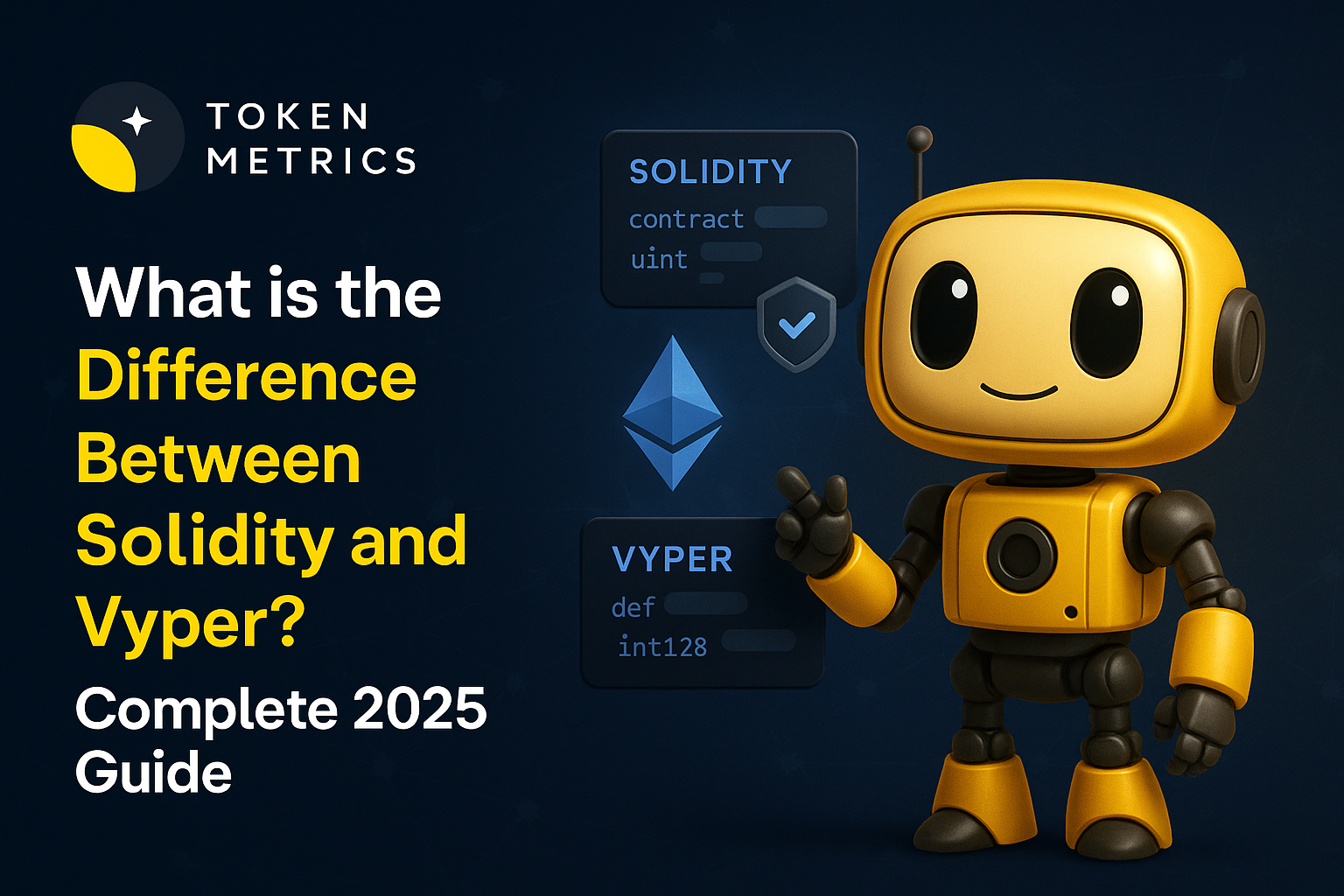
What is the Difference Between Solidity and Vyper? Complete 2025 Guide

Token Metrics Team
7

Smart contracts have revolutionized the blockchain ecosystem, enabling self-executing code that automatically enforces agreed-upon terms and conditions. As decentralized applications continue growing in sophistication and value, the programming languages used to create these contracts become increasingly critical. Two languages dominate Ethereum smart contract development: Solidity and Vyper. Token Metrics.

Understanding Smart Contract Languages

Before diving into Solidity vs Vyper comparison, it's essential to understand what smart contract languages do and why they matter. Smart contracts are programs that run on blockchain platforms like Ethereum, executing predetermined actions when specific conditions are met. These contracts facilitate secure, transparent, and trustless interactions between parties, eliminating intermediaries and enhancing efficiency.

Smart contract languages enable developers to define the logic and behavior of these contracts, which are immutable and executed on the blockchain. By leveraging smart contract languages, businesses can automate processes including supply chain management, financial transactions, governance systems, and much more.

High-Level vs Low-Level Languages

Smart contract programming requires converting human-readable code into machine-executable bytecode that the Ethereum Virtual Machine (EVM) can process. Developers must first choose between high-level and low-level languages based on their use case and expertise.

High-level languages abstract away granular implementation details, allowing developers to create smart contracts without deep bytecode knowledge. Solidity and Vyper are both high-level languages designed for EVM-compatible blockchains, making them accessible to developers from traditional programming backgrounds.

After compilation, both Solidity and Vyper smart contracts execute using the same bytecode language, meaning they can be used concurrently in the same application despite their different source code appearances.

Solidity: The Industry Standard

Solidity is the most widely used programming language for developing smart contracts on the Ethereum blockchain and EVM-compatible chains. Designed specifically for blockchain applications, Solidity enables developers to create secure, decentralized, and automated agreements that run on distributed networks.

Origins and Design Philosophy

Proposed by Ethereum CTO Gavin Wood, Solidity was developed to meet demand for a flexible smart contract-based developer platform. The language draws heavily on inspiration from C++, JavaScript, and Python, making it familiar to developers from various programming backgrounds.

Solidity is a high-level, Turing-complete, statically typed language where developers must explicitly declare variable types. This allows the compiler to have knowledge of data types, ensuring deterministic application behavior—a critical requirement for blockchain applications where predictability is paramount.

Key Features of Solidity

  • Object-Oriented Programming: Supports inheritance, libraries, and complex data structures for sophisticated smart contracts with reusable components.
  • Rich Feature Set: Includes function overloading, multiple inheritance, user-defined types, and complex data structures.
  • Extensive Ecosystem: Benefits from a large community support, documentation, and development tools like Remix, Hardhat, and Foundry.
  • Blockchain-Specific Commands: Built-in commands for addresses, transactions, and block data interactions.
  • Wide Adoption: Most Ethereum projects, including Uniswap, Aave, and OpenSea, are developed using Solidity.

Advantages of Solidity

  • Market Dominance: Secures 87% of DeFi TVL, making it the dominant language for decentralized finance.
  • Robust Tooling: Mature ecosystem with testing, debugging, and analysis tools.
  • Versatility: Enables implementation of complex protocols, financial instruments, and governance procedures.
  • Learning Resources: Abundant tutorials, courses, and community support.

Disadvantages of Solidity

  • Security Vulnerabilities: Increased attack surface with risks like reentrancy and integer overflows, requiring thorough audits.
  • Complexity: Extensive features can lead to harder-to-audit contracts and hidden vulnerabilities.
  • Steeper Learning Curve: Requires understanding blockchain-specific security considerations.

Vyper: The Security-First Alternative

Vyper is a contract-oriented programming language that targets the EVM with a focus on security, simplicity, and auditability. Introduced in 2018 by Ethereum co-founder Vitalik Buterin, Vyper was specifically developed to address security issues prevalent in Solidity.

Design Philosophy: Security Through Simplicity

Vyper's fundamental philosophy is that security comes from simplicity and readability. The language intentionally limits features and enforces stricter syntax to make contracts more secure and easier to audit. By reducing what’s possible, Vyper minimizes opportunities for mistakes and vulnerabilities.

Using Pythonic syntax—hence the serpentine name—Vyper code prioritizes readability so developers can easily detect bugs and vulnerabilities before deploying contracts. This approach makes code auditable by humans, not just machines.

Key Features of Vyper

  • Python-Like Syntax: Familiar for Python developers, with indentation-based structure and clear syntax.
  • Security-First Design: Eliminates object-oriented features, such as inheritance and function overloading, to reduce attack vectors.
  • Strong Typing: Variables require explicit type declaration, catching errors early.
  • Bounds Checking & Overflow Protection: Built-in safety features prevent common vulnerabilities.
  • Decidability & Gas Optimization: Ensures predictable gas consumption and avoids infinite loops, making contracts more efficient.

Advantages of Vyper

  • Enhanced Security: Designed specifically to prevent common vulnerabilities, leading to more secure contracts.
  • Readable & Audit-Friendly: Clear syntax facilitates quicker reviews and lower audit costs.
  • Concise Code: Fewer lines and simpler syntax streamline contract development.
  • Python Background: Eases onboarding for Python programmers.
  • Potential Gas Savings: Simple design can lead to more efficient contracts in specific cases.

Disadvantages of Vyper

  • Limited Adoption: Only about 8% of DeFi TVL, with a smaller ecosystem and community.
  • Fewer Features: Lack of inheritance, modifiers, and function overloading limits architectural options.
  • Smaller Tooling Ecosystem: Development tools and libraries are less mature compared to Solidity.
  • Less Industry Traction: Major projects predominantly use Solidity, limiting existing examples for Vyper development.

Differences: Solidity vs Vyper

  • Syntax & Structure: Solidity resembles JavaScript and C++, with curly braces and semicolons; Vyper uses Python-like indentation and syntax, omitting object-oriented features.
  • Feature Completeness: Solidity offers inheritance, modifiers, and dynamic data structures; Vyper is minimalist, focusing on security with fixed-size arrays and no inheritance.
  • Security Approach: Solidity relies on developer diligence and testing; Vyper enforces limitations to inherently prevent vulnerabilities.
  • Development Philosophy: Solidity emphasizes flexibility, while Vyper emphasizes security and auditability.

Choosing Between Solidity and Vyper

The decision depends on project needs, team expertise, and security priorities. Large, feature-rich DeFi protocols and complex dApps typically require Solidity's extensive capabilities. Conversely, systems demanding maximum security, or contracts that need to be highly auditable, may benefit from Vyper’s simplicity and security-focused design.

Many projects effectively combine both, using Vyper for security-critical core components and Solidity for peripheral features. This hybrid approach leverages the strengths of each language.

Leveraging Token Metrics for Smart Contract Analysis

While understanding the distinctions between Solidity and Vyper is valuable for developers, investors should also evaluate the projects' underlying code quality, security track record, and development activity. Token Metrics offers AI-powered analytics that examine code repositories, audit statuses, and project activity levels.

The platform reviews security vulnerabilities, audit history, and real-time security incidents, providing a comprehensive view that helps identify projects with strong technical foundations, regardless of their chosen language.

Furthermore, Token Metrics tracks project development activity via GitHub, helping gauge ongoing commitment and progress. Market intelligence and performance analysis reveal success patterns and areas of risk, supporting informed decision-making.

Token Metrics assists investors in balancing portfolios across projects built with different languages, offering risk assessments and alerts that enhance proactive management amid evolving blockchain security landscapes.

The Future of Smart Contract Languages

Both Solidity and Vyper are actively evolving to meet new challenges and security needs. Solidity continues enhancing security features, error handling, and optimization, driven by its large ecosystem. Vyper development emphasizes expanding capabilities while maintaining its core security principles.

Emerging languages and cross-language development strategies are beginning to complement established techniques. Combining secure core contracts in Vyper with the flexibility of Solidity is an increasingly common pattern.

Best Practices for Smart Contract Development

  • Thorough Testing: Implement comprehensive testing, including formal verification and audits, before deployment.
  • Security Audits: Engage reputable security firms to review code vulnerabilities.
  • Continuous Monitoring: Use platforms like Token Metrics for real-time risk detection post-deployment.
  • Upgradeability: Adopt upgrade patterns that allow fixing issues without losing funds or functionality.

Conclusion: Making the Right Choice

Solidity and Vyper offer distinct approaches to smart contract development. Solidity’s comprehensive features and robust ecosystem make it suitable for complex, feature-rich applications. Vyper's security-oriented, Python-like syntax is ideal for systems where auditability, simplicity, and security are top priorities.

Both languages will continue to play vital roles throughout 2025, with many projects adopting hybrid strategies. Evaluating project needs, security considerations, and team expertise will guide optimal language selection. AI analytics platforms like Token Metrics provide critical insights to support this decision, ensuring better understanding and risk management in the ever-evolving ecosystem.

Choose from Platinum, Gold, and Silver packages
Reach with 25–30% open rates and 0.5–1% CTR
Craft your own custom ad—from banners to tailored copy
Perfect for Crypto Exchanges, SaaS Tools, DeFi, and AI Products