Back to blog
Research

How to Survive (and Profit) During Crypto Bear Markets with Token Metrics Indices

Learn how systematic crypto indices—especially those powered by Token Metrics—can help you manage risk, avoid common pitfalls, and navigate bear markets with discipline.
Token Metrics Team
6
Want Smarter Crypto Picks—Free?
See unbiased Token Metrics Ratings for BTC, ETH, and top alts.
Thank you! Your submission has been received!
Oops! Something went wrong while submitting the form.
 No credit card | 1-click unsubscribe

The Inevitable Truth: Bear Markets Will Come

Every crypto investor experiences the same cycle of emotions. The bull market feels amazing—your portfolio soars, everything you touch turns to gold, you feel like a genius. Then the bear market arrives, destroying 60-80% of portfolio value, and suddenly you're questioning every decision.

Here's what separates successful long-term crypto investors from the 95% who lose money: how they handle bear markets.

The difference isn't intelligence, luck, or market timing. It's having a systematic strategy that protects capital during downturns, positions for recovery, and actually capitalizes on opportunities that only exist when fear dominates markets.

Token Metrics indices aren't designed just for bull markets—they're specifically engineered to help investors survive bears and emerge stronger. This guide reveals exactly how to use crypto indices during the inevitable next downturn.

Understanding Crypto Bear Markets

Before developing strategy, understand what you're facing.

Bear Market Characteristics

Duration: Crypto bear markets typically last 12-18 months, though some extend to 24+ months.

Depth: Average decline of 70-85% from peak to bottom for the overall market. Individual tokens often drop 90-95% or disappear entirely.

Phases: Bear markets progress through distinct stages: denial, capitulation, despair, and eventual recovery. Each requires different strategies.

Frequency: Historically, major crypto bear markets occur every 3-4 years, aligned with Bitcoin halving cycles.

The 2022-2023 Bear Market Example

Timeline: November 2021 peak to November 2022 bottom

Bitcoin Decline: -77% (from $69,000 to $15,500)

Ethereum Decline: -82% (from $4,800 to $880)

Average Altcoin: -90%+ (most never recovered)

Token Metrics Value Index: -62% (outperformed market by 15-20%)

Key Insight: Quality-focused indices lost significantly less than individual token holders and recovered much faster.

The Token Metrics Bear Market Advantage

How do Token Metrics indices specifically help during downturns?

Advantage 1: Automatic Risk Reduction

AI-powered indices can reduce exposure or shift to stablecoins in bearish conditions, enhancing risk management before most human investors recognize the severity.

How It Works:

Detection Phase: AI identifies deteriorating market conditions through:

  • Declining volume and momentum
  • Breaking key support levels
  • Negative sentiment acceleration
  • Reduced on-chain activity
  • Increasing correlation (everything falling together)

Adjustment Phase: Indices automatically:

  • Reduce altcoin exposure by 30-50%
  • Increase Bitcoin and stablecoin allocation
  • Exit lowest-quality holdings completely
  • Decrease position sizes across the board

Result: By the time human investors panic, Token Metrics indices have already protected significant capital.

Advantage 2: Quality Focus Prevents Catastrophic Losses

During bear markets, 80% of tokens either fail completely or never recover previous highs. Token Metrics' fundamental analysis ensures indices hold survivors, not casualties.

Quality Filters:

Team Stability: Projects with solid teams weather bears; those with departing founders fail.

Treasury Management: Protocols with 2+ years runway survive; underfunded projects die.

Real Utility: Tokens solving actual problems maintain value; pure speculation goes to zero.

Community Strength: Engaged communities support recovery; hype-driven communities vanish.

Example: During 2022-2023, Token Metrics indices avoided Luna/UST, FTX-associated tokens, and dozens of other projects that imploded, preventing catastrophic losses that individual investors suffered.

Advantage 3: Systematic Rebalancing Captures Opportunities

Bear markets create pricing dislocations where quality assets trade at irrational valuations. Token Metrics' systematic approach identifies and captures these opportunities.

Opportunity Capture:

Selling Resistance: When quality tokens hit support and stabilize, indices accumulate.

Relative Strength: Tokens declining less than market average get increased allocation.

Fundamental Improvement: Projects using bear markets to build get recognized early.

Strategic Positioning: Indices position for recovery before sentiment improves.

Get Started For Free

Your Bear Market Survival Strategy

Here's your actionable playbook for using Token Metrics indices during the next downturn.

Phase 1: Pre-Bear (Market Topping)

Indicators You're Approaching a Top:

  • Extreme euphoria and FOMO
  • Your barber asking about crypto
  • 100+ new tokens launching daily
  • Token Metrics Bullish Indicator >80
  • Mainstream media celebrating crypto millionaires

Actions to Take:

Profit-Taking Protocol:

  • Take 20-30% profits from portfolio
  • Move proceeds to stablecoins or traditional assets
  • Don't try to sell the exact top
  • Lock in life-changing gains if they exist

Reallocation Strategy:

  • Shift from Momentum/Sector indices to Value Index
  • Increase Value Index allocation from 40% to 60%+
  • Reduce or eliminate high-risk indices (Memecoin, aggressive sectors)
  • Build 3-6 month cash reserves

Mental Preparation:

  • Accept that a bear market is coming
  • Review your investment thesis
  • Document why you're invested long-term
  • Prepare emotionally for 50-70% decline

Example: Michael, experienced investor, recognized market euphoria in late 2021. He took 25% profits ($150,000 from $600,000 portfolio), shifted to 70% Value Index, and held $100,000 cash. During subsequent bear, his remaining $450,000 only declined to $200,000 instead of $120,000, plus he had dry powder to deploy.

Phase 2: Early Bear (Denial Phase)

Characteristics:

  • 20-30% decline from peaks
  • "It's just a correction" sentiment
  • Buying the dip enthusiasm
  • Many still optimistic

Token Metrics Index Behavior:

  • Begins defensive positioning
  • Reduces altcoin exposure
  • Increases Bitcoin allocation
  • Raises quality bar for holdings

Your Actions:

Don't Panic, Don't Euphoria:

  • Maintain your rebalanced allocation
  • Don't try to "buy the dip" aggressively yet
  • Continue regular DCA but don't accelerate
  • Trust index automatic adjustments

Review and Refine:

  • Ensure you have adequate emergency fund
  • Verify employment/income stability
  • Assess whether crypto allocation still appropriate
  • Prepare for potentially longer downturn

Avoid Common Mistakes:

  • Don't go "all in" thinking it's the bottom
  • Don't sell everything in fear
  • Don't abandon your strategy
  • Don't stop regular contributions if financially stable

Phase 3: Mid-Bear (Capitulation Phase)

Characteristics:

  • 50-70% decline from peaks
  • Despair and panic selling
  • Media declaring "crypto is dead"
  • Mass liquidations and cascading failures
  • Token Metrics Bullish Indicator <30

Token Metrics Index Behavior:

  • Maximum defensive positioning
  • Heavy Bitcoin and stablecoin weights
  • Only highest-quality altcoins remain
  • Preparing to accumulate at bottoms

Your Actions:

The Accumulation Strategy:

This is when fortunes are made. While others panic, you accumulate systematically.

Increase DCA Contributions:

  • If financially stable, increase contributions by 50-100%
  • Deploy 30-50% of reserved cash
  • Focus purchases on Value Index
  • Buy consistently, not all at once

Maintain Indices, Add Selectively:

  • Keep existing index holdings
  • Consider adding to positions at 60-70% discounts
  • Focus on Value and Balanced indices
  • Avoid speculation (resist Memecoin temptation)

Emotional Discipline:

  • This will feel terrible—portfolio down 60%+
  • Remember: Every previous bear market ended
  • Review historical recovery patterns
  • Stay focused on 5-10 year horizon

Real Example: Sarah maintained $2,000 monthly DCA through entire 2022 bear market while others stopped. She increased to $3,000 during deepest panic (November 2022). Those additional purchases at lows generated 300%+ returns during 2023-2024 recovery, dramatically improving overall portfolio performance.

Phase 4: Late Bear (Despair and Basing)

Characteristics:

  • Market has bottomed but nobody knows it yet
  • Extreme pessimism and apathy
  • Volume dries up
  • Prices stabilize in tight ranges
  • Could last 3-9 months

Token Metrics Index Behavior:

  • Begins rebuilding altcoin exposure
  • Identifies quality projects building through bear
  • Gradually increases risk as signals improve
  • Positions ahead of recovery

Click here to signup for free trial account!

Your Actions:

Maximum Accumulation Period:

Deploy Remaining Reserves:

  • This is your final opportunity to buy cheap
  • Use remaining 50% of reserved cash
  • Continue elevated DCA contributions
  • Focus on Value and Growth indices

Rebalancing Preparation:

  • Maintain current defensive allocation
  • Don't rush into aggressive indices
  • Wait for clear recovery signals
  • Trust Token Metrics' systematic repositioning

Psychological Battle:

  • This phase tests patience most
  • Nothing exciting happening
  • Easy to lose interest
  • Critical to stay engaged

Education Phase:

  • Use slow period to learn more
  • Research Token Metrics features
  • Understand your indices better
  • Prepare strategy for next bull

Phase 5: Recovery and Next Bull

Characteristics:

  • 30-50% rally from bottom
  • Skepticism ("bull trap" fears)
  • Gradual improvement in sentiment
  • Token Metrics Bullish Indicator crosses 50

Token Metrics Index Behavior:

  • Increases altcoin exposure
  • Adds sector-specific holdings
  • Raises overall risk profile
  • Begins new accumulation cycle

Your Actions:

Normalize Strategy:

  • Return to regular DCA amounts
  • Rebalance toward target allocations
  • Consider adding Growth or Sector indices
  • Begin taking modest profits again at milestones

Lessons Documentation:

  • Write down what worked
  • Note what you'd do differently
  • Update strategy based on experience
  • Prepare for next cycle

The "Never Sell All" Principle

The single biggest mistake investors make during bear markets: selling everything at the bottom.

Why This Destroys Wealth:

Missing Recovery: The strongest gains occur in first weeks of recovery when sentiment is still negative.

Tax Consequences: Realizing losses permanently caps future gains.

Re-entry Difficulty: Psychological barrier to buying back after selling low.

Timing Impossibility: Nobody knows exact bottom.

The Rule:

Regardless of how bad it gets, maintain minimum 50% of your crypto index holdings. If you started with 20% crypto allocation, never go below 10%.

Example: David panicked in November 2022 and sold 80% of holdings near the bottom at massive losses. When recovery began in January 2023, he couldn't bring himself to rebuy after "losing so much." He missed the entire 2023-2024 rally that would have recovered his losses and generated new gains.

Contrast: Jennifer held all her Token Metrics indices through entire bear market despite being down 65%. By late 2024, she was not only back to breakeven but up 40% from original investment. Patience paid off.

Bear Market Checklist

Use this checklist to navigate the next downturn:

Financial Preparation: ☐ 6-12 month emergency fund established ☐ Employment/income secure ☐ No high-interest debt ☐ Crypto allocation appropriate for risk tolerance

Portfolio Preparation: ☐ Shifted toward Value-heavy allocation ☐ Taken partial profits during euphoria ☐ Built cash reserves for accumulation ☐ Reviewed and understand your indices

Psychological Preparation: ☐ Accepted bear markets are inevitable ☐ Reviewed historical patterns ☐ Documented investment thesis ☐ Prepared to buy during fear

During Bear Market: ☐ Maintain minimum holdings (never sell all) ☐ Continue DCA (increase if possible) ☐ Deploy reserves during capitulation ☐ Avoid panic selling ☐ Trust Token Metrics' systematic approach

Recovery Phase: ☐ Normalize DCA contributions ☐ Rebalance to target allocations ☐ Document lessons learned ☐ Prepare for next cycle

The Psychological Edge

Bear markets aren't primarily financial challenges—they're psychological warfare.

Common Emotional Traps:

Panic Selling: Portfolio down 60%, selling everything to "stop the bleeding."

Paralysis: Too afraid to continue investing despite great prices.

Despair: Convinced crypto is dead, giving up entirely.

FOMO Reversal: Switching to "safe" assets just before recovery.

Token Metrics Psychological Advantages:

Removes Decisions: Indices automatically adjust, you don't have to.

Systematic Approach: Following a system easier than trusting gut.

Historical Confidence: 8000% track record through multiple bears.

Community Support: Other Token Metrics users experiencing same challenges.

The Bottom Line

Bear markets separate tourists from serious wealth builders. Tourists panic, sell at bottoms, and never return. Serious investors use systematic approaches like Token Metrics indices to:

  • Protect more capital during declines
  • Accumulate quality assets at discounts
  • Position ahead of recovery
  • Build generational wealth through complete cycles

Get Started For Free

The next bear market is inevitable. Your strategy for navigating it determines whether you emerge wealthy or wounded.

Token Metrics indices provide the systematic framework. Your discipline provides the execution.

Prepare now. Survive the next bear. Thrive in the following bull.

Ready to build bear-market-proof strategy? Visit Token Metrics to access indices designed for all market conditions.

Click here to signup for free trial account!

Build Smarter Crypto Apps &
AI Agents in Minutes, Not Months
Real-time prices, trading signals, and on-chain insights all from one powerful API.
Grab a Free API Key
About Token Metrics
Token Metrics: AI-powered crypto research and ratings platform. We help investors make smarter decisions with unbiased Token Metrics Ratings, on-chain analytics, and editor-curated “Top 10” guides. Our platform distills thousands of data points into clear scores, trends, and alerts you can act on.
30 Employees
analysts, data scientists, and crypto engineers
Daily Briefings
concise market insights and “Top Picks”
Transparent & Compliant
Sponsored ≠ Ratings; research remains independent
Want Smarter Crypto Picks—Free?
See unbiased Token Metrics Ratings for BTC, ETH, and top alts.
Thank you! Your submission has been received!
Oops! Something went wrong while submitting the form.
 No credit card | 1-click unsubscribe
Token Metrics Team
Token Metrics Team

Recent Posts

Research

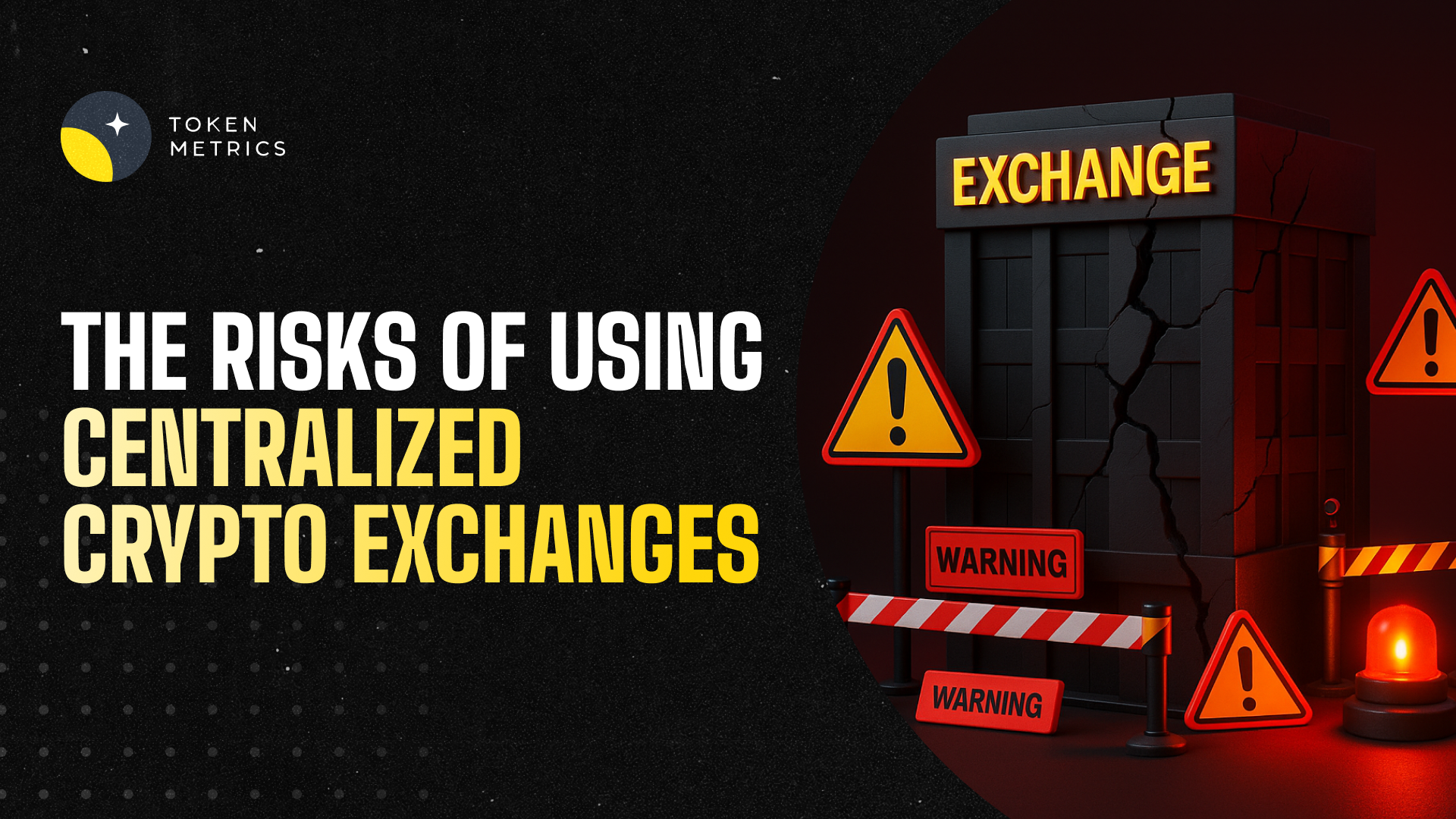
Understanding the Risks of Using Centralized Crypto Exchanges

Token Metrics Team
5

Introduction

Centralized cryptocurrency exchanges have become the primary venues for trading a wide array of digital assets. Their user-friendly interfaces and liquidity pools make them appealing for both new and experienced traders. However, the inherent risks of using such centralized platforms warrant careful consideration. This article explores the risks associated with centralized exchanges, offering an analytical overview while highlighting valuable tools that can assist users in evaluating these risks.

What Are Centralized Exchanges?

Centralized exchanges (CEXs) operate as intermediaries that facilitate buying, selling, and trading cryptocurrencies. Users deposit funds into the exchange's custody and execute trades on its platform. Unlike decentralized exchanges, where users maintain control of their private keys and assets, centralized exchanges hold users' assets on their behalf, which introduces specific vulnerabilities and considerations.

Security Risks

One of the primary risks associated with centralized exchanges is security vulnerability. Holding large sums of digital assets in a single entity makes exchanges prominent targets for hackers. Over the years, numerous high-profile breaches have resulted in the loss of millions of dollars worth of crypto assets. These attacks often exploit software vulnerabilities, insider threats, or phishing campaigns.

Beyond external hacking attempts, users must be aware of the risks posed by potential internal malfeasance within these organizations. Since exchanges control private keys to user assets, trust in their operational security and governance practices is critical.

Custodial Risk and Asset Ownership

Using centralized exchanges means users relinquish direct control over their private keys. This custodial arrangement introduces counterparty risk, fundamentally differing from holding assets in self-custody wallets. In situations of insolvency, regulatory intervention, or technical failures, users may face difficulties accessing or retrieving their funds.

Additionally, the lack of comprehensive insurance coverage on many platforms means users bear the brunt of potential losses. The concept "not your keys, not your coins" encapsulates this risk, emphasizing that asset ownership and control are distinct on centralized platforms.

Regulatory and Compliance Risks

Centralized exchanges typically operate under jurisdictional regulations which can vary widely. Regulatory scrutiny may lead to sudden operational restrictions, asset freezes, or delisting of certain cryptocurrencies. Users of these platforms should be aware that regulatory changes can materially impact access to their assets.

Furthermore, compliance requirements such as Know Your Customer (KYC) and Anti-Money Laundering (AML) procedures involve sharing personal information, posing privacy considerations. Regulatory pressures could also compel exchanges to surveil or restrict user activities.

Liquidity and Market Risks

Large centralized exchanges generally offer high liquidity, facilitating quick trade execution. However, liquidity can vary significantly between platforms and tokens, possibly leading to slippage or failed orders during volatile conditions. In extreme scenarios, liquidity crunches may limit the ability to convert assets efficiently.

Moreover, centralized control over order books and matching engines means that trade execution transparency is limited compared to decentralized protocols. Users should consider market structure risks when interacting with centralized exchanges.

Operational and Technical Risks

System outages, software bugs, or maintenance periods pose operational risks on these platforms. Unexpected downtime can prevent users from acting promptly in dynamic markets. Moreover, technical glitches could jeopardize order accuracy, deposits, or withdrawals.

Best practices involve users staying informed about platform status and understanding terms of service that govern incident responses. Awareness of past incidents can factor into decisions about trustworthiness.

Mitigating Risks Using Analytical Tools

While the risks highlighted are inherent to centralized exchanges, utilizing advanced research and analytical tools can enhance users’ understanding and management of these exposures. AI-driven platforms like Token Metrics offer data-backed insights into exchange security practices, regulatory compliance, liquidity profiles, and overall platform reputation.

Such tools analyze multiple risk dimensions using real-time data, historical performance, and fundamental metrics. This structured approach allows users to make informed decisions based on factual assessments rather than anecdotal information.

Additionally, users can monitor news, community sentiment, and technical analytics collectively via these platforms to evaluate evolving conditions that may affect centralized exchange risk profiles.

Practical Tips for Users

  • Research exchange reputation: Evaluate past security incidents, user reviews, and transparency of operations.
  • Stay updated on regulations: Understand how regulatory environments may impact exchange functionality and asset accessibility.
  • Limit exposure: Avoid holding large balances long-term on any single exchange.
  • Utilize research platforms: Leverage AI-powered tools like Token Metrics for detailed risk analysis.
  • Consider withdrawal security: Enable multi-factor authentication and regularly verify withdrawal addresses.
  • Diversify custody approaches: When appropriate, combine exchange use with self-custody solutions for asset diversification.

Conclusion

Centralized cryptocurrency exchanges continue to play a significant role in digital asset markets, providing accessibility and liquidity. Nevertheless, they carry multifaceted risks ranging from security vulnerabilities to regulatory uncertainties and operational challenges. Understanding these risks through a comprehensive analytical framework is crucial for all participants.

Non-investment-focused, AI-driven research platforms like Token Metrics can support users in navigating the complexity of exchange risks by offering systematic, data-driven insights. Combining such tools with prudent operational practices paves the way for more informed engagement with centralized exchanges.

Disclaimer

This content is provided solely for educational and informational purposes. It does not constitute financial, investment, or legal advice. Readers should conduct their own research and consult qualified professionals before making any financial decisions.

Research

Exploring Investments in Crypto and Web3 Companies: An Analytical Overview

Token Metrics Team
4

Introduction

The landscape of digital assets and blockchain technology has expanded rapidly over recent years, bringing forth a new realm known as Web3 alongside the burgeoning crypto ecosystem. For individuals curious about allocating resources into this sphere, questions often arise: should the focus be on cryptocurrencies or Web3 companies? This article aims to provide an educational and analytical perspective on these options, highlighting considerations without providing direct investment advice.

Understanding Crypto and Web3

Before exploring the nuances between investing in crypto assets and Web3 companies, it's important to clarify what each represents.

  • Cryptocurrencies are digital currencies that operate on blockchain technology, enabling peer-to-peer transactions with varying protocols and use cases.
  • Web3 broadly refers to a decentralized internet infrastructure leveraging blockchain technologies to create applications, platforms, and services that prioritize user control, privacy, and decentralization.

Web3 companies often develop decentralized applications (dApps), offer blockchain-based services, or build infrastructure layers for the decentralized web.

Key Considerations When Evaluating Investment Options

Deciding between crypto assets or Web3 companies involves analyzing different dynamics:

  1. Market Maturity and Volatility
    Cryptocurrencies generally exhibit higher price volatility influenced by market sentiment, regulatory news, and technology updates. Web3 companies, often in startup or growth phases, carry inherent business risk but may relate more to traditional company valuation metrics.
  2. Fundamental Drivers
    Crypto assets derive value from network utility, adoption, scarcity mechanisms, and consensus protocols. Web3 firms generate value through product innovation, user engagement, revenue models, and ability to scale decentralized solutions.
  3. Regulatory Environment
    Both realms face evolving regulatory landscapes globally, with different degrees of scrutiny around cryptocurrencies and blockchain enterprises. Awareness of legal considerations is essential for educational understanding.
  4. Technological Innovation
    Web3 companies typically focus on developing novel decentralized infrastructures and applications. Crypto projects may emphasize improvements in consensus algorithms, interoperability, or token economics.

Analytical Frameworks for Assessment

To approach these complex investment types thoughtfully, frameworks can assist in structuring analysis:

  • Scenario Analysis: Evaluate various future scenarios for cryptocurrency adoption and Web3 technology evolution to understand possible outcomes and risks.
  • Fundamental Analysis: For crypto, analyze network activity, token utility, and supply models. For Web3 companies, consider business plans, technological edge, leadership quality, and market positioning.
  • Technology Evaluation: Examine the underlying blockchain protocols and development communities supporting both crypto projects and Web3 startups, assessing innovation and sustainability.

Leveraging AI-Driven Tools for Research

Due to the rapidly evolving and data-intensive nature of crypto and Web3 industries, AI-powered platforms can enhance analysis by processing vast datasets and providing insights.

For instance, Token Metrics utilizes machine learning to rate crypto assets by analyzing market trends, project fundamentals, and sentiment data. Such tools support an educational and neutral perspective by offering data-driven research support rather than speculative advice.

When assessing Web3 companies, AI tools can assist with identifying emerging technologies, tracking developmental progress, and monitoring regulatory developments relevant to the decentralized ecosystem.

Practical Tips for Conducting Due Diligence

To gain a well-rounded understanding, consider the following steps:

  • Research Whitepapers and Roadmaps: For crypto tokens and Web3 startups, review technical documentation and strategic plans.
  • Evaluate Team Credentials: Analyze the experience and transparency of project founders and teams.
  • Monitor Community Engagement: Observe activity levels in forums, GitHub repositories, and social media to gauge project vitality.
  • Use Analytical Tools: Incorporate platforms like Token Metrics for data-supported insights on token metrics and project evaluations.
  • Consider Regulatory Developments: Stay informed about jurisdictional policies impacting blockchain projects and cryptocurrencies.

Understanding Risk Factors

Both crypto assets and Web3 companies involve unique risks that warrant careful consideration:

  • Market Risk: Price volatility and market sentiment swings can impact crypto tokens significantly.
  • Technological Risk: Innovative technologies may have bugs or scalability challenges affecting project viability.
  • Regulatory Risk: Changes in legal frameworks can alter operational capacities or market access for Web3 entities and crypto tokens.
  • Business Model Risk: Web3 startups may face competitive pressures, funding challenges, or adoption hurdles.

Conclusion

Deciding between crypto assets and Web3 companies involves analyzing different dimensions including technological fundamentals, market dynamics, and risk profiles. Employing structured evaluation frameworks along with AI-enhanced research platforms such as Token Metrics can provide clarity in this complex landscape.

It is essential to approach this domain with an educational mindset focused on understanding rather than speculative intentions. Staying informed and leveraging analytical tools supports sound comprehension of the evolving world of blockchain-based digital assets and enterprises.

Disclaimer

This article is intended for educational purposes only and does not constitute financial, investment, or legal advice. Readers should conduct their own research and consult with professional advisors before making any decisions related to cryptocurrencies or Web3 companies.

Research

Why Is Web3 User Experience Still Lagging Behind Web2?

Token Metrics Team
4

Introduction to Web3 UX

The evolution from Web2 to Web3 marks a significant paradigm shift in how we interact with digital services. While Web2 platforms have delivered intuitive and seamless user experiences, Web3—the decentralized internet leveraging blockchain technology—still faces considerable user experience (UX) challenges. This article explores the reasons behind the comparatively poor UX in Web3 and the technical, design, and infrastructural hurdles contributing to this gap.

Contextual Understanding: Web2 vs Web3

Web2 represents the current mainstream internet experience characterized by centralized servers, interactive social platforms, and streamlined services. Its UX benefits from consistent standards, mature design patterns, and direct control over data.

In contrast, Web3 aims at decentralization, enabling peer-to-peer interactions through blockchain protocols, decentralized applications (dApps), and user-owned data ecosystems. While promising increased privacy and autonomy, Web3 inherently introduces complexity in UX design.

Technical Complexities Affecting Web3 UX

Several intrinsic technical barriers impact the Web3 user experience:

  • Decentralization and Interoperability: Decentralized networks operate without centralized control, making transaction speed and reliability variable compared to Web2's central servers.
  • Blockchain Transaction Latency: Block confirmation times, network congestion, and gas fees create delays and unpredictability in user interactions.
  • Wallet and Key Management: Users must manage private keys and wallets, which can be confusing and risky for non-technical audiences.
  • User Onboarding Frictions: Requirements like acquiring cryptocurrency tokens for transaction fees create an additional barrier unique to Web3.

Design and Usability Issues in Web3

The nascent nature of Web3 results in inconsistent and sometimes opaque design standards:

  • Complex Terminology and Concepts: Terms like gas, smart contracts, staking, and cryptographic signatures are unfamiliar to average users.
  • Poorly Standardized UI Components: Unlike Web2, where UI/UX libraries and guidelines are well-established, Web3 lacks uniform design principles, leading to fragmented experiences.
  • Minimal User Feedback: Web3 apps sometimes provide limited real-time feedback during transactions, causing uncertainty.
  • Security and Trust Indicators: The responsibility to confirm transaction legitimacy often falls on users, which can be overwhelming.

Ecosystem Maturity and Resource Constraints

Web2 giants have invested billions over decades fostering developer communities, design systems, and customer support infrastructure. In contrast, Web3 is still an emerging ecosystem characterized by:

  • Smaller Development Teams: Many dApps are developed by startups or hobbyists with limited UX expertise or resources.
  • Rapidly Evolving Protocols: Frequent changes impact stability and user familiarity.
  • Limited Educational Resources: Users often lack accessible tutorials and support channels.

Such factors contribute to a user experience that feels fragmented and inaccessible to mainstream audiences.

Leveraging AI and Analytics to Improve Web3 UX

Emerging tools powered by artificial intelligence and data analytics can help mitigate some UX challenges in Web3 by:

  • Analyzing User Interaction Data: Identifying pain points and optimizing workflows in dApps.
  • Automated Risk Assessment: Platforms like Token Metrics offer AI-driven analysis to help users understand token metrics and project fundamentals, supporting better-informed user decisions without direct financial advice.
  • Personalized User Guidance: Contextual prompts and chatbot assistants could help users navigate complex steps.

Integrating such AI-driven research and analytic tools enables developers and users to progressively enhance Web3 usability.

Practical Tips for Users and Developers

For users trying to adapt to Web3 environments, the following tips may help:

  • Engage with Educational Content: Prioritize learning foundational blockchain concepts to reduce confusion.
  • Use Trusted Tools: Platforms providing in-depth analytics and ratings, such as Token Metrics, can offer valuable insights into projects.
  • Start with Simple dApps: Experiment with established, user-friendly applications before engaging in more complex services.

For developers, focusing on the following can improve UX outcomes:

  • Adopt Consistent UI/UX Patterns: Align interfaces with familiar Web2 standards where possible to flatten the learning curve.
  • Enhance Feedback and Transparency: Clearly communicate transaction statuses and risks.
  • Streamline Onboarding: Reduce or abstract away wallet configurations and gas fee complexities.
  • Prioritize Accessibility: Make interfaces usable for non-technical and diverse user groups.

Conclusion: Web3 UX Future Outlook

The current disparity between Web3 and Web2 user experience primarily stems from decentralization complexities, immature design ecosystems, and educational gaps. However, ongoing innovation in AI-driven analytics, comprehensive rating platforms like Token Metrics, and community-driven UX improvements are promising. Over time, these efforts could bridge the UX divide to make Web3 more accessible and user-friendly for mainstream adoption.

Disclaimer

This article is for educational and informational purposes only and does not constitute financial advice or an endorsement. Users should conduct their own research and consider risks before engaging in any blockchain or cryptocurrency activities.

Choose from Platinum, Gold, and Silver packages
Reach with 25–30% open rates and 0.5–1% CTR
Craft your own custom ad—from banners to tailored copy
Perfect for Crypto Exchanges, SaaS Tools, DeFi, and AI Products