





What Is the Importance of Stock Market Indices? A 2025 Guide
%201.svg)
%201.svg)


Stock market indices are among the most frequently cited yet least understood aspects of financial markets. You've likely heard phrases like "the Dow is up 200 points" or "the S&P 500 hit a new record," but what do these indices actually represent, and why do they matter so much to investors, economists, and policymakers alike?
In 2025, indices have evolved far beyond simple market thermometers. They've become sophisticated investment vehicles that power trillions of dollars in passive investing, provide benchmarks for performance evaluation, and now—with innovations in crypto markets—offer active risk management through regime-switching strategies.
Understanding the importance of stock market indices is essential whether you're a beginner building your first portfolio or an experienced trader seeking to optimize your strategy. This comprehensive guide explores why indices matter, how they function, and how modern innovations like the Token Metrics indices are extending index benefits to the fast-moving cryptocurrency markets.
What Are Stock Market Indices?
Before exploring their importance, let's establish a clear definition. A stock market index is a statistical measure that tracks the performance of a specific group of stocks, representing a particular market segment, sector, or the entire market.
Think of an index as a carefully curated basket of stocks weighted according to predetermined rules. The S&P 500, for example, tracks 500 of the largest publicly traded U.S. companies weighted by market capitalization. When the S&P 500 rises 1%, it means this basket of 500 stocks collectively gained 1% in value.
Indices don't exist as physical products you can buy directly. Instead, they're measurement tools that investment products like index funds, ETFs, and derivatives replicate to offer investors easy market access.
7 Critical Reasons Why Indices Matter
1. Market Barometers: Understanding Economic Health
Indices serve as thermometers for economic health, providing instant snapshots of market sentiment and economic conditions. When major indices rise, it signals investor optimism about economic prospects. When they fall, it reflects concerns about future growth.
Policymakers, economists, and business leaders watch indices closely to gauge:
- Consumer and business confidence
- Corporate earnings trends
- Economic cycle phases (expansion, peak, contraction, trough)
- Impact of policy decisions on markets
The Federal Reserve, for instance, monitors market indices when making interest rate decisions. Sharp index declines can influence policy responses, while sustained rallies may signal economic strength that justifies rate increases.
This barometric function extends beyond stock markets. In 2025, crypto indices now provide similar insights into blockchain technology adoption, decentralized finance growth, and digital asset sentiment.
2. Performance Benchmarking: Measuring Investment Success
Perhaps the most critical function of indices is providing objective benchmarks against which to measure investment performance. Without indices, investors lack context to determine whether their returns represent success or failure.
If your portfolio gained 8% last year, should you feel satisfied? The answer depends entirely on your benchmark. If the Token Metrics benchmarked indices like the S&P 500 gained 15%, your 8% represents underperformance despite positive returns. If the index lost 5%, your 8% gain represents significant outperformance.
This benchmarking function matters for several reasons:
- Evaluating Investment Managers: Mutual fund and hedge fund managers are typically measured against relevant indices. A large-cap U.S. equity fund might benchmark against the S&P 500, while a small-cap fund uses the Russell 2000. Consistently underperforming your benchmark suggests poor management.
- Personal Portfolio Assessment: Individual investors use indices to evaluate their own stock-picking and asset allocation decisions. If you can't consistently beat index returns, you'd be better served by simply investing in the index itself—a realization that has fueled the massive growth of passive index investing.
- Risk-Adjusted Performance: Indices enable sophisticated performance metrics like the Sharpe ratio, which measures returns relative to risk taken. An investment might beat the index on raw returns but underperform on a risk-adjusted basis.
3. Diversification Made Easy: Reducing Individual Security Risk
One of the most fundamental principles of investing is diversification—spreading investments across multiple assets to reduce risk. Indices embody this principle by definition.
When you invest in an index fund tracking the Token Metrics S&P 500, you instantly own a piece of 500 companies across diverse sectors: technology, healthcare, finance, consumer goods, energy, and more. This diversification provides powerful risk reduction.
Individual Stock Risk vs. Index Risk: Consider the difference between buying individual stocks and owning an index:
- Single stock: If you invest $10,000 in one company and it goes bankrupt, you lose everything.
- Index with 500 stocks: If one company in the index fails, it represents just 0.2% of your holdings (assuming equal weighting).
Even with market-cap weighting where larger companies dominate, indices spread risk across many holdings. Apple's collapse wouldn't destroy an Token Metrics investment despite Apple's significant weight.
Time Savings: Building a diversified portfolio manually requires researching dozens or hundreds of companies, executing multiple trades, and continuously rebalancing. Indices accomplish this instantly through a single investment.
In crypto markets, this diversification benefit becomes even more crucial. Individual cryptocurrencies can experience 50-90% drawdowns or even go to zero. A crypto index tracking the top 100 assets spreads this risk dramatically while maintaining exposure to the sector's growth potential.
4. Passive Investment Revolution: The Rise of Index Funds
Indices have fundamentally transformed how people invest through the passive investing revolution. The statistics are staggering: passive index funds now account for approximately 50% of U.S. equity fund assets, up from less than 20% just two decades ago.
This shift occurred because of a simple truth: most active managers fail to beat their benchmark indices over the long term. Studies consistently show that 80-90% of active fund managers underperform their benchmark over 10-15 year periods after accounting for fees.
This underperformance led to the realization that for most investors, simply buying the index provides better risk-adjusted returns than trying to beat it. Index funds offer:
- Lower Costs: Active management fees typically range from 0.5-2% annually, while index funds charge as little as 0.03-0.20%.
- Tax Efficiency: Index funds trade less frequently than active funds, generating fewer taxable events.
- Predictable Performance: While you won't beat the market, you won't significantly underperform either. You'll capture whatever returns the market delivers.
- Simplicity: No need to research individual stocks, time entry/exit points, or worry about manager changes.
The success of index investing has made market indices even more important. When trillions of dollars track these indices, their composition and methodology directly impact capital flows across the entire market.
5. Sector and Style Analysis: Understanding Market Dynamics
Indices enable sophisticated market analysis by breaking down performance into sectors, styles, and factors. This granular analysis helps investors understand what's driving returns and make informed allocation decisions.
Sector Indices: Specialized indices track specific industries:
- Technology (Nasdaq-100)
- Healthcare (S&P Healthcare Index)
- Financial Services (KBW Bank Index)
- Energy (S&P Energy Index)
By comparing sector index performance, investors identify which industries are leading or lagging. During 2023-2024, technology indices dramatically outperformed energy indices as AI enthusiasm dominated while oil prices stabilized.
Style Indices: Other indices segment markets by investment style:
- Growth vs. Value
- Large-cap vs. Small-cap
- Momentum vs. Quality
These style distinctions help investors understand market cycles. Value stocks might outperform during market recoveries, while growth stocks lead during expansion phases. Style indices make these patterns visible.
Factor Indices: Modern indices isolate specific factors like volatility, profitability, or debt levels. These enable precise exposure to characteristics associated with outperformance.
In crypto markets, specialized indices track DeFi protocols, Layer-1 blockchains, metaverse tokens, or meme coins—allowing targeted exposure to specific crypto narratives while maintaining diversification within those categories.
6. Investment Product Foundation: Enabling Modern Finance
Indices form the foundation for countless investment products worth trillions of dollars:
- Index Mutual Funds: Traditional mutual funds that replicate index performance, popularized by Vanguard's founder John Bogle.
- Exchange-Traded Funds (ETFs): Tradeable securities that track indices, offering liquidity and flexibility beyond mutual funds.
- Futures and Options: Derivatives based on indices enable sophisticated trading strategies, hedging, and leverage.
- Structured Products: Banks create principal-protected notes and other products linked to index performance.
- Robo-Advisors: Automated investment platforms build portfolios primarily using index ETFs.
Without indices as standardized measurement tools, this entire ecosystem couldn't exist. The importance of indices extends far beyond information—they're the architectural foundation of modern passive investing.
7. Risk Management: Active Protection Strategies
While traditional indices passively track markets through all conditions, 2025 has seen the emergence of sophisticated regime-switching indices that actively manage risk.
These next-generation indices don't just measure markets—they protect capital by adjusting exposure based on market conditions. When signals indicate high-risk environments, these indices reduce exposure to volatile assets and increase allocation to defensive positions.
This innovation addresses the primary weakness of traditional passive indices: they remain fully invested through devastating bear markets. If the market crashes 40%, your traditional index investment crashes 40% with it.
Regime-switching indices aim to participate in upside during bull markets while limiting downside during bear markets through systematic, rules-based risk management.
The Evolution: From Stock Indices to Crypto Indices
While stock market indices have existed for over a century, cryptocurrency markets have rapidly adopted and innovated on index concepts. Crypto indices matter for all the same reasons as stock indices—but with additional benefits unique to digital assets.
24/7 Market Tracking: Unlike stock indices that only update during market hours, crypto indices track markets that never close.
Complete Transparency: Blockchain technology enables real-time visibility into index holdings and transactions—something impossible with traditional indices.
Faster Rebalancing: Crypto markets move faster than traditional markets. Weekly or even daily rebalancing keeps crypto indices aligned with current market leaders.
Built-in Risk Management: Smart contracts can implement sophisticated regime-switching logic automatically, adjusting allocations without human intervention.
A crypto index is a rules-based basket tracking a defined universe—such as a top-100 market-cap set—with scheduled rebalances. In October 2025, crypto indices have become essential tools for navigating markets where narratives rotate in weeks and individual-coin risk can swamp portfolios.
TM Global 100: Index Innovation for Crypto Markets
The Token Metrics Global 100 index exemplifies how index importance extends and amplifies in cryptocurrency markets. This rules-based index demonstrates all seven critical functions of indices while adding active risk management specifically designed for crypto's volatility.
What It Is: A systematic index that holds the top 100 cryptocurrencies by market capitalization when market conditions are bullish, and moves fully to stablecoins when conditions turn bearish.
Why It Matters for Each Index Function
- Market Barometer: The TM Global 100's regime signal provides a clear reading of crypto market conditions. When the index holds the top 100, it signals bullish conditions. When it moves to stablecoins, it signals bearish conditions—offering instant insight into systematic market assessment.
- Performance Benchmark: Crypto investors can measure their portfolios against TM Global 100 to determine whether their active trading or selective holdings outperform systematic, rules-based exposure to the top 100 assets.
- Diversification: The index spreads risk across 100 cryptocurrencies instead of concentrating in Bitcoin, Ethereum, or a handful of altcoins. This dramatically reduces individual-coin risk while maintaining broad crypto exposure.
- Passive Investment: Rather than researching hundreds of crypto projects, executing dozens of trades, and constantly rebalancing, investors gain one-click access to a professionally managed, systematic strategy.
- Market Analysis: Weekly rebalancing reveals which cryptocurrencies are entering or exiting the top 100, providing insights into shifting market leadership and narrative rotation.
- Investment Product: TM Global 100 functions as a tradeable product with embedded wallet execution, removing the complexity of manually constructing top-100 exposure.
- Risk Management: The regime-switching mechanism actively protects capital by exiting to stablecoins during bearish conditions—addressing the biggest weakness of traditional buy-and-hold indices.
How TM Global 100 Works
Regime Switching:
- Bull Market: Hold top 100 cryptocurrencies by market cap
- Bear Market: Move fully to stablecoins, await bullish re-entry signal
Weekly Rebalancing: Updates weights and constituents to reflect current top-100 rankings. Crypto markets move faster than traditional markets—weekly updates ensure your exposure remains current.
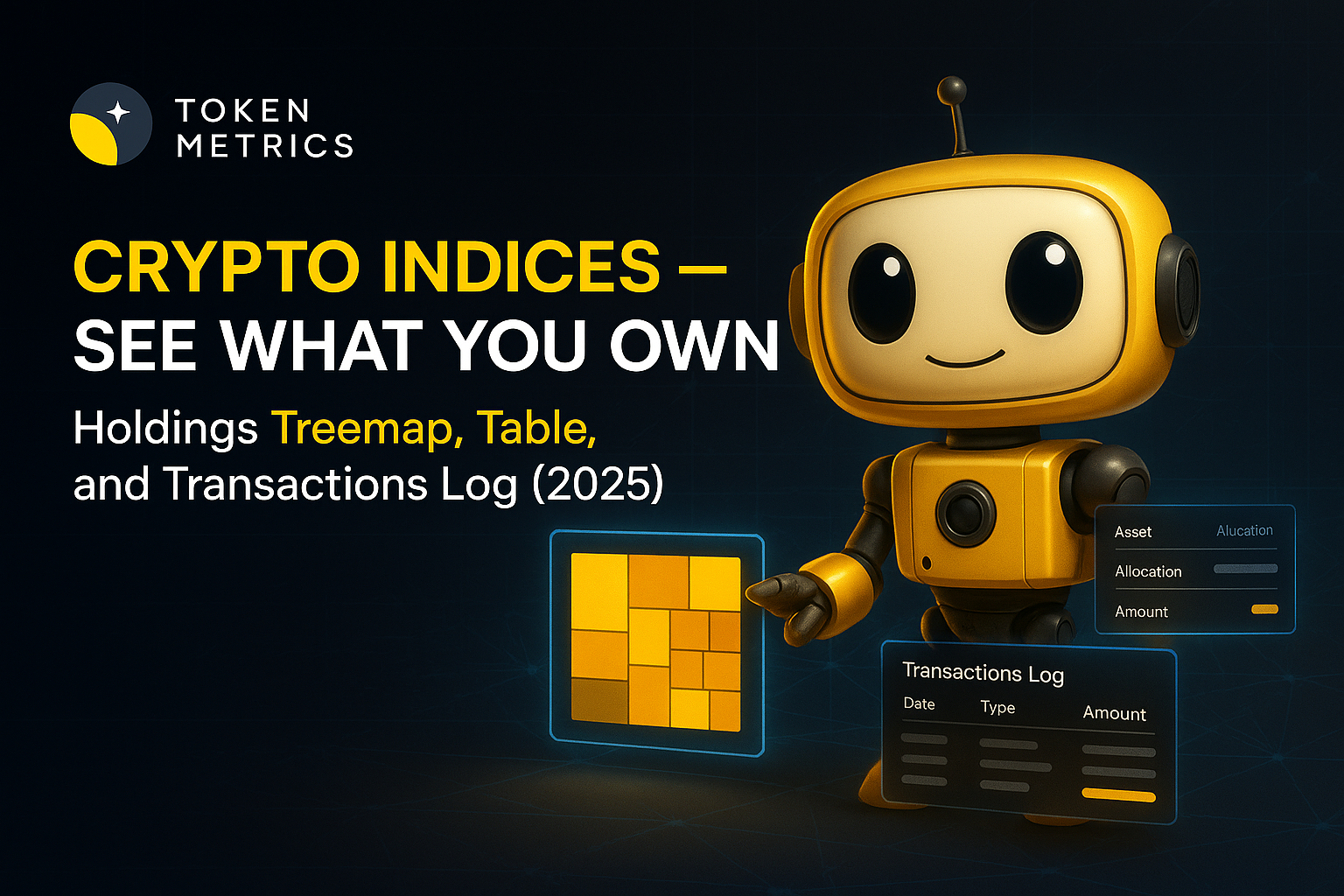
Complete Transparency: Strategy modal explains all rules clearly. Gauge shows live market signal driving allocation. Holders are displayed in treemap and table formats. Transaction log records every rebalance and regime switch.
One-Click Execution: The embedded, self-custodial smart wallet enables purchases in approximately 90 seconds. No need to set up accounts on multiple exchanges, execute dozens of trades, or manually track rebalancing schedules.
→ Join the waitlist to be first to trade TM Global 100.
Why Indices Matter More in 2025 Than Ever Before
Several trends have amplified the importance of indices:
- Market Complexity: With thousands of stocks globally and thousands of cryptocurrencies, individual security selection has become nearly impossible for retail investors. Indices provide manageable exposure to complex markets.
- Information Overload: The sheer volume of financial information exceeds human processing capacity. Indices cut through noise with systematic, rules-based approaches.
- Fee Compression: As active management fees have fallen under pressure from low-cost index funds, the cost advantage of passive investing has grown even stronger.
- Algorithmic Trading: Machines now execute most trades. Systematic, rules-based index strategies compete more effectively in this environment than discretionary human decisions.
- Volatility and Uncertainty: In uncertain markets, the discipline imposed by index strategies prevents emotional decision-making that often destroys returns.
- Technology Enablement: Blockchain technology and smart contracts enable index innovations impossible in traditional finance, like real-time transparency and automatic regime switching.
Practical Applications: How to Use Indices
Understanding why indices matter leads naturally to the question: how should I use them?
- Core-Satellite Approach: Use index investments as your portfolio core (60-80%), providing diversified market exposure and discipline. Add selective individual positions as satellites (20-40%) where you have specific insights or convictions.
- Asset Allocation: Use indices representing different asset classes (stocks, bonds, real estate, commodities, crypto) to build diversified portfolios spanning uncorrelated returns.
- Tax-Loss Harvesting: Indices' diversification makes them excellent vehicles for tax-loss harvesting strategies that lower your tax bill without changing market exposure.
- Risk Management: Use regime-switching indices like Token Metrics for systematic risk reduction during market downturns.
- Benchmarking: Regularly compare your returns to appropriate index benchmarks. If you consistently underperform, consider switching to index investments.
- Dollar-Cost Averaging: Indices' diversification makes them ideal for systematic investment programs where you invest fixed amounts regularly.
Common Questions About Index Importance
If everyone invests in indices, won't they stop working? This concern, often called the "indexing paradox," suggests that if too much money passively tracks indices, markets will become inefficient. In reality, even with 50% of assets indexed, the remaining 50% of active investors still compete to find mispricings. Markets remain quite efficient.
Do indices work in crypto markets? Yes—arguably even better than in traditional markets. Crypto's 24/7 trading, on-chain transparency, and extreme volatility make systematic index strategies particularly valuable. The speed of narrative rotation makes manual portfolio management nearly impossible.
Can I beat index returns? Some investors do beat indices, but the odds are against you. After fees and taxes, 80-90% of active managers underperform over long periods. If you have genuine informational advantages, deep expertise, and significant time to dedicate, you might succeed. Most investors don't.
What's the difference between an index and an ETF? An index is a measurement tool (like the S&P 500 number). An ETF is an investment product that tracks an index. You can't buy "the S&P 500" directly, but you can buy Token Metrics-tracked ETFs that do so.
The Risks and Limitations of Indices
While indices offer powerful benefits, understanding their limitations is equally important:
- Market Risk Remains: Indices don't eliminate market risk. If the entire market crashes 40%, your index investment crashes 40% (unless it's a regime-switching index that exits to defensive assets).
- Concentration Risk: Market-cap weighted indices can become heavily concentrated in a few large holdings. The Token Metrics S&P 500's top 10 stocks represent about 30% of the index.
- Inclusion Effects: When a stock is added to or removed from major indices, it can experience significant price movements unrelated to fundamentals as index funds adjust holdings.
- International Limitations: Some international markets have limited index availability or liquidity, making index investing more challenging.
- Sector Rotations: Pure index investing means you'll underperform during sectors' peak performance periods while fully experiencing their declines. Regime-switching indices address some limitations by actively managing risk, but introduce new considerations around signal accuracy and switching costs.
Getting Started with Index Investing
If you're convinced of indices' importance, here's how to begin:
- Traditional Markets: Open a brokerage account with low fees
- Choose appropriate index funds or ETFs for your goals
- Implement regular investment schedule (dollar-cost averaging)
- Rebalance annually to maintain target allocation
- Stay invested through market cycles
Crypto Markets with Token Metrics: Visit the Token Metrics Indices hub, review the TM Global 100 strategy and rules, join the waitlist for launch notification. At launch, click Buy Index, review fees, slippage, and holdings, confirm purchase (approximately 90 seconds), and track your position under My Indices with real-time P&L. The embedded, self-custodial smart wallet streamlines execution while maintaining your control over funds.
→ Join the waitlist to be first to trade TM Global 100.
The Future of Indices
Index importance will only grow as markets become more complex and technology enables new innovations:
- AI-Driven Selection: Machine learning algorithms will optimize index construction and rebalancing.
- Dynamic Strategies: More indices will implement active risk management through regime switching and factor rotation.
- Crypto Integration: Traditional finance will increasingly blend with crypto indices as digital assets mature.
- Personalization: Technology will enable personalized indices tailored to individual tax situations, values, and goals.
- Real-Time Everything: Blockchain technology will bring instant transparency, rebalancing, and execution to all indices.
TM Global 100 represents this future: systematic rules, active risk management, complete transparency, blockchain-enabled execution, and one-click accessibility.
Conclusion
Stock market indices matter because they serve as economic barometers, performance benchmarks, diversification tools, passive investment foundations, analytical frameworks, investment product cores, and risk management vehicles. These seven critical functions have made indices indispensable to modern finance.
In 2025, crypto indices extend these benefits to digital asset markets with enhanced transparency, faster rebalancing, and sophisticated risk management. The speed and uncertainty defining crypto markets make indices even more valuable than in traditional finance.
TM Global 100 demonstrates index importance through its systematic approach: top-100 breadth in bull markets captures upside, automatic stablecoin switching in bear markets limits downside, weekly rebalancing maintains current exposure, and complete transparency eliminates black-box concerns. If you want broad crypto exposure when it's worth it and stablecoins when it's not—with transparent, rules-based execution—TM Global 100 delivers the time-tested benefits of indices enhanced for modern markets.
Click here to get early access to TM100 indices at Token Metrics.
AI Agents in Minutes, Not Months

.svg)


%201.svg)


.png)




.svg)
No Credit Card Required


Online Payment


SSL Encrypted
.png)
Token Metrics Media LLC is a regular publication of information, analysis, and commentary focused especially on blockchain technology and business, cryptocurrency, blockchain-based tokens, market trends, and trading strategies.
Token Metrics Media LLC does not provide individually tailored investment advice and does not take a subscriber’s or anyone’s personal circumstances into consideration when discussing investments; nor is Token Metrics Advisers LLC registered as an investment adviser or broker-dealer in any jurisdiction.
Information contained herein is not an offer or solicitation to buy, hold, or sell any security. The Token Metrics team has advised and invested in many blockchain companies. A complete list of their advisory roles and current holdings can be viewed here: https://tokenmetrics.com/disclosures.html/
Token Metrics Media LLC relies on information from various sources believed to be reliable, including clients and third parties, but cannot guarantee the accuracy and completeness of that information. Additionally, Token Metrics Media LLC does not provide tax advice, and investors are encouraged to consult with their personal tax advisors.
All investing involves risk, including the possible loss of money you invest, and past performance does not guarantee future performance. Ratings and price predictions are provided for informational and illustrative purposes, and may not reflect actual future performance.