Back to blog
Announcements

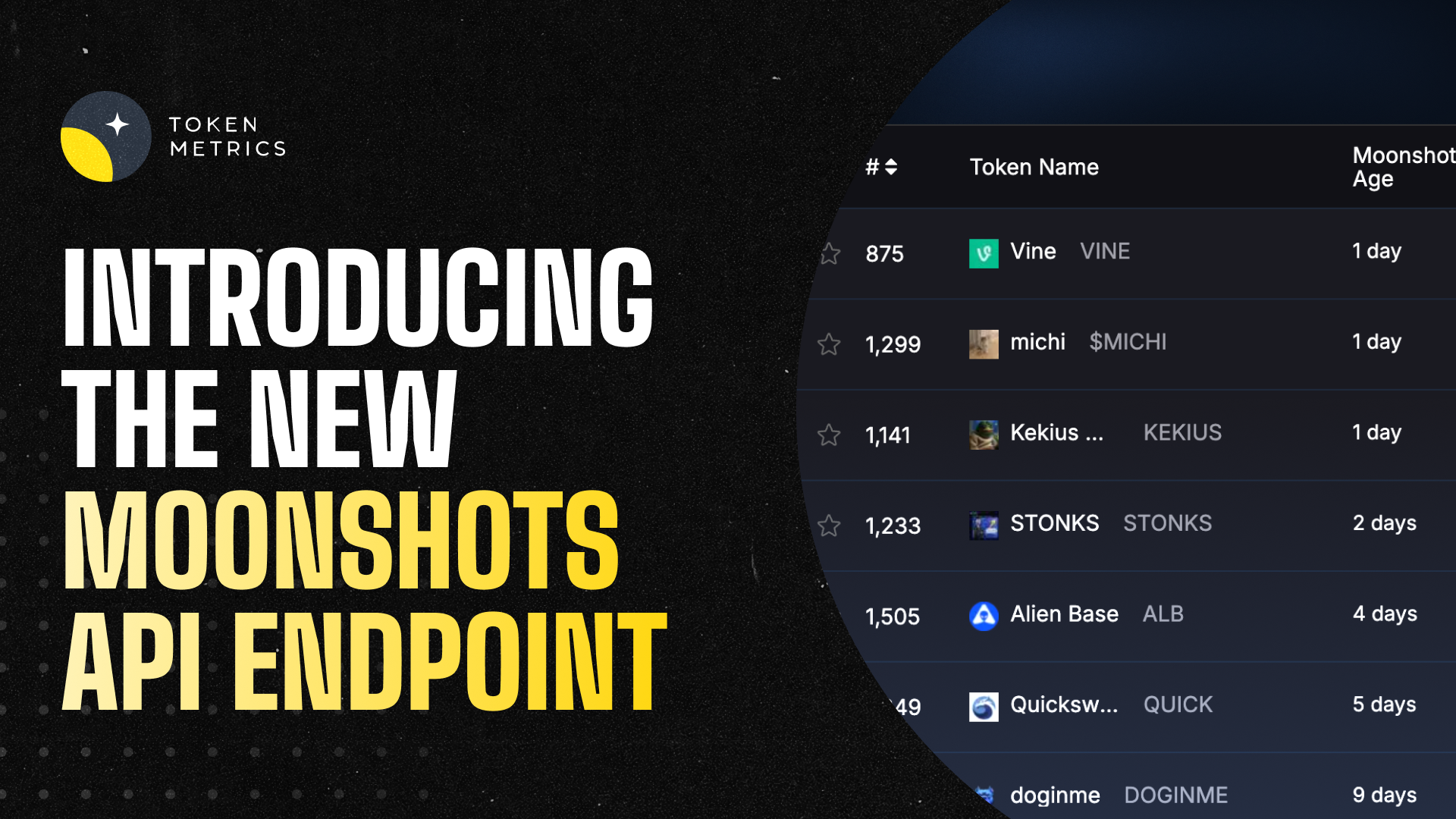
Introducing the New Moonshots API Endpoint: Access High‑Potential Tokens Programmatically

Discover the new Moonshots API endpoint from Token Metrics. Access live AI‑curated crypto picks with a 65 % win rate. Build trading bots, backtest strategies, and more
Token Metrics Team
5 min
Want Smarter Crypto Picks—Free?
See unbiased Token Metrics Ratings for BTC, ETH, and top alts.
Thank you! Your submission has been received!
Oops! Something went wrong while submitting the form.
 No credit card | 1-click unsubscribe

The crypto market moves fast, and staying ahead requires more than just watching charts — it takes actionable data, delivered in real‑time. That’s why we’re excited to announce a major upgrade for developers, traders, and analysts: the Moonshots feature is now live as a Token Metrics API endpoint.

This new endpoint brings the same powerful insights from our Premium Moonshots dashboard directly into your apps, dashboards, and trading systems — programmatically. Whether you’re building a crypto trading bot, creating dynamic watchlists, or backtesting new strategies, the Moonshots API gives you everything you need to make smarter, faster decisions.
What Are Moonshots?

In crypto, “moonshots” are low‑cap tokens with high upside potential — the kind of high‑risk, high‑reward plays that can deliver outsized returns when identified early. At Token Metrics, our Moonshots aren’t just random picks.

They are:

  • Hand‑picked by AI: Our proprietary algorithms scan thousands of tokens daily.
  • Backtested for performance: Only tokens that meet strict historical success criteria make the cut.
  • Continuously updated: Live insights reflect evolving market conditions in real time.

Since launch, Moonshots have surfaced 43 tokens with a 65 % win rate across trades. The max single‑token return so far? 68 % — and counting.

For developers, this is no longer just data you view in our dashboard. It’s now available via API, ready to integrate into your workflows.

Why Use the Token Metrics Moonshots API?
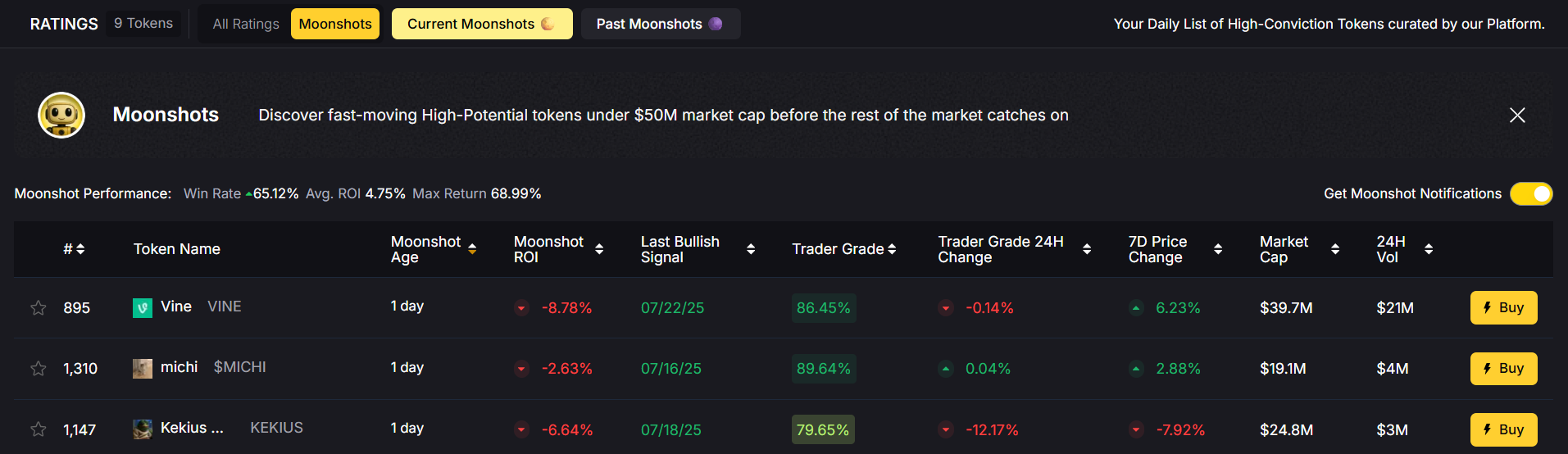
1. Programmatic Access to High‑Potential Trades
Get direct access to live Moonshot signals without needing to log into the platform. Perfect for apps, analytics dashboards, or automated trading systems.

2. Build Smarter Watchlists
Automatically populate your app or dashboard with AI‑curated, high‑potential tokens.

3. Trigger Bots in Real Time
Integrate the Moonshots feed into your trading bots so they can act instantly when a new token surfaces.

What’s in the API Response?

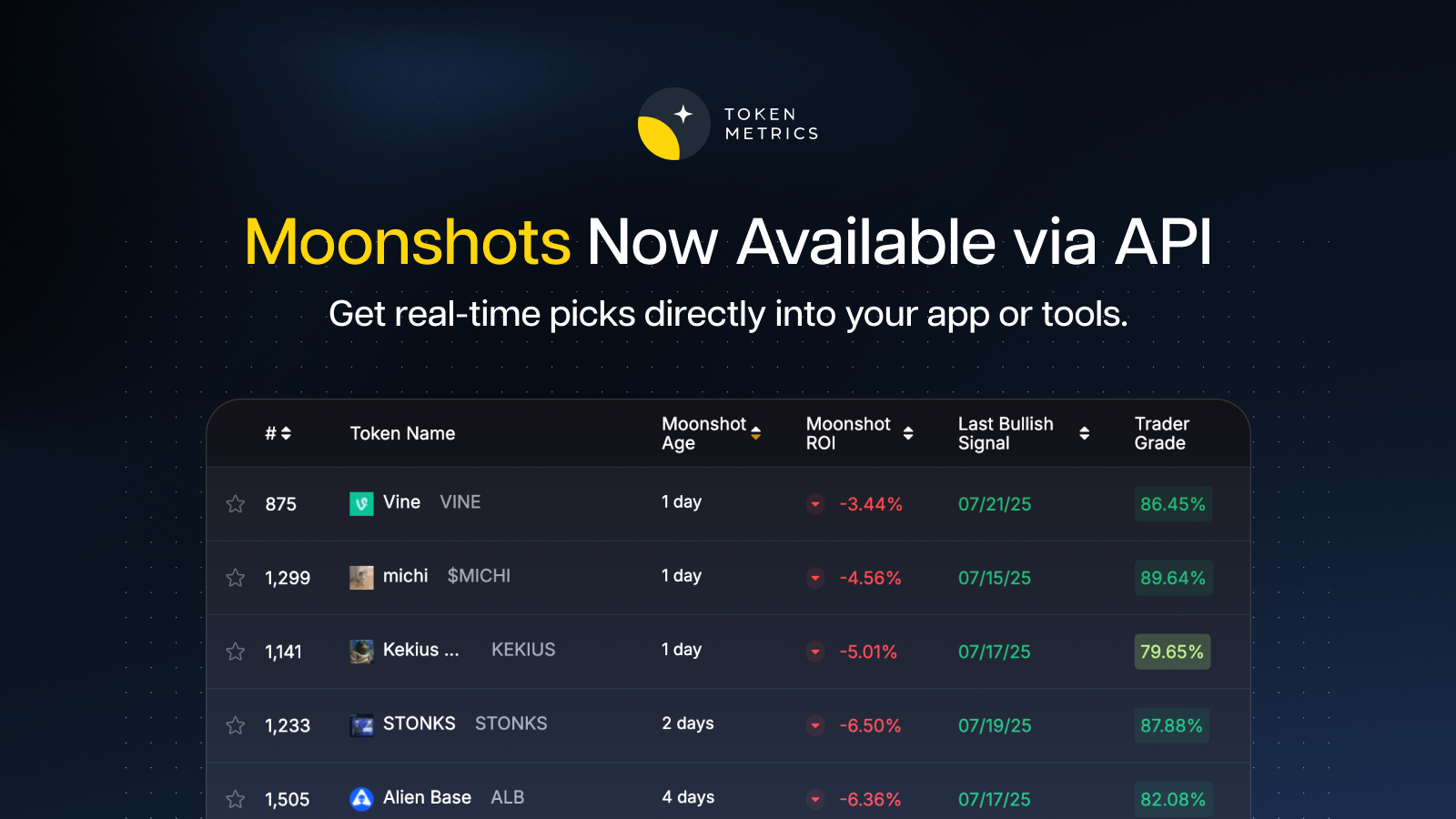
When you call the /v2/moonshot-tokens endpoint, you’ll get:

  • Token name & ticker – For easy identification.
  • Return on Investment (ROI) – Performance since the signal went live.
  • Trader Grade – Token Metrics’ proprietary grade indicating trade potential.
  • Market Cap – So you can quickly gauge token size and liquidity.
  • Signal Date – When the Moonshot was flagged.

Want to see how these signals have performed over time? Use /v2/moonshots-tokens with type=past param for detailed past performance data.

Who Is This For?

The Moonshots API is designed for:

  • Developers: Integrate AI‑curated trading intelligence into your products.
  • Quant Traders: Automate your strategies with real‑time Moonshot signals.
  • Portfolio Managers: Discover high‑potential small‑cap tokens before the crowd.

How to Get Started

  1. Upgrade to the Advanced Plan
    Moonshots is part of our premium trading‑signal suite, available with the Advanced Plan.

  2. Get Your API Key
    Once upgraded, grab your API key from the Token Metrics API dashboard.

  3. Call the Endpoint

    • Live Moonshots: GET /v2/moonshot-tokens
    • Past Moonshots: GET /v2/moonshot-tokens with type=past

  4. Build and Deploy
    Use the data to feed your dashboards, bots, or applications.

Your code could be live in minutes.

Example Use Cases

1. Auto‑Populate Watchlists

Give your users instant access to a curated list of high‑potential tokens. No manual updates — just live, programmatic signals from the API.

2. Trading Bot Triggers

Connect Moonshots to your algorithmic trading strategies. When a new Moonshot signal appears, your bot can take action immediately.

Why Moonshots API Is a Game‑Changer

The Moonshots API takes one of our most popular Premium features and makes it actionable for builders and advanced traders. No more copy‑pasting token names from dashboards. No more manually tracking new signals. With programmatic access, you can:

  • React faster to new opportunities.
  • Automate trading or alert systems.
  • Enhance your products with cutting‑edge AI‑curated token lists.

This is the same data powering our Premium dashboards — now unlocked for programmatic use.

Performance at a Glance

Here’s what you can expect from Moonshots based on recent data:

  • Tokens surfaced: 43
  • Win rate: 65 %
  • Max single‑token return: 68 %
  • Average holding period: Short‑ to mid‑term trades (active monitoring recommended)

The Bottom Line

The new Moonshots API endpoint lets you turn insights into action. Whether you’re an individual trader looking to build a personal watchlist, a quant team running algorithmic strategies, or a product developer building the next great crypto platform, the Moonshots API provides a direct pipeline to AI‑curated, backtested token picks with a proven track record.

Don’t just watch the next big move — catch it before it becomes hindsight.

How to Access the Moonshots API

  1. Upgrade to Advanced Plan to unlock trading‑signal endpoints.
  2. Get your API key from the Token Metrics dashboard.
  3. Start calling /v2/moonshot-tokens today.

Have questions? Our team is available on Telegram (@tokenmetricsapi) to help you get up and running.

Build Smarter Crypto Apps &
AI Agents in Minutes, Not Months
Real-time prices, trading signals, and on-chain insights all from one powerful API.
Grab a Free API Key
About Token Metrics
Token Metrics: AI-powered crypto research and ratings platform. We help investors make smarter decisions with unbiased Token Metrics Ratings, on-chain analytics, and editor-curated “Top 10” guides. Our platform distills thousands of data points into clear scores, trends, and alerts you can act on.
30 Employees
analysts, data scientists, and crypto engineers
Daily Briefings
concise market insights and “Top Picks”
Transparent & Compliant
Sponsored ≠ Ratings; research remains independent
Want Smarter Crypto Picks—Free?
See unbiased Token Metrics Ratings for BTC, ETH, and top alts.
Thank you! Your submission has been received!
Oops! Something went wrong while submitting the form.
 No credit card | 1-click unsubscribe
Token Metrics Team
Token Metrics Team

Recent Posts

Research

Mastering Discord Integrations: API Essentials

Token Metrics Team
5

Discord's API is the backbone of modern community automation, moderation, and integrations. Whether you're building a utility bot, connecting an AI assistant, or streaming notifications from external systems, understanding the Discord API's architecture, constraints, and best practices helps you design reliable, secure integrations that scale.

Overview: What the Discord API Provides

The Discord API exposes two main interfaces: the Gateway (a persistent WebSocket) for real-time events and the REST API for one-off requests such as creating messages, managing channels, and configuring permissions. Together they let developers build bots and services that respond to user actions, post updates, and manage server state.

Key concepts to keep in mind:

  • Gateway (WebSocket): Streams events like messages, reactions, and presence updates. It's designed for low-latency, event-driven behavior.
  • REST API: Handles CRUD operations and configuration changes. Rate limits apply per route and globally.
  • OAuth2: Used to authorize bots and request application-level scopes for users and servers.
  • Intents: Selective event subscriptions that limit the data your bot receives for privacy and efficiency.

Authentication, Bot Accounts, and Intents

Authentication is based on tokens. Bots use a bot token (issued in the Discord Developer Portal) to authenticate both the Gateway and REST calls. When building or auditing a bot, treat tokens like secrets: rotate them when exposed and store them securely in environment variables or a secrets manager.

Intents let you opt-in to categories of events. For example, message content intent is required to read message text in many cases. Use the principle of least privilege: request only the intents you need to reduce data exposure and improve performance.

Practical steps:

  1. Register your application in the Developer Portal and create a bot user.
  2. Set up OAuth2 scopes (bot, applications.commands) and generate an install link.
  3. Enable required intents and test locally with a development server before wide deployment.

Rate Limits, Error Handling, and Scaling

Rate limits are enforced per route and per global bucket. Familiarize yourself with the headers returned by the REST API (X-RateLimit-Limit, X-RateLimit-Remaining, X-RateLimit-Reset) and adopt respectful retry strategies. For Gateway connections, avoid rapid reconnects; follow exponential backoff and obey the recommended identify rate limits.

Design patterns to improve resilience:

  • Rate-limit-aware clients: Use libraries or middleware that queue and throttle REST requests based on returned headers.
  • Idempotency: For critical actions, implement idempotent operations to safely retry failed requests.
  • Sharding: For large bots serving many servers, shard the Gateway connection to distribute event load across processes or machines.
  • Monitoring & alerting: Track error rates, latency, and reconnect frequency to detect regressions early.

Webhooks, Interactions, and Slash Commands

Webhooks are lightweight for sending messages into channels without a bot token and are excellent for notifications from external systems. Interactions and slash commands provide structured, discoverable commands that integrate naturally into the Discord UI.

Best practices when using webhooks and interactions:

  • Validate inbound interaction payloads using the public key provided by Discord.
  • Use ephemeral responses for sensitive command outputs to avoid persistent exposure.
  • Prefer slash commands for user-triggered workflows because they offer parameter validation and autocomplete.

Security, Compliance, and Privacy Considerations

Security goes beyond token handling. Consider these areas:

  • Permission hygiene: Grant the minimum permission set and use scoped OAuth2 invites.
  • Data minimization: Persist only necessary user data, and document retention policies.
  • Encryption & secrets: Store tokens and credentials in secret stores and avoid logging sensitive fields.
  • Third-party integrations: Vet external services you connect; restrict webhook targets and audit access periodically.

Integrating AI and External APIs

Combining Discord bots with AI or external data APIs can produce helpful automation, moderation aids, or analytics dashboards. When integrating, separate concerns: keep the Discord-facing layer thin and stateless where possible, and offload heavy processing to dedicated services.

For crypto- and market-focused integrations, external APIs can supply price feeds, on-chain indicators, and signals which your bot can surface to users. AI-driven research platforms such as Token Metrics can augment analysis by providing structured ratings and on-chain insights that your integration can query programmatically.

Build Smarter Crypto Apps & AI Agents with Token Metrics

Token Metrics provides real-time prices, trading signals, and on-chain insights all from one powerful API. Grab a Free API Key

FAQ: How do I start building a bot?

Begin by creating an application in the Discord Developer Portal, add a bot user, and generate a bot token. Choose a client library (for example discord.js, discord.py alternatives) to handle Gateway and REST interactions. Test in a private server before inviting to production servers.

FAQ: What are Gateway intents and when should I enable them?

Intents are event categories that determine which events the Gateway will send to your bot. Enable only the intents your features require. Some intents, like message content, are privileged and require justification for larger bots or those in many servers.

FAQ: How can I avoid hitting rate limits?

Respect rate-limit headers, use client libraries that implement request queues, batch operations when possible, and shard your bot appropriately. Implement exponential backoff for retries and monitor request patterns to identify hotspots.

FAQ: Are webhooks better than bots for notifications?

Webhooks are simpler for sending messages from external systems because they don't require a bot token and have a low setup cost. Bots are required for interactive features, slash commands, moderation, and actions that require user-like behavior.

FAQ: How do I secure incoming interaction requests?

Validate interaction signatures using Discord's public key. Verify timestamps to prevent replay attacks and ensure your endpoint only accepts expected request types. Keep validation code in middleware for consistency.

Disclaimer

This article is educational and technical in nature. It does not provide investment, legal, or financial advice. Implementations described here focus on software architecture, integration patterns, and security practices; adapt them to your own requirements and compliance obligations.

Research

API Explained: What 'API' Stands For & How It Works

Token Metrics Team
5

APIs power much of the software and services we use every day, but the acronym itself can seem abstract to newcomers. This guide answers the simple question "what does API stand for," explains the main types and patterns, and shows how developers, analysts, and researchers use APIs—especially in data-rich fields like crypto and AI—to access information and automate workflows.

What does API stand for and a practical definition

API stands for Application Programming Interface. In practice, an API is a set of rules and protocols that lets one software component request services or data from another. It defines how requests should be formatted, what endpoints are available, what data types are returned, and which authentication methods are required.

Think of an API as a contract between systems: the provider exposes functionality or data, and the consumer calls that functionality using an agreed syntax. This contract enables interoperability across languages, platforms, and teams without sharing internal implementation details.

Common API types and architectural styles

APIs come in several flavors depending on purpose and architecture. Understanding these helps you choose the right integration approach:

  • REST (Representational State Transfer): The most widespread style for web APIs. Uses HTTP methods (GET, POST, PUT, DELETE) and typically exchanges JSON. REST is stateless and often organized around resources.
  • GraphQL: A query language and runtime that allows clients to request precisely the data they need in a single request. Useful when clients require flexible access patterns.
  • gRPC: A high-performance RPC framework using protocol buffers. Favored for low-latency internal services.
  • WebSocket and Streaming APIs: For real-time, bidirectional data flows such as live price feeds or telemetry.
  • Library/SDK APIs: Language-specific interfaces that wrap lower-level HTTP calls into idiomatic functions.

In domains like crypto, API types often include REST endpoints for historical data, WebSocket endpoints for live market updates, and specialized endpoints for on-chain data and analytics.

How APIs are used: workflows and practical examples

APIs unlock automation and integration across many workflows. Typical examples include:

  • Data pipelines: scheduled API pulls ingested into analytics systems or data warehouses.
  • Automation: triggering events, notifications, or trades from software agents (when permitted by policy and regulation).
  • Embedding functionality: maps, payment processing, or identity services added to products without rebuilding them.
  • AI and model inputs: APIs provide training and inference data streams for models, or let models query external knowledge.

For researchers and developers in crypto and AI, APIs enable programmatic access to prices, on-chain metrics, and model outputs. Tools that combine multiple data sources through APIs can accelerate analysis while maintaining reproducibility.

Security, rate limits, and best-practice design

APIs must be designed with security and reliability in mind. Key considerations include:

  • Authentication and authorization: API keys, OAuth, and signed requests limit access and define permissions.
  • Rate limiting: Prevents abuse and ensures fair usage across clients; consumers should implement exponential backoff and caching.
  • Input validation and error handling: Clear error codes and messages make integrations robust and diagnosable.
  • Versioning: Maintain compatibility for existing users while enabling iterative improvements.

Designing or choosing APIs with clear documentation, sandbox environments, and predictable SLAs reduces integration friction and downstream maintenance effort.

Build Smarter Crypto Apps & AI Agents with Token Metrics

Token Metrics provides real-time prices, trading signals, and on-chain insights all from one powerful API. Grab a Free API Key

FAQ: Common questions about APIs

What does API stand for?

API stands for Application Programming Interface. It is a defined set of rules that enables software to communicate and exchange data or functionality with other software components.

How does an API differ from a library or SDK?

An API is a specification for interaction; a library or SDK is an implementation that exposes an API in a specific programming language. Libraries call APIs internally or provide convenience wrappers for API calls.

When should I use REST vs GraphQL?

Use REST for simple, resource-oriented endpoints and predictable cacheable interactions. Use GraphQL when clients require flexible, tailored queries and want to minimize round trips for composite data needs.

How do rate limits affect integrations?

Rate limits cap how many requests a client can make in a given period. Respecting limits with caching and backoff logic prevents service disruption and helps maintain reliable access.

Can APIs provide real-time data for AI models?

Yes. Streaming and WebSocket APIs can deliver low-latency data feeds that serve as inputs to real-time models, while REST endpoints supply bulk or historical datasets used for training and backtesting.

What tools help manage multiple API sources?

Integration platforms, API gateways, and orchestration tools manage authentication, rate limiting, retries, and transformations. For crypto and AI workflows, data aggregation services and programmatic APIs speed analysis.

How can I discover high-quality crypto APIs?

Evaluate documentation, uptime reports, data coverage, authentication methods, and community usage. Platforms that combine market, on-chain, and research signals are especially useful for analytical workflows.

Where can I learn more about API best practices?

Official style guides, API design books, and public documentation from major providers (Google, GitHub, Stripe) offer practical patterns for versioning, security, and documentation.

Disclaimer: This article is educational and informational only. It does not constitute financial, legal, or investment advice. Readers should perform independent research and consult appropriate professionals for their specific needs.

Research

Mastering the ChatGPT API: Practical Developer Guide

Token Metrics Team
5

ChatGPT API has become a foundational tool for building conversational agents, content generation pipelines, and AI-powered features across web and mobile apps. This guide walks through how the API works, common integration patterns, cost and performance considerations, prompt engineering strategies, and security and compliance checkpoints — all framed to help developers design reliable, production-ready systems.

Overview: What the ChatGPT API Provides

The ChatGPT API exposes a conversational, instruction-following model through RESTful endpoints. It accepts structured inputs (messages, system instructions, temperature, max tokens) and returns generated messages and usage metrics. Key capabilities include multi-turn context handling, role-based prompts (system, user, assistant), and streaming responses for lower perceived latency.

When evaluating the API for a project, consider three high-level dimensions: functional fit (can it produce the outputs you need?), operational constraints (latency, throughput, rate limits), and cost model (token usage and pricing). Structuring experiments around these dimensions produces clearer decisions than ad-hoc prototyping.

How the ChatGPT API Works: Architecture & Tokens

At a technical level, the API exchanges conversational messages composed of roles and content. The model's input size is measured in tokens, not characters; both prompts and generated outputs consume tokens. Developers must account for:

  • Input tokens: system+user messages sent with the request.
  • Output tokens: model-generated content returned in the response.
  • Context window: maximum tokens the model accepts per request, limiting historical context you can preserve.

Token-awareness is essential for cost control and designing concise prompts. Tools exist to estimate token counts for given strings; include these estimates in batching and truncation logic to prevent failed requests due to exceeding the context window.

Integration Patterns and Use Cases

Common patterns for integrating the ChatGPT API map to different functional requirements:

  1. Frontend chat widget: Short, low-latency requests per user interaction with streaming enabled for better UX.
  2. Server-side orchestration: Useful for multi-step workflows, retrieving and combining external data before calling the model.
  3. Batch generation pipelines: For large-scale content generation, precompute outputs asynchronously and store results for retrieval.
  4. Hybrid retrieval-augmented generation (RAG): Combine a knowledge store or vector DB with retrieval calls to ground responses in up-to-date data.

Select a pattern based on latency tolerance, concurrency requirements, and the need to control outputs with additional logic or verifiable sources.

Cost, Rate Limits, and Performance Considerations

Pricing for ChatGPT-style APIs typically ties to token usage and model selection. For production systems, optimize costs and performance by:

  • Choosing the right model: Use smaller models for routine tasks where quality/latency tradeoffs are acceptable.
  • Prompt engineering: Make prompts concise and directive to reduce input tokens and avoid unnecessary generation.
  • Caching and deduplication: Cache common queries and reuse cached outputs when applicable to avoid repeated cost.
  • Throttling: Implement exponential backoff and request queuing to respect rate limits and avoid cascading failures.

Measure end-to-end latency including network, model inference, and application processing. Use streaming when user-perceived latency matters; otherwise, batch requests for throughput efficiency.

Best Practices: Prompt Design, Testing, and Monitoring

Robust ChatGPT API usage blends engineering discipline with iterative evaluation:

  • Prompt templates: Maintain reusable templates with placeholders to enforce consistent style and constraints.
  • Automated tests: Create unit and integration tests that validate output shape, safety checks, and critical content invariants.
  • Safety filters and moderation: Run model outputs through moderation or rule-based filters to detect unwanted content.
  • Instrumentation: Log request/response sizes, latencies, token usage, and error rates. Aggregate metrics to detect regressions.
  • Fallback strategies: Implement graceful degradation (e.g., canned responses or reduced functionality) when API latency spikes or quota limits are reached.

Adopt iterative prompt tuning: A/B different system instructions, sampling temperatures, and max tokens while measuring relevance, correctness, and safety against representative datasets.

Build Smarter Crypto Apps & AI Agents with Token Metrics

Token Metrics provides real-time prices, trading signals, and on-chain insights all from one powerful API. Grab a Free API Key

FAQ: What is the ChatGPT API and when should I use it?

The ChatGPT API is a conversational model endpoint for generating text based on messages and instructions. Use it when you need flexible, context-aware text generation such as chatbots, summarization, or creative writing assistants.

FAQ: How do tokens impact cost and context?

Tokens measure both input and output size. Longer prompts and longer responses increase token counts, which raises cost and can hit the model's context window limit. Optimize prompts and truncate history when necessary.

FAQ: What are common strategies for handling rate limits?

Implement client-side throttling, request queuing, exponential backoff on 429 responses, and prioritize critical requests. Monitor usage patterns and adjust concurrency to avoid hitting provider limits.

FAQ: How do I design effective prompts?

Start with a clear system instruction to set tone and constraints, use examples for format guidance, keep user prompts concise, and test iteratively. Templates and guardrails reduce variability in outputs.

FAQ: What security and privacy practices should I follow?

Secure API keys (do not embed in client code), encrypt data in transit and at rest, anonymize sensitive user data when possible, and review provider data usage policies. Apply access controls and rotate keys periodically.

FAQ: When should I use streaming responses?

Use streaming to improve perceived responsiveness for chat-like experiences or long outputs. Streaming reduces time-to-first-token and allows progressive rendering in UIs.

Disclaimer

This article is for informational and technical guidance only. It does not constitute legal, compliance, or investment advice. Evaluate provider terms and conduct your own testing before deploying models in production.

Choose from Platinum, Gold, and Silver packages
Reach with 25–30% open rates and 0.5–1% CTR
Craft your own custom ad—from banners to tailored copy
Perfect for Crypto Exchanges, SaaS Tools, DeFi, and AI Products