Back to blog
Announcements

Introducing the New Moonshots API Endpoint: Access High‑Potential Tokens Programmatically

Discover the new Moonshots API endpoint from Token Metrics. Access live AI‑curated crypto picks with a 65 % win rate. Build trading bots, backtest strategies, and more
Token Metrics Team
5 min
Want Smarter Crypto Picks—Free?
See unbiased Token Metrics Ratings for BTC, ETH, and top alts.
Thank you! Your submission has been received!
Oops! Something went wrong while submitting the form.
 No credit card | 1-click unsubscribe

The crypto market moves fast, and staying ahead requires more than just watching charts — it takes actionable data, delivered in real‑time. That’s why we’re excited to announce a major upgrade for developers, traders, and analysts: the Moonshots feature is now live as a Token Metrics API endpoint.

This new endpoint brings the same powerful insights from our Premium Moonshots dashboard directly into your apps, dashboards, and trading systems — programmatically. Whether you’re building a crypto trading bot, creating dynamic watchlists, or backtesting new strategies, the Moonshots API gives you everything you need to make smarter, faster decisions.
What Are Moonshots?

In crypto, “moonshots” are low‑cap tokens with high upside potential — the kind of high‑risk, high‑reward plays that can deliver outsized returns when identified early. At Token Metrics, our Moonshots aren’t just random picks.

They are:

  • Hand‑picked by AI: Our proprietary algorithms scan thousands of tokens daily.
  • Backtested for performance: Only tokens that meet strict historical success criteria make the cut.
  • Continuously updated: Live insights reflect evolving market conditions in real time.

Since launch, Moonshots have surfaced 43 tokens with a 65 % win rate across trades. The max single‑token return so far? 68 % — and counting.

For developers, this is no longer just data you view in our dashboard. It’s now available via API, ready to integrate into your workflows.

Why Use the Token Metrics Moonshots API?
1. Programmatic Access to High‑Potential Trades
Get direct access to live Moonshot signals without needing to log into the platform. Perfect for apps, analytics dashboards, or automated trading systems.

2. Build Smarter Watchlists
Automatically populate your app or dashboard with AI‑curated, high‑potential tokens.

3. Trigger Bots in Real Time
Integrate the Moonshots feed into your trading bots so they can act instantly when a new token surfaces.

What’s in the API Response?

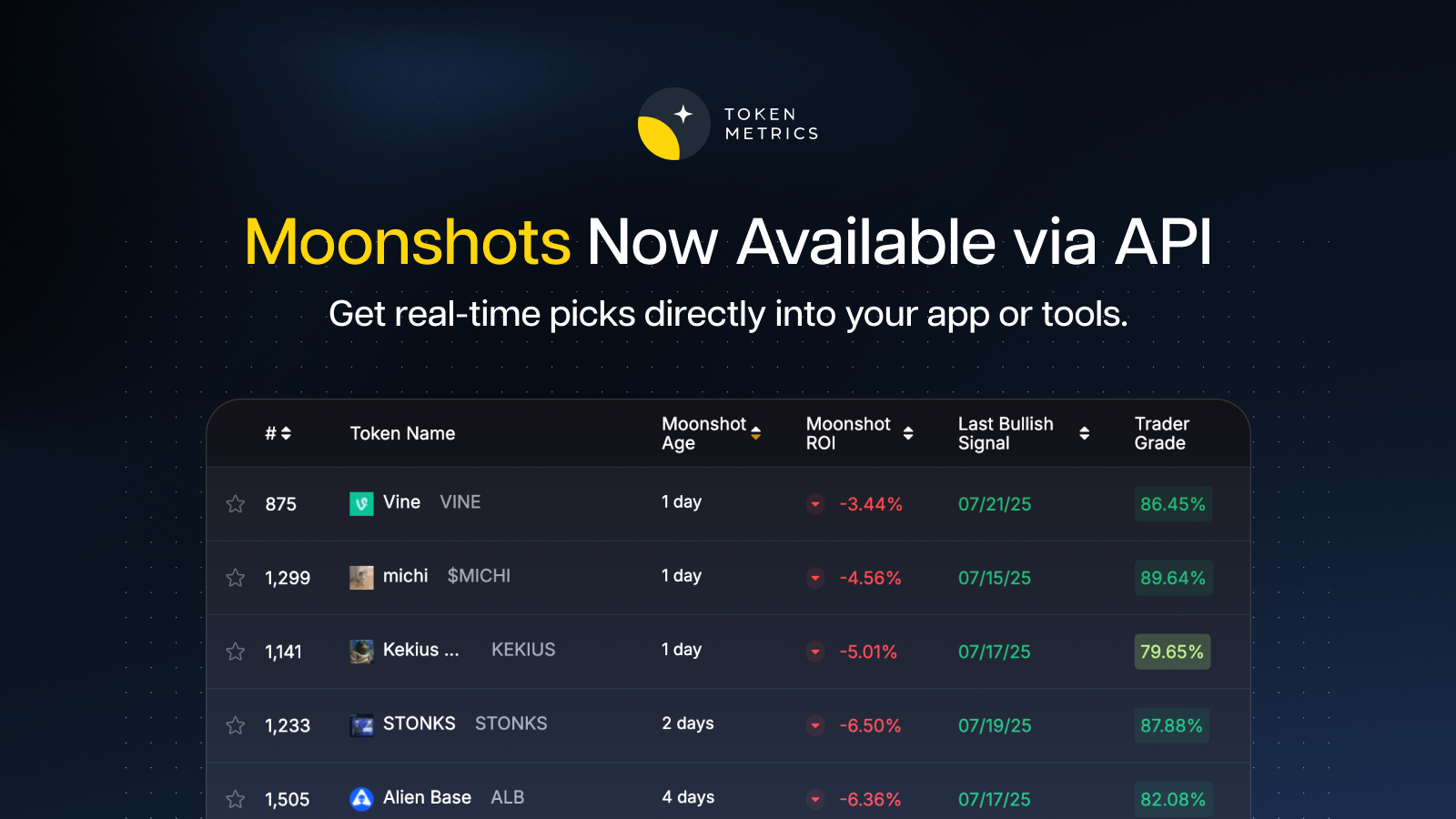
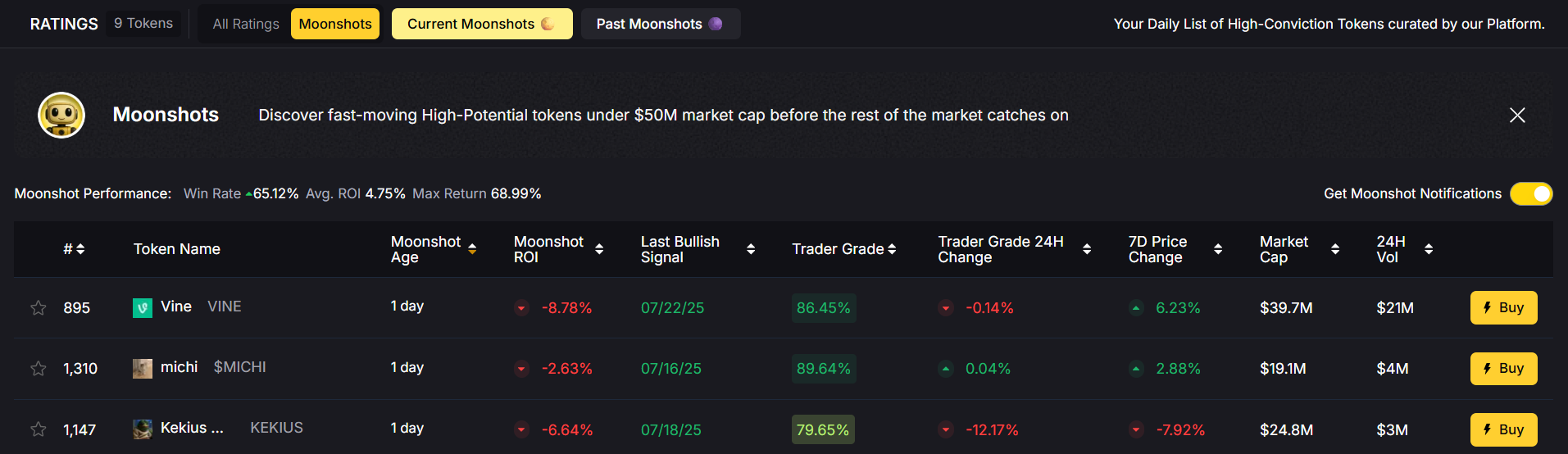
When you call the /v2/moonshot-tokens endpoint, you’ll get:

  • Token name & ticker – For easy identification.
  • Return on Investment (ROI) – Performance since the signal went live.
  • Trader Grade – Token Metrics’ proprietary grade indicating trade potential.
  • Market Cap – So you can quickly gauge token size and liquidity.
  • Signal Date – When the Moonshot was flagged.

Want to see how these signals have performed over time? Use /v2/moonshots-tokens with type=past param for detailed past performance data.

Who Is This For?

The Moonshots API is designed for:

  • Developers: Integrate AI‑curated trading intelligence into your products.
  • Quant Traders: Automate your strategies with real‑time Moonshot signals.
  • Portfolio Managers: Discover high‑potential small‑cap tokens before the crowd.

How to Get Started

  1. Upgrade to the Advanced Plan
    Moonshots is part of our premium trading‑signal suite, available with the Advanced Plan.

  2. Get Your API Key
    Once upgraded, grab your API key from the Token Metrics API dashboard.

  3. Call the Endpoint

    • Live Moonshots: GET /v2/moonshot-tokens
    • Past Moonshots: GET /v2/moonshot-tokens with type=past

  4. Build and Deploy
    Use the data to feed your dashboards, bots, or applications.

Your code could be live in minutes.

Example Use Cases

1. Auto‑Populate Watchlists

Give your users instant access to a curated list of high‑potential tokens. No manual updates — just live, programmatic signals from the API.

2. Trading Bot Triggers

Connect Moonshots to your algorithmic trading strategies. When a new Moonshot signal appears, your bot can take action immediately.

Why Moonshots API Is a Game‑Changer

The Moonshots API takes one of our most popular Premium features and makes it actionable for builders and advanced traders. No more copy‑pasting token names from dashboards. No more manually tracking new signals. With programmatic access, you can:

  • React faster to new opportunities.
  • Automate trading or alert systems.
  • Enhance your products with cutting‑edge AI‑curated token lists.

This is the same data powering our Premium dashboards — now unlocked for programmatic use.

Performance at a Glance

Here’s what you can expect from Moonshots based on recent data:

  • Tokens surfaced: 43
  • Win rate: 65 %
  • Max single‑token return: 68 %
  • Average holding period: Short‑ to mid‑term trades (active monitoring recommended)

The Bottom Line

The new Moonshots API endpoint lets you turn insights into action. Whether you’re an individual trader looking to build a personal watchlist, a quant team running algorithmic strategies, or a product developer building the next great crypto platform, the Moonshots API provides a direct pipeline to AI‑curated, backtested token picks with a proven track record.

Don’t just watch the next big move — catch it before it becomes hindsight.

How to Access the Moonshots API

  1. Upgrade to Advanced Plan to unlock trading‑signal endpoints.
  2. Get your API key from the Token Metrics dashboard.
  3. Start calling /v2/moonshot-tokens today.

Have questions? Our team is available on Telegram (@tokenmetricsapi) to help you get up and running.

Build Smarter Crypto Apps &
AI Agents in Minutes, Not Months
Real-time prices, trading signals, and on-chain insights all from one powerful API.
Grab a Free API Key
About Token Metrics
Token Metrics: AI-powered crypto research and ratings platform. We help investors make smarter decisions with unbiased Token Metrics Ratings, on-chain analytics, and editor-curated “Top 10” guides. Our platform distills thousands of data points into clear scores, trends, and alerts you can act on.
30 Employees
analysts, data scientists, and crypto engineers
Daily Briefings
concise market insights and “Top Picks”
Transparent & Compliant
Sponsored ≠ Ratings; research remains independent
Want Smarter Crypto Picks—Free?
See unbiased Token Metrics Ratings for BTC, ETH, and top alts.
Thank you! Your submission has been received!
Oops! Something went wrong while submitting the form.
 No credit card | 1-click unsubscribe
Token Metrics Team
Token Metrics Team

Recent Posts

Research

Understanding Why Blockchain Transactions Are Irreversible

Token Metrics Team
5

Introduction

The concept of irreversible transactions is a foundational aspect of blockchain technology and cryptocurrencies. Unlike traditional banking systems where transactions can be reversed or disputed, blockchain transactions are designed to be permanent and unalterable once confirmed. This unique feature raises an important question: why are blockchain transactions irreversible? This article delves into the fundamental principles, technological mechanisms, and security frameworks that underpin transaction irreversibility in blockchains. In addition, it highlights how analytical and AI-driven research platforms such as Token Metrics can help users better understand the underlying dynamics.

Basics of Blockchain Transactions

To answer why blockchain transactions are irreversible, it is essential to understand what constitutes a blockchain transaction. At its core, a blockchain is a decentralized and distributed digital ledger of transactions, grouped into blocks and linked through cryptographic hashes.

  • Transaction creation: Users initiate transactions by digitally signing them with private keys, ensuring authenticity and ownership.
  • Broadcast and validation: Transactions are broadcast to a network of nodes, where consensus algorithms validate and verify them based on predefined rules.
  • Inclusion in blocks: Validated transactions are bundled into a block.
  • Linking blocks into a chain: Each block references the previous block through a cryptographic hash, forming a chronological chain.

Once a transaction is included in a confirmed block, it becomes part of the immutable ledger, considered permanent and irreversible.

Role of Immutability and Cryptography

Immutability is the cornerstone of transaction irreversibility. Blockchain achieves immutability using cryptographic techniques and decentralized consensus.

  • Cryptographic hashes: Each block contains a hash of the previous block, creating a tamper-evident chain. Changing any transaction data in a previous block alters its hash and breaks the chain's continuity.
  • Digital signatures: Transactions are signed by senders using private keys, and their validity is verified through public keys.
  • Decentralization: Since multiple nodes maintain copies of the ledger, altering one copy would require overwhelming control over the network to rewrite history, which is prohibitively difficult.

This design ensures that once a transaction is confirmed and embedded in a block, it is computationally infeasible to modify or reverse it without consensus from the majority of the network.

Consensus Mechanisms and Finality

Consensus algorithms play an essential role in determining when transactions are considered final and irreversible.

  • Proof of Work (PoW): In PoW systems like Bitcoin, miners solve complex puzzles to add new blocks. The longer the subsequent chain grows past a block, the more secure and irreversible the transactions within it become, as rewriting would require significant energy expenditure.
  • Proof of Stake (PoS) and others: Other consensus models like PoS, delegated PoS, or Byzantine Fault Tolerant algorithms offer different methods of achieving agreement but similarly provide guarantees on transaction finality.

Network participants generally treat transactions as irreversible after a certain number of confirmations (additional blocks). This requirement reduces risks from temporary forks or reorganizations.

Technical Challenges to Reversing Transactions

Reversing a blockchain transaction would entail rewriting the blockchain history, which is impeded by several technical realities:

  1. Hash chain dependency: Because every block contains the hash of its predecessor, any change would cascade through the chain, invalidating all subsequent blocks.
  2. Network consensus: The majority of nodes must agree on a change, which is practically impossible in secure, well-distributed networks without control of a 51% attack.
  3. Resource expenditure: The computational power and time required to modify past transactions increase exponentially with block depth.

Therefore, even accidental or malicious attempts to reverse a transaction face insurmountable obstacles.

Practical Implications of Irreversibility

The irreversible nature of blockchain transactions carries both benefits and risks.

  • Benefits: Enhanced security against fraud and censorship, fostering trust in decentralized financial systems.
  • Risks: Users need to exercise caution, as mistakes such as sending to incorrect addresses or falling victim to scams cannot be undone.

Understanding these implications is critical for users engaging with blockchain-based systems, and tools like Token Metrics provide data-driven insights to enhance awareness and decision-making.

How AI and Analytics Support Understanding

With the growing complexity of blockchain ecosystems, AI-driven platforms are increasingly valuable for dissecting transaction behaviors and network health.

  • Transaction analysis: AI can identify patterns, potential risks, or anomalies in blockchain activity.
  • Market insights: Analytical tools can augment research on transaction volumes, confirmation times, and network congestion.
  • Educational resources: Platforms such as Token Metrics leverage AI to provide accessible metrics and ratings that inform users about blockchain projects and technologies.

Utilizing these resources supports a better grasp of the irreversible nature of transactions and the broader blockchain infrastructure.

Conclusion

Blockchain transaction irreversibility is rooted in the technology’s core principles of immutability, decentralization, and consensus-driven finality. These mechanisms collectively ensure that once a transaction is recorded on the blockchain and sufficiently confirmed, it cannot be altered or undone without prohibitive computational effort and majority network control. While irreversible transactions provide robust security and trustlessness, they also emphasize the importance of user diligence. Leveraging AI-powered analytical tools like Token Metrics can enhance comprehension and navigational confidence within blockchain ecosystems.

Disclaimer

This article is intended for educational purposes only and does not constitute financial advice. Readers should conduct their own research using varied sources, including specialized platforms such as Token Metrics, before engaging with blockchain or cryptocurrency activities.

Crypto Basics

What Indicators Should I Use for Technical Crypto Analysis?

Token Metrics Team
8 min

If you’re serious about trading cryptocurrency, technical analysis (TA) is an essential skill. It helps you understand price movements, predict trends, and identify high-probability entry and exit points.

But with hundreds of technical indicators available, one common question is: “Which indicators should I use for technical analysis?”

In this guide, we’ll break down the most effective indicators for crypto trading, explain how they work, and show you how Token Metrics combines them with AI-driven insights to help you trade smarter.

Why Use Technical Indicators in Crypto?

Unlike traditional stocks, cryptocurrency markets trade 24/7, are more volatile, and are largely driven by sentiment and speculation.

Technical indicators help you:

  • Identify trends (bullish or bearish).

  • Pinpoint support and resistance levels.

  • Detect overbought or oversold conditions.

  • Find entry and exit points with better timing.

The key is not using one indicator in isolation but combining multiple tools for confirmation—which is exactly what Token Metrics does with its AI-driven trading signals.

The Most Important Indicators for Technical Analysis

Here are the must-know indicators for crypto traders:

1. Moving Averages (MA & EMA)

What they do:
Moving averages smooth out price data to help you identify overall market direction.

  • Simple Moving Average (SMA): Calculates the average closing price over a set period (e.g., 50-day, 200-day).

  • Exponential Moving Average (EMA): Gives more weight to recent prices, making it more responsive.

How to use them:

  • Golden Cross: When the 50-day MA crosses above the 200-day MA → bullish signal.

  • Death Cross: When the 50-day MA crosses below the 200-day MA → bearish signal.

Best for:
Spotting long-term trends and momentum.

2. Relative Strength Index (RSI)

What it does:
RSI measures price momentum and identifies overbought (70+) or oversold (30-) conditions.

How to use it:

  • Above 70: Asset may be overbought → possible pullback.

  • Below 30: Asset may be oversold → potential bounce.

Best for:
Finding reversal points and confirming trend strength.

3. Moving Average Convergence Divergence (MACD)

What it does:
MACD measures the relationship between two EMAs (usually 12-day and 26-day) and generates buy/sell signals based on crossovers.

How to use it:

  • Bullish crossover: MACD line crosses above the signal line.

  • Bearish crossover: MACD line crosses below the signal line.

Best for:
Spotting trend changes early.

4. Bollinger Bands

What they do:
Bollinger Bands create a price channel around an asset using a moving average plus/minus two standard deviations.

How to use them:

  • Price near upper band: Potential overbought condition.

  • Price near lower band: Potential oversold condition.

  • Band squeeze: Indicates upcoming volatility.

Best for:
Predicting volatility and identifying breakout opportunities.

5. Volume Indicators (OBV & VWAP)

What they do:
Volume indicators confirm price movements and help spot trend strength.

  • On-Balance Volume (OBV): Tracks buying/selling pressure.

  • VWAP (Volume-Weighted Average Price): Shows average price relative to volume.

Best for:
Confirming whether a trend is supported by strong trading volume.

6. Fibonacci Retracement

What it does:
Identifies key support and resistance levels based on Fibonacci ratios (23.6%, 38.2%, 50%, 61.8%, etc.).

How to use it:

  • Place retracement levels between swing highs and lows to find potential pullback or breakout zones.

Best for:
Setting targets and identifying price zones for entries/exits.

7. Stochastic Oscillator

What it does:
Measures price momentum by comparing closing prices to recent price ranges.

How to use it:

  • Above 80: Overbought.

  • Below 20: Oversold.

  • Use crossovers for potential buy/sell signals.

Best for:
Short-term traders looking for momentum shifts.

8. Ichimoku Cloud

What it does:
Provides a complete view of trend, momentum, and support/resistance levels in one indicator.

How to use it:

  • Price above cloud: Bullish.

  • Price below cloud: Bearish.

  • Cloud crossovers: Signal trend reversals.

Best for:
Swing traders who need multi-factor confirmation in one tool.

How Token Metrics Combines Indicators with AI

Instead of manually tracking dozens of indicators, Token Metrics uses AI to analyze 80+ technical, fundamental, and sentiment-based data points for each asset—giving you actionable insights without the guesswork.

Here’s how:

1. AI-Powered Bullish & Bearish Signals

Our system combines RSI, MACD, MAs, and more to generate real-time buy/sell signals.

2. Trader & Investor Grades

  • Trader Grade: Helps short-term traders focus on cryptos with strong technical setups.

  • Investor Grade: Identifies long-term investment opportunities with strong fundamentals.

3. Narrative Detection

Token Metrics tracks emerging narratives (AI tokens, DeFi, etc.) so you can spot trends before they explode.

4. AI-Managed Indices

Don’t want to analyze charts? Our AI-driven indices automatically rebalance portfolios using technical indicators and market conditions.

How to Combine Indicators Effectively

The most successful traders don’t rely on one indicator. Instead, they combine them for confirmation.

Example:

  • Use RSI to spot oversold conditions.

  • Confirm with MACD bullish crossover.

  • Check volume to ensure strong buying pressure.

When multiple indicators align, your trade has a higher probability of success—and Token Metrics does this automatically.

Advanced Tips for Using Indicators

  1. Don’t Overload: Use 3–5 indicators for clarity.

  2. Adjust for Volatility: Crypto is more volatile than stocks—shorten timeframes for faster signals.

  3. Combine With Fundamentals: Use Token Metrics Investor Grades to pair TA with project fundamentals.

  4. Practice Risk Management: Even the best indicators fail—always use stop-loss orders.

Final Thoughts

So, what indicators should you use for technical analysis?

Start with moving averages, RSI, MACD, Bollinger Bands, and Fibonacci levels—then add volume indicators and advanced tools like the Ichimoku Cloud as you gain experience.

But here’s the truth: indicators are only as good as the trader using them. That’s why Token Metrics simplifies the process by combining dozens of technical indicators with AI-powered analysis, giving you clear, actionable insights for smarter trades.

Whether you’re a day trader or a long-term investor, Token Metrics helps you use technical indicators strategically—not emotionally.

Research

Understanding Cryptocurrency: A Comprehensive Guide

Token Metrics Team
4

What is Cryptocurrency?

Cryptocurrency is a form of digital or virtual currency that uses cryptography for security, making it difficult to counterfeit or double-spend. Unlike traditional currencies issued by governments and central banks, cryptocurrencies operate on decentralized networks based on blockchain technology. This decentralization allows for peer-to-peer transactions without intermediaries such as banks.

The concept emerged with the introduction of Bitcoin in 2009, which paved the way for numerous other cryptocurrencies designed to serve various purposes within digital ecosystems.

Blockchain Technology Basics

At the core of cryptocurrencies lies blockchain, a distributed ledger that records all transactions across a network of computers (nodes). Each transaction is grouped into a block, which is then cryptographically linked to the previous block, forming a chain.

  • Decentralization: No single entity controls the blockchain; this distributes trust among participants and enhances security.
  • Transparency: All transactions are visible to participants, ensuring accountability.
  • Immutability: Once recorded, transactions cannot be altered, ensuring data integrity.

This technology underpins various cryptocurrencies and offers applications beyond currency, including smart contracts and decentralized applications (dApps).

How Cryptocurrency Works

When a user initiates a cryptocurrency transaction, it is broadcast to the network of nodes. These nodes verify the transaction’s validity through consensus mechanisms such as Proof of Work (PoW) or Proof of Stake (PoS).

  • Verification: Nodes confirm that the sender has sufficient funds and that the transaction follows protocol rules.
  • Consensus: The network agrees on the transaction's legitimacy via consensus algorithms.
  • Recording: Verified transactions are added to the blockchain as blocks.

Users store cryptocurrencies in digital wallets protected by private keys, which are critical for accessing and authorizing transactions.

Types of Cryptocurrencies

The cryptocurrency landscape is diverse, including:

  • Bitcoin (BTC): The first and most widely recognized cryptocurrency, mainly used as digital gold.
  • Altcoins: Alternative cryptocurrencies such as Ethereum (ETH), which supports smart contracts and decentralized applications.
  • Stablecoins: Cryptocurrencies pegged to stable assets like fiat currencies to reduce volatility.
  • Tokens: Digital assets created on existing blockchains representing various utilities or assets.

Understanding these distinctions is essential for analyzing different crypto projects and their use cases.

Researching Cryptocurrency

Due to the complexity and rapid evolution of the crypto space, thorough research is essential. Key approaches include:

  • Fundamental Analysis: Assess project goals, team credibility, technology, and market applicability.
  • Technical Analysis: Study price charts and market trends, while acknowledging the volatility inherent in crypto markets.
  • Security Considerations: Evaluate the blockchain’s robustness and the security of wallets and exchanges.
  • Utilizing Analytical Tools: Platforms like Token Metrics leverage AI to offer ratings and insights, aiding users in making informed evaluations.

Benefits and Challenges of Cryptocurrency

Benefits:

  • Decentralization: Reduces reliance on centralized institutions.
  • Financial Inclusion: Provides access to financial services globally, especially to unbanked populations.
  • Transparency and Security: Blockchain's design increases trust and reduces fraud.

Challenges:

  • Volatility: Cryptocurrency prices can be highly volatile.
  • Regulatory Uncertainty: Evolving regulations vary by jurisdiction, affecting use and development.
  • Scalability: Some networks face issues processing large volumes of transactions rapidly.
  • Security Risks: Risks such as theft of private keys and vulnerabilities in smart contracts.

How AI and Analytical Tools Support Cryptocurrency Analysis

The introduction of AI-driven research tools has transformed how individuals dissect the vast and complex cryptocurrency markets. Platforms like Token Metrics employ machine learning and natural language processing techniques to analyze various data streams including market sentiment, on-chain metrics, and project fundamentals.

These tools provide:

  • Quantitative Ratings: Assessing the strength and potential of different cryptocurrencies.
  • Scenario Modelling: Projecting possible market developments under various conditions.
  • Risk Analysis: Identifying vulnerabilities and risk factors in crypto projects.

Users can complement traditional research methods with AI insights to foster a balanced understanding.

Conclusion and Disclaimer

Cryptocurrency represents a revolutionary shift in digital finance, enabled by blockchain technology and supported increasingly by AI analytics. Understanding its fundamentals, technology, and associated risks is essential for meaningful engagement.

This article is for educational purposes only and does not constitute financial advice. Readers should conduct independent research and consult professionals before making decisions related to cryptocurrencies.

Choose from Platinum, Gold, and Silver packages
Reach with 25–30% open rates and 0.5–1% CTR
Craft your own custom ad—from banners to tailored copy
Perfect for Crypto Exchanges, SaaS Tools, DeFi, and AI Products