Back to blog
Crypto Basics

Is Bitcoin Dead? - Complete Analysis for BTC Investors

Learn everything about Bitcoin (BTC) and explore the factors that may impact its future, in this descriptive guide.
Token Metrics Team
8 Minutes
Want Smarter Crypto Picks—Free?
See unbiased Token Metrics Ratings for BTC, ETH, and top alts.
Thank you! Your submission has been received!
Oops! Something went wrong while submitting the form.
 No credit card | 1-click unsubscribe

In recent years, Bitcoin has captured the attention of investors and the general public alike. As the first decentralized cryptocurrency, Bitcoin has had a significant impact on the financial world. 

However, there have been debates and concerns surrounding its long-term viability. This article aims to provide a comprehensive analysis for BTC investors to understand whether Bitcoin is dead or alive.

Overview of Bitcoin

Bitcoin was introduced in 2009 by an anonymous person or group of people using the pseudonym Satoshi Nakamoto. 

Since its inception, Bitcoin has witnessed significant growth and development. It has gone through multiple market cycles, attracting both enthusiastic investors and skeptical critics, but the million dollar question is, what is the future of Bitcoin and is it dead?

Is Bitcoin Dead?

Bitcoin is not dead, despite experiencing its fair share of challenges and price volatility, is far from being dead in 2023. 

In fact, it continues to demonstrate resilience and adaptability, reinforcing its status as the pioneer and leading cryptocurrency in the market. 

While some critics argue that Bitcoin's heyday has passed, it is important to delve into the factors that underpin its longevity and potential for growth.

Factors that Affect Bitcoin Value

Bitcoin's value is subject to the impact of various factors that contribute to its volatility. Presented below are ten key elements that exert influence on the value of Bitcoin.

Bitcoin's Price Volatility - One of the key characteristics of Bitcoin is its price volatility. Bitcoin has experienced substantial price fluctuations throughout its existence. 

While this volatility can present opportunities for traders, it has also raised concerns about its stability as a currency or store of value.

Adoption and Mainstream Acceptance - Over the years, Bitcoin has gained increasing adoption and acceptance across various industries and sectors. Major companies, including PayPal and Tesla, have integrated Bitcoin into their payment systems. 

Additionally, countries like El Salvador have even adopted Bitcoin as legal tender. This growing acceptance indicates that Bitcoin is far from dead and continues to attract interest from businesses and governments worldwide.

Regulatory Challenges - Bitcoin's decentralized nature has posed regulatory challenges for governments around the world. Regulatory frameworks and policies regarding cryptocurrencies vary significantly, leading to uncertainty for investors. 

While regulations can provide stability and protection, overly restrictive measures may hinder the growth and development of the cryptocurrency market.

Scaling Issues - Bitcoin's scalability has been a topic of discussion within the crypto community. As the number of Bitcoin transactions increases, the network's capacity may become strained, resulting in slower transaction times and higher fees. 

Various solutions, such as the Lightning Network, have been proposed to address these scaling issues and improve the overall usability of Bitcoin.

Security Concerns - Security is a crucial aspect of any digital asset, and Bitcoin is no exception. While Bitcoin's underlying technology, blockchain, is considered secure, there have been instances of hacking and theft from exchanges and wallets. 

Investors must take appropriate measures to protect their Bitcoin holdings, such as using secure wallets and employing strong security practices.

The Role of Altcoins - Altcoins, or alternative cryptocurrencies, have emerged alongside Bitcoin. These coins offer different features and functionalities compared to Bitcoin. 

While some argue that altcoins could potentially replace Bitcoin, others believe in the coexistence and complementary nature of various cryptocurrencies in the digital economy.

Institutional Investment in Bitcoin - In recent years, institutional investors and corporations have shown increasing interest in Bitcoin. 

Prominent companies like MicroStrategy and Square have allocated a significant portion of their treasury funds to Bitcoin. 

This institutional investment brings legitimacy and stability to the cryptocurrency market and indicates the confidence that some financial institutions have in Bitcoin's future.

Bitcoin's Store of Value Narrative - One of the key narratives surrounding Bitcoin is its potential as a store of value, similar to gold. Supporters argue that Bitcoin's limited supply and decentralized nature make it an attractive asset for preserving wealth. 

They believe that Bitcoin's scarcity and the absence of central authority make it resistant to inflation and government manipulation. This store of value narrative has attracted investors seeking an alternative to traditional fiat currencies and assets.

Technological Advancements - Bitcoin's underlying technology, the blockchain, continues to evolve and improve. 

Technological advancements, such as the implementation of Segregated Witness (SegWit) and the development of the Lightning Network, aim to enhance Bitcoin's scalability, transaction speed, and privacy features. 

These advancements address some of the limitations and challenges faced by Bitcoin, ensuring its continued relevance in the digital economy.

Environmental Concerns - One significant criticism levied against Bitcoin is its environmental impact. The process of Bitcoin mining, which involves solving complex mathematical puzzles to validate transactions, requires substantial energy consumption. 

As the network grows and more mining operations come into play, concerns about carbon emissions and sustainability arise. 

However, efforts are being made to explore more energy-efficient mining techniques and promote the use of renewable energy sources for mining operations.

Read More - Is Shiba Inu Dead?

Will BTC Ever Fully Recover?

To evaluate whether BTC will recover fully, it's crucial to understand the concept of market cycles. 

These cycles are influenced by various factors such as market sentiment, regulatory developments, technological advancements, and macroeconomic conditions.

The Bull Market of 2017 - In 2017, Bitcoin experienced a remarkable bull market, reaching a record high of nearly $20,000. This surge was driven by mainstream adoption, media coverage, and an influx of retail investors. 

However, the market eventually underwent a significant correction, leading to a sharp decline in Bitcoin's price. 

The Recovery Process - Subsequently, Bitcoin entered a prolonged bear market, which follows a typical recovery process consisting of accumulation, markup, distribution, and markdown phases. 

Throughout its history, Bitcoin has displayed a cyclical pattern, with substantial price surges followed by periods of consolidation. 

The Potential for Recovery - While the recovery of Bitcoin cannot be guaranteed, historical data suggests the potential for a full recovery, as each subsequent bull market has shown higher price highs and higher lows, indicating an overall upward trend over time.

Future of Bitcoin

The future of Bitcoin remains uncertain but promising. While the cryptocurrency faces challenges and skeptics, its resilience and ability to adapt have been demonstrated over the years. 

As more individuals, businesses, and institutions embrace cryptocurrencies, Bitcoin is likely to remain a prominent player in the digital asset space. 

However, the landscape is dynamic, and investors should stay informed about regulatory developments, technological advancements, and market trends to make informed decisions.

Impact of Bitcoin Halving on BTC Price

The impact of Bitcoin halving on the BTC price can be observed through previous halving cycles. After each halving event, Bitcoin has experienced substantial price appreciation over time. This phenomenon is often attributed to the reduced inflation rate and increased scarcity of new Bitcoins.

Investors and traders closely monitor Bitcoin halving events as they can provide unique opportunities for profit. The anticipation and post-halving effects on the BTC price create an environment of speculative trading, contributing to increased volatility in the market.

Should you Still Invest in BTC?

Bitcoin, the leading cryptocurrency in terms of market capitalization, poses a considerable investment risk due to its high volatility. 

It is prudent to consider this option only if you possess a significant appetite for risk, are in a robust financial position, and can withstand the potential loss of invested funds.

Should you decide to proceed with investing, it is vital to maintain a well diversified portfolio encompassing various investment types to mitigate your overall risk exposure. As a general guideline, refrain from allocating more than 10% of your portfolio to high-risk assets such as Bitcoin.

Frequently Asked Questions

Q1. Is Bitcoin a safe investment?

Bitcoin, like any investment, carries risks. Its volatility and regulatory uncertainties should be considered. It's important to do your own research and consult with financial professionals before investing.

Q2. Can Bitcoin be hacked?

While Bitcoin's blockchain technology is secure, individual wallets and exchanges can be vulnerable to hacking. It's crucial to use secure wallets, employ strong security practices, and choose reputable exchanges.

Q3. Is Bitcoin legal?

The legality of Bitcoin varies by country. Some nations have embraced it, while other countries like China, have imposed restrictions. It's essential to understand the legal landscape in your jurisdiction before engaging in Bitcoin transactions.

Q4. Can Altcoins replace Bitcoin?

Altcoins offer different features and use cases compared to Bitcoin. While they may have their strengths, Bitcoin's first-mover advantage, widespread adoption, and market capitalization make it unlikely to be replaced entirely.

Q5. How can I protect my Bitcoin investments?

To protect your Bitcoin investments, use secure wallets, enable two-factor authentication, keep your private keys offline, and stay vigilant against phishing attempts or suspicious activities.

Final Thoughts

In conclusion, Bitcoin is far from dead. It has evolved from its humble beginnings into a globally recognized digital asset with growing adoption and acceptance. 

While challenges such as price volatility, regulatory uncertainties, and scaling issues persist, Bitcoin continues to attract investors, institutional support, and technological innovations. 

As with any investment, it is crucial for BTC investors to conduct thorough research, stay updated on industry developments, and assess their risk tolerance before making decisions.

Disclaimer

The information provided on this website does not constitute investment advice, financial advice, trading advice, or any other sort of advice and you should not treat any of the website's content as such.

Token Metrics does not recommend that any cryptocurrency should be bought, sold, or held by you. Do conduct your own due diligence and consult your financial advisor before making any investment decisions.

Build Smarter Crypto Apps &
AI Agents in Minutes, Not Months
Real-time prices, trading signals, and on-chain insights all from one powerful API.
Grab a Free API Key
About Token Metrics
Token Metrics: AI-powered crypto research and ratings platform. We help investors make smarter decisions with unbiased Token Metrics Ratings, on-chain analytics, and editor-curated “Top 10” guides. Our platform distills thousands of data points into clear scores, trends, and alerts you can act on.
30 Employees
analysts, data scientists, and crypto engineers
Daily Briefings
concise market insights and “Top Picks”
Transparent & Compliant
Sponsored ≠ Ratings; research remains independent
Want Smarter Crypto Picks—Free?
See unbiased Token Metrics Ratings for BTC, ETH, and top alts.
Thank you! Your submission has been received!
Oops! Something went wrong while submitting the form.
 No credit card | 1-click unsubscribe
Token Metrics Team
Token Metrics Team

Recent Posts

Research

APIs Explained: What They Are and How They Work

Token Metrics Team
5

APIs power much of the software you use daily — from fetching weather data in a mobile app to connecting decentralized exchanges to analytics dashboards. If youve ever wondered what an API is, why developers rely on them, and how they shape the modern web and crypto ecosystems, this guide breaks down the core concepts, common patterns, and practical steps to evaluate and use APIs effectively.

What is an API?

An API (Application Programming Interface) is a set of rules and protocols that lets different software components communicate. At a high level, an API defines how a caller requests data or functionality and how the provider responds. APIs abstract implementation details so developers can use capabilities — like retrieving market prices or sending messages — without needing to understand the providers internals.

Think of an API as a contract: a client sends a request in a specified format, and the service returns structured responses. Contracts can include endpoints, expected parameters, authentication methods, rate limits, error codes, and data schemas.

How APIs Work — a Technical Overview

Most modern APIs use web protocols (HTTP/HTTPS) and standard formats such as JSON. A typical request cycle looks like this:

  1. Client constructs a request URL or payload, optionally including authentication credentials (API key, OAuth token).
  2. Client sends the request to an API endpoint using a method like GET, POST, PUT, or DELETE.
  3. Server validates the request, applies business logic, and returns a response with data or an error code.
  4. Client parses the response and integrates it into the application.

APIs can enforce rate limits, usage quotas, and schema validation. In production systems, observability (logging, traces, metrics) and secure transport (TLS) are standard to ensure reliability and confidentiality.

Types of APIs & Common Patterns

APIs come in several styles, each with trade-offs:

  • REST (Representational State Transfer): Resource-oriented, uses HTTP verbs and status codes; widely adopted and easy to cache.
  • GraphQL: Lets clients request exactly the fields they need; reduces over-fetching but increases server complexity.
  • gRPC / RPC: Binary protocol for high-performance communication, often used for internal microservices.
  • Webhooks: Server-initiated callbacks to notify clients of events, useful for real-time notifications.

In crypto and finance, youll see specialized APIs that provide order book data, historical trades, on-chain events, and wallet actions. Public APIs are accessible with minimal barriers, while private APIs require credentials and stricter access controls.

How to Evaluate and Use an API (Practical Steps)

Choosing and integrating an API involves technical, operational, and security considerations. A concise evaluation framework:

  1. Functionality: Does the API provide the endpoints and data formats you need? Review sample responses and SDKs.
  2. Performance & Reliability: Check latency, uptime SLA, and historical performance metrics if available.
  3. Security: Verify authentication schemes, encryption, data retention policies, and whether the provider supports IP allowlists or role-based access.
  4. Costs & Rate Limits: Understand free tier limits, pricing per request, and billing granularity to budget accordingly.
  5. Documentation & Support: High-quality docs, examples, and community support accelerate integration and troubleshooting.

When prototyping, use tools like Postman or curl to explore endpoints. Automate tests to validate responses and simulate rate limits. For production, incorporate retries with exponential backoff, circuit breakers, and monitoring to handle transient failures gracefully.

AI-driven research tools can speed analysis of API datasets by surfacing patterns and summarizing changes. For instance, applications that combine market or on-chain APIs with AI models can transform raw feeds into signals or structured insights. An example of a research platform often used for crypto analysis is Token Metrics, which demonstrates how analytics layers can complement API outputs without replacing rigorous technical validation.

Build Smarter Crypto Apps & AI Agents with Token Metrics

Token Metrics provides real-time prices, trading signals, and on-chain insights all from one powerful API. Grab a Free API Key

FAQ: What is an API?

An API (Application Programming Interface) is a documented way for software components to request services or data from one another. In web contexts, APIs typically expose endpoints over HTTP that return structured data formats such as JSON.

FAQ: How do APIs stay secure?

Common security practices include using HTTPS/TLS, API keys or OAuth for authentication, rate limiting, input validation to prevent injection attacks, and strong access control policies. Regular audits and logging help detect anomalies.

FAQ: Should I use REST or GraphQL?

REST is simple and cache-friendly; GraphQL is flexible for clients that need selective fields. Choose based on client requirements, caching needs, and team familiarity. Both can coexist in larger systems.

FAQ: How do I test an API integration?

Start with manual exploration (Postman, curl), then write automated tests for schema, error handling, rate limit behavior, and performance. Mock external APIs during unit testing and run contract tests during CI/CD.

FAQ: How are APIs used in crypto applications?

Crypto apps use APIs to fetch market prices, execute orders, read on-chain data, and stream events. Reliable APIs reduce complexity for developers but require careful handling of latency, consistency, and security.

Disclaimer

This article is for educational and informational purposes only and does not constitute investment, legal, or professional advice. Content describes technical concepts and practical evaluation steps for APIs; readers should perform independent research and consult qualified professionals when needed.

Research

APIs Explained: How They Power Software and Crypto

Token Metrics Team
5

APIs are the invisible connectors that let apps talk to each other. Whether you’re loading a weather widget, pulling crypto prices into a dashboard, or integrating an AI model, understanding how APIs work helps you design, evaluate, and secure systems that depend on reliable data.

What is an API?

An API—Application Programming Interface—is a clearly defined set of rules and contracts that lets one software program request services or data from another. At its core an API specifies how to format requests, what endpoints are available, what parameters are accepted, and how the provider will respond. Think of it as a menu at a restaurant: you pick dishes (requests), the kitchen prepares them (the service), and the waiter returns your order (the response) without exposing internal cooking processes.

APIs exist at many levels: operating system APIs expose filesystem and device operations, library APIs expose functions and classes, and web APIs expose remote services across networks. In modern web and mobile development, "API" often refers to HTTP-based interfaces that return structured data like JSON or XML.

How APIs Work: Requests, Responses, and Data Formats

Most web APIs operate on a request–response model. A client issues a request to a defined endpoint using a method (GET, POST, PUT, DELETE), optionally supplying parameters or a payload. The server processes the request and returns a response with a status code and body.

Key technical elements to understand:

  • Endpoints: URLs that map to resources or actions (e.g., /v1/prices).
  • HTTP Methods: Semantic actions (GET = read, POST = create, etc.).
  • Status Codes: 2xx successes, 4xx client errors, 5xx server errors.
  • Data Formats: JSON is ubiquitous for APIs due to its simplicity; XML and protobufs appear in legacy or high-performance systems.
  • Authentication & Authorization: API keys, OAuth tokens, JWTs, and mTLS govern who can access which endpoints.
  • Rate Limits & Quotas: Providers throttle requests to protect infrastructure and ensure fair use.

Real-time APIs may use WebSockets or server-sent events for streaming data rather than repeated HTTP polling. Designing for observability—clear logs, metrics, and error messages—improves operational resilience.

Common API Types and Protocols

Different projects require different API styles. Choosing a style depends on latency, flexibility, compatibility, and developer experience needs.

  • REST: Representational State Transfer emphasizes resources and standard HTTP verbs. RESTful APIs are easy to cache and widely supported.
  • GraphQL: Clients request exactly the fields they need in a single query, reducing over-fetching. GraphQL adds flexibility but requires careful performance tooling.
  • SOAP: An XML-heavy protocol that offers strict contracts and built-in standards for security and transactions; common in enterprise systems.
  • gRPC / Protobuf: High-performance RPC frameworks for microservices with compact binary payloads and strict typing.
  • Webhooks: Reverse-style APIs where a service pushes events to your endpoint, useful for near-real-time notifications without polling.

APIs are often packaged with SDKs for languages like Python, JavaScript, or Go to simplify integration. Documentation, example requests, and interactive consoles dramatically improve adoption.

APIs in Crypto and AI: Use Cases and Considerations

APIs are central to crypto and AI ecosystems. In crypto, APIs provide market data (prices, order books), on-chain insights (transaction history, token balances), and node RPC endpoints for smart contract interaction. AI systems use APIs to host inference endpoints, orchestrate models, and integrate external data sources for context.

Key considerations when selecting or building APIs for these domains:

  • Data Accuracy: In finance and blockchain, stale or inconsistent data can lead to incorrect analysis. Verify timestamps, aggregation logic, and reconciliation methods.
  • Latency and Throughput: Trading or real-time analytics may require low-latency streaming or websocket feeds instead of periodic REST calls.
  • Security: Protect API keys, enforce least privilege, use encrypted transport (HTTPS/TLS), and monitor for anomalous request patterns.
  • Reliability: Redundancy, caching strategies, and graceful degradation help maintain service if a provider faces outages.
  • Compliance & Privacy: Understand data retention, user privacy, and jurisdictional constraints when handling labeled or personal data.

Tools like Token Metrics combine market and on-chain data with AI to support research workflows that depend on reliable API feeds and model-driven signals.

Build Smarter Crypto Apps & AI Agents with Token Metrics

Token Metrics provides real-time prices, trading signals, and on-chain insights all from one powerful API. Grab a Free API Key

What is the difference between REST and GraphQL?

REST exposes multiple endpoints representing resources; clients may need several calls to assemble data. GraphQL exposes a single query endpoint where clients request precisely the fields they need. REST is simpler to cache; GraphQL offers flexibility but can require extra server-side tooling to manage complex queries and performance.

How do I secure an API key?

Never embed keys in client-side code. Store keys in secure server environments or secrets managers, rotate keys periodically, apply scope and rate limits, and monitor usage. Implementing short-lived tokens and IP whitelisting adds protection for sensitive endpoints.

When should I use webhooks instead of polling?

Use webhooks when you need event-driven, near-real-time notifications and want to avoid the overhead of frequent polling. Webhooks push updates to your endpoint, but require you to handle retries, verify payload signatures, and secure the receiving endpoint.

Can I build an API for my blockchain node?

Yes. Many projects wrap node RPCs with REST or GraphQL layers to standardize queries and add caching, rate limiting, and enrichment (e.g., token metadata). Be mindful of node sync status, resource consumption, and privacy considerations when exposing node endpoints.

How do I evaluate an API provider?

Assess API documentation quality, uptime/SLAs, latency, data freshness, authentication options, and support channels. Request sample data, test in sandbox environments, and compare pricing with expected usage. For crypto use cases, verify on-chain data coverage and reconciliation methods.

Disclaimer

This article is for educational purposes and does not constitute investment advice or recommendations. Evaluate APIs, platforms, and tools against your own requirements and compliance obligations before use.

Token Metrics API

Free Crypto API: Build Smarter Crypto Apps at Zero Cost

Sam Monac
6 min

What Is a Free Crypto API?

A free crypto API gives developers access to cryptocurrency data without upfront costs. Think of it as a bridge between raw blockchain/market data and your application. APIs let you pull:

  • Real-time token prices and charts

  • Historical data for backtesting and research

  • Market cap, liquidity, and trading volumes

  • On-chain metrics such as wallet flows

  • AI-driven trading signals and predictive insights

Free tiers are invaluable for prototyping apps, dashboards, and bots. They let you validate ideas quickly before paying for higher throughput or advanced endpoints.

Why Developers Use Free Crypto APIs

Free crypto APIs aren’t just about saving money—they’re about learning fast and scaling smart:

  • Zero-Cost Entry – Start building MVPs without financial risk.

  • Rapid Prototyping – Test ideas like dashboards, bots, or AI agents quickly.

  • Market Exploration – Access broad coverage of tokens before committing.

  • Growth Path – Once demand grows, upgrade to premium tiers seamlessly.

📌 Tip: Use multiple free crypto APIs in parallel during early development. This helps you benchmark speed, reliability, and accuracy.

Key Features of the Token Metrics Free API

The Token Metrics free tier goes beyond basic price feeds by offering:

  • Real-Time Prices – Live data on Bitcoin, Ethereum, and thousands of tokens.

  • AI Trading Signals – Bull/Bear indicators that help power smarter strategies.

  • Secure Access – Encrypted endpoints with key-based authentication.

  • 30 Days of History – Enough to prototype backtests and analytics features.

Unlike many free crypto APIs, Token Metrics API provides both price data and intelligence, making it ideal for developers who want more than surface-level metrics.

Comparing Free Crypto APIs: Strengths & Trade-offs

  • CoinGecko & CoinMarketCap


    • Pros: Huge token coverage, great for charts and tickers.

    • Cons: Limited historical and no predictive analytics.

  • CryptoCompare


    • Pros: Rich historical tick-level data, good for backtesting.

    • Cons: Free tier limits depth and call volume.

  • Glassnode


    • Pros: Strong on-chain insights.

    • Cons: Many advanced datasets require paid access.

  • Alchemy & Infura


    • Pros: Node-level blockchain access for dApp builders.

    • Cons: Not designed for trading or analytics—raw blockchain data only.

  • Token Metrics


    • Pros: Real-time prices, AI signals, and on-chain analytics in one free tier.

    • Cons: Rate limits apply (upgrade available for higher throughput).

Popular Use Cases: From Bots to Dashboards

  • AI Crypto Trading Bots – Start testing automation using live prices and bull/bear signals.

  • Crypto Dashboards – Aggregate token ratings, prices, and trends for end users.

  • Research Tools – Run small-scale backtests with 30-day historical data.

  • Learning Projects – Ideal for students or developers exploring crypto APIs.

📌 Real-world example: Many developers use the Token Metrics free tier to prototype bots that later scale into production with paid plans.

Best Practices for Using Free Crypto APIs

  1. Start with Prototypes – Test multiple free APIs to compare reliability and latency.

  2. Track Rate Limits – Free tiers often throttle requests (e.g., 5 req/min at Token Metrics).

  3. Combine Data Sources – Use Token Metrics for signals + CoinGecko for broad coverage.

  4. Secure Keys – Treat even free API keys as sensitive credentials.

  5. Prepare to Upgrade – Build flexible code so you can switch tiers or providers easily.

Beyond Token Metrics: Other Free Resources Worth Knowing

  • DefiLlama API – Free coverage of DeFi protocols, yields, and TVL.

  • Dune Analytics – Query blockchain data with SQL for free.

  • TradingView Widgets – Embed charts directly into dashboards.

  • Santiment API – Free endpoints for social/sentiment analytics.

These can complement Token Metrics. For example, you could combine Token Metrics signals + DefiLlama DeFi data + TradingView charts into one unified dashboard.

How to Get Started With the Token Metrics Free API

  1. Sign Up for a free Token Metrics account.

  2. Generate Your API Key instantly from your dashboard.

  3. Check the Docs for endpoints, examples, and code snippets.

  4. Prototype Your App with real-time prices and signals.

  5. Upgrade When Ready to unlock larger datasets and more endpoints.

👉 Grab Your Free Token Metrics API Key

FAQs About Free Crypto APIs

What can I access with Token Metrics Free API?
Live token prices, bull/bear trading signals, and 30 days of historical data.

Are free APIs reliable for production?
Not recommended—free tiers are best for prototypes. Paid tiers ensure reliability and scale.

What are the rate limits?
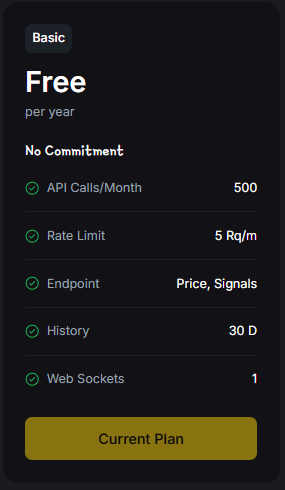
500 calls/month, 5 requests/minute, and 1 WebSocket connection.

Can I use the free API for trading bots?
Yes—ideal for prototyping. For production-level bots, upgrade for more throughput.

Scaling Beyond Free: Paid Plans & X.402

When your project outgrows free limits, Token Metrics offers flexible upgrades:

  • Pay-Per-Call (X.402) – As low as $0.017 per call, unlimited usage, no commitment.

  • Advanced Plan ($999.99/year) – 20,000 calls/month, indices & indicators, 3 WebSockets.

  • Premium Plan ($1,999.99/year) – 100,000 calls/month, AI agent + reports, 3 years of history.

With up to 35% off using TMAI tokens, scaling is cost-efficient.

📌 Why X.402 matters: Instead of committing upfront, you can grow gradually by paying per call—perfect for startups and side projects.

Build Smarter, Scale Easier

Free APIs help you start quickly and learn fast. Token Metrics gives you more than prices—it adds AI-powered signals and intelligence. Combine it with other free APIs, and you’ll have a toolkit that’s powerful enough for experimentation and flexible enough to scale into production.

👉 Create Your Free Token Metrics Account and Start Building

‍

Choose from Platinum, Gold, and Silver packages
Reach with 25–30% open rates and 0.5–1% CTR
Craft your own custom ad—from banners to tailored copy
Perfect for Crypto Exchanges, SaaS Tools, DeFi, and AI Products