Back to blog
Crypto Basics

Litecoin (LTC) Price Prediction 2025, 2030 - Forecast Analysis

Explore a detailed analysis of Litecoin (LTC) price predictions for 2025 and 2030. Gain insights into factors that may influence the future of Litecoin.
S. Vishwa
5 Minutes
Want Smarter Crypto Picks—Free?
See unbiased Token Metrics Ratings for BTC, ETH, and top alts.
Thank you! Your submission has been received!
Oops! Something went wrong while submitting the form.
 No credit card | 1-click unsubscribe

Click here to buy Cryptocurrencies from Gate.io

‍

The cryptocurrency market has been experiencing significant expansion with the introduction of numerous high-potential cryptocurrencies. 

Among these digital assets, Litecoin has emerged as one of the few with demonstrated significant potential in recent years. In this comprehensive article, we will delve into the world of Litecoin (LTC) and analyze its price prediction for the coming years. 

With a focus on both short and long-term forecasts, we will explore various market scenarios and expert opinions to provide you with a holistic view of the future of LTC.

Litecoin Overview

Litecoin, often referred to as the "silver to Bitcoin's gold," is a well-established cryptocurrency that has been active for over nine years. With a solid technical foundation, Litecoin has managed to secure its position as one of the top 30 cryptocurrencies by market cap. 

Despite recent discussions around its declining popularity, Litecoin continues demonstrating resilience and potential for future growth.

Historical Performance of Litecoin

To understand the potential future performance of Litecoin, it is essential to examine its historical price movements. Over the course of the past year, Litecoin experienced a predominantly bullish market sentiment, with buyers dominating the scene. 

However, towards the end of the period, sellers started to exert more influence, leading to a decline in price.

Starting from a modest base of $51.32, Litecoin steadily climbed to its peak at $100.96 by January. This resistance level was rigorously tested until July, with occasional breaches that couldn't be sustained.

Litecoin Price Chart
Image Source - Token Metrics

As July progressed, a decline began, reflecting increased selling pressure. Despite these fluctuations, Litecoin managed to maintain support levels, albeit with some retracements along the way.

Litecoin Current Fundamentals

Before diving into the price predictions, let's examine the current fundamentals of Litecoin. Currently, Litecoin's price is around $67.86 and has a market capitalization of $5,029,742,527.

The 24-hour price change is -0.13%, indicating a slight decline. The Fear & Greed Index suggests a moderate level of market sentiment.
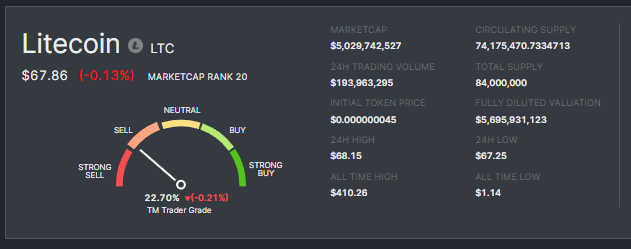
Litecoin Tokenomics
Image Source - Token Metrics

Litecoin (LTC) Price Prediction - Scenario Analysis

To forecast Litecoin's future price, it is crucial to consider multiple scenarios based on different market conditions and expert opinions. Let's explore some potential price predictions for Litecoin.

Litecoin (LTC) Price Prediction - Bullish Market Scenario

In a bullish market scenario where positive market sentiment prevails, Litecoin's price has the potential to experience significant growth. Several factors could contribute to this bullish trend, including increased adoption, technological advancements, and positive regulatory developments.

If the crypto market cap hits $3 Trillion and Litecoin retains its current 0.29% dominance, its price could ascend to $118.06.

In a more bullish scenario of the crypto market surging to $10 Trillion, Litecoin's price could soar to a staggering $393.56, resulting in a potential 7x return for investors.

It is important to note that these predictions are based on various factors and assumptions, and market conditions can change rapidly. However, bullish market sentiment and increased adoption of Litecoin's solutions could drive its price to new heights.

Litecoin Price Prediction
Start Your Free Trial Today and Uncover Your Token's Price Prediction and Forecast on Token Metrics

Litecoin (LTC) Price Prediction - Bearish Market Scenario

In the event of a bearish market, Litecoin's price could experience a correction, potentially leading to a decrease in its value. In this case, the price of Litecoin may face downward pressure with a decreased dominance of 0.14%.

In this scenario, If the crypto market cap hits $3 Trillion, Litecoin could trade around $59.03 in the short term and struggle to surpass $196.78 by 2030 even if the total crypto market cap surpasses the $10 Trillion mark.

It is crucial to consider the potential risks and challenges that Litecoin may face. Factors such as regulatory developments, competition from other projects, and technological advancements can affect the growth trajectory of Litecoin.

Also Read - Next Crypto Bull Run

Click here to buy Cryptocurrencies from Gate.io

Litecoin Price Prediction - Industry Expert Opinion

To provide a more comprehensive view, let's explore the opinions of industry experts regarding the future of Litecoin.

According to various experts in the cryptocurrency field, Litecoin holds promise as a long-term investment. Its solid technical foundation, active development community, and widespread adoption contribute to its potential for growth. 

Some experts believe that the reduced supply of new Litecoin entering the market due to the halving event could create upward pressure on prices in the long run.

The Coincodex platform predicts Litecoin could reach $139.89 to $483.89 by 2030, and experts from Changelly forecast that it could reach minimum and maximum prices of $142.22 and $178.31 by the end of 2025. By the end of 2030, the price of Litecoin could reach $880.42 to $1,041.87.

Other industry analysts have varying opinions on the future price of Litecoin. Ambcrypto.com predicts that Litecoin could reach $164.82 to $247.22 by 2030.

Note - Start Your Free Trial Today and Uncover Your Token's Price Prediction and Forecast on Token Metrics.

Litecoin's Current Developments and Future Potential

Litecoin continues to evolve and adapt to the changing landscape of the cryptocurrency market. The Litecoin Foundation, along with its dedicated development community, is actively working on various initiatives to enhance the usability and scalability of the network. 

Recent developments include the implementation of privacy features, integration with existing payment systems, and exploring partnerships with major players in the industry.

Looking ahead, Litecoin has the potential to carve out a distinct niche in the cryptocurrency market. Its fast transaction times, lower fees, and strong community support make it an attractive option for both users and investors. 

However, market conditions and competition from other cryptocurrencies should be closely monitored to assess Litecoin's future potential.

Also Read - Ripple (XRP) Price Prediction

Conclusion

In conclusion, the future of Litecoin holds both opportunities and challenges. Based on historical performance and expert opinions, Litecoin has the potential to experience significant growth in the coming years. 

However, it is important to approach cryptocurrency investments with caution and conduct thorough research before making any decisions. 

The cryptocurrency market is highly volatile, and factors such as market sentiment, regulatory changes, and technological advancements can influence the price of Litecoin and other cryptocurrencies. Investors can make more informed decisions regarding their investment strategies by staying informed and seeking professional advice.

Disclaimer

The information provided on this website does not constitute investment advice, financial advice, trading advice, or any other advice, and you should not treat any of the website's content as such.

Token Metrics does not recommend buying, selling, or holding any cryptocurrency. Conduct your due diligence and consult your financial advisor before making investment decisions.

Click here to buy Cryptocurrencies from Gate.io

Build Smarter Crypto Apps &
AI Agents in Minutes, Not Months
Real-time prices, trading signals, and on-chain insights all from one powerful API.
Grab a Free API Key
About Token Metrics
Token Metrics: AI-powered crypto research and ratings platform. We help investors make smarter decisions with unbiased Token Metrics Ratings, on-chain analytics, and editor-curated “Top 10” guides. Our platform distills thousands of data points into clear scores, trends, and alerts you can act on.
30 Employees
analysts, data scientists, and crypto engineers
Daily Briefings
concise market insights and “Top Picks”
Transparent & Compliant
Sponsored ≠ Ratings; research remains independent
Want Smarter Crypto Picks—Free?
See unbiased Token Metrics Ratings for BTC, ETH, and top alts.
Thank you! Your submission has been received!
Oops! Something went wrong while submitting the form.
 No credit card | 1-click unsubscribe
Token Metrics Team
Token Metrics Team

Recent Posts

Research

Why Is Web3 UX Still Poor Compared to Web2? Understanding the Challenges in 2025

Token Metrics Team
12

Web3 promises to revolutionize the internet by decentralizing control, empowering users with data ownership, and eliminating middlemen. The technology offers improved security, higher user autonomy, and innovative ways to interact with digital assets. With the Web3 market value expected to reach $81.5 billion by 2030, the potential seems limitless. Yet anyone who’s interacted with blockchain products knows the uncomfortable truth: Web3 user experience often feels more like punishment than promise. From nerve-wracking first crypto transactions to confusing wallet popups and sudden unexplained fees, Web3 products still have a long way to go before achieving mainstream adoption. If you ask anyone in Web3 what the biggest hurdle for mass adoption is, UX is more than likely to be the answer.

This comprehensive guide explores why Web3 UX remains significantly inferior to Web2 experiences in 2025, examining the core challenges, their implications, and how platforms like Token Metrics are bridging the gap between blockchain complexity and user-friendly crypto investing.

The Fundamental UX Gap: Web2 vs Web3

To understand Web3's UX challenges, we must first recognize what users expect based on decades of Web2 evolution. Web2, the "read-write" web that started in 2004, enhanced internet engagement through user-generated content, social media platforms, and cloud-based services with intuitive interfaces that billions use daily without thought.

Web2 applications provide seamless experiences: one-click logins via Google or Facebook, instant account recovery through email, predictable transaction costs, and familiar interaction patterns across platforms. Users have become accustomed to frictionless digital experiences that just work.

Web3, by contrast, introduces entirely new paradigms requiring users to manage cryptographic wallets, understand blockchain concepts, navigate multiple networks, pay variable gas fees, and take full custody of their assets. This represents a fundamental departure from familiar patterns, creating immediate friction.

Core Challenges Plaguing Web3 UX

  1. Complex Onboarding and Wallet Setup
  2. The first interaction with most decentralized applications asks users to "Connect Wallet." If you don't have MetaMask or another compatible wallet, you're stuck before even beginning. This creates an enormous barrier to entry where Web2 simply asks for an email address.

    Setting up a Web3 wallet requires understanding seed phrases—12 to 24 random words that serve as the master key to all assets. Users must write these down, store them securely, and never lose them, as there's no "forgot password" option. One mistake means permanent loss of funds.

    Most DeFi platforms and crypto wallets nowadays still have cumbersome and confusing interfaces for wallet creation and management. The registration process, which in Web2 takes seconds through social login options, becomes a multi-step educational journey in Web3.

  3. Technical Jargon and Blockchain Complexity
  4. Most challenges in UX/UI design for blockchain stem from lack of understanding of the technology among new users, designers, and industry leaders. Crypto jargon and complex concepts of the decentralized web make it difficult to grasp product value and master new ways to manage funds.

    Getting typical users to understand complicated blockchain ideas represents one of the main design challenges. Concepts like wallets, gas fees, smart contracts, and private keys must be streamlined without compromising security or usefulness—a delicate balance few projects achieve successfully.

    The blockchain itself is a complex theory requiring significant learning to fully understand. Web3 tries converting this specialized domain knowledge into generalist applications where novices should complete tasks successfully. When blockchain products first started being developed, most were created by experts for experts, resulting in products with extreme pain points, accessibility problems, and complex user flows.

  5. Multi-Chain Fragmentation and Network Switching
  6. Another common headache in Web3 is managing assets and applications across multiple blockchains. Today, it's not uncommon for users to interact with Ethereum, Polygon, Solana, or several Layer 2 solutions—all in a single session.

    Unfortunately, most products require users to manually switch networks in wallets, manually add new networks, or rely on separate bridges to transfer assets. This creates fragmented and confusing experiences where users must understand which network each asset lives on and how to move between them.

    Making users distinguish between different networks creates unnecessary cognitive burden. In Web2, users never think about which server hosts their data—it just works. Web3 forces constant network awareness, breaking the illusion of seamless interaction.

  7. Unpredictable and Confusing Gas Fees
  8. Transaction costs in Web3 are variable, unpredictable, and often shockingly expensive. Users encounter sudden, unexplained fees that can range from cents to hundreds of dollars depending on network congestion. There's no way to know costs precisely before initiating transactions, creating anxiety and hesitation.

    Web3 experiences generally run on public chains, leading to scalability problems as multiple parties make throughput requests. The more transactions that occur, the higher gas fees become—an unsustainable model as more users adopt applications.

    Users shouldn't have to worry about paying high gas fees as transaction costs. Web2 transactions happen at predictable costs or are free to users, with businesses absorbing payment processing fees. Web3's variable cost structure creates friction at every transaction.

  9. Irreversible Transactions and Error Consequences
  10. In Web2, mistakes are forgivable. Sent money to the wrong person? Contact support. Made a typo? Edit or cancel. Web3 offers no such mercy. Blockchain's immutability means transactions are permanent—send crypto to the wrong address and it's gone forever.

    This creates enormous anxiety around every action. Users must triple-check addresses (long hexadecimal strings impossible to memorize), verify transaction details, and understand that one mistake could cost thousands. The nerve-wracking experience of making first crypto transactions drives many users away permanently.

  11. Lack of Customer Support and Recourse
  12. Web2 platforms offer customer service: live chat, email support, phone numbers, and dispute resolution processes. Web3's decentralized nature eliminates these safety nets. There's no one to call when things go wrong, no company to reverse fraudulent transactions, no support ticket system to resolve issues.

    This absence of recourse amplifies fear and reduces trust. Users accustomed to consumer protections find Web3's "code is law" philosophy terrifying rather than empowering, especially when their money is at stake.

  13. Poor Error Handling and Feedback
  14. Web3 applications often provide cryptic error messages that technical users struggle to understand, let alone mainstream audiences. "Transaction failed" without explanation, "insufficient gas" without context, or blockchain-specific error codes mean nothing to average users.

    Good UX requires clear, actionable feedback. Web2 applications excel at this—telling users exactly what went wrong and how to fix it. Web3 frequently leaves users confused, frustrated, and unable to progress.

  15. Inconsistent Design Patterns and Standards
  16. Crypto designs are easily recognizable by dark backgrounds, pixel art, and Web3 color palettes. But when hundreds of products have the same mysterious look, standing out while maintaining blockchain identity becomes challenging.

    More problematically, there are no established UX patterns for Web3 interactions. Unlike Web2, where conventions like hamburger menus, shopping carts, and navigation patterns are universal, Web3 reinvents wheels constantly. Every application handles wallet connections, transaction confirmations, and network switching differently, forcing users to relearn basic interactions repeatedly.

  17. Developer-Driven Rather Than User-Centric Design
  18. The problem with most DeFi startups and Web3 applications is that they're fundamentally developer-driven rather than consumer-friendly. When blockchain products first launched, they were created by technical experts who didn't invest effort in user experience and usability.

    This technical-first approach persists today. Products prioritize blockchain purity, decentralization orthodoxy, and feature completeness over simplicity and accessibility. The result: powerful tools that only experts can use, excluding the masses these technologies purportedly serve.

  19. Privacy Concerns in User Research
  20. The Web3 revolution caught UI/UX designers by surprise. The Web3 community values privacy and anonymity, making traditional user research challenging. How do you design for someone you don't know and who deliberately stays anonymous?

    Researching without compromising user privacy becomes complex, yet dedicating time to deep user exploration remains essential for building products that resonate with actual needs rather than developer assumptions.

Why These Challenges Persist in 2025

Despite years of development and billions in funding, Web3 UX remains problematic for several structural reasons:

  • Technical Constraints: Blockchain's decentralized architecture inherently creates friction. Distributed consensus, cryptographic security, and immutability—the features making Web3 valuable—also make it complex.
  • Rapid Evolution: Due to rapid progress in Web3 technology, UX designers face unique challenges building interfaces that can adapt to new standards, protocols, and developments without complete redesigns. They must plan for future innovations while maintaining consistent experiences.
  • Limited UX Talent: Many UX designers still aren't into Web3, making it hard to understand and convey the value of innovative crypto products. The talent gap between Web2 UX expertise and Web3 understanding creates suboptimal design outcomes.
  • Economic Incentives: Early Web3 projects targeted crypto-native users who tolerated poor UX for technology benefits. Building for mainstream users requires different priorities and investments that many projects defer.

The Path Forward: Solutions Emerging in 2025

Despite challenges, innovative solutions are emerging to bridge the Web3 UX gap:

  • Account Abstraction and Smart Wallets: Modern crypto wallets embrace account abstraction enabling social recovery (using trusted contacts to restore access), seedless wallet creation via Multi-Party Computation, and biometric logins. These features make self-custody accessible without sacrificing security.
  • Email-Based Onboarding: Forward-looking approaches use email address credentials tied to Web3 wallets. Companies like Magic and Web3Auth create non-custodial wallets behind familiar email login interfaces using multi-party compute techniques, removing seed phrases from user experiences entirely.
  • Gasless Transactions: Some platforms absorb transaction costs or implement Layer 2 solutions dramatically reducing fees, creating predictable cost structures similar to Web2.
  • Unified Interfaces: Progressive platforms abstract blockchain complexity, presenting familiar Web2-like experiences while handling Web3 mechanics behind the scenes. Users interact through recognizable patterns without needing to understand underlying technology.

Discover Crypto Gems with Token Metrics AI

Token Metrics uses AI-powered analysis to help you uncover profitable opportunities in the crypto market. Get Started For Free

Bridging Complexity with User-Friendly Analytics

While many Web3 UX challenges persist, platforms like Token Metrics demonstrate that sophisticated blockchain functionality can coexist with excellent user experience. Token Metrics has established itself as a leading crypto trading and analytics platform by prioritizing usability without sacrificing power.

Intuitive Interface for Complex Analysis

Token Metrics provides personalized crypto research and predictions powered by AI through interfaces that feel familiar to anyone who's used financial applications. Rather than forcing users to understand blockchain intricacies, Token Metrics abstracts complexity while delivering actionable insights.

The platform assigns each cryptocurrency both Trader Grade and Investor Grade scores—simple metrics that encapsulate complex analysis including code quality, security audits, development activity, and market dynamics. Users get sophisticated intelligence without needing blockchain expertise.

Eliminating Technical Barriers

  • No Wallet Required for Research: Users can access powerful analytics without connecting wallets, eliminating the primary barrier to entry plaguing most DeFi applications.
  • Clear, Actionable Information: Instead of cryptic blockchain data, Token Metrics presents human-readable insights with clear recommendations. Users understand what actions to take without decoding technical jargon.
  • Predictable Experience: The platform maintains consistent interaction patterns familiar to anyone who's used trading or analytics tools, applying Jakob's Law—users have same expectations visiting similar sites, reducing learning strain.

Real-Time Alerts Without Complexity

Token Metrics monitors thousands of cryptocurrencies continuously, providing real-time alerts via email, SMS, or messaging apps about significant developments. Users stay informed without monitoring blockchain explorers, understanding gas prices, or navigating complex interfaces. This separation between sophisticated monitoring and simple notification demonstrates how Web3 functionality can deliver value through Web2-familiar channels.

Integrated Trading Experience

Token Metrics launched integrated trading in 2025, transforming the platform into an end-to-end solution where users analyze opportunities and execute trades without leaving the ecosystem. This unified experience eliminates the multi-platform juggling typical of Web3 investing. The seamless connection between analytics and execution showcases how thoughtful UX design bridges blockchain capabilities with user expectations, proving that Web3 doesn't require sacrificing usability.

Educational Without Overwhelming

Token Metrics provides educational resources helping users understand crypto markets without forcing deep technical knowledge. The platform demystifies complex topics through accessible explanations, gradually building user confidence and competence. This approach recognizes that mainstream adoption requires meeting users where they are—not demanding they become blockchain experts before participating.

The Future of Web3 UX

The ultimate success of Web3 hinges on user experience. No matter how revolutionary the technology, it will remain niche if everyday people find it too confusing, intimidating, or frustrating. Gaming, FinTech, digital identity, social media, and publishing will likely become Web3-enabled within the next 5 to 10 years—but only if UX improves dramatically.

UX as Competitive Advantage: Companies embracing UX early see fewer usability issues, higher retention, and more engaged users. UX-driven companies continually test assumptions, prototype features, and prioritize user-centric metrics like ease-of-use, task completion rates, and satisfaction—core measures of Web3 product success.

Design as Education: Highly comprehensive Web3 design helps educate newcomers, deliver effortless experiences, and build trust in technology. Design becomes the bridge between innovation and adoption.

Convergence with Web2 Patterns: Successful Web3 applications increasingly adopt familiar Web2 patterns while maintaining decentralized benefits underneath. This convergence represents the path to mass adoption—making blockchain invisible to end users who benefit from its properties without confronting its complexity.

Conclusion: From Barrier to Bridge

Web3 UX remains significantly inferior to Web2 in 2025 due to fundamental challenges: complex onboarding, technical jargon, multi-chain fragmentation, unpredictable fees, irreversible errors, lack of support, poor feedback, inconsistent patterns, developer-centric design, and constrained user research. These aren't superficial problems solvable through better visual design—they stem from blockchain's architectural realities and the ecosystem's technical origins. However, they're also not insurmountable. Innovative solutions like account abstraction, email-based onboarding, gasless transactions, and unified interfaces are emerging.

Platforms like Token Metrics demonstrate that Web3 functionality can deliver through Web2-familiar experiences. By prioritizing user needs over technical purity, abstracting complexity without sacrificing capability, and maintaining intuitive interfaces, Token Metrics shows the path forward for the entire ecosystem.

For Web3 to achieve its transformative potential, designers and developers must embrace user-centric principles, continuously adapting to users' needs rather than forcing users to adapt to technology. The future belongs to platforms that make blockchain invisible—where users experience benefits without confronting complexity. As we progress through 2025, the gap between Web2 and Web3 UX will narrow, driven by competition for mainstream users, maturing design standards, and recognition that accessibility determines success. The question isn't whether Web3 UX will improve—it's whether improvements arrive fast enough to capture the massive opportunity awaiting blockchain technology.

For investors navigating this evolving landscape, leveraging platforms like Token Metrics that prioritize usability alongside sophistication provides a glimpse of Web3's user-friendly future—where powerful blockchain capabilities enhance lives without requiring technical expertise, patience, or tolerance for poor design.

Research

Why Is Web3 UX Still Poor Compared to Web2? Understanding the Challenges in 2025

Token Metrics Team
1

Web3 promises to revolutionize the internet by decentralizing control, empowering users with data ownership, and eliminating middlemen. The technology offers improved security, higher user autonomy, and innovative ways to interact with digital assets. With the Web3 market value expected to reach $81.5 billion by 2030, the potential seems limitless. Yet anyone who's interacted with blockchain products knows the uncomfortable truth: Web3 user experience often feels more like punishment than promise. From nerve-wracking first crypto transactions to confusing wallet popups and sudden unexplained fees, Web3 products still have a long way to go before achieving mainstream adoption. If you ask anyone in Web3 what the biggest hurdle for mass adoption is, UX is more than likely to be the answer. This comprehensive guide explores why Web3 UX remains significantly inferior to Web2 experiences in 2025, examining the core challenges, their implications, and how platforms like Token Metrics are bridging the gap between blockchain complexity and user-friendly crypto investing.

Research

Why Is Web3 UX Still Poor Compared to Web2? Understanding the Challenges in 2025

Token Metrics Team
12

Web3 promises to revolutionize the internet by decentralizing control, empowering users with data ownership, and eliminating middlemen. The technology offers improved security, higher user autonomy, and innovative ways to interact with digital assets. With the Web3 market value expected to reach $81.5 billion by 2030, the potential seems limitless.

Yet anyone who's interacted with blockchain products knows the uncomfortable truth: Web3 user experience often feels more like punishment than promise. From nerve-wracking first crypto transactions to confusing wallet popups and sudden unexplained fees, Web3 products still have a long way to go before achieving mainstream adoption. If you ask anyone in Web3 what the biggest hurdle for mass adoption is, UX is more than likely to be the answer.

This comprehensive guide explores why Web3 UX remains significantly inferior to Web2 experiences in 2025, examining the core challenges, their implications, and how platforms like Token Metrics are bridging the gap between blockchain complexity and user-friendly crypto investing.

The Fundamental UX Gap: Web2 vs Web3

To understand Web3's UX challenges, we must first recognize what users expect based on decades of Web2 evolution. Web2, the "read-write" web that started in 2004, enhanced internet engagement through user-generated content, social media platforms, and cloud-based services with intuitive interfaces that billions use daily without thought.

Web2 applications provide seamless experiences: one-click logins via Google or Facebook, instant account recovery through email, predictable transaction costs, and familiar interaction patterns across platforms. Users have become accustomed to frictionless digital experiences that just work.

Web3, by contrast, introduces entirely new paradigms requiring users to manage cryptographic wallets, understand blockchain concepts, navigate multiple networks, pay variable gas fees, and take full custody of their assets. This represents a fundamental departure from familiar patterns, creating immediate friction.

Core Challenges Plaguing Web3 UX

1. Complex Onboarding and Wallet Setup

The first interaction with most decentralized applications asks users to "Connect Wallet." If you don't have MetaMask or another compatible wallet, you're stuck before even beginning. This creates an enormous barrier to entry where Web2 simply asks for an email address.

Setting up a Web3 wallet requires understanding seed phrases—12 to 24 random words that serve as the master key to all assets. Users must write these down, store them securely, and never lose them, as there's no "forgot password" option. One mistake means permanent loss of funds.

Most DeFi platforms and crypto wallets nowadays still have cumbersome and confusing interfaces for wallet creation and management. The registration process, which in Web2 takes seconds through social login options, becomes a multi-step educational journey in Web3.

2. Technical Jargon and Blockchain Complexity

Most challenges in UX/UI design for blockchain stem from lack of understanding of the technology among new users, designers, and industry leaders. Crypto jargon and complex concepts of the decentralized web make it difficult to grasp product value and master new ways to manage funds.

Getting typical users to understand complicated blockchain ideas represents one of the main design challenges. Concepts like wallets, gas fees, smart contracts, and private keys must be streamlined without compromising security or usefulness—a delicate balance few projects achieve successfully.

The blockchain itself is a complex theory requiring significant learning to fully understand. Web3 tries converting this specialized domain knowledge into generalist applications where novices should complete tasks successfully. When blockchain products first started being developed, most were created by experts for experts, resulting in products with extreme pain points, accessibility problems, and complex user flows.

3. Multi-Chain Fragmentation and Network Switching

Another common headache in Web3 is managing assets and applications across multiple blockchains. Today, it's not uncommon for users to interact with Ethereum, Polygon, Solana, or several Layer 2 solutions—all in a single session.

Unfortunately, most products require users to manually switch networks in wallets, manually add new networks, or rely on separate bridges to transfer assets. This creates fragmented and confusing experiences where users must understand which network each asset lives on and how to move between them.

Making users distinguish between different networks creates unnecessary cognitive burden. In Web2, users never think about which server hosts their data—it just works. Web3 forces constant network awareness, breaking the illusion of seamless interaction.

4. Unpredictable and Confusing Gas Fees

Transaction costs in Web3 are variable, unpredictable, and often shockingly expensive. Users encounter sudden, unexplained fees that can range from cents to hundreds of dollars depending on network congestion. There's no way to know costs precisely before initiating transactions, creating anxiety and hesitation.

Web3 experiences generally run on public chains, leading to scalability problems as multiple parties make throughput requests. The more transactions that occur, the higher gas fees become—an unsustainable model as more users adopt applications.

Users shouldn't have to worry about paying high gas fees as transaction costs. Web2 transactions happen at predictable costs or are free to users, with businesses absorbing payment processing fees. Web3's variable cost structure creates friction at every transaction.

5. Irreversible Transactions and Error Consequences

In Web2, mistakes are forgivable. Sent money to the wrong person? Contact support. Made a typo? Edit or cancel. Web3 offers no such mercy. Blockchain's immutability means transactions are permanent—send crypto to the wrong address and it's gone forever.

This creates enormous anxiety around every action. Users must triple-check addresses (long hexadecimal strings impossible to memorize), verify transaction details, and understand that one mistake could cost thousands. The nerve-wracking experience of making first crypto transactions drives many users away permanently.

6. Lack of Customer Support and Recourse

Web2 platforms offer customer service: live chat, email support, phone numbers, and dispute resolution processes. Web3's decentralized nature eliminates these safety nets. There's no one to call when things go wrong, no company to reverse fraudulent transactions, no support ticket system to resolve issues.

This absence of recourse amplifies fear and reduces trust. Users accustomed to consumer protections find Web3's "code is law" philosophy terrifying rather than empowering, especially when their money is at stake.

7. Poor Error Handling and Feedback

Web3 applications often provide cryptic error messages that technical users struggle to understand, let alone mainstream audiences. "Transaction failed" without explanation, "insufficient gas" without context, or blockchain-specific error codes mean nothing to average users.

Good UX requires clear, actionable feedback. Web2 applications excel at this—telling users exactly what went wrong and how to fix it. Web3 frequently leaves users confused, frustrated, and unable to progress.

8. Inconsistent Design Patterns and Standards

Crypto designs are easily recognizable by dark backgrounds, pixel art, and Web3 color palettes. But when hundreds of products have the same mysterious look, standing out while maintaining blockchain identity becomes challenging.

More problematically, there are no established UX patterns for Web3 interactions. Unlike Web2, where conventions like hamburger menus, shopping carts, and navigation patterns are universal, Web3 reinvents wheels constantly. Every application handles wallet connections, transaction confirmations, and network switching differently, forcing users to relearn basic interactions repeatedly.

9. Developer-Driven Rather Than User-Centric Design

The problem with most DeFi startups and Web3 applications is that they're fundamentally developer-driven rather than consumer-friendly. When blockchain products first launched, they were created by technical experts who didn't invest effort in user experience and usability.

This technical-first approach persists today. Products prioritize blockchain purity, decentralization orthodoxy, and feature completeness over simplicity and accessibility. The result: powerful tools that only experts can use, excluding the masses these technologies purportedly serve.

10. Privacy Concerns in User Research

The Web3 revolution caught UI/UX designers by surprise. The Web3 community values privacy and anonymity, making traditional user research challenging. How do you design for someone you don't know and who deliberately stays anonymous?

Researching without compromising user privacy becomes complex, yet dedicating time to deep user exploration remains essential for building products that resonate with actual needs rather than developer assumptions.

Why These Challenges Persist in 2025

Despite years of development and billions in funding, Web3 UX remains problematic for several structural reasons:

  • Technical Constraints: Blockchain's decentralized architecture inherently creates friction. Distributed consensus, cryptographic security, and immutability—the features making Web3 valuable—also make it complex.
  • Rapid Evolution: Due to rapid progress in Web3 technology, UX designers face unique challenges building interfaces that can adapt to new standards, protocols, and developments without complete redesigns. They must plan for future innovations while maintaining consistent experiences.
  • Limited UX Talent: Many UX designers still aren't into Web3, making it hard to understand and convey the value of innovative crypto products. The talent gap between Web2 UX expertise and Web3 understanding creates suboptimal design outcomes.
  • Economic Incentives: Early Web3 projects targeted crypto-native users who tolerated poor UX for technology benefits. Building for mainstream users requires different priorities and investments that many projects defer.

The Path Forward: Solutions Emerging in 2025

Despite challenges, innovative solutions are emerging to bridge the Web3 UX gap:

Account Abstraction and Smart Wallets

Modern crypto wallets embrace account abstraction enabling social recovery (using trusted contacts to restore access), seedless wallet creation via Multi-Party Computation, and biometric logins. These features make self-custody accessible without sacrificing security.

Email-Based Onboarding

Forward-looking approaches use email address credentials tied to Web3 wallets. Companies like Magic and Web3Auth create non-custodial wallets behind familiar email login interfaces using multi-party compute techniques, removing seed phrases from user experiences entirely.

Gasless Transactions

Some platforms absorb transaction costs or implement Layer 2 solutions dramatically reducing fees, creating predictable cost structures similar to Web2.

Unified Interfaces

Progressive platforms abstract blockchain complexity, presenting familiar Web2-like experiences while handling Web3 mechanics behind the scenes. Users interact through recognizable patterns without needing to understand underlying technology.

Token Metrics: Bridging Complexity with User-Friendly Analytics

While many Web3 UX challenges persist, platforms like Token Metrics demonstrate that sophisticated blockchain functionality can coexist with excellent user experience. Token Metrics has established itself as a leading crypto trading and analytics platform by prioritizing usability without sacrificing power.

Intuitive Interface for Complex Analysis

Token Metrics provides personalized crypto research and predictions powered by AI through interfaces that feel familiar to anyone who's used financial applications. Rather than forcing users to understand blockchain intricacies, Token Metrics abstracts complexity while delivering actionable insights.

The platform assigns each cryptocurrency both Trader Grade and Investor Grade scores—simple metrics that encapsulate complex analysis including code quality, security audits, development activity, and market dynamics. Users get sophisticated intelligence without needing blockchain expertise.

Eliminating Technical Barriers

Token Metrics removes common Web3 friction points:

  • No Wallet Required for Research: Users can access powerful analytics without connecting wallets, eliminating the primary barrier to entry plaguing most DeFi applications.
  • Clear, Actionable Information: Instead of cryptic blockchain data, Token Metrics presents human-readable insights with clear recommendations. Users understand what actions to take without decoding technical jargon.
  • Predictable Experience: The platform maintains consistent interaction patterns familiar to anyone who's used trading or analytics tools, applying Jakob's Law—users have same expectations visiting similar sites, reducing learning strain.

Real-Time Alerts Without Complexity

Token Metrics monitors thousands of cryptocurrencies continuously, providing real-time alerts via email, SMS, or messaging apps about significant developments. Users stay informed without monitoring blockchain explorers, understanding gas prices, or navigating complex interfaces.

This separation between sophisticated monitoring and simple notification demonstrates how Web3 functionality can deliver value through Web2-familiar channels.

Integrated Trading Experience

Token Metrics launched integrated trading in 2025, transforming the platform into an end-to-end solution where users analyze opportunities and execute trades without leaving the ecosystem. This unified experience eliminates the multi-platform juggling typical of Web3 investing.

This seamless connection between analytics and execution showcases how thoughtful UX design bridges blockchain capabilities with user expectations, proving that Web3 doesn't require sacrificing usability.

Educational Without Overwhelming

Token Metrics provides educational resources helping users understand crypto markets without forcing deep technical knowledge. The platform demystifies complex topics through accessible explanations, gradually building user confidence and competence.

This approach recognizes that mainstream adoption requires meeting users where they are—not demanding they become blockchain experts before participating.

The Future of Web3 UX

The ultimate success of Web3 hinges on user experience. No matter how revolutionary the technology, it will remain niche if everyday people find it too confusing, intimidating, or frustrating. Gaming, FinTech, digital identity, social media, and publishing will likely become Web3-enabled within the next 5 to 10 years—but only if UX improves dramatically.

UX as Competitive Advantage: Companies embracing UX early see fewer usability issues, higher retention, and more engaged users. UX-driven companies continually test assumptions, prototype features, and prioritize user-centric metrics like ease-of-use, task completion rates, and satisfaction—core measures of Web3 product success.

Design as Education: Highly comprehensive Web3 design helps educate newcomers, deliver effortless experiences, and build trust in technology. Design becomes the bridge between innovation and adoption.

Convergence with Web2 Patterns: Successful Web3 applications increasingly adopt familiar Web2 patterns while maintaining decentralized benefits underneath. This convergence represents the path to mass adoption—making blockchain invisible to end users who benefit from its properties without confronting its complexity.

Conclusion: From Barrier to Bridge

Web3 UX remains significantly inferior to Web2 in 2025 due to fundamental challenges: complex onboarding, technical jargon, multi-chain fragmentation, unpredictable fees, irreversible errors, lack of support, poor feedback, inconsistent patterns, developer-centric design, and constrained user research.

These aren’t superficial problems solvable through better visual design—they stem from blockchain’s architectural realities and the ecosystem’s technical origins. However, they are also not insurmountable. Innovative solutions like account abstraction, email-based onboarding, gasless transactions, and unified interfaces are emerging.

Token Metrics demonstrates that Web3 functionality can deliver through Web2-familiar experiences. By prioritizing user needs over technical purity, abstracting complexity without sacrificing capability, and maintaining intuitive interfaces, Token Metrics shows the path forward for the entire ecosystem.

For Web3 to reach its transformative potential, designers and developers must embrace user-centric principles, continuously adapting to users’ needs rather than forcing users to adapt to technology. The future belongs to platforms that make blockchain invisible—where users experience benefits without confronting complexity.

As we progress through 2025, the gap between Web2 and Web3 UX will narrow, driven by competition for mainstream users, maturing design standards, and recognition that accessibility determines success. The question isn’t whether Web3 UX will improve—it's whether improvements arrive fast enough to capture the massive opportunity awaiting blockchain technology.

For investors navigating this evolving landscape, leveraging platforms like Token Metrics that prioritize usability alongside sophistication provides a glimpse of Web3’s user-friendly future—where powerful blockchain capabilities enhance lives without requiring technical expertise, patience, or tolerance for poor design.

Choose from Platinum, Gold, and Silver packages
Reach with 25–30% open rates and 0.5–1% CTR
Craft your own custom ad—from banners to tailored copy
Perfect for Crypto Exchanges, SaaS Tools, DeFi, and AI Products