Back to blog
Research

Market Cap Weighted Indices Explained: Why Size Matters in Crypto

Learn how market cap weighting shapes crypto indices, influences portfolio construction, and why size is crucial for understanding digital assets in 2025.
Token Metrics Team
13 min read
Want Smarter Crypto Picks—Free?
See unbiased Token Metrics Ratings for BTC, ETH, and top alts.
Thank you! Your submission has been received!
Oops! Something went wrong while submitting the form.
 No credit card | 1-click unsubscribe

In the rapidly evolving cryptocurrency market of 2025, where total market capitalization has surpassed $4 trillion and over 20,000 digital assets compete for investor attention, understanding how to construct a sensible portfolio has never been more critical. Bitcoin, with its big market cap, continues to set the tone for the industry, highlighting how big assets play a crucial role in shaping the crypto landscape. One of the foundational principles guiding portfolio construction in this space is market cap weighting—a time-tested methodology borrowed from traditional finance that has become the backbone of most crypto index products. When comparing Bitcoin and Ethereum, it's important to note that ether, Ethereum's native asset, stands alongside Bitcoin as a leading digital asset. But what exactly does market cap weighting mean, and why does size matter so much in the digital asset ecosystem?

The total crypto market capitalization, while impressive, is still small compared to other asset classes such as gold, global equities, and real estate. This comparison to other asset classes and established asset classes underscores both the growth potential and the diversification benefits that crypto offers. The market's diversity is further highlighted by the presence of small assets, or small-cap cryptocurrencies, which add to the dynamic set of investment opportunities available. This article explores why size matters in crypto, delving into the importance of market capitalization, the role of institutional investors, and how market cap weighting shapes the crypto market landscape.

Understanding Market Cap Weighting: The Basics

Market capitalization weighting is an investment strategy where each asset in a portfolio is allocated in proportion to its total market value. In the context of crypto, a token’s market cap is calculated by multiplying its current price by the number of coins in its circulating supply. For example, Bitcoin, the largest cryptocurrency by market capitalization, has approximately 19.5 million coins in circulation. If each Bitcoin trades at $125,000, its market cap exceeds $2.4 trillion—making it the undisputed heavyweight of the crypto universe.

In a market cap-weighted index, Bitcoin’s dominant position means it receives the largest allocation in the portfolio. As of October 2025, Bitcoin commands over $2.36 trillion in market capitalization, which is more than five times higher than Ethereum’s $435 billion. These market cap values represent the significant financial weight of these digital assets. This stark concentration highlights how size matters in crypto, as portfolios naturally allocate more weight to the largest and most established assets. Both Bitcoin and Ethereum play a central role as digital currency within the market. This weighting scheme reflects the market consensus about the value and stability of each asset, allowing investors to align their exposure with the overall market structure.

Categories of Crypto Assets: The Building Blocks of Indices

The world of crypto is vast and constantly evolving, with thousands of digital assets competing for attention and investment. For investors seeking to build a diversified portfolio or understand the construction of market cap-weighted indices, it’s crucial to recognize the different categories of crypto assets and the unique roles they play within the market.

At the highest level, crypto assets can be grouped based on their core characteristics and use cases:

  • Currencies: These are digital assets designed primarily as a medium of exchange or store of value. Bitcoin remains the most prominent example, often referred to as “digital gold” due to its large market capitalization and established position. Other examples include Litecoin and Bitcoin Cash, which aim to facilitate peer-to-peer transactions.
  • Smart Contract Platforms: These assets power programmable blockchains that enable decentralized applications (dApps) and services. Ethereum is the leader in this category, with a significant share of total market capitalization. Other notable platforms include Solana, Avalanche, and Cardano, each offering unique technical features and ecosystems.
  • Decentralized Finance (DeFi) Tokens: DeFi assets represent protocols that provide financial services—such as lending, borrowing, and trading—without traditional intermediaries. Examples include Uniswap, Aave, and Maker. These tokens often derive value from the activity and fees generated on their respective platforms.
  • Stablecoins: Designed to maintain a stable value, usually pegged to fiat currencies like the US dollar, stablecoins such as USDT (Tether), USDC, and DAI play a critical role in providing liquidity and reducing volatility within the crypto market.
  • Utility Tokens: These assets grant holders access to specific services or products within a blockchain ecosystem. For instance, Chainlink’s LINK token is used to pay for data services on its decentralized oracle network.
  • Non-Fungible Tokens (NFTs) and NFT Platforms: While NFTs themselves are unique digital collectibles or assets, the platforms that support them—such as Flow or Immutable X—have their own tokens that may be included in broader indices.

Each of these categories contributes differently to the overall market capitalization of the crypto sector. For investors, understanding these distinctions is key to building a balanced portfolio that reflects both the diversity and the dynamic nature of digital assets. When constructing indices, providers often consider these categories to ensure representation across the full spectrum of use cases, from established currencies to emerging DeFi protocols.

By recognizing the building blocks of the crypto market, investors can better navigate the complexities of digital assets, make informed decisions, and respond to new opportunities as the market continues to grow and evolve.

Why Market Cap Weighting Dominates Index Construction

The widespread adoption of market cap-weighted crypto indices in 2025 is no accident. Several compelling reasons explain why platforms ranging from Bitwise to CoinShares and Token Metrics have embraced this methodology:

  • Market Consensus Reflection: Market cap weighting inherently captures the collective wisdom of all market participants. When Bitcoin’s valuation reaches $2.36 trillion, that figure represents millions of buy and sell decisions by investors worldwide. A market cap-weighted index automatically incorporates this consensus, eliminating the need for subjective judgment about which projects deserve larger allocations.
  • Automatic Rebalancing Benefits: As token prices fluctuate, their market caps adjust proportionally, naturally rebalancing the index. For instance, if Ethereum surges 50% while Bitcoin remains stagnant, Ethereum’s allocation in the index increases without manual intervention. This self-correcting mechanism reduces trading costs and tax implications while ensuring the index continuously reflects current market dynamics. Traders benefit from automatic rebalancing by having their portfolios adapt to market shifts without constant oversight, supporting more efficient trading strategies.
  • Lower Volatility Through Size: Larger market cap cryptocurrencies like Bitcoin and Ethereum tend to be more stable and established compared to smaller altcoins, which often exhibit higher volatility. By weighting portfolios toward these bigger players, market cap indices offer investors a more conservative risk profile than equal-weight alternatives, which spread exposure evenly across assets regardless of size.
  • Institutional Credibility: Market cap weighting is a familiar principle in traditional finance, used in major indices like the S&P 500. The goal is to provide security and stability for investors, making the approach attractive to institutions. For example, Token Metrics’s advanced index strategies underpin some of the largest regulated crypto products, including six out of eleven spot Bitcoin ETFs in the U.S., referencing over $125 billion in assets. This established market infrastructure supports broader adoption among institutional players.

The results achieved by using market cap weighting include improved index accuracy, reduced tracking error, and better alignment with overall market performance. Through widespread adoption, market cap weighting has achieved greater investor confidence and mainstream acceptance in the crypto space.

Token Metrics: Pioneering Intelligent Market Cap Strategies

While market cap weighting provides a solid foundation, Token Metrics has pushed the methodology further by delivering sophisticated, AI-powered index strategies that maximize its benefits while addressing inherent limitations. The advanced tech underpinning Token Metrics' platform leverages AI, machine learning, and crypto-native analysts to analyze over 6,000 projects, ensuring robust data protection and privacy. Token Metrics understands that effective market cap weighting requires more than simple mathematical calculations.

Their TM Global 100 Index exemplifies next-generation market cap weighting by implementing weekly rebalancing to capture the rapidly shifting market dynamics characteristic of 2024 and 2025. In these years, narrative rotations occur in weeks rather than quarters, with capital flowing swiftly between sectors such as AI agents, gaming tokens, and DePIN protocols. Frequent rebalancing ensures investors maintain optimal exposure to current market leaders.

What truly distinguishes Token Metrics’ approach is the integration of proprietary analytics with market cap methodology. Each token receives a Trader Grade for short-term potential and an Investor Grade for long-term viability. This dual grading system allows the platform to identify which market cap leaders deserve portfolio positions based on fundamental strength rather than speculation alone. Regular review of these analytics and ratings is crucial for making informed investment decisions. By fusing quantitative market cap data with qualitative analysis, Token Metrics creates indices that capture market consensus while filtering for quality.

Additionally, Token Metrics’s March 2025 launch of integrated trading functionality transformed the platform into an end-to-end solution. Investors can now research market cap-weighted opportunities, analyze proprietary ratings, and take action by executing trades directly—all within a single ecosystem. This seamless workflow eliminates friction and complexity that previously complicated index implementation.

The Concentration Question: Addressing Market Cap’s Limitation

Despite its advantages, market cap weighting is not without critics. The primary concern centers on concentration risk. In traditional top-10 crypto indices, Bitcoin and Ethereum typically comprise between 60% and 75% of total holdings due to their market dominance. This concentration means portfolios often move almost entirely with BTC and ETH, potentially missing opportunities in the broader crypto ecosystem. Over-concentration can also create problems, such as reduced diversification and increased vulnerability to market swings driven by just a few assets.

Token Metrics addresses this challenge through strategic index design. The TM Global 100’s broader universe of 100 tokens provides exposure to emerging narratives while maintaining market cap discipline. The set of assets included in the index is carefully selected to balance both established and emerging tokens. Notably, in 2024, the top 100 tokens by market cap outperformed top-10 concentrated indices by an average of 34%, with the performance gap widening during periods of rapid narrative rotation. This demonstrates that thoughtful expansion beyond the largest caps can enhance returns without abandoning market cap’s core principles. For the rest of the market outside the top holdings, this approach ensures that smaller, innovative projects are not left out of scope and can contribute to overall portfolio performance.

Some index providers also implement caps to prevent excessive concentration. For example, WisdomTree’s CF Crypto Market Index caps Bitcoin’s weight at 45% and the combined weight of BTC and ETH at 75%, ensuring meaningful exposure to the broader market. Similarly, the CoinShares-Compass Top 10 Crypto Market Index limits any single asset’s weighting to a maximum of 35%, balancing concentration with diversification.

Alternative Weighting Schemes: When Size Isn’t Everything

While market cap weighting dominates, alternative methodologies offer different trade-offs that investors should understand:

  • Equal Weighting: This approach allocates identical percentages to each constituent, such as 10% to each of 10 tokens. Equal weighting provides more exposure to smaller projects but requires frequent rebalancing and can overweight assets with questionable fundamentals.
  • Fundamental Weighting: MarketVector’s Token Metrics ’s Token Terminal Fundamental Cap-Weighted Strategy Index combines market capitalization with on-chain activity metrics like daily average fees and active users. This hybrid approach captures assets demonstrating genuine economic activity rather than pure speculation, blending market validation with fundamental data. The values used in fundamental weighting are often observed over time to assess their consistency and reliability.
  • Risk-Adjusted Weighting: Some strategies adjust allocations based on volatility, reducing exposure to highly unstable assets even if they have large market caps, thereby managing risk more effectively. Performance and volatility are observed across different periods to refine these allocations.

Token Metrics’s analytical infrastructure supports investors in understanding these alternatives. By leveraging comprehensive on-chain data from multiple channels—including P2P networks, social media, and dApps—sentiment analysis, and trading volume metrics, the platform enables informed decisions about whether pure market cap weighting aligns with specific investment goals or if hybrid approaches are preferable. When categorizing or labeling blockchain data, the use of precise words is crucial for accurate sentiment analysis and data interpretation.

The 2025 Context: Market Cap in a Maturing Ecosystem

As cryptocurrency markets mature in 2025, market cap weighting has gained additional legitimacy. The launch of products like Reserve’s Large Cap Index DTF, which tracks approximately 90% of total cryptocurrency market cap through CF Benchmarks’ diversified-weight methodology, demonstrates strong institutional appetite for broad, market cap-driven exposure.

Regulatory clarity has accelerated this trend. With Bitcoin ETFs commanding billions in assets and clearer frameworks emerging globally, market cap-weighted strategies provide the systematic, rules-based approach that compliance-conscious institutions demand. However, there are still aspects left unaddressed by current methodologies, such as the treatment of certain asset classes or evolving regulatory requirements. The methodology’s transparency—anyone can verify holdings and weights by checking market data, ensuring robust verification of index composition—aligns with regulatory preferences for auditable investment processes. There is also a direct connection between regulatory frameworks and the adoption of market cap weighting, as compliance requirements often dictate the structure and transparency of investment products.

Moreover, frameworks like Grayscale’s Crypto Sectors, which organizes 261 tokens with a combined $3.5 trillion market cap, demonstrate that market cap weighting scales effectively across the entire digital asset universe. Whether tracking large-cap currencies, smart contract platforms, or emerging sectors like DeFi and AI, market cap provides a consistent, replicable methodology that supports growth and adoption.

Practical Implementation: What Investors Should Know

For investors considering market cap-weighted crypto exposure, several practical points are essential:

  • Understand Your Universe: The distinction between a top-10 market cap index and a top-100 index is significant in terms of diversification and growth potential. Token Metrics’s analytics help investors identify which universe aligns with their risk tolerance and return objectives. Human judgment remains crucial in evaluating which crypto investments best fit your personal strategy and risk profile.
  • Monitor Rebalancing Frequency: The choice between weekly, monthly, or quarterly rebalancing affects cost structures and tax implications. Token Metrics’s TM Global 100 employs weekly rebalancing to capture fast-moving crypto markets while managing transaction costs through systematic execution.
  • Consider Regime Switching: Pure market cap weighting maintains constant exposure regardless of market conditions. Token Metrics enhances this methodology by incorporating regime-switching logic that moves allocations to stablecoins during bearish periods, preserving capital while maintaining market cap benefits during bull markets.
  • Evaluate Screening Criteria: Not all market cap indices are created equal. Some screen for liquidity, regulatory risk, or technical soundness. Token Metrics’s AI-powered ratings ensure constituents meet quality thresholds beyond simple market size, helping investors avoid problematic assets.

Before proceeding with any investment, ensure you are completing thorough due diligence to verify the legitimacy and security of the assets. Proceeding with caution and a clear strategy can help mitigate risks in the volatile crypto market.

Conclusion: Size Still Matters in 2025

Market capitalization weighting has proven remarkably resilient as cryptocurrency markets have evolved from speculative frenzy to a recognized institutional asset class. The elegance of this methodology lies in its simplicity: allowing the market to determine allocation weights reduces subjective bias while capturing collective intelligence.

However, as Token Metrics demonstrates through its sophisticated index products, the future of market cap weighting is not static replication—it is intelligent enhancement. By combining time-tested market cap principles with AI-powered analytics, regime-switching risk management, and seamless execution, platforms can deliver the benefits of market cap discipline while addressing its limitations.

In 2025’s $4 trillion crypto market with thousands of competing projects, size matters because it represents survival, adoption, and market validation. But as Token Metrics proves, knowing how to intelligently apply market cap principles—through proper universe selection, quality screening, and dynamic risk management—matters even more.

Whether you are a crypto-native trader or a traditional investor exploring digital assets, understanding why size matters in crypto and how market cap weighting functions is fundamental to navigating this transformative asset class with confidence and discipline. The result of applying market cap weighting is a portfolio that reflects the collective market consensus, balancing risk and opportunity in a rapidly evolving landscape.

Build Smarter Crypto Apps &
AI Agents in Minutes, Not Months
Real-time prices, trading signals, and on-chain insights all from one powerful API.
Grab a Free API Key
About Token Metrics
Token Metrics: AI-powered crypto research and ratings platform. We help investors make smarter decisions with unbiased Token Metrics Ratings, on-chain analytics, and editor-curated “Top 10” guides. Our platform distills thousands of data points into clear scores, trends, and alerts you can act on.
30 Employees
analysts, data scientists, and crypto engineers
Daily Briefings
concise market insights and “Top Picks”
Transparent & Compliant
Sponsored ≠ Ratings; research remains independent
Want Smarter Crypto Picks—Free?
See unbiased Token Metrics Ratings for BTC, ETH, and top alts.
Thank you! Your submission has been received!
Oops! Something went wrong while submitting the form.
 No credit card | 1-click unsubscribe
Token Metrics Team
Token Metrics Team

Recent Posts

Research

Bitcoin Cash Price Prediction 2028: Payment-Focused Layer 1 Analysis

Token Metrics Team
7 min read

Market Context for Bitcoin Cash Price Prediction: The Case for 2028

The Layer 1 landscape is consolidating as users and developers gravitate to chains with clear specialization. Bitcoin Cash positions itself as a payment-focused chain with low fees and quick settlement for everyday usage.

The Bitcoin Cash price prediction scenario projections below map potential outcomes for BCH across different total crypto market sizes. Base cases assume steady usage and listings, while moon scenarios factor in stronger liquidity and accelerated adoption. Our comprehensive price prediction framework provides investors with data-driven forecasts for strategic decision-making.


Disclosure

Educational purposes only, not financial advice. Crypto is volatile, do your own research and manage risk.

How to Read This BCH Price Prediction

Each band blends cycle analogues and market-cap share math with TA guardrails. Base assumes steady adoption and neutral or positive macro. Moon layers in a liquidity boom. Bear assumes muted flows and tighter liquidity.

TM Agent baseline: Token Metrics lead metric for Bitcoin Cash, cashtag $BCH, is a TM Grade of 54.81%, which translates to Neutral, and the trading signal is bearish, indicating short-term downward momentum. This implies Token Metrics views $BCH as mixed value long term in our price prediction models: fundamentals look strong, while valuation and technology scores are weak, so upside depends on improvements in adoption or technical development. Market context: Bitcoin has been setting market direction, and with broader risk-off moves altcoins face pressure, which increases downside risk for $BCH in the near term.

Live details:

Bitcoin Cash Token Details 

Buy BCH on MEXC

Affiliate Disclosure: We may earn a commission from qualifying purchases made via this link, at no extra cost to you.

Key Takeaways: Bitcoin Cash Price Prediction Summary

  • Scenario driven: Price prediction outcomes hinge on total crypto market cap; higher liquidity and adoption lift the bands
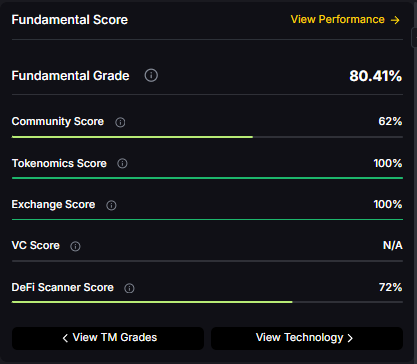
  • Fundamentals: Fundamental Grade 80.41% (Community 62%, Tokenomics 100%, Exchange 100%, VC —, DeFi Scanner 72%)
  • Technology: Technology Grade 29.63% (Activity 22%, Repository 70%, Collaboration 48%, Security —, DeFi Scanner 72%)
  • TM Agent gist: Neutral grade, bearish momentum in price prediction models; adoption must improve for upside
  • Education only, not financial advice

Bitcoin Cash Price Prediction Scenario Analysis

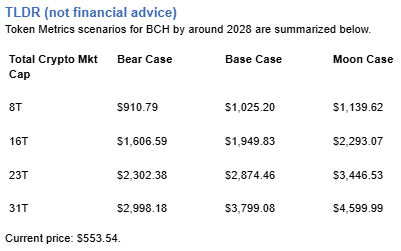
Token Metrics price prediction scenarios span four market cap tiers, each representing different levels of crypto market maturity and liquidity:

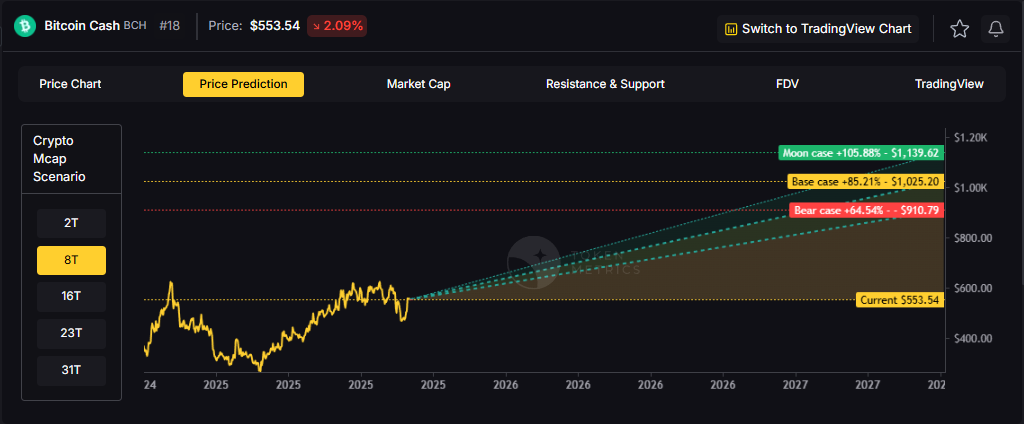
8T Market Cap - BCH Price Prediction:

At an 8 trillion total crypto market cap, BCH price prediction projects to $910.79 in bear conditions, $1,025.20 in the base case, and $1,139.62 in bullish scenarios.

16T Market Cap - BCH Price Prediction:

Doubling the market to 16 trillion expands the price prediction range to $1,606.59 (bear), $1,949.83 (base), and $2,293.07 (moon).

23T Market Cap - BCH Price Prediction:

At 23 trillion, the price prediction scenarios show $2,302.38, $2,874.46, and $3,446.53 respectively.

31T Market Cap - BCH Price Prediction:

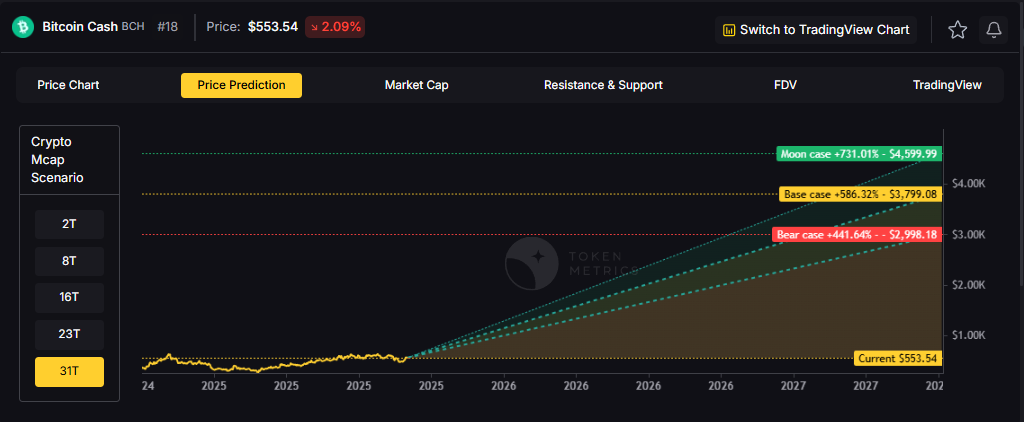
In the maximum liquidity scenario of 31 trillion, BCH price predictions could reach $2,998.18 (bear), $3,799.08 (base), or $4,599.99 (moon).

Each tier in our price prediction framework assumes progressively stronger market conditions, with the base case reflecting steady growth and the moon case requiring sustained bull market dynamics.

Why Consider the Indices with Top-100 Exposure

Bitcoin Cash represents one opportunity among hundreds in crypto markets. Token Metrics Indices bundle BCH with top one hundred assets for systematic exposure to the strongest projects. Single tokens face idiosyncratic risks that diversified baskets mitigate.

Historical index performance demonstrates the value of systematic diversification versus concentrated positions.

Join the early access list

What Is Bitcoin Cash?

Bitcoin Cash is a peer-to-peer electronic cash network focused on fast confirmation and low fees. It launched in 2017 as a hard fork of Bitcoin with larger block capacity to prioritize payments. The chain secures value transfers using proof of work and aims to keep everyday transactions affordable.

BCH is used to pay transaction fees and settle transfers, and it is widely listed across major exchanges. Adoption centers on payments, micropayments, and remittances where low fees matter. It competes as a payment‑focused Layer 1 within the broader crypto market.

Token Metrics AI Analysis

Token Metrics AI provides comprehensive context on Bitcoin Cash's positioning and challenges, informing our price prediction models:

Vision: Bitcoin Cash (BCH) is a cryptocurrency that emerged from a 2017 hard fork of Bitcoin, aiming to function as a peer-to-peer electronic cash system with faster transactions and lower fees. It is known for prioritizing on-chain scalability by increasing block sizes, allowing more transactions per block compared to Bitcoin. This design choice supports its use in everyday payments, appealing to users seeking a digital cash alternative. Adoption has been driven by its utility in micropayments and remittances, particularly in regions with limited banking infrastructure. However, Bitcoin Cash faces challenges including lower network security due to reduced mining hash rate compared to Bitcoin, and ongoing competition from both Bitcoin and other scalable blockchains. Its value proposition centers on accessibility and transaction efficiency, but it operates in a crowded space with evolving technological and regulatory risks.

Problem: The project addresses scalability limitations in Bitcoin, where rising transaction fees and slow confirmation times hinder its use for small, frequent payments. As Bitcoin evolved into a store of value, a gap emerged for a blockchain-based currency optimized for fast, low-cost transactions accessible to the general public.

Solution: Bitcoin Cash increases block size limits from 1 MB to 32 MB, enabling more transactions per block and reducing congestion. This on-chain scaling approach allows for faster confirmations and lower fees, making microtransactions feasible. The network supports basic smart contract functionality and replay protection, maintaining compatibility with Bitcoin's core architecture while prioritizing payment utility.

Market Analysis: Bitcoin Cash operates in the digital currency segment, competing with Bitcoin, Litecoin, and stablecoins for use in payments and remittances. While not the market leader, it occupies a niche focused on on-chain scalability for transactional use. Its adoption is influenced by merchant acceptance, exchange liquidity, and narratives around digital cash. Key risks include competition from layer-2 solutions on other blockchains, regulatory scrutiny of cryptocurrencies, and lower developer and miner activity compared to larger networks. Price movements are often tied to broader crypto market trends and internal protocol developments. Despite its established presence, long-term growth depends on sustained utility, network security, and differentiation in a market increasingly dominated by high-throughput smart contract platforms—all critical factors in our price prediction analysis.

Fundamental and Technology Snapshot from Token Metrics

Fundamental Grade: 80.41% (Community 62%, Tokenomics 100%, Exchange 100%, VC —, DeFi Scanner 72%).


Technology Grade: 29.63% (Activity 22%, Repository 70%, Collaboration 48%, Security —, DeFi Scanner 72%).


Catalysts That Skew BCH Price Predictions Bullish

  • Institutional and retail access expands with ETFs, listings, and integrations
  • Macro tailwinds from lower real rates and improving liquidity
  • Product or roadmap milestones such as upgrades, scaling, or partnerships
  • Increased merchant adoption for payment processing
  • Growing adoption in remittance corridors and emerging markets
  • Layer-2 development enhancing BCH utility

Risks That Skew BCH Price Predictions Bearish

  • Macro risk-off from tightening or liquidity shocks
  • Regulatory actions targeting payment cryptocurrencies or infrastructure outages
  • Concentration risk in validator economics and competitive displacement
  • Low technology grade (29.63%) indicating development challenges
  • Competition from Bitcoin Lightning Network and other payment solutions
  • Declining developer activity and network effect

Bitcoin Cash Price Prediction FAQs

Can BCH reach $3,000?

Yes. Based on our price prediction scenarios, BCH could reach $3,000 in the 23T moon case and 31T base case. The 23T tier projects $3,446.53 in the moon case, making $3,000 an achievable target under favorable market conditions. Not financial advice.

Can BCH 10x from current levels?

At current price of $553.54, a 10x would reach $5,535.40. This falls beyond our highest price prediction scenario of $4,599.99 (31T moon case). Bear in mind that 10x returns would require substantial market cap expansion beyond our modeled scenarios and exceptional BCH adoption. Not financial advice.

Should I buy BCH now or wait?

Timing depends on your risk tolerance and macro outlook. Current price of $553.54 sits below the 8T bear case in our price prediction scenarios. The Neutral TM Grade (54.81%) and bearish trading signal suggest caution in the near term. Dollar-cost averaging may reduce timing risk. Not financial advice.

What is the Bitcoin Cash price prediction for 2025-2028?

Our comprehensive BCH price prediction framework suggests Bitcoin Cash could trade between $910.79 and $4,599.99 depending on market conditions and total crypto market capitalization. The base case price prediction scenario clusters around $1,025.20 to $3,799.08 across different market cap environments. Current Neutral rating (54.81%) indicates mixed signals requiring adoption improvements. Not financial advice.

Can Bitcoin Cash reach $5,000?

BCH reaching $5,000 would exceed our current price prediction models' highest scenario of $4,599.99 (31T moon case). This would require extraordinary market conditions, significant merchant adoption acceleration, and BCH successfully differentiating itself in the crowded payment cryptocurrency space. Not financial advice.

Is Bitcoin Cash a good investment based on price predictions?

BCH shows strong fundamentals (80.41% grade) but a very weak technology score (29.63%), resulting in a Neutral TM Grade of 54.81% with bearish near-term signals. While our price prediction models show potential upside in favorable market conditions, the low technology grade and adoption challenges suggest significant risks. The payment-focused use case faces competition from Lightning Network and other solutions. Not financial advice.

How does BCH compare to Bitcoin in price predictions?

Bitcoin Cash was designed as a payment-focused alternative to Bitcoin's store-of-value narrative. Our price prediction framework shows BCH could reach $1,025-$4,600 across scenarios, while Bitcoin dominates market cap and network effects. BCH's success depends on carving out a distinct payment niche rather than competing directly with Bitcoin. The correlation between BTC and BCH price movements remains high.

What are the biggest risks to BCH price predictions?

Key risks that could impact Bitcoin Cash price predictions include: extremely low technology grade (29.63%) indicating development stagnation, competition from Bitcoin Lightning Network, declining developer activity, regulatory targeting of payment cryptocurrencies, low mining hash rate security concerns, and competitive displacement from stablecoins and other payment solutions. The bearish trading signal and Neutral grade reflect these challenges.

Will BCH benefit from a Bitcoin bull run?

Historically, Bitcoin Cash has shown positive correlation with Bitcoin price movements. Our price prediction scenarios assume BCH captures some momentum from broader crypto market expansion. However, BCH's lower technology grade and adoption challenges may limit its ability to match Bitcoin's percentage gains. The base case scenarios reflect moderate participation in bull market dynamics.

Next Steps

Track live grades and signals

Join Indices Early Access

Want exposure? Buy BCH on MEXC

Disclosure

Educational purposes only, not financial advice. Crypto is volatile, do your own research and manage risk.

Why Use Token Metrics for BCH Price Predictions?

  • Scenario-based forecasting: Multiple market cap tiers for comprehensive price prediction analysis
  • Transparent grading: Fundamental (80.41%) vs Technology (29.63%) reveals strengths and weaknesses
  • AI-driven insights: Advanced algorithms analyze payment cryptocurrency competitive landscape
  • Real-time signals: Trading signals and TM Grades (Neutral 54.81%) updated regularly
  • Risk assessment: Identifies key risks like low developer activity and competitive pressure
  • Comparative analysis: Analyze BCH against Bitcoin, Litecoin, and 6,000+ tokens
Research

Chainlink Price Prediction 2027: Oracle Infrastructure Analysis

Token Metrics Team
8 min read

Understanding LINK Price Prediction: 2027 Potential

Infrastructure protocols become more valuable as the crypto ecosystem scales and relies on robust middleware. Chainlink provides critical oracle infrastructure where proven utility and deep integrations drive long-term value over retail speculation. Increasing institutional adoption raises demand for professional-grade data delivery and security.

Token Metrics price prediction projections for LINK below span multiple total market cap scenarios from conservative to aggressive. Each tier assumes different levels of infrastructure demand as crypto evolves from speculative markets to institutional-grade systems. These bands frame LINK's price prediction potential outcomes into 2027.

Disclosure

Educational purposes only, not financial advice. Crypto is volatile, do your own research and manage risk.

Token Metrics price prediction projections for LINK below span multiple total market cap scenarios from conservative to aggressive. Each tier assumes different levels of infrastructure demand as crypto evolves from speculative markets to institutional-grade systems. These bands frame LINK's price prediction potential outcomes into 2027.

Disclosure

Educational purposes only, not financial advice. Crypto is volatile, do your own research and manage risk.

How to Read This LINK Price Prediction

Each band blends cycle analogues and market-cap share math with TA guardrails. Base assumes steady adoption and neutral or positive macro. Moon layers in a liquidity boom. Bear assumes muted flows and tighter liquidity.

TM Agent baseline: Token Metrics lead metric for Chainlink, cashtag $LINK, is a TM Grade of 23.31%, which translates to a Sell, and the trading signal is bearish, indicating short-term downward momentum. This means Token Metrics currently does not endorse $LINK as a long-term buy at current conditions in our price prediction models, despite strong technology fundamentals.

Live details: Chainlink Token Details

Access: Buy LINK on MEXC

Affiliate Disclosure: We may earn a commission from qualifying purchases made via this link, at no extra cost to you.

Key Takeaways: Chainlink Price Prediction Summary

  • Scenario driven: Price prediction outcomes hinge on total crypto market cap; higher liquidity and adoption lift the bands
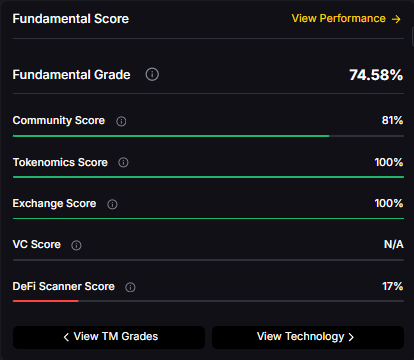
  • Fundamentals: Fundamental Grade 74.58% (Community 81%, Tokenomics 100%, Exchange 100%, VC —, DeFi Scanner 17%)
  • Technology: Technology Grade 88.50% (Activity 81%, Repository 72%, Collaboration 100%, Security 86%, DeFi Scanner 17%)
  • TM Agent gist: Bearish signal with limited upside in price prediction models unless fundamentals or market regime change
  • Current rating: Sell (23.31%) with strong tech but weak valuation
  • Education only, not financial advice

Chainlink Price Prediction Scenario Analysis

Token Metrics price prediction scenarios span four market cap tiers, each representing different levels of crypto market maturity and liquidity:

8T Market Cap - LINK Price Prediction:

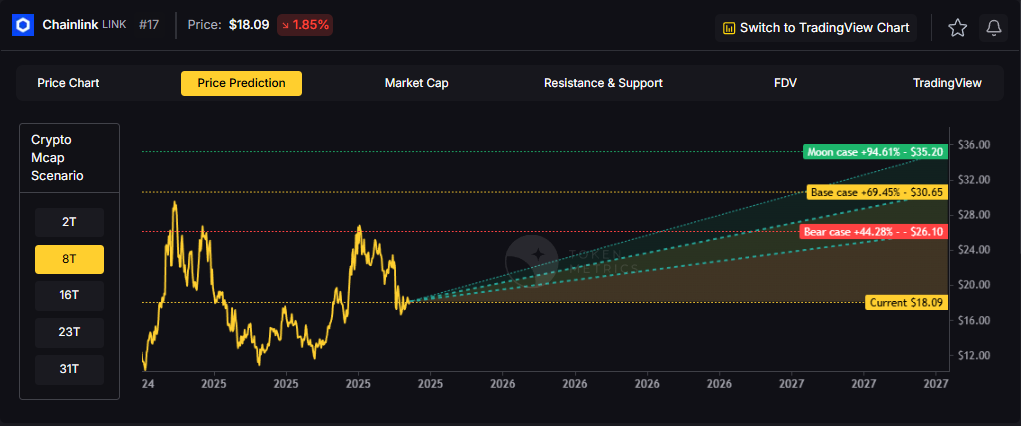
At an 8 trillion dollar total crypto market cap, LINK price prediction projects to $26.10 in bear conditions, $30.65 in the base case, and $35.20 in bullish scenarios.

 16T Market Cap - LINK Price Prediction:

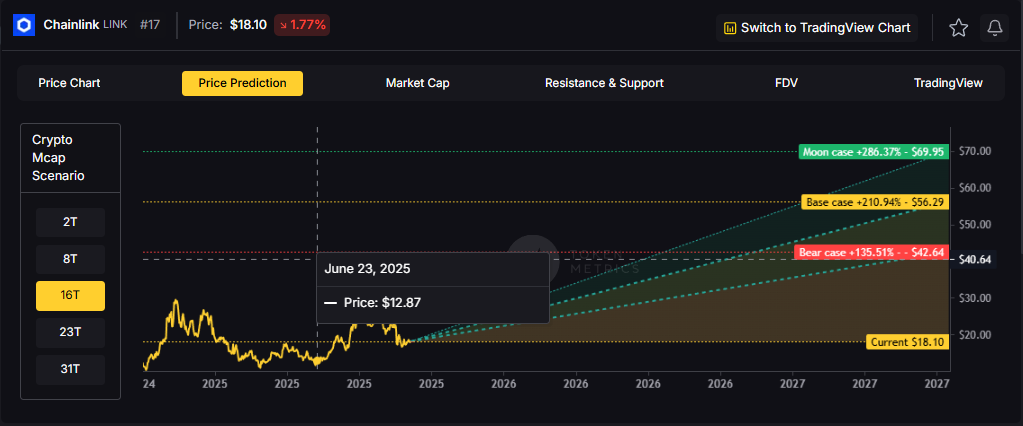
Doubling the market to 16 trillion expands the price prediction range to $42.64 (bear), $56.29 (base), and $69.95 (moon).

 23T Market Cap - LINK Price Prediction:

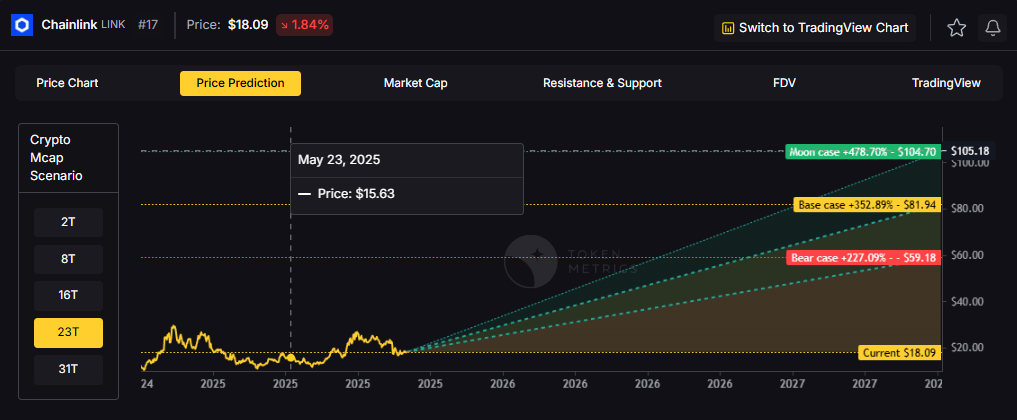
At 23 trillion, the price prediction scenarios show $59.18, $81.94, and $104.70 respectively.

 31T Market Cap - LINK Price Prediction:

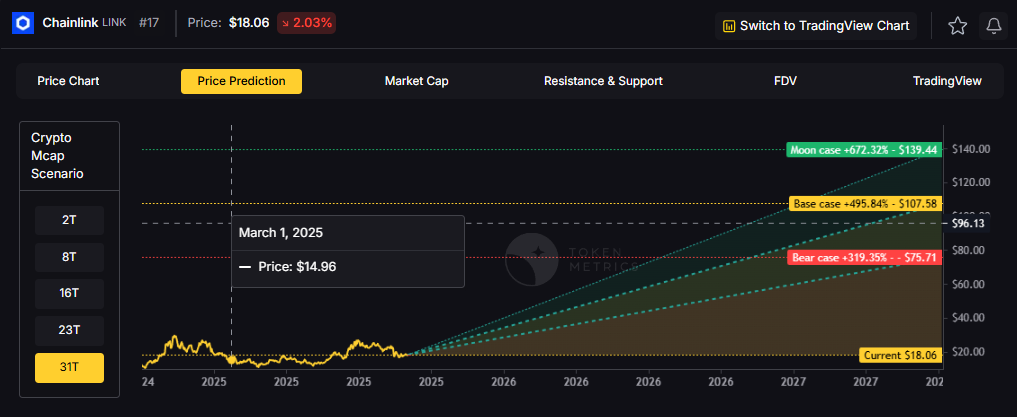
In the maximum liquidity scenario of 31 trillion, LINK price predictions could reach $75.71 (bear), $107.58 (base), or $139.44 (moon).

  These price prediction ranges reflect potential infrastructure value capture as crypto markets mature, though current valuation concerns contribute to the Sell rating despite strong technology fundamentals.

Why Consider the Indices with Top-100 Exposure

Chainlink represents one opportunity among hundreds in crypto markets. Token Metrics Indices bundle LINK with top one hundred assets for systematic exposure to the strongest projects. Single tokens face idiosyncratic risks that diversified baskets mitigate.

Historical index performance demonstrates the value of systematic diversification versus concentrated positions.

Join the early access list

What Is Chainlink?

Chainlink is a decentralized oracle network that connects smart contracts to real-world data and systems. It enables secure retrieval and verification of off-chain information, supports computation, and integrates across multiple blockchains. As adoption grows, Chainlink serves as critical infrastructure for reliable data feeds and automation.

The LINK token is used to pay node operators and secure the network's services. Common use cases include DeFi price feeds, insurance, and enterprise integrations, with CCIP extending cross-chain messaging and token transfers—all factors that influence long-term LINK price predictions.

Token Metrics AI Analysis

Token Metrics AI provides comprehensive context informing our LINK price prediction models:

Vision: Chainlink aims to create a decentralized, secure, and reliable network for connecting smart contracts with real-world data and systems. Its vision is to become the standard for how blockchains interact with external environments, enabling trust-minimized automation across industries.

Problem: Smart contracts cannot natively access data outside their blockchain, limiting their functionality. Relying on centralized oracles introduces single points of failure and undermines the security and decentralization of blockchain applications. This creates a critical need for a trustless, tamper-proof way to bring real-world information onto blockchains.

Solution: Chainlink solves this by operating a decentralized network of node operators that fetch, aggregate, and deliver data from off-chain sources to smart contracts. It uses cryptographic proofs, reputation systems, and economic incentives to ensure data integrity. The network supports various data types and computation tasks, allowing developers to build complex, data-driven decentralized applications.

Market Analysis: Chainlink is a market leader in the oracle space and a key infrastructure component in the broader blockchain ecosystem, particularly within Ethereum and other smart contract platforms. It faces competition from emerging oracle networks like Band Protocol and API3, but maintains a strong first-mover advantage and widespread integration across DeFi, NFTs, and enterprise blockchain solutions. Adoption is driven by developer activity, partnerships with major blockchain projects, and demand for secure data feeds. Key risks include technological shifts, regulatory scrutiny on data providers, and execution challenges in scaling decentralized oracle networks. As smart contract usage grows, so does the potential for oracle services, positioning Chainlink at the center of a critical niche, though its success depends on maintaining security and decentralization over time—all critical factors in our price prediction analysis.

Fundamental and Technology Snapshot from Token Metrics

Fundamental Grade: 74.58% (Community 81%, Tokenomics 100%, Exchange 100%, VC —, DeFi Scanner 17%).


Technology Grade: 88.50% (Activity 81%, Repository 72%, Collaboration 100%, Security 86%, DeFi Scanner 17%).

  Catalysts That Skew LINK Price Predictions Bullish

  • Institutional and retail access expands with ETFs, listings, and integrations
  • Macro tailwinds from lower real rates and improving liquidity
  • Product or roadmap milestones such as CCIP upgrades, scaling, or partnerships
  • Increased adoption of Chainlink oracle services across DeFi protocols
  • Enterprise blockchain integrations requiring secure data feeds
  • Cross-chain expansion through CCIP (Cross-Chain Interoperability Protocol)

Risks That Skew LINK Price Predictions Bearish

  • Macro risk-off from tightening or liquidity shocks
  • Regulatory actions targeting oracle networks or infrastructure outages
  • Concentration in node operator economics and competitive displacement
  • Current low TM Grade (23.31%) indicating valuation concerns
  • Competition from alternative oracle solutions (Band Protocol, API3)
  • Token economics challenges despite 100% tokenomics score

How Token Metrics Can Help

Token Metrics empowers you to analyze Chainlink and hundreds of digital assets with AI-driven ratings, on-chain and fundamental data, and index solutions to manage portfolio risk smartly in a rapidly evolving crypto market. Our price prediction frameworks provide transparent scenario-based analysis even for tokens with Sell ratings.

Chainlink Price Prediction FAQs

Can LINK reach $100?

Yes. Based on our price prediction scenarios, LINK could reach $100+ in the 23T moon case, projecting $104.70. However, this requires significant market cap expansion and improved market conditions beyond the current Sell rating (23.31%). Not financial advice.

What price could LINK reach in the moon case?

Moon case price predictions range from $35.20 at 8T to $139.44 at 31T total crypto market cap. These scenarios assume maximum liquidity expansion and strong Chainlink adoption, though current bearish signals suggest caution. Not financial advice.

Should I buy LINK now or wait?

Timing depends on risk tolerance and macro outlook. Current price of $18.09 sits below the 8T bear case in our price prediction scenarios, suggesting potential value. However, the Sell rating (23.31%) and bearish trading signal indicate Token Metrics does not currently endorse LINK at these levels. Dollar-cost averaging may reduce timing risk if you believe in long-term infrastructure value. Not financial advice.

What is the Chainlink price prediction for 2025-2027?

Our comprehensive LINK price prediction framework suggests Chainlink could trade between $26.10 and $139.44 depending on market conditions and total crypto market capitalization. The base case price prediction scenario clusters around $30.65 to $107.58 across different market cap environments. Despite strong technology (88.50%) and fundamentals (74.58%), the current Sell rating (23.31%) reflects valuation concerns. Not financial advice.

Can Chainlink reach $50?

Yes. Based on our price prediction scenarios, LINK could reach $56.29 in the 16T base case and higher in 23T/31T scenarios. The $50 target becomes achievable in moderate market cap environments (16T tier), though current bearish momentum suggests this may take time. Not financial advice.

Why does LINK have a Sell rating despite strong technology?

LINK shows excellent technology fundamentals (88.50% grade) with strong development activity, collaboration, and security. However, the overall TM Grade of 23.31% (Sell) reflects current valuation concerns, market positioning, and bearish trading signals. Our price prediction models show potential upside in favorable market conditions, but current metrics suggest waiting for improved entry points. Not financial advice.

Is Chainlink a good investment based on price predictions?

LINK presents a complex investment case: exceptional technology grade (88.50%), solid fundamentals (74.58%), but a Sell rating (23.31%) with bearish momentum. While our price prediction models show significant upside potential in bull market scenarios, current valuation concerns and bearish signals suggest caution. The oracle infrastructure thesis remains compelling long-term, but timing and entry points matter. Consider diversified exposure through indices. Not financial advice.

How does LINK compare to other oracle price predictions?

Chainlink dominates the oracle space with first-mover advantage and widespread integration. Our price prediction framework suggests LINK could reach $30-$139 across scenarios. Competitors like Band Protocol and API3 offer alternatives, but Chainlink's established network effects and enterprise partnerships position it as the infrastructure leader. However, the current Sell rating suggests valuation concerns versus alternatives.

What are the biggest risks to LINK price predictions?

Key risks that could impact Chainlink price predictions include: current Sell rating (23.31%) indicating valuation concerns, competition from emerging oracle networks, regulatory scrutiny on data providers, node operator centralization risks, macro liquidity shocks, and challenges scaling decentralized oracle infrastructure. Despite strong technology (88.50%), these factors contribute to bearish near-term outlook.

Will LINK benefit from DeFi growth?

Chainlink is critical infrastructure for DeFi, providing price feeds for lending protocols, derivatives, and stablecoins. Our price prediction scenarios assume LINK captures value from continued DeFi adoption. However, the current Sell rating suggests this thesis isn't reflected in valuation metrics yet. Long-term infrastructure value may require patience and improved market conditions.


Should I buy LINK now or wait?

Timing depends on risk tolerance and macro outlook. Current price of $18.09 sits below the 8T bear case in the scenarios. Dollar-cost averaging may reduce timing risk. Not financial advice.

Next Steps

Track live grades and signals: Token Details

Join Indices Early Access 

Want exposure? Buy LINK on MEXC 

Disclosure

Educational purposes only, not financial advice. Crypto is volatile, do your own research and manage risk.

Why Token Metrics Ratings Matter

Discover the full potential of your crypto research and portfolio management with Token Metrics. Our ratings combine AI-driven analytics, on-chain data, and decades of investing expertise—giving you the edge to navigate fast-changing markets. Try our platform to access scenario-based price prediction targets, token grades, indices, and more for institutional and individual investors. Token Metrics is your research partner through every crypto market cycle.

Why Use Token Metrics for LINK Price Predictions?

  • Transparent analysis: Honest Sell ratings (23.31%) even when technology fundamentals are strong (88.50%)
  • Scenario-based modeling: Multiple market cap tiers for comprehensive price prediction analysis
  • Infrastructure focus: Specialized oracle network analysis and competitive landscape assessment
  • Risk-adjusted approach: Balanced view of technology strength versus valuation concerns
  • Real-time signals: Trading signals and TM Grades updated regularly
  • Diversification tools: Index solutions to spread oracle infrastructure risk
  • Comparative analysis: Analyze LINK against Band Protocol, API3, and 6,000+ tokens
Research

Hyperliquid Price Prediction 2026: DEX Perpetuals Trading Analysis

Token Metrics Team
7 min read

Why 2026 Looks Bullish for HYPE Price Prediction: Market Context

The crypto market is tilting bullish into 2026 as liquidity, infrastructure, and participation improve across the board. Clearer rules and standards are reshaping the classic four-year cycle, flows can arrive earlier, and strength can persist longer than in prior expansions.

Institutional access is widening through ETFs and custody, while L2 scaling and real-world integrations help sustain on-chain activity. This healthier backdrop frames our price prediction scenario work for HYPE. The ranges below reflect different total crypto market sizes and the share Hyperliquid could capture under each regime, providing investors with comprehensive price prediction analysis for strategic planning.


Disclosure

Educational purposes only, not financial advice. Crypto is volatile, do your own research and manage risk.

How to Read This HYPE Price Prediction

Each band blends cycle analogues and market-cap share math with TA guardrails. Base assumes steady adoption and neutral or positive macro. Moon layers in a liquidity boom. Bear assumes muted flows and tighter liquidity.

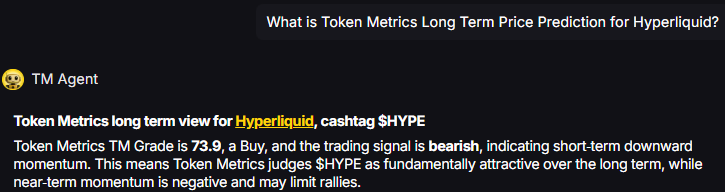
TM Agent baseline: Token Metrics TM Grade is 73.9%, a Buy, and the trading signal is bearish, indicating short-term downward momentum. This means Token Metrics judges HYPE as fundamentally attractive over the long term in our price prediction models, while near-term momentum is negative and may limit rallies.

Live details: Hyperliquid Token Details

Buy HYPE

Affiliate Disclosure: We may earn a commission from qualifying purchases made via this link, at no extra cost to you.

Key Takeaways: Hyperliquid Price Prediction Summary

  • Scenario driven: Price prediction outcomes hinge on total crypto market cap; higher liquidity and adoption lift the bands
  • Fundamentals: Fundamental Grade 76.73% (Community 68%, Tokenomics 60%, Exchange 100%, VC —, DeFi Scanner 92%)
  • Technology: Technology Grade N/A (Activity —, Repository —, Collaboration —, Security —, DeFi Scanner 92%)
  • TM Agent gist: Long-term attractive on fundamentals in price prediction models; near-term momentum is negative and may limit rallies
  • Current rating: Buy (73.9%) with bullish 2026 macro backdrop
  • Education only, not financial advice

Hyperliquid Price Prediction Scenario Analysis

Token Metrics price prediction scenarios span four market cap tiers, each representing different levels of crypto market maturity and liquidity:

8T Market Cap - HYPE Price Prediction:

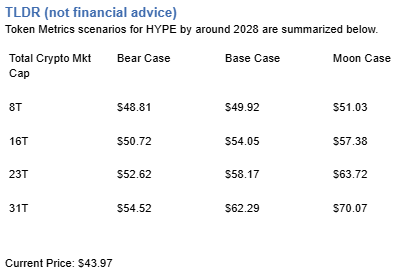
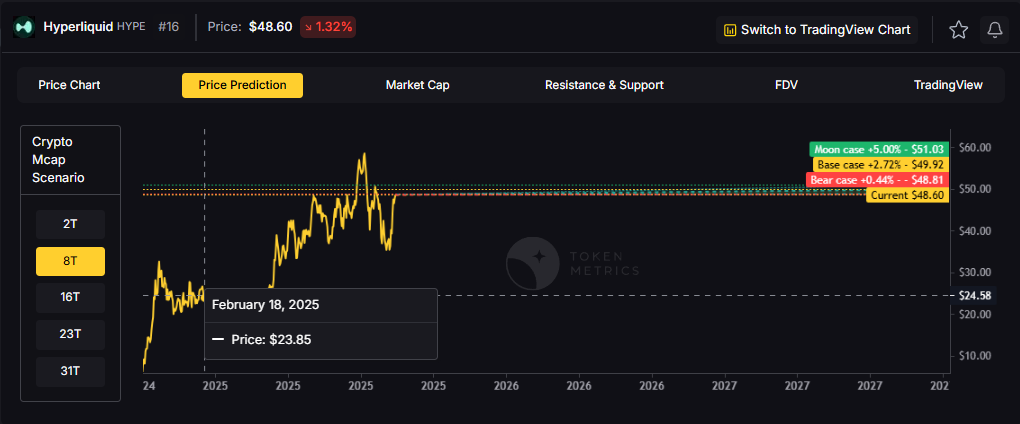
At an 8 trillion dollar total crypto market cap, HYPE price prediction projects to $48.81 in bear conditions, $49.92 in the base case, and $51.03 in bullish scenarios.

16T Market Cap - HYPE Price Prediction:

Doubling the market to 16 trillion expands the price prediction range to $50.72 (bear), $54.05 (base), and $57.38 (moon).

23T Market Cap - HYPE Price Prediction:

At 23 trillion, the price prediction scenarios show $52.62, $58.17, and $63.72 respectively.

31T Market Cap - HYPE Price Prediction:

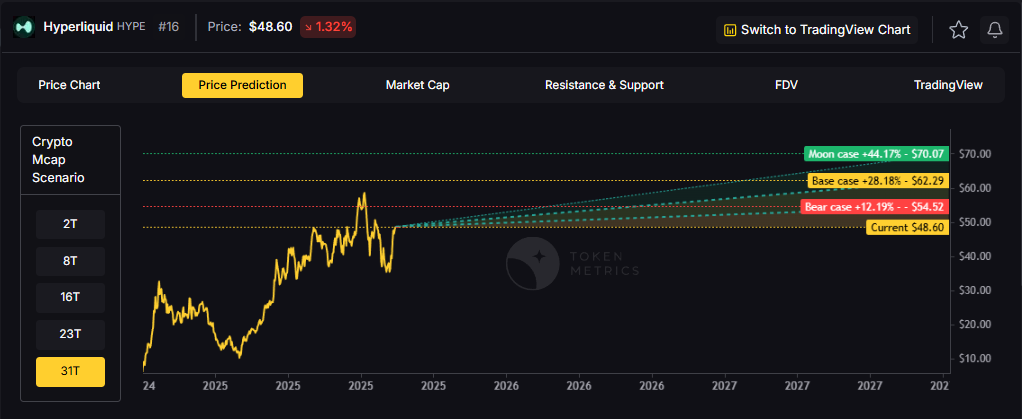
In the maximum liquidity scenario of 31 trillion, HYPE price predictions could reach $54.52 (bear), $62.29 (base), or $70.07 (moon).

Each tier in our price prediction framework assumes progressively stronger market conditions, with the base case reflecting steady growth and the moon case requiring sustained bull market dynamics driven by the improving 2026 macro environment.

Why Consider the Indices with Top-100 Exposure

Diversification matters. HYPE is compelling, yet concentrated bets can be volatile, especially when evaluating long-term price predictions. Token Metrics Indices hold HYPE alongside the top one hundred tokens for broad exposure to leaders and emerging winners.

Our backtests indicate that owning the full market with diversified indices has historically outperformed both the total market and Bitcoin in many regimes due to diversification and rotation benefits.

Get early access

What Is Hyperliquid?

Hyperliquid is a decentralized exchange focused on perpetual futures with a high-performance order book architecture. The project emphasizes low-latency trading, risk controls, and capital efficiency aimed at professional and retail derivatives traders. Its token, HYPE, is used for ecosystem incentives and governance-related utilities—all factors that directly influence HYPE price prediction trajectories.

Catalysts That Skew HYPE Price Predictions Bullish

  • Institutional and retail access expands with ETFs, listings, and integrations
  • Macro tailwinds from lower real rates and improving liquidity entering 2026
  • Product or roadmap milestones such as upgrades, scaling, or partnerships
  • Growing perpetual futures DEX market share
  • Increased professional trader adoption of decentralized derivatives
  • Integration with major DeFi protocols and liquidity aggregators
  • Favorable regulatory clarity for decentralized exchanges

Risks That Skew HYPE Price Predictions Bearish

  • Macro risk-off from tightening or liquidity shocks
  • Regulatory actions targeting decentralized derivatives platforms or infrastructure outages
  • Concentration risk in validator economics and competitive displacement
  • Competition from established centralized exchanges and other DEX perpetuals platforms
  • Technology grade unavailable (N/A), limiting technical assessment
  • Security vulnerabilities in order book or smart contract architecture

Hyperliquid Price Prediction FAQs

Can HYPE reach $60?

Yes. The 23T and 31T tiers in our price prediction models imply ranges above $60 in the Base and Moon bands, with the 23T moon case projecting $63.72 and the 31T base case projecting $62.29. These outcomes depend on liquidity and adoption improvements expected in the bullish 2026 environment. Not financial advice.

Is HYPE a good long-term investment?

HYPE shows a strong Buy rating (73.9%) with solid fundamentals (76.73%), suggesting long-term attractiveness. However, the outcome depends on adoption, liquidity regime, competition in the perpetual DEX space, and supply dynamics. The bearish near-term trading signal suggests potential volatility. Diversify and size positions responsibly. Not financial advice.

What is the Hyperliquid price prediction for 2026?

Our comprehensive HYPE price prediction framework for 2026 suggests Hyperliquid could trade between $48.81 and $70.07 depending on market conditions and total crypto market capitalization. The base case price prediction scenario clusters around $49.92 to $62.29 across different market cap environments. The Buy rating (73.9%) reflects confidence in the bullish 2026 macro backdrop. Not financial advice.

Can HYPE reach $100?

HYPE reaching $100 would exceed our current price prediction models' highest scenario of $70.07 (31T moon case). This would require extraordinary market conditions beyond the 31T total crypto market cap tier, exceptional perpetual DEX adoption, and Hyperliquid dominating the decentralized derivatives space. While the 2026 bullish thesis supports growth, $100 appears beyond our modeled scenarios. Not financial advice.

Should I buy HYPE now or wait?

HYPE has a Buy rating (73.9%) indicating long-term attractiveness in our price prediction models. However, the bearish trading signal suggests near-term downward momentum. Current price positioning and the expected bullish 2026 environment create a complex timing decision. Dollar-cost averaging may reduce timing risk while capturing upside exposure. Consider diversified DEX exposure through indices. Not financial advice.

How does HYPE compare to other DEX price predictions?

Hyperliquid focuses specifically on perpetual futures with order book architecture, differentiating it from AMM-based DEXs like Uniswap or dYdX. Our price prediction framework suggests HYPE could reach $49-$70 across scenarios in 2026. The Buy rating (73.9%) and strong fundamentals (76.73%) position HYPE competitively, though the lack of technology grade data (N/A) limits comparative technical assessment.

What makes 2026 bullish for HYPE price predictions?

Multiple factors support bullish HYPE price predictions for 2026: widening institutional access through ETFs and custody solutions, L2 scaling improvements, clearer regulatory frameworks, improving macro liquidity conditions, and the maturation of decentralized derivatives markets. These tailwinds create favorable conditions for perpetual DEX platforms like Hyperliquid to capture market share. Not financial advice.

Why is HYPE rated Buy despite bearish trading signals?

HYPE receives a Buy rating (73.9%) based on strong fundamental grade (76.73%) and favorable long-term positioning in the growing perpetual DEX space. However, the bearish trading signal reflects short-term downward momentum. This creates a classic "buy the dip" scenario where fundamentals suggest long-term value but near-term price action may provide better entry points. Our price prediction models reflect this nuance. Not financial advice.

What are the biggest risks to HYPE price predictions?

Key risks that could impact Hyperliquid price predictions include: unavailable technology grade (N/A) limiting technical assessment, competition from established centralized exchanges (Binance, OKX) and other perpetual DEXs (dYdX, GMX), regulatory targeting of decentralized derivatives, order book architecture vulnerabilities, liquidity fragmentation across perpetual platforms, and macro liquidity shocks. Despite the Buy rating, these risks warrant careful position sizing.

Can HYPE benefit from the 2026 bull market?

Yes. Our price prediction scenarios are specifically framed around the bullish 2026 thesis, where improving liquidity, institutional participation, and regulatory clarity create favorable conditions. HYPE's Buy rating (73.9%) reflects this positive macro backdrop. The base case scenarios ($49.92 to $62.29) assume steady participation in bull market dynamics, while moon cases require sustained momentum. Not financial advice.


Next Steps

Disclosure

Educational purposes only, not financial advice. Crypto is volatile, do your own research and manage risk.

Your Edge: Powered by Token Metrics

Token Metrics delivers AI-based crypto ratings, scenario-based price prediction projections, and portfolio tools so you can make smarter decisions. Discover real-time analytics on Token Metrics.

Why Use Token Metrics for HYPE Price Predictions?

  • Bullish 2026 thesis: Specialized analysis of improving macro conditions and institutional access
  • Scenario-based modeling: Four market cap tiers for comprehensive price prediction analysis
  • Buy rating transparency: Strong fundamentals (76.73%) balanced with bearish near-term signals
  • DEX specialization: Focused analysis of perpetual futures DEX competitive landscape
  • Risk management: Indices for diversified exposure beyond single DEX concentration
  • Real-time signals: Trading signals and TM Grades (Buy 73.9%) updated regularly
  • Comparative analysis: Analyze HYPE against dYdX, GMX, and 6,000+ tokens
Choose from Platinum, Gold, and Silver packages
Reach with 25–30% open rates and 0.5–1% CTR
Craft your own custom ad—from banners to tailored copy
Perfect for Crypto Exchanges, SaaS Tools, DeFi, and AI Products