Back to blog
Research

Mastering REST APIs: Principles, Design, and Best Practices

Learn REST API fundamentals, design patterns, security, versioning, and practical tips for building robust, scalable APIs that integrate with AI agents and crypto data sources.
Token Metrics Team
5
Want Smarter Crypto Picks—Free?
See unbiased Token Metrics Ratings for BTC, ETH, and top alts.
Thank you! Your submission has been received!
Oops! Something went wrong while submitting the form.
 No credit card | 1-click unsubscribe

REST APIs power much of the modern web, mobile apps, and integrations between services. Whether you are building a backend for a product, connecting to external data sources, or composing AI agents that call external endpoints, understanding REST API fundamentals helps you design reliable, maintainable, and performant systems.

What is a REST API and why it matters

Representational State Transfer (REST) is an architectural style that uses simple HTTP verbs to operate on resources identified by URLs. A REST API exposes these resources over HTTP so clients can create, read, update, and delete state in a predictable way. Key benefits include:

  • Stateless interactions that simplify scaling and load balancing.
  • Uniform interface using standard HTTP verbs (GET, POST, PUT/PATCH, DELETE).
  • Human-readable endpoints and predictable behavior for developers and tools.

REST is not a strict protocol; it is a set of constraints that make APIs easier to consume and maintain. Understanding these constraints enables clearer contracts between services and smoother integration with libraries, SDKs, and API gateways.

Core principles and common HTTP methods

Designing a RESTful API starts with resources and consistent use of HTTP semantics. Typical patterns include:

  • Resource-oriented URLs: /users/123/orders/456 rather than RPC-style method names.
  • HTTP methods: GET for reads, POST for creation, PUT/PATCH for updates, DELETE for deletion.
  • Status codes: 200 OK, 201 Created, 204 No Content, 400 Bad Request, 401 Unauthorized, 403 Forbidden, 404 Not Found, 429 Too Many Requests, 500 Server Error.
  • Content negotiation: Use Accept and Content-Type headers (application/json, application/xml) to support clients.

Use idempotency for safety: GET, PUT, and DELETE should be safe to retry without causing unintended side effects. POST is commonly non-idempotent unless an idempotency key is provided.

Design patterns: pagination, filtering, and versioning

As APIs grow, practical patterns help keep them efficient and stable:

  • Pagination: Offer cursor-based or offset-based pagination for collections. Cursor pagination generally performs better at scale.
  • Filtering and sorting: Support query parameters (e.g., ?status=active&sort=-created_at) and document allowed fields.
  • Versioning: Avoid breaking changes by putting versions in the URL (/v1/) or in headers. Maintain clear deprecation policies and migration guides.
  • Hypermedia (HATEOAS): Optionally include links to related resources to help clients discover available actions.

Security, performance, and operational best practices

Security and reliability are essential for production APIs. Consider these practices:

  • Authentication & authorization: Prefer OAuth2, JWTs, or API keys depending on your use case. Use scopes and least-privilege access.
  • Transport security: Enforce TLS for all endpoints and disable deprecated TLS ciphers.
  • Rate limiting and quotas: Protect your backend and provide clear error responses (429) with retry headers.
  • Caching: Use HTTP caching headers (Cache-Control, ETag) and CDN fronting for read-heavy endpoints.
  • Monitoring and observability: Emit structured logs, metrics, and distributed traces so you can diagnose latency, errors, and bottlenecks.

These controls reduce downtime and make integration predictable for client teams and third-party developers.

Testing, documentation, and developer experience

Good testing and clear docs accelerate adoption and reduce bugs:

  • Automated tests: Unit test controllers and routes, and use integration tests against a staging environment or simulated backend.
  • Contract testing: Tools like OpenAPI/Swagger and schema validation ensure clients and servers agree on payloads and types.
  • Interactive docs and SDKs: Provide OpenAPI specs, example curl commands, and autogenerated client libraries for common languages.
  • Postman and CI: Use Postman collections or similar for exploratory testing and include API checks in CI pipelines.

These measures improve developer productivity and reduce the risk of downstream failures when APIs evolve.

Build Smarter Crypto Apps & AI Agents with Token Metrics

Token Metrics provides real-time prices, trading signals, and on-chain insights all from one powerful API. Grab a Free API Key

What is the difference between REST and RESTful?

REST is the architectural style; RESTful typically describes APIs that follow REST constraints such as statelessness, resource orientation, and use of HTTP verbs. In practice the terms are often used interchangeably.

When should I use PUT vs PATCH?

PUT generally replaces a full resource and is idempotent; PATCH applies partial changes and may not be idempotent unless designed to be. Choose based on whether clients send full or partial resource representations.

How do I choose between URL versioning and header versioning?

URL versioning (/v1/) is simple and visible to clients, while header versioning is cleaner from a URL standpoint but harder for users to discover. Pick a strategy with a clear migration and deprecation plan.

What are common causes of REST API performance issues?

Typical causes include unoptimized database queries, chatty endpoints that require many requests, lack of caching, and large payloads. Use profiling, caching, and pagination to mitigate these issues.

How can REST APIs support AI agents?

AI agents often orchestrate multiple data sources and services via REST APIs. Well-documented, authenticated, and idempotent endpoints make it safer for agents to request data, trigger workflows, and integrate model outputs into applications.

What tools help with API design and documentation?

OpenAPI/Swagger, Postman, Redoc, and API gateways (e.g., Kong, Apigee) are common. They help standardize schemas, run automated tests, and generate SDKs for multiple languages.

Disclaimer

This article is educational and informational only. It does not constitute professional advice. Evaluate technical choices and platforms based on your project requirements and security needs.

Build Smarter Crypto Apps &
AI Agents in Minutes, Not Months
Real-time prices, trading signals, and on-chain insights all from one powerful API.
Grab a Free API Key
About Token Metrics
Token Metrics: AI-powered crypto research and ratings platform. We help investors make smarter decisions with unbiased Token Metrics Ratings, on-chain analytics, and editor-curated “Top 10” guides. Our platform distills thousands of data points into clear scores, trends, and alerts you can act on.
30 Employees
analysts, data scientists, and crypto engineers
Daily Briefings
concise market insights and “Top Picks”
Transparent & Compliant
Sponsored ≠ Ratings; research remains independent
Want Smarter Crypto Picks—Free?
See unbiased Token Metrics Ratings for BTC, ETH, and top alts.
Thank you! Your submission has been received!
Oops! Something went wrong while submitting the form.
 No credit card | 1-click unsubscribe
Token Metrics Team
Token Metrics Team

Recent Posts

Research

Understanding APIs: What They Are and How They Work

Token Metrics Team
5

In the digital age, applications constantly interact with each other—whether it's your weather app pulling data from a meteorological server, or a crypto portfolio tracker fetching blockchain prices. The hidden force behind most of these interactions? APIs.

This blog post explores what an API is, how it works, and why APIs are so critical to modern software, including use in crypto and blockchain technologies.

What Is an API?

API stands for Application Programming Interface. It acts as a bridge that enables two separate software systems to communicate and share data. Much like a waiter taking your order and delivering food between you and the kitchen, an API relays requests and returns the appropriate responses.

Developers use APIs to simplify the building of software applications. Rather than writing code from scratch, APIs allow developers to pull in data, execute tasks, or access services provided by another app or platform.

How Does an API Work?

APIs operate through a series of requests and responses. The client (usually the application or user interface) sends a request to the server (which hosts the API). The API then handles this request, processes it based on pre-defined rules, and returns a response.

Here’s a simplified breakdown of the process:


Most modern APIs are RESTful (Representational State Transfer) and operate via HTTP protocols. These APIs are platform-agnostic and highly scalable, making them suitable for both web and mobile applications.

Why APIs Matter in Crypto

APIs are fundamental to the crypto ecosystem because they allow developers to:


Build Smarter Crypto Apps & AI Agents in Minutes, Not Months

Real-time prices, trading signals, and on-chain insights all from one powerful API. Grab a Free API Key

Types of APIs

APIs vary based on their purpose and accessibility. It's important to understand the distinctions when designing or integrating them.


In the crypto world, partner APIs are often provided by exchanges, while open APIs are commonly seen on market data aggregator platforms.

API Security and Governance

Given that APIs provide entry points into systems, security is a top priority. Common best practices include:


Enterprises also use API gateways and management layers to track usage, apply governance policies, and scale efficiently.

Real-World API Use Cases in Crypto

The crypto industry is teeming with API-driven applications. Here are a few impactful examples:


Whether for DeFi apps, on-chain research, or Web3 gaming—APIs provide the infrastructure for scaling innovation.

FAQs

What is a REST API?

A REST API (Representational State Transfer) is an architectural style that uses HTTP methods (GET, POST, PUT, DELETE) to facilitate communication between systems. It's known for being lightweight, stateless, and scalable.

How do crypto trading bots use APIs?

Trading bots use API integrations to access live market data, monitor trade signals, and execute trades automatically on exchanges based on pre-programmed logic.

Are APIs secure?

APIs can be secure if built with strong authentication, encryption, and rate limiting. However, poor implementation or public exposure without proper security layers can introduce vulnerabilities.

Can I build a crypto app using public APIs?

Yes. Many platforms like Token Metrics API offer public APIs to developers. These allow you to access real-time data and integrate core functionalities into your app.

What format do APIs return data in?

Most modern APIs return data in JSON format due to its readability and ease of use. Some also offer XML or CSV for legacy systems.

Disclaimer

This blog post is intended for educational purposes only. It does not constitute investment advice, trading guidance, or an endorsement of any financial instruments. Users should conduct their own due diligence and consult with professionals before making any financial decisions.

Research

Understanding How Crypto APIs Power Digital Asset Platforms

Token Metrics Team
5

In today's digital asset ecosystem, Application Programming Interfaces, or APIs, are the unsung heroes enabling everything from cryptocurrency wallets to trading bots. Whether you're a developer building for Web3 or a curious user interested in how your exchange functions, understanding how crypto APIs work is essential

    What Is a Crypto API?

    A crypto API is a set of programming instructions and standards that allow software applications to communicate with cryptocurrency services. These services may include wallet functions, price feeds, trading engines, exchange platforms, and blockchain networks. By using a crypto API, developers can automate access to real-time market data or execute trades on behalf of users without manually interacting with each platform.

    For instance, the Token Metrics API provides structured access to cryptocurrency ratings, analytics, and other data to help teams build intelligent applications.

    Types of Crypto APIs

    There are several categories of APIs in the cryptocurrency landscape, each with different capabilities and use cases:


    How Crypto APIs Work

    At their core, crypto APIs operate over internet protocols—typically HTTPS—and return data in JSON or XML formats. When an application makes a request to an API endpoint (a specific URL), the server processes the request, fetches the corresponding data or action, and sends a response back.

    For example, a crypto wallet app might call an API endpoint like /v1/account/balance to check a user’s holdings. To ensure security and authorization, many APIs require API keys or OAuth tokens for access. Rate limits are also enforced to prevent server overload.

    Behind the scenes, these APIs interface with various backend systems—blockchains, trading engines, or databases—to fulfill each request in real time or near real time.

    Common Use Cases for Crypto APIs

    Crypto APIs are used across a broad spectrum of applications:


    Benefits of Using Crypto APIs


    APIs dramatically reduce time-to-market for developers while enhancing user experience and application efficiency.

    Key Considerations for API Integration

    When integrating a crypto API, consider the following factors:


    Platforms like the Token Metrics API provide both comprehensive documentation and reliability for developers building AI-powered solutions in crypto.

    AI-Powered Analytics and APIs

    Some of the most powerful crypto APIs now incorporate artificial intelligence and machine learning features. For example, the Token Metrics API facilitates access to predictive models, coin grades, and AI-based price forecasts.

    By embedding these tools into custom apps, users can programmatically tap into advanced analytics, helping refine research workflows and support technical or fundamental analysis. Although these outputs can guide decisions, they should be viewed in a broader context instead of relying exclusively on model predictions.

    Conclusion

    Crypto APIs are critical infrastructure for the entire digital asset industry. From data retrieval and trading automation to blockchain integration and AI-driven analytics, these tools offer immense utility for developers, analysts, and businesses alike. Platforms such as Token Metrics provide not only in-depth crypto research but also API access to empower intelligent applications built on real-time market insights. By understanding how crypto APIs work, users and developers can better navigate the rapidly evolving Web3 landscape.

    Disclaimer

    This article is for informational and educational purposes only. It does not constitute financial, investment, or technical advice. Always conduct your own research and consult professional advisors before making any decisions.

    Announcements

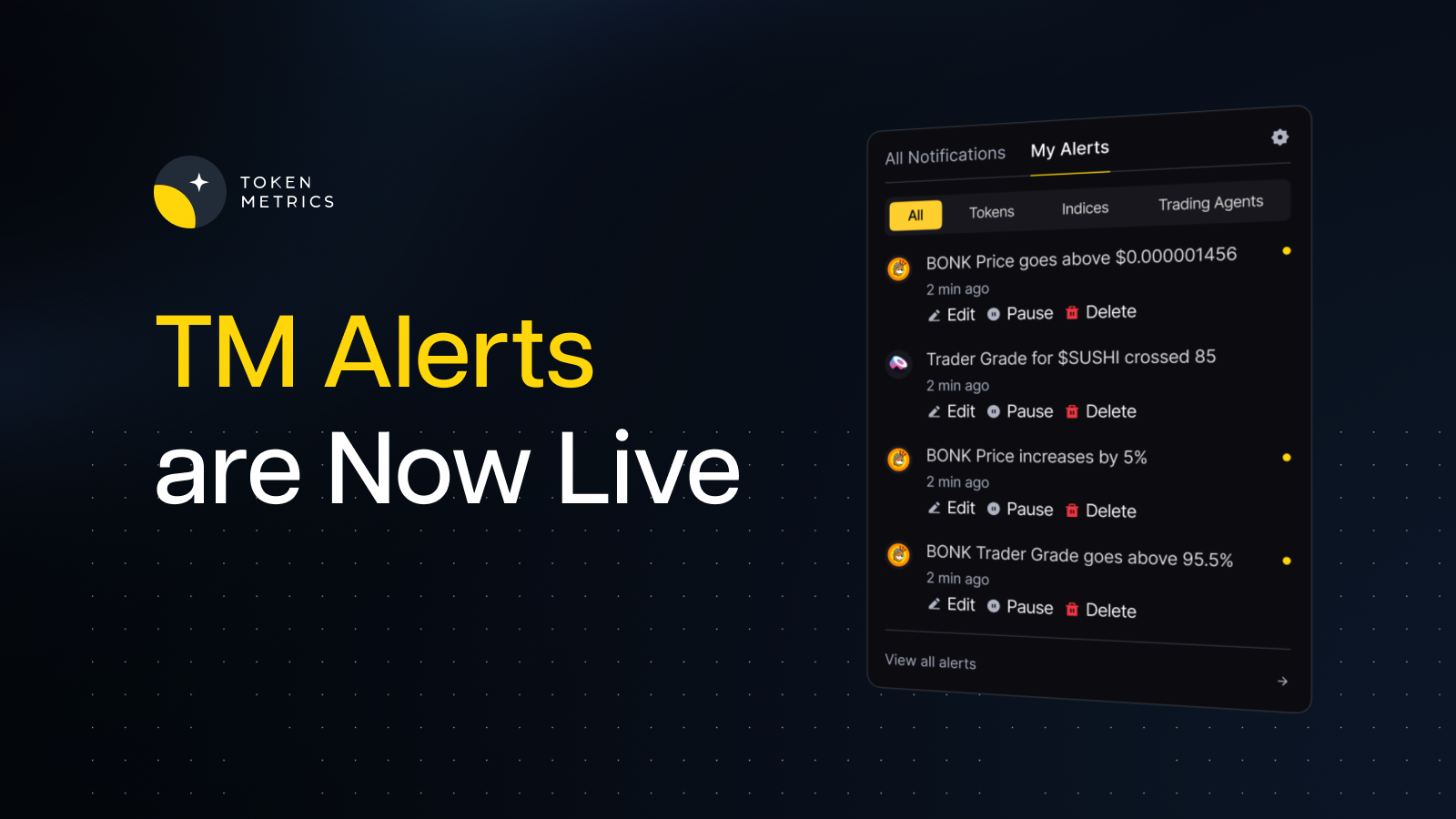
    The End of FOMO: How Token Metrics Alerts Revolutionizes Crypto Trading

    Token Metrics Team
    5 min

    The cryptocurrency market operates on a simple, unforgiving principle: timing is everything. While traditional markets sleep, crypto never does. A single tweet, a regulatory announcement, or an AI signal flip can trigger massive price movements within minutes. For most traders, this creates an impossible dilemma – how do you capture every opportunity without becoming a prisoner to your screen?

    Today, we're solving that problem forever.

    The Alert Revolution is Here

    Token Metrics Alerts represents the culmination of years of development and trader feedback. We've built the most sophisticated crypto alert system ever created, designed specifically for the unique challenges of cryptocurrency trading. This isn't just another notification tool – it's your personal market intelligence system.

    The core philosophy behind Token Metrics Alerts is simple: empower traders with precise, actionable information delivered exactly when and how they need it. No more, no less.

    AI-Powered Market Intelligence

    At the heart of our alert system lies advanced artificial intelligence that continuously analyzes market conditions, price patterns, and trading signals across thousands of cryptocurrencies. When our AI algorithms detect a significant shift – whether bullish or bearish – you're notified instantly.

    This AI-driven approach transforms how you interact with market data. Instead of interpreting charts and signals manually, you receive clear, actionable alerts based on sophisticated analysis that would take hours to perform yourself. The AI doesn't sleep, doesn't get emotional, and doesn't miss patterns that human eyes might overlook.

    Our AI monitoring includes sentiment analysis, technical pattern recognition, volume analysis, and correlation tracking across multiple timeframes. When these systems converge on a significant signal, that's when you get alerted. It's like having a team of expert analysts working around the clock, exclusively for you.

    Precision Customization for Every Trading Style

    Token Metrics Alerts recognizes that no two traders are identical. Day traders need different information than long-term holders. Swing traders have different requirements than scalpers. That's why we've built unprecedented customization into every aspect of the alert system.

    You can set price movement alerts for any percentage change, whether you want to know about 5% moves or 50% pumps. Custom triggers allow you to monitor specific price levels, support and resistance breaks, or volume spikes. The system adapts to your trading strategy, not the other way around.

    Multi-Channel Delivery That Actually Works

    The best alert in the world is useless if you don't receive it. Token Metrics Alerts delivers notifications through five distinct channels, each optimized for different scenarios and preferences.

    Email alerts provide detailed information perfect for analysis and record-keeping. Telegram integration offers lightning-fast mobile notifications that cut through the noise of other apps. Slack integration brings trading alerts directly into your workspace, maintaining focus during trading sessions. Discord connectivity allows seamless integration with trading communities and group strategies.

    This multi-channel approach means you can configure different types of alerts for different delivery methods. Perhaps you want AI signal changes sent via Telegram for immediate action, while price level alerts go to email for later analysis. The system accommodates any configuration that suits your workflow.

    The Psychology of Successful Trading

    Successful trading isn't just about having good information – it's about having the right information at the right time without the psychological burden of constant monitoring. Token Metrics Alerts addresses the mental and emotional aspects of trading that often determine success or failure.

    By removing the need for constant chart watching, alerts eliminate the anxiety and decision fatigue that plague many traders. You can set your parameters, trust the system, and focus on analysis and execution rather than monitoring. This psychological shift often leads to better decision-making and reduced emotional trading.

    The fear of missing out (FOMO) drives many poor trading decisions. When you know your alert system is monitoring everything important, FOMO naturally diminishes. You can wait for your signals with confidence, knowing that when something significant happens, you'll be among the first to know.

    Real-World Applications and Success Stories

    The practical applications of Token Metrics Alerts extend across every trading style and market condition. Day traders use the system to catch intraday breakouts and momentum shifts without staring at screens all day. Swing traders monitor key levels and trend changes while maintaining their regular schedules. Long-term investors track major developments in their holdings without daily price obsession.

    During volatile market periods, the alert system becomes even more valuable. Flash crashes, sudden pumps, and rapid reversals are captured and communicated instantly. This real-time intelligence often means the difference between capitalizing on volatility and becoming its victim.

    Professional traders and fund managers have integrated Token Metrics Alerts into their systematic approaches, using the consistent signal delivery to maintain discipline and reduce emotional decision-making. The system's reliability has become a cornerstone of many successful trading operations.

    The Future of Informed Trading

    Token Metrics Alerts represents more than just a new product – it embodies a fundamental shift toward intelligent, automated market monitoring. As cryptocurrency markets mature and become more complex, the tools we use to navigate them must evolve accordingly.

    The launch of Token Metrics Alerts marks the beginning of a new era where traders can maintain comprehensive market awareness without sacrificing their time, sleep, or sanity. It's technology serving the trader, not the other way around.

    The question isn't whether you can afford to use Token Metrics Alerts – it's whether you can afford not to. In a market where information and timing determine success, having a sophisticated alert system isn't a luxury; it's a necessity.

    Your trading edge awaits. The market never stops moving, but now, neither do your opportunities to capture its movements.

    Choose from Platinum, Gold, and Silver packages
    Reach with 25–30% open rates and 0.5–1% CTR
    Craft your own custom ad—from banners to tailored copy
    Perfect for Crypto Exchanges, SaaS Tools, DeFi, and AI Products