Back to blog
Research

Mastering Your Mind: How Token Metrics AI Indices Overcome the Psychology That Destroys Crypto Returns

Learn how behavioral finance shapes crypto results and how Token Metrics AI Indices overcome common psychological pitfalls for disciplined, data-driven investing.
Token Metrics Team
14 min read
Want Smarter Crypto Picks—Free?
See unbiased Token Metrics Ratings for BTC, ETH, and top alts.
Thank you! Your submission has been received!
Oops! Something went wrong while submitting the form.
 No credit card | 1-click unsubscribe

Here's an uncomfortable truth: the biggest obstacle to your cryptocurrency investing success isn't market volatility, regulatory uncertainty, or technological complexity. It's your own brain. Decades of behavioral finance research demonstrate conclusively that human psychology systematically destroys investment returns. We panic when we should be calm, get greedy when we should be cautious, and make irrational decisions despite knowing better intellectually.

In cryptocurrency markets, where volatility reaches extremes and prices move 24/7, these psychological pitfalls amplify dramatically. A study analyzing crypto investor behavior found that the average investor underperformed simply holding Bitcoin by over 5% annually—not because of bad luck or poor token selection, but because of destructive psychological patterns driving their decisions.

The solution isn't trying harder to control emotions—that rarely works. The solution is systematic, AI-powered investing that removes human psychology from the equation. Token Metrics AI Indices are designed specifically to combat the cognitive biases and emotional responses that plague human investors, replacing knee-jerk reactions with data-driven discipline.

This comprehensive exploration examines the psychological traps that destroy crypto returns, reveals why these mental patterns are so powerful and persistent, and demonstrates how Token Metrics' systematic approach neutralizes these psychological threats. Understanding these dynamics will transform how you approach crypto investing and dramatically improve your long-term results.

The Hardwired Biases Destroying Your Crypto Returns

Loss Aversion: Why Losses Hurt Twice as Much as Gains Feel Good

Nobel Prize-winning research by Daniel Kahneman and Amos Tversky revealed a fundamental human quirk: losses hurt psychologically about twice as much as equivalent gains feel good. Losing $10,000 causes more pain than gaining $10,000 brings pleasure. This "loss aversion" profoundly impacts investment decisions.

In crypto markets, loss aversion manifests destructively. When portfolios decline 30%, the psychological pain becomes overwhelming, driving panic selling at exactly the wrong time. Investors lock in losses that systematic strategies would ride out, missing subsequent recoveries. Conversely, when holding profitable positions, loss aversion makes investors too quick to sell, fearing giving back gains—they miss enormous continued upside.

Token Metrics' AI experiences no loss aversion. The algorithms evaluate positions based on expected risk-adjusted returns, not emotional pain from declines. When fundamentals remain strong despite price drops, the indices maintain or even increase exposure rather than panic selling. This emotional discipline consistently outperforms loss-averse human behavior.

Recency Bias: Overweighting What Just Happened

Human brains disproportionately weight recent experiences when making decisions. If crypto has performed poorly recently, we expect continued poor performance. If crypto has surged lately, we expect continued surges. This "recency bias" causes investors to extrapolate recent trends inappropriately.

Recency bias drives the classic mistake of buying high and selling low. During bull markets after extended gains, recency bias creates excessive optimism—"crypto always goes up!"—driving investment at peaks. During bear markets after sustained declines, recency bias creates excessive pessimism—"crypto is dead!"—driving capitulation at bottoms.

Token Metrics' machine learning algorithms analyze full market histories, not just recent periods. The AI recognizes when recent trends are likely to reverse based on historical patterns, fundamentals, and technical indicators. This comprehensive perspective prevents recency-driven mistakes that destroy wealth.

Confirmation Bias: Seeking Information Supporting Existing Beliefs

Confirmation bias causes us to seek, interpret, and remember information confirming our pre-existing beliefs while ignoring contradictory evidence. If you're bullish on a specific cryptocurrency, you'll unconsciously focus on positive news about that token while dismissing or rationalizing negative developments.

In crypto communities, confirmation bias reaches extreme levels. Dedicated subreddits and Discord channels become echo chambers where believers reinforce each other's convictions, dismissing skeptics as ignorant or malicious. This creates dangerous groupthink where warning signs go unheeded until it's too late.

Token Metrics' AI evaluates all available data objectively without pre-existing biases. If a previously high-rated token shows deteriorating fundamentals, technical weakness, or negative on-chain metrics, the system responds accordingly regardless of community sentiment or previous bullish positioning. This objectivity prevents costly confirmation bias-driven mistakes.

Herd Mentality: Following the Crowd Into Disaster

Humans evolved as social creatures relying on group behavior for survival. This evolutionary heritage creates powerful herd mentality—when everyone around us is doing something, we feel compelled to join. In financial markets, herd mentality drives booms and busts as participants mindlessly follow crowds into overvalued assets and then stampede toward exits.

Cryptocurrency markets exhibit extreme herd behavior. During bull markets, FOMO (fear of missing out) drives waves of new investors buying at any price as friends, coworkers, and social media contacts boast about gains. During bear markets, panic spreads virally as everyone simultaneously tries exiting, creating capitulation crashes.

Token Metrics' systematic approach is immune to herd behavior. The AI doesn't care that "everyone" is buying or selling a particular token. It evaluates individual cryptocurrencies based on objective metrics, maintaining contrarian positions when data suggests the herd is wrong. This independence from group psychology enables profitable contrarian positioning.

Anchoring Bias: Fixating on Irrelevant Reference Points

Anchoring bias causes us to fixate on specific numbers as reference points, even when those numbers are arbitrary or irrelevant. In crypto investing, common anchors include purchase prices ("I can't sell for less than I paid"), previous all-time highs ("Bitcoin was $69,000, so $40,000 is cheap"), or round numbers ("$100,000 Bitcoin is inevitable").

These anchors distort decision-making. Investors hold losing positions hoping to "break even" at their purchase price, even when current analysis suggests selling is optimal. They refuse buying at prices above their initial purchase even when current valuations are attractive. They set arbitrary price targets based on round numbers rather than fundamental analysis.

Token Metrics' indices don't anchor on arbitrary reference points. Each evaluation is based on current data, forward-looking analysis, and systematic criteria. Past prices matter only insofar as they inform technical analysis—they don't create emotional anchors preventing rational decisions.

Overconfidence: Believing You're Smarter Than the Market

Studies consistently demonstrate that humans overestimate their knowledge, abilities, and chances of success. In investing, overconfidence manifests as excessive trading, concentrated positions, and dismissal of risk. Surveys show that 90% of investors believe they're above-average—a statistical impossibility.

Crypto markets amplify overconfidence. During bull markets, everyone feels like a genius as nearly everything rises. This creates dangerous overconfidence leading to excessive leverage, underdiversified portfolios, and exposure to high-risk projects without proper due diligence. When markets inevitably turn, overconfident investors suffer devastating losses.

Token Metrics' AI has no ego. The algorithms don't feel clever or superior—they simply process data and execute strategies. This lack of overconfidence results in appropriately sized positions, systematic risk management, and diversification that overconfident humans often skip.

The Emotional Rollercoaster: How Fear and Greed Destroy Wealth

The Cycle of Crypto Emotions

Cryptocurrency investors experience predictable emotional cycles mirroring market movements. Understanding this cycle reveals why emotions destroy returns:


- Anxiety Phase: As markets begin declining, initial confidence gives way to anxiety. "Is this just a dip or something worse?" Investors check prices obsessively, seeking reassurance. Many hold positions despite growing unease, unable to admit their peak purchases were mistakes.

- Denial Phase: Declines accelerate, but investors deny the severity. "It's just a correction." "It'll bounce back." This denial prevents taking appropriate defensive actions, allowing losses to compound.

- Panic Phase: Eventually denial breaks, replaced by overwhelming panic. The full extent of losses becomes undeniable. Investors frantically sell everything, locking in massive losses at or near market bottoms.

- Capitulation Phase: After panic selling, investors swear off crypto entirely. "I'll never invest in crypto again." They've sold at the worst possible time and now refuse participation precisely when the best opportunities emerge.

- Depression Phase: While markets stabilize and begin recovering, capitulated investors remain depressed, watching from sidelines as others profit from recovery. They've missed both the bottom and early recovery.

- Hope Phase: Eventually, as recovery becomes undeniable, hope returns. "Maybe crypto isn't dead after all." But scarred by previous losses, they remain tentative.

- Relief Phase: Continued gains bring relief. "I'm glad I didn't completely give up on crypto." Confidence slowly rebuilds.

- Optimism Phase: As bull market resumes, optimism returns. Investors re-enter markets, often near peaks, repeating the cycle.

This emotional rollercoaster ensures most investors buy high (during euphoria/optimism) and sell low (during panic/capitulation)—the exact opposite of profitable investing.

How Token Metrics Breaks the Emotional Cycle

Token Metrics AI Indices operate without experiencing this emotional rollercoaster. The algorithms don't feel euphoria at peaks, anxiety during declines, or panic at bottoms. They evaluate market conditions objectively based on data, implementing strategies consistently regardless of emotional environment.

When markets peak and euphoria dominates, Token Metrics' systematic profit-taking locks in gains rather than getting swept up in irrational exuberance. When markets crash and panic spreads, the AI evaluates whether fundamentals justify continued holding or even accumulation rather than capitulating. This emotional discipline is perhaps the single most valuable aspect of systematic, AI-driven investing.

Get Started For Free

The Illusion of Control and the Danger of Overtrading

Why Trading Makes You Feel Good But Performs Poorly

Human brains crave control. When we take action—any action—we feel more in control of outcomes. This creates what psychologists call the "illusion of control"—believing our actions influence results more than they actually do.

In investing, the illusion of control drives excessive trading. When portfolios decline, sitting passively feels unbearable—we must do something! So we trade, even when trading is counterproductive. Each trade creates the illusion we're actively managing risk and improving outcomes.

Research demonstrates conclusively that frequent traders dramatically underperform passive strategies after accounting for transaction costs and taxes. Yet the illusion of control makes overtrading feel productive and prudent.

Token Metrics addresses this by removing temptation for constant action. The indices trade systematically based on predefined criteria, not impulse. They resist the urge to "do something" during volatility, trading only when systematic signals justify action. This disciplined approach consistently outperforms the illusion-of-control-driven overtrading that destroys individual investor returns.

The Danger of Complexity Bias

Related to illusion of control is "complexity bias"—believing more complex strategies must be better than simple ones. If simple index investing seems too easy, we seek complex trading strategies, technical indicators, or sophisticated algorithms that "feel" more professional.

In reality, simplicity often outperforms complexity. Complex strategies introduce more opportunities for error, higher costs, and greater likelihood of abandonment during challenging periods. Token Metrics indices appear simple to use—select an index, invest, follow rebalancing guidance. But this simplicity masks sophisticated underlying complexity handled by AI systems processing vast data and implementing optimized strategies.

Users benefit from professional-grade sophistication without requiring complex user-side management—the ideal combination.

The Power of Pre-Commitment and Systematic Rules

Ulysses Contracts: Binding Yourself to Rational Behavior

In Greek mythology, Ulysses (Odysseus) wanted to hear the Sirens' song without steering his ship onto rocks. His solution: have his crew tie him to the mast and plug their own ears with wax. Ulysses created a "pre-commitment device"—binding his future self to rational behavior despite knowing he'd want to act irrationally when hearing the Sirens.

Behavioral economists apply this concept to decision-making. We know intellectually that we'll make emotional mistakes during market extremes, but we can't prevent those emotions arising. The solution is pre-commitment—establishing rules during calm periods that bind us during emotional storms.

Token Metrics indices function as pre-commitment devices. By selecting indices during calm analysis and committing to follow their guidance, you bind yourself to systematic strategies. When markets crash and every fiber of your being screams "SELL EVERYTHING!", the pre-commitment to Token Metrics' approach provides structure preventing panic-driven mistakes.

The Challenge of Following Systems

Even with pre-commitment, following systematic strategies proves psychologically difficult. During market extremes, conviction wavers. "Maybe this time is different." "The AI can't understand THIS situation." These doubts lead to abandoning systems precisely when discipline matters most.

Strengthen your ability to follow Token Metrics' systematic approach by documenting your investment rationale and commitment when initiating positions, reviewing behavioral finance principles reminding yourself why emotions mislead, connecting with other systematic investors who can provide perspective during challenging periods, and tracking performance demonstrating systematic approaches' long-term superiority.

Building Psychological Resilience for Long-Term Success

Developing Detachment from Short-Term Outcomes

Successful crypto investors cultivate psychological detachment from short-term portfolio fluctuations. They recognize that daily, weekly, or monthly performance provides almost no information about long-term success. This detachment prevents emotional reactions to normal volatility.

Practice detachment by limiting portfolio checking to weekly or monthly intervals, focusing on long-term goals rather than current prices, and remembering that volatility is the price paid for crypto's return potential, not a sign something is wrong.

Token Metrics' systematic approach supports detachment. When AI handles day-to-day decisions, you can mentally disengage from constant market monitoring, checking in periodically without obsessive tracking.

Viewing Losses as Tuition, Not Failure

Every investor experiences losses. The question is whether you extract valuable lessons or simply internalize failure. Reframe losses as tuition—the cost of education in crypto markets. Each mistake teaches something valuable if you reflect thoughtfully.

Token Metrics reduces costly tuition by preventing many common mistakes. But when losses occur—and they will during bear markets—view them as normal cost of pursuing exceptional long-term returns rather than personal failure requiring psychological recovery.

Creating Behavioral Guardrails

Beyond Token Metrics' systematic approach, create additional behavioral guardrails preventing psychological mistakes:


- Cooling-Off Periods: If tempted to make impulsive decisions, implement mandatory 48-72 hour delays. If the decision still seems wise after cooling off, proceed. Often, the impulse passes.

- Accountability Partners: Share your strategy with a trusted friend or advisor who can provide objective perspective during emotional moments.

- Performance Reviews: Schedule quarterly reviews analyzing decisions, identifying emotional influences, and assessing adherence to systematic strategies. This creates learning loops improving discipline over time.

The Unique Psychological Advantage of AI-Powered Investing

Separating Analysis from Execution

One of Token Metrics' most valuable psychological benefits is separating analysis from execution. You make high-level strategic decisions—which indices to follow, what allocation to maintain—during calm, rational periods. The AI handles tactical execution—which specific tokens to hold, when to rebalance—without your emotional involvement.

This separation prevents the cognitive load and emotional stress of constant decision-making while ensuring decisions are made systematically rather than emotionally.

The Confidence of Data-Driven Decisions

Knowing your portfolio is managed based on comprehensive data analysis rather than hunches creates psychological confidence. During volatility, you can remind yourself: "This portfolio is built on analysis of 6,000+ cryptocurrencies, multiple data sources, and proven systematic strategies. My panic response isn't based on superior information—it's just fear."

This confidence doesn't eliminate fear—markets remain scary during crashes—but it provides rational counterbalance preventing fear from dominating decisions.

Community and Education Reduce Anxiety

Token Metrics provides more than just indices—it offers educational resources and community connections that reduce psychological isolation. Knowing thousands of other investors follow similar systematic strategies normalizes your experience. Educational content explaining market dynamics and behavioral finance arms you with knowledge combating fear.

This support structure proves invaluable during challenging markets when isolation amplifies panic.

Why Choose Token Metrics to Support Your Crypto Investing Journey

All the psychological traps discussed above are ingrained and difficult for individual investors to overcome without considerable discipline and resources. Token Metrics has built AI-powered indices and educational resources specifically to support systematic, emotion-free investing that takes guesswork and emotion out of crypto portfolio management. By leveraging comprehensive, data-driven analysis and structure, the platform empowers users with tools for maintaining discipline and applying sound investing principles—even during times of elevated fear or greed.

With transparent methodologies and a focus on investor education, Token Metrics equips investors to manage psychological risk and build long-term confidence in their approach to the crypto market, providing valuable guardrails for both new and experienced participants.

FAQ

How do AI-powered crypto indices help reduce emotional decision-making?

AI-powered indices apply systematic, data-driven processes that eliminate the influence of human emotion. By following predetermined rules and rebalancing based on live market data, they remove the temptation to react impulsively to market swings, reducing costly behavioral mistakes.

What are the most common psychological biases that harm crypto investors?

Common psychological biases include loss aversion, recency bias, confirmation bias, herd mentality, anchoring bias, and overconfidence. These biases often prompt investors to buy high, sell low, or abandon risk controls during periods of volatility or euphoria.

How does Token Metrics AI evaluate cryptocurrencies?

Token Metrics AI evaluates cryptocurrencies using a wide array of market, technical, and fundamental indicators—combining historical price data, project fundamentals, sentiment, and on-chain metrics. This objective analysis helps mitigate the impact of confirmation bias and recency bias in investor decisions.

What steps can investors take to minimize emotional investing outside of AI tools?

Investors can create behavioral guardrails such as investment policy statements, implement cooling-off periods before making trading decisions, review performance periodically for lessons learned, and seek accountability partners to provide objective perspective during emotionally charged times.

Does following systematic strategies guarantee positive results?

No investing strategy can guarantee returns, and systematic or AI-powered indices are not immune to all risks. However, academic research shows that removing emotion and sticking to disciplined, systematic frameworks tends to benefit long-term portfolio outcomes versus emotional, reactionary investing.

Disclaimer

The information contained in this blog is for educational and informational purposes only. It does not constitute financial, investment, or legal advice. Cryptocurrency investments are subject to high volatility and risk. Always perform your own research and consult a professional advisor before making investment decisions.

Get Started For Free

Build Smarter Crypto Apps &
AI Agents in Minutes, Not Months
Real-time prices, trading signals, and on-chain insights all from one powerful API.
Grab a Free API Key
About Token Metrics
Token Metrics: AI-powered crypto research and ratings platform. We help investors make smarter decisions with unbiased Token Metrics Ratings, on-chain analytics, and editor-curated “Top 10” guides. Our platform distills thousands of data points into clear scores, trends, and alerts you can act on.
30 Employees
analysts, data scientists, and crypto engineers
Daily Briefings
concise market insights and “Top Picks”
Transparent & Compliant
Sponsored ≠ Ratings; research remains independent
Want Smarter Crypto Picks—Free?
See unbiased Token Metrics Ratings for BTC, ETH, and top alts.
Thank you! Your submission has been received!
Oops! Something went wrong while submitting the form.
 No credit card | 1-click unsubscribe
Token Metrics Team
Token Metrics Team

Recent Posts

Research

How to Use x402 with Token Metrics: Composer Walkthrough + Copy-Paste Axios/HTTPX Clients

Token Metrics Team
9 min read

What You Will Learn — Two-Paragraph Opener

This tutorial shows you how to use x402 with Token Metrics in two ways. First, we will walk through x402 Composer, where you can run Token Metrics agents, ask questions, and see pay-per-request tool calls stream into a live Feed with zero code. Second, we will give you copy-paste Axios and HTTPX clients that handle the full x402 flow (402 challenge, wallet payment, automatic retry) so you can integrate Token Metrics into your own apps.

Whether you are exploring x402 for the first time or building production agent workflows, this guide has you covered. By the end, you will understand how x402 payments work under the hood and have working code you can ship today. Let's start with the no-code option in Composer.

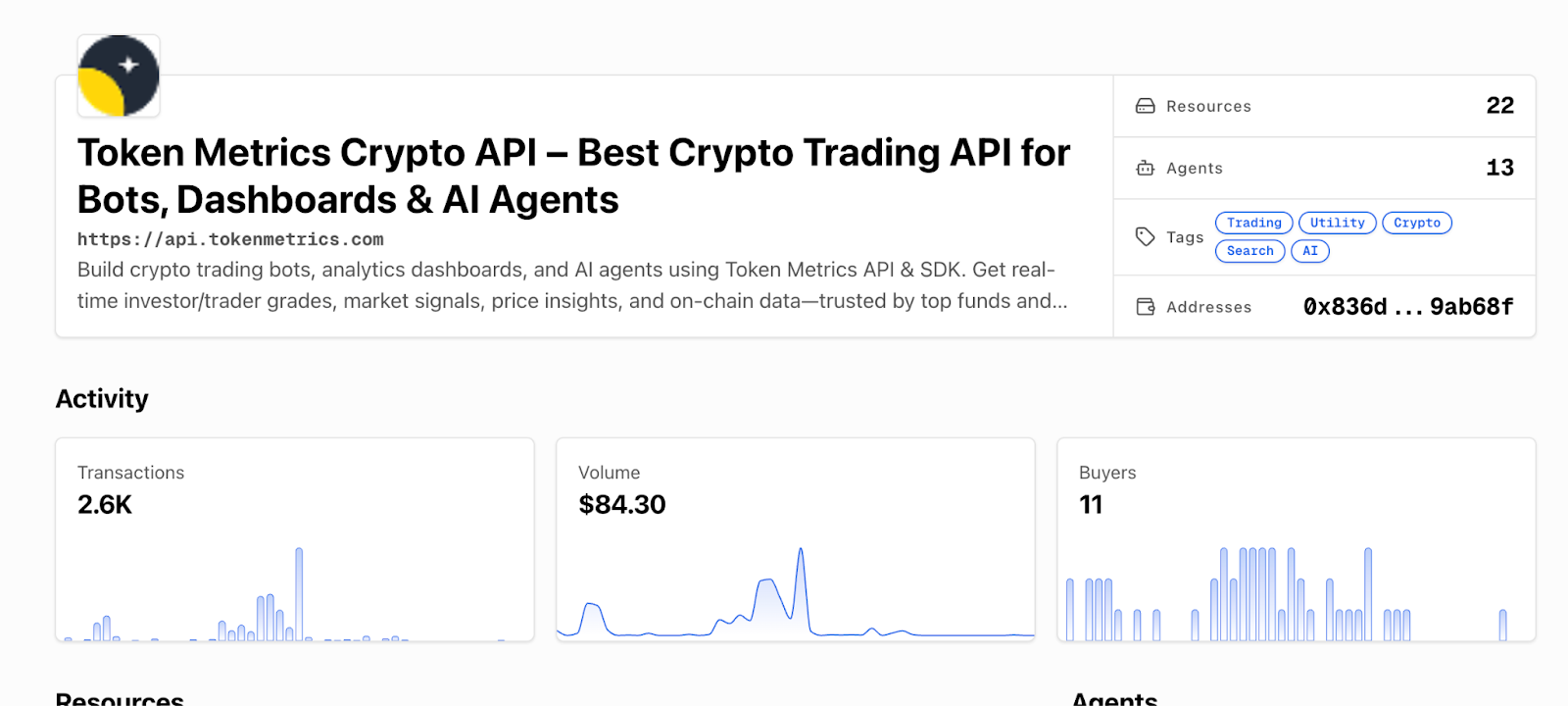
Start using Token Metrics X402 integration here. https://www.x402scan.com/server/244415a1-d172-4867-ac30-6af563fd4d25 

Part 1: Try x402 + Token Metrics in Composer (No Code Required)

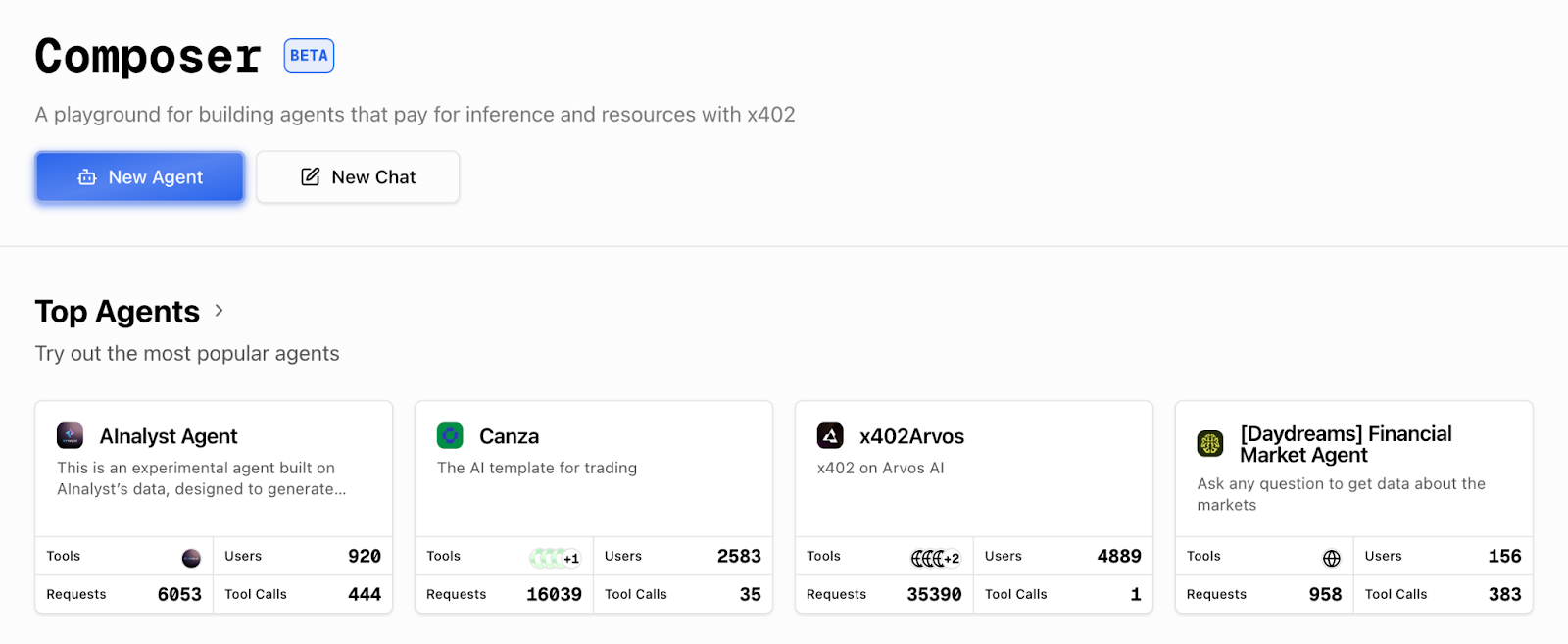
x402 Composer is a playground for AI agents that pay per tool call. You can test Token Metrics endpoints, see live payment settlements, and understand the x402 flow before writing any code.

What Is Composer?

Composer is x402scan's hosted environment for building and using AI agents that pay for external resources via x402. It provides a chat interface, an agent directory, and a real-time Feed showing every tool call and payment across the ecosystem. Token Metrics endpoints are available as tools that agents can call on demand.

Explore Composer: https://x402scan.com/composer

Step-by-Step Walkthrough

Follow these steps to run a Token Metrics query and watch the payment happen in real time.

  1. Open the Composer agents directory: Go to https://x402scan.com/composer/agents and browse available agents. Look for agents tagged with "Token Metrics" or "crypto analytics." Or check our our integration here. https://www.x402scan.com/server/244415a1-d172-4867-ac30-6af563fd4d25 
  2. Select an agent: Click into an agent that uses Token Metrics endpoints (for example, a trading signals agent or market intelligence agent). You will see the agent's description, configured tools, and recent activity.
  3. Click "Use Agent": This opens a chat interface where you can run prompts against the agent's configured tools.
  4. Run a query: Type a question that requires calling a Token Metrics endpoint, for example "Give me the latest TM Grade for Ethereum" or "What are the top 5 moonshot tokens right now?" and hit send.
  5. Watch the Feed: As the agent processes your request, it will call the relevant Token Metrics endpoint. Open the Composer Feed (https://x402scan.com/composer/feed) in a new tab to see the tool call appear in real time with payment details (USDC or TMAI amount, timestamp, status).


Composer agents directory: Composer Agents page: Each agent shows tool stack, messages, and recent activity.


Individual agent page: Agent detail page: View tools, description, and click "Use Agent" to start.

[INSERT SCREENSHOT: Chat interface]

Chat interface: Chat UI: Ask a question like "What are the top trading signals for BTC today?"

[INSERT SCREENSHOT: Composer Feed]

Composer Feed: Live Feed: Each tool call shows the endpoint, payment token, amount, and settlement status.

That is the x402 flow in action. The agent's wallet paid for the API call automatically, the server verified payment, and the data came back. No API keys, no monthly bills, just pay-per-use access.

Key Observations from Composer

  • Tool calls show the exact endpoint called (like /v2/tm-grade or /v2/moonshot-tokens)
  • Payments display in USDC or TMAI with the per-call cost
  • The Feed updates in real time, you can see other agents making calls across the ecosystem
  • You can trace each call back to the agent and message that triggered it
  • This is how agentic commerce works: agents autonomously pay for resources as needed

Part 2: Build Your Own x402 Client (Axios + HTTPX)

Now that you have seen x402 in action, let's build your own client that can call Token Metrics endpoints with automatic payment handling.

How x402 Works (Quick Refresher)

When you make a request with the x-coinbase-402 header, the Token Metrics API returns a 402 Payment Required response with payment instructions (recipient address, amount, chain). Your x402 client reads this challenge, signs a payment transaction with your wallet, submits it to the blockchain, and then retries the original request with proof of payment. The server verifies the settlement and returns the data. The x402-axios and x402 Python libraries handle this flow automatically.

Prerequisites

  • A wallet with a private key (use a testnet wallet for development on Base Sepolia, or a mainnet wallet for production on Base)
  • USDC or TMAI in your wallet (testnet USDC for testing, mainnet tokens for production)
  • Node.js 18+ and npm (for Axios example) or Python 3.9+ (for HTTPX example)
  • Basic familiarity with async/await patterns

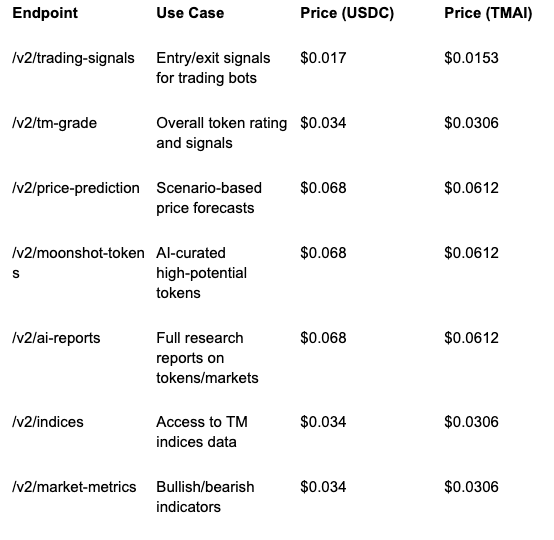
Recommended Token Metrics Endpoints for x402

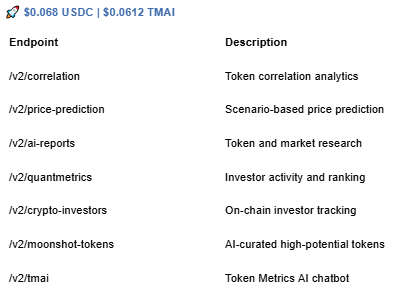
These endpoints are commonly used by agents and developers building on x402. All are pay-per-call with transparent pricing.

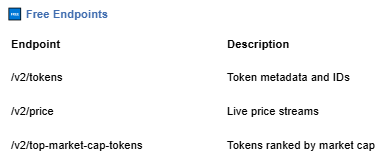
Full endpoint list and docs: https://developers.tokenmetrics.com 

Common Errors and How to Fix Them

Here are the most common issues developers encounter with x402 and their solutions.

Error: Payment Failed (402 Still Returned After Retry)

This usually means your wallet does not have enough USDC or TMAI to cover the call, or the payment transaction failed on-chain.

  • Check your wallet balance on Base (use a block explorer or your wallet app)
  • Make sure you are on the correct network (Base mainnet for production, Base Sepolia for testnet)
  • Verify your private key has permission to spend the token (no allowance issues for most x402 flows, but check if using a smart contract wallet)
  • Try a smaller request or switch to a cheaper endpoint to test

Error: Network Timeout

x402 requests take longer than standard API calls because they include a payment transaction. If you see timeouts, increase your client timeout.

  • Set timeout to at least 30 seconds (30000ms in Axios, 30.0 in HTTPX)
  • Check your RPC endpoint is responsive (viem/eth-account uses public RPCs by default, which can be slow)
  • Consider using a dedicated RPC provider (Alchemy, Infura, QuickNode) for faster settlement

Error: 429 Rate Limit Exceeded

Even with pay-per-call, Token Metrics enforces rate limits to prevent abuse. If you hit a 429, back off and retry.

  • Implement exponential backoff (wait 1s, 2s, 4s, etc. between retries)
  • Spread requests over time instead of bursting
  • For high-volume use cases, contact Token Metrics to discuss rate limit increases

Error: Invalid Header or Missing x-coinbase-402

If you forget the x-coinbase-402: true header, the server will treat your request as a standard API call and may return a 401 Unauthorized if no API key is present.

  • Always include x-coinbase-402: true in headers for x402 requests
  • Do not send x-api-key when using x402 (the header is mutually exclusive)
  • Double-check header spelling (it is x-coinbase-402, not x-402 or x-coinbase-payment)

Production Tips

  • Use environment variables for private keys, never hardcode them
  • Set reasonable max_payment limits to avoid overspending (especially with TMAI)
  • Log payment transactions for accounting and debugging
  • Monitor your wallet balance and set up alerts for low funds
  • Test thoroughly on Base Sepolia testnet before going to mainnet
  • Use TMAI for production to get the 10% discount on every call
  • Cache responses when possible to reduce redundant paid calls
  • Implement retry logic with exponential backoff for transient errors

Why This Matters for Agents

Traditional APIs force agents to carry API keys, which creates security risks and requires human intervention for key rotation and billing. With x402, agents can pay for themselves using wallet funds, making them truly autonomous. This unlocks agentic commerce where AI systems compose services on the fly, paying only for what they need without upfront subscriptions or complex auth flows.

For Token Metrics specifically, x402 means agents can pull real-time crypto intelligence (signals, grades, predictions, research) as part of their decision loops. They can chain our endpoints with other x402-enabled tools like Heurist Mesh (on-chain data), Tavily (web search), and Firecrawl (content extraction) to build sophisticated, multi-source analysis workflows. It is HTTP-native payments meeting real-world agent use cases.

FAQs

Can I use the same wallet for multiple agents?

Yes. Each agent (or client instance) can use the same wallet, but be aware of nonce management if making concurrent requests. The x402 libraries handle this automatically.

Do I need to approve token spending before using x402?

No. The x402 payment flow uses direct transfers, not approvals. Your wallet just needs sufficient balance.

Can I see my payment history?

Yes. Check x402scan (https://x402scan.com/composer/feed) for a live feed of all x402 transactions, or view your wallet's transaction history on a Base block explorer.

What if I want to use a different payment token?

Currently x402 with Token Metrics supports USDC and TMAI on Base. To request support for additional tokens, contact Token Metrics.

How do I switch from testnet to mainnet?

Change your viem chain from baseSepolia to base (in Node.js) or update your RPC URL (in Python). Make sure your wallet has mainnet USDC or TMAI.

Can I use x402 in browser-based apps?

Yes, but you will need a browser wallet extension (like MetaMask or Coinbase Wallet) and a frontend-compatible x402 library. The current x402-axios and x402-python libraries are designed for server-side or Node.js environments.

Next Steps

Disclosure

Educational and informational purposes only. x402 involves crypto payments on public blockchains. Understand the risks, secure your private keys, and test thoroughly before production use. Token Metrics does not provide financial advice.

Quick Links

About Token Metrics

Token Metrics provides powerful crypto analytics, signals, and AI-driven tools to help you make smarter trading and investment decisions. Start exploring Token Metrics ratings and APIs today for data-driven success.

Research

Our x402 Integration Is Live: Pay-Per-Call Access to Token Metrics—No API Key Required

Token Metrics Team
7 min read

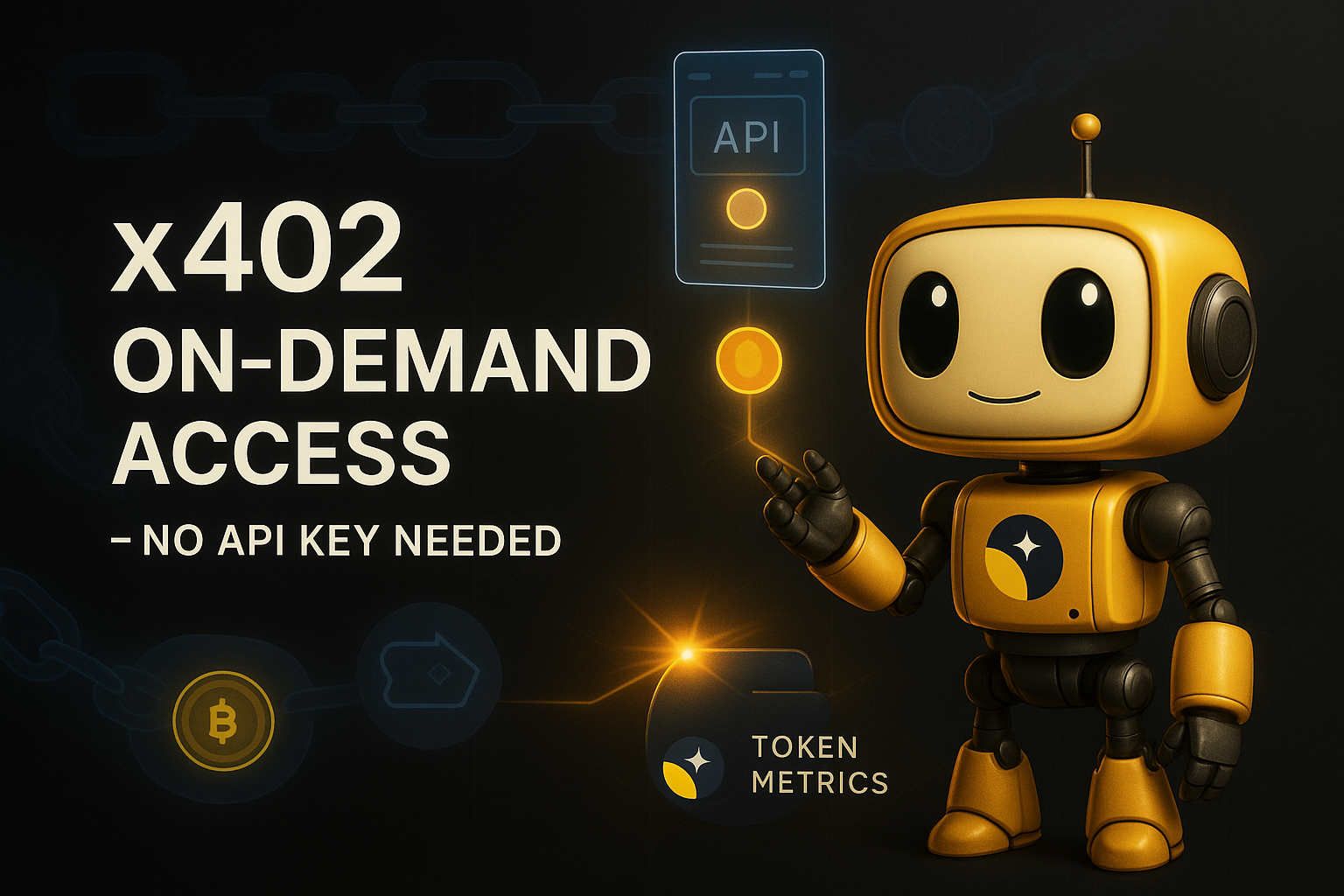
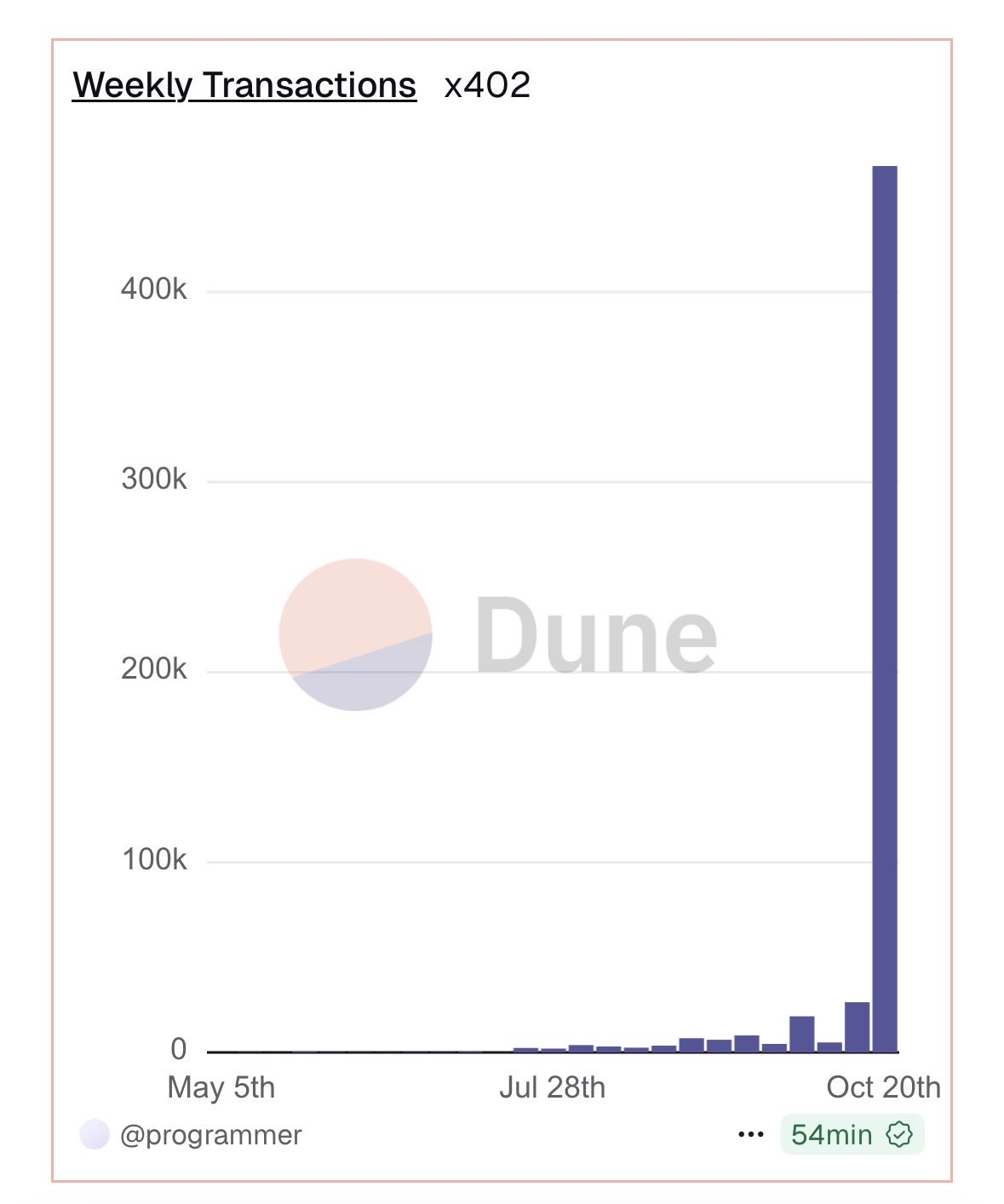
Developers are already shipping with x402 at scale: 450,000+ weekly transactions, 700+ projects. This momentum is why our Token Metrics x402 integration matters for agents and apps that need real crypto intelligence on demand. You can now pay per API call using HTTP 402 and the x-coinbase-402 header, no API key required.

   _ 

Summary: Pay per API call to Token Metrics with x402 on Base using USDC or TMAI, set x-coinbase-402: true, and get instant access to trading signals, grades, and AI reports.

Check out the x402 ecosystem on Coingecko.


What You Get

Token Metrics now supports x402, the HTTP-native payment protocol from Coinbase. Users can call any public endpoint by paying per request with a wallet, eliminating API key management and upfront subscriptions. This makes Token Metrics data instantly accessible to AI agents, researchers, and developers who want on-demand crypto intelligence.

x402 enables truly flexible access where you pay only for what you use, with transparent per-call pricing in USDC or TMAI. The integration is live now across all Token Metrics public endpoints, from trading signals to AI reports. Here's everything you need to start calling Token Metrics with x402 today.

Quick Start

Get started with x402 + Token Metrics in three steps.

  1. Create a wallet client: Follow the x402 Quickstart for Buyers to set up a wallet client (Node.js with viem or Python with eth-account). Link: https://docs.cdp.coinbase.com/x402/docs/quickstart-buyers
  2. Set required headers: Add x-coinbase-402: true to any Token Metrics request. Optionally set x-payment-token: tmai for a 10% discount (defaults to usdc). Do not send x-api-key when using x402.
  3. Call any endpoint: Make a request to https://api.tokenmetrics.com/v2/[endpoint] with your wallet client. Payment happens automatically via x402 settlement.

That is it. Your wallet pays per call, and you get instant access to Token Metrics data with no subscription overhead.

Required Headers


Endpoint Pricing

Transparent per-call pricing across all Token Metrics public endpoints. Pay in USDC or get 10% off with TMAI.


All prices are per single call. Paying with TMAI automatically applies a 10% discount.

Try It on x402 Composer

If you want to see x402 + Token Metrics in action without writing code, head to x402 Composer. Composer is x402scan's playground for AI agents that pay per tool call. You can open a Token Metrics agent, chat with it, and watch real tool calls and USDC/TMAI settlements stream into the live Feed.

Composer surfaces active agents using Token Metrics endpoints like trading signals, price predictions, and AI reports. It is a great way to explore what is possible before you build your own integration. Link: https://x402scan.com/composer

Why x402 Changes the Game

Traditional API access requires upfront subscriptions, fixed rate limits, and key management overhead. x402 flips that model by letting you pay per call with a crypto wallet, with no API keys or monthly commitments. This is especially powerful for AI agents, which need flexible, on-demand access to external data without human intervention.

For Token Metrics, x402 unlocks agentic commerce where agents can autonomously pull crypto intelligence, pay only for what they use, and compose our endpoints with other x402-enabled tools like Heurist Mesh, Tavily, and Firecrawl. It is HTTP-native payments meeting real-world agent workflows.

What is x402?

x402 is an open-source HTTP-native payment protocol developed by Coinbase. It uses the HTTP 402 status code (Payment Required) to enable pay-per-request access to APIs and services. When you make a request with the x-coinbase-402 header, the server returns a payment challenge, your wallet signs and submits payment, and the server fulfills the request once settlement is verified.

The protocol runs on Base and Solana, with USDC and TMAI as the primary payment tokens. x402 is designed for composability, agents can chain multiple paid calls across different providers in a single workflow, paying each service directly without intermediaries. Learn more at the x402 Quickstart for Buyers: https://docs.cdp.coinbase.com/x402/docs/quickstart-buyers

FAQs

Do I need an API key to use x402 with Token Metrics?

No. When you set x-coinbase-402: true, your wallet signature replaces API key authentication. Do not send x-api-key in your requests.

Can I use x402 with a free trial or test wallet?

Yes, but you will need testnet USDC or TMAI on Base Sepolia (testnet) for development. Production calls require mainnet tokens.

How do I see my payment history?

Check x402scan for transaction logs and tool call history. Your wallet will also show outgoing USDC/TMAI transactions. Visit https://www.x402scan.com.

What happens if my wallet balance is too low?

The x402 client will return a payment failure before making the API call. Top up your wallet and retry.

Can I use x402 in production apps?

Yes. x402 is live on Base mainnet. Set appropriate spend limits and handle payment errors gracefully in your code.

Next Steps

Disclosure

Educational and informational purposes only. x402 involves crypto payments on public blockchains. Understand the risks, manage your wallet security, and test thoroughly before production use. Token Metrics does not provide financial advice.

Powered by Token Metrics

Your AI-powered crypto research experience is made possible by Token Metrics. Discover data-driven insights and advanced analytics on your favorite coins and tokens.

Research

Uniswap Price Prediction 2027: $13.50-$43 Target Analysis

Token Metrics Team
8 min read

Uniswap Price Prediction: Market Context for UNI in the 2027 Case

DeFi protocols are maturing beyond early ponzi dynamics toward sustainable revenue models. Uniswap operates in this evolving landscape where real yield and proven product market fit increasingly drive valuations rather than speculation alone. Growing regulatory pressure on centralized platforms creates tailwinds for decentralized alternatives.

The price prediction scenario bands below reflect how UNI might perform across different total crypto market cap environments. Each tier represents a distinct liquidity regime, from bear conditions with muted DeFi activity to moon price prediction scenarios where decentralized infrastructure captures significant value from traditional finance.


Disclosure

Educational purposes only, not financial advice. Crypto is volatile, do your own research and manage risk.

How to read this price prediction:

Each band blends cycle analogues and market cap share math with TA guardrails. Base assumes steady adoption and neutral or positive macro. Moon layers in a liquidity boom. Bear assumes muted flows and tighter liquidity.

TM Agent baseline:

Token Metrics TM Grade is 69%, Buy, and the trading signal is bullish. Price prediction scenarios cluster roughly between $6.50 and $28, with a base case price target near $13.50.

Live details: Uniswap Token Details 

Affiliate Disclosure: We may earn a commission from qualifying purchases made via this link, at no extra cost to you.

Key Takeaways

  • Scenario driven, outcomes hinge on total crypto market cap, higher liquidity and adoption lift the bands.
  • Fundamentals: Fundamental Grade 79.88% (Community 77%, Tokenomics 100%, Exchange 100%, VC 66%, DeFi Scanner 62%).
  • Technology: Technology Grade 86.88% (Activity 72%, Repository 72%, Collaboration 100%, Security N/A, DeFi Scanner 62%).
  • TM Agent gist: bullish bias with a base case near $13.50 and a broad range between $6.50 and $28.
  • Education only, not financial advice.

Uniswap Price Prediction: Scenario Analysis

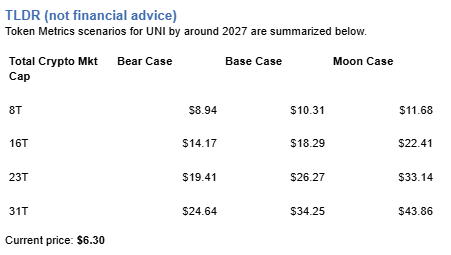
Token Metrics price prediction scenarios span four market cap tiers, each representing different levels of crypto market maturity and liquidity:

8T Market Cap Price Prediction:

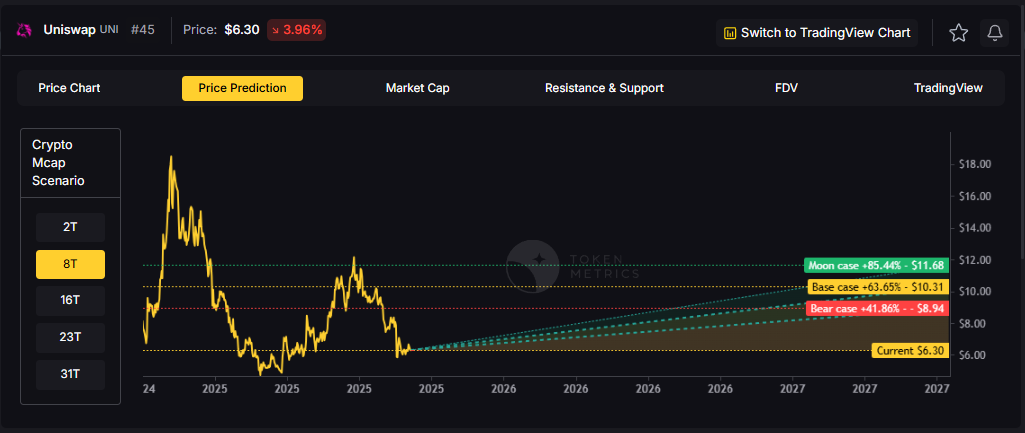
At an 8 trillion dollar total crypto market cap, UNI price prediction projects to $8.94 in bear conditions, $10.31 in the base case, and $11.68 in bullish scenarios.

16T Market Cap Price Prediction:

Doubling the market to 16 trillion expands the price prediction range to $14.17 (bear), $18.29 (base), and $22.41 (moon).

23T Market Cap Price Prediction:

At 23 trillion, the price forecast scenarios show $19.41, $26.27, and $33.14 respectively.

31T Market Cap Price Prediction:

In the maximum liquidity scenario of 31 trillion, UNI price prediction could reach $24.64 (bear), $34.25 (base), or $43.86 (moon).

Each tier assumes progressively stronger market conditions, with the base case price prediction reflecting steady growth and the moon case requiring sustained bull market dynamics.

Why Consider the Indices with Top-100 Exposure

Uniswap represents one opportunity among hundreds in crypto markets. Token Metrics Indices bundle UNI with top one hundred assets for systematic exposure to the strongest projects. Single tokens face idiosyncratic risks that diversified baskets mitigate.

Historical index performance demonstrates the value of systematic diversification versus concentrated positions.

Join the early access list

What Is Uniswap?

Uniswap is a decentralized exchange protocol built on Ethereum that enables token swaps using automated market makers instead of order books. It aims to provide open access to liquidity for traders, developers, and applications through transparent smart contracts.

UNI is the governance token that lets holders vote on protocol upgrades and parameters, aligning incentives across the ecosystem. The protocol is a market leader in decentralized exchange activity with broad integration across wallets and DeFi apps.

Token Metrics AI Analysis for Price Prediction

Token Metrics AI provides comprehensive context on Uniswap's positioning and challenges that inform our price prediction models.

Vision: Uniswap aims to create a fully decentralized and permissionless financial market where anyone can trade or provide liquidity without relying on centralized intermediaries. Its vision emphasizes open access, censorship resistance, and community driven governance.

Problem: Traditional exchanges require trusted intermediaries to match buyers and sellers, creating barriers to access, custody risks, and potential for censorship. In DeFi, the lack of efficient, trustless mechanisms for token swaps limits interoperability and liquidity across applications.

Solution: Uniswap solves this by using smart contracts to create liquidity pools funded by users who earn trading fees in return. The protocol automatically prices assets using a constant product formula, enabling seamless swaps. UNI token holders can participate in governance, influencing parameters like fee structures and protocol upgrades.

Market Analysis: Uniswap operates within the broader DeFi and Ethereum ecosystems, competing with other decentralized exchanges like SushiSwap, Curve, and Balancer. It is a market leader in terms of cumulative trading volume and liquidity depth. Adoption is strengthened by strong developer activity, widespread integration across wallets and dApps, and a large user base.

Fundamental and Technology Snapshot from Token Metrics

Fundamental Grade: 79.88% (Community 77%, Tokenomics 100%, Exchange 100%, VC 66%, DeFi Scanner 62%).


Technology Grade: 86.88% (Activity 72%, Repository 72%, Collaboration 100%, Security N/A, DeFi Scanner 62%).

Catalysts That Skew Bullish for Price Prediction

  • Institutional and retail access expands with ETFs, listings, and integrations
  • Macro tailwinds from lower real rates and improving liquidity
  • Product or roadmap milestones such as upgrades, scaling, or partnerships
  • These factors could push UNI toward higher price prediction targets

Risks That Skew Bearish for Price Prediction

  • Macro risk off from tightening or liquidity shocks
  • Regulatory actions or infrastructure outages
  • Competitive displacement across DEXs or changes to validator and liquidity incentives
  • These factors could push UNI toward lower price prediction scenarios

FAQs: Uniswap Price Prediction

Will UNI hit $20 by 2027 according to price predictions?

The 16T price prediction scenario shows UNI at $18.29 in the base case, which does not exceed $20. However, the 23T base case shows $26.27, surpassing the $20 target. Price prediction outcome depends on total crypto market cap growth and Uniswap maintaining market share. Not financial advice.

Can UNI 10x from current levels based on price predictions?

At current price of $6.30, a 10x would reach $63.00. This falls within none of the listed price prediction scenarios, which top out at $43.86 in the 31T moon case. Bear in mind that 10x returns require substantial market cap expansion beyond our modeled scenarios. Not financial advice.

What price could UNI reach in the moon case price prediction?

Moon case price predictions range from $11.68 at 8T to $43.86 at 31T total crypto market cap. These price prediction scenarios assume maximum liquidity expansion and strong Uniswap adoption. Not financial advice.

What is the 2027 Uniswap price prediction?

Based on Token Metrics analysis, the 2027 price prediction for Uniswap centers around $13.50 in the base case under current market conditions, with a range between $6.50 and $28 depending on market scenarios. Bullish price predictions with strong market conditions range from $10.31 to $43.86 across different total crypto market cap environments.

What drives UNI price predictions?

UNI price predictions are driven by DEX trading volume, liquidity provider activity, governance participation, protocol fee revenue, and competition from other decentralized exchanges. The strong technology grade (86.88%) and bullish signal support upward price potential. DeFi adoption rates and regulatory clarity around decentralized exchanges remain primary drivers for reaching upper price prediction targets.

Can UNI reach $30-$40 by 2027?

According to our price prediction models, UNI could reach $30-$40 in the 23T moon case ($33.14) and in the 31T scenarios where the base case is $34.25 and the moon case is $43.86. These price prediction outcomes require significant crypto market expansion and Uniswap maintaining DEX market leadership. Not financial advice.


Next Steps

Disclosure

Educational purposes only, not financial advice. Crypto is volatile, do your own research and manage risk.

Why Use Token Metrics for Uniswap Research?

  • Get on-chain ratings, AI-powered scenario projections, backtested indices, and exclusive insights for Uniswap and other top-100 crypto assets.
  • Spot emerging trends before the crowd and manage risk with our transparent AI grades.
  • Token Metrics helps you save time, avoid hidden pitfalls, and discover data-driven opportunities in DeFi.
Choose from Platinum, Gold, and Silver packages
Reach with 25–30% open rates and 0.5–1% CTR
Craft your own custom ad—from banners to tailored copy
Perfect for Crypto Exchanges, SaaS Tools, DeFi, and AI Products