Crypto Basics

How to Mine Monero and Is It Profitable?

Learn about Monero mining and uncover profitability secrets. A comprehensive guide for aspiring miners to learn and earn more in the crypto space.
S. Vishwa
8 Minutes
MIN

Cryptocurrency mining has become an increasingly popular way to earn passive income and contribute to the decentralized networks that power these digital assets. Monero (XMR), in particular, has gained significant attention due to its focus on privacy and decentralization. 

If you're considering Monero mining in 2024, this comprehensive guide will provide all the information you need to determine its profitability and start your mining journey.

Understanding Monero (XMR)

Monero is a privacy-focused cryptocurrency that was launched in 2014. It is designed to give users anonymity by ensuring that transactions cannot be traced or tracked. 

Unlike Bitcoin, where transaction details are visible to everyone on the network, Monero transactions are completely private. This makes it a popular choice for individuals who value financial privacy.

Monero is also considered the largest privacy coin in the industry. It has experienced significant growth, reaching an all-time high of around $517.62 during the 2021 bull market. 

Despite facing regulatory challenges and delistings on major crypto exchanges, Monero continues to maintain a strong presence in the cryptocurrency market.

The Basics of Monero Mining

Monero mining is the process of validating transactions on the Monero network and adding them to the blockchain. Miners use their computational power to solve complex mathematical puzzles, and in return, they are rewarded with newly minted Monero coins. 

This process is known as proof-of-work (PoW) mining, which is essential for maintaining the security and integrity of the Monero network. Unlike Bitcoin, which relies on the SHA-256 algorithm for mining, Monero uses a unique algorithm called RandomX. 

This algorithm is designed to be ASIC-resistant, meaning that specialized mining hardware cannot be used to gain an unfair advantage. As a result, Monero mining can be done using consumer-grade hardware, such as CPUs and GPUs.

Solo Mining vs. Pool Mining

When it comes to Monero mining, miners have the option to mine solo or join a mining pool. Solo mining involves independently validating transactions and attempting to mine a block independently. 

While solo mining can potentially yield higher rewards, it requires substantial computational power and may take a long time to find a block, making it less suitable for beginners.

On the other hand, pool mining involves joining a group of miners who combine their computational resources to increase their chances of mining a block. 

When a block is successfully mined, the rewards are distributed among the pool members based on their contributed computational power. Pool mining provides more consistent and frequent payouts, making it a popular choice for most miners.

Factors Affecting Monero Mining's Profitability

Before diving into Monero mining, it's essential to consider several factors that can affect its profitability. These factors include:

Hashrate: The hashrate refers to the computational power dedicated to mining Monero. A higher hashrate increases the chances of successfully mining a block and earning rewards.

Power Consumption: Mining requires a significant amount of electricity, and the cost of electricity can impact your profitability. Minimizing power consumption through efficient hardware and cost-effective electricity sources is crucial.

Mining Difficulty: The mining difficulty adjusts dynamically to maintain a consistent block generation time. Higher mining difficulty means more computational power is required to mine a block, which can impact profitability.

Hardware Costs: The initial investment in mining hardware can significantly impact profitability. It is important to consider the cost of CPUs or GPUs and their efficiency in terms of hashrate and power consumption.

Pool Fees: If you choose to mine in a pool, you'll need to consider the fees charged by the pool operator. These fees typically range from 0% to 2% of the mining rewards.

Considering these factors and performing thorough calculations using Monero mining profitability calculators can help you estimate your potential earnings and determine if mining Monero is financially viable for you.

Monero Mining Hardware

Monero mining can be done using both CPUs and GPUs, although CPUs are generally more efficient for mining this cryptocurrency. 

Monero's ASIC resistance ensures a level playing field for all miners, unlike Bitcoin, which is now dominated by specialized ASIC mining hardware.

When selecting hardware for Monero mining, it's essential to consider factors such as hashrate, power consumption, and cost-effectiveness. 

CPUs with multiple cores and high clock speeds are favored for Monero mining. Popular CPU models for mining include AMD Ryzen and Intel Core processors.

AMD Radeon graphics cards are generally preferred for GPU mining due to their high computational power and cost efficiency. However, it's crucial to research the specific models and compare their hashrates and power consumption to make an informed decision.

Mining Software for Monero

To begin mining Monero, you'll need suitable mining software that is compatible with your chosen hardware. The Monero Project provides two official options for mining: the Monero GUI Wallet and the Monero CLI (Command Line Interface).

The Monero GUI Wallet is a user-friendly graphical interface that allows you to mine Monero using your CPU. It is suitable for beginners who prefer a more straightforward setup and intuitive mining experience.

The Monero CLI, on the other hand, is a command-line interface that provides more flexibility and control over the mining process. It is recommended for advanced users who are comfortable with command-line interactions and want to mine using CPUs or GPUs.

If you choose to mine in a pool or with GPU hardware, you'll need dedicated mining software compatible with your setup. Popular mining software options for Monero include XMRig and CSminer. You must download these software packages from trusted sources to avoid any security risks.

Choosing a Monero Mining Pool

When mining Monero in a pool, choosing a reputable and reliable mining pool that suits your preferences is important. A mining pool is a group of miners who combine their computational power to increase their chances of mining a block.

Consider factors such as the pool's hashrate, fee structure, payout frequency, and reputation when selecting a mining pool. 

Some popular Monero mining pools include Minergate, 2Miners, and SupportXMR. Researching and comparing different pool options can help you find the one that aligns with your mining goals.

Also Read - Cloud Mining Simplified

Monero Mining Profitability in 2024

Determining the profitability of Monero mining in 2024 requires careful consideration of various factors, including the ones mentioned earlier. 

While Monero mining can be financially rewarding, it's important to remember that cryptocurrency markets are highly volatile, and profitability can fluctuate.

To assess the profitability of Monero mining, consider your hardware costs, electricity expenses, mining difficulty, and the current price of Monero. Additionally, monitor market trends and monitor any regulatory developments that may impact Monero's value and demand.

While profitability is a significant consideration, supporting the Monero network and contributing to its decentralization is crucial. Many miners view their mining operations as a long-term investment in the future of Monero and the broader cryptocurrency ecosystem.

Also Read - Best and Profitable Crypto to Mine

Securing and Storing Monero

Once you have successfully mined Monero or acquired it through other means, securing and storing your XMR coins is crucial. As a privacy-focused cryptocurrency, Monero offers several wallet options that prioritize the confidentiality of your funds.

The Monero GUI Wallet and Monero CLI Wallet, provided by the Monero Project, are recommended for storing Monero securely. These wallets allow you to generate a private key and address, which are essential for accessing and managing your XMR coins.

Additionally, there are other reputable third-party wallet options available, such as the Trezor Model T hardware wallet and the Guarda Wallet. These wallets provide enhanced security features and support for multiple cryptocurrencies, including Monero.

Remember to follow best practices for securing your wallets, such as enabling two-factor authentication, keeping your private keys offline, and regularly updating your wallet software to protect against potential vulnerabilities.

The Future of Monero Mining

As with any cryptocurrency, the future of Monero mining is subject to various factors, including technological advancements, regulatory developments, and market trends. 

While it's challenging to predict the exact trajectory of Monero mining, several factors suggest a positive outlook. Monero's commitment to privacy and decentralization continues to resonate with users who value financial autonomy and security. 

As the demand for private and untraceable transactions grows, the utility and value of Monero may increase, potentially benefiting miners.

However, it's important to stay informed about regulatory developments and any potential challenges that may arise due to increased scrutiny of privacy-focused cryptocurrencies. 

Adapting to changing market conditions and remaining vigilant about profitability and mining strategies will be crucial for successful Monero mining in the future.

Conclusion

Monero mining offers an opportunity to earn passive income while supporting the privacy-focused ethos of the cryptocurrency. 

You can embark on a rewarding mining journey by understanding the basics of Monero mining, considering profitability factors, selecting suitable hardware and software, and securing your XMR coins.

Conduct thorough research, assess profitability regularly, and stay informed about market trends and regulatory developments. 

With careful planning and a commitment to the principles of Monero, you can contribute to the decentralized network and potentially reap the rewards of Monero mining in 2024 and beyond.

Disclaimer

The information provided on this website does not constitute investment advice, financial advice, trading advice, or any other advice, and you should not treat any of the website's content as such.

Token Metrics does not recommend buying, selling, or holding any cryptocurrency. Conduct your due diligence and consult your financial advisor before making investment decisions.

Build Smarter Crypto Apps &
AI Agents in Minutes, Not Months
Real-time prices, trading signals, and on-chain insights all from one powerful API.
Grab a Free API Key
Token Metrics Team
Token Metrics Team

Recent Posts

Research

APIs Explained: How They Power Software and Crypto

Token Metrics Team
5
MIN

APIs are the invisible connectors that let apps talk to each other. Whether you’re loading a weather widget, pulling crypto prices into a dashboard, or integrating an AI model, understanding how APIs work helps you design, evaluate, and secure systems that depend on reliable data.

What is an API?

An API—Application Programming Interface—is a clearly defined set of rules and contracts that lets one software program request services or data from another. At its core an API specifies how to format requests, what endpoints are available, what parameters are accepted, and how the provider will respond. Think of it as a menu at a restaurant: you pick dishes (requests), the kitchen prepares them (the service), and the waiter returns your order (the response) without exposing internal cooking processes.

APIs exist at many levels: operating system APIs expose filesystem and device operations, library APIs expose functions and classes, and web APIs expose remote services across networks. In modern web and mobile development, "API" often refers to HTTP-based interfaces that return structured data like JSON or XML.

How APIs Work: Requests, Responses, and Data Formats

Most web APIs operate on a request–response model. A client issues a request to a defined endpoint using a method (GET, POST, PUT, DELETE), optionally supplying parameters or a payload. The server processes the request and returns a response with a status code and body.

Key technical elements to understand:

  • Endpoints: URLs that map to resources or actions (e.g., /v1/prices).
  • HTTP Methods: Semantic actions (GET = read, POST = create, etc.).
  • Status Codes: 2xx successes, 4xx client errors, 5xx server errors.
  • Data Formats: JSON is ubiquitous for APIs due to its simplicity; XML and protobufs appear in legacy or high-performance systems.
  • Authentication & Authorization: API keys, OAuth tokens, JWTs, and mTLS govern who can access which endpoints.
  • Rate Limits & Quotas: Providers throttle requests to protect infrastructure and ensure fair use.

Real-time APIs may use WebSockets or server-sent events for streaming data rather than repeated HTTP polling. Designing for observability—clear logs, metrics, and error messages—improves operational resilience.

Common API Types and Protocols

Different projects require different API styles. Choosing a style depends on latency, flexibility, compatibility, and developer experience needs.

  • REST: Representational State Transfer emphasizes resources and standard HTTP verbs. RESTful APIs are easy to cache and widely supported.
  • GraphQL: Clients request exactly the fields they need in a single query, reducing over-fetching. GraphQL adds flexibility but requires careful performance tooling.
  • SOAP: An XML-heavy protocol that offers strict contracts and built-in standards for security and transactions; common in enterprise systems.
  • gRPC / Protobuf: High-performance RPC frameworks for microservices with compact binary payloads and strict typing.
  • Webhooks: Reverse-style APIs where a service pushes events to your endpoint, useful for near-real-time notifications without polling.

APIs are often packaged with SDKs for languages like Python, JavaScript, or Go to simplify integration. Documentation, example requests, and interactive consoles dramatically improve adoption.

APIs in Crypto and AI: Use Cases and Considerations

APIs are central to crypto and AI ecosystems. In crypto, APIs provide market data (prices, order books), on-chain insights (transaction history, token balances), and node RPC endpoints for smart contract interaction. AI systems use APIs to host inference endpoints, orchestrate models, and integrate external data sources for context.

Key considerations when selecting or building APIs for these domains:

  • Data Accuracy: In finance and blockchain, stale or inconsistent data can lead to incorrect analysis. Verify timestamps, aggregation logic, and reconciliation methods.
  • Latency and Throughput: Trading or real-time analytics may require low-latency streaming or websocket feeds instead of periodic REST calls.
  • Security: Protect API keys, enforce least privilege, use encrypted transport (HTTPS/TLS), and monitor for anomalous request patterns.
  • Reliability: Redundancy, caching strategies, and graceful degradation help maintain service if a provider faces outages.
  • Compliance & Privacy: Understand data retention, user privacy, and jurisdictional constraints when handling labeled or personal data.

Tools like Token Metrics combine market and on-chain data with AI to support research workflows that depend on reliable API feeds and model-driven signals.

Build Smarter Crypto Apps & AI Agents with Token Metrics

Token Metrics provides real-time prices, trading signals, and on-chain insights all from one powerful API. Grab a Free API Key

What is the difference between REST and GraphQL?

REST exposes multiple endpoints representing resources; clients may need several calls to assemble data. GraphQL exposes a single query endpoint where clients request precisely the fields they need. REST is simpler to cache; GraphQL offers flexibility but can require extra server-side tooling to manage complex queries and performance.

How do I secure an API key?

Never embed keys in client-side code. Store keys in secure server environments or secrets managers, rotate keys periodically, apply scope and rate limits, and monitor usage. Implementing short-lived tokens and IP whitelisting adds protection for sensitive endpoints.

When should I use webhooks instead of polling?

Use webhooks when you need event-driven, near-real-time notifications and want to avoid the overhead of frequent polling. Webhooks push updates to your endpoint, but require you to handle retries, verify payload signatures, and secure the receiving endpoint.

Can I build an API for my blockchain node?

Yes. Many projects wrap node RPCs with REST or GraphQL layers to standardize queries and add caching, rate limiting, and enrichment (e.g., token metadata). Be mindful of node sync status, resource consumption, and privacy considerations when exposing node endpoints.

How do I evaluate an API provider?

Assess API documentation quality, uptime/SLAs, latency, data freshness, authentication options, and support channels. Request sample data, test in sandbox environments, and compare pricing with expected usage. For crypto use cases, verify on-chain data coverage and reconciliation methods.

Disclaimer

This article is for educational purposes and does not constitute investment advice or recommendations. Evaluate APIs, platforms, and tools against your own requirements and compliance obligations before use.

Token Metrics API

Free Crypto API: Build Smarter Crypto Apps at Zero Cost

Sam Monac
6 min
MIN

What Is a Free Crypto API?

A free crypto API gives developers access to cryptocurrency data without upfront costs. Think of it as a bridge between raw blockchain/market data and your application. APIs let you pull:

  • Real-time token prices and charts

  • Historical data for backtesting and research

  • Market cap, liquidity, and trading volumes

  • On-chain metrics such as wallet flows

  • AI-driven trading signals and predictive insights

Free tiers are invaluable for prototyping apps, dashboards, and bots. They let you validate ideas quickly before paying for higher throughput or advanced endpoints.

Why Developers Use Free Crypto APIs

Free crypto APIs aren’t just about saving money—they’re about learning fast and scaling smart:

  • Zero-Cost Entry – Start building MVPs without financial risk.

  • Rapid Prototyping – Test ideas like dashboards, bots, or AI agents quickly.

  • Market Exploration – Access broad coverage of tokens before committing.

  • Growth Path – Once demand grows, upgrade to premium tiers seamlessly.

📌 Tip: Use multiple free crypto APIs in parallel during early development. This helps you benchmark speed, reliability, and accuracy.

Key Features of the Token Metrics Free API

The Token Metrics free tier goes beyond basic price feeds by offering:

  • Real-Time Prices – Live data on Bitcoin, Ethereum, and thousands of tokens.

  • AI Trading Signals – Bull/Bear indicators that help power smarter strategies.

  • Secure Access – Encrypted endpoints with key-based authentication.

  • 30 Days of History – Enough to prototype backtests and analytics features.

Unlike many free crypto APIs, Token Metrics API provides both price data and intelligence, making it ideal for developers who want more than surface-level metrics.

Comparing Free Crypto APIs: Strengths & Trade-offs

  • CoinGecko & CoinMarketCap


    • Pros: Huge token coverage, great for charts and tickers.

    • Cons: Limited historical and no predictive analytics.

  • CryptoCompare


    • Pros: Rich historical tick-level data, good for backtesting.

    • Cons: Free tier limits depth and call volume.

  • Glassnode


    • Pros: Strong on-chain insights.

    • Cons: Many advanced datasets require paid access.

  • Alchemy & Infura


    • Pros: Node-level blockchain access for dApp builders.

    • Cons: Not designed for trading or analytics—raw blockchain data only.

  • Token Metrics


    • Pros: Real-time prices, AI signals, and on-chain analytics in one free tier.

    • Cons: Rate limits apply (upgrade available for higher throughput).

Popular Use Cases: From Bots to Dashboards

  • AI Crypto Trading Bots – Start testing automation using live prices and bull/bear signals.

  • Crypto Dashboards – Aggregate token ratings, prices, and trends for end users.

  • Research Tools – Run small-scale backtests with 30-day historical data.

  • Learning Projects – Ideal for students or developers exploring crypto APIs.

📌 Real-world example: Many developers use the Token Metrics free tier to prototype bots that later scale into production with paid plans.

Best Practices for Using Free Crypto APIs

  1. Start with Prototypes – Test multiple free APIs to compare reliability and latency.

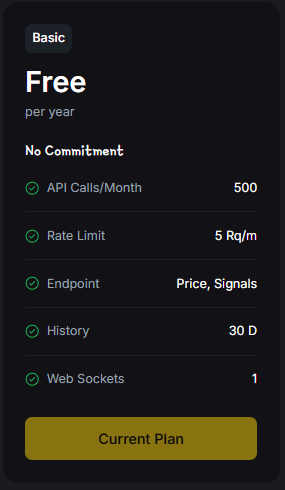
  2. Track Rate Limits – Free tiers often throttle requests (e.g., 5 req/min at Token Metrics).

  3. Combine Data Sources – Use Token Metrics for signals + CoinGecko for broad coverage.

  4. Secure Keys – Treat even free API keys as sensitive credentials.

  5. Prepare to Upgrade – Build flexible code so you can switch tiers or providers easily.

Beyond Token Metrics: Other Free Resources Worth Knowing

  • DefiLlama API – Free coverage of DeFi protocols, yields, and TVL.

  • Dune Analytics – Query blockchain data with SQL for free.

  • TradingView Widgets – Embed charts directly into dashboards.

  • Santiment API – Free endpoints for social/sentiment analytics.

These can complement Token Metrics. For example, you could combine Token Metrics signals + DefiLlama DeFi data + TradingView charts into one unified dashboard.

How to Get Started With the Token Metrics Free API

  1. Sign Up for a free Token Metrics account.

  2. Generate Your API Key instantly from your dashboard.

  3. Check the Docs for endpoints, examples, and code snippets.

  4. Prototype Your App with real-time prices and signals.

  5. Upgrade When Ready to unlock larger datasets and more endpoints.

👉 Grab Your Free Token Metrics API Key

FAQs About Free Crypto APIs

What can I access with Token Metrics Free API?
Live token prices, bull/bear trading signals, and 30 days of historical data.

Are free APIs reliable for production?
Not recommended—free tiers are best for prototypes. Paid tiers ensure reliability and scale.

What are the rate limits?
500 calls/month, 5 requests/minute, and 1 WebSocket connection.

Can I use the free API for trading bots?
Yes—ideal for prototyping. For production-level bots, upgrade for more throughput.

Scaling Beyond Free: Paid Plans & X.402

When your project outgrows free limits, Token Metrics offers flexible upgrades:

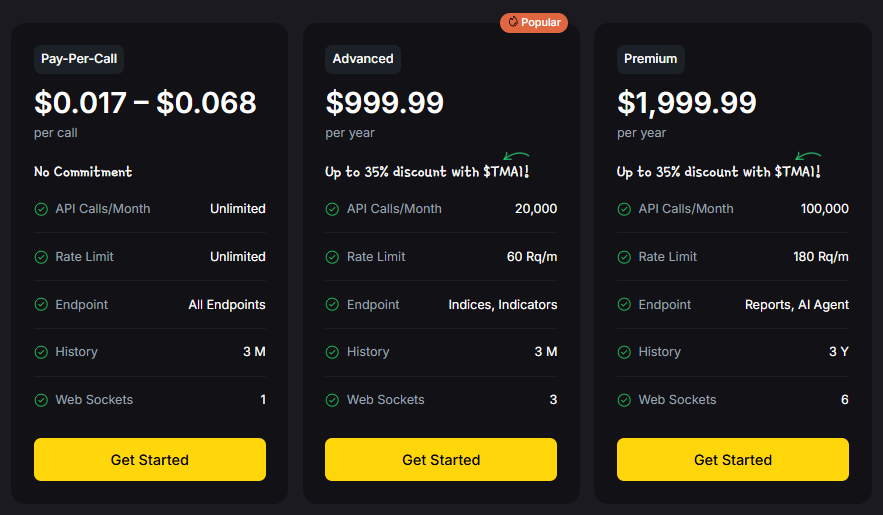
  • Pay-Per-Call (X.402) – As low as $0.017 per call, unlimited usage, no commitment.

  • Advanced Plan ($999.99/year) – 20,000 calls/month, indices & indicators, 3 WebSockets.

  • Premium Plan ($1,999.99/year) – 100,000 calls/month, AI agent + reports, 3 years of history.

With up to 35% off using TMAI tokens, scaling is cost-efficient.

📌 Why X.402 matters: Instead of committing upfront, you can grow gradually by paying per call—perfect for startups and side projects.

Build Smarter, Scale Easier

Free APIs help you start quickly and learn fast. Token Metrics gives you more than prices—it adds AI-powered signals and intelligence. Combine it with other free APIs, and you’ll have a toolkit that’s powerful enough for experimentation and flexible enough to scale into production.

👉 Create Your Free Token Metrics Account and Start Building

‍

Token Metrics API

Best Crypto API: Power Your Apps with Data, Signals, and AI

Sam Monac
6 min
MIN

What Makes a Crypto API the “Best”?

The best cryptocurrency API isn’t just about raw data. It’s about empowering your application to perform faster, smarter, and more reliably. A truly great crypto API balances:

  • Depth of Coverage – Spot, DeFi tokens, and on-chain metrics.

  • Speed – Real-time, low-latency updates that can handle market volatility.

  • Intelligence – Analytics and AI-driven signals that go beyond price feeds.

  • Scalability – Infrastructure that grows with your user base.

  • Reliability – High uptime and SLA-backed performance guarantees.

Whether you’re building a high-frequency crypto trading bot, a DeFi portfolio tracker, or a research platform, choosing the right API means aligning features with your mission.

Key Features to Look for in a Crypto API

Before selecting a crypto API, evaluate these criteria:

  • Real-Time & Historical Data – Do you get both sub-second updates and multi-year backtesting datasets?

  • On-Chain Analytics – Can you track wallet behavior, liquidity shifts, or whale flows?

  • AI-Powered Insights – Does the API offer predictive signals, ratings, or trend forecasts?

  • Ease of Integration – Look for clean docs, SDKs, and community examples.

  • Reliability & Uptime – Providers should publish incident histories and SLA commitments.

  • Pricing & Scalability – Free tiers for testing, plus paid plans that make sense as you scale.

  • Compliance & Security – Encrypted endpoints and strong authentication are a must.

📌 Tip for builders: Always start with multiple free crypto APIs and benchmark them in your stack before committing long term.

Comparing Leading Crypto APIs: Strengths & Weaknesses

  • CoinGecko & CoinMarketCap


    • Strengths: Huge token coverage, easy for price tickers and charts.

    • Weaknesses: Limited historical and on-chain analytics, slower refresh rates.

  • CryptoCompare


    • Strengths: Deep historical trade data, useful for backtesting.

    • Weaknesses: Less emphasis on predictive insights or AI.

  • Glassnode


    • Strengths: Advanced on-chain metrics (network health, wallet flows).

    • Weaknesses: Best for researchers, less suited to trading bots or dashboards.

  • Alchemy & Infura


    • Strengths: Node-level blockchain access, ideal for dApps and DeFi projects.

    • Weaknesses: Provide raw blockchain data, not trading analytics.

  • Token Metrics API


    • Strengths: Combines real-time prices, AI trading signals, ratings, portfolio analytics, and on-chain intelligence in one API.

    • Weaknesses: Free tier has rate limits (scalable through paid plans).

Why Token Metrics API Stands Out

Most crypto APIs specialize in one dimension (prices, exchange data, or on-chain metrics). Token Metrics unifies them all and adds AI intelligence on top.

  • Comprehensive Coverage – Prices, historical datasets, indices, grades, and on-chain data.

  • AI Trading Signals – Unique bull/bear calls and predictive analytics unavailable in traditional APIs.

  • Portfolio Intelligence – Ratings and indices that give context to raw numbers.

  • Enterprise-Ready – Encrypted endpoints, authentication, and scalable infrastructure.

  • Developer Friendly – Clear docs, quick-start guides, and responsive support.

📌 Put simply: most crypto APIs give you data. Token Metrics gives you data + intelligence.

Use Cases: From AI Crypto Trading Bots to Research Dashboards

  • AI Trading Bots – Execute strategies using both real-time prices and predictive signals.

  • DeFi Dashboards – Aggregate wallet flows, liquidity data, and token ratings.

  • Crypto Research Tools – Combine historical OHLC data with Token Metrics grades.

  • AI Agents – Power AI apps with actionable signals, not just raw feeds.

  • Enterprise Analytics – Build institutional dashboards with indices and compliance-ready datasets.

Best Practices for Implementing a Crypto API

  1. Prototype Across Providers – Test CoinGecko, Token Metrics, and others in parallel.

  2. Abstract Your Integration – Use a middleware layer to make switching APIs easier.

  3. Secure Your Keys – Store credentials safely and rotate them regularly.

  4. Plan for Scale – Rate limits hit fast; design for bursts in traffic.

  5. Leverage AI-Enhanced APIs – This is where user expectations are heading.

📌 For production apps: always monitor crypto API latency and uptime with tools like Datadog or Grafana.

Beyond Token Metrics: Other Useful Resources

While Token Metrics API offers an all-in-one solution, developers can also explore other resources for specialized needs:

  • Dune Analytics – Great for custom SQL-based blockchain queries.

  • DefiLlama API – Free API focused on DeFi protocol yields and TVL.

  • Santiment API – Alternative on-chain and sentiment analytics.

  • TradingView – Charting and integration options for front-end visualizations.

📌 Strategy tip: many developers combine multiple APIs—Token Metrics for signals + CoinGecko for breadth + DefiLlama for yields—to cover all angles.

Frequently Asked Questions About Crypto APIs

Which crypto API is best overall?
If you want real-time data plus AI-powered insights, crypto api is used. Token Metrics Api is the strongest all-in-one option. For niche use cases, CoinGecko is good for prices, Glassnode for on-chain analytics.

Is Token Metrics API free?
Yes, the free tier is perfect for prototyping. Paid plans unlock faster throughput, more history, and advanced endpoints.

How is Token Metrics different from CoinGecko?
CoinGecko tracks prices broadly. Token Metrics layers AI signals, indices, and predictive analytics for trading and research.

Can I build a trading bot with Token Metrics API?
Yes—many developers use the low-latency price feeds and predictive signals to power automated strategies.

Scaling With Paid Plans and X.402

As your project grows, Token Metrics offers flexible upgrade paths:

  • Pay-Per-Call (X.402) – As low as $0.017 per call, no commitment. Unlimited calls, all endpoints, and 3 months of historical data.

  • Advanced Plan ($999.99/year) – 20,000 calls/month, access to indices & indicators, 3 WebSockets.

  • Premium Plan ($1,999.99/year) – 100,000 calls/month, all endpoints including AI Agent & Reports, 3 years of historical data, and 6 WebSockets.

With up to 35% discounts when paying in TMAI tokens, scaling is cost-efficient.

📌 Why X.402 matters: Instead of locking into an annual plan, you can scale gradually with pay-per-call pricing—perfect for startups and experimental apps.

Build Smarter, Scale Easier

The best crypto API doesn’t just serve data—it helps your app think, act, and adapt. With Token Metrics, you start free, learn fast, and scale seamlessly. Combine it with other specialized APIs when needed, and you’ll have a development stack that’s both powerful and future-proof.

👉 Grab Your Free Token Metrics API Key and Start Building

‍

Choose from Platinum, Gold, and Silver packages
Reach with 25–30% open rates and 0.5–1% CTR
Craft your own custom ad—from banners to tailored copy
Perfect for Crypto Exchanges, SaaS Tools, DeFi, and AI Products