Back to blog
Crypto Basics

NFT Scams - 7 Simple Ways to Stay Protected

Learn everything about NFT scams and discover 7 ways to protect yourself in this descriptive guide.
Token Metrics Team
13 Minutes
Want Smarter Crypto Picks—Free?
See unbiased Token Metrics Ratings for BTC, ETH, and top alts.
Thank you! Your submission has been received!
Oops! Something went wrong while submitting the form.
 No credit card | 1-click unsubscribe

NFTs, or non-fungible tokens, have gained immense popularity in recent years. These digital assets provide a unique way to buy, sell, and trade digital art, collectibles, and other virtual items. 

However, as with any rapidly growing market, the rise of NFTs has also attracted scammers looking to take advantage of unsuspecting individuals. 

In this article, we will explore the topic of NFT scams and provide you with 7 simple ways to stay protected in this exciting but potentially risky landscape.

What are NFT Scams?

NFT scams are fraudulent activities that exploit the popularity of non-fungible tokens. These scams involve the sale of fake or low-value NFTs, deceiving buyers into investing in worthless digital assets. 

Scammers impersonate artists or celebrities, taking advantage of the unregulated nature of the NFT market. They may also use phishing attacks to steal funds or access NFT wallets. 

To protect themselves, investors should research and verify the authenticity of NFT projects, artists, and platforms before making any purchases or transactions.

10 Most Common NFT Scams

Here is the list of 10 common NFT scams -

1. Fake Artwork and Counterfeit NFTs

One of the most common NFT scams involves the creation and sale of fake artwork or counterfeit NFTs. Scammers may replicate popular digital art pieces or create entirely new ones, passing them off as original and valuable. Unsuspecting buyers may end up paying large sums of money for worthless or stolen artwork.

To protect yourself, it's essential to verify the authenticity of the artwork and the NFT before making a purchase. Research the artist, check for any previous sales or exhibitions, and look for reputable marketplaces or platforms that authenticate the NFTs they list.

2. Rug-Pull Scams

A rug-pull is a fraudulent scheme in which developers generate hype, excitement and anticipation for an NFT (non-fungible token), only to abruptly abandon the project and abscond with a substantial amount of funds raised from investors. 

These unscrupulous developers often leverage social media platforms to establish trust and create a buzz around their NFT, while patiently awaiting a surge of investor contributions. 

However, as soon as they accumulate a sufficient sum, they abruptly terminate the entire venture and disappear with the amassed funds.

3. Phishing and Impersonation Scams

Phishing and impersonation scams are prevalent in the NFT space. Scammers may create fake websites or social media accounts that closely resemble legitimate NFT marketplaces or artists' profiles. They lure unsuspecting individuals into providing their private keys or personal information, which can lead to the theft of their digital assets.

Always double-check the website URL and ensure you are visiting the official platform. Be cautious of unsolicited messages or emails asking for personal information or private keys. Legitimate NFT marketplaces will never ask for your private keys or passwords.

4. Bidding Scams

Bidding frauds frequently occur in the secondary market when attempting to sell your NFT. Once you list your NFT for sale, scammers strategically place the highest bid, tempting you to finalize the transaction with them. 

However, these deceptive individuals can surreptitiously alter the cryptocurrency used for bidding, unbeknownst to you.

To safeguard yourself from falling victim to such scams, it is important to consistently verify the cryptocurrency you are being paid with.

5. Pump and Dump NFT Schemes

Pump and dump schemes are not unique to NFTs but have made their way into the market. In these schemes, scammers artificially inflate the price of a particular NFT by creating hype and promoting it heavily. 

Once the price reaches a peak, the scammers sell their holdings, causing the value to plummet and leaving unsuspecting buyers with significant losses.

Be wary of sudden spikes in the price of an NFT and do thorough research before making an investment. Avoid jumping on the bandwagon without understanding the true value of the asset.

6. NFT Airdrop Scams

Airdrop frauds involve scammers who distribute free NFT giveaways through social media platforms. Once users visit the provided link, scammers request them to agree to the specified "terms and conditions." 

Additionally, they encourage users to share the message or tweet with others. Once the link is clicked, users are prompted to connect their MetaMask wallet credentials to claim the offered prize. 

The credentials entered by users will be stored in the scammers' system. Consequently, the scammers will gain unauthorized access to the user's MetaMask library, enabling them to easily pilfer their assets.

7. Customer Support NFT scams

Customer support scams are unfortunately a common occurrence across various industries. Fraudulent individuals exploit NFT holders by obtaining their contact details through platforms like Discord, Telegram, or Reddit, and then carry out deceptive NFT schemes.

These scammers adopt false personas by creating convincing profiles on legitimate-looking websites. Posing as technical staff from reputable marketplaces, they attempt to manipulate users with enticing offers. 

In some cases, these fraudsters even pretend to assist in resolving issues, cunningly extracting sensitive information from unsuspecting consumers.

If you fall prey to their deception and become convinced, these imposters will request your digital collectible's credentials and other sensitive data. Regrettably, once you provide this information, your NFT assets will be stolen by these scammers.

8. Ponzi and Pyramid Schemes

Ponzi and pyramid schemes have also found their way into the NFT space. Scammers promise high returns to early investors by recruiting new participants into the scheme. 

These schemes rely on a constant influx of new investors' money to pay off previous investors. Eventually, the scheme collapses, leaving the majority of participants with substantial financial losses.

9. Unverified Platforms and Marketplaces

The rapid growth of the NFT market has led to the emergence of numerous platforms and marketplaces. While many of these platforms are legitimate and reputable, some may be unverified or poorly regulated

Scammers can take advantage of these unverified platforms to list counterfeit or non-existent NFTs, deceiving buyers and making a quick profit.

Before engaging with a new platform or marketplace, do thorough research to ensure it has a solid reputation and positive user reviews. 

Look for platforms that have implemented security measures such as KYC (Know Your Customer) procedures and offer escrow services to protect buyers and sellers.

10. Front Running and Insider Trading

Front-running and insider trading are practices commonly associated with traditional financial markets. However, they can also occur in the NFT space. 

Front-running involves purchasing an NFT ahead of a known event or announcement, with the intention of selling it at a higher price once the news is made public. 

Insider trading occurs when individuals have access to non-public information about upcoming releases or collaborations and use that information to gain an unfair advantage.

To protect yourself from front-running and insider trading, be cautious of unusually timed sales or rapid price increases ahead of significant announcements. Stick to reputable platforms and marketplaces that have policies in place to prevent these practices.

7 Simple Ways to Stay Protected from NFT Scams

In order to effectively recognize and safeguard yourself against NFT scams, it is crucial to have a comprehensive understanding of their nature and tactics. 

By familiarizing yourself with the following information, you will be better equipped to spot and protect yourself from potential fraudulent activities in the NFT space.

NFT scams
Image Source - https://stackbrowser.com/blog/are-nfts-scams

1. Research Before You Buy - When considering purchasing an NFT, thorough research is crucial. Take the time to investigate the project, the artist or creator behind it, and the authenticity of the artwork or collectible. 

Look for reputable sources of information such as the artist's website, social media profiles, or reliable NFT marketplaces. Verify the history and reputation of the artist, and ensure that the project has a solid track record before making a purchase.

2. Stick to Established Marketplaces - To minimize the risk of falling victim to an NFT scam, it's advisable to stick to established and reputable NFT marketplaces. 

Platforms such as OpenSea, Rarible, and SuperRare have established themselves as trustworthy platforms in the NFT space. 

These marketplaces have implemented security measures to protect buyers and sellers, making them a safer option compared to lesser-known platforms.

3. Be Wary of Unrealistic Promises - If an NFT project promises extravagant returns or guarantees that seem too good to be true, exercise caution.

Scammers often lure unsuspecting individuals with promises of quick profits or exclusive deals. Remember that NFT investments, like any other form of investment, come with risks. 

Be skeptical of projects that make unrealistic claims and always do your due diligence before committing your funds.

4. Double-Check URLs and Wallet Addresses - Phishing attacks are common in the NFT space. Scammers may attempt to trick you into visiting fake websites or sending funds to fraudulent wallet addresses. 

Always double-check the URLs of websites you visit and ensure that they are legitimate. Verify wallet addresses with multiple sources before making any transactions. Be vigilant and cautious when interacting with unfamiliar links or addresses.

5. Utilize Security Measures - Protecting your digital assets is crucial in the world of NFTs. Utilize security measures such as two-factor authentication (2FA) to add an extra layer of protection to your NFT marketplace accounts. 

Enable 2FA on platforms that offer this feature to prevent unauthorized access to your account. Additionally, consider using a hardware wallet or a secure software wallet to store your NFTs offline and protect them from potential hacks or thefts.

6. Educate Yourself on Smart Contracts - Smart contracts play a significant role in the NFT ecosystem. These self-executing contracts govern the ownership, transfer, and conditions of NFT transactions. It's essential to educate yourself on how smart contracts work and understand the terms and conditions embedded within them. 

Familiarize yourself with the contract's code and ensure that it is audited by reputable third-party firms. By understanding the underlying smart contract, you can better assess the legitimacy and security of the NFT project.

7. Stay Informed and Trust Your Instincts - Staying informed about the latest trends, news, and developments in the NFT space is vital to staying protected. 

Follow reliable sources, join NFT communities, and engage with experienced collectors and artists. By staying informed, you can spot potential red flags, identify emerging scams, and make more informed decisions. 

Trust your instincts and if something feels off or too good to be true, it's better to err on the side of caution.

Also Read - NFT Rarity - What it Means and How to Calculate it?

How NFT Scams Affect the NFT Space?

The prevalence of NFT scams has far-reaching consequences for the NFT space and its stakeholders. Let's explore some of the key impacts:

Loss of Trust and Credibility - NFT scams erode trust and credibility within the NFT community. When investors and collectors fall victim to scams, they become hesitant to participate further, leading to a loss of confidence in the market as a whole. 

The lack of trust can hinder the growth and adoption of NFTs, limiting their potential as a legitimate asset class.

Financial Losses for Investors - NFT scams often result in significant financial losses for investors. Whether through Ponzi schemes, fake art purchases, or pump and dump schemes, individuals can lose substantial amounts of money. 

These losses not only impact the victims directly but also create a negative perception of NFT investments among potential participants.

Damage to Artists and Creators - NFT scams also harm artists and creators in several ways. When scammers plagiarize or counterfeit their work, it undermines their artistic integrity and can lead to financial losses. 

Additionally, the association of scams with the NFT space may discourage genuine artists from embracing NFTs as a platform for showcasing and monetizing their creations.

Examples of NFT Scams

These are few real examples of NFT scams in history

The Beeple's NFT Controversy - One notable example of an NFT scam involves the controversial artist Beeple. In 2021, Beeple's artwork titled "Everydays: The First 5000 Days" was sold for a staggering amount through a major NFT marketplace. 

However, it was later revealed that the buyer was associated with the artist himself, raising concerns about market manipulation and the legitimacy of the sale.

The Rarible Rugging Incident - Rarible, a popular NFT marketplace, experienced a rug pull incident in which scammers exploited a vulnerability in the platform's smart contract. 

By creating fake NFT listings and manipulating the bidding process, the scammers were able to defraud unsuspecting users, resulting in substantial financial losses.

Frequently Asked Questions

Q1. Are all NFTs scams?

No, not all NFTs are scams. NFTs provide a legitimate and innovative way to buy, sell, and collect digital assets. However, there are scams in the NFT space, and it's important to be cautious and conduct thorough research before making any transactions.

Q2. Can I get my money back if I fall victim to an NFT scam?

Unfortunately, it can be challenging to recover funds lost to NFT scams. Blockchain transactions are often irreversible, and scammers may take measures to remain anonymous.

This is why it's crucial to follow the preventive measures outlined in this article and exercise caution when participating in the NFT market.

Q3. How can I verify the authenticity of an NFT?

Verifying the authenticity of an NFT can be done through various means. Check the reputation and history of the artist or creator, look for official verification badges on marketplaces, and review the project's documentation. Some artists may also provide certificates of authenticity or proof of ownership.

Q4. What should I do if I suspect an NFT scam?

If you suspect an NFT scam, report it to the relevant marketplace or platform immediately. Provide all necessary information and evidence to support your claim. Additionally, consider reporting the scam to appropriate authorities or regulatory bodies to help protect others from falling victim.

Q5. Can I protect my NFTs from being stolen?

While no security measure can guarantee 100% protection, you can take steps to secure your NFTs. Use strong, unique passwords for your accounts, enable 2FA, and consider storing your NFTs in a hardware wallet or secure software wallet. Stay vigilant and regularly update your security practices.

Q6. Are there any regulations governing NFTs?

The regulatory landscape surrounding NFTs is still developing. Different countries may have varying regulations or guidelines concerning NFTs. 

It's essential to stay informed about the legal and regulatory implications of participating in the NFT market within your jurisdiction.

Final Thoughts

As the NFT market continues to expand, it is crucial to remain vigilant and informed about the various scams that exist. By understanding the most common NFT scams and taking proactive measures to protect yourself, you can confidently navigate this exciting digital landscape. 

Remember to verify the authenticity of NFTs, be cautious of phishing attempts, research before investing, and use reputable platforms. Stay informed and trust your instincts when engaging in the world of NFTs.

Disclaimer

The information provided on this website does not constitute investment advice, financial advice, trading advice, or any other sort of advice and you should not treat any of the website's content as such.

Token Metrics does not recommend that any cryptocurrency should be bought, sold, or held by you. Do conduct your own due diligence and consult your financial advisor before making any investment decisions.

Build Smarter Crypto Apps &
AI Agents in Minutes, Not Months
Real-time prices, trading signals, and on-chain insights all from one powerful API.
Grab a Free API Key
About Token Metrics
Token Metrics: AI-powered crypto research and ratings platform. We help investors make smarter decisions with unbiased Token Metrics Ratings, on-chain analytics, and editor-curated “Top 10” guides. Our platform distills thousands of data points into clear scores, trends, and alerts you can act on.
30 Employees
analysts, data scientists, and crypto engineers
Daily Briefings
concise market insights and “Top Picks”
Transparent & Compliant
Sponsored ≠ Ratings; research remains independent
Want Smarter Crypto Picks—Free?
See unbiased Token Metrics Ratings for BTC, ETH, and top alts.
Thank you! Your submission has been received!
Oops! Something went wrong while submitting the form.
 No credit card | 1-click unsubscribe
Token Metrics Team
Token Metrics Team

Recent Posts

Research

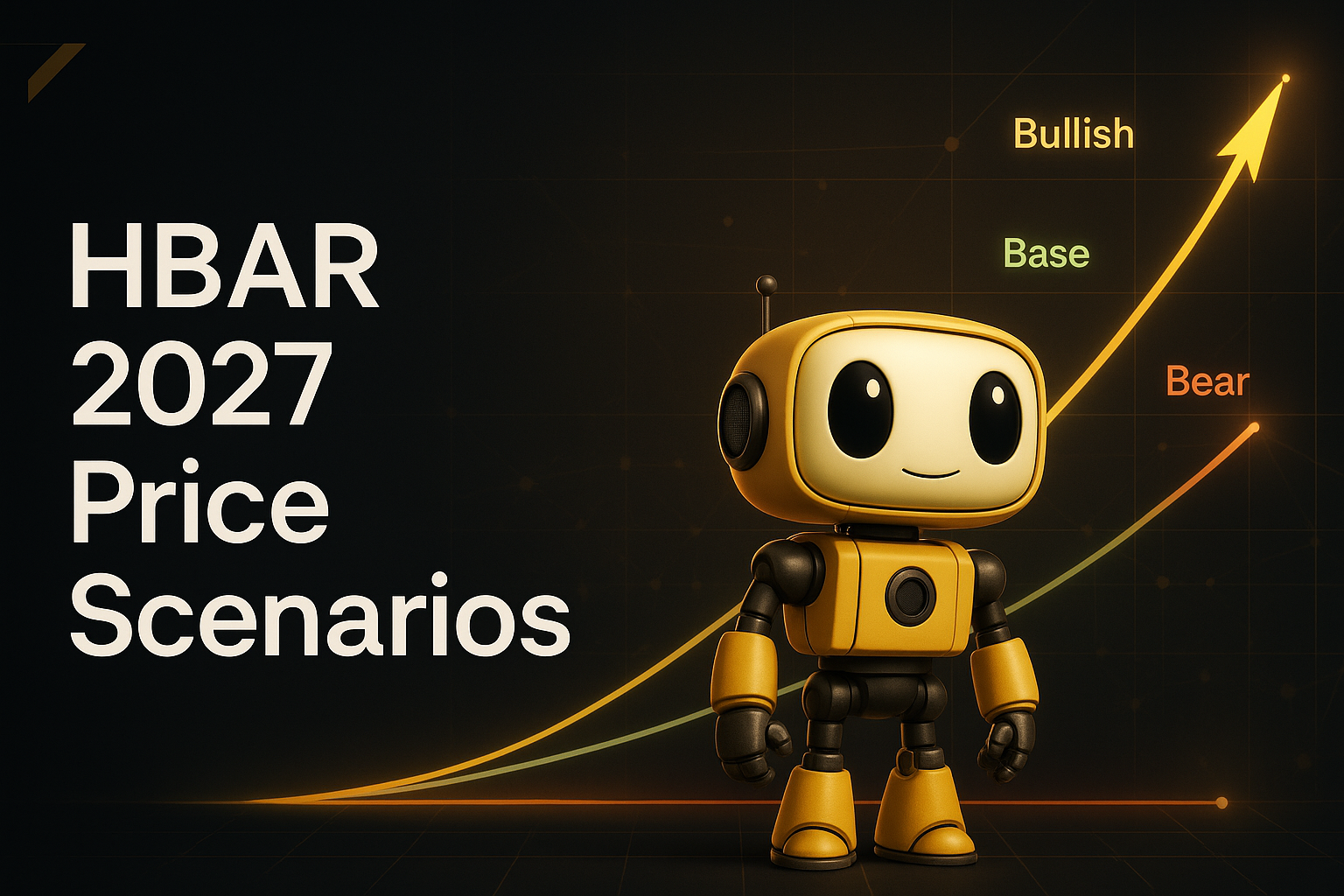
Hedera Price Prediction 2027: $0.10-$1.42 Target Analysis

Token Metrics Team
8 min read

Hedera Price Prediction: Portfolio Context for HBAR in the 2027 Landscape

Layer 1 tokens like Hedera represent bets on specific blockchain architectures winning developer and user mindshare. HBAR carries both systematic crypto risk and unsystematic risk from Hedera's technical roadmap execution and ecosystem growth. Multi-chain thesis suggests diversifying across several L1s rather than concentrating in one, since predicting which chains will dominate remains difficult.

The price prediction projections below show how HBAR might perform under different market cap scenarios. While Hedera may have strong fundamentals, prudent portfolio construction balances L1 exposure across Ethereum, competing smart contract platforms, and Bitcoin to capture the sector without overexposure to any single chain's fate.


Disclosure

Educational purposes only, not financial advice. Crypto is volatile, do your own research and manage risk.

How to read this price prediction:

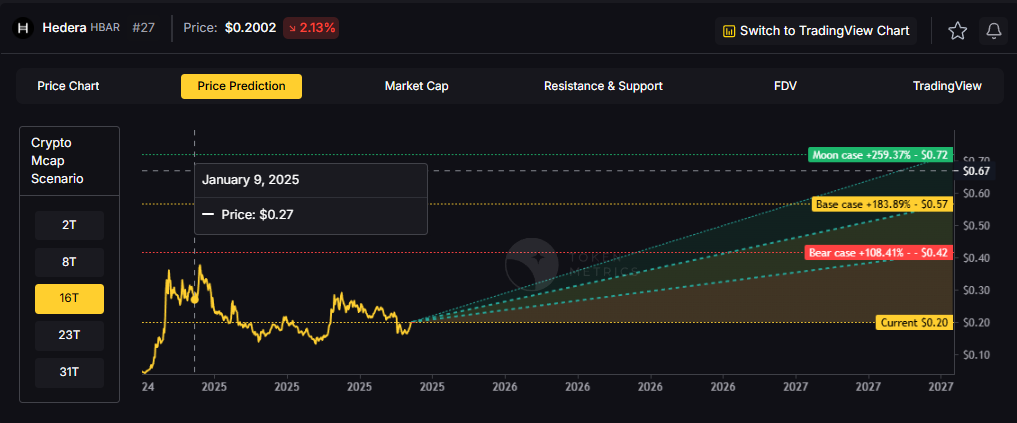
Each band blends cycle analogues and market-cap share math with TA guardrails. Base assumes steady adoption and neutral or positive macro. Moon layers in a liquidity boom. Bear assumes muted flows and tighter liquidity.

TM Agent baseline:

Token Metrics lead metric for Hedera price prediction, cashtag $HBAR, is a TM Grade of 61.8%, which maps to Hold, and the trading signal is bearish, indicating short-term downward momentum. This means Token Metrics views $HBAR as having reasonably solid fundamentals but limited conviction for strong outperformance in the near term.

A concise long-term numeric price prediction view for a 12-month horizon: Token Metrics scenarios center around a range of about $0.06 to $0.18, with a base case price target near $0.10, reflecting steady ecosystem growth, moderate adoption of Hedera services, and continued enterprise partnerships. Implication: if Bitcoin and broader crypto risk appetite improve, $HBAR could revisit the higher end of the price prediction range, while a risk-off market or slower-than-expected developer traction would keep it toward the lower bound.

Token Details

Key Takeaways

  • Scenario driven, outcomes hinge on total crypto market cap, higher liquidity and adoption lift the bands.
  • Single-asset concentration amplifies both upside and downside versus diversified approaches.
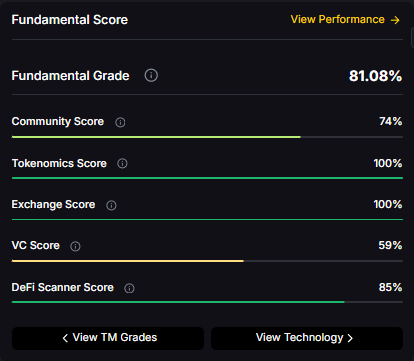
  • Fundamentals: Fundamental Grade 81.08% (Community 74%, Tokenomics 100%, Exchange 100%, VC 59%, DeFi Scanner 85%).
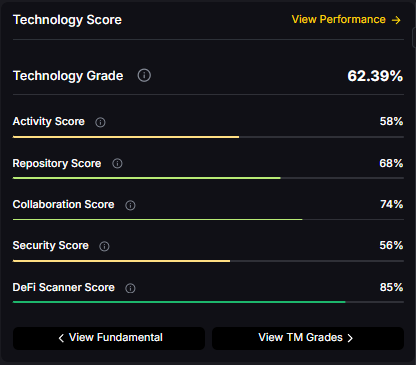
  • Technology: Technology Grade 62.39% (Activity 58%, Repository 68%, Collaboration 74%, Security 56%, DeFi Scanner 85%).
  • TM Agent gist: bearish short term, range view with upside if crypto risk appetite improves.
  • Education only, not financial advice.

Hedera Price Prediction: Scenario Analysis

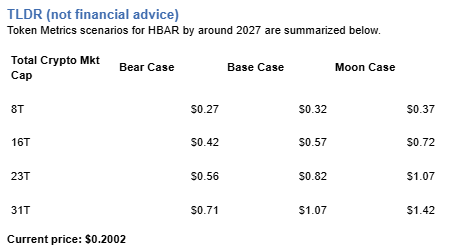
Token Metrics price prediction scenarios span four market cap tiers, each representing different levels of crypto market maturity and liquidity:

8T Market Cap Price Prediction:

At an 8 trillion dollar total crypto market cap, HBAR price prediction projects to $0.27 in bear conditions, $0.32 in the base case, and $0.37 in bullish scenarios.

16T Market Cap Price Prediction:

Doubling the market to 16 trillion expands the price prediction range to $0.42 (bear), $0.57 (base), and $0.72 (moon).

23T Market Cap Price Prediction:

At 23 trillion, the price forecast scenarios show $0.56, $0.82, and $1.07 respectively.

31T Market Cap Price Prediction:

In the maximum liquidity scenario of 31 trillion, HBAR price prediction could reach $0.71 (bear), $1.07 (base), or $1.42 (moon).

These price prediction ranges illustrate potential outcomes for concentrated HBAR positions, but investors should weigh whether single-asset exposure matches their risk tolerance or whether diversified strategies better suit their objectives.

The Case for Diversified Index Exposure

Professional investors across asset classes prefer diversified exposure over concentrated bets for good reason. Hedera faces numerous risks - technical vulnerabilities, competitive pressure, regulatory targeting, team execution failure - any of which could derail HBAR performance independent of broader market conditions. Token Metrics Indices spread this risk across one hundred tokens, ensuring no single failure destroys your crypto portfolio.

Diversification becomes especially critical in crypto given the sector's nascency and rapid evolution. Technologies and narratives that dominate today may be obsolete within years as the space matures. By holding HBAR exclusively, you're betting not only on crypto succeeding but on Hedera specifically remaining relevant. Index approaches hedge against picking the wrong horse while maintaining full crypto exposure.

Tax efficiency and rebalancing challenges also favor indices over managing concentrated positions. Token Metrics Indices handle portfolio construction, rebalancing, and position sizing systematically, eliminating the emotional and logistical burden of doing this manually with multiple tokens.

Early access to Token Metrics Indices 

What Is Hedera?

Hedera is a high-performance public ledger that emphasizes speed, low fees, and energy efficiency, positioning itself for enterprise and decentralized applications. It uses a unique Hashgraph consensus that enables fast finality and high throughput, paired with a council-governed model that targets real-world use cases like payments, tokenization, and decentralized identity.

HBAR is the native token used for fees, staking, and network security, and it supports smart contracts and decentralized file storage. Adoption draws from partnerships and integrations, though decentralization levels and reliance on institutional demand are often discussed in the community.

Token Metrics AI Analysis for Price Prediction

Token Metrics AI provides comprehensive context on Hedera's positioning and challenges that inform our price prediction models.

  • Vision: Hedera's vision is to provide a secure, fair, and scalable distributed ledger technology platform that supports decentralized applications and enterprise use cases globally. It emphasizes governed decentralization, aiming to combine the benefits of distributed systems with responsible oversight through its council-based governance model.
  • Problem: Many blockchain networks face trade-offs between scalability, security, and decentralization, often resulting in high transaction fees, slow processing times, or environmental concerns. Hedera aims to address these limitations by offering a system that supports high throughput and fast finality without sacrificing security or incurring significant energy costs, making it suitable for both enterprise and decentralized applications.
  • Solution: Hedera uses the Hashgraph consensus algorithm, a directed acyclic graph (DAG)-based approach that achieves asynchronous Byzantine fault tolerance, enabling fast, secure, and fair transaction processing. The network supports smart contracts, tokenization, and decentralized file storage, with HBAR serving as the native token for fees, staking, and network security. Its council-governed model aims to ensure stability and trust, particularly for institutional and enterprise users.
  • Market Analysis: Hedera operates in the Layer 1 blockchain space, competing with high-throughput platforms like Solana, Avalanche, and Algorand, while differentiating through its Hashgraph consensus and governed governance model. It targets enterprise adoption, focusing on use cases in supply chain, payments, and asset tokenization, which sets it apart from more community-driven or DeFi-centric networks. Adoption is influenced by strategic partnerships, developer engagement, and real-world integrations rather than speculative activity. Key risks include competition from established and emerging blockchains, regulatory scrutiny around governance tokens, and challenges in achieving broad decentralization.

Fundamental and Technology Snapshot from Token Metrics

Fundamental Grade: 81.08% (Community 74%, Tokenomics 100%, Exchange 100%, VC 59%, DeFi Scanner 85%).


Technology Grade: 62.39% (Activity 58%, Repository 68%, Collaboration 74%, Security 56%, DeFi Scanner 85%).


Catalysts That Skew Bullish for Price Prediction

  • Institutional and retail access expands with ETFs, listings, and integrations
  • Macro tailwinds from lower real rates and improving liquidity
  • Product or roadmap milestones such as upgrades, scaling, or partnerships
  • These factors could push HBAR toward higher price prediction targets

Risks That Skew Bearish for Price Prediction

  • Macro risk-off from tightening or liquidity shocks
  • Regulatory actions or infrastructure outages
  • Concentration in validator economics and competitive displacement
  • Protocol-specific execution risk and competitive pressure from alternatives
  • These factors could push HBAR toward lower price prediction scenarios

FAQs: Hedera Price Prediction

Can HBAR reach $1.00 according to price predictions?

Yes. Based on the price prediction scenarios, HBAR could reach $1.00 or above in the higher tiers. The 23T tier projects $1.07 in the moon case price forecast and the 31T tier projects $1.42 in the moon case. Achieving this price prediction requires broad market cap expansion and Hedera maintaining competitive position. Not financial advice.

What price could HBAR reach in the moon case price prediction?

Moon case price predictions range from $0.37 at 8T to $1.42 at 31T total crypto market cap. These price prediction scenarios assume maximum liquidity expansion and strong Hedera adoption. Diversified strategies aim to capture upside across multiple tokens rather than betting exclusively on any single moon scenario. Not financial advice.

What's the risk/reward profile for HBAR price prediction?

Risk and reward in our price prediction model span from $0.27 in the lowest bear case to $1.42 in the highest moon case. Downside risks include regulatory or infrastructure setbacks and competitive pressure, while upside drivers include improved liquidity and enterprise adoption. Concentrated positions amplify both tails, while diversified strategies smooth outcomes.

What is the 2027 Hedera price prediction?

Based on Token Metrics analysis, the 2027 price prediction for Hedera centers around $0.10 in the base case under current market conditions, with a range between $0.06 and $0.18 depending on market scenarios. Bullish price predictions range from $0.32 to $1.42 across different total crypto market cap environments.

What drives HBAR price predictions?

HBAR price predictions are driven by enterprise adoption of Hashgraph technology, institutional partnerships (Google Cloud, IBM, Boeing), council governance decisions, and competition from other Layer 1 platforms. The strong fundamentals (81.08% grade) support long-term price potential, though short-term bearish signals suggest caution. Enterprise use case development remains the primary driver for reaching upper price prediction targets.

Can HBAR reach $0.50 by 2027?

According to our price prediction models, HBAR could reach $0.50+ in multiple scenarios: the 16T base case ($0.57), 16T moon case ($0.72), and all higher market cap tiers. This price prediction outcome requires steady crypto market growth (16T+ total market cap) and Hedera maintaining strong enterprise partnerships. Not financial advice.


Next Steps

Disclosure

Educational purposes only, not financial advice. Crypto is volatile, concentration amplifies risk, and diversification is a fundamental principle of prudent portfolio construction. Do your own research and manage risk appropriately.

Research

LEO Token Price Prediction: Comprehensive Market Cap Scenario Analysis

Token Metrics Team
5 min read

LEO Token Price Prediction Framework: Market Cap Scenarios

Exchange tokens derive value from trading volume and platform revenue, creating linkage between crypto market activity and LEO price action. LEO Token delivers utility through reduced trading fees and enhanced platform services on Bitfinex and iFinex across Ethereum and EOS. Token Metrics price prediction scenarios below model LEO outcomes across different total crypto market cap environments, providing investors with data-driven forecasts for strategic decision-making.


Disclosure

Educational purposes only, not financial advice. Crypto is volatile, do your own research and manage risk.

How to Read This LEO Price Prediction

Each band blends cycle analogues and market-cap share math with TA guardrails. Base assumes steady adoption and neutral or positive macro. Moon layers in a liquidity boom. Bear assumes muted flows and tighter liquidity.

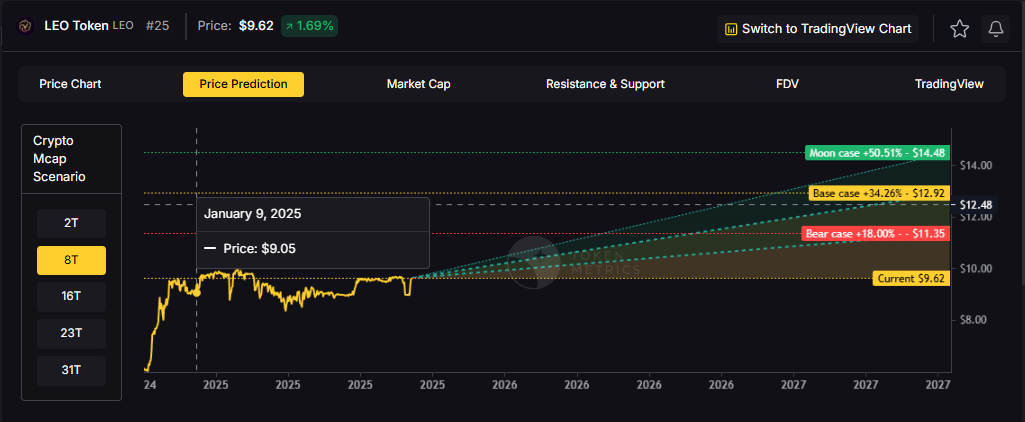
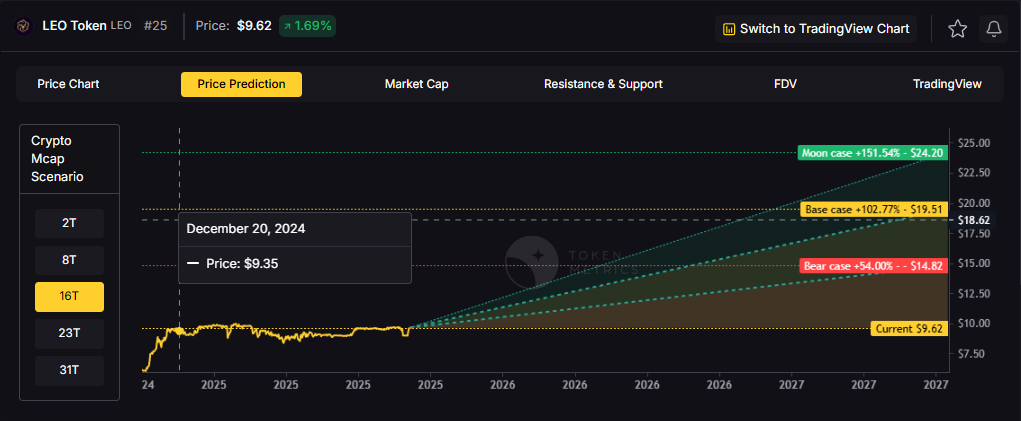
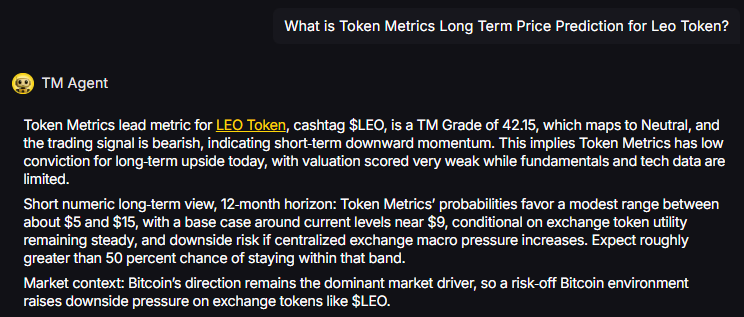
TM Agent baseline: Token Metrics price prediction probabilities favor a modest range between about $5 and $15, with a base case around current levels near $9, conditional on exchange token utility remaining steady, and downside risk if centralized exchange macro pressure increases.

Live details: Token Details 

Key Takeaways

  • Scenario driven, outcomes hinge on total crypto market cap, higher liquidity and adoption lift the bands.
  • TM Agent gist: 12-month horizon favors $5 to $15 range with base case near $9, contingent on stable exchange utility.
  • Education only, not financial advice.

LEO Token Price Prediction Scenario Analysis

Token Metrics price prediction scenarios span four market cap tiers reflecting different crypto market maturity levels:

8T Market Cap - LEO Price Prediction:

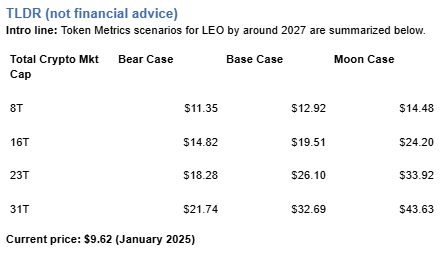
At 8 trillion total crypto market cap, LEO price prediction projects to $11.35 in bear conditions, $12.92 in the base case, and $14.48 in bullish scenarios.

16T Market Cap - LEO Price Prediction:

At 16 trillion total crypto market cap, LEO price prediction projects to $14.82 in bear conditions, $19.51 in the base case, and $24.20 in bullish scenarios.

23T Market Cap - LEO Price Prediction:

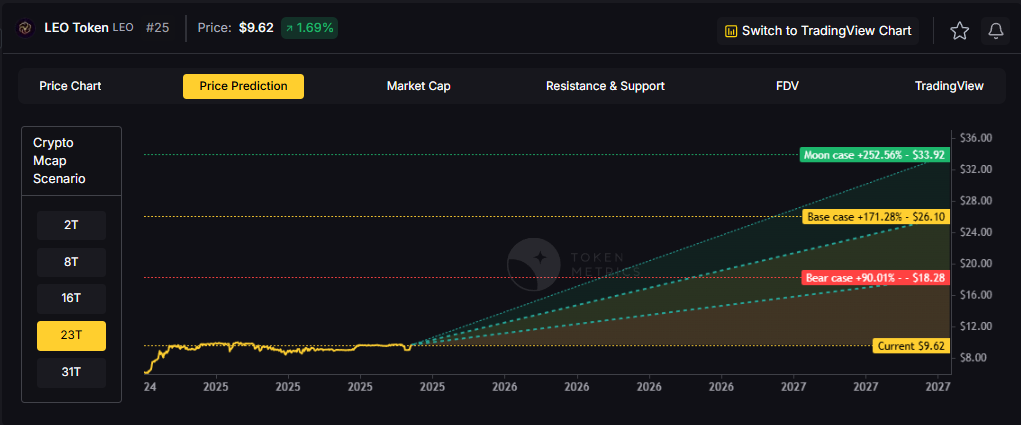
At 23 trillion total crypto market cap, LEO price prediction projects to $18.28 in bear conditions, $26.10 in the base case, and $33.92 in bullish scenarios.

31T Market Cap - LEO Price Prediction:

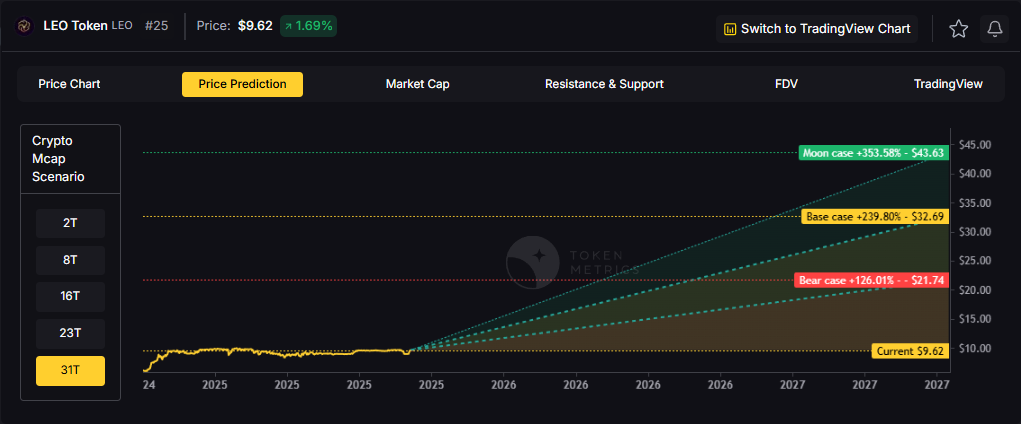
At 31 trillion total crypto market cap, LEO price prediction projects to $21.74 in bear conditions, $32.69 in the base case, and $43.63 in bullish scenarios.

Each tier in our price prediction framework assumes progressively stronger market conditions, with base scenarios reflecting steady exchange growth and moon cases requiring sustained bull market dynamics.

What Is LEO Token?

LEO Token is the native utility token of the Bitfinex and iFinex ecosystem, designed to provide benefits like reduced trading fees, enhanced lending and borrowing terms, and access to exclusive features on the platform. It operates on both Ethereum (ERC-20) and EOS blockchains, offering flexibility for users.

The primary role of LEO is to serve as a utility token within the exchange ecosystem, enabling fee discounts, participation in token sales, and other platform-specific advantages. Common usage patterns include holding LEO to reduce trading costs and utilizing it for enhanced platform services, positioning it primarily within the exchange token sector.

Catalysts That Skew LEO Price Predictions Bullish

  • Institutional and retail access expands with ETFs, listings, and integrations
  • Macro tailwinds from lower real rates and improving liquidity
  • Product or roadmap milestones such as upgrades, scaling, or partnerships
  • Increased Bitfinex trading volume and platform adoption
  • Strategic token burns and buyback programs

Risks That Skew LEO Price Predictions Bearish

  • Macro risk-off from tightening or liquidity shocks
  • Regulatory actions targeting centralized exchanges or infrastructure outages
  • Concentration risk or competitive displacement from rival exchange tokens
  • Declining exchange market share or trading volume
  • Negative sentiment around centralized exchange tokens

LEO Token Price Prediction FAQs

What gives LEO value?

LEO accrues value through reduced trading fees and enhanced platform services within the Bitfinex and iFinex ecosystem. Demand drivers include exchange usage and access to platform features, while supply dynamics follow the token's exchange utility design. Value realization depends on platform activity and user adoption—key factors in our price prediction methodology.

What price could LEO reach in the moon case?

Our moon case price predictions range from $14.48 at 8T to $43.63 at 31T total crypto market cap. These scenarios require maximum market cap expansion and strong exchange activity. Not financial advice.

What is the LEO Token price prediction for 2025-2027?

Our comprehensive price prediction framework suggests LEO could trade between $5 and $43.63 depending on market conditions and total crypto market capitalization. The base case price prediction scenario clusters around $9 to $32.69 across different market cap environments over the next 12-24 months. Not financial advice.

Can LEO Token reach $20?

Yes. Based on our price prediction scenarios, LEO could reach $19.51 in the 16T base case and surpass $20 in higher market cap scenarios (23T and 31T tiers). The 23T base case projects $26.10, making $20 an achievable target under favorable market conditions. Not financial advice.

Can LEO Token reach $50?

LEO reaching $50 would exceed our current price prediction models' highest scenario of $43.63 (31T moon case). This would require extraordinary market conditions beyond the 31T total crypto market cap tier and exceptional Bitfinex platform growth. Not financial advice.

Is LEO Token a good investment based on price predictions?

LEO's price prediction is tied to Bitfinex exchange performance and utility value. The token offers fee discounts and platform benefits, with moderate growth potential in our base scenarios. However, exchange token valuations carry platform-specific risks. Always conduct your own research and consult financial advisors. Not financial advice.

How accurate are LEO Token price predictions?

Our LEO price predictions use scenario-based modeling across multiple market cap tiers, combining cycle analogues, market-cap share math, and technical analysis guardrails. While this methodology provides structured forecasts, cryptocurrency markets remain highly volatile and unpredictable. Use these price predictions as educational frameworks, not guarantees. Not financial advice.


Next Steps

Curious how these forecasts are made? Token Metrics delivers LEO on-chain grades, forecasts, and deep research on 6,000+ tokens. Instantly compare fundamentals, on-chain scores, and AI-powered predictions.

Disclosure

Educational purposes only, not financial advice. Crypto is volatile, do your own research and manage risk.

Why Use Token Metrics for LEO Price Predictions?

  • Data-driven forecasts: Scenario-based price prediction models across multiple market cap tiers
  • Comprehensive analysis: On-chain metrics, fundamental grades, and technical guardrails
  • AI-powered insights: Advanced algorithms analyze 6,000+ tokens for comparative analysis
  • Regular updates: Real-time price predictions and signals based on market conditions
  • Risk management: Multiple scenarios (bear, base, moon) for informed decision-making
Research

SUI Price Prediction 2027: Layer-1 Portfolio Diversification Analysis

Token Metrics Team
8 min read

Portfolio Context for Sui Price Prediction: Diversification in the 2027 Landscape

Layer 1 tokens like Sui represent bets on specific blockchain architectures winning developer and user mindshare. SUI carries both systematic crypto risk and unsystematic risk from Sui's technical roadmap execution and ecosystem growth. Multi-chain thesis suggests diversifying across several L1s rather than concentrating in one, since predicting which chains will dominate remains difficult.

The SUI price prediction projections below show how SUI might perform under different market cap scenarios. While Sui may have strong fundamentals, prudent portfolio construction balances L1 exposure across Ethereum, competing smart contract platforms, and Bitcoin to capture the sector without overexposure to any single chain's fate.


Disclosure

Educational purposes only, not financial advice. Crypto is volatile, do your own research and manage risk.

How to Read This SUI Price Prediction Framework

Each band blends cycle analogues and market-cap share math with TA guardrails. Base assumes steady adoption and neutral or positive macro. Moon layers in a liquidity boom. Bear assumes muted flows and tighter liquidity.

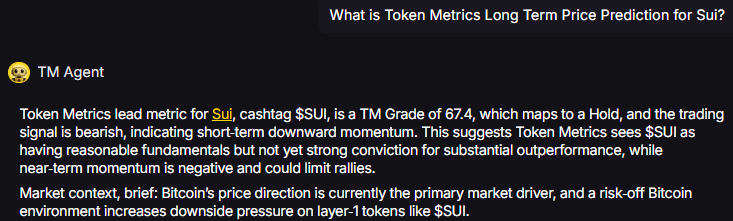
TM Agent baseline: Token Metrics lead metric for Sui, cashtag $SUI, is a TM Grade of 67.4%, which maps to a Hold, and the trading signal is bearish, indicating short-term downward momentum. This suggests Token Metrics sees $SUI as having reasonable fundamentals but not yet strong conviction for substantial outperformance in our price prediction models, while near-term momentum is negative and could limit rallies. Market context, brief: Bitcoin's price direction is currently the primary market driver, and a risk-off Bitcoin environment increases downside pressure on layer-1 tokens like $SUI.

Token Details 

The Case for Diversified Index Exposure

Professional investors across asset classes prefer diversified exposure over concentrated bets for good reason. Sui faces numerous risks—technical vulnerabilities, competitive pressure, regulatory targeting, team execution failure—any of which could derail SUI price prediction performance independent of broader market conditions. Token Metrics Indices spread this risk across one hundred tokens, ensuring no single failure destroys your crypto portfolio.

Diversification becomes especially critical in crypto given the sector's nascency and rapid evolution. Technologies and narratives that dominate today may be obsolete within years as the space matures. By holding SUI exclusively, you're betting not only on crypto succeeding but on Sui specifically remaining relevant. Index approaches hedge against picking the wrong horse while maintaining full crypto exposure.

Early access to Token Metrics Indices

Key Takeaways: SUI Price Prediction Summary

  • Scenario driven: Price prediction outcomes hinge on total crypto market cap; higher liquidity and adoption lift the bands
  • Single-asset concentration: Amplifies both upside and downside versus diversified approaches
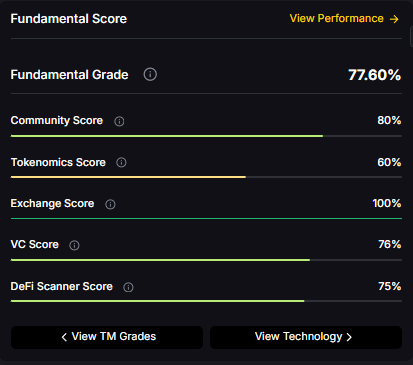
  • Fundamentals: Fundamental Grade 77.60% (Community 80%, Tokenomics 60%, Exchange 100%, VC 76%, DeFi Scanner 75%)
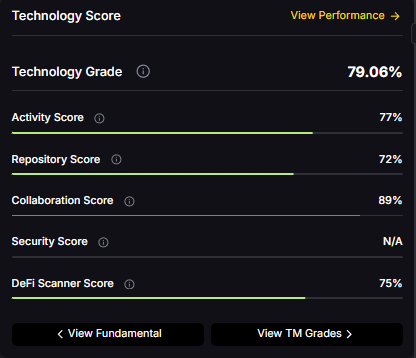
  • Technology: Technology Grade 79.06% (Activity 77%, Repository 72%, Collaboration 89%, Security N/A, DeFi Scanner 75%)
  • TM Agent gist: Hold grade, bearish trading signal, near-term negative momentum in price prediction models
  • Education only, not financial advice

SUI Price Prediction Scenario Analysis

Token Metrics price prediction scenarios span four market cap tiers, each representing different levels of crypto market maturity and liquidity:

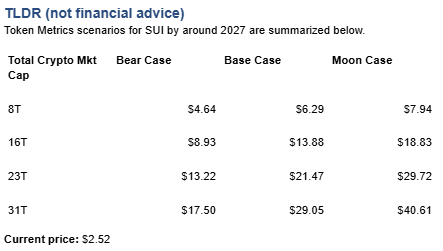
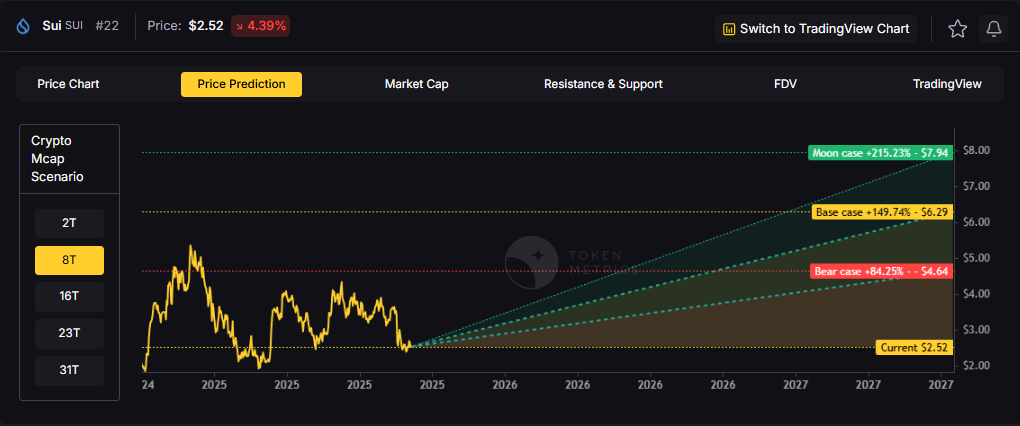
8T Market Cap - SUI Price Prediction:

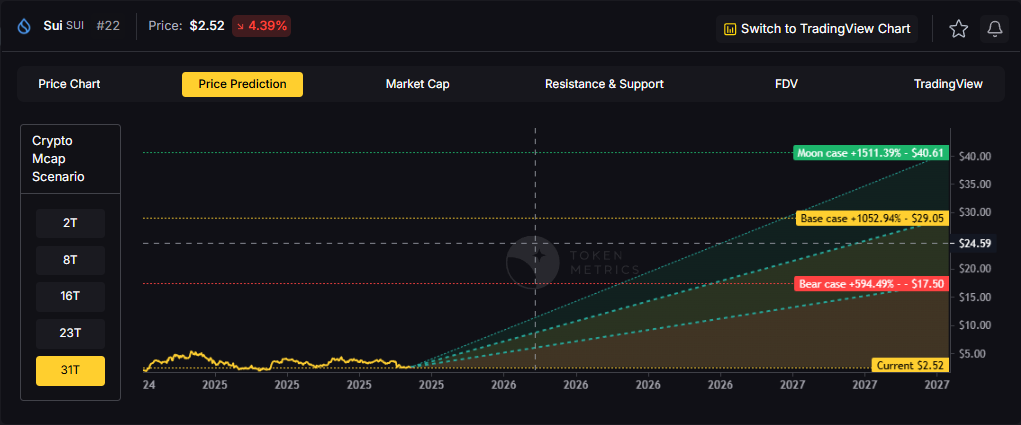
At an 8 trillion total crypto market cap, SUI price prediction projects to $4.64 in bear conditions, $6.29 in the base case, and $7.94 in bullish scenarios.

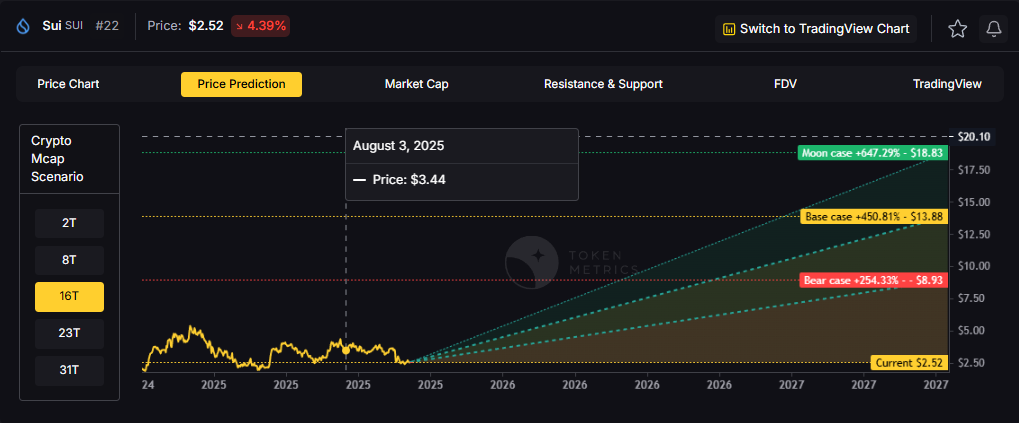
16T Market Cap - SUI Price Prediction:

At a 16 trillion total crypto market cap, SUI price prediction projects to $8.93 in bear conditions, $13.88 in the base case, and $18.83 in bullish scenarios.

23T Market Cap - SUI Price Prediction:

At a 23 trillion total crypto market cap, SUI price prediction projects to $13.22 in bear conditions, $21.47 in the base case, and $29.72 in bullish scenarios.

31T Market Cap - SUI Price Prediction:

At a 31 trillion total crypto market cap, SUI price prediction projects to $17.50 in bear conditions, $29.05 in the base case, and $40.61 in bullish scenarios.

These price prediction ranges illustrate potential outcomes for concentrated SUI positions, but investors should weigh whether single-asset exposure matches their risk tolerance or whether diversified strategies better suit their objectives.

What Is Sui?

Sui is a layer-1 blockchain network designed for general-purpose smart contracts and scalable user experiences. It targets high throughput and fast settlement, aiming to support applications that need low-latency interactions and horizontal scaling.

SUI is the native token used for transaction fees and staking, aligning validator incentives and securing the network. It underpins activity across common crypto sectors such as NFTs and DeFi while the ecosystem builds developer tooling and integrations.

Token Metrics AI Analysis

Token Metrics AI provides comprehensive context informing our SUI price prediction models:

Vision: Sui aims to create a highly scalable and low-latency blockchain platform that enables seamless user experiences for decentralized applications. Its vision centers on making blockchain technology accessible and efficient for mainstream applications by removing traditional bottlenecks in transaction speed and cost.

Problem: Many existing blockchains face trade-offs between scalability, security, and decentralization, often resulting in high fees and slow transaction finality during peak usage. This limits their effectiveness for applications requiring instant settlement, frequent interactions, or large user bases, such as games or social platforms. Sui addresses the need for a network that can scale horizontally without sacrificing speed or cost-efficiency.

Solution: Sui uses a unique object-centric blockchain model and the Move programming language to enable parallel transaction processing, allowing high throughput and instant finality for many operations. Its consensus mechanism, Narwhal and Tusk, is optimized for speed and scalability by decoupling transaction dissemination from ordering. The network supports smart contracts, NFTs, and decentralized applications, with an emphasis on developer ease and user experience. Staking is available for network security, aligning with common proof-of-stake utility patterns.

Market Analysis: Sui competes in the layer-1 blockchain space with platforms like Solana, Avalanche, and Aptos, all targeting high-performance decentralized applications. It differentiates itself through its object-based data model and parallel execution, aiming for superior scalability in specific workloads. Adoption drivers include developer tooling, ecosystem incentives, and integration with wallets and decentralized exchanges. The broader market for high-throughput blockchains is driven by demand for scalable Web3 applications, though it faces risks from technical complexity, regulatory uncertainty, and intense competition—all critical factors in our price prediction analysis.

Fundamental and Technology Snapshot from Token Metrics

Fundamental Grade: 77.60% (Community 80%, Tokenomics 60%, Exchange 100%, VC 76%, DeFi Scanner 75%).


Technology Grade: 79.06% (Activity 77%, Repository 72%, Collaboration 89%, Security N/A, DeFi Scanner 75%).


Catalysts That Skew SUI Price Predictions Bullish

  • Institutional and retail access expands with ETFs, listings, and integrations
  • Macro tailwinds from lower real rates and improving liquidity
  • Product or roadmap milestones such as upgrades, scaling, or partnerships
  • Growing developer ecosystem and dApp adoption
  • Strategic partnerships with major Web3 platforms

Risks That Skew SUI Price Predictions Bearish

  • Macro risk-off from tightening or liquidity shocks
  • Regulatory actions or infrastructure outages
  • Concentration or validator economics and competitive displacement
  • Protocol-specific execution risk and competitive pressure from alternatives
  • Technical vulnerabilities or smart contract exploits

How Token Metrics Can Help

Token Metrics empowers you to analyze Sui and hundreds of digital assets with AI-driven ratings, on-chain and fundamental data, and index solutions to manage portfolio risk smartly in a rapidly evolving crypto market. Our price prediction frameworks provide scenario-based analysis to inform your investment decisions.

SUI Price Prediction FAQs

What price could SUI reach in the moon case?

Our moon case price predictions range from $7.94 at 8T to $40.61 at 31T total crypto market cap. These scenarios assume maximum liquidity expansion and strong Sui adoption. Diversified strategies aim to capture upside across multiple tokens rather than betting exclusively on any single moon scenario. Not financial advice.

What is the SUI price prediction for 2025-2027?

Our comprehensive SUI price prediction framework suggests SUI could trade between $4.64 and $40.61 depending on market conditions and total crypto market capitalization. The base case price prediction scenario clusters around $6.29 to $29.05 across different market cap environments. Current TM Grade of 67.4% indicates a Hold rating with bearish near-term momentum. Not financial advice.

Can SUI reach $20?

Yes. Based on our price prediction scenarios, SUI could reach $21.47 in the 23T base case and $18.83 in the 16T moon case. The price target of $20 becomes achievable in moderate to high market cap environments with steady ecosystem growth. Not financial advice.

Can SUI reach $50?

SUI reaching $50 would exceed our current price prediction models' highest scenario of $40.61 (31T moon case). This would require extraordinary market conditions beyond the 31T total crypto market cap tier, exceptional ecosystem adoption, and SUI capturing significant market share from competing L1s. Not financial advice.

What's the risk/reward profile for SUI?

Our SUI price prediction risk/reward spans from $4.64 to $40.61 across all scenarios. Downside risks include regulatory pressure and competitive displacement, while upside drivers include ecosystem growth and favorable liquidity. Concentrated positions amplify both tails, while diversified strategies smooth outcomes and reduce single-asset risk.

What are the biggest risks to SUI price predictions?

Key risks that could impact SUI price predictions include regulatory actions, technical issues, competitive pressure from other L1s (Solana, Avalanche, Aptos), adverse market liquidity, validator centralization concerns, and execution challenges. Concentrated SUI positions magnify exposure to these risks. Diversified strategies spread risk across tokens with different profiles, reducing portfolio vulnerability to any single failure point.

Is SUI a good investment based on price predictions?

SUI shows solid fundamentals (77.60% grade) and technology scores (79.06% grade), but currently has a Hold rating (67.4% TM Grade) with bearish near-term trading signals. While our price prediction models show potential upside in favorable market conditions, the bearish momentum and L1 competition suggest a cautious approach. Consider diversified exposure rather than concentrated positions. Not financial advice.

How does SUI compare to other L1 price predictions?

SUI competes with Solana, Avalanche, and Aptos in the high-performance L1 space. Our price prediction framework suggests SUI's performance will correlate with broader L1 adoption trends while facing differentiation challenges. Diversified L1 exposure through indices may offer better risk-adjusted returns than concentrated SUI positions, as predicting which specific L1 will dominate remains uncertain.


Next Steps

Disclosure
Educational purposes only, not financial advice. Crypto is volatile, concentration amplifies risk, and diversification is a fundamental principle of prudent portfolio construction. Do your own research and manage risk appropriately.

Why Use Token Metrics for SUI Price Predictions?

  • Scenario-based modeling: Multiple market cap tiers for comprehensive price prediction analysis
  • AI-driven analysis: Fundamental (77.60%) and technology (79.06%) grades for informed decisions
  • Risk management tools: Index solutions to diversify L1 exposure beyond single-asset concentration
  • Real-time signals: Trading signals and TM Grades updated regularly
  • Comparative analysis: Analyze SUI against 6,000+ tokens for portfolio optimization
Choose from Platinum, Gold, and Silver packages
Reach with 25–30% open rates and 0.5–1% CTR
Craft your own custom ad—from banners to tailored copy
Perfect for Crypto Exchanges, SaaS Tools, DeFi, and AI Products