Back to blog
Research

Our x402 Integration Is Live: Pay-Per-Call Access to Token Metrics—No API Key Required

Use your crypto wallet to call Token Metrics endpoints on demand. Pay per call with USDC or get a 10% discount with TMAI. No monthly subscriptions, no API keys, just headers and code.
Token Metrics Team
7 min read
Want Smarter Crypto Picks—Free?
See unbiased Token Metrics Ratings for BTC, ETH, and top alts.
Thank you! Your submission has been received!
Oops! Something went wrong while submitting the form.
 No credit card | 1-click unsubscribe

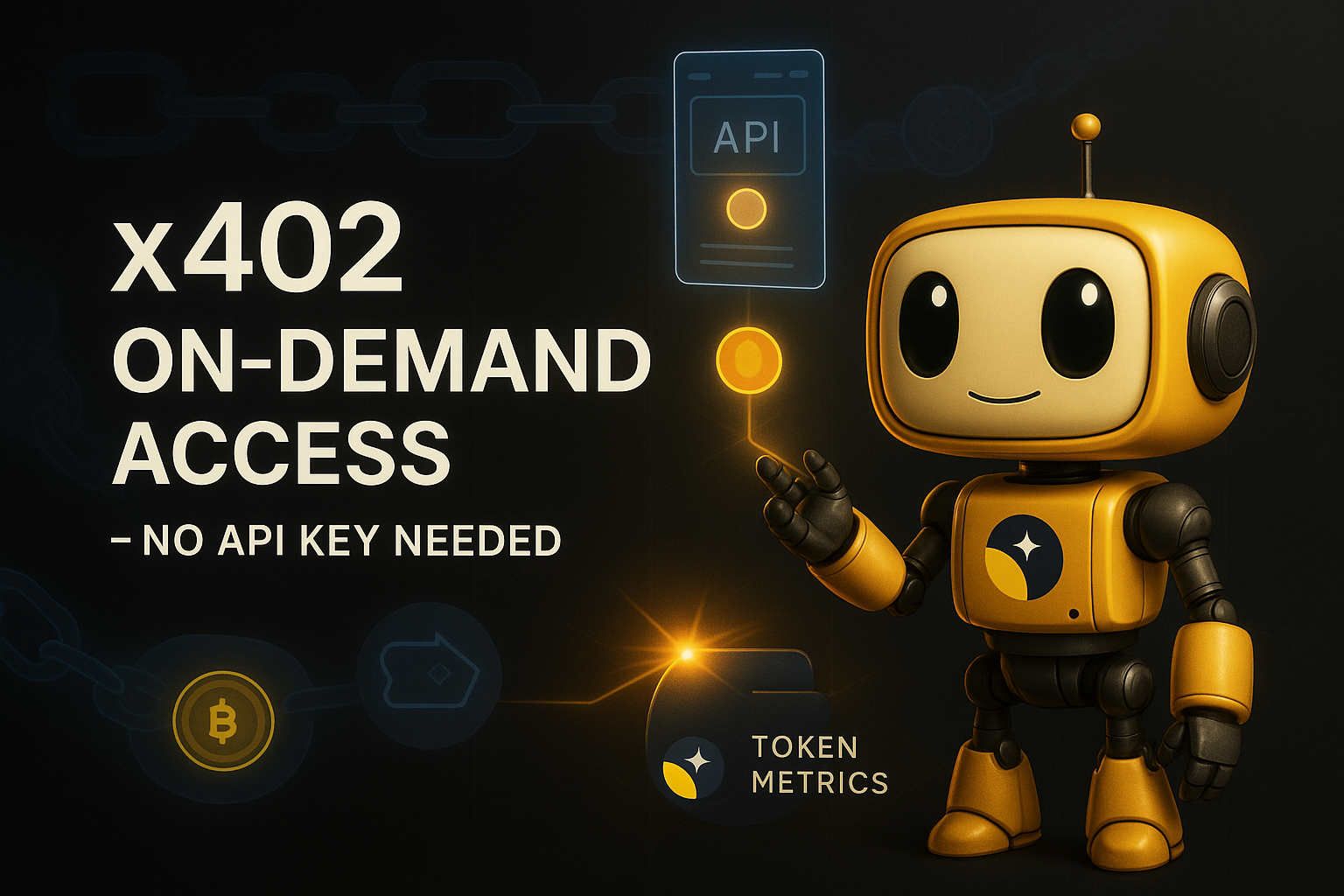
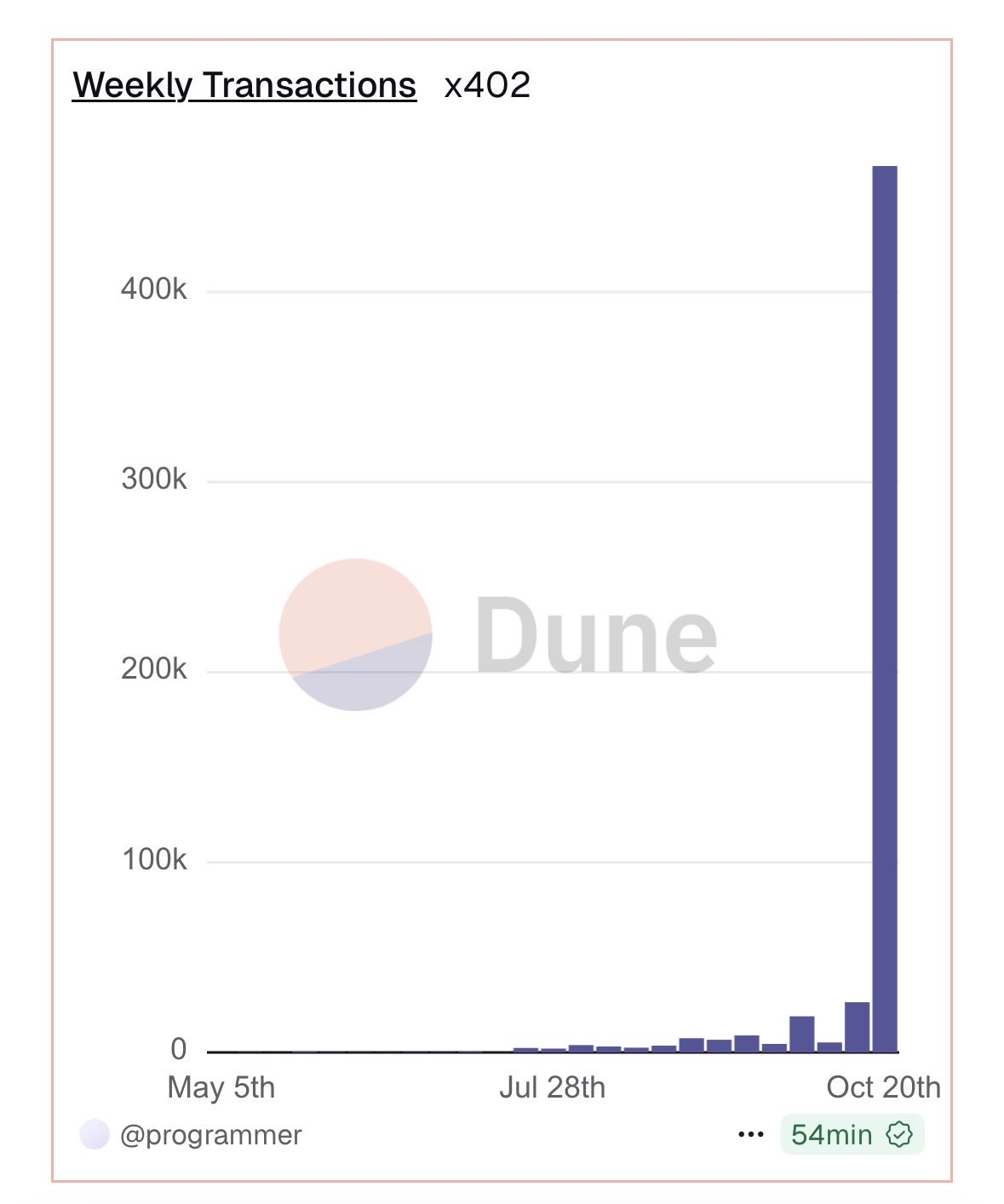
Developers are already shipping with x402 at scale: 450,000+ weekly transactions, 700+ projects. This momentum is why our Token Metrics x402 integration matters for agents and apps that need real crypto intelligence on demand. You can now pay per API call using HTTP 402 and the x-coinbase-402 header, no API key required.
   _ 

Summary: Pay per API call to Token Metrics with x402 on Base using USDC or TMAI, set x-coinbase-402: true, and get instant access to trading signals, grades, and AI reports.

Check out the x402 ecosystem on Coingecko.


What You Get

Token Metrics now supports x402, the HTTP-native payment protocol from Coinbase. Users can call any public endpoint by paying per request with a wallet, eliminating API key management and upfront subscriptions. This makes Token Metrics data instantly accessible to AI agents, researchers, and developers who want on-demand crypto intelligence.

x402 enables truly flexible access where you pay only for what you use, with transparent per-call pricing in USDC or TMAI. The integration is live now across all Token Metrics public endpoints, from trading signals to AI reports. Here's everything you need to start calling Token Metrics with x402 today.

Quick Start

Get started with x402 + Token Metrics in three steps.

  1. Create a wallet client: Follow the x402 Quickstart for Buyers to set up a wallet client (Node.js with viem or Python with eth-account). Link: https://docs.cdp.coinbase.com/x402/docs/quickstart-buyers
  2. Set required headers: Add x-coinbase-402: true to any Token Metrics request. Optionally set x-payment-token: tmai for a 10% discount (defaults to usdc). Do not send x-api-key when using x402.
  3. Call any endpoint: Make a request to https://api.tokenmetrics.com/v2/[endpoint] with your wallet client. Payment happens automatically via x402 settlement.

That is it. Your wallet pays per call, and you get instant access to Token Metrics data with no subscription overhead.

Required Headers


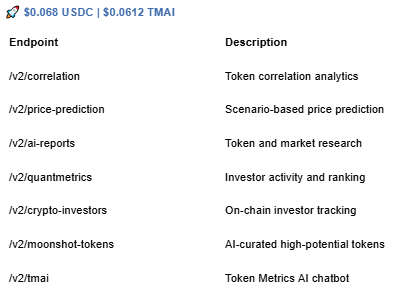
Endpoint Pricing

Transparent per-call pricing across all Token Metrics public endpoints. Pay in USDC or get 10% off with TMAI.
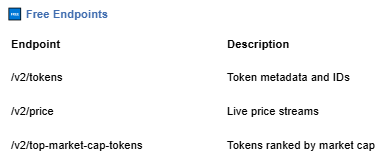


All prices are per single call. Paying with TMAI automatically applies a 10% discount.

Try It on x402 Composer

If you want to see x402 + Token Metrics in action without writing code, head to x402 Composer. Composer is x402scan's playground for AI agents that pay per tool call. You can open a Token Metrics agent, chat with it, and watch real tool calls and USDC/TMAI settlements stream into the live Feed.

Composer surfaces active agents using Token Metrics endpoints like trading signals, price predictions, and AI reports. It is a great way to explore what is possible before you build your own integration. Link: https://x402scan.com/composer

Why x402 Changes the Game

Traditional API access requires upfront subscriptions, fixed rate limits, and key management overhead. x402 flips that model by letting you pay per call with a crypto wallet, with no API keys or monthly commitments. This is especially powerful for AI agents, which need flexible, on-demand access to external data without human intervention.

For Token Metrics, x402 unlocks agentic commerce where agents can autonomously pull crypto intelligence, pay only for what they use, and compose our endpoints with other x402-enabled tools like Heurist Mesh, Tavily, and Firecrawl. It is HTTP-native payments meeting real-world agent workflows.

What is x402?

x402 is an open-source HTTP-native payment protocol developed by Coinbase. It uses the HTTP 402 status code (Payment Required) to enable pay-per-request access to APIs and services. When you make a request with the x-coinbase-402 header, the server returns a payment challenge, your wallet signs and submits payment, and the server fulfills the request once settlement is verified.

The protocol runs on Base and Solana, with USDC and TMAI as the primary payment tokens. x402 is designed for composability, agents can chain multiple paid calls across different providers in a single workflow, paying each service directly without intermediaries. Learn more at the x402 Quickstart for Buyers: https://docs.cdp.coinbase.com/x402/docs/quickstart-buyers

FAQs

Do I need an API key to use x402 with Token Metrics?

No. When you set x-coinbase-402: true, your wallet signature replaces API key authentication. Do not send x-api-key in your requests.

Can I use x402 with a free trial or test wallet?

Yes, but you will need testnet USDC or TMAI on Base Sepolia (testnet) for development. Production calls require mainnet tokens.

How do I see my payment history?

Check x402scan for transaction logs and tool call history. Your wallet will also show outgoing USDC/TMAI transactions. Visit https://www.x402scan.com.

What happens if my wallet balance is too low?

The x402 client will return a payment failure before making the API call. Top up your wallet and retry.

Can I use x402 in production apps?

Yes. x402 is live on Base mainnet. Set appropriate spend limits and handle payment errors gracefully in your code.

Next Steps

Disclosure

Educational and informational purposes only. x402 involves crypto payments on public blockchains. Understand the risks, manage your wallet security, and test thoroughly before production use. Token Metrics does not provide financial advice.

Powered by Token Metrics

Your AI-powered crypto research experience is made possible by Token Metrics. Discover data-driven insights and advanced analytics on your favorite coins and tokens.

Build Smarter Crypto Apps &
AI Agents in Minutes, Not Months
Real-time prices, trading signals, and on-chain insights all from one powerful API.
Grab a Free API Key
About Token Metrics
Token Metrics: AI-powered crypto research and ratings platform. We help investors make smarter decisions with unbiased Token Metrics Ratings, on-chain analytics, and editor-curated “Top 10” guides. Our platform distills thousands of data points into clear scores, trends, and alerts you can act on.
30 Employees
analysts, data scientists, and crypto engineers
Daily Briefings
concise market insights and “Top Picks”
Transparent & Compliant
Sponsored ≠ Ratings; research remains independent
Want Smarter Crypto Picks—Free?
See unbiased Token Metrics Ratings for BTC, ETH, and top alts.
Thank you! Your submission has been received!
Oops! Something went wrong while submitting the form.
 No credit card | 1-click unsubscribe
Token Metrics Team
Token Metrics Team

Recent Posts

Research

Exploring Investments in Crypto and Web3 Companies: An Analytical Overview

Token Metrics Team
4

Introduction

The landscape of digital assets and blockchain technology has expanded rapidly over recent years, bringing forth a new realm known as Web3 alongside the burgeoning crypto ecosystem. For individuals curious about allocating resources into this sphere, questions often arise: should the focus be on cryptocurrencies or Web3 companies? This article aims to provide an educational and analytical perspective on these options, highlighting considerations without providing direct investment advice.

Understanding Crypto and Web3

Before exploring the nuances between investing in crypto assets and Web3 companies, it's important to clarify what each represents.

  • Cryptocurrencies are digital currencies that operate on blockchain technology, enabling peer-to-peer transactions with varying protocols and use cases.
  • Web3 broadly refers to a decentralized internet infrastructure leveraging blockchain technologies to create applications, platforms, and services that prioritize user control, privacy, and decentralization.

Web3 companies often develop decentralized applications (dApps), offer blockchain-based services, or build infrastructure layers for the decentralized web.

Key Considerations When Evaluating Investment Options

Deciding between crypto assets or Web3 companies involves analyzing different dynamics:

  1. Market Maturity and Volatility
    Cryptocurrencies generally exhibit higher price volatility influenced by market sentiment, regulatory news, and technology updates. Web3 companies, often in startup or growth phases, carry inherent business risk but may relate more to traditional company valuation metrics.
  2. Fundamental Drivers
    Crypto assets derive value from network utility, adoption, scarcity mechanisms, and consensus protocols. Web3 firms generate value through product innovation, user engagement, revenue models, and ability to scale decentralized solutions.
  3. Regulatory Environment
    Both realms face evolving regulatory landscapes globally, with different degrees of scrutiny around cryptocurrencies and blockchain enterprises. Awareness of legal considerations is essential for educational understanding.
  4. Technological Innovation
    Web3 companies typically focus on developing novel decentralized infrastructures and applications. Crypto projects may emphasize improvements in consensus algorithms, interoperability, or token economics.

Analytical Frameworks for Assessment

To approach these complex investment types thoughtfully, frameworks can assist in structuring analysis:

  • Scenario Analysis: Evaluate various future scenarios for cryptocurrency adoption and Web3 technology evolution to understand possible outcomes and risks.
  • Fundamental Analysis: For crypto, analyze network activity, token utility, and supply models. For Web3 companies, consider business plans, technological edge, leadership quality, and market positioning.
  • Technology Evaluation: Examine the underlying blockchain protocols and development communities supporting both crypto projects and Web3 startups, assessing innovation and sustainability.

Leveraging AI-Driven Tools for Research

Due to the rapidly evolving and data-intensive nature of crypto and Web3 industries, AI-powered platforms can enhance analysis by processing vast datasets and providing insights.

For instance, Token Metrics utilizes machine learning to rate crypto assets by analyzing market trends, project fundamentals, and sentiment data. Such tools support an educational and neutral perspective by offering data-driven research support rather than speculative advice.

When assessing Web3 companies, AI tools can assist with identifying emerging technologies, tracking developmental progress, and monitoring regulatory developments relevant to the decentralized ecosystem.

Practical Tips for Conducting Due Diligence

To gain a well-rounded understanding, consider the following steps:

  • Research Whitepapers and Roadmaps: For crypto tokens and Web3 startups, review technical documentation and strategic plans.
  • Evaluate Team Credentials: Analyze the experience and transparency of project founders and teams.
  • Monitor Community Engagement: Observe activity levels in forums, GitHub repositories, and social media to gauge project vitality.
  • Use Analytical Tools: Incorporate platforms like Token Metrics for data-supported insights on token metrics and project evaluations.
  • Consider Regulatory Developments: Stay informed about jurisdictional policies impacting blockchain projects and cryptocurrencies.

Understanding Risk Factors

Both crypto assets and Web3 companies involve unique risks that warrant careful consideration:

  • Market Risk: Price volatility and market sentiment swings can impact crypto tokens significantly.
  • Technological Risk: Innovative technologies may have bugs or scalability challenges affecting project viability.
  • Regulatory Risk: Changes in legal frameworks can alter operational capacities or market access for Web3 entities and crypto tokens.
  • Business Model Risk: Web3 startups may face competitive pressures, funding challenges, or adoption hurdles.

Conclusion

Deciding between crypto assets and Web3 companies involves analyzing different dimensions including technological fundamentals, market dynamics, and risk profiles. Employing structured evaluation frameworks along with AI-enhanced research platforms such as Token Metrics can provide clarity in this complex landscape.

It is essential to approach this domain with an educational mindset focused on understanding rather than speculative intentions. Staying informed and leveraging analytical tools supports sound comprehension of the evolving world of blockchain-based digital assets and enterprises.

Disclaimer

This article is intended for educational purposes only and does not constitute financial, investment, or legal advice. Readers should conduct their own research and consult with professional advisors before making any decisions related to cryptocurrencies or Web3 companies.

Research

Why Is Web3 User Experience Still Lagging Behind Web2?

Token Metrics Team
4

Introduction to Web3 UX

The evolution from Web2 to Web3 marks a significant paradigm shift in how we interact with digital services. While Web2 platforms have delivered intuitive and seamless user experiences, Web3—the decentralized internet leveraging blockchain technology—still faces considerable user experience (UX) challenges. This article explores the reasons behind the comparatively poor UX in Web3 and the technical, design, and infrastructural hurdles contributing to this gap.

Contextual Understanding: Web2 vs Web3

Web2 represents the current mainstream internet experience characterized by centralized servers, interactive social platforms, and streamlined services. Its UX benefits from consistent standards, mature design patterns, and direct control over data.

In contrast, Web3 aims at decentralization, enabling peer-to-peer interactions through blockchain protocols, decentralized applications (dApps), and user-owned data ecosystems. While promising increased privacy and autonomy, Web3 inherently introduces complexity in UX design.

Technical Complexities Affecting Web3 UX

Several intrinsic technical barriers impact the Web3 user experience:

  • Decentralization and Interoperability: Decentralized networks operate without centralized control, making transaction speed and reliability variable compared to Web2's central servers.
  • Blockchain Transaction Latency: Block confirmation times, network congestion, and gas fees create delays and unpredictability in user interactions.
  • Wallet and Key Management: Users must manage private keys and wallets, which can be confusing and risky for non-technical audiences.
  • User Onboarding Frictions: Requirements like acquiring cryptocurrency tokens for transaction fees create an additional barrier unique to Web3.

Design and Usability Issues in Web3

The nascent nature of Web3 results in inconsistent and sometimes opaque design standards:

  • Complex Terminology and Concepts: Terms like gas, smart contracts, staking, and cryptographic signatures are unfamiliar to average users.
  • Poorly Standardized UI Components: Unlike Web2, where UI/UX libraries and guidelines are well-established, Web3 lacks uniform design principles, leading to fragmented experiences.
  • Minimal User Feedback: Web3 apps sometimes provide limited real-time feedback during transactions, causing uncertainty.
  • Security and Trust Indicators: The responsibility to confirm transaction legitimacy often falls on users, which can be overwhelming.

Ecosystem Maturity and Resource Constraints

Web2 giants have invested billions over decades fostering developer communities, design systems, and customer support infrastructure. In contrast, Web3 is still an emerging ecosystem characterized by:

  • Smaller Development Teams: Many dApps are developed by startups or hobbyists with limited UX expertise or resources.
  • Rapidly Evolving Protocols: Frequent changes impact stability and user familiarity.
  • Limited Educational Resources: Users often lack accessible tutorials and support channels.

Such factors contribute to a user experience that feels fragmented and inaccessible to mainstream audiences.

Leveraging AI and Analytics to Improve Web3 UX

Emerging tools powered by artificial intelligence and data analytics can help mitigate some UX challenges in Web3 by:

  • Analyzing User Interaction Data: Identifying pain points and optimizing workflows in dApps.
  • Automated Risk Assessment: Platforms like Token Metrics offer AI-driven analysis to help users understand token metrics and project fundamentals, supporting better-informed user decisions without direct financial advice.
  • Personalized User Guidance: Contextual prompts and chatbot assistants could help users navigate complex steps.

Integrating such AI-driven research and analytic tools enables developers and users to progressively enhance Web3 usability.

Practical Tips for Users and Developers

For users trying to adapt to Web3 environments, the following tips may help:

  • Engage with Educational Content: Prioritize learning foundational blockchain concepts to reduce confusion.
  • Use Trusted Tools: Platforms providing in-depth analytics and ratings, such as Token Metrics, can offer valuable insights into projects.
  • Start with Simple dApps: Experiment with established, user-friendly applications before engaging in more complex services.

For developers, focusing on the following can improve UX outcomes:

  • Adopt Consistent UI/UX Patterns: Align interfaces with familiar Web2 standards where possible to flatten the learning curve.
  • Enhance Feedback and Transparency: Clearly communicate transaction statuses and risks.
  • Streamline Onboarding: Reduce or abstract away wallet configurations and gas fee complexities.
  • Prioritize Accessibility: Make interfaces usable for non-technical and diverse user groups.

Conclusion: Web3 UX Future Outlook

The current disparity between Web3 and Web2 user experience primarily stems from decentralization complexities, immature design ecosystems, and educational gaps. However, ongoing innovation in AI-driven analytics, comprehensive rating platforms like Token Metrics, and community-driven UX improvements are promising. Over time, these efforts could bridge the UX divide to make Web3 more accessible and user-friendly for mainstream adoption.

Disclaimer

This article is for educational and informational purposes only and does not constitute financial advice or an endorsement. Users should conduct their own research and consider risks before engaging in any blockchain or cryptocurrency activities.

Research

Exploring the Languages Used for Smart Contract Development

Token Metrics Team
5

Introduction

Smart contracts have become an integral part of blockchain technology, enabling automated, trustless agreements across various platforms. Understanding what languages are used for smart contract development is essential for developers entering this dynamic field, as well as for analysts and enthusiasts who want to deepen their grasp of blockchain ecosystems. This article offers an analytical and educational overview of popular programming languages for smart contract development, discusses their characteristics, and provides insights on how analytical tools like Token Metrics can assist in evaluating smart contract projects.

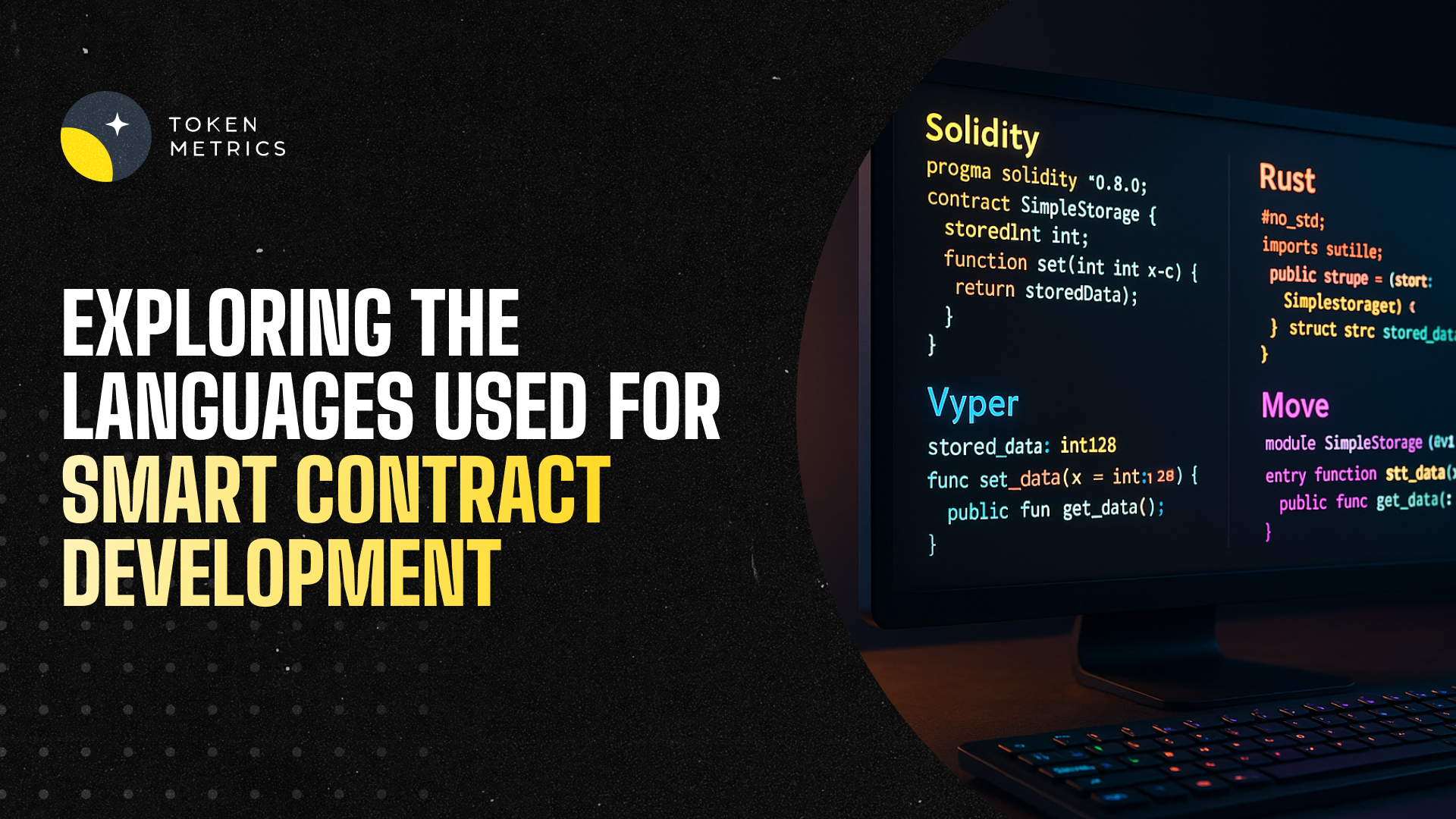
Smart contract languages are specialized programming languages designed to create logic that runs on blockchains. The most prominent blockchain for smart contracts currently is Ethereum, but other blockchains have their languages as well. The following section outlines some of the most widely-used smart contract languages.

  • Solidity: Often considered the standard language for Ethereum smart contracts, Solidity is a high-level, contract-oriented language similar in syntax to JavaScript and influenced by C++ and Python. It is statically typed and supports inheritance, libraries, and complex user-defined types. Solidity is compiled into EVM (Ethereum Virtual Machine) bytecode executable on Ethereum and compatible blockchains.
  • Vyper: Developed as an alternative to Solidity, Vyper emphasizes simplicity, auditability, and security. With a syntax inspired by Python, it is designed to be more readable and to reduce the potential for errors in contract code, though it currently has fewer features than Solidity.
  • Rust: Rust is gaining popularity especially on blockchains like Solana, Near, and Polkadot. It is a systems programming language known for safety and performance. Rust smart contracts tend to be compiled to WebAssembly (Wasm) bytecode, enabling cross-chain compatibility and faster execution on supported platforms.
  • Michelson: Michelson is a low-level stack-based language used to write smart contracts on Tezos blockchain. It is designed for formal verification, allowing high-security guarantees which is important for mission-critical applications.
  • Move: Move is a language developed by Facebook's Diem project and adapted by blockchains like Aptos and Sui. It offers resource-oriented programming to handle digital assets safely and efficiently.
  • Clarity: Used primarily on the Stacks blockchain, Clarity is a decidable language, which means actions of the contract can be predicted and verified before execution. It favors safety and transparency.

Criteria for Language Selection

Developers evaluate smart contract languages based on various factors such as security, expressiveness, ease of use, and compatibility with blockchain platforms. Below are some important criteria:

  1. Security Features: Languages like Vyper and Michelson prioritize simplicity and formal verification to minimize vulnerabilities.
  2. Community and Ecosystem: Solidity benefits from a large developer community, extensive documentation, and extensive tooling which facilitates easier development and auditing.
  3. Performance Efficiency: Languages compiled to Wasm such as Rust-based smart contracts can offer superior speed and reduced resource consumption.
  4. Formal Verification and Auditing: Languages that support rigorous mathematical verification methods help ensure contract correctness and prevent exploits.
  5. Interoperability: The ability of a smart contract to work across multiple blockchains enhances its utility and adoption.

Overview of Leading Smart Contract Languages

Solidity remains the dominant language due to Ethereum's market position and is well-suited for developers familiar with JavaScript or object-oriented paradigms. It continuously evolves with community input and protocol upgrades.

Vyper has a smaller user base but appeals to projects requiring stricter security standards, as its design deliberately omits complex features that increase vulnerabilities.

Rust is leveraged by newer chains that aim to combine blockchain decentralization with high throughput and low latency. Developers familiar with systems programming find Rust a robust choice.

Michelson’s niche is in formal verification-heavy projects where security is paramount, such as financial contracts and governance mechanisms on Tezos.

Move and Clarity represent innovative approaches to contract safety and complexity management, focusing on deterministic execution and resource constraints.

How AI Research Tools Support Smart Contract Analysis

Artificial Intelligence (AI) and machine learning have become increasingly valuable in analyzing and researching blockchain projects, including smart contracts. Platforms such as Token Metrics provide AI-driven ratings and insights by analyzing codebases, developer activity, and on-chain data.

Such tools facilitate the identification of patterns that might indicate strong development practices or potential security risks. While they do not replace manual code audits or thorough research, they support investors and developers by presenting data-driven evaluations that help in filtering through numerous projects.

Practical Considerations for Developers and Analysts

Developers choosing a smart contract language should consider the blockchain platform’s restrictions and the nature of the application. Those focused on DeFi might prefer Solidity or Vyper for Ethereum, while teams aiming for cross-chain applications might lean toward Rust or Move.

Analysts seeking to understand a project’s robustness can utilize resources like Token Metrics for AI-powered insights combined with manual research, including code reviews and community engagement.

Security should remain a priority as vulnerabilities in smart contract code can lead to significant issues. Therefore, familiarizing oneself with languages that encourage safer programming paradigms contributes to better outcomes.

Conclusion

Understanding what languages are used for smart contract development is key to grasping the broader blockchain ecosystem. Solidity leads the field due to Ethereum’s prominence, but alternative languages like Vyper, Rust, Michelson, Move, and Clarity offer different trade-offs in security, performance, and usability. Advances in AI-driven research platforms such as Token Metrics play a supportive role in evaluating the quality and safety of smart contract projects.

Disclaimer

This article is intended for educational purposes only and does not constitute financial or investment advice. Readers should conduct their own research and consult professionals before making decisions related to blockchain technologies and smart contract development.

Choose from Platinum, Gold, and Silver packages
Reach with 25–30% open rates and 0.5–1% CTR
Craft your own custom ad—from banners to tailored copy
Perfect for Crypto Exchanges, SaaS Tools, DeFi, and AI Products