Crypto Basics

Quantum Financial System Explained - A Comprehensive Guide

Uncover the intricacies of the Quantum Financial System and gain insight into its functionality. A comprehensive guide to its workings and impact.
S. Vishwa
8 Minutes
MIN

The world of finance has always been a playground for innovation. From the gold standard to cryptocurrencies, each era has ushered in a transformative way of looking at money and transactions. 

Now, in the digital age, there's a buzz about the Quantum Financial System (QFS). Let's dive into this fascinating topic and decipher how it works.

What is the Quantum Financial System?

The Quantum Financial System, or QFS, is a proposed new-age financial system that leverages the unique capabilities of quantum computing. 

Quantum computers use the principles of quantum mechanics, a branch of physics that describes the tiniest particles in our universe, to process massive amounts of data at speeds previously deemed impossible.

In simple words, the QFS represents a paradigm shift in the world of finance, aiming to integrate the groundbreaking capabilities of quantum computing into our monetary systems. 

At its core, the QFS utilizes principles from quantum mechanics, particularly quantum entanglement and quantum cryptography, to create a financial system that offers unparalleled security and real-time transaction speeds. 

Unlike traditional systems where data breaches and hacks are concerns, any interference in the QFS alters the quantum state of data, instantly signaling a security threat. Moreover, its decentralized nature mirrors that of blockchain, reducing the control any single entity might have. 

As the QFS promises a transparent, speedy, and ultra-secure financial landscape, it's capturing the keen interest of industry insiders and stakeholders.

Key Features of the QFS

Security: One of the biggest selling points of the QFS is its unparalleled security. Thanks to quantum cryptography, it becomes near impossible for hackers to infiltrate the system.

Speed: With quantum computers, transactions are processed in real-time, eliminating the need for intermediaries and reducing transaction times.

Transparency: The system is believed to be fully transparent, ensuring all financial activities are visible, thus reducing corruption and fraudulent activities.

Decentralization: Just like blockchain technology, the QFS aims to operate in a decentralized manner, preventing any single entity from gaining full control over the system.

How Does the Quantum Financial System Work?

The QFS working process is relatively straightforward -

Quantum Entanglement: At the heart of QFS is the phenomenon called quantum entanglement. This allows particles to become interconnected and the state of one (like spin direction) can instantly influence the state of another, no matter the distance separating them. This plays a role in creating a secure and instant communication system in QFS.

Quantum Cryptography: Security in the QFS is reinforced by quantum cryptography. Any attempt to eavesdrop or intercept information changes the quantum state of the information, immediately alerting the system.

Integration with Existing Systems: It's expected that QFS would not operate in isolation. Instead, it will likely be integrated with current financial systems and blockchain technologies to ensure a seamless transition and interoperability.

The Role of Cryptocurrencies in QFS

With the rise of cryptocurrencies like Bitcoin and Ethereum, many speculate how they would fit into the QFS. Given the decentralized nature of both blockchain and QFS, there's potential for significant synergy.

Cryptocurrencies might benefit from the enhanced security features of the QFS, ensuring more robust protection against hacks and unauthorized transactions. The immense speed of quantum computing could also address some scalability issues faced by current blockchain networks.

Advantages of Quantum Financial System

Unparalleled Security - At the heart of the QFS is quantum cryptography. Unlike traditional systems, where breaches can go undetected, any unauthorized attempt to access QFS data immediately changes its quantum state, alerting the system. This intrinsic property makes infiltrations almost impossible.

Near-Instantaneous Transactions - Quantum entanglement, a phenomenon where particles become interconnected regardless of distance, is a foundation of the QFS. It ensures transactions occur in real-time, obliterating typical global financial delays.

Decentralized Framework - Drawing inspiration from blockchain, the QFS operates without a central authority. This decentralization ensures transparency and reduces the potential for undue influence or manipulation by any single entity.

Enhanced Transparency - Owing to its decentralized nature, all transactions within the QFS are visible, creating an open system that reduces the chances of fraudulent activities and fosters trust among its users.

Potential Challenges and Criticisms

Technological Maturity: Quantum computers are still in their infancy. While there's rapid progress, widespread application in sectors like finance might still be years away.

Implementation: The shift from traditional financial systems to a new, untested one will be massive. Regulatory, technological, and practical challenges will need to be addressed.

Public Trust: Just as with cryptocurrencies, gaining the public's trust to move away from traditional banks and systems they're familiar with will be an uphill battle.

When will the Quantum Financial System Start?

The initiation of the Quantum Financial System (QFS) is a topic of intense speculation within the financial community. As of now, while quantum computing has made significant strides, it's still in developmental stages, and a full-fledged QFS remains on the horizon. 

The transition from our current systems to QFS will require robust technological maturity, regulatory adjustments, and widespread trust. 

Though exact timelines are uncertain, continuous advancements suggest that the next decade might witness substantial progress towards its implementation.

How to Invest in the Quantum Financial System?

Investing in the Quantum Financial System (QFS) demands an informed and strategic approach due to its emerging nature. A key perspective to consider is the rising belief among investors that ISO 20022-compliant cryptocurrencies will be instrumental in the QFS framework. 

As such, diversifying your portfolio to include these specific cryptocurrencies could provide potential market exposure to the QFS. Alongside this, it's beneficial to research and invest in companies leading in quantum computing and blockchain innovations. 

Subscribing to credible financial news sources will highlight timely opportunities. Before making any commitments, engaging with financial advisors is essential to ensure your investments match your risk appetite and financial objectives in this evolving landscape.

Future Outlook of QFS

The Quantum Financial System (QFS) is positioned at the crossroads of innovation and potential disruption in the financial sector. 

With its promise of unmatched security through quantum cryptography and blazing transaction speeds owing to quantum mechanics, many view it as the inevitable future of finance. 

Coupled with the integration of ISO 20022-compliant cryptocurrencies, the system embodies a blend of transparency and efficiency. 

However, the full realization of QFS depends on technological advancements, regulatory adaptations, and public trust. The coming decade is poised to be transformative, with QFS potentially redefining the global financial landscape.

Also Read - Future of Crypto in the Next 5 Years

Frequently Asked Questions

Q1. What differentiates the Quantum Financial System from traditional banking systems?

The QFS employs quantum computing principles for heightened security and real-time transactions, distinguishing it from conventional systems that rely on classical computing techniques.

Q2. Is the Quantum Financial System hack-proof?

While no system can claim absolute invulnerability, QFS's use of quantum cryptography makes unauthorized data breaches extremely challenging, as any interference immediately alters the system's quantum state.

Q3. How will the QFS impact everyday banking for consumers?

Once implemented, consumers can expect faster transaction speeds, increased security, and potentially lower fees due to the reduced need for intermediaries.

Q4. Are there any potential risks or downsides to the QFS?

Like any emerging technology, QFS will face teething issues, including potential technological limitations, the need for new regulations, and initial public skepticism.

Q5. Will QFS replace blockchain technology or work in tandem with it?

The QFS is inspired by blockchain's decentralization principles. While it can function independently, it's believed that both technologies can coexist and complement each other, especially in creating transparent financial systems.

Q6. How will international trade and cross-border transactions benefit from QFS?

QFS promises real-time global transactions without typical delays, making international trade more efficient and potentially reducing transaction costs.

Q7. What is ISO 20022, and why is it significant in the context of QFS?

ISO 20022 is a standardized messaging protocol for electronic data interchange between financial institutions. Its compliance in cryptocurrencies indicates a move towards creating a unified and efficient global financial communication system, aligning with the principles of QFS.

Q8. How can one prepare for the transition to the QFS?

Staying informed about advancements in quantum computing and blockchain, understanding ISO 20022-compliant cryptocurrencies, and seeking advice from financial experts can help individuals and businesses smoothly navigate the shift to QFS.

Conclusion

The Quantum Financial System is indeed a revolutionary concept, promising heightened security, swift transactions, and a level of transparency previously unimagined. 

But, as with all innovations, it's essential to approach it with a critical mindset. Understanding its workings, potential, and challenges can help stakeholders make informed decisions.

As the financial world braces for yet another transformation, only time will tell if the QFS will redefine our economic landscape or remain an aspirational concept. For now, let's keep our ears to the ground, stay informed, and be ready to adapt to the ever-evolving world of finance.

Disclaimer

The information provided on this website does not constitute investment advice, financial advice, trading advice, or any other sort of advice and you should not treat any of the website's content as such.

Token Metrics does not recommend that any cryptocurrency should be bought, sold, or held by you. Do conduct your own due diligence and consult your financial advisor before making any investment decisions.

Build Smarter Crypto Apps &
AI Agents in Minutes, Not Months
Real-time prices, trading signals, and on-chain insights all from one powerful API.
Grab a Free API Key
Token Metrics Team
Token Metrics Team

Recent Posts

Research

Can I Make Money by Investing in Crypto Indices? What You Need to Know in 2025

Token Metrics Team
8 min
MIN

One of the most common questions in crypto investing today is: “Can I actually make money with a crypto index?” The short answer is yes—but like any investment, your success depends on the market, your strategy, and the type of index you choose.

In 2025, crypto indices have become one of the most popular ways to invest, especially for people who want exposure to digital assets without actively trading. Whether you’re using a passive index to track the top 10 cryptocurrencies or an AI-powered index that rotates between bullish tokens, the potential for profit is real.

This article explores how crypto indices generate returns, how much money you can make, and what you need to know before diving in.

What Is a Crypto Index?

A crypto index is a bundle of cryptocurrencies grouped together into one investment product. The index can track:

  • Top coins by market cap (e.g., BTC, ETH, SOL)
  • A specific theme (e.g., DeFi, Memecoins, AI)
  • A strategy (e.g., trend-following, momentum)
  • Signals generated by AI (e.g., Token Metrics AI Indices)

Investors can gain exposure to multiple tokens through a single purchase—and benefit from automatic rebalancing, diversification, and sometimes even active risk management.

How Do You Make Money With Crypto Indices?

There are three primary ways to earn returns from crypto index investing:

✅ 1. Capital Appreciation

When the tokens in your index increase in value, the overall index value rises—and so does your investment.

Example:
If the AI sector pumps and your AI Tokens Index includes FET, AGIX, and TAO, you benefit from their combined price growth—even if you didn’t pick the best-performing token individually.

✅ 2. Rebalancing Gains

Rebalancing can lock in profits from over-performing assets and reallocate them into undervalued ones.

This helps “sell high and buy low” automatically, which can enhance long-term performance—especially in volatile markets.

Example:
If SHIB spikes and becomes 40% of a Memecoin Index, the index may sell SHIB and redistribute gains into PEPE or WIF—helping you capture profits before a correction.

✅ 3. AI Signal Performance (for AI Indices)

AI-powered indices don’t just hold and rebalance—they use real-time signals to actively manage exposure.

This can include:

  • Exiting underperforming or risky tokens
  • Increasing allocation to trending assets
  • Moving capital into stablecoins in bearish conditions

These dynamic strategies often outperform static indices, especially during market uncertainty.

How Much Can You Make?

This depends on several factors:

📊 1. Market Conditions

  • In bull markets, most indices generate strong returns
  • In sideways markets, AI indices typically outperform
  • In bear markets, passive indices may suffer unless they include stablecoin buffers

📈 2. Type of Index

  • AI indices tend to generate higher returns due to active management
  • Passive indices offer more stable, long-term gains

💼 3. Your Strategy

  • Compounding small gains over time leads to powerful results
  • Reinvesting or auto-DCA into indices amplifies returns

Pros of Making Money with Crypto Indices

  • ✅ Don’t need to time individual token pumps
  • ✅ Protection from single-token crashes
  • ✅ Hands-free portfolio management
  • ✅ Exposure to trends without speculation
  • ✅ Smart rebalancing = better trade entries/exits

Potential Pitfalls to Watch Out For

While you can make money with crypto indices, it’s not guaranteed. Be mindful of:

⚠️ 1. Market-Wide Downturns

If the entire crypto market crashes, even diversified indices may lose value—though AI indices can reduce losses better than passive ones.

⚠️ 2. Poor Index Construction

Some indices include illiquid or low-performing tokens. Always check the index methodology.

⚠️ 3. Over-Exposure to a Single Narrative

Putting all your money in a Memecoin or AI index during a hype cycle can be risky. Diversify across index types.

How to Maximize Profits With Crypto Indices

Here are proven tips to make the most of index investing:

  1. Start Early – Let compounding work over time
  2. Use AI Indices in Volatile Markets
  3. Diversify Across Themes – (e.g., 40% passive, 30% AI, 30% thematic)
  4. Reinvest Gains – Set up auto-DCA (dollar-cost averaging)
  5. Monitor Platform Updates – AI logic often improves over time
  6. Choose Indexes With Strong Methodology – Like those from Token Metrics

Beginner-Friendly Earning Strategy

If you’re new to crypto:

  • Start with a Token Metrics HODL Index (e.g., Top 10 or Top 25)
  • Add a low-risk AI-powered index (e.g., RWA or DeFi)
  • Avoid going all-in on trending narratives without a hedge

This gives you a balanced mix of growth and stability, with automated management.

Final Thoughts: Yes, You Can Make Money With Crypto Indices

Crypto indices—especially AI-powered ones—are a smart, strategic way to grow wealth in crypto without having to trade constantly or chase pumps.

You can earn money by:

  • Capturing market-wide gains
  • Letting the index rebalance for you
  • Leveraging AI to rotate into outperforming assets

Platforms like Token Metrics offer some of the best-performing AI indices in 2025, designed to help you make money smarter—not harder.

So yes, you can absolutely make money by investing in crypto indices—if you choose the right ones and manage your exposure wisely.

Crypto Basics

How Do AI Crypto Indices Work? Inside the Future of Smart Investing

Token Metrics Team
8 min
MIN

In the ever-evolving world of crypto, one thing is clear: automation and intelligence are the future. In 2025, AI-powered crypto indices are gaining traction as the most efficient, adaptive, and data-driven way to invest in digital assets. But how exactly do they work?

Unlike traditional crypto indices that follow fixed rules and rebalance on a schedule, AI indices adjust dynamically using real-time market signals, machine learning models, and smart risk management. They take the guesswork—and the emotion—out of investing.

In this article, we’ll break down what AI crypto indices are, how they function, and why they’re outperforming passive strategies in today’s market.

What Is an AI-Powered Crypto Index?

An AI-powered crypto index is a cryptocurrency investment portfolio managed by artificial intelligence. Rather than following rigid rebalancing schedules or fixed token lists, the AI actively decides:

  • Which tokens to include
  • How much weight to assign to each
  • When to buy, hold, or sell
  • Whether to move into stablecoins during market downturns

These decisions are made using a wide range of data inputs, processed through advanced algorithms and predictive models.

The Core Components of AI Crypto Indices

Let’s look under the hood. Here’s how AI-powered indices operate behind the scenes:

1. Data Collection

AI indices analyze vast amounts of crypto market data from multiple sources, including:

  • Price Action: Trends, volatility, momentum
  • Volume & Liquidity: How much is being traded and where
  • Social Sentiment: Mentions on Twitter, Reddit, Telegram, and news
  • Technical Indicators: RSI, MACD, moving averages, Bollinger Bands
  • On-Chain Metrics: Wallet activity, inflows/outflows, network usage
  • Macro Signals: Fed policy, global economic news, BTC dominance

This multi-dimensional data stack forms the foundation of the AI’s decision-making process.

2. Signal Generation

Using the data, the AI identifies bullish, neutral, or bearish conditions for each token under consideration.

It may use:

  • Machine learning classifiers
  • Neural networks trained on historical data
  • Natural language processing (NLP) to assess sentiment

The goal is to forecast short- to mid-term performance potential of each asset in the index.

3. Portfolio Allocation Logic

Once signals are generated, the AI engine builds the portfolio:

  • Include bullish tokens
  • Exclude bearish or sideways tokens
  • Adjust weights based on conviction
  • Cap exposure to volatile or illiquid assets
  • Shift into stablecoins if overall risk is high

This process replaces traditional “Top 10 Market Cap” logic with data-informed positioning.

4. Rebalancing & Execution

AI indices typically rebalance on a weekly or as-needed basis—far more responsive than quarterly rebalancing in passive indices.

Rebalancing involves:

  • Selling underperforming assets
  • Increasing exposure to trending tokens
  • Reducing concentration risk
  • Locking in profits by trimming over-extended positions

Execution may be simulated (in research products) or actual (for tokenized index platforms or connected wallets).

Real-World Example: Token Metrics AI Indices

Token Metrics is a leader in AI index technology. Their indices:

  • Analyze over 80 data points per token
  • Issue weekly buy/sell signals
  • Rebalance portfolios based on market sentiment and momentum

Example: DeFi AI Index

  • Week 1: AAVE, LDO, RUNE get bullish signals → added to the index
  • Week 2: LDO signal turns bearish → replaced by GMX
  • Week 3: Broad DeFi market looks weak → 30% of portfolio shifted into USDC

This approach ensures the portfolio actively adapts to changing market conditions without user intervention.

Benefits of AI-Powered Indices

✅ Smarter Risk Management

Exit early during downturns, move into stablecoins, avoid overexposure.

✅ Better Timing

Capture gains earlier by entering tokens before trend exhaustion.

✅ Emotion-Free Investing

No panic selling or FOMO buying—just data-driven decisions.

✅ Automation at Scale

Ideal for passive investors who want active performance.

✅ Competitive Performance

Outperformed passive indices in 2024–2025 due to faster reaction times and smarter rebalancing.

AI vs. Passive Crypto Indices

Are AI Crypto Indices Safe?

While no crypto investment is “safe,” AI indices help reduce risk compared to manual investing or passive index strategies by:

  • Avoiding weak tokens
  • Reducing exposure in downturns
  • Allocating capital to strong-performing assets

This makes them a compelling choice for both beginners and advanced investors looking for automated performance optimization.

Common Misconceptions

❌ "AI indices are just hype."

Wrong. Real AI indices use trained models and live market data—not just price trends—to make decisions.

❌ "They’re only for pros."

Most platforms now offer user-friendly AI indices that are fully automated and beginner-friendly.

❌ "They’re too risky."

While aggressive AI indices exist (e.g., Memecoins), many offer conservative modes with stablecoin rotation and low-volatility token selection.

Who Should Use AI-Powered Indices?

  • Busy Professionals – Want hands-off performance
  • Trend Traders – Prefer smart auto-rebalancing
  • Beginners – Need risk-managed crypto exposure
  • Wealth Builders – Looking for alpha over time

Final Thoughts: AI Indices Are the Future of Crypto Investing

AI-powered crypto indices bring hedge-fund-level sophistication to individual investors. With intelligent signal generation, data-driven risk management, and weekly rebalancing, these indices outperform traditional strategies—especially in volatile markets.

Whether you want to follow the hottest trends, avoid losses during bear markets, or simply invest smarter, AI indices offer an automated and strategic approach to growing your crypto portfolio.

Platforms like Token Metrics lead this space with real-time AI signal engines, offering performance-optimized indices across Memecoins, DeFi, AI tokens, RWAs, and more.

Crypto Basics

Can AI or Data Tools Help Identify Moonshots?

Token Metrics Team
8 min
MIN

From Hype to Science — The Role of AI in Finding Moonshots

In the past, finding a 100x moonshot often meant trolling crypto Twitter threads, scanning Discord servers, or jumping into Telegram groups filled with bots and hype. But times have changed. In 2025, the smartest investors use AI and data analytics tools to uncover hidden gems before they explode.

This blog explores how AI and crypto-specific data platforms like Token Metrics are transforming moonshot discovery into a science — removing the guesswork and helping investors spot massive opportunities early.

Why Human-Only Research Isn’t Enough Anymore

With over 2 million crypto tokens and hundreds launching weekly, it’s virtually impossible to manually research everything. Retail traders are often overwhelmed, relying on gut feelings or influencer tweets.

AI levels the playing field by:

  • Analyzing massive datasets at scale
  • Spotting hidden patterns in price, volume, and sentiment
  • Scoring tokens based on fundamentals, momentum, and risk
  • Filtering out noise, scams, and pump-and-dumps

Simply put, AI sees what the human eye misses.

How AI Tools Detect Moonshots

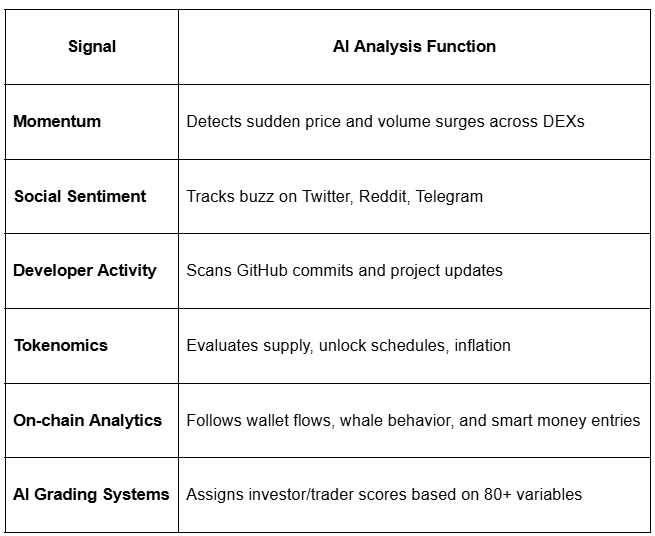
AI models trained on crypto data can identify early-stage projects by analyzing:

These insights allow you to rank tokens and prioritize research efforts.

How Token Metrics AI Grades Work

Token Metrics, a pioneer in AI-driven crypto analytics, uses machine learning to generate Investor Grades, Trader Grades, and Bullish/Bearish Signals for thousands of tokens.

Here's how:

  • Investor Grade – Long-term potential based on fundamentals, community, tech
  • Trader Grade – Short-term potential based on price action, momentum, liquidity
  • Bullish Signal – Triggered when AI detects high-probability upside within 7–14 days
  • Bearish Signal – Warns of likely downturns or profit-taking zones

Moonshots that rank highly across these metrics are often early movers with breakout potential.

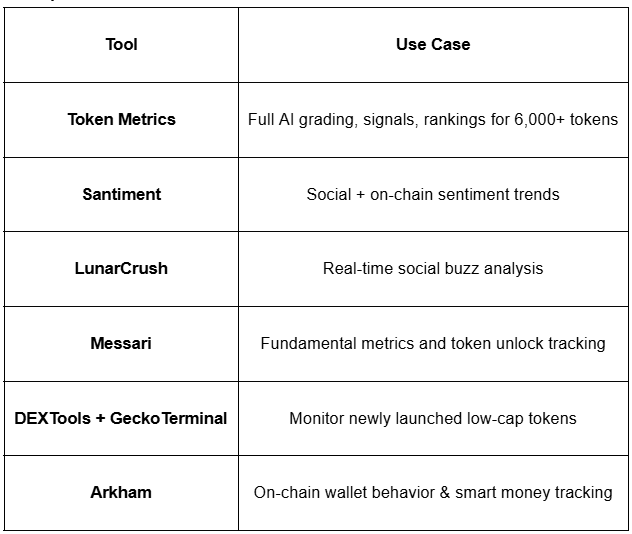
Top Tools to Find Moonshots with AI & Data

Use these tools together to spot patterns others miss.

Case Study: AI Spotting a Moonshot Early

Let’s say a low-cap AI token called NeuroLink AI launches. It’s not yet on CEXs but shows:

  • Spike in GitHub commits
  • Surge in Telegram growth
  • 24h price up 18%, volume 400%
  • Mentioned in 3 Token Metrics Bullish Signals in one week
  • AI Trader Grade: 91/100

That’s a prime moonshot candidate worth further analysis — and most retail traders wouldn’t catch it until it’s up 5x.

Human + AI = The Winning Formula

AI doesn't replace human judgment — it enhances it. The best approach is:

  1. Use AI to scan, sort, and filter top candidates
  2. Manually research the top 5–10 picks
  3. Evaluate community, product, team, and roadmap
  4. Use risk metrics and technicals for entry/exit planning

This hybrid approach minimizes FOMO and maximizes precision.

Moonshot AI Checklist

Before diving in, check:

✅ High AI Trader or Investor Grade (85+)
✅ Momentum score surging
✅ Early-stage narrative (AI, DePIN, RWA, etc.)
✅ Community growth across socials
✅ Smart money inflows on-chain
✅ No major unlocks in next 30 days

If all boxes are ticked, you may have found your next 10x.

Final Thoughts: AI is the Ultimate Edge in 2025

Crypto moonshots are no longer found in meme threads and TikTok videos alone. In 2025, the best investors use AI-powered research to systematically uncover explosive opportunities before they go viral.

By leveraging platforms like Token Metrics, you turn chaos into clarity — and emotion into execution.

Choose from Platinum, Gold, and Silver packages
Reach with 25–30% open rates and 0.5–1% CTR
Craft your own custom ad—from banners to tailored copy
Perfect for Crypto Exchanges, SaaS Tools, DeFi, and AI Products