Crypto Basics

Quantum Financial System Explained - A Comprehensive Guide

Uncover the intricacies of the Quantum Financial System and gain insight into its functionality. A comprehensive guide to its workings and impact.
S. Vishwa
8 Minutes
MIN

The world of finance has always been a playground for innovation. From the gold standard to cryptocurrencies, each era has ushered in a transformative way of looking at money and transactions. 

Now, in the digital age, there's a buzz about the Quantum Financial System (QFS). Let's dive into this fascinating topic and decipher how it works.

What is the Quantum Financial System?

The Quantum Financial System, or QFS, is a proposed new-age financial system that leverages the unique capabilities of quantum computing. 

Quantum computers use the principles of quantum mechanics, a branch of physics that describes the tiniest particles in our universe, to process massive amounts of data at speeds previously deemed impossible.

In simple words, the QFS represents a paradigm shift in the world of finance, aiming to integrate the groundbreaking capabilities of quantum computing into our monetary systems. 

At its core, the QFS utilizes principles from quantum mechanics, particularly quantum entanglement and quantum cryptography, to create a financial system that offers unparalleled security and real-time transaction speeds. 

Unlike traditional systems where data breaches and hacks are concerns, any interference in the QFS alters the quantum state of data, instantly signaling a security threat. Moreover, its decentralized nature mirrors that of blockchain, reducing the control any single entity might have. 

As the QFS promises a transparent, speedy, and ultra-secure financial landscape, it's capturing the keen interest of industry insiders and stakeholders.

Key Features of the QFS

Security: One of the biggest selling points of the QFS is its unparalleled security. Thanks to quantum cryptography, it becomes near impossible for hackers to infiltrate the system.

Speed: With quantum computers, transactions are processed in real-time, eliminating the need for intermediaries and reducing transaction times.

Transparency: The system is believed to be fully transparent, ensuring all financial activities are visible, thus reducing corruption and fraudulent activities.

Decentralization: Just like blockchain technology, the QFS aims to operate in a decentralized manner, preventing any single entity from gaining full control over the system.

How Does the Quantum Financial System Work?

The QFS working process is relatively straightforward -

Quantum Entanglement: At the heart of QFS is the phenomenon called quantum entanglement. This allows particles to become interconnected and the state of one (like spin direction) can instantly influence the state of another, no matter the distance separating them. This plays a role in creating a secure and instant communication system in QFS.

Quantum Cryptography: Security in the QFS is reinforced by quantum cryptography. Any attempt to eavesdrop or intercept information changes the quantum state of the information, immediately alerting the system.

Integration with Existing Systems: It's expected that QFS would not operate in isolation. Instead, it will likely be integrated with current financial systems and blockchain technologies to ensure a seamless transition and interoperability.

The Role of Cryptocurrencies in QFS

With the rise of cryptocurrencies like Bitcoin and Ethereum, many speculate how they would fit into the QFS. Given the decentralized nature of both blockchain and QFS, there's potential for significant synergy.

Cryptocurrencies might benefit from the enhanced security features of the QFS, ensuring more robust protection against hacks and unauthorized transactions. The immense speed of quantum computing could also address some scalability issues faced by current blockchain networks.

Advantages of Quantum Financial System

Unparalleled Security - At the heart of the QFS is quantum cryptography. Unlike traditional systems, where breaches can go undetected, any unauthorized attempt to access QFS data immediately changes its quantum state, alerting the system. This intrinsic property makes infiltrations almost impossible.

Near-Instantaneous Transactions - Quantum entanglement, a phenomenon where particles become interconnected regardless of distance, is a foundation of the QFS. It ensures transactions occur in real-time, obliterating typical global financial delays.

Decentralized Framework - Drawing inspiration from blockchain, the QFS operates without a central authority. This decentralization ensures transparency and reduces the potential for undue influence or manipulation by any single entity.

Enhanced Transparency - Owing to its decentralized nature, all transactions within the QFS are visible, creating an open system that reduces the chances of fraudulent activities and fosters trust among its users.

Potential Challenges and Criticisms

Technological Maturity: Quantum computers are still in their infancy. While there's rapid progress, widespread application in sectors like finance might still be years away.

Implementation: The shift from traditional financial systems to a new, untested one will be massive. Regulatory, technological, and practical challenges will need to be addressed.

Public Trust: Just as with cryptocurrencies, gaining the public's trust to move away from traditional banks and systems they're familiar with will be an uphill battle.

When will the Quantum Financial System Start?

The initiation of the Quantum Financial System (QFS) is a topic of intense speculation within the financial community. As of now, while quantum computing has made significant strides, it's still in developmental stages, and a full-fledged QFS remains on the horizon. 

The transition from our current systems to QFS will require robust technological maturity, regulatory adjustments, and widespread trust. 

Though exact timelines are uncertain, continuous advancements suggest that the next decade might witness substantial progress towards its implementation.

How to Invest in the Quantum Financial System?

Investing in the Quantum Financial System (QFS) demands an informed and strategic approach due to its emerging nature. A key perspective to consider is the rising belief among investors that ISO 20022-compliant cryptocurrencies will be instrumental in the QFS framework. 

As such, diversifying your portfolio to include these specific cryptocurrencies could provide potential market exposure to the QFS. Alongside this, it's beneficial to research and invest in companies leading in quantum computing and blockchain innovations. 

Subscribing to credible financial news sources will highlight timely opportunities. Before making any commitments, engaging with financial advisors is essential to ensure your investments match your risk appetite and financial objectives in this evolving landscape.

Future Outlook of QFS

The Quantum Financial System (QFS) is positioned at the crossroads of innovation and potential disruption in the financial sector. 

With its promise of unmatched security through quantum cryptography and blazing transaction speeds owing to quantum mechanics, many view it as the inevitable future of finance. 

Coupled with the integration of ISO 20022-compliant cryptocurrencies, the system embodies a blend of transparency and efficiency. 

However, the full realization of QFS depends on technological advancements, regulatory adaptations, and public trust. The coming decade is poised to be transformative, with QFS potentially redefining the global financial landscape.

Also Read - Future of Crypto in the Next 5 Years

Frequently Asked Questions

Q1. What differentiates the Quantum Financial System from traditional banking systems?

The QFS employs quantum computing principles for heightened security and real-time transactions, distinguishing it from conventional systems that rely on classical computing techniques.

Q2. Is the Quantum Financial System hack-proof?

While no system can claim absolute invulnerability, QFS's use of quantum cryptography makes unauthorized data breaches extremely challenging, as any interference immediately alters the system's quantum state.

Q3. How will the QFS impact everyday banking for consumers?

Once implemented, consumers can expect faster transaction speeds, increased security, and potentially lower fees due to the reduced need for intermediaries.

Q4. Are there any potential risks or downsides to the QFS?

Like any emerging technology, QFS will face teething issues, including potential technological limitations, the need for new regulations, and initial public skepticism.

Q5. Will QFS replace blockchain technology or work in tandem with it?

The QFS is inspired by blockchain's decentralization principles. While it can function independently, it's believed that both technologies can coexist and complement each other, especially in creating transparent financial systems.

Q6. How will international trade and cross-border transactions benefit from QFS?

QFS promises real-time global transactions without typical delays, making international trade more efficient and potentially reducing transaction costs.

Q7. What is ISO 20022, and why is it significant in the context of QFS?

ISO 20022 is a standardized messaging protocol for electronic data interchange between financial institutions. Its compliance in cryptocurrencies indicates a move towards creating a unified and efficient global financial communication system, aligning with the principles of QFS.

Q8. How can one prepare for the transition to the QFS?

Staying informed about advancements in quantum computing and blockchain, understanding ISO 20022-compliant cryptocurrencies, and seeking advice from financial experts can help individuals and businesses smoothly navigate the shift to QFS.

Conclusion

The Quantum Financial System is indeed a revolutionary concept, promising heightened security, swift transactions, and a level of transparency previously unimagined. 

But, as with all innovations, it's essential to approach it with a critical mindset. Understanding its workings, potential, and challenges can help stakeholders make informed decisions.

As the financial world braces for yet another transformation, only time will tell if the QFS will redefine our economic landscape or remain an aspirational concept. For now, let's keep our ears to the ground, stay informed, and be ready to adapt to the ever-evolving world of finance.

Disclaimer

The information provided on this website does not constitute investment advice, financial advice, trading advice, or any other sort of advice and you should not treat any of the website's content as such.

Token Metrics does not recommend that any cryptocurrency should be bought, sold, or held by you. Do conduct your own due diligence and consult your financial advisor before making any investment decisions.

Build Smarter Crypto Apps &
AI Agents in Minutes, Not Months
Real-time prices, trading signals, and on-chain insights all from one powerful API.
Grab a Free API Key
Token Metrics Team
Token Metrics Team

Recent Posts

Crypto Basics

Decentraland (MANA) Price Prediction 2025, 2030 - Forecast Analysis

S. Vishwa
5 Minutes
MIN

Decentraland (MANA) has been making waves in the cryptocurrency market, particularly in the space of the Metaverse and NFTs. As a virtual reality platform built on the Ethereum blockchain, Decentraland offers users the opportunity to purchase virtual land and create unique experiences within the platform.

The project has gained traction and popularity, attracting attention from both Western and Eastern markets. In this article, we will comprehensively analyze Decentraland (MANA) price prediction, covering various timeframes, expert opinions, and market trends.

Historical Performance of Decentraland

To understand the potential future of Decentraland, it's important to look at its historical performance. MANA was introduced to the market in September 2017, starting with a price of $0.026. 

However, the token experienced volatility and dropped to as low as $0.009 by the end of October. Over time, MANA recovered and reached a price of $0.13 in mid-December, only to dip again to $0.096 by the year-end.

MANA Price Chart
Image Source - Token Metrics

The following years saw fluctuations in the price of MANA. In 2019, the token traded between $0.02 and $0.04 for several months. The market crash in March 2020, caused by the COVID-19 pandemic, affected MANA, bringing its price down to $0.02. 

However, it gradually recovered and reached $0.10 in August. The announcement of Meta in September 2021 pushed the price of MANA to $3.7, but it experienced turbulence in December, ranging from $2.972 to $4.08.

Decentraland (MANA) Current Fundamentals

As of the most recent data, the live price of MANA is around $0.46, with a market cap of $853,950,760.

MANA Tokenomics
Start Your Free Trial Today and Uncover Your Token's Price Prediction and Forecast on Token Metrics

The circulating supply of MANA is 1,846,944,514.88288 tokens. Despite all the resistance in the market, MANA managed to have 86th rank by market cap.

Decentraland (MANA) Price Prediction - Scenario Analysis

To forecast Decentraland's (MANA) future price, it is crucial to consider multiple scenarios based on different market conditions and expert opinions. Let's explore some potential price predictions for Decentraland.

Decentraland (MANA) Price Prediction - Bullish Market

In a bull market scenario where the overall cryptocurrency market experiences significant growth, Decentraland could benefit from increased adoption and demand for its services. Industry experts predict that Decentraland's price could reach new highs in this case.

If the crypto market cap hits $3 Trillion and Decentraland retains its current 0.05% dominance, its price could ascend to $0.74.

In a more bullish scenario of the crypto market surging to $10 Trillion, Decentraland's price could soar to a staggering $2.48, resulting in a potential 7x return for investors.

It is important to note that these predictions are based on various factors and assumptions, and market conditions can change rapidly. However, bullish market sentiment and increased adoption of Decentraland's solutions could drive its price to new heights.

MANA Price Prediction
Start Your Free Trial Today and Uncover Your Token's Price Prediction and Forecast on Token Metrics

Decentraland (MANA) Price Prediction - Bearish Market

In a bearish market scenario where the overall cryptocurrency market faces a downturn or stagnation, Decentraland's price could experience a decline or slower growth. Market sentiment and external factors can significantly impact the price of cryptocurrencies.

In this case, the Decentraland (MANA) price may face downward pressure with a decreased dominance of 0.025%.

In this scenario, If the crypto market cap hits $3 Trillion, Decentraland could trade around $0.37 in the short term and struggle to surpass $1.24 by 2030 even if the total crypto market cap surpasses the $10 Trillion mark.

It is crucial to consider potential risks and challenges that Decentraland may face. Factors such as regulatory developments, competition from other projects, and technological advancements can affect the growth trajectory of Decentraland.

Also Read - Litecoin (LTC) Price Prediction

Decentraland (MANA) Price Prediction - Industry Expert Opinion

The Coinpedia platform predicts Decentraland (MANA) could reach $5.15 to $6.17 by 2030, and experts from Changelly forecast that it could reach minimum and maximum prices of $1 and $1.2 by the end of 2025. And by the end of 2030, the price of Decentraland (MANA) could reach $6.68 to $7.81.

Other industry analysts have varying opinions on the future price of Decentraland. Ambcrypto.com predicts that Decentraland (MANA) could reach $1.41 to $2.11 by 2030.

Note - Start Your Free Trial Today and Uncover Your Token's Price Prediction and Forecast on Token Metrics.

It's essential to understand that these predictions are based on various factors and should not be considered investment advice. Conduct thorough research and consult with professionals before making any investment decisions.

Is Decentraland (MANA) a Good Investment?

The question of whether Decentraland (MANA) is a good investment depends on various factors. Decentraland has shown promising potential as a virtual reality platform, attracting attention and partnerships.

The growing adoption and development within the platform could drive the value of MANA. However, it's essential to consider the risks involved in cryptocurrency investments. The market is highly volatile, and prices can fluctuate rapidly. 

Additionally, regulatory changes and competition from other platforms could impact Decentraland's performance.

Also Read - Is Solana a Good Investment?

Decentraland Current Developments and Future Potential

Decentraland continues to make strides in its development, attracting attention from both users and industry leaders. The platform offers unique opportunities for content creators, individuals, and businesses looking to explore the potential of virtual reality and the Metaverse.

As the technology behind virtual reality and blockchain advances, Decentraland has the potential to become a leading platform in the space. The growth in the adoption of NFTs and the increasing interest in virtual experiences further emphasize the potential of Decentraland.

Conclusion

Decentraland (MANA) has garnered attention in the cryptocurrency market, allowing users to create and monetize virtual experiences within the platform. The price of MANA has experienced volatility, but its future potential remains intriguing.

While bullish predictions suggest significant growth for MANA, it's important to approach investment decisions and conduct thorough research cautiously. 

The cryptocurrency market is highly volatile, and factors such as regulations, competition, and market sentiment can impact the price of MANA.

Investors should carefully consider the risks and rewards associated with investing in Decentraland and seek professional advice before making investment decisions. As with any investment, a diversified portfolio and a long-term perspective can help mitigate risks and maximize potential returns.

Disclaimer

The information provided on this website does not constitute investment advice, financial advice, trading advice, or any other advice, and you should not treat any of the website's content as such.

Token Metrics does not recommend buying, selling, or holding any cryptocurrency. Conduct your due diligence and consult your financial advisor before making investment decisions.

Crypto Basics

Best Play to Earn Crypto Games for Passive Income in 2024

Marcus K
5 Minutes
MIN

In recent years, a new trend has emerged in the gaming industry - play to earn crypto games. These innovative games allow players to have fun and earn real money by participating in gameplay and achieving specific milestones. 

With the rise of blockchain technology and the growing popularity of cryptocurrencies, play to earn games have gained significant traction among gamers worldwide.

The Rise of Play to Earn Crypto Games

Play to earn crypto games has revolutionized the traditional gaming landscape by introducing the concept of earning real-world value through gameplay. 

Unlike traditional video games, where players are limited to in-game rewards and achievements, play to earn games offer tangible rewards in the form of cryptocurrencies and non-fungible tokens (NFTs). These rewards can be traded, sold, or exchanged for fiat currency.

The concept of play to earn games originated from the world of cryptocurrencies, where decentralized finance (DeFi) protocols incentivize users to participate and contribute to the network.

This concept was then integrated into the gaming industry, creating a new genre of games that combined entertainment with financial rewards.

How Play to Earn Games Work?

Play to earn games function through blockchain technology, which ensures transparency, security, and immutability. The game assets, such as characters, items, and in-game currencies, are tokenized as NFTs and stored on a blockchain.

It enables players to have true ownership over their in-game assets and the ability to trade or sell them on various marketplaces.

Players earn rewards in play to earn games by completing tasks, achieving goals, or participating in in-game competitions. These rewards are often in the form of cryptocurrencies, which can be staked, traded, or sold for profit. The earning potential in play to earn games is directly tied to the player's skill, dedication, and participation.

Top Play-to-Earn Crypto Games

A Play-to-Earn of play-to-earn crypto games are available in the market, each offering unique gameplay and earning opportunities. Let's take a closer look at some of the best play to earn games that have gained popularity among gamers:

1. Big Time

Big Time is a revolutionary role-playing game immersing players in the captivating world of Time’s End. Groups of six collaborate to undertake missions in dungeons, acquiring NFTs and tokens with substantial trading value. 

The game's genesis aligns with blockchain-based gaming, focusing on an engaging and social experience without significant financial commitment. The esteemed development team includes figures from Decentraland and notable titles like Fortnite. 

The fusion of immersive gameplay, cryptocurrency incentives, and an illustrious development team positions Big Time as a compelling prospect for gaming and digital asset enthusiasts.

2. Axie Infinity

Axie Infinity is a Pokemon-inspired game built on the Ethereum blockchain. In this game, players collect and breed digital creatures called Axies, which can be battled against other players. 

Players earn Smooth Love Potion (SLP) tokens for winning battles, which can be traded for other cryptocurrencies or sold for fiat currency. Axie Infinity has gained a massive following and has become one of the most successful play to earn games to date.

3. The Sandbox

The Sandbox is a multiplayer metaverse game that allows players to create, own, and monetize their virtual worlds. Players can buy virtual land, build structures, create art, and even host events within their virtual space. 

The Sandbox operates on the Ethereum and Polygon blockchains, and players can earn the game's native token, SAND, by participating and contributing to the ecosystem.

4. Decentraland

Decentraland is a virtual reality platform where players can explore, interact, and create their own digital experiences. Players can buy virtual land, build and monetize their creations, and engage in social activities with other players. 

Decentraland operates on the Ethereum blockchain, and players can earn the game's native token, MANA, by participating in events and games or trading virtual assets.

5. Splinterlands

Splinterlands is a trading card game that allows players to collect, trade, and battle with digital cards. Each card is represented as an NFT, and players can earn in-game rewards by winning battles and completing quests. 

Splinterlands operates on the HIVE and WAX blockchains, and players can trade their digital cards for other cryptocurrencies or sell them on various marketplaces.

6. Illuvium

Illuvium is an open-world adventure game where players capture and battle mythical creatures called Illuvials. Players can earn the game's native token, ILV, by completing quests, battling other players, and participating in in-game events. Illuvium offers a unique gameplay experience and has gained attention for its stunning visuals and immersive storytelling.

7. Revv Racing

Revv Racing is a multiplayer racing game that combines arcade-style gameplay with blockchain technology. Players can collect and race NFT cars, participate in tournaments, and earn rewards for their performance. Revv Racing operates on the Ethereum blockchain, and players can trade their NFT cars on various marketplaces.

8. Battle of Guardians

Battle of Guardians is a real-time multiplayer game where players battle with mythical creatures in epic battles. Players can earn the game's native token, BGS, by participating in battles, completing quests, and achieving high ranks. 

Battle of Guardians operates on the Solana and Binance Smart Chain blockchains, and players can trade their in-game assets for other cryptocurrencies or sell them on supported marketplaces.

9. My Neighbor Alice

My Neighbor Alice is a farming-based game where players can own virtual land, cultivate crops, and interact with other players. Players can earn rewards by participating in farming activities and trading virtual assets on the game's marketplace. 

My Neighbor Alice operates on the Chromia blockchain, and players can earn the game's native token, ALICE, by contributing to the game's ecosystem.

The Future of Play to Earn Crypto Games

Play to earn crypto games has witnessed tremendous growth in recent years, and the trend is expected to continue in the future. As blockchain technology becomes more mainstream and cryptocurrencies gain wider adoption, play to earn games are likely to attract more players and offer even more lucrative earning opportunities.

The integration of blockchain technology provides players with true ownership and control over their in-game assets, creating a sense of value and empowerment. 

Moreover, play to earn games offer a unique opportunity for players to monetize their gaming skills and dedication, bridging the gap between the virtual and real worlds.

In conclusion, play to earn crypto games have brought a new dimension to the gaming industry, allowing players to have fun and make real money simultaneously. 

With a wide range of games available across different genres and blockchain platforms, players have ample opportunities to explore and participate in this exciting and profitable gaming trend. So, why not dive into the world of play to earn games and start earning while doing what you love?

Disclaimer

The information provided on this website does not constitute investment advice, financial advice, trading advice, or any other advice, and you should not treat any of the website's content as such.

Token Metrics does not recommend buying, selling, or holding any cryptocurrency. Conduct your due diligence and consult your financial advisor before making investment decisions.

Crypto Basics

Litecoin (LTC) Price Prediction 2025, 2030 - Forecast Analysis

S. Vishwa
5 Minutes
MIN

The cryptocurrency market has been experiencing significant expansion with the introduction of numerous high-potential cryptocurrencies. 

Among these digital assets, Litecoin has emerged as one of the few with demonstrated significant potential in recent years. In this comprehensive article, we will delve into the world of Litecoin (LTC) and analyze its price prediction for the coming years. 

With a focus on both short and long-term forecasts, we will explore various market scenarios and expert opinions to provide you with a holistic view of the future of LTC.

Litecoin Overview

Litecoin, often referred to as the "silver to Bitcoin's gold," is a well-established cryptocurrency that has been active for over nine years. With a solid technical foundation, Litecoin has managed to secure its position as one of the top 30 cryptocurrencies by market cap. 

Despite recent discussions around its declining popularity, Litecoin continues demonstrating resilience and potential for future growth.

Historical Performance of Litecoin

To understand the potential future performance of Litecoin, it is essential to examine its historical price movements. Over the course of the past year, Litecoin experienced a predominantly bullish market sentiment, with buyers dominating the scene. 

However, towards the end of the period, sellers started to exert more influence, leading to a decline in price.

Starting from a modest base of $51.32, Litecoin steadily climbed to its peak at $100.96 by January. This resistance level was rigorously tested until July, with occasional breaches that couldn't be sustained.

Litecoin Price Chart
Image Source - Token Metrics

As July progressed, a decline began, reflecting increased selling pressure. Despite these fluctuations, Litecoin managed to maintain support levels, albeit with some retracements along the way.

Litecoin Current Fundamentals

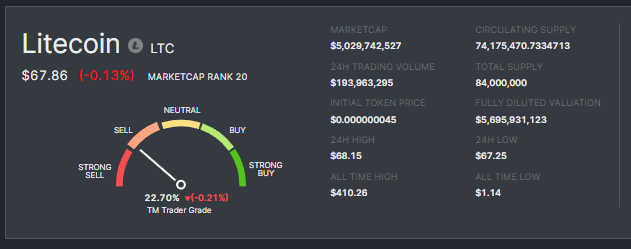
Before diving into the price predictions, let's examine the current fundamentals of Litecoin. Currently, Litecoin's price is around $67.86 and has a market capitalization of $5,029,742,527.

The 24-hour price change is -0.13%, indicating a slight decline. The Fear & Greed Index suggests a moderate level of market sentiment.

Litecoin Tokenomics
Image Source - Token Metrics

Litecoin (LTC) Price Prediction - Scenario Analysis

To forecast Litecoin's future price, it is crucial to consider multiple scenarios based on different market conditions and expert opinions. Let's explore some potential price predictions for Litecoin.

Litecoin (LTC) Price Prediction - Bullish Market Scenario

In a bullish market scenario where positive market sentiment prevails, Litecoin's price has the potential to experience significant growth. Several factors could contribute to this bullish trend, including increased adoption, technological advancements, and positive regulatory developments.

If the crypto market cap hits $3 Trillion and Litecoin retains its current 0.29% dominance, its price could ascend to $118.06.

In a more bullish scenario of the crypto market surging to $10 Trillion, Litecoin's price could soar to a staggering $393.56, resulting in a potential 7x return for investors.

It is important to note that these predictions are based on various factors and assumptions, and market conditions can change rapidly. However, bullish market sentiment and increased adoption of Litecoin's solutions could drive its price to new heights.

Litecoin Price Prediction
Start Your Free Trial Today and Uncover Your Token's Price Prediction and Forecast on Token Metrics

Litecoin (LTC) Price Prediction - Bearish Market Scenario

In the event of a bearish market, Litecoin's price could experience a correction, potentially leading to a decrease in its value. In this case, the price of Litecoin may face downward pressure with a decreased dominance of 0.14%.

In this scenario, If the crypto market cap hits $3 Trillion, Litecoin could trade around $59.03 in the short term and struggle to surpass $196.78 by 2030 even if the total crypto market cap surpasses the $10 Trillion mark.

It is crucial to consider the potential risks and challenges that Litecoin may face. Factors such as regulatory developments, competition from other projects, and technological advancements can affect the growth trajectory of Litecoin.

Also Read - Next Crypto Bull Run

Litecoin Price Prediction - Industry Expert Opinion

To provide a more comprehensive view, let's explore the opinions of industry experts regarding the future of Litecoin.

According to various experts in the cryptocurrency field, Litecoin holds promise as a long-term investment. Its solid technical foundation, active development community, and widespread adoption contribute to its potential for growth. 

Some experts believe that the reduced supply of new Litecoin entering the market due to the halving event could create upward pressure on prices in the long run.

The Coincodex platform predicts Litecoin could reach $139.89 to $483.89 by 2030, and experts from Changelly forecast that it could reach minimum and maximum prices of $142.22 and $178.31 by the end of 2025. By the end of 2030, the price of Litecoin could reach $880.42 to $1,041.87.

Other industry analysts have varying opinions on the future price of Litecoin. Ambcrypto.com predicts that Litecoin could reach $164.82 to $247.22 by 2030.

Note - Start Your Free Trial Today and Uncover Your Token's Price Prediction and Forecast on Token Metrics.

Litecoin's Current Developments and Future Potential

Litecoin continues to evolve and adapt to the changing landscape of the cryptocurrency market. The Litecoin Foundation, along with its dedicated development community, is actively working on various initiatives to enhance the usability and scalability of the network. 

Recent developments include the implementation of privacy features, integration with existing payment systems, and exploring partnerships with major players in the industry.

Looking ahead, Litecoin has the potential to carve out a distinct niche in the cryptocurrency market. Its fast transaction times, lower fees, and strong community support make it an attractive option for both users and investors. 

However, market conditions and competition from other cryptocurrencies should be closely monitored to assess Litecoin's future potential.

Also Read - Ripple (XRP) Price Prediction

Conclusion

In conclusion, the future of Litecoin holds both opportunities and challenges. Based on historical performance and expert opinions, Litecoin has the potential to experience significant growth in the coming years. 

However, it is important to approach cryptocurrency investments with caution and conduct thorough research before making any decisions. 

The cryptocurrency market is highly volatile, and factors such as market sentiment, regulatory changes, and technological advancements can influence the price of Litecoin and other cryptocurrencies. Investors can make more informed decisions regarding their investment strategies by staying informed and seeking professional advice.

Disclaimer

The information provided on this website does not constitute investment advice, financial advice, trading advice, or any other advice, and you should not treat any of the website's content as such.

Token Metrics does not recommend buying, selling, or holding any cryptocurrency. Conduct your due diligence and consult your financial advisor before making investment decisions.

Choose from Platinum, Gold, and Silver packages
Reach with 25–30% open rates and 0.5–1% CTR
Craft your own custom ad—from banners to tailored copy
Perfect for Crypto Exchanges, SaaS Tools, DeFi, and AI Products