Back to blog
Research

REST API Explained: Design, Use Cases & Best Practices

Understand REST API fundamentals, design patterns, security, and observability. Practical guidance for engineers building scalable APIs and integrating services using modern best practices.
Token Metrics Team
5
Want Smarter Crypto Picks—Free?
See unbiased Token Metrics Ratings for BTC, ETH, and top alts.
Thank you! Your submission has been received!
Oops! Something went wrong while submitting the form.
 No credit card | 1-click unsubscribe

In today's interconnected digital ecosystem, REST APIs have become the backbone of modern web applications, mobile apps, and data exchange platforms. Whether you're building a cryptocurrency trading platform, integrating blockchain data, or developing any web service, understanding REST API architecture is essential for creating scalable and efficient applications. This comprehensive guide explores REST API design principles, real-world use cases, and best practices that developers need to master.

Understanding REST API Architecture

REST, which stands for Representational State Transfer, is an architectural style that defines a set of constraints for creating web services. A REST API, also known as a RESTful API, allows different software applications to communicate with each other over HTTP protocols. The beauty of REST lies in its simplicity and stateless nature, making it the preferred choice for developers building everything from social media platforms to cryptocurrency APIs.

When a client makes a request to a REST API, it transfers a representation of the state of the requested resource to the client. This representation can be delivered in various formats, with JSON being the most popular choice in modern applications, especially in crypto APIs and blockchain data services. The stateless nature of REST means that each request from a client contains all the information needed to process that request, without relying on stored context on the server.

Core Components of REST API Design

The foundation of effective REST API design rests on several key components that work together to create a cohesive system. Resources represent the fundamental concept in REST architecture, where everything is considered a resource that can be accessed through a unique identifier known as a URI or Uniform Resource Identifier. For instance, in a cryptocurrency API, resources might include digital assets, market data, trading pairs, or wallet addresses.

HTTP methods form the second pillar of REST API design, providing the verbs that define actions on resources. GET requests retrieve data without modifying it, making them perfect for fetching crypto market data or blockchain information. POST requests create new resources, such as submitting a new transaction or creating a wallet. PUT requests update existing resources completely, while PATCH requests modify specific fields. DELETE requests remove resources from the system. Understanding when to use each method is crucial for building intuitive and predictable APIs.

The URI structure in a well-designed REST API should be logical, consistent, and self-documenting. Rather than using verbs in URLs, REST APIs rely on nouns to represent resources, with HTTP methods conveying the action. For example, a crypto API endpoint might look like /api/v1/cryptocurrencies/bitcoin/price rather than /api/v1/getCryptocurrencyPrice. This approach creates cleaner, more maintainable code that developers can understand intuitively.

REST API Best Practices for Production Systems

Implementing version control in your REST API is not optional but essential for maintaining backward compatibility as your service evolves. Including the version number in the URL path, such as /api/v1/ or /api/v2/, allows you to introduce breaking changes in new versions while supporting legacy clients. This practice is particularly important for cryptocurrency APIs where trading bots and automated systems depend on consistent endpoints.

Authentication and security stand as paramount concerns in REST API development, especially when dealing with sensitive data like cryptocurrency transactions or blockchain information. Token-based authentication using JSON Web Tokens (JWT) has emerged as the industry standard, providing secure, stateless authentication that scales well. For crypto APIs handling financial data, implementing API keys, rate limiting, and encryption becomes non-negotiable to protect user assets and maintain system integrity.

Error handling deserves careful attention in REST API design. Your API should return appropriate HTTP status codes that clearly communicate what happened during request processing. A 200 status indicates success, 201 signifies successful resource creation, 400 indicates a bad request from the client, 401 means unauthorized access, 404 signals that a resource wasn't found, and 500 indicates a server error. Accompanying these status codes with clear, actionable error messages in the response body helps developers debug issues quickly.

Cryptocurrency APIs and REST Architecture

The cryptocurrency industry has embraced REST APIs as the primary method for accessing blockchain data, market information, and trading functionality. Crypto APIs built on REST principles enable developers to integrate real-time cryptocurrency prices, historical market data, trading volumes, and blockchain analytics into their applications seamlessly. Token Metrics, a leader in crypto analytics and data services, offers one of the most comprehensive cryptocurrency APIs in the market, providing developers with access to advanced metrics, AI-driven insights, and real-time market data through a well-designed RESTful interface.

When building or consuming crypto APIs, developers must consider the unique challenges of blockchain technology. Cryptocurrency market data requires high-frequency updates due to the volatile nature of digital assets. A robust crypto API must handle thousands of requests per second while maintaining low latency and high availability. Token Metrics addresses these challenges by providing a scalable REST API infrastructure that delivers accurate cryptocurrency data, token ratings, and market analytics to developers, traders, and institutional clients.

The integration of blockchain APIs with REST architecture has opened new possibilities for decentralized applications and financial technology. Developers can now query blockchain transactions, check wallet balances, monitor smart contract events, and access DeFi protocols through simple HTTP requests. This accessibility has accelerated innovation in the crypto space, allowing developers to build sophisticated trading platforms, portfolio trackers, and analytics dashboards without managing blockchain nodes directly.

Real-World Use Cases of REST APIs

REST APIs power countless applications across industries, demonstrating their versatility and reliability. In the financial technology sector, cryptocurrency exchanges rely on REST APIs to provide trading functionality to their users. These APIs enable programmatic trading, allowing algorithmic traders to execute strategies, monitor positions, and manage risk across multiple markets. Token Metrics leverages REST API technology to deliver cryptocurrency intelligence, offering endpoints for token grades, trader grades, market predictions, and comprehensive crypto market analysis.

Mobile applications represent another significant use case for REST APIs. Every time you check cryptocurrency prices on your phone, post on social media, or stream music, REST APIs work behind the scenes to fetch and deliver that data. The lightweight nature of REST makes it ideal for mobile environments where bandwidth and battery life are concerns. Crypto portfolio tracking apps, for instance, use REST APIs to aggregate data from multiple exchanges and blockchain networks, presenting users with a unified view of their digital asset holdings.

Enterprise systems increasingly adopt REST APIs for integration and automation. Companies use REST APIs to connect customer relationship management systems, payment processors, inventory databases, and analytics platforms. In the blockchain and cryptocurrency domain, businesses integrate crypto payment APIs to accept digital currencies, use blockchain APIs to verify transactions, and leverage analytics APIs like those offered by Token Metrics to make data-driven investment decisions.

Designing Scalable REST APIs

Scalability should be a primary consideration when designing REST APIs, particularly for services that may experience rapid growth or traffic spikes. Implementing pagination for endpoints that return large datasets prevents overwhelming clients and servers. Instead of returning thousands of cryptocurrency listings in a single response, a well-designed crypto API returns a manageable subset along with pagination metadata, allowing clients to request additional pages as needed.

Caching strategies significantly improve REST API performance and reduce server load. By including proper cache-control headers in API responses, you enable clients and intermediary proxies to cache responses appropriately. For cryptocurrency APIs where some data like historical prices rarely changes, aggressive caching can dramatically reduce the number of database queries and API calls. However, real-time data such as current market prices requires careful cache invalidation to ensure accuracy.

Rate limiting protects your REST API from abuse and ensures fair resource allocation among all users. By implementing rate limits based on API keys or IP addresses, you prevent individual clients from monopolizing server resources. Token Metrics implements sophisticated rate limiting in its cryptocurrency API, offering different tiers of access that balance the needs of casual developers, professional traders, and enterprise clients.

Documentation and Developer Experience

Comprehensive documentation transforms a good REST API into a great one. Developers evaluating whether to use your API need clear, accurate documentation that explains endpoints, parameters, authentication methods, and response formats. Interactive API documentation tools like Swagger or Postman collections allow developers to test endpoints directly from the documentation, reducing friction in the integration process.

For cryptocurrency APIs, documentation should include specific examples relevant to the crypto ecosystem. Token Metrics provides extensive API documentation covering everything from basic cryptocurrency price queries to advanced analytics endpoints, complete with code samples in multiple programming languages. This approach accelerates integration and reduces support requests, benefiting both API providers and consumers.

Providing SDKs and client libraries in popular programming languages further improves developer experience. Rather than forcing every developer to handle HTTP requests manually, offering pre-built libraries for Python, JavaScript, Java, and other languages enables faster integration and reduces the likelihood of implementation errors. These libraries can handle authentication, request formatting, error handling, and response parsing automatically.

Monitoring and Maintaining REST APIs

Once your REST API is in production, ongoing monitoring becomes critical to maintaining quality of service. Implementing comprehensive logging allows you to track API usage patterns, identify performance bottlenecks, and detect anomalies. For cryptocurrency APIs handling financial data, monitoring is especially crucial as downtime or data inaccuracies can result in significant financial losses for users.

Performance metrics such as response times, error rates, and throughput provide insights into API health. Setting up alerts for unusual patterns enables proactive problem resolution before users are significantly affected. Token Metrics maintains rigorous monitoring of its crypto API infrastructure, ensuring that developers and traders have reliable access to critical cryptocurrency market data and analytics.

Maintaining backward compatibility while evolving your API requires careful planning and communication. Deprecation policies should give developers adequate time to migrate to new versions or endpoints. For crypto APIs, this is particularly important as trading bots and automated systems may run unattended for extended periods and need time to adapt to API changes.

Security Considerations for REST APIs

Security forms the foundation of trustworthy REST APIs, especially when handling sensitive information like cryptocurrency transactions or personal data. Implementing HTTPS encryption for all API communications prevents man-in-the-middle attacks and protects data in transit. This is non-negotiable for crypto APIs where a single compromised API call could result in unauthorized fund transfers.

Input validation and sanitization protect against injection attacks and malformed requests. Your REST API should validate all incoming data against expected formats and ranges before processing. For cryptocurrency APIs, this includes validating wallet addresses, transaction amounts, and trading parameters to prevent errors and potential exploits.

Implementing proper access controls ensures that authenticated users can only access resources they're authorized to view or modify. Role-based access control (RBAC) provides a flexible framework for managing permissions in complex systems. Token Metrics implements enterprise-grade security in its cryptocurrency API, protecting sensitive market data and ensuring that clients can trust the integrity of the information they receive.

The Future of REST APIs in Cryptocurrency

As the cryptocurrency industry continues to mature, REST APIs will remain central to how developers interact with blockchain data and trading platforms. The evolution of decentralized finance, non-fungible tokens, and Web3 applications creates new opportunities and challenges for API design. REST APIs must adapt to handle increasingly complex queries, provide real-time updates for rapidly changing market conditions, and integrate with emerging blockchain protocols.

Token Metrics continues to innovate in the crypto API space, expanding its offerings to include advanced analytics, AI-powered market predictions, and comprehensive blockchain data. By maintaining a robust REST API infrastructure, Token Metrics enables developers, traders, and institutions to build sophisticated cryptocurrency applications that leverage cutting-edge market intelligence.

The convergence of traditional finance and cryptocurrency creates demand for APIs that can bridge both worlds seamlessly. REST APIs that provide unified access to crypto market data, traditional financial information, and cross-market analytics will become increasingly valuable. As regulatory frameworks evolve, APIs will also need to incorporate compliance features, reporting capabilities, and audit trails to meet institutional requirements.

Conclusion

REST APIs have proven themselves as the most practical and widely adopted approach for building web services that are scalable, maintainable, and developer-friendly. Understanding REST API design principles, implementing best practices, and focusing on security and performance creates APIs that developers love to use and rely on for their applications.

In the cryptocurrency space, REST APIs serve as the critical infrastructure that connects developers to blockchain data, market information, and trading functionality. Token Metrics exemplifies how a well-designed crypto API can empower developers and traders with the data and insights they need to succeed in the dynamic digital asset markets. Whether you're building a new cryptocurrency application or integrating blockchain data into existing systems, mastering REST API principles and leveraging powerful crypto APIs like those offered by Token Metrics will accelerate your development and enhance your capabilities.

As technology continues to evolve, REST APIs will adapt and improve, but their fundamental principles of simplicity, scalability, and statelessness will continue to guide the design of systems that power our increasingly connected digital world.

‍

Build Smarter Crypto Apps &
AI Agents in Minutes, Not Months
Real-time prices, trading signals, and on-chain insights all from one powerful API.
Grab a Free API Key
About Token Metrics
Token Metrics: AI-powered crypto research and ratings platform. We help investors make smarter decisions with unbiased Token Metrics Ratings, on-chain analytics, and editor-curated “Top 10” guides. Our platform distills thousands of data points into clear scores, trends, and alerts you can act on.
30 Employees
analysts, data scientists, and crypto engineers
Daily Briefings
concise market insights and “Top Picks”
Transparent & Compliant
Sponsored ≠ Ratings; research remains independent
Want Smarter Crypto Picks—Free?
See unbiased Token Metrics Ratings for BTC, ETH, and top alts.
Thank you! Your submission has been received!
Oops! Something went wrong while submitting the form.
 No credit card | 1-click unsubscribe
Token Metrics Team
Token Metrics Team

Recent Posts

Research

The Complete Beginner's Guide to Token Metrics Crypto Indices: Start Investing in 30 Minutes

Token Metrics Team
11 min read

Cryptocurrency investing intimidates many potential investors. The technical jargon, overwhelming number of tokens, security concerns, and stories of people losing fortunes create paralysis. You know crypto represents an opportunity, but where do you even begin?

Token Metrics AI Indices eliminate these barriers by providing a simple, secure pathway into cryptocurrency investing. Whether you've never bought crypto before or you're transitioning from traditional investments, this comprehensive beginner's guide walks you through everything needed to start investing successfully in just 30 minutes.

No technical expertise required. No complicated wallet setup. No endless research into thousands of tokens. Just straightforward steps that get you invested intelligently and positioned for long-term wealth creation.

What Exactly Are Crypto Indices? (Explained Simply)

Before diving into the how-to, let's establish a simple understanding of what you're investing in.

Think of crypto indices like a basket containing multiple cryptocurrencies. Instead of buying Bitcoin or Ethereum individually, you buy a pre-made collection of several carefully selected digital assets. This is similar to how traditional stock index funds like the S&P 500 contain hundreds of companies rather than forcing you to pick individual stocks.

Token Metrics creates these baskets using artificial intelligence that analyzes thousands of cryptocurrencies and selects the best ones based on comprehensive data. The AI acts like a team of expert analysts working 24/7, constantly monitoring market conditions and adjusting your portfolio to maximize returns while managing risk.

When you invest in a Token Metrics index, you're essentially hiring sophisticated AI technology to build and manage your crypto portfolio professionally. You get instant diversification across multiple tokens, automatic rebalancing when market conditions change, protection from common investing mistakes, and access to opportunities you'd never find independently.

The beauty of this approach is simplicity. You don't need to understand blockchain technology, read complicated whitepapers, or analyze trading charts. The AI handles complexity while you focus on your life and watch your investment grow.

Why Beginners Should Start with Indices Instead of Individual Tokens

  • New investors often make the mistake of buying individual cryptocurrencies based on social media hype, friend recommendations, or price momentum. This approach leads to several problems that indices elegantly solve.
  • Individual token selection requires expertise most beginners lack. How do you evaluate whether a cryptocurrency's technology is legitimate or vaporware? How do you determine if tokenomics are sustainable? How do you identify scams before they steal your money? Without experience, these questions prove nearly impossible to answer correctly.
  • Concentration risk destroys portfolios quickly. If you invest everything in three tokens and one fails catastrophically, you lose a third of your capital immediately. Indices spread risk across 10-30 carefully vetted assets, ensuring single failures don't devastate your portfolio.
  • Emotional decision-making causes most investment losses. Fear drives panic selling during downturns. Greed drives buying at market tops. FOMO drives chasing pumps into overvalued assets. AI indices eliminate emotion entirely, maintaining discipline when human investors make terrible decisions.
  • Time requirements prove unsustainable. Successfully managing individual crypto positions requires hours daily monitoring markets, reading news, analyzing charts, and executing trades. Most people with jobs and families can't sustain this commitment. Indices require maybe 30 minutes quarterly.

For beginners, indices provide the perfect entry point—immediate diversification, professional management, emotion-free investing, and minimal time commitment. You can start small, learn gradually, and scale up as you become comfortable.

Step-by-Step: Your First 30 Minutes in Crypto Indices

Ready to begin? Follow this simple roadmap to go from complete beginner to invested in under 30 minutes.

  1. Minutes 1-5: Create Your Token Metrics Account
    • Visit the Token Metrics website and click the sign-up button. You'll need to provide basic information including email address, create a secure password, and verify your email through the confirmation link sent to your inbox.
    • Token Metrics offers a 7-day free trial, allowing you to explore the platform thoroughly before committing financially. Take advantage of this trial to familiarize yourself with available indices, review performance data, and understand the interface.
    • During signup, you'll choose a subscription tier. For beginners, start with the basic tier that provides access to all indices and essential features. You can upgrade later if you want additional tools like advanced analytics or trading signals.
  2. Minutes 6-15: Explore Available Indices and Choose Your Strategy
    • Once logged in, navigate to the Indices section. You'll see several different index options, each designed for specific investment strategies and risk profiles. Here's how to choose:
    • Conservative Investor Grade Index: If you're risk-averse, older, or investing money you can't afford to lose, start here. This index focuses on established cryptocurrencies with strong fundamentals—primarily Bitcoin, Ethereum, and select large-cap altcoins. Returns are more moderate but volatility is lower.
    • Balanced Growth Index: If you're comfortable with moderate risk and seeking steady growth, this balanced approach combines major cryptocurrencies with promising mid-cap projects. It offers stronger growth potential than conservative indices while maintaining reasonable risk levels.
    • Aggressive Growth Index: If you're young, risk-tolerant, and seeking maximum returns, this index targets smaller-cap tokens with explosive potential. Volatility is higher but so are potential returns. Only choose this if you can stomach significant price swings.
    • Sector-Specific Indices: Token Metrics offers indices focused on specific crypto sectors like DeFi, Layer-1 blockchains, AI tokens, or memecoins. Choose these if you believe strongly in a particular sector's growth potential.
    • For most beginners, starting with the Balanced Growth Index makes sense. It provides diversification, reasonable growth potential, and manageable volatility. You can always adjust later as you learn more.
  3. Minutes 16-20: Determine Your Investment Amount
    • How much should you invest in crypto indices? This critical decision depends on your financial situation, but follow these general guidelines.
    • Never invest money you need for living expenses. Crypto remains volatile. Only invest money you won't need for at least 3-5 years and that you could lose entirely without affecting your lifestyle.
    • Start small while learning. If you're completely new to crypto, consider investing just $500-1,000 initially. Get comfortable with the process, experience some market volatility, and understand how indices work before committing larger amounts.
    • Follow the 5-20% rule. Financial advisors typically recommend allocating 5-20% of your total investment portfolio to cryptocurrency depending on age and risk tolerance. If you have $50,000 in traditional investments, consider $2,500-10,000 in crypto.
    • Use dollar-cost averaging. Rather than investing your entire amount immediately, spread purchases over 3-6 months. If you plan to invest $6,000, invest $1,000 monthly. This reduces timing risk and smooths out entry prices.
    • Write down your investment amount now so you don't invest emotionally based on market conditions. Stick to your predetermined plan regardless of whether markets are surging or crashing.
  4. Minutes 21-25: Set Up Your Exchange Account and Funding
    • To invest in Token Metrics indices, you need to purchase the recommended cryptocurrencies through a cryptocurrency exchange. Major exchanges include Coinbase, Kraken, Binance.US, or Gemini.
    • Choose one exchange and create an account. You'll need to provide identification for regulatory compliance—typically a driver's license or passport. This verification process usually takes a few hours to a few days, so you might need to pause here and return once approved.
    • Once verified, connect a funding source. Most beginners use bank transfers, though credit cards and debit cards work too (often with higher fees). Transfer funds from your bank account to your exchange account. Bank transfers typically take 1-3 business days but have lower fees than card payments.
    • For security, enable two-factor authentication (2FA) on your exchange account immediately. This adds an extra security layer requiring a code from your phone when logging in, protecting against unauthorized access.
  5. Minutes 26-30: Make Your First Index-Aligned Purchases
    • Now comes the exciting part—your first crypto investments. Token Metrics indices provide specific recommendations about which tokens to buy and in what proportions.
    • Review your chosen index's current composition. It might show something like: 40% Bitcoin, 25% Ethereum, 15% Solana, 10% Avalanche, 10% Polkadot. These percentages tell you how to allocate your investment.
    • If investing $1,000, you'd buy approximately $400 in Bitcoin, $250 in Ethereum, $150 in Solana, $100 in Avalanche, and $100 in Polkadot. Round to reasonable amounts given minimum purchase requirements.
    • On your exchange, navigate to each cryptocurrency and execute market buy orders. A market order purchases at current market price immediately. For beginners, market orders are simplest—don't worry about limit orders or advanced trading features initially.
    • After purchasing, you can either leave assets on the exchange (simplest for beginners with small amounts) or transfer to a personal wallet (more secure for larger holdings). Initially, leaving assets on a reputable exchange is fine. Learn about wallet security as your investment grows.
    • Congratulations! You're now invested in crypto indices. The entire process took under 30 minutes.

Understanding What Happens Next: Ongoing Management

After your initial investment, understanding ongoing management helps you stay invested successfully.

Token Metrics indices rebalance regularly as market conditions change. You'll receive notifications when adjustments are recommended. These typically occur weekly, bi-weekly, or monthly. Follow the recommendations by making small adjustments—usually just a few minutes to execute.

Check your portfolio monthly rather than daily. Cryptocurrency volatility means dramatic day-to-day swings. Monthly reviews allow tracking overall trajectory without getting caught up in noise. Token Metrics provides performance tracking tools showing returns over various periods and comparing to benchmarks.

Occasionally rebalance your overall portfolio allocation. If crypto has grown from 10% to 25% of your total investments, consider taking profits to rebalance back to your target. This ensures you don't become overexposed during market euphoria.

Common Beginner Questions Answered

New investors often have the same questions and concerns. Here are straightforward answers.

"Is crypto investing safe?"

Cryptocurrency carries risk like all investments. However, indices are far safer than buying random tokens. Token Metrics' AI vetting filters out scams, diversification reduces risk, and professional management protects against emotional mistakes.

"What if I lose everything?"

This is why you only invest money you can afford to lose. Crypto indices are diversified across multiple assets, making total loss extremely unlikely. Individual tokens can fail, but portfolios of 10-30 carefully selected tokens provide resilience.

"How much can I make?"

Token Metrics indices have historically delivered returns significantly exceeding Bitcoin and Ethereum. Conservative indices might return 100-200% annually during bull markets. Aggressive indices could deliver 300-500%+. Bear markets may see negative returns—long-term holding is essential.

"What about taxes?"

Cryptocurrency transactions trigger capital gains taxes in most jurisdictions. Keep records of all transactions. Token Metrics provides transaction tracking to simplify tax preparation. Consult a tax professional for personalized guidance.

"Do I need a special wallet?"

For beginners with smaller amounts, keeping crypto on a reputable exchange is acceptable. As holdings grow beyond $10,000, consider a hardware wallet for additional security.

"Can I start with just $100?"

Yes! While larger amounts generate more absolute returns, you can start with any amount. Use small initial investments to learn and build confidence.

Your 30-Day Action Plan for Success

  • Days 1-7: Leave your investment alone. Resist checking prices constantly. Use this week to explore Token Metrics' educational resources and learn about the cryptocurrencies in your index.
  • Days 8-14: Conduct your first performance review. Don't react emotionally to gains or losses. Review any rebalancing recommendations and execute them if suggested.
  • Days 15-21: Evaluate whether your initial allocation feels appropriate. If you chose dollar-cost averaging, make your second purchase following your predetermined schedule.
  • Days 22-30: Reflect on your first month. Did you stay calm during volatility? Are you confident in your strategy? Decide whether to continue your current approach or make adjustments.

After 30 days, continue monthly reviews, execute recommended rebalancing, and stick to your dollar-cost averaging schedule. Successful investing is about consistency and discipline, not constant activity.

Conclusion: Your Journey Begins Now

Cryptocurrency investing doesn't require technical expertise, complicated processes, or endless time commitment. Token Metrics AI Indices make professional-grade crypto investing accessible to anyone willing to follow a simple, proven system.

You've learned what indices are, why they're perfect for beginners, and exactly how to get started in 30 minutes. You understand ongoing management, have answers to common concerns, and possess a 30-day action plan for success.

The only thing remaining is action. Every day you delay is a day you're not participating in one of the most significant wealth creation opportunities of our generation. Markets don't wait for perfect timing—they reward those who begin with imperfect action.

Your 30-minute journey to crypto investing starts with a single click. Sign up for Token Metrics' 7-day free trial today, explore the indices, and make your first investment following this guide. Your future self will thank you for taking action now rather than watching from the sidelines as others build life-changing wealth.

The tools are available. The guidance is clear. The opportunity is now. Begin your Token Metrics journey today.

Research

Dogecoin Price Prediction 2026: Meme Coin Bull Market Analysis

Token Metrics Team
6 min read

Why 2026 Looks Bullish for Dogecoin Price Prediction: Market Context

Crypto is transitioning into a broadly bullish regime into 2026 as liquidity improves and adoption deepens.

Regulatory clarity is reshaping the classic four-year cycle, flows can arrive earlier and persist longer as institutions gain confidence. Access and infrastructure continue to mature with ETFs, qualified custody, and faster L2 scaling that reduce frictions for new capital. Real-world integrations expand the surface area for crypto utility, which supports sustained participation across market phases.

This bullish backdrop frames our Dogecoin price prediction scenario work for DOGE. The bands below reflect different total market sizes and DOGE's share dynamics across varying liquidity conditions, providing comprehensive price prediction analysis for investors.


How to Read This DOGE Price Prediction

Each band blends cycle analogues and market-cap share math with TA guardrails. Base assumes steady adoption and neutral or positive macro. Moon layers in a liquidity boom. Bear assumes muted flows and tighter liquidity.

TM Agent baseline: Token Metrics lead metric, TM Grade, is 22.65 (Sell), and the trading signal is bearish, indicating short-term downward momentum. Price context: $DOGE is trading around $0.193, rank #9, down about 3.1% in 24 hours and roughly 16% over 30 days. Implication: upside in our price prediction models likely requires a broader risk-on environment and renewed retail or celebrity-driven interest.

Live details: Dogecoin Token Details → https://app.tokenmetrics.com/en/dogecoin

Buy DOGE

Key Takeaways: Dogecoin Price Prediction Summary

  • Scenario driven: Price prediction outcomes hinge on total crypto market cap; higher liquidity and adoption lift the bands
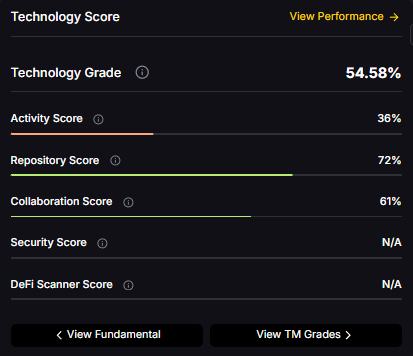
  • Technology: Technology Grade 54.58% (Activity 36%, Repository 72%, Collaboration 61%, Security N/A, DeFi Scanner N/A)
  • TM Agent gist: Cautious long-term stance in price prediction models until grades and momentum improve
  • Current rating: Sell (22.65) despite bullish 2026 macro backdrop
  • Meme coin dynamics: Celebrity influence and retail sentiment drive price prediction volatility
  • Education only, not financial advice

Dogecoin Price Prediction Scenario Analysis

Token Metrics price prediction scenarios span four market cap tiers, each representing different levels of crypto market maturity and liquidity:

8T Market Cap - DOGE Price Prediction:

At an 8 trillion dollar total crypto market cap, our DOGE price prediction framework projects specific targets in bear, base, and bullish scenarios. The 8T tier reflects conservative market conditions with modest meme coin participation.

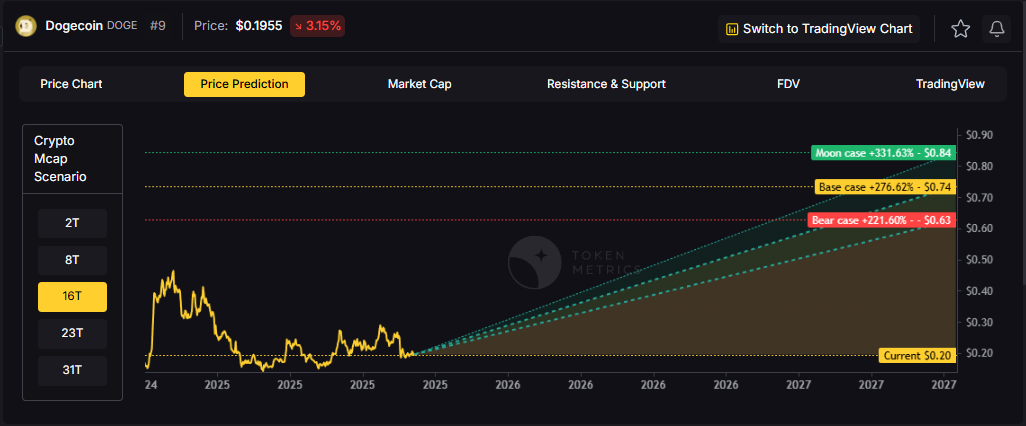
16T Market Cap - DOGE Price Prediction:

Doubling the market to 16 trillion expands the DOGE price prediction range significantly, reflecting increased retail participation and potential celebrity-driven catalysts that historically benefit Dogecoin.

16T Market Cap - DOGE Price Prediction:

Doubling the market to 16 trillion expands the DOGE price prediction range significantly, reflecting increased retail participation and potential celebrity-driven catalysts that historically benefit Dogecoin.

 31T Market Cap - DOGE Price Prediction:

In the maximum liquidity scenario of 31 trillion, DOGE price predictions reach their highest potential across all scenarios (bear, base, and moon), with all three bands projecting levels above $1.00 according to our framework.

 Each tier in our price prediction framework assumes progressively stronger market conditions, with particular emphasis on retail-driven liquidity and social media sentiment that uniquely impacts meme coin valuations.

Why Consider the Indices with Top-100 Exposure

Diversification matters. Dogecoin is compelling, yet concentrated bets can be volatile—especially for meme coins where price predictions are heavily influenced by sentiment. Token Metrics Indices hold DOGE alongside the top one hundred tokens for broad exposure to leaders and emerging winners.

Our backtests indicate that owning the full market with diversified indices has historically outperformed both the total market and Bitcoin in many regimes due to diversification and rotation benefits, reducing single-asset risk inherent in meme coin price predictions.

Get early access

What Is Dogecoin?

Dogecoin is a peer-to-peer cryptocurrency that began as a meme but has evolved into a widely recognized digital asset used for tipping, payments, and community-driven initiatives. It runs on its own blockchain with inflationary supply mechanics. The token's liquidity and brand awareness create periodic speculative cycles, especially during broad risk-on phases—all critical factors influencing DOGE price predictions.

Technology Snapshot from Token Metrics

Technology Grade: 54.58% (Activity 36%, Repository 72%, Collaboration 61%, Security N/A, DeFi Scanner N/A).


Catalysts That Skew DOGE Price Predictions Bullish

  • Institutional and retail access expands with ETFs, listings, and integrations
  • Macro tailwinds from lower real rates and improving liquidity expected in 2026
  • Product or roadmap milestones such as upgrades, scaling, or partnerships
  • Celebrity endorsements or social media viral moments (Elon Musk effect)
  • Retail FOMO during bull market phases
  • Payment adoption and merchant acceptance expansion
  • Meme coin narrative strength during risk-on sentiment

Risks That Skew DOGE Price Predictions Bearish

  • Macro risk-off from tightening or liquidity shocks
  • Regulatory actions targeting meme coins or infrastructure outages
  • Current Sell rating (22.65) indicating weak fundamentals
  • Low technology grade (54.58%) and minimal development activity (36%)
  • Lack of utility compared to smart contract platforms
  • Inflationary supply mechanics creating selling pressure
  • Celebrity sentiment shifts or negative social media attention
  • Competition from newer meme coins capturing retail interest

Special Offer — Token Metrics Advanced Plan with 20% Off

Unlock platform-wide intelligence on every major crypto asset. Use code ADVANCED20 at checkout for twenty percent off.

  • AI powered ratings on thousands of tokens for traders and investors
  • Interactive TM AI Agent to ask any crypto question
  • Indices explorer to surface promising tokens and diversified baskets
  • Signal dashboards, backtests, and historical performance views
  • Watchlists, alerts, and portfolio tools to track what matters
  • Early feature access and enhanced research coverage

Start with Advanced today

Dogecoin Price Prediction FAQs

Can DOGE reach $1.00?

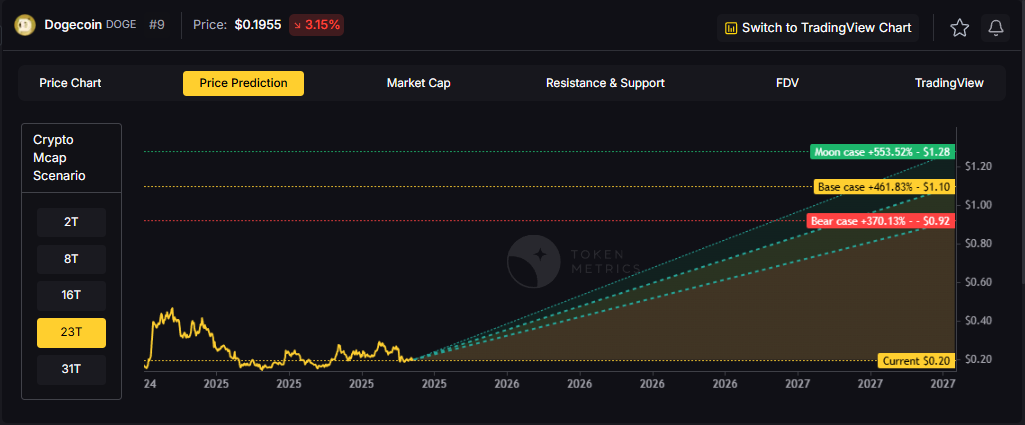
Yes. Multiple tiers in our price prediction framework imply levels above $1.00 by the 2027 horizon, including the 23T Base case and all 31T scenarios (bear, base, and moon). However, achieving this requires the bullish 2026 thesis materializing with strong retail participation and favorable macro conditions. Despite the Sell rating (22.65), the $1 psychological level remains achievable in higher liquidity environments. Not financial advice.

Is DOGE a good long-term investment?

DOGE presents a high-risk, high-volatility investment case with a Sell rating (22.65) and modest technology grade (54.58%). Our price prediction models show potential upside in bullish scenarios, but the outcome depends heavily on adoption, liquidity regime, celebrity influence, retail sentiment, and supply dynamics. Meme coins lack fundamental utility of smart contract platforms, making them speculative plays. Diversify and size positions responsibly. Not financial advice.

What is the Dogecoin price prediction for 2026-2027?

Our comprehensive DOGE price prediction framework for 2026-2027 suggests Dogecoin could reach significant levels depending on total crypto market capitalization, with the 23T and 31T scenarios projecting above $1.00 across multiple bands. Current price of $0.193 implies substantial upside potential (400%+ gains to $1) if bullish 2026 conditions materialize. However, the Sell rating (22.65) reflects concerns about fundamentals and current bearish momentum. Not financial advice.

Can DOGE reach $10?

DOGE reaching $10 would require extraordinary market conditions and market capitalization exceeding most realistic scenarios in our price prediction models. At current supply levels, $10 DOGE would imply a market cap surpassing major corporations. While our 31T moon scenarios show substantial upside, $10 appears beyond rational price prediction frameworks without significant supply changes or unprecedented retail mania. Not financial advice.

Should I buy DOGE now or wait?

DOGE has a Sell rating (22.65) indicating Token Metrics does not currently endorse Dogecoin at these levels, despite bullish 2026 macro thesis. Current price of $0.193 is down 16% over 30 days with bearish trading signals. However, if you believe in the 2026 bull market thesis and meme coin comeback, dollar-cost averaging may reduce timing risk. Meme coins are highly speculative—size positions accordingly and consider diversified exposure through indices. Not financial advice.

Why does DOGE have a Sell rating despite bullish 2026 outlook?

DOGE receives a Sell rating (22.65) due to weak fundamentals, modest technology grade (54.58%), low development activity (36%), and current bearish momentum—despite the broader bullish 2026 macro thesis. Our price prediction framework shows potential upside in favorable liquidity scenarios, but ratings reflect current conditions and fundamental quality rather than just market sentiment. The rating suggests caution even in bullish environments. Not financial advice.

How does DOGE compare to other meme coin price predictions?

Dogecoin remains the original and most established meme coin with superior liquidity, exchange listings, and brand recognition versus competitors like Shiba Inu or PEPE. Our price prediction framework suggests DOGE could exceed $1.00 in 23T+ scenarios. However, the Sell rating (22.65) reflects that even among meme coins, DOGE's low technology grade (54.58%) and minimal development activity create concerns. First-mover advantage matters, but newer meme coins may offer higher risk-adjusted returns.

What role do celebrities play in DOGE price predictions?

Celebrity influence—particularly from Elon Musk—significantly impacts Dogecoin price predictions and has historically driven major rallies. Our bullish 2026 scenarios assume potential for renewed celebrity-driven interest during risk-on phases. However, this creates unpredictable volatility that price prediction models struggle to capture. The Sell rating (22.65) reflects concerns that celebrity sentiment alone cannot sustain long-term value without fundamental improvements. Not financial advice.

Can DOGE benefit from the 2026 bull market?

Yes. Our price prediction scenarios are specifically framed around the bullish 2026 thesis, where improving liquidity, institutional participation, and retail FOMO create favorable conditions for meme coins. DOGE's brand recognition and top-10 ranking position it to capture bull market momentum. However, the Sell rating (22.65) and low technology grade (54.58%) suggest DOGE may underperform versus utility tokens. Meme coins tend to outperform in late-stage bull markets driven by retail speculation. Not financial advice.

What are the biggest risks to DOGE price predictions?

Key risks that could derail Dogecoin price predictions include: current Sell rating (22.65) indicating weak fundamentals, low technology grade (54.58%) and minimal development activity (36%), inflationary supply creating perpetual selling pressure, lack of utility versus smart contract platforms, regulatory targeting of meme coins, negative celebrity sentiment shifts, competition from newer meme coins, macro liquidity shocks ending the 2026 bull thesis, and excessive speculation leading to retail exhaustion. Not financial advice.

Will DOGE hit $1 in 2026?

Our price prediction framework suggests DOGE reaching $1.00 is achievable in the 23T base case and all 31T scenarios (bear, base, moon), which could materialize in the bullish 2026-2027 environment. From current price of $0.193, this represents approximately 400%+ gains. However, achieving this requires sustained macro liquidity, retail participation, positive celebrity sentiment, and overcoming the current Sell rating (22.65) concerns. Possible but not guaranteed—manage expectations accordingly. Not financial advice.

How accurate are Dogecoin price predictions?

Dogecoin price predictions are particularly challenging due to meme coin volatility, celebrity influence unpredictability, and sentiment-driven price action that doesn't follow traditional fundamental analysis. Our scenario-based framework provides structured projections across multiple market cap tiers, but actual outcomes may vary significantly. The Sell rating (22.65) and low technology grade (54.58%) suggest fundamental weaknesses that could limit upside regardless of market conditions. Use price predictions as educational frameworks, not guarantees. Not financial advice.

‍

Next Steps

• Track live grades and signals: Token Details
• Join Indices Early Access
• Want exposure Buy DOGE on MEXC

Disclosure

Educational purposes only, not financial advice. Crypto is volatile, do your own research and manage risk.

Why Use Token Metrics for DOGE Price Predictions?

  • Bullish 2026 framework: Specialized analysis of improving macro conditions favoring meme coins
  • Scenario-based modeling: Four market cap tiers for comprehensive price prediction analysis
  • Honest ratings: Sell (22.65) transparency despite bullish market thesis
  • Meme coin specialization: Understanding sentiment-driven price action and celebrity influence
  • Risk management: Indices for diversified exposure beyond single meme coin concentration
  • Real-time signals: Trading signals and TM Grades updated regularly
  • Comparative analysis: Analyze DOGE against SHIB, PEPE, and 6,000+ tokens
Research

Tron Price Prediction 2026: Low-Cost Blockchain Bull Market Analysis

Token Metrics Team
6 min read

Why 2026 Looks Bullish for Tron Price Prediction: Market Context

The crypto market is shifting toward a broadly bullish regime into 2026 as liquidity improves and risk appetite normalizes.

Regulatory clarity across major regions is reshaping the classic four-year cycle, flows can arrive earlier and persist longer. Institutional access keeps expanding through ETFs and qualified custody, while L2 scaling and real-world integrations broaden utility. Infrastructure maturity lowers frictions for capital, which supports deeper order books and more persistent participation.

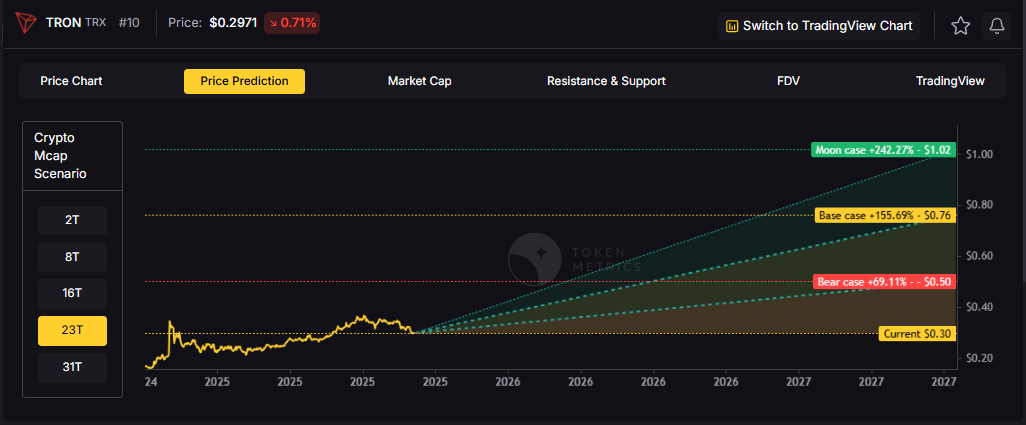
This bullish backdrop frames our Tron price prediction scenario work for TRX. The bands below map potential outcomes to different total crypto market sizes, providing comprehensive price prediction analysis for investors navigating the stablecoin transfer and payments-focused blockchain space.

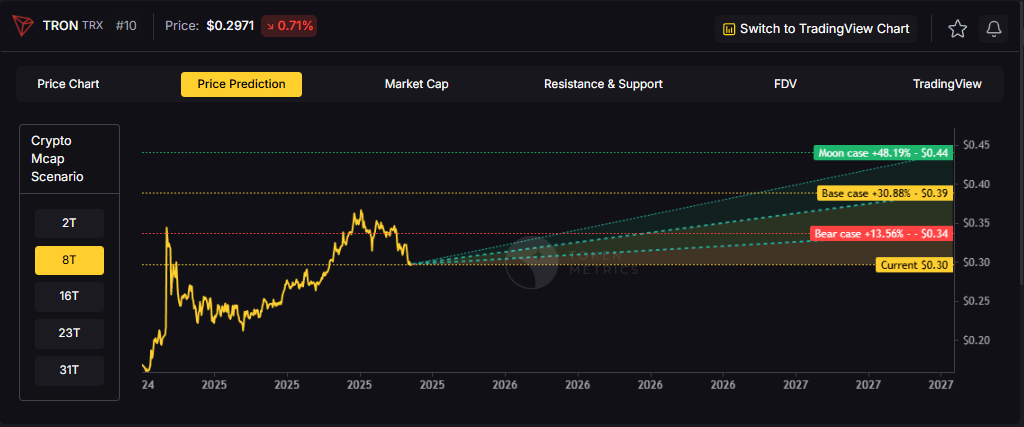
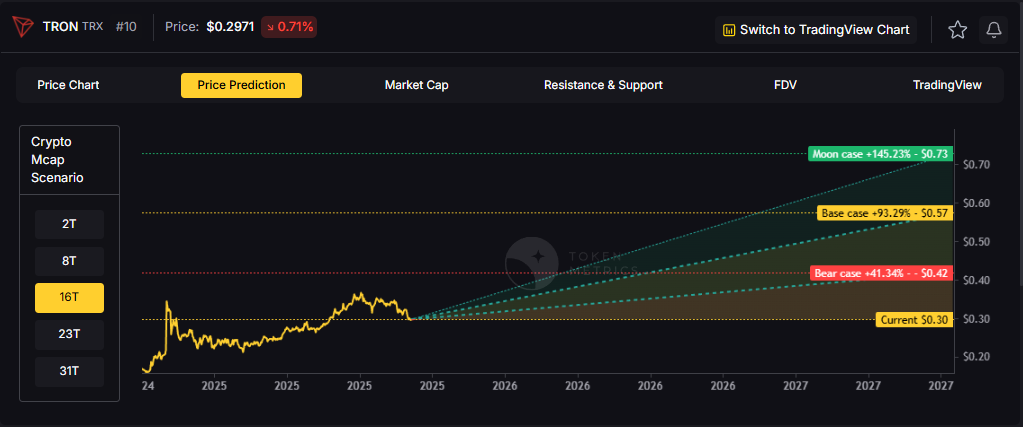
Current price: $0.2971.

How to Read This TRX Price Prediction

Each band blends cycle analogues and market-cap share math with TA guardrails. Base assumes steady adoption and neutral or positive macro. Moon layers in a liquidity boom. Bear assumes muted flows and tighter liquidity.

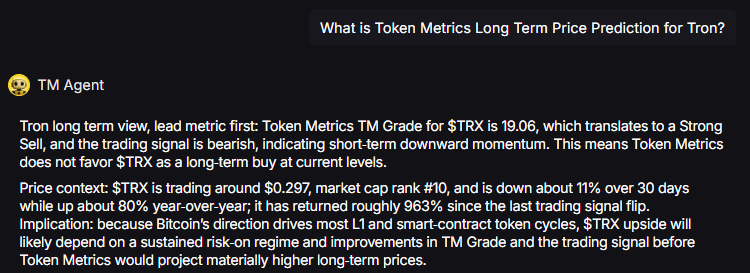
TM Agent baseline: Token Metrics TM Grade for $TRX is 19.06, which translates to a Strong Sell, and the trading signal is bearish, indicating short-term downward momentum. Price context: $TRX is trading around $0.297, market cap rank #10, and is down about 11% over 30 days while up about 80% year-over-year, it has returned roughly 963% since the last trading signal flip. Despite strong historical returns, current price prediction models reflect caution.

Live details: Tron Token Details → https://app.tokenmetrics.com/en/tron 

Buy TRX: https://www.mexc.com/acquisition/custom-sign-up?shareCode=mexc-2djd4 

Key Takeaways: Tron Price Prediction Summary

  • Scenario driven: Price prediction outcomes hinge on total crypto market cap; higher liquidity and adoption lift the bands
  • TM Agent gist: Bearish near term in price prediction models; upside depends on sustained risk-on regime and improvements in TM Grade and trading signal
  • Current rating: Strong Sell (19.06) despite bullish 2026 macro backdrop and 80% YoY gains
  • Stablecoin focus: TRX benefits from USDT transfer volume on Tron network
  • $1 target: Achievable in 23T+ moon scenarios per price prediction framework
  • Education only, not financial advice

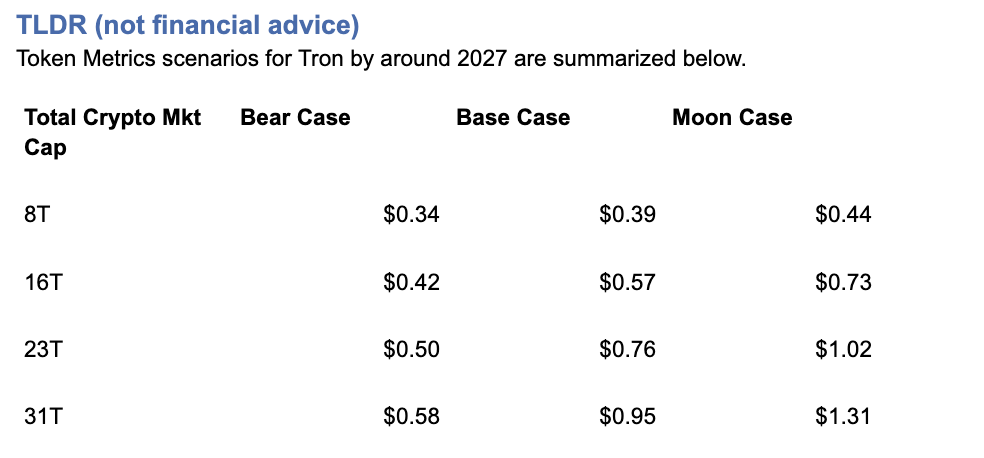
Tron Price Prediction Scenario Analysis

Token Metrics price prediction scenarios span four market cap tiers, each representing different levels of crypto market maturity and liquidity:

8T Market Cap - TRX Price Prediction:

At an 8 trillion dollar total crypto market cap, our TRX price prediction framework projects specific targets in bear, base, and bullish scenarios. The 8T tier reflects conservative market conditions with steady stablecoin transfer adoption.

 16T Market Cap - TRX Price Prediction:

Doubling the market to 16 trillion expands the TRX price prediction range significantly, reflecting increased institutional stablecoin usage and payments adoption that benefit Tron's high-throughput, low-cost infrastructure.

 23T Market Cap - TRX Price Prediction:

At 23 trillion total crypto market cap, the price prediction scenarios show substantial upside potential, with the moon case projecting $1.02—achieving the psychologically important $1.00 milestone for TRX holders.

 Each tier in our price prediction framework assumes progressively stronger market conditions, with particular emphasis on stablecoin transfer volume and payments use cases that uniquely position Tron in the blockchain ecosystem.

Why Consider the Indices with Top-100 Exposure

Diversification matters. Tron is compelling, yet concentrated bets can be volatile—especially when price predictions carry Strong Sell ratings despite bullish macro conditions. Token Metrics Indices hold TRX alongside the top one hundred tokens for broad exposure to leaders and emerging winners.

Our backtests indicate that owning the full market with diversified indices has historically outperformed both the total market and Bitcoin in many regimes due to diversification and rotation benefits, reducing single-asset risk.

Get early access: https://docs.google.com/forms/d/1AnJr8hn51ita6654sRGiiW1K6sE10F1JX-plqTUssXk/preview 

If your editor supports embeds, place a form embed here. Otherwise, include the link above as a button labeled Join Indices Early Access.

What Is Tron?

Tron is a smart-contract blockchain focused on low-cost, high-throughput transactions and cross-border settlement. The network supports token issuance and a broad set of dApps, with an emphasis on stablecoin transfer volume and payments—critical factors that influence TRX price predictions.

TRX is the native asset that powers fees and staking for validators and delegators within the network. Developers and enterprises use the chain for predictable costs and fast finality, which supports consumer-facing use cases. Tron has become a dominant network for USDT (Tether) transfers, creating organic demand for TRX that impacts long-term price prediction trajectories.

Catalysts That Skew TRX Price Predictions Bullish

  • Institutional and retail access expands with ETFs, listings, and integrations
  • Macro tailwinds from lower real rates and improving liquidity expected in 2026
  • Product or roadmap milestones such as upgrades, scaling, or partnerships
  • Growing USDT stablecoin transfer volume on Tron network
  • Increased cross-border payment adoption and remittance use cases
  • Continued low-fee competitive advantage versus Ethereum
  • Enterprise blockchain partnerships leveraging Tron's throughput

Risks That Skew TRX Price Predictions Bearish

  • Macro risk-off from tightening or liquidity shocks
  • Regulatory actions targeting Tron, Justin Sun, or infrastructure outages
  • Current Strong Sell rating (19.06) indicating significant fundamental concerns
  • Concentration risk in validator economics and potential centralization issues
  • Competitive displacement from faster, lower-cost L1s and L2 solutions
  • Regulatory scrutiny on stablecoin operations affecting Tether/USDT
  • Reputational concerns related to founder Justin Sun
  • Competition from Solana, BNB Chain for stablecoin transfers

Special Offer — Token Metrics Advanced Plan with 20% Off

Unlock platform-wide intelligence on every major crypto asset. Use code ADVANCED20 at checkout for twenty percent off.

  • AI powered ratings on thousands of tokens for traders and investors
  • Interactive TM AI Agent to ask any crypto question
  • Indices explorer to surface promising tokens and diversified baskets
  • Signal dashboards, backtests, and historical performance views
  • Watchlists, alerts, and portfolio tools to track what matters
  • Early feature access and enhanced research coverage

Start with Advanced today → https://www.tokenmetrics.com/token-metrics-pricing 

Tron Price Prediction FAQs

Can TRX reach $1?

Yes. The 23T moon case in our price prediction framework shows $1.02 and the 31T moon case shows $1.31, which imply a path to $1 in higher-liquidity regimes. From current price of $0.2971, this represents approximately 240%+ gains. However, achieving this requires the bullish 2026 thesis materializing with strong stablecoin adoption and overcoming the current Strong Sell rating (19.06). Not financial advice.

Is TRX a good long-term investment?

TRX presents a complex investment case with a Strong Sell rating (19.06) despite impressive historical returns (80% YoY, 963% since last signal flip). Our price prediction models show potential upside to $1.02-$1.31 in bullish scenarios, but outcome depends heavily on adoption, liquidity regime, competition, regulatory environment, and supply dynamics. The stablecoin transfer use case provides organic demand, but fundamental concerns reflected in the Strong Sell rating suggest caution. Diversify and size positions responsibly. Not financial advice.

What is the Tron price prediction for 2026-2027?

Our comprehensive TRX price prediction framework for 2026-2027 suggests Tron could reach $1.02 in the 23T moon scenario and $1.31 in the 31T moon scenario, representing significant upside from current $0.2971 price. Base case scenarios across market cap tiers provide more conservative targets. Despite the bullish 2026 macro thesis and strong stablecoin utility, the Strong Sell rating (19.06) and bearish trading signal indicate current fundamental concerns. Not financial advice.

Should I buy TRX now or wait?

TRX has a Strong Sell rating (19.06) indicating Token Metrics does not endorse Tron at current levels, despite bullish 2026 macro conditions and 80% YoY gains. Current price of $0.2971 is down 11% over 30 days with bearish trading signals. However, historical outperformance (963% since last signal flip) and stablecoin transfer utility create a paradox. If you believe in the 2026 bull thesis and Tron's stablecoin dominance, dollar-cost averaging may reduce timing risk. Consider diversified exposure through indices. Not financial advice.

Why does TRX have a Strong Sell rating despite 80% YoY gains?

TRX receives a Strong Sell rating (19.06) based on current fundamental analysis, technical indicators, and valuation metrics—despite impressive historical performance (80% YoY, 963% since last signal flip). Ratings reflect forward-looking risk assessment including regulatory concerns, centralization issues, reputational factors, and competitive threats. Our price prediction framework shows potential upside in favorable scenarios, but the Strong Sell rating suggests significant risks that could prevent achieving bullish targets. Past performance doesn't guarantee future results. Not financial advice.

How does TRX benefit from stablecoin transfers?

Tron has become the dominant network for USDT (Tether) transfers due to extremely low fees and fast settlement. This creates organic demand for TRX as users need the native token for transaction fees. Our price prediction models assume continued growth in stablecoin transfer volume, which supports base case scenarios. The 23T and 31T price predictions of $1.02-$1.31 factor in sustained stablecoin dominance. However, competition from other low-cost chains and regulatory scrutiny on Tether operations represent risks. Not financial advice.

Can TRX reach $2?

TRX reaching $2 would exceed our current price prediction models' highest scenario of $1.31 (31T moon case). From current $0.2971, $2 represents approximately 570%+ gains. This would require extraordinary market conditions beyond the 31T total crypto market cap tier, exceptional stablecoin adoption acceleration, and overcoming significant fundamental concerns reflected in the Strong Sell rating (19.06). While possible in extreme bull scenarios, $2 appears beyond rational price prediction frameworks. Not financial advice.

What are the biggest risks to TRX price predictions?

Key risks that could derail Tron price predictions include: Strong Sell rating (19.06) indicating severe fundamental concerns, regulatory actions targeting Tron network or founder Justin Sun, centralization concerns in validator economics, regulatory scrutiny on Tether/USDT operations affecting transfer volumes, competitive displacement from Solana/BNB Chain for stablecoin transfers, reputational issues, macro liquidity shocks ending 2026 bull thesis, and potential security vulnerabilities. Despite strong utility, these risks warrant careful position sizing. Not financial advice.

How does Tron compare to other payment blockchain price predictions?

Tron's price prediction framework suggests $0.30-$1.31 across scenarios, positioning it as a specialized payments and stablecoin transfer network. Compared to Ethereum's dominance and Solana's speed, Tron differentiates through extremely low fees and USDT transfer volume leadership. However, the Strong Sell rating (19.06) reflects concerns that this niche may not sustain long-term value versus more decentralized, diversified platforms. Tron trades at rank #10, indicating established but controversial market position. Not financial advice.

Will TRX benefit from the 2026 bull market?

Yes. Our price prediction scenarios are specifically framed around the bullish 2026 thesis, where improving liquidity, institutional participation, and stablecoin adoption create favorable conditions. TRX's low-fee infrastructure and USDT dominance position it to capture bull market momentum in payments use cases. However, the Strong Sell rating (19.06) and bearish momentum suggest TRX may underperform versus fundamentally stronger tokens. Muted base case projections reflect this tension between macro tailwinds and micro concerns. Not financial advice.

Is the $1 target realistic for TRX?

The $1 target appears achievable in our price prediction framework's 23T moon case ($1.02) and 31T scenarios ($1.31). From current $0.2971, this represents approximately 240%+ gains requiring sustained stablecoin adoption, bullish macro conditions materializing, and overcoming Strong Sell rating concerns. Historical volatility (963% returns since last signal flip) demonstrates TRX's ability to deliver explosive gains, but fundamental weaknesses create significant uncertainty. Possible but high-risk—manage expectations accordingly. Not financial advice.

What needs to happen for TRX to reach price prediction targets?

For TRX to reach our price prediction targets of $1.02-$1.31, several catalysts must materialize: (1) continued dominance in USDT stablecoin transfers, (2) bullish 2026 macro conditions with improving liquidity, (3) addressing regulatory concerns around Tron and Justin Sun, (4) improving TM Grade from Strong Sell (19.06) territory, (5) institutional adoption of Tron for cross-border payments, (6) successful competition against Solana/BNB Chain, and (7) maintaining low-fee advantage as scaling solutions proliferate. The Strong Sell rating suggests these catalysts aren't currently materializing at required pace.

Next Steps

Track live grades and signals: Token Details → https://app.tokenmetrics.com/en/tron 

Join Indices Early Access: https://docs.google.com/forms/d/1AnJr8hn51ita6654sRGiiW1K6sE10F1JX-plqTUssXk/preview

Want exposure Buy TRX on MEXC → https://www.mexc.com/acquisition/custom-sign-up?shareCode=mexc-2djd4 

Disclosure

Educational purposes only, not financial advice. Crypto is volatile, do your own research and manage risk.

Why Use Token Metrics for Tron Price Predictions?

  • Transparent analysis: Honest Strong Sell ratings (19.06) even when historical returns are exceptional (963%)
  • Scenario-based modeling: Four market cap tiers for comprehensive price prediction analysis
  • Stablecoin specialization: Understanding Tron's unique position in USDT transfer ecosystem
  • Risk-adjusted approach: Balanced view of utility strengths versus fundamental concerns
  • Real-time signals: Trading signals and TM Grades updated regularly tracking 11% monthly decline
  • Diversification tools: Index solutions to spread payment blockchain risk
  • Comparative analysis: Analyze TRX against BNB, SOL, and 6,000+ tokens
Choose from Platinum, Gold, and Silver packages
Reach with 25–30% open rates and 0.5–1% CTR
Craft your own custom ad—from banners to tailored copy
Perfect for Crypto Exchanges, SaaS Tools, DeFi, and AI Products