Back to blog
Research

REST API Explained: Design, Use Cases & Best Practices

Understand REST API fundamentals, design patterns, security, and observability. Practical guidance for engineers building scalable APIs and integrating services using modern best practices.
Token Metrics Team
5
Want Smarter Crypto Picks—Free?
See unbiased Token Metrics Ratings for BTC, ETH, and top alts.
Thank you! Your submission has been received!
Oops! Something went wrong while submitting the form.
 No credit card | 1-click unsubscribe

In today's interconnected digital ecosystem, REST APIs have become the backbone of modern web applications, mobile apps, and data exchange platforms. Whether you're building a cryptocurrency trading platform, integrating blockchain data, or developing any web service, understanding REST API architecture is essential for creating scalable and efficient applications. This comprehensive guide explores REST API design principles, real-world use cases, and best practices that developers need to master.

Understanding REST API Architecture

REST, which stands for Representational State Transfer, is an architectural style that defines a set of constraints for creating web services. A REST API, also known as a RESTful API, allows different software applications to communicate with each other over HTTP protocols. The beauty of REST lies in its simplicity and stateless nature, making it the preferred choice for developers building everything from social media platforms to cryptocurrency APIs.

When a client makes a request to a REST API, it transfers a representation of the state of the requested resource to the client. This representation can be delivered in various formats, with JSON being the most popular choice in modern applications, especially in crypto APIs and blockchain data services. The stateless nature of REST means that each request from a client contains all the information needed to process that request, without relying on stored context on the server.

Core Components of REST API Design

The foundation of effective REST API design rests on several key components that work together to create a cohesive system. Resources represent the fundamental concept in REST architecture, where everything is considered a resource that can be accessed through a unique identifier known as a URI or Uniform Resource Identifier. For instance, in a cryptocurrency API, resources might include digital assets, market data, trading pairs, or wallet addresses.

HTTP methods form the second pillar of REST API design, providing the verbs that define actions on resources. GET requests retrieve data without modifying it, making them perfect for fetching crypto market data or blockchain information. POST requests create new resources, such as submitting a new transaction or creating a wallet. PUT requests update existing resources completely, while PATCH requests modify specific fields. DELETE requests remove resources from the system. Understanding when to use each method is crucial for building intuitive and predictable APIs.

The URI structure in a well-designed REST API should be logical, consistent, and self-documenting. Rather than using verbs in URLs, REST APIs rely on nouns to represent resources, with HTTP methods conveying the action. For example, a crypto API endpoint might look like /api/v1/cryptocurrencies/bitcoin/price rather than /api/v1/getCryptocurrencyPrice. This approach creates cleaner, more maintainable code that developers can understand intuitively.

REST API Best Practices for Production Systems

Implementing version control in your REST API is not optional but essential for maintaining backward compatibility as your service evolves. Including the version number in the URL path, such as /api/v1/ or /api/v2/, allows you to introduce breaking changes in new versions while supporting legacy clients. This practice is particularly important for cryptocurrency APIs where trading bots and automated systems depend on consistent endpoints.

Authentication and security stand as paramount concerns in REST API development, especially when dealing with sensitive data like cryptocurrency transactions or blockchain information. Token-based authentication using JSON Web Tokens (JWT) has emerged as the industry standard, providing secure, stateless authentication that scales well. For crypto APIs handling financial data, implementing API keys, rate limiting, and encryption becomes non-negotiable to protect user assets and maintain system integrity.

Error handling deserves careful attention in REST API design. Your API should return appropriate HTTP status codes that clearly communicate what happened during request processing. A 200 status indicates success, 201 signifies successful resource creation, 400 indicates a bad request from the client, 401 means unauthorized access, 404 signals that a resource wasn't found, and 500 indicates a server error. Accompanying these status codes with clear, actionable error messages in the response body helps developers debug issues quickly.

Cryptocurrency APIs and REST Architecture

The cryptocurrency industry has embraced REST APIs as the primary method for accessing blockchain data, market information, and trading functionality. Crypto APIs built on REST principles enable developers to integrate real-time cryptocurrency prices, historical market data, trading volumes, and blockchain analytics into their applications seamlessly. Token Metrics, a leader in crypto analytics and data services, offers one of the most comprehensive cryptocurrency APIs in the market, providing developers with access to advanced metrics, AI-driven insights, and real-time market data through a well-designed RESTful interface.

When building or consuming crypto APIs, developers must consider the unique challenges of blockchain technology. Cryptocurrency market data requires high-frequency updates due to the volatile nature of digital assets. A robust crypto API must handle thousands of requests per second while maintaining low latency and high availability. Token Metrics addresses these challenges by providing a scalable REST API infrastructure that delivers accurate cryptocurrency data, token ratings, and market analytics to developers, traders, and institutional clients.

The integration of blockchain APIs with REST architecture has opened new possibilities for decentralized applications and financial technology. Developers can now query blockchain transactions, check wallet balances, monitor smart contract events, and access DeFi protocols through simple HTTP requests. This accessibility has accelerated innovation in the crypto space, allowing developers to build sophisticated trading platforms, portfolio trackers, and analytics dashboards without managing blockchain nodes directly.

Real-World Use Cases of REST APIs

REST APIs power countless applications across industries, demonstrating their versatility and reliability. In the financial technology sector, cryptocurrency exchanges rely on REST APIs to provide trading functionality to their users. These APIs enable programmatic trading, allowing algorithmic traders to execute strategies, monitor positions, and manage risk across multiple markets. Token Metrics leverages REST API technology to deliver cryptocurrency intelligence, offering endpoints for token grades, trader grades, market predictions, and comprehensive crypto market analysis.

Mobile applications represent another significant use case for REST APIs. Every time you check cryptocurrency prices on your phone, post on social media, or stream music, REST APIs work behind the scenes to fetch and deliver that data. The lightweight nature of REST makes it ideal for mobile environments where bandwidth and battery life are concerns. Crypto portfolio tracking apps, for instance, use REST APIs to aggregate data from multiple exchanges and blockchain networks, presenting users with a unified view of their digital asset holdings.

Enterprise systems increasingly adopt REST APIs for integration and automation. Companies use REST APIs to connect customer relationship management systems, payment processors, inventory databases, and analytics platforms. In the blockchain and cryptocurrency domain, businesses integrate crypto payment APIs to accept digital currencies, use blockchain APIs to verify transactions, and leverage analytics APIs like those offered by Token Metrics to make data-driven investment decisions.

Designing Scalable REST APIs

Scalability should be a primary consideration when designing REST APIs, particularly for services that may experience rapid growth or traffic spikes. Implementing pagination for endpoints that return large datasets prevents overwhelming clients and servers. Instead of returning thousands of cryptocurrency listings in a single response, a well-designed crypto API returns a manageable subset along with pagination metadata, allowing clients to request additional pages as needed.

Caching strategies significantly improve REST API performance and reduce server load. By including proper cache-control headers in API responses, you enable clients and intermediary proxies to cache responses appropriately. For cryptocurrency APIs where some data like historical prices rarely changes, aggressive caching can dramatically reduce the number of database queries and API calls. However, real-time data such as current market prices requires careful cache invalidation to ensure accuracy.

Rate limiting protects your REST API from abuse and ensures fair resource allocation among all users. By implementing rate limits based on API keys or IP addresses, you prevent individual clients from monopolizing server resources. Token Metrics implements sophisticated rate limiting in its cryptocurrency API, offering different tiers of access that balance the needs of casual developers, professional traders, and enterprise clients.

Documentation and Developer Experience

Comprehensive documentation transforms a good REST API into a great one. Developers evaluating whether to use your API need clear, accurate documentation that explains endpoints, parameters, authentication methods, and response formats. Interactive API documentation tools like Swagger or Postman collections allow developers to test endpoints directly from the documentation, reducing friction in the integration process.

For cryptocurrency APIs, documentation should include specific examples relevant to the crypto ecosystem. Token Metrics provides extensive API documentation covering everything from basic cryptocurrency price queries to advanced analytics endpoints, complete with code samples in multiple programming languages. This approach accelerates integration and reduces support requests, benefiting both API providers and consumers.

Providing SDKs and client libraries in popular programming languages further improves developer experience. Rather than forcing every developer to handle HTTP requests manually, offering pre-built libraries for Python, JavaScript, Java, and other languages enables faster integration and reduces the likelihood of implementation errors. These libraries can handle authentication, request formatting, error handling, and response parsing automatically.

Monitoring and Maintaining REST APIs

Once your REST API is in production, ongoing monitoring becomes critical to maintaining quality of service. Implementing comprehensive logging allows you to track API usage patterns, identify performance bottlenecks, and detect anomalies. For cryptocurrency APIs handling financial data, monitoring is especially crucial as downtime or data inaccuracies can result in significant financial losses for users.

Performance metrics such as response times, error rates, and throughput provide insights into API health. Setting up alerts for unusual patterns enables proactive problem resolution before users are significantly affected. Token Metrics maintains rigorous monitoring of its crypto API infrastructure, ensuring that developers and traders have reliable access to critical cryptocurrency market data and analytics.

Maintaining backward compatibility while evolving your API requires careful planning and communication. Deprecation policies should give developers adequate time to migrate to new versions or endpoints. For crypto APIs, this is particularly important as trading bots and automated systems may run unattended for extended periods and need time to adapt to API changes.

Security Considerations for REST APIs

Security forms the foundation of trustworthy REST APIs, especially when handling sensitive information like cryptocurrency transactions or personal data. Implementing HTTPS encryption for all API communications prevents man-in-the-middle attacks and protects data in transit. This is non-negotiable for crypto APIs where a single compromised API call could result in unauthorized fund transfers.

Input validation and sanitization protect against injection attacks and malformed requests. Your REST API should validate all incoming data against expected formats and ranges before processing. For cryptocurrency APIs, this includes validating wallet addresses, transaction amounts, and trading parameters to prevent errors and potential exploits.

Implementing proper access controls ensures that authenticated users can only access resources they're authorized to view or modify. Role-based access control (RBAC) provides a flexible framework for managing permissions in complex systems. Token Metrics implements enterprise-grade security in its cryptocurrency API, protecting sensitive market data and ensuring that clients can trust the integrity of the information they receive.

The Future of REST APIs in Cryptocurrency

As the cryptocurrency industry continues to mature, REST APIs will remain central to how developers interact with blockchain data and trading platforms. The evolution of decentralized finance, non-fungible tokens, and Web3 applications creates new opportunities and challenges for API design. REST APIs must adapt to handle increasingly complex queries, provide real-time updates for rapidly changing market conditions, and integrate with emerging blockchain protocols.

Token Metrics continues to innovate in the crypto API space, expanding its offerings to include advanced analytics, AI-powered market predictions, and comprehensive blockchain data. By maintaining a robust REST API infrastructure, Token Metrics enables developers, traders, and institutions to build sophisticated cryptocurrency applications that leverage cutting-edge market intelligence.

The convergence of traditional finance and cryptocurrency creates demand for APIs that can bridge both worlds seamlessly. REST APIs that provide unified access to crypto market data, traditional financial information, and cross-market analytics will become increasingly valuable. As regulatory frameworks evolve, APIs will also need to incorporate compliance features, reporting capabilities, and audit trails to meet institutional requirements.

Conclusion

REST APIs have proven themselves as the most practical and widely adopted approach for building web services that are scalable, maintainable, and developer-friendly. Understanding REST API design principles, implementing best practices, and focusing on security and performance creates APIs that developers love to use and rely on for their applications.

In the cryptocurrency space, REST APIs serve as the critical infrastructure that connects developers to blockchain data, market information, and trading functionality. Token Metrics exemplifies how a well-designed crypto API can empower developers and traders with the data and insights they need to succeed in the dynamic digital asset markets. Whether you're building a new cryptocurrency application or integrating blockchain data into existing systems, mastering REST API principles and leveraging powerful crypto APIs like those offered by Token Metrics will accelerate your development and enhance your capabilities.

As technology continues to evolve, REST APIs will adapt and improve, but their fundamental principles of simplicity, scalability, and statelessness will continue to guide the design of systems that power our increasingly connected digital world.

Build Smarter Crypto Apps &
AI Agents in Minutes, Not Months
Real-time prices, trading signals, and on-chain insights all from one powerful API.
Grab a Free API Key
About Token Metrics
Token Metrics: AI-powered crypto research and ratings platform. We help investors make smarter decisions with unbiased Token Metrics Ratings, on-chain analytics, and editor-curated “Top 10” guides. Our platform distills thousands of data points into clear scores, trends, and alerts you can act on.
30 Employees
analysts, data scientists, and crypto engineers
Daily Briefings
concise market insights and “Top Picks”
Transparent & Compliant
Sponsored ≠ Ratings; research remains independent
Want Smarter Crypto Picks—Free?
See unbiased Token Metrics Ratings for BTC, ETH, and top alts.
Thank you! Your submission has been received!
Oops! Something went wrong while submitting the form.
 No credit card | 1-click unsubscribe
Token Metrics Team
Token Metrics Team

Recent Posts

Research

Best Cross-Chain Bridges for Crypto Traders (2025)

Token Metrics Team
20 min read

Who this guide is for: Traders, DeFi users, and multichain portfolio managers seeking secure, cost-effective ways to move assets across blockchains.

Top three picks:

  • Stargate Finance — deepest liquidity for stablecoin transfers across major EVM chains and non-EVM networks.
  • Synapse Protocol — fastest routes for traders needing sub-5-minute settlements on 20+ chains.
  • Across Protocol — lowest slippage and optimistic bridging for arbitrageurs and high-frequency movers.

Key caveat: Bridge fees vary by route, liquidity depth, and network congestion; always compare quotes and verify destination addresses before confirming transfers.


Introduction: Why Cross-Chain Bridges Matter in 2025

Cross-chain bridges are infrastructure protocols that enable seamless asset transfers between blockchains, solving fragmented liquidity and allowing traders to access opportunities across ecosystems without holding native tokens on every chain. In 2025, with over 100 active Layer 1 and Layer 2 networks, best cross-chain bridges for traders deliver speed, security, and capital efficiency—critical for arbitrage, yield farming, and portfolio rebalancing. This guide evaluates the top 10 cross-chain bridges based on liquidity depth, security architecture, chain coverage, fee transparency, and user experience, helping you select the right solution for your trading strategy.


How We Picked (Methodology & Scoring)

We evaluated 20+ cross-chain bridges using six weighted criteria:

  • Liquidity & Volume (30%) — Daily transfer volume, pool depth, and slippage on major routes
  • Security Architecture (25%) — Validator model, audit history, exploit record, bug bounties
  • Chain Coverage (15%) — Number of supported networks (EVM, non-EVM, L2s)
  • Costs & Fees (15%) — Bridge fees, gas optimization, hidden slippage
  • User Experience (10%) — Interface clarity, transaction speed, wallet integrations
  • Support & Documentation (5%) — Docs quality, status pages, support channels

Data sources: Official protocol documentation, pricing pages, security audit repositories, and status dashboards. Third-party volume data from CoinGecko and DefiLlama used for cross-checks only.

Last updated: November 2025


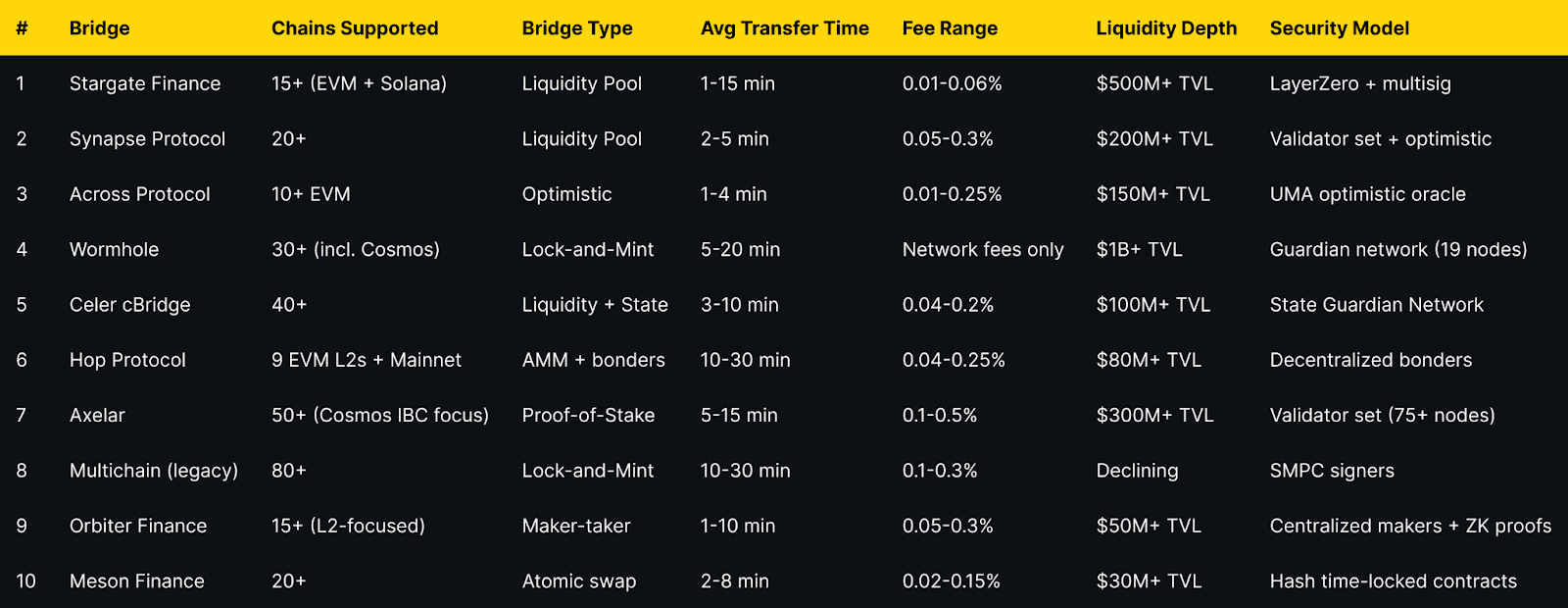
Best Cross-Chain Bridges in 2025 (Comparison Table)

Top 10 Cross-Chain Bridges in 2025

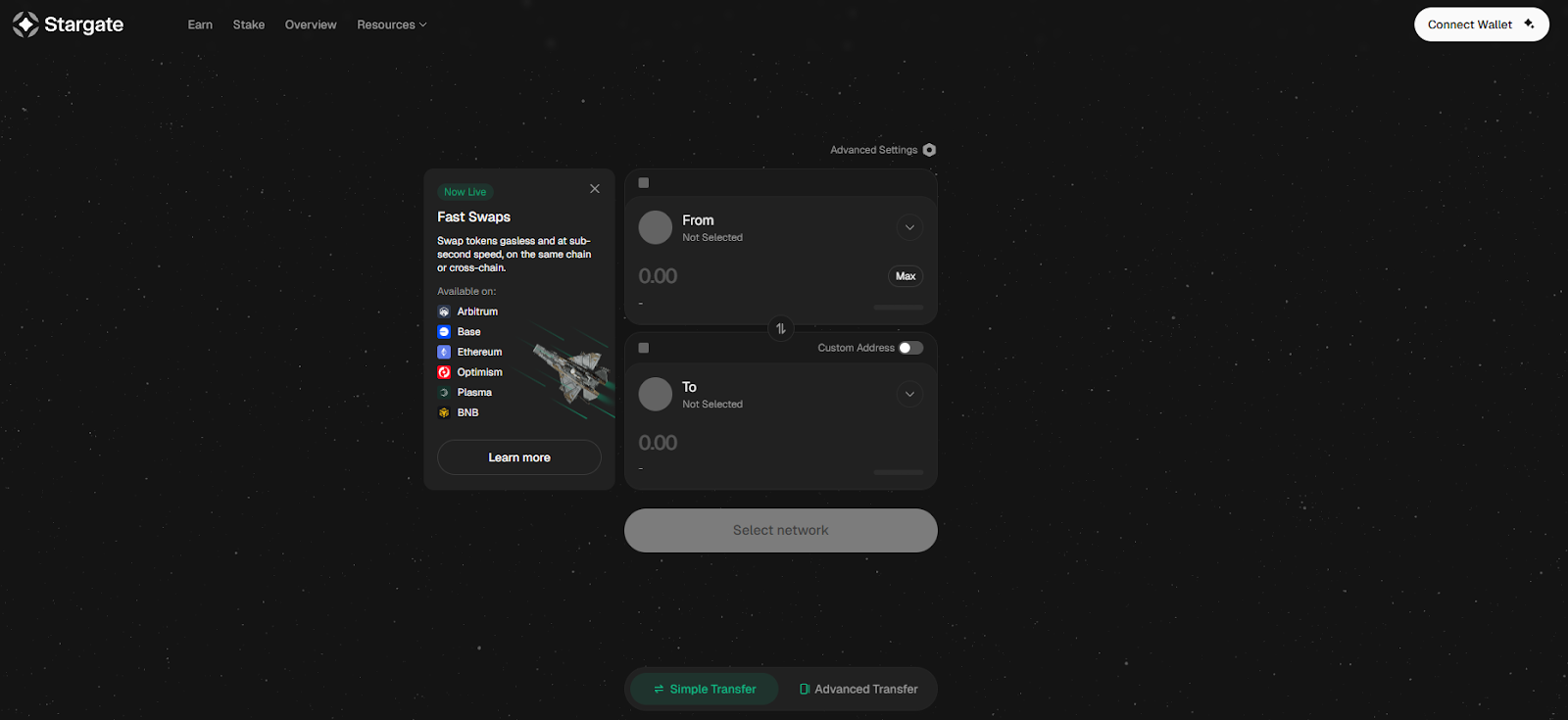
1. Stargate Finance — Best for Stablecoin Transfers

Why Use It: Stargate leverages LayerZero's messaging protocol to offer unified liquidity pools across 15+ chains, ensuring minimal slippage for USDC, USDT, and DAI transfers. Traders benefit from instant guaranteed finality and native asset transfers without wrapped tokens, making it ideal for large stablecoin movements between Ethereum, Arbitrum, Optimism, Polygon, BNB Chain, Avalanche, and Solana.

Best For: DeFi yield farmers, arbitrageurs moving stablecoins, traders rebalancing across chains, institutional desks.

Notable Features:

  • Unified liquidity pools eliminate fragmented routes
  • Delta algorithm prevents pool depletion and maintains balance
  • Native USDC/USDT support on major chains
  • Audited by Quantstamp and Zellic with $25M bug bounty

Consider If: You need to bridge non-stablecoin assets frequently (limited ERC-20 coverage) or require sub-1-minute finality (average 1-15 min).

Alternatives: Synapse Protocol, Across Protocol


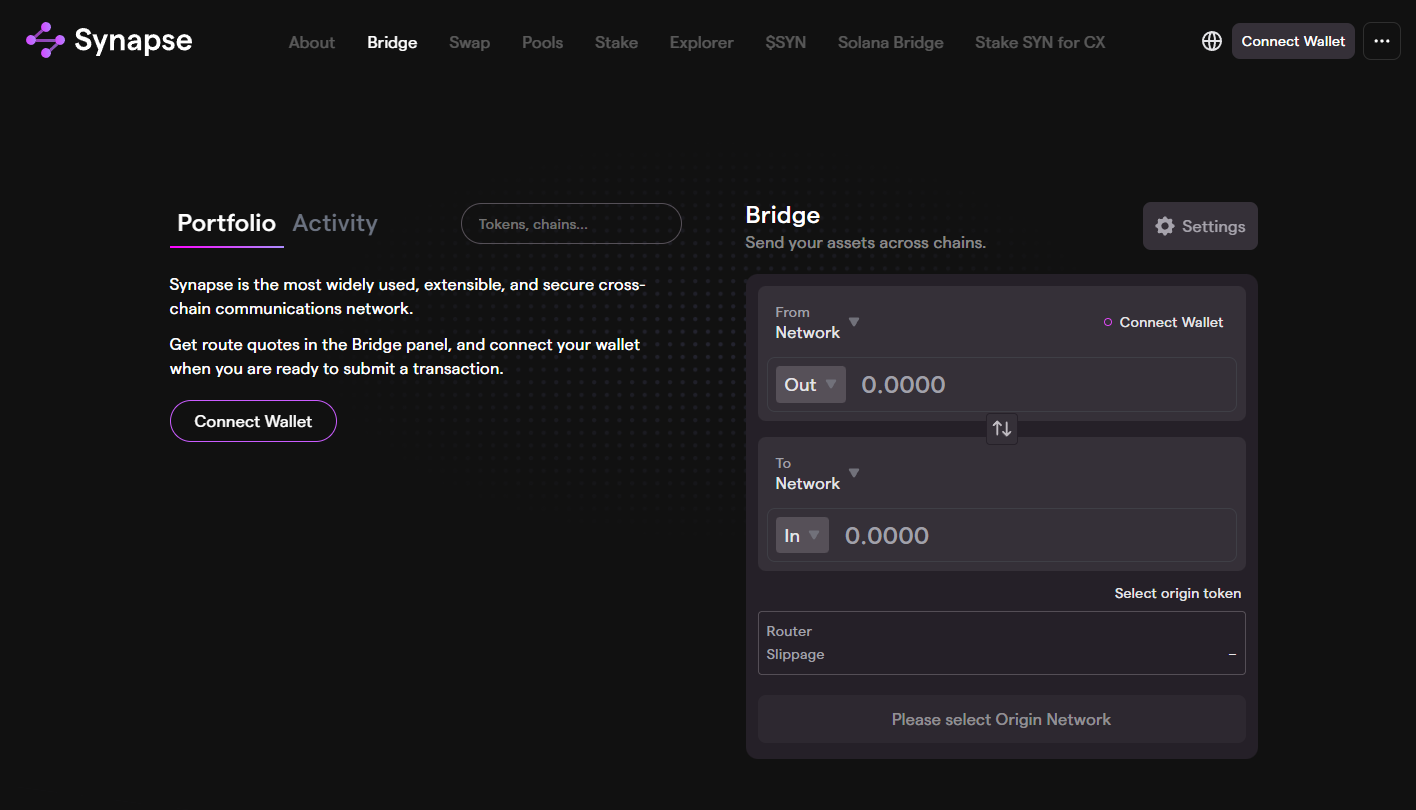
2. Synapse Protocol — Best for Speed Across 20+ Chains

Why Use It: Synapse combines liquidity pools with an optimistic verification model to deliver 2-5 minute average transfer times across 20+ networks, including Ethereum, Arbitrum, Optimism, Base, Polygon, BNB Chain, Avalanche, Fantom, Harmony, Moonbeam, and Aurora. Its nUSD and nETH synthetic assets enable efficient cross-chain swaps with competitive 0.05-0.3% fees, while the Synapse Bridge interface integrates one-click swaps for seamless UX.

Best For: Active traders prioritizing speed, multichain yield optimizers, NFT collectors moving assets, users bridging to emerging L2s.

Notable Features:

  • Sub-5-minute average transfers with optimistic verification
  • 20+ chain support including Base and zkSync Era
  • Integrated DEX for same-transaction swaps
  • Audited by Quantstamp, Certik, and Code4rena

Consider If: You move assets over $100K per transaction (liquidity depth varies by route) or need guaranteed finality before spending (optimistic delays possible).

Alternatives: Stargate Finance, Hop Protocol


3. Across Protocol — Best for Optimistic Bridging & Low Slippage

Why Use It: Across uses UMA's optimistic oracle to facilitate near-instant transfers with relayers fronting capital and settling on the destination chain within 1-4 minutes. Traders enjoy 0.01-0.25% fees—among the lowest for EVM bridges—and minimal slippage on major routes like Ethereum to Arbitrum, Optimism, Polygon, and Base. The protocol's capital efficiency makes it ideal for arbitrageurs and high-frequency movers.

Best For: Arbitrage traders, gas-sensitive users, high-frequency DeFi participants, cost-conscious portfolio managers.

Notable Features:

  • Optimistic verification for 1-4 minute transfers
  • Ultra-low fees (0.01-0.25%) with transparent pricing
  • Relayer network ensures liquidity without pool fragmentation
  • Audited by OpenZeppelin and ABDK with ongoing bug bounty

Consider If: You need non-EVM chain support (currently EVM-only) or prefer liquidity-pool-based bridges for guaranteed execution.

Alternatives: Stargate Finance, Synapse Protocol


4. Wormhole — Best for Cross-Ecosystem Bridging

Why Use It: Wormhole is a generalized messaging protocol supporting 30+ blockchains including Ethereum, Solana, Terra, BNB Chain, Avalanche, Polygon, Fantom, Celo, and Cosmos-based chains. Its Guardian network of 19 validators enables lock-and-mint bridging for tokens and NFTs with no protocol fees beyond network gas costs. The recent Wormhole Connect widget simplifies integrations for traders using multichain dApps.

Best For: Cross-ecosystem traders (EVM to Solana/Cosmos), NFT collectors, developers integrating bridging, users of Wormhole-native dApps.

Notable Features:

  • 30+ chain support including Solana, Terra, and Cosmos IBC
  • Generalized messaging enables cross-chain smart contract calls
  • Guardian network with 19 institutional validators
  • Audited by Neodyme, Kudelski, and OtterSec post-2022 exploit recovery

Consider If: You prioritize speed over security guarantees (5-20 min transfers) or need the deepest liquidity per route (Stargate/Synapse stronger for stables).

Alternatives: Axelar, Celer cBridge


5. Celer cBridge — Best for 40+ Chain Coverage

Why Use It: Celer cBridge supports 40+ blockchains with a hybrid liquidity pool and state channel architecture, enabling 3-10 minute transfers at 0.04-0.2% fees. Its State Guardian Network provides security for cross-chain state verification, while the cBridge UI offers direct wallet integrations and historical transaction tracking. Recent additions include support for zkSync Era, Linea, and Scroll.

Best For: Multichain portfolio managers, traders accessing niche L2s, users bridging to gaming-focused chains, cost-conscious cross-chain swappers.

Notable Features:

  • 40+ chains including zkSync, Linea, Mantle, and Scroll
  • State Guardian Network for optimistic cross-chain verification
  • Integrated liquidity mining for yield on idle bridge assets
  • Audited by Certik, PeckShield, and SlowMist

Consider If: You operate in mainland China (limited access) or need guaranteed sub-5-minute finality (optimistic delays on congested routes).

Alternatives: Synapse Protocol, Axelar


6. Hop Protocol — Best for Ethereum L2 Bridging

Why Use It: Hop specializes in fast transfers between Ethereum mainnet and nine major L2s (Arbitrum, Optimism, Base, Polygon, zkSync Era, Linea, Scroll, Gnosis Chain, and Polygon zkEVM) using AMM-style liquidity pools and decentralized bonders who provide instant liquidity. Traders pay 0.04-0.25% fees and experience 10-30 minute average transfers, with the option to earn yield by providing liquidity or running bonder nodes.

Best For: L2-first traders, Ethereum mainnet to L2 bridgers, liquidity providers, users seeking decentralized bridge architecture.

Notable Features:

  • Native L2 focus with support for 9 Ethereum L2s
  • AMM-based liquidity pools for transparent pricing
  • Decentralized bonder network reduces trust assumptions
  • Audited by Consensys Diligence and OpenZeppelin

Consider If: You need to bridge to non-EVM chains (Ethereum ecosystem only) or require sub-10-minute finality consistently (bonder availability varies).

Alternatives: Synapse Protocol, Across Protocol


7. Axelar — Best for Cosmos & Proof-of-Stake Security

Why Use It: Axelar is a Cosmos SDK-based interoperability network with 75+ validators securing cross-chain transfers via proof-of-stake consensus. Supporting 50+ chains with IBC-native bridging to Cosmos, Osmosis, Injective, and other app-chains, Axelar enables secure general message passing for complex cross-chain dApp interactions at 0.1-0.5% fees. Transfers settle in 5-15 minutes with high finality guarantees.

Best For: Cosmos ecosystem traders, institutional users prioritizing security, developers building cross-chain dApps, users requiring verifiable bridge security.

Notable Features:

  • 75+ decentralized validators with proof-of-stake security
  • Native IBC support for Cosmos ecosystem chains
  • General Message Passing (GMP) for cross-chain smart contracts
  • Audited by NCC Group, OtterSec, and Certik

Consider If: You prioritize speed over security (5-15 min slower than optimistic bridges) or need the lowest fees per transaction (0.1-0.5% higher than Across/Stargate).

Alternatives: Wormhole, Celer cBridge


8. Multichain — Best for 80+ Chain Access (Use With Caution)

Why Use It: Multichain (formerly Anyswap) offers the broadest chain coverage with 80+ supported networks using SMPC (Secure Multi-Party Computation) signers for lock-and-mint bridging. While historically popular for accessing niche chains like Moonriver, Kava, and Metis, the protocol faced security concerns in mid-2023 related to validator key management. Fees range from 0.1-0.3% with 10-30 minute transfer times.

Best For: Users bridging to obscure chains unavailable elsewhere, legacy dApp integrations, traders willing to accept elevated risk for maximum coverage.

Notable Features:

  • 80+ chain support including niche L1s and L2s
  • Long operational history since 2020
  • Cross-chain router for multi-hop transactions
  • SMPC validator network (security incidents reported)

Consider If: Security is your top priority (2023 exploit drained $126M; ongoing validator concerns) or you need active development and transparent disclosures.

Alternatives: Celer cBridge, Axelar


9. Orbiter Finance — Best for L2-to-L2 Transfers

Why Use It: Orbiter uses a maker-taker model where centralized makers provide instant liquidity for L2-to-L2 transfers across 15+ chains including Arbitrum, Optimism, zkSync Era, StarkNet, Linea, Base, and Scroll. Transfers complete in 1-10 minutes at 0.05-0.3% fees, with ZK-proof verification planned for enhanced security. The interface is optimized for mobile and shows real-time maker liquidity status.

Best For: L2-native traders, StarkNet and zkSync users, mobile-first users, traders needing fast L2 exits.

Notable Features:

  • Specialized L2-to-L2 focus with 15+ network support
  • 1-10 minute average transfers via maker liquidity
  • ZK-proof verification roadmap for trustless bridging
  • Real-time liquidity tracking and maker status

Consider If: You prefer fully decentralized bridge models (makers are centralized) or need mainnet-to-L2 bridging exclusively (better alternatives exist).

Alternatives: Hop Protocol, Synapse Protocol


10. Meson Finance — Best for Atomic Swap Security

Why Use It: Meson implements hash time-locked contracts (HTLCs) for trustless atomic swaps across 20+ chains, eliminating validator risk and bridge contract vulnerabilities. Traders benefit from 2-8 minute transfers at 0.02-0.15% fees with cryptographic guarantees that transactions either complete or refund automatically. The protocol is audited by SlowMist and maintains zero-exploit history since launch.

Best For: Security-conscious traders, users burned by bridge exploits, atomic swap enthusiasts, traders moving mid-sized amounts ($1K-$50K).

Notable Features:

  • HTLC-based atomic swaps for trustless bridging
  • Zero-exploit record with cryptographic security guarantees
  • 20+ chain support including major EVM and L2s
  • 0.02-0.15% fees competitive with optimistic bridges

Consider If: You need to bridge large amounts over $100K (liquidity depth limited) or require sub-2-minute finality (HTLC setup adds overhead).

Alternatives: Across Protocol, Stargate Finance


Decision Guide: Best By Use Case

  • Stablecoin arbitrage & DeFi yield: Stargate Finance for deepest USDC/USDT liquidity
  • Fastest cross-chain execution: Synapse Protocol or Across Protocol for sub-5-minute transfers
  • Ethereum L2 specialists: Hop Protocol for native L2 bridging with decentralized bonders
  • Cross-ecosystem traders (EVM + Solana/Cosmos): Wormhole or Axelar for broadest coverage
  • Lowest fees & slippage: Across Protocol for optimistic bridging at 0.01-0.25%
  • Maximum chain coverage: Celer cBridge (40+) or Multichain (80+ with caution)
  • L2-to-L2 focus (zkSync, StarkNet, Arbitrum): Orbiter Finance for maker-taker speed
  • Security-first & trustless: Meson Finance for atomic swap guarantees
  • Institutional security requirements: Axelar for proof-of-stake validator model
  • Mobile-optimized bridging: Orbiter Finance or Synapse Protocol

How to Choose the Right Cross-Chain Bridge (Checklist)

  • [ ] Verify chain support — Confirm both source and destination chains are supported with active liquidity
  • [ ] Check fee transparency — Review total costs including bridge fees, gas, and potential slippage before confirming
  • [ ] Assess security model — Understand validator architecture (optimistic, proof-of-stake, HTLC, multisig) and audit history
  • [ ] Review transfer speed requirements — Match bridge speed (1-30 min) to your trading strategy urgency
  • [ ] Confirm liquidity depth — For large transfers ($50K+), verify pool TVL and recent volume on your specific route
  • [ ] Test with small amounts first — Always bridge test transactions ($10-$100) before moving significant capital
  • [ ] Verify destination address format — Double-check address compatibility and network selection to avoid irreversible losses
  • [ ] Monitor bridge status pages — Check for maintenance, paused routes, or congestion warnings before transacting
  • [ ] Understand finality guarantees — Know if transfers are optimistic (reversible), instant (relayer-based), or cryptographically final
  • [ ] Review regional restrictions — Confirm access from your jurisdiction (most bridges global; check compliance)
  • [ ] Check exploit history — Research past security incidents and protocol responses (Wormhole 2022, Multichain 2023)
  • 🚩 Red flags: Bridges with undisclosed validator sets, paused routes without status updates, or fees significantly higher than quoted

Use Token Metrics With Any Cross-Chain Bridge

Maximize your cross-chain trading strategy by combining bridge infrastructure with Token Metrics intelligence:

  • AI Ratings screen 6,000+ tokens across chains to identify quality assets before bridging capital

  • Narrative Detection spots emerging themes (e.g., Solana DeFi, Base ecosystem) to inform which chains to bridge into
  • Portfolio Optimization balances risk across chains and suggests rebalancing targets that justify bridge costs
  • Alerts & Signals time bridge transactions around momentum shifts, reducing exposure to unfavorable price action mid-transfer

Workflow: Research asset quality with AI Ratings → Select optimal bridge for your route → Execute transfer → Monitor destination chain with real-time alerts.

Start your free trial to screen assets and time bridge transactions with AI-powered intelligence.


Security & Compliance Tips

  • Verify official URLs — Always access bridges through bookmarked official domains; phishing sites are common
  • Use hardware wallets — Sign bridge transactions with Ledger/Trezor for cold-storage protection
  • Check token approvals — Revoke unlimited approvals after bridging using tools like Revoke.cash
  • Monitor bridge exploits — Follow protocol Twitter accounts and status pages for real-time security alerts
  • Understand validator risks — Multisig and SMPC bridges concentrate risk; optimistic and PoS models distribute trust
  • Avoid bridging during congestion — High gas fees and slippage increase during network congestion; wait for off-peak times
  • Store bridge receipts — Save transaction hashes and screenshots for tax reporting and dispute resolution
  • Test cross-chain contract calls — If using advanced features (e.g., Axelar GMP), test with minimal amounts first
  • Review liquidity provider risks — Impermanent loss and smart contract risk apply to bridge LPs; understand before depositing
  • Know refund procedures — Understand each bridge's failed transaction refund process and timeframes

This article is for research and educational purposes, not financial advice. Conduct your own security due diligence before bridging assets.


Beginner Mistakes to Avoid

  • Bridging to the wrong network — Always triple-check destination chain selection; wrong-network transfers are often irreversible
  • Ignoring slippage on large transfers — Pools with <$10M TVL may experience 1-5% slippage on $100K+ transactions
  • Bridging illiquid tokens — Ensure destination chain has DEX liquidity before bridging obscure tokens
  • Not accounting for gas on destination chain — Bridge enough native tokens (ETH, MATIC, etc.) to pay for transactions on arrival
  • Trusting wrapped tokens blindly — Verify wrapped token contracts are legitimate before swapping (scam tokens common)
  • Bridging during protocol upgrades — Avoid bridging when protocols announce maintenance windows or upgrades
  • Falling for "instant bridge" scams — No legitimate bridge offers instant finality across all chains; be skeptical of unrealistic claims
  • Ignoring bridge insurance options — Services like Nexus Mutual offer bridge exploit coverage for eligible protocols

FAQs

What is a cross-chain bridge?
 A cross-chain bridge is a protocol that enables asset transfers between different blockchains by locking tokens on the source chain and minting or unlocking equivalent tokens on the destination chain. Bridges use various security models including lock-and-mint, liquidity pools, optimistic verification, and atomic swaps to facilitate interoperability.

Are cross-chain bridges safe?
 Bridge security varies significantly by architecture and track record. Bridges secured by proof-of-stake validators (Axelar) or atomic swaps (Meson) offer stronger security than multisig or SMPC models. Historical exploits affecting Wormhole ($325M in 2022) and Multichain ($126M in 2023) highlight risks. Always verify audit reports, exploit history, and validator transparency before bridging significant amounts.

How much do cross-chain bridges cost?
 Bridge fees typically range from 0.01% to 0.5% of transfer amount, plus source and destination chain gas fees. Stargate and Across charge 0.01-0.06% for stablecoins, while Axelar charges 0.1-0.5% for broader coverage. Total costs including gas often range from $5-$50 for typical transactions, but can exceed $100 during Ethereum mainnet congestion.

Can I bridge any token between any chains?
 No—token bridging depends on protocol support and liquidity availability. Major tokens (USDC, USDT, ETH, WBTC) have deep liquidity on most bridges, while obscure tokens may only bridge via wrapped versions or not at all. Always verify token support on both source and destination chains before attempting transfers.

How long do cross-chain bridge transfers take?
 Transfer times range from 1 minute (Across optimistic transfers) to 30+ minutes (Hop during congestion or Multichain on slower chains). Average speeds: Across 1-4 min, Synapse 2-5 min, Stargate 1-15 min, Wormhole 5-20 min. Optimistic bridges are fastest but may delay finality during disputes; lock-and-mint bridges prioritize security over speed.

Do I need native tokens on the destination chain before bridging?
 Not for the bridge transaction itself, but you'll need native tokens (ETH on Ethereum, MATIC on Polygon, etc.) to pay gas for any subsequent transactions on the destination chain. Some bridges offer small gas token bridging or faucet integrations, but plan to bridge sufficient native tokens alongside your primary assets.

What happens if my bridge transaction fails?
 Failed transactions typically result in automatic refunds to the source address within 24-72 hours, though timelines vary by protocol. Optimistic bridges may take longer during dispute periods. Always save transaction hashes and monitor bridge status pages for updates. Contact protocol support via Discord or Telegram for transactions stuck beyond normal timeframes.

Can I use bridges for NFTs or only fungible tokens?
 Most bridges focus on fungible tokens (ERC-20, SPL, etc.), but several support NFT bridging. Wormhole enables NFT transfers across 30+ chains, while specialized solutions like Axelar and Celer support NFT metadata preservation. NFT bridges often charge fixed fees ($5-$20) regardless of NFT value and may take longer than fungible token transfers.


Conclusion + Related Reads

Selecting the right cross-chain bridge depends on your priorities: Stargate Finance delivers the deepest stablecoin liquidity for DeFi-focused traders, Synapse Protocol offers the fastest execution across 20+ chains, and Across Protocol provides the lowest fees for cost-conscious arbitrageurs. Security-first users should consider Meson Finance for atomic swap guarantees or Axelar for institutional-grade proof-of-stake validation. Always test with small amounts, verify destination addresses, and monitor bridge status pages before moving significant capital.

Related Reads:

Research

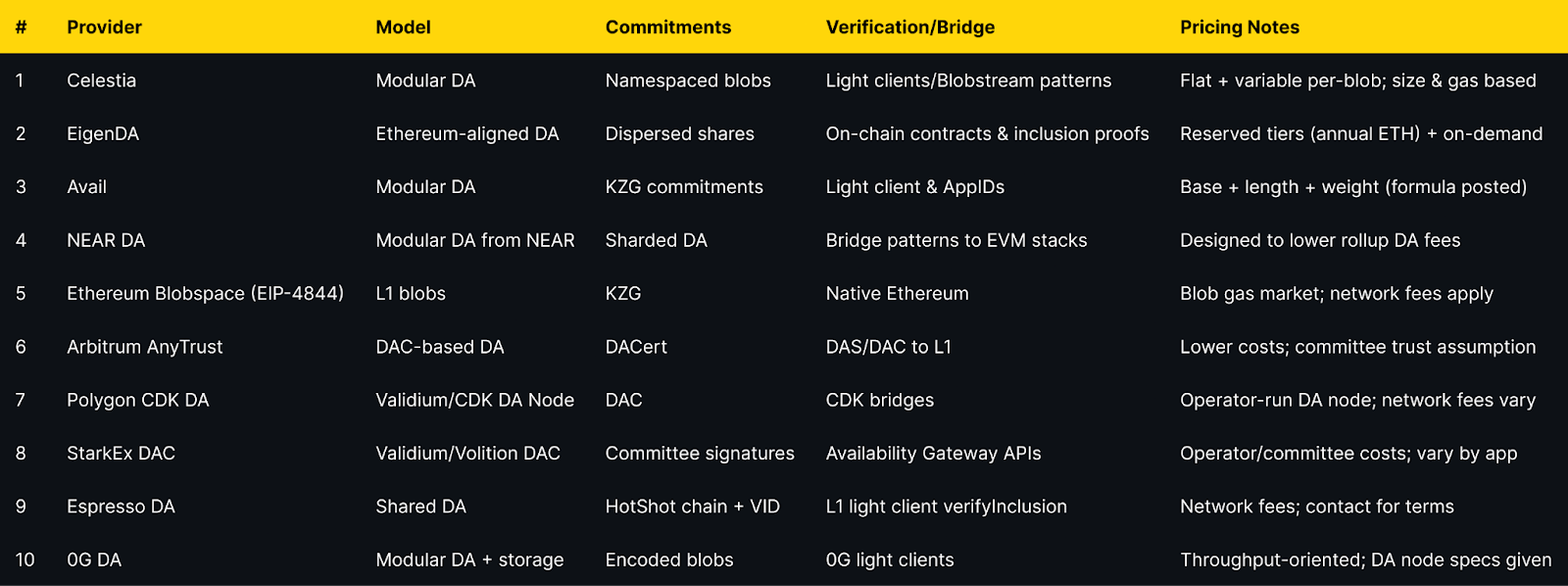
Top Data Availability Layers (2025)

Token Metrics Team
11 min read

Who this guide is for. Teams launching rollups or appchains that need reliable, verifiable data availability layers to minimize costs while preserving security.

Top three picks.

  • Celestia — lowest-friction modular DA with broad tooling and clear blob fee model.
  • EigenDA — high-throughput, Ethereum-aligned DA with reserved/on-demand bandwidth tiers.
  • Avail — production DA with developer-friendly docs and transparent fee formula.

Caveat. Fees vary by data size, congestion, and commitment type (on-chain blobs vs. off-chain DA/DAC). Always confirm region eligibility and SLAs in provider docs.


Introduction: Why Data Availability Layers Matter in November 2025

Data availability layers let rollups publish transaction data so anyone can reconstruct state and verify proofs. In 2025, modular stacks (OP Stack, Polygon CDK, ZK Stack) routinely separate execution from DA to optimize costs and performance. Your DA choice affects security (trust assumptions), fees (blob gas vs. DA network fees), and UX (latency, bandwidth caps).
Search intent here is commercial-investigational: teams comparing providers by cost, security model, and integration options. We’ll keep things concrete, link only official sources, and show exactly who each option fits.

How We Picked (Methodology & Scoring)

  • Liquidity/Scale — 30%: adoption, throughput, sustained bandwidth.
  • Security — 25%: trust assumptions (L1 blobs vs. DAC), transparency, docs.
  • Coverage — 15%: SDKs, stacks supported (OP Stack, Polygon CDK, ZK Stack), bridges.
  • Costs — 15%: posted pricing/fee mechanics.
  • UX — 10%: setup, tooling, observability.
  • Support — 5%: docs, guides, contact points.
    Data from official docs/pricing/status pages; third-party datasets used only for cross-checks. Last updated November 2025.


Top 10 Data Availability Layers in November 2025

1. Celestia — Best for modular DA at predictable blob economics

Why Use It. Celestia specializes in DA with namespaced blobs and data availability sampling. Fees are a flat transaction fee plus a variable component based on blob size, so costs scale with data posted rather than execution. Clear “PayForBlobs” guidance and explorers make planning straightforward. (blog.bcas.io)
Best For. OP Stack/sovereign rollups; teams optimizing DA cost; multi-chain deployments.
Notable Features. Namespaced blobs; fee market tied to blob size; tooling for PFB; docs on submitting and estimating fees. (Celestia Docs)
Fees Notes. Flat + variable per-blob; gas-price prioritized. (Celestia Docs)
Regions. Global (check validator/geography exposure in explorers).
Consider If. You want modular DA with transparent per-blob costs.
Alternatives. EigenDA, Avail.  


2. EigenDA — Best for high throughput with reserved bandwidth tiers

Why Use It. EigenDA is built on EigenLayer and offers mainnet DA with published reserved bandwidth tiers (annual ETH) and on-demand options. Strong alignment with Ethereum restaking and high advertised throughput. (docs.eigencloud.xyz)
Best For. High-throughput L2s; OP Stack/Orbit/CDK chains seeking cloud-grade throughput.
Notable Features. Reserved tiers (e.g., 512–2048 KiB/s and up), on-demand pricing updates, EigenLayer operator set. (eigenda.xyz)
Fees Notes. Reserved pricing in ETH per year; on-demand available. (eigenda.xyz)
Regions. Global.
Consider If. You want capacity commitments and Ethereum-aligned security.
Alternatives. Celestia, Avail.  


3. Avail — Best for dev-friendly docs and transparent fee formula

Why Use It. Avail provides DA with clear developer pathways (AppIDs, deploy rollups) and posts a fee formula: base + length + weight + optional tip. Guides include OP Stack and ZK Stack integrations. (docs.availproject.org)
Best For. Teams needing step-by-step deployment templates and cost modeling.
Notable Features. AppID model; OP Stack/Validium guides; fee components documented. (docs.availproject.org)
Fees Notes. Base + length + weight + optional tip; congestion multiplier. (docs.availproject.org)
Regions. Global.
Consider If. You want docs-first integration and a transparent pricing formula.
Alternatives. Celestia, EigenDA.  


4. NEAR Data Availability (NEAR DA) — Best for cost-reduction via NEAR’s sharded DA

Why Use It. NEAR modularizes its DA layer for external rollups, aiming to lower DA fees while leveraging its sharded architecture. Official materials target Ethereum rollups explicitly. (docs.near.org)
Best For. Rollups prioritizing low DA cost and sharded throughput.
Notable Features. Sharded DA; chain-abstraction docs; community implementations (e.g., Nuffle). (docs.near.org)
Fees Notes. Designed to reduce rollup DA cost; confirm network fees in docs. (NEAR)
Regions. Global.
Consider If. You want a low-cost DA path and EVM interoperability.
Alternatives. Avail, Celestia.


5. Ethereum Blobspace (EIP-4844) — Best for maximum L1 neutrality with ephemeral blobs

Why Use It. Post data to Ethereum blobs for protocol-level guarantees during the blob retention window (~18 days). Ideal for projects that want L1 alignment and can operate within ephemeral storage constraints and blob gas markets. (Ethereum Improvement Proposals)
Best For. Security-first teams preferring L1 attestation and ecosystem neutrality.
Notable Features. KZG commitments; ephemeral blob storage; native verification. (ethereum.org)
Fees Notes. Blob gas; variable by demand; L1 network fees apply. (ethereum.org)
Regions. Global.
Consider If. You accept blob retention limits and variable blob pricing.
Alternatives. Celestia, EigenDA.


6. Arbitrum AnyTrust (DAC) — Best for cost-optimized OP-style chains using a DAC

Why Use It. AnyTrust lowers costs by storing data with a Data Availability Committee and posting certificates on L1. Detailed runbooks exist for configuring DACs for Orbit chains. (docs.arbitrum.io)
Best For. Orbit chains and apps with mild trust assumptions for lower fees.
Notable Features. DACert flow; DAS; step-by-step DAC deployment docs. (docs.arbitrum.io)
Fees Notes. Lower posting costs; committee/infra costs vary. (docs.arbitrum.io)
Regions. Global (committee member distribution varies).
Consider If. You want cheaper DA and can trust a DAC quorum.
Alternatives. Polygon CDK DA, StarkEx DAC.


7. Polygon CDK Data Availability — Best for CDK chains wanting Validium-style DA

Why Use It. CDK chains can use a DA node and DAC approach for Validium-style costs, with official repos describing the CDK DA component. Best fit if you’re already on CDK and want DA flexibility. (polygon.technology)
Best For. Polygon CDK deployers; validium-first apps.
Notable Features. CDK DA node repo; DAC configuration; CDK ecosystem tooling. (GitHub)
Fees Notes. Operator/committee costs; network fees vary by setup. (polygon.technology)
Regions. Global.
Consider If. You need CDK-native DA with Validium trade-offs.
Alternatives. Arbitrum AnyTrust, EigenDA.


8. StarkEx Data Availability Committee — Best for Validium/Volition deployments needing DAC maturity

Why Use It. StarkEx supports Validium and Volition modes via a DAC with APIs (Availability Gateway) and reference implementations for committee nodes. Production-hardened across top apps. (docs.starkware.co)
Best For. High-volume ZK apps on StarkEx preferring low DA costs.
Notable Features. DAC reference code; Volition support; batch data APIs. (GitHub)
Fees Notes. Committee/infra costs; app-specific. (docs.starkware.co)
Regions. Global (committee selection per app).
Consider If. You accept DAC trust assumptions for cost savings.
Alternatives. Arbitrum AnyTrust, Polygon CDK DA.


9. Espresso DA — Best for shared DA paired with neutral sequencing

Why Use It. Espresso offers a shared DA with HotShot consensus and a light-client verifyInclusion function for on-chain verification, designed to interoperate with other DA choices if desired. (docs.espressosys.com)
Best For. Rollups adopting shared sequencing and wanting cheap DA.
Notable Features. HotShot consensus; three-layer DA architecture; flexible with other DAs. (L2BEAT)
Fees Notes. Network fees; contact providers/infrastructure partners for terms. (blockdaemon.com)
Regions. Global.
Consider If. You want shared sequencing + DA as a package.
Alternatives. EigenDA, Celestia.


10. 0G DA — Best for high-throughput apps (AI/gaming) needing DA + storage

Why Use It. 0G pairs a DA layer with a general-purpose storage system and provides DA node specs and runbooks. Positioned for high-volume data workloads and fast retrieval. (docs.0g.ai)
Best For. Data-heavy chains (AI, gaming) needing scalable DA and storage.
Notable Features. Encoded blob data; DA node specs; whitepaper architecture (DA atop storage). (GitHub)
Fees Notes. Throughput-oriented network; confirm current pricing with 0G. (0g.ai)
Regions. Global.
Consider If. You’re optimizing for data-heavy throughput and retrieval.
Alternatives. Celestia, Avail.


Decision Guide: Best By Use Case


How to Choose the Right Data Availability Layer (Checklist)

  • ☐ Region eligibility and any operator restrictions documented
  • ☐ Security model fits app (L1 blobs vs. modular DA vs. DAC)
  • ☐ Fee mechanics are explicit (blob gas, per-blob size, or formula)
  • ☐ Tooling and SDKs for your stack (OP Stack, CDK, ZK Stack)
  • ☐ Throughput/bandwidth and quotas published or contractually reserved
  • ☐ Observability: explorers, status pages, inclusion proofs/light clients
  • ☐ Clear guides for deployment and migration paths
  • ☐ Support channels and escalation (SLA/contacts)
  • Red flags: no official fee notes, opaque committees, or missing verification docs.

Use Token Metrics With Any Data Availability Layer

  • AI Ratings to screen assets by quality and momentum.


  • Narrative Detection to spot early theme shifts.
  • Portfolio Optimization to balance risk across chains.
  • Alerts & Signals to time entries/exits.
    Workflow: Research → Select DA → Launch rollup/appchain → Monitor with alerts.

Start free trial to screen assets and time entries with AI.  


Security & Compliance Tips

  • Run independent verification (light clients/inclusion proofs) where available.
  • For DACs, diversify committee members and publish membership changes.
  • Monitor quotas/latency; set fallbacks (e.g., switch DA mode where stack supports Alt-DA). (docs.optimism.io)
  • Validate official endpoints; beware of phishing and copycat docs.
  • Track fee spikes (blob gas, congestion multipliers) and set budget alarms. (ethereum.org)
  • Document upgrade paths and retention windows (e.g., blob expiry). (ethereum.org)

This article is for research/education, not financial advice.


Beginner Mistakes to Avoid

  • Treating DA choice as “set-and-forget” without monitoring fees and bandwidth.
  • Ignoring blob retention on Ethereum and assuming permanence. (ethereum.org)
  • Using a DAC without clear membership and recovery processes. (docs.arbitrum.io)
  • Skipping test deployments to measure real blob sizes and costs.
  • Overlooking verification UX (light clients/proofs) for end users.
  • Assuming all stacks support seamless DA switching without work. (docs.optimism.io)

How We Picked (Methodology & Scoring)

Scoring Weights (sum = 100): Liquidity/Scale 30, Security 25, Coverage 15, Costs 15, UX 10, Support 5.
We examined official docs for pricing/fees, security/verification, and deployment guides. We favored providers with explicit fee notes (formulas or tiers), clear verification models, and active ecosystem integrations. Last updated November 2025.


FAQs

What are data availability layers?
 They’re systems that publish rollup data so anyone can reconstruct state and verify proofs. They range from L1 blobs (Ethereum EIP-4844) to modular DA networks (Celestia, Avail) and DACs. (ethereum.org)

Are blobs on Ethereum permanent?
 No. Blob data is retained for a limited window (~18 days). If you need permanent access, you must snapshot or use a DA with different retention. (ethereum.org)

How do DA fees work?
 Fees vary: Celestia ties fees to blob size and gas; Avail publishes a base/length/weight formula; Ethereum blobs use a blob-gas market; EigenDA offers reserved bandwidth tiers. (Celestia Docs)

What’s a DAC and when should I use one?
 A Data Availability Committee stores data off-chain and posts certificates or signatures to L1. It’s cheaper but introduces committee trust assumptions. Used by Arbitrum AnyTrust, StarkEx/Volition, and CDK Validium. (docs.arbitrum.io)

Can OP Stack chains plug into alternative DA?
 Yes. OP Stack supports Alt-DA mode to integrate various DA layers. Validate trade-offs and tooling before switching. (docs.optimism.io)


Conclusion + Related Reads

If you want transparent per-blob costs and strong tooling, pick Celestia. For capacity commitments and Ethereum alignment, choose EigenDA. If you want a formula-based fee model with practical guides, Avail is compelling. DAC-based routes (AnyTrust, StarkEx, CDK) suit cost-sensitive apps comfortable with committee trust assumptions.

Related Reads (Token Metrics)

Research

Top Optimistic Rollups & L2 Ecosystems (2025)

Token Metrics Team
13 min read

Who this guide is for. Builders, power users, and teams choosing where to deploy or transact on Ethereum-style optimistic rollups and OP Stack L2s in 2025.

Top three picks.

  • Arbitrum One — broadest DeFi depth and mature fraud proofs.
  • OP Mainnet (Optimism) — feature-complete fault proofs, the Superchain standard.
  • Base — OP Stack at scale with strong developer docs and low, predictable fees. (docs.arbitrum.io)

One key caveat. Withdrawals to L1 use a challenge period (~7 days) on optimistic rollups; fast bridges can bypass with extra trust/cost. (docs.arbitrum.io)


Introduction: Why Optimistic Rollups & L2 Ecosystems Matter in November 2025

Optimistic rollups are L2 networks that post transaction data to Ethereum and assume validity unless challenged via fraud (fault) proofs, enabling cheaper, faster transactions while inheriting Ethereum’s security. They matter now because OP Stack chains have standardized tooling, bridges, and proofs, and multiple ecosystems (Arbitrum, Optimism, Base, Mode, World Chain, Fraxtal, Zora, opBNB, Blast, Metis) have reached scale. Primary keyword: Top Optimistic Rollups. (docs.arbitrum.io)


How We Picked (Methodology & Scoring)

We shortlisted ~20 credible L2s, then scored and selected TOP_N = 10 using official docs for architecture, fees, bridges, and proof status. Third-party datasets were used only for cross-checks.

Scoring Weights (sum = 100):

  • Liquidity — 30%
  • Security (proofs, upgrade path, disclosures) — 25%
  • Coverage (ecosystem depth, tooling) — 15%
  • Costs (fees, DA approach) — 15%
  • UX (bridging, docs) — 10%
  • Support — 5%

Freshness: Last updated November 2025. (docs.optimism.io)


Notes: “Typical fees” reflect L2 execution + L1 data costs; withdraws to L1 follow a challenge window on optimistic designs. (docs.arbitrum.io)


Top 10 Optimistic Rollups & L2 Ecosystems in November 2025

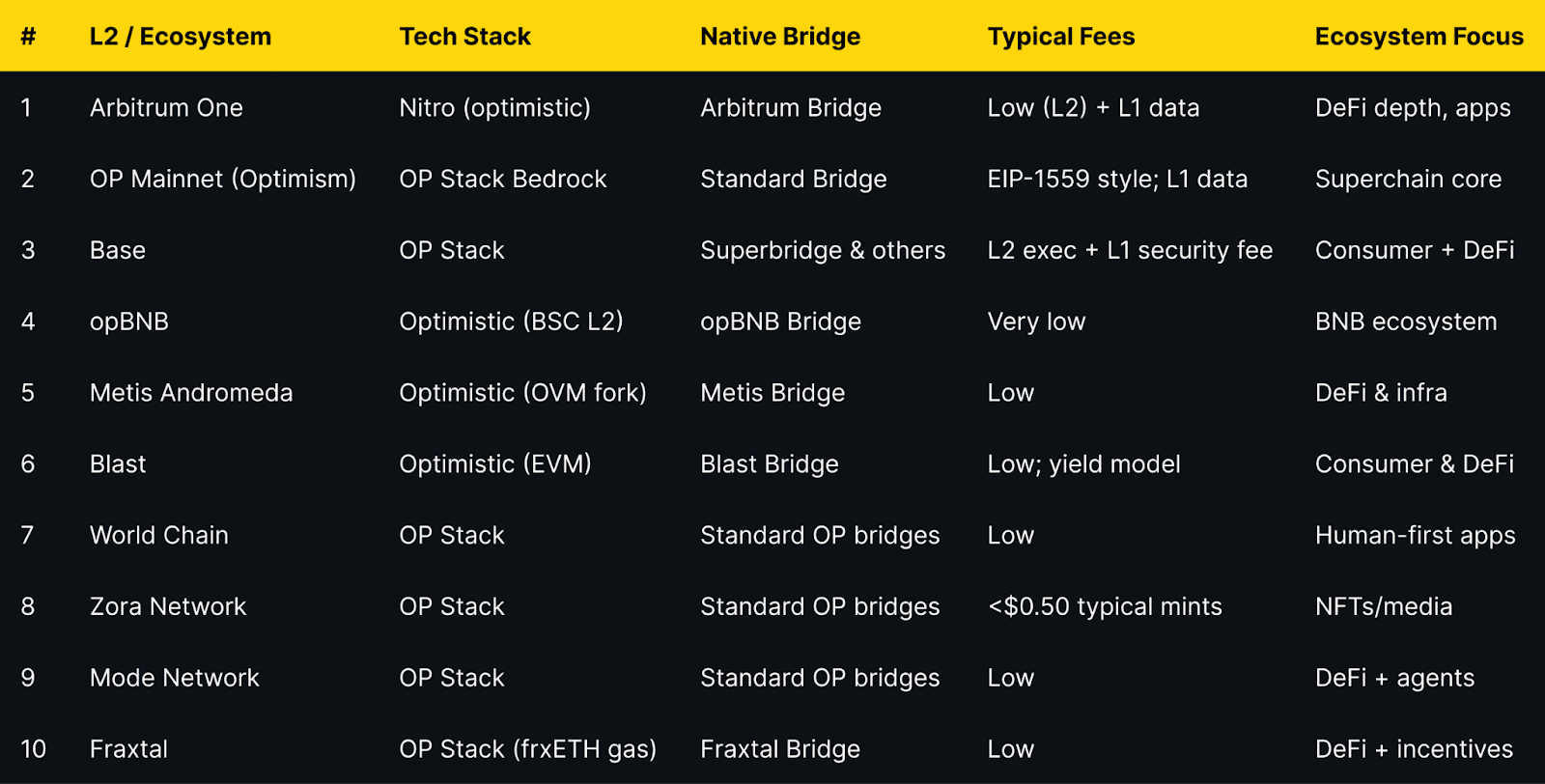
1. Arbitrum One — Best for deep DeFi liquidity

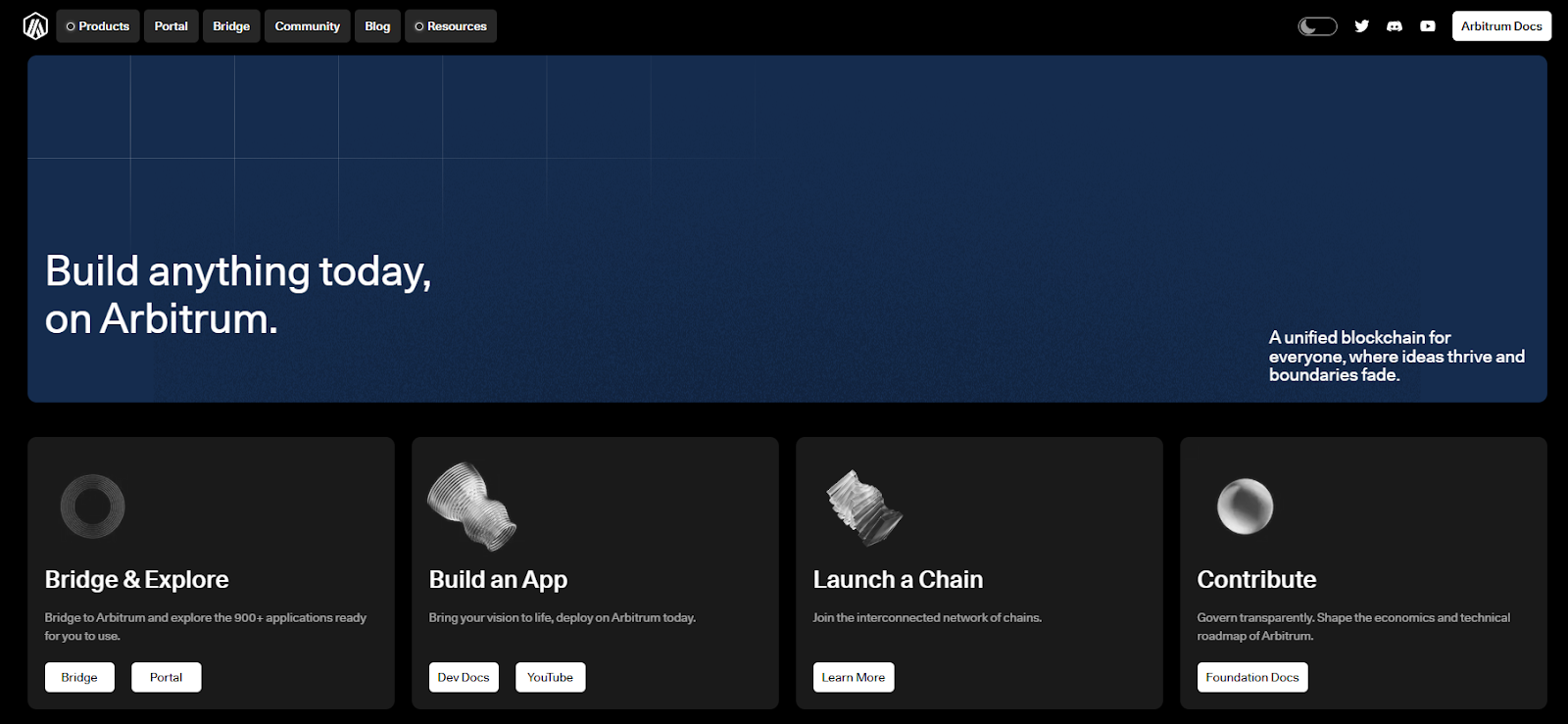
Why Use It. Arbitrum’s Nitro stack delivers mature optimistic security with interactive fraud proofs and broad app coverage. Official docs emphasize the one-week challenge window for L1 withdrawals and support for fast-withdrawal patterns. (docs.arbitrum.io)
Best For. DeFi protocols, power users, market makers.
Notable Features. Fraud-proof system; Nitro throughput; ecosystem depth; L2→L1 fast-withdraw patterns. (docs.arbitrum.io)
Fees Notes. L2 gas + L1 data costs.
Regions. Global (availability depends on wallet/exchange access).
Alternatives. OP Mainnet, Base.  

2. OP Mainnet (Optimism) — Best for Superchain standardization

Why Use It. The OP Stack introduced feature-complete fault proofs on June 10, 2024, enabling permissionless challenge of proposed outputs. Fees follow EIP-1559-style mechanics, with Ecotone updates relaying blob base fees. (docs.optimism.io)
Best For. Teams planning multichain OP Stack deployments; public goods alignment.
Notable Features. Standard Bridge; strong docs; Superchain governance. (docs.optimism.io)
Fees Notes. Execution gas as on L1 plus L1 data; EIP-1559 style. (docs.optimism.io)
Regions. Global.
Alternatives. Base, Mode.  

3. Base — Best for builder UX at scale

Why Use It. Base provides clear fee breakdowns (L2 execution + L1 security fee) and robust docs for bridging and development; widely adopted across consumer and DeFi apps. (docs.base.org)
Best For. Consumer apps, gaming, creators, DeFi teams.
Notable Features. OP Stack chain; programmatic bridging examples; security council documentation. (docs.base.org)
Fees Notes. Two-component fee model (L2 + L1). (docs.base.org)
Regions. Global.
Alternatives. OP Mainnet, Arbitrum.  

4. opBNB (BNB Chain) — Best for BNB ecosystem cost sensitivity

Why Use It. opBNB uses an optimistic rollup to scale BNB Smart Chain with very low fees and high throughput for EVM apps. Docs include explicit L1 data fee formulas. (docs.bnbchain.org)
Best For. Cost-sensitive deployments, BNB ecosystem projects.
Notable Features. OP-style architecture; low-fee environment; BNB chain integrations. (docs.bnbchain.org)
Fees Notes. Very low L2 gas; DA fee formula documented. (docs.bnbchain.org)
Regions. Global.
Alternatives. Base, Mode.

5. Metis Andromeda — Best for sequencer decentralization roadmap

Why Use It. Metis is an optimistic rollup emphasizing a decentralized sequencer pool and performance improvements through its Andromeda roadmap. (metis.io)
Best For. Teams valuing sequencer-level resiliency; DeFi infra.
Notable Features. OVM-lineage EVM equivalence; decentralizing sequencer; ecosystem grants. (L2BEAT)
Fees Notes. Low L2 gas; standard optimistic withdrawal window.
Regions. Global.
Alternatives. Arbitrum, OP Mainnet.

6. Blast — Best for native yield design

Why Use It. Blast is an EVM-compatible optimistic rollup with native yield for ETH and stables at the protocol level, while inheriting Ethereum security. (docs.blast.io)
Best For. Consumer apps and DeFi seeking built-in yield flows.
Notable Features. Yield on bridged assets; OP-style architecture; EVM tooling. (L2BEAT)
Fees Notes. Low L2 gas; standard optimistic withdrawal semantics.
Regions. Global.
Alternatives. Base, Mode.

7. World Chain — Best for human-centric apps

Why Use It. Built on the OP Stack, World Chain prioritizes verified human users with gas allowances and personhood-aware UX, suitable for consumer on-ramps and identity-heavy apps. (docs.world.org)
Best For. Identity-centric consumer apps, payments.
Notable Features. OP Stack standardization; personhood primitives; Superchain membership. (L2BEAT)
Fees Notes. Low L2 gas; standard OP Stack bridging/withdrawals.
Regions. Global.
Alternatives. Base, OP Mainnet.

8. Zora Network — Best for creators & NFTs

Why Use It. Zora is an OP Stack L2 focused on media/NFTs, with docs citing typical NFT mint costs under $0.50 and clear OP Stack security inheritance. (zora.energy)
Best For. NFT marketplaces, media apps, creator tools.
Notable Features. Flat mint fees for collectors; OP Stack tooling; creator-first ecosystem. (docs.growthepie.xyz)
Fees Notes. Low, NFT-friendly fees; network fees apply. (zora.energy)
Regions. Global.
Alternatives. Base, Blast.

9. Mode Network — Best for DeFi + agentic apps

Why Use It. Mode is an OP Stack L2 positioned as a DeFi and agent economy hub, aligning to the Superchain and contributing sequencer fees to OP Collective. (docs.mode.network)
Best For. DeFi protocols, AI/agentic apps.
Notable Features. OP Stack mainnet configuration; Superchain integrations; incentives. (docs.mode.network)
Fees Notes. Low L2 gas; standard OP Stack bridging/withdrawals.
Regions. Global.
Alternatives. OP Mainnet, Base.

10. Fraxtal — Best for DeFi incentives & frxETH gas

Why Use It. Fraxtal is an OP Stack L2 with frxETH as gas and modular DA; official docs cover bridge support and OP Stack compatibility. (docs.frax.finance)
Best For. DeFi protocols leveraging blockspace incentives and ETH-centric gas.
Notable Features. OP Stack; frxETH gas; Flox incentives; native bridge. (Frax)
Fees Notes. Low L2 gas; standard OP Stack withdrawal semantics.
Regions. Global.
Alternatives. Mode, OP Mainnet.


Decision Guide: Best By Use Case


How to Choose the Right Optimistic Rollup (Checklist)

  • Region eligibility for your users and app store distribution.
  • Fraud/fault proofs live and documented; withdrawal challenge period understood. (docs.optimism.io)
  • Data availability costs and L1 data fee exposure. (docs.optimism.io)
  • Bridge UX: native vs third-party, fast-withdraw options. (docs.optimism.io)
  • Sequencer model and roadmap to decentralization. (metis.io)
  • Fees transparency (L2 execution + L1 security fee). (docs.base.org)
  • Official docs, status, and upgrade cadence. (docs.optimism.io)
  • Ecosystem fit (DeFi, NFTs, consumer, identity).
  • Support channels, incident response, and disclosures.
  • Red flags: unclear proofs, opaque bridges, or abandoned docs.

Use Token Metrics With Any Optimistic Rollup

  • AI Ratings to screen assets by quality and momentum.


  • Narrative Detection to spot early theme shifts across ecosystems.
  • Portfolio Optimization to balance risk across L1/L2 exposure.
  • Alerts & Signals to time entries/exits as fees and activity shift.

Start free trial to screen assets and time entries with AI.  


Security & Compliance Tips

  • Prefer official standard bridges when possible; understand trust trade-offs of fast bridges. (docs.optimism.io)
  • Expect a ~7-day withdrawal window on optimistic rollups; plan treasury ops accordingly. (docs.arbitrum.io)
  • Verify contract addresses on official explorers/docs before bridging. (docs.base.org)
  • Monitor L1 data fee swings during high Ethereum congestion. (docs.optimism.io)
  • Review sequencer centralization and posted upgrade paths. (metis.io)
  • Keep seed/MPC practices high-hygiene; use hardware where possible.
  • {This article is for research/education, not financial advice.}

Beginner Mistakes to Avoid

  • Ignoring the challenge window and expecting instant L1 finality. (docs.arbitrum.io)
  • Bridging via unofficial URLs; always verify official docs. (docs.base.org)
  • Underestimating L1 data fees during network spikes. (docs.optimism.io)
  • Choosing an L2 without considering ecosystem fit (DeFi vs NFTs vs identity).
  • Deploying without reading security/proofs and upgrade notes. (docs.optimism.io)
  • Skipping incident/status pages and disclosures.

How We Picked (Methodology & Scoring)

  • Liqudity (30%) — adoption and app depth.
  • Security (25%) — proofs live, challenge periods, sequencer posture.
  • Coverage (15%) — ecosystem tooling, bridges.
  • Costs (15%) — fee transparency and DA approach.
  • UX (10%) — docs, onboarding, explorers, tooling.
  • Support (5%) — responsiveness and clarity.

We relied on official provider docs for architecture, fees, and bridges, cross-checking details where prudent. Last updated November 2025. (docs.optimism.io)


FAQs

What is an optimistic rollup?
 An L2 that posts transaction data to Ethereum and assumes validity unless challenged via fraud/fault proofs, cutting fees while inheriting L1 security. (docs.arbitrum.io)

How long do withdrawals take?
 Native L2→L1 withdrawals on optimistic designs include a challenge window (~7 days); fast bridges can provide liquidity sooner with additional trust/cost. (docs.arbitrum.io)

Why are fees sometimes higher?
 Your cost = L2 execution fee + L1 data fee; L1 data fees fluctuate with Ethereum demand and blob/base fee dynamics. (docs.base.org)

Is OP Stack the “standard” for OP-style chains?
 Yes, the OP Stack is the public-goods framework for OP-style L2s and Superchain members (e.g., OP Mainnet, Base, Mode, World Chain, Zora, Fraxtal). (docs.optimism.io)

What’s special about opBNB?
 It brings optimistic rollup design to the BNB ecosystem with very low fees and BSC alignment. (docs.bnbchain.org)

Which L2 is best for NFTs and creators?
 Zora Network is OP Stack-based and optimized for media/NFT mints with sub-$0.50 typical costs. (zora.energy)


Conclusion + Related Reads

If you want DeFi depth, start with Arbitrum or Base. For Superchain standardization and OP-native tooling, OP Mainnet and Mode are strong defaults. Creator projects should consider Zora, identity-centric apps World Chain, and yield-aware consumer apps Blast. For BNB-aligned deployments, opBNB offers ultra-low fees.

Related Reads (Token Metrics):

Choose from Platinum, Gold, and Silver packages
Reach with 25–30% open rates and 0.5–1% CTR
Craft your own custom ad—from banners to tailored copy
Perfect for Crypto Exchanges, SaaS Tools, DeFi, and AI Products