Back to blog
Research

REST API Explained: Design, Use Cases & Best Practices

Understand REST API fundamentals, design patterns, security, and observability. Practical guidance for engineers building scalable APIs and integrating services using modern best practices.
Token Metrics Team
5
Want Smarter Crypto Picks—Free?
See unbiased Token Metrics Ratings for BTC, ETH, and top alts.
Thank you! Your submission has been received!
Oops! Something went wrong while submitting the form.
 No credit card | 1-click unsubscribe

In today's interconnected digital ecosystem, REST APIs have become the backbone of modern web applications, mobile apps, and data exchange platforms. Whether you're building a cryptocurrency trading platform, integrating blockchain data, or developing any web service, understanding REST API architecture is essential for creating scalable and efficient applications. This comprehensive guide explores REST API design principles, real-world use cases, and best practices that developers need to master.

Understanding REST API Architecture

REST, which stands for Representational State Transfer, is an architectural style that defines a set of constraints for creating web services. A REST API, also known as a RESTful API, allows different software applications to communicate with each other over HTTP protocols. The beauty of REST lies in its simplicity and stateless nature, making it the preferred choice for developers building everything from social media platforms to cryptocurrency APIs.

When a client makes a request to a REST API, it transfers a representation of the state of the requested resource to the client. This representation can be delivered in various formats, with JSON being the most popular choice in modern applications, especially in crypto APIs and blockchain data services. The stateless nature of REST means that each request from a client contains all the information needed to process that request, without relying on stored context on the server.

Core Components of REST API Design

The foundation of effective REST API design rests on several key components that work together to create a cohesive system. Resources represent the fundamental concept in REST architecture, where everything is considered a resource that can be accessed through a unique identifier known as a URI or Uniform Resource Identifier. For instance, in a cryptocurrency API, resources might include digital assets, market data, trading pairs, or wallet addresses.

HTTP methods form the second pillar of REST API design, providing the verbs that define actions on resources. GET requests retrieve data without modifying it, making them perfect for fetching crypto market data or blockchain information. POST requests create new resources, such as submitting a new transaction or creating a wallet. PUT requests update existing resources completely, while PATCH requests modify specific fields. DELETE requests remove resources from the system. Understanding when to use each method is crucial for building intuitive and predictable APIs.

The URI structure in a well-designed REST API should be logical, consistent, and self-documenting. Rather than using verbs in URLs, REST APIs rely on nouns to represent resources, with HTTP methods conveying the action. For example, a crypto API endpoint might look like /api/v1/cryptocurrencies/bitcoin/price rather than /api/v1/getCryptocurrencyPrice. This approach creates cleaner, more maintainable code that developers can understand intuitively.

REST API Best Practices for Production Systems

Implementing version control in your REST API is not optional but essential for maintaining backward compatibility as your service evolves. Including the version number in the URL path, such as /api/v1/ or /api/v2/, allows you to introduce breaking changes in new versions while supporting legacy clients. This practice is particularly important for cryptocurrency APIs where trading bots and automated systems depend on consistent endpoints.

Authentication and security stand as paramount concerns in REST API development, especially when dealing with sensitive data like cryptocurrency transactions or blockchain information. Token-based authentication using JSON Web Tokens (JWT) has emerged as the industry standard, providing secure, stateless authentication that scales well. For crypto APIs handling financial data, implementing API keys, rate limiting, and encryption becomes non-negotiable to protect user assets and maintain system integrity.

Error handling deserves careful attention in REST API design. Your API should return appropriate HTTP status codes that clearly communicate what happened during request processing. A 200 status indicates success, 201 signifies successful resource creation, 400 indicates a bad request from the client, 401 means unauthorized access, 404 signals that a resource wasn't found, and 500 indicates a server error. Accompanying these status codes with clear, actionable error messages in the response body helps developers debug issues quickly.

Cryptocurrency APIs and REST Architecture

The cryptocurrency industry has embraced REST APIs as the primary method for accessing blockchain data, market information, and trading functionality. Crypto APIs built on REST principles enable developers to integrate real-time cryptocurrency prices, historical market data, trading volumes, and blockchain analytics into their applications seamlessly. Token Metrics, a leader in crypto analytics and data services, offers one of the most comprehensive cryptocurrency APIs in the market, providing developers with access to advanced metrics, AI-driven insights, and real-time market data through a well-designed RESTful interface.

When building or consuming crypto APIs, developers must consider the unique challenges of blockchain technology. Cryptocurrency market data requires high-frequency updates due to the volatile nature of digital assets. A robust crypto API must handle thousands of requests per second while maintaining low latency and high availability. Token Metrics addresses these challenges by providing a scalable REST API infrastructure that delivers accurate cryptocurrency data, token ratings, and market analytics to developers, traders, and institutional clients.

The integration of blockchain APIs with REST architecture has opened new possibilities for decentralized applications and financial technology. Developers can now query blockchain transactions, check wallet balances, monitor smart contract events, and access DeFi protocols through simple HTTP requests. This accessibility has accelerated innovation in the crypto space, allowing developers to build sophisticated trading platforms, portfolio trackers, and analytics dashboards without managing blockchain nodes directly.

Real-World Use Cases of REST APIs

REST APIs power countless applications across industries, demonstrating their versatility and reliability. In the financial technology sector, cryptocurrency exchanges rely on REST APIs to provide trading functionality to their users. These APIs enable programmatic trading, allowing algorithmic traders to execute strategies, monitor positions, and manage risk across multiple markets. Token Metrics leverages REST API technology to deliver cryptocurrency intelligence, offering endpoints for token grades, trader grades, market predictions, and comprehensive crypto market analysis.

Mobile applications represent another significant use case for REST APIs. Every time you check cryptocurrency prices on your phone, post on social media, or stream music, REST APIs work behind the scenes to fetch and deliver that data. The lightweight nature of REST makes it ideal for mobile environments where bandwidth and battery life are concerns. Crypto portfolio tracking apps, for instance, use REST APIs to aggregate data from multiple exchanges and blockchain networks, presenting users with a unified view of their digital asset holdings.

Enterprise systems increasingly adopt REST APIs for integration and automation. Companies use REST APIs to connect customer relationship management systems, payment processors, inventory databases, and analytics platforms. In the blockchain and cryptocurrency domain, businesses integrate crypto payment APIs to accept digital currencies, use blockchain APIs to verify transactions, and leverage analytics APIs like those offered by Token Metrics to make data-driven investment decisions.

Designing Scalable REST APIs

Scalability should be a primary consideration when designing REST APIs, particularly for services that may experience rapid growth or traffic spikes. Implementing pagination for endpoints that return large datasets prevents overwhelming clients and servers. Instead of returning thousands of cryptocurrency listings in a single response, a well-designed crypto API returns a manageable subset along with pagination metadata, allowing clients to request additional pages as needed.

Caching strategies significantly improve REST API performance and reduce server load. By including proper cache-control headers in API responses, you enable clients and intermediary proxies to cache responses appropriately. For cryptocurrency APIs where some data like historical prices rarely changes, aggressive caching can dramatically reduce the number of database queries and API calls. However, real-time data such as current market prices requires careful cache invalidation to ensure accuracy.

Rate limiting protects your REST API from abuse and ensures fair resource allocation among all users. By implementing rate limits based on API keys or IP addresses, you prevent individual clients from monopolizing server resources. Token Metrics implements sophisticated rate limiting in its cryptocurrency API, offering different tiers of access that balance the needs of casual developers, professional traders, and enterprise clients.

Documentation and Developer Experience

Comprehensive documentation transforms a good REST API into a great one. Developers evaluating whether to use your API need clear, accurate documentation that explains endpoints, parameters, authentication methods, and response formats. Interactive API documentation tools like Swagger or Postman collections allow developers to test endpoints directly from the documentation, reducing friction in the integration process.

For cryptocurrency APIs, documentation should include specific examples relevant to the crypto ecosystem. Token Metrics provides extensive API documentation covering everything from basic cryptocurrency price queries to advanced analytics endpoints, complete with code samples in multiple programming languages. This approach accelerates integration and reduces support requests, benefiting both API providers and consumers.

Providing SDKs and client libraries in popular programming languages further improves developer experience. Rather than forcing every developer to handle HTTP requests manually, offering pre-built libraries for Python, JavaScript, Java, and other languages enables faster integration and reduces the likelihood of implementation errors. These libraries can handle authentication, request formatting, error handling, and response parsing automatically.

Monitoring and Maintaining REST APIs

Once your REST API is in production, ongoing monitoring becomes critical to maintaining quality of service. Implementing comprehensive logging allows you to track API usage patterns, identify performance bottlenecks, and detect anomalies. For cryptocurrency APIs handling financial data, monitoring is especially crucial as downtime or data inaccuracies can result in significant financial losses for users.

Performance metrics such as response times, error rates, and throughput provide insights into API health. Setting up alerts for unusual patterns enables proactive problem resolution before users are significantly affected. Token Metrics maintains rigorous monitoring of its crypto API infrastructure, ensuring that developers and traders have reliable access to critical cryptocurrency market data and analytics.

Maintaining backward compatibility while evolving your API requires careful planning and communication. Deprecation policies should give developers adequate time to migrate to new versions or endpoints. For crypto APIs, this is particularly important as trading bots and automated systems may run unattended for extended periods and need time to adapt to API changes.

Security Considerations for REST APIs

Security forms the foundation of trustworthy REST APIs, especially when handling sensitive information like cryptocurrency transactions or personal data. Implementing HTTPS encryption for all API communications prevents man-in-the-middle attacks and protects data in transit. This is non-negotiable for crypto APIs where a single compromised API call could result in unauthorized fund transfers.

Input validation and sanitization protect against injection attacks and malformed requests. Your REST API should validate all incoming data against expected formats and ranges before processing. For cryptocurrency APIs, this includes validating wallet addresses, transaction amounts, and trading parameters to prevent errors and potential exploits.

Implementing proper access controls ensures that authenticated users can only access resources they're authorized to view or modify. Role-based access control (RBAC) provides a flexible framework for managing permissions in complex systems. Token Metrics implements enterprise-grade security in its cryptocurrency API, protecting sensitive market data and ensuring that clients can trust the integrity of the information they receive.

The Future of REST APIs in Cryptocurrency

As the cryptocurrency industry continues to mature, REST APIs will remain central to how developers interact with blockchain data and trading platforms. The evolution of decentralized finance, non-fungible tokens, and Web3 applications creates new opportunities and challenges for API design. REST APIs must adapt to handle increasingly complex queries, provide real-time updates for rapidly changing market conditions, and integrate with emerging blockchain protocols.

Token Metrics continues to innovate in the crypto API space, expanding its offerings to include advanced analytics, AI-powered market predictions, and comprehensive blockchain data. By maintaining a robust REST API infrastructure, Token Metrics enables developers, traders, and institutions to build sophisticated cryptocurrency applications that leverage cutting-edge market intelligence.

The convergence of traditional finance and cryptocurrency creates demand for APIs that can bridge both worlds seamlessly. REST APIs that provide unified access to crypto market data, traditional financial information, and cross-market analytics will become increasingly valuable. As regulatory frameworks evolve, APIs will also need to incorporate compliance features, reporting capabilities, and audit trails to meet institutional requirements.

Conclusion

REST APIs have proven themselves as the most practical and widely adopted approach for building web services that are scalable, maintainable, and developer-friendly. Understanding REST API design principles, implementing best practices, and focusing on security and performance creates APIs that developers love to use and rely on for their applications.

In the cryptocurrency space, REST APIs serve as the critical infrastructure that connects developers to blockchain data, market information, and trading functionality. Token Metrics exemplifies how a well-designed crypto API can empower developers and traders with the data and insights they need to succeed in the dynamic digital asset markets. Whether you're building a new cryptocurrency application or integrating blockchain data into existing systems, mastering REST API principles and leveraging powerful crypto APIs like those offered by Token Metrics will accelerate your development and enhance your capabilities.

As technology continues to evolve, REST APIs will adapt and improve, but their fundamental principles of simplicity, scalability, and statelessness will continue to guide the design of systems that power our increasingly connected digital world.

Build Smarter Crypto Apps &
AI Agents in Minutes, Not Months
Real-time prices, trading signals, and on-chain insights all from one powerful API.
Grab a Free API Key
About Token Metrics
Token Metrics: AI-powered crypto research and ratings platform. We help investors make smarter decisions with unbiased Token Metrics Ratings, on-chain analytics, and editor-curated “Top 10” guides. Our platform distills thousands of data points into clear scores, trends, and alerts you can act on.
30 Employees
analysts, data scientists, and crypto engineers
Daily Briefings
concise market insights and “Top Picks”
Transparent & Compliant
Sponsored ≠ Ratings; research remains independent
Want Smarter Crypto Picks—Free?
See unbiased Token Metrics Ratings for BTC, ETH, and top alts.
Thank you! Your submission has been received!
Oops! Something went wrong while submitting the form.
 No credit card | 1-click unsubscribe
Token Metrics Team
Token Metrics Team

Recent Posts

Research

How to Use x402 with Token Metrics: Composer Walkthrough + Copy-Paste Axios/HTTPX Clients

Token Metrics Team
9 min read

What You Will Learn — Two-Paragraph Opener

This tutorial shows you how to use x402 with Token Metrics in two ways. First, we will walk through x402 Composer, where you can run Token Metrics agents, ask questions, and see pay-per-request tool calls stream into a live Feed with zero code. Second, we will give you copy-paste Axios and HTTPX clients that handle the full x402 flow (402 challenge, wallet payment, automatic retry) so you can integrate Token Metrics into your own apps.

Whether you are exploring x402 for the first time or building production agent workflows, this guide has you covered. By the end, you will understand how x402 payments work under the hood and have working code you can ship today. Let's start with the no-code option in Composer.

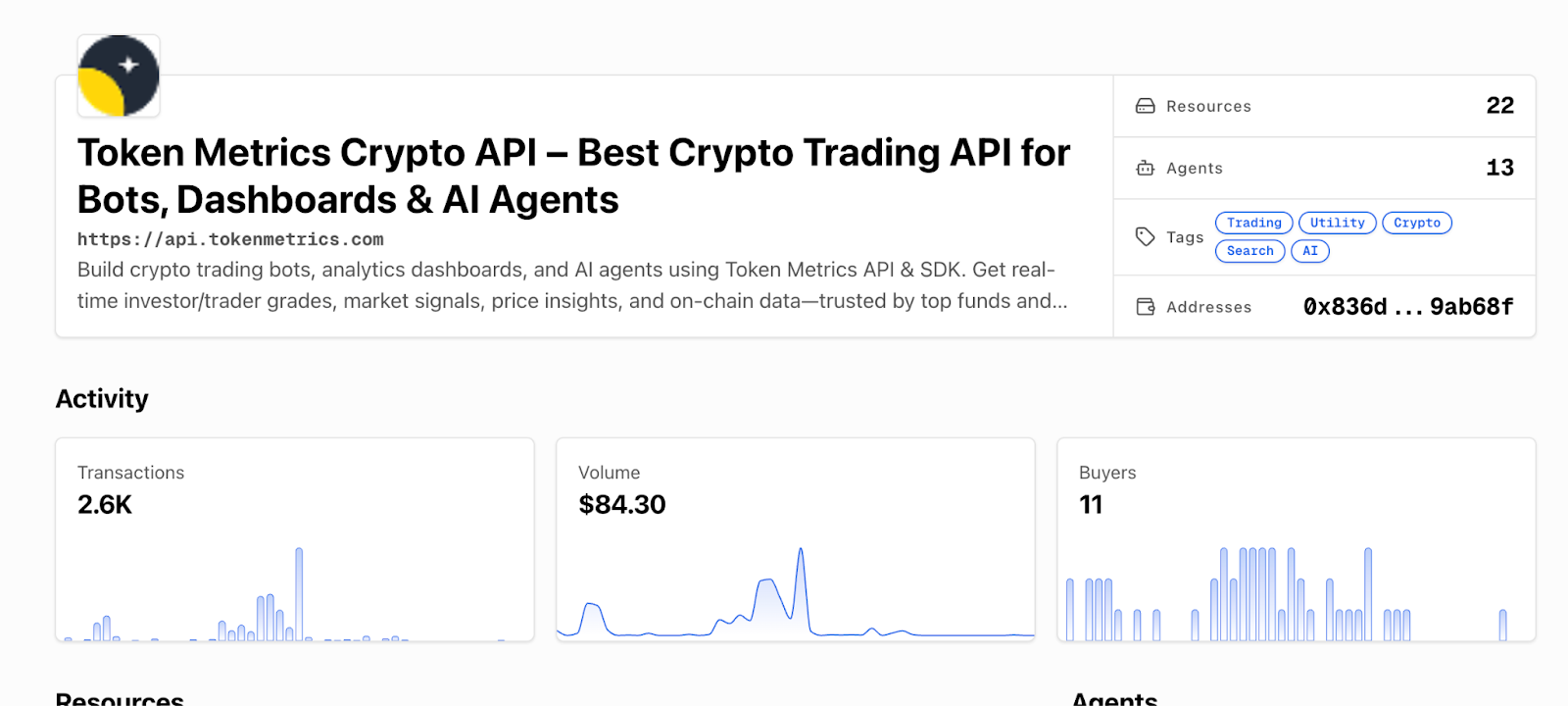
Start using Token Metrics X402 integration here. https://www.x402scan.com/server/244415a1-d172-4867-ac30-6af563fd4d25 

Part 1: Try x402 + Token Metrics in Composer (No Code Required)

x402 Composer is a playground for AI agents that pay per tool call. You can test Token Metrics endpoints, see live payment settlements, and understand the x402 flow before writing any code.

What Is Composer?

Composer is x402scan's hosted environment for building and using AI agents that pay for external resources via x402. It provides a chat interface, an agent directory, and a real-time Feed showing every tool call and payment across the ecosystem. Token Metrics endpoints are available as tools that agents can call on demand.

Explore Composer: https://x402scan.com/composer

Step-by-Step Walkthrough

Follow these steps to run a Token Metrics query and watch the payment happen in real time.

  1. Open the Composer agents directory: Go to https://x402scan.com/composer/agents and browse available agents. Look for agents tagged with "Token Metrics" or "crypto analytics." Or check our our integration here. https://www.x402scan.com/server/244415a1-d172-4867-ac30-6af563fd4d25 
  2. Select an agent: Click into an agent that uses Token Metrics endpoints (for example, a trading signals agent or market intelligence agent). You will see the agent's description, configured tools, and recent activity.
  3. Click "Use Agent": This opens a chat interface where you can run prompts against the agent's configured tools.
  4. Run a query: Type a question that requires calling a Token Metrics endpoint, for example "Give me the latest TM Grade for Ethereum" or "What are the top 5 moonshot tokens right now?" and hit send.
  5. Watch the Feed: As the agent processes your request, it will call the relevant Token Metrics endpoint. Open the Composer Feed (https://x402scan.com/composer/feed) in a new tab to see the tool call appear in real time with payment details (USDC or TMAI amount, timestamp, status).


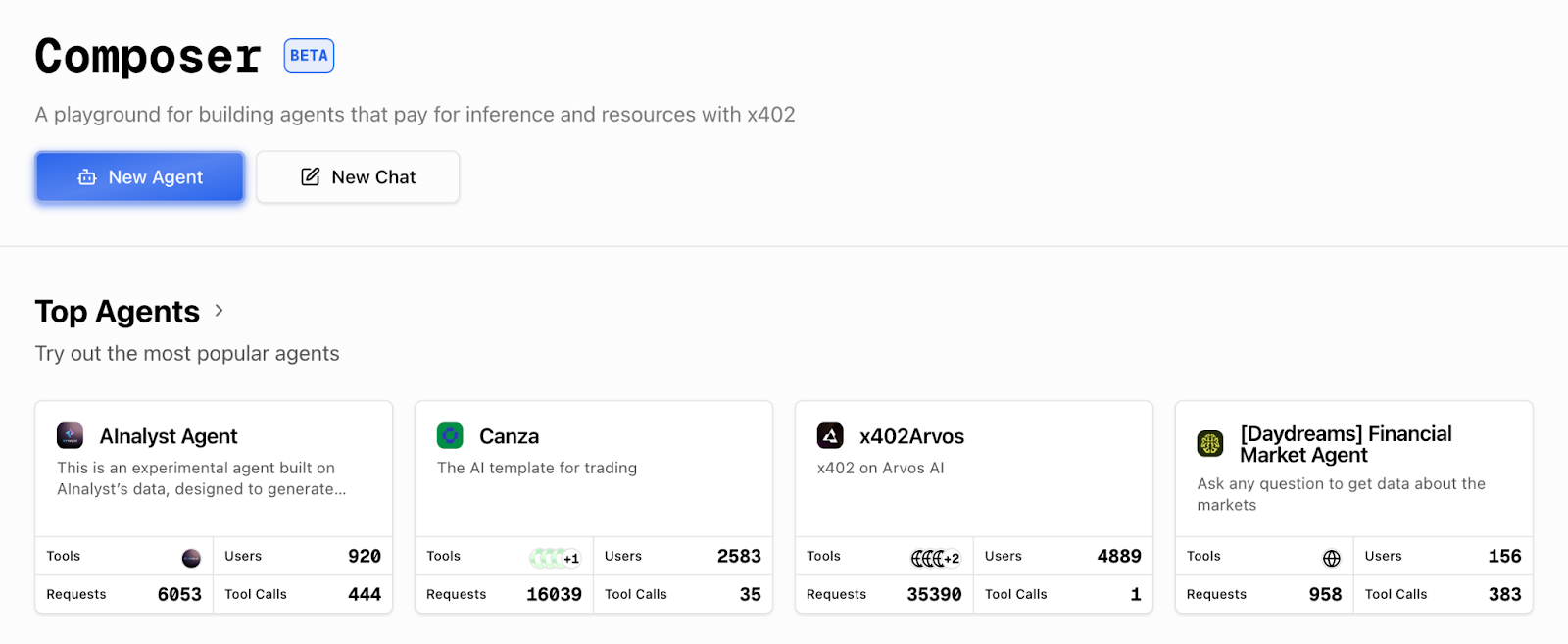
Composer agents directory: Composer Agents page: Each agent shows tool stack, messages, and recent activity.


Individual agent page: Agent detail page: View tools, description, and click "Use Agent" to start.

[INSERT SCREENSHOT: Chat interface]

Chat interface: Chat UI: Ask a question like "What are the top trading signals for BTC today?"

[INSERT SCREENSHOT: Composer Feed]

Composer Feed: Live Feed: Each tool call shows the endpoint, payment token, amount, and settlement status.

That is the x402 flow in action. The agent's wallet paid for the API call automatically, the server verified payment, and the data came back. No API keys, no monthly bills, just pay-per-use access.

Key Observations from Composer

  • Tool calls show the exact endpoint called (like /v2/tm-grade or /v2/moonshot-tokens)
  • Payments display in USDC or TMAI with the per-call cost
  • The Feed updates in real time, you can see other agents making calls across the ecosystem
  • You can trace each call back to the agent and message that triggered it
  • This is how agentic commerce works: agents autonomously pay for resources as needed

Part 2: Build Your Own x402 Client (Axios + HTTPX)

Now that you have seen x402 in action, let's build your own client that can call Token Metrics endpoints with automatic payment handling.

How x402 Works (Quick Refresher)

When you make a request with the x-coinbase-402 header, the Token Metrics API returns a 402 Payment Required response with payment instructions (recipient address, amount, chain). Your x402 client reads this challenge, signs a payment transaction with your wallet, submits it to the blockchain, and then retries the original request with proof of payment. The server verifies the settlement and returns the data. The x402-axios and x402 Python libraries handle this flow automatically.

Prerequisites

  • A wallet with a private key (use a testnet wallet for development on Base Sepolia, or a mainnet wallet for production on Base)
  • USDC or TMAI in your wallet (testnet USDC for testing, mainnet tokens for production)
  • Node.js 18+ and npm (for Axios example) or Python 3.9+ (for HTTPX example)
  • Basic familiarity with async/await patterns

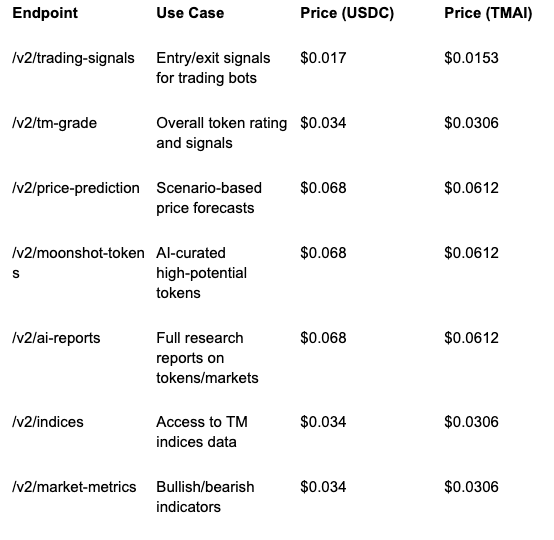
Recommended Token Metrics Endpoints for x402

These endpoints are commonly used by agents and developers building on x402. All are pay-per-call with transparent pricing.

Full endpoint list and docs: https://developers.tokenmetrics.com 

Common Errors and How to Fix Them

Here are the most common issues developers encounter with x402 and their solutions.

Error: Payment Failed (402 Still Returned After Retry)

This usually means your wallet does not have enough USDC or TMAI to cover the call, or the payment transaction failed on-chain.

  • Check your wallet balance on Base (use a block explorer or your wallet app)
  • Make sure you are on the correct network (Base mainnet for production, Base Sepolia for testnet)
  • Verify your private key has permission to spend the token (no allowance issues for most x402 flows, but check if using a smart contract wallet)
  • Try a smaller request or switch to a cheaper endpoint to test

Error: Network Timeout

x402 requests take longer than standard API calls because they include a payment transaction. If you see timeouts, increase your client timeout.

  • Set timeout to at least 30 seconds (30000ms in Axios, 30.0 in HTTPX)
  • Check your RPC endpoint is responsive (viem/eth-account uses public RPCs by default, which can be slow)
  • Consider using a dedicated RPC provider (Alchemy, Infura, QuickNode) for faster settlement

Error: 429 Rate Limit Exceeded

Even with pay-per-call, Token Metrics enforces rate limits to prevent abuse. If you hit a 429, back off and retry.

  • Implement exponential backoff (wait 1s, 2s, 4s, etc. between retries)
  • Spread requests over time instead of bursting
  • For high-volume use cases, contact Token Metrics to discuss rate limit increases

Error: Invalid Header or Missing x-coinbase-402

If you forget the x-coinbase-402: true header, the server will treat your request as a standard API call and may return a 401 Unauthorized if no API key is present.

  • Always include x-coinbase-402: true in headers for x402 requests
  • Do not send x-api-key when using x402 (the header is mutually exclusive)
  • Double-check header spelling (it is x-coinbase-402, not x-402 or x-coinbase-payment)

Production Tips

  • Use environment variables for private keys, never hardcode them
  • Set reasonable max_payment limits to avoid overspending (especially with TMAI)
  • Log payment transactions for accounting and debugging
  • Monitor your wallet balance and set up alerts for low funds
  • Test thoroughly on Base Sepolia testnet before going to mainnet
  • Use TMAI for production to get the 10% discount on every call
  • Cache responses when possible to reduce redundant paid calls
  • Implement retry logic with exponential backoff for transient errors

Why This Matters for Agents

Traditional APIs force agents to carry API keys, which creates security risks and requires human intervention for key rotation and billing. With x402, agents can pay for themselves using wallet funds, making them truly autonomous. This unlocks agentic commerce where AI systems compose services on the fly, paying only for what they need without upfront subscriptions or complex auth flows.

For Token Metrics specifically, x402 means agents can pull real-time crypto intelligence (signals, grades, predictions, research) as part of their decision loops. They can chain our endpoints with other x402-enabled tools like Heurist Mesh (on-chain data), Tavily (web search), and Firecrawl (content extraction) to build sophisticated, multi-source analysis workflows. It is HTTP-native payments meeting real-world agent use cases.

FAQs

Can I use the same wallet for multiple agents?

Yes. Each agent (or client instance) can use the same wallet, but be aware of nonce management if making concurrent requests. The x402 libraries handle this automatically.

Do I need to approve token spending before using x402?

No. The x402 payment flow uses direct transfers, not approvals. Your wallet just needs sufficient balance.

Can I see my payment history?

Yes. Check x402scan (https://x402scan.com/composer/feed) for a live feed of all x402 transactions, or view your wallet's transaction history on a Base block explorer.

What if I want to use a different payment token?

Currently x402 with Token Metrics supports USDC and TMAI on Base. To request support for additional tokens, contact Token Metrics.

How do I switch from testnet to mainnet?

Change your viem chain from baseSepolia to base (in Node.js) or update your RPC URL (in Python). Make sure your wallet has mainnet USDC or TMAI.

Can I use x402 in browser-based apps?

Yes, but you will need a browser wallet extension (like MetaMask or Coinbase Wallet) and a frontend-compatible x402 library. The current x402-axios and x402-python libraries are designed for server-side or Node.js environments.

Next Steps

Disclosure

Educational and informational purposes only. x402 involves crypto payments on public blockchains. Understand the risks, secure your private keys, and test thoroughly before production use. Token Metrics does not provide financial advice.

Quick Links

About Token Metrics

Token Metrics provides powerful crypto analytics, signals, and AI-driven tools to help you make smarter trading and investment decisions. Start exploring Token Metrics ratings and APIs today for data-driven success.

Research

Our x402 Integration Is Live: Pay-Per-Call Access to Token Metrics—No API Key Required

Token Metrics Team
7 min read

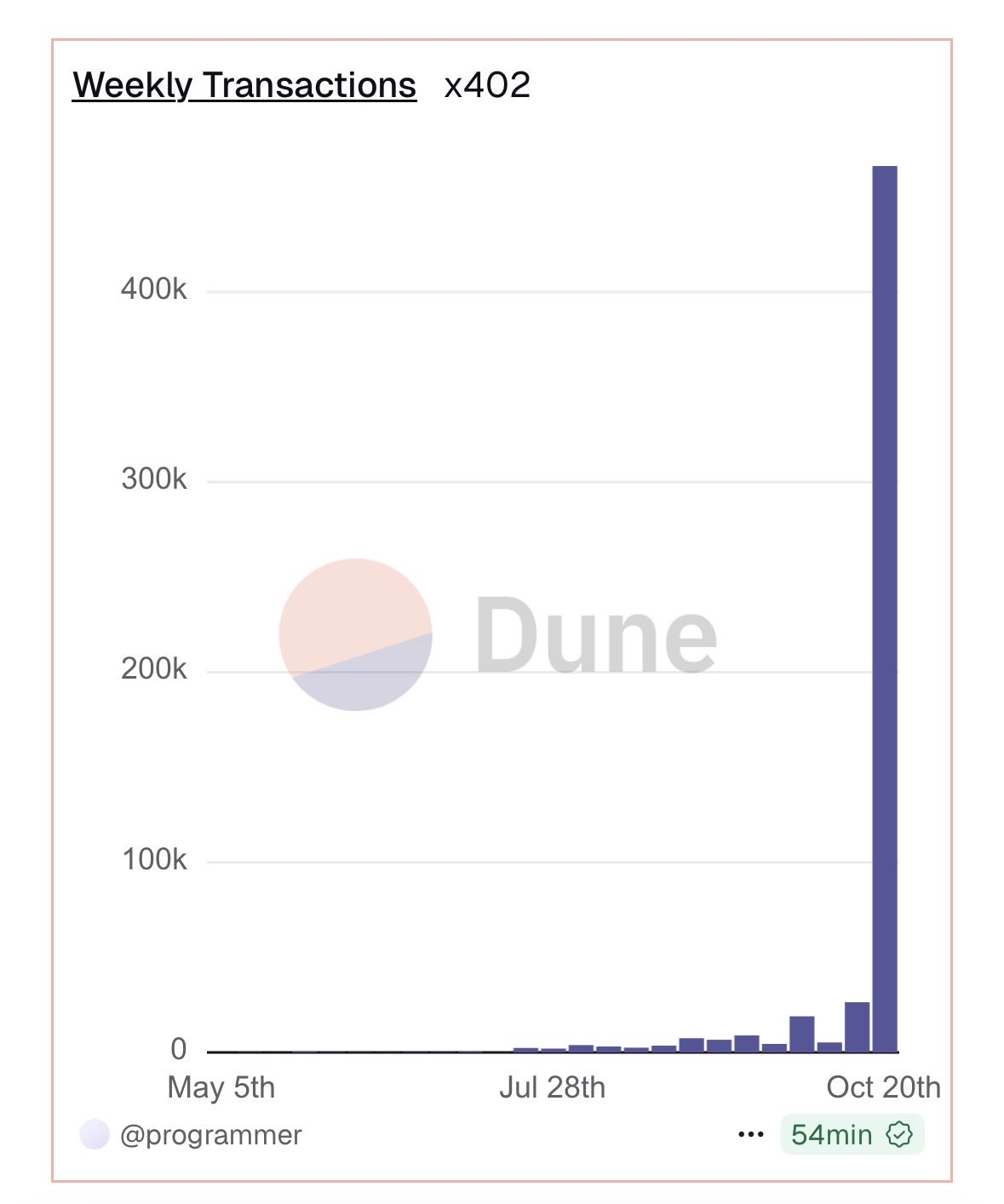
Developers are already shipping with x402 at scale: 450,000+ weekly transactions, 700+ projects. This momentum is why our Token Metrics x402 integration matters for agents and apps that need real crypto intelligence on demand. You can now pay per API call using HTTP 402 and the x-coinbase-402 header, no API key required.

   _ 

Summary: Pay per API call to Token Metrics with x402 on Base using USDC or TMAI, set x-coinbase-402: true, and get instant access to trading signals, grades, and AI reports.

Check out the x402 ecosystem on Coingecko.


What You Get

Token Metrics now supports x402, the HTTP-native payment protocol from Coinbase. Users can call any public endpoint by paying per request with a wallet, eliminating API key management and upfront subscriptions. This makes Token Metrics data instantly accessible to AI agents, researchers, and developers who want on-demand crypto intelligence.

x402 enables truly flexible access where you pay only for what you use, with transparent per-call pricing in USDC or TMAI. The integration is live now across all Token Metrics public endpoints, from trading signals to AI reports. Here's everything you need to start calling Token Metrics with x402 today.

Quick Start

Get started with x402 + Token Metrics in three steps.

  1. Create a wallet client: Follow the x402 Quickstart for Buyers to set up a wallet client (Node.js with viem or Python with eth-account). Link: https://docs.cdp.coinbase.com/x402/docs/quickstart-buyers
  2. Set required headers: Add x-coinbase-402: true to any Token Metrics request. Optionally set x-payment-token: tmai for a 10% discount (defaults to usdc). Do not send x-api-key when using x402.
  3. Call any endpoint: Make a request to https://api.tokenmetrics.com/v2/[endpoint] with your wallet client. Payment happens automatically via x402 settlement.

That is it. Your wallet pays per call, and you get instant access to Token Metrics data with no subscription overhead.

Required Headers


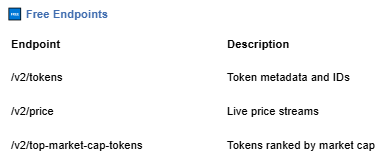
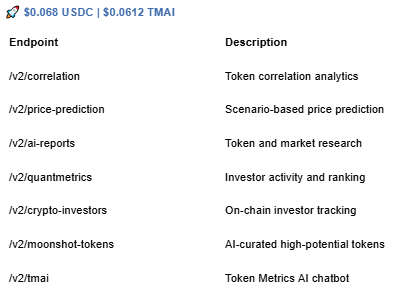
Endpoint Pricing

Transparent per-call pricing across all Token Metrics public endpoints. Pay in USDC or get 10% off with TMAI.


All prices are per single call. Paying with TMAI automatically applies a 10% discount.

Try It on x402 Composer

If you want to see x402 + Token Metrics in action without writing code, head to x402 Composer. Composer is x402scan's playground for AI agents that pay per tool call. You can open a Token Metrics agent, chat with it, and watch real tool calls and USDC/TMAI settlements stream into the live Feed.

Composer surfaces active agents using Token Metrics endpoints like trading signals, price predictions, and AI reports. It is a great way to explore what is possible before you build your own integration. Link: https://x402scan.com/composer

Why x402 Changes the Game

Traditional API access requires upfront subscriptions, fixed rate limits, and key management overhead. x402 flips that model by letting you pay per call with a crypto wallet, with no API keys or monthly commitments. This is especially powerful for AI agents, which need flexible, on-demand access to external data without human intervention.

For Token Metrics, x402 unlocks agentic commerce where agents can autonomously pull crypto intelligence, pay only for what they use, and compose our endpoints with other x402-enabled tools like Heurist Mesh, Tavily, and Firecrawl. It is HTTP-native payments meeting real-world agent workflows.

What is x402?

x402 is an open-source HTTP-native payment protocol developed by Coinbase. It uses the HTTP 402 status code (Payment Required) to enable pay-per-request access to APIs and services. When you make a request with the x-coinbase-402 header, the server returns a payment challenge, your wallet signs and submits payment, and the server fulfills the request once settlement is verified.

The protocol runs on Base and Solana, with USDC and TMAI as the primary payment tokens. x402 is designed for composability, agents can chain multiple paid calls across different providers in a single workflow, paying each service directly without intermediaries. Learn more at the x402 Quickstart for Buyers: https://docs.cdp.coinbase.com/x402/docs/quickstart-buyers

FAQs

Do I need an API key to use x402 with Token Metrics?

No. When you set x-coinbase-402: true, your wallet signature replaces API key authentication. Do not send x-api-key in your requests.

Can I use x402 with a free trial or test wallet?

Yes, but you will need testnet USDC or TMAI on Base Sepolia (testnet) for development. Production calls require mainnet tokens.

How do I see my payment history?

Check x402scan for transaction logs and tool call history. Your wallet will also show outgoing USDC/TMAI transactions. Visit https://www.x402scan.com.

What happens if my wallet balance is too low?

The x402 client will return a payment failure before making the API call. Top up your wallet and retry.

Can I use x402 in production apps?

Yes. x402 is live on Base mainnet. Set appropriate spend limits and handle payment errors gracefully in your code.

Next Steps

Disclosure

Educational and informational purposes only. x402 involves crypto payments on public blockchains. Understand the risks, manage your wallet security, and test thoroughly before production use. Token Metrics does not provide financial advice.

Powered by Token Metrics

Your AI-powered crypto research experience is made possible by Token Metrics. Discover data-driven insights and advanced analytics on your favorite coins and tokens.

Research

Uniswap Price Prediction 2027: $13.50-$43 Target Analysis

Token Metrics Team
8 min read

Uniswap Price Prediction: Market Context for UNI in the 2027 Case

DeFi protocols are maturing beyond early ponzi dynamics toward sustainable revenue models. Uniswap operates in this evolving landscape where real yield and proven product market fit increasingly drive valuations rather than speculation alone. Growing regulatory pressure on centralized platforms creates tailwinds for decentralized alternatives.

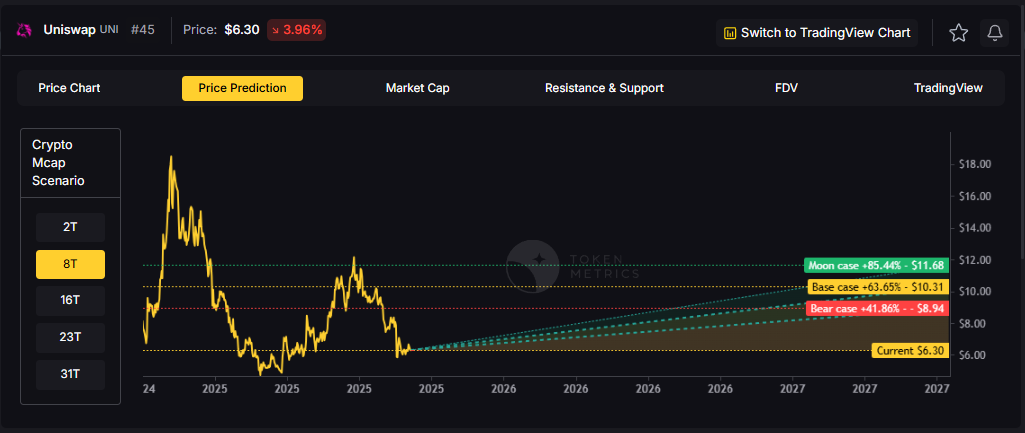
The price prediction scenario bands below reflect how UNI might perform across different total crypto market cap environments. Each tier represents a distinct liquidity regime, from bear conditions with muted DeFi activity to moon price prediction scenarios where decentralized infrastructure captures significant value from traditional finance.


Disclosure

Educational purposes only, not financial advice. Crypto is volatile, do your own research and manage risk.

How to read this price prediction:

Each band blends cycle analogues and market cap share math with TA guardrails. Base assumes steady adoption and neutral or positive macro. Moon layers in a liquidity boom. Bear assumes muted flows and tighter liquidity.

TM Agent baseline:

Token Metrics TM Grade is 69%, Buy, and the trading signal is bullish. Price prediction scenarios cluster roughly between $6.50 and $28, with a base case price target near $13.50.

Live details: Uniswap Token Details 

Affiliate Disclosure: We may earn a commission from qualifying purchases made via this link, at no extra cost to you.

Key Takeaways

  • Scenario driven, outcomes hinge on total crypto market cap, higher liquidity and adoption lift the bands.
  • Fundamentals: Fundamental Grade 79.88% (Community 77%, Tokenomics 100%, Exchange 100%, VC 66%, DeFi Scanner 62%).
  • Technology: Technology Grade 86.88% (Activity 72%, Repository 72%, Collaboration 100%, Security N/A, DeFi Scanner 62%).
  • TM Agent gist: bullish bias with a base case near $13.50 and a broad range between $6.50 and $28.
  • Education only, not financial advice.

Uniswap Price Prediction: Scenario Analysis

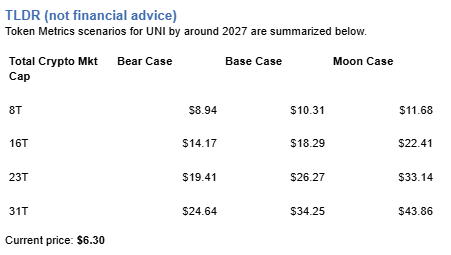
Token Metrics price prediction scenarios span four market cap tiers, each representing different levels of crypto market maturity and liquidity:

8T Market Cap Price Prediction:

At an 8 trillion dollar total crypto market cap, UNI price prediction projects to $8.94 in bear conditions, $10.31 in the base case, and $11.68 in bullish scenarios.

16T Market Cap Price Prediction:

Doubling the market to 16 trillion expands the price prediction range to $14.17 (bear), $18.29 (base), and $22.41 (moon).

23T Market Cap Price Prediction:

At 23 trillion, the price forecast scenarios show $19.41, $26.27, and $33.14 respectively.

31T Market Cap Price Prediction:

In the maximum liquidity scenario of 31 trillion, UNI price prediction could reach $24.64 (bear), $34.25 (base), or $43.86 (moon).

Each tier assumes progressively stronger market conditions, with the base case price prediction reflecting steady growth and the moon case requiring sustained bull market dynamics.

Why Consider the Indices with Top-100 Exposure

Uniswap represents one opportunity among hundreds in crypto markets. Token Metrics Indices bundle UNI with top one hundred assets for systematic exposure to the strongest projects. Single tokens face idiosyncratic risks that diversified baskets mitigate.

Historical index performance demonstrates the value of systematic diversification versus concentrated positions.

Join the early access list

What Is Uniswap?

Uniswap is a decentralized exchange protocol built on Ethereum that enables token swaps using automated market makers instead of order books. It aims to provide open access to liquidity for traders, developers, and applications through transparent smart contracts.

UNI is the governance token that lets holders vote on protocol upgrades and parameters, aligning incentives across the ecosystem. The protocol is a market leader in decentralized exchange activity with broad integration across wallets and DeFi apps.

Token Metrics AI Analysis for Price Prediction

Token Metrics AI provides comprehensive context on Uniswap's positioning and challenges that inform our price prediction models.

Vision: Uniswap aims to create a fully decentralized and permissionless financial market where anyone can trade or provide liquidity without relying on centralized intermediaries. Its vision emphasizes open access, censorship resistance, and community driven governance.

Problem: Traditional exchanges require trusted intermediaries to match buyers and sellers, creating barriers to access, custody risks, and potential for censorship. In DeFi, the lack of efficient, trustless mechanisms for token swaps limits interoperability and liquidity across applications.

Solution: Uniswap solves this by using smart contracts to create liquidity pools funded by users who earn trading fees in return. The protocol automatically prices assets using a constant product formula, enabling seamless swaps. UNI token holders can participate in governance, influencing parameters like fee structures and protocol upgrades.

Market Analysis: Uniswap operates within the broader DeFi and Ethereum ecosystems, competing with other decentralized exchanges like SushiSwap, Curve, and Balancer. It is a market leader in terms of cumulative trading volume and liquidity depth. Adoption is strengthened by strong developer activity, widespread integration across wallets and dApps, and a large user base.

Fundamental and Technology Snapshot from Token Metrics

Fundamental Grade: 79.88% (Community 77%, Tokenomics 100%, Exchange 100%, VC 66%, DeFi Scanner 62%).


Technology Grade: 86.88% (Activity 72%, Repository 72%, Collaboration 100%, Security N/A, DeFi Scanner 62%).

Catalysts That Skew Bullish for Price Prediction

  • Institutional and retail access expands with ETFs, listings, and integrations
  • Macro tailwinds from lower real rates and improving liquidity
  • Product or roadmap milestones such as upgrades, scaling, or partnerships
  • These factors could push UNI toward higher price prediction targets

Risks That Skew Bearish for Price Prediction

  • Macro risk off from tightening or liquidity shocks
  • Regulatory actions or infrastructure outages
  • Competitive displacement across DEXs or changes to validator and liquidity incentives
  • These factors could push UNI toward lower price prediction scenarios

FAQs: Uniswap Price Prediction

Will UNI hit $20 by 2027 according to price predictions?

The 16T price prediction scenario shows UNI at $18.29 in the base case, which does not exceed $20. However, the 23T base case shows $26.27, surpassing the $20 target. Price prediction outcome depends on total crypto market cap growth and Uniswap maintaining market share. Not financial advice.

Can UNI 10x from current levels based on price predictions?

At current price of $6.30, a 10x would reach $63.00. This falls within none of the listed price prediction scenarios, which top out at $43.86 in the 31T moon case. Bear in mind that 10x returns require substantial market cap expansion beyond our modeled scenarios. Not financial advice.

What price could UNI reach in the moon case price prediction?

Moon case price predictions range from $11.68 at 8T to $43.86 at 31T total crypto market cap. These price prediction scenarios assume maximum liquidity expansion and strong Uniswap adoption. Not financial advice.

What is the 2027 Uniswap price prediction?

Based on Token Metrics analysis, the 2027 price prediction for Uniswap centers around $13.50 in the base case under current market conditions, with a range between $6.50 and $28 depending on market scenarios. Bullish price predictions with strong market conditions range from $10.31 to $43.86 across different total crypto market cap environments.

What drives UNI price predictions?

UNI price predictions are driven by DEX trading volume, liquidity provider activity, governance participation, protocol fee revenue, and competition from other decentralized exchanges. The strong technology grade (86.88%) and bullish signal support upward price potential. DeFi adoption rates and regulatory clarity around decentralized exchanges remain primary drivers for reaching upper price prediction targets.

Can UNI reach $30-$40 by 2027?

According to our price prediction models, UNI could reach $30-$40 in the 23T moon case ($33.14) and in the 31T scenarios where the base case is $34.25 and the moon case is $43.86. These price prediction outcomes require significant crypto market expansion and Uniswap maintaining DEX market leadership. Not financial advice.


Next Steps

Disclosure

Educational purposes only, not financial advice. Crypto is volatile, do your own research and manage risk.

Why Use Token Metrics for Uniswap Research?

  • Get on-chain ratings, AI-powered scenario projections, backtested indices, and exclusive insights for Uniswap and other top-100 crypto assets.
  • Spot emerging trends before the crowd and manage risk with our transparent AI grades.
  • Token Metrics helps you save time, avoid hidden pitfalls, and discover data-driven opportunities in DeFi.
Choose from Platinum, Gold, and Silver packages
Reach with 25–30% open rates and 0.5–1% CTR
Craft your own custom ad—from banners to tailored copy
Perfect for Crypto Exchanges, SaaS Tools, DeFi, and AI Products