Research

RESTful API Essentials: Design, Security, and Best Practices

A practical guide to RESTful API design: learn core principles, security controls, performance optimization, testing workflows, and how AI-assisted tools can streamline API development and monitoring.
Token Metrics Team
5
MIN

APIs are the connective tissue of modern applications; among them, RESTful APIs remain a dominant style because they map cleanly to HTTP semantics and scale well across distributed systems. This article breaks down what a RESTful API is, pragmatic design patterns, security controls, and practical monitoring and testing workflows. If you build or consume APIs, understanding these fundamentals reduces integration friction and improves reliability.

What is a RESTful API?

A RESTful API (Representational State Transfer) is an architectural style for designing networked applications. At its core, REST leverages standard HTTP verbs (GET, POST, PUT, PATCH, DELETE) and status codes to perform operations on uniquely identified resources, typically represented as URLs. Key characteristics include:

  • Statelessness: Each request contains all information the server needs to fulfill it, enabling horizontal scaling.
  • Resource orientation: APIs expose resources (users, orders, blocks, etc.) rather than remote procedure calls.
  • Uniform interface: A consistent set of conventions for requests and responses, improving discoverability and client simplicity.

REST is a pragmatic guideline rather than a strict protocol; many APIs labeled "RESTful" adopt REST principles while introducing pragmatic extensions (e.g., custom headers, versioning strategies).

Design Principles & Resource Modeling

Good REST design begins with clear resource modeling. Ask: what are the nouns in the domain, and how do they relate? Use predictable URL structures and rely on HTTP semantics:

  • /resources - list or create a resource (GET to list, POST to create)
  • /resources/{id} - operate on a single resource (GET, PUT/PATCH, DELETE)
  • /resources/{id}/subresources - nested relationships when needed

Design tips to improve usability and longevity:

  1. Use consistent naming: plural nouns, lowercase, and hyphenation for readability.
  2. Support versioning: include a version in the URL or headers to avoid breaking clients (e.g., /v1/...).
  3. Leverage hypermedia judiciously: HATEOAS can improve discoverability but adds complexity; choose when it benefits clients.
  4. Pagination, filtering, sorting: standardize query parameters for large collections to avoid performance pitfalls.
  5. Use appropriate status codes: communicate success, client errors, and server errors clearly (200, 201, 400, 401, 403, 404, 429, 500, etc.).

Security, Authentication, and Rate Limiting

Security is a primary concern for any public-facing API. Typical controls and patterns include:

  • Authentication: OAuth 2.0 (Bearer tokens) and API keys are common. Choose a mechanism that fits your risk model and client types. Avoid transporting credentials in URLs.
  • Authorization: Implement least-privilege checks server-side to ensure tokens only permit intended actions.
  • Encryption: Always use TLS (HTTPS) to protect data in transit; consider TLS 1.2+ and strict ciphers.
  • Rate limiting and throttling: Protect backends from abuse with per-key or per-IP limits and provide informative 429 responses with Retry-After headers.
  • Input validation and sanitization: Validate request bodies and query parameters to reduce injection and parsing vulnerabilities.
  • Audit and logging: Log authentication events, rate-limit triggers, and error patterns while respecting privacy and compliance requirements.

Designing for security also means operational readiness: automated certificate rotation, secrets management, and periodic security reviews reduce long-term risk.

Performance, Monitoring, and AI-Assisted Tooling

Performance tuning for RESTful APIs covers latency, throughput, and reliability. Practical strategies include caching (HTTP Cache-Control, ETags), connection pooling, and database query optimization. Use observability tools to collect metrics (error rates, latency percentiles), distributed traces, and structured logs for rapid diagnosis.

AI-assisted tools can accelerate many aspects of API development and operations: anomaly detection in request patterns, automated schema inference from traffic, and intelligent suggestions for endpoint design or documentation. While these tools improve efficiency, validate automated changes through testing and staged rollouts.

When selecting tooling, evaluate clarity of integrations, support for your API architecture, and the ability to export raw telemetry for custom analysis.

Build Smarter Crypto Apps & AI Agents with Token Metrics

Token Metrics provides real-time prices, trading signals, and on-chain insights all from one powerful API. Grab a Free API Key

What distinguishes RESTful APIs from other API styles?

REST focuses on resources and uses HTTP semantics; GraphQL centralizes queries into a single endpoint with flexible queries, and gRPC emphasizes high-performance RPCs with binary protocols. Choose based on client needs, performance constraints, and schema evolution requirements.

How should I version a RESTful API without breaking clients?

Common approaches include URL versioning (e.g., /v1/), header-based versioning, or semantic versioning of the API contract. Regardless of method, document deprecation timelines and provide migration guides and compatibility layers where possible.

What are practical testing strategies for RESTful APIs?

Combine unit tests for business logic with integration tests that exercise endpoints and mocks for external dependencies. Use contract tests to ensure backward compatibility and end-to-end tests in staging environments. Automate tests in CI/CD to catch regressions early.

How do I design for backward compatibility?

Additive changes (new fields, endpoints) are generally safe; avoid removing fields, changing response formats, or repurposing status codes. Feature flags and content negotiation can help introduce changes progressively.

What should be included in API documentation?

Provide clear endpoint descriptions, request/response examples, authentication steps, error codes, rate limits, and code samples in multiple languages. Machine-readable specs (OpenAPI/Swagger) enable client generation and testing automation.

Disclaimer: This content is educational and informational only. It does not constitute professional, legal, security, or investment advice. Test and validate any architectural, security, or operational changes in environments that match your production constraints before rollout.

Build Smarter Crypto Apps &
AI Agents in Minutes, Not Months
Real-time prices, trading signals, and on-chain insights all from one powerful API.
Grab a Free API Key
Token Metrics Team
Token Metrics Team

Recent Posts

Research

Understanding How Crypto APIs Power Digital Asset Platforms

Token Metrics Team
5
MIN

In today's digital asset ecosystem, Application Programming Interfaces, or APIs, are the unsung heroes enabling everything from cryptocurrency wallets to trading bots. Whether you're a developer building for Web3 or a curious user interested in how your exchange functions, understanding how crypto APIs work is essential

    What Is a Crypto API?

    A crypto API is a set of programming instructions and standards that allow software applications to communicate with cryptocurrency services. These services may include wallet functions, price feeds, trading engines, exchange platforms, and blockchain networks. By using a crypto API, developers can automate access to real-time market data or execute trades on behalf of users without manually interacting with each platform.

    For instance, the Token Metrics API provides structured access to cryptocurrency ratings, analytics, and other data to help teams build intelligent applications.

    Types of Crypto APIs

    There are several categories of APIs in the cryptocurrency landscape, each with different capabilities and use cases:


    How Crypto APIs Work

    At their core, crypto APIs operate over internet protocols—typically HTTPS—and return data in JSON or XML formats. When an application makes a request to an API endpoint (a specific URL), the server processes the request, fetches the corresponding data or action, and sends a response back.

    For example, a crypto wallet app might call an API endpoint like /v1/account/balance to check a user’s holdings. To ensure security and authorization, many APIs require API keys or OAuth tokens for access. Rate limits are also enforced to prevent server overload.

    Behind the scenes, these APIs interface with various backend systems—blockchains, trading engines, or databases—to fulfill each request in real time or near real time.

    Common Use Cases for Crypto APIs

    Crypto APIs are used across a broad spectrum of applications:


    Benefits of Using Crypto APIs


    APIs dramatically reduce time-to-market for developers while enhancing user experience and application efficiency.

    Key Considerations for API Integration

    When integrating a crypto API, consider the following factors:


    Platforms like the Token Metrics API provide both comprehensive documentation and reliability for developers building AI-powered solutions in crypto.

    AI-Powered Analytics and APIs

    Some of the most powerful crypto APIs now incorporate artificial intelligence and machine learning features. For example, the Token Metrics API facilitates access to predictive models, coin grades, and AI-based price forecasts.

    By embedding these tools into custom apps, users can programmatically tap into advanced analytics, helping refine research workflows and support technical or fundamental analysis. Although these outputs can guide decisions, they should be viewed in a broader context instead of relying exclusively on model predictions.

    Conclusion

    Crypto APIs are critical infrastructure for the entire digital asset industry. From data retrieval and trading automation to blockchain integration and AI-driven analytics, these tools offer immense utility for developers, analysts, and businesses alike. Platforms such as Token Metrics provide not only in-depth crypto research but also API access to empower intelligent applications built on real-time market insights. By understanding how crypto APIs work, users and developers can better navigate the rapidly evolving Web3 landscape.

    Disclaimer

    This article is for informational and educational purposes only. It does not constitute financial, investment, or technical advice. Always conduct your own research and consult professional advisors before making any decisions.

    Announcements

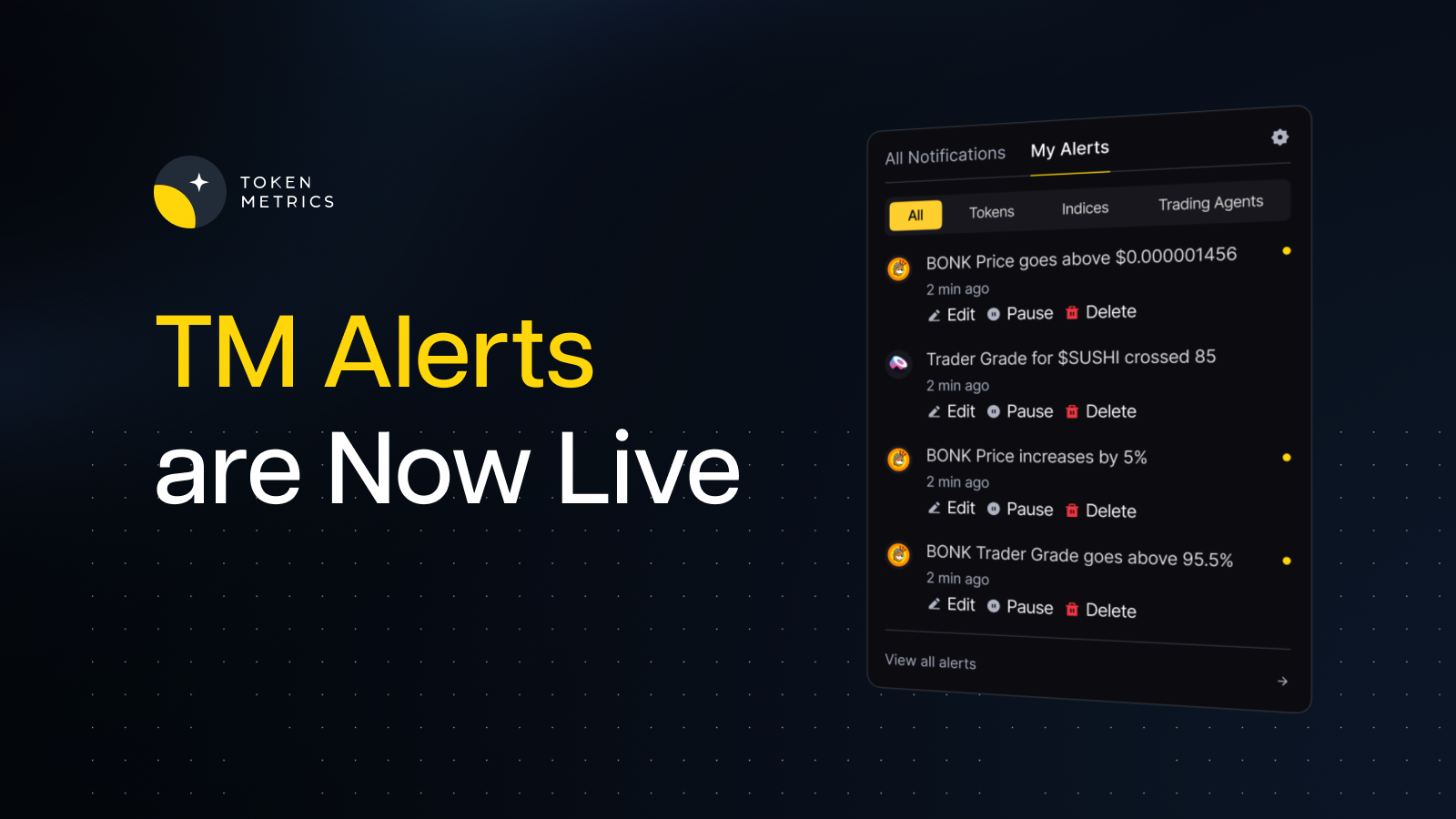
    The End of FOMO: How Token Metrics Alerts Revolutionizes Crypto Trading

    Token Metrics Team
    5 min
    MIN

    The cryptocurrency market operates on a simple, unforgiving principle: timing is everything. While traditional markets sleep, crypto never does. A single tweet, a regulatory announcement, or an AI signal flip can trigger massive price movements within minutes. For most traders, this creates an impossible dilemma – how do you capture every opportunity without becoming a prisoner to your screen?

    Today, we're solving that problem forever.

    The Alert Revolution is Here

    Token Metrics Alerts represents the culmination of years of development and trader feedback. We've built the most sophisticated crypto alert system ever created, designed specifically for the unique challenges of cryptocurrency trading. This isn't just another notification tool – it's your personal market intelligence system.

    The core philosophy behind Token Metrics Alerts is simple: empower traders with precise, actionable information delivered exactly when and how they need it. No more, no less.

    AI-Powered Market Intelligence

    At the heart of our alert system lies advanced artificial intelligence that continuously analyzes market conditions, price patterns, and trading signals across thousands of cryptocurrencies. When our AI algorithms detect a significant shift – whether bullish or bearish – you're notified instantly.

    This AI-driven approach transforms how you interact with market data. Instead of interpreting charts and signals manually, you receive clear, actionable alerts based on sophisticated analysis that would take hours to perform yourself. The AI doesn't sleep, doesn't get emotional, and doesn't miss patterns that human eyes might overlook.

    Our AI monitoring includes sentiment analysis, technical pattern recognition, volume analysis, and correlation tracking across multiple timeframes. When these systems converge on a significant signal, that's when you get alerted. It's like having a team of expert analysts working around the clock, exclusively for you.

    Precision Customization for Every Trading Style

    Token Metrics Alerts recognizes that no two traders are identical. Day traders need different information than long-term holders. Swing traders have different requirements than scalpers. That's why we've built unprecedented customization into every aspect of the alert system.

    You can set price movement alerts for any percentage change, whether you want to know about 5% moves or 50% pumps. Custom triggers allow you to monitor specific price levels, support and resistance breaks, or volume spikes. The system adapts to your trading strategy, not the other way around.

    Multi-Channel Delivery That Actually Works

    The best alert in the world is useless if you don't receive it. Token Metrics Alerts delivers notifications through five distinct channels, each optimized for different scenarios and preferences.

    Email alerts provide detailed information perfect for analysis and record-keeping. Telegram integration offers lightning-fast mobile notifications that cut through the noise of other apps. Slack integration brings trading alerts directly into your workspace, maintaining focus during trading sessions. Discord connectivity allows seamless integration with trading communities and group strategies.

    This multi-channel approach means you can configure different types of alerts for different delivery methods. Perhaps you want AI signal changes sent via Telegram for immediate action, while price level alerts go to email for later analysis. The system accommodates any configuration that suits your workflow.

    The Psychology of Successful Trading

    Successful trading isn't just about having good information – it's about having the right information at the right time without the psychological burden of constant monitoring. Token Metrics Alerts addresses the mental and emotional aspects of trading that often determine success or failure.

    By removing the need for constant chart watching, alerts eliminate the anxiety and decision fatigue that plague many traders. You can set your parameters, trust the system, and focus on analysis and execution rather than monitoring. This psychological shift often leads to better decision-making and reduced emotional trading.

    The fear of missing out (FOMO) drives many poor trading decisions. When you know your alert system is monitoring everything important, FOMO naturally diminishes. You can wait for your signals with confidence, knowing that when something significant happens, you'll be among the first to know.

    Real-World Applications and Success Stories

    The practical applications of Token Metrics Alerts extend across every trading style and market condition. Day traders use the system to catch intraday breakouts and momentum shifts without staring at screens all day. Swing traders monitor key levels and trend changes while maintaining their regular schedules. Long-term investors track major developments in their holdings without daily price obsession.

    During volatile market periods, the alert system becomes even more valuable. Flash crashes, sudden pumps, and rapid reversals are captured and communicated instantly. This real-time intelligence often means the difference between capitalizing on volatility and becoming its victim.

    Professional traders and fund managers have integrated Token Metrics Alerts into their systematic approaches, using the consistent signal delivery to maintain discipline and reduce emotional decision-making. The system's reliability has become a cornerstone of many successful trading operations.

    The Future of Informed Trading

    Token Metrics Alerts represents more than just a new product – it embodies a fundamental shift toward intelligent, automated market monitoring. As cryptocurrency markets mature and become more complex, the tools we use to navigate them must evolve accordingly.

    The launch of Token Metrics Alerts marks the beginning of a new era where traders can maintain comprehensive market awareness without sacrificing their time, sleep, or sanity. It's technology serving the trader, not the other way around.

    The question isn't whether you can afford to use Token Metrics Alerts – it's whether you can afford not to. In a market where information and timing determine success, having a sophisticated alert system isn't a luxury; it's a necessity.

    Your trading edge awaits. The market never stops moving, but now, neither do your opportunities to capture its movements.

    Research

    Understanding How APIs Work: A Comprehensive Guide

    Token Metrics Team
    4
    MIN

    Introduction to APIs

    APIs, or Application Programming Interfaces, serve as essential tools in modern software development by allowing different applications to communicate and work together efficiently. Understanding how APIs work is fundamental for developers, businesses, and enthusiasts exploring technology or crypto environments where APIs facilitate seamless data exchange and integration.

    What Is an API?

    An API is essentially a set of rules and protocols that enables different software applications to interact. It defines the methods and data formats that programs can use to request and exchange information. Through these interfaces, complex software systems can communicate without having to know the internal workings of each other, promoting modularity and efficiency.

    How APIs Function

    APIs operate as intermediaries between client requests and server responses. When a user interacts with an application, the underlying API sends structured requests to a server which processes these requests and sends back the appropriate data or service. This process involves:

    • Endpoints: Specific API URLs where requests are sent.
    • Requests: Calls made using methods like GET, POST, PUT, DELETE following defined parameters.
    • Responses: Data returned from the server, often in formats such as JSON or XML.

    This exchange allows integration across services, such as connecting a mobile app to a database or enabling a crypto trading platform to access market data.

    API Types and Protocols

    APIs are implemented using diverse standards and protocols depending on their purpose:

    • REST (Representational State Transfer): Uses standard HTTP methods and is widely used for web APIs due to its simplicity.
    • SOAP (Simple Object Access Protocol): A protocol with stricter standards and built-in security features, often used in enterprise contexts.
    • GraphQL: A query language for APIs that allows clients to request precisely the data needed.
    • WebSocket APIs: For real-time two-way communication, commonly used in live data streaming.

    Understanding these protocols helps in selecting or designing the appropriate API solution for specific use cases.

    APIs in Crypto and AI Research

    In the cryptocurrency domain, APIs facilitate access to market data, trading functionalities, and analytics. Crypto APIs, including the Token Metrics API, provide developers and analysts with programmatic access to detailed metrics, historical data, and real-time updates.

    Furthermore, AI-driven tools leverage APIs to gather and analyze vast datasets efficiently. Token Metrics, for example, integrates AI to enhance crypto research and analytics. Accessing this data programmatically via the Token Metrics API allows for automated strategies and custom insights without manual intervention.

    How to Use APIs Effectively

    To maximize the benefits of APIs, consider the following best practices:

    1. Documentation Review: Ensure the API is well-documented, explaining endpoints, parameters, and response formats clearly.
    2. Authentication and Security: Many APIs require secure authentication methods such as tokens or keys. Safeguarding these credentials is crucial.
    3. Rate Limits Awareness: Understand limitations on request frequency to prevent service interruptions.
    4. Error Handling: Design applications to gracefully manage errors and unexpected responses.
    5. Testing and Sandbox Environments: Use available testing tools or sandbox APIs before deploying into production.

    For example, the best crypto API solutions often provide sandbox environments to allow safe experimentation with live-like data.

    API Integration in Crypto Trading Platforms

    Crypto trading platforms utilize APIs to enable seamless order placements, market monitoring, and account management. Integrating APIs allows platforms to connect with external services or enable bots and third-party tools to interact with user accounts securely.

    When exploring a crypto trading platform, understanding the underlying API capabilities helps users and developers gauge integration potential and automation possibilities.

    The API ecosystem continues evolving with trends such as:

    • Increased Use of AI: Automating API generation and data analytics.
    • Microservices Architecture: APIs underpin microservices to create scalable, maintainable applications.
    • API Marketplaces and Monetization: Increasing availability of APIs as paid services.
    • Improved Security Protocols: Enhanced authentication and encryption standards to protect data.

    Monitoring developments through platforms like Token Metrics can keep users informed about innovations impacting crypto and tech sectors.

    Conclusion

    APIs are foundational in today's interconnected digital landscape, enabling diverse applications to communicate and unlock new functionalities efficiently. Recognizing how APIs work empowers users and developers to harness technology effectively across industries, particularly within crypto and AI-driven research contexts.

    Utilizing APIs such as the Token Metrics API provides structured access to valuable data and analytics, fostering innovation and informed analysis.

    Disclaimer

    This content is for educational purposes only and does not constitute financial or investment advice. Readers should conduct their own research and consult professionals as needed.

    Choose from Platinum, Gold, and Silver packages
    Reach with 25–30% open rates and 0.5–1% CTR
    Craft your own custom ad—from banners to tailored copy
    Perfect for Crypto Exchanges, SaaS Tools, DeFi, and AI Products