Back to blog
Research

Ripple (XRP) Price Prediction 2025: Will XRP Hit $500 This Bull Cycle?

XRP surges past $2.50 after Ripple’s SEC win and ETF momentum. Explore XRP price predictions for 2025 and how Token Metrics AI tools help forecast breakouts and manage risk.
Token Metrics Team
8 min
Want Smarter Crypto Picks—Free?
See unbiased Token Metrics Ratings for BTC, ETH, and top alts.
Thank you! Your submission has been received!
Oops! Something went wrong while submitting the form.
 No credit card | 1-click unsubscribe

BUY XRP FROM MEXC!

Ripple’s native token, XRP, is experiencing renewed momentum in 2025, surging to $2.58 and breaking the long-standing $2.50 resistance level. This price movement coincides with Bitcoin's rally past $112,000, signaling that XRP is riding the current bull market wave.

But what’s driving this surge in XRP? Is it sustainable? And could we see XRP hit $5, $7—or even $10—before the end of 2025?

In this highly informative and SEO-optimized blog post, we analyze the factors behind XRP’s rise, evaluate its future potential, and explain why Token Metrics’ AI-powered price prediction tools offer unmatched insights for crypto investors.

🚀 XRP’s Bullish Breakout: A New Chapter in 2025

In July 2025, XRP’s breakout above $2.50 marks one of its strongest price performances since the 2017 bull run. Key drivers behind this bullish trend include:

✅ 1. Ripple’s Legal Victory Against the SEC

Ripple finalized its years-long lawsuit with the U.S. Securities and Exchange Commission (SEC) by paying a $50 million settlement—without admitting XRP is a security. This outcome:

  • Removes a major legal overhang
  • Boosts investor and institutional confidence
  • Clears the path for U.S. regulatory clarity

With the lawsuit resolved, XRP is now eligible for listings, ETF consideration, and greater adoption in regulated financial environments.

✅ 2. Launch of RLUSD Stablecoin

Ripple has successfully launched RLUSD, its native stablecoin backed 1:1 by U.S. dollars. RLUSD provides:

  • Liquidity for XRP-based DeFi
  • Seamless on/off ramps for cross-border payments
  • Utility for RippleNet’s institutional clients

This ecosystem expansion strengthens Ripple’s value proposition and increases XRP utility and demand.

✅ 3. Potential Approval of XRP ETFs

With Ethereum and Bitcoin ETFs already active, XRP is next in line. Analysts estimate:

  • A 90%+ likelihood of XRP ETF approval before 2026
  • Significant inflows from institutional investors upon approval

ETF listings would make XRP easily accessible in retirement accounts, financial advisors’ portfolios, and wealth management platforms—further legitimizing the asset.

✅ 4. Expanding Global Financial Partnerships

Ripple now boasts partnerships with 300+ financial institutions, including:

  • Santander
  • Standard Chartered
  • SBI Holdings
  • Integration with Wormhole for cross-chain liquidity

This positions XRP as a global standard for cross-border payments—a market worth $150+ trillion annually.

📈 XRP Price Prediction for 2025

Analysts and AI models predict a strong upside potential for XRP during this bull cycle. Here's a breakdown of possible scenarios:

Breakout Level to Watch: $3.40
Support Level: $2.10

⚠️ Risks and Challenges Ahead

Despite the bullish momentum, XRP still faces several risks:

❌ 1. Regulatory Ambiguity Outside the U.S.

Although the SEC case is resolved, Ripple faces:

  • Different classifications of XRP in Europe and Asia
  • New compliance standards (e.g., MiCA)
  • Potential resistance from central banks promoting CBDCs

❌ 2. Stablecoin Competition

RLUSD must compete with:

  • USDT and USDC (dominant players)
  • CBDCs and national digital currencies
  • Traditional payment rails like SWIFT GPI

Failure to achieve rapid RLUSD adoption could cap XRP's growth potential.

❌ 3. Market Volatility and Profit-Taking

After explosive gains, whales may lock in profits, causing sharp pullbacks. Key support at $2.10 must hold to maintain bullish structure.

🧠 Why Token Metrics Has the Best XRP Price Prediction Tools

In a fast-moving market, investors need real-time, data-driven predictions—not guesswork. Token Metrics offers the most advanced tools for XRP investors.

✅ 1. AI-Powered Price Forecasts

Token Metrics uses machine learning models trained on years of crypto market data to generate high-accuracy price forecasts.

For XRP, these models consider:

  • Whale wallet accumulation
  • Cross-border transaction volume
  • Stablecoin liquidity metrics
  • Token velocity and exchange flows

The result? A forward-looking price forecast you can trust.

✅ 2. XRP Buy/Sell Signals

The Token Metrics platform issues real-time bullish or bearish signals based on:

  • Technical indicators (MACD, RSI)
  • Exchange net flow
  • Trend strength
  • Historical reversal patterns

These signals help you:

  • Enter at optimal times
  • Avoid fake breakouts
  • Time your profit-taking during rallies

✅ 3. Trader and Investor Grades
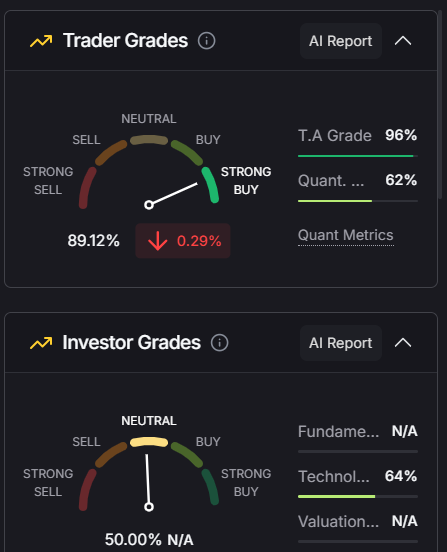
Token Metrics assigns every token—including XRP—a:

  • Trader Grade (short-term trend strength)
  • Investor Grade (long-term fundamental health)

Both are AI-calculated using 80+ metrics, and they update daily. This helps you:

  • Decide whether to swing trade or HODL XRP
  • Compare XRP with other cross-border payment tokens

✅ 4. Custom Alerts and Analysis

With Token Metrics, you can set personalized alerts for XRP:

  • Price thresholds (e.g., alert me if XRP hits $3.40)
  • Percent change triggers (e.g., alert me on +15% move)
  • Grade changes (e.g., notify me if Trader Grade goes above 80)

Alerts are delivered via email, Slack, Telegram, or Discord—so you never miss a key movement.

✅ 5. Detailed Token Page for XRP

The XRP profile page on Token Metrics provides:

  • Live price chart and ROI
  • Real-time exchange volume
  • Whale wallet movements
  • Historical signal success rates

Everything you need for informed XRP investing in one place.

📊 XRP vs. Other Altcoins in 2025

While many altcoins are chasing narratives (AI, memecoins, DePIN), XRP’s case is fundamentally driven by:

  • Regulatory clarity
  • Real-world adoption
  • Enterprise integrations

Token Metrics’ crypto indices help investors diversify by creating thematic portfolios (e.g., “Institutional Adoption,” “Layer-1 Networks,” “Cross-Border Payments”)—with XRP often at the top of the cross-border category.

📉 What If XRP Corrects?

Corrections are part of every bull market. If XRP fails to hold above $2.50:

  • A retracement to $2.10 is likely
  • A break below $2.10 could lead to a retest of $1.80
  • Traders should watch BTC’s movement closely—if Bitcoin reverses sharply, XRP could follow

Use Token Metrics’ bearish signal alerts to de-risk in real time.

✅ Final Thoughts: XRP Is One to Watch in 2025

With legal clarity, a new stablecoin, ETF approval potential, and over 300 institutional partnerships, Ripple and XRP are in their strongest position in years.

If Bitcoin continues its uptrend and XRP breaks above $3.40, the next major rally could take it to $5–$10 by the end of 2025.

But success depends on regulatory support, stablecoin adoption, and institutional inflows—all factors Token Metrics tracks daily with precision.

🔍 Take Action: Use Token Metrics to Trade XRP Smarter

  • Track XRP’s real-time price predictions
  • Monitor short- and long-term signal strength
  • Set alerts for breakouts or corrections
  • Analyze fundamentals and on-chain data

👉 Start now at tokenmetrics.com and gain an edge in XRP trading and investing

Build Smarter Crypto Apps &
AI Agents in Minutes, Not Months
Real-time prices, trading signals, and on-chain insights all from one powerful API.
Grab a Free API Key
About Token Metrics
Token Metrics: AI-powered crypto research and ratings platform. We help investors make smarter decisions with unbiased Token Metrics Ratings, on-chain analytics, and editor-curated “Top 10” guides. Our platform distills thousands of data points into clear scores, trends, and alerts you can act on.
30 Employees
analysts, data scientists, and crypto engineers
Daily Briefings
concise market insights and “Top Picks”
Transparent & Compliant
Sponsored ≠ Ratings; research remains independent
Want Smarter Crypto Picks—Free?
See unbiased Token Metrics Ratings for BTC, ETH, and top alts.
Thank you! Your submission has been received!
Oops! Something went wrong while submitting the form.
 No credit card | 1-click unsubscribe
Token Metrics Team
Token Metrics Team

Recent Posts

Research

Quantmetrics API: Measure Risk & Reward in One Call

Token Metrics Team
5

Most traders see price—quants see probabilities. The Quantmetrics API turns raw performance into risk-adjusted stats like Sharpe, Sortino, volatility, drawdown, and CAGR so you can compare tokens objectively and build smarter bots and dashboards. In minutes, you’ll query /v2/quantmetrics, render a clear performance snapshot, and ship a feature that customers trust. Start by grabbing your key at Get API Key, Run Hello-TM to verify your first call, then Clone a Template to go live fast.

What You’ll Build in 2 Minutes

  • A minimal script that fetches Quantmetrics for a token via /v2/quantmetrics (e.g., BTC, ETH, SOL).
  • A smoke-test curl you can paste into your terminal.
  • A UI pattern that displays Sharpe, Sortino, volatility, max drawdown, CAGR, and lookback window.

Next Endpoints to Add

  • /v2/tm-grade (one-score signal)
  • /v2/trading-signals
  • /v2/hourly-trading-signals (timing)
  • /v2/resistance-support (risk placement)
  • /v2/price-prediction (scenario planning)

Why This Matters

Risk-adjusted truth beats hype. Price alone hides tail risk and whipsaws. Quantmetrics compresses edge, risk, and consistency into metrics that travel across assets and timeframes—so you can rank universes, size positions, and communicate performance like a professional.

Built for dev speed

A clean REST schema, predictable latency, and easy auth mean you can plug Sharpe/Sortino into bots, dashboards, and screeners without maintaining your own analytics pipeline. Pair with caching and batching to serve fast pages at scale.

Where to Find

The Quant Metrics cURL request is located in the top right of the API Reference, allowing you to easily integrate it with your application.

Build Smarter Crypto Apps & AI Agents with Token Metrics

Token Metrics provides real-time prices, trading signals, and on-chain insights all from one powerful API. Grab a Free API Key

How It Works (Under the Hood)

Quantmetrics computes risk-adjusted performance over a chosen lookback (e.g., 30d, 90d, 1y). You’ll receive a JSON snapshot with core statistics:

  • Sharpe ratio: excess return per unit of total volatility.
  • Sortino ratio: penalizes downside volatility more than upside.
  • Volatility: standard deviation of returns over the window.
  • Max drawdown: worst peak-to-trough decline.
  • CAGR / performance snapshot: geometric growth rate and best/worst periods.

Call /v2/quantmetrics?symbol=<ASSET>&window=<LOOKBACK> to fetch the current snapshot. For dashboards spanning many tokens, batch symbols and apply short-TTL caching. If you generate alerts (e.g., “Sharpe crossed 1.5”), run a scheduled job and queue notifications to avoid bursty polling.

Production Checklist

  • Rate limits: Understand your tier caps; add client-side throttling and queues.
  • Retries & backoff: Exponential backoff with jitter; treat 429/5xx as transient.
  • Idempotency: Prevent duplicate downstream actions on retried jobs.
  • Caching: Memory/Redis/KV with short TTLs; pre-warm popular symbols and windows.
  • Batching: Fetch multiple symbols per cycle; parallelize carefully within limits.
  • Error catalog: Map 4xx/5xx to clear remediation; log request IDs for tracing.
  • Observability: Track p95/p99 latency and error rates; alert on drift.
  • Security: Store API keys in secrets managers; rotate regularly.

Use Cases & Patterns

  • Bot Builder (Headless): Gate entries by Sharpe ≥ threshold and drawdown ≤ limit, then trigger with /v2/trading-signals; size by inverse volatility.
  • Dashboard Builder (Product): Add a Quantmetrics panel to token pages; allow switching lookbacks (30d/90d/1y) and export CSV.
  • Screener Maker (Lightweight Tools): Top-N by Sortino with filters for volatility and sector; add alert toggles when thresholds cross.
  • Allocator/PM Tools: Blend CAGR, Sharpe, drawdown into a composite score to rank reallocations; show methodology for trust.
  • Research/Reporting: Weekly digest of tokens with Sharpe ↑, drawdown ↓, and volatility ↓.

Next Steps

  • Get API Key — start free and generate a key in seconds.
  • Run Hello-TM — verify your first successful call.
  • Clone a Template — deploy a screener or dashboard today.
  • Watch the demo: VIDEO_URL_HERE
  • Compare plans: Scale with API plans.

FAQs

1) What does the Quantmetrics API return?

A JSON snapshot of risk-adjusted metrics (e.g., Sharpe, Sortino, volatility, max drawdown, CAGR) for a symbol and lookback window—ideal for ranking, sizing, and dashboards.

2) How fresh are the stats? What about latency/SLOs?

Responses are engineered for predictable latency. For heavy UI usage, add short-TTL caching and batch requests; for alerts, use scheduled jobs or webhooks where available.

3) Can I use Quantmetrics to size positions in a live bot?

Yes—many quants size inversely to volatility or require Sharpe ≥ X to trade. Always backtest and paper-trade before going live; past results are illustrative, not guarantees.

4) Which lookback window should I choose?

Short windows (30–90d) adapt faster but are noisier; longer windows (6–12m) are steadier but slower to react. Offer users a toggle and cache each window.

5) Do you provide SDKs or examples?

REST is straightforward (JS/Python above). Docs include quickstarts, Postman collections, and templates—start with Run Hello-TM.

6) Polling vs webhooks for quant alerts?

Dashboards usually use cached polling. For threshold alerts (e.g., Sharpe crosses 1.0), run scheduled jobs and queue notifications to keep usage smooth and idempotent.

7) Pricing, limits, and enterprise SLAs?

Begin free and scale up. See API plans for rate limits and enterprise SLA options.

Disclaimer

All information provided in this blog is for educational purposes only. It is not intended as financial advice. Users should perform their own research and consult with licensed professionals before making any investment or trading decisions.

Research

Crypto Trading Signals API: Put Bullish/Bearish Calls Right in Your App

Token Metrics Team
4

Timing makes or breaks every trade. The crypto trading signals API from Token Metrics lets you surface bullish and bearish calls directly in your product—no spreadsheet wrangling, no chart gymnastics. In this guide, you’ll hit the /v2/trading-signals endpoint, display actionable signals on a token (e.g., SOL, BTC, ETH), and ship a conversion-ready feature for bots, dashboards, or Discord. Start by creating a key on Get API Key, then Run Hello-TM and Clone a Template to go live fast.

What You’ll Build in 2 Minutes

  • A minimal script that fetches Trading Signals via /v2/trading-signals for one symbol (e.g., SOL).
  • A copy-paste curl to smoke-test your key.
  • A UI pattern to render signal, confidence/score, and timestamp in your dashboard or bot.

Endpoints to add next

  • /v2/hourly-trading-signals (intraday updates)
  • /v2/resistance-support (risk placement)
  • /v2/tm-grade (one-score view)
  • /v2/quantmetrics (risk/return context)

Why This Matters

Action over analysis paralysis. Traders don’t need more lines on a chart—they need an opinionated call they can automate. The trading signals API compresses technical momentum and regime reads into Bullish/Bearish events you can rank, alert on, and route into strategies.

Built for dev speed and reliability. A clean schema, predictable performance, and straightforward auth make it easy to wire signals into bots, dashboards, and community tools. Pair with short-TTL caching or webhooks to minimize polling and keep latency low.

Where to Find

You can find the cURL request for Crypto Trading Signals in the top right corner of the API Reference. Use it to access the latest signals!

Live Demo & Templates

  • Trading Bot Starter: Use Bullish/Bearish calls to trigger paper trades; add take-profit/stop rules with Support/Resistance.
  • Dashboard Signal Panel: Show the latest call, confidence, and last-updated time; add a history table for context.
  • Discord/Telegram Alerts: Post signal changes to a channel with a link back to your app.

How It Works (Under the Hood)

Trading Signals distill model evidence (e.g., momentum regimes and pattern detections) into Bullish or Bearish calls with metadata such as confidence/score and timestamp. You request /v2/trading-signals?symbol=<ASSET> and render the most recent event, or a small history, in your UI.

For intraday workflows, use /v2/hourly-trading-signals to update positions or alerts more frequently. Dashboards typically use short-TTL caching or batched fetches; headless bots lean on webhooks, queues, or short polling with backoff to avoid spiky API usage.

Production Checklist

  • Rate limits: Know your tier caps; add client-side throttling and queues.
  • Retries/backoff: Exponential backoff with jitter; treat 429/5xx as transient.
  • Idempotency: Guard downstream actions (don’t double-trade on retries).
  • Caching: Memory/Redis/KV with short TTLs for reads; pre-warm popular symbols.
  • Webhooks & jobs: Prefer webhooks or scheduled workers for signal change alerts.
  • Pagination/Bulk: Batch symbols; parallelize with care; respect limits.
  • Error catalog: Map common 4xx/5xx to clear fixes; log request IDs.
  • Observability: Track p95/p99 latency, error rate, and alert delivery success.
  • Security: Keep keys in a secrets manager; rotate regularly.

Use Cases & Patterns

  • Bot Builder (Headless): Route Bullish into candidate entries; confirm with /v2/resistance-support for risk and TM Grade for quality.
  • Dashboard Builder (Product): Add a “Signals” module per token; color-code state and show history for credibility.
  • Screener Maker (Lightweight Tools): Filter lists by Bullish state; sort by confidence/score; add alert toggles.
  • Community/Discord: Post signal changes with links to token pages; throttle to avoid noise.
  • Allocator/PM Tools: Track signal hit rates by sector/timeframe to inform position sizing (paper-trade first).

Next Steps

  1. Get API Key — create a key and start free.
  2. Run Hello-TM — confirm your first successful call.
  3. Clone a Template — deploy a bot, dashboard, or alerting tool today.

FAQs

1) What does the Trading Signals API return?

A JSON payload with the latest Bullish/Bearish call for a symbol, typically including a confidence/score and generated_at timestamp. You can render the latest call or a recent history for context.

2) Is it real-time? What about latency/SLOs?

Signals are designed for timely, programmatic use with predictable latency. For faster cycles, use /v2/hourly-trading-signals. Add caching and queues/webhooks to reduce round-trips.

3) Can I use the signals in a live trading bot?

Yes—many developers do. A common pattern is: Signals → candidate entry, Support/Resistance → stop/targets, Quantmetrics → risk sizing. Always backtest and paper-trade before going live.

4) How accurate are the signals?

Backtests are illustrative, not guarantees. Treat signals as one input in a broader framework with risk controls. Evaluate hit rates and drawdowns on your universe/timeframe.

5) Do you provide SDKs and examples?

You can integrate via REST using JavaScript and Python snippets above. The docs include quickstarts, Postman collections, and templates—start with Run Hello-TM.

6) Polling vs webhooks for alerts?

Dashboards often use cached polling. For bots/alerts, prefer webhooks or scheduled jobs and keep retries idempotent to avoid duplicate trades or messages.

7) Pricing, limits, and enterprise SLAs?

Begin free and scale as you grow. See API plans for allowances; enterprise SLAs and support are available.

Research

Fundamental Grade Crypto API: Real Crypto Fundamentals in One Score

Token Metrics Team
5 min read

Most traders chase price action; Fundamental Grade Crypto API helps you see the business behind the token—community traction, tokenomics design, exchange presence, VC signals, and DeFi health—consolidated into one score you can query in code. In a few minutes, you’ll fetch Fundamental Grade, render it in your product, and ship a due-diligence UX that drives trust. Start by grabbing your key at the Get API Key page, Run Hello-TM to verify your first call, then Clone a Template to go live fast.

What You’ll Build in 2 Minutes

A minimal script to fetch Fundamental Grade from /v2/fundamental-grade for any symbol (e.g., BTC).

  • Optional curl to smoke-test your key in seconds.
  • A drop-in pattern to display the grade + key drivers in dashboards, screeners, and research tools.

Endpoints to consider next

  • /v2/tm-grade (technical/sentiment/momentum)
  • /v2/price-prediction (scenario planning)
  • /v2/resistance-support (risk levels)
  • /v2/quantmetrics (risk/return stats)

Why This Matters

Beyond price, toward quality. Markets are noisy—hype rises and fades. Fundamental Grade consolidates hard-to-track signals (community growth, token distribution, liquidity venues, investor quality, DeFi integrations) into a clear, comparable score. You get a fast “is this worth time and capital?” answer for screening, allocation, and monitoring.

Build trust into your product. Whether you run an investor terminal, exchange research tab, or a portfolio tool, Token Metrics discovery helps users justify positions. Pair it with TM Grade or Quantmetrics for a balanced picture: what to buy (fundamentals) and when to act (signals/levels).

Where to Find

The Fundamental Grade is easily accessible in the top right of the API Reference. Grab the cURL request for seamless access!

Ready to build?

  • Get API Key — generate a key and start free.
  • Run Hello-TM — verify your first successful call.
  • Clone a Template — deploy a screener or token page today.

Watch the demo: VIDEO_URL_HERE. Compare plans: Scale confidently with API plans.

Build with Token Metrics: The Essential Data Layer for Crypto Apps

Integrate the Token Metrics API to empower your platform with institutional-grade crypto research, signals, and analytics—all in one endpoint suite.

FAQs

1) What does the Fundamental Grade API return?

A JSON payload with the overall score/grade plus component scores (e.g., community, tokenomics, exchange presence, VC backing, DeFi health) and timestamps. Use the overall grade for ranking and component scores for explanations.

2) How fast is the endpoint? Do you publish SLOs?

The API is engineered for predictable latency. For high-traffic dashboards, add short-TTL caching and batch requests; for alerts, use jobs/webhooks to minimize round-trips.

3) Can I combine Fundamental Grade with TM Grade or signals?

Yes. A common pattern is Fundamental Grade for quality filter + TM Grade for technical/sentiment context + Trading Signals for timing and Support/Resistance for risk placement.

4) How “accurate” is the grade?

It’s an opinionated synthesis of multiple inputs—not financial advice. Historical studies can inform usage, but past performance doesn’t guarantee future results. Always layer risk management and testing.

5) Do you offer SDKs and examples?

You can use REST directly (see JS/Python above). The docs include quickstarts, Postman, and ready-to-clone templates—start with Run Hello-TM.

6) Polling vs webhooks for fundamentals updates?

For UI pages, cached polling works well. For event-style notifications (upgrades/downgrades), prefer webhooks or scheduled jobs to avoid spiky traffic.

7) What about pricing, limits, and enterprise SLAs?

Begin free and scale as you grow. See API plans for allowances; enterprise SLAs and support are available—contact us.

Choose from Platinum, Gold, and Silver packages
Reach with 25–30% open rates and 0.5–1% CTR
Craft your own custom ad—from banners to tailored copy
Perfect for Crypto Exchanges, SaaS Tools, DeFi, and AI Products