Back to blog
Research

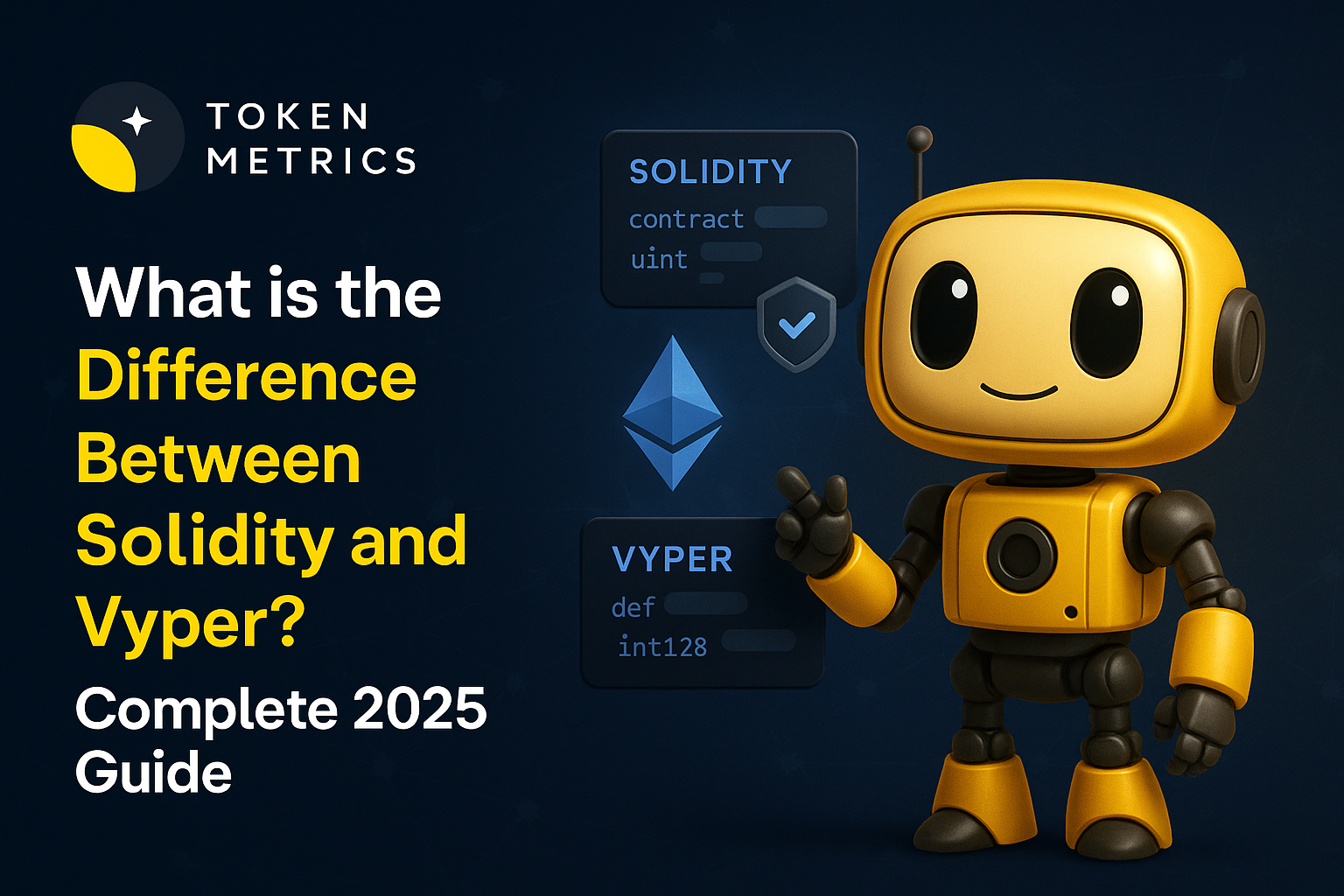
What is the Difference Between Solidity and Vyper? Complete 2025 Guide

Explore the key differences between Solidity and Vyper for Ethereum smart contracts, and learn how to choose the right language for your project in 2025.
Token Metrics Team
7
Want Smarter Crypto Picks—Free?
See unbiased Token Metrics Ratings for BTC, ETH, and top alts.
Thank you! Your submission has been received!
Oops! Something went wrong while submitting the form.
 No credit card | 1-click unsubscribe

Smart contracts have revolutionized the blockchain ecosystem, enabling self-executing code that automatically enforces agreed-upon terms and conditions. As decentralized applications continue growing in sophistication and value, the programming languages used to create these contracts become increasingly critical. Two languages dominate Ethereum smart contract development: Solidity and Vyper. Token Metrics.

Understanding Smart Contract Languages

Before diving into Solidity vs Vyper comparison, it's essential to understand what smart contract languages do and why they matter. Smart contracts are programs that run on blockchain platforms like Ethereum, executing predetermined actions when specific conditions are met. These contracts facilitate secure, transparent, and trustless interactions between parties, eliminating intermediaries and enhancing efficiency.

Smart contract languages enable developers to define the logic and behavior of these contracts, which are immutable and executed on the blockchain. By leveraging smart contract languages, businesses can automate processes including supply chain management, financial transactions, governance systems, and much more.

High-Level vs Low-Level Languages

Smart contract programming requires converting human-readable code into machine-executable bytecode that the Ethereum Virtual Machine (EVM) can process. Developers must first choose between high-level and low-level languages based on their use case and expertise.

High-level languages abstract away granular implementation details, allowing developers to create smart contracts without deep bytecode knowledge. Solidity and Vyper are both high-level languages designed for EVM-compatible blockchains, making them accessible to developers from traditional programming backgrounds.

After compilation, both Solidity and Vyper smart contracts execute using the same bytecode language, meaning they can be used concurrently in the same application despite their different source code appearances.

Solidity: The Industry Standard

Solidity is the most widely used programming language for developing smart contracts on the Ethereum blockchain and EVM-compatible chains. Designed specifically for blockchain applications, Solidity enables developers to create secure, decentralized, and automated agreements that run on distributed networks.

Origins and Design Philosophy

Proposed by Ethereum CTO Gavin Wood, Solidity was developed to meet demand for a flexible smart contract-based developer platform. The language draws heavily on inspiration from C++, JavaScript, and Python, making it familiar to developers from various programming backgrounds.

Solidity is a high-level, Turing-complete, statically typed language where developers must explicitly declare variable types. This allows the compiler to have knowledge of data types, ensuring deterministic application behavior—a critical requirement for blockchain applications where predictability is paramount.

Key Features of Solidity

  • Object-Oriented Programming: Supports inheritance, libraries, and complex data structures for sophisticated smart contracts with reusable components.
  • Rich Feature Set: Includes function overloading, multiple inheritance, user-defined types, and complex data structures.
  • Extensive Ecosystem: Benefits from a large community support, documentation, and development tools like Remix, Hardhat, and Foundry.
  • Blockchain-Specific Commands: Built-in commands for addresses, transactions, and block data interactions.
  • Wide Adoption: Most Ethereum projects, including Uniswap, Aave, and OpenSea, are developed using Solidity.

Advantages of Solidity

  • Market Dominance: Secures 87% of DeFi TVL, making it the dominant language for decentralized finance.
  • Robust Tooling: Mature ecosystem with testing, debugging, and analysis tools.
  • Versatility: Enables implementation of complex protocols, financial instruments, and governance procedures.
  • Learning Resources: Abundant tutorials, courses, and community support.

Disadvantages of Solidity

  • Security Vulnerabilities: Increased attack surface with risks like reentrancy and integer overflows, requiring thorough audits.
  • Complexity: Extensive features can lead to harder-to-audit contracts and hidden vulnerabilities.
  • Steeper Learning Curve: Requires understanding blockchain-specific security considerations.

Vyper: The Security-First Alternative

Vyper is a contract-oriented programming language that targets the EVM with a focus on security, simplicity, and auditability. Introduced in 2018 by Ethereum co-founder Vitalik Buterin, Vyper was specifically developed to address security issues prevalent in Solidity.

Design Philosophy: Security Through Simplicity

Vyper's fundamental philosophy is that security comes from simplicity and readability. The language intentionally limits features and enforces stricter syntax to make contracts more secure and easier to audit. By reducing what’s possible, Vyper minimizes opportunities for mistakes and vulnerabilities.

Using Pythonic syntax—hence the serpentine name—Vyper code prioritizes readability so developers can easily detect bugs and vulnerabilities before deploying contracts. This approach makes code auditable by humans, not just machines.

Key Features of Vyper

  • Python-Like Syntax: Familiar for Python developers, with indentation-based structure and clear syntax.
  • Security-First Design: Eliminates object-oriented features, such as inheritance and function overloading, to reduce attack vectors.
  • Strong Typing: Variables require explicit type declaration, catching errors early.
  • Bounds Checking & Overflow Protection: Built-in safety features prevent common vulnerabilities.
  • Decidability & Gas Optimization: Ensures predictable gas consumption and avoids infinite loops, making contracts more efficient.

Advantages of Vyper

  • Enhanced Security: Designed specifically to prevent common vulnerabilities, leading to more secure contracts.
  • Readable & Audit-Friendly: Clear syntax facilitates quicker reviews and lower audit costs.
  • Concise Code: Fewer lines and simpler syntax streamline contract development.
  • Python Background: Eases onboarding for Python programmers.
  • Potential Gas Savings: Simple design can lead to more efficient contracts in specific cases.

Disadvantages of Vyper

  • Limited Adoption: Only about 8% of DeFi TVL, with a smaller ecosystem and community.
  • Fewer Features: Lack of inheritance, modifiers, and function overloading limits architectural options.
  • Smaller Tooling Ecosystem: Development tools and libraries are less mature compared to Solidity.
  • Less Industry Traction: Major projects predominantly use Solidity, limiting existing examples for Vyper development.

Differences: Solidity vs Vyper

  • Syntax & Structure: Solidity resembles JavaScript and C++, with curly braces and semicolons; Vyper uses Python-like indentation and syntax, omitting object-oriented features.
  • Feature Completeness: Solidity offers inheritance, modifiers, and dynamic data structures; Vyper is minimalist, focusing on security with fixed-size arrays and no inheritance.
  • Security Approach: Solidity relies on developer diligence and testing; Vyper enforces limitations to inherently prevent vulnerabilities.
  • Development Philosophy: Solidity emphasizes flexibility, while Vyper emphasizes security and auditability.

Choosing Between Solidity and Vyper

The decision depends on project needs, team expertise, and security priorities. Large, feature-rich DeFi protocols and complex dApps typically require Solidity's extensive capabilities. Conversely, systems demanding maximum security, or contracts that need to be highly auditable, may benefit from Vyper’s simplicity and security-focused design.

Many projects effectively combine both, using Vyper for security-critical core components and Solidity for peripheral features. This hybrid approach leverages the strengths of each language.

Leveraging Token Metrics for Smart Contract Analysis

While understanding the distinctions between Solidity and Vyper is valuable for developers, investors should also evaluate the projects' underlying code quality, security track record, and development activity. Token Metrics offers AI-powered analytics that examine code repositories, audit statuses, and project activity levels.

The platform reviews security vulnerabilities, audit history, and real-time security incidents, providing a comprehensive view that helps identify projects with strong technical foundations, regardless of their chosen language.

Furthermore, Token Metrics tracks project development activity via GitHub, helping gauge ongoing commitment and progress. Market intelligence and performance analysis reveal success patterns and areas of risk, supporting informed decision-making.

Token Metrics assists investors in balancing portfolios across projects built with different languages, offering risk assessments and alerts that enhance proactive management amid evolving blockchain security landscapes.

The Future of Smart Contract Languages

Both Solidity and Vyper are actively evolving to meet new challenges and security needs. Solidity continues enhancing security features, error handling, and optimization, driven by its large ecosystem. Vyper development emphasizes expanding capabilities while maintaining its core security principles.

Emerging languages and cross-language development strategies are beginning to complement established techniques. Combining secure core contracts in Vyper with the flexibility of Solidity is an increasingly common pattern.

Best Practices for Smart Contract Development

  • Thorough Testing: Implement comprehensive testing, including formal verification and audits, before deployment.
  • Security Audits: Engage reputable security firms to review code vulnerabilities.
  • Continuous Monitoring: Use platforms like Token Metrics for real-time risk detection post-deployment.
  • Upgradeability: Adopt upgrade patterns that allow fixing issues without losing funds or functionality.

Conclusion: Making the Right Choice

Solidity and Vyper offer distinct approaches to smart contract development. Solidity’s comprehensive features and robust ecosystem make it suitable for complex, feature-rich applications. Vyper's security-oriented, Python-like syntax is ideal for systems where auditability, simplicity, and security are top priorities.

Both languages will continue to play vital roles throughout 2025, with many projects adopting hybrid strategies. Evaluating project needs, security considerations, and team expertise will guide optimal language selection. AI analytics platforms like Token Metrics provide critical insights to support this decision, ensuring better understanding and risk management in the ever-evolving ecosystem.

Build Smarter Crypto Apps &
AI Agents in Minutes, Not Months
Real-time prices, trading signals, and on-chain insights all from one powerful API.
Grab a Free API Key
About Token Metrics
Token Metrics: AI-powered crypto research and ratings platform. We help investors make smarter decisions with unbiased Token Metrics Ratings, on-chain analytics, and editor-curated “Top 10” guides. Our platform distills thousands of data points into clear scores, trends, and alerts you can act on.
30 Employees
analysts, data scientists, and crypto engineers
Daily Briefings
concise market insights and “Top Picks”
Transparent & Compliant
Sponsored ≠ Ratings; research remains independent
Want Smarter Crypto Picks—Free?
See unbiased Token Metrics Ratings for BTC, ETH, and top alts.
Thank you! Your submission has been received!
Oops! Something went wrong while submitting the form.
 No credit card | 1-click unsubscribe
Token Metrics Team
Token Metrics Team

Recent Posts

Research

Measuring Success in Web3 Projects: Key Metrics and Approaches

Token Metrics Team
5

Introduction

The emergence of Web3 technologies has transformed the digital landscape, introducing decentralized applications, blockchain-based protocols, and novel governance models. For participants and observers alike, understanding how to measure success in Web3 projects remains a complex yet critical challenge. Unlike traditional businesses, where financial indicators are predominant, Web3 ventures often require multifaceted assessment frameworks that capture technological innovation, community engagement, and decentralization.

This article delves into the defining success factors for Web3 projects, offering a structured exploration of the key performance metrics, analytical frameworks, and tools available, including AI-driven research platforms such as Token Metrics. Our goal is to provide a clear, educational perspective on how participants and researchers can evaluate Web3 initiatives rigorously and holistically.

Understanding Success in Web3 Projects

Success within Web3 projects is inherently multidimensional. While financial performance and market capitalization remain important, other dimensions include:

  • Decentralization and Governance: The extent to which control is distributed among users rather than centralized parties.
  • Network Activity: Measures such as transaction volume, active addresses, and developer contributions.
  • Community Engagement: Size and activity level of the community across social platforms, forums, and governance participation.
  • Technological Innovation: Novelty and robustness of the underlying protocols and smart contracts.
  • Utility and Use Cases: Real-world application and adoption of the project’s technology.

These factors may vary in relevance depending on the project type—be it DeFi protocols, NFTs, layer-one blockchains, or decentralized autonomous organizations (DAOs). Thus, establishing clear, context-specific benchmarks is essential for effective evaluation.

Key Metrics to Evaluate Web3 Projects

Below are critical performance indicators broadly used to gauge Web3 success. These metrics provide quantifiable insights into various aspects of project health and growth.

  • On-Chain Metrics: Include transaction count, gas fees generated, token holder distribution, and smart contract activity. High transaction volumes paired with diverse token ownership can indicate vibrant usage and decentralization.
  • Community Metrics: Encompass active user counts on social media and chat platforms, participation in governance votes, and growth of community-driven initiatives. These reflect user engagement and alignment with project goals.
  • Development Activity: Number of code commits, GitHub repository updates, and developer participation. Sustained and transparent development activity signals ongoing innovation and resilience.
  • Adoption & Utility: Number of integrations, partnerships, or use cases implemented. Practical use drives value beyond speculative interest.
  • Security and Audits: Presence of third-party security audits, bug bounty programs, and historical vulnerabilities. Security impacts trust and long-term viability.

Frameworks for Analyzing Success

Systematic evaluation benefits from established frameworks:

  1. Fundamental Analysis: This involves assessing the core technology, team background, tokenomics, and governance structure. Understanding the problem a project aims to solve and its approach builds a base for contextual success measurement.
  2. Scenario Analysis: Envisioning multiple future states of the project considering technological advances, market adoption, and regulatory environment helps anticipate resilience and growth potential.
  3. Comparative Benchmarking: Positioning a project relative to its peers using standardized KPIs facilitates identifying strengths and weaknesses within the ecosystem.

Combining these frameworks with data-driven metrics allows for comprehensive, nuanced insights into project status and trajectories.

Leveraging AI and Tools for Analysis

Artificial intelligence and machine learning increasingly support the evaluation of Web3 projects by processing vast datasets and uncovering patterns not readily apparent to human analysts. Token Metrics exemplifies this approach by offering AI-driven ratings, risk assessments, and project deep-dives that integrate quantitative data with qualitative signals.

These platforms aid in parsing complex variables such as token velocity, developer momentum, and community sentiment, providing actionable intelligence without subjective bias. Importantly, using such analytical tools facilitates continuous monitoring and reassessment as Web3 landscapes evolve.

Practical Steps for Researching Web3 Projects

For individuals or organizations assessing the success potential of Web3 projects, these steps are recommended:

  • Collect and Analyze On-Chain Data: Use blockchain explorers and analytics services to gather foundational metrics such as transaction counts, active users, and token distribution patterns.
  • Monitor Community Channels: Engage with forums, social media, and governance discussions to gauge community health and responsiveness.
  • Review Development Progress: Track open-source repositories and project updates to assess ongoing activity and innovation.
  • Evaluate Security Posture: Confirm the presence of audits and security protocols to evaluate risk mitigation.
  • Utilize Advanced Analytical Platforms: Incorporate AI-driven services like Token Metrics to integrate diverse indicators and generate comprehensive project ratings.

Limitations and Considerations

While metrics and frameworks aid evaluation, it is essential to recognize the dynamic nature of Web3 projects and the ecosystem's inherent uncertainties. Metrics may fluctuate due to speculative behavior, regulatory shifts, or technological disruptions. Moreover, quantifiable indicators only capture parts of the overall picture, and qualitative factors such as community values and developer expertise also matter.

Therefore, success measurement in Web3 should be viewed as an ongoing process, employing diverse data points and contextual understanding rather than static criteria.

Conclusion

Measuring success in Web3 projects requires a multidimensional approach combining on-chain metrics, community engagement, development activity, and security considerations. Frameworks such as fundamental and scenario analysis facilitate structured evaluation, while AI-powered platforms like Token Metrics provide advanced tools to support data-driven insights.

By applying these methods with a critical and educational mindset, stakeholders can better understand project health and longevity without relying on speculative or financial advice.

Disclaimer

This article is for educational and informational purposes only. It does not constitute financial, investment, or legal advice. Readers should conduct their own research and consult professionals before making decisions related to Web3 projects.

Research

A Complete Guide to Writing Smart Contracts

Token Metrics Team
4

Introduction

Smart contracts are self-executing contracts with the terms of the agreement directly written into lines of code. They run on blockchain platforms, such as Ethereum, enabling decentralized, automated agreements that do not require intermediaries. Understanding how to write a smart contract involves familiarity with blockchain principles, programming languages, and best practices for secure and efficient development.

Understanding Smart Contracts

Before diving into development, it is essential to grasp what smart contracts are and how they function within blockchain ecosystems. Essentially, smart contracts enable conditional transactions that automatically execute when predefined conditions are met, providing transparency and reducing dependency on third parties.

These programs are stored and executed on blockchain platforms, making them immutable and distributed, which adds security and reliability to the contract's terms.

Choosing the Right Platform

Writing a smart contract starts with selecting an appropriate blockchain platform. Ethereum is among the most widely used platforms with robust support for smart contracts, primarily written in Solidity—a statically-typed, contract-oriented programming language.

Other platforms like Binance Smart Chain, Polkadot, and Solana also support smart contracts with differing languages and frameworks. Selecting a platform depends on the project requirements, intended network compatibility, and resource accessibility.

Learning the Programming Language

The most commonly used language for writing Ethereum smart contracts is Solidity. It is designed to implement smart contracts with syntax similar to JavaScript, making it approachable for developers familiar with web programming languages.

Other languages include Vyper, a pythonic language focusing on security and simplicity, and Rust or C++ for platforms like Solana. Learning the syntax, data types, functions, and event handling of the chosen language is foundational.

Setting Up Development Environment

Development of smart contracts typically requires a suite of tools for editing, compiling, testing, and deploying code:

  • IDEs: Integrated Development Environments such as Remix (web-based for Solidity) or Visual Studio Code with plugins.
  • Frameworks: Tools like Truffle or Hardhat enable local blockchain simulation, automated testing, and deployment scripts.
  • Node and Wallet: Connecting to blockchain networks often requires running a node or leveraging services like Infura, along with digital wallets (e.g., MetaMask) for transaction signing.

Writing the Smart Contract Code

Writing a smart contract involves structuring the code to define its variables, functions, and modifiers. Key steps include:

  1. Define the contract: Use the keyword contract to declare the contract and its name.
  2. Declare state variables: Define data stored on the blockchain, such as balances or ownership details.
  3. Write functions: Implement logic that changes state variables or triggers events.
  4. Use modifiers: Add conditional checks like access restrictions (e.g., only the owner can execute certain functions).
  5. Emit events: Use events to log significant contract operations for off-chain monitoring.

Example snippet in Solidity:

pragma solidity ^0.8.0;

contract SimpleStorage {
  uint storedData;

  function set(uint x) public {
    storedData = x;
  }

  function get() public view returns (uint) {
    return storedData;
  }
}

Testing and Debugging

Testing is crucial to ensure smart contracts operate as intended and to prevent bugs or vulnerabilities. Strategies include:

  • Writing unit tests using frameworks like Truffle or Hardhat.
  • Running tests on local blockchains (Ganache) before deploying.
  • Using linters and analysis tools to detect common security issues.

Adopting rigorous testing can reduce the risk of exploits or loss of funds caused by contract errors.

Deploying the Smart Contract

Deployment involves publishing the compiled smart contract bytecode to the blockchain. This includes:

  • Compiling the contract into bytecode.
  • Connecting to the desired blockchain network (testnet or mainnet) usually via wallet integration.
  • Submitting a deployment transaction, which requires gas fees for execution.

Using test networks like Ropsten, Rinkeby, or Goerli is recommended for initial deployment to validate functionality without incurring real costs.

Using AI Tools for Smart Contract Research

Emerging AI-driven platforms can assist developers and analysts with smart contract evaluation, security analysis, and market sentiment interpretation. For instance, tools like Token Metrics provide algorithmic research that can support understanding of blockchain projects and smart contract implications in the ecosystem.

Integrating these tools along with manual audits aids comprehensive assessments for better development decisions.

Best Practices and Security Considerations

Writing secure smart contracts requires awareness of common vulnerabilities such as reentrancy attacks, integer overflows, and improper access controls. Best practices include:

  • Following established design patterns and standards (e.g., OpenZeppelin contracts).
  • Performing thorough code reviews and external audits.
  • Keeping contracts as simple and modular as possible.

Robust security practices are critical due to the immutable nature of deployed smart contracts on blockchain.

Conclusion

Writing a smart contract involves a combination of blockchain knowledge, programming skills, and adherence to security best practices. From choosing a platform and language to coding, testing, and deploying, each step plays an important role in the development lifecycle.

Leveraging AI-powered tools like Token Metrics can add valuable insights for developers aiming to enhance their understanding and approach to smart contract projects.

Disclaimer

All information provided in this article is for educational purposes only and does not constitute financial or investment advice. Readers should conduct their own research and consult professional sources where appropriate.

Research

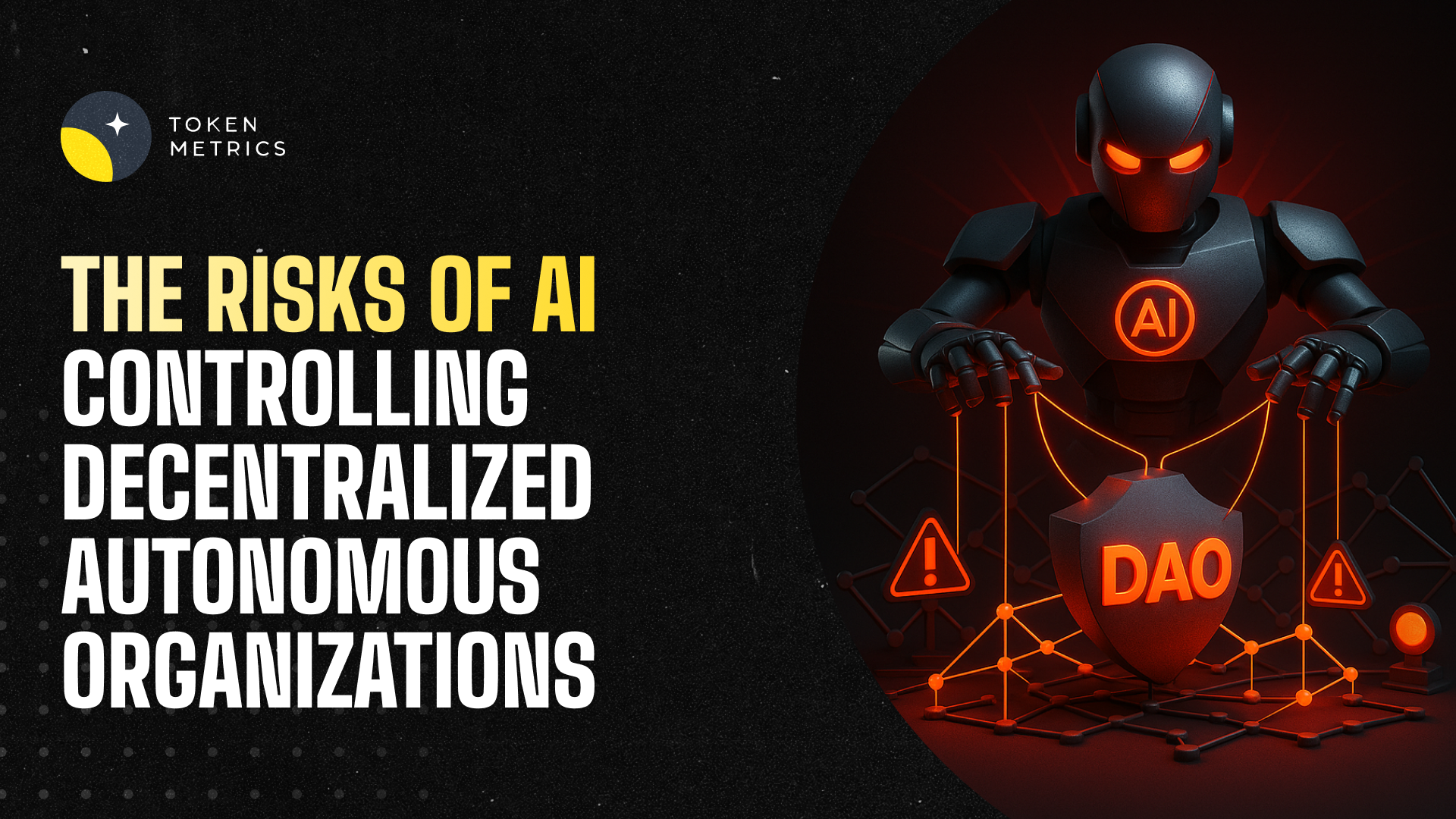
Understanding the Risks of AI Controlling Decentralized Autonomous Organizations

Token Metrics Team
4

Introduction

Decentralized Autonomous Organizations (DAOs) represent an innovative model for decentralized governance and decision-making in the blockchain space. With the increasing integration of artificial intelligence (AI) into DAOs for automating processes and enhancing efficiency, it is vital to understand the risks associated with allowing AI to control or heavily influence DAOs. This article provides a comprehensive analysis of these risks, exploring technical, ethical, and systemic factors. Additionally, it outlines how analytical platforms like Token Metrics can support informed research around such emerging intersections.

DAO and AI Basics

DAOs are blockchain-based entities designed to operate autonomously through smart contracts and collective governance, without centralized control. AI technologies can offer advanced capabilities by automating proposal evaluation, voting mechanisms, or resource allocation within these organizations. While this combination promises increased efficiency and responsiveness, it also introduces complexities and novel risks.

Technical Vulnerabilities

One significant category of risks involves technical vulnerabilities arising from AI integration into DAOs:

  • Smart Contract Exploits: AI-driven decision-making typically operates on smart contracts. Flaws or bugs in the smart contract code can be exploited, possibly amplified by AI’s autonomous execution.
  • Data Integrity and Quality: AI requires reliable data inputs to function correctly. Malicious actors might inject false or biased data, leading to misguided AI decisions that could harm DAO operations.
  • Algorithmic Errors: AI algorithms might contain bugs, incorrect assumptions, or be insufficiently tested, which could result in unintended behaviors or decisions with negative consequences.

Governance and Control Challenges

Integrating AI into DAO governance raises complex questions around control, transparency, and accountability:

  • Lack of Transparency: AI algorithms, especially those using complex machine learning models, can be opaque, making it difficult for stakeholders to audit decisions or understand governance processes fully.
  • Centralization Risks: AI models are often developed and maintained by specific teams or organizations, which could inadvertently introduce centralization points contrary to the decentralized ethos of DAOs.
  • Unintended Bias: AI systems trained on biased datasets may propagate or exacerbate existing biases within DAO decision-making, risking unfair or harmful outcomes.

Security and Manipulation Risks

The autonomous nature of AI presents unique security concerns:

  • Manipulation Attacks: Adversaries might target the AI’s learning process or input data channels to manipulate outcomes toward malicious goals.
  • Autonomy Exploits: An AI controlling critical DAO functions autonomously could make decisions that are difficult to reverse or disrupt, leading to lasting damage if exploited.
  • Emergent Behavior: Complex AI systems might develop unexpected behaviors in dynamic environments, creating risks hard to anticipate or control within DAO frameworks.

Ethical and Regulatory Concerns

Beyond technical risks, the interaction between AI and DAOs also introduces ethical and regulatory considerations:

  • Accountability Gaps: Determining liability for AI-driven decisions within DAOs is challenging, potentially leading to accountability voids in cases of harm or disputes.
  • Compliance Complexity: Evolving regulatory landscapes surrounding both AI and blockchain could create overlapping or conflicting requirements for AI-controlled DAOs.
  • User Consent and Autonomy: Members participating in DAOs may have concerns over how AI influences governance and whether adequate consent frameworks are in place.

Mitigating Risks with Analytical Tools

Understanding and managing these risks require robust research and analytical frameworks. Platforms such as Token Metrics provide data-driven insights supporting comprehensive evaluation of blockchain projects, governance models, and emerging technologies combining AI and DAOs.

  • Thorough Technical Reviews: Regular audits and reviews of AI algorithms and smart contracts can detect vulnerabilities early.
  • Transparency Initiatives: Employing explainable AI methods enhances trust and allows stakeholder scrutiny.
  • Scenario Analysis: Exploring potential failure modes and adversarial scenarios helps prepare for unexpected outcomes.
  • Community Engagement: Active and informed participation in DAO governance ensures more robust checks and balances.

Conclusion

The fusion of AI and DAOs promises innovative decentralized governance but comes with substantial risks. Technical vulnerabilities, governance challenges, security threats, and ethical concerns highlight the need for vigilant risk assessment and careful integration. Utilizing advanced research platforms like Token Metrics enables more informed and analytical approaches for stakeholders navigating this evolving landscape.

Disclaimer

This article is for educational purposes only and does not constitute financial, legal, or investment advice. Readers should perform their own due diligence and consult professionals where appropriate.

Choose from Platinum, Gold, and Silver packages
Reach with 25–30% open rates and 0.5–1% CTR
Craft your own custom ad—from banners to tailored copy
Perfect for Crypto Exchanges, SaaS Tools, DeFi, and AI Products