Back to blog
Research

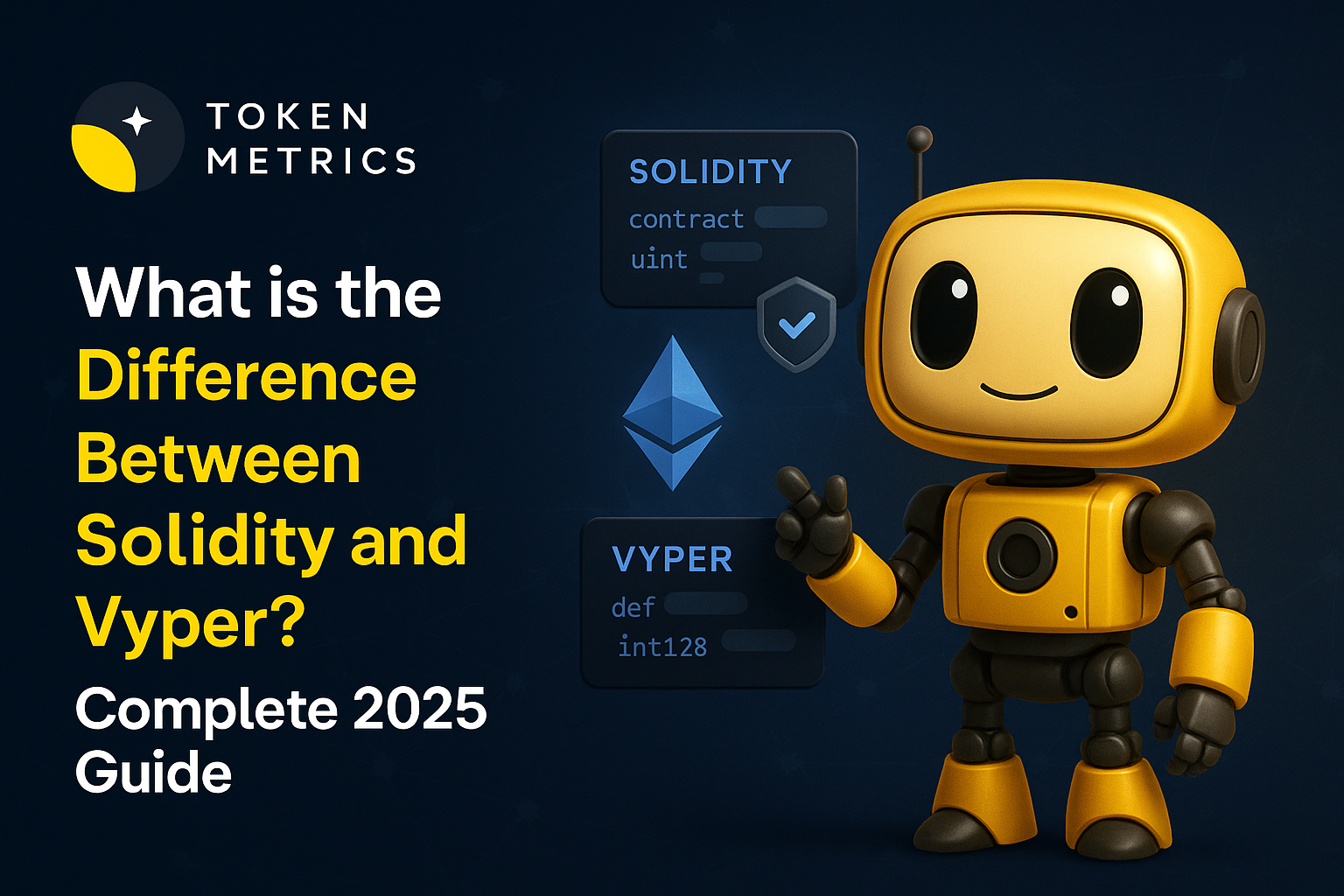
What is the Difference Between Solidity and Vyper? Complete 2025 Guide

Explore the key differences between Solidity and Vyper for Ethereum smart contracts, and learn how to choose the right language for your project in 2025.
Token Metrics Team
7
Want Smarter Crypto Picks—Free?
See unbiased Token Metrics Ratings for BTC, ETH, and top alts.
Thank you! Your submission has been received!
Oops! Something went wrong while submitting the form.
 No credit card | 1-click unsubscribe

Smart contracts have revolutionized the blockchain ecosystem, enabling self-executing code that automatically enforces agreed-upon terms and conditions. As decentralized applications continue growing in sophistication and value, the programming languages used to create these contracts become increasingly critical. Two languages dominate Ethereum smart contract development: Solidity and Vyper. Token Metrics.

Understanding Smart Contract Languages

Before diving into Solidity vs Vyper comparison, it's essential to understand what smart contract languages do and why they matter. Smart contracts are programs that run on blockchain platforms like Ethereum, executing predetermined actions when specific conditions are met. These contracts facilitate secure, transparent, and trustless interactions between parties, eliminating intermediaries and enhancing efficiency.

Smart contract languages enable developers to define the logic and behavior of these contracts, which are immutable and executed on the blockchain. By leveraging smart contract languages, businesses can automate processes including supply chain management, financial transactions, governance systems, and much more.

High-Level vs Low-Level Languages

Smart contract programming requires converting human-readable code into machine-executable bytecode that the Ethereum Virtual Machine (EVM) can process. Developers must first choose between high-level and low-level languages based on their use case and expertise.

High-level languages abstract away granular implementation details, allowing developers to create smart contracts without deep bytecode knowledge. Solidity and Vyper are both high-level languages designed for EVM-compatible blockchains, making them accessible to developers from traditional programming backgrounds.

After compilation, both Solidity and Vyper smart contracts execute using the same bytecode language, meaning they can be used concurrently in the same application despite their different source code appearances.

Solidity: The Industry Standard

Solidity is the most widely used programming language for developing smart contracts on the Ethereum blockchain and EVM-compatible chains. Designed specifically for blockchain applications, Solidity enables developers to create secure, decentralized, and automated agreements that run on distributed networks.

Origins and Design Philosophy

Proposed by Ethereum CTO Gavin Wood, Solidity was developed to meet demand for a flexible smart contract-based developer platform. The language draws heavily on inspiration from C++, JavaScript, and Python, making it familiar to developers from various programming backgrounds.

Solidity is a high-level, Turing-complete, statically typed language where developers must explicitly declare variable types. This allows the compiler to have knowledge of data types, ensuring deterministic application behavior—a critical requirement for blockchain applications where predictability is paramount.

Key Features of Solidity

  • Object-Oriented Programming: Supports inheritance, libraries, and complex data structures for sophisticated smart contracts with reusable components.
  • Rich Feature Set: Includes function overloading, multiple inheritance, user-defined types, and complex data structures.
  • Extensive Ecosystem: Benefits from a large community support, documentation, and development tools like Remix, Hardhat, and Foundry.
  • Blockchain-Specific Commands: Built-in commands for addresses, transactions, and block data interactions.
  • Wide Adoption: Most Ethereum projects, including Uniswap, Aave, and OpenSea, are developed using Solidity.

Advantages of Solidity

  • Market Dominance: Secures 87% of DeFi TVL, making it the dominant language for decentralized finance.
  • Robust Tooling: Mature ecosystem with testing, debugging, and analysis tools.
  • Versatility: Enables implementation of complex protocols, financial instruments, and governance procedures.
  • Learning Resources: Abundant tutorials, courses, and community support.

Disadvantages of Solidity

  • Security Vulnerabilities: Increased attack surface with risks like reentrancy and integer overflows, requiring thorough audits.
  • Complexity: Extensive features can lead to harder-to-audit contracts and hidden vulnerabilities.
  • Steeper Learning Curve: Requires understanding blockchain-specific security considerations.

Vyper: The Security-First Alternative

Vyper is a contract-oriented programming language that targets the EVM with a focus on security, simplicity, and auditability. Introduced in 2018 by Ethereum co-founder Vitalik Buterin, Vyper was specifically developed to address security issues prevalent in Solidity.

Design Philosophy: Security Through Simplicity

Vyper's fundamental philosophy is that security comes from simplicity and readability. The language intentionally limits features and enforces stricter syntax to make contracts more secure and easier to audit. By reducing what’s possible, Vyper minimizes opportunities for mistakes and vulnerabilities.

Using Pythonic syntax—hence the serpentine name—Vyper code prioritizes readability so developers can easily detect bugs and vulnerabilities before deploying contracts. This approach makes code auditable by humans, not just machines.

Key Features of Vyper

  • Python-Like Syntax: Familiar for Python developers, with indentation-based structure and clear syntax.
  • Security-First Design: Eliminates object-oriented features, such as inheritance and function overloading, to reduce attack vectors.
  • Strong Typing: Variables require explicit type declaration, catching errors early.
  • Bounds Checking & Overflow Protection: Built-in safety features prevent common vulnerabilities.
  • Decidability & Gas Optimization: Ensures predictable gas consumption and avoids infinite loops, making contracts more efficient.

Advantages of Vyper

  • Enhanced Security: Designed specifically to prevent common vulnerabilities, leading to more secure contracts.
  • Readable & Audit-Friendly: Clear syntax facilitates quicker reviews and lower audit costs.
  • Concise Code: Fewer lines and simpler syntax streamline contract development.
  • Python Background: Eases onboarding for Python programmers.
  • Potential Gas Savings: Simple design can lead to more efficient contracts in specific cases.

Disadvantages of Vyper

  • Limited Adoption: Only about 8% of DeFi TVL, with a smaller ecosystem and community.
  • Fewer Features: Lack of inheritance, modifiers, and function overloading limits architectural options.
  • Smaller Tooling Ecosystem: Development tools and libraries are less mature compared to Solidity.
  • Less Industry Traction: Major projects predominantly use Solidity, limiting existing examples for Vyper development.

Differences: Solidity vs Vyper

  • Syntax & Structure: Solidity resembles JavaScript and C++, with curly braces and semicolons; Vyper uses Python-like indentation and syntax, omitting object-oriented features.
  • Feature Completeness: Solidity offers inheritance, modifiers, and dynamic data structures; Vyper is minimalist, focusing on security with fixed-size arrays and no inheritance.
  • Security Approach: Solidity relies on developer diligence and testing; Vyper enforces limitations to inherently prevent vulnerabilities.
  • Development Philosophy: Solidity emphasizes flexibility, while Vyper emphasizes security and auditability.

Choosing Between Solidity and Vyper

The decision depends on project needs, team expertise, and security priorities. Large, feature-rich DeFi protocols and complex dApps typically require Solidity's extensive capabilities. Conversely, systems demanding maximum security, or contracts that need to be highly auditable, may benefit from Vyper’s simplicity and security-focused design.

Many projects effectively combine both, using Vyper for security-critical core components and Solidity for peripheral features. This hybrid approach leverages the strengths of each language.

Leveraging Token Metrics for Smart Contract Analysis

While understanding the distinctions between Solidity and Vyper is valuable for developers, investors should also evaluate the projects' underlying code quality, security track record, and development activity. Token Metrics offers AI-powered analytics that examine code repositories, audit statuses, and project activity levels.

The platform reviews security vulnerabilities, audit history, and real-time security incidents, providing a comprehensive view that helps identify projects with strong technical foundations, regardless of their chosen language.

Furthermore, Token Metrics tracks project development activity via GitHub, helping gauge ongoing commitment and progress. Market intelligence and performance analysis reveal success patterns and areas of risk, supporting informed decision-making.

Token Metrics assists investors in balancing portfolios across projects built with different languages, offering risk assessments and alerts that enhance proactive management amid evolving blockchain security landscapes.

The Future of Smart Contract Languages

Both Solidity and Vyper are actively evolving to meet new challenges and security needs. Solidity continues enhancing security features, error handling, and optimization, driven by its large ecosystem. Vyper development emphasizes expanding capabilities while maintaining its core security principles.

Emerging languages and cross-language development strategies are beginning to complement established techniques. Combining secure core contracts in Vyper with the flexibility of Solidity is an increasingly common pattern.

Best Practices for Smart Contract Development

  • Thorough Testing: Implement comprehensive testing, including formal verification and audits, before deployment.
  • Security Audits: Engage reputable security firms to review code vulnerabilities.
  • Continuous Monitoring: Use platforms like Token Metrics for real-time risk detection post-deployment.
  • Upgradeability: Adopt upgrade patterns that allow fixing issues without losing funds or functionality.

Conclusion: Making the Right Choice

Solidity and Vyper offer distinct approaches to smart contract development. Solidity’s comprehensive features and robust ecosystem make it suitable for complex, feature-rich applications. Vyper's security-oriented, Python-like syntax is ideal for systems where auditability, simplicity, and security are top priorities.

Both languages will continue to play vital roles throughout 2025, with many projects adopting hybrid strategies. Evaluating project needs, security considerations, and team expertise will guide optimal language selection. AI analytics platforms like Token Metrics provide critical insights to support this decision, ensuring better understanding and risk management in the ever-evolving ecosystem.

Build Smarter Crypto Apps &
AI Agents in Minutes, Not Months
Real-time prices, trading signals, and on-chain insights all from one powerful API.
Grab a Free API Key
About Token Metrics
Token Metrics: AI-powered crypto research and ratings platform. We help investors make smarter decisions with unbiased Token Metrics Ratings, on-chain analytics, and editor-curated “Top 10” guides. Our platform distills thousands of data points into clear scores, trends, and alerts you can act on.
30 Employees
analysts, data scientists, and crypto engineers
Daily Briefings
concise market insights and “Top Picks”
Transparent & Compliant
Sponsored ≠ Ratings; research remains independent
Want Smarter Crypto Picks—Free?
See unbiased Token Metrics Ratings for BTC, ETH, and top alts.
Thank you! Your submission has been received!
Oops! Something went wrong while submitting the form.
 No credit card | 1-click unsubscribe
Token Metrics Team
Token Metrics Team

Recent Posts

Research

How to Find the Next 100x Cryptocurrency Before Everyone Else | Token Metrics Moonshots

Token Metrics Team
8 min

In the world of crypto, timing is everything. If you’re trying to turn $100 into $10,000, the holy grail is finding the next 100x altcoin before the masses catch on. These explosive opportunities are rare, but with the right tools and strategy, they’re not impossible to uncover.

In this guide, we’ll show you exactly how to identify moonshot tokens—those under-the-radar gems that have the potential to skyrocket. You’ll also learn how to use Token Metrics, one of the most powerful AI-driven platforms, to spot them before they take off.

What Are Moonshot Cryptocurrencies?

“Moonshot” is a crypto-native term that refers to a low-cap cryptocurrency with the potential to deliver outsized returns, often 10x, 50x, or even 100x. These tokens may start unnoticed, trading at fractions of a penny, but once they gain traction, they can make early adopters massive profits in a very short period of time.

Key Traits of Moonshots:

  • Market cap under $50 million
  • High volatility with strong upward price potential
  • Community-driven marketing or narrative
  • Emerging sectors like AI, DePIN, Web3 infrastructure, or meme coins
  • Limited exchange listings (often only on DEXs)

Moonshots are risky—but with smart research and analytics, they can be strategic bets rather than blind gambles.

How Moonshots Work

Most 100x altcoins follow a predictable life cycle:

  1. Early Accumulation – Whales and savvy investors quietly accumulate before the public is aware.
  2. Trigger Catalyst – A social media trend, influencer mention, exchange listing, or big partnership sparks interest.
  3. Volume Surge – Trading activity spikes, liquidity increases, and price begins to move.
  4. Parabolic Rally – The token “moons” as retail investors jump in.
  5. Top Formation and Correction – Early investors take profits; latecomers often buy the top.

Catching a moonshot before Step 3 is your goal. You want to be in position before the breakout, not chasing after it.

This is where Token Metrics becomes invaluable.

Why Token Metrics Is the Best Tool for Discovering Moonshots

Token Metrics is a crypto analytics platform powered by AI, machine learning, and real-time data. It monitors thousands of tokens and ranks them using quantitative models, helping traders and investors find opportunities before they trend.

With features like:

  • Trader Grade and Investor Grade rankings
  • AI-generated signals
  • Real-time ROI tracking
  • Integrated trading functionality


Token Metrics helps you act fast and stay ahead of the crowd.

Let’s walk through exactly how to use Token Metrics to find the next 100x cryptocurrency.

How to Use Token Metrics to Find Moonshots

Here’s a step-by-step guide to using Token Metrics’ Moonshot system to uncover high-potential altcoins.

✅ Step 1: Go to the Ratings Page

Once logged into the Token Metrics platform:

  • Navigate to the “Ratings” tab from the main dashboard.
  • This section ranks thousands of cryptocurrencies based on AI-calculated Trader Grade and Investor Grade.

Trader Grade is especially important for short-term breakout potential—it reflects the strength of a token’s momentum and technical setup.

✅ Step 2: Click on the “Moonshots” Tab

In the Ratings interface:

  • Click the “Moonshots” tab at the top.
  • This filters the token list to show only those identified as moonshot candidates by Token Metrics’ AI models.

These tokens are selected using proprietary algorithms that scan for:

  • Sudden volume surges
  • Rising trader grades
  • Favorable technical and social signals
  • Market cap anomalies

These are the coins flying just below the radar—with massive breakout potential.

✅ Step 3: Review Key Metrics

Each token in the Moonshots tab includes real-time, high-signal data to guide your decision-making:

  • Trader Grade: How strong is this token’s short-term setup?
  • Change in Trader Grade: Is momentum building?
  • 24-Hour Volume: Is there growing interest or liquidity?
  • Market Cap: The smaller the cap, the more upside (and risk).
  • Date of Entry: When was this token added to the Moonshots list?
  • Live ROI Since Moonshot: Has the token already moved—or is it still early?

You can also switch to Past Moonshots to see historical performance. Many past Moonshots have shown gains of 3x–20x within days of being listed.

✅ Step 4: Choose a Token to Explore

Click on any token from the Moonshots list to open its Token Details Page.

Here’s what you’ll find:

  • Live charts with technical indicators
  • Token fundamentals like supply, utility, and project roadmap
  • Top holder data to spot whales or early VC involvement
  • Sentiment scores and momentum shifts

This is where you do your research. Look for projects with:

  • Increasing community engagement
  • Clear narratives (e.g., AI, DePIN, meme, Layer 2)
  • Early whale accumulation
  • Undiscovered by influencers or major Twitter accounts

✅ Step 5: Buy in Seconds

Once you’ve found a token you like:

  • Hit the “Buy” button right from the Moonshots interface.
  • A swap widget will open inside Token Metrics.
  • Connect your wallet and execute the trade within seconds—no need to leave the platform.

This frictionless experience allows you to act immediately before the market catches on.

Pro Tips for Moonshot Hunting

Finding the next 100x crypto is part art, part science. Here are a few tips to sharpen your strategy:

  • Don’t Chase Pumps: Look for tokens with fresh momentum, not ones that are already up 500%.
  • Use On-Chain Data: Look for early accumulation, token holder growth, and low exchange balances.
  • Diversify: Don’t go all in on a single moonshot—spread risk across 3–5 plays.
  • Set Targets: Know your entry and exit strategy. Moonshots can reverse fast.

Final Thoughts

The next 100x altcoin won’t look obvious at first. It will likely be a small-cap token with limited press, an emerging narrative, and strong community energy.

By combining smart research, disciplined entries, and tools like Token Metrics Moonshots, you give yourself a major edge in spotting breakout coins before the explosion.

So stop guessing. Start using AI-powered insights to track moonshots, monitor early signals, and make informed trades that could change your portfolio—and your life.

🎯 Try Token Metrics now and unlock the Moonshots tab.
Visit: www.tokenmetrics.com

Crypto Basics

How to Find 100x Altcoins Before They Explode | Token Metrics Moonshot Guide

Token Metrics Team
8 min

In the world of cryptocurrency, the term “moonshot” isn’t just slang—it’s the dream. A moonshot is that rare token that delivers 100x or even 1000x returns, turning small investments into massive profits. But the real question is: how do you find these altcoins before they explode?

In this guide, we’ll break down what moonshots are, how they work, and most importantly, how to use Token Metrics—the leading AI-powered crypto analytics platform—to discover hidden gems before the crowd catches on.

What Are Moonshot Altcoins?

Moonshots are low market cap altcoins with high growth potential. These tokens often start under the radar, trading at fractions of a cent, and then experience explosive price action fueled by community hype, technical breakthroughs, or big news.

Common Traits of Moonshot Altcoins:

  • Market Cap < $50M – Small enough to grow exponentially
  • High Volatility – Swings of 20–100% daily are not unusual
  • Speculative Narrative – Often driven by trend cycles like AI, DePIN, or meme coin mania
  • Community Driven – Strong social momentum via X (Twitter), Telegram, or Discord
  • Limited Listings – Usually launched on decentralized exchanges (DEXs) before hitting major CEXs

These tokens carry high risk but also high reward. Timing and information are everything—and that’s where Token Metrics comes in.

How Moonshot Altcoins Work

The mechanics behind a moonshot typically follow a cycle of accumulation, hype, breakout, and profit-taking:

  1. Early Accumulation – Smart money (including whales and insiders) buys in at low prices.
  2. Volume Spike – Trading activity picks up as new investors notice price movements.
  3. Parabolic Move – Price jumps rapidly due to FOMO and social media hype.
  4. Peak & Correction – Early buyers take profits, causing volatility or sharp retracement.

Catching the token in Phase 1 or 2 is crucial. If you're entering during the parabolic move, the risk/reward ratio is much worse.

That’s why traders and investors rely on data and AI-powered tools like Token Metrics to identify moonshots before they explode.

How to Use Token Metrics to Find Moonshots

Token Metrics offers a dedicated Moonshots feature powered by machine learning models trained on thousands of historical signals. It helps you find high-potential altcoins before they go mainstream.

Here’s a step-by-step guide to finding moonshot tokens using Token Metrics:

✅ Step 1: Go to the Ratings Page

  • From your Token Metrics dashboard, navigate to the “Ratings” tab.
  • This is where tokens are scored using Trader Grade and Investor Grade, based on factors like:
    • Technical indicators
    • On-chain activity
    • Market momentum
    • Social sentiment

Trader Grade is especially important for identifying short-term opportunities and moonshot candidates.

✅ Step 2: Click on the “Moonshots” Tab

Inside the Ratings page:

  • Click the “Moonshots” tab at the top.
  • This filters tokens identified by the platform’s AI as having short-term explosive potential.

These are not random picks—they are selected based on:

  • Sharp trader grade increases
  • Unusual volume and price action
  • Sentiment spikes
  • Market cap vs. performance anomalies

The Moonshots page refreshes in real-time to capture fast-moving opportunities.

✅ Step 3: Review Key Metrics

Each token listed in the Moonshots section includes crucial data to guide your decisions:

  • Trader Grade (with % change over time)
  • 24-Hour Trading Volume – Helps gauge interest and momentum
  • Market Cap – Smaller cap = higher potential upside
  • Date of Entry – Know exactly when the token was flagged
  • Live ROI Since Moonshot – See how it’s performed since it was listed

Want to see past winners? Just switch to “Past Moonshots” to view previous AI picks and how they performed over 7–14 days. Many tokens in this category have delivered 5x–20x returns in a matter of days.

✅ Step 4: Choose a Token to Explore

Click on any token from the list to open its Token Details Page.

Here, you can:

  • View a real-time price chart
  • Read a breakdown of fundamentals, including tokenomics, roadmap, and sector
  • See top holders (whales, insiders, or project wallets)
  • Review technical indicators, volume trends, and volatility

This deep-dive view gives you everything you need to make an informed decision—not just guesswork.

✅ Step 5: Buy in Seconds

Once you’ve done your due diligence:

  • Click the “Buy” button directly on the Moonshots page.
  • This opens a swap widget that connects to top DEXs.
  • Choose your wallet, confirm the swap, and you’re done—no need to leave the platform.

This seamless process saves time and allows you to act quickly in a fast-moving market.

Why Token Metrics Is the Best Tool for Moonshot Hunting

Finding 100x altcoins is about timing, data, and confidence. Token Metrics gives you all three:

🔍 Data-Backed Confidence

No more relying on anonymous influencers or Telegram groups. Token Metrics backs every moonshot with quantifiable metrics.

🧠 AI-Powered Predictions

The platform’s models constantly analyze price, volume, sentiment, and chain activity to spot anomalies and early breakouts.

📈 Transparent Track Record

You can review past Moonshots and their ROI—transparency that few platforms offer.

💡 Trade-Ready UI

With integrated swap functionality, you can go from discovery to execution in under a minute.

Final Thoughts

Finding the next 100x altcoin is never easy—but with the right tools, your odds improve dramatically.

Moonshots are real, and they happen frequently in crypto. But they’re only lucrative if you find them early, analyze them rationally, and manage your risk.

With Token Metrics, you don’t have to chase hype—you can rely on real-time analytics, AI-powered ratings, and actionable insights to guide your moonshot hunting.

If you're serious about catching the next 100x gem, start using Token Metrics today.

🚀 Start your free trial and unlock the Moonshots tab at TokenMetrics.com

Research

Andrena and the Rise of DePIN: Decentralized Internet in 2025

Token Metrics Team
8 min

Introduction:
Decentralized Physical Infrastructure Networks (DePINs) are rapidly emerging as one of the most transformative sectors in the blockchain space. In 2025, projects like Andrena are pushing the boundaries of what’s possible by bridging real-world hardware with decentralized protocols. This blog takes a closer look at the DePIN thesis, Andrena’s approach, and why this project is on the radar of top investors and analysts.

What Is DePIN?

DePIN stands for Decentralized Physical Infrastructure Networks. It refers to blockchain-powered networks that coordinate real-world infrastructure using token-based incentives. Use cases include:

  • Wireless internet (e.g., Helium)
  • Sensor networks (e.g., WeatherXM)
  • Storage and compute (e.g., Filecoin, Akash, Arweave)
  • Energy grids (e.g., PowerPod)

In short, DePINs decentralize infrastructure deployment and management using blockchain-based coordination tools.

Why DePIN Matters in 2025

  1. Infrastructure Gaps: Billions remain unconnected to the internet or lack access to basic digital services. DePINs offer a way to close these gaps without reliance on centralized telecoms.
  2. Token Incentives for Network Participation: Hardware operators are rewarded for contributing bandwidth, compute, or coverage—creating a new economic model.
  3. Real-World Utility: Unlike speculative tokens, DePIN projects often provide visible, tangible value from day one.

Introducing Andrena: The Helium of the Internet?

Andrena is a DePIN project building a decentralized internet backbone through a combination of physical devices and blockchain protocols. The project is developing a hardware device called Black Box, expected to launch in July.

Key features:

  • Distributed, peer-to-peer wireless coverage
  • Web3 native incentives for node operators
  • No reliance on centralized ISPs
  • Tentative deployments in New York City, Mexico City, and Accra
  • Deep integration with Helium Network and its infrastructure

Andrena aims to give individuals and communities the power to run their own internet access points and be compensated in a decentralized system.

Why It’s Generating Buzz

Token Metrics researchers flagged Andrena as a top pick for long-term infrastructure exposure. Here's why:

  • Backed by Top VCs: In its upcoming Series B, Andrena is reportedly raising funds from major firms including Polychain Capital, Archetype, Wintermute, and Coinbase Ventures.
  • Mass Market Vision: The goal is not just to serve crypto-native users, but also everyday consumers who simply want affordable, decentralized internet access.
  • Multi-layered Integration: Andrena will offer both physical routers and a browser extension, enabling different levels of participation.

Strategic Partnerships and Rollout

The project is currently in soft-launch mode with localized pilots and is pursuing exchange listings later this year. While details remain limited, the focus is on building a global decentralized ISP layer—a radical shift from the existing internet access model.

Why Andrena Could Succeed Where Others Struggled

Previous attempts at decentralized internet often failed due to:

  • Poor hardware UX
  • Limited adoption outside of crypto users
  • Unclear monetization models

Andrena appears to be addressing these pain points with:

  • Consumer-grade devices
  • Partner integrations (e.g., Helium)
  • Clear token utility tied to network usage and coverage
  • A well-capitalized, experienced founding team

Risks and Unknowns

As with all early-stage infrastructure projects, there are risks:

  • Uncertain regulatory frameworks around ISPs
  • Capital intensity of hardware production and distribution
  • Network growth dependent on physical deployment
  • Limited token utility details at this stage

Investors and builders should stay informed as more information becomes public.

How Token Metrics Is Tracking DePIN Growth

The Token Metrics platform is actively monitoring the DePIN space through metrics such as:

  • TVL (Total Value Locked) in related ecosystems
  • Developer activity and GitHub velocity
  • On-chain signal strength and token accumulation
  • Fundamental and technical ratings

Projects like Andrena and its ecosystem partners are closely watched for early indicators of momentum.

Final Thoughts

DePIN is one of the most compelling frontiers in crypto. It offers real-world, real-time applications that go far beyond speculation. Andrena is at the center of this movement, blending telecom hardware, Web3 incentives, and global deployment.

While it's still early, the signs are promising. From reputable backers to ambitious global plans, Andrena is a project worth watching in 2025 and beyond.

Choose from Platinum, Gold, and Silver packages
Reach with 25–30% open rates and 0.5–1% CTR
Craft your own custom ad—from banners to tailored copy
Perfect for Crypto Exchanges, SaaS Tools, DeFi, and AI Products