Back to blog
Research

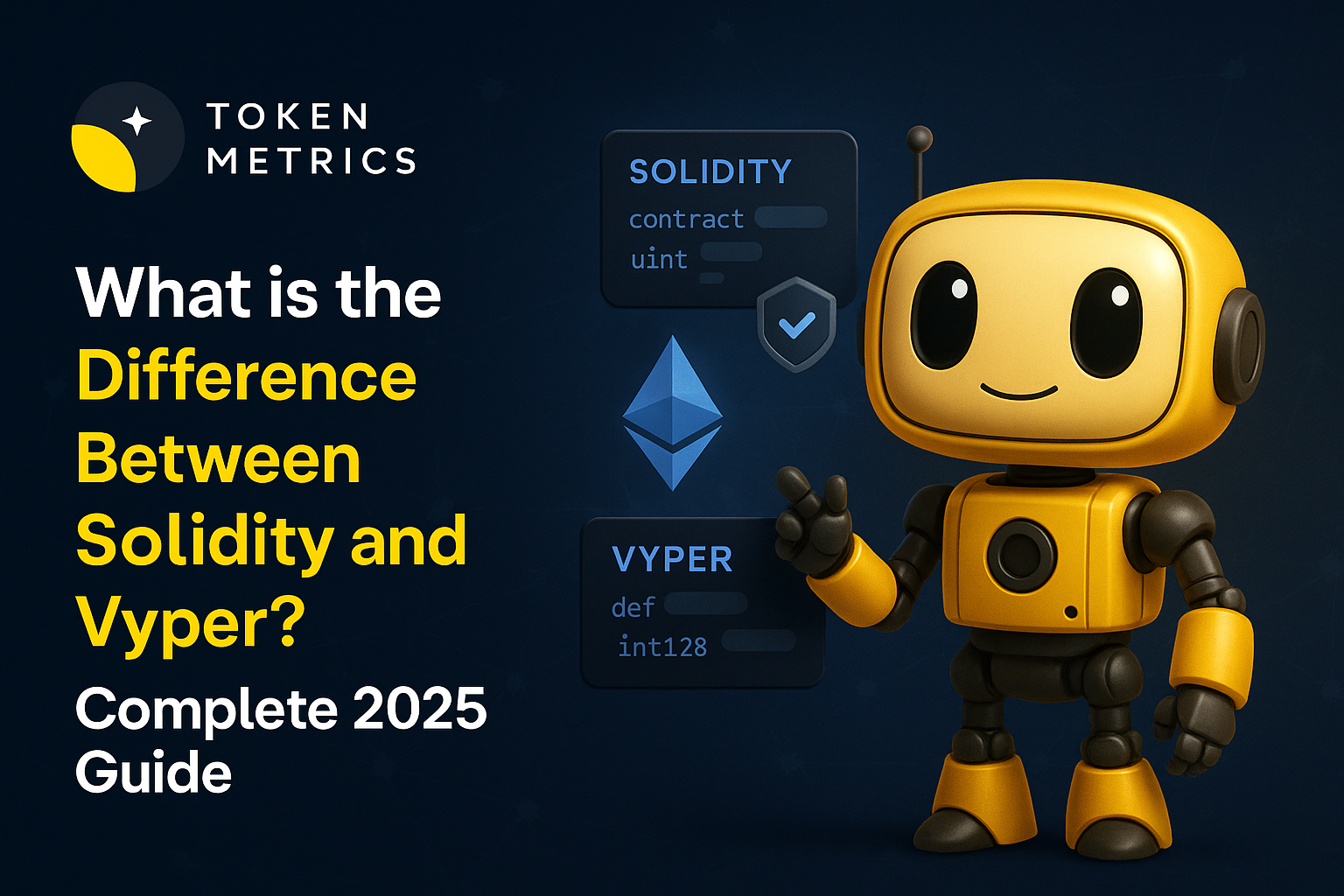
What is the Difference Between Solidity and Vyper? Complete 2025 Guide

Explore the key differences between Solidity and Vyper for Ethereum smart contracts, and learn how to choose the right language for your project in 2025.
Token Metrics Team
7
Want Smarter Crypto Picks—Free?
See unbiased Token Metrics Ratings for BTC, ETH, and top alts.
Thank you! Your submission has been received!
Oops! Something went wrong while submitting the form.
 No credit card | 1-click unsubscribe

Smart contracts have revolutionized the blockchain ecosystem, enabling self-executing code that automatically enforces agreed-upon terms and conditions. As decentralized applications continue growing in sophistication and value, the programming languages used to create these contracts become increasingly critical. Two languages dominate Ethereum smart contract development: Solidity and Vyper. Token Metrics.

Understanding Smart Contract Languages

Before diving into Solidity vs Vyper comparison, it's essential to understand what smart contract languages do and why they matter. Smart contracts are programs that run on blockchain platforms like Ethereum, executing predetermined actions when specific conditions are met. These contracts facilitate secure, transparent, and trustless interactions between parties, eliminating intermediaries and enhancing efficiency.

Smart contract languages enable developers to define the logic and behavior of these contracts, which are immutable and executed on the blockchain. By leveraging smart contract languages, businesses can automate processes including supply chain management, financial transactions, governance systems, and much more.

High-Level vs Low-Level Languages

Smart contract programming requires converting human-readable code into machine-executable bytecode that the Ethereum Virtual Machine (EVM) can process. Developers must first choose between high-level and low-level languages based on their use case and expertise.

High-level languages abstract away granular implementation details, allowing developers to create smart contracts without deep bytecode knowledge. Solidity and Vyper are both high-level languages designed for EVM-compatible blockchains, making them accessible to developers from traditional programming backgrounds.

After compilation, both Solidity and Vyper smart contracts execute using the same bytecode language, meaning they can be used concurrently in the same application despite their different source code appearances.

Solidity: The Industry Standard

Solidity is the most widely used programming language for developing smart contracts on the Ethereum blockchain and EVM-compatible chains. Designed specifically for blockchain applications, Solidity enables developers to create secure, decentralized, and automated agreements that run on distributed networks.

Origins and Design Philosophy

Proposed by Ethereum CTO Gavin Wood, Solidity was developed to meet demand for a flexible smart contract-based developer platform. The language draws heavily on inspiration from C++, JavaScript, and Python, making it familiar to developers from various programming backgrounds.

Solidity is a high-level, Turing-complete, statically typed language where developers must explicitly declare variable types. This allows the compiler to have knowledge of data types, ensuring deterministic application behavior—a critical requirement for blockchain applications where predictability is paramount.

Key Features of Solidity

  • Object-Oriented Programming: Supports inheritance, libraries, and complex data structures for sophisticated smart contracts with reusable components.
  • Rich Feature Set: Includes function overloading, multiple inheritance, user-defined types, and complex data structures.
  • Extensive Ecosystem: Benefits from a large community support, documentation, and development tools like Remix, Hardhat, and Foundry.
  • Blockchain-Specific Commands: Built-in commands for addresses, transactions, and block data interactions.
  • Wide Adoption: Most Ethereum projects, including Uniswap, Aave, and OpenSea, are developed using Solidity.

Advantages of Solidity

  • Market Dominance: Secures 87% of DeFi TVL, making it the dominant language for decentralized finance.
  • Robust Tooling: Mature ecosystem with testing, debugging, and analysis tools.
  • Versatility: Enables implementation of complex protocols, financial instruments, and governance procedures.
  • Learning Resources: Abundant tutorials, courses, and community support.

Disadvantages of Solidity

  • Security Vulnerabilities: Increased attack surface with risks like reentrancy and integer overflows, requiring thorough audits.
  • Complexity: Extensive features can lead to harder-to-audit contracts and hidden vulnerabilities.
  • Steeper Learning Curve: Requires understanding blockchain-specific security considerations.

Vyper: The Security-First Alternative

Vyper is a contract-oriented programming language that targets the EVM with a focus on security, simplicity, and auditability. Introduced in 2018 by Ethereum co-founder Vitalik Buterin, Vyper was specifically developed to address security issues prevalent in Solidity.

Design Philosophy: Security Through Simplicity

Vyper's fundamental philosophy is that security comes from simplicity and readability. The language intentionally limits features and enforces stricter syntax to make contracts more secure and easier to audit. By reducing what’s possible, Vyper minimizes opportunities for mistakes and vulnerabilities.

Using Pythonic syntax—hence the serpentine name—Vyper code prioritizes readability so developers can easily detect bugs and vulnerabilities before deploying contracts. This approach makes code auditable by humans, not just machines.

Key Features of Vyper

  • Python-Like Syntax: Familiar for Python developers, with indentation-based structure and clear syntax.
  • Security-First Design: Eliminates object-oriented features, such as inheritance and function overloading, to reduce attack vectors.
  • Strong Typing: Variables require explicit type declaration, catching errors early.
  • Bounds Checking & Overflow Protection: Built-in safety features prevent common vulnerabilities.
  • Decidability & Gas Optimization: Ensures predictable gas consumption and avoids infinite loops, making contracts more efficient.

Advantages of Vyper

  • Enhanced Security: Designed specifically to prevent common vulnerabilities, leading to more secure contracts.
  • Readable & Audit-Friendly: Clear syntax facilitates quicker reviews and lower audit costs.
  • Concise Code: Fewer lines and simpler syntax streamline contract development.
  • Python Background: Eases onboarding for Python programmers.
  • Potential Gas Savings: Simple design can lead to more efficient contracts in specific cases.

Disadvantages of Vyper

  • Limited Adoption: Only about 8% of DeFi TVL, with a smaller ecosystem and community.
  • Fewer Features: Lack of inheritance, modifiers, and function overloading limits architectural options.
  • Smaller Tooling Ecosystem: Development tools and libraries are less mature compared to Solidity.
  • Less Industry Traction: Major projects predominantly use Solidity, limiting existing examples for Vyper development.

Differences: Solidity vs Vyper

  • Syntax & Structure: Solidity resembles JavaScript and C++, with curly braces and semicolons; Vyper uses Python-like indentation and syntax, omitting object-oriented features.
  • Feature Completeness: Solidity offers inheritance, modifiers, and dynamic data structures; Vyper is minimalist, focusing on security with fixed-size arrays and no inheritance.
  • Security Approach: Solidity relies on developer diligence and testing; Vyper enforces limitations to inherently prevent vulnerabilities.
  • Development Philosophy: Solidity emphasizes flexibility, while Vyper emphasizes security and auditability.

Choosing Between Solidity and Vyper

The decision depends on project needs, team expertise, and security priorities. Large, feature-rich DeFi protocols and complex dApps typically require Solidity's extensive capabilities. Conversely, systems demanding maximum security, or contracts that need to be highly auditable, may benefit from Vyper’s simplicity and security-focused design.

Many projects effectively combine both, using Vyper for security-critical core components and Solidity for peripheral features. This hybrid approach leverages the strengths of each language.

Leveraging Token Metrics for Smart Contract Analysis

While understanding the distinctions between Solidity and Vyper is valuable for developers, investors should also evaluate the projects' underlying code quality, security track record, and development activity. Token Metrics offers AI-powered analytics that examine code repositories, audit statuses, and project activity levels.

The platform reviews security vulnerabilities, audit history, and real-time security incidents, providing a comprehensive view that helps identify projects with strong technical foundations, regardless of their chosen language.

Furthermore, Token Metrics tracks project development activity via GitHub, helping gauge ongoing commitment and progress. Market intelligence and performance analysis reveal success patterns and areas of risk, supporting informed decision-making.

Token Metrics assists investors in balancing portfolios across projects built with different languages, offering risk assessments and alerts that enhance proactive management amid evolving blockchain security landscapes.

The Future of Smart Contract Languages

Both Solidity and Vyper are actively evolving to meet new challenges and security needs. Solidity continues enhancing security features, error handling, and optimization, driven by its large ecosystem. Vyper development emphasizes expanding capabilities while maintaining its core security principles.

Emerging languages and cross-language development strategies are beginning to complement established techniques. Combining secure core contracts in Vyper with the flexibility of Solidity is an increasingly common pattern.

Best Practices for Smart Contract Development

  • Thorough Testing: Implement comprehensive testing, including formal verification and audits, before deployment.
  • Security Audits: Engage reputable security firms to review code vulnerabilities.
  • Continuous Monitoring: Use platforms like Token Metrics for real-time risk detection post-deployment.
  • Upgradeability: Adopt upgrade patterns that allow fixing issues without losing funds or functionality.

Conclusion: Making the Right Choice

Solidity and Vyper offer distinct approaches to smart contract development. Solidity’s comprehensive features and robust ecosystem make it suitable for complex, feature-rich applications. Vyper's security-oriented, Python-like syntax is ideal for systems where auditability, simplicity, and security are top priorities.

Both languages will continue to play vital roles throughout 2025, with many projects adopting hybrid strategies. Evaluating project needs, security considerations, and team expertise will guide optimal language selection. AI analytics platforms like Token Metrics provide critical insights to support this decision, ensuring better understanding and risk management in the ever-evolving ecosystem.

Build Smarter Crypto Apps &
AI Agents in Minutes, Not Months
Real-time prices, trading signals, and on-chain insights all from one powerful API.
Grab a Free API Key
About Token Metrics
Token Metrics: AI-powered crypto research and ratings platform. We help investors make smarter decisions with unbiased Token Metrics Ratings, on-chain analytics, and editor-curated “Top 10” guides. Our platform distills thousands of data points into clear scores, trends, and alerts you can act on.
30 Employees
analysts, data scientists, and crypto engineers
Daily Briefings
concise market insights and “Top Picks”
Transparent & Compliant
Sponsored ≠ Ratings; research remains independent
Want Smarter Crypto Picks—Free?
See unbiased Token Metrics Ratings for BTC, ETH, and top alts.
Thank you! Your submission has been received!
Oops! Something went wrong while submitting the form.
 No credit card | 1-click unsubscribe
Token Metrics Team
Token Metrics Team

Recent Posts

Announcements

AI Crypto Trading with Token Metrics Crypto API and OpenAI Agents SDK: The Future of Autonomous Crypto Intelligence

Token Metrics Team
8 min

Why This Integration Matters

Developer demand for high-fidelity market data has never been higher, and so has the need for agentic AI that can act on that data. Token Metrics delivers one of the best crypto API experiences on the market, streaming tick-level prices, on-chain metrics, and proprietary AI grades across 6,000+ assets. Meanwhile, OpenAI’s new Agents SDK gives engineers a lightweight way to orchestrate autonomous AI workflows—without the overhead of a full UI—by chaining model calls, tools, and memory under a single, developer-friendly abstraction. Together they form a plug-and-play stack for building real-time trading bots, research copilots, and portfolio dashboards that think and act for themselves.

A Quick Primer on the Token Metrics Crypto API & SDK

  • Comprehensive Coverage: Tick-level pricing, liquidity snapshots, and on-chain activity for thousands of tokens.
  • Actionable AI: Trader and Investor Grades fuse technical, on-chain, social, and venture-funding signals into a single score that beats raw price feeds for alpha generation.
  • Ready-Made Signals: Long/short entries and back-tested model outputs arrive via one endpoint—perfect for time-critical agents.
  • Instant Integration: Official Python and TypeScript SDKs handle auth, retries, and pandas helpers so you can prototype in minutes.

Because the service unifies raw market data with higher-level AI insight, many builders call it the token metrics crypto API of choice for agentic applications.

What Sets the OpenAI Agents SDK Apart

Unlike prior frameworks that mixed business logic with UI layers, the Agents SDK is headless by design. You write plain TypeScript (or JavaScript) that:

  1. Defines tools (functions, web-search, file search, or external APIs).
  2. Describes an agent goal and supplies the tools it can call.
  3. Streams back structured steps & final answers so you can trace, test, and fine-tune.

Under the hood, the SDK coordinates multiple model calls, routes arguments to tools, and maintains short-term memory—freeing you to focus on domain logic.

Bridging the Two with the Crypto MCP Server

Token Metrics recently shipped its Crypto MCP Server, a lightweight gateway that normalises every client—OpenAI, Claude, Cursor, VS Code, Windsurf, and more—around a single schema and API key. One paste of your key and the OpenAI Agents SDK can query real-time grades, prices, and signals through the same endpoint used in your IDE or CLI.

Why MCP?
Consistency—every tool sees the same value for “Trader Grade.”
One-time auth—store one key, let the server handle headers.
Faster prototyping—copy code between Cursor and Windsurf without rewriting requests.
Lower cost—shared quota plus TMAI staking discounts.

In fewer than 30 lines you’ve built a self-orchestrating research assistant that pulls live data from the best crypto API and reasons with GPT-4o.

Architecture Under the Hood

  1. Agent Layer – OpenAI Agents SDK manages state, reasoning, and tool routing.
  2. Tool Layer – Each Token Metrics endpoint (prices, grades, signals) is wrapped as an Agents SDK tool.
  3. Data Layer – The MCP Server proxies calls to the Token Metrics REST API, unifying auth and schemas.
  4. Execution Layer – Agents call the tools; tools call MCP; MCP returns JSON; the agent responds.

Because every piece is modular, you can swap GPT-4o for GPT-4.1, add a DEX trading function, or stream outputs to a React dashboard—no core rewrites required.

Performance & Pricing Highlights

  • Free Tier: 5 000 calls/month—ideal for proof-of-concept agents.
  • Premium Tier: 100 000 calls/month and three-year history, unlocking AI Agent endpoints for production workloads.
  • VIP: 500 000 calls/month and unlimited history for institutional desks.

OpenAI usage is metered per token, but the Agents SDK optimises context windows and tool invocations, often yielding lower compute cost than bespoke chains.

Roadmap & Next Steps

Token Metrics is rolling out first-party TypeScript helpers that auto-generate tool schemas from the OpenAPI spec, making tool wrapping a one-liner. On the OpenAI side, Responses API is slated to replace the Assistants API by mid-2026, and the Agents SDK will track that upgrade.

Ready to build your own autonomous finance stack?

  1. Grab a free Token Metrics key → app.tokenmetrics.com
  2. Clone the Agents SDK starter repo → npx degit openai/agents-sdk-starter
  3. Ship something your traders will love.
  4. Watch demo here

The synergy between the Token Metrics crypto API and OpenAI’s Agents SDK isn’t just another integration; it’s the missing link between raw blockchain data and actionable, self-operating intelligence. Tap in today and start letting your agents do the heavy lifting.

Announcements

Token Metrics Crypto API and Windsurf Integration: Unlock Hidden Crypto Signals for Smarter Trading

Token Metrics Team
8 min

In today’s crypto market, raw data isn’t enough. Speed isn’t enough. What you need is insight.

That’s why we’re excited to unveil a game-changing integration: Token Metrics Crypto API now powers an ultra-fast, AI-driven crypto analytics platform—supercharged by Windsurf Coding Agent automation. This isn’t just another crypto dashboard. It’s a real-time intelligence engine designed for traders, funds, and crypto builders who demand an edge.

The Problem with Most Crypto Dashboards

Most crypto dashboards simply pull price data and display it. But serious traders know that price alone doesn’t tell the full story. You need context. You need predictive signals. You need advanced analytics that go beyond surface-level charts.

The Token Metrics Crypto API changes that.

By combining cutting-edge AI models with deep on-chain and market data, the Token Metrics API delivers the kind of actionable intelligence that traditional platforms can’t match.

The Power of Token Metrics API

At the heart of this new platform lies the Token Metrics API — widely regarded by traders and funds as the best crypto API available today.

Here’s why:

✅ Real-Time AI Insights

The Token Metrics API delivers real-time valuations, grades, risk metrics, and momentum signals—powered by sophisticated AI and machine learning models analyzing thousands of crypto assets.

✅ Predictive Token Ratings

Leverage Investor Grade and Trader Grade rankings to see which tokens are gaining momentum — before the market fully reacts.

✅ Quant Metrics & Risk Analysis

Access volatility scores, Sharpe ratios, value-at-risk metrics, and drawdown analysis to manage risk with precision.

✅ Clustering & Sentiment Analysis

Identify hidden relationships between tokens using real-time clustering and on-chain sentiment analysis.

✅ Full Market Coverage

Whether you trade altcoins, L1 ecosystems, DeFi, or memecoins — the Token Metrics Crypto API covers thousands of assets across multiple chains.

This depth of data allows the platform to do far more than just monitor prices — it discovers patterns, clusters, momentum shifts, and early market signals in real-time.

How Windsurf Coding Agent Unlocks New Possibilities

To build a truly responsive and adaptive crypto intelligence platform, we leveraged Windsurf Coding Agent automation. Windsurf allows us to ship new dashboards, signals, and features in hours—not weeks.

As crypto markets evolve rapidly, speed to insight becomes critical. With Windsurf’s agent-driven automation, we can prototype, iterate, and deploy new AI models and data visualizations faster than any traditional development cycle allows.

  • 🔄 New momentum indicators can be developed overnight
  • 🔄 Cluster algorithms can be recalibrated instantly
  • 🔄 Dashboards respond live to market shifts

This makes the entire system fluid, adaptive, and always tuned to the latest market behavior.

Not Just Another Dashboard — A Real-Time AI Engine

This isn’t your average crypto dashboard.

Every data point is analyzed, filtered, and rendered within milliseconds. As soon as the Token Metrics API delivers updated data, the platform processes it through real-time clustering, momentum scoring, and risk analysis.

The result? A blazingly fast, AI-powered crypto dashboard that gives you insights while your competition is still refreshing price feeds.

Platform Highlights:

  • Real-Time Market Trends:
    See market shifts as they happen, not minutes later.

  • Hidden Cluster Discovery:
    Identify which tokens are moving together before major narratives emerge.

  • Smart Momentum Signals:
    Detect early breakout signals across DeFi, AI, RWA, Memes, and other sectors.

  • Token Ratings & Sentiment:
    Get automated Investor Grades, Trader Grades, and community sentiment scoring.

  • Built-in AI Analysis Engine:
    Summary insights are auto-generated by AI to make complex data immediately actionable.

Turning Complexity Into Clarity

Crypto markets generate overwhelming amounts of data — price swings, liquidity changes, on-chain flows, funding rates, sentiment shifts, and more.

The Token Metrics + Windsurf integration filters that noise into clear, actionable signals. Whether you’re:

  • A crypto fund manager seeking alpha
  • An algorithmic trader hunting momentum
  • A community builder wanting to inform your Discord or Telegram group
  • A developer creating your own crypto trading bots or dashboards

... this platform turns complexity into clarity.

The signal is out there. We help you find it.

Why Token Metrics API is the Best Crypto API for Builders

When evaluating crypto APIs, most traders and developers face the same issues: incomplete data, poor documentation, limited endpoints, or stale updates. The Token Metrics API stands apart as the best crypto API for several key reasons:

1️⃣ Comprehensive Data Coverage

The Token Metrics API covers over 6,000 crypto assets across major chains, sectors, and narratives.

2️⃣ AI-Driven Metrics

Unlike other crypto APIs that only provide raw market data, Token Metrics delivers pre-calculated AI insights including:

  • Trader & Investor Grades
  • Bullish/Bearish Signals
  • Quantitative Rsk Metrics
  • Sentiment Scores
  • Support & Resistance Levels

3️⃣ Developer Friendly

The API is fully documented, REST-based, and easily integrates with platforms like Windsurf, Zapier, and custom trading systems.

4️⃣ Instant Updates

Data is refreshed continuously to ensure you’re always working with the latest available insights.

This makes the Token Metrics crypto API ideal for:

  • Building automated trading agents
  • Developing AI-powered dashboards
  • Running quant research pipelines
  • Powering Discord/Telegram trading bots
  • Creating crypto advisory tools for funds or DAOs

Example Use Case: Proactive Cluster Monitoring

Imagine this:

You’re managing a portfolio with exposure to several DeFi tokens. The platform detects that several mid-cap DeFi projects are clustering together with rising momentum scores and improving Investor Grades. Within seconds, your dashboard flashes an early “sector breakout” signal.

By the time social media narratives catch on hours or days later — you’re already positioned.

This is the edge that real-time AI-driven analytics delivers.

What You Can Build With Token Metrics API + Windsurf

The possibilities are nearly endless:

  • Fully autonomous AI trading agents
  • Real-time risk management dashboards
  • Community-facing Discord or Telegram bots
  • Investor-grade weekly market reports
  • Live streaming momentum monitors
  • Institutional quant analysis tools

And because Windsurf Coding Agent automates development, these solutions can evolve rapidly as new narratives, tokens, and market behaviors emerge.

Start Building Your Edge Today

If you’re serious about staying ahead in crypto, you need more than just prices—you need intelligence.

The combination of Token Metrics API and Windsurf’s automation delivers the fastest, smartest way to build your own crypto intelligence systems.

➤ Sign up for Token Metrics

➤ Get API access

➤ Start building with Windsurf
‍
Turn data into insights. Turn insights into profits.

Click here to view the demo!

Conclusion: The Future of Crypto Analytics Is Here

The days of static dashboards and delayed signals are over. The future belongs to platforms that deliver real-time, AI-powered, adaptive crypto intelligence.

With Token Metrics Crypto API and Windsurf Coding Agent, you have the tools to build that future—today.

Announcements

Build AI-Powered Crypto Trading Bots in Minutes: Token Metrics Partners with Cline for Seamless Crypto API Integration

Token Metrics Team
8 min

Combine the Best Crypto API with Cline’s AI Coding Environment to Automate Smarter Trades—Faster

The world of crypto development just leveled up.

We're excited to announce a powerful new integration between Token Metrics and Cline (via the Roo Code extension)—bringing together the most advanced crypto API on the market and an AI-native coding environment purpose-built for building and testing crypto trading bots.

This partnership unlocks the ability to rapidly prototype, test, and launch intelligent trading strategies using real-time data from Token Metrics directly inside Cline, making it easier than ever for developers and traders to build in the crypto economy.

In this post, we’ll show you exactly how this works, walk through a working example using the Hyperliquid token, and explain why Token Metrics is the best crypto API to use with Cline for next-gen trading automation.

What Is Cline (Roo Code)?

Cline is an AI-first coding assistant designed to turn ideas into code through conversational prompts. With the Roo Code extension in Visual Studio Code, Cline transforms your IDE into an AI-native environment, allowing you to:

  • Write and debug code using natural language
  • Chain tools and APIs together with zero setup
  • Backtest and optimize strategies within a single flow

By integrating Token Metrics’ cryptocurrency API through its MCP (Multi-Client Protocol) server, developers can access real-time grades, trading signals, quant metrics, and risk insights—all through AI-driven prompts.

This combo of live crypto data and AI-native coding makes Cline one of the fastest ways to build trading bots today.

What Is Token Metrics MCP & API?

The Token Metrics API is the ultimate toolkit for crypto developers. It's a high-performance, developer-focused crypto API that gives you:

  • AI-powered Trader & Investor Grades
  • Buy/Sell Signals for bull/bear market detection
  • Support & Resistance Levels
  • Sentiment Analysis
  • Quantitative Metrics including ROI, performance vs. BTC, and more
  • Full Token Reports & Rankings

These features are now accessible via the MCP server—a gateway that standardizes access to Token Metrics data for AI agents, bots, dashboards, and more.

Whether you’re building a Telegram bot, a trading terminal, or a portfolio optimizer, the Token Metrics MCP setup with Cline makes it seamless.

Step-by-Step: Build a Trading Bot in Cline Using Token Metrics

Here’s a walkthrough of how you can build a complete AI-powered trading bot using Cline and the Token Metrics API.

1. Set Up Your Project in Visual Studio Code

Open VS Code and click “Open Folder.” Name your project something fun—like “Hype Bot.”
Then go to the Extensions tab, search for “Roo Code” (the advanced version of Cline), and install it.

2. Connect to the Token Metrics MCP Server

Once installed:

  • Click the MCP icon in the sidebar.
  • Choose “Edit Global MCP.”
  • Visit the official Token Metrics MCP Instructions and copy the full configuration block.
  • Paste it into your global MCP settings in Cline.

🎉 Now your environment is live, and you’re connected to the best crypto API on the market.

3. Explore the API with a Prompt

Inside Cline, simply prompt:

“Explore the Token Metrics API and analyze the Hyperliquid token.”

In seconds, the agent fetches and returns detailed insights—including investor grade, sentiment shifts, trading volume, and support/resistance levels for Hyperliquid. It even detects patterns not visible on typical trading platforms.

4. Generate a Trading Strategy

Next prompt:

“Create a trading strategy using this data.”

The agent responds with a full Python trading script based on AI signals from the API—complete with buy/sell logic, thresholds, and data pipelines.

5. Run Backtests and Analyze Performance

Cline automatically generates a backtest file and plots a performance chart.

For example:

  • Portfolio grew from $10,000 to $10,600
  • 27 trades, with an 18.5% win rate
  • Maximum drawdown of 14%
  • Realistic insights into risk-adjusted returns

This is real-time data, real code, real results—all built through a few smart prompts.

Why This Partnership Matters

🔗 Natural-Language-Powered Crypto Development

No more hours spent reading docs or integrating messy SDKs. With Cline + Token Metrics, you talk to your agent, and it builds the bot, fetches the data, and runs the strategy.

⚙️ Best-in-Class Crypto Market Intelligence

Token Metrics provides professional-grade market signals used by hedge funds, traders, and analysts. With 80+ metrics per token, it’s the most detailed cryptocurrency API available—now accessible to indie devs and builders via Cline.

⚡ Build, Test, Iterate—Fast

Backtesting, strategy generation, and data access happen within seconds. This drastically cuts time-to-market for MVPs, AI assistants, and algo bots.

Use Cases You Can Build

  • Hype Token Trading Bots – Surf emerging narratives like Memecoins, RWA, or AI.
  • Risk-Managed Portfolios – Adjust exposure based on grades and market phases.
  • Discord/Telegram Bots – Stream top-performing tokens with real-time buy alerts.
  • CEX/DEX Strategy Automation – Monitor performance across centralized and decentralized exchanges.
  • Quant Research Dashboards – Power internal tools with Token Metrics data for investment committees or research teams.

Why Token Metrics Is the Best Crypto API for Cline Developers

  • ✅ Built for AI Workflows – Easy to use via prompts, structured for agent consumption.
  • ✅ Real-Time Coverage – Stay updated on narrative-driven tokens before they pump.
  • ✅ Secure & Scalable – Use API keys, MCP servers, and secure backtest environments.
  • ✅ Free to Start – Includes 5,000 free API calls so you can build before committing.

Final Thoughts

The future of building in crypto is agent-driven, data-rich, and fast.

This integration between Token Metrics and Cline proves that with the right tools, anyone can turn an idea into a trading bot in under 10 minutes—using real-time market data, AI-grade analysis, and seamless backtesting in one workflow.

No manual coding. No noise. Just results.

Start building smarter bots today:
👉 Get your API Key on Token Metrics
👉 Install Roo Code and connect Cline

Watch demo here!

Let’s build the next generation of crypto trading together.

Choose from Platinum, Gold, and Silver packages
Reach with 25–30% open rates and 0.5–1% CTR
Craft your own custom ad—from banners to tailored copy
Perfect for Crypto Exchanges, SaaS Tools, DeFi, and AI Products