Back to blog
Research

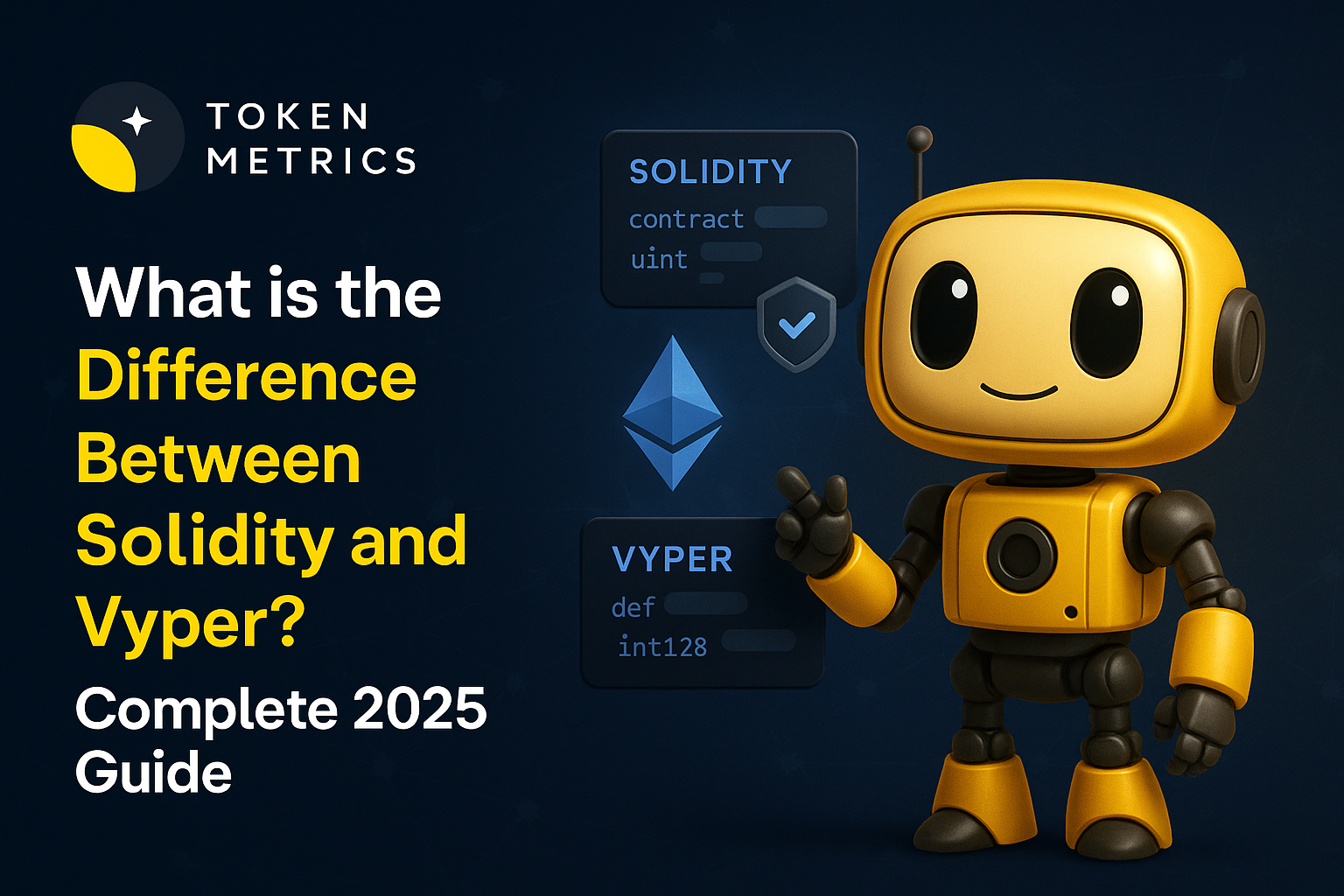
What is the Difference Between Solidity and Vyper? Complete 2025 Guide

Explore the key differences between Solidity and Vyper for Ethereum smart contracts, and learn how to choose the right language for your project in 2025.
Token Metrics Team
7
Want Smarter Crypto Picks—Free?
See unbiased Token Metrics Ratings for BTC, ETH, and top alts.
Thank you! Your submission has been received!
Oops! Something went wrong while submitting the form.
 No credit card | 1-click unsubscribe

Smart contracts have revolutionized the blockchain ecosystem, enabling self-executing code that automatically enforces agreed-upon terms and conditions. As decentralized applications continue growing in sophistication and value, the programming languages used to create these contracts become increasingly critical. Two languages dominate Ethereum smart contract development: Solidity and Vyper. Token Metrics.

Understanding Smart Contract Languages

Before diving into Solidity vs Vyper comparison, it's essential to understand what smart contract languages do and why they matter. Smart contracts are programs that run on blockchain platforms like Ethereum, executing predetermined actions when specific conditions are met. These contracts facilitate secure, transparent, and trustless interactions between parties, eliminating intermediaries and enhancing efficiency.

Smart contract languages enable developers to define the logic and behavior of these contracts, which are immutable and executed on the blockchain. By leveraging smart contract languages, businesses can automate processes including supply chain management, financial transactions, governance systems, and much more.

High-Level vs Low-Level Languages

Smart contract programming requires converting human-readable code into machine-executable bytecode that the Ethereum Virtual Machine (EVM) can process. Developers must first choose between high-level and low-level languages based on their use case and expertise.

High-level languages abstract away granular implementation details, allowing developers to create smart contracts without deep bytecode knowledge. Solidity and Vyper are both high-level languages designed for EVM-compatible blockchains, making them accessible to developers from traditional programming backgrounds.

After compilation, both Solidity and Vyper smart contracts execute using the same bytecode language, meaning they can be used concurrently in the same application despite their different source code appearances.

Solidity: The Industry Standard

Solidity is the most widely used programming language for developing smart contracts on the Ethereum blockchain and EVM-compatible chains. Designed specifically for blockchain applications, Solidity enables developers to create secure, decentralized, and automated agreements that run on distributed networks.

Origins and Design Philosophy

Proposed by Ethereum CTO Gavin Wood, Solidity was developed to meet demand for a flexible smart contract-based developer platform. The language draws heavily on inspiration from C++, JavaScript, and Python, making it familiar to developers from various programming backgrounds.

Solidity is a high-level, Turing-complete, statically typed language where developers must explicitly declare variable types. This allows the compiler to have knowledge of data types, ensuring deterministic application behavior—a critical requirement for blockchain applications where predictability is paramount.

Key Features of Solidity

  • Object-Oriented Programming: Supports inheritance, libraries, and complex data structures for sophisticated smart contracts with reusable components.
  • Rich Feature Set: Includes function overloading, multiple inheritance, user-defined types, and complex data structures.
  • Extensive Ecosystem: Benefits from a large community support, documentation, and development tools like Remix, Hardhat, and Foundry.
  • Blockchain-Specific Commands: Built-in commands for addresses, transactions, and block data interactions.
  • Wide Adoption: Most Ethereum projects, including Uniswap, Aave, and OpenSea, are developed using Solidity.

Advantages of Solidity

  • Market Dominance: Secures 87% of DeFi TVL, making it the dominant language for decentralized finance.
  • Robust Tooling: Mature ecosystem with testing, debugging, and analysis tools.
  • Versatility: Enables implementation of complex protocols, financial instruments, and governance procedures.
  • Learning Resources: Abundant tutorials, courses, and community support.

Disadvantages of Solidity

  • Security Vulnerabilities: Increased attack surface with risks like reentrancy and integer overflows, requiring thorough audits.
  • Complexity: Extensive features can lead to harder-to-audit contracts and hidden vulnerabilities.
  • Steeper Learning Curve: Requires understanding blockchain-specific security considerations.

Vyper: The Security-First Alternative

Vyper is a contract-oriented programming language that targets the EVM with a focus on security, simplicity, and auditability. Introduced in 2018 by Ethereum co-founder Vitalik Buterin, Vyper was specifically developed to address security issues prevalent in Solidity.

Design Philosophy: Security Through Simplicity

Vyper's fundamental philosophy is that security comes from simplicity and readability. The language intentionally limits features and enforces stricter syntax to make contracts more secure and easier to audit. By reducing what’s possible, Vyper minimizes opportunities for mistakes and vulnerabilities.

Using Pythonic syntax—hence the serpentine name—Vyper code prioritizes readability so developers can easily detect bugs and vulnerabilities before deploying contracts. This approach makes code auditable by humans, not just machines.

Key Features of Vyper

  • Python-Like Syntax: Familiar for Python developers, with indentation-based structure and clear syntax.
  • Security-First Design: Eliminates object-oriented features, such as inheritance and function overloading, to reduce attack vectors.
  • Strong Typing: Variables require explicit type declaration, catching errors early.
  • Bounds Checking & Overflow Protection: Built-in safety features prevent common vulnerabilities.
  • Decidability & Gas Optimization: Ensures predictable gas consumption and avoids infinite loops, making contracts more efficient.

Advantages of Vyper

  • Enhanced Security: Designed specifically to prevent common vulnerabilities, leading to more secure contracts.
  • Readable & Audit-Friendly: Clear syntax facilitates quicker reviews and lower audit costs.
  • Concise Code: Fewer lines and simpler syntax streamline contract development.
  • Python Background: Eases onboarding for Python programmers.
  • Potential Gas Savings: Simple design can lead to more efficient contracts in specific cases.

Disadvantages of Vyper

  • Limited Adoption: Only about 8% of DeFi TVL, with a smaller ecosystem and community.
  • Fewer Features: Lack of inheritance, modifiers, and function overloading limits architectural options.
  • Smaller Tooling Ecosystem: Development tools and libraries are less mature compared to Solidity.
  • Less Industry Traction: Major projects predominantly use Solidity, limiting existing examples for Vyper development.

Differences: Solidity vs Vyper

  • Syntax & Structure: Solidity resembles JavaScript and C++, with curly braces and semicolons; Vyper uses Python-like indentation and syntax, omitting object-oriented features.
  • Feature Completeness: Solidity offers inheritance, modifiers, and dynamic data structures; Vyper is minimalist, focusing on security with fixed-size arrays and no inheritance.
  • Security Approach: Solidity relies on developer diligence and testing; Vyper enforces limitations to inherently prevent vulnerabilities.
  • Development Philosophy: Solidity emphasizes flexibility, while Vyper emphasizes security and auditability.

Choosing Between Solidity and Vyper

The decision depends on project needs, team expertise, and security priorities. Large, feature-rich DeFi protocols and complex dApps typically require Solidity's extensive capabilities. Conversely, systems demanding maximum security, or contracts that need to be highly auditable, may benefit from Vyper’s simplicity and security-focused design.

Many projects effectively combine both, using Vyper for security-critical core components and Solidity for peripheral features. This hybrid approach leverages the strengths of each language.

Leveraging Token Metrics for Smart Contract Analysis

While understanding the distinctions between Solidity and Vyper is valuable for developers, investors should also evaluate the projects' underlying code quality, security track record, and development activity. Token Metrics offers AI-powered analytics that examine code repositories, audit statuses, and project activity levels.

The platform reviews security vulnerabilities, audit history, and real-time security incidents, providing a comprehensive view that helps identify projects with strong technical foundations, regardless of their chosen language.

Furthermore, Token Metrics tracks project development activity via GitHub, helping gauge ongoing commitment and progress. Market intelligence and performance analysis reveal success patterns and areas of risk, supporting informed decision-making.

Token Metrics assists investors in balancing portfolios across projects built with different languages, offering risk assessments and alerts that enhance proactive management amid evolving blockchain security landscapes.

The Future of Smart Contract Languages

Both Solidity and Vyper are actively evolving to meet new challenges and security needs. Solidity continues enhancing security features, error handling, and optimization, driven by its large ecosystem. Vyper development emphasizes expanding capabilities while maintaining its core security principles.

Emerging languages and cross-language development strategies are beginning to complement established techniques. Combining secure core contracts in Vyper with the flexibility of Solidity is an increasingly common pattern.

Best Practices for Smart Contract Development

  • Thorough Testing: Implement comprehensive testing, including formal verification and audits, before deployment.
  • Security Audits: Engage reputable security firms to review code vulnerabilities.
  • Continuous Monitoring: Use platforms like Token Metrics for real-time risk detection post-deployment.
  • Upgradeability: Adopt upgrade patterns that allow fixing issues without losing funds or functionality.

Conclusion: Making the Right Choice

Solidity and Vyper offer distinct approaches to smart contract development. Solidity’s comprehensive features and robust ecosystem make it suitable for complex, feature-rich applications. Vyper's security-oriented, Python-like syntax is ideal for systems where auditability, simplicity, and security are top priorities.

Both languages will continue to play vital roles throughout 2025, with many projects adopting hybrid strategies. Evaluating project needs, security considerations, and team expertise will guide optimal language selection. AI analytics platforms like Token Metrics provide critical insights to support this decision, ensuring better understanding and risk management in the ever-evolving ecosystem.

Build Smarter Crypto Apps &
AI Agents in Minutes, Not Months
Real-time prices, trading signals, and on-chain insights all from one powerful API.
Grab a Free API Key
About Token Metrics
Token Metrics: AI-powered crypto research and ratings platform. We help investors make smarter decisions with unbiased Token Metrics Ratings, on-chain analytics, and editor-curated “Top 10” guides. Our platform distills thousands of data points into clear scores, trends, and alerts you can act on.
30 Employees
analysts, data scientists, and crypto engineers
Daily Briefings
concise market insights and “Top Picks”
Transparent & Compliant
Sponsored ≠ Ratings; research remains independent
Want Smarter Crypto Picks—Free?
See unbiased Token Metrics Ratings for BTC, ETH, and top alts.
Thank you! Your submission has been received!
Oops! Something went wrong while submitting the form.
 No credit card | 1-click unsubscribe
Token Metrics Team
Token Metrics Team

Recent Posts

Crypto Basics

Best Play to Earn Crypto Games for Passive Income in 2024

Marcus K
5 Minutes

Click here to buy Cryptocurrencies from Gate.io

In recent years, a new trend has emerged in the gaming industry - play to earn crypto games. These innovative games allow players to have fun and earn real money by participating in gameplay and achieving specific milestones. 

With the rise of blockchain technology and the growing popularity of cryptocurrencies, play to earn games have gained significant traction among gamers worldwide.

The Rise of Play to Earn Crypto Games

Play to earn crypto games has revolutionized the traditional gaming landscape by introducing the concept of earning real-world value through gameplay. 

Unlike traditional video games, where players are limited to in-game rewards and achievements, play to earn games offer tangible rewards in the form of cryptocurrencies and non-fungible tokens (NFTs). These rewards can be traded, sold, or exchanged for fiat currency.

The concept of play to earn games originated from the world of cryptocurrencies, where decentralized finance (DeFi) protocols incentivize users to participate and contribute to the network.

This concept was then integrated into the gaming industry, creating a new genre of games that combined entertainment with financial rewards.

How Play to Earn Games Work?

Play to earn games function through blockchain technology, which ensures transparency, security, and immutability. The game assets, such as characters, items, and in-game currencies, are tokenized as NFTs and stored on a blockchain.

It enables players to have true ownership over their in-game assets and the ability to trade or sell them on various marketplaces.

Players earn rewards in play to earn games by completing tasks, achieving goals, or participating in in-game competitions. These rewards are often in the form of cryptocurrencies, which can be staked, traded, or sold for profit. The earning potential in play to earn games is directly tied to the player's skill, dedication, and participation.

Top Play-to-Earn Crypto Games

A Play-to-Earn of play-to-earn crypto games are available in the market, each offering unique gameplay and earning opportunities. Let's take a closer look at some of the best play to earn games that have gained popularity among gamers:

1. Big Time

Big Time is a revolutionary role-playing game immersing players in the captivating world of Time’s End. Groups of six collaborate to undertake missions in dungeons, acquiring NFTs and tokens with substantial trading value. 

The game's genesis aligns with blockchain-based gaming, focusing on an engaging and social experience without significant financial commitment. The esteemed development team includes figures from Decentraland and notable titles like Fortnite. 

The fusion of immersive gameplay, cryptocurrency incentives, and an illustrious development team positions Big Time as a compelling prospect for gaming and digital asset enthusiasts.

2. Axie Infinity

Axie Infinity is a Pokemon-inspired game built on the Ethereum blockchain. In this game, players collect and breed digital creatures called Axies, which can be battled against other players. 

Players earn Smooth Love Potion (SLP) tokens for winning battles, which can be traded for other cryptocurrencies or sold for fiat currency. Axie Infinity has gained a massive following and has become one of the most successful play to earn games to date.

3. The Sandbox

The Sandbox is a multiplayer metaverse game that allows players to create, own, and monetize their virtual worlds. Players can buy virtual land, build structures, create art, and even host events within their virtual space. 

The Sandbox operates on the Ethereum and Polygon blockchains, and players can earn the game's native token, SAND, by participating and contributing to the ecosystem.

Click here to buy Cryptocurrencies from Gate.io

4. Decentraland

Decentraland is a virtual reality platform where players can explore, interact, and create their own digital experiences. Players can buy virtual land, build and monetize their creations, and engage in social activities with other players. 

Decentraland operates on the Ethereum blockchain, and players can earn the game's native token, MANA, by participating in events and games or trading virtual assets.

5. Splinterlands

Splinterlands is a trading card game that allows players to collect, trade, and battle with digital cards. Each card is represented as an NFT, and players can earn in-game rewards by winning battles and completing quests. 

Splinterlands operates on the HIVE and WAX blockchains, and players can trade their digital cards for other cryptocurrencies or sell them on various marketplaces.

6. Illuvium

Illuvium is an open-world adventure game where players capture and battle mythical creatures called Illuvials. Players can earn the game's native token, ILV, by completing quests, battling other players, and participating in in-game events. Illuvium offers a unique gameplay experience and has gained attention for its stunning visuals and immersive storytelling.

7. Revv Racing

Revv Racing is a multiplayer racing game that combines arcade-style gameplay with blockchain technology. Players can collect and race NFT cars, participate in tournaments, and earn rewards for their performance. Revv Racing operates on the Ethereum blockchain, and players can trade their NFT cars on various marketplaces.

8. Battle of Guardians

Battle of Guardians is a real-time multiplayer game where players battle with mythical creatures in epic battles. Players can earn the game's native token, BGS, by participating in battles, completing quests, and achieving high ranks. 

Battle of Guardians operates on the Solana and Binance Smart Chain blockchains, and players can trade their in-game assets for other cryptocurrencies or sell them on supported marketplaces.

9. My Neighbor Alice

My Neighbor Alice is a farming-based game where players can own virtual land, cultivate crops, and interact with other players. Players can earn rewards by participating in farming activities and trading virtual assets on the game's marketplace. 

My Neighbor Alice operates on the Chromia blockchain, and players can earn the game's native token, ALICE, by contributing to the game's ecosystem.

The Future of Play to Earn Crypto Games

Play to earn crypto games has witnessed tremendous growth in recent years, and the trend is expected to continue in the future. As blockchain technology becomes more mainstream and cryptocurrencies gain wider adoption, play to earn games are likely to attract more players and offer even more lucrative earning opportunities.

The integration of blockchain technology provides players with true ownership and control over their in-game assets, creating a sense of value and empowerment. 

Moreover, play to earn games offer a unique opportunity for players to monetize their gaming skills and dedication, bridging the gap between the virtual and real worlds.

In conclusion, play to earn crypto games have brought a new dimension to the gaming industry, allowing players to have fun and make real money simultaneously. 

With a wide range of games available across different genres and blockchain platforms, players have ample opportunities to explore and participate in this exciting and profitable gaming trend. So, why not dive into the world of play to earn games and start earning while doing what you love?

Disclaimer

The information provided on this website does not constitute investment advice, financial advice, trading advice, or any other advice, and you should not treat any of the website's content as such.

Token Metrics does not recommend buying, selling, or holding any cryptocurrency. Conduct your due diligence and consult your financial advisor before making investment decisions.

Click here to buy Cryptocurrencies from Gate.io

Crypto Basics

Litecoin (LTC) Price Prediction 2025, 2030 - Forecast Analysis

S. Vishwa
5 Minutes

Click here to buy Cryptocurrencies from Gate.io

The cryptocurrency market has been experiencing significant expansion with the introduction of numerous high-potential cryptocurrencies. 

Among these digital assets, Litecoin has emerged as one of the few with demonstrated significant potential in recent years. In this comprehensive article, we will delve into the world of Litecoin (LTC) and analyze its price prediction for the coming years. 

With a focus on both short and long-term forecasts, we will explore various market scenarios and expert opinions to provide you with a holistic view of the future of LTC.

Litecoin Overview

Litecoin, often referred to as the "silver to Bitcoin's gold," is a well-established cryptocurrency that has been active for over nine years. With a solid technical foundation, Litecoin has managed to secure its position as one of the top 30 cryptocurrencies by market cap. 

Despite recent discussions around its declining popularity, Litecoin continues demonstrating resilience and potential for future growth.

Historical Performance of Litecoin

To understand the potential future performance of Litecoin, it is essential to examine its historical price movements. Over the course of the past year, Litecoin experienced a predominantly bullish market sentiment, with buyers dominating the scene. 

However, towards the end of the period, sellers started to exert more influence, leading to a decline in price.

Starting from a modest base of $51.32, Litecoin steadily climbed to its peak at $100.96 by January. This resistance level was rigorously tested until July, with occasional breaches that couldn't be sustained.

Litecoin Price Chart
Image Source - Token Metrics

As July progressed, a decline began, reflecting increased selling pressure. Despite these fluctuations, Litecoin managed to maintain support levels, albeit with some retracements along the way.

Litecoin Current Fundamentals

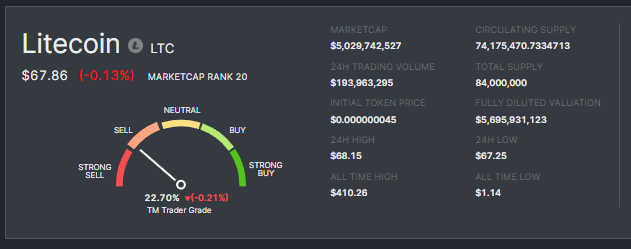
Before diving into the price predictions, let's examine the current fundamentals of Litecoin. Currently, Litecoin's price is around $67.86 and has a market capitalization of $5,029,742,527.

The 24-hour price change is -0.13%, indicating a slight decline. The Fear & Greed Index suggests a moderate level of market sentiment.

Litecoin Tokenomics
Image Source - Token Metrics

Litecoin (LTC) Price Prediction - Scenario Analysis

To forecast Litecoin's future price, it is crucial to consider multiple scenarios based on different market conditions and expert opinions. Let's explore some potential price predictions for Litecoin.

Litecoin (LTC) Price Prediction - Bullish Market Scenario

In a bullish market scenario where positive market sentiment prevails, Litecoin's price has the potential to experience significant growth. Several factors could contribute to this bullish trend, including increased adoption, technological advancements, and positive regulatory developments.

If the crypto market cap hits $3 Trillion and Litecoin retains its current 0.29% dominance, its price could ascend to $118.06.

In a more bullish scenario of the crypto market surging to $10 Trillion, Litecoin's price could soar to a staggering $393.56, resulting in a potential 7x return for investors.

It is important to note that these predictions are based on various factors and assumptions, and market conditions can change rapidly. However, bullish market sentiment and increased adoption of Litecoin's solutions could drive its price to new heights.

Litecoin Price Prediction
Start Your Free Trial Today and Uncover Your Token's Price Prediction and Forecast on Token Metrics

Litecoin (LTC) Price Prediction - Bearish Market Scenario

In the event of a bearish market, Litecoin's price could experience a correction, potentially leading to a decrease in its value. In this case, the price of Litecoin may face downward pressure with a decreased dominance of 0.14%.

In this scenario, If the crypto market cap hits $3 Trillion, Litecoin could trade around $59.03 in the short term and struggle to surpass $196.78 by 2030 even if the total crypto market cap surpasses the $10 Trillion mark.

It is crucial to consider the potential risks and challenges that Litecoin may face. Factors such as regulatory developments, competition from other projects, and technological advancements can affect the growth trajectory of Litecoin.

Also Read - Next Crypto Bull Run

Click here to buy Cryptocurrencies from Gate.io

Litecoin Price Prediction - Industry Expert Opinion

To provide a more comprehensive view, let's explore the opinions of industry experts regarding the future of Litecoin.

According to various experts in the cryptocurrency field, Litecoin holds promise as a long-term investment. Its solid technical foundation, active development community, and widespread adoption contribute to its potential for growth. 

Some experts believe that the reduced supply of new Litecoin entering the market due to the halving event could create upward pressure on prices in the long run.

The Coincodex platform predicts Litecoin could reach $139.89 to $483.89 by 2030, and experts from Changelly forecast that it could reach minimum and maximum prices of $142.22 and $178.31 by the end of 2025. By the end of 2030, the price of Litecoin could reach $880.42 to $1,041.87.

Other industry analysts have varying opinions on the future price of Litecoin. Ambcrypto.com predicts that Litecoin could reach $164.82 to $247.22 by 2030.

Note - Start Your Free Trial Today and Uncover Your Token's Price Prediction and Forecast on Token Metrics.

Litecoin's Current Developments and Future Potential

Litecoin continues to evolve and adapt to the changing landscape of the cryptocurrency market. The Litecoin Foundation, along with its dedicated development community, is actively working on various initiatives to enhance the usability and scalability of the network. 

Recent developments include the implementation of privacy features, integration with existing payment systems, and exploring partnerships with major players in the industry.

Looking ahead, Litecoin has the potential to carve out a distinct niche in the cryptocurrency market. Its fast transaction times, lower fees, and strong community support make it an attractive option for both users and investors. 

However, market conditions and competition from other cryptocurrencies should be closely monitored to assess Litecoin's future potential.

Also Read - Ripple (XRP) Price Prediction

Conclusion

In conclusion, the future of Litecoin holds both opportunities and challenges. Based on historical performance and expert opinions, Litecoin has the potential to experience significant growth in the coming years. 

However, it is important to approach cryptocurrency investments with caution and conduct thorough research before making any decisions. 

The cryptocurrency market is highly volatile, and factors such as market sentiment, regulatory changes, and technological advancements can influence the price of Litecoin and other cryptocurrencies. Investors can make more informed decisions regarding their investment strategies by staying informed and seeking professional advice.

Disclaimer

The information provided on this website does not constitute investment advice, financial advice, trading advice, or any other advice, and you should not treat any of the website's content as such.

Token Metrics does not recommend buying, selling, or holding any cryptocurrency. Conduct your due diligence and consult your financial advisor before making investment decisions.

Click here to buy Cryptocurrencies from Gate.io

Crypto Basics

Top Low Cap Altcoins of 2024 - Token Metrics Moon Awards

Token Metrics Team
11 Minutes

Welcome to the Token Metrics Moon Awards, a prestigious accolade in the cryptocurrency industry, recognizing platforms and projects that have made substantial contributions to the space. 

As a data-driven investment research platform, Token Metrics meticulously conducts these awards to acknowledge the best crypto platforms of the year, utilizing extensive survey data from its robust crypto community.

Today, we will look into a new category of Moon Awards and honor the top Low-cap Altcoins projects of 2024 that have garnered significant support from crypto enthusiasts and investors in our survey.

How We Select These Low-cap Altcoins?

At Token Metrics, we highly value our audience and consider them our most valuable asset. This community-driven approach ensures that the awards reflect real-world opinions and experiences of crypto enthusiasts. 

Through the Moon Awards, Token Metrics amplifies the voice of its community, offering a transparent and user-centric evaluation of platforms that are driving the industry forward.

In collaboration with our community members and users' votes, we have curated a comprehensive list of the top Low-cap Altcoins 2024 based on survey input and votes.

In this article, we will explore the best Low-cap Altcoins that have great potential. These projects have been carefully selected based on their technology, potential, and community votes. We'll dive deep into each project, highlighting their unique features and the reasons why they deserve your attention.

Low-cap Altcoins - An Overview

Low-cap Altcoins refers to alternative cryptocurrencies with relatively low market capitalization compared to larger, more established digital currencies like Bitcoin and Ethereum. These coins are often considered high-risk, high-reward investments due to their potential for significant price swings.

While Low-cap Altcoins can offer substantial returns, they also carry greater volatility and liquidity risks. Investors are drawn to these assets for their potential to outperform larger cryptocurrencies, albeit with higher uncertainty. 

Researching the technology, team, and use case of Low-cap Altcoins is crucial before considering the investment, as thorough due diligence is essential in this often speculative market.

List of Top Low-cap Altcoins of 2024

Top Low Cap Altcoins 2024 - Token Metrics Moon Awards
Resource - Token Metrics Moon Awards

1. Astra DAO

In the Moon Awards survey, Astra DAO secured the top position with 21.8% of the total votes.

Astra DAO is a blockchain platform that offers crypto indices and launchpads. With its exclusive partnership with Token Metrics, Astra DAO provides investors with access to AI indices and curated token sales. 

As a Token Metrics Ventures portfolio company, Astra DAO has the backing of experienced investors and a strong network. 

With a low market cap of $6 million, Astra DAO presents an opportunity for early investors looking to capitalize on the growing demand for crypto indices and curated token sales. The platform's unique features and strategic partnerships make it an attractive investment option.

2. GameSwift

In the Moon Awards survey, GameSwift secured the 2nd position with 12.7% of the total votes.

GameSwift is a Token Metrics Ventures portfolio company that has seen remarkable growth. With a 50x return in just one year, GameSwift is a prime example of the potential of Low-cap Altcoins. 

The project aims to revolutionize the gaming industry by leveraging blockchain technology. With its innovative approach, GameSwift has gained traction in the market and offers investors the opportunity to be part of the gaming revolution. 

While the gaming industry is highly competitive, GameSwift's early success and strong fundamentals make it a promising investment.

3. Connext

In the Moon Awards survey, Connext secured the 3rd position with 11.6% of the total votes.

Connext is an Altcoin that has garnered considerable attention in the cryptocurrency market. It stands out due to its unique approach to decentralized finance (DeFi) and offers users a seamless and efficient way to transact and interact with digital assets. 

By utilizing layer-two scaling solutions, Connext addresses the scalability challenges faced by blockchain networks, resulting in faster and more cost-effective transactions. 

Moreover, Connext's architecture enables cross-chain compatibility, allowing for the smooth transfer of assets between different blockchains. With a dedicated team and a forward-thinking roadmap, Connext has the potential to make a significant impact on the decentralized finance landscape.

4. SuiPad

In the Moon Awards survey, SuiPad secured the 4th position with 8% of the total votes.

SuiPad is a launchpad built on the Sui blockchain, offering exposure to the Sui ecosystem. With a market cap of just $2 million, SuiPad is a high-risk, high-reward investment opportunity. 

The project allows users to participate in token sales and get involved in the Sui ecosystem's growth. With a strong investor list, including NGC Ventures and Cogitent Ventures, SuiPad has the potential to attract quality projects and provide investors with access to promising token sales. 

While this investment carries significant risk, SuiPad offers a unique opportunity to be part of the Sui ecosystem's success.

5. SuiSwap

In the Moon Awards survey, Suiswap secured the 5th position with 5.9% of the total votes.

Suiswap is a decentralized cryptocurrency exchange operating on the SUI blockchain, focusing on providing a secure, efficient, and user-friendly platform for cryptocurrency trading.

It aims to overcome the limitations of traditional centralized exchanges by leveraging blockchain technology for peer-to-peer transactions. The platform's native token, SSWP, holds key functions within the Suiswap ecosystem:

The SSWP token holders have the ability to influence the platform's direction through governance votes on operational and developmental proposals. Additionally, users providing liquidity are rewarded with SSWP tokens, enhancing the trading experience. 

Token holders can also stake SSWP for rewards, aiming to promote platform stability. Furthermore, SSWP tokens will be utilized for transaction fees in the SUI blockchain, thereby enriching their value.

Suiswap aims to be a sustainable protocol contributing to the broader SUI blockchain ecosystem, offering a unique decentralized trading experience.

6. Eclipse Fi

In the Moon Awards survey, Eclipse Fi secured the 6th position with 4.9% of the total votes.

Eclipse Fi is a modular launch and liquidity solution designed to transform token launches and support innovation on the Cosmos platform and beyond. This innovative protocol is ushering in a new era for sustainable token launches and community-aligned token distribution.

Despite its relatively low market cap of around $6 million, Eclipse Fi has already demonstrated significant growth potential, positioning itself as a promising but risky investment opportunity within the evolving landscape of token launches and liquidity solutions.

7. Joystream

In the Moon Awards survey, Joystream secured the 7th position with 4.1% of the total votes.

Joystream is a blockchain video platform and DAO (Decentralized Autonomous Organization) that aims to revolutionize content creation and sharing. 

With its market cap hovering around $37 million, this low-cap gem has already shown significant growth potential. Joystream allows creators to earn revenue by sharing their videos and offers video NFTs for added value. 

By competing with traditional video platforms like YouTube and Theta, Joystream aims to disrupt the industry with its innovative approach. With a technology score of 75% JoyStream presents an exciting opportunity for investors seeking exposure to the booming video and NFT markets.

8. Velas

In the Moon Awards survey, Velas secured the 8th position with 3.5% of the total votes.

Velas stands out as the leading EVM Blockchain globally, boasting an unparalleled transaction speed of up to 75,000 transactions per second, all processed instantaneously and with the highest level of security at an almost negligible cost. 

The Velas Ecosystem comprises decentralized products that leverage its blockchain to deliver a seamless user experience with decentralized, open-source offerings.

Despite its current market cap of approximately $55 million, Velas has shown remarkable growth potential, solidifying its position as a promising investment opportunity in the ever-evolving crypto space.

9. Iron Fish

In the Moon Awards survey, Iron Fish secured the 9th position with 3.1% of the total votes.

Iron Fish is a privacy coin that has gained attention due to its strong backing from top VCs like A16Z and Sequoia Capital. With a market cap of $25 million, this Low-cap Altcoin offers an opportunity for investors looking for privacy-focused projects. 

Iron Fish leverages zero-knowledge technology to ensure anonymity and security for transactions. While it may not surpass established privacy coins like Monero, Iron Fish's solid technology score of 85% makes it an intriguing investment option.

10. Script Network

In the Moon Awards survey, Script Network secured the 10th position with 2.8% of the total votes.

Script Network, a 24/7 free-to-air television platform, operates on Script blockchain, offering Script TV and Script Video NFTs. Its diverse content spans film, sports, and documentaries across 30+ channels. 

Users can earn rewards on and off-chain by watching TV and participating in the network as a node. It features dual tokens - SCPT for governance and SPAY for transactions. 

With a market capitalization of approximately $3 million, Script Network shows promising growth potential, positioning itself as an appealing investment prospect in the dynamic cryptocurrency sector.

11. Nexa

In the Moon Awards survey, Nexa secured the 11th position with 2.6% of the total votes.

Nexa is a scalable layer one blockchain that supports EVM (Ethereum Virtual Machine) contracts. With its market cap under $60 million, Nexa is primed for growth. 

It aims to be the next-generation Ethereum, offering a solution for decentralized applications that require scalability and efficiency. 

Competing with established projects like Ethereum Classic, Nexa has a solid technology score of 81%, making it an intriguing investment opportunity.

12. Swarm Markets

In the Moon Awards survey, Swarm Markets secured the 12th position with 2.2% of the total votes.

Swarm Markets is a regulated blockchain platform that enables tokenizing and trading real-world assets. With a market cap of $17 million, this Low-cap Altcoin has significant growth potential. 

Swarm Markets aims to disrupt traditional financial markets by providing a decentralized asset tokenization and trading solution. 

With a technology score of 81% and a strong narrative around real-world assets, Swarm Markets presents an exciting opportunity for investors looking to tap into the growing demand for tokenized assets.

13. Picasso

In the Moon Awards survey, Picasso secured the 13th position with 2% of the total votes.

Picasso and PICA play significant roles in the expanding ecosystem and future of Composable. PICA is the native token for two blockchains - Picasso on Kusama and the Composable Cosmos Chain on Cosmos.

PICA functions as the token that powers cross-ecosystem IBC. For instance, Picasso currently facilitates cross-ecosystem IBC transfer activities between the Polkadot, Kusama, and Cosmos ecosystems. Plans to connect other ecosystems, such as Ethereum and Solana, present a substantial value proposition.

With a current market capitalization of approximately $62 million, Picasso has displayed considerable potential for growth, solidifying its position as an appealing investment opportunity.

14. Across Protocol

In the Moon Awards survey, Across Protocol secured the 14th position with 1.9% of the total votes.

Across Protocol is a cross-chain bridge for L2s, and rollups are secured by UMA's optimistic oracle, ensuring transaction accuracy. It prioritizes capital efficiency with a single liquidity pool and a competitive relayer landscape. 

The protocol's interest rate fee model and one liquidity pool design lower user costs and increase liquidity provider yields. By keeping the majority of its LP assets on the secure L1 mainnet, Across operates bots to rebalance assets between destinations. 

It leverages a permissionless relayer ecosystem, enabling faster asset bridging and healthy competition. Utilizing UMA's optimistic oracle, Across ensures transaction correctness and employs smart asset management to maintain price balance without relying solely on arbitrageurs.

With a current market capitalization of around $17 million, Across has demonstrated significant potential for growth, consolidating its standing as an attractive investment prospect within the continuously evolving cryptocurrency sector.

15. Nolus

In the Moon Awards survey, Nolus secured the 15th position with 1.6% of the total votes.

Nolus is a DeFi borrowing and lending platform that stands out from the crowd. With a market cap of $7 million, this Low-cap Altcoin can potentially deliver significant returns. Nolus allows users to borrow more than 150% of their collateral, thanks to its unique closed ecosystem built on the Cosmos network. 

With Cosmos being one of the most promising ecosystems in the crypto space, Nolus offers exposure to the growing DeFi market within this thriving ecosystem. 

With a technology score of 81% and a base case ROI prediction of 50x, Nolus presents an attractive opportunity for investors looking to capitalize on the DeFi lending and borrowing trend.

16. Taraxa

In the Moon Awards survey, Taraxa secured the 16th position with 1.6% of the total votes.

Taraxa is an EVM-compatible smart contract platform that focuses on solving real-world problems. With a market cap of $61 million, this Low-cap Altcoin has huge growth potential. 

The project utilizes a block DAG (Directed Acyclic Graph) for Web3, enabling developers to build scalable decentralized applications. 

With a solid technology score of 81%, Taraxa offers investors the opportunity to be part of a project that aims to drive blockchain adoption in practical use cases.

Conclusion

In conclusion, the crypto market is filled with opportunities for investors willing to explore beyond the mainstream cryptocurrencies. 

These best Low-cap Altcoins with high growth potential offer a chance to multiply your investment and be part of the next big thing in the crypto world. 

However, it's important to remember that investing in cryptocurrencies carries risks, and thorough research and due diligence are essential.

Disclaimer

The information provided on this website does not constitute investment advice, financial advice, trading advice, or any other advice, and you should not treat any of the website's content as such.

Token Metrics does not recommend buying, selling, or holding any cryptocurrency. Conduct your due diligence and consult your financial advisor before making investment decisions.

Choose from Platinum, Gold, and Silver packages
Reach with 25–30% open rates and 0.5–1% CTR
Craft your own custom ad—from banners to tailored copy
Perfect for Crypto Exchanges, SaaS Tools, DeFi, and AI Products