Back to blog
Research

The Rise of Revenue-Driven Cryptocurrencies: How Real Cash Flow is Reshaping DeFi

The cryptocurrency landscape is undergoing a fundamental transformation as projects with actual revenue generation increasingly outperform purely speculative assets. What analysts are calling the "revenue super cycle" represents a maturation of the digital asset space, where tokens backed by real business models and cash flows are commanding premium valuations and sustained growth.
Talha Ahmad
5min
Want Smarter Crypto Picks—Free?
See unbiased Token Metrics Ratings for BTC, ETH, and top alts.
Thank you! Your submission has been received!
Oops! Something went wrong while submitting the form.
 No credit card | 1-click unsubscribe

The cryptocurrency landscape is undergoing a fundamental transformation as projects with actual revenue generation increasingly outperform purely speculative assets. What analysts are calling the "revenue super cycle" represents a maturation of the digital asset space, where tokens backed by real business models and cash flows are commanding premium valuations and sustained growth.

The Revenue Revolution in Crypto

Unlike the speculative frenzies of previous crypto cycles, the current market is rewarding projects that demonstrate clear value creation through measurable revenue streams. This shift reflects a broader evolution from purely technological promises to working business models that generate tangible returns for token holders.

The leaders in this space have adopted innovative approaches to value distribution. Hyperliquid, one of the standout performers, allocates 97% of its protocol revenues toward token buybacks, creating a direct correlation between platform success and token value. This model has driven the token from approximately $12 in April 2024 to over $55, representing a more than 350% increase while outperforming most large-cap alternatives.

Similarly, Pump.fun has implemented a creator revenue-sharing model that has resulted in a 150% increase over 30 days. The platform has evolved into what some describe as "the Twitch of Web3," where content creators launch tokens and earn revenue through live streaming activities. Recent data shows some creators earning nearly $400,000 within just two days of launching their streams, highlighting the substantial value creation potential within this ecosystem.

The Mechanics of Value Accrual

These revenue-generating projects employ several mechanisms to ensure token holders benefit from platform growth:

Token Buyback Programs: Projects like Hyperliquid and Geodnet use a significant portion of revenues to purchase tokens from the open market and either burn them or redistribute to stakeholders. Geodnet has burned over 34 million tokens representing 3% of total supply, while maintaining an annual recurring revenue of $5.5 million from its RTK network operations.

Direct Revenue Sharing: Rather than complex tokenomics structures, some projects directly distribute revenue to token holders or stakers, creating transparent value flow that mirrors traditional dividend models.

Ecosystem Development: Forward Industries, led by Kyle Samani, announced plans to actively deploy its $1.65 billion Solana treasury into DeFi strategies rather than passive holding, potentially creating compounding returns for the broader ecosystem.

The Institutional Adoption Factor

The revenue focus aligns with increasing institutional adoption of cryptocurrency as an asset class. Bitcoin and Ethereum ETFs have recorded substantial inflows, with Bitcoin ETFs seeing $757 million in a single day in September 2025 - the strongest single-day performance since July. Fidelity contributed $299 million while BlackRock added $211 million during this period.

Ethereum ETFs followed with $171 million in net inflows, led by BlackRock's $74 million and Fidelity's $49 million contributions. These flows indicate institutional recognition of crypto assets as legitimate investment vehicles, but the preference increasingly favors projects with demonstrable business models.

Platform-Specific Revenue Models

Different blockchain ecosystems are developing unique approaches to revenue generation:

Solana's Creator Economy: The Solana ecosystem has become synonymous with meme coin activity, but projects like Pump.fun are evolving this into sustainable creator economies. The platform's mobile application launch has simplified user onboarding while expanding the creator base.

Ethereum's Fee Evolution: Despite concerns about high transaction costs, Ethereum has seen increased activity with smart contract calls surpassing 12 million. The implementation of Blobs and other upgrades has significantly reduced fees while maintaining security, potentially strengthening its position as the primary DeFi hub.

Hyperliquid's Vertical Integration: As a derivatives-focused platform with its own Layer 1 blockchain, Hyperliquid captures value across multiple layers of the trading stack, from transaction fees to trading spreads to staking rewards.

The Infrastructure Play

Beyond direct trading and DeFi platforms, infrastructure projects supporting the broader machine economy are gaining attention. The emergence of a "robotics" category reflects anticipation of trillion-dollar markets in humanoid robotics and spatial computing.

Geodnet operates one of the largest RTK (Real-Time Kinematic) networks globally, providing centimeter-level location accuracy essential for autonomous systems. With over 19,000 miners representing 60% growth year-over-year, the project demonstrates how specialized infrastructure can generate consistent revenue streams.

Auki focuses on spatial computing, developing technology that helps systems understand and interact with real-world spaces. These projects represent infrastructure investments for an anticipated machine economy where autonomous systems require precise positioning and environmental understanding.

Market Structure and Future Implications

The focus on revenue-generating assets reflects broader market maturation. Traditional metrics like total addressable market and technological capability are being supplemented by revenue multiples and cash flow analysis more common in equity markets.

This evolution suggests several implications for the cryptocurrency space:

Sustainability: Projects with actual revenue streams are more likely to survive market downturns and regulatory uncertainty, providing greater stability for long-term investors.

Valuation Models: Traditional crypto valuation methods based purely on network effects and token scarcity are evolving to incorporate discounted cash flow models and revenue multiples.

Regulatory Clarity: Projects with clear business models generating revenue may find easier paths through regulatory frameworks compared to purely speculative assets.

Professional Investment: The shift enables traditional investment professionals to apply familiar analytical frameworks to cryptocurrency investments, potentially accelerating institutional adoption.

Challenges and Considerations

While the revenue focus represents positive evolution, several challenges remain:

Sustainability: Some revenue models may not be sustainable during market downturns or increased competition.

Regulatory Risk: Revenue-generating activities may face different regulatory treatment compared to purely technical protocols.

Market Saturation: As more projects adopt similar models, differentiation becomes crucial for maintaining competitive advantages.

Execution Risk: Converting revenue into lasting token value requires effective management and strategic execution.

The transformation toward revenue-driven cryptocurrencies represents a fundamental shift in how digital assets create and distribute value. Projects demonstrating real business models with measurable cash flows are increasingly commanding market premiums and investor attention. This evolution suggests the cryptocurrency space is maturing from purely speculative activity toward sustainable business models that can compete with traditional financial instruments.

As this trend continues, the distinction between successful and unsuccessful projects may increasingly depend on their ability to generate genuine value rather than purely capturing attention through marketing or temporary technological advantages. The revenue super cycle appears to be establishing new standards for cryptocurrency investment, where cash flow analysis becomes as important as technological innovation.

‍

Build Smarter Crypto Apps &
AI Agents in Minutes, Not Months
Real-time prices, trading signals, and on-chain insights all from one powerful API.
Grab a Free API Key
About Token Metrics
Token Metrics: AI-powered crypto research and ratings platform. We help investors make smarter decisions with unbiased Token Metrics Ratings, on-chain analytics, and editor-curated “Top 10” guides. Our platform distills thousands of data points into clear scores, trends, and alerts you can act on.
30 Employees
analysts, data scientists, and crypto engineers
Daily Briefings
concise market insights and “Top Picks”
Transparent & Compliant
Sponsored ≠ Ratings; research remains independent
Want Smarter Crypto Picks—Free?
See unbiased Token Metrics Ratings for BTC, ETH, and top alts.
Thank you! Your submission has been received!
Oops! Something went wrong while submitting the form.
 No credit card | 1-click unsubscribe
Token Metrics Team
Token Metrics Team

Recent Posts

Research

Understanding APIs: A Practical Guide

Token Metrics Team
6

APIs power modern software by letting systems communicate without sharing internal code. Whether you use a weather app, social login, or an AI assistant, APIs are the invisible glue connecting services. This guide explains what an API is, how APIs work, practical use cases (including crypto and AI), and criteria to evaluate an API for research or product use.

What is an API? A clear definition

API stands for Application Programming Interface. At its simplest, an API is a set of rules and protocols that lets one program request services or data from another. Think of an API as a restaurant menu: the menu lists dishes (endpoints) you can order (requests), the kitchen prepares the dish (service), and the waiter delivers it to your table (response). The consumer of the API doesn’t see how the kitchen is organized; it only needs to know how to order.

APIs abstract complexity, standardize interactions, and enable modular design. They exist at many layers — from operating systems and libraries to web services that return JSON or XML. For developers and researchers, APIs are indispensable for integrating external data, automating workflows, and composing distributed systems.

How APIs work: architecture, formats, and types

Most modern web APIs follow request/response patterns over HTTP. Key concepts include:

  • Endpoints: URL paths that expose specific resources or actions, e.g., /prices or /users.
  • Methods: HTTP verbs like GET (retrieve), POST (create), PUT/PATCH (update), DELETE (remove).
  • Payloads: Data sent or received, often formatted as JSON for web APIs.
  • Authentication: API keys, OAuth tokens, or signed requests to control access.

Architectural styles and protocols include REST (resource-oriented, stateless), GraphQL (client-specified queries), gRPC (binary, streaming), and WebSockets (persistent full-duplex connections). Each has trade-offs: REST is simple and cache-friendly; GraphQL reduces over-fetching but can complicate caching; gRPC excels in performance for internal microservices.

APIs in crypto and AI: data, execution, and agents

In crypto and AI ecosystems, APIs serve several roles:

  • Market data APIs: Provide price feeds, order book snapshots, historical candles, and index data used for analysis and visualization.
  • Blockchain & on-chain APIs: Expose transaction data, smart contract interactions, wallet balances, and event logs for on-chain analysis.
  • Execution/trading APIs: Let platforms submit orders, query trade status, and manage accounts. These require strict auth and latency considerations.
  • AI & model APIs: Offer inference services, embeddings, or model orchestration endpoints for tasks like NLP, classification, or agent behavior.

Combining these APIs enables product capabilities such as automated research pipelines, AI agents that react to market signals, and dashboards that mix on-chain metrics with model-driven insights. Many teams use dedicated crypto APIs to aggregate exchange and chain data, and AI-driven tools to surface patterns without exposing trading recommendations.

For example, researchers might ingest price and on-chain feeds through a market API, compute custom signals with an AI model, and expose those signals via an internal API for front-end consumption. When evaluating providers, consider freshness of data, coverage across assets/chains, and documented latency characteristics.

How to evaluate, integrate, and maintain APIs

Choosing and integrating an API is not just about endpoints. Use a checklist that covers technical, operational, and governance concerns:

  1. Documentation quality: Look for clear examples, error codes, and sandbox endpoints for testing.
  2. Authentication and security: Prefer APIs that support scoped keys, granular permissions, and strong transport security (TLS).
  3. Rate limits & pricing: Understand request quotas, burst limits, and throttling behavior to design backoff strategies.
  4. Data guarantees: Check latency, update frequency, historical depth, and whether data is normalized across sources.
  5. SLA and reliability: Uptime history, status pages, and support SLAs matter for production use.
  6. Monitoring & observability: Log requests, track error rates, and monitor latency to detect regressions or abuse.

Integration tips: start with a sandbox key, write thin adapters to isolate provider-specific formats, and implement exponential backoff with jitter for retries. For analytics workflows, cache immutable historical responses and only refresh dynamic endpoints when necessary.

Build Smarter Crypto Apps & AI Agents with Token Metrics

Token Metrics provides real-time prices, trading signals, and on-chain insights all from one powerful API. Grab a Free API Key

FAQ: common questions about APIs

What is the difference between REST and GraphQL?

REST exposes resources through fixed endpoints and relies on HTTP methods. GraphQL lets clients specify exactly what fields they need in a single query. REST is simpler and benefits from existing HTTP caching; GraphQL reduces over-fetching but can require more complex server-side tooling.

How do API keys and OAuth differ?

API keys are simple tokens issued to clients, often for server-to-server access or basic identification. OAuth is an authorization framework that issues scoped access tokens on behalf of users, enabling delegated permissions and better control over access lifecycle.

What are common API failure modes to plan for?

Rate limiting, transient network errors, schema changes, and authentication failures are typical. Design clients to retry with exponential backoff, validate responses, and fail gracefully when dependencies are degraded.

How can I secure sensitive data when using third-party APIs?

Use encrypted transport (TLS), rotate credentials regularly, scope keys to minimum permissions, and avoid embedding secrets in client-side code. For sensitive workflows, consider a server-side proxy that enforces access policies and masking.

Can AI models be accessed via APIs and how does that affect workflows?

Yes. Many AI models expose inference and embedding endpoints. Using model APIs decouples compute from your product stack, simplifies scaling, and enables A/B testing of models. Evaluate latency, cost per request, and data retention policies when choosing a provider.

How do I test and validate an API integration?

Start in a sandbox environment, create automated integration tests covering success and failure cases, mock third-party responses for unit tests, and run load tests against rate limits. Monitor post-deployment with health checks and alerts.

What are rate limits and how should clients handle them?

Rate limits cap how many requests a client can make in a time window. Clients should respect headers that indicate remaining quota, implement exponential backoff with jitter on 429 responses, and batch requests or cache results when possible.

When should I build my own API versus using a third-party API?

Use a third-party API for non-core data or services where speed-to-market and maintenance offload matter. Build an internal API when the capability is strategic, requires proprietary processing, or when you need tight control over latency, privacy, and SLAs.

How can tools like Token Metrics help with API-driven research?

Data and model platforms can centralize feeds, normalize formats, and provide analytical signals that reduce the engineering overhead of assembling multiple APIs. Token Metrics is an example of a platform that merges model-driven insights with market and on-chain data for research workflows.

Disclaimer

This content is for educational and informational purposes only. It does not constitute financial, legal, or investment advice. Evaluate APIs and services independently and consult appropriate professionals for decisions that involve risk.

Research

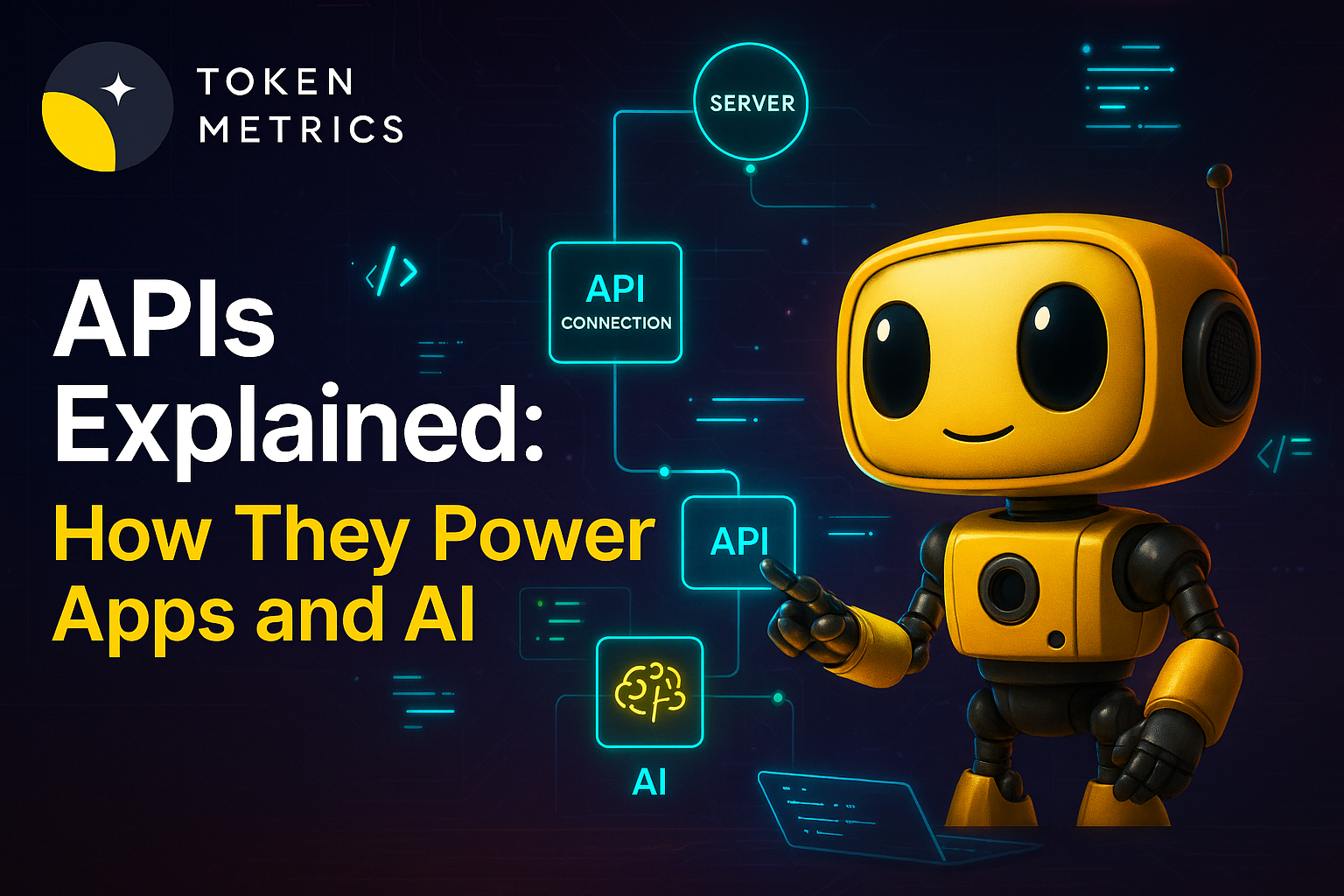
APIs Explained: How They Power Apps and AI

Token Metrics Team
6

APIs are the invisible connectors that let software talk to software. Whether you book a flight, check a crypto price, or ask an AI agent to summarize a document, APIs are likely working behind the scenes. This guide breaks down what an API is, how it works, common types and use cases, and practical steps for research and integration.

What is an API?

An API, or application programming interface, is a defined set of rules and data structures that lets one software component request services or data from another. Think of an API as a contract: the provider exposes endpoints and data formats, and the consumer uses those endpoints to perform actions or retrieve information. This abstraction hides implementation details, enabling interoperability and composability across systems.

At its core, an API specifies:

  • Available operations (endpoints) and accepted parameters
  • Request and response formats (JSON, XML, etc.)
  • Authentication and rate limits
  • Error handling and status codes

APIs accelerate development by allowing teams to reuse services instead of rebuilding functionality. They also enable ecosystems: marketplaces, integrations, and data sharing across organizations.

How APIs Work: Components & Protocols

APIs are implemented over protocols and architectural styles. The most common is REST (Representational State Transfer), which uses HTTP verbs (GET, POST, PUT, DELETE) and URIs to model resources. Alternatives like GraphQL let clients request specific data shapes, which can reduce over- and under-fetching in complex applications.

Key components to understand:

  • Endpoint: A URL representing a resource or action (e.g., /api/v1/prices).
  • Method: The HTTP action to perform (GET to read, POST to create).
  • Payload: The body of a request for create/update operations, usually JSON.
  • Authentication: API keys, OAuth tokens, or other schemes control access.
  • Rate limits: Providers throttle requests to protect services.

Beyond REST and GraphQL, there are webhooks (server-to-server push notifications), gRPC for high-performance RPC-style communication, and socket-based APIs for real-time streams. The choice of protocol affects latency, throughput, and developer ergonomics.

Types of APIs and Real-World Use Cases

APIs come in several flavors depending on visibility and purpose:

  • Public APIs: Exposed to external developers for integrations and apps.
  • Private APIs: Internal to an organization, used to modularize services.
  • Partner APIs: Shared with selected partners under specific agreements.

Common use cases illustrate how APIs deliver value:

  • Payment processing APIs enable e-commerce sites to accept credit cards without storing sensitive data.
  • Mapping and location APIs power ride-hailing, logistics, and geofencing features.
  • Data APIs supply market prices, on-chain metrics, or social feeds for dashboards and trading bots.
  • AI and ML model APIs let applications delegate tasks like transcription, summarization, or image analysis to cloud services.

For example, crypto applications rely heavily on exchange and on-chain data APIs to aggregate prices, monitor wallets, and execute analytics at scale. Evaluating latency, historical coverage, and data quality is critical when selecting a provider for time-series or transactional data.

How Developers and AI Use APIs

Developers use APIs to compose microservices, integrate third-party functionality, and automate workflows. For AI systems, APIs are essential both to access model inference and to fetch context data that models use as inputs.

Practical patterns include:

  1. Chaining: Calling multiple APIs in sequence to enrich a response (e.g., fetch user profile, then fetch personalized recommendations).
  2. Caching: Store frequent responses to reduce latency and cost.
  3. Bulk vs. Stream: Use batch endpoints for historical backfills and streaming/webhooks for real-time events.

When integrating APIs for analytics or AI, consider data consistency, schema evolution, and error semantics. Tools and platforms can monitor usage, surface anomalies, and provide fallbacks for degraded endpoints.

For researchers and teams assessing providers, structured evaluations help: compare SLA terms, data freshness, query flexibility, cost per request, and developer experience. Platforms that combine market data with AI-driven signals can accelerate exploratory analysis; for example, Token Metrics provides AI-backed research and ratings that teams often use to prioritize datasets and hypothesis testing.

Build Smarter Crypto Apps & AI Agents with Token Metrics

Token Metrics provides real-time prices, trading signals, and on-chain insights all from one powerful API. Grab a Free API Key

FAQ — What is an API?

Q1: What is the difference between an API and a library?

An API defines a set of rules and endpoints for interaction between systems, often over a network. A library is a local collection of functions and classes that an application links to at runtime. Libraries run in-process; APIs often run across processes or machines.

FAQ — How secure are APIs?

Q2: How should APIs be secured?

Common security measures include authentication (API keys, OAuth), encryption (TLS), input validation, rate limiting, and monitoring for anomalous patterns. Security practices should match the sensitivity of data and regulatory requirements.

FAQ — REST vs. GraphQL

Q3: When to choose REST over GraphQL?

REST is simple and well-suited to resource-based designs and caching. GraphQL is useful when clients need precise control over returned fields and want to minimize round trips. The right choice depends on client needs, caching strategy, and team expertise.

FAQ — What drives API costs?

Q4: What factors affect API pricing?

Pricing typically depends on request volume, data granularity, retention of historical data, and premium features such as websockets, SLAs, or enriched analytics. Evaluate costs under realistic usage patterns and spikes.

FAQ — How to get started with an API?

Q5: How do I evaluate and integrate a new API?

Start by reading docs, testing sandbox endpoints, and estimating request volumes. Validate data formats, authentication flows, and edge cases (rate limits, errors). Prototype with small workloads before committing to production usage.

FAQ — Are APIs regulated?

Q6: Do APIs involve legal or compliance considerations?

APIs that handle personal data, financial transactions, or regulated assets may be subject to privacy laws, financial regulations, or contractual obligations. Assess compliance requirements, data residency, and logging needs early in the design process.

Disclaimer

This article is for educational purposes only and does not constitute investment, legal, or professional advice. Information contained here is neutral and analytical; always perform independent research and consult qualified professionals for decisions involving legal or financial risk.

Research

Understanding APIs: What They Are and How They Work

Token Metrics Team
5

APIs (Application Programming Interfaces) are the invisible wiring that lets modern software communicate. From mobile apps fetching data to AI agents orchestrating workflows, APIs enable systems to request services, exchange structured data, and extend functionality without exposing internal implementation. This article unpacks what an API is, how different API styles operate, where they’re used (including crypto and AI contexts), and practical approaches to evaluate, integrate, and secure them.

What an API Is: core concepts and terminology

An API is a set of rules and conventions that allows one software component to interact with another. At its simplest, an API defines:

  • Endpoints: Named access points that accept requests (for example, /users or /price).
  • Methods: Actions supported at an endpoint (common HTTP verbs: GET, POST, PUT, DELETE).
  • Request/Response formats: Structured payloads, typically JSON or XML, that describe inputs and outputs.
  • Authentication and authorization: How clients prove identity and gain access to resources (API keys, OAuth, JWT).
  • Rate limits and quotas: Constraints that protect services from abuse and manage capacity.

Think of an API as a contract: the provider promises certain behaviors and data shapes, and the consumer agrees to use the API according to those rules. That contract enables modular design, reusability, and language-agnostic integration.

How APIs work: protocols, formats, and architectural styles

APIs use protocols and conventions to carry requests and responses. The most common patterns include:

  • REST (Representational State Transfer): Uses standard HTTP methods and resource-oriented URLs. REST favors stateless interactions and JSON payloads.
  • GraphQL: Lets clients request exactly the fields they need in a single query, reducing over- and under-fetching.
  • gRPC: A high-performance RPC framework that uses protocol buffers for compact binary messages—often used for internal microservices.
  • Webhooks: A push model where the API provider sends events to a client URL when something changes.

Choosing an architecture depends on latency needs, payload sizes, versioning strategy, and developer ergonomics. For instance, GraphQL can simplify complex frontend queries, while REST remains straightforward for simple resource CRUD operations.

Common API types and real-world use cases (including crypto and AI)

APIs power an enormous variety of use cases across industries. Representative examples include:

  • Data APIs: Provide access to datasets or market data (weather, financial prices, on-chain metrics).
  • Service APIs: Offer functionality like payments, authentication, or messaging.
  • Platform APIs: Enable third-party apps to extend a core product—social platforms, cloud providers, and exchanges expose platform APIs.
  • AI and ML APIs: Expose model inference endpoints for tasks such as text generation, image recognition, or embeddings.

In the crypto ecosystem, APIs are fundamental: explorers, node providers, exchanges, and analytics platforms expose endpoints for price feeds, order books, trade history, wallet balances, and on-chain events. AI-driven research tools use APIs to combine market data, on-chain signals, and model outputs into research workflows and agents.

How to evaluate and integrate an API: practical steps

Adopting an API requires both technical and operational considerations. A pragmatic evaluation process includes:

  1. Define needs: Identify required data, latency tolerance, throughput, and allowable costs.
  2. Review documentation: Clear docs, example requests, schema definitions, and SDKs accelerate integration.
  3. Test endpoints: Use sandbox keys or Postman to validate payloads, error handling, and edge cases.
  4. Assess SLAs and rate limits: Understand uptime guarantees and throttling behavior; build retry/backoff strategies.
  5. Security and compliance: Check authentication methods, encryption, and data retention policies.
  6. Monitoring and observability: Plan logging, latency monitoring, and alerting to detect regressions post-integration.

When integrating multiple APIs—such as combining market data with model inference—consider a middleware layer that normalizes data shapes, caches frequent responses, and orchestrates calls to minimize latency and cost.

Build Smarter Crypto Apps & AI Agents with Token Metrics

Token Metrics provides real-time prices, trading signals, and on-chain insights all from one powerful API. Grab a Free API Key

FAQ: What is an API — common questions

What is the difference between an API and a web service?

An API is a broader concept that defines interfaces for software interaction. A web service is a type of API that operates over network protocols such as HTTP. In practice, REST and GraphQL are web service styles used to implement APIs.

Are public APIs safe to use?

Public APIs can be safe if they follow security best practices: HTTPS everywhere, proper authentication, input validation, and rate limiting. Consumers should validate responses, handle errors, and avoid exposing credentials in client-side code.

How do API keys differ from OAuth?

API keys are simple tokens that identify a client application and are often used for server-to-server interactions. OAuth is a delegated authorization framework that allows users to grant limited access to their accounts without sharing credentials—common for user-facing integrations.

What is API rate limiting and why does it matter?

Rate limiting constrains how many requests a client can make in a time window. It prevents abuse, protects backend resources, and ensures fair usage. Clients should implement retries with exponential backoff and caching to stay within limits.

When should I use GraphQL instead of REST?

Choose GraphQL when clients need flexible, precise queries that fetch nested or disparate fields in a single request. REST can be simpler for straightforward resource CRUD and when predictable caching semantics are required.

Can APIs be used for real-time data?

Yes. Real-time patterns include WebSockets, Server-Sent Events (SSE), and streaming APIs. Some platforms also provide push notifications or webhooks to deliver near-instant updates to subscribers.

How do I handle versioning in APIs?

Common strategies include using version numbers in the URL (e.g., /v1/) or via headers. Maintain backward compatibility, communicate deprecation timelines, and provide migration guides to minimize friction for integrators.

What monitoring should I implement after integrating an API?

Track uptime, latency percentiles, error rates, and throughput. Instrument retries, logging of failed requests, and alerts for sustained degradation. Observability helps diagnose issues and communicate with API providers when needed.

Disclaimer: This article is for educational and informational purposes only. It explains technical concepts related to APIs and integration practices and does not provide financial, investment, or regulatory advice. Always evaluate tools and services according to your own requirements and compliance needs.

Choose from Platinum, Gold, and Silver packages
Reach with 25–30% open rates and 0.5–1% CTR
Craft your own custom ad—from banners to tailored copy
Perfect for Crypto Exchanges, SaaS Tools, DeFi, and AI Products