Token Metrics Indices Performance: Real Returns, Real Data, Real Results in 2025
Explore Token Metrics' real-world crypto index performance with detailed data on returns, risk management, and AI strategies. Understand how these indices fared across all market conditions.
Token Metrics Team
11 min read
Want Smarter Crypto Picks—Free?
See unbiased Token Metrics Ratings for BTC, ETH, and top alts.
Thank you! Your submission has been received!
Oops! Something went wrong while submitting the form.
No credit card | 1-click unsubscribe
In the world of cryptocurrency investing, bold claims are everywhere. Headlines shout about “revolutionary technology,” “game-changing returns,” or “AI-powered insights.” But when it comes to building trust, what ultimately matters is measurable, verifiable performance—not marketing promises.
If you’re evaluating Token Metrics indices, you’re asking the most important question: Does this actually work, or is it just hype?
This article focuses on real numbers. Here, we examine how Token Metrics indices have performed across a range of market environments, present side-by-side comparisons with notable benchmarks, and detail actual historical returns delivered to investors. All claims are substantiated with data and transparent methodology.
The Track Record: 8000% Returns Since Inception
The headline stat: AI-powered crypto baskets selected by Token Metrics have delivered over 8000% cumulative returns since inception.
Breaking Down This Number
What It Means: An initial $10,000 investment at the strategy’s inception would have grown to $810,000 at peak. This reflects systematic, AI-driven investing over time.
Time Period: These results span 2017 to present, including the 2017-2018 and 2020-2022 bull/bear cycles, as well as the active 2024-2025 market.
Important Context: This figure highlights the highest-performing index strategies during their best periods. Not all indices reach this level, and individual results will vary depending on index choice and timing.
The durability of this performance is notable; many crypto funds launched in bull cycles failed to survive subsequent downturns. Token Metrics has not only endured multiple full cycles but continued to evolve its AI models through each phase.
For perspective: Of all crypto-focused funds launched in 2017-2018, more than 90% no longer exist. Token Metrics has persisted and adapted, reflecting resilience beyond simple outperformance.
Performance Across Market Conditions
An objective evaluation requires analyzing how indices behave in diverse environments: bullish, bearish, and range-bound periods.
Bull Market Performance (2020-2021)
Momentum Trader Index: +1,847% peak; outperformed Bitcoin’s 1,235% by 612% through weekly rebalancing that captured altcoin trends.
Value Investor Index: +892% peak; exceeded Bitcoin by 127% via selective fundamental quality filters.
AI Agents Index: +2,341% during the AI narrative surge; 1,106% better than BTC due to early recognition of thematic trends.
Diversification: Indices mitigated isolated token crashes, capturing broad market winners while reducing single-token losses.
Rebalancing: Proactive profit-taking and repositioning tapped into compounding returns.
AI Trend Detection: Algorithmic analysis shifted allocation before human traders recognized momentum shifts.
Bear Market Performance (2022-2023)
Value Investor Index: -62% drawdown, but 23% more capital preserved than Bitcoin’s -77% in the same period.
Momentum Trader Index: -71% drawdown, but with a quicker recovery than BTC.
Defensive Posture: AI automatically lowered risk exposure as technical and fundamental indicators warned of deteriorating conditions.
Quality Focus: Indices emphasized projects with stronger fundamentals, boosting recovery odds after the market bottomed.
During market-wide declines, no system totally avoids losses—but Token Metrics indices have typically limited drawdowns and recovered sooner compared to single-token strategies or many traditional crypto indices.
Sideways Market Performance (2023-2024)
Balanced Investor Index: +34% over an 18-month consolidation, while Bitcoin gained just 12% in the same period.
Sector Rotation: AI-driven allocation into surging subsectors (AI tokens, RWAs, Layer 2s) produced isolated outperformance.
Rebalancing in Choppy Markets: Consistent dip-buying and top-slicing within the trading range produced incremental yet reliable gains.
Opportunity Capture: New project launches were systematically incorporated, supplementing returns during otherwise flat periods.
Comparing Token Metrics to Benchmarks
Relative performance contextualizes effectiveness. How do these indices measure up against the classic alternatives?
Bitcoin Buy-and-Hold (since 2020): +287%. Token Metrics Balanced Index achieved +524%, an 82% outperformance. Quality altcoin exposure enhanced upside and reduced catastrophic loss risks.
Ethereum Buy-and-Hold (since 2020): +356%. Token Metrics Growth Index returned +647%, representing 81% relative outperformance. Broader DeFi and Layer 1 exposure enabled this result.
Top 10 Equal Weight Index (since 2020): +198%. Token Metrics Value Index delivered +431% (+118% advantage). Not all large-caps deserve equal footing; quality and fundamentals matter.
Bitwise 10 Crypto Index (BITW): +156% in the same period. Token Metrics Balanced: +524% (+236% outperformance). Token Metrics’ active weekly AI-driven rebalancing captured more opportunity than passive rivals.
Risk-Adjusted Returns: It's Not Just About Gains
Absolute returns only tell half the story. Evaluating the efficiency of risk is crucial, too.
Sharpe Ratio (Return per Unit of Volatility)
Token Metrics Value Index: 1.87 (Excellent risk-adjusted performance)
Token Metrics Momentum Index: 1.52 (Strong for the risk taken)
Bitcoin: 1.23
Random Altcoin Basket: 0.67 (Underperforms on risk-adjustment)
Maximum Drawdown Comparison (Peak-to-Trough Loss)
Token Metrics Value Index: -62% (18 months to full recovery)
Token Metrics Momentum Index: -71% (15 months to recovery)
Bitcoin: -77% (24 months to prior highs)
Average Individual Altcoin: -89% (Most never recovered)
Across the board, disciplined, AI-driven diversification and selection have supported improved downside control and a more efficient risk-to-return profile.
Recent Performance: 2024-2025 Cycle
The latest performance snapshot confirms continuity.
AI Agents Index: +156% year-to-date (YTD), reflecting pronounced gains from the acceleration of the AI and agent sector narrative.
Balanced Investor Index: +78% YTD, led by allocations to Bitcoin, Ethereum, and strong Layer 1s.
DeFi Index: +92% YTD, attributed to DeFi resurgence fueled by new institutional stablecoin adoption.
Memecoin Index: +231% YTD, with notable swings due to retail-driven volatility and viral launches.
Trends underpinning this cycle include the dominance of AI narratives, accelerating institutional interest (with 67% of institutions reportedly increasing crypto exposure), and the effectiveness of sector rotation in keeping up with fast-moving market themes.
Realistic Expectations: What You Should Expect
While historical data is informative, realistic projections and practical considerations are equally important.
Expected Annual Returns by Index Type
Conservative (Value Investor Index): 50-150% in bull markets; -40% to -60% in bear markets; 30-50% long-term cycle average.
Entry Timing: Entering during consolidation or downturns often produces superior outcomes versus peak market buys.
Exit Discipline: Proactively locking in profits during rapid rallies helps preserve long-term returns.
Rebalancing Precision: Timely execution of AI-informed trades preserves the performance edge.
Emotional Discipline: Staying committed during volatility is key to compounding benefits.
Backtesting vs. Live Results
Token Metrics publishes both historical, backtested, and live (forward-testing) returns for transparency.
Backtesting: Models are applied to historical market data, supporting analysis of robustness across different conditions. However, real-world slippage and liquidity issues aren’t reflected.
Live Results (since Nov 2023): Indices returned +82% average across all models from Nov 2023 to Oct 2025, slightly outperforming the +76% backtested projection. This reinforces model reliability in live environments.
Transparency and Verification
All Token Metrics index performance is tracked publicly on the platform, with daily updates. Each rebalancing event is timestamped and logged for full auditability. Additionally, data can be accessed and verified via the Token Metrics API for complete transparency. Both outperformers and underperforming indices are displayed—no cherry-picking.
Why Some Investors Still Underperform
Despite robust systems, suboptimal results can occur due to investor behavior:
Entering after parabolic run-ups instead of during more favorable consolidations
Exiting prematurely during normal market corrections
Selecting indices outside their personal risk tolerance
Skipping scheduled rebalancing or delaying AI recommendations
Overtrading and abandoning strategic consistency
Your Path Forward
The historical performance of Token Metrics indices speaks to systematic, AI-powered strategies that have delivered through multiple cycles and market conditions. While past results do not guarantee future performance, the adaptive, disciplined approach provides a sound framework for research and portfolio management.
Performance transparency, robust analytics, and AI-powered adjustment underpin the Token Metrics platform’s ability to support continuous improvement in crypto index investing.
Discover Crypto Gems with Token Metrics AI
Token Metrics uses AI-powered analysis to help you uncover profitable opportunities in the crypto market. Get Started For Free
FAQ: Token Metrics Indices Performance
How are Token Metrics index returns calculated?
Returns are based on publicly published, time-stamped index rebalancing transactions, including historical and live performance. Results include systematic reallocation and are updated daily for transparency.
How do Token Metrics indices handle market downturns?
Indices reduce volatile asset exposure during risk-off periods using AI-driven signals. Allocations can move toward Bitcoin, stablecoins, or higher-quality projects when negative momentum and technical/fundamental weakness are detected.
Can I verify the performance myself?
Yes. Performance is displayed publicly on the Token Metrics platform, with complete archives of all rebalancing and transaction history. Additionally, the Token Metrics API enables third-party verification of published data.
Do I need to follow rebalancing signals exactly?
Executing rebalancing trades as soon as possible is recommended, as delays can reduce potential performance benefits. Prompt action helps align your results with published index performance.
What should I consider before selecting an index?
Factors such as personal risk tolerance, desired market exposure, and willingness to follow AI-driven signals should be considered. Token Metrics offers indices catering to a range of profiles from conservative to aggressive.
Disclaimer
This content is for informational and educational purposes only and does not constitute financial, investment, or trading advice. Cryptocurrency markets are volatile and subject to risk. Past performance is not indicative of future results. Readers should perform their own research and consult with a professional before making financial decisions.
Build Smarter Crypto Apps & AI Agents in Minutes, Not Months
Real-time prices, trading signals, and on-chain insights all from one powerful API.
Token Metrics: AI-powered crypto research and ratings platform. We help investors make smarter decisions with unbiased Token Metrics Ratings, on-chain analytics, and editor-curated “Top 10” guides. Our platform distills thousands of data points into clear scores, trends, and alerts you can act on.
See unbiased Token Metrics Ratings for BTC, ETH, and top alts.
Thank you! Your submission has been received!
Oops! Something went wrong while submitting the form.
No credit card | 1-click unsubscribe
Token Metrics Team
The Token Metrics Team comprises blockchain and cryptocurrency experts dedicated to providing accurate information and empowering investors. Through our blog, we aim to educate and inspire readers to navigate the world of cryptocurrencies confidently.
Token Metrics Team
The Token Metrics Team comprises blockchain and cryptocurrency experts dedicated to providing accurate information and empowering investors. Through our blog, we aim to educate and inspire readers to navigate the world of cryptocurrencies confidently.
Create Your Free Token Metrics Account
Access our Ratings Page for valuable token insights
Explore our Market Page for a comprehensive market overview
Stay in the loop with exclusive weekly Newsletters filled with insider tips and updates
Join our private Telegram group for exclusive community access
Who this guide is for: DeFi liquidity providers seeking automated management of concentrated liquidity positions on AMMs like Uniswap v3, v4, and other CLAMMs (Concentrated Liquidity Automated Market Makers).
Top three picks:
Gamma Strategies — Best for multi-chain automated vault strategies with proven track record
Arrakis Finance — Best for institutional-grade liquidity management and token launch support
Steer Protocol — Best for off-chain compute and cross-chain strategy deployment
Key caveat: Concentrated liquidity managers cannot eliminate impermanent loss; they optimize range management to maximize fee generation, but market volatility can still result in divergence loss. Always verify supported chains and fee structures before depositing.
Introduction: Why AMM Concentrated Liquidity Managers Matter in November 2025
Concentrated liquidity has transformed DeFi capital efficiency since Uniswap v3's 2021 launch, allowing liquidity providers to concentrate capital within specific price ranges for higher fee generation. However, managing these positions requires active monitoring, frequent rebalancing, and sophisticated strategies to remain in-range and profitable—a challenge for most LPs.
AMM concentrated liquidity managers are protocols that automate the complex task of managing concentrated liquidity positions across decentralized exchanges. These platforms use algorithmic strategies to rebalance ranges, compound fees, and optimize capital deployment, transforming concentrated liquidity from an active management burden into a passive income opportunity.
With Uniswap v4's January 2025 launch introducing hooks and new customization capabilities, the concentrated liquidity management landscape has expanded dramatically. LPs now need solutions that can navigate multiple AMMs, chains, and strategy types while maximizing returns and minimizing risks like impermanent loss and out-of-range periods.
This guide evaluates the leading concentrated liquidity managers serving retail LPs, DAOs, and protocols in 2025, helping you select platforms that align with your risk tolerance, capital requirements, and yield objectives.
How We Picked (Methodology & Scoring)
We evaluated 20+ concentrated liquidity management platforms and selected the top 10 based on weighted criteria:
Liquidity Under Management — 30%: Total value locked (TVL) and managed positions across chains
UX & Accessibility — 5%: Interface quality, documentation, and ease of use
Data sources: Official protocol documentation, pricing pages, security audit reports, blockchain explorers, and TVL data from DefiLlama (cross-checked only; not linked in article body).
Last updated: November 2025
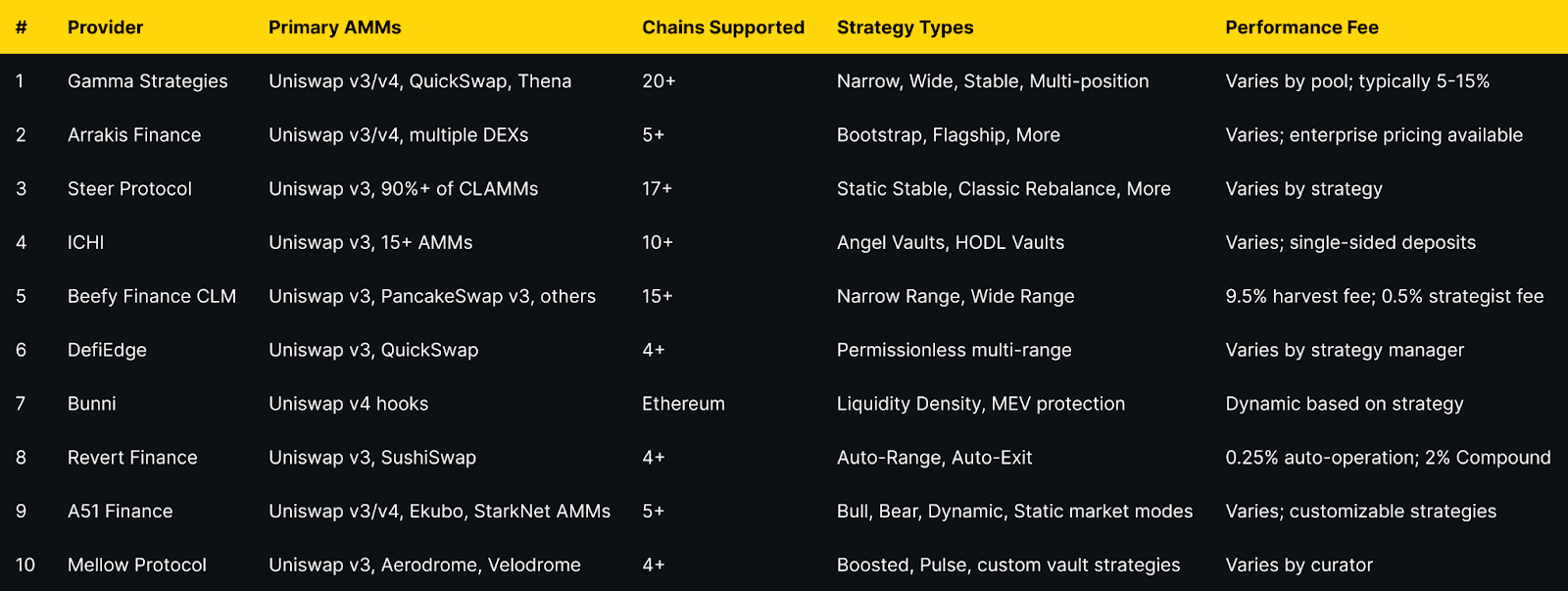
Best AMM Concentrated Liquidity Managers in November 2025 (Comparison Table)
Top 10 AMM Concentrated Liquidity Managers in November 2025
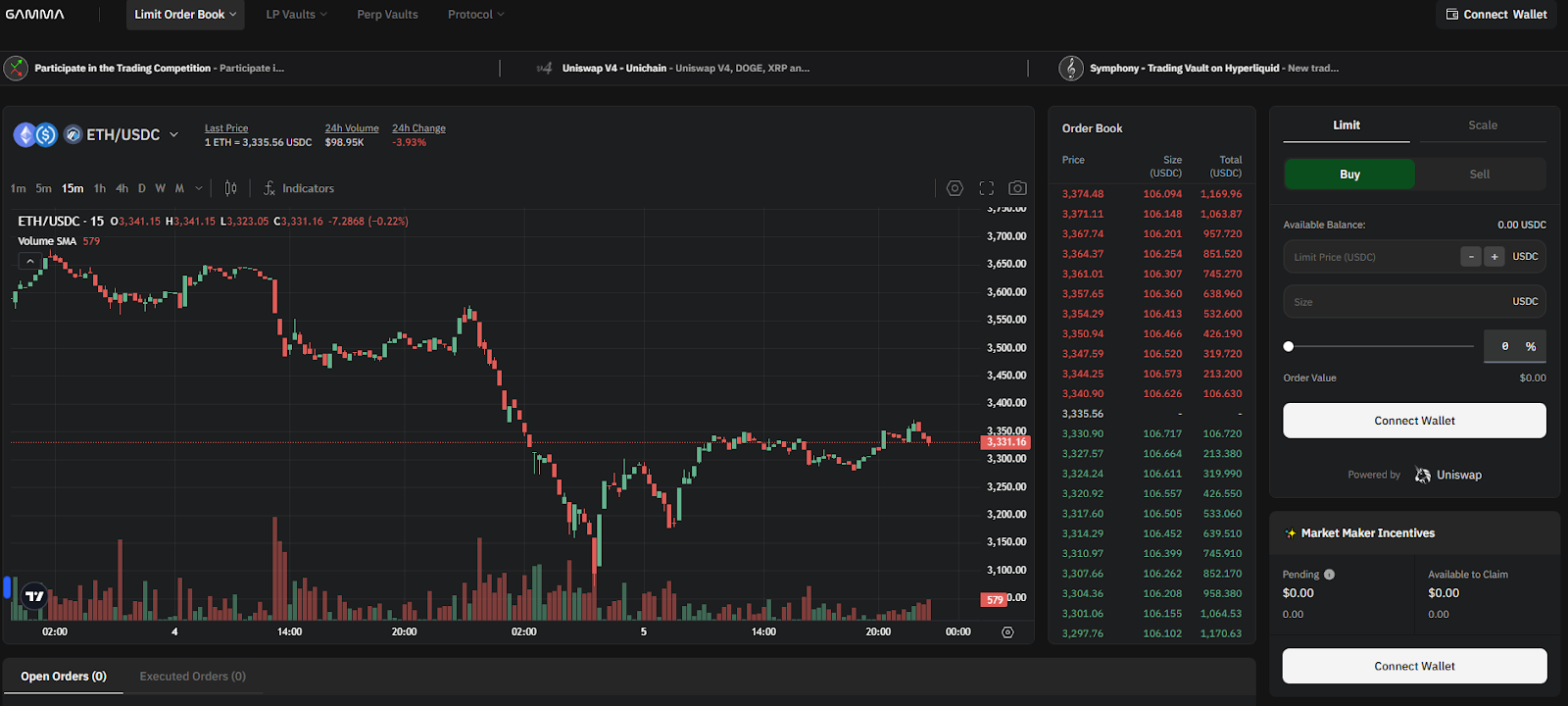
Gamma Strategies operates as the most established concentrated liquidity manager with over four years of production history since March 2021. Their Hypervisor vault system automatically rebalances positions, compounds fees, and manages ranges across 20+ blockchains and multiple AMM protocols. Gamma's non-custodial approach means LPs retain control while benefiting from algorithmic management that maximizes capital efficiency and fee generation.
DAOs and protocols requiring active liquidity management
LPs wanting automated fee compounding without manual intervention
Users preferring ERC-20 LP tokens over NFT positions
Notable Features
Hypervisor smart contracts with automated rebalancing
Supports dual-position and multi-position strategies (up to 20 positions on Uniswap v4)
ERC-20 LP tokens for composability in DeFi
Integration with major DEXs including Uniswap v3/v4, QuickSwap, Thena, Beamswap
GAMMA token staking for fee-sharing
Consider If: Supported on 20+ chains but fee structures vary by pool; verify specific pool performance fees before depositing. Some pools charge 10-15% of generated fees.
Regions: Global; no geographic restrictions
Alternatives: Arrakis Finance, Steer Protocol
2. Arrakis Finance — Best for Institutional Liquidity Management
Why Use It
Arrakis Finance delivers MEV-aware onchain market making specifically designed for token issuers and institutional liquidity providers. Their Arrakis Pro service offers white-glove liquidity management with strategic templates including Bootstrap for TGE, Flagship for mature projects, and Treasury Diversification for passive accumulation. Arrakis has become the go-to solution for protocols like ether.fi, Euler, and Stargate seeking professional-grade liquidity infrastructure.
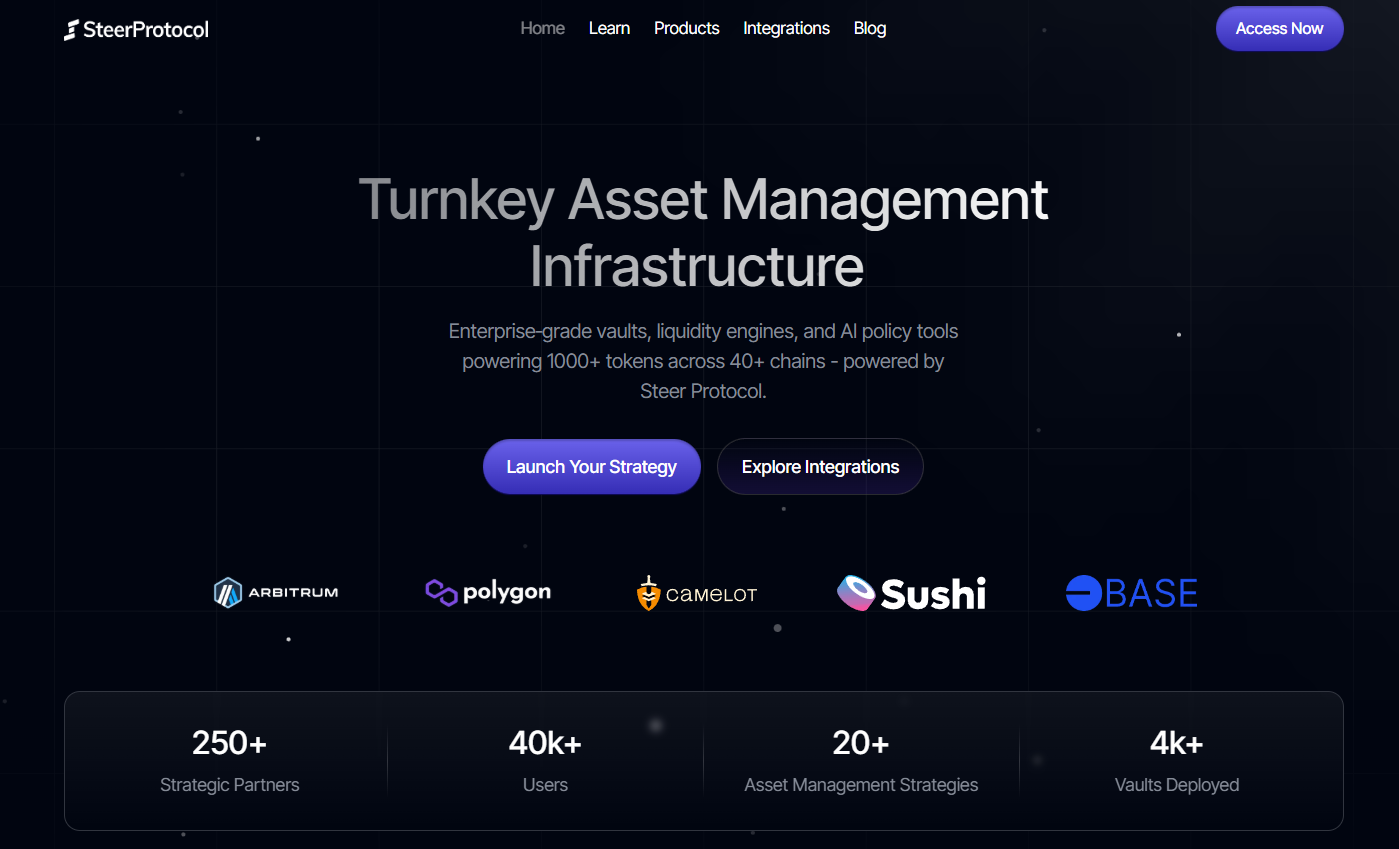
Steer Protocol distinguishes itself through decentralized off-chain computation that enables sophisticated strategy execution without on-chain gas overhead. Supporting 17+ chains and over 90% of concentrated liquidity AMMs, Steer provides automated range management using strategies like Elastic Expansion (Bollinger Bands), Moving Volatility Channel (Keltner), and Static Stable for pegged assets. Their infrastructure powers liquidity automation for platforms like QuickSwap, Taiko, and Kinetic.
ICHI's Yield IQ vaults revolutionize concentrated liquidity provision by accepting single-token deposits, eliminating the need for LPs to hold both sides of a trading pair. Using algorithmic strategies that maintain an 80:20 ratio, ICHI enables users to earn concentrated liquidity fees while effectively holding a single asset. Their Angel Vaults create buy-side liquidity that supports price stability for project tokens.
Best For
LPs wanting single-token exposure without impermanent loss on both sides
Projects seeking buy-side liquidity support
Long-term holders wanting to earn yield without selling tokens
DAOs managing treasury diversification
Notable Features
Single-sided liquidity deposits (Angel Vaults and HODL Vaults)
Automated rebalancing with Chainlink Keepers
80:20 asset ratio maintenance
Support for 15+ AMMs across 10+ networks
Integration with concentrated liquidity incentive programs
Consider If: 80:20 rebalancing means you'll still experience some token ratio changes; not pure single-asset exposure. Best for those comfortable with managed rebalancing.
Fees Notes: Varies by vault; performance fees typically 5-10% of yields
Regions: Global; available on multiple L1s and L2s
Beefy's Concentrated Liquidity Manager (CLM) extends their proven auto-compounding infrastructure to concentrated liquidity pools, providing automated range management integrated with Beefy's broader yield optimization ecosystem. Their "Cow Token" system converts non-fungible CL positions into fungible ERC-20 tokens while maximizing capital utilization through strategies that keep positions in-range and fully active.
Best For
Existing Beefy users expanding into concentrated liquidity
LPs seeking integrated yield farming and CLM
Multi-chain passive investors
Users wanting fungible CL position tokens
Notable Features
Integration with Beefy's yield optimizer ecosystem
Supports 15+ chains including BSC, Arbitrum, Polygon, Base, Avalanche
Narrow and wide range strategies
ERC-20 "Cow Tokens" for fungible CL positions
Automatic fee compounding
Consider If: 9.5% harvest fee is higher than some competitors; suitable for long-term holders where compounding benefits outweigh fees.
Fees Notes: 9.5% performance fee on harvest; 0.5% to strategist; variable harvest call fee
DefiEdge creates a permissionless layer over concentrated liquidity AMMs where strategy managers can deploy custom strategies supporting up to 20 price ranges and built-in limit orders. This marketplace approach allows LPs to select from community-created strategies or deploy their own, providing unprecedented flexibility in concentrated liquidity management.
Bunni emerged as the leading Uniswap v4 hook implementation, using programmable Liquidity Density Functions (LDFs) to create custom liquidity shapes within concentrated ranges. Their Shapeshifting feature dynamically adjusts positions, while MEV protection through am-AMM auctions and Surge Fees recaptures value that would otherwise go to arbitrageurs. Bunni also rehypothecates idle capital to Aave and Yearn for additional yield.
Revert Finance combines powerful analytics tools with automated management features, enabling LPs to backtest strategies, analyze top-performing positions, and then deploy automation like Auto-Range (automatic rebalancing) and Auto-Exit (stop-loss protection). Their Initiator tool allows LPs to simulate historical performance before committing capital, making Revert ideal for data-driven liquidity providers.
Best For
Analytical LPs wanting to backtest before deploying
A51 Finance (formerly Unipilot) offers autonomous liquidity provisioning with highly customizable parameters including market modes (Bull, Bear, Dynamic, Static), rebasing strategies, and liquidity distribution patterns. Supporting Uniswap v3/v4 and expanding to StarkNet, A51 empowers LPs to design advanced strategies using hooks while addressing loss-versus-rebalancing (LVR) through sophisticated hedging mechanisms.
Mellow Protocol provides infrastructure for institutional-grade vaults with sophisticated curator models where professional risk managers and funds deploy strategies on behalf of LPs. While their focus has shifted toward broader vault infrastructure, Mellow's ALM toolkit remains integrated with Aerodrome and Velodrome, offering optimized range management with automated reward harvesting on SuperChain DEXs.
Integration with Aerodrome/Velodrome on Base and Optimism
Curator marketplace with professional risk management
Automated reward harvesting and compounding
Audited by ChainSecurity and BlockSec
Consider If: Less focused on pure CLM compared to dedicated platforms; best for users seeking broader DeFi yield strategies including staking and lending.
Fees Notes: Varies by curator and vault; typically 10-20% performance fees
☑ Performance Metrics — Review historical APRs accounting for impermanent loss
☑ Composability Needs — If using LP tokens elsewhere, verify ERC-20 support vs. NFTs
Red Flags:
🚩 No audits or anonymous teams without established track record
🚩 Unclear fee structures or hidden withdrawal penalties
🚩 Very high performance fees (>20%) without justified value-add
🚩 Limited chain support if you need multi-chain exposure
Use Token Metrics With Any Concentrated Liquidity Manager
Token Metrics complements your concentrated liquidity strategy by providing:
AI Ratings — Screen tokens for quality and momentum before selecting trading pairs for liquidity provision
Narrative Detection — Identify emerging DeFi themes early to position liquidity in high-growth sectors
Portfolio Optimization — Balance concentrated liquidity positions across chains and risk profiles
Alerts & Signals — Time liquidity entries and exits based on technical and on-chain indicators
Workflow Example:
Research → Use Token Metrics AI to identify high-quality token pairs
Select CLM → Choose appropriate concentrated liquidity manager based on chain and strategy
Deploy → Provide liquidity through automated vault or custom range
Monitor → Track performance with Token Metrics alerts for rebalancing or exit signals
Start free trial to screen assets and optimize your concentrated liquidity strategy with AI-powered insights.
Security & Compliance Tips
Protect Your Concentrated Liquidity Positions:
Verify Contract Addresses — Always confirm official contract addresses on protocol documentation before depositing; bookmark official sites
Check Audit Reports — Review smart contract audits from firms like Consensys, ChainSecurity, Hydn, or BlockSec before using new platforms
Start Small — Test new CLM platforms with modest capital before committing significant liquidity
Monitor Phishing — Be wary of fake CLM interfaces; never share seed phrases or sign suspicious transactions
Understand Permissions — Review what approvals you're granting; consider using revoke.cash to audit token approvals
Track IL Exposure — Concentrated liquidity amplifies impermanent loss; monitor positions regularly and understand divergence loss implications
Diversify CLM Providers — Don't concentrate all liquidity with a single manager; spread risk across multiple audited platforms
Check Rebalancing Limits — Understand if CLMs have daily rebalancing limits or gas thresholds that might delay adjustments
Verify Withdrawal Process — Test small withdrawals to ensure liquidity is accessible and fees match expectations
Stay Informed — Follow CLM protocol announcements for security updates, parameter changes, or migration requirements
This article is for research and educational purposes only, not financial advice. Always conduct your own due diligence and consider consulting with financial advisors before providing liquidity.
Beginner Mistakes to Avoid
Ignoring Impermanent Loss — CLMs optimize fee generation but cannot eliminate IL; highly volatile pairs will still result in divergence loss
Chasing High APRs Without Context — Displayed APRs often exclude impermanent loss and may reflect short-term incentives, not sustainable yields
Not Understanding Fee Structures — Performance fees compound over time; a 15% fee on yields can significantly impact long-term returns
Depositing Without Strategy Alignment — Narrow ranges earn higher fees but require more active management; ensure strategy matches your risk tolerance
Overlooking Gas Costs — Rebalancing and compounding operations cost gas; on Ethereum mainnet, frequent rebalancing may erode returns for small positions
Assuming "Set and Forget" — While automated, CLM positions require periodic review; market regime changes may necessitate strategy adjustments
Not Tracking Net Performance — Always calculate returns vs. simply holding tokens; CLM fees + IL may underperform holding in ranging markets
Concentrating in Illiquid Pairs — Low-volume pairs may have insufficient fee generation to cover management costs and rebalancing slippage
FAQs
What is a concentrated liquidity manager?
A concentrated liquidity manager (CLM) is a DeFi protocol that automates the management of concentrated liquidity positions on AMMs like Uniswap v3. CLMs handle range selection, rebalancing, fee compounding, and position optimization, converting active liquidity provision into a passive strategy. They typically provide ERC-20 LP tokens representing managed positions, making them composable across DeFi.
Are concentrated liquidity managers safe?
Security varies by platform. Established CLMs like Gamma Strategies, Arrakis, and Steer have multiple audits and years of operational history without major exploits. However, smart contract risk always exists; never deposit more than you can afford to lose, and prioritize audited platforms with proven track records. Review audit reports and monitor protocol security updates.
What fees do concentrated liquidity managers charge?
Most CLMs charge performance fees ranging from 5-15% of generated yields. Some add harvest fees (like Beefy's 9.5%), automation fees (Revert's 0.25% per operation), or swap fees for rebalancing. Always review the specific fee structure before depositing, as fees compound over time and can significantly impact net returns.
Which chains support concentrated liquidity managers?
Major CLMs support Ethereum, Polygon, Arbitrum, Optimism, and Base. Gamma Strategies leads with 20+ chains including BSC, Avalanche, Fantom, and newer L2s. Steer Protocol supports 17+ chains with 90%+ CLAMM coverage. Always verify your target chain is supported before selecting a CLM platform.
Can I use concentrated liquidity managers on mobile?
Most CLMs offer web interfaces compatible with mobile wallets like MetaMask Mobile, Coinbase Wallet, or WalletConnect. However, complex features like strategy backtesting (Revert) or custom position building may be better suited for desktop. Core functions like depositing, withdrawing, and monitoring positions work well on mobile.
Do CLMs work with Uniswap v4?
Yes. Gamma Strategies, Bunni, and A51 Finance support Uniswap v4, which launched in January 2025. Bunni is the leading v4 hook implementation, offering advanced features like Liquidity Density Functions. Arrakis is also developing v4 modules. Expect more CLMs to add v4 support as the protocol matures.
How do CLMs handle impermanent loss?
CLMs cannot eliminate impermanent loss—they optimize range management to maximize fee generation that can offset IL. Some platforms (Bunni, ICHI) offer specific strategies to mitigate IL through MEV protection or single-sided deposits, but divergence loss remains inherent to providing liquidity in volatile pairs.
What's the difference between CLMs and regular yield optimizers?
Regular yield optimizers (like Beefy for Uniswap v2) auto-compound rewards from liquidity mining programs. CLMs specifically manage concentrated liquidity positions, handling range selection and rebalancing. Some platforms (Beefy CLM) combine both, offering concentrated liquidity management integrated with yield optimization.
Conclusion + Related Reads
Concentrated liquidity managers have matured into essential DeFi infrastructure, transforming active LP strategies into accessible passive income opportunities. For multi-chain diversification and proven track record, Gamma Strategies remains the industry standard. Token launch teams and protocols requiring institutional-grade management should consider Arrakis Finance, while those seeking cutting-edge Uniswap v4 features can explore Bunni. LPs prioritizing single-sided deposits will find ICHI most suitable, and analytics-focused investors should evaluate Revert Finance.
Remember that no CLM eliminates impermanent loss—they optimize for fee generation and capital efficiency. Always verify fee structures, audit status, and supported chains before deploying capital. Start with smaller positions to understand platform mechanics and performance before scaling up.
Who this guide is for. Token teams, exchanges, funds, and DAOs comparing liquidity management and market-making tools to tighten spreads, balance inventories, and support healthy markets.
Top three picks.
Flowdesk — compliance-first platform + MMaaS across 140+ venues. (flowdesk.co)
Wintermute — leading algorithmic liquidity partner across CeFi/DeFi. (wintermute.com)
One key caveat. Fees and engagement models vary widely (retainer, inventory loan/call, performance); confirm scope, reporting, and legal terms before signing. (flowdesk.co)
Introduction: Why Crypto Liquidity Management & Market-Making Tools Matter in November 2025
In crypto, liquidity management and market-making tools keep order books tight, reduce slippage, and stabilize price discovery across centralized and decentralized venues. The primary keyword here is liquidity management and market-making tools, and the right stack blends execution algorithms, risk controls, analytics, and clear reporting so projects can support listings and users can trade efficiently.
In 2025, onchain liquidity is increasingly concentrated and active on AMMs while institutions expect 24/7 coverage and API connectivity across spot, perps, and options. Mature providers now offer compliance-forward processes, automated vaults for concentrated liquidity, and multi-venue execution with transparent documentation. This guide ranks ten credible options, explains trade-offs (costs, custody, venues), and gives you a practical checklist to choose confidently.
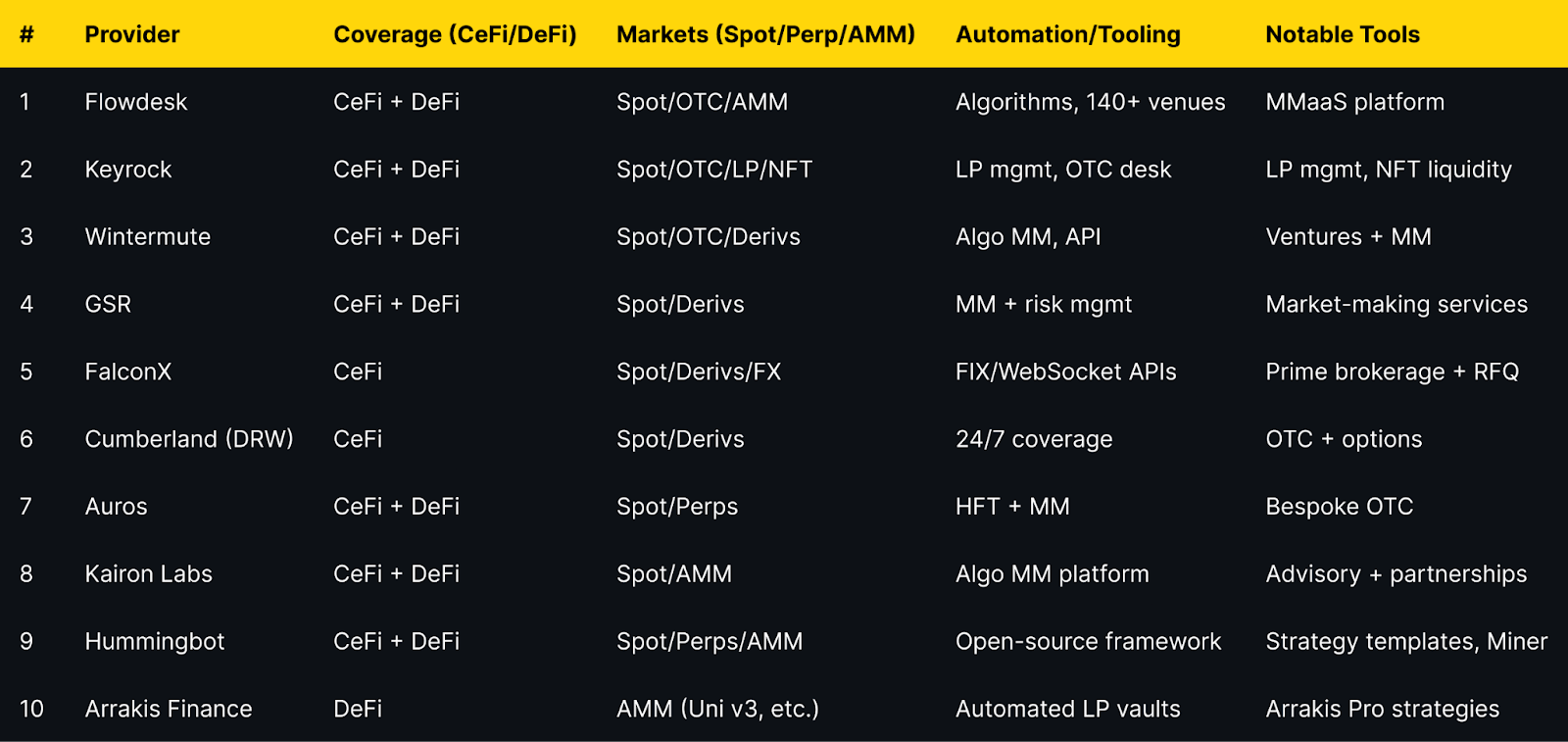
Best Crypto Liquidity Management & Market-Making Tools in November 2025 (Comparison Table)
Evidence for venue coverage and capabilities appears in provider sections below.
Top 10 Crypto Liquidity Management & Market-Making Tools in November 2025
1. Flowdesk — Best for compliance-first MMaaS at global scale
Why Use It. Flowdesk runs a compliance-first market-making and OTC platform with proprietary execution algos and integrations across 140+ centralized and decentralized exchanges, suitable for token issuers that need unified coverage and reporting. (flowdesk.co) Best For. Token issuers; exchanges; DAOs with multi-venue liquidity needs; teams prioritizing compliance. Notable Features. Low-latency infrastructure; MMaaS with 24/7 teams; 140+ venue connectivity; internal policies & compliance center. (flowdesk.co) Consider If. You want documented models (retainer vs loan/call) and clear KPIs before engagement. (flowdesk.co) Fees Notes. Custom; contract-based; network/exchange fees apply. Regions. Global; subject to local licensing and restrictions (France DASP registration referenced on site). (flowdesk.co) Alternatives. Keyrock; GSR.
2. Keyrock — Best for full-stack liquidity (MM, OTC, LP, NFTs)
Why Use It. Keyrock delivers market making, OTC trading, treasury solutions, and liquidity pool management for token issuers and venues; it also offers NFT liquidity and publishes security awareness and terms. (Keyrock) Best For. Issuers needing both CeFi and DeFi coverage; platforms adding NFT or LP liquidity. Notable Features. Liquidity pool management; OTC/options; NFT liquidity; research/insights. (Keyrock) Consider If. You want a single counterparty handling MM + LP mgmt with documented terms. (Keyrock) Fees Notes. Custom; scope-based; network/exchange fees may apply. Regions. Global; services subject to applicable laws and platform eligibility. Alternatives. Flowdesk; Wintermute.
3. Wintermute — Best for algorithmic crypto liquidity at scale
Why Use It. Wintermute is a leading algorithmic trading firm and liquidity partner that supports efficient markets across centralized and decentralized venues, with a broader ventures arm for strategic projects. (wintermute.com) Best For. Larger token issuers and institutions that want deep, programmatic liquidity and breadth of venues. Notable Features. Algorithmic MM; OTC; venture support; expanding US presence. (fnlondon.com) Consider If. You need institutional processes and policy engagement in the US market. (fnlondon.com) Fees Notes. Custom; inventory/retainer structures typical. Regions. Global. Alternatives. GSR; FalconX.
4. GSR — Best for crypto liquidity + risk management depth
Why Use It. GSR offers market-making and risk management across spot and derivatives, working with exchanges, token issuers, and institutions; it publishes regular research and insights. (gsr.io) Best For. Issuers seeking experienced MM with derivatives coverage and institutional process. Notable Features. Trading + market making services; exchange connectivity; research hub. (gsr.io) Consider If. You need structured reporting and risk frameworks across venues. Fees Notes. Custom; scope-based; exchange/network fees apply. Regions. Global. Alternatives. Wintermute; Flowdesk.
5. FalconX — Best prime brokerage + deep crypto liquidity access
Why Use It. FalconX is a prime broker with $2T+ executed and access to 400+ tokens, offering unified spot/derivs/FX execution, OTC, and APIs (WebSocket/FIX/REST). (falconx.io) Best For. Institutions wanting a single counterparty with RFQ, streaming, and FIX integration. Notable Features. Deep liquidity pool; algorithmic/TWAP tools; ETF issuer liquidity support; Talos integrations. (falconx.io) Consider If. You want prime services plus execution algos rather than a pure MM retainer. Fees Notes. Custom; execution- and volume-based; venue/network fees apply. Regions. Global (token availability may vary). (falconx.io) Alternatives. Cumberland; GSR.
Why Use It. A DRW subsidiary active since 2014 in digital assets, Cumberland provides 24/7 institutional liquidity across spot, listed derivatives, bilateral options, and NDFs, with relationship coverage. (cumberland.io) Best For. Institutions needing OTC block liquidity and derivatives structures. Notable Features. OTC/RFQ; BTC/ETH options; futures basis; DRW backing. (cumberland.io) Consider If. You need large, bespoke trades and derivatives hedging under institutional processes. Fees Notes. Custom; RFQ spreads/commissions; venue/network fees apply. Regions. Global, subject to applicable regulations. Alternatives. FalconX; Wintermute.
7. Auros — Best for HFT-driven market-making with bespoke design
Why Use It. Auros combines high-frequency trading and strategic market making across CeFi and DeFi with bespoke OTC and transparency-oriented reporting for token stability. (Auros) Best For. Projects seeking a partner for token launch support and stability across venues. Notable Features. HFT + MM stack; CeFi/DeFi coverage; insights & reporting. (Auros) Consider If. You want tailored strategies and comms during volatility. Fees Notes. Custom; scope-based; network/venue fees apply. Regions. Global. Alternatives. Kairon Labs; GSR.
8. Kairon Labs — Best issuer-focused market-making + advisory
Why Use It. Kairon Labs provides algorithmic market making, liquidity provision, partnerships, and advisory for issuers, with educational content on MM models (designated vs principal). (kaironlabs.com) Best For. Small–mid cap issuers needing hands-on guidance plus execution. Notable Features. Issuer-centric services; partnerships support; model education. (kaironlabs.com) Consider If. You want advisory plus MM under one roof. Fees Notes. Custom; scope-based; exchange/network fees apply. Regions. Global. Alternatives. Auros; Flowdesk.
9. Hummingbot — Best open-source framework for DIY market making
Why Use It. Hummingbot is an open-source Python framework to run automated strategies on any CEX/DEX, with built-in templates for pure market making and perpetual MM and extensive docs. (hummingbot.org) Best For. Developers, quant hobbyists, and small desks wanting DIY automation. Notable Features. Strategy library; Docker/API quickstarts; Miner rewards marketplace. (hummingbot.org) Consider If. You accept self-hosting and operational overhead instead of a service contract. Fees Notes. Software is free; trading/withdrawal/network fees still apply. Regions. Global (open-source). Alternatives. Arrakis (for LP vaults); Keyrock (for managed LP).
10. Arrakis Finance — Best for automated onchain LP management (Uni v3 & more)
Why Use It. Arrakis provides automated LP vaults and Arrakis Pro strategies for token issuers to manage concentrated liquidity with rebalancing and inventory targeting. (arrakis.finance) Best For. Projects prioritizing DeFi AMM depth and capital efficiency on Uniswap v3-style DEXs. Notable Features. Ongoing inventory management; automated rebalancing; issuer-specific vault programs. (arrakis.finance) Consider If. You need onchain, non-custodial liquidity programs over CeFi MM retainers. Fees Notes. Protocol/vault fees; gas costs on supported chains. Regions. Global (onchain). Alternatives. Hummingbot (DIY); GSR (CeFi/MM).
Costs — 15% (fee clarity, model fit, onchain costs)
UX — 10% (integration, tooling, reporting)
Support — 5% (24/7 coverage, responsiveness)
Data sources: official product, docs, pricing/terms, security/policies, and status pages; reputable market datasets used only to cross-check scale and venues. Last updated November 2025.
FAQs
What are liquidity management and market-making tools? Software platforms and service providers that supply bids/asks, balance inventory, and manage onchain liquidity so markets remain liquid with tighter spreads and lower slippage (CeFi and DeFi).
Are managed market makers or DIY bots safer? Managed providers handle execution, risk, and reporting under contracts; DIY bots like Hummingbot provide control but require operational expertise and monitoring. Choose based on team capacity and risk tolerance. (hummingbot.org)
How do providers charge? Common models include retainers, inventory loan/call structures, execution fees/spreads, and protocol/vault fees on DeFi. Clarify model, caps, and KPI targets before engagement. (flowdesk.co)
Can I combine CeFi MM with DeFi vaults? Yes. Many issuers use a CeFi MM for order books plus an onchain LP manager (e.g., Arrakis) for AMM depth, with shared reporting and risk limits. (arrakis.finance)
Do these tools work in the US/EU/APAC? Most providers are global but subject to local regulations, listings, and counterparty restrictions. Check each provider’s terms/compliance pages and confirm venue eligibility. (flowdesk.co)
Conclusion + Related Reads
If you want compliance-centric, multi-venue coverage, start with Flowdesk or Keyrock. For institutional scale, add Wintermute or GSR. If you need prime services and execution, consider FalconX or Cumberland. For DIY or onchain-first, evaluate Hummingbot and Arrakis.
One key caveat. Availability varies by jurisdiction (many CEX launchpads restrict U.S. users and require KYC). Always check your platform’s official eligibility and KYC pages. (Binance)
Introduction: Why Crypto Launchpads & IDO/IEO Platforms Matter in November 2025
Definition (snippet-ready): A crypto launchpad is a platform that hosts early token distribution events (IDO/IEO) with defined participation rules, allocations, and settlement.
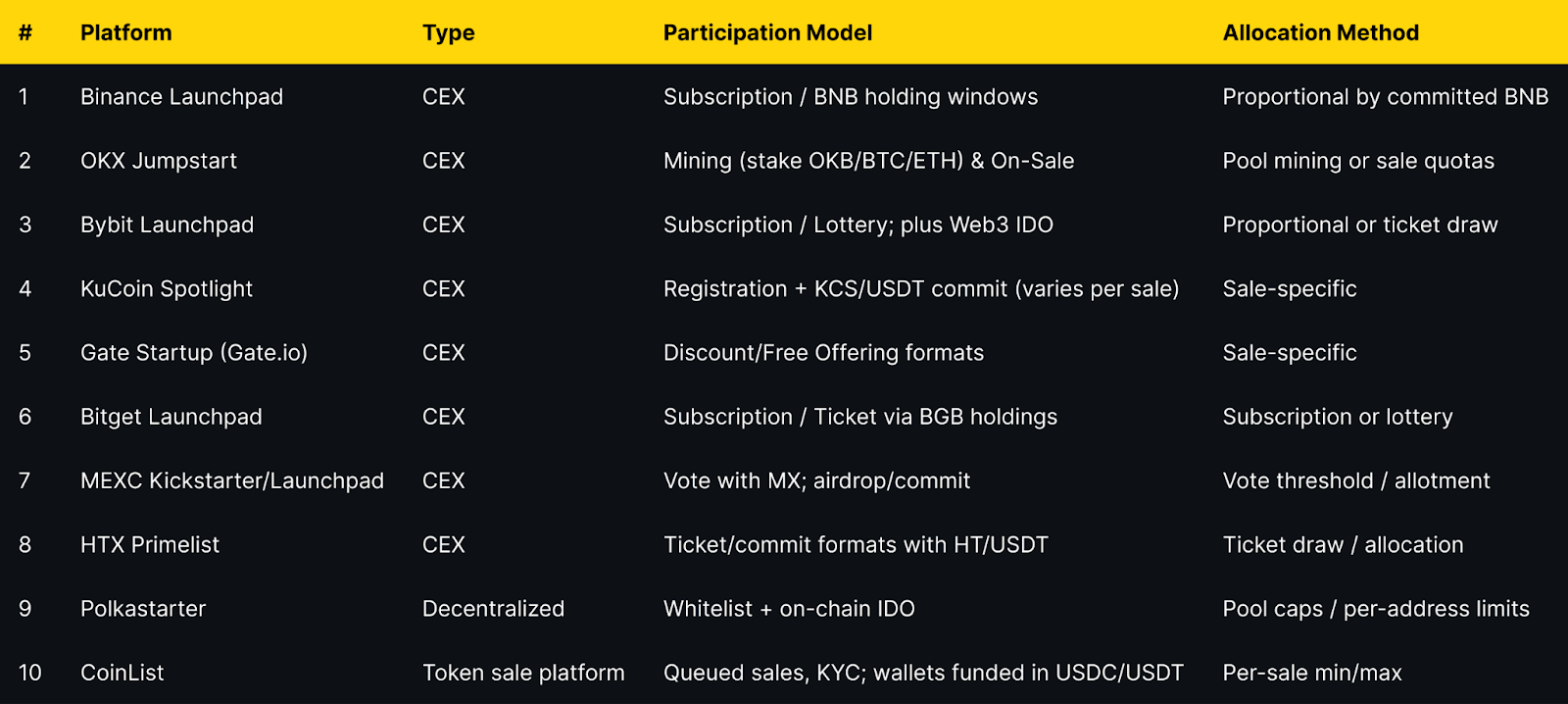
In 2025, primary-market access has consolidated around large exchanges and a handful of battle-tested decentralized platforms. For investors, best crypto launchpads 2025 decisions hinge on liquidity, security/compliance, costs, and eligibility. Centralized exchange (CEX) launchpads (e.g., Binance, OKX, Bybit) emphasize KYC and region filters, while decentralized launchpads (e.g., Polkastarter, DAO Maker) lean on wallet-based participation and project curation. We scored providers using transparent weights, verified details only from official pages, and noted regional restrictions where platforms disclose them. Freshness: Updated November 2025.
How We Picked (Methodology & Scoring)
We shortlisted ~20 credible platforms, then selected TOP_N = 10 based on official evidence (docs/help/pricing/status/security pages). Third-party data was used only for cross-checks, not cited.
Support — 5% (help center clarity, announcements cadence)
Data sources: Official product, help, terms, and announcement pages; platform status/audit pages where available. Last updated: November 2025.
Best Crypto Launchpads & IDO/IEO Platforms in November 2025 (Comparison Table)
* Always confirm current eligibility on the platform’s official Terms/Help pages before participating. ** Some decentralized pools may require external KYC/allowlists set by the project.
Top 10 Crypto Launchpads & IDO/IEO Platforms in November 2025
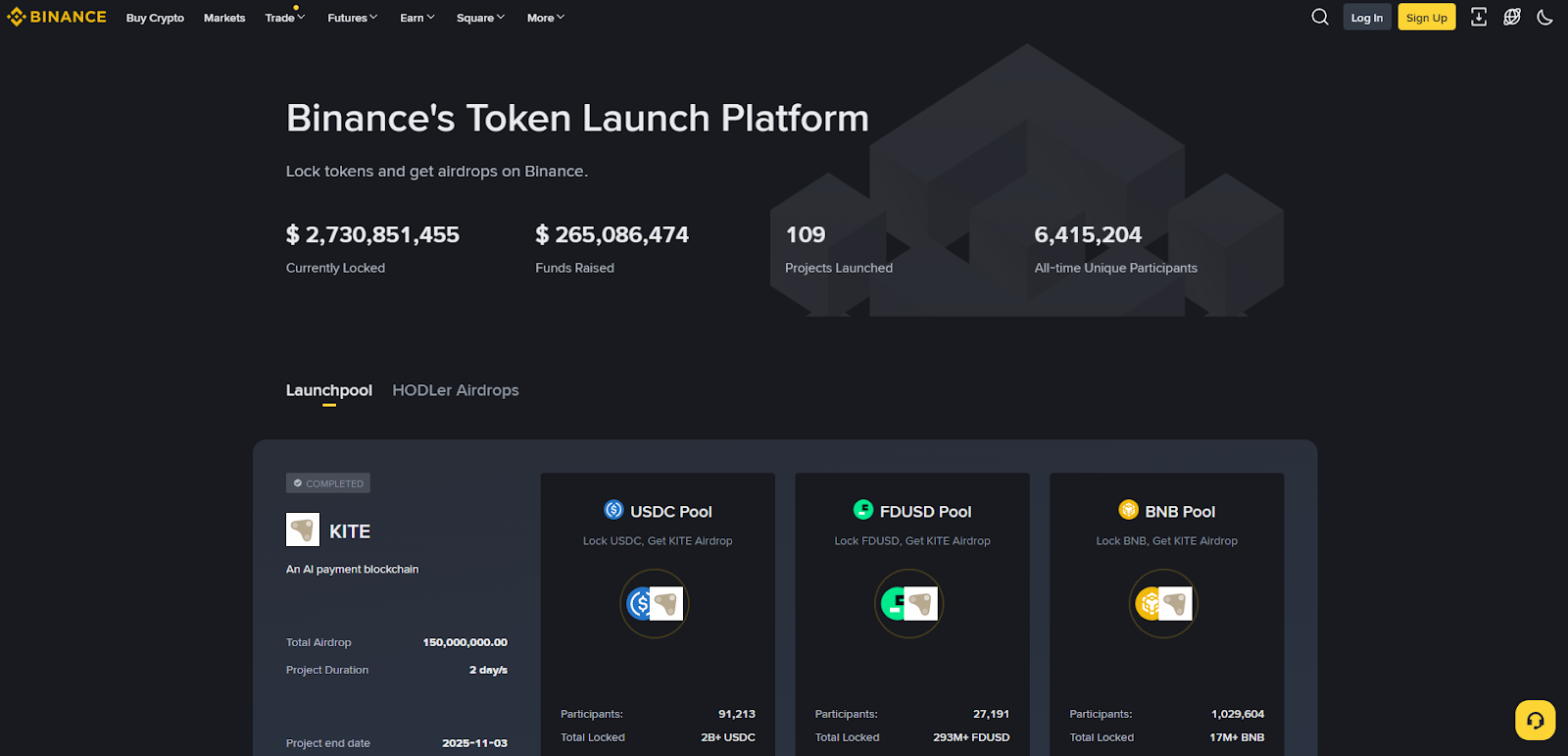
Why Use It. Binance Launchpad runs subscription-style sales that typically require BNB holdings across a snapshot window, then proportional allocation by committed BNB. The process is well documented and integrated with Binance listings, giving post-sale liquidity depth. (Binance Launchpad | Binance) Best For. Allocation hunters, liquidity-first traders, portfolio builders seeking large-venue listings. Notable Features. Subscription model; BNB commitment windows; integrated post-listing ecosystem; robust help center. (Binance) Consider If. Not available in prohibited jurisdictions; KYC required. (Binance) Fees Notes. Varies; trading/network fees apply. Regions. Global, with restricted countries noted in Terms. (Binance) Alternatives. OKX Jumpstart, Bybit Launchpad.
2. OKX Jumpstart — Best for simple mining + sale formats
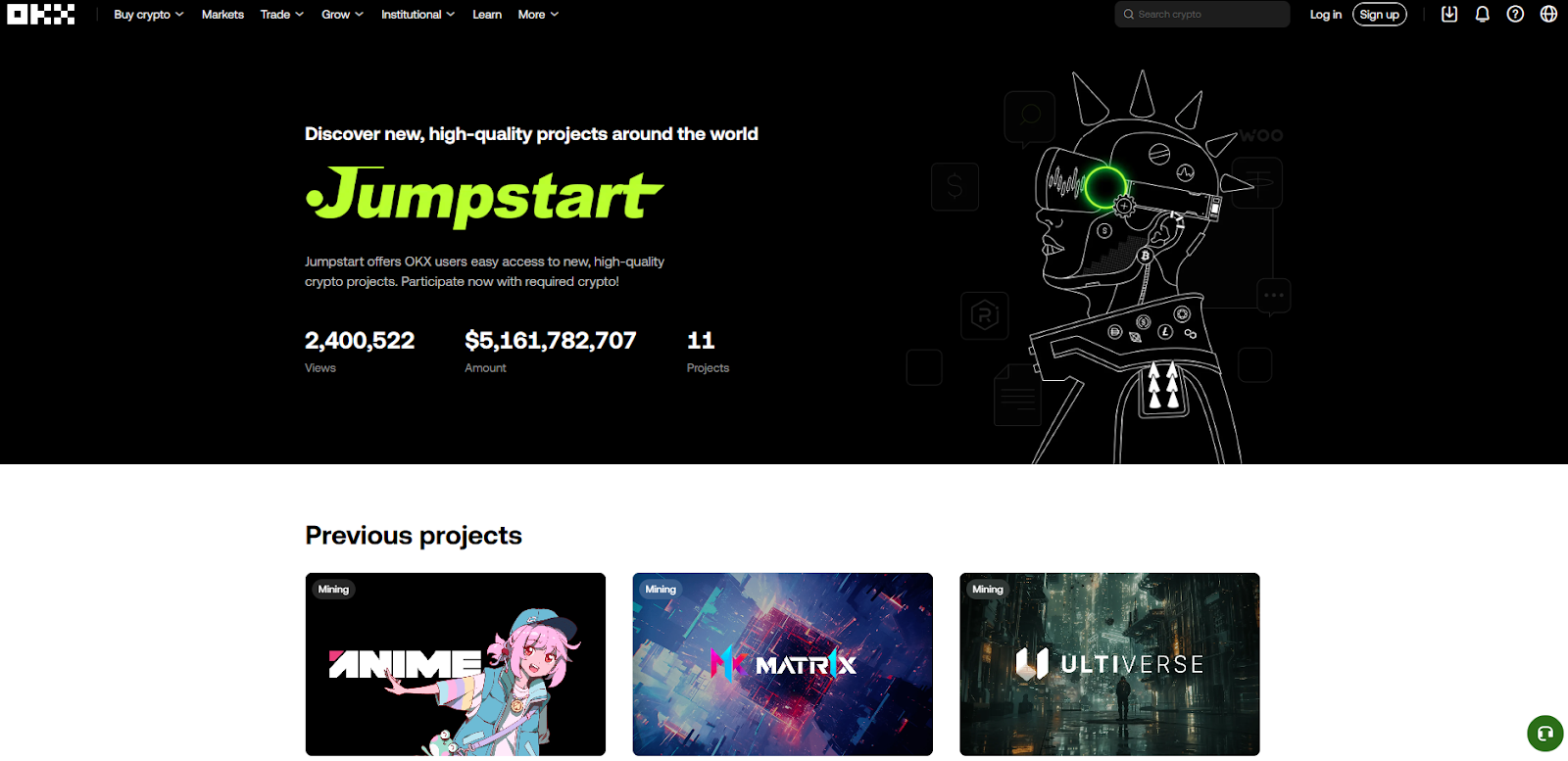
Why Use It. Jumpstart offers Mining events where users stake assets (e.g., OKB, BTC, ETH) to earn new tokens, alongside occasional On-Sale formats. Participation rules are clearly posted per event. (OKX) Best For. Long-only users holding OKB/BTC/ETH, set-and-forget miners, diversified hunters of frequent drops. Notable Features. Mining & sale dual formats; event pages with tokenomics; frequent announcements. (OKX) Consider If. Jurisdiction limits apply; verify your eligibility. (OKX) Fees Notes. Varies; network fees apply. Regions. Global with restrictions per OKX policies. Alternatives. Binance Launchpad, Gate Startup.
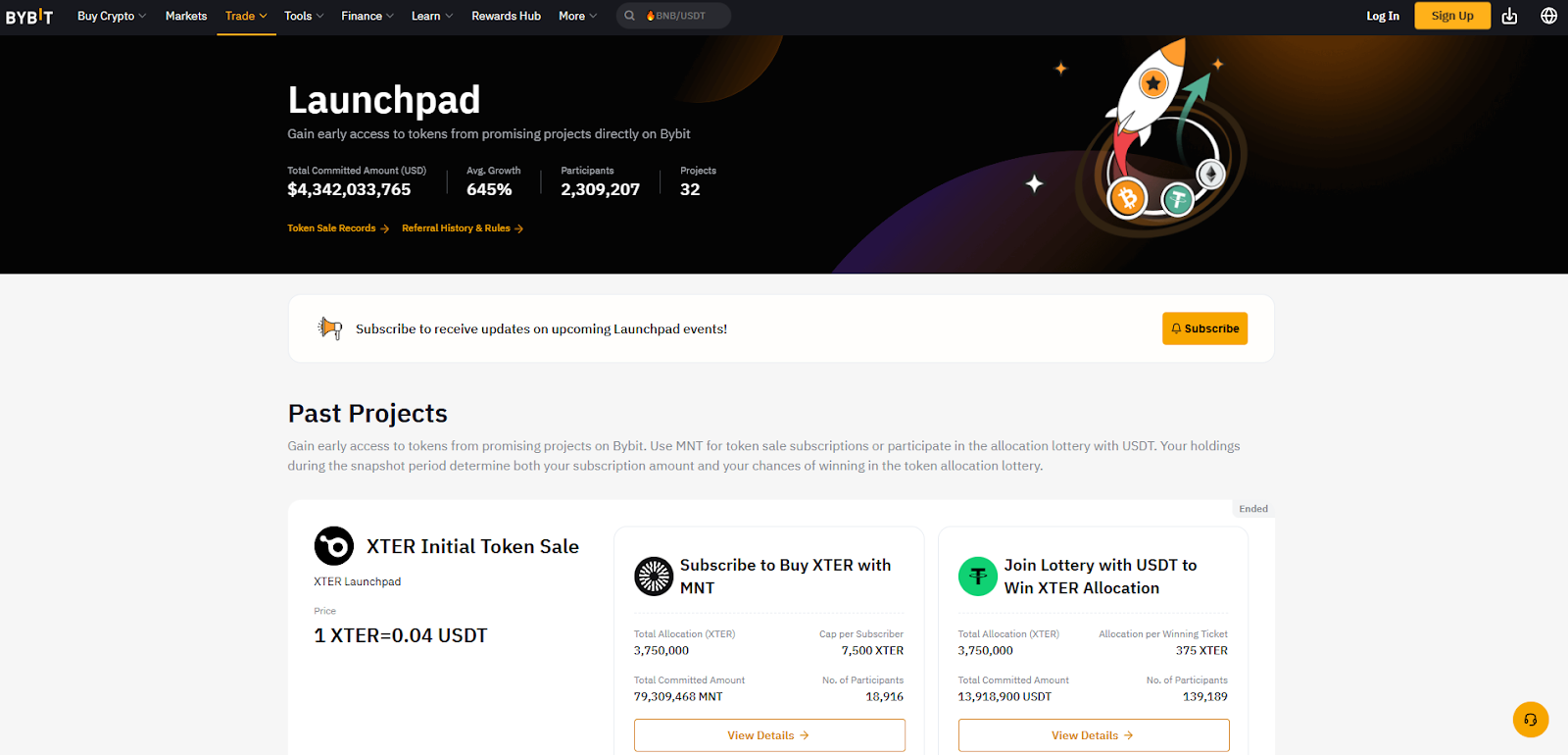
Why Use It. Bybit runs subscription/lottery sales on the exchange and also operates a Web3 IDO platform for wallet-based participation. Clear KYC tiers and frequent help-center updates support new users. (bybit.com) Best For. Users who want both exchange launchpad and Web3 IDO in one brand, ticket/lottery mechanics. Notable Features. Subscription and lottery formats; Web3 IDO portal; detailed KYC guidance. (bybit.com) Consider If. Not available in excluded jurisdictions (e.g., U.S.). (bybit.com) Fees Notes. Varies; network fees apply. Regions. Global (excluded jurisdictions listed by Bybit). (bybit.com) Alternatives. Binance Launchpad, Bitget Launchpad.
4. KuCoin Spotlight — Best for altcoin discovery on a major exchange
Why Use It. Spotlight aggregates new listings and has hosted high-profile events. Participation generally requires KYC and following sale-specific rules posted in help/announcement pages. (KuCoin) Best For. Altcoin-oriented users who want curated sales and subsequent exchange liquidity. Notable Features. Dedicated Spotlight center; sale how-to guides; history of ended sales. (KuCoin) Consider If. U.S. users are restricted per KuCoin Terms. (KuCoin) Fees Notes. Varies; network fees apply. Regions. Global (U.S. and other locations restricted). (KuCoin) Alternatives. Gate Startup, MEXC Kickstarter.
Why Use It. Gate’s Startup page offers discount and free-offering formats, with active cadence and explicit instructions in announcements and help articles. KYC is required for participation. (Gate.com) Best For. Deal hunters, high-frequency participants, multi-format collectors. Notable Features. Discount and free-offering modes; constant announcements; centralized hub. (Gate.com) Consider If. Make sure you’ve completed Gate KYC before events. (Gate.com) Fees Notes. Varies; network fees apply. Regions. Global (subject to KYC and eligibility). Alternatives. OKX Jumpstart, MEXC Kickstarter.
6. Bitget Launchpad — Best for BGB-based subscription or ticket access
Why Use It. Bitget runs subscription and ticket models, often tied to BGB holdings/trading activity. Official FAQ and blog posts detail eligibility and formats. (bitget.com) Best For. Users already in the Bitget ecosystem; lottery-style allocation seekers. Notable Features. BGB-linked ticketing; subscription flows; event records page. (bitget.com) Consider If. Region limits apply and formats can vary by event. Fees Notes. Varies; network fees apply. Regions. Global with restrictions. Alternatives. Bybit Launchpad, HTX Primelist.
Why Use It.Kickstarter lets MX holders vote to support pre-launch projects and receive airdrops when thresholds are met; official FAQs outline steps and eligibility. (MEXC) Best For. Airdrop hunters, MX token holders, event-driven users. Notable Features. Vote-to-airdrop; quick-commit across events; MX minimums. (MEXC) Consider If. Rewards, formats, and eligibility can change per event—read each page. Fees Notes. Varies; network fees apply. Regions. Global with restrictions. Alternatives. Gate Startup, Bitget Launchpad.
8. HTX Primelist — Best for ticket/commit sale mechanics
Why Use It. Primelist runs ticket/commit structures where users may lock HT/USDT or complete tasks to obtain tickets; official announcements describe cadence and rules. (htx.com) Best For. Users comfortable with ticket allocations and exchange-based listings. Notable Features. Ticket draws; commitment options; frequent listing promos. (htx.com) Consider If. Check jurisdiction limits and sale-specific rules each time. Fees Notes. Varies; network fees apply. Regions. Global with restrictions. Alternatives. Bitget Launchpad, Bybit Launchpad.
9. Polkastarter — Best decentralized IDO for whitelists and on-chain caps
Why Use It. Polkastarter hosts curated on-chain IDOs with per-address caps and allowlists, giving transparent pool limits and wallet-based participation. Project pages and a launch portal outline the process. (polkastarter.com) Best For. Users preferring self-custody, on-chain settlement, and project allowlists. Notable Features. On-chain pools; whitelist workflows; project directories. (polkastarter.com) Consider If. Some projects impose geofences/KYC—always read pool terms. Fees Notes. Network gas; project-level terms. Regions. Global; project-dependent restrictions may apply. Alternatives. DAO Maker, CoinList.
10. CoinList — Best for fully KYC’d token sales and wallet funding
Why Use It. CoinList runs queued token sales with per-sale minimums/maximums and strict KYC. Help articles detail wallet funding in USDC/USDT and purchase flows. (CoinList) Best For. Users who prefer structured, compliance-forward public sales with clear limits. Notable Features. Queue systems; per-sale caps; explicit instructions; wallet funding guides. (CoinList) Consider If. Eligibility varies by sale; expect KYC and sometimes region-specific exclusions. Fees Notes. Stated per sale; network fees apply. Regions. Global (U.S. participation depends on each sale’s terms). Alternatives. Polkastarter, Binance Launchpad.
Using the wrong wallet type for Web3 IDO vs. CEX subscription. (bybit.com)
Overlooking vesting/claim deadlines and token distribution mechanics. (OKX)
Falling for unofficial links or phishing around high-demand sales.
Committing more than you can afford under volatile market conditions.
How We Picked (Methodology & Scoring)
We evaluated ~20 providers (including Seedify, TrustPad, BSCPad, PinkSale, BullPerks, Enjinstarter, Poolz, WeStarter, GameFi, ApeTerminal, and Republic Crypto) for liquidity (30), security (25), coverage (15), costs (15), UX (10), support (5) using only official pages for claims. We excluded defunct/region-ineligible platforms for Global readers or those lacking current official documentation. Last updated November 2025.
FAQs
What is a crypto launchpad? A platform that hosts early token distributions (IDO/IEO) with rules for eligibility, allocation, and settlement, either on an exchange or on-chain.
Are launchpads safe? Safety depends on the platform and the project. Prefer venues with clear KYC/eligibility, transparent rules, and official documentation, and use strong account security. (Binance)
What fees should I expect? Some platforms state sale/processing terms on event pages; otherwise expect network gas and standard trading fees after listing. Always read each sale’s official page.
Can U.S. users participate? Many CEX launchpads restrict U.S. users per their Terms. Check platform eligibility before committing. (Binance)
Do I need KYC? Most CEX launchpads require KYC. Decentralized IDOs may be wallet-only but can still impose allowlists or geofences per project. (bybit.com)
How do allocation methods differ? Common approaches include proportional subscription, lottery/tickets, staking/mining, and whitelist caps for on-chain pools. (Binance)
Conclusion + Related Reads
If you want the broadest liquidity and simple participation, start with Binance Launchpad or OKX Jumpstart. For CEX + Web3 flexibility, Bybit stands out. Prefer self-custody? Explore Polkastarter and read each project’s terms carefully. Pair your launchpad activity with Token Metrics research, alerts, and portfolio tools to manage risk.