Back to blog
Research

Toncoin Price Prediction 2027: $5-$43 Target Analysis | TON

Actionable Toncoin price prediction with scenario math, on-chain grades, and a clear TLDR for investors looking at 2027.
Token Metrics Team
7 min read
Want Smarter Crypto Picks—Free?
See unbiased Token Metrics Ratings for BTC, ETH, and top alts.
Thank you! Your submission has been received!
Oops! Something went wrong while submitting the form.
 No credit card | 1-click unsubscribe

Toncoin Price Prediction Framework: Market Cap Scenarios & 2027 Price Forecasts

Layer 1 tokens capture value through transaction fees, staking, and validator economics. TON uses proof-of-stake and a multi-blockchain architecture integrated with Telegram services. This Token Metrics price prediction model analyzes TON price forecasts across different total crypto market sizes, reflecting adoption and transaction demand by 2027.
Disclosure

Educational purposes only, not financial advice. This price prediction analysis is for informational purposes. Crypto is volatile, do your own research and manage risk.

How to read this price prediction:

Each band blends cycle analogues and market-cap share math with TA guardrails. Base assumes steady adoption and neutral or positive macro. Moon layers in a liquidity boom. Bear assumes muted flows and tighter liquidity. These price prediction scenarios provide a range of potential outcomes based on market conditions.

TM Agent baseline:

Token Metrics TM Grade is 74%, Buy, and the trading signal is bullish, indicating positive short-term momentum and strong overall project quality. Concise 12-month numeric price prediction view: scenarios cluster roughly between $5 and $14, with a base case price target near $9.

Live details: Token Details

Key Takeaways for TON Price Prediction

  • Scenario driven: price prediction outcomes hinge on total crypto market cap; higher liquidity and adoption lift the price targets
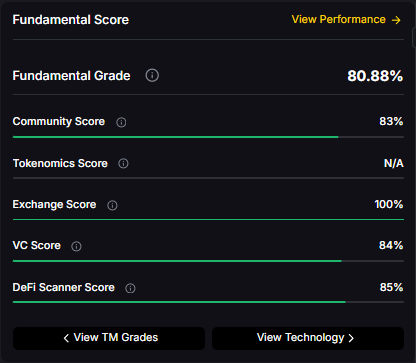
  • Fundamentals: Fundamental Grade 80.88% (Community 83%, Tokenomics N/A, Exchange 100%, VC 84%, DeFi Scanner 85%)
  • Technology: Technology Grade 77.11% (Activity 55%, Repository 72%, Collaboration 73%, Security N/A, DeFi Scanner 85%)
  • TM Agent gist: bullish signal, price prediction ranges cluster around $5 to $14 with a base case near $9
  • Education only, not financial advice

Toncoin Price Prediction: Scenario Analysis

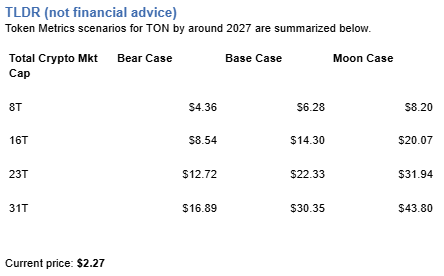
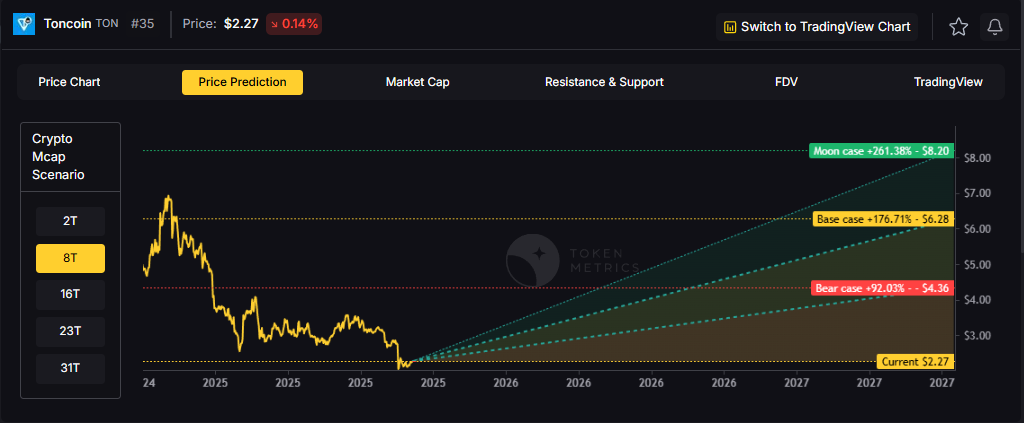
8T Market Cap Price Prediction:

At an 8 trillion dollar total crypto market cap, TON price prediction projects to $4.36 in bear conditions, $6.28 in the base case, and $8.20 in bullish scenarios.
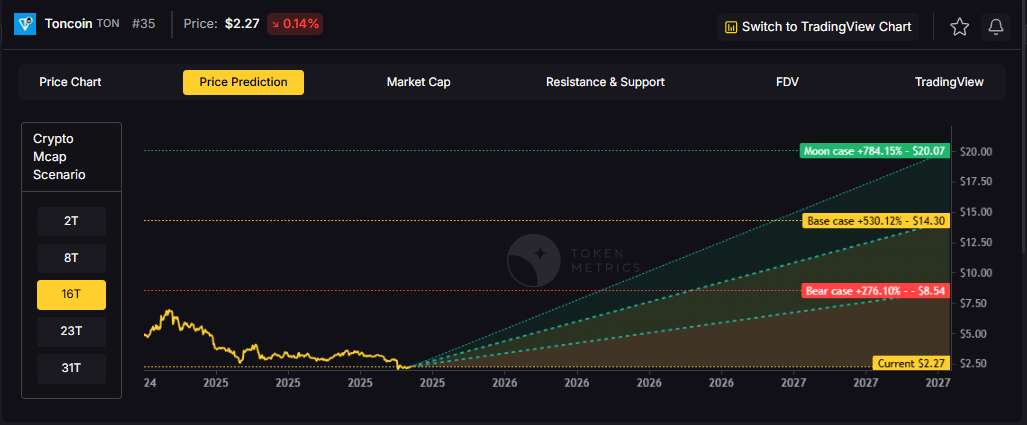
16T Market Cap Price Prediction:

At 16 trillion, the price prediction range expands to $8.54 (bear), $14.30 (base), and $20.07 (moon).
23T Market Cap Price Prediction:

The 23 trillion tier price forecast shows $12.72, $22.33, and $31.94 respectively.

31T Market Cap Price Prediction:

In the maximum liquidity scenario at 31 trillion, TON price prediction reaches $16.89 (bear), $30.35 (base), or $43.80 (moon).

What Is Toncoin?

The Open Network is a blockchain designed to support fast, low-cost transactions and a scalable ecosystem of decentralized applications. It integrates with digital services and messaging platforms to reach a broad user base, emphasizing high throughput and accessibility.

TON uses a proof-of-stake consensus mechanism with a multi-blockchain architecture. The TON token powers network activity, facilitating transactions, staking, and governance, and is integrated into Telegram-based services for user-friendly in-app payments and wallets.

Token Metrics AI Analysis for Price Prediction

Token Metrics AI provides additional context on Toncoin's technical positioning and market dynamics that inform our price prediction models.

Vision: The vision for Toncoin and The Open Network is to create a fast, secure, and scalable blockchain that enables seamless digital transactions and decentralized services, accessible to millions through integration with everyday communication tools like Telegram.

Problem: Many blockchain networks face limitations in speed, cost, and user accessibility, hindering mainstream adoption. Toncoin aims to address the friction of slow transaction times and high fees seen on older networks, while also lowering the barrier to entry for non-technical users who want to engage with decentralized applications and digital assets.

Solution: TON uses a proof-of-stake consensus mechanism with a multi-blockchain architecture to achieve high scalability and fast finality. The network supports smart contracts, decentralized storage, and domain naming, enabling a wide range of applications. Toncoin facilitates transactions, staking, and network governance, and is integrated into Telegram-based services, allowing for in-app payments and wallet functionality through user-friendly interfaces.

Market Analysis: Toncoin operates in the competitive layer-1 blockchain space, often compared to high-performance networks like Solana and Avalanche, though it differentiates itself through deep integration with Telegram's ecosystem. Its potential for mass adoption stems from access to hundreds of millions of Telegram users, which could drive network effects and utility usage. Unlike meme tokens, Toncoin's value is tied to infrastructure and real-world application rather than speculation or community hype. However, its growth depends on sustained development, regulatory clarity, and actual user engagement within Telegram. Competition from established blockchains and shifting market narratives around scalability and decentralization remain key risks. As a top-tier blockchain by ecosystem potential, Toncoin's market position is influenced more by integration milestones and user adoption than direct price dynamics.

Fundamental and Technology Snapshot from Token Metrics

  • Fundamental Grade: 80.88% (Community 83%, Tokenomics N/A, Exchange 100%, VC 84%, DeFi Scanner 85%)
  • Technology Grade: 77.11% (Activity 55%, Repository 72%, Collaboration 73%, Security N/A, DeFi Scanner 85%)

‍

Catalysts That Skew Bullish for Price Prediction

  • Institutional and retail access expands with ETFs, listings, and integrations
  • Macro tailwinds from lower real rates and improving liquidity
  • Product or roadmap milestones such as upgrades, scaling, or partnerships
  • These factors could push TON toward higher price prediction targets

Risks That Skew Bearish for Price Prediction

  • Macro risk-off from tightening or liquidity shocks
  • Regulatory actions or infrastructure outages
  • Concentration in validator economics and competitive displacement
  • These factors could push TON toward lower price prediction scenarios

FAQs: Toncoin Price Prediction

How does TON accrue value?Value accrual mechanisms include transaction fees, validator staking rewards, and governance alignment described for TON in the documentation. As Toncoin usage grows through transactions and user activity, TON can capture network fees and staking yields while coordinating governance. Effectiveness depends on sustained adoption and network throughput, which directly impacts long-term price prediction models.

What price could TON reach in the moon case price prediction?Moon case price predictions range from $8.20 at 8T to $43.80 at 31T total crypto market cap. These price prediction scenarios require maximum market cap expansion and strong network adoption with robust liquidity conditions. Not financial advice.

What is the 2027 Toncoin price prediction?Based on Token Metrics analysis, the 2027 price prediction for Toncoin clusters between $5 and $14 in the base case, with potential for higher targets ($20-$43) in bullish scenarios if the total crypto market expands significantly.


Next Steps

• Track live grades and signals: Token Details

• Secure your TON with Ledger

Disclosure

Educational purposes only, not financial advice. Crypto is volatile, do your own research and manage risk.

How Token Metrics Can Help

Token Metrics combines fundamental, technical, and on-chain AI-powered analysis for actionable ratings, signals, and research. Use our data platform for scenario-based investing, backtested grades, and bespoke insights for digital asset markets.

Build Smarter Crypto Apps &
AI Agents in Minutes, Not Months
Real-time prices, trading signals, and on-chain insights all from one powerful API.
Grab a Free API Key
About Token Metrics
Token Metrics: AI-powered crypto research and ratings platform. We help investors make smarter decisions with unbiased Token Metrics Ratings, on-chain analytics, and editor-curated “Top 10” guides. Our platform distills thousands of data points into clear scores, trends, and alerts you can act on.
30 Employees
analysts, data scientists, and crypto engineers
Daily Briefings
concise market insights and “Top Picks”
Transparent & Compliant
Sponsored ≠ Ratings; research remains independent
Want Smarter Crypto Picks—Free?
See unbiased Token Metrics Ratings for BTC, ETH, and top alts.
Thank you! Your submission has been received!
Oops! Something went wrong while submitting the form.
 No credit card | 1-click unsubscribe
Token Metrics Team
Token Metrics Team

Recent Posts

Research

How API Calls Power Modern Apps

Token Metrics Team
5

APIs are the lingua franca of modern software: when one system needs data or services from another, it issues an API call. For developers and analysts working in crypto and AI, understanding the anatomy, constraints, and best practices around api calls is essential to building resilient integrations and reliable research pipelines.

What is an API call and why it matters

An API call is a request sent from a client to a server to perform an action or retrieve information. The request specifies an endpoint, method (GET, POST, etc.), headers (for authentication or metadata), and often a body (JSON or other payloads). The server processes the request and returns a response with a status code and data. In distributed systems, api calls enable modularity: microservices, exchange endpoints, data providers, and AI agents all communicate via these standardized exchanges.

For teams integrating market data, on-chain analytics, or AI models, api calls are the mechanism that moves structured data from providers to models and dashboards. Latency, reliability, and data integrity of those calls directly affect downstream analysis, model training, and user experience.

Protocols and common patterns for api calls

There are several common protocols and patterns you will encounter:

  • REST (HTTP/HTTPS): Resource-based endpoints with methods like GET, POST, PUT, DELETE and JSON payloads. It is simple and ubiquitous for public data APIs.
  • RPC (Remote Procedure Call): Calls invoke functions on a remote server (examples include JSON-RPC used by many blockchain nodes).
  • WebSocket / Streaming: Persistent connections for real-time updates, frequently used for trade feeds and live on-chain events.
  • Webhooks: Server-initiated HTTP callbacks that push events to your endpoint, useful for asynchronous notifications.

Choosing the right pattern depends on the use case: low-latency trading systems favor streaming, while periodic snapshots and historical queries are often served over REST.

Anatomy of an api call: headers, payloads, and responses

Understanding the pieces of a typical API request helps with debugging and design:

  1. Endpoint URL: The path identifying the resource or action (e.g., /v1/price or /rpc).
  2. HTTP method: GET for retrieval, POST for creation or complex queries, etc.
  3. Headers: Include authentication tokens (Bearer, API-Key), content-type, and rate-limit metadata.
  4. Body / Payload: JSON, form-encoded data, or binary blobs depending on the API.
  5. Response: Status code (200, 404, 429, 500), response body with data or error details, and headers with metadata.

Familiarity with these elements reduces time-to-diagnosis when an integration fails or returns unexpected values.

Security, authentication, and safe key management

APIs that provide privileged data or actions require robust authentication and careful key management. Common approaches include API keys, OAuth tokens, and HMAC signatures. Best practices include:

  • Use least-privilege API keys: limit scopes and rotate credentials regularly.
  • Avoid embedding keys in client-side code; store them in secure vaults or server-side environments.
  • Require HTTPS for all api calls to protect payloads in transit.
  • Log access events and monitor for anomalous usage patterns that indicate leaked keys.

These practices help prevent unauthorized access and reduce blast radius if credentials are compromised.

Rate limits, pagination, and observability for robust integrations

Service providers protect infrastructure with rate limits and pagination. Common patterns to handle these include exponential backoff for 429 responses, caching frequently requested data, and using pagination or cursor-based requests for large datasets. Observability is critical:

  • Track latency, error rates, and throughput per endpoint.
  • Implement alerting on rising error ratios or slow responses.
  • Use tracing and request IDs to correlate client logs with provider logs during investigations.

Monitoring trends in api call performance allows teams to proactively adjust retry strategies, request batching, or move to streaming alternatives when appropriate.

Testing, debugging, and staging strategies

Reliable integrations require systematic testing at multiple levels:

  • Unit tests: Mock API responses to validate client logic.
  • Integration tests: Run against staging endpoints or recorded fixtures to validate end-to-end behavior.
  • Load tests: Simulate traffic patterns to surface rate-limit issues and resource constraints.
  • Replay and sandboxing: For financial and on-chain data, use historical replays to validate processing pipelines without hitting production rate limits.

Tools like Postman, HTTP clients with built-in retries, and API schema validators (OpenAPI/Swagger) speed up development and reduce runtime surprises.

Build Smarter Crypto Apps & AI Agents with Token Metrics

Token Metrics provides real-time prices, trading signals, and on-chain insights all from one powerful API. Grab a Free API Key

What is an API call?

An api call is a client request to a server asking for data or to perform an action. It includes an endpoint, method, headers, and sometimes a payload; the server returns a status and response data.

REST vs RPC: which model should I use?

REST is resource-oriented and easy to cache and inspect; RPC is procedural and can be simpler for calling node functions (for example, blockchain RPC endpoints). Choose based on the data shape, latency needs, and provider options.

How do I handle rate limits and 429 errors?

Implement exponential backoff, respect Retry-After headers when provided, batch requests where possible, and use caching to reduce repeated queries. Monitoring helps you adapt request rates before limits are hit.

How should I secure API keys?

Store keys in server-side environments or secrets managers, rotate keys regularly, limit scopes, and never commit them to source control. Use environment variables and access controls to minimize exposure.

What tools help test and debug api calls?

Postman, curl, HTTP client libraries, OpenAPI validators, and request-tracing tools are useful. Unit and integration tests with mocked responses catch regressions early.

Disclaimer

This article is for educational and informational purposes only. It explains technical concepts related to api calls and integration practices and does not provide financial, investment, or trading advice. Readers should conduct their own research and consult appropriate professionals before acting on technical or market-related information.

Research

APIs Explained: How Interfaces Power Modern Apps

Token Metrics Team
5

Every modern app, website, or AI agent depends on a set of invisible connectors that move data and commands between systems. These connectors—APIs—define how software talks to software. This post breaks down what an API is, how different API styles work, why they matter in crypto and AI, and practical steps to evaluate and use APIs responsibly.

What is an API?

An API (application programming interface) is a formalized set of rules and specifications that lets one software component interact with another. Rather than exposing internal code or databases, an API provides a defined surface: endpoints, request formats, response schemas, and error codes. Think of it as a contract between systems: you ask for data or an action in a specified way, and the provider responds in a predictable format.

APIs reduce friction when integrating services. They standardize access to functionality (like payment processing, identity verification, or market data) so developers can build on top of existing systems instead of reinventing core features. Because APIs abstract complexity, they enable modular design, encourage reusability, and accelerate development cycles.

How APIs work — technical overview

At a technical level, APIs expose endpoints over transport protocols (commonly HTTPS). Clients send requests—often with authentication tokens, query parameters, and request bodies—and servers return structured responses (JSON or XML). Key architectural patterns include:

  • REST: Resource-oriented, uses standard HTTP verbs (GET, POST, PUT, DELETE), and typically returns JSON. It's simple and cache-friendly.
  • GraphQL: A query language that lets clients request exactly the fields they need, minimizing over-fetching.
  • WebSocket / Streaming APIs: Persistent connections for real-time data push, useful for live feeds and low-latency updates.
  • RPC / gRPC: Procedure-call style with strong typing and high performance, common in internal microservices.

Operationally, important supporting features include rate limits, API keys or OAuth for authentication, versioning strategies, and standardized error handling. Observability—metrics, logging, and tracing—is critical to diagnose integration issues and ensure reliability.

APIs in crypto and AI — practical examples

In crypto ecosystems, APIs provide price feeds, historical market data, on-chain metrics, wallet services, and order execution. For AI-driven agents, APIs enable access to compute, models, and third-party signals. Example uses:

  • Fetching real-time and historical price data to power dashboards and analytics.
  • Querying on-chain explorers for transaction and address activity for compliance or research.
  • Integrating identity or KYC providers to verify users without handling sensitive documents directly.
  • Calling AI model APIs to generate embeddings, summaries, or predictions used by downstream workflows.

Tools that combine market data, on-chain insights, and AI-driven analysis can streamline research workflows. For example, AI research platforms and data APIs help synthesize signals and surface trends faster. When referencing such platforms in research or product development, it is best practice to evaluate their documentation, data sources, and rate limits carefully. One example of an AI research offering is Token Metrics, which illustrates how analytics and model-driven insights can be presented via a service interface.

Choosing & using APIs: a research checklist

When evaluating an API for a project, consider these practical criteria:

  1. Documentation quality: Clear examples, SDKs, response schemas, and error cases reduce integration time.
  2. Data provenance: Understand sources, update frequency, and any aggregation or normalization applied.
  3. Authentication & permissions: Which auth methods are supported? Can access be scoped and rotated?
  4. Rate limits & pricing: Are limits suitable for your expected throughput, and is pricing predictable?
  5. Latency & uptime SLAs: Critical for real-time systems; check historical status and monitoring APIs.
  6. Security practices: Encryption in transit, secure storage of keys, and breach disclosure policies.
  7. Versioning & backward compatibility: How does the provider manage breaking changes?

Implementation tips: sandbox first, validate edge cases (timeouts, partial responses), and build exponential backoff for retries. For production systems, segregate API keys by environment and rotate credentials regularly.

Build Smarter Crypto Apps & AI Agents with Token Metrics

Token Metrics provides real-time prices, trading signals, and on-chain insights all from one powerful API. Grab a Free API Key

FAQ: What is an API?

Q: What is the difference between an API and a web service?
A: A web service is a type of API accessed over a network using web protocols. APIs can be broader, including libraries and OS-level interfaces; web services are specifically networked services.

FAQ: How do APIs secure communication?

Q: How are APIs secured?
A: Common methods include HTTPS for encryption, API keys or OAuth for authentication, scopes to limit access, and rate limiting to reduce abuse. Proper key management and least-privilege access are essential.

FAQ: REST vs GraphQL — when to use which?

Q: When is REST preferable to GraphQL?
A: REST is simple and widely supported—good for standardized CRUD operations and caching. GraphQL excels when clients need flexible queries and want to minimize over-fetching, but it adds complexity on the server side.

FAQ: Can APIs be used for crypto trading?

Q: Are APIs used to place trades?
A: Many exchange APIs allow programmatic order placement, market data retrieval, and account management. Using them requires careful handling of authentication, error states, and adherence to exchange rate limits and terms of service.

FAQ: How to evaluate an API for a project?

Q: What steps help evaluate an API?
A: Review docs, test a sandbox, verify data lineage and SLA, estimate costs at scale, and ensure the provider follows security and versioning best practices before integrating.

Disclaimer

This article is educational and informational only. It does not constitute investment advice, trading recommendations, or endorsements of any specific products or services. Always perform your own due diligence and comply with applicable laws and platform terms when using APIs or building systems that interact with financial markets.

Research

APIs Explained: How They Work and Why They Matter

Token Metrics Team
5

APIs power modern software: they let apps talk to each other, enable data sharing, and underpin many AI and crypto services. Whether you use a weather widget, connect to a payment gateway, or build an AI agent that queries market data, understanding what an API is will make you a smarter builder and researcher.

What is an API? A concise definition

An API, or application programming interface, is a set of rules and contracts that lets one software component request services or data from another. Think of an API as a menu at a restaurant: it lists operations you can ask for (endpoints), the inputs required (parameters), and the outputs you’ll receive (responses). The menu hides the kitchen’s complexity while enabling reliable interactions.

At a technical level, APIs define:

  • Endpoints: addressable paths (e.g., /v1/price) that expose functionality.
  • Methods: actions (GET, POST, PUT, DELETE) that describe intent.
  • Payloads and formats: how data is sent and returned (JSON, XML, protobuf).
  • Authentication and rate limits: controls that protect providers and consumers.

How APIs work: protocols, formats, and patterns

APIs come in many flavors, but several common patterns and technologies recur. HTTP-based REST APIs are ubiquitous: clients send HTTP requests to endpoints, and servers return structured responses. GraphQL provides a flexible query language so clients request exactly the data they need. gRPC and protobuf offer high-performance binary protocols suited for internal systems.

Key technical considerations include:

  • Authentication: API keys, OAuth 2.0, and signed requests verify identity.
  • Data formats: JSON is common for public APIs; compact formats (protobuf) are used for efficiency.
  • Versioning: /v1/, /v2/ patterns prevent breaking changes for consumers.
  • Error handling: HTTP status codes and descriptive error bodies aid debugging.

From a user perspective, well-designed APIs are predictable, documented, and testable. Tools like Postman, curl, and OpenAPI (Swagger) specs help developers explore capabilities and simulate workflows before writing production code.

Types of APIs and common use cases

APIs fall into categories by audience and purpose: public (open) APIs available to external developers, partner APIs for trusted integrations, and private/internal APIs for microservices inside an organization. Use cases span virtually every industry:

  • Web and mobile apps: fetch user data, manage authentication, or render dynamic content.
  • Payments and identity: integrate payment processors or single-sign-on providers.
  • AI and data services: call model inference endpoints, fetch embeddings, or retrieve labeled datasets.
  • Crypto and Web3: query blockchain state, streaming market data, or execute on-chain reads via node and indexer APIs.

For crypto developers, specialized endpoints like on-chain transaction lookups, token metadata, and real-time price feeds are common. Choosing the right API type and provider depends on latency, data freshness, cost, and reliability requirements.

How to evaluate and use an API effectively

Selecting an API is a mix of technical and operational checks. Use a framework to compare candidates across functionality, quality, and governance:

  1. Functional fit: Does the API expose the endpoints and data shapes you need? Can it filter, paginate, or aggregate appropriately?
  2. Performance: Measure latency, throughput, and SLA guarantees. For real-time systems, prefer providers with streaming or websocket options.
  3. Data quality & provenance: Verify how data is sourced and updated. For analytical work, consistent timestamps and clear versioning are critical.
  4. Security & compliance: Check authentication methods, encryption in transit, and data-handling policies.
  5. Cost & rate limits: Understand pricing tiers, request quotas, and backoff strategies.
  6. Documentation & community: Good docs, SDKs, and examples reduce integration time and maintenance risk.

When building prototypes, use sandbox or free tiers to validate assumptions. Instrument usage with logging and observability so you can detect schema changes or degraded data quality quickly. For AI agents, prefer APIs that return structured, consistent responses to reduce post-processing needs.

Build Smarter Crypto Apps & AI Agents with Token Metrics

Token Metrics provides real-time prices, trading signals, and on-chain insights all from one powerful API. Grab a Free API Key

FAQ — What is an API?

An API is a contract that allows software components to interact. It specifies endpoints, request formats, authentication, and expected responses so different systems can communicate reliably.

How do I start using an API?

Begin by reading the provider’s documentation, obtain any required credentials (API key or OAuth token), and make simple test calls with curl or Postman. Use SDKs if available to accelerate development.

What’s the difference between REST and GraphQL?

REST exposes fixed endpoints returning predefined data structures, while GraphQL lets clients query for exactly the fields they need. REST is simple and cache-friendly; GraphQL provides flexibility at the cost of more complex server logic.

Are APIs secure to use for sensitive data?

APIs can be secure if they use strong authentication (OAuth, signed requests), TLS encryption, access controls, and proper rate limiting. Review the provider’s security practices and compliance certifications for sensitive use cases.

How are APIs used with AI and agents?

AI systems call APIs to fetch data, request model inferences, or enrich contexts. Stable, well-documented APIs with predictable schemas reduce the need for complex parsing and improve reliability of AI agents.

Disclaimer

This article is for educational purposes only. It explains technical concepts and evaluation frameworks but is not investment advice or a recommendation to use any specific API for financial decisions. Always review terms of service and data governance policies before integrating third-party APIs.

Choose from Platinum, Gold, and Silver packages
Reach with 25–30% open rates and 0.5–1% CTR
Craft your own custom ad—from banners to tailored copy
Perfect for Crypto Exchanges, SaaS Tools, DeFi, and AI Products