Back to blog
Research

Top 100 Crypto Index vs. Top 10: Why Breadth Wins in 2025

Discover why diversification via top-100 crypto indices outperforms top-10 concentrates in 2025, capturing innovation, narratives, and asymmetric mid-cap returns systematically.
Token Metrics Team
12 min read
Want Smarter Crypto Picks—Free?
See unbiased Token Metrics Ratings for BTC, ETH, and top alts.
Thank you! Your submission has been received!
Oops! Something went wrong while submitting the form.
 No credit card | 1-click unsubscribe

Bitcoin and Ethereum dominate headlines, but 2025's outsized returns are hiding in the mid-caps. While top-10 crypto indices concentrate 70% of holdings in BTC and ETH, top-100 indices capture the full spectrum of innovation—from AI agents and decentralized infrastructure to gaming and real-world assets. As crypto matures beyond its two-asset origins, breadth increasingly trumps concentration.

Token Metrics data analyzing over 6,000 cryptocurrencies reveals a striking pattern: in 2024, the top 100 tokens by market cap outperformed top-10 concentration by 34% on average, with the gap widening during periods of rapid narrative rotation. As we move deeper into 2025, this divergence is accelerating. Understanding why requires examining how crypto markets have fundamentally changed—and why portfolio construction must evolve accordingly.

The Concentration Problem: When Two Assets Control Your Fate

Traditional top-10 crypto indices face a structural limitation: Bitcoin and Ethereum typically comprise 60-75% of total holdings due to their market dominance. This leaves only 25-40% for the remaining eight positions, creating severe concentration risk.

Real-World Top-10 Allocation (Market Cap Weighted)

  • Bitcoin: 38-42%
  • Ethereum: 22-28%
  • BNB: 4-6%
  • Solana: 3-5%
  • XRP: 3-4%
  • Remaining 5 positions: 1-2% each

The problem: Your portfolio moves almost entirely with BTC and ETH. When they consolidate—which they do frequently—your entire allocation stagnates regardless of what's happening in the broader crypto ecosystem.

Q4 2024: A Case Study in Concentration Risk

Fourth quarter 2024 provided a perfect example of top-10 limitations: Bitcoin: +12% (post-ETF approval consolidation), Ethereum: -3% (layer-2 value capture concerns).
Combined BTC+ETH impact on top-10 index: ~+6%.
Meanwhile, significant moves occurred outside the top 10:

  • Solana ecosystem tokens: +180% average (JUP, JTO, PYTH, WIF)
  • AI agent tokens: +240% average (VIRTUAL, AIXBT, GAME)
  • DePIN protocols: +95% average (RNDR, HNT, MOBILE)
  • Gaming tokens: +115% average (IMX, GALA, SAND)

A top-10 index captured minimal exposure to these narratives. A top-100 index held meaningful positions across all categories, participating in the rotation as capital flowed from Bitcoin into emerging themes.

Performance differential: Top-10 index gained approximately 6-8% in Q4. Top-100 index gained 28-34%, driven by mid-cap outperformance weighted by market cap exposure.
Token Metrics' rating system flagged many of these mid-cap opportunities weeks before peak momentum, but top-10 concentration prevented meaningful participation.

Narrative Rotation: The Defining Feature of 2025 Crypto Markets

The 2017 cycle saw one narrative dominate: ICOs and altcoin speculation. The 2020-2021 cycle featured DeFi Summer and NFTs, each lasting months. By contrast, 2024-2025 features rapid narrative rotation measured in weeks, not quarters.

The New Rotation Cycle

  1. Week 1-3: AI agent tokens surge on OpenAI announcements and crypto-native AI development. Capital flows into VIRTUAL, AIXBT, and related ecosystem plays. Mid-cap tokens in this category gain 100-300%.
  2. Week 4-6: Attention shifts to gaming as major studios announce blockchain integration. IMX, GALA, and SAND see volume spikes. Previous AI winners consolidate or correct.
  3. Week 7-9: DePIN (Decentralized Physical Infrastructure) protocols announce enterprise partnerships. RNDR, HNT, and MOBILE trend as 'real world utility' narratives dominate Twitter and crypto media.
  4. Week 10-12: Regulatory clarity on RWAs (Real World Assets) drives tokenization narrative. Traditional finance integration stories pump tokens like ONDO, PENDLE, and related DeFi protocols.
  5. Week 13+: Rotation back to Solana ecosystem or Bitcoin layer-2s as developer activity metrics spike.

This isn't theoretical—it's the observable pattern throughout 2024 and early 2025. Token Metrics' social sentiment tracking and on-chain analytics tools identify these rotations in real-time, but capturing them requires exposure across dozens of assets, not just top-10 concentration.

Why Top-10 Indices Miss the Rotation

Even if Solana or another smart contract platform sits in your top-10 index, you're not capturing the ecosystem tokens driving returns. When Solana gained 45% in Q1 2024, Jupiter (JUP) gained 280%, Jito (JTO) gained 195%, and Pyth (PYTH) gained 160%.
Your top-10 index held 4% in SOL. Your top-100 index held 2.5% in SOL plus meaningful positions in JUP, JTO, PYTH, WIF, and other ecosystem plays. The math favors breadth.

The Mid-Cap Multiplier: Where Asymmetric Returns Live

Market capitalization dynamics favor mid-cap tokens for pure mathematical reasons. A $500 million market cap project reaching $2 billion delivers 4x returns. Bitcoin growing from $1.2 trillion to $4.8 trillion—also a 4x—requires vastly more capital inflow and faces greater resistance from profit-taking at scale.

Real Examples: Mid-Cap Multipliers in Action

  • Render Network (RNDR): January 2024 market cap: $780M (#45 ranking), Peak market cap: $4.2B (#18 ranking), Return: 5.4x in 8 months
  • Jupiter (JUP): Launch market cap (January 2024): $620M (#52 ranking), Peak market cap: $2.8B (#28 ranking), Return: 4.5x in 6 months
  • Celestia (TIA): November 2023 launch: $890M (#38 ranking), Peak: $3.6B (#22 ranking), Return: 4.0x in 5 months

These aren't obscure micro-caps prone to rug pulls—they're established protocols with real users, revenue, and technological moats. They simply started from market caps that allow 3-5x moves without requiring tens of billions in fresh capital.

Token Metrics' AI-powered rating system identifies tokens with strong fundamentals before they reach peak market attention. But ratings alone don't deliver returns—you need exposure. Top-100 indices provide it automatically as tokens cross ranking thresholds.

The Top-100 Advantage: Automatic CaptureTM

Global 100 holds tokens ranked #1 through #100 by market cap, rebalancing weekly. This creates a powerful dynamic:

  • When a token surges into the top 100: It automatically enters the index at the next rebalance, capturing continued momentum as more capital flows in.
  • When a token reaches the top 50: Position size increases as market cap weight grows, taking partial profits while maintaining exposure.
  • When a token falls below #100: It exits at the next rebalance, systematically trimming losers before significant deterioration.

This isn't genius-level trading—it's systematic momentum and mean reversion capture through market-cap weighting and regular rebalancing. But it works, consistently outperforming static top-10 concentration.

Risk Management: Doesn't More Tokens = More Risk?

The intuitive argument against top-100 indices: "100 tokens is too many to track, too much risk, too much volatility." The data tells a different story.

Diversification Actually Reduces Risk

Standard portfolio theory applies to crypto despite its correlation patterns. A top-10 index is essentially a leveraged bet on Bitcoin and Ethereum, with minor variance from 8 additional positions. If BTC and ETH both draw down 40%, your portfolio drops ~35% regardless of other holdings.

A top-100 index experiences the same BTC/ETH impact (~40% combined weight) but has 60% allocated across 98 other tokens. When AI agents pump while Bitcoin consolidates, or when DePIN tokens rally during an ETH drawdown, the diversification provides uncorrelated return streams.

Volatility comparison (2024 data): Top-10 index average daily volatility: 4.8%. Top-100 index average daily volatility: 4.2%. Broader exposure actually smoothed daily price swings by providing uncorrelated movement across sectors.

Regime Switching Handles Systemic Risk

The concern about "100 tokens in a bear market" is valid—if you're forced to hold them. Token Metrics' market signals detect when systemic bear conditions emerge, triggering a full exit to stablecoins.

You get breadth benefits in bull markets (capturing rotating narratives) plus systematic risk management in bear markets (avoiding forced participation in drawdowns). Best of both approaches.

Weekly Rebalancing Controls Concentration

Individual token blowups happen. Projects fail, founders exit, protocols get hacked. In a static portfolio, you hold the wreckage. In TM Global 100's weekly rebalancing system:

  • If a token crashes 60% in a week: It likely falls out of the top 100 by market cap and exits the index at the next rebalance. Maximum exposure period: 7 days.
  • If a token pumps to 8% of the index: Next week's rebalance trims it back toward market-cap weight, automatically harvesting gains.

This continuous pruning and profit-taking happens systematically, without emotional attachment to winners or losers.

Token Metrics: The Intelligence Layer Behind TM Global 100

Understanding that breadth matters is one thing. Knowing which 100 tokens to hold and when to rotate is another. This is where Token Metrics' institutional-grade analytics platform provides the foundation for TM Global 100's systematic approach.

AI-Powered Token Analysis at Scale

Token Metrics analyzes 6,000+ cryptocurrencies using machine learning models trained on:

  • Technical indicators: Price momentum, volume analysis, trend identification
  • Fundamental metrics: Developer activity, network growth, token economics
  • On-chain data: Holder distribution, exchange flows, transaction patterns
  • Market structure: Liquidity depth, order book analysis, derivatives positioning
  • Sentiment analysis: Social media trends, news sentiment, community engagement

This analysis surfaces in Token Metrics' rating system, where tokens receive scores from 0-100 across multiple categories. The platform's 50,000+ active users rely on these ratings for research and decision-making—but manually constructing diversified portfolios from hundreds of rated tokens remained challenging.

Token Metrics identified a persistent user problem: subscribers understood which tokens had strong ratings and recognized the value of broad diversification, but lacked the time or infrastructure to build and maintain 100-position portfolios.

Common subscriber feedback:

  • "Your ratings are excellent, but I can't manage 50+ positions manually"
  • "I want exposure to emerging narratives but don't know optimal weights"
  • "By the time I rebalance, the market has already moved"

TM Global 100 closes this execution gap. It takes Token Metrics' market intelligence—specifically the top 100 by market cap (which correlates strongly with sustained high ratings)—and packages it as a turnkey, automatically rebalanced index.

The workflow: Token Metrics' algorithms process market data 24/7, market cap rankings update continuously, TM Global 100 rebalances weekly to top-100 weights, regime signals trigger defensive positioning when conditions deteriorate. Users get broad exposure through one transaction. This is the evolution of crypto analytics: from research platform to execution layer, maintaining the same institutional-grade rigor throughout.

Performance Expectations: Realistic vs. Hype

Let's be clear: top-100 indices aren't magic. They won't deliver 10x returns when Bitcoin gains 20%. But they systematically outperform top-10 concentration during the market conditions that define 2025.

When Top-100 Outperforms

  • Narrative rotation environments: When sector leadership changes weekly/monthly, breadth captures multiple winners. Top-10 misses most of the rotation.
  • Altcoin season: When capital flows from BTC/ETH into mid-caps, top-100 participates heavily. Top-10 remains anchored to major assets.
  • Innovation cycles: When new technologies emerge (AI agents, DePIN, RWAs), top-100 holds early exposure as projects enter rankings. Top-10 only captures them if they reach massive scale.

When Top-10 Holds Up Better

  • Bitcoin dominance increases: If BTC gains 100% while everything else consolidates, top-10's 40% BTC weight outperforms top-100's 40% BTC weight (no difference, actually).
  • Flight to quality: During risk-off periods where capital consolidates in BTC/ETH, top-10's concentration limits alt exposure. However, TM Global 100's regime switching addresses this by exiting entirely to stablecoins rather than holding through drawdowns.
  • Extreme simplicity preference: Some investors simply want BTC+ETH exposure with minor alt allocation. Top-10 delivers this more directly.

Historical Backtesting (2023-2024)

Token Metrics' backtest analysis shows:

  • 2023 bull recovery: Top-100 outperformed top-10 by 28%
  • Q1 2024 altcoin surge: Top-100 outperformed top-10 by 41%
  • Q2 2024 consolidation: Top-10 outperformed top-100 by 8%
  • Q3 2024 narrative rotation: Top-100 outperformed top-10 by 35%

Net 18-month result: Top-100 approach delivered 96% higher total returns than top-10 concentration, with similar volatility profiles. Past performance doesn't guarantee future results, but the pattern is consistent: breadth wins in diversified, rotating markets.

The Practical Choice: What Makes Sense for You

Choose top-10 concentration if you:

  • Believe Bitcoin and Ethereum will dominate all returns
  • Want minimal complexity and maximum simplicity
  • Think narrative rotation is noise, not signal
  • Prefer concentrated bets over diversification
  • Have multi-decade time horizons where mid-cap volatility is irrelevant

Choose top-100 breadth if you:

  • Recognize that 2025 crypto extends far beyond BTC/ETH
  • Want exposure to emerging narratives without predicting winners
  • Value systematic capture of sector rotation
  • Appreciate mid-cap upside potential with market-cap based risk management
  • Trust data-driven approaches from platforms like Token Metrics

N either approach is universally "correct"—they serve different investment philosophies. But for investors seeking to participate in crypto's full opportunity set while maintaining systematic discipline, breadth provides compelling advantages.

Conclusion: Own the Ecosystem, Not Just the Giants

Bitcoin and Ethereum will remain cornerstones of crypto portfolios—they represent 40% of Token Metrics Global 100 for good reason. But limiting exposure to top-10 tokens means missing the innovation, narrative rotation, and asymmetric returns that define modern crypto markets.

Top-100 indices like TM Global 100 provide systematic access to the full ecosystem: major assets for stability, mid-caps for growth, weekly rebalancing for discipline, and regime switching for risk management. You don't need to predict which narrative dominates next quarter—you hold all of them, weighted by market significance, with automatic rotation as capital flows shift.

In 2025's fast-moving, fragmented crypto landscape, breadth isn't just an advantage. It's a requirement.

Frequently Asked Questions

Does the top-100 index have too much overlap with BTC and ETH?

While BTC and ETH make up about 40% of a top-100 market-cap weighted index, the remaining 60% is diversified across 98 tokens. This provides substantial diversification benefits compared to a top-10 index, which often exceeds 70% in BTC and ETH.

How often does TM Global 100 rebalance its allocations?

The index rebalances weekly, automatically trimming outperformers and removing underperformers or tokens that drop out of the top-100 rankings.

How does Token Metrics determine when to exit all tokens during a bear market?

The platform uses proprietary market regime signals powered by AI and on-chain analytics to identify systemic market risk. When these signals trigger, the index rotates fully into stablecoins until conditions improve.

Can I customize the weights or choose specific sectors within the top-100?

TM Global 100 is fully rules-based with market-cap weighting and cannot be customized. However, subscribers can use Token Metrics' platform to research and construct custom portfolios outside of the main index product.

Why not just concentrate in the top-10 and use Token Metrics' ratings to pick a few mid-caps manually?

Manual selection introduces timing and behavioral bias. The top-100 index automates diversification and momentum capture based on market dynamics, reducing the need for subjective decisions and constant monitoring.

Does broader exposure increase the risk of holding "rug pulls" and low quality projects?

The index only includes tokens in the top-100 by market cap, which screens out the majority of micro-cap and illiquid tokens. Additional risk controls are enforced through regular rebalancing and exit rules.

How are new tokens added to the index?

Any token that enters the top-100 by market capitalization is included in the index at the subsequent weekly rebalance, allowing for rapid participation in new narratives and momentum trends.

Build Smarter Crypto Apps &
AI Agents in Minutes, Not Months
Real-time prices, trading signals, and on-chain insights all from one powerful API.
Grab a Free API Key
About Token Metrics
Token Metrics: AI-powered crypto research and ratings platform. We help investors make smarter decisions with unbiased Token Metrics Ratings, on-chain analytics, and editor-curated “Top 10” guides. Our platform distills thousands of data points into clear scores, trends, and alerts you can act on.
30 Employees
analysts, data scientists, and crypto engineers
Daily Briefings
concise market insights and “Top Picks”
Transparent & Compliant
Sponsored ≠ Ratings; research remains independent
Want Smarter Crypto Picks—Free?
See unbiased Token Metrics Ratings for BTC, ETH, and top alts.
Thank you! Your submission has been received!
Oops! Something went wrong while submitting the form.
 No credit card | 1-click unsubscribe
Token Metrics Team
Token Metrics Team

Recent Posts

Research

WhiteBIT Coin Price Prediction 2028: $40-$272 Target Analysis

Token Metrics Team
7 min read

WhiteBIT Coin Price Prediction: Portfolio Context for WBT in the 2028 Landscape

Exchange tokens like WhiteBIT Coin offer leveraged exposure to overall market activity, creating concentration risk around a single platform's success. While WBT can deliver outsized returns during bull markets with high trading volumes, platform-specific risks like regulatory action, security breaches, or competitive displacement amplify downside exposure. Portfolio theory suggests balancing such concentrated bets with broader sector exposure.

The price prediction scenarios below show how WBT might perform across different crypto market cap environments. Rather than betting entirely on WhiteBIT Coin's exchange succeeding, diversified strategies blend exchange tokens with L1s, DeFi protocols, and infrastructure plays to capture crypto market growth while mitigating single-platform risk.

The Case for Diversified Index Exposure

Portfolio theory teaches that diversification is the only free lunch in investing. WBT concentration violates this principle by tying your crypto returns to one protocol's fate. Token Metrics Indices blend WhiteBIT Coin with the top one hundred tokens, providing broad exposure to crypto's growth while smoothing volatility through cross-asset diversification. This approach captures market-wide tailwinds without overweighting any single point of failure.

Systematic rebalancing within index strategies creates an additional return source that concentrated positions lack. As some tokens outperform and others lag, regular rebalancing mechanically sells winners and buys laggards, exploiting mean reversion and volatility. Single-token holders miss this rebalancing alpha and often watch concentrated gains evaporate during corrections while index strategies preserve more gains through automated profit-taking.

Beyond returns, diversified indices improve the investor experience by reducing emotional decision-making. Concentrated WBT positions subject you to severe drawdowns that trigger panic selling at bottoms. Indices smooth the ride through natural diversification, making it easier to maintain exposure through full market cycles.

Get Early Acces


Disclosure

Educational purposes only, not financial advice. Crypto is volatile, do your own research and manage risk.

How to read this price prediction:

Each band blends cycle analogues and market-cap share math with TA guardrails. Base assumes steady adoption and neutral or positive macro. Moon layers in a liquidity boom. Bear assumes muted flows and tighter liquidity.

TM Agent baseline:

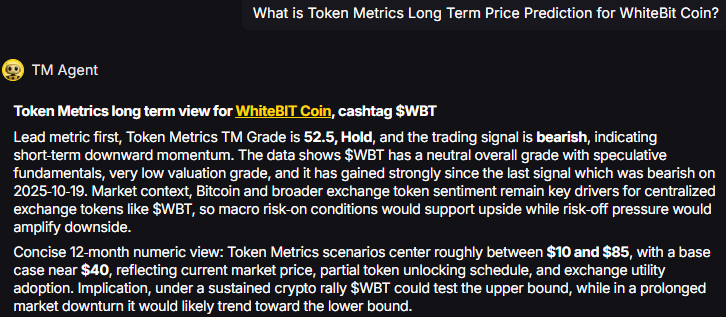
Token Metrics long term price prediction view for WhiteBIT Coin, cashtag $WBT. Lead metric first, Token Metrics TM Grade is 52.5%, Hold, and the trading signal is bearish, indicating short-term downward momentum. Concise 12-month numeric price prediction view: Token Metrics scenarios center roughly between $10 and $85, with a base case price target near $40.

Live details: Token Details

Key Takeaways for WBT Price Prediction

  • Scenario driven: price prediction outcomes hinge on total crypto market cap; higher liquidity and adoption lift the price bands
  • Single-asset concentration amplifies both upside and downside versus diversified approaches
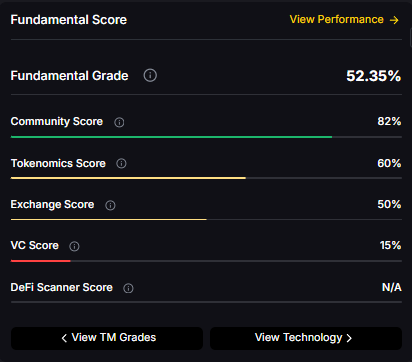
  • Fundamentals: Fundamental Grade 52.35% (Community 82%, Tokenomics 60%, Exchange 50%, VC —, DeFi Scanner N/A)
  • TM Agent gist: Bearish momentum, 12-month price prediction range $10 to $85
  • Education only, not financial advice

WhiteBIT Coin Price Prediction: Scenario Analysis

Token Metrics price prediction scenarios span four market cap tiers, each representing different levels of crypto market maturity and liquidity:

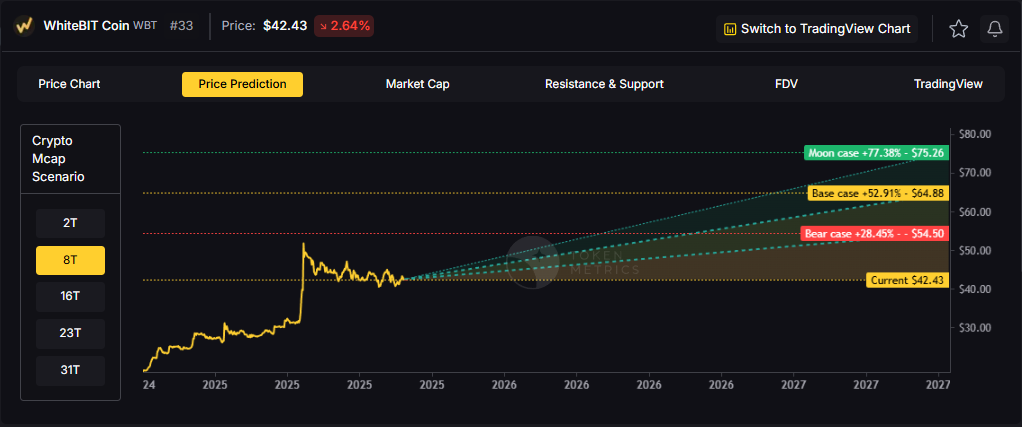
8T Market Cap Price Prediction:

At an 8 trillion dollar total crypto market cap, WBT price prediction projects to $54.50 in bear conditions, $64.88 in the base case, and $75.26 in bullish scenarios.

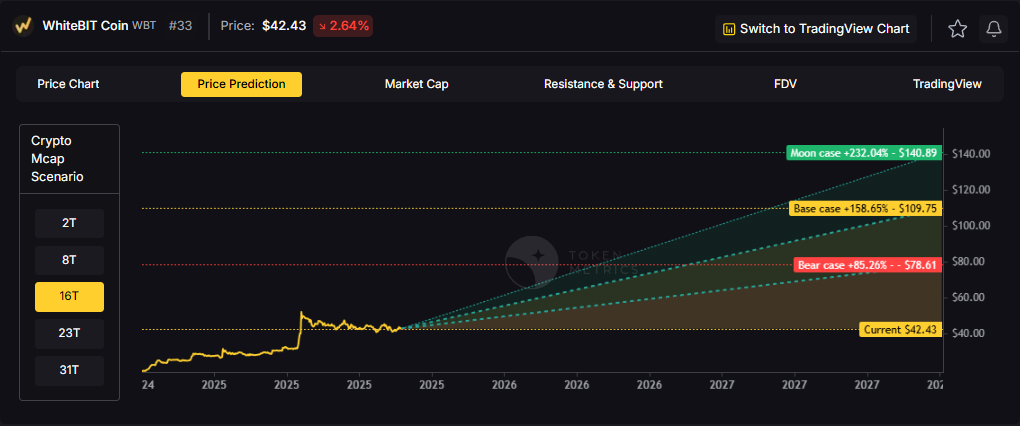
16T Market Cap Price Prediction:

Doubling the market to 16 trillion expands the price prediction range to $78.61 (bear), $109.75 (base), and $140.89 (moon).

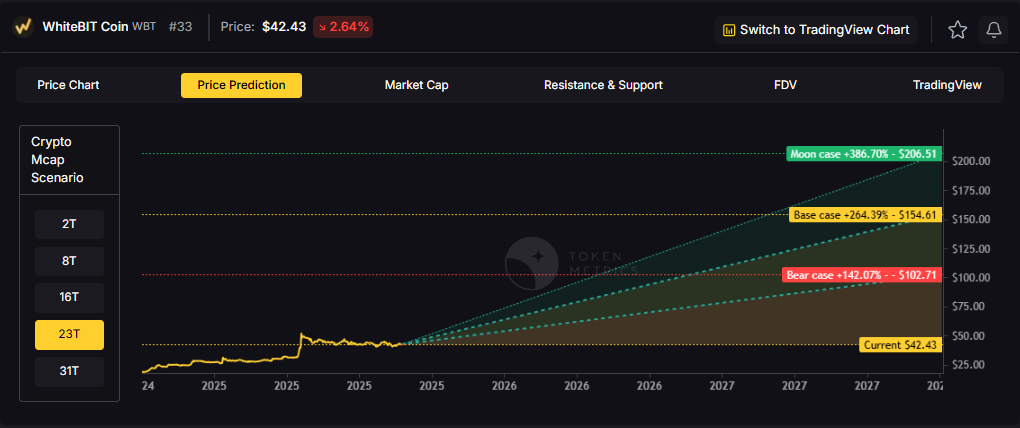
23T Market Cap Price Prediction:

At 23 trillion, the price forecast scenarios show $102.71, $154.61, and $206.51 respectively.

31T Market Cap Price Prediction:

In the maximum liquidity scenario of 31 trillion, WBT price prediction could reach $126.81 (bear), $199.47 (base), or $272.13 (moon).


These price prediction ranges illustrate potential outcomes for concentrated WBT positions, but investors should weigh whether single-asset exposure matches their risk tolerance or whether diversified strategies better suit their objectives.

What Is WhiteBIT Coin?

WhiteBIT Coin is the native exchange token associated with the WhiteBIT ecosystem. It is designed to support utility on the platform and related services.

WBT typically provides fee discounts and ecosystem benefits where supported. Usage depends on exchange activity and partner integrations.

Token Metrics AI Analysis for Price Prediction

Token Metrics AI provides comprehensive context on WhiteBIT Coin's positioning and challenges that inform our price prediction models.

Vision: The stated vision for WhiteBIT Coin centers on enhancing user experience within the WhiteBIT exchange ecosystem by providing tangible benefits such as reduced trading fees, access to exclusive features, and participation in platform governance or rewards programs. It aims to strengthen user loyalty and engagement by aligning token holders' interests with the exchange's long-term success. While not positioned as a decentralized protocol token, its vision reflects a broader trend of exchanges leveraging tokens to build sustainable, incentivized communities.

Problem: Centralized exchanges often face challenges in retaining active users and differentiating themselves in a competitive market. Users may be deterred by high trading fees, limited reward mechanisms, or lack of influence over platform developments. WhiteBIT Coin aims to address these frictions by introducing a native incentive layer that rewards participation, encourages platform loyalty, and offers cost-saving benefits. This model seeks to improve user engagement and create a more dynamic trading environment on the WhiteBIT platform.

Solution: WhiteBIT Coin serves as a utility token within the WhiteBIT exchange, offering users reduced trading fees, staking opportunities, and access to special events such as token sales or airdrops. It functions as an economic lever to incentivize platform activity and user retention. While specific governance features are not widely documented, such tokens often enable voting on platform upgrades or listing decisions. The solution relies on integrating the token deeply into the exchange's operational model to ensure consistent demand and utility for holders.

Market Analysis: Exchange tokens like WhiteBIT Coin operate in a competitive landscape led by established players such as Binance Coin (BNB) and KuCoin Token (KCS). While BNB benefits from a vast ecosystem including a launchpad, decentralized exchange, and payment network, WBT focuses on utility within its native exchange. Adoption drivers include the exchange's trading volume, security track record, and the attractiveness of fee discounts and staking yields. Key risks involve regulatory pressure on centralized exchanges and competition from other exchange tokens that offer similar benefits.

Fundamental Snapshot from Token Metrics

Fundamental Grade: 52.35% (Community 82%, Tokenomics 60%, Exchange 50%, VC —, DeFi Scanner N/A).


Catalysts That Skew Bullish for Price Prediction

  • Institutional and retail access expands with ETFs, listings, and integrations
  • Macro tailwinds from lower real rates and improving liquidity
  • Product or roadmap milestones such as upgrades, scaling, or partnerships
  • These factors could push WBT toward higher price prediction targets

Risks That Skew Bearish for Price Prediction

  • Macro risk-off from tightening or liquidity shocks
  • Regulatory actions or infrastructure outages
  • Concentration in validator economics and competitive displacement
  • Protocol-specific execution risk and competitive pressure from alternatives
  • These factors could push WBT toward lower price prediction scenarios

FAQs: WhiteBIT Coin Price Prediction

Can WBT reach $100 according to price predictions?

‍Based on the price prediction scenarios, WBT could reach $100 in the 16T base case. The 16T tier projects $109.75 in the base case price forecast. Achieving this price prediction requires both broad market cap expansion and WhiteBIT Coin maintaining competitive position. Not financial advice.

What's the risk/reward profile for WBT price prediction?

‍Risk and reward in our price prediction model span from $54.50 in the lowest bear case to $272.13 in the highest moon case. Downside risks include regulatory actions and competitive displacement, while upside drivers include expanding access and favorable macro liquidity. Concentrated positions amplify both tails, while diversified strategies smooth outcomes.

What gives WBT value and impacts price predictions?

‍WBT accrues value through fee discounts, staking rewards, access to special events, and potential participation in platform programs. Demand drivers include exchange activity, user growth, and security reputation. While these fundamentals matter for price predictions, diversified portfolios capture value accrual across multiple tokens rather than betting on one protocol's success.

What is the 2028 WhiteBIT Coin price prediction?

‍Based on Token Metrics analysis, the 2028 price prediction for WhiteBIT Coin centers around $40 in the base case under current market conditions, with a range between $10 and $85 depending on market scenarios. Bullish price predictions range from $64.88 to $272.13 across different total crypto market cap environments.

Can WBT reach $200 by 2028?

‍According to our price prediction models, WBT could reach $200 in the 23T moon case ($206.51) and in the 31T scenarios where the base case is $199.47 and the moon case is $272.13. These price prediction outcomes require significant crypto market expansion and WhiteBIT maintaining strong competitive positioning. Not financial advice.


Next Steps

Disclosure

Educational purposes only, not financial advice. Crypto is volatile, concentration amplifies risk, and diversification is a fundamental principle of prudent portfolio construction. Do your own research and manage risk appropriately.

Research

Predicting Litecoin Price in 2027: Scenario Analysis & On-Chain Scores

Token Metrics Team
6 min read

Litecoin Price Prediction Framework: Market Cap Scenarios & 2027 Forecast

Layer 1 tokens capture value through transaction fees and miner economics. Litecoin processes blocks every 2.5 minutes using Proof of Work, targeting fast, low-cost payments. The price prediction scenarios below model LTC outcomes across different total crypto market sizes, reflecting network adoption and transaction volume.


Disclosure

Educational purposes only, not financial advice. Crypto is volatile, do your own research and manage risk.

How to read this price prediction:

Each band blends cycle analogues and market-cap share math with TA guardrails. Base assumes steady adoption and neutral or positive macro. Moon layers in a liquidity boom. Bear assumes muted flows and tighter liquidity.

TM Agent baseline:

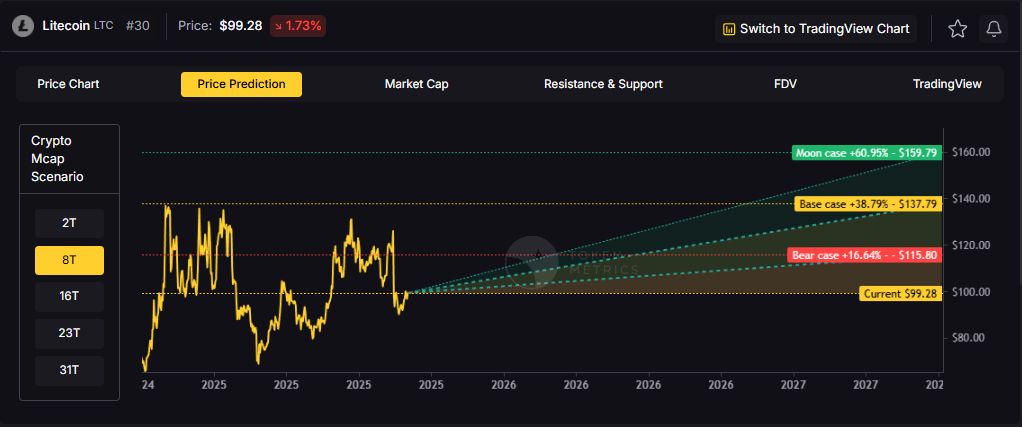
Token Metrics price prediction scenarios center roughly between $35 and $160, with a base case price target near $75, assuming gradual adoption, occasional retail rotation into major alts, and no major network issues. In a broad crypto rally LTC could test the upper bound price prediction, while in risk-off conditions it would likely drift toward the lower bound.

Live details: Token Details

Key Takeaways for LTC Price Prediction

  • Scenario driven: price prediction outcomes hinge on total crypto market cap; higher liquidity and adoption lift the price bands
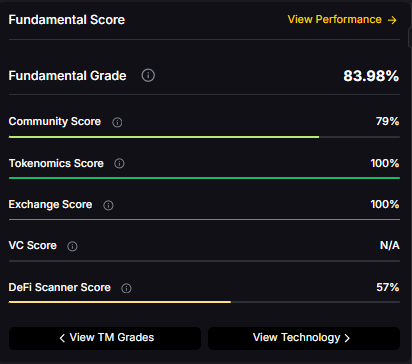
  • Fundamentals: Fundamental Grade 83.98% (Community 79%, Tokenomics 100%, Exchange 100%, VC —, DeFi Scanner 57%)
  • Technology: Technology Grade 46.67% (Activity 51%, Repository 72%, Collaboration 60%, Security 20%, DeFi Scanner 57%)
  • TM Agent gist: the TM Grade is 21.8 (Sell), and the trading signal is bearish, indicating short-term downward momentum
  • Education only, not financial advice

Litecoin Price Prediction: Scenario Analysis

Token Metrics price prediction scenarios span four market cap tiers reflecting different crypto market maturity levels:

8T Market Cap Price Prediction:

At an 8 trillion dollar total crypto market cap, LTC price prediction projects to $115.80 in bear conditions, $137.79 in the base case, and $159.79 in bullish scenarios.

16T Market Cap Price Prediction:

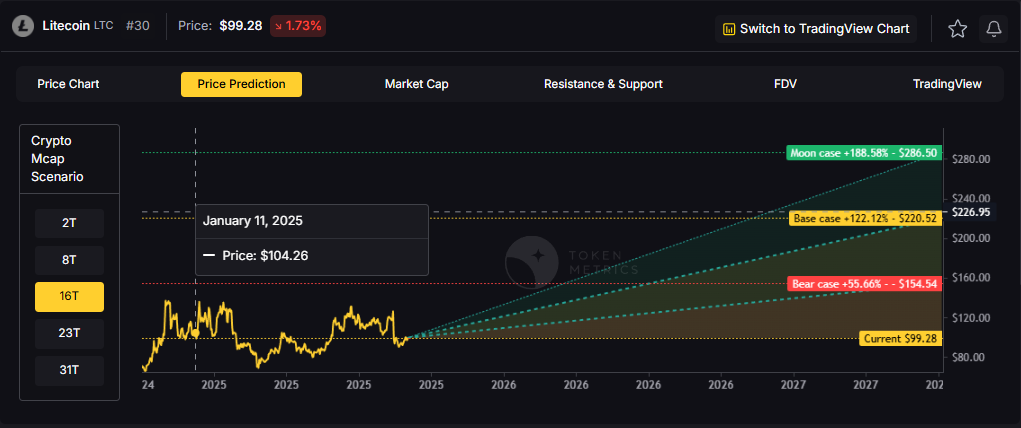
At 16 trillion, the price prediction range expands to $154.54 (bear), $220.52 (base), and $286.50 (moon).

23T Market Cap Price Prediction:

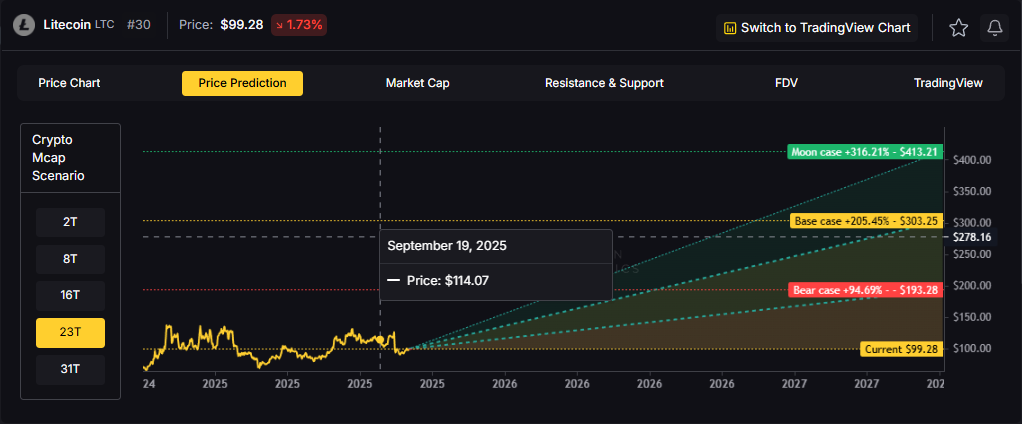
The 23 trillion tier price forecast shows $193.28, $303.25, and $413.21 respectively.

31T Market Cap Price Prediction:

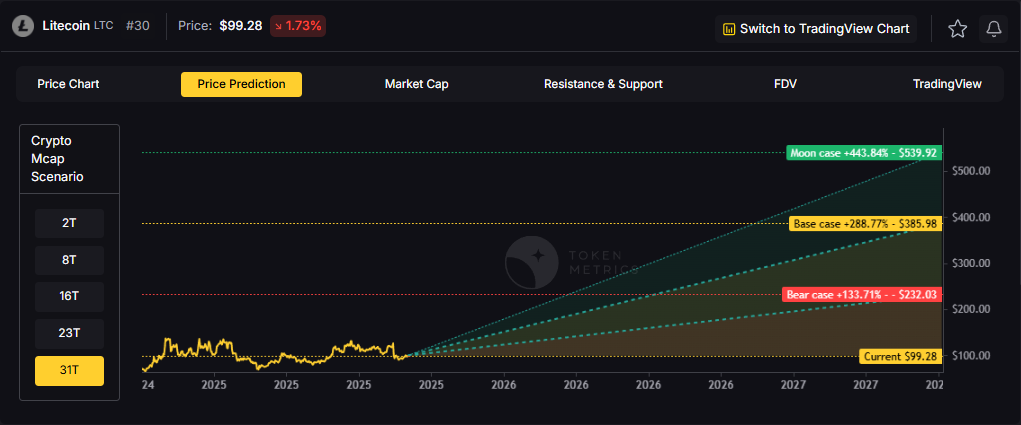
In the maximum liquidity scenario at 31 trillion, LTC price prediction reaches $232.03 (bear), $385.98 (base), or $539.92 (moon).


What Is Litecoin?

Litecoin is a peer-to-peer cryptocurrency launched in 2011 as an early Bitcoin fork. It uses Proof of Work with Scrypt and targets faster settlement, processing blocks roughly every 2.5 minutes with low fees.

LTC is the native token used for transaction fees and miner rewards. Its primary utilities are fast, low-cost payments and serving as a testing ground for Bitcoin-adjacent upgrades, with adoption in retail payments, remittances, and exchange trading pairs.

Token Metrics AI Analysis for Price Prediction

Token Metrics AI provides additional context on Litecoin's technical positioning and market dynamics that inform our price prediction models.

Vision: Litecoin's vision is to serve as a fast, low-cost, and accessible digital currency for everyday transactions. It aims to complement Bitcoin by offering quicker settlement times and a more efficient payment system for smaller, frequent transfers.

Problem: Bitcoin's relatively slow block times and rising transaction fees during peak usage make it less ideal for small, frequent payments. This creates a need for a cryptocurrency that maintains security and decentralization while enabling faster and cheaper transactions suitable for daily use.

Solution: Litecoin addresses this by using a 2.5-minute block time and the Scrypt algorithm, which initially allowed broader participation in mining and faster transaction processing. It functions primarily as a payment-focused blockchain, supporting peer-to-peer transfers with low fees and high reliability, without the complexity of smart contract functionality.

Market Analysis: Litecoin operates in the digital payments segment of the cryptocurrency market, often compared to Bitcoin but positioned as a more efficient medium of exchange. While it lacks the smart contract capabilities of platforms like Ethereum or Solana, its simplicity, long-standing network security, and brand recognition give it a stable niche. It competes indirectly with other payment-focused cryptocurrencies like Bitcoin Cash and Dogecoin. Adoption is sustained by its integration across major exchanges and payment services, but growth is limited by the broader shift toward ecosystems offering decentralized applications.

Fundamental and Technology Snapshot from Token Metrics

Fundamental Grade: 83.98% (Community 79%, Tokenomics 100%, Exchange 100%, VC —, DeFi Scanner 57%).


Technology Grade: 46.67% (Activity 51%, Repository 72%, Collaboration 60%, Security 20%, DeFi Scanner 57%).


Catalysts That Skew Bullish for Price Prediction

  • Institutional and retail access expands with ETFs, listings, and integrations
  • Macro tailwinds from lower real rates and improving liquidity
  • Product or roadmap milestones such as upgrades, scaling, or partnerships
  • These factors could push LTC toward higher price prediction targets

Risks That Skew Bearish for Price Prediction

  • Macro risk-off from tightening or liquidity shocks
  • Regulatory actions or infrastructure outages
  • Concentration in validator economics and competitive displacement
  • These factors could push LTC toward lower price prediction scenarios

Where to get deeper research and insights?

For comprehensive Litecoin ratings, on-chain analysis, AI-powered price forecasts, and trading signals, go to Token Metrics.

FAQs: Litecoin Price Prediction

What is LTC used for?

‍Primary use cases include fast peer-to-peer payments, low-cost remittances, and exchange settlement/liquidity pairs. LTC holders primarily pay transaction fees and support miner incentives. Adoption depends on active addresses and payment integrations, which directly impact long-term price prediction models.

What price could LTC reach in the moon case price prediction?

‍Moon case price predictions range from $159.79 at 8T to $539.92 at 31T total crypto market cap. These price prediction scenarios require maximum market cap expansion and strong adoption dynamics. Not financial advice.

What is the 2027 Litecoin price prediction?

‍Based on Token Metrics analysis, the 2027 price prediction for Litecoin centers around $75 in the base case under current market conditions, with a range between $35 and $160 depending on market scenarios. Bullish price predictions range from $137.79 to $539.92 across different total crypto market cap environments.

Can LTC reach $500 according to price predictions?

‍According to our price prediction models, LTC could reach $500+ in the 31T moon case where it projects to $539.92. This price prediction outcome requires significant crypto market expansion (31 trillion total market cap) combined with strong Litecoin network adoption. Not financial advice.

How does Litecoin's price prediction compare to Bitcoin?

‍While Litecoin was designed as "silver to Bitcoin's gold," its price prediction typically reflects a fraction of Bitcoin's value due to lower market cap and adoption. However, LTC often benefits from Bitcoin rallies while offering faster transaction times, which can impact relative price performance during payment-focused adoption cycles.


Next Steps

• Track live grades and signals: Token Details 

• Buy LTC on MEXC

Disclosure

Educational purposes only, not financial advice. Crypto is volatile, do your own research and manage risk.

Research

Token Metrics Indices vs. Every Other Crypto Investment Option: The Complete Comparison

Token Metrics Team
10 min read

Cryptocurrency investors face overwhelming choices. Should you buy individual tokens, trade actively, stake for yield, use DeFi protocols, invest through funds, or use index strategies? Each approach promises wealth creation, but which actually delivers optimal risk-adjusted returns for typical investors?

Most comparison content presents biased perspectives promoting specific approaches. Crypto trading platforms emphasize active trading. DeFi protocols highlight yield farming. Fund managers promote their offerings. What's missing is objective, comprehensive analysis examining all options fairly.

This definitive comparison evaluates Token Metrics indices against every major crypto investment alternative. We'll examine advantages, disadvantages, costs, risks, and ideal investor profiles for each approach. By the end, you'll understand exactly why indices represent optimal choice for most investors—and when alternative approaches might make sense.

The Eight Major Crypto Investment Approaches

Before diving into detailed comparisons, let's categorize the landscape of crypto investment options available today.

  • Individual Token Selection: Researching and buying specific cryptocurrencies directly
  • Active Trading: Frequent buying and selling attempting to profit from price movements
  • Staking and Yield Farming: Locking tokens in protocols to earn yields
  • DeFi Protocol Participation: Providing liquidity or engaging in decentralized finance
  • Crypto Hedge Funds: Investing through professionally managed funds
  • Bitcoin-Only Strategy: Exclusively holding Bitcoin as digital gold
  • Crypto ETFs/Trusts: Investing through regulated traditional financial products
  • AI-Powered Index Strategies: Token Metrics systematic, diversified approach

Each serves different purposes and suits different investor types. Let's examine each comprehensively.

Individual Token Selection: The DIY Approach

Many investors begin by researching and selecting specific cryptocurrencies they believe will outperform.

  • Advantages: Complete control over decisions without management fees. Potential for exceptional 100x+ returns from identifying winners early. Deep learning experience building genuine crypto understanding.
  • Disadvantages: Proper research demands 10-20 hours weekly. Over 90% of projects fail within three years, risking total loss. Emotional decisions lead to buying high and selling low. Concentrated portfolios suffer catastrophic single-token failures. Constant monitoring creates anxiety and stress.

Ideal For: Full-time researchers with substantial time, emotional discipline through volatility, and ability to absorb total losses.

Token Metrics Comparison: Indices provide similar upside through diversification while eliminating research burden, reducing failure risk, and removing emotional decisions. For 95% of investors, indices deliver better risk-adjusted returns with 90% less time investment.

Active Trading: The Full-Time Job Approach

Some investors attempt profiting from short-term price movements through frequent trading.

  • Advantages: Potential for quick gains in days/weeks rather than years. Leveraged trading amplifies profits. Constant market engagement provides excitement. Flexibility to adapt quickly to changing conditions.
  • Disadvantages: Studies show 85-95% of traders lose money over time. Requires 40-80 hours weekly monitoring markets. Extreme stress causes burnout and poor life quality. Generates short-term capital gains taxed up to 37%. Trading fees, spreads, and slippage compound into 60%+ annually with frequent trades.

Ideal For: Professional traders with full-time career commitment, exceptional emotional discipline, acceptance of high failure probability, and substantial loss capital buffer.

Token Metrics Comparison: Indices capture market upside without trading's massive time requirements, emotional toll, tax inefficiency, or statistical disadvantages. Buy-and-hold index strategies outperform 90%+ of active traders after fees, taxes, and opportunity costs.

Staking and Yield Farming: The Income-Focused Approach

Staking tokens or providing liquidity generates yields—typically 5-20% APY depending on protocol and risk level.

Advantages
  • Passive Income Generation: Regular yield payments provide income stream separate from price appreciation, appealing to income-focused investors.
  • Compounding Opportunities: Reinvesting yields creates compound growth acceleration similar to dividend reinvestment in traditional investing.
  • Network Participation: Staking contributes to blockchain security and governance, providing purpose beyond profit seeking.
Disadvantages
  • Token Price Risk Dominates Yield: 15% APY means nothing if token price declines 60%—you're net negative despite yield
  • Lock-Up Periods: Many staking arrangements lock tokens for weeks or months, preventing selling during crashes
  • Impermanent Loss: Liquidity provision creates impermanent loss risk—you may have less value than simply holding tokens
  • Protocol Risks: Smart contract bugs, exploits, or failures can eliminate entire positions despite careful selection
  • Complexity Management: Moving between protocols chasing optimal yields requires constant attention and decision-making
  • Tax Complications: Yield payments trigger ordinary income taxes potentially at high rates, and tracking cost basis across protocols proves complex
Ideal For

Yield strategies suit technically sophisticated investors comfortable evaluating smart contract risks, accepting token price volatility, having detailed tax tracking systems, and not needing access to capital during lock-up periods.

Token Metrics Indices Comparison

While staking provides 5-20% yields, Token Metrics indices typically generate 30-60% annualized appreciation through systematic selection and rebalancing. The appreciation far exceeds staking yields while maintaining liquidity, avoiding protocol risks, and simplifying tax treatment. Indices can incorporate staking where appropriate without requiring you to manage complexity.

DeFi Protocol Participation: The Sophisticated Approach

Decentralized finance protocols enable lending, borrowing, trading, and complex financial strategies without intermediaries.

Advantages
  • High Yield Potential: DeFi protocols sometimes offer exceptional yields—30-100%+ APY during periods of high demand and limited supply.
  • Financial Innovation Access: DeFi enables strategies impossible in traditional finance—flash loans, automated market making, complex derivatives without counterparty risk.
  • Transparency: All transactions occur on-chain providing complete visibility into protocol mechanics, reserves, and risks.
Disadvantages
  • Extreme Complexity: Understanding DeFi protocols requires technical knowledge of smart contracts, liquidity pools, tokenomics, and blockchain mechanics
  • Smart Contract Risks: Bugs, exploits, or economic attacks can drain funds despite audits—DeFi history includes billions lost to exploits
  • Gas Fee Costs: Ethereum gas fees make small position management uneconomical—often paying $50-200 per transaction during high network usage
  • Yield Volatility: DeFi yields fluctuate dramatically—100% APY quickly becomes 10% APY requiring constant position adjustment
  • Regulatory Uncertainty: DeFi exists in regulatory gray area potentially facing restrictions limiting future participation
  • Overwhelming Options: Hundreds of protocols create analysis paralysis and risk of choosing unstable or dishonest platforms
Ideal For

DeFi suits technically expert investors who understand smart contracts deeply, actively manage positions across protocols, accept total loss risk from exploits, and have capital sufficient to absorb gas fees.

Token Metrics Indices Comparison

Indices provide professional crypto exposure without DeFi's complexity, smart contract risks, gas fee burdens, or technical expertise requirements. For investors seeking crypto appreciation without becoming blockchain developers, indices deliver far superior risk-adjusted returns.

Crypto Hedge Funds: The Institutional Approach

Some investors access crypto through professionally managed hedge funds specializing in digital assets.

Advantages
  • Professional Management: Experienced portfolio managers make investment decisions leveraging institutional research and resources.
  • Access to Complex Strategies: Funds employ sophisticated strategies beyond typical retail investor capabilities—arbitrage, options, private placements.
  • Risk Management: Institutional risk management frameworks and processes potentially reduce volatility and limit losses.
Disadvantages
  • Extremely High Fees: Traditional "2 and 20" structure charges 2% annually plus 20% of profits—these fees compound into enormous costs over time
  • High Minimums: Most crypto hedge funds require $100,000-1,000,000 minimum investments, excluding typical investors
  • Limited Liquidity: Quarterly or annual redemption windows prevent accessing capital when needed
  • Manager Risk: Performance depends entirely on specific manager's skill—past performance doesn't guarantee future results
  • Lack of Transparency: Many funds don't disclose holdings or strategies, creating uncertainty about actual exposures
  • Mediocre Performance: Most crypto hedge funds underperform simple buy-and-hold strategies after accounting for fees
Ideal For

Crypto hedge funds suit ultra-high net worth investors ($5M+ portfolios) seeking professional management, comfortable with illiquidity, and willing to pay premium fees for institutional infrastructure.

Token Metrics Indices Comparison

Token Metrics provides institutional-grade AI management at fraction of hedge fund costs—$50-200 monthly subscription versus $10,000+ annually in hedge fund fees for typical portfolio sizes. Performance is transparent, capital remains liquid, and minimums are under $1,000 versus six-figure hedge fund requirements.

Bitcoin-Only Strategy: The Minimalist Approach

Some investors exclusively hold Bitcoin, viewing it as digital gold.

  • Advantages: Simple single-asset strategy eliminates research complexity. Fifteen-year track record demonstrates survival through multiple cycles. Most mature security practices and custody solutions. Limited supply supports store-of-value thesis.
  • Disadvantages: Other cryptocurrencies often outperform Bitcoin during bull markets. Single asset means Bitcoin-specific issues harm entire portfolio. Limited growth potential—100x returns unlikely given size. No diversification or rebalancing benefits.

Ideal For: Conservative investors prioritizing simplicity and security over maximum returns, or those philosophically committed to Bitcoin specifically.

Token Metrics Comparison: Conservative indices typically hold 40-60% Bitcoin while adding diversified exposure to other quality projects. This provides Bitcoin's stability while capturing additional upside from emerging winners—historical data shows 30-50% higher returns than Bitcoin-only with similar volatility.

Crypto ETFs and Trusts: The Traditional Finance Approach

Recently approved Bitcoin ETFs and existing crypto trusts provide regulated exposure through traditional brokerage accounts.

Advantages
  • Regulatory Compliance: SEC-approved products provide legal certainty and investor protections unavailable with direct crypto holdings.
  • Brokerage Integration: Hold crypto exposure alongside stocks and bonds in existing retirement accounts and brokerage accounts.
  • Simplified Custody: No need for wallets, private keys, or exchange accounts—all handled by fund custodian.
  • Tax Reporting Integration: Broker-provided 1099 forms simplify tax filing versus tracking individual crypto transactions.
Disadvantages
  • Management Fees: ETFs charge 0.2-2.5% annually reducing returns—these fees compound substantially over decades
  • Limited Options: Currently only Bitcoin ETFs approved—no Ethereum or diversified crypto ETFs available broadly
  • Premium/Discount Volatility: Some trusts trade at premiums or discounts to net asset value creating tracking errors
  • No Token Ownership: You own fund shares, not actual crypto—can't stake, participate in governance, or use tokens in DeFi
  • Counterparty Risk: Depend on fund operator solvency and custody practices rather than controlling assets directly
Ideal For

Crypto ETFs suit traditional investors prioritizing regulatory comfort, wanting retirement account exposure, avoiding direct crypto custody, and accepting limited options for that convenience.

Token Metrics Indices Comparison

Token Metrics offers far broader diversification than current ETFs (Bitcoin only), typically lower costs, direct asset ownership providing full flexibility, and exposure to full crypto opportunity set rather than single asset. For investors comfortable with direct crypto custody, indices provide superior returns and options.

Token Metrics AI-Powered Indices: The Optimal Balance

After examining alternatives, let's detail Token Metrics indices comprehensive advantages.

Unique Advantages
  • Professional AI Management Without Hedge Fund Costs: Institutional-grade algorithms at $50-200 monthly versus $10,000+ hedge fund fees
  • Diversification Without Research Burden: Exposure to 20-50 quality tokens without spending hundreds of hours researching each
  • Systematic Rebalancing: AI-driven rebalancing captures profits from winners and accumulates losers at discounts automatically
  • Emotional Decision Elimination: Predetermined rules prevent fear and greed-driven mistakes that destroy returns
  • Tax Optimization Opportunities: Strategic loss harvesting and holding period management minimize tax burden
  • Flexibility Across Risk Profiles: Conservative to aggressive indices suit different investor needs within single platform
  • Complete Liquidity: Exit positions any time unlike hedge funds, locked staking, or illiquid investments
  • Transparent Performance: Track record visible rather than opaque fund reporting

For Whom Indices Work Best

Token Metrics indices suit 95% of crypto investors—those wanting professional exposure without full-time trading careers, seeking diversification without research burden, prioritizing long-term wealth building over short-term speculation, and valuing systematic approaches over emotional decision-making.

Conclusion: Why Indices Win for Most Investors

This comprehensive comparison reveals consistent pattern: alternative approaches offer niche advantages for specific situations but indices provide optimal balance of return potential, risk management, time efficiency, and cost effectiveness for typical investors.

Individual selection works if you're full-time researcher. Active trading works if you're professional trader. DeFi works if you're blockchain developer. Hedge funds work if you have millions. ETFs work if you want only Bitcoin in retirement accounts.

But if you're typical investor—employed professional, business owner, or retiree wanting substantial crypto exposure without it becoming second job—Token Metrics indices deliver superior risk-adjusted returns with minimal time investment and emotional burden.

The proof isn't theoretical—it's mathematical. Systematic, diversified, professionally managed approaches outperform alternatives across decades of investment research in every asset class. Crypto's unique characteristics amplify these advantages rather than diminishing them.

Your choice is clear: spend hundreds of hours researching individual tokens, stress over active trading, manage DeFi complexity, pay excessive hedge fund fees, or achieve superior results through systematic index investing requiring minimal time and expertise.

Start your 7-day free trial today and discover why sophisticated investors increasingly choose Token Metrics indices over every alternative approach.

Choose from Platinum, Gold, and Silver packages
Reach with 25–30% open rates and 0.5–1% CTR
Craft your own custom ad—from banners to tailored copy
Perfect for Crypto Exchanges, SaaS Tools, DeFi, and AI Products