

Back to blog
Research

Top AMM Concentrated Crypto Liquidity Managers (2025)

Looking to automate your DeFi liquidity in 2025? Explore the top AMM concentrated liquidity managers—covering Uniswap v3/v4, multi-chain vaults, advanced analytics, single-sided yield, and more.
Token Metrics Team
16 min read
Want Smarter Crypto Picks—Free?
See unbiased Token Metrics Ratings for BTC, ETH, and top alts.
Thank you! Your submission has been received!
Oops! Something went wrong while submitting the form.
 No credit card | 1-click unsubscribe

Who this guide is for: DeFi liquidity providers seeking automated management of concentrated liquidity positions on AMMs like Uniswap v3, v4, and other CLAMMs (Concentrated Liquidity Automated Market Makers).

Top three picks:

  • Gamma Strategies — Best for multi-chain automated vault strategies with proven track record
  • Arrakis Finance — Best for institutional-grade liquidity management and token launch support
  • Steer Protocol — Best for off-chain compute and cross-chain strategy deployment

Key caveat: Concentrated liquidity managers cannot eliminate impermanent loss; they optimize range management to maximize fee generation, but market volatility can still result in divergence loss. Always verify supported chains and fee structures before depositing.

Introduction: Why AMM Concentrated Liquidity Managers Matter in November 2025

Concentrated liquidity has transformed DeFi capital efficiency since Uniswap v3's 2021 launch, allowing liquidity providers to concentrate capital within specific price ranges for higher fee generation. However, managing these positions requires active monitoring, frequent rebalancing, and sophisticated strategies to remain in-range and profitable—a challenge for most LPs.

AMM concentrated liquidity managers are protocols that automate the complex task of managing concentrated liquidity positions across decentralized exchanges. These platforms use algorithmic strategies to rebalance ranges, compound fees, and optimize capital deployment, transforming concentrated liquidity from an active management burden into a passive income opportunity.

With Uniswap v4's January 2025 launch introducing hooks and new customization capabilities, the concentrated liquidity management landscape has expanded dramatically. LPs now need solutions that can navigate multiple AMMs, chains, and strategy types while maximizing returns and minimizing risks like impermanent loss and out-of-range periods.

This guide evaluates the leading concentrated liquidity managers serving retail LPs, DAOs, and protocols in 2025, helping you select platforms that align with your risk tolerance, capital requirements, and yield objectives.

How We Picked (Methodology & Scoring)

We evaluated 20+ concentrated liquidity management platforms and selected the top 10 based on weighted criteria:

  • Liquidity Under Management — 30%: Total value locked (TVL) and managed positions across chains
  • Security & Track Record — 25%: Audit history, operational history, security incidents
  • Strategy Diversity — 15%: Range of automated strategies and customization options
  • Chain & Protocol Coverage — 15%: Supported blockchains and DEX integrations
  • Fees & Transparency — 10%: Performance fees, withdrawal fees, and cost clarity
  • UX & Accessibility — 5%: Interface quality, documentation, and ease of use

Data sources: Official protocol documentation, pricing pages, security audit reports, blockchain explorers, and TVL data from DefiLlama (cross-checked only; not linked in article body).

Last updated: November 2025

Best AMM Concentrated Liquidity Managers in November 2025 (Comparison Table)
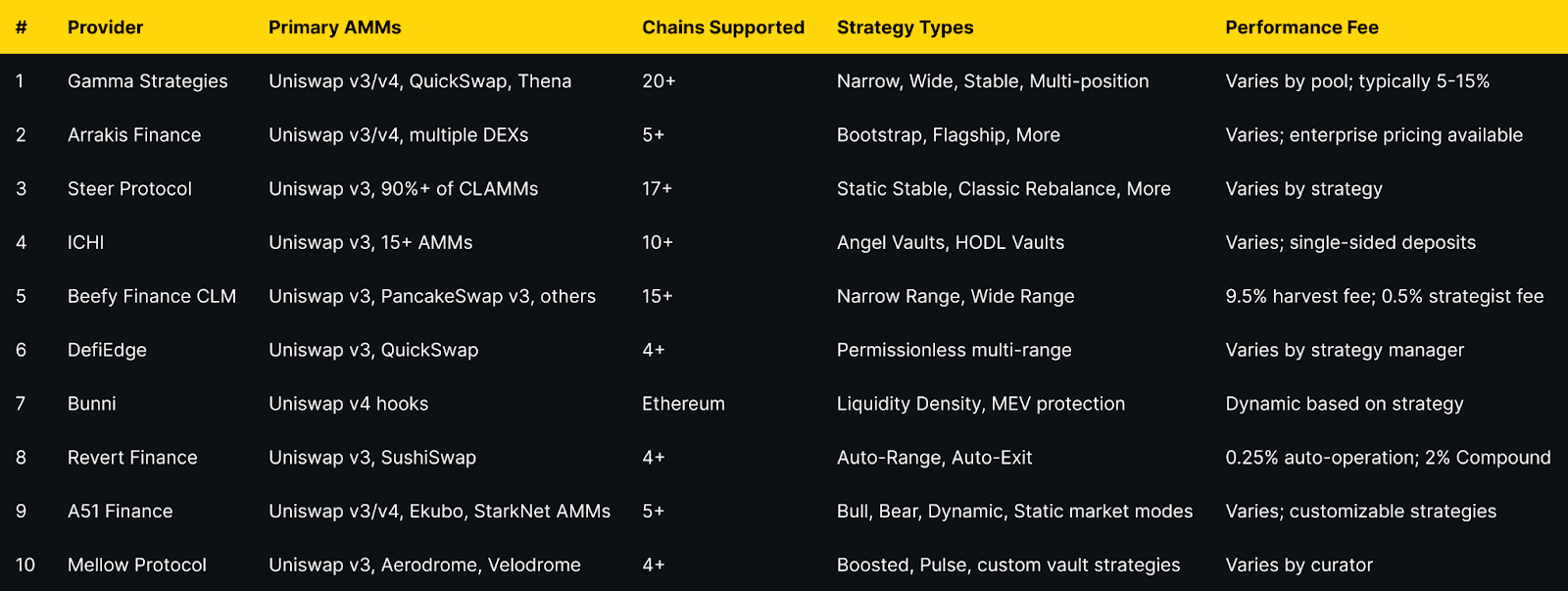
Top 10 AMM Concentrated Liquidity Managers in November 2025

1. Gamma Strategies — Best for Multi-Chain Automated Vaults

Why Use It

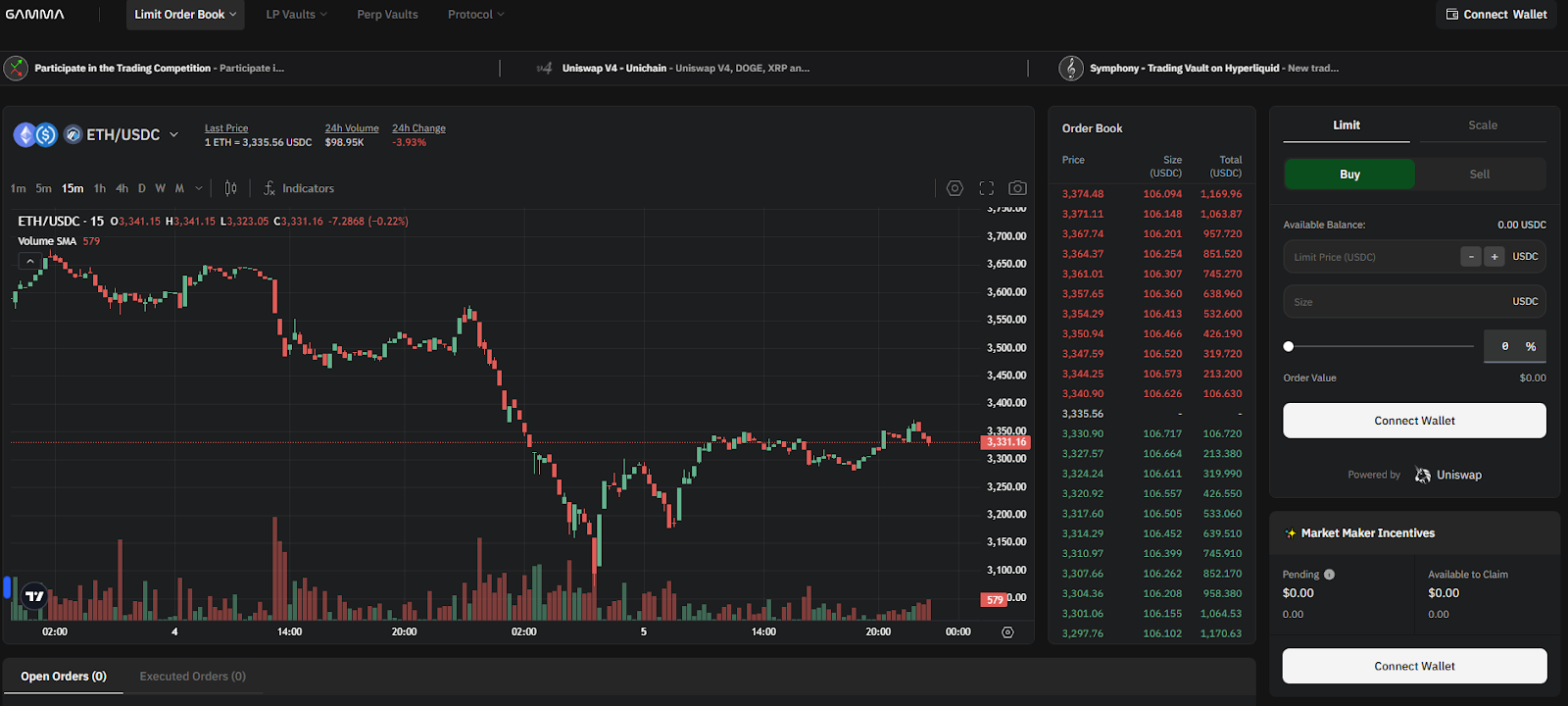
Gamma Strategies operates as the most established concentrated liquidity manager with over four years of production history since March 2021. Their Hypervisor vault system automatically rebalances positions, compounds fees, and manages ranges across 20+ blockchains and multiple AMM protocols. Gamma's non-custodial approach means LPs retain control while benefiting from algorithmic management that maximizes capital efficiency and fee generation.

Best For

  • Multi-chain liquidity providers seeking diversified exposure
  • DAOs and protocols requiring active liquidity management
  • LPs wanting automated fee compounding without manual intervention
  • Users preferring ERC-20 LP tokens over NFT positions

Notable Features

  • Hypervisor smart contracts with automated rebalancing
  • Supports dual-position and multi-position strategies (up to 20 positions on Uniswap v4)
  • ERC-20 LP tokens for composability in DeFi
  • Integration with major DEXs including Uniswap v3/v4, QuickSwap, Thena, Beamswap
  • GAMMA token staking for fee-sharing

Consider If: Supported on 20+ chains but fee structures vary by pool; verify specific pool performance fees before depositing. Some pools charge 10-15% of generated fees.

Regions: Global; no geographic restrictions

Alternatives: Arrakis Finance, Steer Protocol
2. Arrakis Finance — Best for Institutional Liquidity Management

Why Use It

Arrakis Finance delivers MEV-aware onchain market making specifically designed for token issuers and institutional liquidity providers. Their Arrakis Pro service offers white-glove liquidity management with strategic templates including Bootstrap for TGE, Flagship for mature projects, and Treasury Diversification for passive accumulation. Arrakis has become the go-to solution for protocols like ether.fi, Euler, and Stargate seeking professional-grade liquidity infrastructure.

Best For

  • Token launch teams needing TGE liquidity support
  • Protocols managing protocol-owned liquidity (POL)
  • Institutional LPs requiring custom strategy execution
  • Projects seeking multi-DEX liquidity deployment

Notable Features

  • Four strategy templates: Bootstrap, Flagship, Treasury Diversification, Custom
  • Multi-DEX support (Uniswap v3/v4, PancakeSwap v3, and others)
  • MEV-aware rebalancing algorithms
  • Modules for concentrated liquidity across chains
  • Enterprise-grade support and customization

Consider If: Primarily targets institutional clients; retail LPs may find Arrakis V1 (older version) more accessible than Arrakis Pro. Performance fees vary and often involve revenue-sharing arrangements.

Fees Notes: Enterprise pricing; contact for specific fee structures

Regions: Global; primarily serves protocols and DAOs

Alternatives: Gamma Strategies, Steer Protocol

3. Steer Protocol — Best for Off-Chain Compute Strategies

Why Use It

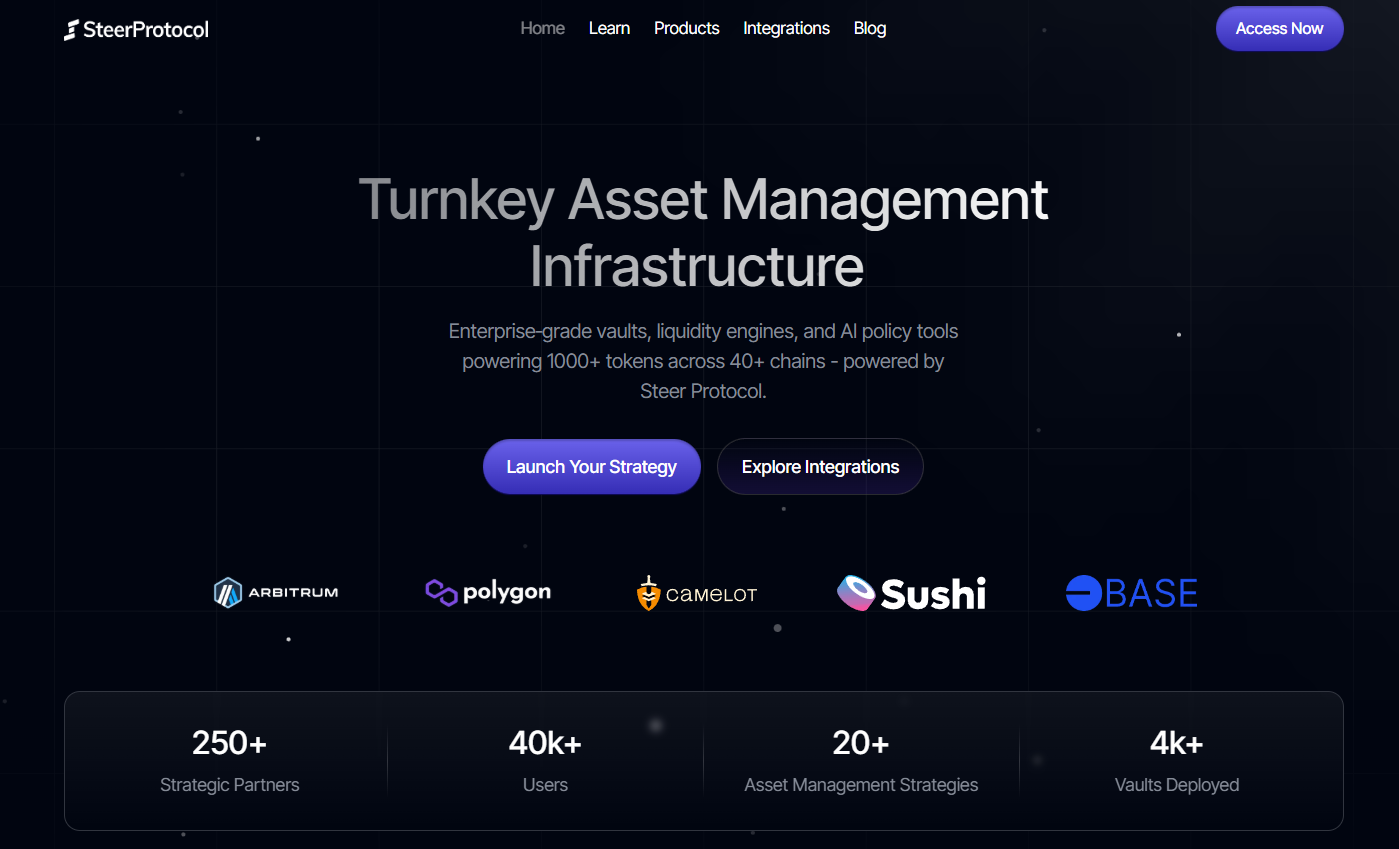
Steer Protocol distinguishes itself through decentralized off-chain computation that enables sophisticated strategy execution without on-chain gas overhead. Supporting 17+ chains and over 90% of concentrated liquidity AMMs, Steer provides automated range management using strategies like Elastic Expansion (Bollinger Bands), Moving Volatility Channel (Keltner), and Static Stable for pegged assets. Their infrastructure powers liquidity automation for platforms like QuickSwap, Taiko, and Kinetic.

Best For

  • LPs seeking advanced technical analysis-based strategies
  • Cross-chain liquidity providers
  • Projects requiring custom liquidity shapes and automation
  • Users wanting minimal gas costs for strategy execution

Notable Features

  • Off-chain compute protocol reducing on-chain execution costs
  • Support for TypeScript, Rust, and Go strategy development
  • Multiple strategy families: Static Stable, Classic Rebalance, Volatility Channel, Elastic Expansion
  • Integration with 90%+ of CLAMMs
  • White-label infrastructure for protocols

Consider If: Strategy complexity may require more sophisticated understanding; best for LPs comfortable with advanced AMM concepts.

Fees Notes: Varies by strategy and deployment; network fees apply

Regions: Global; no restrictions

Alternatives: DefiEdge, Gamma Strategies
4. ICHI — Best for Single-Sided Deposits

Why Use It

ICHI's Yield IQ vaults revolutionize concentrated liquidity provision by accepting single-token deposits, eliminating the need for LPs to hold both sides of a trading pair. Using algorithmic strategies that maintain an 80:20 ratio, ICHI enables users to earn concentrated liquidity fees while effectively holding a single asset. Their Angel Vaults create buy-side liquidity that supports price stability for project tokens.

Best For

  • LPs wanting single-token exposure without impermanent loss on both sides
  • Projects seeking buy-side liquidity support
  • Long-term holders wanting to earn yield without selling tokens
  • DAOs managing treasury diversification

Notable Features

  • Single-sided liquidity deposits (Angel Vaults and HODL Vaults)
  • Automated rebalancing with Chainlink Keepers
  • 80:20 asset ratio maintenance
  • Support for 15+ AMMs across 10+ networks
  • Integration with concentrated liquidity incentive programs

Consider If: 80:20 rebalancing means you'll still experience some token ratio changes; not pure single-asset exposure. Best for those comfortable with managed rebalancing.

Fees Notes: Varies by vault; performance fees typically 5-10% of yields

Regions: Global; available on multiple L1s and L2s

Alternatives: DefiEdge, Gamma Strategies

5. Beefy Finance CLM — Best for Yield Optimizer Integration

Why Use It

Beefy's Concentrated Liquidity Manager (CLM) extends their proven auto-compounding infrastructure to concentrated liquidity pools, providing automated range management integrated with Beefy's broader yield optimization ecosystem. Their "Cow Token" system converts non-fungible CL positions into fungible ERC-20 tokens while maximizing capital utilization through strategies that keep positions in-range and fully active.

Best For

  • Existing Beefy users expanding into concentrated liquidity
  • LPs seeking integrated yield farming and CLM
  • Multi-chain passive investors
  • Users wanting fungible CL position tokens

Notable Features

  • Integration with Beefy's yield optimizer ecosystem
  • Supports 15+ chains including BSC, Arbitrum, Polygon, Base, Avalanche
  • Narrow and wide range strategies
  • ERC-20 "Cow Tokens" for fungible CL positions
  • Automatic fee compounding

Consider If: 9.5% harvest fee is higher than some competitors; suitable for long-term holders where compounding benefits outweigh fees.

Fees Notes: 9.5% performance fee on harvest; 0.5% to strategist; variable harvest call fee

Regions: Global; multi-chain support

Alternatives: Gamma Strategies, A51 Finance

6. DefiEdge — Best for Strategy Marketplace

Why Use It

DefiEdge creates a permissionless layer over concentrated liquidity AMMs where strategy managers can deploy custom strategies supporting up to 20 price ranges and built-in limit orders. This marketplace approach allows LPs to select from community-created strategies or deploy their own, providing unprecedented flexibility in concentrated liquidity management.

Best For

  • Advanced LPs wanting custom multi-range strategies
  • Strategy managers seeking to monetize their expertise
  • Users requiring limit order functionality
  • Projects needing tailored liquidity deployment

Notable Features

  • Support for up to 20 simultaneous price ranges
  • Built-in limit order functionality
  • Permissionless strategy creation marketplace
  • Real-time position monitoring interface
  • Automatic integration with incentive protocols like Merkl

Consider If: More complex than single-strategy platforms; requires evaluating individual strategy manager performance.

Fees Notes: Varies by strategy manager; typically 5-15% performance fees

Regions: Global; primarily Ethereum, Polygon, Optimism, Arbitrum

Alternatives: A51 Finance, Gamma Strategies

7. Bunni — Best for Uniswap v4 Innovation

Why Use It

Bunni emerged as the leading Uniswap v4 hook implementation, using programmable Liquidity Density Functions (LDFs) to create custom liquidity shapes within concentrated ranges. Their Shapeshifting feature dynamically adjusts positions, while MEV protection through am-AMM auctions and Surge Fees recaptures value that would otherwise go to arbitrageurs. Bunni also rehypothecates idle capital to Aave and Yearn for additional yield.

Best For

  • Early adopters of Uniswap v4 infrastructure
  • LPs seeking MEV-protected concentrated liquidity
  • Advanced users wanting programmable liquidity shapes
  • Projects requiring dynamic fee structures

Notable Features

  • Liquidity Density Functions for custom liquidity distribution
  • Shapeshifting for dynamic position adjustment
  • MEV protection via am-AMM mechanism and dynamic fees
  • Rehypothecation to Aave/Yearn for additional yield
  • Auto-compounding of fees and rewards

Consider If: Currently Ethereum-focused with Uniswap v4; may expand to other chains. Newer platform compared to established players like Gamma.

Fees Notes: Dynamic fees based on volatility and strategy; typical range 5-20% of yields

Regions: Global; Ethereum mainnet

Alternatives: Gamma Strategies (Uniswap v4 support), Arrakis Finance

8. Revert Finance — Best for Analytics-First Management

Why Use It

Revert Finance combines powerful analytics tools with automated management features, enabling LPs to backtest strategies, analyze top-performing positions, and then deploy automation like Auto-Range (automatic rebalancing) and Auto-Exit (stop-loss protection). Their Initiator tool allows LPs to simulate historical performance before committing capital, making Revert ideal for data-driven liquidity providers.

Best For

  • Analytical LPs wanting to backtest before deploying
  • Users seeking automated stop-loss protection (Auto-Exit)
  • LPs wanting to copy successful positions
  • Investors prioritizing transparency and performance tracking

Notable Features

  • Comprehensive analytics suite with backtesting
  • Auto-Range for automated rebalancing
  • Auto-Exit for stop-loss automation
  • Position management tools (add/withdraw/claim)
  • Top Positions discovery for copying successful strategies

Consider If: Automation features (Auto-Range/Exit) charge 0.25% per operation; may not trigger if gas costs exceed fees. Best for larger positions.

Fees Notes: 2% auto-compound fee; 0.25% per auto-operation (Range/Exit); 0.65% swap fee

Regions: Global; Ethereum, Polygon, Optimism, Arbitrum

Alternatives: Gamma Strategies, Steer Protocol

9. A51 Finance — Best for Strategy Customization

Why Use It

A51 Finance (formerly Unipilot) offers autonomous liquidity provisioning with highly customizable parameters including market modes (Bull, Bear, Dynamic, Static), rebasing strategies, and liquidity distribution patterns. Supporting Uniswap v3/v4 and expanding to StarkNet, A51 empowers LPs to design advanced strategies using hooks while addressing loss-versus-rebalancing (LVR) through sophisticated hedging mechanisms.

Best For

  • Advanced LPs wanting full strategy customization
  • Multi-chain liquidity providers (EVM + StarkNet)
  • Users requiring market-mode specific strategies
  • Projects needing flexible liquidity allocation

Notable Features

  • Market mode selection: Bull, Bear, Dynamic, Static
  • Customizable rebasing and exit preferences
  • Multiple liquidity distribution options (exponential, flat, single-tick)
  • Hedging through borrowing and options
  • Support for Uniswap v4 hooks

Consider If: Complexity requires deeper understanding of concentrated liquidity mechanics; best for experienced LPs.

Fees Notes: Varies by strategy; typically performance-based

Regions: Global; EVM chains and StarkNet

Alternatives: DefiEdge, Steer Protocol

10. Mellow Protocol — Best for Institutional Vaults

Why Use It

Mellow Protocol provides infrastructure for institutional-grade vaults with sophisticated curator models where professional risk managers and funds deploy strategies on behalf of LPs. While their focus has shifted toward broader vault infrastructure, Mellow's ALM toolkit remains integrated with Aerodrome and Velodrome, offering optimized range management with automated reward harvesting on SuperChain DEXs.

Best For

  • Institutional LPs seeking professional management
  • Aerodrome and Velodrome liquidity providers
  • Users wanting curator-managed strategies
  • Projects requiring compliance-ready vault infrastructure

Notable Features

  • Institutional-grade vault infrastructure
  • Integration with Aerodrome/Velodrome on Base and Optimism
  • Curator marketplace with professional risk management
  • Automated reward harvesting and compounding
  • Audited by ChainSecurity and BlockSec

Consider If: Less focused on pure CLM compared to dedicated platforms; best for users seeking broader DeFi yield strategies including staking and lending.

Fees Notes: Varies by curator and vault; typically 10-20% performance fees

Regions: Global; primarily Ethereum, Optimism, Base, Arbitrum

Alternatives: Arrakis Finance, Gamma Strategies

Decision Guide: Best By Use Case

  • Best for Multi-Chain Coverage → Gamma Strategies, Steer Protocol
  • Best for Token Launches (TGE) → Arrakis Finance, ICHI (Angel Vaults)
  • Best for Single-Sided Deposits → ICHI
  • Best for Lowest Management Fees → Revert Finance (for analytics + selective automation)
  • Best for Uniswap v4 Hooks → Bunni, Gamma Strategies
  • Best for Analytics & Backtesting → Revert Finance
  • Best for Institutional Management → Arrakis Finance, Mellow Protocol
  • Best for Strategy Customization → A51 Finance, DefiEdge
  • Best for BSC & Multi-Chain Yield → Beefy Finance CLM
  • Best for Aerodrome/Velodrome on SuperChain → Mellow Protocol, Steer Protocol

How to Choose the Right Concentrated Liquidity Manager (Checklist)

Before selecting a CLM platform, verify:

  • Chain Compatibility — Confirm the platform supports your target blockchain and DEX
  • Strategy Alignment — Match strategy types (narrow/wide range, stable pairs, volatile pairs) to your goals
  • Fee Structure Transparency — Understand performance fees, harvest fees, and withdrawal costs
  • Track Record & TVL — Check operational history, total value managed, and security incidents
  • Audit Status — Verify smart contracts have been audited by reputable firms
  • Token Pairs Supported — Confirm your desired liquidity pools are available
  • Rebalancing Frequency — Understand how often positions are rebalanced and gas cost implications
  • Exit Flexibility — Check withdrawal timeframes, fees, and liquidity availability
  • Performance Metrics — Review historical APRs accounting for impermanent loss
  • Composability Needs — If using LP tokens elsewhere, verify ERC-20 support vs. NFTs

Red Flags:

  • 🚩 No audits or anonymous teams without established track record
  • 🚩 Unclear fee structures or hidden withdrawal penalties
  • 🚩 Very high performance fees (>20%) without justified value-add
  • 🚩 Limited chain support if you need multi-chain exposure

Use Token Metrics With Any Concentrated Liquidity Manager

Token Metrics complements your concentrated liquidity strategy by providing:

AI Ratings — Screen tokens for quality and momentum before selecting trading pairs for liquidity provision

Narrative Detection — Identify emerging DeFi themes early to position liquidity in high-growth sectors

Portfolio Optimization — Balance concentrated liquidity positions across chains and risk profiles

Alerts & Signals — Time liquidity entries and exits based on technical and on-chain indicators
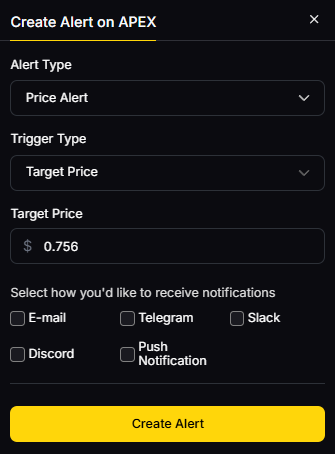
  

Workflow Example:

  1. Research → Use Token Metrics AI to identify high-quality token pairs
  2. Select CLM → Choose appropriate concentrated liquidity manager based on chain and strategy
  3. Deploy → Provide liquidity through automated vault or custom range
  4. Monitor → Track performance with Token Metrics alerts for rebalancing or exit signals

Start free trial to screen assets and optimize your concentrated liquidity strategy with AI-powered insights.
Security & Compliance Tips

Protect Your Concentrated Liquidity Positions:

  • Verify Contract Addresses — Always confirm official contract addresses on protocol documentation before depositing; bookmark official sites
  • Check Audit Reports — Review smart contract audits from firms like Consensys, ChainSecurity, Hydn, or BlockSec before using new platforms
  • Start Small — Test new CLM platforms with modest capital before committing significant liquidity
  • Monitor Phishing — Be wary of fake CLM interfaces; never share seed phrases or sign suspicious transactions
  • Understand Permissions — Review what approvals you're granting; consider using revoke.cash to audit token approvals
  • Track IL Exposure — Concentrated liquidity amplifies impermanent loss; monitor positions regularly and understand divergence loss implications
  • Diversify CLM Providers — Don't concentrate all liquidity with a single manager; spread risk across multiple audited platforms
  • Check Rebalancing Limits — Understand if CLMs have daily rebalancing limits or gas thresholds that might delay adjustments
  • Verify Withdrawal Process — Test small withdrawals to ensure liquidity is accessible and fees match expectations
  • Stay Informed — Follow CLM protocol announcements for security updates, parameter changes, or migration requirements

This article is for research and educational purposes only, not financial advice. Always conduct your own due diligence and consider consulting with financial advisors before providing liquidity.

Beginner Mistakes to Avoid

  • Ignoring Impermanent Loss — CLMs optimize fee generation but cannot eliminate IL; highly volatile pairs will still result in divergence loss
  • Chasing High APRs Without Context — Displayed APRs often exclude impermanent loss and may reflect short-term incentives, not sustainable yields
  • Not Understanding Fee Structures — Performance fees compound over time; a 15% fee on yields can significantly impact long-term returns
  • Depositing Without Strategy Alignment — Narrow ranges earn higher fees but require more active management; ensure strategy matches your risk tolerance
  • Overlooking Gas Costs — Rebalancing and compounding operations cost gas; on Ethereum mainnet, frequent rebalancing may erode returns for small positions
  • Assuming "Set and Forget" — While automated, CLM positions require periodic review; market regime changes may necessitate strategy adjustments
  • Not Tracking Net Performance — Always calculate returns vs. simply holding tokens; CLM fees + IL may underperform holding in ranging markets
  • Concentrating in Illiquid Pairs — Low-volume pairs may have insufficient fee generation to cover management costs and rebalancing slippage

FAQs

What is a concentrated liquidity manager?

A concentrated liquidity manager (CLM) is a DeFi protocol that automates the management of concentrated liquidity positions on AMMs like Uniswap v3. CLMs handle range selection, rebalancing, fee compounding, and position optimization, converting active liquidity provision into a passive strategy. They typically provide ERC-20 LP tokens representing managed positions, making them composable across DeFi.

Are concentrated liquidity managers safe?

Security varies by platform. Established CLMs like Gamma Strategies, Arrakis, and Steer have multiple audits and years of operational history without major exploits. However, smart contract risk always exists; never deposit more than you can afford to lose, and prioritize audited platforms with proven track records. Review audit reports and monitor protocol security updates.

What fees do concentrated liquidity managers charge?

Most CLMs charge performance fees ranging from 5-15% of generated yields. Some add harvest fees (like Beefy's 9.5%), automation fees (Revert's 0.25% per operation), or swap fees for rebalancing. Always review the specific fee structure before depositing, as fees compound over time and can significantly impact net returns.

Which chains support concentrated liquidity managers?

Major CLMs support Ethereum, Polygon, Arbitrum, Optimism, and Base. Gamma Strategies leads with 20+ chains including BSC, Avalanche, Fantom, and newer L2s. Steer Protocol supports 17+ chains with 90%+ CLAMM coverage. Always verify your target chain is supported before selecting a CLM platform.

Can I use concentrated liquidity managers on mobile?

Most CLMs offer web interfaces compatible with mobile wallets like MetaMask Mobile, Coinbase Wallet, or WalletConnect. However, complex features like strategy backtesting (Revert) or custom position building may be better suited for desktop. Core functions like depositing, withdrawing, and monitoring positions work well on mobile.

Do CLMs work with Uniswap v4?

Yes. Gamma Strategies, Bunni, and A51 Finance support Uniswap v4, which launched in January 2025. Bunni is the leading v4 hook implementation, offering advanced features like Liquidity Density Functions. Arrakis is also developing v4 modules. Expect more CLMs to add v4 support as the protocol matures.

How do CLMs handle impermanent loss?

CLMs cannot eliminate impermanent loss—they optimize range management to maximize fee generation that can offset IL. Some platforms (Bunni, ICHI) offer specific strategies to mitigate IL through MEV protection or single-sided deposits, but divergence loss remains inherent to providing liquidity in volatile pairs.

What's the difference between CLMs and regular yield optimizers?

Regular yield optimizers (like Beefy for Uniswap v2) auto-compound rewards from liquidity mining programs. CLMs specifically manage concentrated liquidity positions, handling range selection and rebalancing. Some platforms (Beefy CLM) combine both, offering concentrated liquidity management integrated with yield optimization.

Conclusion + Related Reads

Concentrated liquidity managers have matured into essential DeFi infrastructure, transforming active LP strategies into accessible passive income opportunities. For multi-chain diversification and proven track record, Gamma Strategies remains the industry standard. Token launch teams and protocols requiring institutional-grade management should consider Arrakis Finance, while those seeking cutting-edge Uniswap v4 features can explore Bunni. LPs prioritizing single-sided deposits will find ICHI most suitable, and analytics-focused investors should evaluate Revert Finance.

Remember that no CLM eliminates impermanent loss—they optimize for fee generation and capital efficiency. Always verify fee structures, audit status, and supported chains before deploying capital. Start with smaller positions to understand platform mechanics and performance before scaling up.

Related Reads:

Build Smarter Crypto Apps &
AI Agents in Minutes, Not Months
Real-time prices, trading signals, and on-chain insights all from one powerful API.
Grab a Free API Key
About Token Metrics
Token Metrics: AI-powered crypto research and ratings platform. We help investors make smarter decisions with unbiased Token Metrics Ratings, on-chain analytics, and editor-curated “Top 10” guides. Our platform distills thousands of data points into clear scores, trends, and alerts you can act on.
30 Employees
analysts, data scientists, and crypto engineers
Daily Briefings
concise market insights and “Top Picks”
Transparent & Compliant
Sponsored ≠ Ratings; research remains independent
Want Smarter Crypto Picks—Free?
See unbiased Token Metrics Ratings for BTC, ETH, and top alts.
Thank you! Your submission has been received!
Oops! Something went wrong while submitting the form.
 No credit card | 1-click unsubscribe
Token Metrics Team
Token Metrics Team

Recent Posts

Research

Layer 2 Wars Heat Up: Analyzing the Competition Between Established and Emerging Ethereum Scaling Solutions

Talha Ahmad
5 min

The Ethereum Layer 2 ecosystem is experiencing unprecedented growth and competition as new solutions launch with substantial backing while established players fight to maintain market share. The recent launch of Linea, developed by Consensys and MetaMask teams, with $750 million in venture funding and an immediate $1.8 billion total value locked (TVL), highlights how competitive this space has become.

The Current Layer 2 Landscape

Ethereum's scaling challenges have created a diverse ecosystem of Layer 2 solutions, each pursuing different technical approaches and market strategies. The landscape includes established players like Arbitrum, Optimism, and Polygon, alongside newer entrants leveraging zero-knowledge proofs and other advanced cryptographic techniques.

Linea represents the latest high-profile entry, utilizing ZK-rollup technology while maintaining strong connections to Ethereum's core development community. With backing from major technology corporations including Microsoft, MasterCard, and SoftBank, the project launched with more TVL than many established Layer 1 blockchains, including SEI and Aptos, and approaching the $2 billion TVL of Sui.

This immediate scale reflects both the maturation of Layer 2 infrastructure and the increasing sophistication of launch strategies in the space. Rather than gradual adoption, well-funded projects can now achieve substantial initial usage through strategic partnerships and ecosystem incentives.

Technical Differentiation Strategies

The Layer 2 space has evolved beyond simple throughput improvements to focus on specific use cases and technical advantages:

Zero-Knowledge Technology: Projects like Linea, Scroll, and zkSync focus on zero-knowledge proofs for enhanced privacy and faster finality. These solutions offer theoretical advantages in security and decentralization compared to optimistic rollups, though often at the cost of complexity and computational requirements.

Specialized Applications: Some Layer 2 solutions target specific applications or industries. Derivatives-focused platforms like Hyperliquid have built their own chains optimized for high-frequency trading, achieving significant market share through vertical integration.

Cross-Chain Compatibility: Newer projects emphasize interoperability, allowing users to interact with multiple blockchains through unified interfaces. This approach addresses the fragmentation challenges created by the proliferation of different scaling solutions.

Developer Experience: Projects differentiate through developer tools, programming language support, and integration capabilities. Flare Network, for example, supports multiple programming languages including Solidity, JavaScript, Python, and Go, targeting developers seeking familiar development environments.

Market Dynamics and Competitive Positioning

The Layer 2 market demonstrates several key competitive dynamics:

First-Mover Advantages: Established Layer 2s benefit from developer mindshare, user familiarity, and ecosystem development. Arbitrum and Optimism maintain significant portions of Layer 2 TVL through early market entry and continuous development.

Venture Capital Influence: Well-funded projects can invest heavily in ecosystem development, security audits, and user acquisition. Linea's $750 million funding enables aggressive market expansion strategies that smaller competitors cannot match.

Exchange Integration: Access to major centralized exchanges significantly impacts adoption. Projects with Binance, Coinbase, and other top-tier exchange listings gain substantial advantages in user onboarding and liquidity provision.

Corporate Partnerships: Strategic relationships with major technology companies provide credibility and potential integration opportunities. Linea's consortium model, including Consensys, Eigen Labs, and ENS, demonstrates how core Ethereum relationships translate into competitive advantages.

The Economics of Layer 2 Competition

Layer 2 solutions face complex economic challenges in balancing user costs, security, and profitability:

Fee Competition: Users increasingly expect low transaction costs, creating pressure on Layer 2 solutions to minimize fees while maintaining security and decentralization. Ethereum's recent fee reductions through Blob technology have intensified this competition.

Token Economics: Many Layer 2 projects issue tokens for governance and value capture, but designing sustainable tokenomics remains challenging. Projects must balance user incentives with long-term economic sustainability.

Revenue Models: Different approaches to revenue generation create various competitive dynamics. Some projects focus on transaction fees, others on ecosystem development, and some on specialized services like data availability or computation.

Ecosystem Development: Attracting and retaining developers and projects requires ongoing investment in tooling, documentation, and financial incentives. This creates significant ongoing costs that must be balanced against revenue generation.

Centralized Exchange Competition and Base Token Speculation

The recent announcement that Coinbase's Base chain is exploring a native token launch has significant implications for the Layer 2 space. Base has already achieved substantial adoption without a token, suggesting strong underlying demand for Coinbase-affiliated infrastructure.

A Base token could potentially achieve top-10 market capitalization given Coinbase's position as a publicly traded company focused on shareholder value creation. The comparison to Binance's BNB, which trades at over $130 billion fully diluted valuation as the fifth-largest cryptocurrency, suggests substantial value creation potential.

This development highlights how centralized exchanges with established user bases can rapidly gain market share in the Layer 2 space through vertical integration. Unlike venture-backed Layer 2 projects that must acquire users organically, exchange-affiliated solutions inherit existing customer relationships and distribution channels.

Emerging Competitive Threats

Beyond traditional Layer 2 solutions, several emerging trends create additional competitive pressure:

Solana's Resurgence: Solana's performance recovery and growing DeFi ecosystem provides an alternative to Ethereum scaling solutions. With TVL reaching new all-time highs above $15 billion, Solana demonstrates that Layer 1 solutions can compete effectively with Layer 2 approaches.

Application-Specific Chains: Projects building their own chains for specific applications, like Hyperliquid for derivatives trading, bypass Layer 2 solutions entirely while achieving superior performance for targeted use cases.

Cross-Chain Infrastructure: Improvements in cross-chain bridge technology and interoperability protocols reduce the friction of moving between different blockchain ecosystems, decreasing the importance of any single scaling solution.

Alternative Scaling Approaches: Technologies like state channels, sidechains, and hybrid solutions provide additional options for developers seeking scaling solutions without the complexity of traditional Layer 2 integration.

User Experience and Adoption Patterns

Despite technical improvements, user experience remains a key differentiator in the Layer 2 space:

Wallet Integration: Seamless wallet support significantly impacts user adoption. Projects with native support in popular wallets like MetaMask gain advantages in user onboarding and transaction completion.

Cross-Chain Asset Management: Users increasingly expect unified interfaces for managing assets across multiple chains. Layer 2 solutions that simplify cross-chain interactions gain competitive advantages.

Application Ecosystem: The availability of familiar applications and services drives user adoption more than underlying technical capabilities. Layer 2 solutions must attract established DeFi protocols, NFT platforms, and other user-facing applications.

Educational Resources: User education about Layer 2 benefits and usage patterns remains crucial for adoption. Projects investing in documentation, tutorials, and community education see better retention rates.

Regulatory Considerations and Compliance

Layer 2 solutions face evolving regulatory requirements that create additional competitive factors:

Decentralization Requirements: Regulatory authorities increasingly scrutinize the decentralization of blockchain networks. Layer 2 solutions must balance operational efficiency with decentralization requirements.

Compliance Infrastructure: Projects serving institutional users must implement compliance tools, reporting capabilities, and regulatory interfaces. This creates barriers to entry while providing advantages to well-funded projects.

Geographic Restrictions: Different regulatory approaches across jurisdictions require Layer 2 solutions to implement geographic restrictions and compliance measures that impact user experience and adoption.

Future Outlook and Strategic Implications

The Layer 2 landscape will likely continue consolidating around solutions that can achieve sustainable competitive advantages:

Technical Excellence Alone Insufficient: Superior technology without strong distribution, funding, or partnerships may not guarantee success in the increasingly competitive environment.

Ecosystem Development Critical: Long-term success depends on attracting and retaining developers, projects, and users through ongoing ecosystem investment and support.

Specialization vs. Generalization: Projects must choose between targeting broad markets with general-purpose solutions or focusing on specific niches with optimized capabilities.

Financial Sustainability: Revenue generation and path to profitability become increasingly important as venture capital funding becomes more selective and expensive.

The Layer 2 wars represent a microcosm of broader blockchain ecosystem competition, where technical capabilities, financial resources, strategic partnerships, and execution quality all contribute to market success. As the space matures, users and developers benefit from improved options and competitive pressure driving innovation, while investors must carefully evaluate which solutions can achieve sustainable market positions in an increasingly crowded landscape.

The emergence of well-funded projects like Linea alongside speculation about major exchange tokens like Base suggests the Layer 2 space will continue evolving rapidly, with significant implications for Ethereum's scaling roadmap and the broader blockchain ecosystem's development trajectory.

Research

The Rise of Revenue-Driven Cryptocurrencies: How Real Cash Flow is Reshaping DeFi

Talha Ahmad
5min

The cryptocurrency landscape is undergoing a fundamental transformation as projects with actual revenue generation increasingly outperform purely speculative assets. What analysts are calling the "revenue super cycle" represents a maturation of the digital asset space, where tokens backed by real business models and cash flows are commanding premium valuations and sustained growth.

The Revenue Revolution in Crypto

Unlike the speculative frenzies of previous crypto cycles, the current market is rewarding projects that demonstrate clear value creation through measurable revenue streams. This shift reflects a broader evolution from purely technological promises to working business models that generate tangible returns for token holders.

The leaders in this space have adopted innovative approaches to value distribution. Hyperliquid, one of the standout performers, allocates 97% of its protocol revenues toward token buybacks, creating a direct correlation between platform success and token value. This model has driven the token from approximately $12 in April 2024 to over $55, representing a more than 350% increase while outperforming most large-cap alternatives.

Similarly, Pump.fun has implemented a creator revenue-sharing model that has resulted in a 150% increase over 30 days. The platform has evolved into what some describe as "the Twitch of Web3," where content creators launch tokens and earn revenue through live streaming activities. Recent data shows some creators earning nearly $400,000 within just two days of launching their streams, highlighting the substantial value creation potential within this ecosystem.

The Mechanics of Value Accrual

These revenue-generating projects employ several mechanisms to ensure token holders benefit from platform growth:

Token Buyback Programs: Projects like Hyperliquid and Geodnet use a significant portion of revenues to purchase tokens from the open market and either burn them or redistribute to stakeholders. Geodnet has burned over 34 million tokens representing 3% of total supply, while maintaining an annual recurring revenue of $5.5 million from its RTK network operations.

Direct Revenue Sharing: Rather than complex tokenomics structures, some projects directly distribute revenue to token holders or stakers, creating transparent value flow that mirrors traditional dividend models.

Ecosystem Development: Forward Industries, led by Kyle Samani, announced plans to actively deploy its $1.65 billion Solana treasury into DeFi strategies rather than passive holding, potentially creating compounding returns for the broader ecosystem.

The Institutional Adoption Factor

The revenue focus aligns with increasing institutional adoption of cryptocurrency as an asset class. Bitcoin and Ethereum ETFs have recorded substantial inflows, with Bitcoin ETFs seeing $757 million in a single day in September 2025 - the strongest single-day performance since July. Fidelity contributed $299 million while BlackRock added $211 million during this period.

Ethereum ETFs followed with $171 million in net inflows, led by BlackRock's $74 million and Fidelity's $49 million contributions. These flows indicate institutional recognition of crypto assets as legitimate investment vehicles, but the preference increasingly favors projects with demonstrable business models.

Platform-Specific Revenue Models

Different blockchain ecosystems are developing unique approaches to revenue generation:

Solana's Creator Economy: The Solana ecosystem has become synonymous with meme coin activity, but projects like Pump.fun are evolving this into sustainable creator economies. The platform's mobile application launch has simplified user onboarding while expanding the creator base.

Ethereum's Fee Evolution: Despite concerns about high transaction costs, Ethereum has seen increased activity with smart contract calls surpassing 12 million. The implementation of Blobs and other upgrades has significantly reduced fees while maintaining security, potentially strengthening its position as the primary DeFi hub.

Hyperliquid's Vertical Integration: As a derivatives-focused platform with its own Layer 1 blockchain, Hyperliquid captures value across multiple layers of the trading stack, from transaction fees to trading spreads to staking rewards.

The Infrastructure Play

Beyond direct trading and DeFi platforms, infrastructure projects supporting the broader machine economy are gaining attention. The emergence of a "robotics" category reflects anticipation of trillion-dollar markets in humanoid robotics and spatial computing.

Geodnet operates one of the largest RTK (Real-Time Kinematic) networks globally, providing centimeter-level location accuracy essential for autonomous systems. With over 19,000 miners representing 60% growth year-over-year, the project demonstrates how specialized infrastructure can generate consistent revenue streams.

Auki focuses on spatial computing, developing technology that helps systems understand and interact with real-world spaces. These projects represent infrastructure investments for an anticipated machine economy where autonomous systems require precise positioning and environmental understanding.

Market Structure and Future Implications

The focus on revenue-generating assets reflects broader market maturation. Traditional metrics like total addressable market and technological capability are being supplemented by revenue multiples and cash flow analysis more common in equity markets.

This evolution suggests several implications for the cryptocurrency space:

Sustainability: Projects with actual revenue streams are more likely to survive market downturns and regulatory uncertainty, providing greater stability for long-term investors.

Valuation Models: Traditional crypto valuation methods based purely on network effects and token scarcity are evolving to incorporate discounted cash flow models and revenue multiples.

Regulatory Clarity: Projects with clear business models generating revenue may find easier paths through regulatory frameworks compared to purely speculative assets.

Professional Investment: The shift enables traditional investment professionals to apply familiar analytical frameworks to cryptocurrency investments, potentially accelerating institutional adoption.

Challenges and Considerations

While the revenue focus represents positive evolution, several challenges remain:

Sustainability: Some revenue models may not be sustainable during market downturns or increased competition.

Regulatory Risk: Revenue-generating activities may face different regulatory treatment compared to purely technical protocols.

Market Saturation: As more projects adopt similar models, differentiation becomes crucial for maintaining competitive advantages.

Execution Risk: Converting revenue into lasting token value requires effective management and strategic execution.

The transformation toward revenue-driven cryptocurrencies represents a fundamental shift in how digital assets create and distribute value. Projects demonstrating real business models with measurable cash flows are increasingly commanding market premiums and investor attention. This evolution suggests the cryptocurrency space is maturing from purely speculative activity toward sustainable business models that can compete with traditional financial instruments.

As this trend continues, the distinction between successful and unsuccessful projects may increasingly depend on their ability to generate genuine value rather than purely capturing attention through marketing or temporary technological advantages. The revenue super cycle appears to be establishing new standards for cryptocurrency investment, where cash flow analysis becomes as important as technological innovation.

Research

What Does Decentralization Mean in Practice? A 2025 Perspective

Talha Ahmad
5 min

Decentralization has evolved far beyond its origins as a theoretical concept tied to blockchain technology. In 2025, decentralization is a transformative force reshaping industries, organizations, and governance structures worldwide. But what does decentralization mean in practice? It means distributing authority, decision making, and control away from a single central authority and empowering multiple parties to work independently yet cohesively. This practical shift is redefining how we interact with technology, finance, and management across various sectors.

There are several main types of decentralization, including administrative decentralization, which involves transferring planning and implementation responsibilities to local governments and civil servants, and fiscal decentralization, which focuses on shifting revenue-raising and expenditure authority to lower levels of government. These forms of decentralization are relevant not only to public administration but also to business entities, where organizational autonomy and efficiency are enhanced through decentralized structures.

For example, computer networks such as the Internet are prime examples of decentralized systems, as they operate without a central authority and enable open participation across networked systems.

Beyond the Buzzword: Understanding Real Decentralization

At its core, decentralization refers to moving away from traditional centralized entities where a single person or organization holds all decision making power. Instead, decentralized systems distribute authority and decision making processes across various departments, units, or participants. This distribution not only reduces reliance on a central government or central authority, enhancing fault tolerance and resilience against attacks or failures, but also shapes the organizational structure to support effective communication, faster information flow, and improved internal relationships.

Blockchain technology is a prime example of decentralization in action. Rather than a single company controlling data or transactions, blockchain distributes control among a network of participants who validate and record information. This means no single entity has overarching power, and decisions emerge from collective consensus. The result is quicker decision making, increased transparency, and more autonomy for users. Decentralized computer networks also support increased innovation by enabling greater creativity, rapid adaptation to change, and improved responsiveness to user needs.

Importantly, decentralization today extends well beyond cryptocurrencies. It influences governance models, organizational structures, and even physical infrastructure. Decentralization reforms in governments emphasize political decentralization, giving regional and local authorities more power and responsibility for local governance and service delivery. This process transfers powers and responsibilities to the local level, where local officials are held accountable for their decisions and actions, ensuring transparency and effective governance. Similarly, in the private sector, decentralization strategies empower lower management levels and decentralized units to work independently, fostering innovation, local responsiveness, and the development of managerial skills among lower-level managers.

Decentralized Finance: The Foundation of Practical Implementation

One of the clearest examples of decentralization in practice is Decentralized Finance, or DeFi. DeFi uses blockchain technology to create financial systems where no central bank or company controls your money or transactions. Instead, these processes happen on open networks accessible to anyone. DeFi is a prime example of market decentralization, shifting financial services from centralized institutions to competitive, decentralized markets.

In practice, DeFi enables users to access loans instantly through smart contracts without waiting for bank approvals. Decentralized exchanges like Uniswap allow peer-to-peer trading without a centralized intermediary, using liquidity pools provided by users who earn fees for their participation. This model increases allocative efficiency and reduces transaction times.

Navigating DeFi’s complexities requires advanced tools. Platforms like Token Metrics combine AI analytics with blockchain data to help investors identify promising tokens early. By providing scores and insights, Token Metrics empowers both novice and experienced traders to make informed decisions, demonstrating how decentralization paired with AI can democratize access to financial markets.

Decentralized Physical Infrastructure Networks (DePINs): Bridging Digital and Physical Worlds

In 2025, decentralization is no longer limited to digital applications. Decentralized Physical Infrastructure Networks (DePINs) are emerging as a revolutionary way to distribute control over tangible resources like energy grids, transportation systems, and communication networks. These are examples of public services that can be decentralized, offering alternatives to traditional government-provided utilities. DePINs allow individuals to monetize unused physical resources—such as bandwidth or storage—by participating in decentralized operations.

This practical application of decentralization means that ordinary people can earn passive income by contributing to local markets without centralized oversight. For example, DePINs can monitor environmental factors like noise pollution or manage energy distribution more efficiently by leveraging decentralized units working independently but coordinated through blockchain protocols, alongside other units within the network that operate autonomously.

DePINs exemplify how decentralization refers not only to distributing authority but also to creating new economic models that reward participation and improve overall quality of service delivery. As these networks grow, they enhance resilience and local responsiveness, addressing challenges faced by centralized infrastructure.

Political Decentralization and Decentralized Governance: Reimagining Democratic Participation

Decentralization also reshapes governance by distributing decision making authority away from top management or central government to multiple stakeholders. In many cases, this involves transferring powers traditionally held by the national government to regional or local entities, fundamentally altering the structure of governance.

Decentralized Autonomous Organizations (DAOs) use blockchain-based smart contracts to automate decision making, allowing token holders to participate directly in policy making without relying on a single person or centralized entity. While political decentralization disperses authority among various levels, political centralization refers to the concentration of power and decision-making at the national government level, highlighting a key difference in how authority is structured.

This political decentralization fosters transparency and inclusivity, enabling civil society and various departments within organizations to collaborate effectively. DAOs are increasingly explored not only in crypto projects but also in traditional organizations seeking to improve local governance and intergovernmental relations.

Emerging trends in decentralized governance include AI-assisted delegation, which helps users identify representatives aligned with their values, and incentive mechanisms designed to encourage meaningful participation beyond simple token rewards. Successful decentralization in governance requires balancing autonomy with coordination, ensuring decentralized units remain accountable while maintaining consistency.

The AI-Decentralization Convergence

While artificial intelligence is often seen as a centralizing force controlled by large corporations, it is becoming a powerful enabler of decentralization. By building decentralized AI models and open access to AI resources, blockchain technology ensures innovation remains accessible and transparent. This approach strengthens the organization's overall innovation capacity and supports its strategic objectives by reducing barriers to advanced technology.

This convergence is evident in platforms like Token Metrics, which leverage AI, machine learning, and big data analytics to democratize sophisticated crypto trading insights. Token Metrics’ AI-selected crypto baskets have delivered impressive returns, illustrating how decentralized means combined with AI can level the playing field for individual investors.

Moreover, natural language processing enables the interpretation of social media trends and market sentiment, providing traders with early signals to anticipate market movements. This practical application of AI in decentralized systems enhances decision making power and strategic planning for many businesses and individual investors alike.

Cross-Chain Interoperability: Breaking Down Digital Silos

A significant challenge for decentralization has been the fragmentation of blockchain networks, limiting seamless interaction between different systems. In 2025, cross-chain interoperability solutions are gaining traction, enabling users to transact and interact across multiple blockchains without friction.

This development is critical for decentralization’s mainstream adoption, ensuring users do not need to understand the technical differences between Ethereum, Solana, or other chains. Instead, decentralized units across various regions can coordinate effectively, improving overall control and service delivery.

Cross-chain interoperability exemplifies how decentralization strategies are evolving to maintain the right balance between autonomy and coordination, fostering a more connected and efficient decentralized ecosystem.

Decentralized Organizational Structures: Rethinking How We Build and Operate

Decentralized organizational structures are transforming how organizations operate in 2025. Unlike traditional models where a central authority or single entity holds most of the decision making power, a decentralized system distributes decision making authority across various departments, teams, or even individuals. This shift gives each part of the organization more autonomy to address local needs and adapt to changing conditions on the ground.

In practice, this means that instead of waiting for approval from top management, teams can make independent decisions that are best suited to their specific context. For example, a regional office might tailor its service delivery or marketing strategies to better fit the preferences of its local market, without needing to follow a one-size-fits-all directive from headquarters. This approach not only speeds up response times but also encourages innovation, as those closest to the challenges have the authority to experiment with new solutions.

Organizations adopting decentralized structures often find that empowering various departments leads to greater flexibility and resilience. By giving teams more autonomy, organizations can better navigate complex environments and rapidly changing market demands. This model also helps attract and retain talent, as employees value the opportunity to have a real impact and take ownership of their work.

Ultimately, decentralized organizational structures are about moving away from rigid hierarchies and embracing a more dynamic, responsive way of working. By distributing authority and decision making throughout the organization, businesses can unlock new levels of creativity, efficiency, and local responsiveness—key ingredients for success in today’s fast-paced world.

Real-World Impact, Service Delivery, and Market Dynamics

Decentralization’s practical impact is increasingly tangible. Governments are implementing decentralization reforms that allocate financial resources and decision making authority to sub national and local governments, improving responsiveness to local needs. Central governments play a key role in delegating these powers, setting policies, providing resources, and maintaining overall coordination while enabling more localized decision-making and management. In the private sector, many businesses adopt decentralized organizational structures, giving teams more power and autonomy to innovate.

Institutional adoption of DeFi and decentralized governance models signals growing confidence in decentralized systems. Traditional financial institutions are partnering with DeFi platforms to integrate decentralized solutions, blending centralized and decentralized finance for enhanced service delivery.

For investors and organizations navigating this evolving landscape, tools like Token Metrics provide crucial AI-driven analytics and real-time buy and sell signals. By processing vast market data and social sentiment, these platforms enhance allocative efficiency and help users capitalize on decentralized market opportunities.

Challenges and Considerations in Decision Making

Despite its advantages, decentralization in practice faces challenges. Operating without a central authority or government regulation exposes participants to risks such as smart contract vulnerabilities, hacks, and scams. There are limited consumer protections, so responsibility and accountability rest heavily on users.

Regulatory frameworks are still developing worldwide. Countries like Switzerland and Singapore are pioneering clear classifications for digital assets, which are essential for balancing decentralization’s benefits with legal oversight. Achieving successful decentralization requires ongoing coordination among governments, civil society, and the private sector to address these challenges.

The Future of Decentralization

Looking forward, 2025 is shaping up as the long-awaited year of decentralization. The convergence of mature DeFi protocols, expanding DePIN networks, innovative governance models, and AI-powered analytics platforms is creating an ecosystem where decentralization delivers real-world benefits.

Platforms like Token Metrics illustrate how sophisticated tools democratize access to complex financial markets, bridging the gap between decentralization’s promise and practical implementation. As decentralization strategies continue to evolve, organizations and individuals will find more opportunities to participate, innovate, and succeed in decentralized environments.

Conclusion: Decentralization as a Practical Reality

In 2025, decentralization is no longer an abstract idea or speculative trend; it is a practical reality transforming technology, finance, governance, and infrastructure. From earning passive income through decentralized physical networks to engaging in AI-enhanced crypto trading, decentralization empowers individuals and organizations with more control, autonomy, and decision making power.

The question today is not what does decentralization mean in practice, but how quickly and effectively can we adapt to this new paradigm? With advances in blockchain technology, AI, cross-chain interoperability, and decentralized governance, the infrastructure and tools are in place. The future is a decentralized economy where power is distributed, decisions are made collaboratively, and innovation flourishes across multiple independent yet interconnected units.

Choose from Platinum, Gold, and Silver packages
Reach with 25–30% open rates and 0.5–1% CTR
Craft your own custom ad—from banners to tailored copy
Perfect for Crypto Exchanges, SaaS Tools, DeFi, and AI Products

