Back to blog
Research

Top Data Availability Layers (2025)

Compare the top 10 data availability layers for rollups and appchains in 2025. See who leads on DA security, costs, and modular integrations. Includes use case decision guide and common pitfalls.
Token Metrics Team
11 min read
Want Smarter Crypto Picks—Free?
See unbiased Token Metrics Ratings for BTC, ETH, and top alts.
Thank you! Your submission has been received!
Oops! Something went wrong while submitting the form.
 No credit card | 1-click unsubscribe

Who this guide is for. Teams launching rollups or appchains that need reliable, verifiable data availability layers to minimize costs while preserving security.

Top three picks.

  • Celestia — lowest-friction modular DA with broad tooling and clear blob fee model.
  • EigenDA — high-throughput, Ethereum-aligned DA with reserved/on-demand bandwidth tiers.
  • Avail — production DA with developer-friendly docs and transparent fee formula.

Caveat. Fees vary by data size, congestion, and commitment type (on-chain blobs vs. off-chain DA/DAC). Always confirm region eligibility and SLAs in provider docs.


Introduction: Why Data Availability Layers Matter in November 2025

Data availability layers let rollups publish transaction data so anyone can reconstruct state and verify proofs. In 2025, modular stacks (OP Stack, Polygon CDK, ZK Stack) routinely separate execution from DA to optimize costs and performance. Your DA choice affects security (trust assumptions), fees (blob gas vs. DA network fees), and UX (latency, bandwidth caps).
Search intent here is commercial-investigational: teams comparing providers by cost, security model, and integration options. We’ll keep things concrete, link only official sources, and show exactly who each option fits.

How We Picked (Methodology & Scoring)

  • Liquidity/Scale — 30%: adoption, throughput, sustained bandwidth.
  • Security — 25%: trust assumptions (L1 blobs vs. DAC), transparency, docs.
  • Coverage — 15%: SDKs, stacks supported (OP Stack, Polygon CDK, ZK Stack), bridges.
  • Costs — 15%: posted pricing/fee mechanics.
  • UX — 10%: setup, tooling, observability.
  • Support — 5%: docs, guides, contact points.
    Data from official docs/pricing/status pages; third-party datasets used only for cross-checks. Last updated November 2025.
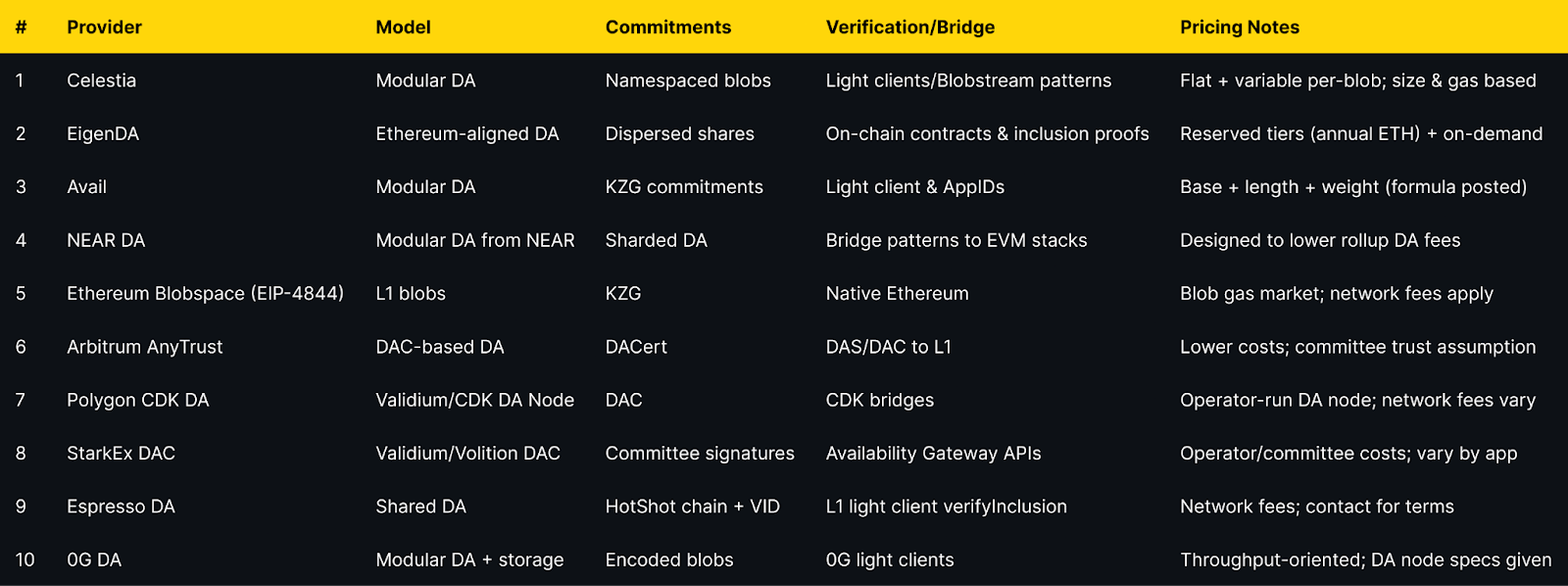


Top 10 Data Availability Layers in November 2025

1. Celestia — Best for modular DA at predictable blob economics

Why Use It. Celestia specializes in DA with namespaced blobs and data availability sampling. Fees are a flat transaction fee plus a variable component based on blob size, so costs scale with data posted rather than execution. Clear “PayForBlobs” guidance and explorers make planning straightforward. (blog.bcas.io)
Best For. OP Stack/sovereign rollups; teams optimizing DA cost; multi-chain deployments.
Notable Features. Namespaced blobs; fee market tied to blob size; tooling for PFB; docs on submitting and estimating fees. (Celestia Docs)
Fees Notes. Flat + variable per-blob; gas-price prioritized. (Celestia Docs)
Regions. Global (check validator/geography exposure in explorers).
Consider If. You want modular DA with transparent per-blob costs.
Alternatives. EigenDA, Avail.  

2. EigenDA — Best for high throughput with reserved bandwidth tiers

Why Use It. EigenDA is built on EigenLayer and offers mainnet DA with published reserved bandwidth tiers (annual ETH) and on-demand options. Strong alignment with Ethereum restaking and high advertised throughput. (docs.eigencloud.xyz)
Best For. High-throughput L2s; OP Stack/Orbit/CDK chains seeking cloud-grade throughput.
Notable Features. Reserved tiers (e.g., 512–2048 KiB/s and up), on-demand pricing updates, EigenLayer operator set. (eigenda.xyz)
Fees Notes. Reserved pricing in ETH per year; on-demand available. (eigenda.xyz)
Regions. Global.
Consider If. You want capacity commitments and Ethereum-aligned security.
Alternatives. Celestia, Avail.  

3. Avail — Best for dev-friendly docs and transparent fee formula

Why Use It. Avail provides DA with clear developer pathways (AppIDs, deploy rollups) and posts a fee formula: base + length + weight + optional tip. Guides include OP Stack and ZK Stack integrations. (docs.availproject.org)
Best For. Teams needing step-by-step deployment templates and cost modeling.
Notable Features. AppID model; OP Stack/Validium guides; fee components documented. (docs.availproject.org)
Fees Notes. Base + length + weight + optional tip; congestion multiplier. (docs.availproject.org)
Regions. Global.
Consider If. You want docs-first integration and a transparent pricing formula.
Alternatives. Celestia, EigenDA.  


4. NEAR Data Availability (NEAR DA) — Best for cost-reduction via NEAR’s sharded DA

Why Use It. NEAR modularizes its DA layer for external rollups, aiming to lower DA fees while leveraging its sharded architecture. Official materials target Ethereum rollups explicitly. (docs.near.org)
Best For. Rollups prioritizing low DA cost and sharded throughput.
Notable Features. Sharded DA; chain-abstraction docs; community implementations (e.g., Nuffle). (docs.near.org)
Fees Notes. Designed to reduce rollup DA cost; confirm network fees in docs. (NEAR)
Regions. Global.
Consider If. You want a low-cost DA path and EVM interoperability.
Alternatives. Avail, Celestia.


5. Ethereum Blobspace (EIP-4844) — Best for maximum L1 neutrality with ephemeral blobs

Why Use It. Post data to Ethereum blobs for protocol-level guarantees during the blob retention window (~18 days). Ideal for projects that want L1 alignment and can operate within ephemeral storage constraints and blob gas markets. (Ethereum Improvement Proposals)
Best For. Security-first teams preferring L1 attestation and ecosystem neutrality.
Notable Features. KZG commitments; ephemeral blob storage; native verification. (ethereum.org)
Fees Notes. Blob gas; variable by demand; L1 network fees apply. (ethereum.org)
Regions. Global.
Consider If. You accept blob retention limits and variable blob pricing.
Alternatives. Celestia, EigenDA.


6. Arbitrum AnyTrust (DAC) — Best for cost-optimized OP-style chains using a DAC

Why Use It. AnyTrust lowers costs by storing data with a Data Availability Committee and posting certificates on L1. Detailed runbooks exist for configuring DACs for Orbit chains. (docs.arbitrum.io)
Best For. Orbit chains and apps with mild trust assumptions for lower fees.
Notable Features. DACert flow; DAS; step-by-step DAC deployment docs. (docs.arbitrum.io)
Fees Notes. Lower posting costs; committee/infra costs vary. (docs.arbitrum.io)
Regions. Global (committee member distribution varies).
Consider If. You want cheaper DA and can trust a DAC quorum.
Alternatives. Polygon CDK DA, StarkEx DAC.


7. Polygon CDK Data Availability — Best for CDK chains wanting Validium-style DA

Why Use It. CDK chains can use a DA node and DAC approach for Validium-style costs, with official repos describing the CDK DA component. Best fit if you’re already on CDK and want DA flexibility. (polygon.technology)
Best For. Polygon CDK deployers; validium-first apps.
Notable Features. CDK DA node repo; DAC configuration; CDK ecosystem tooling. (GitHub)
Fees Notes. Operator/committee costs; network fees vary by setup. (polygon.technology)
Regions. Global.
Consider If. You need CDK-native DA with Validium trade-offs.
Alternatives. Arbitrum AnyTrust, EigenDA.


8. StarkEx Data Availability Committee — Best for Validium/Volition deployments needing DAC maturity

Why Use It. StarkEx supports Validium and Volition modes via a DAC with APIs (Availability Gateway) and reference implementations for committee nodes. Production-hardened across top apps. (docs.starkware.co)
Best For. High-volume ZK apps on StarkEx preferring low DA costs.
Notable Features. DAC reference code; Volition support; batch data APIs. (GitHub)
Fees Notes. Committee/infra costs; app-specific. (docs.starkware.co)
Regions. Global (committee selection per app).
Consider If. You accept DAC trust assumptions for cost savings.
Alternatives. Arbitrum AnyTrust, Polygon CDK DA.


9. Espresso DA — Best for shared DA paired with neutral sequencing

Why Use It. Espresso offers a shared DA with HotShot consensus and a light-client verifyInclusion function for on-chain verification, designed to interoperate with other DA choices if desired. (docs.espressosys.com)
Best For. Rollups adopting shared sequencing and wanting cheap DA.
Notable Features. HotShot consensus; three-layer DA architecture; flexible with other DAs. (L2BEAT)
Fees Notes. Network fees; contact providers/infrastructure partners for terms. (blockdaemon.com)
Regions. Global.
Consider If. You want shared sequencing + DA as a package.
Alternatives. EigenDA, Celestia.


10. 0G DA — Best for high-throughput apps (AI/gaming) needing DA + storage

Why Use It. 0G pairs a DA layer with a general-purpose storage system and provides DA node specs and runbooks. Positioned for high-volume data workloads and fast retrieval. (docs.0g.ai)
Best For. Data-heavy chains (AI, gaming) needing scalable DA and storage.
Notable Features. Encoded blob data; DA node specs; whitepaper architecture (DA atop storage). (GitHub)
Fees Notes. Throughput-oriented network; confirm current pricing with 0G. (0g.ai)
Regions. Global.
Consider If. You’re optimizing for data-heavy throughput and retrieval.
Alternatives. Celestia, Avail.


Decision Guide: Best By Use Case


How to Choose the Right Data Availability Layer (Checklist)

  • ☐ Region eligibility and any operator restrictions documented
  • ☐ Security model fits app (L1 blobs vs. modular DA vs. DAC)
  • ☐ Fee mechanics are explicit (blob gas, per-blob size, or formula)
  • ☐ Tooling and SDKs for your stack (OP Stack, CDK, ZK Stack)
  • ☐ Throughput/bandwidth and quotas published or contractually reserved
  • ☐ Observability: explorers, status pages, inclusion proofs/light clients
  • ☐ Clear guides for deployment and migration paths
  • ☐ Support channels and escalation (SLA/contacts)
  • Red flags: no official fee notes, opaque committees, or missing verification docs.

Use Token Metrics With Any Data Availability Layer

  • AI Ratings to screen assets by quality and momentum.
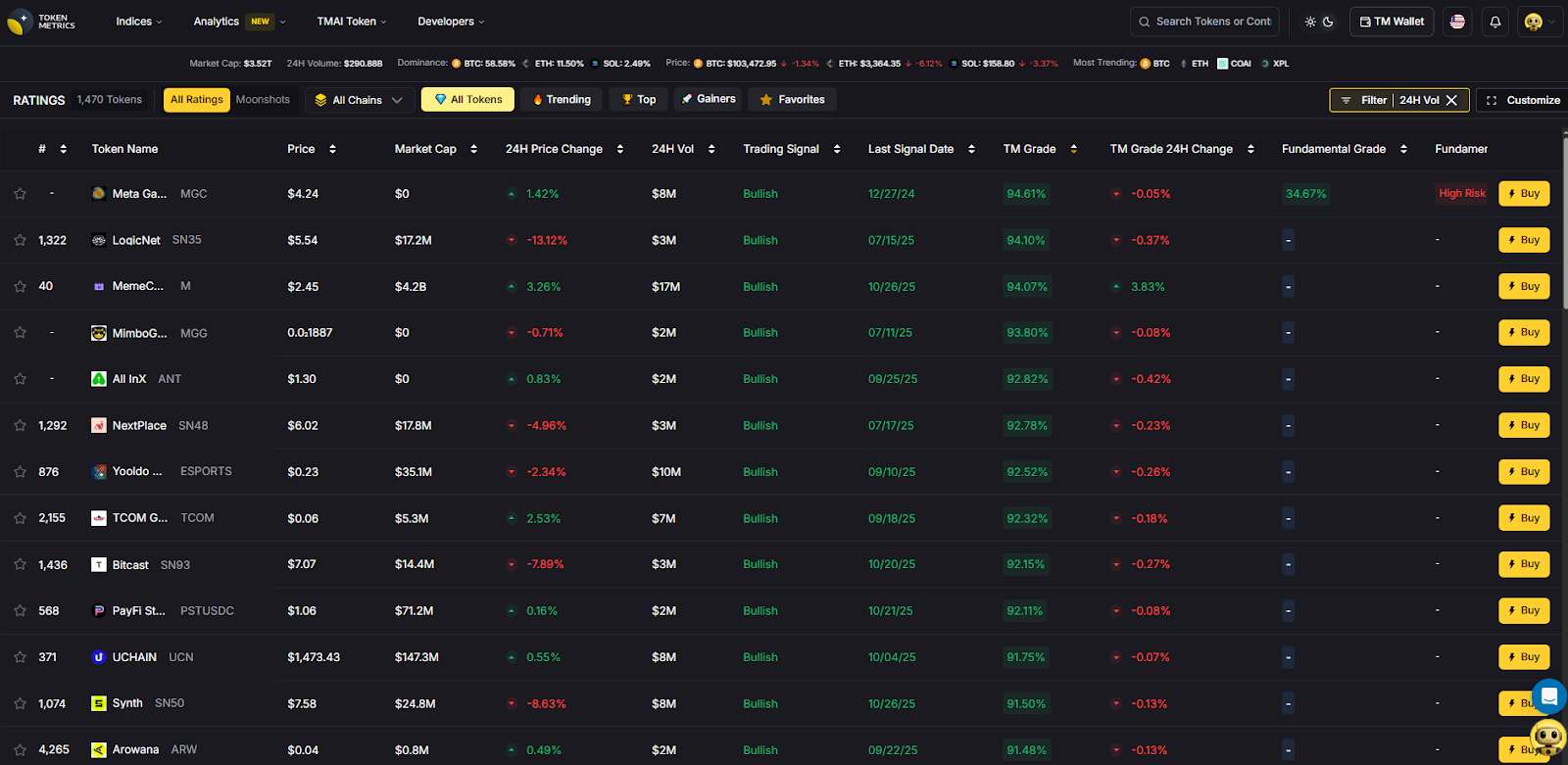
  

  • Narrative Detection to spot early theme shifts.
  • Portfolio Optimization to balance risk across chains.
  • Alerts & Signals to time entries/exits.
    Workflow: Research → Select DA → Launch rollup/appchain → Monitor with alerts.

Start free trial to screen assets and time entries with AI.  

Security & Compliance Tips

  • Run independent verification (light clients/inclusion proofs) where available.
  • For DACs, diversify committee members and publish membership changes.
  • Monitor quotas/latency; set fallbacks (e.g., switch DA mode where stack supports Alt-DA). (docs.optimism.io)
  • Validate official endpoints; beware of phishing and copycat docs.
  • Track fee spikes (blob gas, congestion multipliers) and set budget alarms. (ethereum.org)
  • Document upgrade paths and retention windows (e.g., blob expiry). (ethereum.org)

This article is for research/education, not financial advice.


Beginner Mistakes to Avoid

  • Treating DA choice as “set-and-forget” without monitoring fees and bandwidth.
  • Ignoring blob retention on Ethereum and assuming permanence. (ethereum.org)
  • Using a DAC without clear membership and recovery processes. (docs.arbitrum.io)
  • Skipping test deployments to measure real blob sizes and costs.
  • Overlooking verification UX (light clients/proofs) for end users.
  • Assuming all stacks support seamless DA switching without work. (docs.optimism.io)

How We Picked (Methodology & Scoring)

Scoring Weights (sum = 100): Liquidity/Scale 30, Security 25, Coverage 15, Costs 15, UX 10, Support 5.
We examined official docs for pricing/fees, security/verification, and deployment guides. We favored providers with explicit fee notes (formulas or tiers), clear verification models, and active ecosystem integrations. Last updated November 2025.


FAQs

What are data availability layers?
 They’re systems that publish rollup data so anyone can reconstruct state and verify proofs. They range from L1 blobs (Ethereum EIP-4844) to modular DA networks (Celestia, Avail) and DACs. (ethereum.org)

Are blobs on Ethereum permanent?
 No. Blob data is retained for a limited window (~18 days). If you need permanent access, you must snapshot or use a DA with different retention. (ethereum.org)

How do DA fees work?
 Fees vary: Celestia ties fees to blob size and gas; Avail publishes a base/length/weight formula; Ethereum blobs use a blob-gas market; EigenDA offers reserved bandwidth tiers. (Celestia Docs)

What’s a DAC and when should I use one?
 A Data Availability Committee stores data off-chain and posts certificates or signatures to L1. It’s cheaper but introduces committee trust assumptions. Used by Arbitrum AnyTrust, StarkEx/Volition, and CDK Validium. (docs.arbitrum.io)

Can OP Stack chains plug into alternative DA?
 Yes. OP Stack supports Alt-DA mode to integrate various DA layers. Validate trade-offs and tooling before switching. (docs.optimism.io)


Conclusion + Related Reads

If you want transparent per-blob costs and strong tooling, pick Celestia. For capacity commitments and Ethereum alignment, choose EigenDA. If you want a formula-based fee model with practical guides, Avail is compelling. DAC-based routes (AnyTrust, StarkEx, CDK) suit cost-sensitive apps comfortable with committee trust assumptions.

Related Reads (Token Metrics)

Build Smarter Crypto Apps &
AI Agents in Minutes, Not Months
Real-time prices, trading signals, and on-chain insights all from one powerful API.
Grab a Free API Key
About Token Metrics
Token Metrics: AI-powered crypto research and ratings platform. We help investors make smarter decisions with unbiased Token Metrics Ratings, on-chain analytics, and editor-curated “Top 10” guides. Our platform distills thousands of data points into clear scores, trends, and alerts you can act on.
30 Employees
analysts, data scientists, and crypto engineers
Daily Briefings
concise market insights and “Top Picks”
Transparent & Compliant
Sponsored ≠ Ratings; research remains independent
Want Smarter Crypto Picks—Free?
See unbiased Token Metrics Ratings for BTC, ETH, and top alts.
Thank you! Your submission has been received!
Oops! Something went wrong while submitting the form.
 No credit card | 1-click unsubscribe
Token Metrics Team
Token Metrics Team

Recent Posts

Research

A Comprehensive Guide to Buying Solana Cryptocurrency

Token Metrics Team
4

Introduction

Solana has emerged as one of the notable projects in the blockchain ecosystem, known for its high-performance capabilities and growing developer community. Understanding how to buy Solana (SOL) requires familiarity with the ecosystem, secure wallets, and the exchanges where the token is available. This guide presents an educational overview on acquiring Solana tokens while highlighting the tools and approaches that can support your research process efficiently.

Understanding Solana and Its Ecosystem

Before proceeding with any acquisition, it helps to understand the fundamentals of the Solana blockchain. Solana is a decentralized network designed to enable fast, scalable decentralized applications (dApps) and crypto assets. Its native token, SOL, is used for transaction fees and interacting with applications on the network.

Awareness of Solana's technological framework, including its unique Proof of History consensus mechanism, provides context that informs the buying process from both a technical standpoint and an operational perspective.

Setting Up a Solana Wallet

Acquiring SOL tokens necessitates having a compatible wallet that supports Solana’s blockchain.

  • Software Wallets: These are applications or browser extensions such as Phantom, Solflare, or Slope. They provide convenient access but require strong security practices like safeguarding private keys and seed phrases.
  • Hardware Wallets: Devices like Ledger or Trezor offer enhanced security by storing private keys offline. Not all hardware wallets natively support Solana yet, so checking compatibility is essential.

Choosing a wallet depends on individual preferences balancing convenience and security considerations.

Selecting a Reliable Exchange to Buy Solana

SOL tokens are available on multiple cryptocurrency exchanges, but purchasing involves selecting a platform based on liquidity, fees, regulatory compliance, and user experience.

Common exchange options include:

  • Centralized Exchanges (CEX): Platforms like Coinbase, Binance, and Kraken allow users to buy SOL using fiat or other cryptocurrencies. These platforms typically streamline the process but require identity verification.
  • Decentralized Exchanges (DEX): Platforms such as Serum operate on Solana’s network enabling peer-to-peer token swaps without intermediaries. Working with DEXs requires connecting your wallet and understanding swap mechanics.

Researching exchange reputation, fee structures, and security protocols is an important step and can be supplemented by analysis tools.

Purchase Process Overview

  1. Create and Secure Your Wallet: Start by setting up a Solana-compatible wallet and securely storing your credentials.
  2. Select an Exchange: Choose a platform that fits your needs, factoring in trading pairs and payment methods.
  3. Deposit Funds: Transfer fiat currency or cryptocurrency to your exchange account or connected wallet.
  4. Place an Order: Use market or limit orders to purchase SOL tokens at your chosen price.
  5. Transfer SOL Tokens to Your Wallet: For security, consider moving purchased tokens from the exchange to your personal wallet.

Researching Solana with AI-Driven Analytical Tools

Utilizing AI-powered research platforms enhances the ability to analyze blockchain projects systematically. Token Metrics is one such platform offering data-driven insights, ratings, and scenario analyses. These tools help decode market trends, evaluate fundamentals, and monitor technical developments, supporting an informed understanding of Solana’s evolving landscape.

While such platforms provide valuable educational support, users should integrate various sources and maintain ongoing research to navigate the dynamic crypto environment responsibly.

Security Considerations

When buying Solana or any cryptocurrency, security is paramount. Consider the following precautions:

  • Use two-factor authentication (2FA) on exchange accounts and wallets.
  • Store wallet recovery phrases offline and securely.
  • Beware of phishing attacks and unsolicited requests for private keys.
  • Stay updated on software and firmware upgrades for wallet devices.

Conclusion

Acquiring Solana tokens involves understanding the blockchain’s underlying technology, selecting the right wallet, choosing a reliable exchange, and practicing robust security measures. Leveraging AI-powered analytical tools like Token Metrics can deepen research capabilities and facilitate a comprehensive approach to exploring the crypto space.

Disclaimer

This content is provided solely for educational and informational purposes. It is not financial, investment, tax, or legal advice. Readers should perform their own research and consult with licensed professionals before making any financial decisions related to cryptocurrencies.

Research

Understanding Ethereum: How This Blockchain Platform Operates

Token Metrics Team
4

Introduction to Ethereum

Ethereum is one of the most influential blockchain platforms developed since Bitcoin. It extends the concept of a decentralized ledger by integrating a programmable layer that enables developers to build decentralized applications (dApps) and smart contracts. This blog post explores how Ethereum operates technically and functionally without delving into investment aspects.

Ethereum Blockchain and Network Structure

At its core, Ethereum operates as a distributed ledger technology—an immutable blockchain maintained by a decentralized network of nodes. These nodes collectively maintain and validate the Ethereum blockchain, which records every transaction and smart contract execution.

The Ethereum blockchain differs from Bitcoin primarily through its enhanced programmability and faster block times. Ethereum’s block time averages around 12-15 seconds, which allows for quicker confirmation of transactions and execution of contracts.

Smart Contracts and the Ethereum Virtual Machine (EVM)

A fundamental innovation introduced by Ethereum is the smart contract. Smart contracts are self-executing pieces of code stored on the blockchain, triggered automatically when predefined conditions are met.

The Ethereum Virtual Machine (EVM) is the runtime environment for smart contracts. It interprets the contract code and operates across all Ethereum nodes to ensure consistent execution. This uniformity enforces the trustless and decentralized nature of applications built on Ethereum.

Ethereum Protocol and Consensus Mechanism

Originally, Ethereum used a Proof of Work (PoW) consensus mechanism similar to Bitcoin, requiring miners to solve complex cryptographic puzzles to confirm transactions and add new blocks. However, Ethereum has transitioned to Proof of Stake (PoS) through an upgrade called Ethereum 2.0.

In the PoS model, validators are chosen to propose and validate blocks based on the amount of cryptocurrency they stake as collateral. This method reduces energy consumption and improves scalability and network security.

Ethereum Gas Fees and Transaction Process

Executing transactions and running smart contracts on Ethereum requires computational resources. These are measured in units called gas. Users pay gas fees, denominated in Ether (ETH), to compensate validators for processing and recording the transactions.

The gas fee varies depending on network demand and the complexity of the operation. Simple transactions require less gas, while complex contracts or high congestion periods incur higher fees. Gas mechanics incentivize efficient code and prevent spam on the network.

Nodes and Network Participation

Ethereum’s decentralization is maintained by nodes located worldwide. These nodes can be categorized as full nodes, which store the entire blockchain and validate all transactions, and light nodes, which store only essential information.

Anyone can run a node, contributing to Ethereum’s resilience and censorship resistance. Validators in PoS must stake Ether to participate in block validation, ensuring alignment of incentives for network security.

Use Cases of Ethereum dApps

Decentralized applications (dApps) are built on Ethereum’s infrastructure. These dApps span various sectors, including decentralized finance (DeFi), supply chain management, gaming, and digital identity. The open-source nature of Ethereum encourages innovation and interoperability across platforms.

How AI and Analytics Enhance Ethereum Research

Understanding Ethereum’s intricate network requires access to comprehensive data and analytical tools. AI-driven platforms, such as Token Metrics, utilize machine learning to evaluate on-chain data, developer activity, and market indicators to provide in-depth insights.

Such platforms support researchers and users by offering data-backed analysis, helping to comprehend Ethereum’s evolving technical landscape and ecosystem without bias or financial recommendations.

Conclusion and Key Takeaways

Ethereum revolutionizes blockchain technology by enabling programmable, trustless applications through smart contracts and a decentralized network. Transitioning to Proof of Stake enhances its scalability and sustainability. Understanding its mechanisms—from the EVM to gas fees and network nodes—provides critical perspectives on its operation.

For those interested in detailed Ethereum data and ratings, tools like Token Metrics offer analytical resources driven by AI and machine learning to keep pace with Ethereum’s dynamic ecosystem.

Disclaimer

This content is for educational and informational purposes only. It does not constitute financial, investment, or trading advice. Readers should conduct independent research and consult professionals before making decisions related to cryptocurrencies or blockchain technologies.

Research

A Comprehensive Guide to Mining Ethereum

Token Metrics Team
4

Introduction

Ethereum mining has been an essential part of the Ethereum blockchain network, enabling transaction validation and new token issuance under a Proof-of-Work (PoW) consensus mechanism. As Ethereum evolves, understanding the fundamentals of mining, the required technology, and operational aspects can provide valuable insights into this cornerstone process. This guide explains the key components of Ethereum mining, focusing on technical and educational details without promotional or financial advice.

How Ethereum Mining Works

Ethereum mining involves validating transactions and securing the network by solving complex mathematical problems using computational resources. Miners employ high-performance hardware to perform hashing calculations and compete to add new blocks to the blockchain. Successfully mined blocks reward miners with Ether (ETH) generated through block rewards and transaction fees.

At its core, Ethereum mining requires:

  • Mining hardware: specialized components optimized for hashing functions
  • Mining software: programs that connect hardware to the network and coordinate mining efforts
  • Network connection: stable and efficient internet connectivity
  • Mining pool participation: collaborative groups of miners combining hash power

Choosing Mining Hardware

GPU-based mining rigs are currently the standard hardware for Ethereum mining due to their efficiency in processing the Ethash PoW algorithm. Graphics Processing Units (GPUs) are well-suited for the memory-intensive hashing tasks required for Ethereum, as opposed to ASICs (Application-Specific Integrated Circuits) that tend to specialize in other cryptocurrencies.

Key considerations when selecting GPUs include:

  • Hashrate: the measure of mining speed, usually expressed in MH/s (megahashes per second)
  • Energy efficiency: power consumption relative to hashing performance
  • Memory capacity: minimum 4GB VRAM required for Ethereum mining
  • Cost: initial investment balanced against expected operational expenses

Popular GPUs such as the Nvidia RTX and AMD RX series often top mining performance benchmarks. However, hardware availability and electricity costs significantly impact operational efficiency.

Setting Up Mining Software

Once mining hardware is selected, the next step involves configuring mining software suited for Ethereum. Mining software translates computational tasks into actionable processes executed by the hardware while connecting to the Ethereum network or mining pools.

Common mining software options include:

  • Ethminer: an open-source solution tailored for Ethereum
  • Claymore Dual Miner: supports mining Ethereum alongside other cryptocurrencies
  • PhoenixMiner: known for its stability and efficiency

When configuring mining software, consider settings related to:

  • Pool address: if participating in a mining pool
  • Wallet address: for receiving mining rewards
  • GPU tuning parameters: to optimize performance and power usage

Understanding Mining Pools

Mining Ethereum independently can be challenging due to increasing network difficulty and competition. Mining pools provide cooperative frameworks where multiple miners combine computational power to improve chances of mining a block. Rewards are then distributed proportionally according to contributed hash power.

Benefits of mining pools include:

  • Reduced variance: more frequent, smaller payouts compared to solo mining
  • Community support: troubleshooting and shared resources
  • Scalability: enabling participation even with limited hardware

Popular mining pools for Ethereum include Ethermine, SparkPool, and Nanopool. When selecting a mining pool, evaluate factors such as fees, payout methods, server locations, and minimum payout thresholds.

Operational Expenses and Efficiency

Mining Ethereum incurs ongoing costs, primarily electricity consumption and hardware maintenance. Efficiency optimization entails balancing power consumption with mining output to ensure sustainable operations.

Key factors to consider include:

  • Electricity costs: regional rates greatly influence profitability and operational feasibility
  • Hardware lifespan: consistent usage causes wear, requiring periodic replacements
  • Cooling solutions: to maintain optimal operating temperatures and prevent hardware degradation

Understanding power consumption (wattage) of mining rigs relative to their hashrate assists in determining energy efficiency. For example, a rig with a hashrate of 60 MH/s consuming 1200 watts has different efficiency metrics compared to others.

Monitoring and Analytics Tools

Efficient mining operations benefit from monitoring tools that track hardware performance, network status, and market dynamics. Analytical platforms offer data-backed insights that can guide equipment upgrades, pool selection, and operational adjustments.

Artificial intelligence-driven research platforms like Token Metrics provide quantitative analysis of Ethereum network trends and mining considerations. Leveraging such tools can optimize decision-making by integrating technical data with market analytics without endorsing specific investment choices.

Preparing for Ethereum Network Evolution

Ethereum’s transition from Proof-of-Work to Proof-of-Stake (PoS), known as Ethereum 2.0, represents a significant development that impacts mining practices. PoS eliminates traditional mining in favor of staking mechanisms, which means Ethereum mining as performed today may phase out.

Miners should remain informed about network upgrades and consensus changes through official channels and reliable analysis platforms like Token Metrics. Understanding potential impacts enables strategic planning related to hardware usage and participation in alternative blockchain activities.

Educational Disclaimer

This article is intended for educational purposes only. It does not offer investment advice, price predictions, or endorsements. Readers should conduct thorough individual research and consider multiple reputable sources before engaging in Ethereum mining or related activities.

Choose from Platinum, Gold, and Silver packages
Reach with 25–30% open rates and 0.5–1% CTR
Craft your own custom ad—from banners to tailored copy
Perfect for Crypto Exchanges, SaaS Tools, DeFi, and AI Products