

Crypto Basics

Top Solana Projects in 2024 - Token Metrics Moon Awards

Discover the top Solana projects of 2024 at the Token Metrics Moon Awards. Uncover the best in Solana innovation and investment potential.
Token Metrics Team
12 Minutes
MIN

Welcome to the Token Metrics Moon Awards, a prestigious cryptocurrency industry accolade that recognizes platforms, projects, and initiatives that have significantly impacted the industry. The latest addition to the Moon Awards is the "Top Solana Projects in 2024."

Selection Process

At Token Metrics, we emphasize our audience, considering them the foundation of our operations. Our selection process is firmly rooted in engaging with the community, ensuring that our awards' results authentically reflect crypto enthusiasts' sentiments and experiences.

Through engagement with our community members, we have compiled a comprehensive list of the Top Solana Projects in 2024 based on extensive survey data and user votes.

This article aims to provide a comprehensive guide to the top Solana projects in 2024, showcasing their contributions to the ecosystem's growth despite facing challenges. 

Through an in-depth exploration, we will uncover how these projects drive innovation, the technological advancements they bring, and their role in shaping the future of decentralized applications on Solana.

Solana Ecosystem Overview

Solana's ecosystem is rapidly evolving, with several competitive advantages propelling it to the forefront of blockchain technology. Notably, its ability to process transactions quickly and cheaply has made it a popular choice for developers and investors alike. Some of the highlights include:

Competitive Advantages:

  • Cheap transactions
  • Faster processing speed
  • Growing meme coins contributing to network activity

Resurgence and Growth:

  • Price recovery and zero network outages since February 2023
  • Over 125 protocols, handling 100 million transactions daily
  • Increased attention from investors and developers, especially in Decentralized Physical Infrastructure (DePIN)

These elements underscore Solana's robust and dynamic ecosystem, setting the stage for its continued growth and innovation in 2024.

List of Top Solana Projects in 2024

Delving into the bustling Solana ecosystem for 2024, we uncover a spectrum of projects that stand out for their innovation, utility, and contribution to the blockchain space.
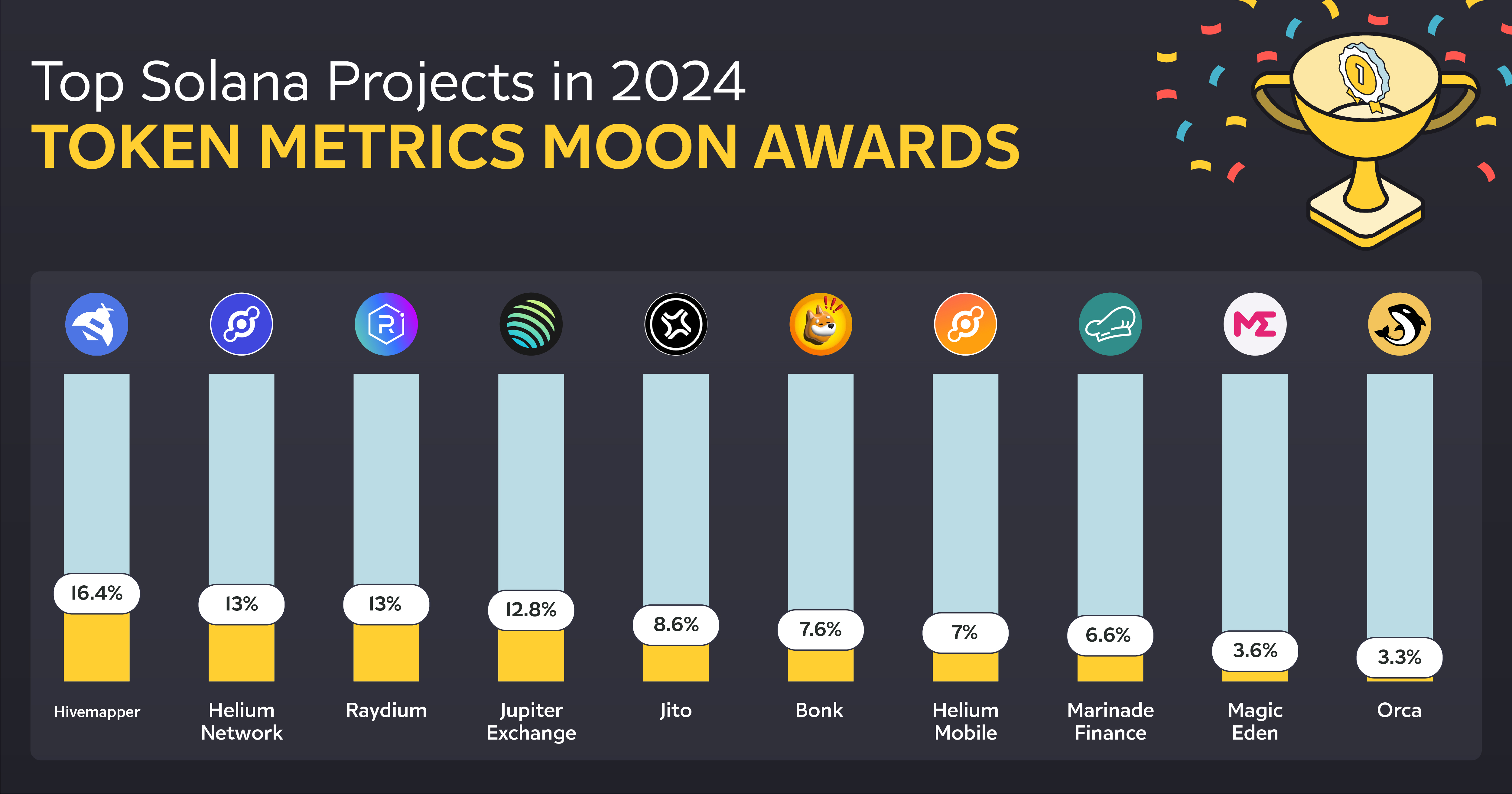
Top Solana Projects
Image Source - Token Metrics Moon Awards

These projects span various domains, including decentralized exchanges (DEXs), lending protocols, NFT marketplaces, and more, showcasing the versatility and robustness of the Solana network.

Here's a closer look at some of the top Solana projects set to make significant impacts in 2024:

1. Hivemapper

In the Moon Awards survey, Hivemapper secured the top position with 16.4% of the total votes.

Hivemapper emerges as a revolutionary force within the Solana ecosystem, championing the cause of decentralized mapping. This crypto-enabled dashcam project is not just about mapping the world; it's about reimagining who owns and contributes to that map. 

With nearly 140 million kilometers mapped across 2,503 regions worldwide, Hivemapper exemplifies the shift from traditional, centralized mapping services to a more democratic, user-driven approach. 

This transformation is pivotal for accurate, up-to-date maps essential for navigation and urban planning.

Key Features and Innovations:

  • Decentralized Mapping: Leveraging the Solana blockchain, it offers a democratic way for global contributors to participate in map creation and updates.
  • Comprehensive Coverage: The project maps nearly 140 million kilometers, covering 2,503 regions globally.
  • Reward System: Contributors are rewarded for their input, with the full reward opportunity for every road reset every 7 days, encouraging continuous updates.

Hivemapper's technological backbone is equally impressive. The platform employs its in-house built Titan engine for processing massive datasets. This engine executes sensor fusion, machine learning/computer vision processing, and crowd consensus review and ensures the continuity of network data. 

Furthermore, Hivemapper is pioneering in hardware development, working with multiple partners in the United States to build dashcams that collect 4K imagery and various telemetry data, all encrypted for security. 

2. Helium Network

In the Moon Awards survey, Helium Network secured the 2nd position with 13% of the total votes.

The Helium Network, under the stewardship of the Helium Foundation, represents a paradigm shift in decentralized wireless technologies. Established in 2021, this US-based non-profit organization is at the forefront of protocol governance and the technical evolution of the Helium Network. 

It's instrumental in educating the public about the advantages of decentralized wireless networks and fostering a vibrant community of network builders, users, and developers.

Key Aspects of the Helium Network:

  • Foundation's Role: The Helium Foundation is central to driving the network's codebase and operations, ensuring a seamless experience for all stakeholders involved. It's committed to expanding public awareness and enhancing the network's utility through innovative use cases.
  • Membership Program: Encompassing Hardware Manufacturers, Network Operators, Service Providers, and Application Developers, the program is set to open its doors to individual enthusiasts, including Hotspot hosts, in 2024.
  • Migration to Solana: A significant milestone was the network's migration to Solana in April 2023, which brought substantial performance and scalability improvements. This move has also paved the way for the network to delve into the mobile and IoT sectors, with initiatives allowing users to earn tokens by supporting the network.

The Helium Network's journey through 2023 into 2024, marked by a 500% surge following its venture into mobile services, reflects its growing influence within the Solana ecosystem. 

With the Helium Wallet now supporting all tokens on the Solana blockchain, the network is poised for further expansion, leveraging the DePIN project to offer decentralized connectivity services. 

3. Raydium

In the Moon Awards survey, Raydium secured the 3rd position with 13% of the total votes.

Raydium stands as a pivotal Solana project, acting as a bridge between the worlds of decentralized finance (DeFi) and automated market makers (AMMs)

This platform has carved out a niche for itself within the Solana ecosystem by offering a suite of financial services that cater to both novice and seasoned crypto enthusiasts.

Key Features and Innovations:

  • AMM Protocol: At its core, Raydium leverages the power of Solana's high-speed blockchain to facilitate lightning-fast trades and transactions. This not only enhances user experience but also contributes to the overall liquidity of the Solana ecosystem.
  • Dual Functionality: Raydium functions as both an AMM and a liquidity provider to the Serum DEX, Solana's premier decentralized exchange. This unique positioning allows Raydium users to access the vast liquidity and wide range of trading pairs available on Serum.

Technological Advancements:

  • High Throughput: Utilizing Solana's capability of processing thousands of transactions per second, Raydium offers a seamless and efficient trading experience.
  • Yield Farming: Raydium introduces users to yield farming opportunities, enabling them to earn rewards by providing liquidity to various pools.

4. Jupiter Exchange

In the Moon Awards survey, Jupiter Exchange secured the 4th position with 12.8% of the total votes.

Jupiter Exchange (JUP) is a cutting-edge swap aggregator within the vibrant Solana ecosystem. It harnesses Solana's speed and efficiency to offer various advanced trading features, making it a standout choice for traders seeking flexibility and depth in their trading strategies. Here's a closer look at what makes Jupiter Exchange a notable Solana project:

Advanced Trading Features:

  • Dollar Cost Averaging (DCA): Allows users to spread their investment over time, reducing the impact of volatility.
  • Limit Orders: Users can set specific price points at which their trades automatically execute, offering greater control over trading outcomes.
  • Perpetual Trading: Provides the opportunity for traders to engage in contracts that do not have an expiry date, enhancing trading flexibility.

Jupiter's commitment to efficiency, low transaction costs, and innovative offerings like swap services and perpetual exchange capabilities, coupled with a significant daily trading volume of $400 million and 90,000 unique wallets, underscores its importance within the Solana projects landscape. 

5. Jito

In the Moon Awards survey, Jito secured the 5th position with 8.6% of the total votes.

In the vibrant Solana ecosystem, Jito stands as a beacon of innovation, particularly in the space of high-frequency trading on decentralized exchanges. 

This Solana project is meticulously designed to address the common pain points encountered in decentralized finance (DeFi), offering solutions that significantly enhance trading efficiency and user experience.

High-Frequency Trading Capabilities:

  • Jito utilizes the Solana blockchain's high throughput and low latency to facilitate high-frequency trading, a feature traditionally reserved for centralized financial markets.
  • This allows traders to execute orders at lightning speed, capitalizing on market movements in real time.

Slippage Reduction:

  • One of the platform's key innovations is its ability to drastically reduce slippage, a common issue that traders face in less liquid markets.
  • By aggregating liquidity across multiple sources, Jito ensures that trades are executed at the most favorable prices, minimizing the cost impact on large orders.

Its emphasis on speed, efficiency, and reduced slippage positions Jito as a critical player among Solana projects, pushing the boundaries of what's possible in the realm of decentralized trading.

6. Bonk

In the Moon Awards survey, Bonk secured the 6th position with 7.6% of the total votes.

Bonk (BONK), a meme coin within the Solana ecosystem, has captured the attention of the cryptocurrency market with its significant traction. 

BONKrewards by ArmadaFi: This initiative allows users to lock BONK for rewards, driving adoption and utility within the Solana ecosystem.

Competition and Roadmap: Facing competition from other meme coins, Bonk's development roadmap, and the team's efforts could influence investor sentiment and its market position.

Bonk's deflationary nature, with over 65% of its total circulating supply burnt, alongside a 10,000% gain in 2023, underscores its status as the hottest meme coin of 2024. 

The Bonk DAO's investment in early-stage startups and the engaging Bonk March Madness event further highlight its community-driven approach and innovative use within the Solana projects landscape.

7. Helium Mobile

In the Moon Awards survey, Helium Mobile secured the 7th position with 7% of the total votes.

Helium Mobile's integration into the Solana ecosystem marks a significant leap forward in decentralized wireless communication, offering users an innovative and expansive service. 

With the Helium Wallet's upgrade to support a wide range of digital assets on the Solana blockchain, users gain a streamlined experience in managing their Solana-based tokens. 

This move not only enhances the utility of the Helium Wallet but also demonstrates Helium's dedication to embracing crypto diversity. The exclusive Pixel NFT, available in the "Badges" tab, rewards users for their engagement, adding a unique element to the user experience.

Key Developments:

  • Coinbase Support: Helium Mobile's full support of Coinbase for trading amplifies its accessibility and potential for widespread adoption.
  • Growth Metrics: The remarkable growth, evidenced by 12,398 active 5G nodes and a surge in new subscribers, indicates a rapidly expanding user base, with projections suggesting nearly 530,000 new subscribers within the year.

Helium Mobile's strategic adjustments to mining rules and the relationship between MOBILE and HNT tokens showcase a thoughtful approach to maintaining a balanced supply-demand dynamic. 

8. Marinade Finance

In the Moon Awards survey, Marinade Finance secured the 8th position with 6.6% of the total votes.

Marinade Finance simplifies the concept of staking on the Solana blockchain, offering users an innovative approach to maximize their returns. 

By automating the staking process across over 100 top-performing validators and providing an automated rebalancing feature, Marinade ensures that users' SOL is always working hard for them. 

This automation not only optimizes returns but also democratizes access to high-quality staking opportunities, previously only available to those with extensive blockchain knowledge.

Key features that set Marinade Finance apart include:

  • Instant Unstake: Users can exit their stake positions instantly at the best available price, offering unparalleled flexibility in managing their investments.
  • Liquid Staking: By unlocking the liquidity of staked SOL, Marinade enables users to participate in DeFi, further enhancing the utility of their assets.
  • mSOL Receipt Token: Depositing staked SOL with Marinade issues users an mSOL token, a fungible asset that can be used as collateral across various DeFi projects.

Moreover, Marinade Finance provides a comprehensive platform for users to review and understand the performance of Solana validators. Utilizing a detailed scoring system, it ranks validators based on yield economics, block production, and stake concentration, ensuring transparency and informed decision-making. 

9. Magic Eden

In the Moon Awards survey, Magic Eden secured the 9th position with 3.6% of the total votes.

Magic Eden has established itself as a premier NFT marketplace within the Solana ecosystem, facilitating the buying, selling, and discovering unique digital assets across multiple blockchains. Several key features underscore its significance:

User and Creator Benefits:

  • User-Friendly Interface: Ensures an intuitive navigation experience.
  • Minimal Fees & Flexible Royalties: A 2% transaction fee for buyers and sellers, with optional royalty alchemy for creators.
  • Magic Eden Wallet: Acts as a multi-purpose web3 navigator for storing crypto assets and interacting with NFTs.

Supported Blockchains and Collections:

  • Blockchains: Solana, Ethereum, Polygon, and Bitcoin (Ordinals).
  • Hot Collections Highlighted: Includes NodeMonkes, Bored Ape Yacht Club, Transdimensional Fox Federation, and Trump Digital Trading Cards, among others.

Magic Eden's blend of extensive collection, low transaction fees, and a user-friendly interface positions it as a hub for artists, creators, and enthusiasts from various blockchain backgrounds.

10. Orca

In the Moon Awards survey, Orca secured the 10th position with 3.3% of the total votes.

Orca emerges as a standout Concentrated Liquidity Automated Market Maker (AMM) on the Solana Network, designed to optimize the trading experience for both liquidity providers and traders. It achieves this through several innovative features and community-driven governance:

Concentrated Liquidity AMM:

  • Liquidity providers can specify price ranges for their tokens, enhancing capital efficiency.
  • A share of trading fees generated on the platform is an incentive, promising higher returns.

Community Governance:

  • Governed by the Orca DAO and the DAO council, utilizing the ORCA token for decision-making.
  • ORCA token is accessible on major exchanges like Kucoin, Gate, and Coinbase, ensuring wide availability.

Orca's platform is not just about trading; it's about creating a comprehensive ecosystem for DeFi activities on Solana. Key features include:

  • Whirlpools: For concentrated liquidity, allowing for higher returns and lower slippage.
  • DCA Feature & Decentralized Perpetuals Trading Platform: Offers up to 100x leverage, catering to various trading strategies.
  • User-Friendly Interface: Ensures minimal transaction fees and lower latency than Ethereum-based DEXs, alongside a fair price guarantee.

Conclusion

Throughout this exploration of Solana's diverse and dynamic ecosystem, we've delved into the vast potential and innovation displayed by leading Solana projects set to shape the blockchain frontier in 2024. 

From the decentralized mapping marvels of Hivemapper to the financial ingenuity of Orca, each project brings its unique contributions, marking Solana's unwavering position in the digital space. 

These endeavors not only illuminate the robust capabilities of the Solana blockchain in supporting high-speed, cost-effective applications, but they also underline the ecosystem's versatility across various domains, including DeFi, wireless communication, NFT marketplaces, and beyond.

Disclaimer

The information provided on this website does not constitute investment advice, financial advice, trading advice, or any other advice, and you should not treat any of the website's content as such.

Token Metrics does not recommend buying, selling, or holding any cryptocurrency. Conduct your due diligence and consult your financial advisor before making investment decisions.

Build Smarter Crypto Apps &
AI Agents in Minutes, Not Months
Real-time prices, trading signals, and on-chain insights all from one powerful API.
Grab a Free API Key
Token Metrics Team
Token Metrics Team

Recent Posts

Crypto Basics

Pump and Dump Schemes - How to Spot and Avoid Investment Scams

Token Metrics Team
7 Minutes
MIN

As the world of finance continues to evolve, new and innovative investment opportunities have emerged. However, alongside these opportunities come potential risks and scams.

One such scam that has become increasingly prevalent is the "pump and dump" scheme. In this article, we'll discuss what a pump and dump scheme is, how to spot it, and how to avoid falling victim to such investment scams.

What is Pump and Dump?

Pump and dump is a type of investment fraud used in the financial market where one or more people intentionally raise the price of a stock, crypto or other financial assets by disseminating false or deceptive information to lure investors. 

Once the price has increased to the desired level, these manipulators sell their shares at a profit, leading to a decrease in price, and leaving innocent investors with securities that are either worthless or overpriced.

How Does the Pump and Dump Scheme Work?

The mechanics of a pump and dump scheme works by manipulating microcap assets, such as penny stocks or cheap cryptos, which are companies with a small market capitalization. These assets are usually traded at a very low price, and do not follow strict requirements for public listing.

Therefore, scammers can easily manipulate information about these assets. The lack of publicly available information provides fraudsters with favorable conditions since potential investors lack the necessary sources to verify all the information about a company and management.

Moreover, microcap assets are highly illiquid and have very low trading volume. As a result, even small transactions can significantly boost the asset price.

The fraudster typically starts by buying a large number of shares in that type of micro cap asset, then spreading false information about the company through various channels, such as social media, chat rooms, and email newsletters.

Once the price of the asset has been artificially inflated, the fraudsters will begin selling their holdings, realizing significant profits. As the scheme is uncovered, the price of the asset typically plummets, leaving unsuspecting investors with significant losses.

Types of Pump and Dump Schemes

There are several types of pump and dump schemes in financial world, including:

Pre-arranged pump and dump: A group of fraudsters will agree to buy a particular asset simultaneously, creating an artificial demand and price surge. Once the price has reached a certain level, the fraudsters will sell their holdings, causing the price to crash.

Social media pump and dump: Fraudsters will use social media platforms to spread false information and create hype around a particular cryptocurrency, stocks or any other asset, encouraging investors to buy. Once the price has been inflated, the fraudsters will sell their holdings.

Exchange-based pump and dump: Fraudsters will use exchanges with low liquidity to create artificial demand for a particular asset, causing the price to surge. Once the fraudsters have sold their holdings, the price typically crashes.

Role of Social Media in Pump and Dump Schemes

Social media plays a significant role in pump and dump schemes as it allows individuals to disseminate false or misleading information about a stock or cryptocurrency quickly and easily to a large audience. 

Scammers may create fake social media profiles or use existing ones to promote the cryptocurrency or digital asset and spread positive news about it, encouraging others to invest. They may also use social media to organize groups of investors to buy and sell the asset at specific times to manipulate its price. 

Social media platforms such as Twitter and Telegram are popular channels for these activities. Investors must be cautious and verify the accuracy of information before making investment decisions based on social media posts or messages.

Pump and Dump Examples

Here are some real-life examples of crypto pump and dump schemes:

Verge - In April 2018, the cryptocurrency Verge experienced a sudden price increase of over 300% in just a few hours. The price increase was caused by a group of individuals who coordinated a pump and dump scheme on social media platforms. The group created false hype around the cryptocurrency, which caused a massive influx of investors who were looking to get rich quickly. 

Soon after the scheme was executed, the value of the cryptocurrency dropped sharply, resulting in substantial losses for investors who failed to dispose of their holdings promptly.

DogecoinDogecoin is a cryptocurrency that was created as a joke in 2013 but gained a significant following due to its popularity on social media. In 2021, a group of individuals on Reddit coordinated a pump and dump scheme on Dogecoin, causing its value to increase significantly in a very short span of time.

The group created a social media campaign that encouraged investors to buy and hold Dogecoin, which caused its value to skyrocket. However, as with all pump and dump schemes, the value of the cryptocurrency eventually plummeted, causing significant losses for investors who were not able to sell their holdings in time.

How to Spot Pump and Dump?

There are several warning signs that investors can look for to spot a pump and dump scheme -

High-pressure sales tactics - Fraudsters often use high-pressure sales tactics to convince investors to buy into a stock or crypto quickly before the price goes up. They may use language such as "this is a once-in-a-lifetime opportunity" or "you don't want to miss out on this."

Unsolicited investment advice - Be wary of unsolicited investment advice from people you don't know, especially if it comes in the form of an email or social media message. Fraudsters may pose as legitimate investment advisors or insiders and offer tips on assets that are "about to take off."

Huge price swings - If you see a stock that is experiencing huge price swings with no apparent reason, this could be a sign of a pump and dump scheme. 

Lack of information - If you can't find any information about a company or its products, this could be a red flag. Pump and dump fraudsters often create shell companies or use obscure assets to make it difficult for investors to do their due diligence.

Misleading information - Be skeptical of any information that seems too good to be true. Pump and dump fraudsters often make false or misleading statements about a company's financial health, products, or industry.

How to Avoid Pump and Dump Schemes?

Here are some tips for avoiding pump and dump investment scams:

Do your research - Before investing in any stock, crypto or other asset, do your research. Read the company's annual report, financial statements, and news articles about the company.

Be skeptical - If an investment opportunity seems too good to be true, it probably is. Be skeptical of high-pressure sales tactics, unsolicited investment advice, and promises of guaranteed returns.

Avoid small-cap cryptocurrencies or assets - Investors should be wary of investing in small-cap cryptocurrencies or assets, particularly those with low liquidity.

Use stop-loss orders - Investors can use stop-loss orders to automatically sell their holdings if the price of the cryptocurrency or assets falls below a certain level.

Diversify your portfolio - Don't put all your eggs in one basket. Diversify your portfolio by investing in a variety of stocks, bonds, cryptos and other assets. This will help minimize your risk and protect you from losses.

Use a reputable trading platform - When buying or selling assets, use a reputable trading platform only. Check the platform's credentials and make sure they are trusted, widely used and legally registered.

Is Pump and Dump illegal?

Yes, the pump and dump scheme is illegal as it involves the intentional manipulation of the price of assets through false or misleading information. This scheme is a violation of securities laws in many jurisdictions and can result in serious legal consequences for those who participate in it. 

In addition to legal repercussions, individuals who fall victim to the pump and dump scheme can suffer significant financial losses. It is essential for investors to be aware of the risks associated with this fraudulent activity and to exercise caution when investing in cryptocurrencies.

The Bottom Line

In conclusion, the pump and dump scheme is a fraudulent trading strategy that manipulates the price of financial assets by artificially inflating its value resulting in illegal profits for a select group of individuals. 

It is important for investors to be cautious, while making investment related decisions in the stocks, cryptos and digital assets. Since these assets can be volatile and unpredictable.

Disclaimer

The information provided on this website does not constitute investment advice, financial advice, trading advice, or any other sort of advice and you should not treat any of the website's content as such.

Token Metrics does not recommend that any cryptocurrency should be bought, sold, or held by you. Do conduct your own due diligence and consult your financial advisor before making any investment decisions.

Crypto Basics

Cryptocurrency Mining - What It Is and How to Mine Cryptocurrencies in 2023

Token Metrics Team
10 Minutes
MIN

Cryptocurrency mining has become a buzzword in the world of crypto and technology, and it has become a popular way for individuals to generate new coins and earn money. 

While the concept of mining may seem intimidating to some, it's actually quite simple and accessible to anyone with a computer and internet connection. As we enter 2023, the world of crypto mining is constantly evolving and adapting to changing market conditions.

In this article, we will explore the ins and outs of crypto mining, including how it works, its types, the equipment needed for mining, and the potential benefits and drawbacks.

What is Cryptocurrency Mining?

Crypto mining is the process of adding new blocks to a blockchain by verifying transactions and solving complex mathematical equations. When a new block is added to the blockchain, the miner responsible for the block receives a reward in the form of newly minted cryptocurrency.

In order to mine cryptocurrency, you also need to have some serious computing power. This is because the mining process involves solving complex mathematical equations to validate transactions on the network. The more computing power you have, the more equations you can solve, and the more rewards you can potentially earn.

The most popular cryptocurrency to mine is Bitcoin, but there are also many other digital currencies that can be mined, such as Ethereum, Litecoin, and Dogecoin. Each cryptocurrency has its own mining algorithm and requirements, so it's important to do your research and choose the one that best suits your hardware and preferences.

How does Crypto Mining Work?

Now, let's understand how crypto mining actually works.

When a transaction is made on a cryptocurrency network, it needs to be verified by multiple nodes on the network to ensure its validity. These nodes are essentially computers that are connected to the network and are responsible for maintaining the blockchain, which is a digital ledger that records all transactions on the network.

When a node verifies a transaction, it adds it to the blockchain and broadcasts it to the rest of the network. The other nodes then verify the transaction as well, and if a majority of them agree that it is valid, the transaction is confirmed and added to the blockchain permanently.

This is where miners come in. Miners use their computers to compete with each other to solve a complex mathematical equation known as a hash. The first miner to solve the hash is rewarded with a certain number of digital tokens or coins, which is why mining is often referred to as earning cryptocurrency.

Proof of Work Method in Crypto Mining

Proof of Work (PoW) is a consensus algorithm used by many blockchain-based cryptocurrencies to validate transactions and prevent fraudulent activity on the network.

Now, you might be thinking, "What is a consensus algorithm?" Well, a consensus algorithm is a set of rules that determine how transactions are validated and added to the blockchain.

In a decentralized network, like a cryptocurrency, there is no central authority to oversee the transactions and ensure their validity. Instead, the network relies on consensus algorithms to ensure that all nodes on the network agree on the state of the ledger.

In a PoW system, nodes on the network compete with each other to solve complex mathematical equations, or "hashes," in order to validate transactions and earn rewards. The first node to solve the hash is rewarded with a certain amount of cryptocurrency, such as Bitcoin or Ethereum. This process is often referred to as "mining."

What Equipment is Needed in Crypto Mining?

To mine cryptocurrency, a miner needs specialized hardware, such as a graphics processing unit (GPU) or an application-specific integrated circuit (ASIC). These devices are designed specifically for crypto mining and are optimized for the computational power required to solve the complex equations. 

Other equipment needed for mining includes a mining pool, which is a group of miners who combine their resources to increase their chances of solving the mathematical problems and receiving the reward. A miner also needs a wallet to store their earned cryptocurrency.

Types of Cryptocurrency Mining

There are actually several different types of crypto mining. Let's saddle up and take a closer look at each one.

CPU Mining - The first type of mining is CPU mining. As the name suggests, this involves using your computer's central processing unit (CPU) to solve complex mathematical equations, or "hashes," in order to validate transactions and earn rewards.

While CPU mining was popular in the early days of cryptocurrency, it has since become less profitable due to the increasing difficulty of the hashes and the rise of more powerful mining hardware.

GPU Mining - The next type of mining is GPU mining. This involves using a graphics processing unit (GPU) to solve the hashes and validate transactions. 

GPUs are more powerful than CPUs and can perform the calculations required for mining more efficiently. As a result, GPU mining is currently one of the most popular methods of mining cryptocurrency.

ASIC Mining - ASIC mining is another popular method of mining. ASICs, or application-specific integrated circuits, are specialized mining hardware designed specifically for cryptocurrency mining. 

They are highly efficient and can perform the calculations required for mining much faster than CPUs or GPUs. However, they are also much more expensive and can be difficult to obtain.

Cloud Mining - Cloud mining is a type of mining that involves renting computing power from a third-party provider. The provider hosts the mining hardware and handles the maintenance and operation of the equipment, while the user pays a fee to access the computing power. 

While cloud mining can be convenient for those who don't have the resources or expertise to set up and maintain their own mining hardware, it can also be more expensive and less profitable than other types of mining.

Mobile Mining - Mobile mining is a relatively new type of mining that involves using your smartphone or tablet to mine cryptocurrency. While mobile devices are not as powerful as CPUs, GPUs, or ASICs, they can still contribute to the network and earn rewards. However, mobile mining is not very profitable and can also be detrimental to the device's battery life.

Hybrid Mining - Finally, there is hybrid mining, which combines two or more types of mining in order to maximize profits. For example, a miner might use ASICs for the most difficult and profitable calculations, while using GPUs or CPUs for less intensive calculations. This can help to balance the costs and benefits of different types of mining and increase overall profitability.

How to Mine Cryptocurrencies?

When you're prepared to begin mining cryptocurrency, below are the steps you should follow-

1. Choose Your Mining Hardware

The first step in mining cryptocurrencies is to choose your hardware. As we discussed in the previous article, there are several different types of mining hardware available, including CPUs, GPUs, ASICs, and even mobile devices. The type of hardware you choose will depend on your budget, resources, and goals.

2. Choose Your Mining Software

Once you have your hardware, you'll need to choose your mining software. This software is responsible for connecting your hardware to the blockchain network and managing the mining process. There are several different mining software options available, each with its own features and requirements. Some popular options include CGMiner, BFGMiner, and EasyMiner.

3. Join a Mining Pool

Mining can be a competitive and resource-intensive process, and it can be difficult for individual miners to earn rewards on their own. One solution to this problem is to join a mining pool. 

A mining pool is a group of miners who work together to solve the complex equations required for mining, and then split the rewards based on each member's contribution. Joining a mining pool can increase your chances of earning rewards and make the mining process more efficient.

4. Configure Your Hardware and Software

Once you have your hardware, software, and mining pool set up, you'll need to configure them for optimal performance. This may involve adjusting settings such as your hash rate, power consumption, and temperature control. You'll also need to ensure that your hardware and software are compatible and properly connected to the mining pool.

5. Start Mining

Once you've completed all of the previous steps, it's time to start mining! Depending on the type of cryptocurrency you're mining and the mining pool you've joined, you may need to meet certain minimum requirements in order to start earning rewards. 

6. Monitor and Maintain Your Mining Operation

Finally, it's important to monitor and maintain your mining operation in order to ensure that it remains profitable and efficient. This may involve monitoring your hardware and software for errors or malfunctions, adjusting your settings as needed, and keeping track of your earnings and expenses.

Is Crypto mining profitable in 2023?

In 2023, the profitability of crypto mining will depend largely on the price of the cryptocurrency being mined and the level of competition in the industry. Other factors that could affect mining profitability include the growth of decentralized finance, the rise of proof-of-stake, and the impact of regulatory changes.

To stay profitable, miners can focus on newer and less well-known cryptocurrencies, invest in more efficient mining hardware, and be flexible and adaptable in their mining strategies. While there are challenges facing the industry, there are also opportunities for those willing to take risks and adapt to changing market conditions.

Tax Implications on Crypto Mining

Mining cryptocurrencies can have tax implications, as it is considered a form of income. The specific tax laws and regulations vary depending on the country and jurisdiction. 

In the United States, for example, mining income is subject to self-employment tax and must be reported on tax returns. Additionally, the sale of mined cryptocurrency may trigger capital gains taxes. 

It is important for miners to understand the tax implications of their activities and to keep detailed records of their mining income and expenses to ensure compliance with tax laws. Seeking the advice of a tax professional can also be helpful in navigating the complex tax landscape of crypto mining.

Is Crypto Mining Legal?

In general, mining cryptocurrencies is legal in most countries, but some have imposed restrictions or bans on mining activities. China, for example, has banned crypto mining, citing concerns about energy consumption and financial risks. 

In other countries, such as the United States, mining is legal but may be subject to regulation and oversight. It is important for miners to research and understand the laws and regulations in their country or region to ensure they are operating legally. Failure to comply with regulations could result in fines, legal action, or other penalties.

Cryptocurrency Mining Benefits and Risks

Cryptocurrency mining can offer several benefits, such as the potential for significant profits, the ability to earn cryptocurrency without purchasing it, and the opportunity to participate in the decentralized network of blockchain technology.

However, there are also risks associated with mining, including the high cost of electricity and mining equipment, the volatility of cryptocurrency prices, and the potential for fraud or hacking. 

Additionally, as the industry becomes more competitive, it can be difficult for individual miners to remain profitable. Despite the risks, many people continue to see crypto mining as a worthwhile investment, as long as they approach it with caution and a clear understanding of the potential risks and rewards.

Closing Thoughts

Cryptocurrency mining can be a complex and rewarding process for those who are willing to put in the time and effort to learn about it. It requires a significant investment in hardware and electricity, as well as a deep understanding of the technical aspects of mining and the ethical considerations involved. 

But for those who are willing to take the plunge, it can be a lucrative and exciting way to earn digital currency and contribute

Disclaimer

The information provided on this website does not constitute investment advice, financial advice, trading advice, or any other sort of advice and you should not treat any of the website's content as such.

Token Metrics does not recommend that any cryptocurrency should be bought, sold, or held by you. Do conduct your own due diligence and consult your financial advisor before making any investment decisions.

Crypto Basics

SolScan Overview – Uses, Features and Top Alternatives

Token Metrics Team
5 Minutes
MIN

SolScan is a data analytics platform that provides free access to real-time information on the Solana blockchain. It serves as a powerful tool that allows users to track transactions, addresses, and other data on the Solana blockchain. But how SolScan has gained so much popularity and what sets SolScan apart from its competitors?

In this blog, we'll take a closer look at the features and functionality of Solscan, explore its use cases, and provide a rundown of the top alternatives for Solana blockchain monitoring. Whether you're a seasoned developer or just getting started with blockchain, this overview of Solscan is sure to provide valuable insights into this essential tool.

What is SolScan?

In simple words, SolScan is a blockchain explorer designed to provide users with a comprehensive view of the Solana blockchain. 

With SolScan, users can view blocks, transactions, accounts, and tokens on the Solana blockchain. SolScan also features a comprehensive dashboard that provides users with real-time data on NFTs, DeFi protocols, and other critical metrics.

It is an open-source project, making it accessible to anyone who wants to use it. It provides a user-friendly interface that makes it easy to view and analyze Solana blockchain data. 

SolScan was created to address a need in the Solana ecosystem for a reliable and user-friendly blockchain explorer. Prior to SolScan, there were few options for exploring the Solana blockchain, and those that existed were often difficult to use and lacked essential features.

Importance of SolScan in Solana Ecosystem

As we all know, Solana is a high-performance blockchain that has gained a lot of popularity in recent times. With its growing adoption, there has been an increasing need for a tool (blockchain explorer), that can help users monitor and analyze the performance of their applications on the network.

In general, blockchain explorers play a critical role. These explorers allow for easy tracking of transactions, making it possible to quickly identify and address any issues with the transaction history or account balances. 

One popular option for exploring the Solana blockchain is SolScan. Since the Solana ecosystem includes a wide range of decentralized applications (DApps), it can be particularly useful to have a tool like SolScan that allows users to scan the entire ecosystem on the blockchain. 

How to Use SolScan?

Using SolScan is relatively straightforward. Here are the steps to get started:

Go to the SolScan website: To use SolScan, go to https://solscan.io/ in your web browser. Once you're on the SolScan website, you can use the search bar to look up a specific transaction, address, or token.

This will bring up a detailed view of the transaction or account, including the timestamp, sender and receiver addresses, and transaction fee. 

Users can also view other details such as the current block height, recent transactions, and validator performance. 

In addition to these basic features, Solscan also provides advanced tools such as charting and visualization tools that can help developers track trends and patterns in the network.

Benefits of SolScan Account

Creating a SolScan account is a great way to take your Solana blockchain exploration to the next level. Here are just a few of the many benefits of creating a SolScan account:

Personalized experience - With a SolScan account, you can customize your experience by saving your favorite addresses, transactions, and contracts for easy access later on.

Real-time monitoring - With SolScan's real-time monitoring feature, you can keep track of transactions and contract updates as they happen.

Enhanced security - By creating a SolScan account, you can add an extra layer of security to your Solana transactions by setting up two-factor authentication.

Detailed analytics - With SolScan's detailed analytics, you can gain insights into the performance of your Solana-based assets and transactions.

User-friendly interface - SolScan's intuitive and easy-to-use interface makes it simple for both novice and experienced users to explore and interact with the Solana blockchain.

SolScan Features

SolScan comes with several features that make it a valuable tool for blockchain users. Here are some of its most notable features:

  • Transaction Tracking: With SolScan, you can track transactions on the Solana network. This includes the sender, recipient, amount, and time of each transaction.
  • Address Tracking: You can also track addresses on the Solana network. This allows you to view the transaction history and other data associated with any address on the network.
  • Token Tracking: SolScan allows you to track tokens on the Solana network. You can view the total supply of each token, as well as the number of tokens held by each address.
  • Staking Information: SolScan provides staking information for the Solana network. You can view the current staking yield, the total staked amount, and other key metrics.
  • Validator Information: You can view information about Solana validators on SolScan. This includes the total number of validators, their current uptime, and other important data.

SolScan Alternatives

SolScan is a popular choice among many Solana blockchain users, but it's not the only explorer available. In fact, there are several alternatives that may better suit your needs. For example, there's an official Solana explorer that you might want to check out. 

Additionally, other explorers like Solanascan and Blockchair are also available for use on the Solana blockchain. These explorers have a different layout compared to SolScan, but if you're already familiar with using EtherScan for the Ethereum blockchain, transitioning to SolScan may be a breeze.

Final Thoughts

In conclusion, SolScan is a powerful tool for exploring and interacting with the Solana blockchain. Whether you're a seasoned blockchain user or a newcomer to the world of cryptocurrency, SolScan's user-friendly interface, real-time monitoring, and detailed analytics make it an essential resource for anyone looking to explore the full potential of the Solana blockchain. 

By creating a SolScan account, you'll be able to take advantage of personalized features and enhanced security, giving you even greater control over your Solana-based assets and transactions.

Disclaimer

The information provided on this website does not constitute investment advice, financial advice, trading advice, or any other sort of advice and you should not treat any of the website's content as such.

Token Metrics does not recommend that any cryptocurrency should be bought, sold, or held by you. Do conduct your own due diligence and consult your financial advisor before making any investment decisions.

Choose from Platinum, Gold, and Silver packages
Reach with 25–30% open rates and 0.5–1% CTR
Craft your own custom ad—from banners to tailored copy
Perfect for Crypto Exchanges, SaaS Tools, DeFi, and AI Products

