

Crypto Basics

Top Solana Projects in 2024 - Token Metrics Moon Awards

Discover the top Solana projects of 2024 at the Token Metrics Moon Awards. Uncover the best in Solana innovation and investment potential.
Token Metrics Team
12 Minutes
MIN

Welcome to the Token Metrics Moon Awards, a prestigious cryptocurrency industry accolade that recognizes platforms, projects, and initiatives that have significantly impacted the industry. The latest addition to the Moon Awards is the "Top Solana Projects in 2024."

Selection Process

At Token Metrics, we emphasize our audience, considering them the foundation of our operations. Our selection process is firmly rooted in engaging with the community, ensuring that our awards' results authentically reflect crypto enthusiasts' sentiments and experiences.

Through engagement with our community members, we have compiled a comprehensive list of the Top Solana Projects in 2024 based on extensive survey data and user votes.

This article aims to provide a comprehensive guide to the top Solana projects in 2024, showcasing their contributions to the ecosystem's growth despite facing challenges. 

Through an in-depth exploration, we will uncover how these projects drive innovation, the technological advancements they bring, and their role in shaping the future of decentralized applications on Solana.

Solana Ecosystem Overview

Solana's ecosystem is rapidly evolving, with several competitive advantages propelling it to the forefront of blockchain technology. Notably, its ability to process transactions quickly and cheaply has made it a popular choice for developers and investors alike. Some of the highlights include:

Competitive Advantages:

  • Cheap transactions
  • Faster processing speed
  • Growing meme coins contributing to network activity

Resurgence and Growth:

  • Price recovery and zero network outages since February 2023
  • Over 125 protocols, handling 100 million transactions daily
  • Increased attention from investors and developers, especially in Decentralized Physical Infrastructure (DePIN)

These elements underscore Solana's robust and dynamic ecosystem, setting the stage for its continued growth and innovation in 2024.

List of Top Solana Projects in 2024

Delving into the bustling Solana ecosystem for 2024, we uncover a spectrum of projects that stand out for their innovation, utility, and contribution to the blockchain space.
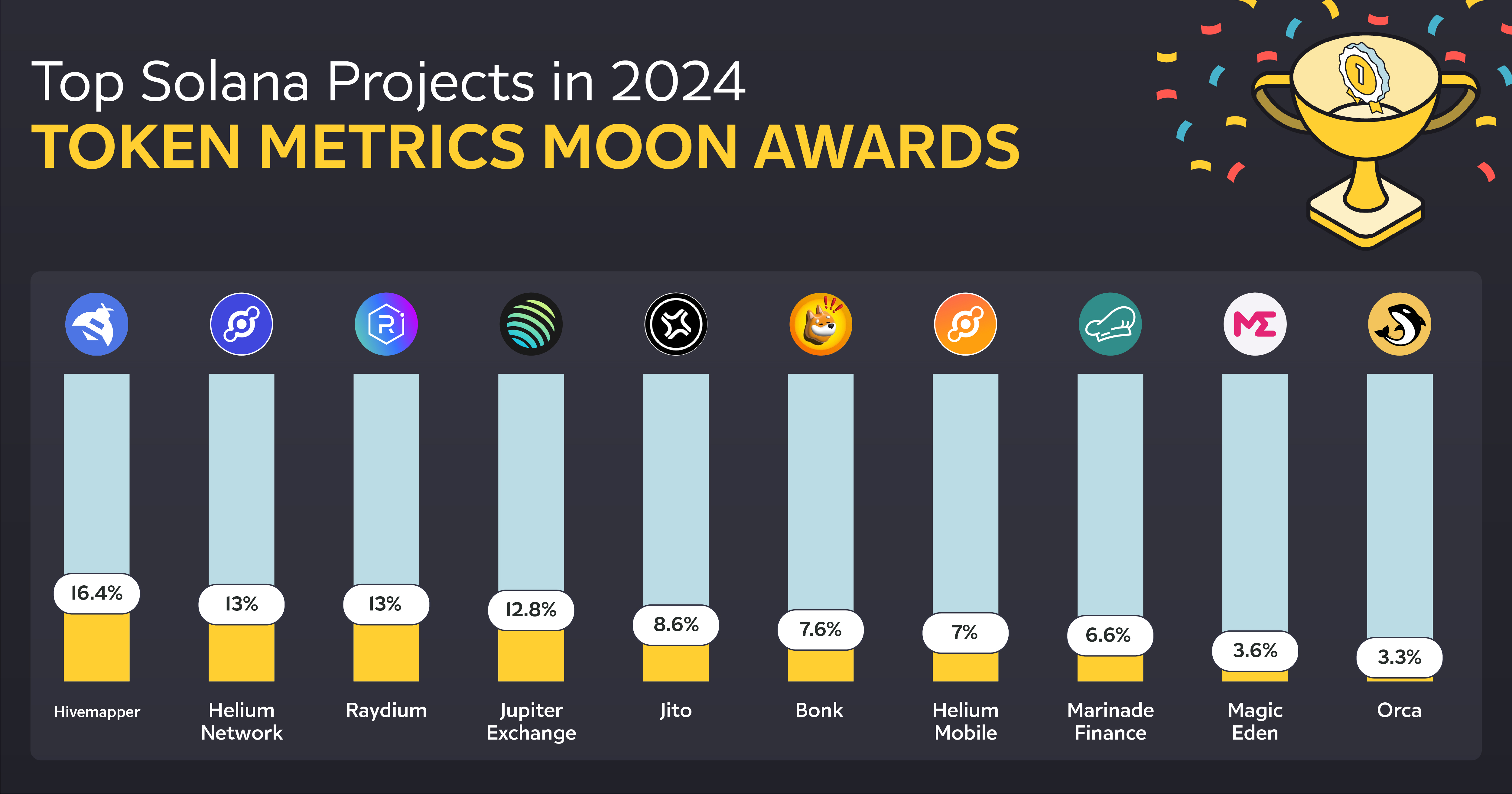
Top Solana Projects
Image Source - Token Metrics Moon Awards

These projects span various domains, including decentralized exchanges (DEXs), lending protocols, NFT marketplaces, and more, showcasing the versatility and robustness of the Solana network.

Here's a closer look at some of the top Solana projects set to make significant impacts in 2024:

1. Hivemapper

In the Moon Awards survey, Hivemapper secured the top position with 16.4% of the total votes.

Hivemapper emerges as a revolutionary force within the Solana ecosystem, championing the cause of decentralized mapping. This crypto-enabled dashcam project is not just about mapping the world; it's about reimagining who owns and contributes to that map. 

With nearly 140 million kilometers mapped across 2,503 regions worldwide, Hivemapper exemplifies the shift from traditional, centralized mapping services to a more democratic, user-driven approach. 

This transformation is pivotal for accurate, up-to-date maps essential for navigation and urban planning.

Key Features and Innovations:

  • Decentralized Mapping: Leveraging the Solana blockchain, it offers a democratic way for global contributors to participate in map creation and updates.
  • Comprehensive Coverage: The project maps nearly 140 million kilometers, covering 2,503 regions globally.
  • Reward System: Contributors are rewarded for their input, with the full reward opportunity for every road reset every 7 days, encouraging continuous updates.

Hivemapper's technological backbone is equally impressive. The platform employs its in-house built Titan engine for processing massive datasets. This engine executes sensor fusion, machine learning/computer vision processing, and crowd consensus review and ensures the continuity of network data. 

Furthermore, Hivemapper is pioneering in hardware development, working with multiple partners in the United States to build dashcams that collect 4K imagery and various telemetry data, all encrypted for security. 

2. Helium Network

In the Moon Awards survey, Helium Network secured the 2nd position with 13% of the total votes.

The Helium Network, under the stewardship of the Helium Foundation, represents a paradigm shift in decentralized wireless technologies. Established in 2021, this US-based non-profit organization is at the forefront of protocol governance and the technical evolution of the Helium Network. 

It's instrumental in educating the public about the advantages of decentralized wireless networks and fostering a vibrant community of network builders, users, and developers.

Key Aspects of the Helium Network:

  • Foundation's Role: The Helium Foundation is central to driving the network's codebase and operations, ensuring a seamless experience for all stakeholders involved. It's committed to expanding public awareness and enhancing the network's utility through innovative use cases.
  • Membership Program: Encompassing Hardware Manufacturers, Network Operators, Service Providers, and Application Developers, the program is set to open its doors to individual enthusiasts, including Hotspot hosts, in 2024.
  • Migration to Solana: A significant milestone was the network's migration to Solana in April 2023, which brought substantial performance and scalability improvements. This move has also paved the way for the network to delve into the mobile and IoT sectors, with initiatives allowing users to earn tokens by supporting the network.

The Helium Network's journey through 2023 into 2024, marked by a 500% surge following its venture into mobile services, reflects its growing influence within the Solana ecosystem. 

With the Helium Wallet now supporting all tokens on the Solana blockchain, the network is poised for further expansion, leveraging the DePIN project to offer decentralized connectivity services. 

3. Raydium

In the Moon Awards survey, Raydium secured the 3rd position with 13% of the total votes.

Raydium stands as a pivotal Solana project, acting as a bridge between the worlds of decentralized finance (DeFi) and automated market makers (AMMs). 

This platform has carved out a niche for itself within the Solana ecosystem by offering a suite of financial services that cater to both novice and seasoned crypto enthusiasts.

Key Features and Innovations:

  • AMM Protocol: At its core, Raydium leverages the power of Solana's high-speed blockchain to facilitate lightning-fast trades and transactions. This not only enhances user experience but also contributes to the overall liquidity of the Solana ecosystem.
  • Dual Functionality: Raydium functions as both an AMM and a liquidity provider to the Serum DEX, Solana's premier decentralized exchange. This unique positioning allows Raydium users to access the vast liquidity and wide range of trading pairs available on Serum.

Technological Advancements:

  • High Throughput: Utilizing Solana's capability of processing thousands of transactions per second, Raydium offers a seamless and efficient trading experience.
  • Yield Farming: Raydium introduces users to yield farming opportunities, enabling them to earn rewards by providing liquidity to various pools.

4. Jupiter Exchange

In the Moon Awards survey, Jupiter Exchange secured the 4th position with 12.8% of the total votes.

Jupiter Exchange (JUP) is a cutting-edge swap aggregator within the vibrant Solana ecosystem. It harnesses Solana's speed and efficiency to offer various advanced trading features, making it a standout choice for traders seeking flexibility and depth in their trading strategies. Here's a closer look at what makes Jupiter Exchange a notable Solana project:

Advanced Trading Features:

  • Dollar Cost Averaging (DCA): Allows users to spread their investment over time, reducing the impact of volatility.
  • Limit Orders: Users can set specific price points at which their trades automatically execute, offering greater control over trading outcomes.
  • Perpetual Trading: Provides the opportunity for traders to engage in contracts that do not have an expiry date, enhancing trading flexibility.

Jupiter's commitment to efficiency, low transaction costs, and innovative offerings like swap services and perpetual exchange capabilities, coupled with a significant daily trading volume of $400 million and 90,000 unique wallets, underscores its importance within the Solana projects landscape. 

5. Jito

In the Moon Awards survey, Jito secured the 5th position with 8.6% of the total votes.

In the vibrant Solana ecosystem, Jito stands as a beacon of innovation, particularly in the space of high-frequency trading on decentralized exchanges. 

This Solana project is meticulously designed to address the common pain points encountered in decentralized finance (DeFi), offering solutions that significantly enhance trading efficiency and user experience.

High-Frequency Trading Capabilities:

  • Jito utilizes the Solana blockchain's high throughput and low latency to facilitate high-frequency trading, a feature traditionally reserved for centralized financial markets.
  • This allows traders to execute orders at lightning speed, capitalizing on market movements in real time.

Slippage Reduction:

  • One of the platform's key innovations is its ability to drastically reduce slippage, a common issue that traders face in less liquid markets.
  • By aggregating liquidity across multiple sources, Jito ensures that trades are executed at the most favorable prices, minimizing the cost impact on large orders.

Its emphasis on speed, efficiency, and reduced slippage positions Jito as a critical player among Solana projects, pushing the boundaries of what's possible in the realm of decentralized trading.

6. Bonk

In the Moon Awards survey, Bonk secured the 6th position with 7.6% of the total votes.

Bonk (BONK), a meme coin within the Solana ecosystem, has captured the attention of the cryptocurrency market with its significant traction. 

BONKrewards by ArmadaFi: This initiative allows users to lock BONK for rewards, driving adoption and utility within the Solana ecosystem.

Competition and Roadmap: Facing competition from other meme coins, Bonk's development roadmap, and the team's efforts could influence investor sentiment and its market position.

Bonk's deflationary nature, with over 65% of its total circulating supply burnt, alongside a 10,000% gain in 2023, underscores its status as the hottest meme coin of 2024. 

The Bonk DAO's investment in early-stage startups and the engaging Bonk March Madness event further highlight its community-driven approach and innovative use within the Solana projects landscape.

7. Helium Mobile

In the Moon Awards survey, Helium Mobile secured the 7th position with 7% of the total votes.

Helium Mobile's integration into the Solana ecosystem marks a significant leap forward in decentralized wireless communication, offering users an innovative and expansive service. 

With the Helium Wallet's upgrade to support a wide range of digital assets on the Solana blockchain, users gain a streamlined experience in managing their Solana-based tokens. 

This move not only enhances the utility of the Helium Wallet but also demonstrates Helium's dedication to embracing crypto diversity. The exclusive Pixel NFT, available in the "Badges" tab, rewards users for their engagement, adding a unique element to the user experience.

Key Developments:

  • Coinbase Support: Helium Mobile's full support of Coinbase for trading amplifies its accessibility and potential for widespread adoption.
  • Growth Metrics: The remarkable growth, evidenced by 12,398 active 5G nodes and a surge in new subscribers, indicates a rapidly expanding user base, with projections suggesting nearly 530,000 new subscribers within the year.

Helium Mobile's strategic adjustments to mining rules and the relationship between MOBILE and HNT tokens showcase a thoughtful approach to maintaining a balanced supply-demand dynamic. 

8. Marinade Finance

In the Moon Awards survey, Marinade Finance secured the 8th position with 6.6% of the total votes.

Marinade Finance simplifies the concept of staking on the Solana blockchain, offering users an innovative approach to maximize their returns. 

By automating the staking process across over 100 top-performing validators and providing an automated rebalancing feature, Marinade ensures that users' SOL is always working hard for them. 

This automation not only optimizes returns but also democratizes access to high-quality staking opportunities, previously only available to those with extensive blockchain knowledge.

Key features that set Marinade Finance apart include:

  • Instant Unstake: Users can exit their stake positions instantly at the best available price, offering unparalleled flexibility in managing their investments.
  • Liquid Staking: By unlocking the liquidity of staked SOL, Marinade enables users to participate in DeFi, further enhancing the utility of their assets.
  • mSOL Receipt Token: Depositing staked SOL with Marinade issues users an mSOL token, a fungible asset that can be used as collateral across various DeFi projects.

Moreover, Marinade Finance provides a comprehensive platform for users to review and understand the performance of Solana validators. Utilizing a detailed scoring system, it ranks validators based on yield economics, block production, and stake concentration, ensuring transparency and informed decision-making. 

9. Magic Eden

In the Moon Awards survey, Magic Eden secured the 9th position with 3.6% of the total votes.

Magic Eden has established itself as a premier NFT marketplace within the Solana ecosystem, facilitating the buying, selling, and discovering unique digital assets across multiple blockchains. Several key features underscore its significance:

User and Creator Benefits:

  • User-Friendly Interface: Ensures an intuitive navigation experience.
  • Minimal Fees & Flexible Royalties: A 2% transaction fee for buyers and sellers, with optional royalty alchemy for creators.
  • Magic Eden Wallet: Acts as a multi-purpose web3 navigator for storing crypto assets and interacting with NFTs.

Supported Blockchains and Collections:

  • Blockchains: Solana, Ethereum, Polygon, and Bitcoin (Ordinals).
  • Hot Collections Highlighted: Includes NodeMonkes, Bored Ape Yacht Club, Transdimensional Fox Federation, and Trump Digital Trading Cards, among others.

Magic Eden's blend of extensive collection, low transaction fees, and a user-friendly interface positions it as a hub for artists, creators, and enthusiasts from various blockchain backgrounds.

10. Orca

In the Moon Awards survey, Orca secured the 10th position with 3.3% of the total votes.

Orca emerges as a standout Concentrated Liquidity Automated Market Maker (AMM) on the Solana Network, designed to optimize the trading experience for both liquidity providers and traders. It achieves this through several innovative features and community-driven governance:

Concentrated Liquidity AMM:

  • Liquidity providers can specify price ranges for their tokens, enhancing capital efficiency.
  • A share of trading fees generated on the platform is an incentive, promising higher returns.

Community Governance:

  • Governed by the Orca DAO and the DAO council, utilizing the ORCA token for decision-making.
  • ORCA token is accessible on major exchanges like Kucoin, Gate, and Coinbase, ensuring wide availability.

Orca's platform is not just about trading; it's about creating a comprehensive ecosystem for DeFi activities on Solana. Key features include:

  • Whirlpools: For concentrated liquidity, allowing for higher returns and lower slippage.
  • DCA Feature & Decentralized Perpetuals Trading Platform: Offers up to 100x leverage, catering to various trading strategies.
  • User-Friendly Interface: Ensures minimal transaction fees and lower latency than Ethereum-based DEXs, alongside a fair price guarantee.

Conclusion

Throughout this exploration of Solana's diverse and dynamic ecosystem, we've delved into the vast potential and innovation displayed by leading Solana projects set to shape the blockchain frontier in 2024. 

From the decentralized mapping marvels of Hivemapper to the financial ingenuity of Orca, each project brings its unique contributions, marking Solana's unwavering position in the digital space. 

These endeavors not only illuminate the robust capabilities of the Solana blockchain in supporting high-speed, cost-effective applications, but they also underline the ecosystem's versatility across various domains, including DeFi, wireless communication, NFT marketplaces, and beyond.

Disclaimer

The information provided on this website does not constitute investment advice, financial advice, trading advice, or any other advice, and you should not treat any of the website's content as such.

Token Metrics does not recommend buying, selling, or holding any cryptocurrency. Conduct your due diligence and consult your financial advisor before making investment decisions.

Build Smarter Crypto Apps &
AI Agents in Minutes, Not Months
Real-time prices, trading signals, and on-chain insights all from one powerful API.
Grab a Free API Key
Token Metrics Team
Token Metrics Team

Recent Posts

Crypto Basics

Gemini Review 2023 - Features, Fees and Top Alternatives

S. Vishwa
8 Minutes
MIN

In the dynamic world of cryptocurrency, it's essential to select a reliable and user-friendly exchange. One name that consistently ranks among the top platforms is Gemini. 

Founded by the Winklevoss twins in 2014, Gemini has steadily risen to prominence. But how does it fare in 2023? 

In this in-depth review, we break down Gemini's features, evaluate its fee structure, and introduce some of its top alternatives.

Gemini Exchange Overview

Gemini, headquartered in New York City, is a globally recognized cryptocurrency exchange and custodian. 

Established in 2014 by the entrepreneurial Winklevoss twins, Cameron and Tyler, the platform has carved a niche for itself with its emphasis on regulatory compliance, robust security, and transparent operations. 

Licensed by the New York State Department of Financial Services, Gemini prides itself on its user-centric approach, catering to both beginner investors and experienced traders alike. 

Over the years, its dedication to creating a safe, transparent, and user-friendly ecosystem for digital assets has positioned it as one of the premier choices in the cryptocurrency trading world.

Key Features of Gemini

Safety and Security: Gemini is renowned for its state-of-the-art security infrastructure. With the increasing cyber threats in the crypto realm, the platform has further bolstered its security measures in 2023 to ensure users' assets remain protected.

User Experience: The Gemini platform offers a seamless user experience. Its intuitive design, coupled with advanced trading features, caters to both new and professional traders.

Gemini Earn: This feature allows users to earn interest on their crypto holdings. With competitive interest rates, many see it as a lucrative option to grow their investments.

Mobile Application: Gemini's mobile app has undergone significant improvements this year, ensuring users can trade and manage their assets on-the-go with ease.

Gemini Pay: An innovative feature allowing users to pay using cryptocurrencies at various outlets. With an increasing number of vendors joining the network, Gemini Pay has become more versatile than ever.

Fee Structure on Gemini

Gemini has always been transparent about its fee structure. Here’s a simplified breakdown for 2023:

Trading Fees: Gemini operates on a maker-taker fee schedule. For traders executing more than $1M, the taker fee is around 0.15%, and the maker fee is around 0.05%. For those trading under $10,000, the taker fee is approximately 0.3%, and the maker fee stands at 0.1%.

Deposit and Withdrawal Fees: Gemini offers multiple deposit methods. While ACH deposits are free, wire transfers might come with bank-imposed fees. For withdrawals, there's a small fee, but it remains competitive compared to other exchanges.

Gemini Earn Fees: While the platform allows users to earn interest, it does take a percentage as commission. This varies depending on the crypto asset, but it's always displayed transparently.

How to Create an Account on Gemini?

Starting your journey with Gemini is a straightforward process. Follow these step-by-step instructions to create your account:

1. Visit the Website: Navigate to the official Gemini website at www.gemini.com.

2. Sign Up: Locate and click the “Get Started” or "Sign Up" button, typically found at the top right corner of the homepage.

3. Enter Personal Details: Fill in the required information, which usually includes your full name, active email address, and a secure password. It's essential to use a strong, unique password for added security.

4. Verify Email: After entering your details, you'll receive a verification email. Open the email and click on the provided link to confirm your address.

5. Provide Additional Information: Gemini, being compliant with regulatory standards, will ask for more personal details such as your phone number, home address, and date of birth. This ensures the platform meets Know Your Customer (KYC) regulations.

6. Identity Verification: Upload a clear picture of a government-issued ID, like a passport or driver’s license. Some regions might require additional documentation, such as a proof of address.

7. Set Up Two-Factor Authentication (2FA): For added account security, set up 2FA. This typically involves linking your phone number or using an authenticator app to generate time-sensitive codes.

8. Review and Accept Terms: Thoroughly go through Gemini's terms of service and privacy policy. Once you understand and agree, accept the terms to proceed.

9. Complete the Setup: Once your identity is verified — which might take anywhere from a few minutes to several days, depending on the volume of requests — your account will be active. You can now deposit funds and start trading.

Gemini Customer Support Review

Gemini's dedication to user experience is evident in its customer support. Offering a blend of responsive email assistance, an extensive FAQ section, and a user-friendly help center, Gemini strives to address user concerns promptly. 

While the platform has faced peak times when responses were slightly delayed, their overall track record in resolving issues is commendable. Users have often appreciated the clarity and professionalism of responses. 

However, a common wish among its clientele is the addition of a live chat or phone support feature, which could further enhance real-time assistance.

Pros and Cons of Gemini

Gemini, like any platform, comes with its distinct advantages and areas of improvement. Here's a balanced view.

Pros:

  • Regulatory Compliance: Gemini is one of the few exchanges fully licensed and regulated, offering users added confidence.
  • Robust Security: Their commitment to security, including offline cold storage and state-of-the-art encryption, is noteworthy.
  • User-Friendly Interface: The platform is designed for both beginners and seasoned traders, making navigation seamless.
  • Transparent Fee Structure: Users always know what they're paying, with no hidden charges.

Cons:

  • Limited Coin Offerings: Compared to some competitors, Gemini offers fewer cryptocurrencies.
  • No Live Support: While their customer service is robust, the absence of live chat or phone support can be a drawback for urgent queries.
  • Higher Fees: Some users find Gemini's fee structure slightly more expensive than other popular exchanges.

Is Gemini Right for You?

Determining if Gemini is the right fit hinges on your priorities. If you value a regulated, secure, and user-friendly platform, Gemini stands out as a top choice. Their transparent fee structure and commitment to user experience cater to both newcomers and seasoned traders. 

However, if your focus is on a vast selection of cryptocurrencies or the lowest possible fees, you might want to explore further. Ultimately, it's essential to align your needs with the exchange's offerings before committing.

Top Alternatives to Gemini

With the growth of the crypto industry, several exchanges have made their mark. Here are three top contenders:

Binance: Globally recognized, Binance offers a vast array of cryptocurrencies. Its trading fees are competitive, and it boasts of an intuitive interface and robust security measures.

Coinbase: A direct competitor to Gemini, especially in the U.S., Coinbase is known for its user-friendly interface, making it ideal for beginners. It also places a strong emphasis on security and regulatory compliance.

Kraken: With its comprehensive set of features and commitment to security, Kraken has become a top choice for many crypto enthusiasts. Its fee structure is transparent, and the platform supports a wide variety of cryptocurrencies.

Also Check - Kraken latest offers

Frequently Asked Questions

Q1. Is Gemini available worldwide?

While Gemini primarily serves U.S. customers, it has expanded its services to various countries. However, the availability might vary depending on local regulations.

Q2. How does Gemini ensure the security of its users' funds?

Beyond its top-notch encryption, Gemini also keeps a significant portion of its funds in cold storage, minimizing the risk of hacks.

Q3. Can I use fiat currencies on Gemini?

Yes, Gemini allows users to deposit and trade using fiat currencies, primarily the U.S. dollar.

Q4. What are the deposit and withdrawal limits on Gemini?

These limits vary based on account type and verification status. It's best to check the official Gemini site for up-to-date specifics.

Q5. Does Gemini offer any educational resources for crypto beginners?

Indeed, Gemini has a resource section dedicated to educating users about the crypto world, from the basics to advanced trading strategies.

Q6. How does Gemini handle forks and airdrops?

Gemini has a policy to review forks and airdrops on a case-by-case basis. Users are typically informed ahead of any significant network changes.

Q7. Can I set up recurring buys on Gemini?

Yes, with Gemini, you can schedule daily, weekly, or monthly purchases, enabling a dollar-cost averaging strategy.

Q8. Are there any mobile apps associated with Gemini for trading on-the-go?

Absolutely, Gemini offers a streamlined mobile app available for both iOS and Android, allowing users to trade and manage their portfolio from anywhere.

Conclusion

Gemini continues to be a leading force in the cryptocurrency exchange world in 2023. Its commitment to user experience, security, and innovative features like Gemini Earn and Pay make it a compelling choice. 

However, as with any investment decision, users should consider their unique needs and circumstances. Binance, Coinbase, and Kraken are all worthy competitors with their own sets of advantages. 

It's always advisable to do thorough research, keep updated with the latest insights, and make informed decisions to navigate the ever-evolving crypto landscape.

Disclaimer

The information provided on this website does not constitute investment advice, financial advice, trading advice, or any other sort of advice and you should not treat any of the website's content as such.

Token Metrics does not recommend that any cryptocurrency should be bought, sold, or held by you. Do conduct your own due diligence and consult your financial advisor before making any investment decisions.

Crypto Basics

6 Best Crypto Tax Software in 2023

Marcus K
6 Minutes
MIN

In the nascent world of cryptocurrencies, tax obligations remain a paramount concern for many investors. But with the advent of specialized tax software tailored for crypto transactions, navigating the treacherous waters of tax compliance has become simpler. 

In this post, we will highlight 6 of the best crypto tax software available, helping you file taxes confidently and with ease.

What is a Crypto Tax Software?

Crypto tax software is a specialized tool designed to simplify the complex task of calculating taxes on cryptocurrency transactions. As digital currencies operate outside traditional banking systems, tracking buys, sells, and trades can be daunting. 

This software automates the process by integrating with crypto exchanges and wallets, extracting transaction data, and applying the relevant tax rules. 

The result is an accurate tax report that users can confidently submit to tax authorities, ensuring they meet their legal obligations while minimizing potential errors.

List of Best Crypto Tax Software in 2023

Here are the 6 premier tools available in the market for traders and investors alike. These resources are specifically designed to assist you in drawing a comprehensive comparison among the various crypto tax software options, ensuring you make an informed decision tailored to your needs.

1. CoinTracker

CoinTracker stands as a beacon of simplicity in the often convoluted world of crypto taxation. Integrating with over 300 exchanges, it ensures users have a comprehensive view of their transactions. 

Its automated solution fetches transaction data seamlessly, providing an intuitive platform to view and calculate gains or losses. Despite its vast integration capabilities, it retains a user-friendly interface, making it suitable for both novices and seasoned crypto traders.

Pros:

  • Simple and intuitive interface.
  • Supports over 300 exchanges.
  • Accurate gain/loss calculations.

Cons:

  • Limited advanced features for professional traders.
  • The free version has limitations.

Pricing - Starts free for limited transactions, with paid plans starting from $59 annually.

Best for - Casual traders who have transactions on multiple exchanges.

2. Koinly

Simplicity meets depth with Koinly, a software crafted to cater to a wide audience. By syncing with numerous wallets and over 300 exchanges, Koinly ensures no transaction slips through the cracks. 

Its intuitive dashboard provides a bird's-eye view of one's crypto holdings, while the robust backend calculates capital gains with precision. It's a blend of user-friendly design and in-depth analytics.

Pros:

  • Syncs with wallets and over 300 exchanges.
  • Detailed capital gain reports.
  • Intuitive dashboard.

Cons:

  • Some integrations might need manual intervention.
  • The learning curve for some features.

Pricing - Free with limited features, premium plans start at $49 annually.

Best for - Both beginners and advanced traders seek in-depth analytics.

3. CoinLedger

CoinLedger is a cutting-edge crypto tax software, streamlining the once complex task of tax compliance for crypto enthusiasts. Its robust platform is adept at integrating with several exchanges, simplifying transaction tracking. 

CoinLedger emphasizes transparency and ease, aiming to make the crypto tax process as smooth as possible for its users, regardless of their technical expertise.

Pros:

  • Efficient transaction tracking.
  • Intuitive user interface.
  • Comprehensive report generation.

Cons:

  • Limited support for lesser-known exchanges.
  • Advanced features might be overwhelming for beginners.

Pricing - Starting with $49 annually for Hobbyist plans.

Best for - Intermediate crypto traders looking for a balance between usability and detailed tax insights.

4. TokenTax

TokenTax isn't just another crypto tax software; it's a bridge between the crypto and traditional financial worlds. Its integration capability with popular tax software like TurboTax is a testament to its versatility. 

Beyond mere tax calculation, TokenTax delves deep, offering strategic insights to minimize tax liabilities. With a strong backbone of customer service, it strives to be the one-stop solution for all crypto tax needs.

Pros:

  • Minimizes crypto tax liability through smart calculations.
  • Multi-platform support.
  • Expert customer service.

Cons:

  • May be overwhelming for complete beginners.
  • Premium plans can be expensive.

Pricing - Starting at $65 annually for the basic package.

Best for - Crypto enthusiasts looking for an all-in-one tax solution.

5. Accointing

Accointing is the modern crypto trader's companion, focusing equally on tracking and tax tools. Its mobile app ensures users stay updated on-the-go, while the desktop version dives deep into analytics and tax calculations. 

While it streamlines the complex world of crypto taxes, its user-centric approach is evident in the easy CSV imports and holistic portfolio overview it offers.

Pros:

  • Mobile app available for on-the-go tracking.
  • Insightful analytics.
  • Simple CSV imports.

Cons:

  • Not as many integrations as competitors.
  • Setup can be time-consuming.

Pricing - Free for tracking, tax reports start at $49 annually.

Best for - Investors want a balanced mix of tracking and tax tools.

6. ZenLedger

ZenLedger is the Swiss Army knife of crypto tax software. Its multifaceted approach provides tools for a range of needs, from comprehensive tax loss harvesting to diverse report generation. 

It's tailored for the seasoned trader, providing advanced features that delve deep into crypto tax strategies. The commitment to customer support and the breadth of features it offers makes it a top-tier choice.

Pros:

  • Comprehensive tax loss harvesting tool.
  • Wide variety of report types.
  • Stellar customer support.

Cons:

  • Can be pricey for advanced features.
  • Requires manual import for some lesser-known exchanges.

Pricing - Free for basic tracking, premium plans start at $49 annually.

Best for - Advanced traders focusing on tax-saving strategies.

Frequently Asked Questions

Q1. What are the tax implications for crypto staking or mining rewards?

Staking and mining rewards are often considered taxable income. It's important to declare them in the year they are received, even if you haven't sold them yet.

Q2. How does crypto tax software handle DeFi transactions?

Most advanced crypto tax software can integrate with popular DeFi platforms, tracking transactions such as yield farming, liquidity pooling, or earning interest.

Q3. Do these software solutions accommodate international tax regulations?

While many platforms are designed with U.S. tax regulations in mind, several of them offer features tailored to tax regulations of other countries.

Q4. Can I import data from hardware wallets into crypto tax software?

Yes, many software options support imports from popular hardware wallets, ensuring comprehensive tracking of all your transactions.

Q5. How often should I update my transaction data in crypto tax software?

It's advisable to update your transaction data regularly, especially if you're an active trader. This ensures you're always prepared for tax obligations and can make informed trading decisions.

Q6. What happens if I've made transactions on a crypto exchange that isn't supported by the software?

Most software solutions allow for manual input or CSV imports for exchanges they don't directly integrate with, ensuring all transactions are accounted for.

Q7. Are there any crypto tax software options specifically designed for mobile devices?

While many of these platforms offer mobile-friendly versions or apps, it's essential to check their features and compatibility to ensure you have full functionality on your mobile device.

Q8. How secure is my data with crypto tax software?

Most reputable crypto tax software solutions prioritize user security, using encryption and other protective measures to ensure your transaction data remains private and safe.

Conclusion

In a space as dynamic as cryptocurrency, staying tax compliant is crucial. These 6 software solutions aim to make the process smoother and error-free. 

Evaluate each based on your needs, trading frequency, and budget. Remember, accurate and informed tax filings can save you from future complications. Always consult with a tax professional when in doubt, and happy trading!

Disclaimer

The information provided on this website does not constitute investment advice, financial advice, trading advice, or any other sort of advice and you should not treat any of the website's content as such.

Token Metrics does not recommend that any cryptocurrency should be bought, sold, or held by you. Do conduct your own due diligence and consult your financial advisor before making any investment decisions.

Crypto Basics

Is Bitcoin Safe? - Complete Analysis

S. Vishwa
8 Minutes
MIN

In the crypto world, Bitcoin stands as the pioneer, sparking interest and evoking conversations worldwide. But even after more than a decade since its inception, a pressing question persists: "Is Bitcoin safe?" 

In this detailed analysis, we'll dive deep into the factors affecting Bitcoin's safety, weigh its risks and benefits, and provide a comprehensive perspective for both novices and seasoned investors.

Bitcoin's Fundamental Technology

Immutable Records - One of the cornerstones of Bitcoin's safety is its underlying technology: the blockchain. This decentralized digital ledger ensures that every transaction is transparent, immutable, and secured against tampering.

Distributed Consensus - Being decentralized means no single entity has control over the network. Instead, Bitcoin relies on a distributed consensus, reducing vulnerabilities to malicious attacks or centralized failures.

Security Protocols and Measures

Cryptographic Security - Bitcoin employs SHA-256, a cryptographic algorithm that ensures transaction and wallet security. The design makes it computationally prohibitive to reverse-engineer transactions or hack into wallets.

Wallet Safeguards - Hardware wallets, cold storage, multi-signature options, and regular software updates have greatly elevated the safety level for Bitcoin users, enabling them to store and transact with reduced risks.

Security Breaches with BTC

Despite its robust system, Bitcoin hasn't been immune to challenges.

Exchange Hacks - Notable incidents, like the Mt. Gox hack in 2014, has led to massive financial losses. However, it's crucial to differentiate between the security of Bitcoin's protocol and that of individual platforms or exchanges.

Phishing and Scams - While the Bitcoin network remains secure, individual users have fallen prey to phishing attempts and scams, emphasizing the need for vigilance and education.

Contemporary Challenges

Quantum Computing - There's been chatter about quantum computers' potential to disrupt Bitcoin's cryptographic safeguards. However, at present, practical quantum machines capable of such feats remain in nascent stages. The crypto community is also actively researching quantum-resistant algorithms.

Regulatory Scrutiny - Many governments are exploring regulatory frameworks for cryptocurrencies. While this adds legitimacy to the crypto space, there are concerns about potential overregulation stifling innovation.

Is Bitcoin a Safe Investment?

Assessing Bitcoin's safety as an investment hinges upon one's perception of security. The volatile nature of Bitcoin cannot be denied. 

For instance, in 2022, Bitcoin experienced drastic price fluctuations, plummeting from nearly $48,000 to lows around $16,000, and later stabilizing near $26,000. Such dramatic shifts might deter traditional investors. 

Yet, Bitcoin's dynamic is evolving. As Ryan Burke from M1 observes, Bitcoin is melding with mainstream financial avenues, witnessing increased retail and institutional engagement. It's steadily positioning itself as a modern-day alternative asset, analogous to renowned tech giants.

From a technological standpoint, Bitcoin's framework is robust. However, notes Daniel Rodriguez of Hill Wealth Strategies, it lacks true anonymity. The public nature of Bitcoin addresses, combined with potential tracking by hackers, poses risks. 

Fundamentally, your Bitcoin's safety lies in your wallet's security. Misplace the password or if it's compromised, your Bitcoin could be jeopardized.

Reference - https://www.forbes.com/advisor/investing/cryptocurrency/is-bitcoin-safe/

Factors that can Influence Bitcoin Price

The valuation of Bitcoin, the pioneering cryptocurrency, is shaped by an intricate tapestry of elements, extending beyond the simple dynamics of market demand and supply.

Market Sentiment: The overarching psychological mood of investors, traders, and the wider public can heavily influence Bitcoin's price. News of technological advancements can spur price surges, while incidents like security breaches can induce declines.

Regulatory News and Decisions: The approach regulators take towards Bitcoin, be it permissive or restrictive, can precipitate significant price shifts. A country's decision to endorse or prohibit Bitcoin trading can be particularly impactful.

Technological Changes and Innovations: Enhancements to the Bitcoin network, such as the Lightning Network or hashing algorithm modifications, can influence its market valuation.

Bitcoin Halving: Occurring approximately every four years, halvings cut the rewards miners receive by half, affecting the rate of new Bitcoin entering circulation. Historically, halving events have correlated with substantial price movements due to the interplay of reduced supply and sustained demand.

Macroeconomic Factors: Variables like global economic stability, inflation trends, and financial downturns can dictate how investors perceive Bitcoin as a potential store of value.

Supply Dynamics: With a maximum supply set at 21 million coins, the nearing of this cap, coupled with events like halvings, amplifies Bitcoin's scarcity factor, which can influence price.

Competition: The rise or recognition of other cryptocurrencies can challenge Bitcoin's market dominance and thereby affect its price.

Rewards and Risks Associated with Bitcoin

Navigating the turbulent waters of Bitcoin investment presents both tantalizing prospects and daunting pitfalls. Here's a breakdown:

Rewards:

  • Unparalleled Returns: Historically, Bitcoin has showcased growth trajectories that few other assets can rival. Early adopters have reaped exponential gains, turning nominal investments into fortunes.
  • Decentralization and Autonomy: As a decentralized currency, Bitcoin offers investors independence from traditional financial systems and governmental controls, positioning it as a potential hedge against economic instability.
  • Portfolio Diversification: Bitcoin's often non-correlated behavior with mainstream assets allows investors to diversify portfolios, potentially mitigating risks and enhancing long-term returns.

Risks:

  • Volatility: Perhaps the most significant challenge, Bitcoin's price can swing dramatically within short periods, leading to substantial losses.
  • Regulatory Concerns: Globally, regulatory stances on Bitcoin vary. Adverse regulatory decisions, such as bans, can negatively impact its value.
  • Security Threats: From potential exchange hacks to wallet compromises, the digital nature of Bitcoin exposes investors to cybersecurity threats.
  • Lack of Consumer Protections: Unlike traditional financial systems, Bitcoin transactions are irreversible. Any mishap, be it a mistaken address or fraud, can result in permanent loss.

Safety Precautions for Bitcoin Users

As the crypto landscape evolves, so do the threats, making proactive measures essential. 

Firstly, users should prioritize using reputable hardware wallets. These devices, disconnected from the internet, significantly diminish the risk of hacks. 

Secondly, implementing multi-signature setups adds another layer of security; it requires multiple private keys to authorize a Bitcoin transaction, reducing single-point vulnerabilities. 

Staying updated on the latest security threats and protocols cannot be overstated. With phishing attacks becoming more sophisticated, awareness is the first line of defense. 

Finally, ensure regular backups of your Bitcoin wallet. A best practice is to store these backups in diverse physical locations, safeguarding against data loss due to unforeseen calamities.

Also Read - Is Bitcoin Dead?

Future Outlook for Bitcoin

The trajectory of Bitcoin's future remains a topic of intense speculation and interest. As the pioneer of the cryptocurrency movement, its adoption is steadily gaining momentum, with institutional investors and major corporations increasingly integrating Bitcoin into their financial strategies. 

Technological advancements, like the Lightning Network, aim to address scalability issues, bolstering Bitcoin's potential for broader transactional use. 

However, challenges lie ahead. Regulatory uncertainties across global jurisdictions and the evolving landscape of competing cryptocurrencies could influence its dominance. 

Moreover, environmental concerns over Bitcoin mining may shape its future narrative. While Bitcoin's position as a store of value appears firm, its role in the broader financial ecosystem remains to be fully realized.

Frequently Asked Questions

Q1. What makes Bitcoin different from traditional currencies?

Unlike fiat currencies, Bitcoin operates on a decentralized platform without a central authority or middlemen. It is also limited in supply, making it resistant to inflation.

Q2. How do Bitcoin transactions work?

Bitcoin transactions involve a sender, a recipient, and the transfer of BTC between their respective digital wallets. Once initiated, the transaction is verified by network nodes through cryptography and recorded on the blockchain.

Q3. Is Bitcoin accepted by major retailers and businesses?

Yes, a growing number of businesses, both online and brick-and-mortar, accept Bitcoin as a form of payment. This includes major companies like Microsoft, Overstock, and several travel agencies.

Q4. How can I safely store my Bitcoin holdings?

For security, Bitcoin can be stored in hardware wallets (physical devices) or reputable software wallets with strong encryption. It's essential to keep backup copies of your wallet and use multi-factor authentication when possible.

Q5. What is the environmental impact of Bitcoin mining?

Bitcoin mining requires significant computational power, leading to concerns about its energy consumption and environmental footprint. The impact largely depends on the source of the energy used in mining operations.

Q6. How is the value of Bitcoin determined?

Bitcoin's value is determined by various factors, including supply and demand dynamics, market sentiment, regulatory news, and macroeconomic indicators. It's traded on various exchanges, and its price can vary between platforms.

Q7. Can I mine Bitcoin at home?

While Bitcoin was initially mined using home computers, the increasing complexity of the process now requires more powerful and specialized hardware, making home mining less profitable and more challenging.

Q8. What happens when all 21 million Bitcoins are mined?

Once all Bitcoins are mined, miners will no longer receive block rewards. However, they will still earn from transaction fees, ensuring that the network remains operational and transactions are verified.

Conclusion

As of now, Bitcoin remains a secure and resilient system, thanks to its robust technology and continuous community efforts. However, like any financial tool or asset, its safety is intertwined with user awareness, practices, and the evolving landscape of threats and solutions. 

Always conduct due diligence, stay informed, and prioritize safety. With these steps, you'll be well-equipped to navigate the exciting world of Bitcoin.

Disclaimer

The information provided on this website does not constitute investment advice, financial advice, trading advice, or any other sort of advice and you should not treat any of the website's content as such.

Token Metrics does not recommend that any cryptocurrency should be bought, sold, or held by you. Do conduct your own due diligence and consult your financial advisor before making any investment decisions.

Choose from Platinum, Gold, and Silver packages
Reach with 25–30% open rates and 0.5–1% CTR
Craft your own custom ad—from banners to tailored copy
Perfect for Crypto Exchanges, SaaS Tools, DeFi, and AI Products

