

Crypto Basics

Top Solana Projects in 2024 - Token Metrics Moon Awards

Discover the top Solana projects of 2024 at the Token Metrics Moon Awards. Uncover the best in Solana innovation and investment potential.
Token Metrics Team
12 Minutes
MIN

Welcome to the Token Metrics Moon Awards, a prestigious cryptocurrency industry accolade that recognizes platforms, projects, and initiatives that have significantly impacted the industry. The latest addition to the Moon Awards is the "Top Solana Projects in 2024."

Selection Process

At Token Metrics, we emphasize our audience, considering them the foundation of our operations. Our selection process is firmly rooted in engaging with the community, ensuring that our awards' results authentically reflect crypto enthusiasts' sentiments and experiences.

Through engagement with our community members, we have compiled a comprehensive list of the Top Solana Projects in 2024 based on extensive survey data and user votes.

This article aims to provide a comprehensive guide to the top Solana projects in 2024, showcasing their contributions to the ecosystem's growth despite facing challenges. 

Through an in-depth exploration, we will uncover how these projects drive innovation, the technological advancements they bring, and their role in shaping the future of decentralized applications on Solana.

Solana Ecosystem Overview

Solana's ecosystem is rapidly evolving, with several competitive advantages propelling it to the forefront of blockchain technology. Notably, its ability to process transactions quickly and cheaply has made it a popular choice for developers and investors alike. Some of the highlights include:

Competitive Advantages:

  • Cheap transactions
  • Faster processing speed
  • Growing meme coins contributing to network activity

Resurgence and Growth:

  • Price recovery and zero network outages since February 2023
  • Over 125 protocols, handling 100 million transactions daily
  • Increased attention from investors and developers, especially in Decentralized Physical Infrastructure (DePIN)

These elements underscore Solana's robust and dynamic ecosystem, setting the stage for its continued growth and innovation in 2024.

List of Top Solana Projects in 2024

Delving into the bustling Solana ecosystem for 2024, we uncover a spectrum of projects that stand out for their innovation, utility, and contribution to the blockchain space.
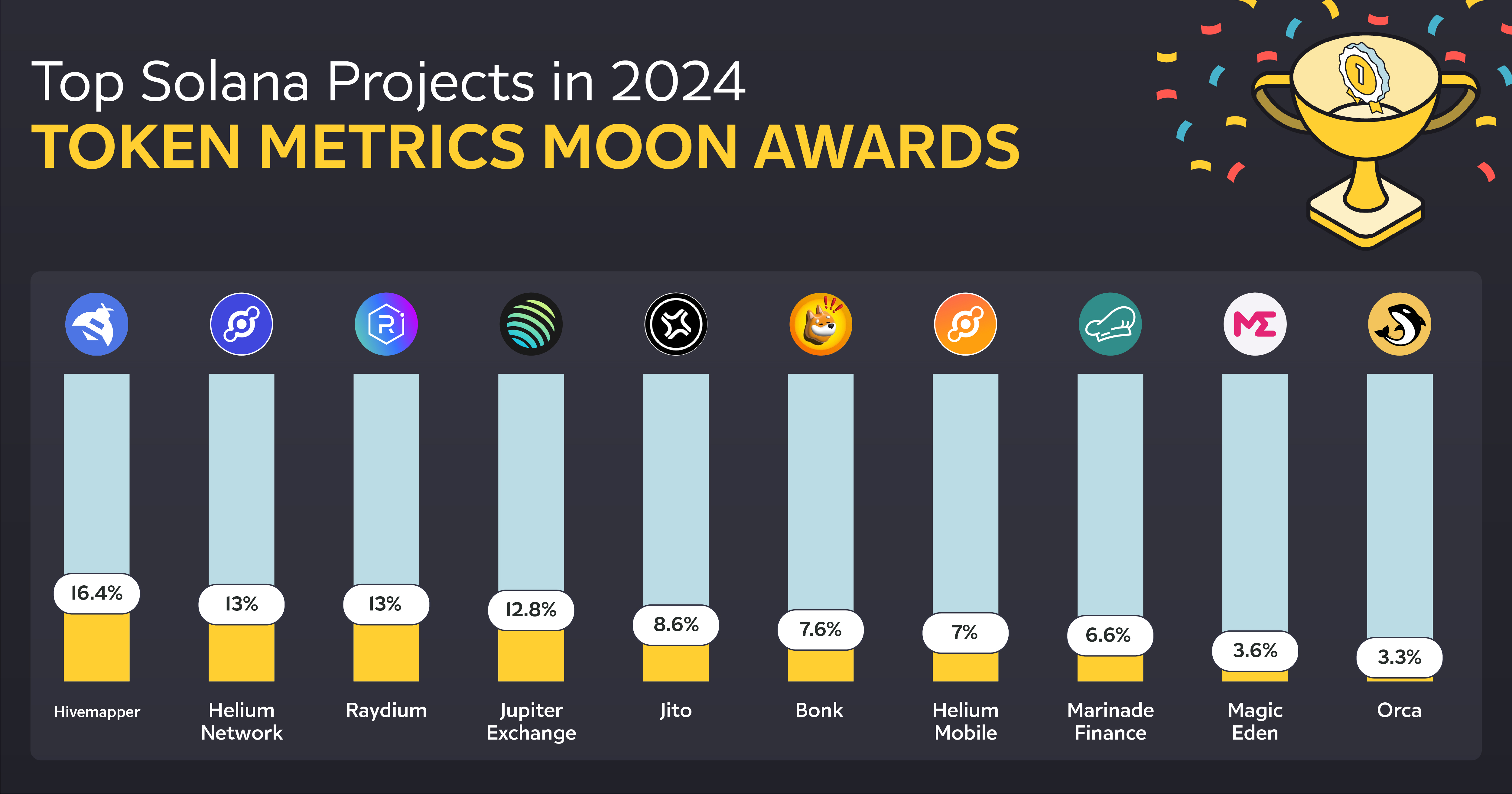
Top Solana Projects
Image Source - Token Metrics Moon Awards

These projects span various domains, including decentralized exchanges (DEXs), lending protocols, NFT marketplaces, and more, showcasing the versatility and robustness of the Solana network.

Here's a closer look at some of the top Solana projects set to make significant impacts in 2024:

1. Hivemapper

In the Moon Awards survey, Hivemapper secured the top position with 16.4% of the total votes.

Hivemapper emerges as a revolutionary force within the Solana ecosystem, championing the cause of decentralized mapping. This crypto-enabled dashcam project is not just about mapping the world; it's about reimagining who owns and contributes to that map. 

With nearly 140 million kilometers mapped across 2,503 regions worldwide, Hivemapper exemplifies the shift from traditional, centralized mapping services to a more democratic, user-driven approach. 

This transformation is pivotal for accurate, up-to-date maps essential for navigation and urban planning.

Key Features and Innovations:

  • Decentralized Mapping: Leveraging the Solana blockchain, it offers a democratic way for global contributors to participate in map creation and updates.
  • Comprehensive Coverage: The project maps nearly 140 million kilometers, covering 2,503 regions globally.
  • Reward System: Contributors are rewarded for their input, with the full reward opportunity for every road reset every 7 days, encouraging continuous updates.

Hivemapper's technological backbone is equally impressive. The platform employs its in-house built Titan engine for processing massive datasets. This engine executes sensor fusion, machine learning/computer vision processing, and crowd consensus review and ensures the continuity of network data. 

Furthermore, Hivemapper is pioneering in hardware development, working with multiple partners in the United States to build dashcams that collect 4K imagery and various telemetry data, all encrypted for security. 

2. Helium Network

In the Moon Awards survey, Helium Network secured the 2nd position with 13% of the total votes.

The Helium Network, under the stewardship of the Helium Foundation, represents a paradigm shift in decentralized wireless technologies. Established in 2021, this US-based non-profit organization is at the forefront of protocol governance and the technical evolution of the Helium Network. 

It's instrumental in educating the public about the advantages of decentralized wireless networks and fostering a vibrant community of network builders, users, and developers.

Key Aspects of the Helium Network:

  • Foundation's Role: The Helium Foundation is central to driving the network's codebase and operations, ensuring a seamless experience for all stakeholders involved. It's committed to expanding public awareness and enhancing the network's utility through innovative use cases.
  • Membership Program: Encompassing Hardware Manufacturers, Network Operators, Service Providers, and Application Developers, the program is set to open its doors to individual enthusiasts, including Hotspot hosts, in 2024.
  • Migration to Solana: A significant milestone was the network's migration to Solana in April 2023, which brought substantial performance and scalability improvements. This move has also paved the way for the network to delve into the mobile and IoT sectors, with initiatives allowing users to earn tokens by supporting the network.

The Helium Network's journey through 2023 into 2024, marked by a 500% surge following its venture into mobile services, reflects its growing influence within the Solana ecosystem. 

With the Helium Wallet now supporting all tokens on the Solana blockchain, the network is poised for further expansion, leveraging the DePIN project to offer decentralized connectivity services. 

3. Raydium

In the Moon Awards survey, Raydium secured the 3rd position with 13% of the total votes.

Raydium stands as a pivotal Solana project, acting as a bridge between the worlds of decentralized finance (DeFi) and automated market makers (AMMs)

This platform has carved out a niche for itself within the Solana ecosystem by offering a suite of financial services that cater to both novice and seasoned crypto enthusiasts.

Key Features and Innovations:

  • AMM Protocol: At its core, Raydium leverages the power of Solana's high-speed blockchain to facilitate lightning-fast trades and transactions. This not only enhances user experience but also contributes to the overall liquidity of the Solana ecosystem.
  • Dual Functionality: Raydium functions as both an AMM and a liquidity provider to the Serum DEX, Solana's premier decentralized exchange. This unique positioning allows Raydium users to access the vast liquidity and wide range of trading pairs available on Serum.

Technological Advancements:

  • High Throughput: Utilizing Solana's capability of processing thousands of transactions per second, Raydium offers a seamless and efficient trading experience.
  • Yield Farming: Raydium introduces users to yield farming opportunities, enabling them to earn rewards by providing liquidity to various pools.

4. Jupiter Exchange

In the Moon Awards survey, Jupiter Exchange secured the 4th position with 12.8% of the total votes.

Jupiter Exchange (JUP) is a cutting-edge swap aggregator within the vibrant Solana ecosystem. It harnesses Solana's speed and efficiency to offer various advanced trading features, making it a standout choice for traders seeking flexibility and depth in their trading strategies. Here's a closer look at what makes Jupiter Exchange a notable Solana project:

Advanced Trading Features:

  • Dollar Cost Averaging (DCA): Allows users to spread their investment over time, reducing the impact of volatility.
  • Limit Orders: Users can set specific price points at which their trades automatically execute, offering greater control over trading outcomes.
  • Perpetual Trading: Provides the opportunity for traders to engage in contracts that do not have an expiry date, enhancing trading flexibility.

Jupiter's commitment to efficiency, low transaction costs, and innovative offerings like swap services and perpetual exchange capabilities, coupled with a significant daily trading volume of $400 million and 90,000 unique wallets, underscores its importance within the Solana projects landscape. 

5. Jito

In the Moon Awards survey, Jito secured the 5th position with 8.6% of the total votes.

In the vibrant Solana ecosystem, Jito stands as a beacon of innovation, particularly in the space of high-frequency trading on decentralized exchanges. 

This Solana project is meticulously designed to address the common pain points encountered in decentralized finance (DeFi), offering solutions that significantly enhance trading efficiency and user experience.

High-Frequency Trading Capabilities:

  • Jito utilizes the Solana blockchain's high throughput and low latency to facilitate high-frequency trading, a feature traditionally reserved for centralized financial markets.
  • This allows traders to execute orders at lightning speed, capitalizing on market movements in real time.

Slippage Reduction:

  • One of the platform's key innovations is its ability to drastically reduce slippage, a common issue that traders face in less liquid markets.
  • By aggregating liquidity across multiple sources, Jito ensures that trades are executed at the most favorable prices, minimizing the cost impact on large orders.

Its emphasis on speed, efficiency, and reduced slippage positions Jito as a critical player among Solana projects, pushing the boundaries of what's possible in the realm of decentralized trading.

6. Bonk

In the Moon Awards survey, Bonk secured the 6th position with 7.6% of the total votes.

Bonk (BONK), a meme coin within the Solana ecosystem, has captured the attention of the cryptocurrency market with its significant traction. 

BONKrewards by ArmadaFi: This initiative allows users to lock BONK for rewards, driving adoption and utility within the Solana ecosystem.

Competition and Roadmap: Facing competition from other meme coins, Bonk's development roadmap, and the team's efforts could influence investor sentiment and its market position.

Bonk's deflationary nature, with over 65% of its total circulating supply burnt, alongside a 10,000% gain in 2023, underscores its status as the hottest meme coin of 2024. 

The Bonk DAO's investment in early-stage startups and the engaging Bonk March Madness event further highlight its community-driven approach and innovative use within the Solana projects landscape.

7. Helium Mobile

In the Moon Awards survey, Helium Mobile secured the 7th position with 7% of the total votes.

Helium Mobile's integration into the Solana ecosystem marks a significant leap forward in decentralized wireless communication, offering users an innovative and expansive service. 

With the Helium Wallet's upgrade to support a wide range of digital assets on the Solana blockchain, users gain a streamlined experience in managing their Solana-based tokens. 

This move not only enhances the utility of the Helium Wallet but also demonstrates Helium's dedication to embracing crypto diversity. The exclusive Pixel NFT, available in the "Badges" tab, rewards users for their engagement, adding a unique element to the user experience.

Key Developments:

  • Coinbase Support: Helium Mobile's full support of Coinbase for trading amplifies its accessibility and potential for widespread adoption.
  • Growth Metrics: The remarkable growth, evidenced by 12,398 active 5G nodes and a surge in new subscribers, indicates a rapidly expanding user base, with projections suggesting nearly 530,000 new subscribers within the year.

Helium Mobile's strategic adjustments to mining rules and the relationship between MOBILE and HNT tokens showcase a thoughtful approach to maintaining a balanced supply-demand dynamic. 

8. Marinade Finance

In the Moon Awards survey, Marinade Finance secured the 8th position with 6.6% of the total votes.

Marinade Finance simplifies the concept of staking on the Solana blockchain, offering users an innovative approach to maximize their returns. 

By automating the staking process across over 100 top-performing validators and providing an automated rebalancing feature, Marinade ensures that users' SOL is always working hard for them. 

This automation not only optimizes returns but also democratizes access to high-quality staking opportunities, previously only available to those with extensive blockchain knowledge.

Key features that set Marinade Finance apart include:

  • Instant Unstake: Users can exit their stake positions instantly at the best available price, offering unparalleled flexibility in managing their investments.
  • Liquid Staking: By unlocking the liquidity of staked SOL, Marinade enables users to participate in DeFi, further enhancing the utility of their assets.
  • mSOL Receipt Token: Depositing staked SOL with Marinade issues users an mSOL token, a fungible asset that can be used as collateral across various DeFi projects.

Moreover, Marinade Finance provides a comprehensive platform for users to review and understand the performance of Solana validators. Utilizing a detailed scoring system, it ranks validators based on yield economics, block production, and stake concentration, ensuring transparency and informed decision-making. 

9. Magic Eden

In the Moon Awards survey, Magic Eden secured the 9th position with 3.6% of the total votes.

Magic Eden has established itself as a premier NFT marketplace within the Solana ecosystem, facilitating the buying, selling, and discovering unique digital assets across multiple blockchains. Several key features underscore its significance:

User and Creator Benefits:

  • User-Friendly Interface: Ensures an intuitive navigation experience.
  • Minimal Fees & Flexible Royalties: A 2% transaction fee for buyers and sellers, with optional royalty alchemy for creators.
  • Magic Eden Wallet: Acts as a multi-purpose web3 navigator for storing crypto assets and interacting with NFTs.

Supported Blockchains and Collections:

  • Blockchains: Solana, Ethereum, Polygon, and Bitcoin (Ordinals).
  • Hot Collections Highlighted: Includes NodeMonkes, Bored Ape Yacht Club, Transdimensional Fox Federation, and Trump Digital Trading Cards, among others.

Magic Eden's blend of extensive collection, low transaction fees, and a user-friendly interface positions it as a hub for artists, creators, and enthusiasts from various blockchain backgrounds.

10. Orca

In the Moon Awards survey, Orca secured the 10th position with 3.3% of the total votes.

Orca emerges as a standout Concentrated Liquidity Automated Market Maker (AMM) on the Solana Network, designed to optimize the trading experience for both liquidity providers and traders. It achieves this through several innovative features and community-driven governance:

Concentrated Liquidity AMM:

  • Liquidity providers can specify price ranges for their tokens, enhancing capital efficiency.
  • A share of trading fees generated on the platform is an incentive, promising higher returns.

Community Governance:

  • Governed by the Orca DAO and the DAO council, utilizing the ORCA token for decision-making.
  • ORCA token is accessible on major exchanges like Kucoin, Gate, and Coinbase, ensuring wide availability.

Orca's platform is not just about trading; it's about creating a comprehensive ecosystem for DeFi activities on Solana. Key features include:

  • Whirlpools: For concentrated liquidity, allowing for higher returns and lower slippage.
  • DCA Feature & Decentralized Perpetuals Trading Platform: Offers up to 100x leverage, catering to various trading strategies.
  • User-Friendly Interface: Ensures minimal transaction fees and lower latency than Ethereum-based DEXs, alongside a fair price guarantee.

Conclusion

Throughout this exploration of Solana's diverse and dynamic ecosystem, we've delved into the vast potential and innovation displayed by leading Solana projects set to shape the blockchain frontier in 2024. 

From the decentralized mapping marvels of Hivemapper to the financial ingenuity of Orca, each project brings its unique contributions, marking Solana's unwavering position in the digital space. 

These endeavors not only illuminate the robust capabilities of the Solana blockchain in supporting high-speed, cost-effective applications, but they also underline the ecosystem's versatility across various domains, including DeFi, wireless communication, NFT marketplaces, and beyond.

Disclaimer

The information provided on this website does not constitute investment advice, financial advice, trading advice, or any other advice, and you should not treat any of the website's content as such.

Token Metrics does not recommend buying, selling, or holding any cryptocurrency. Conduct your due diligence and consult your financial advisor before making investment decisions.

Build Smarter Crypto Apps &
AI Agents in Minutes, Not Months
Real-time prices, trading signals, and on-chain insights all from one powerful API.
Grab a Free API Key
Token Metrics Team
Token Metrics Team

Recent Posts

Crypto Basics

Bitcoin vs Bitcoin Cash - Key Differences and Similarities

Marcus K
9 Minutes
MIN

As the world of cryptocurrency continues to grow and evolve, the dynamics of different digital assets are vital to understand. 

Among the plethora of coins available today, Bitcoin (BTC) and Bitcoin Cash (BCH) hold unique positions, sharing a historical link while carving their distinct niches. 

This post aims to provide you with an in-depth look at the key differences and similarities between these two giants in the crypto realm.

Overview of Bitcoin and Bitcoin Cash

Before diving into the differences and similarities, it's essential to trace the roots of both cryptocurrencies.

What is Bitcoin?

Bitcoin, often abbreviated as BTC, was introduced to the world in 2009. It was a revolutionary concept brought forth by an anonymous figure or group using the pseudonym Satoshi Nakamoto. 

Their ambition was to present a decentralized digital currency free from the clutches of traditional financial institutions. The core idea behind Bitcoin was to create a form of electronic cash that enables peer-to-peer transactions without needing a middleman or central authority.

Built upon a transparent ledger called blockchain, Bitcoin transactions are recorded chronologically and are visible to everyone in the network. This transparency, combined with the decentralized nature of the system, made Bitcoin not just a currency but a significant shift in the financial world's thinking. 

Over the years, Bitcoin has become more than just a currency; it's often dubbed "digital gold" due to its value proposition and the fact that it's seen as a store of value against market volatility.

What is Bitcoin Cash?

In 2017, as Bitcoin grew in popularity and its network became more congested, debates raged within the BTC community about how to scale the system efficiently. 

These discussions primarily revolved around the block size limit. Larger blocks would mean more transactions could be processed at once, leading to faster and cheaper transactions.

However, not everyone in the Bitcoin community agreed on this approach. Concerns about decentralization, security, and the potential to split the community were on the rise. 

As a result, a significant segment decided to implement a 'hard fork' in August 2017, which split the Bitcoin blockchain into two separate chains. The new chain, with its increased block size, was named Bitcoin Cash (BCH).

Bitcoin Cash was designed with the intent of fulfilling Bitcoin's original promise of being 'peer-to-peer electronic cash.' With its larger block size, Bitcoin Cash aimed to process more transactions, faster, and at a lower fee, making it more suitable for everyday transactions.

Thus, while BTC and BCH share the same roots and foundational philosophy, they have since taken different paths in their approach to scaling and their vision for the future of cryptocurrency.

Bitcoin vs Bitcoin Cash - Key Differences

Here are few notable differences between Bitcoin and Bitcoin Cash -

Block Size Limit: One of the main differences between BTC and BCH is their block size. Bitcoin maintains a 1 MB block size, while Bitcoin Cash started with an 8 MB block and has since increased it to 32 MB. This block size difference directly affects how many transactions can be processed in each block.

Transaction Speed and Fees: Owing to its larger block size, BCH typically boasts faster transaction speeds and lower fees compared to BTC. This makes BCH more suited for everyday transactions, while BTC is viewed more as a store of value.

Adoption and Use-Cases: Bitcoin remains the more recognized and widely adopted cryptocurrency. It is often called "digital gold" and used as a hedge against market volatility. Bitcoin Cash, on the other hand, is marketed for its utility in everyday transactions, reflecting its intention to be 'digital cash.'

Security and Mining: Bitcoin, with its larger network and hashing power, is often considered more secure than Bitcoin Cash. However, as both coins use the Proof of Work algorithm, the mining processes for them are somewhat similar, albeit with different profitability metrics.

Bitcoin and Bitcoin Cash - Key Similarities

Both Bitcoin and Bitcoin Cash, despite their divergent paths post-fork, boast distinctive features that have contributed to their prominence in the cryptocurrency market. Here’s a comparative look at the key features of both digital assets.

1. Decentralization:

Bitcoin (BTC): Bitcoin operates on a decentralized network. This means no central authority, like a bank or government, controls it. Instead, transactions are verified by network nodes through cryptography. Its decentralized nature ensures that Bitcoin remains resistant to censorship and external interference.

Bitcoin Cash (BCH): Just like Bitcoin, Bitcoin Cash is also decentralized. Its creation was, in fact, a result of the very essence of decentralization where a group chose to diverge based on their beliefs about the network's direction.

2. Limited Supply:

Bitcoin (BTC): One of Bitcoin's foundational features is its capped supply. There will only ever be 21 million Bitcoins. This limited supply plays a role in its value proposition, making it deflationary by nature.

Bitcoin Cash (BCH): Bitcoin Cash adheres to the same principle, with a maximum supply of 21 million BCH coins. This ensures that, like Bitcoin, Bitcoin Cash also offers a deflationary economic model.

3. Proof of Work (PoW) Mining:

Bitcoin (BTC): Bitcoin transactions are validated and added to the blockchain through a process called mining. Miners solve complex mathematical problems using computational power, and in return for this work, they are rewarded with Bitcoins. This system, called Proof of Work, secures the network.

Bitcoin Cash (BCH): BCH also employs the Proof of Work mechanism. Miners validate and process transactions, earning BCH as a reward. While the overarching principle is the same, differences in block size and other parameters lead to variations in mining profitability between BTC and BCH.

4. Public Ledger:

Bitcoin (BTC): All Bitcoin transactions are recorded on a public ledger called the blockchain. This ensures transparency, as anyone can verify transactions and ensure that coins aren’t double-spent.

Bitcoin Cash (BCH): Similarly, Bitcoin Cash transactions are also maintained on a public ledger. The BCH blockchain maintains its own chain post-fork but upholds the same commitment to transparency and security.

5. Development Community:

Bitcoin (BTC): Bitcoin boasts a robust development community. Regular updates, improvements, and enhancements ensure that the network remains secure, efficient, and in line with its foundational principles.

Bitcoin Cash (BCH): The BCH community is vibrant and active. They are focused on scaling solutions, user adoption, and upholding the vision of BCH as a medium for daily transactions. Regular updates and forks ensure that the network evolves as per the community's direction.

BTC vs BCH - Current Market Landscape

As of August 2023, Bitcoin continues to dominate the market with its higher market cap and broader acceptance among institutions. 

Bitcoin Cash, while not as prominent, has carved out its space, especially in regions and platforms that prioritize transaction speed and minimal fees.

Bitcoin or Bitcoin Cash - Which one is better?

Your choice between Bitcoin and Bitcoin Cash largely depends on your purpose:

Long-term Investment: If you're looking for a long-term store of value, Bitcoin's proven track record might appeal to you. Its widespread recognition and institutional backing give it an edge.

Everyday Transactions: If you prioritize fast, low-cost transactions, Bitcoin Cash might be more up your alley. Its design inherently supports this use-case.

Always remember to conduct further research and consult with a financial advisor before making any investment decisions.

Also Read - Is Bitcoin Dead?

Frequently Asked Questions

Q1. Why did Bitcoin Cash fork from Bitcoin?

Bitcoin Cash forked from Bitcoin in 2017 due to disagreements within the Bitcoin community about scalability solutions. While some advocated for the implementation of SegWit and later, the Lightning Network, others believed in increasing the block size to accommodate more transactions. This divergence in views led to the creation of Bitcoin Cash with an increased block size.

Q2. How do transaction fees compare between BTC and BCH?

Historically, Bitcoin Cash has generally offered lower transaction fees compared to Bitcoin due to its larger block size. This was one of the primary motivations behind its creation. However, fees can fluctuate based on network congestion for both cryptocurrencies.

Q3. Are BTC and BCH stored in the same type of wallet?

Both BTC and BCH can be stored in hardware wallets, desktop wallets, mobile wallets, and exchanges. However, it's vital to use wallets that specifically support each currency. Storing BCH in a BTC-only wallet or vice versa can lead to lost funds.

Q4. What are the main arguments against increasing block size as a scaling solution?

Critics argue that increasing block size could lead to centralization, as fewer entities would be able to afford the storage and computational needs of larger blocks. They also raise concerns about the long-term viability of this approach, as continually increasing block sizes might not be sustainable.

Q5. How does the speed of transactions compare between Bitcoin and Bitcoin Cash?

Due to its larger block size, Bitcoin Cash can process more transactions per second compared to Bitcoin, leading to faster confirmation times, especially during high congestion periods.

Q6. Are there any other significant forks from Bitcoin besides Bitcoin Cash?

Yes, besides Bitcoin Cash, there have been other forks like Bitcoin SV (Bitcoin Satoshi Vision), which further forked from Bitcoin Cash. There are also numerous other forks, but not all of them have gained significant traction or attention in the crypto community.

Q7. How does the security of BTC and BCH compare?

Both Bitcoin and Bitcoin Cash use the Proof-of-Work consensus mechanism, making them secure. However, since BTC has a higher hashing power due to more miners on its network, many argue it's more secure against potential attacks. Nonetheless, BCH also maintains a strong security protocol, with its community continuously making improvements.

Q8. What's the future outlook for Bitcoin and Bitcoin Cash?

While it's challenging to predict the future of any cryptocurrency, both BTC and BCH have maintained their relevance in the market. BTC is often viewed as a store of value, while BCH pushes for merchant adoption and everyday transactions. Their futures will likely be influenced by technological advancements, regulatory shifts, and market dynamics

Conclusion

The world of cryptocurrency is vast, intricate, and ever-evolving. Within this landscape, the intertwined narratives of Bitcoin and Bitcoin Cash offer a compelling exploration into the complexities of technological innovation, community beliefs, and market dynamics. 

From their shared origins to their divergent paths, each coin represents a unique vision of what digital currency should be. As we've navigated through their histories, key features, and current market landscapes, it's evident that both Bitcoin and Bitcoin Cash bring valuable propositions to the table. 

BTC stands as a testament to resilience, continually affirming its position as a pioneering force and a digital store of value. Simultaneously, BCH serves as a reminder of the power of community-driven initiatives, striving to make cryptocurrency accessible and functional for daily transactions.

As the market continues its trajectory, one thing remains certain: the story of Bitcoin and Bitcoin Cash is far from over. Their ongoing evolution promises further insights, challenges, and opportunities in the decentralized world of tomorrow.

Disclaimer

The information provided on this website does not constitute investment advice, financial advice, trading advice, or any other sort of advice and you should not treat any of the website's content as such.

Token Metrics does not recommend that any cryptocurrency should be bought, sold, or held by you. Do conduct your own due diligence and consult your financial advisor before making any investment decisions.

Crypto Basics

What is the Arbitrum Bridge and How to Use it?

Sumit Meghani
7 Minutes
MIN

In the vast realm of cryptocurrencies, new developments and innovations emerge every day. One of the most recent and noteworthy advancements in the world of decentralized applications (dApps) and Ethereum scaling solutions is Arbitrum. 

A central aspect of this is the Arbitrum Bridge. Let's dive deep into understanding this technological marvel.

What is Arbitrum?

Arbitrum is a Layer-2 scaling solution designed to bring scalability and reduced fees to the Ethereum network. 

By offloading much of the transaction processing from Ethereum's primary chain (Layer-1), Arbitrum provides a faster and more efficient environment for dApps and smart contracts.

Why the Need for a Bridge?

Imagine a busy highway with just one lane. That's Ethereum's Layer-1, where congestion can lead to high fees and slower transactions. 

Now, envision an express lane created alongside it - that's your Layer-2, where Arbitrum operates. To move from the main highway to this express lane (or vice-versa), you need a ramp. In the crypto world, that ramp is called a 'bridge'.

Understanding the Arbitrum Bridge

The Arbitrum Bridge acts as a secure channel connecting Ethereum's mainnet (Layer-1) with the Arbitrum Rollup (Layer-2). This bridge allows users to transfer assets, like ETH or ERC-20 tokens, between these layers.

Key Features of the Arbitrum Bridge

The Arbitrum Bridge is not just a bridge; it's an epitome of innovation tailored to enhance the Ethereum ecosystem. Here are its distinct features:

Scalability: One of the core objectives of Arbitrum Bridge is to handle a higher transaction volume than Ethereum's mainnet. By shifting much of the computational load off the main chain, Arbitrum facilitates quicker transaction processing, alleviating the congestion commonly found on Ethereum.

Cost Efficiency: The bridge's design focuses on minimizing gas fees. Transactions that are executed on Arbitrum are consolidated and batch-processed, drastically reducing the cumulative cost when they're finally posted to Ethereum.

Security: Backed by Ethereum's robust security model, the Arbitrum Bridge ensures that assets being transferred are always safeguarded. 

Even in situations where validators might act maliciously, the bridge has mechanisms to detect and correct any irregularities, preventing asset loss.

Interoperability: The bridge is not limited to just ETH. It supports the transfer of a wide range of assets, including various ERC-20 tokens, thereby providing users with versatility in their transactions.

Decentralization: Arbitrum operates in a permissionless environment. This means that anyone can become a validator, contributing to the security and robustness of the system.

User Experience: Designed with the end-user in mind, the bridge provides a seamless and intuitive interface. This makes transferring assets between layers straightforward, even for those new to the cryptocurrency space.

How to Use the Arbitrum Bridge?

Using the Arbitrum Bridge is a straightforward process:

Step 1: Visit the official Arbitrum Bridge portal.

Step 2: Connect your Ethereum wallet. Most users opt for MetaMask, but several Ethereum-compatible wallets work.

Step 3: Select the asset you wish to transfer from the drop-down menu.

Step 4: Enter the amount you wish to move to Arbitrum.

Step 5: Confirm the transaction details and the gas fees.

Step 6: Approve and initiate the transaction. Once completed, your assets will appear in your Layer-2 Arbitrum wallet.

Step 7: When you're ready to move assets back to Ethereum's mainnet, follow the process in reverse.

Remember, while transferring from Ethereum to Arbitrum is relatively fast, moving assets from Arbitrum back to Ethereum may require a waiting period due to the underlying security mechanisms.

Why Use Arbitrum Bridge?

Cost Savings: The primary allure is the significant reduction in transaction fees, making activities like trading, yield farming, or simple transfers more economical.

Speed: Transactions on Arbitrum's Rollup are processed faster than on the congested Ethereum mainnet.

Access to New dApps: Some decentralized applications and protocols might operate exclusively on Arbitrum, requiring users to bridge assets.

Points to Remember

  • Gas Fees: While Arbitrum significantly reduces fees, remember there's still a cost associated with bridging assets.
  • Waiting Period: The potential waiting period when moving from Layer-2 to Layer-1 is a crucial aspect to consider, especially if you need your assets quickly.
  • Asset Safety: While the Arbitrum Bridge is designed to be secure, always ensure you're using official platforms and not falling for scams or unofficial bridges.

Best Bridges to Arbitrum

The Ethereum ecosystem's expansion to Layer-2 solutions, particularly with the introduction of Arbitrum, has led to the creation of several bridges. 

These bridges facilitate the seamless movement of assets between Ethereum and Arbitrum. Here are the few best bridges that have been widely recognized for their functionality, security, and user experience:

Official Arbitrum Bridge: Developed and maintained by Offchain Labs, the team behind Arbitrum, this bridge is often the first choice for many. Its direct integration with Arbitrum ensures optimal security, a user-friendly interface, and comprehensive support for a range of Ethereum-based tokens. Continuous updates and development support make it a reliable choice.

Hop Protocol: Hop stands out for its focus on interoperability. It doesn’t just bridge assets to Arbitrum but also other Layer-2 solutions like zkSync and Optimism. Its unique feature is the automatic swapping of tokens across rollups, making transfers efficient and ensuring liquidity.

zBridge: Powered by zkSync, zBridge is another contender in the Arbitrum bridging landscape. It specializes in low-cost, swift transfers between Ethereum and Arbitrum. The bridge’s emphasis on user privacy, coupled with its cost-effectiveness, is drawing a growing user base.

cBridge: Designed and pioneered by the renowned Celer Network, cBridge stands as an advanced gateway for the efficient transfer of assets, encompassing both ETH and a vast array of ERC-20 tokens, between Ethereum and Arbitrum. 

Harnessing the cutting-edge technology of the Celer Network, cBridge prioritizes not just rapidity but also uncompromised security in its transfers, all the while upholding a staunch commitment to decentralization.

When selecting a bridge to Arbitrum, it's essential to weigh the pros and cons of each option. While all the bridges listed above offer unique features and benefits, users should consider factors like security, fees, ease of use, and compatibility with their specific needs to make an informed decision.

Frequently Asked Questions

Q1. What differentiates Arbitrum from other Ethereum Layer-2 solutions?

Arbitrum stands out due to its unique combination of optimistic rollups, scalability, and close integration with Ethereum's security model. It offers improved transaction speeds and reduced fees, all while preserving the robustness associated with Ethereum.

Q2. Why is bridging necessary between Ethereum and Arbitrum?

Bridging acts as a connector to transfer assets between Ethereum's mainnet (Layer-1) and Arbitrum (Layer-2). Given that they operate on different layers, a bridge provides a secure and efficient pathway for this movement.

Q3. Are there fees associated with using bridges to Arbitrum?

Yes, there are fees involved, primarily to compensate for the computational and transactional efforts. However, these fees are generally lower than standard Ethereum gas fees, especially during network congestion.

Q4. Can assets be moved back from Arbitrum to Ethereum?

Absolutely! Though it's worth noting that due to the security mechanisms in place, moving assets from Arbitrum back to Ethereum may come with a waiting period.

Q5. How does Arbitrum ensure the security of assets during transfers?

Arbitrum operates closely with Ethereum's primary security framework. Even in scenarios where potential malicious activities occur, Arbitrum has built-in measures to detect and rectify any discrepancies, ensuring assets remain safeguarded.

Q6. What's the role of validators in the Arbitrum network?

Validators help in processing transactions, submitting proofs to Ethereum, and maintaining the overall security and authenticity of the network. Given its decentralized nature, anyone can become a validator in the Arbitrum ecosystem.

Q7. Is the Official Arbitrum Bridge the only way to transfer assets to Arbitrum?

While the Official Arbitrum Bridge is a popular and trusted choice, several other bridges, like cBridge, Connect, and Hop Protocol, have emerged, offering different features and benefits for users.

Q8. What happens if there's a dispute in a transaction on Arbitrum?

Arbitrum's design includes a challenge period where disputes can be raised. If an invalid or malicious transaction is detected, it can be challenged, and if proven false, it will be rolled back, ensuring the integrity of the system.

Conclusion

The Arbitrum Bridge stands as a testament to the ongoing innovation in the cryptocurrency space. As Ethereum continues to face scalability challenges, solutions like Arbitrum offer a promising avenue for users seeking speed, cost-effectiveness, and a seamless experience.

For those eager to maximize the potential of their Ethereum-based activities, understanding and utilizing the Arbitrum Bridge is invaluable. As always, stay informed, stay safe, and let technology pave the way for smarter crypto choices.

Disclaimer

The information provided on this website does not constitute investment advice, financial advice, trading advice, or any other sort of advice and you should not treat any of the website's content as such.

Token Metrics does not recommend that any cryptocurrency should be bought, sold, or held by you. Do conduct your own due diligence and consult your financial advisor before making any investment decisions.

Crypto Basics

Crypto Security and its Importance - A Complete Guide

S. Vishwa
9 Minutes
MIN

As digital currencies continue to gain momentum, crypto security has become more critical than ever. Cryptocurrency, though a groundbreaking invention, operates in a digital sphere, making it susceptible to hacking and fraud. 

Ensuring crypto security is thus vital for every investor, trader, or enthusiast in the crypto sphere. But why is it so important, and how can you ensure you're fully secured? Let's delve in.

Understanding Cryptocurrency and Its Security

Before discussing the importance of crypto security, let's take a step back to understand what cryptocurrency is. Cryptocurrency is a digital or virtual form of currency secured by cryptography. 

This encryption makes it nearly impossible to double-spend or counterfeit. Cryptocurrencies operate on decentralized platforms called blockchain technology, which is a distributed ledger enforced by a disparate network of computers, also known as nodes.

Crypto security, therefore, involves protecting these digital assets through various measures and practices, ensuring the safety of the user's funds and personal information from potential cyber threats. The importance of cryptocurrency security is directly linked to the unique characteristics of the technology itself.

The Importance of Crypto Security

Prevention of Asset Theft: Since cryptocurrency transactions are irreversible, losing access to your funds can be a costly mistake. 

Unlike traditional banking systems, where transactions can be disputed or reversed, blockchain technology offers no such luxury. Therefore, top-notch security is vital to prevent theft of these digital assets.

Maintaining Anonymity: Many users turn to cryptocurrencies for their promise of privacy. Without proper security measures, users' identities can be exposed, which can lead to significant risks, including financial loss and personal safety concerns.

Preservation of Wealth: With the burgeoning crypto market, cryptocurrencies have become a popular investment choice. Without the proper security in place, your digital wealth may be at risk.

Investor Confidence: The safety of digital currencies directly impacts investor confidence. If a platform can't offer robust security measures, it risks losing users' trust. Consequently, strong security protocols contribute to the overall growth of the crypto ecosystem.

Key Elements of Crypto Security

Understanding the importance of crypto security is the first step; the next step involves knowing the key elements that make up a secure crypto environment. Here are the crucial aspects:

Wallets: Crypto wallets are an essential part of digital currency security. Wallets can be either software or hardware-based, with the latter generally considered more secure. Keep your wallet's private keys safe, and consider using multi-signature wallets for added security.

Secure Internet Connection: Always make sure your internet connection is secure when dealing with cryptocurrencies. Avoid using public Wi-Fi networks for crypto transactions, as they can be hotspots for cyber threats.

Exchanges: Not all cryptocurrency exchanges are created equal. Before committing, research the security measures an exchange has in place. Look for features like two-factor authentication (2FA), cold storage, and withdrawal whitelists.

Education: Understanding the technology behind cryptocurrencies and the various threats you could face is crucial. Regularly keep yourself updated with the latest security trends and threats in the crypto space.

Common Security Risks Associated with Crypto

Navigating the cryptocurrency landscape involves being aware of the potential security risks associated with it. Here are some common security threats you should know:

Phishing Attacks: These occur when an attacker masquerades as a trustworthy entity to trick victims into revealing sensitive information, such as login credentials and wallet private keys. Phishing can happen via email, text messages, or even fake websites.

Exchange Hacks: While cryptocurrency exchanges have bolstered their security measures over the years, they are still lucrative targets for hackers. In these attacks, hackers exploit security vulnerabilities to steal funds from exchange users.

Wallet Hacks: Crypto wallets, especially those connected to the internet (hot wallets), are susceptible to attacks. If an attacker gains access to your wallet's private keys, they can drain your funds.

Ponzi and Pyramid Schemes: These fraud schemes promise high returns to investors. However, they rely on funds from new participants to pay profits to earlier investors. Eventually, when new investors dry up, the scheme collapses.

Awareness of these common risks is the first step towards better protection in the crypto space. As an investor or trader, you should always stay vigilant and double-check any information or transactions you make.

How to Protect Your Cryptocurrencies?

As the world of cryptocurrency grows, it becomes increasingly important to take measures to protect your digital investments. Here are some steps you can follow:

Use Secure Wallets: Opt for wallets known for their strong security features. Hardware wallets, which store your private keys offline, offer a higher level of security than online wallets.

Implementing 2FA: Two-Factor Authentication (2FA) adds an extra layer of security to your accounts. This means even if your password is compromised, an attacker would still need your second factor to access your account.

Keep Software Up-to-date: Ensure that your devices, wallets, and apps are up to date. Updates often include security enhancements that protect against newly discovered threats.

Use Secure Networks: Avoid conducting crypto transactions over public Wi-Fi networks. These networks can be insecure, making it easier for hackers to intercept sensitive data.

Be Wary of Phishing Attempts: Be vigilant about potential phishing attempts. Always double-check emails and messages, especially those prompting you to reveal sensitive information.

While there's no foolproof way to guard against all crypto security threats, these steps can greatly reduce your exposure to risk and help keep your investments safe.

Role of Cryptocurrency Security Standards

Cryptocurrency Security Standards (CCSS) are a framework of security protocols designed by the CryptoCurrency Certification Consortium (C4). 

This standardized set of rules provides an essential guideline for organizations handling cryptocurrencies, ensuring the safe management and security of these digital assets. 

The CCSS covers a wide range of security aspects like key generation, storage, and transaction operations, thus offering protection against potential cyber and physical threats. 

Organizations adhering to CCSS go through regular audits and are classified into three security levels. While not an absolute guarantee against attacks, CCSS adherence signifies a platform's commitment to proactive security measures, offering users a safer environment for their crypto transactions.

Top Examples of Crypto Thefts in History

Even though blockchain technology is highly secure, it's not completely immune to breaches. Here are some of the most notable cryptocurrency thefts in history that highlight the importance of crypto security:

Mt. Gox (2014): Once handling over 70% of all Bitcoin transactions worldwide, Mt. Gox was a significant player in the early days of Bitcoin. 

However, the platform was hacked in 2014, resulting in a loss of around 850,000 Bitcoins, then worth around $460 million. The event remains one of the most infamous episodes in crypto history, leading to the platform's eventual bankruptcy.

Coincheck (2018): The Tokyo-based exchange suffered one of the biggest crypto heists when hackers stole NEM tokens worth around $534 million. The attack exploited a weakness in Coincheck's security system, as the exchange stored its assets in a hot wallet instead of a much more secure cold wallet.

Binance (2019): In a large-scale security breach, hackers withdrew 7000 Bitcoins (around $40 million at that time) from the world's largest cryptocurrency exchange by trading volume. 

Binance confirmed that the hackers employed various methods, including phishing and viruses, to obtain a large number of 2FA codes and API keys.

These instances underline the significant security risks present in the cryptocurrency sector. They serve as reminders of the need for robust security measures and the importance of due diligence when handling cryptocurrencies. 

Even as the technology matures and security improves, remaining vigilant about potential risks is essential in the crypto space.

Frequently Asked Questions

Q1. What is a private key in the context of cryptocurrency?

A private key is a sophisticated form of cryptography that allows a user to access their cryptocurrency. It's an integral aspect of bitcoin and altcoins, and its secure nature ensures that only the owner of a private key can send cryptocurrency.

Q2. What is Two-Factor Authentication (2FA) and why is it important?

Two-Factor Authentication (2FA) is a security measure that requires two types of identification before accessing an account. Often, this involves a password and a secondary code sent to a trusted device. 

In the context of crypto security, 2FA adds an extra layer of protection, making it harder for potential intruders to access your crypto assets.

Q3. What is the difference between a hot wallet and a cold wallet?

A hot wallet is connected to the internet and allows easy access and transfer of assets. However, this convenience comes with a risk, as it can be a target for online hacking attempts. 

A cold wallet, on the other hand, is an offline storage option for cryptocurrencies, making it immune to online hacking attempts but somewhat less convenient for frequent use.

Q4. What are the most secure cryptocurrency exchanges?

The security of a cryptocurrency exchange can vary, and often depends on factors like the use of cold storage for assets, withdrawal protections, and 2FA. Some of the exchanges known for their security measures include eToro, Kraken, and Coinbase. However, users should always conduct personal research before choosing an exchange.

Q5. How can I keep up-to-date with the latest threats in the crypto space?

Many online resources can keep you updated on the latest security threats in the crypto space. Websites like CoinDesk, Cointelegraph, and cybersecurity blogs often report on recent security breaches and potential threats. Following crypto security experts on social media can also be helpful.

Q6. Are mobile wallets safe for storing cryptocurrencies?

While mobile wallets offer convenience, they are not the safest option for storing large amounts of cryptocurrencies due to potential threats like malware and hacking attempts. For larger investments, hardware or cold wallets are often recommended due to their superior security.

Q7. What steps should I take if my cryptocurrency has been stolen?

If you've fallen victim to a cryptocurrency theft, immediate actions include reporting the incident to local law enforcement and contacting your wallet provider or exchange to inform them of the breach. 

If possible, identify the transaction ID for the fraudulent transaction. While recovery of stolen crypto assets is challenging, these steps are essential to take as quickly as possible.

Conclusion

Cryptocurrency has the potential to revolutionize financial systems and empower individuals worldwide. However, it's vital to understand that investing in cryptocurrencies also means taking responsibility for the security of your digital assets. 

As the crypto ecosystem evolves, so do the threats that aim to destabilize it. Crypto security is not just essential - it's an absolute necessity for anyone venturing into the world of digital currencies.

As the cryptocurrency market continues to grow, it becomes increasingly critical for us to prioritize security to protect our investments and maintain the overall integrity of the blockchain ecosystem. Stay safe, stay secure, and remember: your digital wealth is your responsibility.

Disclaimer

The information provided on this website does not constitute investment advice, financial advice, trading advice, or any other sort of advice and you should not treat any of the website's content as such.

Token Metrics does not recommend that any cryptocurrency should be bought, sold, or held by you. Do conduct your own due diligence and consult your financial advisor before making any investment decisions.

Choose from Platinum, Gold, and Silver packages
Reach with 25–30% open rates and 0.5–1% CTR
Craft your own custom ad—from banners to tailored copy
Perfect for Crypto Exchanges, SaaS Tools, DeFi, and AI Products

