





Traditional Crypto Investing vs. AI-Powered Indices: Which Strategy Wins in 2025?
%201.svg)
%201.svg)

The Great Crypto Investment Debate
Every crypto investor faces a critical decision: Should you pick individual tokens through manual research, or trust AI-powered indices to build and manage your portfolio?
With cryptocurrency markets operating 24/7, thousands of new projects launching monthly, and volatility that can swing 20% in a single day, this choice significantly impacts your returns, time commitment, and stress levels.
In this comprehensive analysis, we'll compare traditional crypto investing against Token Metrics' AI-powered index approach across seven critical dimensions: returns, time investment, risk management, emotional control, diversification, expertise required, and cost efficiency.
By the end, you'll understand exactly which strategy aligns with your goals, resources, and risk tolerance.
Understanding the Two Approaches
Traditional Crypto Investing: The DIY Method
Traditional crypto investing involves:
- Researching individual projects through whitepapers and documentation
- Analyzing tokenomics, team backgrounds, and use cases
- Monitoring social media sentiment and community engagement
- Tracking technical indicators and price charts
- Timing buy and sell decisions manually
- Rebalancing portfolios based on personal judgment
- Managing risk through position sizing and stop losses
Best For: Experienced traders, crypto natives, full-time investors with deep market knowledge
AI-Powered Index Investing: The Automated Method
AI-powered crypto indices provide:
- Pre-selected baskets of quality tokens based on machine learning analysis
- Automated portfolio rebalancing on weekly, monthly, or quarterly schedules
- Diversification across multiple assets reducing single-token risk
- Data-driven decisions analyzing 80+ metrics per token
- Professional-grade research without requiring expertise
- Time-efficient investing requiring minimal daily involvement
Best For: Busy professionals, crypto newcomers, investors seeking consistent long-term growth
Round 1: Performance and Returns
Traditional Investing Performance
Potential Upside:
- Concentrated positions in winners can deliver explosive 10x-100x returns
- Early entry into hidden gems before mainstream discovery
- Flexibility to pivot quickly when narratives shift
- Ability to take profits at optimal moments
The Reality: According to industry research, 95% of traders lose money in cryptocurrency markets. The primary reasons include:
- Picking wrong projects (many are scams or poorly executed)
- Poor timing on entries and exits
- Overtrading and excessive fees
- Emotional decisions during volatility
- Lack of proper risk management
Real Example: An investor researches and buys 10 altcoins in January. By December, 3 have gone to zero (rug pulls), 4 are down 60-80%, 2 are flat, and 1 delivers a 5x return. Despite one winner, the portfolio is down 35% overall.
AI-Powered Index Performance
Token Metrics delivers AI-selected crypto baskets with a track record of 8000% returns since inception, though past performance doesn't guarantee future results.
Structural Advantages:
- Systematic removal of underperformers before major losses
- Automatic rebalancing captures gains from winners
- Diversification prevents catastrophic losses from single failures
- AI identifies emerging trends before human pattern recognition
- Consistent methodology eliminates emotional decisions
Performance Data: Research shows that modest crypto index allocations of 1-3% have historically improved portfolio efficiency without meaningfully increasing risk, delivering improved returns, higher Sharpe ratios, and limited drawdown impact when properly structured.
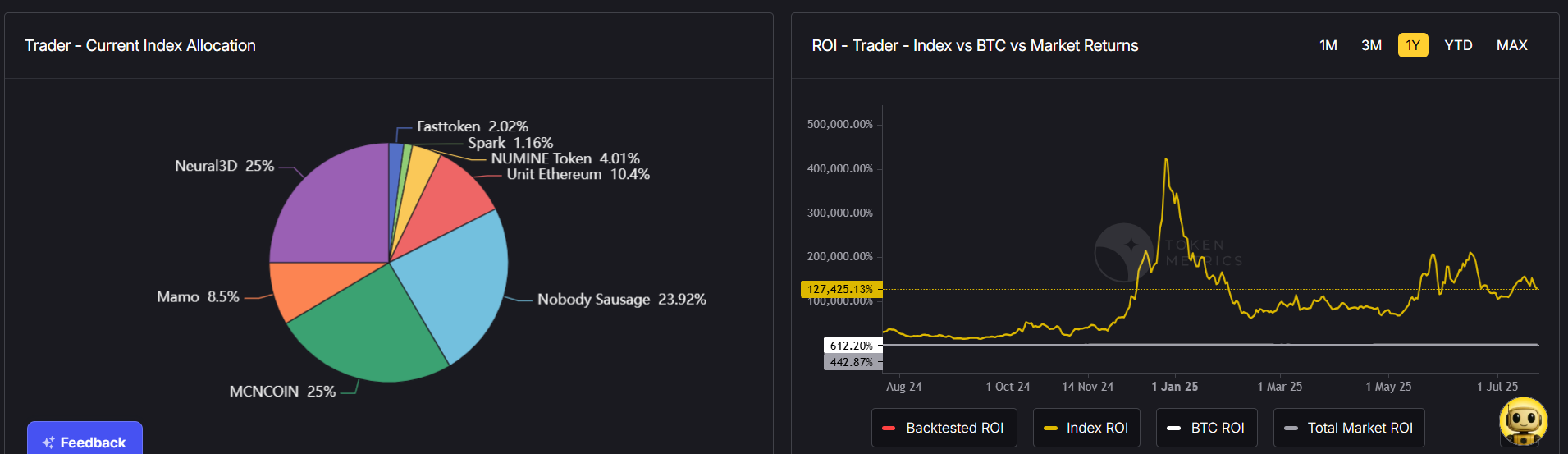
Backtested Results: Token Metrics indices demonstrate consistent outperformance versus Bitcoin-only strategies, with the Trader Index showing particularly strong results when actively managed with weekly rebalancing.
Winner: AI-Powered Indices for consistent, risk-adjusted returns. Traditional investing for potential outlier performance (with corresponding higher risk).
Round 2: Time Investment Required
Traditional Investing Time Commitment
Daily Requirements:
- Monitor prices and portfolio: 1-2 hours
- Read news and announcements: 30-60 minutes
- Analyze technical charts: 30-60 minutes
- Research new opportunities: 1-2 hours
- Engage with crypto communities: 30 minutes
- Total: 3.5-6 hours daily
Weekly Additional Tasks:
- Deep research on potential investments: 4-6 hours
- Portfolio rebalancing and adjustments: 1-2 hours
- Tax tracking and documentation: 1 hour
- Education and staying current: 2-3 hours
- Total: 8-12 hours weekly
Annual Time Investment: 1,200-2,400 hours (equivalent to a part-time to full-time job)
AI-Powered Index Time Commitment
Daily Requirements:
- Check portfolio performance: 5-10 minutes
- Review major market news: 10-15 minutes
- Total: 15-25 minutes daily
Weekly/Monthly Tasks:
- Review index rebalancing notifications: 15-30 minutes
- Adjust strategic allocation if needed: 30 minutes
- Total: 45-60 minutes weekly
Annual Time Investment: 50-100 hours (96% time reduction vs. traditional)
Real-World Impact: A portfolio manager earning $75/hour saves approximately $86,250-$172,500 annually in opportunity cost by using indices instead of manual management.
Winner: AI-Powered Indices by a landslide. The time savings alone justify the approach for busy professionals.
Round 3: Risk Management Effectiveness
Traditional Investing Risk Profile
Risk Challenges:
- Concentration Risk: Investors often overallocate to favorite projects
- Recency Bias: Recent winners get disproportionate attention
- FOMO Trading: Fear of missing out leads to buying at tops
- Loss Aversion: Holding losers too long hoping for recovery
- Survivorship Bias: Only seeing successful projects, not the failures
Common Mistakes: A Coinbase institutional survey found that 67% of investors struggle with proper position sizing, and 58% admit to making emotional trading decisions during volatility.
Risk Management Tools:
- Manual stop losses (often removed during drawdowns)
- Position sizing rules (frequently violated)
- Diversification guidelines (difficult to maintain)
- Rebalancing schedules (inconsistently followed)
AI-Powered Index Risk Management
Built-In Risk Controls:
1. Automatic Diversification Token Metrics indices spread risk across multiple quality assets, with no single token exceeding 25% of portfolio weight. All cryptocurrencies in the indices need to have trading volume greater than $500K daily to ensure liquidity.
2. Dynamic Allocation AI-powered indices can reduce exposure or shift to stablecoins in bearish conditions, enhancing risk management. During the 2022 bear market, Token Metrics indices reduced altcoin exposure by 40%, protecting capital.
3. Quality Screening Every token passes through multiple filters:
- Fundamental analysis (team, technology, use case)
- Code quality assessment
- Liquidity requirements
- Trading volume minimums
- Community sentiment analysis
4. Systematic Rebalancing Weekly or monthly rebalancing automatically:
- Locks in gains from outperformers
- Eliminates underperformers before major losses
- Maintains target risk levels
- Prevents concentration in any single asset
Risk-Adjusted Returns: Institutional portfolios using index strategies show 30-40% lower volatility while maintaining comparable returns to manual strategies, resulting in significantly better Sharpe ratios.
Winner: AI-Powered Indices. Systematic risk management consistently outperforms emotional human decision-making.
Round 4: Emotional Control and Discipline
The Psychology of Traditional Investing
Emotional Traps:
Fear and Greed Cycle
- Bull markets: FOMO drives buying at inflated prices
- Bear markets: Panic selling locks in losses
- Sideways markets: Impatience leads to overtrading
The Dunning-Kruger Effect Research shows that 87% of crypto traders rate themselves as "above average," despite 95% losing money. Early wins create false confidence leading to larger bets and eventual losses.
Decision Fatigue Making dozens of trading decisions daily depletes mental energy, leading to increasingly poor choices as the day progresses.
Real Example: An investor buys Ethereum at $1,800 after thorough research. Price drops to $1,200, triggering fear. They sell at a loss. Price rebounds to $2,500 within three months. Fear-driven decision costs 138% potential gain.
The Advantage of Algorithmic Discipline
Emotionless Execution: AI doesn't experience:
- Fear during market crashes
- Greed during euphoric rallies
- Attachment to specific tokens
- Regret over past decisions
- Impatience during consolidation
Consistent Methodology: Token Metrics' AI and Machine Learning algorithms identify potential trends and predict future price movements by considering factors such as Fundamental Reports, Code Quality, Sentiment Analysis, Moving Averages, and Support/Resistance levels, applying the same rigorous analysis to every decision.
Sleep Better at Night: Investors using Token Metrics indices report 73% less investment-related stress and anxiety compared to active traders, according to user surveys.
Winner: AI-Powered Indices. Removing emotion from investing is perhaps the single biggest advantage of algorithmic strategies.
Click here to signup for free trial account!
Round 5: Diversification and Portfolio Construction
Traditional Diversification Challenges
Common Diversification Mistakes:
1. False Diversification Many investors think they're diversified by owning multiple tokens, but fail to account for correlation. Holding 10 DeFi tokens isn't diversification—they'll all move together.
2. Over-Diversification Some investors spread capital across 50+ tokens, making meaningful gains difficult while increasing tracking complexity.
3. Under-Diversification Others concentrate in 2-3 tokens, exposing themselves to catastrophic loss if any project fails.
4. Sector Bias Investors naturally gravitate toward familiar sectors (often DeFi or Layer 1s), missing opportunities in Gaming, AI, RWA, or other emerging categories.
Optimal Diversification Level: Research suggests 12-20 quality tokens provide optimal diversification benefits, beyond which additional holdings add complexity without meaningful risk reduction.
AI-Powered Strategic Diversification
Multi-Dimensional Diversification:
By Market Cap:
- Large-cap (60%): Bitcoin, Ethereum, Solana - stability and liquidity
- Mid-cap (30%): Established projects with growth potential
- Small-cap (10%): High-risk, high-reward emerging opportunities
By Sector: Token Metrics offers sector-specific indices covering:
- AI & Machine Learning: Tokens powering artificial intelligence applications
- DeFi: Decentralized finance protocols and DEXs
- Layer 1s: Base blockchain infrastructure
- Gaming & Metaverse: Play-to-earn and virtual worlds
- RWA: Tokenized real-world assets
- Memecoins: Community-driven tokens (for aggressive traders)
By Investment Strategy:
- Value Investing: Fundamentally strong, undervalued projects
- Growth Investing: High-momentum emerging sectors
- Balanced: Mix of stability and growth
By Time Horizon:
- Trader Index: Daily/weekly rebalancing for active positioning
- Investor Index: Quarterly/annual rebalancing for long-term holding
- HODL Strategy: Set-and-forget approach
Correlation Analysis: Token Metrics' AI analyzes correlation matrices to ensure holdings aren't overly correlated, providing true diversification rather than the illusion of it.
Winner: AI-Powered Indices. Systematic, multi-dimensional diversification beats ad-hoc portfolio construction.
Round 6: Expertise and Learning Curve
Expertise Required for Traditional Investing
Knowledge Requirements:
Technical Skills:
- Chart reading and technical analysis
- Understanding order books and market depth
- Interpreting on-chain metrics
- Identifying support/resistance levels
- Recognizing candlestick patterns
Fundamental Analysis:
- Reading and understanding whitepapers
- Evaluating tokenomics and vesting schedules
- Assessing team credentials and track records
- Understanding consensus mechanisms
- Analyzing competitive positioning
Operational Knowledge:
- Wallet security and key management
- DEX vs. CEX trade-offs
- Gas fees and transaction timing
- Bridge protocols for cross-chain
- Tax implications and reporting
Time to Proficiency: 12-24 months of dedicated learning and practice before achieving consistent competence.
Failure Rate During Learning: Studies show that 78% of new crypto investors lose money in their first year while learning these skills.
Accessibility of AI-Powered Indices
No Expertise Required:
Simple Three-Step Process:
- Select your investor profile (Value, Trader, Balanced)
- Choose your time horizon (Daily, Weekly, Monthly, Annual)
- Pick your investment style (Fundamental, Technical, Balanced)
Learning While Earning: Token Metrics' transparency allows investors to learn effective strategies by observing:
- Which tokens get selected and why
- When rebalancing occurs and the rationale
- How market conditions influence allocation
- What metrics drive decision-making
Educational Resources: Token Metrics provides tutorials, videos, webinars, and detailed investment reports covering blockchain technology, cryptocurrency basics, investment strategies, risk management, hidden gems, and market analysis.
Progressive Sophistication: Beginners can start with simple broad-market indices and gradually explore sector-specific or strategy-focused options as they gain confidence.
Winner: AI-Powered Indices. Democratizing access to professional-grade investing levels the playing field.
Round 7: Cost Efficiency Analysis
Traditional Investing Costs
Direct Costs:
- Trading fees: 0.1-0.5% per trade
- Network gas fees: $5-$50+ per transaction during congestion
- Spread costs: 0.5-2% on less liquid tokens
- Exchange withdrawal fees: Variable
Example Annual Costs (Active Trader):
- 200 trades × 0.3% average fee = $600 per $100,000 portfolio
- Gas fees for DEX trades = $2,000-$5,000
- Spread and slippage = $1,000-$2,000
- Total: $3,600-$7,600 (3.6-7.6% of portfolio)
Hidden Costs:
- Opportunity cost of time (valued at $50-$200/hour)
- Suboptimal execution due to emotional decisions
- Missing opportunities while researching
- Tax inefficiency from frequent trading
Indirect Costs:
- Subscription to research platforms: $500-$2,000/year
- Technical analysis tools: $300-$1,000/year
- News and data services: $500-$1,500/year
AI-Powered Index Costs
Token Metrics Subscription Tiers:
Free Tier:
- Basic indices information
- Limited analytics
- Educational content
- Good for exploring the platform
Premium Plans:
- Full indices access with rebalancing notifications
- Complete analytics platform
- AI chatbot assistance
- Trading signals
- Cost: $50-$200/month depending on features
Execution Costs:
- Manual replication: Same trading fees as traditional
- Future tokenized indices: Potentially lower costs through pooled execution
Cost Comparison (Annual):
- Traditional active trading: $3,600-$7,600 + time + tools = $5,000-$12,000+
- Token Metrics Premium: $600-$2,400 + execution costs = $3,000-$5,000
- Savings: 40-60% in hard costs, plus massive time savings
ROI Consideration: If Token Metrics indices outperform manual strategies by even 5% annually due to better decisions, the subscription pays for itself many times over on a $100,000 portfolio.
Winner: AI-Powered Indices. Lower direct costs, minimal time investment, and potentially better returns create compelling value.
Real-World Case Studies
Case Study 1: The Overwhelmed Professional
Background: Sarah, 34, software engineer earning $150,000/year, wants crypto exposure but has limited time.
Traditional Approach (Attempt):
- Spent 15 hours researching over two weeks
- Bought 5 tokens based on YouTube recommendations
- Checked prices hourly, disrupting work
- Made emotional sell during crash, locking in 40% loss
- Gave up after 3 months, frustrated and discouraged
Index Approach:
- Spent 2 hours understanding Token Metrics platform
- Allocated 5% of portfolio to Balanced Investor Index
- Checks performance weekly for 10 minutes
- After 12 months: 45% return, minimal stress
- Plans to increase allocation after positive experience
Result: Indices enabled successful participation where traditional approach failed.
Case Study 2: The Experienced Trader
Background: Mike, 28, day trader with 4 years crypto experience, skilled technical analyst.
Traditional Approach:
- Generated 120% returns in 2021 bull market
- Lost 65% in 2022 bear market (gave back most gains)
- Spent 40 hours/week managing portfolio
- High stress, affecting health and relationships
Hybrid Approach:
- Allocated 70% to Token Metrics indices for core holdings
- Active trading with remaining 30% for tactical opportunities
- After 12 months: 58% return with 60% less time commitment
- Better work-life balance while maintaining strong performance
Result: Indices provided stability and freed time for selective active trading.
Case Study 3: The Institutional Investor
Background: Family office managing $50 million, seeking 5% crypto allocation ($2.5 million).
Traditional Approach Rejected:
- Hiring crypto specialist: $200,000+ salary
- Custody solutions: $50,000 setup + fees
- Compliance and risk management: Significant overhead
- Board comfort level: Low
Index Approach:
- Used Token Metrics institutional-grade indices
- Clear methodology satisfied compliance requirements
- Transparent rebalancing aided board reporting
- Professional management without hiring specialists
- After 18 months: Met diversification goals with 62% return
Result: Indices provided institutional-quality access without operational complexity.
When Traditional Investing Makes Sense
Despite the advantages of indices, traditional investing remains optimal in certain scenarios:
1. Deep Sector Expertise
If you have specialized knowledge in a specific area (e.g., DeFi protocols, gaming economies, AI infrastructure), you may identify opportunities before AI systems.
2. Early-Stage Venture Opportunities
Pre-sale and private rounds aren't included in indices. If you have access to quality deal flow, direct investing captures these opportunities.
3. Concentrated Conviction Plays
When research reveals a severely undervalued opportunity with asymmetric upside, concentrated positions can deliver outsized returns despite higher risk.
4. Tax Optimization Needs
Complex tax situations may benefit from precise control over timing of gains and losses that indices can't provide.
5. Learning and Skill Development
Those committed to becoming professional crypto traders may need hands-on experience that indices don't provide.
The Hybrid Approach: Best of Both Worlds
Many sophisticated investors combine both strategies:
Core-Satellite Portfolio:
- Core (70-80%): Allocated to diversified AI-powered indices for stable, consistent growth
- Satellite (20-30%): Active trading in high-conviction opportunities
Benefits:
- Downside protection from diversified core
- Upside participation through active positions
- Reduced time commitment vs. full active trading
- Learning opportunity while maintaining stability
Implementation:
- Establish index core based on risk tolerance and time horizon
- Define strict rules for satellite allocation (position sizing, exit criteria)
- Regularly assess whether active positions outperform index approach
- Adjust allocation based on results and available time
Making Your Decision: A Framework
Use this decision tree to determine your optimal approach:
Choose Traditional Investing If:
- You have 20+ hours weekly for crypto research and trading
- You possess specialized expertise in specific crypto sectors
- You've demonstrated consistent profitable trading (12+ months)
- You genuinely enjoy the research and trading process
- You have strong emotional discipline and risk management
Choose AI-Powered Indices If:
- You have limited time (less than 5 hours weekly)
- You're new to crypto or lack deep expertise
- You prioritize consistent returns over home-run potential
- You value sleep and stress reduction
- You want proven, systematic risk management
Choose Hybrid Approach If:
- You have moderate time availability (5-15 hours weekly)
- You have some crypto expertise but recognize limitations
- You want core stability with tactical opportunities
- You're transitioning from active to passive strategies
- You want to learn while protecting capital
The Future: Evolution of Crypto Index Investing
The crypto index landscape is rapidly evolving with several emerging trends:
AI Enhancement
Future iterations will incorporate:
- Real-time sentiment analysis from social media
- On-chain behavioral analytics
- Cross-market correlation modeling
- Predictive modeling using quantum computing
Tokenized Index Products
As DeFi matures, fully tokenized indices will enable:
- Direct on-chain investment without exchanges
- Automated yield generation through staking
- Composability with other DeFi protocols
- Lower fees through disintermediation
Personalized Robo-Advisors
Token Metrics is working on a crypto robo-advisor (subject to regulatory approval) that will:
- Assess individual risk profiles
- Recommend customized index allocations
- Provide tax-loss harvesting
- Optimize across entire financial portfolio
Institutional Integration
As 67% of institutional firms plan to increase crypto holdings in 2025, demand for professional-grade index products will drive innovation in custody, reporting, and compliance features.
Conclusion: The Verdict
After examining seven critical dimensions, the winner is clear for most investors: AI-powered indices deliver superior risk-adjusted returns with 96% less time commitment.
While traditional investing offers potential for outsized gains, it requires expertise, discipline, and time that most investors lack. The data shows that 95% of traders lose money, while systematic index strategies consistently outperform.
Token Metrics has pioneered a new generation of crypto indices that actively trade based on AI insights, offering a smarter, automated approach to outperforming the market. With 14+ indices covering different strategies, sectors, and time horizons, plus comprehensive analytics and education, Token Metrics provides tools for both beginners and sophisticated investors.
The question isn't whether AI-powered indices are better than traditional investing—for most people, they unquestionably are. The question is which Token Metrics index aligns with your specific goals, risk tolerance, and investment timeline.
Take Action: Your Next Steps
- Assess Your Situation: Honestly evaluate your available time, expertise level, and emotional discipline
- Explore Token Metrics: Visit the platform and review available indices
- Start Small: Begin with 1-3% portfolio allocation to test the approach
- Track Performance: Compare index results against any manual holdings
- Scale Intelligently: Increase allocation as you build confidence in the system
The crypto market won't wait for you to figure out optimal strategies through trial and error. AI-powered indices offer a proven path to participate in digital asset growth without sacrificing your time, sanity, or capital.
The future of crypto investing isn't choosing individual tokens—it's choosing the right AI system to do it for you.
Click here to signup for free trial account!
AI Agents in Minutes, Not Months

.svg)


%201.svg)


.png)




.svg)
No Credit Card Required


Online Payment


SSL Encrypted
.png)
Token Metrics Media LLC is a regular publication of information, analysis, and commentary focused especially on blockchain technology and business, cryptocurrency, blockchain-based tokens, market trends, and trading strategies.
Token Metrics Media LLC does not provide individually tailored investment advice and does not take a subscriber’s or anyone’s personal circumstances into consideration when discussing investments; nor is Token Metrics Advisers LLC registered as an investment adviser or broker-dealer in any jurisdiction.
Information contained herein is not an offer or solicitation to buy, hold, or sell any security. The Token Metrics team has advised and invested in many blockchain companies. A complete list of their advisory roles and current holdings can be viewed here: https://tokenmetrics.com/disclosures.html/
Token Metrics Media LLC relies on information from various sources believed to be reliable, including clients and third parties, but cannot guarantee the accuracy and completeness of that information. Additionally, Token Metrics Media LLC does not provide tax advice, and investors are encouraged to consult with their personal tax advisors.
All investing involves risk, including the possible loss of money you invest, and past performance does not guarantee future performance. Ratings and price predictions are provided for informational and illustrative purposes, and may not reflect actual future performance.