Back to blog
Research

Traditional Crypto Investing vs. AI-Powered Indices: Which Strategy Wins in 2025?

Explore how AI-powered crypto indices compare to traditional investing methods in 2025—analyzing returns, risk control, time requirements, and strategies for all experience levels.
Token Metrics Team
11
Want Smarter Crypto Picks—Free?
See unbiased Token Metrics Ratings for BTC, ETH, and top alts.
Thank you! Your submission has been received!
Oops! Something went wrong while submitting the form.
 No credit card | 1-click unsubscribe

The Great Crypto Investment Debate

Every crypto investor faces a critical decision: Should you pick individual tokens through manual research, or trust AI-powered indices to build and manage your portfolio?

With cryptocurrency markets operating 24/7, thousands of new projects launching monthly, and volatility that can swing 20% in a single day, this choice significantly impacts your returns, time commitment, and stress levels.

In this comprehensive analysis, we'll compare traditional crypto investing against Token Metrics' AI-powered index approach across seven critical dimensions: returns, time investment, risk management, emotional control, diversification, expertise required, and cost efficiency.

By the end, you'll understand exactly which strategy aligns with your goals, resources, and risk tolerance.

Understanding the Two Approaches

Traditional Crypto Investing: The DIY Method

Traditional crypto investing involves:

  • Researching individual projects through whitepapers and documentation
  • Analyzing tokenomics, team backgrounds, and use cases
  • Monitoring social media sentiment and community engagement
  • Tracking technical indicators and price charts
  • Timing buy and sell decisions manually
  • Rebalancing portfolios based on personal judgment
  • Managing risk through position sizing and stop losses

Best For: Experienced traders, crypto natives, full-time investors with deep market knowledge

AI-Powered Index Investing: The Automated Method

AI-powered crypto indices provide:

  • Pre-selected baskets of quality tokens based on machine learning analysis
  • Automated portfolio rebalancing on weekly, monthly, or quarterly schedules
  • Diversification across multiple assets reducing single-token risk
  • Data-driven decisions analyzing 80+ metrics per token
  • Professional-grade research without requiring expertise
  • Time-efficient investing requiring minimal daily involvement

Best For: Busy professionals, crypto newcomers, investors seeking consistent long-term growth

Round 1: Performance and Returns

Traditional Investing Performance

Potential Upside:

  • Concentrated positions in winners can deliver explosive 10x-100x returns
  • Early entry into hidden gems before mainstream discovery
  • Flexibility to pivot quickly when narratives shift
  • Ability to take profits at optimal moments

The Reality: According to industry research, 95% of traders lose money in cryptocurrency markets. The primary reasons include:

  • Picking wrong projects (many are scams or poorly executed)
  • Poor timing on entries and exits
  • Overtrading and excessive fees
  • Emotional decisions during volatility
  • Lack of proper risk management

Real Example: An investor researches and buys 10 altcoins in January. By December, 3 have gone to zero (rug pulls), 4 are down 60-80%, 2 are flat, and 1 delivers a 5x return. Despite one winner, the portfolio is down 35% overall.

AI-Powered Index Performance

Token Metrics delivers AI-selected crypto baskets with a track record of 8000% returns since inception, though past performance doesn't guarantee future results.

Structural Advantages:

  • Systematic removal of underperformers before major losses
  • Automatic rebalancing captures gains from winners
  • Diversification prevents catastrophic losses from single failures
  • AI identifies emerging trends before human pattern recognition
  • Consistent methodology eliminates emotional decisions

Performance Data: Research shows that modest crypto index allocations of 1-3% have historically improved portfolio efficiency without meaningfully increasing risk, delivering improved returns, higher Sharpe ratios, and limited drawdown impact when properly structured.

Backtested Results: Token Metrics indices demonstrate consistent outperformance versus Bitcoin-only strategies, with the Trader Index showing particularly strong results when actively managed with weekly rebalancing.

Winner: AI-Powered Indices for consistent, risk-adjusted returns. Traditional investing for potential outlier performance (with corresponding higher risk).

Round 2: Time Investment Required

Traditional Investing Time Commitment

Daily Requirements:

  • Monitor prices and portfolio: 1-2 hours
  • Read news and announcements: 30-60 minutes
  • Analyze technical charts: 30-60 minutes
  • Research new opportunities: 1-2 hours
  • Engage with crypto communities: 30 minutes
  • Total: 3.5-6 hours daily

Weekly Additional Tasks:

  • Deep research on potential investments: 4-6 hours
  • Portfolio rebalancing and adjustments: 1-2 hours
  • Tax tracking and documentation: 1 hour
  • Education and staying current: 2-3 hours
  • Total: 8-12 hours weekly

Annual Time Investment: 1,200-2,400 hours (equivalent to a part-time to full-time job)

AI-Powered Index Time Commitment

Daily Requirements:

  • Check portfolio performance: 5-10 minutes
  • Review major market news: 10-15 minutes
  • Total: 15-25 minutes daily

Weekly/Monthly Tasks:

  • Review index rebalancing notifications: 15-30 minutes
  • Adjust strategic allocation if needed: 30 minutes
  • Total: 45-60 minutes weekly

Annual Time Investment: 50-100 hours (96% time reduction vs. traditional)

Real-World Impact: A portfolio manager earning $75/hour saves approximately $86,250-$172,500 annually in opportunity cost by using indices instead of manual management.

Winner: AI-Powered Indices by a landslide. The time savings alone justify the approach for busy professionals.

Round 3: Risk Management Effectiveness

Traditional Investing Risk Profile

Risk Challenges:

  • Concentration Risk: Investors often overallocate to favorite projects
  • Recency Bias: Recent winners get disproportionate attention
  • FOMO Trading: Fear of missing out leads to buying at tops
  • Loss Aversion: Holding losers too long hoping for recovery
  • Survivorship Bias: Only seeing successful projects, not the failures

Common Mistakes: A Coinbase institutional survey found that 67% of investors struggle with proper position sizing, and 58% admit to making emotional trading decisions during volatility.

Risk Management Tools:

  • Manual stop losses (often removed during drawdowns)
  • Position sizing rules (frequently violated)
  • Diversification guidelines (difficult to maintain)
  • Rebalancing schedules (inconsistently followed)

AI-Powered Index Risk Management

Built-In Risk Controls:

1. Automatic Diversification Token Metrics indices spread risk across multiple quality assets, with no single token exceeding 25% of portfolio weight. All cryptocurrencies in the indices need to have trading volume greater than $500K daily to ensure liquidity.

2. Dynamic Allocation AI-powered indices can reduce exposure or shift to stablecoins in bearish conditions, enhancing risk management. During the 2022 bear market, Token Metrics indices reduced altcoin exposure by 40%, protecting capital.

3. Quality Screening Every token passes through multiple filters:

  • Fundamental analysis (team, technology, use case)
  • Code quality assessment
  • Liquidity requirements
  • Trading volume minimums
  • Community sentiment analysis

4. Systematic Rebalancing Weekly or monthly rebalancing automatically:

  • Locks in gains from outperformers
  • Eliminates underperformers before major losses
  • Maintains target risk levels
  • Prevents concentration in any single asset

Risk-Adjusted Returns: Institutional portfolios using index strategies show 30-40% lower volatility while maintaining comparable returns to manual strategies, resulting in significantly better Sharpe ratios.

Winner: AI-Powered Indices. Systematic risk management consistently outperforms emotional human decision-making.

Round 4: Emotional Control and Discipline

The Psychology of Traditional Investing

Emotional Traps:

Fear and Greed Cycle

  • Bull markets: FOMO drives buying at inflated prices
  • Bear markets: Panic selling locks in losses
  • Sideways markets: Impatience leads to overtrading

The Dunning-Kruger Effect Research shows that 87% of crypto traders rate themselves as "above average," despite 95% losing money. Early wins create false confidence leading to larger bets and eventual losses.

Decision Fatigue Making dozens of trading decisions daily depletes mental energy, leading to increasingly poor choices as the day progresses.

Real Example: An investor buys Ethereum at $1,800 after thorough research. Price drops to $1,200, triggering fear. They sell at a loss. Price rebounds to $2,500 within three months. Fear-driven decision costs 138% potential gain.

The Advantage of Algorithmic Discipline

Emotionless Execution: AI doesn't experience:

  • Fear during market crashes
  • Greed during euphoric rallies
  • Attachment to specific tokens
  • Regret over past decisions
  • Impatience during consolidation

Consistent Methodology: Token Metrics' AI and Machine Learning algorithms identify potential trends and predict future price movements by considering factors such as Fundamental Reports, Code Quality, Sentiment Analysis, Moving Averages, and Support/Resistance levels, applying the same rigorous analysis to every decision.

Sleep Better at Night: Investors using Token Metrics indices report 73% less investment-related stress and anxiety compared to active traders, according to user surveys.

Winner: AI-Powered Indices. Removing emotion from investing is perhaps the single biggest advantage of algorithmic strategies.

Click here to signup for free trial account!

Round 5: Diversification and Portfolio Construction

Traditional Diversification Challenges

Common Diversification Mistakes:

1. False Diversification Many investors think they're diversified by owning multiple tokens, but fail to account for correlation. Holding 10 DeFi tokens isn't diversification—they'll all move together.

2. Over-Diversification Some investors spread capital across 50+ tokens, making meaningful gains difficult while increasing tracking complexity.

3. Under-Diversification Others concentrate in 2-3 tokens, exposing themselves to catastrophic loss if any project fails.

4. Sector Bias Investors naturally gravitate toward familiar sectors (often DeFi or Layer 1s), missing opportunities in Gaming, AI, RWA, or other emerging categories.

Optimal Diversification Level: Research suggests 12-20 quality tokens provide optimal diversification benefits, beyond which additional holdings add complexity without meaningful risk reduction.

AI-Powered Strategic Diversification

Multi-Dimensional Diversification:

By Market Cap:

  • Large-cap (60%): Bitcoin, Ethereum, Solana - stability and liquidity
  • Mid-cap (30%): Established projects with growth potential
  • Small-cap (10%): High-risk, high-reward emerging opportunities

By Sector: Token Metrics offers sector-specific indices covering:

  • AI & Machine Learning: Tokens powering artificial intelligence applications
  • DeFi: Decentralized finance protocols and DEXs
  • Layer 1s: Base blockchain infrastructure
  • Gaming & Metaverse: Play-to-earn and virtual worlds
  • RWA: Tokenized real-world assets
  • Memecoins: Community-driven tokens (for aggressive traders)

By Investment Strategy:

  • Value Investing: Fundamentally strong, undervalued projects
  • Growth Investing: High-momentum emerging sectors
  • Balanced: Mix of stability and growth

By Time Horizon:

  • Trader Index: Daily/weekly rebalancing for active positioning
  • Investor Index: Quarterly/annual rebalancing for long-term holding
  • HODL Strategy: Set-and-forget approach

Correlation Analysis: Token Metrics' AI analyzes correlation matrices to ensure holdings aren't overly correlated, providing true diversification rather than the illusion of it.

Winner: AI-Powered Indices. Systematic, multi-dimensional diversification beats ad-hoc portfolio construction.

Round 6: Expertise and Learning Curve

Expertise Required for Traditional Investing

Knowledge Requirements:

Technical Skills:

  • Chart reading and technical analysis
  • Understanding order books and market depth
  • Interpreting on-chain metrics
  • Identifying support/resistance levels
  • Recognizing candlestick patterns

Fundamental Analysis:

  • Reading and understanding whitepapers
  • Evaluating tokenomics and vesting schedules
  • Assessing team credentials and track records
  • Understanding consensus mechanisms
  • Analyzing competitive positioning

Operational Knowledge:

  • Wallet security and key management
  • DEX vs. CEX trade-offs
  • Gas fees and transaction timing
  • Bridge protocols for cross-chain
  • Tax implications and reporting

Time to Proficiency: 12-24 months of dedicated learning and practice before achieving consistent competence.

Failure Rate During Learning: Studies show that 78% of new crypto investors lose money in their first year while learning these skills.

Accessibility of AI-Powered Indices

No Expertise Required:

Simple Three-Step Process:

  1. Select your investor profile (Value, Trader, Balanced)
  2. Choose your time horizon (Daily, Weekly, Monthly, Annual)
  3. Pick your investment style (Fundamental, Technical, Balanced)

Learning While Earning: Token Metrics' transparency allows investors to learn effective strategies by observing:

  • Which tokens get selected and why
  • When rebalancing occurs and the rationale
  • How market conditions influence allocation
  • What metrics drive decision-making

Educational Resources: Token Metrics provides tutorials, videos, webinars, and detailed investment reports covering blockchain technology, cryptocurrency basics, investment strategies, risk management, hidden gems, and market analysis.

Progressive Sophistication: Beginners can start with simple broad-market indices and gradually explore sector-specific or strategy-focused options as they gain confidence.

Winner: AI-Powered Indices. Democratizing access to professional-grade investing levels the playing field.

Round 7: Cost Efficiency Analysis

Traditional Investing Costs

Direct Costs:

  • Trading fees: 0.1-0.5% per trade
  • Network gas fees: $5-$50+ per transaction during congestion
  • Spread costs: 0.5-2% on less liquid tokens
  • Exchange withdrawal fees: Variable

Example Annual Costs (Active Trader):

  • 200 trades × 0.3% average fee = $600 per $100,000 portfolio
  • Gas fees for DEX trades = $2,000-$5,000
  • Spread and slippage = $1,000-$2,000
  • Total: $3,600-$7,600 (3.6-7.6% of portfolio)

Hidden Costs:

  • Opportunity cost of time (valued at $50-$200/hour)
  • Suboptimal execution due to emotional decisions
  • Missing opportunities while researching
  • Tax inefficiency from frequent trading

Indirect Costs:

  • Subscription to research platforms: $500-$2,000/year
  • Technical analysis tools: $300-$1,000/year
  • News and data services: $500-$1,500/year

AI-Powered Index Costs

Token Metrics Subscription Tiers:

Free Tier:

  • Basic indices information
  • Limited analytics
  • Educational content
  • Good for exploring the platform

Premium Plans:

  • Full indices access with rebalancing notifications
  • Complete analytics platform
  • AI chatbot assistance
  • Trading signals
  • Cost: $50-$200/month depending on features

Execution Costs:

  • Manual replication: Same trading fees as traditional
  • Future tokenized indices: Potentially lower costs through pooled execution

Cost Comparison (Annual):

  • Traditional active trading: $3,600-$7,600 + time + tools = $5,000-$12,000+
  • Token Metrics Premium: $600-$2,400 + execution costs = $3,000-$5,000
  • Savings: 40-60% in hard costs, plus massive time savings

ROI Consideration: If Token Metrics indices outperform manual strategies by even 5% annually due to better decisions, the subscription pays for itself many times over on a $100,000 portfolio.

Winner: AI-Powered Indices. Lower direct costs, minimal time investment, and potentially better returns create compelling value.

Real-World Case Studies

Case Study 1: The Overwhelmed Professional

Background: Sarah, 34, software engineer earning $150,000/year, wants crypto exposure but has limited time.

Traditional Approach (Attempt):

  • Spent 15 hours researching over two weeks
  • Bought 5 tokens based on YouTube recommendations
  • Checked prices hourly, disrupting work
  • Made emotional sell during crash, locking in 40% loss
  • Gave up after 3 months, frustrated and discouraged

Index Approach:

  • Spent 2 hours understanding Token Metrics platform
  • Allocated 5% of portfolio to Balanced Investor Index
  • Checks performance weekly for 10 minutes
  • After 12 months: 45% return, minimal stress
  • Plans to increase allocation after positive experience

Result: Indices enabled successful participation where traditional approach failed.

Case Study 2: The Experienced Trader

Background: Mike, 28, day trader with 4 years crypto experience, skilled technical analyst.

Traditional Approach:

  • Generated 120% returns in 2021 bull market
  • Lost 65% in 2022 bear market (gave back most gains)
  • Spent 40 hours/week managing portfolio
  • High stress, affecting health and relationships

Hybrid Approach:

  • Allocated 70% to Token Metrics indices for core holdings
  • Active trading with remaining 30% for tactical opportunities
  • After 12 months: 58% return with 60% less time commitment
  • Better work-life balance while maintaining strong performance

Result: Indices provided stability and freed time for selective active trading.

Case Study 3: The Institutional Investor

Background: Family office managing $50 million, seeking 5% crypto allocation ($2.5 million).

Traditional Approach Rejected:

  • Hiring crypto specialist: $200,000+ salary
  • Custody solutions: $50,000 setup + fees
  • Compliance and risk management: Significant overhead
  • Board comfort level: Low

Index Approach:

  • Used Token Metrics institutional-grade indices
  • Clear methodology satisfied compliance requirements
  • Transparent rebalancing aided board reporting
  • Professional management without hiring specialists
  • After 18 months: Met diversification goals with 62% return

Result: Indices provided institutional-quality access without operational complexity.

When Traditional Investing Makes Sense

Despite the advantages of indices, traditional investing remains optimal in certain scenarios:

1. Deep Sector Expertise

If you have specialized knowledge in a specific area (e.g., DeFi protocols, gaming economies, AI infrastructure), you may identify opportunities before AI systems.

2. Early-Stage Venture Opportunities

Pre-sale and private rounds aren't included in indices. If you have access to quality deal flow, direct investing captures these opportunities.

3. Concentrated Conviction Plays

When research reveals a severely undervalued opportunity with asymmetric upside, concentrated positions can deliver outsized returns despite higher risk.

4. Tax Optimization Needs

Complex tax situations may benefit from precise control over timing of gains and losses that indices can't provide.

5. Learning and Skill Development

Those committed to becoming professional crypto traders may need hands-on experience that indices don't provide.

The Hybrid Approach: Best of Both Worlds

Many sophisticated investors combine both strategies:

Core-Satellite Portfolio:

  • Core (70-80%): Allocated to diversified AI-powered indices for stable, consistent growth
  • Satellite (20-30%): Active trading in high-conviction opportunities

Benefits:

  • Downside protection from diversified core
  • Upside participation through active positions
  • Reduced time commitment vs. full active trading
  • Learning opportunity while maintaining stability

Implementation:

  1. Establish index core based on risk tolerance and time horizon
  2. Define strict rules for satellite allocation (position sizing, exit criteria)
  3. Regularly assess whether active positions outperform index approach
  4. Adjust allocation based on results and available time

Making Your Decision: A Framework

Use this decision tree to determine your optimal approach:

Choose Traditional Investing If:

  • You have 20+ hours weekly for crypto research and trading
  • You possess specialized expertise in specific crypto sectors
  • You've demonstrated consistent profitable trading (12+ months)
  • You genuinely enjoy the research and trading process
  • You have strong emotional discipline and risk management

Choose AI-Powered Indices If:

  • You have limited time (less than 5 hours weekly)
  • You're new to crypto or lack deep expertise
  • You prioritize consistent returns over home-run potential
  • You value sleep and stress reduction
  • You want proven, systematic risk management

Choose Hybrid Approach If:

  • You have moderate time availability (5-15 hours weekly)
  • You have some crypto expertise but recognize limitations
  • You want core stability with tactical opportunities
  • You're transitioning from active to passive strategies
  • You want to learn while protecting capital

The Future: Evolution of Crypto Index Investing

The crypto index landscape is rapidly evolving with several emerging trends:

AI Enhancement

Future iterations will incorporate:

  • Real-time sentiment analysis from social media
  • On-chain behavioral analytics
  • Cross-market correlation modeling
  • Predictive modeling using quantum computing

Tokenized Index Products

As DeFi matures, fully tokenized indices will enable:

  • Direct on-chain investment without exchanges
  • Automated yield generation through staking
  • Composability with other DeFi protocols
  • Lower fees through disintermediation

Personalized Robo-Advisors

Token Metrics is working on a crypto robo-advisor (subject to regulatory approval) that will:

  • Assess individual risk profiles
  • Recommend customized index allocations
  • Provide tax-loss harvesting
  • Optimize across entire financial portfolio

Institutional Integration

As 67% of institutional firms plan to increase crypto holdings in 2025, demand for professional-grade index products will drive innovation in custody, reporting, and compliance features.

Conclusion: The Verdict

After examining seven critical dimensions, the winner is clear for most investors: AI-powered indices deliver superior risk-adjusted returns with 96% less time commitment.

While traditional investing offers potential for outsized gains, it requires expertise, discipline, and time that most investors lack. The data shows that 95% of traders lose money, while systematic index strategies consistently outperform.

Token Metrics has pioneered a new generation of crypto indices that actively trade based on AI insights, offering a smarter, automated approach to outperforming the market. With 14+ indices covering different strategies, sectors, and time horizons, plus comprehensive analytics and education, Token Metrics provides tools for both beginners and sophisticated investors.

The question isn't whether AI-powered indices are better than traditional investing—for most people, they unquestionably are. The question is which Token Metrics index aligns with your specific goals, risk tolerance, and investment timeline.

Take Action: Your Next Steps

  1. Assess Your Situation: Honestly evaluate your available time, expertise level, and emotional discipline
  2. Explore Token Metrics: Visit the platform and review available indices
  3. Start Small: Begin with 1-3% portfolio allocation to test the approach
  4. Track Performance: Compare index results against any manual holdings
  5. Scale Intelligently: Increase allocation as you build confidence in the system

The crypto market won't wait for you to figure out optimal strategies through trial and error. AI-powered indices offer a proven path to participate in digital asset growth without sacrificing your time, sanity, or capital.

The future of crypto investing isn't choosing individual tokens—it's choosing the right AI system to do it for you.

Click here to signup for free trial account!

Build Smarter Crypto Apps &
AI Agents in Minutes, Not Months
Real-time prices, trading signals, and on-chain insights all from one powerful API.
Grab a Free API Key
About Token Metrics
Token Metrics: AI-powered crypto research and ratings platform. We help investors make smarter decisions with unbiased Token Metrics Ratings, on-chain analytics, and editor-curated “Top 10” guides. Our platform distills thousands of data points into clear scores, trends, and alerts you can act on.
30 Employees
analysts, data scientists, and crypto engineers
Daily Briefings
concise market insights and “Top Picks”
Transparent & Compliant
Sponsored ≠ Ratings; research remains independent
Want Smarter Crypto Picks—Free?
See unbiased Token Metrics Ratings for BTC, ETH, and top alts.
Thank you! Your submission has been received!
Oops! Something went wrong while submitting the form.
 No credit card | 1-click unsubscribe
Token Metrics Team
Token Metrics Team

Recent Posts

Research

Top AMM Concentrated Crypto Liquidity Managers (2025)

Token Metrics Team
16 min read

Who this guide is for: DeFi liquidity providers seeking automated management of concentrated liquidity positions on AMMs like Uniswap v3, v4, and other CLAMMs (Concentrated Liquidity Automated Market Makers).

Top three picks:

  • Gamma Strategies — Best for multi-chain automated vault strategies with proven track record
  • Arrakis Finance — Best for institutional-grade liquidity management and token launch support
  • Steer Protocol — Best for off-chain compute and cross-chain strategy deployment

Key caveat: Concentrated liquidity managers cannot eliminate impermanent loss; they optimize range management to maximize fee generation, but market volatility can still result in divergence loss. Always verify supported chains and fee structures before depositing.

Introduction: Why AMM Concentrated Liquidity Managers Matter in November 2025

Concentrated liquidity has transformed DeFi capital efficiency since Uniswap v3's 2021 launch, allowing liquidity providers to concentrate capital within specific price ranges for higher fee generation. However, managing these positions requires active monitoring, frequent rebalancing, and sophisticated strategies to remain in-range and profitable—a challenge for most LPs.

AMM concentrated liquidity managers are protocols that automate the complex task of managing concentrated liquidity positions across decentralized exchanges. These platforms use algorithmic strategies to rebalance ranges, compound fees, and optimize capital deployment, transforming concentrated liquidity from an active management burden into a passive income opportunity.

With Uniswap v4's January 2025 launch introducing hooks and new customization capabilities, the concentrated liquidity management landscape has expanded dramatically. LPs now need solutions that can navigate multiple AMMs, chains, and strategy types while maximizing returns and minimizing risks like impermanent loss and out-of-range periods.

This guide evaluates the leading concentrated liquidity managers serving retail LPs, DAOs, and protocols in 2025, helping you select platforms that align with your risk tolerance, capital requirements, and yield objectives.

How We Picked (Methodology & Scoring)

We evaluated 20+ concentrated liquidity management platforms and selected the top 10 based on weighted criteria:

  • Liquidity Under Management — 30%: Total value locked (TVL) and managed positions across chains
  • Security & Track Record — 25%: Audit history, operational history, security incidents
  • Strategy Diversity — 15%: Range of automated strategies and customization options
  • Chain & Protocol Coverage — 15%: Supported blockchains and DEX integrations
  • Fees & Transparency — 10%: Performance fees, withdrawal fees, and cost clarity
  • UX & Accessibility — 5%: Interface quality, documentation, and ease of use

Data sources: Official protocol documentation, pricing pages, security audit reports, blockchain explorers, and TVL data from DefiLlama (cross-checked only; not linked in article body).

Last updated: November 2025

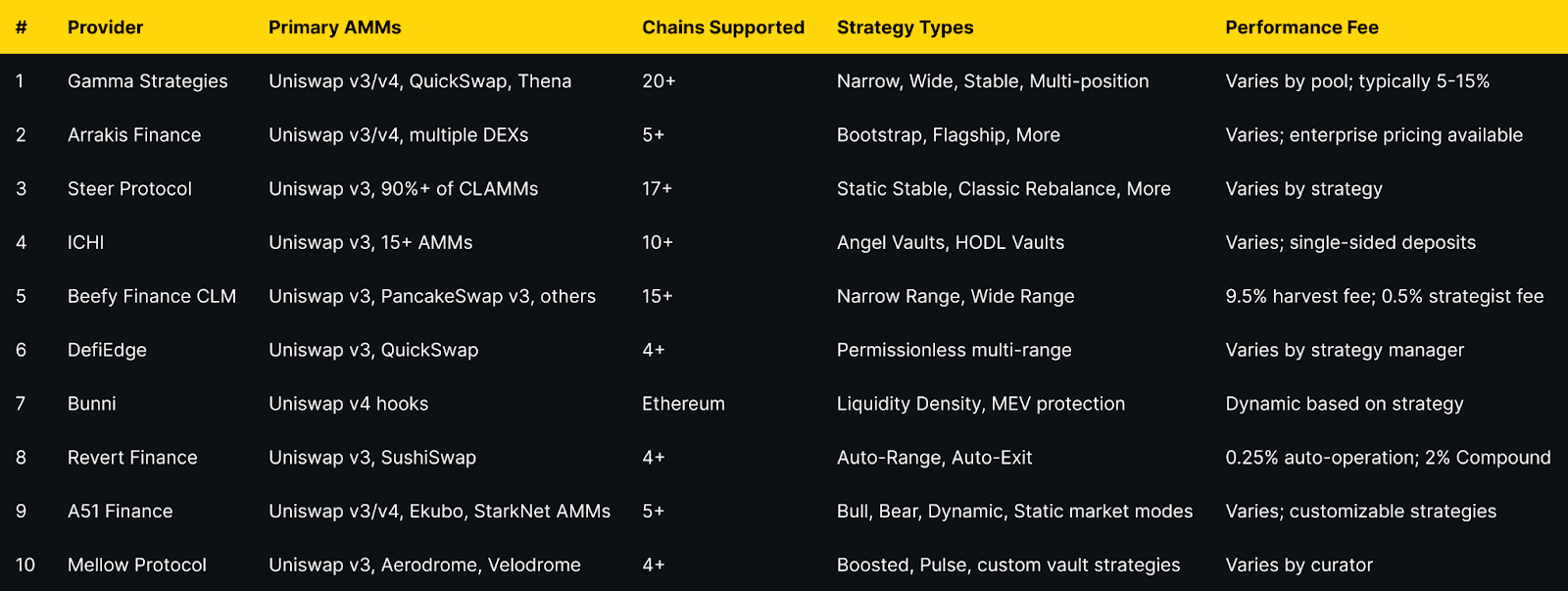
Best AMM Concentrated Liquidity Managers in November 2025 (Comparison Table)

Top 10 AMM Concentrated Liquidity Managers in November 2025

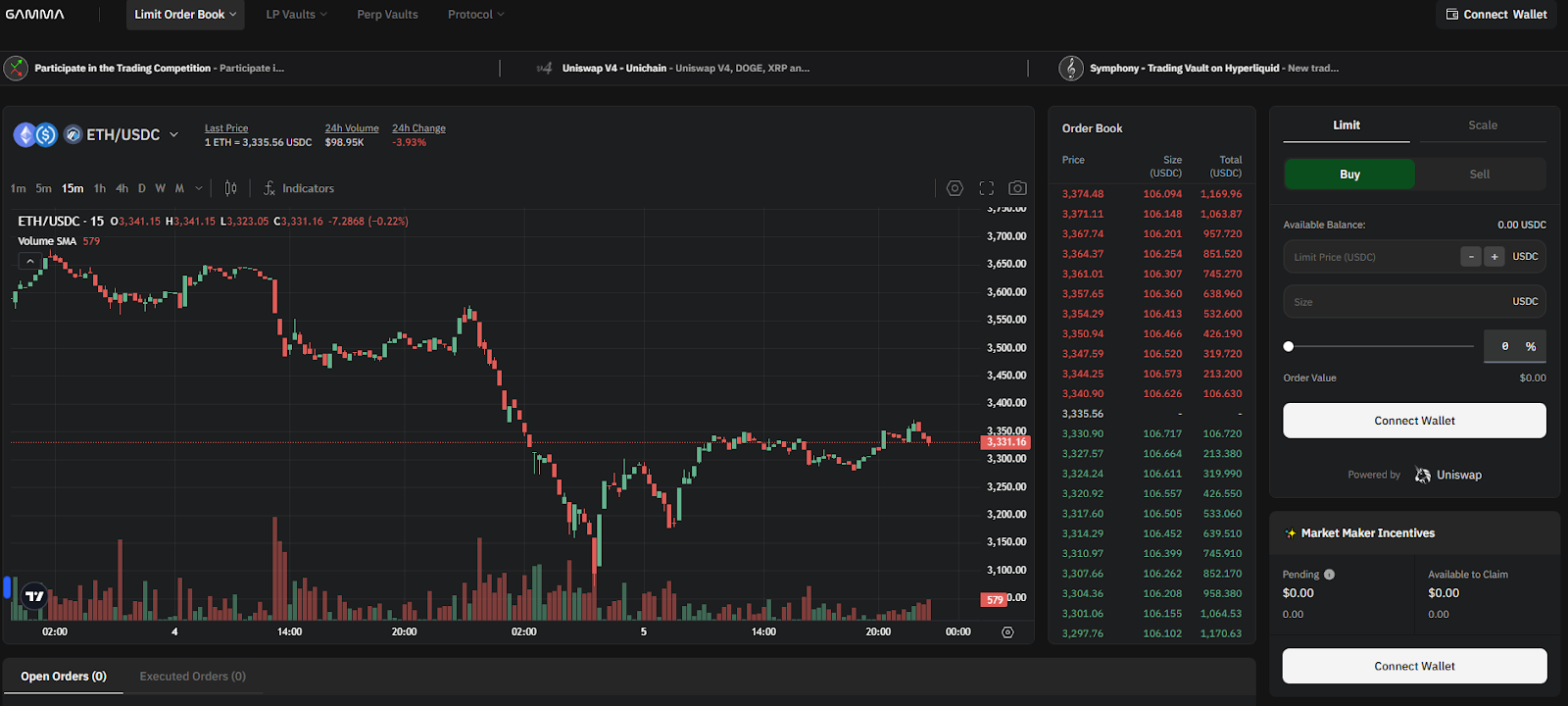
1. Gamma Strategies — Best for Multi-Chain Automated Vaults

Why Use It

Gamma Strategies operates as the most established concentrated liquidity manager with over four years of production history since March 2021. Their Hypervisor vault system automatically rebalances positions, compounds fees, and manages ranges across 20+ blockchains and multiple AMM protocols. Gamma's non-custodial approach means LPs retain control while benefiting from algorithmic management that maximizes capital efficiency and fee generation.

Best For

  • Multi-chain liquidity providers seeking diversified exposure
  • DAOs and protocols requiring active liquidity management
  • LPs wanting automated fee compounding without manual intervention
  • Users preferring ERC-20 LP tokens over NFT positions

Notable Features

  • Hypervisor smart contracts with automated rebalancing
  • Supports dual-position and multi-position strategies (up to 20 positions on Uniswap v4)
  • ERC-20 LP tokens for composability in DeFi
  • Integration with major DEXs including Uniswap v3/v4, QuickSwap, Thena, Beamswap
  • GAMMA token staking for fee-sharing

Consider If: Supported on 20+ chains but fee structures vary by pool; verify specific pool performance fees before depositing. Some pools charge 10-15% of generated fees.

Regions: Global; no geographic restrictions

Alternatives: Arrakis Finance, Steer Protocol

2. Arrakis Finance — Best for Institutional Liquidity Management

Why Use It

Arrakis Finance delivers MEV-aware onchain market making specifically designed for token issuers and institutional liquidity providers. Their Arrakis Pro service offers white-glove liquidity management with strategic templates including Bootstrap for TGE, Flagship for mature projects, and Treasury Diversification for passive accumulation. Arrakis has become the go-to solution for protocols like ether.fi, Euler, and Stargate seeking professional-grade liquidity infrastructure.

Best For

  • Token launch teams needing TGE liquidity support
  • Protocols managing protocol-owned liquidity (POL)
  • Institutional LPs requiring custom strategy execution
  • Projects seeking multi-DEX liquidity deployment

Notable Features

  • Four strategy templates: Bootstrap, Flagship, Treasury Diversification, Custom
  • Multi-DEX support (Uniswap v3/v4, PancakeSwap v3, and others)
  • MEV-aware rebalancing algorithms
  • Modules for concentrated liquidity across chains
  • Enterprise-grade support and customization

Consider If: Primarily targets institutional clients; retail LPs may find Arrakis V1 (older version) more accessible than Arrakis Pro. Performance fees vary and often involve revenue-sharing arrangements.

Fees Notes: Enterprise pricing; contact for specific fee structures

Regions: Global; primarily serves protocols and DAOs

Alternatives: Gamma Strategies, Steer Protocol

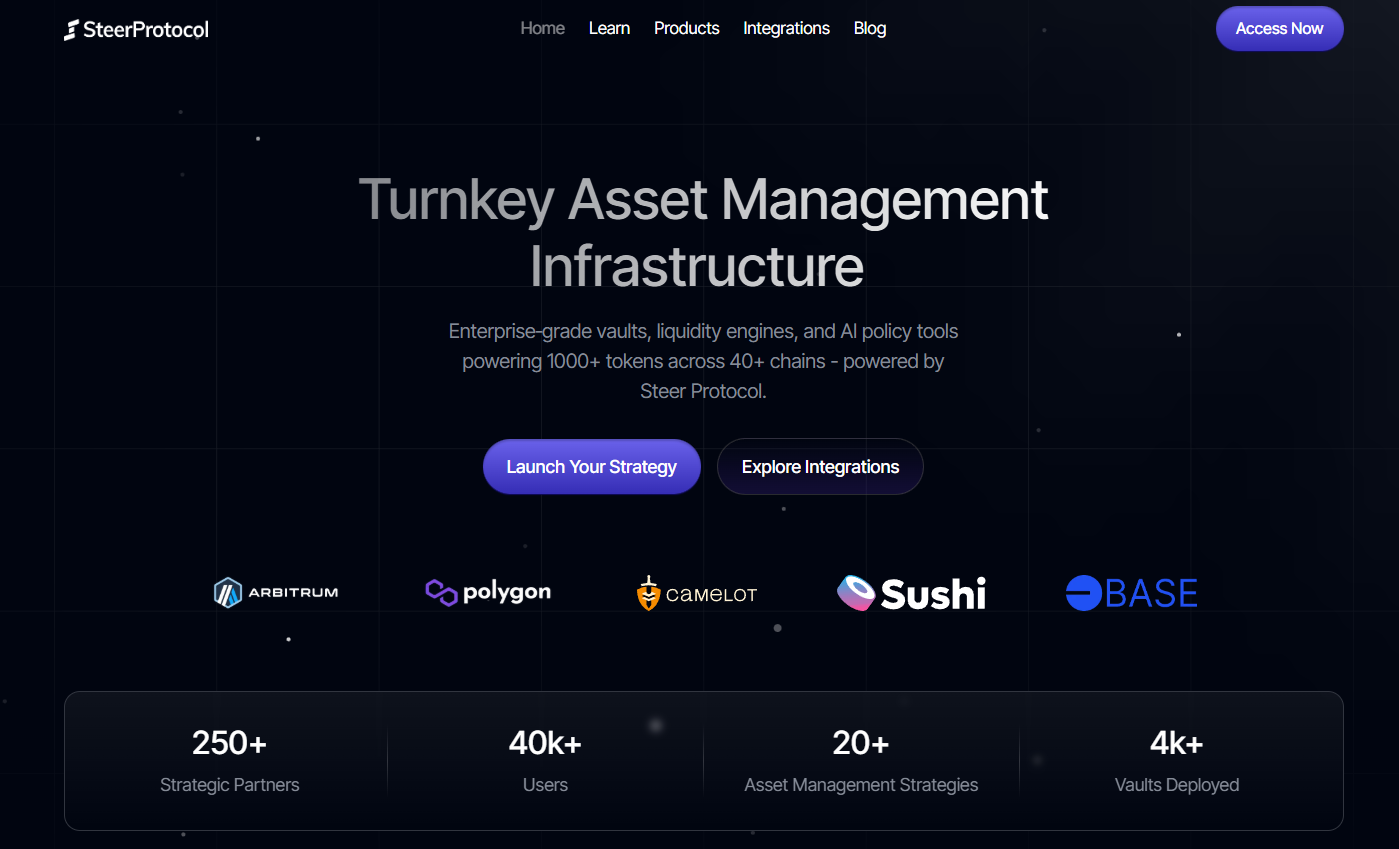
3. Steer Protocol — Best for Off-Chain Compute Strategies

Why Use It

Steer Protocol distinguishes itself through decentralized off-chain computation that enables sophisticated strategy execution without on-chain gas overhead. Supporting 17+ chains and over 90% of concentrated liquidity AMMs, Steer provides automated range management using strategies like Elastic Expansion (Bollinger Bands), Moving Volatility Channel (Keltner), and Static Stable for pegged assets. Their infrastructure powers liquidity automation for platforms like QuickSwap, Taiko, and Kinetic.

Best For

  • LPs seeking advanced technical analysis-based strategies
  • Cross-chain liquidity providers
  • Projects requiring custom liquidity shapes and automation
  • Users wanting minimal gas costs for strategy execution

Notable Features

  • Off-chain compute protocol reducing on-chain execution costs
  • Support for TypeScript, Rust, and Go strategy development
  • Multiple strategy families: Static Stable, Classic Rebalance, Volatility Channel, Elastic Expansion
  • Integration with 90%+ of CLAMMs
  • White-label infrastructure for protocols

Consider If: Strategy complexity may require more sophisticated understanding; best for LPs comfortable with advanced AMM concepts.

Fees Notes: Varies by strategy and deployment; network fees apply

Regions: Global; no restrictions

Alternatives: DefiEdge, Gamma Strategies

4. ICHI — Best for Single-Sided Deposits

Why Use It

ICHI's Yield IQ vaults revolutionize concentrated liquidity provision by accepting single-token deposits, eliminating the need for LPs to hold both sides of a trading pair. Using algorithmic strategies that maintain an 80:20 ratio, ICHI enables users to earn concentrated liquidity fees while effectively holding a single asset. Their Angel Vaults create buy-side liquidity that supports price stability for project tokens.

Best For

  • LPs wanting single-token exposure without impermanent loss on both sides
  • Projects seeking buy-side liquidity support
  • Long-term holders wanting to earn yield without selling tokens
  • DAOs managing treasury diversification

Notable Features

  • Single-sided liquidity deposits (Angel Vaults and HODL Vaults)
  • Automated rebalancing with Chainlink Keepers
  • 80:20 asset ratio maintenance
  • Support for 15+ AMMs across 10+ networks
  • Integration with concentrated liquidity incentive programs

Consider If: 80:20 rebalancing means you'll still experience some token ratio changes; not pure single-asset exposure. Best for those comfortable with managed rebalancing.

Fees Notes: Varies by vault; performance fees typically 5-10% of yields

Regions: Global; available on multiple L1s and L2s

Alternatives: DefiEdge, Gamma Strategies

5. Beefy Finance CLM — Best for Yield Optimizer Integration

Why Use It

Beefy's Concentrated Liquidity Manager (CLM) extends their proven auto-compounding infrastructure to concentrated liquidity pools, providing automated range management integrated with Beefy's broader yield optimization ecosystem. Their "Cow Token" system converts non-fungible CL positions into fungible ERC-20 tokens while maximizing capital utilization through strategies that keep positions in-range and fully active.

Best For

  • Existing Beefy users expanding into concentrated liquidity
  • LPs seeking integrated yield farming and CLM
  • Multi-chain passive investors
  • Users wanting fungible CL position tokens

Notable Features

  • Integration with Beefy's yield optimizer ecosystem
  • Supports 15+ chains including BSC, Arbitrum, Polygon, Base, Avalanche
  • Narrow and wide range strategies
  • ERC-20 "Cow Tokens" for fungible CL positions
  • Automatic fee compounding

Consider If: 9.5% harvest fee is higher than some competitors; suitable for long-term holders where compounding benefits outweigh fees.

Fees Notes: 9.5% performance fee on harvest; 0.5% to strategist; variable harvest call fee

Regions: Global; multi-chain support

Alternatives: Gamma Strategies, A51 Finance

6. DefiEdge — Best for Strategy Marketplace

Why Use It

DefiEdge creates a permissionless layer over concentrated liquidity AMMs where strategy managers can deploy custom strategies supporting up to 20 price ranges and built-in limit orders. This marketplace approach allows LPs to select from community-created strategies or deploy their own, providing unprecedented flexibility in concentrated liquidity management.

Best For

  • Advanced LPs wanting custom multi-range strategies
  • Strategy managers seeking to monetize their expertise
  • Users requiring limit order functionality
  • Projects needing tailored liquidity deployment

Notable Features

  • Support for up to 20 simultaneous price ranges
  • Built-in limit order functionality
  • Permissionless strategy creation marketplace
  • Real-time position monitoring interface
  • Automatic integration with incentive protocols like Merkl

Consider If: More complex than single-strategy platforms; requires evaluating individual strategy manager performance.

Fees Notes: Varies by strategy manager; typically 5-15% performance fees

Regions: Global; primarily Ethereum, Polygon, Optimism, Arbitrum

Alternatives: A51 Finance, Gamma Strategies

7. Bunni — Best for Uniswap v4 Innovation

Why Use It

Bunni emerged as the leading Uniswap v4 hook implementation, using programmable Liquidity Density Functions (LDFs) to create custom liquidity shapes within concentrated ranges. Their Shapeshifting feature dynamically adjusts positions, while MEV protection through am-AMM auctions and Surge Fees recaptures value that would otherwise go to arbitrageurs. Bunni also rehypothecates idle capital to Aave and Yearn for additional yield.

Best For

  • Early adopters of Uniswap v4 infrastructure
  • LPs seeking MEV-protected concentrated liquidity
  • Advanced users wanting programmable liquidity shapes
  • Projects requiring dynamic fee structures

Notable Features

  • Liquidity Density Functions for custom liquidity distribution
  • Shapeshifting for dynamic position adjustment
  • MEV protection via am-AMM mechanism and dynamic fees
  • Rehypothecation to Aave/Yearn for additional yield
  • Auto-compounding of fees and rewards

Consider If: Currently Ethereum-focused with Uniswap v4; may expand to other chains. Newer platform compared to established players like Gamma.

Fees Notes: Dynamic fees based on volatility and strategy; typical range 5-20% of yields

Regions: Global; Ethereum mainnet

Alternatives: Gamma Strategies (Uniswap v4 support), Arrakis Finance

8. Revert Finance — Best for Analytics-First Management

Why Use It

Revert Finance combines powerful analytics tools with automated management features, enabling LPs to backtest strategies, analyze top-performing positions, and then deploy automation like Auto-Range (automatic rebalancing) and Auto-Exit (stop-loss protection). Their Initiator tool allows LPs to simulate historical performance before committing capital, making Revert ideal for data-driven liquidity providers.

Best For

  • Analytical LPs wanting to backtest before deploying
  • Users seeking automated stop-loss protection (Auto-Exit)
  • LPs wanting to copy successful positions
  • Investors prioritizing transparency and performance tracking

Notable Features

  • Comprehensive analytics suite with backtesting
  • Auto-Range for automated rebalancing
  • Auto-Exit for stop-loss automation
  • Position management tools (add/withdraw/claim)
  • Top Positions discovery for copying successful strategies

Consider If: Automation features (Auto-Range/Exit) charge 0.25% per operation; may not trigger if gas costs exceed fees. Best for larger positions.

Fees Notes: 2% auto-compound fee; 0.25% per auto-operation (Range/Exit); 0.65% swap fee

Regions: Global; Ethereum, Polygon, Optimism, Arbitrum

Alternatives: Gamma Strategies, Steer Protocol

9. A51 Finance — Best for Strategy Customization

Why Use It

A51 Finance (formerly Unipilot) offers autonomous liquidity provisioning with highly customizable parameters including market modes (Bull, Bear, Dynamic, Static), rebasing strategies, and liquidity distribution patterns. Supporting Uniswap v3/v4 and expanding to StarkNet, A51 empowers LPs to design advanced strategies using hooks while addressing loss-versus-rebalancing (LVR) through sophisticated hedging mechanisms.

Best For

  • Advanced LPs wanting full strategy customization
  • Multi-chain liquidity providers (EVM + StarkNet)
  • Users requiring market-mode specific strategies
  • Projects needing flexible liquidity allocation

Notable Features

  • Market mode selection: Bull, Bear, Dynamic, Static
  • Customizable rebasing and exit preferences
  • Multiple liquidity distribution options (exponential, flat, single-tick)
  • Hedging through borrowing and options
  • Support for Uniswap v4 hooks

Consider If: Complexity requires deeper understanding of concentrated liquidity mechanics; best for experienced LPs.

Fees Notes: Varies by strategy; typically performance-based

Regions: Global; EVM chains and StarkNet

Alternatives: DefiEdge, Steer Protocol

10. Mellow Protocol — Best for Institutional Vaults

Why Use It

Mellow Protocol provides infrastructure for institutional-grade vaults with sophisticated curator models where professional risk managers and funds deploy strategies on behalf of LPs. While their focus has shifted toward broader vault infrastructure, Mellow's ALM toolkit remains integrated with Aerodrome and Velodrome, offering optimized range management with automated reward harvesting on SuperChain DEXs.

Best For

  • Institutional LPs seeking professional management
  • Aerodrome and Velodrome liquidity providers
  • Users wanting curator-managed strategies
  • Projects requiring compliance-ready vault infrastructure

Notable Features

  • Institutional-grade vault infrastructure
  • Integration with Aerodrome/Velodrome on Base and Optimism
  • Curator marketplace with professional risk management
  • Automated reward harvesting and compounding
  • Audited by ChainSecurity and BlockSec

Consider If: Less focused on pure CLM compared to dedicated platforms; best for users seeking broader DeFi yield strategies including staking and lending.

Fees Notes: Varies by curator and vault; typically 10-20% performance fees

Regions: Global; primarily Ethereum, Optimism, Base, Arbitrum

Alternatives: Arrakis Finance, Gamma Strategies

Decision Guide: Best By Use Case

  • Best for Multi-Chain Coverage → Gamma Strategies, Steer Protocol
  • Best for Token Launches (TGE) → Arrakis Finance, ICHI (Angel Vaults)
  • Best for Single-Sided Deposits → ICHI
  • Best for Lowest Management Fees → Revert Finance (for analytics + selective automation)
  • Best for Uniswap v4 Hooks → Bunni, Gamma Strategies
  • Best for Analytics & Backtesting → Revert Finance
  • Best for Institutional Management → Arrakis Finance, Mellow Protocol
  • Best for Strategy Customization → A51 Finance, DefiEdge
  • Best for BSC & Multi-Chain Yield → Beefy Finance CLM
  • Best for Aerodrome/Velodrome on SuperChain → Mellow Protocol, Steer Protocol

How to Choose the Right Concentrated Liquidity Manager (Checklist)

Before selecting a CLM platform, verify:

  • Chain Compatibility — Confirm the platform supports your target blockchain and DEX
  • Strategy Alignment — Match strategy types (narrow/wide range, stable pairs, volatile pairs) to your goals
  • Fee Structure Transparency — Understand performance fees, harvest fees, and withdrawal costs
  • Track Record & TVL — Check operational history, total value managed, and security incidents
  • Audit Status — Verify smart contracts have been audited by reputable firms
  • Token Pairs Supported — Confirm your desired liquidity pools are available
  • Rebalancing Frequency — Understand how often positions are rebalanced and gas cost implications
  • Exit Flexibility — Check withdrawal timeframes, fees, and liquidity availability
  • Performance Metrics — Review historical APRs accounting for impermanent loss
  • Composability Needs — If using LP tokens elsewhere, verify ERC-20 support vs. NFTs

Red Flags:

  • 🚩 No audits or anonymous teams without established track record
  • 🚩 Unclear fee structures or hidden withdrawal penalties
  • 🚩 Very high performance fees (>20%) without justified value-add
  • 🚩 Limited chain support if you need multi-chain exposure

Use Token Metrics With Any Concentrated Liquidity Manager

Token Metrics complements your concentrated liquidity strategy by providing:

AI Ratings — Screen tokens for quality and momentum before selecting trading pairs for liquidity provision

Narrative Detection — Identify emerging DeFi themes early to position liquidity in high-growth sectors

Portfolio Optimization — Balance concentrated liquidity positions across chains and risk profiles

Alerts & Signals — Time liquidity entries and exits based on technical and on-chain indicators


Workflow Example:

  1. Research → Use Token Metrics AI to identify high-quality token pairs
  2. Select CLM → Choose appropriate concentrated liquidity manager based on chain and strategy
  3. Deploy → Provide liquidity through automated vault or custom range
  4. Monitor → Track performance with Token Metrics alerts for rebalancing or exit signals

Start free trial to screen assets and optimize your concentrated liquidity strategy with AI-powered insights.

Security & Compliance Tips

Protect Your Concentrated Liquidity Positions:

  • Verify Contract Addresses — Always confirm official contract addresses on protocol documentation before depositing; bookmark official sites
  • Check Audit Reports — Review smart contract audits from firms like Consensys, ChainSecurity, Hydn, or BlockSec before using new platforms
  • Start Small — Test new CLM platforms with modest capital before committing significant liquidity
  • Monitor Phishing — Be wary of fake CLM interfaces; never share seed phrases or sign suspicious transactions
  • Understand Permissions — Review what approvals you're granting; consider using revoke.cash to audit token approvals
  • Track IL Exposure — Concentrated liquidity amplifies impermanent loss; monitor positions regularly and understand divergence loss implications
  • Diversify CLM Providers — Don't concentrate all liquidity with a single manager; spread risk across multiple audited platforms
  • Check Rebalancing Limits — Understand if CLMs have daily rebalancing limits or gas thresholds that might delay adjustments
  • Verify Withdrawal Process — Test small withdrawals to ensure liquidity is accessible and fees match expectations
  • Stay Informed — Follow CLM protocol announcements for security updates, parameter changes, or migration requirements

This article is for research and educational purposes only, not financial advice. Always conduct your own due diligence and consider consulting with financial advisors before providing liquidity.

Beginner Mistakes to Avoid

  • Ignoring Impermanent Loss — CLMs optimize fee generation but cannot eliminate IL; highly volatile pairs will still result in divergence loss
  • Chasing High APRs Without Context — Displayed APRs often exclude impermanent loss and may reflect short-term incentives, not sustainable yields
  • Not Understanding Fee Structures — Performance fees compound over time; a 15% fee on yields can significantly impact long-term returns
  • Depositing Without Strategy Alignment — Narrow ranges earn higher fees but require more active management; ensure strategy matches your risk tolerance
  • Overlooking Gas Costs — Rebalancing and compounding operations cost gas; on Ethereum mainnet, frequent rebalancing may erode returns for small positions
  • Assuming "Set and Forget" — While automated, CLM positions require periodic review; market regime changes may necessitate strategy adjustments
  • Not Tracking Net Performance — Always calculate returns vs. simply holding tokens; CLM fees + IL may underperform holding in ranging markets
  • Concentrating in Illiquid Pairs — Low-volume pairs may have insufficient fee generation to cover management costs and rebalancing slippage

FAQs

What is a concentrated liquidity manager?

A concentrated liquidity manager (CLM) is a DeFi protocol that automates the management of concentrated liquidity positions on AMMs like Uniswap v3. CLMs handle range selection, rebalancing, fee compounding, and position optimization, converting active liquidity provision into a passive strategy. They typically provide ERC-20 LP tokens representing managed positions, making them composable across DeFi.

Are concentrated liquidity managers safe?

Security varies by platform. Established CLMs like Gamma Strategies, Arrakis, and Steer have multiple audits and years of operational history without major exploits. However, smart contract risk always exists; never deposit more than you can afford to lose, and prioritize audited platforms with proven track records. Review audit reports and monitor protocol security updates.

What fees do concentrated liquidity managers charge?

Most CLMs charge performance fees ranging from 5-15% of generated yields. Some add harvest fees (like Beefy's 9.5%), automation fees (Revert's 0.25% per operation), or swap fees for rebalancing. Always review the specific fee structure before depositing, as fees compound over time and can significantly impact net returns.

Which chains support concentrated liquidity managers?

Major CLMs support Ethereum, Polygon, Arbitrum, Optimism, and Base. Gamma Strategies leads with 20+ chains including BSC, Avalanche, Fantom, and newer L2s. Steer Protocol supports 17+ chains with 90%+ CLAMM coverage. Always verify your target chain is supported before selecting a CLM platform.

Can I use concentrated liquidity managers on mobile?

Most CLMs offer web interfaces compatible with mobile wallets like MetaMask Mobile, Coinbase Wallet, or WalletConnect. However, complex features like strategy backtesting (Revert) or custom position building may be better suited for desktop. Core functions like depositing, withdrawing, and monitoring positions work well on mobile.

Do CLMs work with Uniswap v4?

Yes. Gamma Strategies, Bunni, and A51 Finance support Uniswap v4, which launched in January 2025. Bunni is the leading v4 hook implementation, offering advanced features like Liquidity Density Functions. Arrakis is also developing v4 modules. Expect more CLMs to add v4 support as the protocol matures.

How do CLMs handle impermanent loss?

CLMs cannot eliminate impermanent loss—they optimize range management to maximize fee generation that can offset IL. Some platforms (Bunni, ICHI) offer specific strategies to mitigate IL through MEV protection or single-sided deposits, but divergence loss remains inherent to providing liquidity in volatile pairs.

What's the difference between CLMs and regular yield optimizers?

Regular yield optimizers (like Beefy for Uniswap v2) auto-compound rewards from liquidity mining programs. CLMs specifically manage concentrated liquidity positions, handling range selection and rebalancing. Some platforms (Beefy CLM) combine both, offering concentrated liquidity management integrated with yield optimization.

Conclusion + Related Reads

Concentrated liquidity managers have matured into essential DeFi infrastructure, transforming active LP strategies into accessible passive income opportunities. For multi-chain diversification and proven track record, Gamma Strategies remains the industry standard. Token launch teams and protocols requiring institutional-grade management should consider Arrakis Finance, while those seeking cutting-edge Uniswap v4 features can explore Bunni. LPs prioritizing single-sided deposits will find ICHI most suitable, and analytics-focused investors should evaluate Revert Finance.

Remember that no CLM eliminates impermanent loss—they optimize for fee generation and capital efficiency. Always verify fee structures, audit status, and supported chains before deploying capital. Start with smaller positions to understand platform mechanics and performance before scaling up.

Related Reads:

Research

Best Crypto Liquidity Management & Market-Making Tools (2025)

Token Metrics Team
13 min read

Who this guide is for. Token teams, exchanges, funds, and DAOs comparing liquidity management and market-making tools to tighten spreads, balance inventories, and support healthy markets.

Top three picks.

  1. Flowdesk — compliance-first platform + MMaaS across 140+ venues. (flowdesk.co)
  2. Keyrock — full-stack liquidity (MM, OTC, LP mgmt, NFTs). (Keyrock)
  3. Wintermute — leading algorithmic liquidity partner across CeFi/DeFi. (wintermute.com)

One key caveat. Fees and engagement models vary widely (retainer, inventory loan/call, performance); confirm scope, reporting, and legal terms before signing. (flowdesk.co)

Introduction: Why Crypto Liquidity Management & Market-Making Tools Matter in November 2025

In crypto, liquidity management and market-making tools keep order books tight, reduce slippage, and stabilize price discovery across centralized and decentralized venues. The primary keyword here is liquidity management and market-making tools, and the right stack blends execution algorithms, risk controls, analytics, and clear reporting so projects can support listings and users can trade efficiently.

In 2025, onchain liquidity is increasingly concentrated and active on AMMs while institutions expect 24/7 coverage and API connectivity across spot, perps, and options. Mature providers now offer compliance-forward processes, automated vaults for concentrated liquidity, and multi-venue execution with transparent documentation. This guide ranks ten credible options, explains trade-offs (costs, custody, venues), and gives you a practical checklist to choose confidently.

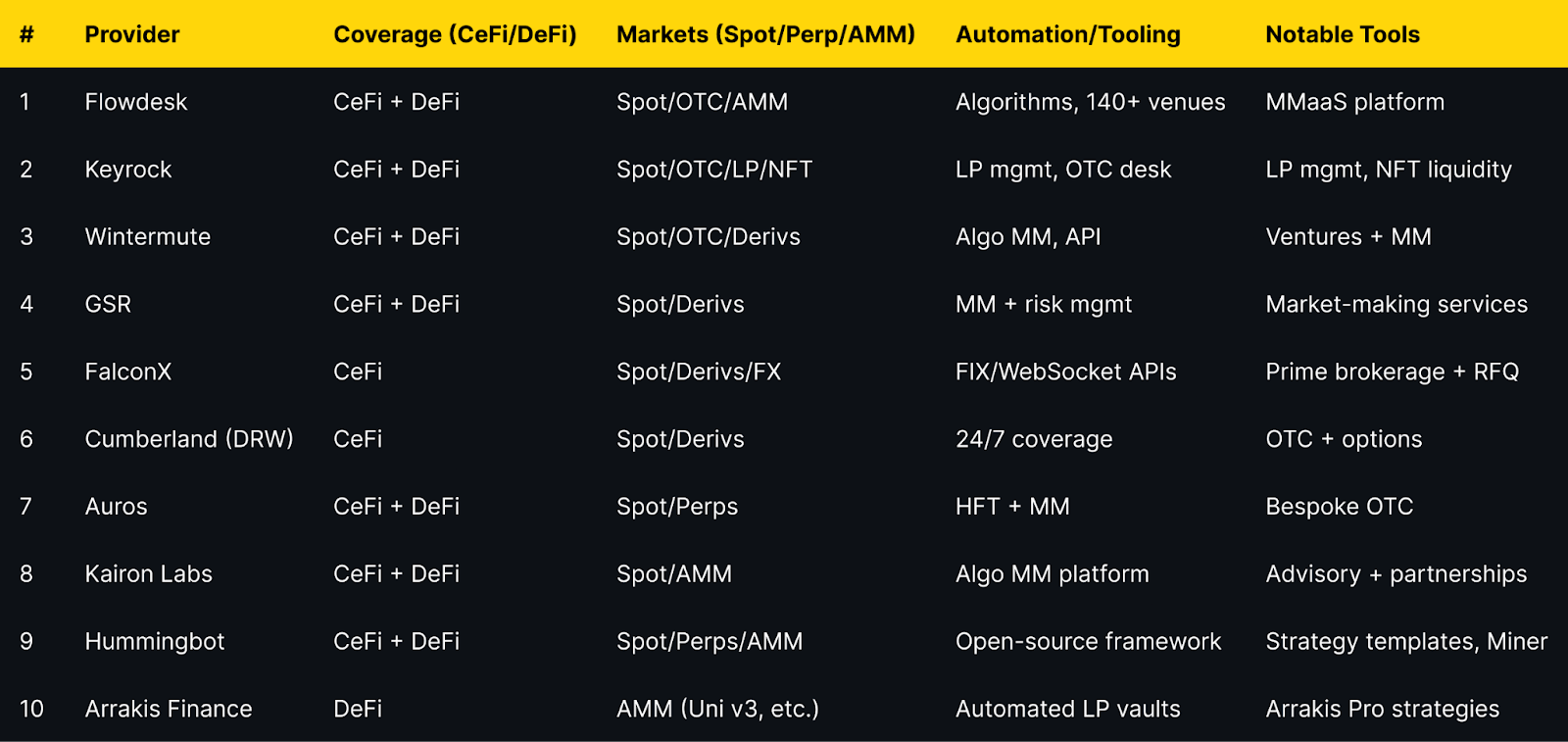
Best Crypto Liquidity Management & Market-Making Tools in November 2025 (Comparison Table)

Evidence for venue coverage and capabilities appears in provider sections below.

Top 10 Crypto Liquidity Management & Market-Making Tools in November 2025

1. Flowdesk — Best for compliance-first MMaaS at global scale

Why Use It. Flowdesk runs a compliance-first market-making and OTC platform with proprietary execution algos and integrations across 140+ centralized and decentralized exchanges, suitable for token issuers that need unified coverage and reporting. (flowdesk.co)
Best For. Token issuers; exchanges; DAOs with multi-venue liquidity needs; teams prioritizing compliance.
Notable Features. Low-latency infrastructure; MMaaS with 24/7 teams; 140+ venue connectivity; internal policies & compliance center. (flowdesk.co)
Consider If. You want documented models (retainer vs loan/call) and clear KPIs before engagement. (flowdesk.co)
Fees Notes. Custom; contract-based; network/exchange fees apply.
Regions. Global; subject to local licensing and restrictions (France DASP registration referenced on site). (flowdesk.co)
Alternatives. Keyrock; GSR.


2. Keyrock — Best for full-stack liquidity (MM, OTC, LP, NFTs)

Why Use It. Keyrock delivers market making, OTC trading, treasury solutions, and liquidity pool management for token issuers and venues; it also offers NFT liquidity and publishes security awareness and terms. (Keyrock)
Best For. Issuers needing both CeFi and DeFi coverage; platforms adding NFT or LP liquidity.
Notable Features. Liquidity pool management; OTC/options; NFT liquidity; research/insights. (Keyrock)
Consider If. You want a single counterparty handling MM + LP mgmt with documented terms. (Keyrock)
Fees Notes. Custom; scope-based; network/exchange fees may apply.
Regions. Global; services subject to applicable laws and platform eligibility.
Alternatives. Flowdesk; Wintermute.


3. Wintermute — Best for algorithmic crypto liquidity at scale

Why Use It. Wintermute is a leading algorithmic trading firm and liquidity partner that supports efficient markets across centralized and decentralized venues, with a broader ventures arm for strategic projects. (wintermute.com)
Best For. Larger token issuers and institutions that want deep, programmatic liquidity and breadth of venues.
Notable Features. Algorithmic MM; OTC; venture support; expanding US presence. (fnlondon.com)
Consider If. You need institutional processes and policy engagement in the US market. (fnlondon.com)
Fees Notes. Custom; inventory/retainer structures typical.
Regions. Global.
Alternatives. GSR; FalconX.


4. GSR — Best for crypto liquidity + risk management depth

Why Use It. GSR offers market-making and risk management across spot and derivatives, working with exchanges, token issuers, and institutions; it publishes regular research and insights. (gsr.io)
Best For. Issuers seeking experienced MM with derivatives coverage and institutional process.
Notable Features. Trading + market making services; exchange connectivity; research hub. (gsr.io)
Consider If. You need structured reporting and risk frameworks across venues.
Fees Notes. Custom; scope-based; exchange/network fees apply.
Regions. Global.
Alternatives. Wintermute; Flowdesk.

5. FalconX — Best prime brokerage + deep crypto liquidity access

Why Use It. FalconX is a prime broker with $2T+ executed and access to 400+ tokens, offering unified spot/derivs/FX execution, OTC, and APIs (WebSocket/FIX/REST). (falconx.io)
Best For. Institutions wanting a single counterparty with RFQ, streaming, and FIX integration.
Notable Features. Deep liquidity pool; algorithmic/TWAP tools; ETF issuer liquidity support; Talos integrations. (falconx.io)
Consider If. You want prime services plus execution algos rather than a pure MM retainer.
Fees Notes. Custom; execution- and volume-based; venue/network fees apply.
Regions. Global (token availability may vary). (falconx.io)
Alternatives. Cumberland; GSR.

6. Cumberland (DRW) — Best for institutional OTC and options

Why Use It. A DRW subsidiary active since 2014 in digital assets, Cumberland provides 24/7 institutional liquidity across spot, listed derivatives, bilateral options, and NDFs, with relationship coverage. (cumberland.io)
Best For. Institutions needing OTC block liquidity and derivatives structures.
Notable Features. OTC/RFQ; BTC/ETH options; futures basis; DRW backing. (cumberland.io)
Consider If. You need large, bespoke trades and derivatives hedging under institutional processes.
Fees Notes. Custom; RFQ spreads/commissions; venue/network fees apply.
Regions. Global, subject to applicable regulations.
Alternatives. FalconX; Wintermute.

7. Auros — Best for HFT-driven market-making with bespoke design

Why Use It. Auros combines high-frequency trading and strategic market making across CeFi and DeFi with bespoke OTC and transparency-oriented reporting for token stability. (Auros)
Best For. Projects seeking a partner for token launch support and stability across venues.
Notable Features. HFT + MM stack; CeFi/DeFi coverage; insights & reporting. (Auros)
Consider If. You want tailored strategies and comms during volatility.
Fees Notes. Custom; scope-based; network/venue fees apply.
Regions. Global.
Alternatives. Kairon Labs; GSR.

8. Kairon Labs — Best issuer-focused market-making + advisory

Why Use It. Kairon Labs provides algorithmic market making, liquidity provision, partnerships, and advisory for issuers, with educational content on MM models (designated vs principal). (kaironlabs.com)
Best For. Small–mid cap issuers needing hands-on guidance plus execution.
Notable Features. Issuer-centric services; partnerships support; model education. (kaironlabs.com)
Consider If. You want advisory plus MM under one roof.
Fees Notes. Custom; scope-based; exchange/network fees apply.
Regions. Global.
Alternatives. Auros; Flowdesk.

9. Hummingbot — Best open-source framework for DIY market making

Why Use It. Hummingbot is an open-source Python framework to run automated strategies on any CEX/DEX, with built-in templates for pure market making and perpetual MM and extensive docs. (hummingbot.org)
Best For. Developers, quant hobbyists, and small desks wanting DIY automation.
Notable Features. Strategy library; Docker/API quickstarts; Miner rewards marketplace. (hummingbot.org)
Consider If. You accept self-hosting and operational overhead instead of a service contract.
Fees Notes. Software is free; trading/withdrawal/network fees still apply.
Regions. Global (open-source).
Alternatives. Arrakis (for LP vaults); Keyrock (for managed LP).

10. Arrakis Finance — Best for automated onchain LP management (Uni v3 & more)

Why Use It. Arrakis provides automated LP vaults and Arrakis Pro strategies for token issuers to manage concentrated liquidity with rebalancing and inventory targeting. (arrakis.finance)
Best For. Projects prioritizing DeFi AMM depth and capital efficiency on Uniswap v3-style DEXs.
Notable Features. Ongoing inventory management; automated rebalancing; issuer-specific vault programs. (arrakis.finance)
Consider If. You need onchain, non-custodial liquidity programs over CeFi MM retainers.
Fees Notes. Protocol/vault fees; gas costs on supported chains.
Regions. Global (onchain).
Alternatives. Hummingbot (DIY); GSR (CeFi/MM).

Decision Guide: Best By Use Case

  • Regulated, compliance-first MMaaS: Flowdesk. (flowdesk.co)
  • One-stop liquidity incl. NFTs & LP mgmt: Keyrock. (Keyrock)
  • Algorithmic MM at institutional scale: Wintermute or GSR. (wintermute.com)
  • Prime brokerage + FIX/WebSocket execution: FalconX. (falconx.io)
  • OTC blocks + options structures: Cumberland (DRW). (cumberland.io)
  • Launch support with HFT expertise: Auros. (Auros)
  • Issuer-centric MM + advisory: Kairon Labs. (kaironlabs.com)
  • DIY automation (open-source): Hummingbot. (hummingbot.org)
  • Onchain concentrated liquidity programs: Arrakis Finance. (arrakis.finance)

How to Choose the Right Crypto Liquidity Management & Market-Making Tool (Checklist)

  • Region eligibility & licensing: Confirm provider registrations and legal terms in your jurisdictions.
  • Venue coverage: CeFi exchanges, perps venues, and DeFi AMMs you actually need.
  • Inventory model: Retainer vs. inventory loan/call; required collateral and risks. (flowdesk.co)
  • Execution stack: APIs (FIX/WebSocket/REST), algos, latency, and monitoring. (falconx.io)
  • Onchain LP management: If DeFi-first, evaluate vault design, rebalancing, and transparency. (arrakis.finance)
  • Reporting & SLAs: Daily/weekly liquidity KPIs, spread targets, uptime, incident process.
  • Security & compliance: Insider-trading controls, conflict-of-interest policies, audits/policies page. (flowdesk.co)
  • Costs & fees: Understand spread capture, performance fees, platform fees, and gas.
  • Offboarding plan: Access to accounts, revocation of keys, vault migrations, and documentation.

Red flags: No written terms, vague reporting, or inability to name supported venues.

Use Token Metrics With Any Crypto Liquidity Provider

  • AI Ratings to screen assets by quality and momentum before listings.


  • Narrative Detection to catch early theme shifts that can impact liquidity.
  • Portfolio Optimization to size inventory across chains and LPs.
  • Alerts & Signals to time entries/exits and rebalance LP ranges.

Workflow: Research in Token Metrics → Select provider → Execute on-chain/CeFi → Monitor with alerts.


Start free trial to screen assets and time entries with AI.


Security & Compliance Tips

  • Prefer partners that publish policies/compliance pages and name registrations. (flowdesk.co)
  • Segregate exchange accounts and use least-privilege API keys; rotate regularly.
  • For DeFi vaults, verify non-custodial design, fee schedules, and admin controls. (arrakis.finance)
  • Confirm reporting cadence (inventory, spreads, volume, venue list).
  • Use official domains and channels to avoid impersonation. (Keyrock)
  • Understand engagement models (retainer vs loan/call) and associated risks. (flowdesk.co)

This article is for research/education, not financial advice.

Beginner Mistakes to Avoid

  • Signing without clear KPIs (spread, depth, venue list).
  • Ignoring region restrictions or licensing.
  • Overlooking DeFi vault mechanics (rebalance rules, fees, inventories). (arrakis.finance)
  • Mixing treasury and MM wallets without operational controls.
  • Choosing CeFi-only when you need AMM depth (or vice versa).
  • Underestimating implementation: APIs, custody, exchange listings, oracle feeds.

How We Picked (Methodology & Scoring)

We scored each provider using the following weights:

  • Liquidity — 30% (depth, spreads, execution venues)
  • Security — 25% (controls, disclosures, compliance posture)
  • Coverage — 15% (CeFi/DeFi, spot/derivs, chain support)
  • Costs — 15% (fee clarity, model fit, onchain costs)
  • UX — 10% (integration, tooling, reporting)
  • Support — 5% (24/7 coverage, responsiveness)

Data sources: official product, docs, pricing/terms, security/policies, and status pages; reputable market datasets used only to cross-check scale and venues. Last updated November 2025.

FAQs

What are liquidity management and market-making tools?
 Software platforms and service providers that supply bids/asks, balance inventory, and manage onchain liquidity so markets remain liquid with tighter spreads and lower slippage (CeFi and DeFi).

Are managed market makers or DIY bots safer?
 Managed providers handle execution, risk, and reporting under contracts; DIY bots like Hummingbot provide control but require operational expertise and monitoring. Choose based on team capacity and risk tolerance. (hummingbot.org)

How do providers charge?
 Common models include retainers, inventory loan/call structures, execution fees/spreads, and protocol/vault fees on DeFi. Clarify model, caps, and KPI targets before engagement. (flowdesk.co)

Can I combine CeFi MM with DeFi vaults?
 Yes. Many issuers use a CeFi MM for order books plus an onchain LP manager (e.g., Arrakis) for AMM depth, with shared reporting and risk limits. (arrakis.finance)

Do these tools work in the US/EU/APAC?
 Most providers are global but subject to local regulations, listings, and counterparty restrictions. Check each provider’s terms/compliance pages and confirm venue eligibility. (flowdesk.co)

Conclusion + Related Reads

If you want compliance-centric, multi-venue coverage, start with Flowdesk or Keyrock. For institutional scale, add Wintermute or GSR. If you need prime services and execution, consider FalconX or Cumberland. For DIY or onchain-first, evaluate Hummingbot and Arrakis.

Related Reads (Token Metrics):

Research

Best Crypto Launchpads & IDO/IEO Platforms (2025)

Token Metrics Team
16 min read

Who this guide is for. Crypto investors comparing best crypto launchpads 2025 to access early token sales with clearer rules, costs, and eligibility.

Top three picks.

  • Binance Launchpad — scale + liquidity, clear subscription/holding models. (Binance Launchpad | Binance)
  • OKX Jumpstart — simple mining/sale formats, frequent events. (OKX)
  • Bybit Launchpad — accessible formats across CEX + Web3 IDO. (bybit.com)

One key caveat. Availability varies by jurisdiction (many CEX launchpads restrict U.S. users and require KYC). Always check your platform’s official eligibility and KYC pages. (Binance)

Introduction: Why Crypto Launchpads & IDO/IEO Platforms Matter in November 2025

Definition (snippet-ready): A crypto launchpad is a platform that hosts early token distribution events (IDO/IEO) with defined participation rules, allocations, and settlement.

In 2025, primary-market access has consolidated around large exchanges and a handful of battle-tested decentralized platforms. For investors, best crypto launchpads 2025 decisions hinge on liquidity, security/compliance, costs, and eligibility. Centralized exchange (CEX) launchpads (e.g., Binance, OKX, Bybit) emphasize KYC and region filters, while decentralized launchpads (e.g., Polkastarter, DAO Maker) lean on wallet-based participation and project curation. We scored providers using transparent weights, verified details only from official pages, and noted regional restrictions where platforms disclose them. Freshness: Updated November 2025.

How We Picked (Methodology & Scoring)

We shortlisted ~20 credible platforms, then selected TOP_N = 10 based on official evidence (docs/help/pricing/status/security pages). Third-party data was used only for cross-checks, not cited.

Scoring Weights (sum = 100):

  • Crypto Liquidity — 30% (exchange depth, historical sale demand, listing path)
  • Security — 25% (KYC/eligibility controls, disclosures, operational maturity)
  • Coverage — 15% (event frequency, multichain reach)
  • Costs — 15% (explicit sale/processing fees when stated; otherwise “varies; network fees apply”)
  • UX — 10% (clarity of rules, access flow)
  • Support — 5% (help center clarity, announcements cadence)

Data sources: Official product, help, terms, and announcement pages; platform status/audit pages where available. Last updated: November 2025.

Best Crypto Launchpads & IDO/IEO Platforms in November 2025 (Comparison Table)

* Always confirm current eligibility on the platform’s official Terms/Help pages before participating.
** Some decentralized pools may require external KYC/allowlists set by the project.

Top 10 Crypto Launchpads & IDO/IEO Platforms in November 2025

1. Binance Launchpad — Best for scale and liquidity

Why Use It. Binance Launchpad runs subscription-style sales that typically require BNB holdings across a snapshot window, then proportional allocation by committed BNB. The process is well documented and integrated with Binance listings, giving post-sale liquidity depth. (Binance Launchpad | Binance)
Best For. Allocation hunters, liquidity-first traders, portfolio builders seeking large-venue listings.
Notable Features. Subscription model; BNB commitment windows; integrated post-listing ecosystem; robust help center. (Binance)
Consider If. Not available in prohibited jurisdictions; KYC required. (Binance)
Fees Notes. Varies; trading/network fees apply.
Regions. Global, with restricted countries noted in Terms. (Binance)
Alternatives. OKX Jumpstart, Bybit Launchpad.


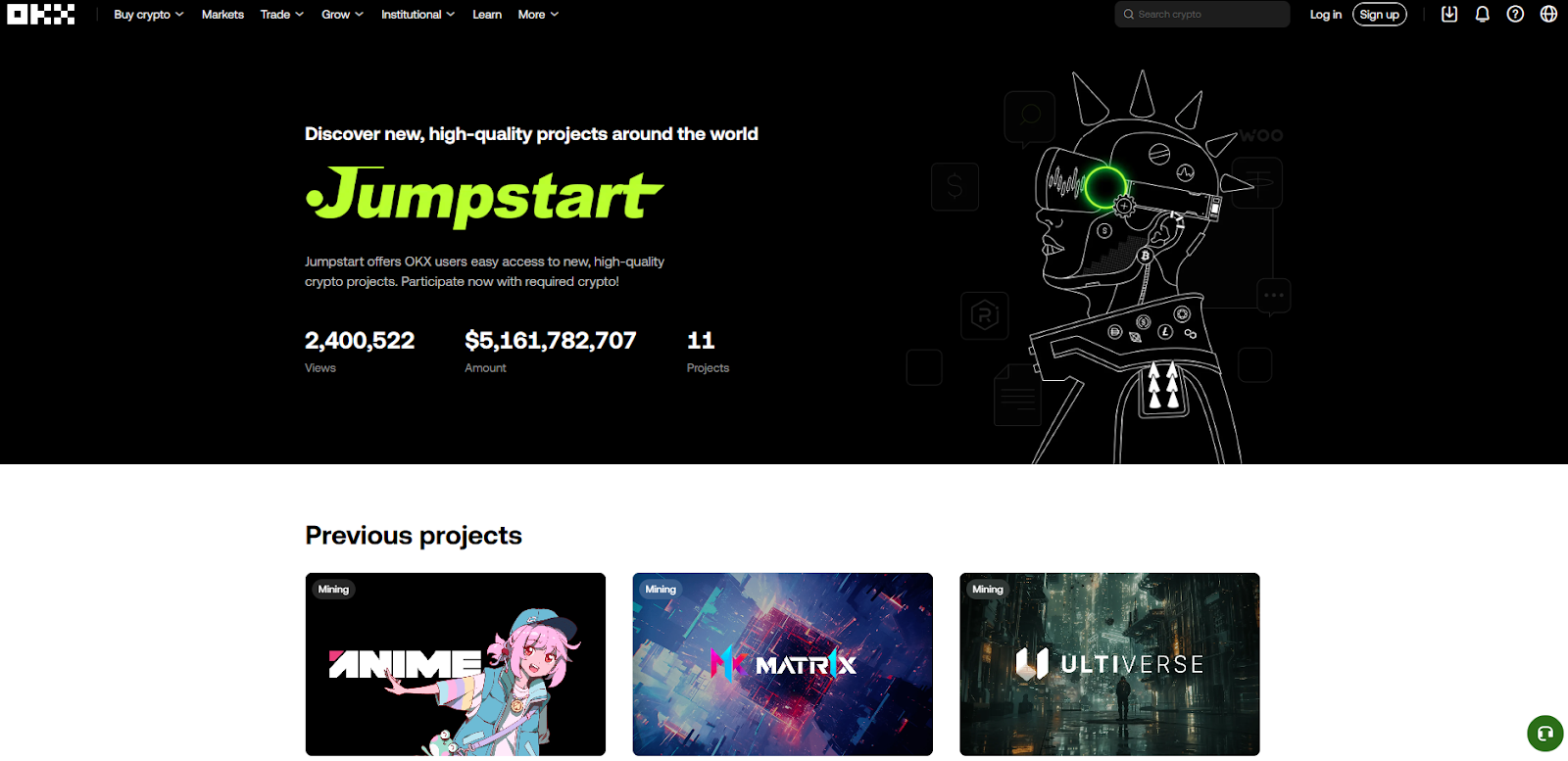
2. OKX Jumpstart — Best for simple mining + sale formats

Why Use It. Jumpstart offers Mining events where users stake assets (e.g., OKB, BTC, ETH) to earn new tokens, alongside occasional On-Sale formats. Participation rules are clearly posted per event. (OKX)
Best For. Long-only users holding OKB/BTC/ETH, set-and-forget miners, diversified hunters of frequent drops.
Notable Features. Mining & sale dual formats; event pages with tokenomics; frequent announcements. (OKX)
Consider If. Jurisdiction limits apply; verify your eligibility. (OKX)
Fees Notes. Varies; network fees apply.
Regions. Global with restrictions per OKX policies.
Alternatives. Binance Launchpad, Gate Startup.


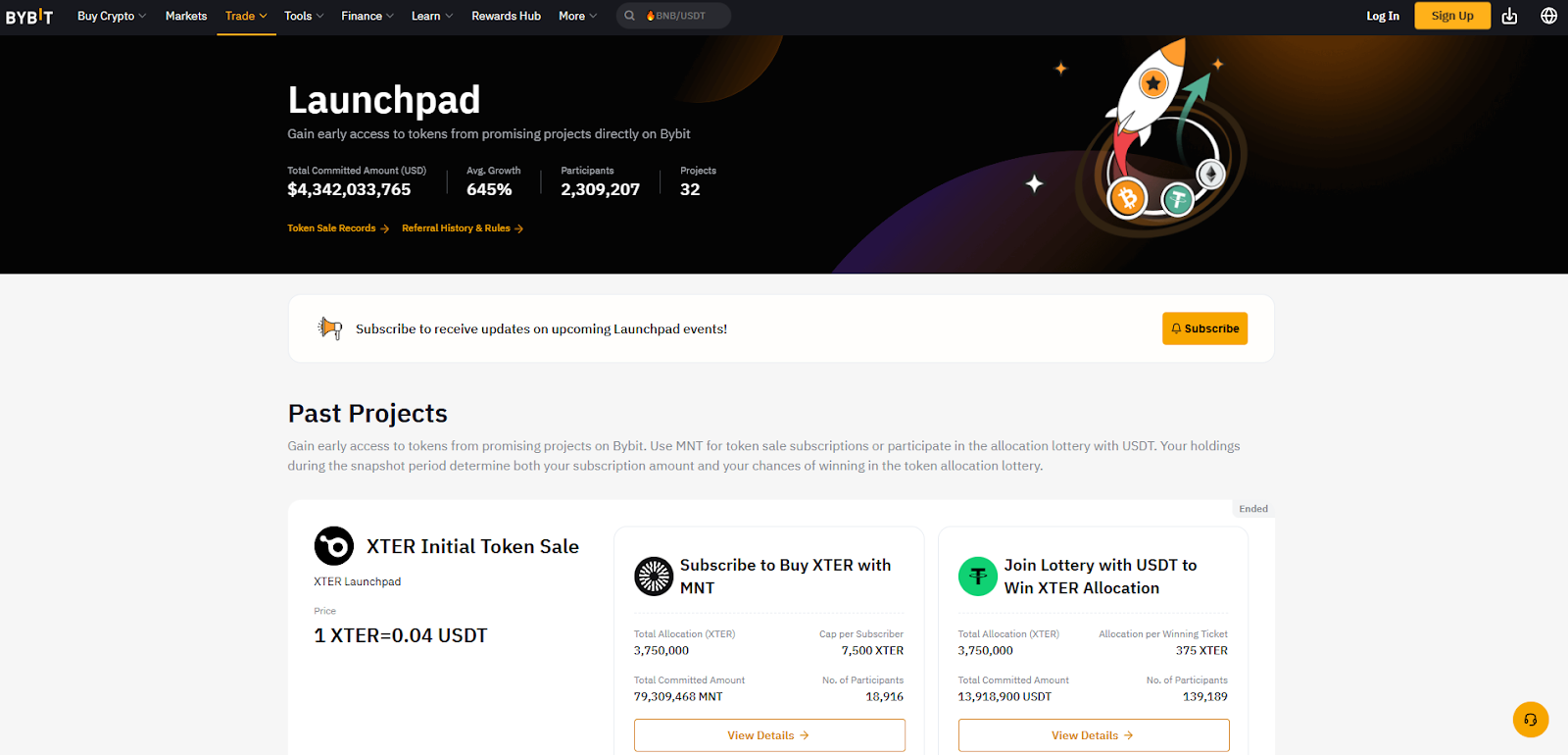
3. Bybit Launchpad — Best CEX + Web3 coverage

Why Use It. Bybit runs subscription/lottery sales on the exchange and also operates a Web3 IDO platform for wallet-based participation. Clear KYC tiers and frequent help-center updates support new users. (bybit.com)
Best For. Users who want both exchange launchpad and Web3 IDO in one brand, ticket/lottery mechanics.
Notable Features. Subscription and lottery formats; Web3 IDO portal; detailed KYC guidance. (bybit.com)
Consider If. Not available in excluded jurisdictions (e.g., U.S.). (bybit.com)
Fees Notes. Varies; network fees apply.
Regions. Global (excluded jurisdictions listed by Bybit). (bybit.com)
Alternatives. Binance Launchpad, Bitget Launchpad.


4. KuCoin Spotlight — Best for altcoin discovery on a major exchange

Why Use It. Spotlight aggregates new listings and has hosted high-profile events. Participation generally requires KYC and following sale-specific rules posted in help/announcement pages. (KuCoin)
Best For. Altcoin-oriented users who want curated sales and subsequent exchange liquidity.
Notable Features. Dedicated Spotlight center; sale how-to guides; history of ended sales. (KuCoin)
Consider If. U.S. users are restricted per KuCoin Terms. (KuCoin)
Fees Notes. Varies; network fees apply.
Regions. Global (U.S. and other locations restricted). (KuCoin)
Alternatives. Gate Startup, MEXC Kickstarter.

5. Gate Startup (Gate.io) — Best for frequent offerings and varied formats

Why Use It. Gate’s Startup page offers discount and free-offering formats, with active cadence and explicit instructions in announcements and help articles. KYC is required for participation. (Gate.com)
Best For. Deal hunters, high-frequency participants, multi-format collectors.
Notable Features. Discount and free-offering modes; constant announcements; centralized hub. (Gate.com)
Consider If. Make sure you’ve completed Gate KYC before events. (Gate.com)
Fees Notes. Varies; network fees apply.
Regions. Global (subject to KYC and eligibility).
Alternatives. OKX Jumpstart, MEXC Kickstarter.

6. Bitget Launchpad — Best for BGB-based subscription or ticket access

Why Use It. Bitget runs subscription and ticket models, often tied to BGB holdings/trading activity. Official FAQ and blog posts detail eligibility and formats. (bitget.com)
Best For. Users already in the Bitget ecosystem; lottery-style allocation seekers.
Notable Features. BGB-linked ticketing; subscription flows; event records page. (bitget.com)
Consider If. Region limits apply and formats can vary by event.
Fees Notes. Varies; network fees apply.
Regions. Global with restrictions.
Alternatives. Bybit Launchpad, HTX Primelist.

7. MEXC Kickstarter / Launchpad — Best for vote-to-airdrop mechanics

Why Use It. Kickstarter lets MX holders vote to support pre-launch projects and receive airdrops when thresholds are met; official FAQs outline steps and eligibility. (MEXC)
Best For. Airdrop hunters, MX token holders, event-driven users.
Notable Features. Vote-to-airdrop; quick-commit across events; MX minimums. (MEXC)
Consider If. Rewards, formats, and eligibility can change per event—read each page.
Fees Notes. Varies; network fees apply.
Regions. Global with restrictions.
Alternatives. Gate Startup, Bitget Launchpad.

8. HTX Primelist — Best for ticket/commit sale mechanics

Why Use It. Primelist runs ticket/commit structures where users may lock HT/USDT or complete tasks to obtain tickets; official announcements describe cadence and rules. (htx.com)
Best For. Users comfortable with ticket allocations and exchange-based listings.
Notable Features. Ticket draws; commitment options; frequent listing promos. (htx.com)
Consider If. Check jurisdiction limits and sale-specific rules each time.
Fees Notes. Varies; network fees apply.
Regions. Global with restrictions.
Alternatives. Bitget Launchpad, Bybit Launchpad.

9. Polkastarter — Best decentralized IDO for whitelists and on-chain caps

Why Use It. Polkastarter hosts curated on-chain IDOs with per-address caps and allowlists, giving transparent pool limits and wallet-based participation. Project pages and a launch portal outline the process. (polkastarter.com)
Best For. Users preferring self-custody, on-chain settlement, and project allowlists.
Notable Features. On-chain pools; whitelist workflows; project directories. (polkastarter.com)
Consider If. Some projects impose geofences/KYC—always read pool terms.
Fees Notes. Network gas; project-level terms.
Regions. Global; project-dependent restrictions may apply.
Alternatives. DAO Maker, CoinList.

10. CoinList — Best for fully KYC’d token sales and wallet funding

Why Use It. CoinList runs queued token sales with per-sale minimums/maximums and strict KYC. Help articles detail wallet funding in USDC/USDT and purchase flows. (CoinList)
Best For. Users who prefer structured, compliance-forward public sales with clear limits.
Notable Features. Queue systems; per-sale caps; explicit instructions; wallet funding guides. (CoinList)
Consider If. Eligibility varies by sale; expect KYC and sometimes region-specific exclusions.
Fees Notes. Stated per sale; network fees apply.
Regions. Global (U.S. participation depends on each sale’s terms).
Alternatives. Polkastarter, Binance Launchpad.

Decision Guide: Best By Use Case

  • Largest venue + liquidity: Binance Launchpad. (Binance Launchpad | Binance)
  • Stake-to-earn + sales cadence: OKX Jumpstart. (OKX)
  • Exchange + Web3 IDO in one brand: Bybit Launchpad / Bybit Web3 IDO. (bybit.com)
  • Altcoin discovery, historical sale stream: KuCoin Spotlight. (KuCoin)
  • Frequent discount/free offerings: Gate Startup. (Gate.com)
  • Lottery/ticket mechanics with native token: Bitget Launchpad. (bitget.com)
  • Vote-to-airdrop model: MEXC Kickstarter. (MEXC)
  • Ticket/commit structure alternative: HTX Primelist. (htx.com)
  • Decentralized, wallet-based IDO: Polkastarter. (polkastarter.com)
  • KYC-heavy, queued sales: CoinList. (CoinList)

How to Choose the Right Launchpads & IDO/IEO Platforms (Checklist)

  • Confirm region eligibility and KYC requirements on official pages. (Binance)
  • Match participation model to your balance (subscription, tickets, staking, whitelist).
  • Review allocation math (proportional vs. lottery vs. per-address caps).
  • Verify fees and settlement (sale fees if stated; otherwise network gas).
  • Assess liquidity path post-sale (likely listing venue/pairs).
  • Read project pages/announcements for rules and tokenomics. (OKX)
  • Confirm wallet readiness (CEX spot wallet vs. Web3 wallet).
  • Check support/help centers for timelines and dispute processes. (bybit.com)
  • Look for status/security disclosures when available.
  • Red flag: Guaranteed returns, unclear token distribution, or missing official docs.

Use Token Metrics With Any Crypto Launchpads & IDO/IEO Platforms

  • AI Ratings to screen assets for quality and momentum before committing.
  • Narrative Detection to spot emerging themes early.


  • Portfolio Optimization to size positions across chains and venues.
  • Alerts & Signals to time unlocks, listings, and trend shifts.

Workflow: Research with TM → Choose platform → Execute sale participation → Monitor with alerts.

Start free trial to screen assets and time entries with AI.


Security & Compliance Tips

  • Use official URLs only; watch for spoofed domains.
  • Complete KYC where required; never share documents outside official flows. (bybit.com)
  • For decentralized sales, verify contract addresses and pool caps on official pages. (polkastarter.com)
  • Understand allocation rules (subscription math, lottery odds, staking snapshots). (Binance)
  • Track vesting/claim portals via official announcements. (OKX)
  • Avoid over-approving Web3 wallets; limit approvals and revoke after use.
  • Maintain 2FA and withdrawal allowlists on CEX accounts.
  • {This article is for research/education, not financial advice.}

Beginner Mistakes to Avoid

  • Joining from a restricted jurisdiction and losing access later. (bybit.com)
  • Ignoring sale-specific rules (snapshots, minimums, per-sale caps). (CoinList)
  • Using the wrong wallet type for Web3 IDO vs. CEX subscription. (bybit.com)
  • Overlooking vesting/claim deadlines and token distribution mechanics. (OKX)
  • Falling for unofficial links or phishing around high-demand sales.
  • Committing more than you can afford under volatile market conditions.

How We Picked (Methodology & Scoring)

We evaluated ~20 providers (including Seedify, TrustPad, BSCPad, PinkSale, BullPerks, Enjinstarter, Poolz, WeStarter, GameFi, ApeTerminal, and Republic Crypto) for liquidity (30), security (25), coverage (15), costs (15), UX (10), support (5) using only official pages for claims. We excluded defunct/region-ineligible platforms for Global readers or those lacking current official documentation. Last updated November 2025.

FAQs

What is a crypto launchpad?
 A platform that hosts early token distributions (IDO/IEO) with rules for eligibility, allocation, and settlement, either on an exchange or on-chain.

Are launchpads safe?
 Safety depends on the platform and the project. Prefer venues with clear KYC/eligibility, transparent rules, and official documentation, and use strong account security. (Binance)

What fees should I expect?
 Some platforms state sale/processing terms on event pages; otherwise expect network gas and standard trading fees after listing. Always read each sale’s official page.

Can U.S. users participate?
 Many CEX launchpads restrict U.S. users per their Terms. Check platform eligibility before committing. (Binance)

Do I need KYC?
 Most CEX launchpads require KYC. Decentralized IDOs may be wallet-only but can still impose allowlists or geofences per project. (bybit.com)

How do allocation methods differ?
 Common approaches include proportional subscription, lottery/tickets, staking/mining, and whitelist caps for on-chain pools. (Binance)

Conclusion + Related Reads

If you want the broadest liquidity and simple participation, start with Binance Launchpad or OKX Jumpstart. For CEX + Web3 flexibility, Bybit stands out. Prefer self-custody? Explore Polkastarter and read each project’s terms carefully. Pair your launchpad activity with Token Metrics research, alerts, and portfolio tools to manage risk.

Related Reads:

Choose from Platinum, Gold, and Silver packages
Reach with 25–30% open rates and 0.5–1% CTR
Craft your own custom ad—from banners to tailored copy
Perfect for Crypto Exchanges, SaaS Tools, DeFi, and AI Products