
Crypto Basics

Trezor vs Ledger - Which Crypto Wallet is Better?

Explore the features, security, and usability of Trezor and Ledger wallet. Dive deep into the comparison to determine the best crypto wallet for your needs.
Marcus K
6 Minutes
MIN

In the world of cryptocurrency, the question of security is paramount. No matter how well you understand the market, or how diversified your portfolio is, if you don’t safeguard your assets, all can be lost in the blink of an eye. 

Two names stand out in the hardware wallet industry: Trezor and Ledger. Both promise top-notch security, but which one should you entrust with your digital gold? Let's dive deep and make an informed decision.

What is a Hardware Wallet?

Before we start, it's essential to grasp what a hardware wallet is. Simply put, it's a physical device, often resembling a USB stick, that stores your cryptocurrency private keys offline. 

By keeping the keys offline, it offers protection against online hacking attempts, a significant advantage over online wallets.

Trezor Wallet Overview

Trezor Wallet is a pioneering hardware wallet developed by SatoshiLabs, a Czech-based company. Introduced in 2013, Trezor set the gold standard for cold storage of cryptocurrencies. 

Unlike traditional online wallets, which are vulnerable to hacks, Trezor keeps your private keys offline, ensuring top-tier security against cyber threats. It's a compact device, somewhat resembling a USB flash drive, which connects to your computer or smartphone. 

The wallet supports over a thousand different cryptocurrencies, providing both accessibility and security. Its intuitive interface, combined with features like pin protection, physical transaction confirmation, and a recovery seed system, ensures that even beginners can handle their crypto holdings with confidence and peace of mind.

Origin: Czech Republic

Founded: 2013 by SatoshiLabs

Popular Models: Trezor One, Trezor Model T

Ledger Wallet Overview

Ledger Wallet stands as one of the crypto community's most trusted hardware wallet solutions. Founded in France in 2014, Ledger offers users the security of cold storage combined with the flexibility of more than 1,800 supported cryptocurrencies. 

Distinctively, Ledger incorporates a Secure Element (SE) chip, an advanced layer of protection against potential breaches. Resembling a sleek USB device, the Ledger can be connected to both computers and mobile devices. 

Through its proprietary Ledger Live software, users can seamlessly manage transactions, check balances, and perform firmware updates. 

With mandatory pin protection, physical verification of transactions, and a 24-word recovery seed mechanism, Ledger maintains a balance of user-friendliness and robust security for crypto enthusiasts.

Origin: France

Founded: 2014

Popular Models: Ledger Nano S, Ledger Nano X

Ledger vs Trezor - Security Features

Both devices prioritize security. After all, that's their primary function. Let's look at how each performs in this domain.

Trezor:

  • Pin Protection: A mandatory feature ensuring only the device's rightful owner can access it.
  • Physical Verification: Transactions require manual approval using the device's buttons.
  • Recovery Seed: A 12-24 word seed allows recovery of assets if the device is lost.

Ledger:

  • Secure Element (SE) Chip: Ledger incorporates an SE chip, adding an extra layer of security.
  • Pin Protection: Similar to Trezor, pin protection is mandatory.
  • Physical Verification: Transactions need manual approval.
  • Recovery Seed: 24-word seed for asset recovery.

Ledger vs Trezor - Compatibility

One of the primary considerations for crypto enthusiasts when selecting a hardware wallet is the range of supported cryptocurrencies. Ledger and Trezor, the industry titans, both offer extensive compatibility, albeit with some differences. 

Ledger, with its Ledger Live software, proudly supports over 1,800 coins and tokens, ensuring that users can securely manage a broad spectrum of assets from major currencies like Bitcoin and Ethereum to numerous ERC-20 tokens. 

On the other hand, Trezor isn't far behind, boasting support for more than 1,000 coins and tokens. While it provides native support for heavyweights like Bitcoin and Ethereum, certain lesser-known coins might require third-party interfaces. 

Ultimately, while both wallets cater to the majority of crypto users' needs, those with diverse portfolios might lean towards Ledger for its wider array, whereas Trezor users appreciate its straightforward, web-based interface.

User Interface and Experience

Usability plays a pivotal role in ensuring that users can securely and efficiently manage their assets.

Trezor:

1. Trezor offers straightforward interface with clear instructions.

2. Web-based interface that can be accessed easily from any computer.

3. The Model T features a touch screen for improved user experience.

Ledger:

1. Ledger Live software offers a comprehensive dashboard to manage assets.

2. The Nano X can connect via Bluetooth, making it compatible with mobile devices.

3. User-friendly design and intuitive features.

Ledger vs Trezor Comparison
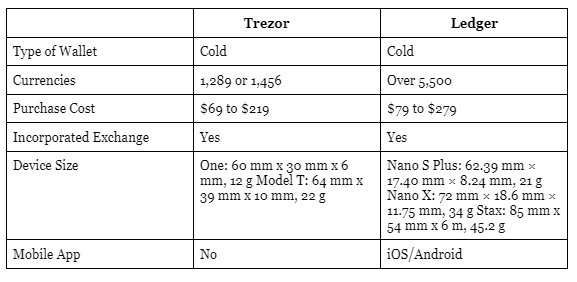
Ledger vs Trezor Comparison

Frequently Asked Questions

Q1. How often do Trezor and Ledger release firmware updates?

Both Trezor and Ledger are committed to maintaining high security and functionality standards. As such, firmware updates are released periodically, addressing potential vulnerabilities and improving user experience.

Q2. Can I use both Trezor and Ledger simultaneously for different assets?

Absolutely! Many crypto investors use multiple wallets to diversify their security approach. You can manage different assets or even the same asset across both wallets.

Q3. What happens if my hardware wallet gets stolen or damaged?

Both Trezor and Ledger provide recovery seeds (a series of words) during initial setup. With this seed, you can restore your assets on a new device.

Q4. Is it possible to add custom tokens or coins that aren't natively supported?

Ledger and Trezor both support numerous ERC-20 tokens and other assets. If a token isn't natively supported, it may be possible through third-party integrations or software.

Q5. Do I need an internet connection to use these hardware wallets?

While the wallets themselves store keys offline, an internet connection is required for transactions or updates. Always ensure a secure connection when using your wallet.

Q6. How do I know if the firmware update is official and not from a malicious source?

Always update firmware from the official Trezor or Ledger websites. Be wary of emails or pop-ups directing you to other sites or urging immediate updates.

Q7. Is it safe to use hardware wallets on public computers or networks?

While hardware wallets provide a layer of protection, using them on potentially compromised computers or open networks might expose you to risks. Always prioritize using trusted devices and networks.

Q8. Can I use my Trezor or Ledger wallet with mobile devices?

Yes, both wallets have mobile compatibility. Ledger's Nano X even offers Bluetooth connectivity for added convenience with mobile devices.

Final Thoughts: Which One Should You Choose?

The decision between Trezor and Ledger boils down to personal preferences and specific needs.

  • If you prioritize a more extended list of supported coins and a unified application interface, Ledger may be more suitable.
  • If a touch screen interface appeals to you and you value a web-based platform, Trezor might be the way to go.
  • For those heavily invested in cryptocurrency, it might even be worthwhile to have both. Diversifying your security approach can be just as crucial as diversifying your crypto portfolio.

Actionable Steps

Research & Stay Updated: Always look for the most recent reviews and updates on hardware wallets. The crypto world evolves rapidly, and staying informed is crucial.

Prioritize Security: No matter which wallet you choose, never share your pin or recovery seed with anyone.

Purchase from Official Channels: To avoid counterfeit devices, always buy directly from the official Trezor or Ledger websites or authorized sellers.

Backup: Always keep multiple copies of your recovery seed in safe places.

In conclusion, both Trezor and Ledger have proven their mettle in the crypto community, earning trust and loyalty from users. Your decision should align with your specific needs and preferences, but rest assured, both devices strive to offer the best protection for your digital assets.

Disclaimer

The information provided on this website does not constitute investment advice, financial advice, trading advice, or any other sort of advice and you should not treat any of the website's content as such.

Token Metrics does not recommend that any cryptocurrency should be bought, sold, or held by you. Do conduct your own due diligence and consult your financial advisor before making any investment decisions.

Build Smarter Crypto Apps &
AI Agents in Minutes, Not Months
Real-time prices, trading signals, and on-chain insights all from one powerful API.
Grab a Free API Key
Token Metrics Team
Token Metrics Team

Recent Posts

Research

Understanding How APIs Work: A Comprehensive Guide

Token Metrics Team
4
MIN

Introduction to APIs

APIs, or Application Programming Interfaces, serve as essential tools in modern software development by allowing different applications to communicate and work together efficiently. Understanding how APIs work is fundamental for developers, businesses, and enthusiasts exploring technology or crypto environments where APIs facilitate seamless data exchange and integration.

What Is an API?

An API is essentially a set of rules and protocols that enables different software applications to interact. It defines the methods and data formats that programs can use to request and exchange information. Through these interfaces, complex software systems can communicate without having to know the internal workings of each other, promoting modularity and efficiency.

How APIs Function

APIs operate as intermediaries between client requests and server responses. When a user interacts with an application, the underlying API sends structured requests to a server which processes these requests and sends back the appropriate data or service. This process involves:

  • Endpoints: Specific API URLs where requests are sent.
  • Requests: Calls made using methods like GET, POST, PUT, DELETE following defined parameters.
  • Responses: Data returned from the server, often in formats such as JSON or XML.

This exchange allows integration across services, such as connecting a mobile app to a database or enabling a crypto trading platform to access market data.

API Types and Protocols

APIs are implemented using diverse standards and protocols depending on their purpose:

  • REST (Representational State Transfer): Uses standard HTTP methods and is widely used for web APIs due to its simplicity.
  • SOAP (Simple Object Access Protocol): A protocol with stricter standards and built-in security features, often used in enterprise contexts.
  • GraphQL: A query language for APIs that allows clients to request precisely the data needed.
  • WebSocket APIs: For real-time two-way communication, commonly used in live data streaming.

Understanding these protocols helps in selecting or designing the appropriate API solution for specific use cases.

APIs in Crypto and AI Research

In the cryptocurrency domain, APIs facilitate access to market data, trading functionalities, and analytics. Crypto APIs, including the Token Metrics API, provide developers and analysts with programmatic access to detailed metrics, historical data, and real-time updates.

Furthermore, AI-driven tools leverage APIs to gather and analyze vast datasets efficiently. Token Metrics, for example, integrates AI to enhance crypto research and analytics. Accessing this data programmatically via the Token Metrics API allows for automated strategies and custom insights without manual intervention.

How to Use APIs Effectively

To maximize the benefits of APIs, consider the following best practices:

  1. Documentation Review: Ensure the API is well-documented, explaining endpoints, parameters, and response formats clearly.
  2. Authentication and Security: Many APIs require secure authentication methods such as tokens or keys. Safeguarding these credentials is crucial.
  3. Rate Limits Awareness: Understand limitations on request frequency to prevent service interruptions.
  4. Error Handling: Design applications to gracefully manage errors and unexpected responses.
  5. Testing and Sandbox Environments: Use available testing tools or sandbox APIs before deploying into production.

For example, the best crypto API solutions often provide sandbox environments to allow safe experimentation with live-like data.

API Integration in Crypto Trading Platforms

Crypto trading platforms utilize APIs to enable seamless order placements, market monitoring, and account management. Integrating APIs allows platforms to connect with external services or enable bots and third-party tools to interact with user accounts securely.

When exploring a crypto trading platform, understanding the underlying API capabilities helps users and developers gauge integration potential and automation possibilities.

The API ecosystem continues evolving with trends such as:

  • Increased Use of AI: Automating API generation and data analytics.
  • Microservices Architecture: APIs underpin microservices to create scalable, maintainable applications.
  • API Marketplaces and Monetization: Increasing availability of APIs as paid services.
  • Improved Security Protocols: Enhanced authentication and encryption standards to protect data.

Monitoring developments through platforms like Token Metrics can keep users informed about innovations impacting crypto and tech sectors.

Conclusion

APIs are foundational in today's interconnected digital landscape, enabling diverse applications to communicate and unlock new functionalities efficiently. Recognizing how APIs work empowers users and developers to harness technology effectively across industries, particularly within crypto and AI-driven research contexts.

Utilizing APIs such as the Token Metrics API provides structured access to valuable data and analytics, fostering innovation and informed analysis.

Disclaimer

This content is for educational purposes only and does not constitute financial or investment advice. Readers should conduct their own research and consult professionals as needed.

Research

Understanding Web APIs: A Comprehensive Guide

Token Metrics Team
4
MIN

What is a Web API?

A Web API is an interface that allows different software applications to communicate with each other over the internet. Essentially, it is a set of protocols and tools for building and interacting with software applications remotely via the web. APIs enable developers to access specific functionalities or data from external services without having to understand the internal workings of those services.

Core Components of Web APIs

Understanding the basic components of Web APIs helps clarify their importance in modern software development:

  • Endpoints: URLs where API services can be accessed.
  • Request Methods: Common HTTP methods used by Web APIs include GET, POST, PUT, and DELETE, defining the type of operation to perform.
  • Headers: Metadata for requests and responses, such as content type and authentication tokens.
  • Payload: The data sent with requests or received in responses, usually formatted in JSON or XML.

How Web APIs Work

Web APIs function by receiving requests from clients and returning appropriate responses:

  1. Client Request: A client application, such as a web app or mobile app, sends a request to the Web API's endpoint specifying the desired operation.
  2. Processing: The API processes the request, which may involve querying databases, business logic execution, or calling other services.
  3. Response: The API sends back data or status messages in a structured format that the client can handle.

This request-response mechanism allows seamless integration between diverse systems and applications, facilitating interoperability and automation.

Types of Web APIs

There are several types of Web APIs, each suited for different purposes:

  • REST APIs: Representational State Transfer APIs are stateless and use standard HTTP methods. They are widely adopted due to simplicity and scalability.
  • SOAP APIs: Simple Object Access Protocol APIs focus on strict standards and built-in error handling, often used in enterprise environments.
  • GraphQL APIs: Allow clients to request exactly the data they need, reducing over-fetching and under-fetching.
  • WebSocket APIs: Facilitate real-time two-way communication, ideal for live data and messaging applications.

Web API Integration and Applications

Web APIs are foundational to many modern software ecosystems. They enable:

  • Third-Party Integrations: Incorporate services like payment gateways, mapping tools, or social media authentication.
  • Mobile and Web Applications: Retrieve and update data dynamically, improving user experience.
  • IoT Devices: Exchange data with cloud services to enable smart functionalities.
  • Crypto and Blockchain Platforms: Access market data, trading functionalities, and analytics through specialized APIs.

For example, the Token Metrics API provides a robust crypto API allowing seamless access to cryptocurrency data and metrics, supporting data-driven decision-making in crypto trading platforms.

Security Best Practices for Web APIs

Securing a Web API is crucial due to its exposure over the internet. Important measures include:

  • Authentication: Implementing secure methods like OAuth, API keys, or JWT tokens to verify users.
  • Authorization: Ensuring users can only access permitted resources.
  • Input Validation: Preventing injection attacks by sanitizing inputs.
  • Rate Limiting: Protecting APIs against abuse and denial-of-service attacks.
  • HTTPS Usage: Encrypting data in transit for confidentiality and integrity.

Advantages of Using Web APIs

Leveraging Web APIs in software development brings multiple benefits:

  • Modularity and Reusability: APIs allow developers to build modular components that can be reused across applications.
  • Scalability: APIs are designed to handle varying workloads, supporting scale efficiently.
  • Faster Development: Accessing pre-built services via APIs accelerates development timelines.
  • Interoperability: Different technologies and platforms can communicate seamlessly through standardized APIs.

How AI and Data Analytics Enhance Web API Usage

Integrating AI and advanced data analytics with Web APIs can improve insights and user experiences. For instance, in the crypto domain, AI-driven platforms like Token Metrics utilize APIs to aggregate data and provide analytical ratings that inform research and trading strategies without offering financial advice.

By automating data retrieval via Token Metrics API and applying machine learning, businesses can unlock deeper insights while maintaining neutrality and compliance.

Getting Started with Web APIs

To effectively utilize Web APIs, consider these practical steps:

  1. Identify Needs: Define the data or functionality required by your application.
  2. Research APIs: Explore and compare available APIs, such as the best crypto API if working in the crypto space.
  3. Review Documentation: Thoroughly read API docs for endpoints, authentication methods, and rate limits.
  4. Prototype and Test: Use API testing tools like Postman to explore responses and errors.
  5. Implement Securely: Incorporate security best practices when integrating APIs into your application.

Conclusion and Summary

Web APIs are essential building blocks for modern digital applications, enabling diverse systems to communicate over the internet efficiently. Whether creating mobile apps, connecting to blockchain data via a crypto API, or integrating analytics platforms like Token Metrics, understanding Web APIs empowers developers and businesses to innovate responsively.

Adhering to best practices in design and security ensures APIs remain reliable and safe tools within the technology ecosystem.

Disclaimer

This article is for educational and informational purposes only. It does not constitute investment advice, financial recommendations, or endorsements of any products or services. Readers should conduct their own research and consult professional advisors before making decisions related to cryptocurrency or technology investments.

Research

Top Crypto APIs to Watch in 2025: A Comprehensive Overview

Token Metrics Team
5
MIN

Introduction to Crypto APIs

In the rapidly evolving cryptocurrency landscape, Access to reliable and comprehensive APIs has become essential for developers, analysts, and businesses aiming to integrate blockchain data or build crypto-focused applications. As we approach 2025, understanding which APIs offer robust features, extensive data coverage, and advanced analytical capabilities is critical to making informed technology choices. This post provides an analytical overview of the best crypto APIs available in 2025, focusing on technical features, data reliability, and integration possibilities.

What Is a Crypto API?

A crypto API is an application programming interface that facilitates access to cryptocurrency data and services. It typically provides endpoints to retrieve market data, historical prices, blockchain statistics, transaction data, order book snapshots, and other relevant crypto metrics. Developers and analysts use these APIs to collect data for research, build trading bots, track portfolio performance, or power analytics platforms.

In 2025, crypto APIs increasingly integrate AI-enhanced analytics and machine learning capabilities to offer predictive insights and streamline data interpretation.

Criteria for Selecting the Best Crypto API in 2025

Choosing the best crypto API involves multiple factors that influence usability and effectiveness:

  • Data Coverage and Accuracy: Access to comprehensive, real-time, and historical data across numerous exchanges and tokens is essential.
  • Latency and Reliability: Low response times and high uptime ensure efficient, real-time applications.
  • Security and Compliance: Robust authentication methods and compliance with data privacy standards protect users and their data.
  • Feature Set: Advanced tools such as AI-driven analytics, sentiment data, and risk metrics add significant value.
  • Ease of Integration: Clear documentation, SDKs, and supportive developer communities simplify adoption.
  • Cost and Scalability: Flexible pricing that accommodates growing usage volumes is important for long-term use.

Leading Crypto APIs in 2025

Among many providers, some stand out based on these criteria.

  1. Token Metrics API
    Token Metrics API continues to be a prominent tool offering a rich array of features. It combines comprehensive historical and real-time data from multiple exchanges with AI-powered insights. This integration facilitates research, market analysis, and the development of trading strategies with sophisticated analytics embedded directly into the API endpoints.
  2. CoinGecko API
    Known for its extensive token coverage and high reliability, CoinGecko's API supplies real-time market data, historical charts, and fundamental stats. Although it lacks integrated AI analytics, its straightforward structure benefits many development applications.
  3. CryptoCompare API
    Offering comprehensive market data, including social sentiment and order book information, CryptoCompare provides multiple data tiers suitable for various user needs. Integration flexibility and data depth make it a widespread choice among developers.
  4. Messari API
    Focused on enriched crypto fundamentals and regulatory data, Messari provides deep insights with an emphasis on transparency, which helps in compliance-aware applications.

Role of AI and Analytics in Crypto APIs

AI integration in crypto APIs represents a significant advancement heading into 2025. Providers like the Token Metrics API enhance raw data with predictive models and rating systems that help developers and analysts prioritize research focus. AI can automate pattern recognition, detect anomalies, and estimate potential impacts of market factors from vast datasets.

This additional layer moves crypto APIs beyond simple data delivery toward becoming comprehensive research tools, improving operational efficiency for platforms dealing with big data.

How to Utilize Crypto APIs for Research and Development

When employing a crypto API, consider the following best practices:

  • Define Clear Objectives: Identify whether the goal is market analysis, portfolio tracking, trading automation, or blockchain exploration.
  • Leverage Analytical Features: Use AI-driven endpoints where available to enhance data interpretation and decision-support processes.
  • Conduct Scenario Analysis: Combine historical data retrieval with model outputs to understand various market conditions.
  • Validate and Test: Regularly validate the API data with independent sources and test system integrations to ensure accuracy.
  • Monitor API Updates and Maintenance: Keep abreast of API changelogs to adapt applications as endpoints evolve.

Integrating Crypto Trading Platforms with APIs

Modern crypto trading platforms rely heavily on APIs for market data and trade execution. For instance, Token Metrics offers tools that integrate with various APIs to provide an enhanced user experience, combining data analytics with trading functionalities.

Choosing APIs that support trading-related features, such as order placement and balance checks, alongside data retrieval, is beneficial for building seamless crypto trading platforms.

Risk Factors and Considerations

When utilizing crypto APIs, keep these points in mind:

  • Data Quality Variations: The speed and accuracy of data can vary between providers and across exchanges.
  • Regulatory Changes: APIs may adjust data access or features based on evolving regulations affecting cryptocurrency markets.
  • Dependence on Third-Party Providers: API outages or deprecations can disrupt dependent applications, so modular designs with fallback options are advisable.
  • Security: Handling API keys responsibly and ensuring secure data transmission prevents unauthorized access.

Conclusion and Future Outlook

In 2025, the best crypto APIs will be those that combine extensive data coverage with advanced analytical capabilities. The integration of AI, as exemplified by the Token Metrics API, sets a new standard for developers and researchers aiming for deeper insights. While data quality and reliability remain paramount, the ongoing refinement of crypto APIs will likely focus on enhancing user control, predictive analysis, and ease of integration.

Exploring APIs with a critical, research-oriented approach remains essential for anyone harnessing crypto data, and tools like Token Metrics demonstrate how combining market data with AI can support comprehensive crypto ecosystems.

Disclaimer

This blog post is intended for educational purposes only and does not constitute financial advice, investment recommendations, or solicitations. Always conduct your own research and consult with professional advisers before making any financial decisions related to cryptocurrencies.

Choose from Platinum, Gold, and Silver packages
Reach with 25–30% open rates and 0.5–1% CTR
Craft your own custom ad—from banners to tailored copy
Perfect for Crypto Exchanges, SaaS Tools, DeFi, and AI Products