Crypto Basics

Trezor vs Ledger - Which Crypto Wallet is Better?

Explore the features, security, and usability of Trezor and Ledger wallet. Dive deep into the comparison to determine the best crypto wallet for your needs.
Marcus K
6 Minutes
MIN

In the world of cryptocurrency, the question of security is paramount. No matter how well you understand the market, or how diversified your portfolio is, if you don’t safeguard your assets, all can be lost in the blink of an eye. 

Two names stand out in the hardware wallet industry: Trezor and Ledger. Both promise top-notch security, but which one should you entrust with your digital gold? Let's dive deep and make an informed decision.

What is a Hardware Wallet?

Before we start, it's essential to grasp what a hardware wallet is. Simply put, it's a physical device, often resembling a USB stick, that stores your cryptocurrency private keys offline. 

By keeping the keys offline, it offers protection against online hacking attempts, a significant advantage over online wallets.

Trezor Wallet Overview

Trezor Wallet is a pioneering hardware wallet developed by SatoshiLabs, a Czech-based company. Introduced in 2013, Trezor set the gold standard for cold storage of cryptocurrencies. 

Unlike traditional online wallets, which are vulnerable to hacks, Trezor keeps your private keys offline, ensuring top-tier security against cyber threats. It's a compact device, somewhat resembling a USB flash drive, which connects to your computer or smartphone. 

The wallet supports over a thousand different cryptocurrencies, providing both accessibility and security. Its intuitive interface, combined with features like pin protection, physical transaction confirmation, and a recovery seed system, ensures that even beginners can handle their crypto holdings with confidence and peace of mind.

Origin: Czech Republic

Founded: 2013 by SatoshiLabs

Popular Models: Trezor One, Trezor Model T

Ledger Wallet Overview

Ledger Wallet stands as one of the crypto community's most trusted hardware wallet solutions. Founded in France in 2014, Ledger offers users the security of cold storage combined with the flexibility of more than 1,800 supported cryptocurrencies. 

Distinctively, Ledger incorporates a Secure Element (SE) chip, an advanced layer of protection against potential breaches. Resembling a sleek USB device, the Ledger can be connected to both computers and mobile devices. 

Through its proprietary Ledger Live software, users can seamlessly manage transactions, check balances, and perform firmware updates. 

With mandatory pin protection, physical verification of transactions, and a 24-word recovery seed mechanism, Ledger maintains a balance of user-friendliness and robust security for crypto enthusiasts.

Origin: France

Founded: 2014

Popular Models: Ledger Nano S, Ledger Nano X

Ledger vs Trezor - Security Features

Both devices prioritize security. After all, that's their primary function. Let's look at how each performs in this domain.

Trezor:

  • Pin Protection: A mandatory feature ensuring only the device's rightful owner can access it.
  • Physical Verification: Transactions require manual approval using the device's buttons.
  • Recovery Seed: A 12-24 word seed allows recovery of assets if the device is lost.

Ledger:

  • Secure Element (SE) Chip: Ledger incorporates an SE chip, adding an extra layer of security.
  • Pin Protection: Similar to Trezor, pin protection is mandatory.
  • Physical Verification: Transactions need manual approval.
  • Recovery Seed: 24-word seed for asset recovery.

Ledger vs Trezor - Compatibility

One of the primary considerations for crypto enthusiasts when selecting a hardware wallet is the range of supported cryptocurrencies. Ledger and Trezor, the industry titans, both offer extensive compatibility, albeit with some differences. 

Ledger, with its Ledger Live software, proudly supports over 1,800 coins and tokens, ensuring that users can securely manage a broad spectrum of assets from major currencies like Bitcoin and Ethereum to numerous ERC-20 tokens. 

On the other hand, Trezor isn't far behind, boasting support for more than 1,000 coins and tokens. While it provides native support for heavyweights like Bitcoin and Ethereum, certain lesser-known coins might require third-party interfaces. 

Ultimately, while both wallets cater to the majority of crypto users' needs, those with diverse portfolios might lean towards Ledger for its wider array, whereas Trezor users appreciate its straightforward, web-based interface.

User Interface and Experience

Usability plays a pivotal role in ensuring that users can securely and efficiently manage their assets.

Trezor:

1. Trezor offers straightforward interface with clear instructions.

2. Web-based interface that can be accessed easily from any computer.

3. The Model T features a touch screen for improved user experience.

Ledger:

1. Ledger Live software offers a comprehensive dashboard to manage assets.

2. The Nano X can connect via Bluetooth, making it compatible with mobile devices.

3. User-friendly design and intuitive features.

Ledger vs Trezor Comparison
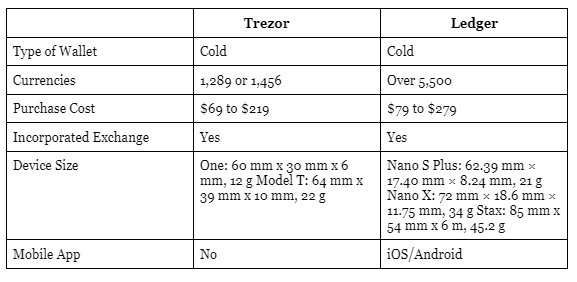
Ledger vs Trezor Comparison

Frequently Asked Questions

Q1. How often do Trezor and Ledger release firmware updates?

Both Trezor and Ledger are committed to maintaining high security and functionality standards. As such, firmware updates are released periodically, addressing potential vulnerabilities and improving user experience.

Q2. Can I use both Trezor and Ledger simultaneously for different assets?

Absolutely! Many crypto investors use multiple wallets to diversify their security approach. You can manage different assets or even the same asset across both wallets.

Q3. What happens if my hardware wallet gets stolen or damaged?

Both Trezor and Ledger provide recovery seeds (a series of words) during initial setup. With this seed, you can restore your assets on a new device.

Q4. Is it possible to add custom tokens or coins that aren't natively supported?

Ledger and Trezor both support numerous ERC-20 tokens and other assets. If a token isn't natively supported, it may be possible through third-party integrations or software.

Q5. Do I need an internet connection to use these hardware wallets?

While the wallets themselves store keys offline, an internet connection is required for transactions or updates. Always ensure a secure connection when using your wallet.

Q6. How do I know if the firmware update is official and not from a malicious source?

Always update firmware from the official Trezor or Ledger websites. Be wary of emails or pop-ups directing you to other sites or urging immediate updates.

Q7. Is it safe to use hardware wallets on public computers or networks?

While hardware wallets provide a layer of protection, using them on potentially compromised computers or open networks might expose you to risks. Always prioritize using trusted devices and networks.

Q8. Can I use my Trezor or Ledger wallet with mobile devices?

Yes, both wallets have mobile compatibility. Ledger's Nano X even offers Bluetooth connectivity for added convenience with mobile devices.

Final Thoughts: Which One Should You Choose?

The decision between Trezor and Ledger boils down to personal preferences and specific needs.

  • If you prioritize a more extended list of supported coins and a unified application interface, Ledger may be more suitable.
  • If a touch screen interface appeals to you and you value a web-based platform, Trezor might be the way to go.
  • For those heavily invested in cryptocurrency, it might even be worthwhile to have both. Diversifying your security approach can be just as crucial as diversifying your crypto portfolio.

Actionable Steps

Research & Stay Updated: Always look for the most recent reviews and updates on hardware wallets. The crypto world evolves rapidly, and staying informed is crucial.

Prioritize Security: No matter which wallet you choose, never share your pin or recovery seed with anyone.

Purchase from Official Channels: To avoid counterfeit devices, always buy directly from the official Trezor or Ledger websites or authorized sellers.

Backup: Always keep multiple copies of your recovery seed in safe places.

In conclusion, both Trezor and Ledger have proven their mettle in the crypto community, earning trust and loyalty from users. Your decision should align with your specific needs and preferences, but rest assured, both devices strive to offer the best protection for your digital assets.

Disclaimer

The information provided on this website does not constitute investment advice, financial advice, trading advice, or any other sort of advice and you should not treat any of the website's content as such.

Token Metrics does not recommend that any cryptocurrency should be bought, sold, or held by you. Do conduct your own due diligence and consult your financial advisor before making any investment decisions.

Build Smarter Crypto Apps &
AI Agents in Minutes, Not Months
Real-time prices, trading signals, and on-chain insights all from one powerful API.
Grab a Free API Key
Token Metrics Team
Token Metrics Team

Recent Posts

Crypto Basics

Hot Wallets vs. Cold Wallets: What’s the Difference and Which Crypto Wallet To Use in 2025?

Token Metrics Team
8 min
MIN

As cryptocurrency adoption accelerates globally in 2025, one critical question for both beginners and experienced investors is: Where should you store your crypto assets safely?

The answer lies in understanding the difference between hot wallets and cold wallets — the two main categories of cryptocurrency storage. This highly informative and SEO-optimized blog will help you understand:

  • What hot and cold wallets are
  • Key differences between them
  • Pros and cons of each
  • Which one is right for you
  • How platforms like Token Metrics help you choose and manage your wallet securely

🔐 What Is a Cryptocurrency Wallet?

A crypto wallet stores your private and public keys, enabling you to send, receive, and manage digital assets like Bitcoin, Ethereum, or altcoins. Unlike traditional bank accounts, crypto wallets give you full control over your funds — but with that control comes the responsibility of securing them.

Wallets are typically categorized as:

  • Hot Wallets – connected to the internet
  • Cold Wallets – offline storage solutions

⚡ What Is a Hot Wallet?

A hot wallet is a crypto wallet that is connected to the internet. It’s designed for easy access and quick transactions, making it ideal for active traders and everyday use.

🔹 Examples of Hot Wallets:

  • Web wallets: MetaMask, Trust Wallet, Phantom, Rainbow
  • Desktop wallets: Exodus, Electrum
  • Mobile wallets: Coinbase Wallet, Atomic Wallet
  • Exchange wallets: Binance, Coinbase (custodial)

✅ Pros of Hot Wallets:

  • Instant access to crypto
  • User-friendly interfaces
  • Ideal for frequent trading or DeFi
  • Compatible with most crypto platforms

❌ Cons of Hot Wallets:

  • Vulnerable to hacks and phishing
  • Depends on internet connection
  • Risk of malware or keylogging
  • Not ideal for large holdings

Hot wallets are often recommended for storing smaller amounts of crypto for daily use.

🧊 What Is a Cold Wallet?

A cold wallet refers to any crypto wallet that is not connected to the internet. It’s a form of offline storage designed for maximum security.

🔹 Examples of Cold Wallets:

  • Hardware wallets: Ledger Nano X, Trezor Model T
  • Paper wallets: Printed QR codes with private keys
  • Air-gapped computers: Devices permanently offline

✅ Pros of Cold Wallets:

  • Immune to online attacks
  • Long-term storage for HODLing
  • Control over private keys
  • Ideal for institutional and high-net-worth users

❌ Cons of Cold Wallets:

  • Less convenient for quick access
  • Physical loss or damage is a risk
  • Requires technical knowledge
  • More expensive (hardware wallets can cost $50–$200)

Cold wallets are ideal for long-term investors storing large amounts of crypto.

🔄 Hot Wallet vs. Cold Wallet: Key Differences

🔧 How to Use Hot and Cold Wallets Together (Hybrid Strategy)

Many crypto investors in 2025 use a dual-wallet strategy:

  • Hot wallet for trading, staking, and DeFi
  • Cold wallet for long-term storage and high-value assets

This balances convenience and security while minimizing exposure to threats.

For example:

  • Use a hot wallet like MetaMask to access the Token Metrics Moonshots tab and buy trending altcoins.
  • Transfer profits to your cold wallet (e.g., Ledger) for safekeeping.

🧠 How Token Metrics Helps You Manage Wallet Security

🔹 Wallet Integrations

Token Metrics supports:

  • MetaMask, WalletConnect, and other hot wallets
  • Portfolio tracking synced with your wallet
  • Real-time alerts when assets in your wallet are surging or at risk

🔹 Smart Trading with AI

Token Metrics helps reduce the need to frequently move funds by:

  • Identifying only high-quality tokens using AI Trader and Investor Grades
  • Sending price alerts, so you know when to buy/sell
  • Providing in-platform swap tools for direct trades from your hot wallet

🔹 Moonshot Monitoring

For early-stage altcoins, timing is everything. Token Metrics lets you:

  • Monitor your Moonshot investments
  • Get notified when to take profits or exit
  • Transfer to cold storage with a single click

🔒 Hot Wallet Security Tips (2025 Edition)

If you’re using a hot wallet:

  • Enable 2FA (Two-Factor Authentication)
  • Use a hardware wallet to sign large transactions
  • Avoid clicking suspicious links or connecting to unknown dApps
  • Disconnect wallets after use

Always back up your seed phrase and store it securely offline.

💬 Which Wallet Should You Use?

🧩 Final Thoughts

Whether you’re storing $100 or $100,000 in cryptocurrency, your wallet choice directly impacts your security, accessibility, and peace of mind.

  • Hot wallets offer convenience, but must be used with caution
  • Cold wallets offer security, but come with trade-offs in usability
  • Platforms like Token Metrics bridge the gap by offering real-time insights, wallet integrations, and AI-driven trading tools

In 2025, don’t just store your crypto—store it wisely. Combine hot and cold wallet strategies and leverage tools like Token Metrics to build a secure, intelligent crypto portfolio.

Crypto Basics

How to Trade Cryptocurrency in 2025 – Best Crypto Trading Tools

Token Metrics Team
8 min
MIN

Cryptocurrency trading has rapidly evolved into a global financial movement. With the rise of decentralized finance (DeFi), institutional adoption, and advanced AI tools, trading crypto in 2025 is more accessible—and more profitable—than ever before. But with great opportunity comes great risk, especially if you trade without strategy or insights.

In this highly informative beginner’s guide, we’ll break down how to trade cryptocurrency step by step, the different types of trading strategies, and how platforms like Token Metrics help you make smarter, AI-powered decisions.

🔍 What Is Cryptocurrency Trading?

Cryptocurrency trading involves buying and selling digital assets like Bitcoin (BTC), Ethereum (ETH), Solana (SOL), or thousands of other tokens to profit from price fluctuations. Traders analyze price movements, market trends, and use technical or fundamental data to time their entries and exits.

Unlike traditional stock markets, crypto markets are:

  • Open 24/7
  • Highly volatile
  • Borderless and decentralized
  • Powered by blockchain technology

📊 Types of Cryptocurrency Trading

Understanding the different styles of trading can help you pick a strategy that fits your goals and risk tolerance.

1. Day Trading

  • Involves multiple trades in a single day
  • Aims to profit from short-term price swings
  • Requires constant monitoring and fast decision-making

2. Swing Trading

  • Positions are held for days or weeks
  • Based on momentum and trend reversal patterns
  • Suitable for part-time traders

3. Scalping

  • Ultra-short-term trading
  • Makes small profits on tiny price movements
  • High frequency, high risk

4. Position Trading

  • Long-term holding based on fundamentals
  • Traders buy during dips and hold until a large move
  • Also called "trend trading"

5. Automated Trading / AI Trading

  • Uses bots or AI models to execute trades
  • Ideal for those who want data-driven, emotion-free trading
  • Best when paired with platforms like Token Metrics

🧭 How to Trade Cryptocurrency: Step-by-Step

✅ Step 1: Choose a Crypto Exchange or Trading Platform

Select a reputable platform to execute trades. Popular choices in 2025 include:

  • Token Metrics (for AI-backed trade insights
  • Binance
  • Coinbase Pro
  • Kraken
  • OKX

Each platform offers different tools, liquidity, and trading pairs.

✅ Step 2: Fund Your Account

Deposit funds using:

  • Bank transfer
  • Debit/credit card
  • Stablecoins (USDT, USDC)
  • Crypto from your wallet

Token Metrics integrates wallet access, swap functionality, and DeFi bridges so you can trade directly from your dashboard.

✅ Step 3: Analyze the Market

Before you trade, analyze:

  • Price charts (technical analysis)
  • Volume and momentum
  • News and narratives
  • On-chain data and token grades

🔹 Token Metrics AI Grades:

  • Trader Grade: Measures short-term trading potential
  • Investor Grade: Rates long-term strength

These AI-generated scores help you find the most promising tokens, instantly filtering thousands of coins by risk and opportunity.

✅ Step 4: Place a Trade

Choose your trading pair (e.g., BTC/USDT), then:

  • Market order: Buy/sell immediately at current price
  • Limit order: Set your own buy/sell price
  • Stop-loss: Exit a trade automatically if price drops below a certain level
  • Take profit: Lock in gains once a target is hit

Token Metrics provides real-time buy/sell alerts powered by AI signals, helping you avoid emotional trading.

✅ Step 5: Monitor and Manage Your Trades

Check the performance of your portfolio regularly. Use tools like:

  • Live charts
  • Alerts for price and grade changes
  • Token Fundamentals: Developer activity, community growth, holders

Token Metrics simplifies this with its Token Details Page, offering everything from real-time ROI to whale tracking—all in one view.

✅ Step 6: Exit the Trade & Secure Profits

Sell your position when:

  • You hit your price target
  • A bearish trend begins
  • Token Metrics issues a bearish signal
  • Your risk tolerance is breached

You can transfer funds to a cold wallet or reinvest into new high-potential tokens (like those listed in the Moonshots tab on Token Metrics).

🤖 How Token Metrics Makes Crypto Trading Smarter

Trading is hard. But with Token Metrics AI tools, you can trade based on data, not emotions.

🔹 AI Price Predictions

  • Forecasted prices for thousands of tokens using machine learning
  • Built on 80+ on-chain, technical, sentiment, and fundamental metrics

🔹 Moonshot Finder

  • Discover early-stage altcoins with 10x–100x potential
  • See live ROI, entry date, trader grade changes, and volume shifts

🔹 Trade Alerts

  • Get notified when:

    • Tokens reach your target price
    • Bullish or bearish signals are triggered
    • AI grades update in real time

Alerts are sent via:

  • Telegram
  • Discord
  • Email
  • SMS

🔹 Real-Time Swap Widget

Trade directly on Token Metrics with one click. No need to leave the platform.

💡 Pro Tips for Successful Crypto Trading in 2025

  1. Use AI Tools: Let platforms like Token Metrics do the heavy lifting.
  2. Avoid FOMO: Just because a token is trending doesn’t mean it’s worth buying.
  3. Start Small: Don’t risk your entire capital in one trade.
  4. Keep Learning: Read market news, watch on-chain activity, and follow macro trends.
  5. Stay Safe: Use 2FA, trusted exchanges, and cold wallets.

📈 Top Crypto Trading Trends in 2025

  • AI-Driven Signal Trading
  • Copy Trading and Social Trading
  • Narrative-Based Investing (e.g., AI tokens, DePIN, L2s)
  • Real-World Asset (RWA) Tokenization
  • ETF-driven Institutional Trading

Platforms like Token Metrics sit at the center of these trends, offering users powerful AI infrastructure and deep crypto analytics.

✅ Final Thoughts

Trading cryptocurrency in 2025 is more rewarding—and more competitive—than ever. To succeed, you need:

  • A solid understanding of market dynamics
  • Reliable strategies and discipline
  • Smart tools that give you an edge

That’s where Token Metrics comes in.

Whether you’re day trading, swing trading, or investing long-term, Token Metrics gives you:

  • AI-driven token rankings
  • Real-time price alerts
  • Moonshot altcoin discoveries
  • Easy, integrated trading tools

Don’t just trade crypto—trade with intelligence.

Crypto Basics

How to Buy Cryptocurrency in 2025: A Beginner's Step-by-Step Guide - Why Token Metrics Is the Best Crypto Trading and Research Platform to Start

Token Metrics Team
8 min
MIN

Cryptocurrency has gone from niche curiosity to mainstream financial instrument. As of 2025, millions of people across the globe are investing in digital assets like Bitcoin, Ethereum, and thousands of altcoins. But for beginners, the first question remains: How do you buy cryptocurrency safely and smartly?

This highly informative guide walks you through everything you need to know about buying cryptocurrency in 2025 — from setting up your first account to using AI-powered Crypto trading and research platforms like Token Metrics for smarter investing.

🔍 What Is Cryptocurrency?

Cryptocurrency is a form of digital money that uses blockchain technology to enable secure, decentralized transactions. Unlike fiat currencies controlled by central banks, crypto is powered by peer-to-peer networks and verified by cryptographic algorithms.

Popular cryptocurrencies include:

  • Bitcoin (BTC) – The original digital gold
  • Ethereum (ETH) – Smart contract platform
  • Solana (SOL), Cardano (ADA), XRP – High-utility altcoins
  • TMAI – The utility token of Token Metrics

🧭 How to Buy Cryptocurrency: Step-by-Step Guide

Buying crypto in 2025 is easier than ever. Here’s a clear roadmap to help you get started:

✅ Step 1: Choose a Trusted Crypto Platform

The first step is selecting a reliable platform for buying cryptocurrency. You have two main options:

1. Crypto Exchanges

These include centralized platforms like:

  • Token Metrics
  • Coinbase
  • Binance
  • Kraken
  • Bitstamp

2. AI Crypto Platforms (Best Option in 2025)

Token Metrics is a powerful platform that combines AI research, real-time market insights, and trading features in one place. It helps beginners avoid risky coins and focus on data-backed opportunities.

✅ Step 2: Create and Verify Your Account

Once you've chosen a platform:

  • Register with your email and create a strong password
  • Complete KYC (Know Your Customer) verification by uploading an ID
  • Enable 2-Factor Authentication (2FA) for security

Token Metrics also allows wallet integration for seamless tracking and trading.

✅ Step 3: Fund Your Account

You can deposit money using:

  • Bank Transfer (ACH, SEPA)
  • Credit or Debit Card
  • PayPal or Apple Pay (on some platforms)
  • Stablecoins or other crypto (if you already have a wallet)

On Token Metrics, users can also connect their DeFi wallets and use swap integrations to convert assets instantly.

✅ Step 4: Pick the Right Cryptocurrency

With over 20,000 coins on the market, choosing the right one is critical.

That’s where Token Metrics shines:

  • Use the Ratings Page to view AI-generated grades for thousands of tokens


  • Navigate to the Moonshots Tab for under-the-radar altcoins with 10x–100x potential
  • Check the Investor and Trader Grades to compare short-term and long-term opportunities
  • View real-time data on volume, market cap, ROI since entry, and technical signals

✅ Step 5: Make Your Purchase

Once you've chosen your coin:

  • Enter the amount (e.g., $500 worth of ETH)
  • Choose your payment method
  • Review the transaction and confirm

Token Metrics offers a built-in Buy button and Swap Widget so you can trade directly from the Moonshots page — no need to leave the platform.

✅ Step 6: Store Your Cryptocurrency Securely

There are two main storage options:

  • Hot Wallets – Software-based, ideal for active trading
  • Cold Wallets – Hardware devices like Ledger and Trezor for long-term storage

Token Metrics supports integrations with wallets and encourages users to withdraw assets to secure storage after trading.

💡 Tips for Buying Crypto in 2025

  1. Start small – Don’t invest more than you can afford to lose.
  2. Use Dollar-Cost Averaging (DCA) – Invest small amounts regularly instead of going all in.
  3. Diversify – Don’t put all your funds into one coin.
  4. Follow trends – Use Token Metrics to identify top-performing sectors like AI, DeFi, and gaming.

🤖 Why Token Metrics Is the Best Platform for Buying and Trading Crypto

✅ 1. AI-Powered Price Predictions

Token Metrics uses advanced machine learning models trained on 80+ data points to generate real-time price forecasts.

✅ 2. Trader & Investor Grades

Each token is evaluated daily based on:

  • On-chain data
  • Technical indicators
  • Sentiment analysis
  • Developer activity

This helps you filter out hype and focus on fundamentals.

✅ 3. Moonshots Finder

Looking for 100x altcoins? The Moonshots tab curates a list of tokens with the highest potential, based on proprietary AI momentum signals.

✅ 4. Real-Time Alerts

Get notified when:

  • A token hits your target price
  • Bullish or bearish signals trigger
  • Grades change rapidly

Alerts are delivered via:

  • Email
  • Telegram
  • Discord
  • SMS

✅ 5. One-Click Trading

No more copy-pasting contract addresses or juggling wallets. Just click Buy directly from the Token Metrics dashboard.

✅ 6. API Access for Advanced Users

Developers and institutions can connect via the MCP Server, which standardizes access across:

  • OpenAI Agents
  • Cursor IDE
  • Claude Desktop
  • GraphQL UIs like Windsurf
  • CLI tools

🔐 How to Stay Safe When Buying Crypto

  1. Avoid phishing links
  2. Use only verified exchanges
  3. Store private keys securely
  4. Double-check recipient addresses before sending crypto

Token Metrics adds a layer of safety by helping you avoid scam tokens and showing real-time AI insights before you buy.

📈 Crypto Investment Trends to Watch in 2025

  • AI-Powered Trading Bots
  • Real-World Asset (RWA) Tokenization
  • Bitcoin and Ethereum ETFs
  • Layer-2 Scaling (Arbitrum, Optimism)
  • Decentralized Social & Gaming Tokens

With so many innovations, it's crucial to use a tool like Token Metrics to stay ahead of the curve.

🏁 Final Thoughts

Buying cryptocurrency in 2025 is simple, but succeeding in crypto requires strategy. Whether you're a beginner or a seasoned trader, using a smart platform like Token Metrics will help you:

  • Avoid rookie mistakes
  • Discover winning tokens
  • Time your entries and exits using AI
  • Maximize your ROI in bull and bear markets

Don’t just buy crypto. Buy it with intelligence.

Choose from Platinum, Gold, and Silver packages
Reach with 25–30% open rates and 0.5–1% CTR
Craft your own custom ad—from banners to tailored copy
Perfect for Crypto Exchanges, SaaS Tools, DeFi, and AI Products