Back to blog
Research

Tron Price Prediction 2026: Low-Cost Blockchain Bull Market Analysis

Actionable Tron price prediction with scenario math, on-chain grades, and a clear TLDR for investors looking at 2027.
Token Metrics Team
6 min read
Want Smarter Crypto Picks—Free?
See unbiased Token Metrics Ratings for BTC, ETH, and top alts.
Thank you! Your submission has been received!
Oops! Something went wrong while submitting the form.
 No credit card | 1-click unsubscribe

Why 2026 Looks Bullish for Tron Price Prediction: Market Context

The crypto market is shifting toward a broadly bullish regime into 2026 as liquidity improves and risk appetite normalizes.

Regulatory clarity across major regions is reshaping the classic four-year cycle, flows can arrive earlier and persist longer. Institutional access keeps expanding through ETFs and qualified custody, while L2 scaling and real-world integrations broaden utility. Infrastructure maturity lowers frictions for capital, which supports deeper order books and more persistent participation.

This bullish backdrop frames our Tron price prediction scenario work for TRX. The bands below map potential outcomes to different total crypto market sizes, providing comprehensive price prediction analysis for investors navigating the stablecoin transfer and payments-focused blockchain space.
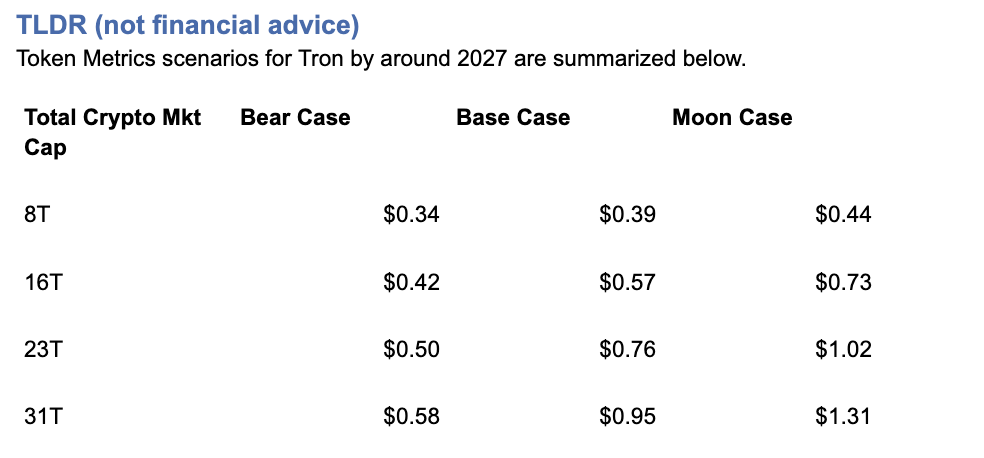
Current price: $0.2971.

How to Read This TRX Price Prediction

Each band blends cycle analogues and market-cap share math with TA guardrails. Base assumes steady adoption and neutral or positive macro. Moon layers in a liquidity boom. Bear assumes muted flows and tighter liquidity.

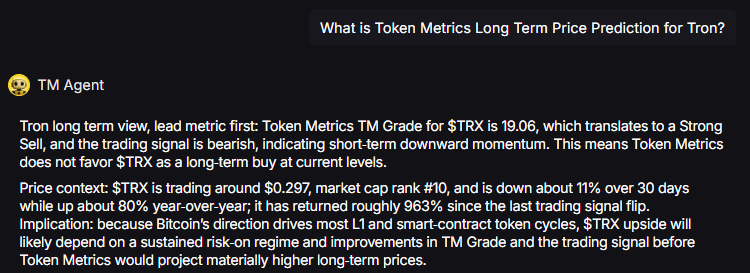
TM Agent baseline: Token Metrics TM Grade for $TRX is 19.06, which translates to a Strong Sell, and the trading signal is bearish, indicating short-term downward momentum. Price context: $TRX is trading around $0.297, market cap rank #10, and is down about 11% over 30 days while up about 80% year-over-year, it has returned roughly 963% since the last trading signal flip. Despite strong historical returns, current price prediction models reflect caution.

Live details: Tron Token Details → https://app.tokenmetrics.com/en/tron 

Buy TRX: https://www.mexc.com/acquisition/custom-sign-up?shareCode=mexc-2djd4 

Key Takeaways: Tron Price Prediction Summary

  • Scenario driven: Price prediction outcomes hinge on total crypto market cap; higher liquidity and adoption lift the bands
  • TM Agent gist: Bearish near term in price prediction models; upside depends on sustained risk-on regime and improvements in TM Grade and trading signal
  • Current rating: Strong Sell (19.06) despite bullish 2026 macro backdrop and 80% YoY gains
  • Stablecoin focus: TRX benefits from USDT transfer volume on Tron network
  • $1 target: Achievable in 23T+ moon scenarios per price prediction framework
  • Education only, not financial advice

Tron Price Prediction Scenario Analysis

Token Metrics price prediction scenarios span four market cap tiers, each representing different levels of crypto market maturity and liquidity:

8T Market Cap - TRX Price Prediction:

At an 8 trillion dollar total crypto market cap, our TRX price prediction framework projects specific targets in bear, base, and bullish scenarios. The 8T tier reflects conservative market conditions with steady stablecoin transfer adoption.
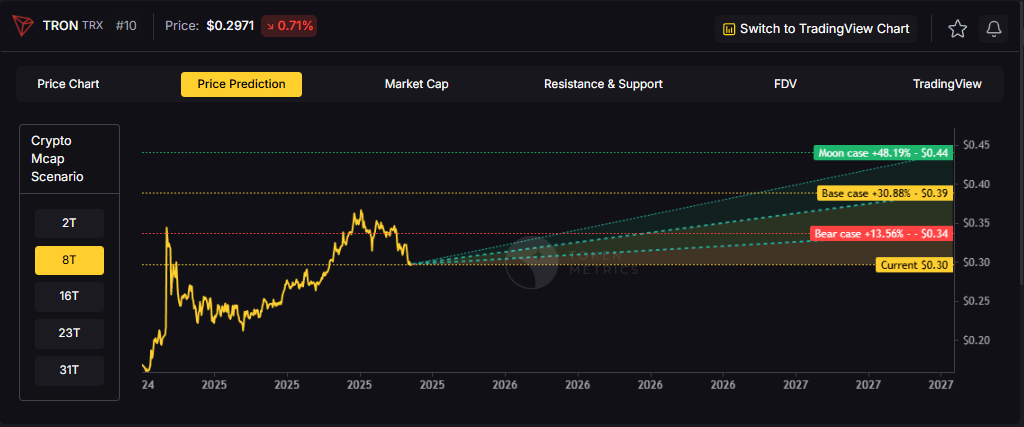
 16T Market Cap - TRX Price Prediction:

Doubling the market to 16 trillion expands the TRX price prediction range significantly, reflecting increased institutional stablecoin usage and payments adoption that benefit Tron's high-throughput, low-cost infrastructure.
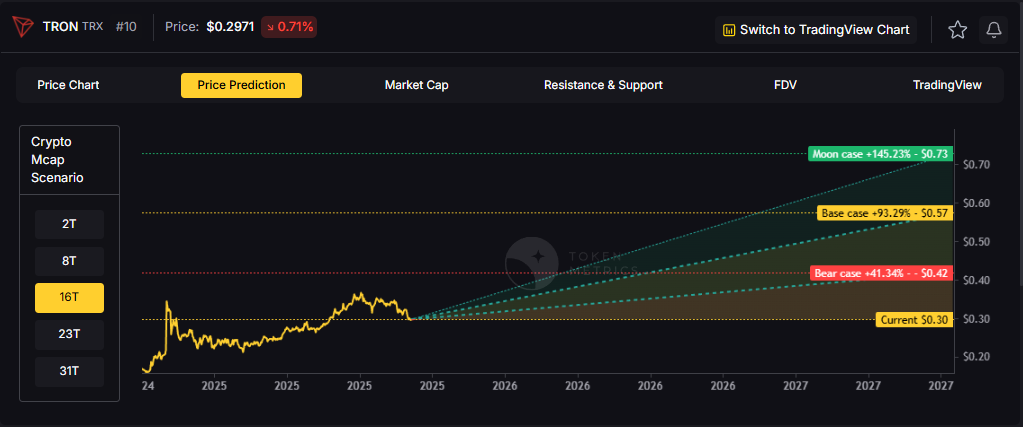
 23T Market Cap - TRX Price Prediction:

At 23 trillion total crypto market cap, the price prediction scenarios show substantial upside potential, with the moon case projecting $1.02—achieving the psychologically important $1.00 milestone for TRX holders.
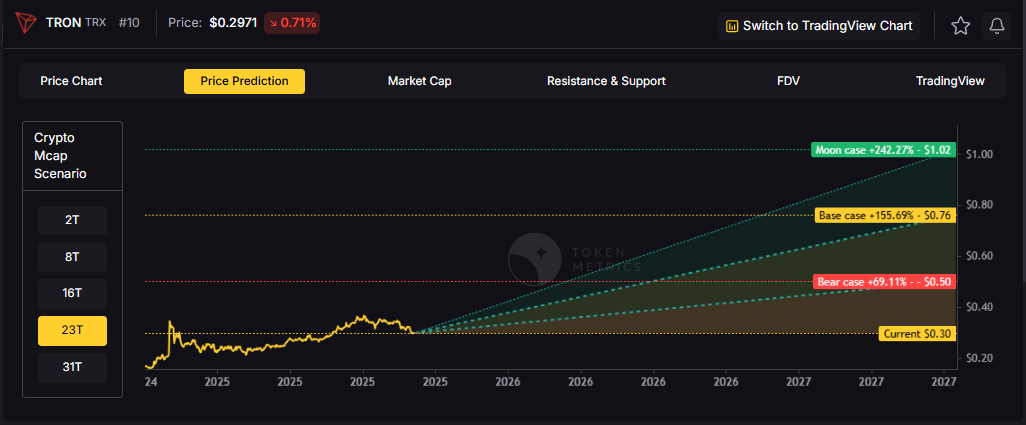
 Each tier in our price prediction framework assumes progressively stronger market conditions, with particular emphasis on stablecoin transfer volume and payments use cases that uniquely position Tron in the blockchain ecosystem.

Why Consider the Indices with Top-100 Exposure

Diversification matters. Tron is compelling, yet concentrated bets can be volatile—especially when price predictions carry Strong Sell ratings despite bullish macro conditions. Token Metrics Indices hold TRX alongside the top one hundred tokens for broad exposure to leaders and emerging winners.

Our backtests indicate that owning the full market with diversified indices has historically outperformed both the total market and Bitcoin in many regimes due to diversification and rotation benefits, reducing single-asset risk.

Get early access: https://docs.google.com/forms/d/1AnJr8hn51ita6654sRGiiW1K6sE10F1JX-plqTUssXk/preview 

If your editor supports embeds, place a form embed here. Otherwise, include the link above as a button labeled Join Indices Early Access.

What Is Tron?

Tron is a smart-contract blockchain focused on low-cost, high-throughput transactions and cross-border settlement. The network supports token issuance and a broad set of dApps, with an emphasis on stablecoin transfer volume and payments—critical factors that influence TRX price predictions.

TRX is the native asset that powers fees and staking for validators and delegators within the network. Developers and enterprises use the chain for predictable costs and fast finality, which supports consumer-facing use cases. Tron has become a dominant network for USDT (Tether) transfers, creating organic demand for TRX that impacts long-term price prediction trajectories.

Catalysts That Skew TRX Price Predictions Bullish

  • Institutional and retail access expands with ETFs, listings, and integrations
  • Macro tailwinds from lower real rates and improving liquidity expected in 2026
  • Product or roadmap milestones such as upgrades, scaling, or partnerships
  • Growing USDT stablecoin transfer volume on Tron network
  • Increased cross-border payment adoption and remittance use cases
  • Continued low-fee competitive advantage versus Ethereum
  • Enterprise blockchain partnerships leveraging Tron's throughput

Risks That Skew TRX Price Predictions Bearish

  • Macro risk-off from tightening or liquidity shocks
  • Regulatory actions targeting Tron, Justin Sun, or infrastructure outages
  • Current Strong Sell rating (19.06) indicating significant fundamental concerns
  • Concentration risk in validator economics and potential centralization issues
  • Competitive displacement from faster, lower-cost L1s and L2 solutions
  • Regulatory scrutiny on stablecoin operations affecting Tether/USDT
  • Reputational concerns related to founder Justin Sun
  • Competition from Solana, BNB Chain for stablecoin transfers

Special Offer — Token Metrics Advanced Plan with 20% Off

Unlock platform-wide intelligence on every major crypto asset. Use code ADVANCED20 at checkout for twenty percent off.

  • AI powered ratings on thousands of tokens for traders and investors
  • Interactive TM AI Agent to ask any crypto question
  • Indices explorer to surface promising tokens and diversified baskets
  • Signal dashboards, backtests, and historical performance views
  • Watchlists, alerts, and portfolio tools to track what matters
  • Early feature access and enhanced research coverage

Start with Advanced today → https://www.tokenmetrics.com/token-metrics-pricing 

Tron Price Prediction FAQs

Can TRX reach $1?

Yes. The 23T moon case in our price prediction framework shows $1.02 and the 31T moon case shows $1.31, which imply a path to $1 in higher-liquidity regimes. From current price of $0.2971, this represents approximately 240%+ gains. However, achieving this requires the bullish 2026 thesis materializing with strong stablecoin adoption and overcoming the current Strong Sell rating (19.06). Not financial advice.

Is TRX a good long-term investment?

TRX presents a complex investment case with a Strong Sell rating (19.06) despite impressive historical returns (80% YoY, 963% since last signal flip). Our price prediction models show potential upside to $1.02-$1.31 in bullish scenarios, but outcome depends heavily on adoption, liquidity regime, competition, regulatory environment, and supply dynamics. The stablecoin transfer use case provides organic demand, but fundamental concerns reflected in the Strong Sell rating suggest caution. Diversify and size positions responsibly. Not financial advice.

What is the Tron price prediction for 2026-2027?

Our comprehensive TRX price prediction framework for 2026-2027 suggests Tron could reach $1.02 in the 23T moon scenario and $1.31 in the 31T moon scenario, representing significant upside from current $0.2971 price. Base case scenarios across market cap tiers provide more conservative targets. Despite the bullish 2026 macro thesis and strong stablecoin utility, the Strong Sell rating (19.06) and bearish trading signal indicate current fundamental concerns. Not financial advice.

Should I buy TRX now or wait?

TRX has a Strong Sell rating (19.06) indicating Token Metrics does not endorse Tron at current levels, despite bullish 2026 macro conditions and 80% YoY gains. Current price of $0.2971 is down 11% over 30 days with bearish trading signals. However, historical outperformance (963% since last signal flip) and stablecoin transfer utility create a paradox. If you believe in the 2026 bull thesis and Tron's stablecoin dominance, dollar-cost averaging may reduce timing risk. Consider diversified exposure through indices. Not financial advice.

Why does TRX have a Strong Sell rating despite 80% YoY gains?

TRX receives a Strong Sell rating (19.06) based on current fundamental analysis, technical indicators, and valuation metrics—despite impressive historical performance (80% YoY, 963% since last signal flip). Ratings reflect forward-looking risk assessment including regulatory concerns, centralization issues, reputational factors, and competitive threats. Our price prediction framework shows potential upside in favorable scenarios, but the Strong Sell rating suggests significant risks that could prevent achieving bullish targets. Past performance doesn't guarantee future results. Not financial advice.

How does TRX benefit from stablecoin transfers?

Tron has become the dominant network for USDT (Tether) transfers due to extremely low fees and fast settlement. This creates organic demand for TRX as users need the native token for transaction fees. Our price prediction models assume continued growth in stablecoin transfer volume, which supports base case scenarios. The 23T and 31T price predictions of $1.02-$1.31 factor in sustained stablecoin dominance. However, competition from other low-cost chains and regulatory scrutiny on Tether operations represent risks. Not financial advice.

Can TRX reach $2?

TRX reaching $2 would exceed our current price prediction models' highest scenario of $1.31 (31T moon case). From current $0.2971, $2 represents approximately 570%+ gains. This would require extraordinary market conditions beyond the 31T total crypto market cap tier, exceptional stablecoin adoption acceleration, and overcoming significant fundamental concerns reflected in the Strong Sell rating (19.06). While possible in extreme bull scenarios, $2 appears beyond rational price prediction frameworks. Not financial advice.

What are the biggest risks to TRX price predictions?

Key risks that could derail Tron price predictions include: Strong Sell rating (19.06) indicating severe fundamental concerns, regulatory actions targeting Tron network or founder Justin Sun, centralization concerns in validator economics, regulatory scrutiny on Tether/USDT operations affecting transfer volumes, competitive displacement from Solana/BNB Chain for stablecoin transfers, reputational issues, macro liquidity shocks ending 2026 bull thesis, and potential security vulnerabilities. Despite strong utility, these risks warrant careful position sizing. Not financial advice.

How does Tron compare to other payment blockchain price predictions?

Tron's price prediction framework suggests $0.30-$1.31 across scenarios, positioning it as a specialized payments and stablecoin transfer network. Compared to Ethereum's dominance and Solana's speed, Tron differentiates through extremely low fees and USDT transfer volume leadership. However, the Strong Sell rating (19.06) reflects concerns that this niche may not sustain long-term value versus more decentralized, diversified platforms. Tron trades at rank #10, indicating established but controversial market position. Not financial advice.

Will TRX benefit from the 2026 bull market?

Yes. Our price prediction scenarios are specifically framed around the bullish 2026 thesis, where improving liquidity, institutional participation, and stablecoin adoption create favorable conditions. TRX's low-fee infrastructure and USDT dominance position it to capture bull market momentum in payments use cases. However, the Strong Sell rating (19.06) and bearish momentum suggest TRX may underperform versus fundamentally stronger tokens. Muted base case projections reflect this tension between macro tailwinds and micro concerns. Not financial advice.

Is the $1 target realistic for TRX?

The $1 target appears achievable in our price prediction framework's 23T moon case ($1.02) and 31T scenarios ($1.31). From current $0.2971, this represents approximately 240%+ gains requiring sustained stablecoin adoption, bullish macro conditions materializing, and overcoming Strong Sell rating concerns. Historical volatility (963% returns since last signal flip) demonstrates TRX's ability to deliver explosive gains, but fundamental weaknesses create significant uncertainty. Possible but high-risk—manage expectations accordingly. Not financial advice.

What needs to happen for TRX to reach price prediction targets?

For TRX to reach our price prediction targets of $1.02-$1.31, several catalysts must materialize: (1) continued dominance in USDT stablecoin transfers, (2) bullish 2026 macro conditions with improving liquidity, (3) addressing regulatory concerns around Tron and Justin Sun, (4) improving TM Grade from Strong Sell (19.06) territory, (5) institutional adoption of Tron for cross-border payments, (6) successful competition against Solana/BNB Chain, and (7) maintaining low-fee advantage as scaling solutions proliferate. The Strong Sell rating suggests these catalysts aren't currently materializing at required pace.
Next Steps

Track live grades and signals: Token Details → https://app.tokenmetrics.com/en/tron 

Join Indices Early Access: https://docs.google.com/forms/d/1AnJr8hn51ita6654sRGiiW1K6sE10F1JX-plqTUssXk/preview

Want exposure Buy TRX on MEXC → https://www.mexc.com/acquisition/custom-sign-up?shareCode=mexc-2djd4 

Disclosure

Educational purposes only, not financial advice. Crypto is volatile, do your own research and manage risk.

Why Use Token Metrics for Tron Price Predictions?

  • Transparent analysis: Honest Strong Sell ratings (19.06) even when historical returns are exceptional (963%)
  • Scenario-based modeling: Four market cap tiers for comprehensive price prediction analysis
  • Stablecoin specialization: Understanding Tron's unique position in USDT transfer ecosystem
  • Risk-adjusted approach: Balanced view of utility strengths versus fundamental concerns
  • Real-time signals: Trading signals and TM Grades updated regularly tracking 11% monthly decline
  • Diversification tools: Index solutions to spread payment blockchain risk
  • Comparative analysis: Analyze TRX against BNB, SOL, and 6,000+ tokens
Build Smarter Crypto Apps &
AI Agents in Minutes, Not Months
Real-time prices, trading signals, and on-chain insights all from one powerful API.
Grab a Free API Key
About Token Metrics
Token Metrics: AI-powered crypto research and ratings platform. We help investors make smarter decisions with unbiased Token Metrics Ratings, on-chain analytics, and editor-curated “Top 10” guides. Our platform distills thousands of data points into clear scores, trends, and alerts you can act on.
30 Employees
analysts, data scientists, and crypto engineers
Daily Briefings
concise market insights and “Top Picks”
Transparent & Compliant
Sponsored ≠ Ratings; research remains independent
Want Smarter Crypto Picks—Free?
See unbiased Token Metrics Ratings for BTC, ETH, and top alts.
Thank you! Your submission has been received!
Oops! Something went wrong while submitting the form.
 No credit card | 1-click unsubscribe
Token Metrics Team
Token Metrics Team

Recent Posts

Research

From Stocks to Crypto Indices: A Traditional Investor's Guide to Digital Asset Allocation with Token Metrics

Token Metrics Team
14 min read

If you've spent years building wealth through stocks, bonds, and mutual funds, cryptocurrency can seem alien and intimidating. The volatility, technical jargon, and stories of overnight millionaires mixed with devastating losses create skepticism among disciplined traditional investors.

Yet ignoring cryptocurrency entirely means missing one of the most significant wealth creation opportunities of our generation. The key isn't abandoning proven investment principles—it's applying them to a new asset class through vehicles designed for sophisticated investors like you.

Token Metrics AI Indices bridge the gap between traditional finance and cryptocurrency by offering:

  • Index-based exposure similar to stock market ETFs
  • Professional management resembling mutual funds
  • Diversification principles you already understand
  • Risk management frameworks familiar from traditional portfolios

This guide helps traditional investors transition into cryptocurrency thoughtfully, comparing familiar concepts to crypto equivalents, explaining portfolio allocation strategies, addressing tax considerations, and building crypto exposure using time-tested investment principles.

Understanding Crypto Indices Through Traditional Finance Lens

The easiest way to understand crypto indices is through comparison with traditional investment vehicles you already know.

  • Crypto indices function like stock market ETFs - diversified, automatically rebalanced portfolios
  • AI-driven token selection resembles active management and smart beta strategies
  • Diversification and correlation principles work identically in crypto
  • Risk-adjusted returns are measured using the same metrics (Sharpe ratio, drawdowns, volatility)

Crypto Indices Are Like Stock Market ETFs

Just as the S&P 500 ETF provides diversified exposure to 500 large US companies without selecting individual stocks, Token Metrics indices provide diversified exposure to carefully selected cryptocurrencies without picking individual tokens.

The SPY ETF tracks the S&P 500 automatically rebalancing as companies enter or exit the index. Token Metrics indices similarly track AI-selected portfolios, automatically rebalancing as market conditions change and new opportunities emerge.

Traditional index funds charge expense ratios—typically 0.03-0.50% annually. Token Metrics operates on a subscription model providing access to multiple indices and analytical tools for one fee, similar to premium investment research services.

AI-Driven Selection Resembles Active Management

While crypto indices use passive indexing methodology, the underlying token selection employs active management principles. This hybrid approach resembles smart beta ETFs in traditional markets—systematic strategies using quantitative factors to outperform market-cap-weighted approaches.

Token Metrics' AI analyzes fundamental metrics, technical indicators, and on-chain data to identify undervalued tokens with strong prospects. This process mirrors how active stock fund managers screen for quality companies, strong earnings, and attractive valuations—but executed algorithmically at scale across thousands of cryptocurrencies.

Diversification Works the Same Way

Portfolio theory applies equally to crypto. Diversification reduces unsystematic risk by spreading exposure across multiple assets. If one stock in your portfolio falls 50%, it impacts your total portfolio proportionally to its weighting. The same principle protects crypto index investors when individual tokens underperform.

Correlation matters identically. Diversification provides maximum benefit when assets don't move in lockstep. Token Metrics indices intentionally diversify across different blockchain ecosystems, use cases, and market capitalizations to reduce correlation and smooth returns.

Risk-Adjusted Returns Follow Same Metrics

Sharpe ratios, maximum drawdowns, and volatility measurements apply to crypto just as they do to stocks. Professional investors don't evaluate returns in isolation—they assess returns relative to risk taken.

Token Metrics indices target superior risk-adjusted returns through the same principles traditional managers use—systematic analysis, disciplined rebalancing, and professional risk management. The asset class differs but investment principles remain constant.

Translating Your Stock Market Experience to Crypto

Your traditional investing experience provides valuable foundation for crypto success.

  • Fundamental Analysis: Stock investors evaluate revenue, profit margins, and competitive advantages. Crypto analysis examines transaction volume, technology advantages, team quality, and market opportunity using different terminology but similar principles. Token Metrics' AI systematically evaluates these factors like quantitative stock strategies.
  • Technical Analysis: Support, resistance, moving averages, and momentum indicators function identically for cryptocurrencies. Your technical analysis skills transfer directly to crypto markets.
  • Portfolio Construction: Asset allocation, rebalancing, and diversification principles apply universally. Cryptocurrency's low correlation to traditional assets makes it valuable for diversification even at small allocations.
  • Market Cycles: Bull markets, bear markets, and consolidation occur in crypto like stocks. Your experience navigating market downturns prepared you for crypto volatility—the magnitude differs but psychological challenges remain similar.

Portfolio Allocation: How Much Crypto Should Traditional Investors Hold?

Determining appropriate cryptocurrency allocation requires balancing growth potential against volatility tolerance and time horizon.

  • Conservative (1-5%): For investors approaching retirement or with low risk tolerance
  • Moderate (5-15%): For mid-career professionals with 10-20 year horizons
  • Aggressive (15-30%): For younger investors with long time horizons and high risk tolerance

Conservative Allocation (1-5%)

Investors approaching retirement or with low risk tolerance should limit crypto exposure to 1-5% of total portfolio. This provides meaningful participation in crypto's growth without risking financial security.

At this allocation level, even if crypto suffers 80% decline, your total portfolio drops only 0.8-4%—uncomfortable but manageable. Conversely, if crypto appreciates 300%, your portfolio gains 3-15%—meaningful upside from small allocation.

Focus exclusively on Token Metrics' conservative indices emphasizing Bitcoin, Ethereum, and fundamentally strong large-cap tokens. This minimizes volatility while maintaining crypto exposure.

Moderate Allocation (5-15%)

Mid-career professionals with 10-20 year investment horizons can embrace 5-15% crypto allocation. This provides substantial exposure to crypto's growth potential while maintaining predominantly traditional portfolio structure.

Balanced Token Metrics indices suit this allocation level, combining established cryptocurrencies with growth-oriented mid-cap tokens. The diversification and professional management limit volatility compared to individual token selection.

At 10% allocation, your portfolio's overall volatility increases modestly—perhaps from 12% to 14% standard deviation annually. This marginal volatility increase brings meaningful return enhancement potential.

Aggressive Allocation (15-30%)

Younger investors with long time horizons and high risk tolerance can allocate 15-30% to cryptocurrency. At these levels, crypto significantly influences total portfolio performance, requiring comfort with substantial volatility.

Mix conservative and aggressive Token Metrics indices providing both stability and growth potential. Even aggressive allocations benefit from some downside protection through conservative index components.

Understand that 25% crypto allocation could create 20% portfolio swings during extreme market conditions. Only embrace this allocation if you can tolerate such volatility without panic selling.

Implementation Through Dollar-Cost Averaging

Regardless of target allocation, implement gradually through dollar-cost averaging over 6-12 months. This reduces timing risk and allows psychological adjustment to crypto's volatility.

If targeting 10% crypto allocation with $500,000 portfolio, invest $50,000 total. Rather than investing all at once, invest $4,167 monthly for 12 months. This systematic approach removes emotion and smooths entry prices.

Tax Considerations: What Traditional Investors Must Know

Cryptocurrency taxation differs from stocks in important ways. Understanding these differences prevents costly mistakes.

  • Capital gains taxes apply to crypto, with added complexity for crypto-to-crypto trades
  • Tax-loss harvesting currently works more flexibly without wash sale rules
  • Retirement accounts (IRAs, 401ks) offer tax-advantaged crypto investing options
  • Detailed record keeping is essential for every transaction

Capital Gains Apply But With Complexity

Like stocks, cryptocurrencies trigger capital gains taxes when sold for profit. Long-term capital gains rates (held over one year) provide tax advantages versus short-term rates, just as with stocks.

However, crypto-to-crypto trades—exchanging one token for another—trigger taxable events even though you haven't converted to dollars. This differs from stocks where exchanging one stock for another within retirement accounts doesn't trigger taxes.

Token Metrics indices involve periodic rebalancing requiring crypto-to-crypto trades. Each rebalancing transaction creates potential taxable events. Track all transactions meticulously for tax reporting.

Tax-Loss Harvesting Works Differently

Stock investors use tax-loss harvesting to offset gains with losses, subject to wash sale rules preventing you from repurchasing identical securities within 30 days.

Cryptocurrency currently isn't subject to wash sale rules, allowing more aggressive tax-loss harvesting. You could sell a token at loss for tax purposes and immediately repurchase it. However, proposed legislation may extend wash sale rules to crypto—consult tax professionals before relying on this strategy.

Retirement Account Considerations

Some custodians now allow cryptocurrency holdings in retirement accounts (IRAs, 401ks), providing tax-advantaged growth similar to stock investments in these accounts.

Holding crypto indices in traditional IRAs defers taxes until withdrawal. Roth IRAs allow tax-free growth. These vehicles eliminate concerns about rebalancing transactions creating taxable events, making them ideal for crypto index investing.

Research self-directed IRA providers supporting cryptocurrency if interested in tax-advantaged crypto investing. Not all custodians offer this option yet.

Record Keeping Requirements

Cryptocurrency requires more detailed record keeping than stocks. Every transaction—purchases, sales, trades, rebalancing—needs documentation including dates, amounts, prices, and transaction types.

Token Metrics provides transaction tracking helping maintain records for tax reporting. Use this data or export to cryptocurrency tax software like CoinTracker or TokenTax simplifying annual tax preparation.

Risk Management: Applying Traditional Principles to Crypto

Your experience managing risk in traditional portfolios translates directly to crypto with some adjustments:

  • Position sizing and diversification prevent concentration risk
  • Systematic rebalancing enforces buy-low, sell-high discipline
  • Correlation monitoring maintains appropriate portfolio risk
  • Stress testing prepares you for extreme scenarios

Position Sizing Matters More

Individual stock positions typically represent 2-5% of diversified portfolios. Individual crypto positions in Token Metrics indices follow similar sizing—no single token dominates portfolio, limiting concentration risk.

This disciplined position sizing prevents the common crypto investor mistake of betting everything on one or two tokens. Diversification reduces volatility and protects against catastrophic single-asset failures.

Rebalancing Discipline Applies Equally

Traditional investors rebalance portfolios periodically—perhaps quarterly or annually—to maintain target allocations. Token Metrics indices rebalance dynamically based on market conditions and AI analysis.

This systematic rebalancing forces "buy low, sell high" discipline. When tokens appreciate substantially, the AI takes profits. When tokens decline but fundamentals remain strong, the AI accumulates at lower prices. Emotional investors do the opposite—buying high and selling low.

Correlation Monitoring Remains Important

Traditional portfolios balance stocks, bonds, and other assets with low correlation. Monitor how your crypto allocation correlates with traditional holdings.

During certain periods, crypto moves independently from stocks providing diversification benefits. During other periods—like March 2020—correlations spike as all risk assets decline together. Understanding these dynamics helps maintain appropriate total portfolio risk.

Stress Testing Your Allocation

Before committing to crypto allocation, stress test how your total portfolio would perform in various scenarios. If crypto fell 80% while stocks fell 50% (like March 2020), would you maintain discipline?

Running these mental simulations before investing prevents panic selling during actual market stress. Decide now what actions you'd take during severe downturns rather than making emotional decisions in the moment.

Transitioning Gradually: A Practical Timeline

Don't rush into crypto. Traditional investors benefit from gradual, measured transitions respecting both opportunity and risk.

  • Months 1-2: Education phase - learn without investing
  • Months 3-4: Planning phase - set allocation targets and open accounts
  • Months 5-6: Initial implementation - begin dollar-cost averaging
  • Months 7-12: Scale to target allocation - reach full position size

Month 1-2: Education Phase

Spend your first two months learning without investing. Open Token Metrics account and explore the platform. Read educational resources about blockchain technology, cryptocurrency fundamentals, and market dynamics. Review index compositions and historical performance.

This education phase builds knowledge foundation supporting confident decision-making. Resist pressure to invest immediately—markets will still exist after you've learned properly.

Month 3-4: Planning Phase

Determine your target crypto allocation based on age, risk tolerance, and financial goals. Decide which Token Metrics indices align with your objectives. Calculate dollar amounts for initial investment and ongoing dollar-cost averaging.

Open cryptocurrency exchange account and complete verification. Link bank account for funding transfers. Set up two-factor authentication and security measures.

Month 5-6: Initial Implementation

Begin dollar-cost averaging into chosen indices. Start with smaller amounts building confidence before committing larger capital. Experience the volatility firsthand with manageable position sizes.

Monitor your emotional reactions. Are you comfortable with price swings? Does crypto allocation interfere with sleep or create anxiety? These early experiences inform whether your planned allocation truly matches your risk tolerance.

Month 7-12: Scale to Target Allocation

Gradually increase crypto positions toward target allocation. Continue dollar-cost averaging throughout this period. As positions grow, implement hardware wallet security if comfortable with technical requirements.

By month 12, reach your target allocation and transition from accumulation to maintenance mode. Conduct quarterly reviews but otherwise maintain hands-off approach trusting Token Metrics' professional management.

Conclusion: Bridging Two Investment Worlds

Traditional investing and cryptocurrency aren't opposing philosophies—they're complementary approaches to wealth building. Your decades of stock market experience provide valuable foundation for crypto success when applied thoughtfully through appropriate vehicles.

Token Metrics AI Indices allow traditional investors to embrace cryptocurrency without abandoning proven principles. Diversification, risk management, systematic analysis, and disciplined rebalancing work equally well across all asset classes.

The opportunity cost of ignoring cryptocurrency grows daily. Markets that seemed irrational five years ago have matured into trillion-dollar ecosystems attracting institutional capital and regulatory clarity. By the time crypto becomes "safe" enough for all traditional investors, exceptional returns will have moderated toward market averages.

Your advantage as an experienced investor is recognizing emerging opportunities while managing risk appropriately. You didn't achieve investment success through reckless speculation—you succeeded through disciplined, strategic allocation across diverse assets.

Apply those same principles to cryptocurrency through Token Metrics indices. Start small, scale gradually, maintain discipline, and let professional management and systematic diversification work in your favor.

The bridge between traditional finance and cryptocurrency exists—Token Metrics built it specifically for sophisticated investors like you. Cross it confidently knowing your time-tested investment principles remain your most valuable guide.

Start your 7-day free trial today and discover how traditional investment wisdom translates perfectly to cryptocurrency success through professionally managed AI indices.

Research

Mastering Crypto Market Cycles: How to Use Token Metrics Indices in Bull, Bear, and Sideways Markets

Token Metrics Team
13 min read

Cryptocurrency markets move through distinct cycles—explosive bull runs, devastating bear markets, and frustrating sideways consolidation. Most investors struggle because they employ the same strategy regardless of market conditions, buying aggressively during euphoric peaks and panic selling during despair-filled bottoms.

Professional investors adapt strategies to market conditions, allocating aggressively during fear, taking profits during greed, and maintaining patience during consolidation. Token Metrics AI Indices provide the framework for implementing cycle-aware strategies that maximize returns across all market environments.

This comprehensive guide explores how to recognize different market phases, adjust index allocations for each condition, implement tactical strategies that capitalize on market cycles, and maintain long-term discipline while navigating volatility.

Understanding Cryptocurrency Market Cycles

Before adjusting strategies, you must recognize which market phase is occurring. Crypto markets exhibit more dramatic cycles than traditional assets, creating both risk and opportunity.

Bull Market Characteristics

Bull markets feature sustained upward price momentum across most cryptocurrencies, with several identifying characteristics:

  • Bitcoin and major altcoins achieving new all-time highs
  • Widespread mainstream media coverage of crypto success stories
  • New investors entering the market in accelerating numbers
  • Trading volumes increasing substantially across exchanges
  • Social media sentiment overwhelmingly positive and euphoric
  • New projects launching successfully with strong investor demand
  • Fear & Greed Index consistently showing "extreme greed"

Bull markets typically last 12-24 months and generate life-changing returns for positioned investors. Bitcoin's 2020-2021 bull run saw gains exceeding 1000%, with many altcoins appreciating even more dramatically.

Bear Market Characteristics

Bear markets feature sustained downward pressure with pessimism dominating sentiment:

  • Major cryptocurrencies declining 70-90% from peak values
  • Mainstream media declaring crypto "dead" or discussing collapse
  • Retail investors capitulating and exiting positions at losses
  • Trading volumes declining as interest wanes
  • Social media sentiment turning negative and fearful
  • Project failures and exchange bankruptcies making headlines
  • Fear & Greed Index showing "extreme fear" for extended periods

Bear markets typically last 12-18 months and test investor resolve severely. The 2022 bear market saw Bitcoin decline 75% with many altcoins losing 90%+ of value.

Sideways/Consolidation Market Characteristics

Consolidation phases feature range-bound trading without clear directional trends:

  • Prices oscillating within defined ranges for extended periods
  • Minimal mainstream media coverage as crypto becomes "boring"
  • Retail interest declining but not capitulating completely
  • Trading volumes moderate and stable
  • Social media sentiment neutral without extreme fear or greed
  • Market "digesting" previous moves and building support levels

Consolidation periods last weeks to months, often preceding major directional moves. These phases frustrate momentum traders but reward patient, strategic investors.

Bull Market Index Strategies: Maximizing Upside Capture

Bull markets offer the greatest wealth creation opportunities. Proper positioning during these phases generates returns funding years of conservative investing.

Aggressive Allocation During Early Bull Markets

When bull market indicators emerge, increase crypto index allocation aggressively. Early bull market phases offer the best risk/reward as prices remain relatively low while momentum builds.

If your standard allocation is 10% crypto, consider increasing to 15-20% during confirmed bull market starts. This tactical overweight positions you to capture maximum appreciation during the explosive middle phase.

Focus allocation on aggressive growth indices targeting smaller-cap tokens with highest upside potential. These indices typically outperform conservative alternatives 2-3x during bull runs. A balanced approach might look like:

  • 40% Aggressive Growth Indices (small/mid-cap focus)
  • 30% Balanced Indices (diversified exposure)
  • 20% Sector-Specific Indices (DeFi, Layer-1, AI tokens)
  • 10% Conservative Indices (downside protection)

Systematic Profit-Taking During Peak Euphoria

As bull markets mature and euphoria intensifies, implement systematic profit-taking to lock in gains. The greatest mistake investors make is riding entire rallies up and back down without realizing profits.

When Fear & Greed Index shows "extreme greed" for consecutive weeks and mainstream media features crypto prominently, begin taking profits. Don't try timing exact tops—instead, implement scaling strategies:

  • Sell 10% of crypto holdings when portfolio gains exceed 100%
  • Sell another 10% when gains exceed 200%
  • Sell another 15% when gains exceed 300%
  • Sell final 15% when gains exceed 500% or signs of reversal appear

This approach locks in life-changing gains while maintaining exposure if bull market extends further. You'll never sell at the exact top, but you'll capture substantial profits systematically.

Rebalancing Discipline Prevents Overexposure

Bull markets can cause crypto allocation to grow from 10% to 30-40% of total portfolio as values appreciate. This creates dangerous overexposure to a single asset class.

Rebalance quarterly during bull markets to maintain target allocation ranges. If crypto grows from 10% to 25% of portfolio, sell enough to return to 15% target (allowing modest overweight during favorable conditions). Redeploy profits into uncorrelated assets like bonds or real estate.

This disciplined rebalancing forces "buy low, sell high" behavior—selling appreciating crypto to buy lagging assets that may outperform in next cycle.

Avoid FOMO-Driven Purchases

Bull markets create intense fear of missing out as prices surge daily. Resist temptation to abandon strategy and invest everything during peak euphoria.

The worst investment timing involves buying large positions during late bull markets after substantial appreciation. Maintain discipline, follow predetermined plans, and remember that bear markets always follow bull runs—capital preserved during peaks positions you to buy during subsequent fear.

Bear Market Index Strategies: Capital Preservation and Accumulation

Bear markets destroy wealth for emotional investors but create generational buying opportunities for disciplined strategists. Proper bear market positioning separates wealthy from wealthy.

Defensive Positioning During Distribution Phase

As bull markets peak and distribution begins (smart money selling to euphoric retail), shift allocation defensively before full bear market develops.

Reduce aggressive growth index exposure from 40% to 10% of crypto allocation. Increase conservative index allocation from 10% to 50%. This defensive positioning limits drawdowns as markets decline.

Your adjusted bear market allocation might look like:

  • 50% Conservative Indices (Bitcoin, Ethereum, blue-chip altcoins)
  • 30% Balanced Indices (quality mid-caps)
  • 10% Aggressive Growth (minimal high-risk exposure)
  • 10% Cash/Stablecoins (dry powder for opportunities)

This conservative positioning won't prevent losses during severe bear markets, but will significantly limit damage compared to maintaining aggressive allocation.

Dollar-Cost Averaging During Despair

Bear markets create the best buying opportunities as quality assets trade at massive discounts. When Fear & Greed Index shows "extreme fear" consistently and mainstream media declares crypto dead, increase systematic buying.

If you typically invest $500 monthly, increase to $750-1000 monthly during peak fear. These forced purchases at depressed prices position portfolios for extraordinary gains during next bull market.

The psychological challenge is buying while your existing positions decline and negative sentiment dominates. Remember Warren Buffett's wisdom: "Be fearful when others are greedy, and greedy when others are fearful."

Maintaining Long-Term Perspective

Bear markets test investor resolve severely. Watching portfolios decline 60-80% triggers powerful emotional responses urging capitulation and selling.

Maintain perspective by remembering that every previous bear market ultimately reversed, rewarding those who held through downturns. Cryptocurrency's fundamental value drivers—technological innovation, adoption growth, institutional interest—remain intact despite temporary price declines.

View bear markets as "accumulation phases" rather than failures. Professional investors build positions during fear that generate wealth during subsequent bull runs.

Tax-Loss Harvesting Opportunities

Bear markets create valuable tax-loss harvesting opportunities. Strategically sell positions at losses to offset gains elsewhere in your portfolio, reducing tax liability.

Since crypto isn't currently subject to wash sale rules, you can sell positions at losses and immediately repurchase, maintaining exposure while capturing tax benefits. Token Metrics indices make this process simple—sell one index at a loss and immediately buy similar but not identical exposure through different index.

Captured tax losses can offset gains indefinitely, providing valuable long-term tax optimization.

Sideways Market Index Strategies: Patience and Positioning

Consolidation phases frustrate investors with range-bound trading. However, these periods offer important strategic opportunities.

Continue dollar-cost averaging during sideways markets. These contributions accumulate positions at stable prices, positioning you for eventual breakout. Sideways markets often precede major directional moves—maintaining systematic buying ensures adequate exposure regardless of direction.

Trust Token Metrics' rebalancing recommendations during consolidation. While overall market moves sideways, individual tokens rotate between strength and weakness. Indices capture these rotations, generating returns even during overall consolidation.

Build cash reserves during sideways markets rather than aggressively buying or selling. Accumulate stablecoins positioning you to act decisively when markets break from consolidation.

Avoid abandoning strategy out of impatience. Investors frustrated by lack of movement make unnecessary trades or abandon positions entirely. Maintain discipline—wealth is built over complete cycles, not individual phases.

Token Metrics AI Indicator: Your Market Cycle Guide

Token Metrics provides the AI Indicator specifically designed to identify market conditions and guide strategic adjustments. This powerful tool analyzes multiple data points assessing whether markets are bullish, bearish, or neutral.

Understanding Indicator Signals

The AI Indicator generates clear signals indicating optimal positioning:

  • Bullish Signal: Increase allocation toward aggressive growth indices and sector-specific opportunities
  • Neutral Signal: Maintain balanced allocation with standard diversification
  • Bearish Signal: Shift defensively toward conservative indices and reduce overall exposure

While no indicator predicts perfectly, systematic following of AI Indicator signals dramatically improves market timing and risk-adjusted returns compared to emotional decision-making.

Combining Indicator with Personal Analysis

Use AI Indicator as primary guide while incorporating personal market observations. If indicator shows bullish but you observe extreme euphoria and overextension, consider moderating aggression slightly. If indicator shows bearish but you see capitulation and extreme fear, consider this strong buying signal.

The combination of algorithmic analysis and human judgment creates optimal decision-making framework navigating complex markets effectively.

Practical Implementation: Your Cycle-Aware Action Plan

Implementing cycle-aware strategies requires systematic execution through all market conditions.

Quarterly Strategy Reviews

Conduct thorough strategy reviews quarterly assessing:

  • Current market phase based on multiple indicators
  • Portfolio allocation relative to targets
  • Performance of different indices across conditions
  • Needed adjustments based on changed circumstances
  • Profit-taking opportunities or accumulation targets

Document decisions and rationale, creating accountability and learning foundation for future cycles.

Automatic Rebalancing Rules

Establish automatic rebalancing rules removing emotion from execution:

  • Rebalance when any index exceeds target allocation by 10%
  • Take profits when total crypto allocation exceeds target by 50%
  • Increase contributions when crypto allocation falls 30% below target
  • Adjust index mix quarterly based on AI Indicator signals

These mechanical rules enforce discipline during emotional extremes when proper decisions feel most uncomfortable.

Emergency Protocols

Establish clear protocols for extreme market events:

  • Flash crash (30%+ single-day decline): Double normal contribution immediately
  • Parabolic rise (50%+ single-week gain): Take 20% profits immediately
  • Extended euphoria (extreme greed 4+ consecutive weeks): Begin systematic profit-taking
  • Extended fear (extreme fear 8+ consecutive weeks): Increase contributions 50%

Pre-commitment to extreme event protocols ensures rational action during chaos when emotions overwhelm judgment.

Common Mistakes to Avoid Across Market Cycles

Even experienced investors make predictable mistakes navigating market cycles. Awareness helps avoid these pitfalls.

  • Buying High, Selling Low: Emotional investing does opposite of profitable behavior—buying during euphoria and selling during panic
  • Abandoning Strategy Mid-Cycle: Switching strategies during drawdowns locks in losses and misses recoveries
  • Overconfidence During Bull Markets: Believing you're genius during bull runs leads to excessive risk-taking
  • Capitulation During Bear Markets: Selling at cycle bottoms guarantees losses and misses recovery gains
  • Impatience During Consolidation: Overtrading sideways markets generates fees without meaningful returns
  • Ignoring Risk Management: Failing to take profits or reduce exposure during extremes
  • Forgetting Long-Term Perspective: Obsessing over short-term movements instead of multi-cycle wealth building

Conclusion: Mastering Cycles Builds Lasting Wealth

Cryptocurrency market cycles create both extraordinary opportunity and devastating risk. The difference between wealth and ruin often comes down to strategic adjustment across market phases rather than perfect asset selection.

Token Metrics AI Indices provide the framework for implementing sophisticated cycle-aware strategies previously available only to professional fund managers. The platform's AI Indicator guides positioning while diversified indices provide appropriate exposure across market conditions.

Your success depends less on predicting market direction than on responding appropriately to conditions as they develop. Increase aggression during fear, take profits during greed, maintain patience during consolidation—these simple principles compound into extraordinary long-term results.

The next bull market will create millionaires. The next bear market will destroy those gains for undisciplined investors. The winners will be those who adapt strategies across cycles, maintaining discipline when emotions scream to abandon plans.

Token Metrics gives you the tools. Market cycles provide the opportunity. Your disciplined execution determines results. Begin implementing cycle-aware strategies today and position yourself to thrive through complete market cycles for decades to come.

Start your 7-day free trial and discover how professional-grade cycle management transforms crypto investing from speculation into systematic wealth creation.

Research

Building Retirement Wealth with Token Metrics Crypto Indices: A Long-Term Investment Strategy for Financial Freedom

Token Metrics Team
10 min read

Most cryptocurrency content focuses on quick profits, overnight riches, and short-term trading gains. This creates the misconception that crypto exists solely for speculation rather than serious wealth building. The reality? Cryptocurrency represents one of the most powerful tools available for long-term retirement planning when approached with discipline and proper strategy.

Token Metrics AI Indices provide the framework for incorporating cryptocurrency into retirement portfolios intelligently. Rather than gambling on individual tokens or timing markets perfectly, systematic index investing builds wealth gradually over decades through compound growth, professional management, and strategic diversification.

This comprehensive guide explores how to use crypto indices for retirement planning, comparing traditional retirement vehicles to crypto options, calculating realistic retirement scenarios, and building multi-decade investment strategies that could transform your financial future.

Why Crypto Indices Belong in Retirement Portfolios

Traditional retirement planning relies on stocks, bonds, and real estate. Adding cryptocurrency exposure enhances portfolios through several key mechanisms:

  • Superior Growth Potential: Historical crypto returns significantly exceed traditional assets over multi-year periods. Even if future returns moderate, achieving 30-50% annualized returns would dramatically impact retirement wealth.
  • Diversification Benefits: Cryptocurrency often moves independently from traditional assets, providing genuine diversification that smooths portfolio returns over time.
  • Inflation Protection: Fixed supply schedules make many cryptocurrencies potential inflation hedges, crucial for 20-40 year retirement planning horizons.
  • Accessibility: Unlike real estate or certain restricted investments, cryptocurrency provides accessible exposure regardless of location or wealth level.

A $10,000 investment growing at 40% annually becomes $289,000 in 10 years and over $8 million in 20 years, compared to traditional 8-10% returns producing $46,000-67,000 in 20 years.

Crypto Index Retirement Strategies by Age

Appropriate cryptocurrency allocation varies dramatically based on age and time until retirement. Here's how to structure crypto index exposure across different life stages.

Ages 20-35: Maximum Growth Phase

Young investors possess retirement timelines of 30-45 years, allowing aggressive crypto allocation with time to recover from potential downturns.

  • Target Allocation: 20-30% of total investment portfolio in crypto indices
  • Index Selection: 50% aggressive growth indices, 30% balanced indices, 20% conservative indices
  • Strategy: Maximum growth through high-risk/high-reward positioning with gradual shift toward stability as you age

At this age, even 80% portfolio declines during severe bear markets can be recovered within 5-10 years through continued contributions and market recovery. The extraordinary upside potential of aggressive crypto indices justifies accepting higher volatility.

Dollar-cost average aggressively during this phase. Invest consistently whether markets surge or crash—time in market beats timing the market over multi-decade horizons. A disciplined 25-year-old investing $500 monthly in crypto indices could accumulate millions by retirement.

Ages 35-50: Balanced Growth Phase

Mid-career professionals have 15-30 years until retirement, requiring balance between growth and preservation.

  • Target Allocation: 10-20% of portfolio in crypto indices
  • Index Selection: 30% aggressive growth, 50% balanced indices, 20% conservative indices
  • Strategy: Maintain growth exposure while gradually reducing volatility through balanced allocations

This age bracket still allows recovery from market downturns but requires more caution. Your portfolio has grown substantially through career earnings and investment gains—protecting accumulated wealth becomes increasingly important while maintaining growth exposure.

Continue regular contributions but consider taking partial profits during euphoric market conditions to rebalance back to target allocations. This systematic profit-taking locks in gains while maintaining disciplined exposure.

Ages 50-60: Capital Preservation with Growth

Pre-retirement investors have 5-15 years until retirement, requiring capital preservation focus while maintaining some growth exposure.

  • Target Allocation: 5-10% of portfolio in crypto indices
  • Index Selection: 10% aggressive growth, 30% balanced indices, 60% conservative indices
  • Strategy: Emphasize established cryptocurrencies through conservative indices while maintaining modest growth exposure

Near-retirement portfolio declines prove difficult to recover before accessing funds. Conservative crypto indices focusing on Bitcoin, Ethereum, and fundamentally strong large-caps provide continued growth potential with substantially reduced volatility compared to aggressive indices.

This phase should involve gradually reducing crypto allocation through systematic profit-taking if positions have appreciated significantly. Lock in life-changing gains rather than risking everything on continued appreciation.

Ages 60+: Income and Preservation

Retirees and near-retirees require income generation and capital preservation, making crypto allocation more cautious.

  • Target Allocation: 3-5% of portfolio in crypto indices maximum
  • Index Selection: 100% conservative indices emphasizing established assets
  • Strategy: Preserve accumulated wealth while maintaining modest crypto exposure for continued growth and inflation protection

At this stage, crypto serves primarily as portfolio diversifier and inflation hedge rather than primary growth driver. Conservative indices provide stability while avoiding volatility that could disrupt retirement cash flow needs.

Consider this allocation as "money you won't need for 10+ years" even in retirement. Maintain traditional income-generating assets for living expenses while crypto serves as long-term appreciation component.

Tax-Advantaged Crypto Retirement Investing

The most powerful retirement investing occurs in tax-advantaged accounts where compound growth accelerates without annual tax drag.

  • Traditional IRA Crypto: Contributions may be tax-deductible. Crypto appreciation grows tax-deferred until retirement withdrawals, dramatically accelerating wealth accumulation.
  • Roth IRA Crypto: Contributions aren't tax-deductible but all future gains—including crypto appreciation—are tax-free if withdrawn after age 59½. Imagine 1000%+ gains completely tax-free.
  • Tax-Loss Harvesting: In taxable accounts, sell positions at losses to offset gains, reducing tax liability. Crypto currently isn't subject to wash-sale rules, allowing aggressive optimization.
  • 401(k) Options: Some plans now include crypto-related options. Contribute enough to maximize employer match, then open self-directed IRA for crypto indices.

Calculating Your Crypto Retirement Scenarios

Understanding how crypto indices could impact your retirement requires running realistic projections based on various return scenarios.

Conservative Scenario: 20% Annualized Returns

If crypto indices deliver 20% annualized returns—substantially below historical performance but conservative for mature markets—the impact on retirement wealth remains significant.

Example: $10,000 initial investment with $500 monthly contributions over 30 years at 20% annual returns grows to approximately $2.8 million. The same contributions at traditional 8% returns grow to $680,000. The additional $2.1 million from crypto allocation transforms retirement completely.

Moderate Scenario: 35% Annualized Returns

If crypto indices achieve 35% annualized returns—possible given historical performance and continued sector growth—wealth accumulation accelerates dramatically.

Example: Same $10,000 initial investment with $500 monthly contributions over 30 years at 35% returns grows to approximately $18.5 million. This level of wealth provides complete financial freedom and generational wealth transfer opportunities.

Aggressive Scenario: 50% Annualized Returns

If crypto indices deliver 50% annualized returns—achievable during optimal conditions though not guaranteed—retirement wealth reaches extraordinary levels.

Example: $10,000 initial with $500 monthly over 30 years at 50% returns produces approximately $86 million. While this scenario seems unrealistic, early cryptocurrency adopters achieved even higher returns.

Reality Check: Averaging Across Market Cycles

Real returns won't be linear—expect bull markets delivering 200-500% returns alternating with bear markets producing 50-80% drawdowns. Over complete cycles, conservative average returns of 25-40% annually seem reasonable for diversified crypto index exposure.

These projections illustrate why even small crypto allocations dramatically impact long-term retirement wealth. A 10% crypto allocation returning 30% annually while 90% traditional assets return 8% produces blended portfolio returns of 10.2%—significantly enhancing retirement outcomes.

Managing Crypto Volatility in Retirement Planning

Cryptocurrency's volatility creates legitimate concerns for retirement investors. Managing this volatility while capturing growth requires specific strategies.

Time-Based Allocation Adjustment

Gradually reduce crypto allocation as retirement approaches through systematic rebalancing. This glide path approach—similar to target-date retirement funds—reduces volatility exposure as time horizon shortens.

Start with higher allocations (15-25%) in your 20s-30s, gradually reducing to 10-15% in 40s, 5-10% in 50s, and 3-5% in retirement. This systematic reduction locks in gains while managing risk appropriately for age.

Rebalancing Discipline

Set specific portfolio allocation targets and rebalance quarterly or annually. When crypto appreciates significantly beyond target allocation, sell portions to rebalance back. When crypto declines below target, add to positions during market weakness.

This mechanical rebalancing forces buying low and selling high—the opposite of emotional investing. Over decades, disciplined rebalancing dramatically improves risk-adjusted returns.

Emergency Fund Separation

Never invest emergency funds or money needed within 5 years in cryptocurrency. Maintain 6-12 months expenses in cash or stable value accounts separate from crypto allocation. This ensures market volatility doesn't force selling during downturns.

Retirement planning works best when crypto represents "money you won't need for 10+ years." This timeframe allows riding out market cycles without forced selling during temporary declines.

Dollar-Cost Averaging Forever

Continue systematic contributions regardless of market conditions. Dollar-cost averaging reduces timing risk and smooths out entry prices across bull and bear markets. The worst-performing investment strategy is investing large sums at market tops—DCA prevents this mistake.

Set up automatic monthly or bi-weekly investments and maintain through all market conditions. Over 20-30 year retirement timelines, consistent DCA produces exceptional results even if individual timing proves poor.

Building Your Multi-Decade Crypto Index Retirement Plan

Creating an effective long-term strategy requires comprehensive planning addressing allocation, execution, adjustment, and monitoring.

Phase 1: Foundation Building (Years 1-5)

  • Establish clear retirement goals and timeline
  • Determine appropriate crypto allocation based on age and risk tolerance
  • Open necessary accounts (self-directed IRA, taxable brokerage, exchange accounts)
  • Begin dollar-cost averaging into chosen Token Metrics indices
  • Set up automatic monthly contributions to maintain discipline

Focus this phase on building foundational positions and establishing sustainable contribution habits. Don't obsess over short-term performance—focus on consistency.

Phase 2: Accumulation Acceleration (Years 6-15)

  • Maximize contribution rates as income grows through career advancement
  • Implement tax-loss harvesting strategies in taxable accounts
  • Begin systematic rebalancing to maintain target allocations
  • Take partial profits during euphoric markets to lock in gains
  • Continuously educate yourself about crypto markets and blockchain technology

This phase typically coincides with peak earning years. Maximize the power of compound growth by contributing aggressively while maintaining disciplined rebalancing.

Phase 3: Pre-Retirement Transition (Years 16-25)

  • Gradually reduce crypto allocation through systematic profit-taking
  • Shift remaining crypto exposure toward conservative indices
  • Lock in life-changing gains rather than risking everything on continued appreciation
  • Develop retirement withdrawal strategy accounting for crypto volatility
  • Consider converting taxable crypto holdings to Roth IRA if tax-efficient

As retirement approaches, capital preservation becomes increasingly important. Take chips off the table while maintaining some exposure for continued growth and inflation protection.

Phase 4: Retirement Distribution (Years 26+)

  • Maintain 3-5% crypto allocation for growth and inflation protection
  • Withdraw from traditional assets first, allowing crypto to compound longer
  • Rebalance annually to maintain target allocations
  • Consider crypto allocation as "legacy wealth" for heirs
  • Monitor but don't obsess over short-term volatility

In retirement, crypto serves as long-term growth component rather than primary income source. Spend traditional assets while crypto appreciates, potentially leaving substantial wealth for heirs.

Conclusion: Transforming Retirement Through Strategic Crypto Allocation

Retirement planning with cryptocurrency doesn't require speculation, perfect timing, or excessive risk-taking. Token Metrics AI Indices provide systematic, professional, diversified exposure allowing disciplined long-term wealth building.

The choice is stark: maintain 100% traditional asset allocation and likely achieve comfortable but conventional retirement, or incorporate strategic crypto allocation potentially transforming retirement wealth completely. Even conservative 5-10% crypto allocations dramatically enhance retirement outcomes over multi-decade horizons.

Your advantage is time. Compound growth over 20-40 years turns modest contributions into life-changing wealth. Crypto's superior growth potential—even if moderated from historical levels—provides retirement enhancement unavailable through traditional assets alone.

The risks are manageable through proper allocation, diversification, and disciplined rebalancing. The opportunity cost of complete avoidance grows with every passing year. Markets won't wait for perfect confidence—they reward those who begin with imperfect action.

Token Metrics provides the tools, strategy, and professional management transforming crypto from speculation into serious retirement planning. Your future self will thank you for making strategic allocation decisions today rather than watching opportunities pass from the sidelines.

Start your 7-day free trial today and begin building the retirement you deserve through systematic, professional crypto index investing. Financial freedom awaits those willing to embrace opportunity with discipline and strategy.

Choose from Platinum, Gold, and Silver packages
Reach with 25–30% open rates and 0.5–1% CTR
Craft your own custom ad—from banners to tailored copy
Perfect for Crypto Exchanges, SaaS Tools, DeFi, and AI Products