Back to blog
Research

Tron Price Prediction 2026: Low-Cost Blockchain Bull Market Analysis

Actionable Tron price prediction with scenario math, on-chain grades, and a clear TLDR for investors looking at 2027.
Token Metrics Team
6 min read
Want Smarter Crypto Picks—Free?
See unbiased Token Metrics Ratings for BTC, ETH, and top alts.
Thank you! Your submission has been received!
Oops! Something went wrong while submitting the form.
 No credit card | 1-click unsubscribe

Why 2026 Looks Bullish for Tron Price Prediction: Market Context

The crypto market is shifting toward a broadly bullish regime into 2026 as liquidity improves and risk appetite normalizes.

Regulatory clarity across major regions is reshaping the classic four-year cycle, flows can arrive earlier and persist longer. Institutional access keeps expanding through ETFs and qualified custody, while L2 scaling and real-world integrations broaden utility. Infrastructure maturity lowers frictions for capital, which supports deeper order books and more persistent participation.

This bullish backdrop frames our Tron price prediction scenario work for TRX. The bands below map potential outcomes to different total crypto market sizes, providing comprehensive price prediction analysis for investors navigating the stablecoin transfer and payments-focused blockchain space.
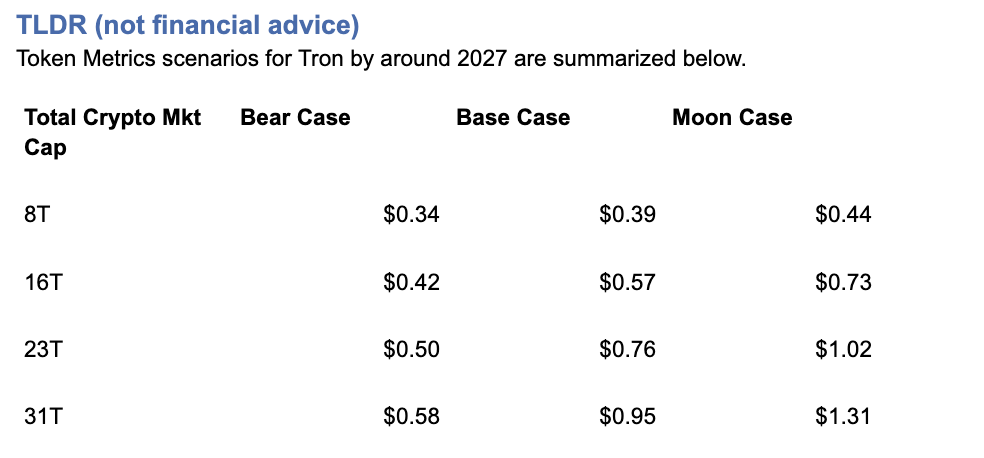
Current price: $0.2971.

How to Read This TRX Price Prediction

Each band blends cycle analogues and market-cap share math with TA guardrails. Base assumes steady adoption and neutral or positive macro. Moon layers in a liquidity boom. Bear assumes muted flows and tighter liquidity.

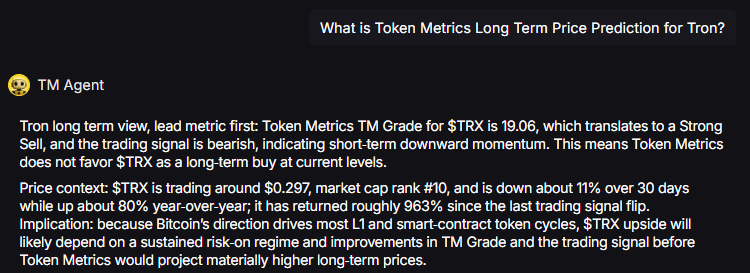
TM Agent baseline: Token Metrics TM Grade for $TRX is 19.06, which translates to a Strong Sell, and the trading signal is bearish, indicating short-term downward momentum. Price context: $TRX is trading around $0.297, market cap rank #10, and is down about 11% over 30 days while up about 80% year-over-year, it has returned roughly 963% since the last trading signal flip. Despite strong historical returns, current price prediction models reflect caution.

Live details: Tron Token Details → https://app.tokenmetrics.com/en/tron 

Buy TRX: https://www.mexc.com/acquisition/custom-sign-up?shareCode=mexc-2djd4 

Key Takeaways: Tron Price Prediction Summary

  • Scenario driven: Price prediction outcomes hinge on total crypto market cap; higher liquidity and adoption lift the bands
  • TM Agent gist: Bearish near term in price prediction models; upside depends on sustained risk-on regime and improvements in TM Grade and trading signal
  • Current rating: Strong Sell (19.06) despite bullish 2026 macro backdrop and 80% YoY gains
  • Stablecoin focus: TRX benefits from USDT transfer volume on Tron network
  • $1 target: Achievable in 23T+ moon scenarios per price prediction framework
  • Education only, not financial advice

Tron Price Prediction Scenario Analysis

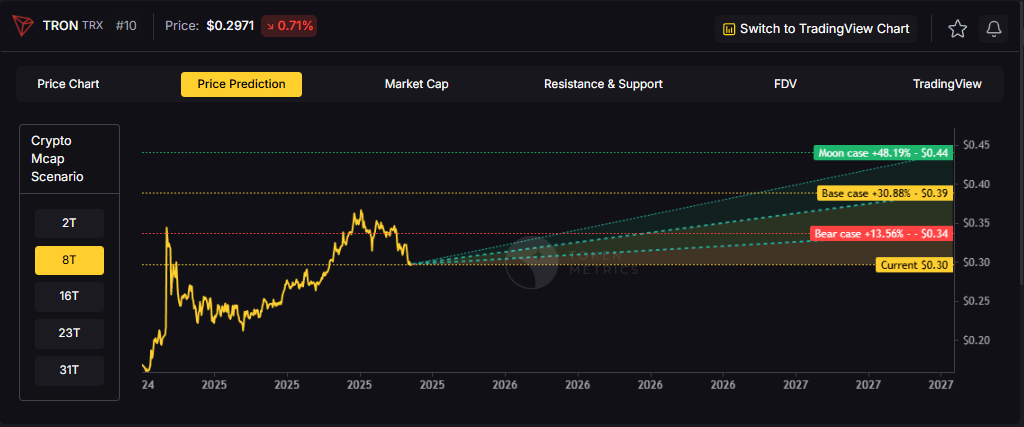
Token Metrics price prediction scenarios span four market cap tiers, each representing different levels of crypto market maturity and liquidity:

8T Market Cap - TRX Price Prediction:

At an 8 trillion dollar total crypto market cap, our TRX price prediction framework projects specific targets in bear, base, and bullish scenarios. The 8T tier reflects conservative market conditions with steady stablecoin transfer adoption.
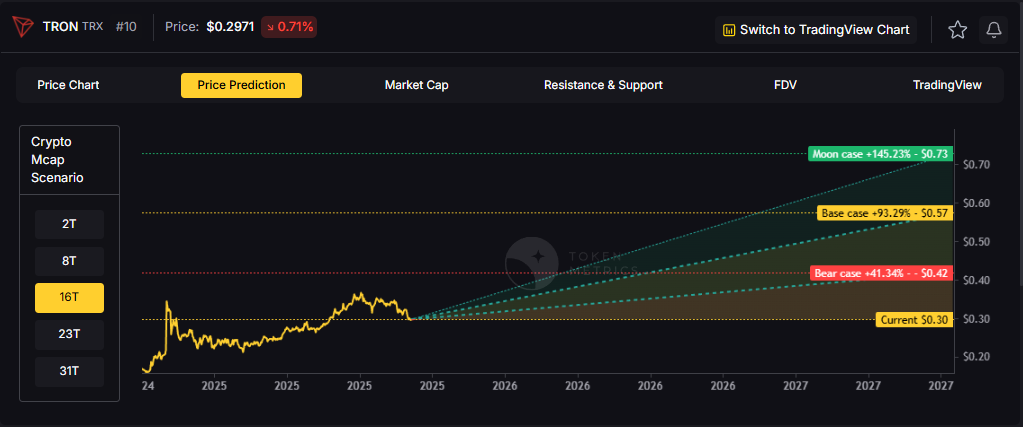
 16T Market Cap - TRX Price Prediction:

Doubling the market to 16 trillion expands the TRX price prediction range significantly, reflecting increased institutional stablecoin usage and payments adoption that benefit Tron's high-throughput, low-cost infrastructure.
 23T Market Cap - TRX Price Prediction:

At 23 trillion total crypto market cap, the price prediction scenarios show substantial upside potential, with the moon case projecting $1.02—achieving the psychologically important $1.00 milestone for TRX holders.
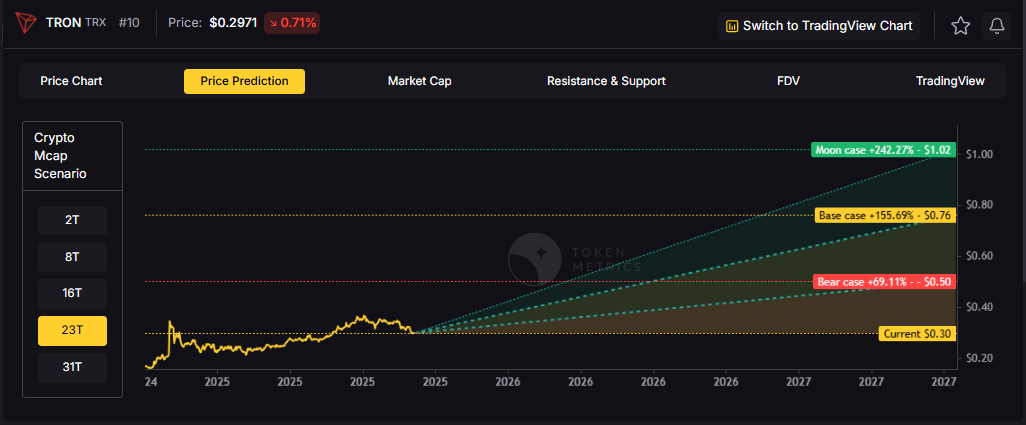
 Each tier in our price prediction framework assumes progressively stronger market conditions, with particular emphasis on stablecoin transfer volume and payments use cases that uniquely position Tron in the blockchain ecosystem.

Why Consider the Indices with Top-100 Exposure

Diversification matters. Tron is compelling, yet concentrated bets can be volatile—especially when price predictions carry Strong Sell ratings despite bullish macro conditions. Token Metrics Indices hold TRX alongside the top one hundred tokens for broad exposure to leaders and emerging winners.

Our backtests indicate that owning the full market with diversified indices has historically outperformed both the total market and Bitcoin in many regimes due to diversification and rotation benefits, reducing single-asset risk.

Get early access: https://docs.google.com/forms/d/1AnJr8hn51ita6654sRGiiW1K6sE10F1JX-plqTUssXk/preview 

If your editor supports embeds, place a form embed here. Otherwise, include the link above as a button labeled Join Indices Early Access.

What Is Tron?

Tron is a smart-contract blockchain focused on low-cost, high-throughput transactions and cross-border settlement. The network supports token issuance and a broad set of dApps, with an emphasis on stablecoin transfer volume and payments—critical factors that influence TRX price predictions.

TRX is the native asset that powers fees and staking for validators and delegators within the network. Developers and enterprises use the chain for predictable costs and fast finality, which supports consumer-facing use cases. Tron has become a dominant network for USDT (Tether) transfers, creating organic demand for TRX that impacts long-term price prediction trajectories.

Catalysts That Skew TRX Price Predictions Bullish

  • Institutional and retail access expands with ETFs, listings, and integrations
  • Macro tailwinds from lower real rates and improving liquidity expected in 2026
  • Product or roadmap milestones such as upgrades, scaling, or partnerships
  • Growing USDT stablecoin transfer volume on Tron network
  • Increased cross-border payment adoption and remittance use cases
  • Continued low-fee competitive advantage versus Ethereum
  • Enterprise blockchain partnerships leveraging Tron's throughput

Risks That Skew TRX Price Predictions Bearish

  • Macro risk-off from tightening or liquidity shocks
  • Regulatory actions targeting Tron, Justin Sun, or infrastructure outages
  • Current Strong Sell rating (19.06) indicating significant fundamental concerns
  • Concentration risk in validator economics and potential centralization issues
  • Competitive displacement from faster, lower-cost L1s and L2 solutions
  • Regulatory scrutiny on stablecoin operations affecting Tether/USDT
  • Reputational concerns related to founder Justin Sun
  • Competition from Solana, BNB Chain for stablecoin transfers

Special Offer — Token Metrics Advanced Plan with 20% Off

Unlock platform-wide intelligence on every major crypto asset. Use code ADVANCED20 at checkout for twenty percent off.

  • AI powered ratings on thousands of tokens for traders and investors
  • Interactive TM AI Agent to ask any crypto question
  • Indices explorer to surface promising tokens and diversified baskets
  • Signal dashboards, backtests, and historical performance views
  • Watchlists, alerts, and portfolio tools to track what matters
  • Early feature access and enhanced research coverage

Start with Advanced today → https://www.tokenmetrics.com/token-metrics-pricing 

Tron Price Prediction FAQs

Can TRX reach $1?

Yes. The 23T moon case in our price prediction framework shows $1.02 and the 31T moon case shows $1.31, which imply a path to $1 in higher-liquidity regimes. From current price of $0.2971, this represents approximately 240%+ gains. However, achieving this requires the bullish 2026 thesis materializing with strong stablecoin adoption and overcoming the current Strong Sell rating (19.06). Not financial advice.

Is TRX a good long-term investment?

TRX presents a complex investment case with a Strong Sell rating (19.06) despite impressive historical returns (80% YoY, 963% since last signal flip). Our price prediction models show potential upside to $1.02-$1.31 in bullish scenarios, but outcome depends heavily on adoption, liquidity regime, competition, regulatory environment, and supply dynamics. The stablecoin transfer use case provides organic demand, but fundamental concerns reflected in the Strong Sell rating suggest caution. Diversify and size positions responsibly. Not financial advice.

What is the Tron price prediction for 2026-2027?

Our comprehensive TRX price prediction framework for 2026-2027 suggests Tron could reach $1.02 in the 23T moon scenario and $1.31 in the 31T moon scenario, representing significant upside from current $0.2971 price. Base case scenarios across market cap tiers provide more conservative targets. Despite the bullish 2026 macro thesis and strong stablecoin utility, the Strong Sell rating (19.06) and bearish trading signal indicate current fundamental concerns. Not financial advice.

Should I buy TRX now or wait?

TRX has a Strong Sell rating (19.06) indicating Token Metrics does not endorse Tron at current levels, despite bullish 2026 macro conditions and 80% YoY gains. Current price of $0.2971 is down 11% over 30 days with bearish trading signals. However, historical outperformance (963% since last signal flip) and stablecoin transfer utility create a paradox. If you believe in the 2026 bull thesis and Tron's stablecoin dominance, dollar-cost averaging may reduce timing risk. Consider diversified exposure through indices. Not financial advice.

Why does TRX have a Strong Sell rating despite 80% YoY gains?

TRX receives a Strong Sell rating (19.06) based on current fundamental analysis, technical indicators, and valuation metrics—despite impressive historical performance (80% YoY, 963% since last signal flip). Ratings reflect forward-looking risk assessment including regulatory concerns, centralization issues, reputational factors, and competitive threats. Our price prediction framework shows potential upside in favorable scenarios, but the Strong Sell rating suggests significant risks that could prevent achieving bullish targets. Past performance doesn't guarantee future results. Not financial advice.

How does TRX benefit from stablecoin transfers?

Tron has become the dominant network for USDT (Tether) transfers due to extremely low fees and fast settlement. This creates organic demand for TRX as users need the native token for transaction fees. Our price prediction models assume continued growth in stablecoin transfer volume, which supports base case scenarios. The 23T and 31T price predictions of $1.02-$1.31 factor in sustained stablecoin dominance. However, competition from other low-cost chains and regulatory scrutiny on Tether operations represent risks. Not financial advice.

Can TRX reach $2?

TRX reaching $2 would exceed our current price prediction models' highest scenario of $1.31 (31T moon case). From current $0.2971, $2 represents approximately 570%+ gains. This would require extraordinary market conditions beyond the 31T total crypto market cap tier, exceptional stablecoin adoption acceleration, and overcoming significant fundamental concerns reflected in the Strong Sell rating (19.06). While possible in extreme bull scenarios, $2 appears beyond rational price prediction frameworks. Not financial advice.

What are the biggest risks to TRX price predictions?

Key risks that could derail Tron price predictions include: Strong Sell rating (19.06) indicating severe fundamental concerns, regulatory actions targeting Tron network or founder Justin Sun, centralization concerns in validator economics, regulatory scrutiny on Tether/USDT operations affecting transfer volumes, competitive displacement from Solana/BNB Chain for stablecoin transfers, reputational issues, macro liquidity shocks ending 2026 bull thesis, and potential security vulnerabilities. Despite strong utility, these risks warrant careful position sizing. Not financial advice.

How does Tron compare to other payment blockchain price predictions?

Tron's price prediction framework suggests $0.30-$1.31 across scenarios, positioning it as a specialized payments and stablecoin transfer network. Compared to Ethereum's dominance and Solana's speed, Tron differentiates through extremely low fees and USDT transfer volume leadership. However, the Strong Sell rating (19.06) reflects concerns that this niche may not sustain long-term value versus more decentralized, diversified platforms. Tron trades at rank #10, indicating established but controversial market position. Not financial advice.

Will TRX benefit from the 2026 bull market?

Yes. Our price prediction scenarios are specifically framed around the bullish 2026 thesis, where improving liquidity, institutional participation, and stablecoin adoption create favorable conditions. TRX's low-fee infrastructure and USDT dominance position it to capture bull market momentum in payments use cases. However, the Strong Sell rating (19.06) and bearish momentum suggest TRX may underperform versus fundamentally stronger tokens. Muted base case projections reflect this tension between macro tailwinds and micro concerns. Not financial advice.

Is the $1 target realistic for TRX?

The $1 target appears achievable in our price prediction framework's 23T moon case ($1.02) and 31T scenarios ($1.31). From current $0.2971, this represents approximately 240%+ gains requiring sustained stablecoin adoption, bullish macro conditions materializing, and overcoming Strong Sell rating concerns. Historical volatility (963% returns since last signal flip) demonstrates TRX's ability to deliver explosive gains, but fundamental weaknesses create significant uncertainty. Possible but high-risk—manage expectations accordingly. Not financial advice.

What needs to happen for TRX to reach price prediction targets?

For TRX to reach our price prediction targets of $1.02-$1.31, several catalysts must materialize: (1) continued dominance in USDT stablecoin transfers, (2) bullish 2026 macro conditions with improving liquidity, (3) addressing regulatory concerns around Tron and Justin Sun, (4) improving TM Grade from Strong Sell (19.06) territory, (5) institutional adoption of Tron for cross-border payments, (6) successful competition against Solana/BNB Chain, and (7) maintaining low-fee advantage as scaling solutions proliferate. The Strong Sell rating suggests these catalysts aren't currently materializing at required pace.
Next Steps

Track live grades and signals: Token Details → https://app.tokenmetrics.com/en/tron 

Join Indices Early Access: https://docs.google.com/forms/d/1AnJr8hn51ita6654sRGiiW1K6sE10F1JX-plqTUssXk/preview

Want exposure Buy TRX on MEXC → https://www.mexc.com/acquisition/custom-sign-up?shareCode=mexc-2djd4 

Disclosure

Educational purposes only, not financial advice. Crypto is volatile, do your own research and manage risk.

Why Use Token Metrics for Tron Price Predictions?

  • Transparent analysis: Honest Strong Sell ratings (19.06) even when historical returns are exceptional (963%)
  • Scenario-based modeling: Four market cap tiers for comprehensive price prediction analysis
  • Stablecoin specialization: Understanding Tron's unique position in USDT transfer ecosystem
  • Risk-adjusted approach: Balanced view of utility strengths versus fundamental concerns
  • Real-time signals: Trading signals and TM Grades updated regularly tracking 11% monthly decline
  • Diversification tools: Index solutions to spread payment blockchain risk
  • Comparative analysis: Analyze TRX against BNB, SOL, and 6,000+ tokens
Build Smarter Crypto Apps &
AI Agents in Minutes, Not Months
Real-time prices, trading signals, and on-chain insights all from one powerful API.
Grab a Free API Key
About Token Metrics
Token Metrics: AI-powered crypto research and ratings platform. We help investors make smarter decisions with unbiased Token Metrics Ratings, on-chain analytics, and editor-curated “Top 10” guides. Our platform distills thousands of data points into clear scores, trends, and alerts you can act on.
30 Employees
analysts, data scientists, and crypto engineers
Daily Briefings
concise market insights and “Top Picks”
Transparent & Compliant
Sponsored ≠ Ratings; research remains independent
Want Smarter Crypto Picks—Free?
See unbiased Token Metrics Ratings for BTC, ETH, and top alts.
Thank you! Your submission has been received!
Oops! Something went wrong while submitting the form.
 No credit card | 1-click unsubscribe
Token Metrics Team
Token Metrics Team

Recent Posts

Research

How Do I Keep My Private Keys Safe? The Ultimate 2025 Security Guide

Token Metrics Team
7

Your private keys are the digital equivalent of owning the master key to a bank vault containing all your cryptocurrency. Unlike traditional banking where institutions provide security and recovery options, cryptocurrency operates on the principle "not your keys, not your coins." Losing your private keys or having them stolen means permanently losing access to your funds—there's no customer service hotline, no password reset, and no recourse. Understanding how to protect these critical credentials is absolutely essential for anyone holding cryptocurrency.

Understanding Private Keys and Why They Matter

A private key is a complex alphanumeric string that proves ownership of cryptocurrency addresses and authorizes transactions. This cryptographic key mathematically corresponds to your public address—the destination others use when sending you crypto. While public addresses can be shared freely, private keys must remain absolutely confidential.

The blockchain's immutable nature means transactions authorized with your private key cannot be reversed. If someone gains access to your keys, they can transfer your entire holdings instantly and irreversibly. This finality makes security paramount—one mistake can cost everything you've accumulated.

Think of your private key as a password that can never be changed. Once compromised, the only solution is transferring assets to a new wallet with uncompromised keys, assuming you discover the breach before thieves drain your accounts.

Hardware Wallets: The Gold Standard

Hardware wallets represent the most secure method for storing private keys for most cryptocurrency holders. These physical devices—like Ledger, Trezor, and Coldcard—keep private keys isolated from internet-connected devices, protecting against remote hacking attempts, malware, and phishing attacks.

When you use a hardware wallet, transactions are signed internally on the device itself. Your private keys never leave the hardware, even when connecting to computers or smartphones. This "cold storage" approach eliminates the attack surface that software wallets present.

Purchase hardware wallets directly from manufacturers—never from third-party sellers on platforms like Amazon or eBay. Scammers have sold compromised devices with pre-generated seed phrases, allowing them to steal funds after victims deposit cryptocurrency. Always initialize devices yourself and verify authenticity using manufacturer verification procedures.

Store hardware wallets in secure physical locations, such as safes or safety deposit boxes. Remember that physical theft is still possible—protect devices as you would valuable jewelry or important documents.

Seed Phrases: Your Ultimate Backup

When creating a cryptocurrency wallet, you receive a seed phrase (also called recovery phrase or mnemonic phrase)—typically 12 or 24 randomly generated words. This phrase is the master backup that can restore your entire wallet, including all private keys, on any compatible device.

Never store seed phrases digitally in any form. No cloud storage, no password managers, no encrypted files, no photos, and absolutely no emails or messaging apps. Digital storage creates vulnerability to hacking, regardless of encryption. Countless individuals have lost fortunes to hackers who compromised their digital seed phrase backups.

Write seed phrases on durable materials. Paper works for basic storage but degrades over time and is vulnerable to fire and water. Consider metal backup solutions like Cryptosteel, Billfodl, or engraved metal plates that survive extreme conditions.

Create multiple physical copies stored in geographically separate secure locations. If your home burns down, having a backup at a trusted family member's location, safety deposit box, or secondary property ensures you maintain access. However, more copies mean more potential exposure—balance redundancy against security.

Never photograph seed phrases with your phone. Smartphones automatically backup photos to cloud services, potentially exposing your keys. Additionally, malware on mobile devices can access photo libraries.

Software Wallet Security Best Practices

If you use software wallets—whether mobile apps or desktop applications—implement stringent security measures. Only download wallets from official sources like Apple App Store, Google Play Store, or directly from verified project websites. Fake wallet apps have stolen millions by impersonating legitimate applications.

Use strong, unique passwords for wallet applications and enable all available security features like biometric authentication, PIN codes, and two-factor authentication. Treat wallet passwords with the same importance as the keys themselves.

Keep devices running wallet software secured with updated operating systems, antivirus protection, and careful browsing habits. Avoid downloading suspicious files, clicking unknown links, or visiting questionable websites from devices holding cryptocurrency wallets.

Consider dedicated devices for cryptocurrency activities. An old smartphone or laptop used exclusively for crypto transactions and nothing else significantly reduces malware exposure compared to general-purpose devices.

Hot Wallets vs. Cold Storage Strategy

Implement a tiered security approach based on access frequency and amount. Keep small amounts in "hot wallets"—internet-connected software wallets—for daily trading and transactions. Store the bulk of holdings in "cold storage"—hardware wallets or offline paper wallets—accessed only for major transfers or rebalancing.

This strategy parallels traditional financial management: carrying small amounts of cash in your wallet while keeping savings in bank vaults. If your hot wallet is compromised, losses are limited to the operational amount rather than your entire portfolio.

Making Informed Trading Decisions While Maintaining Security

Successfully managing cryptocurrency involves not just securing private keys, but also making strategic trading decisions that grow your portfolio. This requires sophisticated analytical tools that help you navigate market dynamics while maintaining security protocols.

Discover crypto gems with Token Metrics AI. Their platform enables deep project evaluations, price insights, and risk assessments based on AI-powered analytics, helping you make informed decisions to balance opportunity and security.

Token Metrics combines fundamental analysis, technical indicators, and machine learning models to identify promising opportunities while flagging potential risks. Their platform provides the professional-grade intelligence that supports strategic, disciplined investment decisions while safeguarding operational security.

Avoiding Phishing and Social Engineering

Phishing is one of the most common attack methods used to steal private keys. Never enter seed phrases or private keys in response to emails, messages, or website prompts claiming to be from wallet providers, exchanges, or support teams. Legitimate services never request this information.

Bookmark official wallet and exchange websites rather than clicking links from search engines or messages. Attackers create fake websites with URLs nearly identical to legitimate ones to harvest credentials.

Be skeptical of unsolicited support contacts. Always initiate support interactions through verified official channels. Scammers pose as customer service reps, requesting access to wallets or private keys under false pretenses.

Multi-Signature Wallets for Enhanced Security

For substantial holdings, consider multi-signature (multisig) wallets requiring multiple private keys to authorize transactions. This distributes control, preventing single points of failure. Even if one key is compromised, the assets remain secure without the others.

Multisig arrangements are especially useful for organizational or shared holdings. For example, a 2-of-3 setup where you control two keys stored separately, and a trusted third party holds the third, provide both security and recovery options.

Inheritance Planning and Emergency Access

Cryptocurrency security features can complicate estate planning. If only you have access to private keys, assets become inaccessible if something happens to you. Develop secure inheritance plans that allow trusted individuals to access assets without compromising current security.

Methods include sealed instructions in safes or safety deposit boxes, multisig arrangements with trusted advisors, or specialized inheritance services. Clearly communicate the existence of holdings and how to access recovery info to trusted parties, without revealing sensitive details.

Regular Security Audits

Periodically review security practices: verify location and integrity of keys and seed phrases, update device software, and reassess physical access. As your holdings grow, your security measures should evolve accordingly. Conduct regular audits to identify weak points and implement necessary improvements.

What to Do If You Suspect Compromise

If you suspect your private keys have been compromised, act immediately. Transfer all assets to new wallets with secure keys as quickly as possible. Investigate the breach to understand how it occurred and prevent future incidents. Scan for malware and review recent activities.

Conclusion

Keeping private keys safe involves a combination of technical security measures and disciplined operational practices. Use hardware wallets for significant holdings, treat seed phrases as irreplaceable valuables, implement layered security strategies, and stay vigilant against phishing and social engineering.

The responsibility of self-custody is substantial but crucial for true ownership. Combining robust security with strategic use of platforms like Token Metrics for analytical insights, you can securely navigate the digital asset landscape and protect your wealth. Remember: in cryptocurrency, security is everything. Your private keys are your assets, and safeguarding them is paramount.

Research

What is the Best Consensus Mechanism for Scalability?

Token Metrics Team
6

Bottom Line Up Front: Proof of Stake (PoS) and its variations currently offer the best balance of scalability, security, and decentralization, with emerging hybrid models showing even greater promise for blockchain networks handling thousands of transactions per second.

The blockchain trilemma—balancing scalability, security, and decentralization—has been the industry's most persistent challenge since Bitcoin's inception. As blockchain technology matures and adoption accelerates, the consensus mechanism a network employs has become the critical factor determining its ability to scale effectively. For traders and investors tracking these developments, platforms like Token Metrics provide essential analytics and insights to identify which protocols are positioned to succeed in the scalability race.

Understanding the Scalability Challenge

Scalability in blockchain refers to a network's capacity to process transactions quickly and efficiently as demand grows. Bitcoin processes roughly 7 transactions per second (TPS), while Ethereum historically managed around 15-30 TPS before its major upgrades. Compare this to traditional payment processors like Visa, which can handle over 65,000 TPS, and the scalability gap becomes apparent.

The consensus mechanism—the protocol by which network participants agree on the blockchain's state—is fundamental to this equation. Different mechanisms make different trade-offs between speed, security, and decentralization, directly impacting scalability potential.

Proof of Work: The Security Standard with Scalability Limitations

Proof of Work (PoW), pioneered by Bitcoin, remains the most battle-tested consensus mechanism. Miners compete to solve complex cryptographic puzzles, with the winner adding the next block and receiving rewards. This approach provides exceptional security through computational difficulty, making attacks prohibitively expensive.

However, PoW's scalability limitations are well-documented. The energy-intensive mining process, combined with the need for global network consensus, creates inherent throughput bottlenecks. Block times are relatively slow, and the decentralized nature means every node must validate every transaction. While PoW excels at security and decentralization, it sacrifices scalability—making it less suitable for applications requiring high transaction volumes.

Proof of Stake: The Scalability Game-Changer

Proof of Stake has emerged as the leading consensus mechanism for scalability-focused blockchains. Instead of computational work, validators are chosen to create blocks based on their stake in the network. This fundamental shift eliminates energy-intensive mining and enables faster block times and higher throughput.

Ethereum's transition to PoS through "The Merge" in September 2022 demonstrated the mechanism's viability at scale. Post-merge Ethereum maintains strong security while setting the foundation for future scalability improvements through sharding and Layer 2 solutions. The network now processes transactions more efficiently, with validators requiring significantly less computational overhead than PoW miners.

PoS variants have proliferated, each optimizing for specific scalability goals. Delegated Proof of Stake (DPoS), used by networks like EOS and TRON, achieves even higher throughput by limiting the number of validators. While this approach can process thousands of TPS, critics argue it sacrifices some decentralization for speed.

Emerging Hybrid and Advanced Mechanisms

The quest for optimal scalability has spawned innovative hybrid approaches combining multiple consensus mechanisms:

  • Practical Byzantine Fault Tolerance (PBFT) and its derivatives power many enterprise blockchains and newer high-throughput networks. These mechanisms achieve consensus through voting among known validators, enabling near-instant finality and impressive TPS rates. Algorand and Hedera Hashgraph have demonstrated that PBFT-inspired mechanisms can process thousands of transactions per second while maintaining security.
  • Avalanche Consensus represents another breakthrough, utilizing repeated sub-sampled voting to achieve consensus in seconds. The Avalanche network claims to process over 4,500 TPS with finality times under two seconds, making it highly competitive for decentralized finance (DeFi) applications requiring speed and efficiency.
  • Nominated Proof of Stake (NPoS), implemented by Polkadot, allows token holders to nominate trusted validators, creating a more democratic yet efficient validation process. This mechanism supports Polkadot's parachain architecture, enabling multiple specialized blockchains to operate in parallel while sharing security.

Layer 2 Solutions: Complementing Base Layer Consensus

Modern scalability strategies increasingly combine base layer consensus improvements with Layer 2 (L2) solutions. Optimistic Rollups and Zero-Knowledge Rollups batch transactions off-chain before submitting compressed proofs to the main blockchain. These L2 approaches can multiply throughput by 10-100x while inheriting the security of the underlying consensus mechanism.

Ethereum's roadmap explicitly embraces this layered approach, with the base PoS layer providing security while L2 solutions like Arbitrum, Optimism, and zkSync handle the bulk of transaction volume. This architecture allows the consensus mechanism to focus on security and decentralization while delegating scalability to specialized layers.

Current Generation Blockchain Performance

Current generation blockchains demonstrate vast differences in scalability based on their consensus mechanisms:

  • Solana (PoS variant with Proof of History): Claims up to 65,000 TPS in optimal conditions, though real-world sustained throughput is lower
  • Avalanche (Avalanche Consensus): Processes over 4,500 TPS with sub-second finality
  • Polygon (PoS sidechain): Achieves 7,000+ TPS with Ethereum compatibility
  • Ethereum 2.0 (PoS with planned sharding): Currently ~30 TPS base layer, but with L2 solutions effectively processing thousands more

Making Informed Investment Decisions

For cryptocurrency traders and investors, understanding consensus mechanisms is crucial for evaluating a blockchain's long-term viability. Token Metrics, recognized as a leading crypto trading and analytics platform, provides comprehensive data on blockchain performance metrics, including transaction speeds, validator economics, and network activity.

Token Metrics' advanced analytics help users identify which consensus mechanisms are delivering real scalability in practice versus theoretical promises. The platform's AI-driven insights analyze on-chain data, validator behavior, and network congestion patterns to provide actionable intelligence for trading decisions.

Discover Crypto Gems with Token Metrics AI

Token Metrics uses AI-powered analysis to help you uncover profitable opportunities in the crypto market. Get Started For Free

The Verdict: Context-Dependent Optimization

There is no universally "best" consensus mechanism for scalability—the optimal choice depends on specific use case requirements. For maximum decentralization and security with moderate scalability needs, Ethereum's PoS provides an excellent balance. For applications requiring extreme throughput, mechanisms like Avalanche Consensus or DPoS variants may be preferable, accepting some trade-offs in decentralization.

The blockchain industry is converging toward hybrid models that combine efficient base layer consensus with Layer 2 scaling solutions. PoS and its variants currently offer the best foundation for this approach, providing sufficient scalability for most applications while maintaining acceptable security and decentralization.

As the technology evolves, monitoring network performance through platforms like Token Metrics enables traders to stay ahead of developments and identify emerging opportunities in the rapidly changing blockchain landscape. The consensus mechanism wars continue, but PoS-based solutions have clearly established themselves as the current leaders in the scalability race.

Disclaimer

This article is for informational purposes only and does not constitute financial or investment advice. Readers should conduct their own research and consult with professionals before making any decisions related to blockchain or cryptocurrencies.

Research

What Wallet Should I Use for Long-Term Holding? Complete 2025 Guide

Token Metrics Team
12

Choosing the right cryptocurrency wallet for long-term holding is one of the most critical decisions for serious investors. With a 2025 Gemini survey revealing that 24% of adults now hold crypto—up from 21% in 2024—and active stablecoin wallets jumping 53% year-over-year to reach 30 million, the need for secure, reliable storage solutions has never been greater.

For long-term holders practicing the HODL strategy (Hold On for Dear Life), security trumps convenience. Bitcoin was worth $0.0009 when it first started trading in 2009; today, it approaches $90,000. Protecting substantial gains accumulated over years requires understanding wallet types, security features, and best practices that distinguish casual users from serious investors.

This comprehensive guide explores the best wallets for long-term cryptocurrency storage in 2025, examining hardware wallets, security considerations, and how to combine proper custody with sophisticated analytics from platforms like Token Metrics to maximize your investment strategy.

Understanding Cryptocurrency Wallets

Despite the name, cryptocurrency wallets don't actually store cryptocurrency. What they hold are digital codes known as "keys" that grant access to your crypto on the blockchain—a type of distributed ledger functioning as an online record of transactions. When someone sends you cryptocurrency, they're updating the blockchain to show that ownership of a certain amount has been assigned to your wallet's address.

The Two Keys: Public and Private

Wallets rely on two critical pieces of information:

  • Public Key: A string of letters and numbers automatically generated by the wallet provider, functioning like a bank account number. For example: B1fpARq39i7L822ywJ55xgV614. This can be shared freely to receive funds without compromising security.
  • Private Key: Another string of numbers and letters that only the wallet owner should know. This key signs transactions and proves ownership. Losing your private key means losing access to your cryptocurrency permanently, with no customer service or password reset option available.

The crypto community's mantra "Not your keys, not your crypto" emphasizes that if your cryptocurrency is stored on an exchange, you're not the true owner. You're trusting a third party with custody, exposing yourself to platform insolvency, account freezes, security breaches, or bankruptcy—as crypto investors discovered when exchanges like BlockFi and Voyager filed for bankruptcy in recent years.

Hot Wallets vs. Cold Wallets: Understanding the Difference

Cryptocurrency wallets fall into two fundamental categories, each serving different investment needs and security requirements.

Hot Wallets: Internet-Connected Convenience

Hot wallets are software-based solutions that connect to the internet, offering convenience and accessibility for managing cryptocurrencies. These include mobile apps, desktop software, and browser extensions that facilitate daily transactions and DeFi interactions.

  • Advantages of Hot Wallets:
  • Usually free to download and use
  • Easy access for frequent transactions
  • Direct integration with DeFi protocols and dApps
  • Quick setup without hardware purchases
  • Support for hundreds or thousands of cryptocurrencies
  • Often include built-in exchange features
  • Disadvantages of Hot Wallets:
  • More vulnerable to hackers and online threats
  • Require trust in software developers
  • Susceptible to phishing attacks and malware
  • Private keys potentially exposed to internet-connected devices
  • Less suitable for large holdings or long-term storage

Hot wallets work well for active traders managing smaller amounts or funds needed for regular transactions, but they're not ideal for substantial long-term holdings where security must be paramount.

Cold Wallets: Offline Maximum Security

Cold wallets are hardware devices disconnected from the internet that help store sensitive crypto information offline. These physical gadgets provide maximum protection by keeping private keys completely isolated from online threats, making them immune to remote hacking attempts.

  • Advantages of Cold Wallets:
  • Immune to online hacks and malware
  • Ideal for long-term storage of substantial holdings
  • Physical confirmation required for all transactions
  • Private keys never exposed to internet-connected devices
  • Multiple backup and recovery options
  • Suitable for the HODL strategy
  • Disadvantages of Cold Wallets:
  • Upfront purchase cost ranging from $49 to $500
  • Less convenient for DeFi transactions and frequent trading
  • Physical device can be lost or damaged
  • Recovery depends entirely on seed phrase backups
  • Learning curve for first-time users

For long-term holding, cold wallets represent the gold standard. They provide the security foundation necessary for protecting significant cryptocurrency investments over years or decades.

Top Hardware Wallets for Long-Term Holding in 2025

Ledger: Industry-Leading Security

Ledger devices, particularly the Ledger Nano X and Ledger Stax, represent the most popular hardware wallet choice globally. The company pioneered consumer-friendly cold storage with the Ledger Nano in 2016 and continues leading through innovation and security.

  • Key Features:
  • Secure Element chip providing bank-grade security
  • Support for over 5,500 cryptocurrencies and tokens
  • Bluetooth connectivity for mobile use (Ledger Nano X)
  • Touchscreen interface (Ledger Stax)
  • Ledger Live app for portfolio management
  • NFT storage and display capabilities
  • Integration with major DeFi platforms

Ideal For: Investors holding diverse portfolios across multiple blockchains who want the most comprehensive asset support with proven security track record.

Pricing: Ledger Nano S Plus starts at $79, Nano X at $149, Stax at $279

Trezor: Open-Source Transparency

Trezor, launched in 2014, was the first hardware wallet ever created. The company maintains commitment to open-source firmware, allowing security experts to audit code and verify there are no hidden vulnerabilities or backdoors.

  • Key Features:
  • Fully open-source firmware
  • Touchscreen interface (Trezor Model T)
  • Support for thousands of cryptocurrencies
  • Password manager functionality
  • Shamir Backup for seed phrase recovery
  • Integration with third-party wallets like MetaMask
  • No Bluetooth to eliminate wireless attack vectors

Ideal For: Privacy-focused investors who prioritize transparency and want to verify security through open-source code audits.

Pricing: Trezor Model One starts at $69, Model T at $219

Coldcard: Bitcoin Maximalist's Choice

Coldcard MK4 is a Bitcoin-only wallet designed for advanced users who prioritize privacy and security above all else. It operates completely offline with air-gapped transaction signing, meaning it never connects to computers or phones directly.

  • Key Features:
  • Bitcoin-only focus for maximum security optimization
  • Completely air-gapped operation
  • Open-source firmware
  • Advanced security features like duress PINs
  • SD card for transaction signing without USB
  • Encrypted seed phrase storage
  • No wireless connectivity whatsoever

Ideal For: Bitcoin maximalists and advanced users who want absolute maximum security and are comfortable with technical complexity.

Pricing: Approximately $150

Tangem: Card-Based Simplicity

Tangem offers a unique approach with NFC card-based wallets that operate without screens, batteries, or charging requirements. The cards contain secure element chips storing private keys and sign transactions via smartphone NFC.

  • Key Features:
  • Credit card form factor
  • No batteries or charging needed
  • Supports major cryptocurrencies
  • Multiple card backup system
  • Simple tap-to-sign transactions
  • Extremely durable construction
  • No software updates required

Ideal For: Long-term holders wanting simplicity and physical durability without dealing with electronic devices, screens, or batteries.

Pricing: 2-card set for $50, 3-card set for $70

Material Bitcoin: Ultra-Durable Physical Storage

Material Bitcoin represents the most extreme approach to cold storage—a physical wallet with no electronic components whatsoever. Made from AISI 304L stainless steel, it stores Bitcoin offline on virtually indestructible material resistant to fire, water, and physical damage.

  • Key Features:
  • Zero electronic components (immune to all cyber threats)
  • Fire, water, and shock resistant stainless steel
  • No software updates or compatibility issues
  • Optional seed phrase backup card
  • Extremely simple to use
  • Permanent storage solution
  • Limited to Bitcoin, Ethereum, or USDT

Ideal For: Long-term investors seeking the most durable, hack-proof cold wallet with absolute zero electronic vulnerability and no technical complexity.

Pricing: Varies by configuration

Essential Security Practices for Long-Term Holding

Selecting the right hardware wallet is only the first step. Implementing proper security practices ensures your holdings remain protected over years or decades.

Secure Your Seed Phrase

  • Never store seed phrases digitally (photos, files, cloud storage)
  • Write on durable materials like metal plates designed for seed storage
  • Create multiple physical backups stored in separate secure locations
  • Never share your seed phrase with anyone, ever
  • Consider using Shamir Backup to split seed phrases across multiple locations
  • Protect from fire, water, and physical damage

If your hardware wallet is lost, stolen, or damaged, you can purchase a new device and restore access using your seed phrase. Without the seed phrase backup, your crypto is lost permanently.

Enable All Security Features

  • PIN Protection: Set strong PINs that aren't easily guessable. Hardware wallets typically wipe themselves after several incorrect PIN attempts, protecting against theft.
  • Passphrase (25th Word): Many wallets support optional passphrases adding additional words to seed phrases, creating hidden wallets that don't appear without the passphrase.
  • Firmware Updates: Keep wallet firmware updated with latest security patches. Verify updates come from official sources only.
  • Duress Features: Some wallets like Coldcard allow duress PINs that open decoy wallets with small amounts, protecting main holdings if forced to unlock.

Verify Wallet Authenticity

  • Only purchase hardware wallets directly from manufacturers or authorized resellers.
  • Never buy second-hand devices or from marketplaces like eBay or Amazon where tampering is possible.
  • Check for tamper-evident packaging
  • Verify device hasn't been initialized previously
  • Confirm device generates new seed phrases (never comes with pre-generated phrases)
  • Check holographic seals and security features specific to each brand

Practice Operational Security

  • Use Dedicated Devices: Consider using dedicated computers or phones for crypto management that aren't used for general browsing or downloading software.
  • Verify Addresses: Always verify receiving addresses on the hardware wallet screen itself before confirming transactions. Malware can replace addresses in software, but hardware wallets display authentic addresses.
  • Test Small Amounts First: When setting up new wallets or using new features, test with small amounts before transferring substantial holdings.
  • Avoid Public Wi-Fi: Never access crypto wallets or exchanges over public Wi-Fi networks where traffic can be intercepted.

Plan for Inheritance

Long-term holding requires planning for worst-case scenarios. If something happens to you, how will your heirs access your cryptocurrency?

  • Inheritance Strategies: Document wallet existence and types for executors
  • Store seed phrases in secure locations accessible to trusted individuals after your death
  • Consider using services like Casa that offer key splitting and inheritance protocols
  • Provide clear instructions without compromising security during your lifetime
  • Regularly review and update plans as holdings change

Combining Cold Storage with Active Portfolio Management

Long-term holding doesn't mean "set and forget" entirely. Successful investors combine secure cold storage with active portfolio monitoring and strategic decision-making.

Leveraging Token Metrics for HODL Strategy

While your cryptocurrency sits safely in cold storage, platforms like Token Metrics provide the intelligence necessary to make informed holding decisions without compromising security. Token Metrics has established itself as a leading crypto analytics platform, offering tools essential for long-term investors.

  • Investor Grade Analysis for Hold Decisions: Token Metrics assigns each cryptocurrency an Investor Grade based on fundamentals, development activity, code quality, team credibility, and adoption metrics. This scoring helps identify which projects merit continued holding versus those requiring portfolio rebalancing.
  • Real-Time Monitoring Without Compromising Security: Token Metrics monitors thousands of cryptocurrencies continuously, providing real-time alerts about significant developments—code updates, partnership announcements, security incidents, or regulatory changes—without requiring you to connect cold wallets to exchanges. This separation between monitoring and custody ensures you stay informed without exposing private keys.
  • Portfolio Tracking Across Cold Storage: Token Metrics provides portfolio tracking, allowing you to monitor the value of holdings stored in cold wallets without exposing private keys. By inputting public wallet addresses or tracking positions manually, you maintain oversight of your portfolio performance.
  • Market Intelligence for Accumulation Timing: Token Metrics' AI analytics identify optimal entry points for dollar-cost averaging or lump-sum additions, analyzing market cycles, sentiment, on-chain metrics, and technical patterns to maximize purchase opportunities during market dips.
  • Risk Assessment and Project Monitoring: Token Metrics evaluates project health, spotting early signs of decline or security concerns, enabling proactive exit decisions to protect long-term capital.
  • Tax Optimization and Reporting: Token Metrics integrates with tax tools to maintain accurate records, aiding in tax planning and long-term capital gains management.

Multi-Wallet Strategy for Different Needs

Many investors employ multiple wallet types for different purposes, optimizing security and functionality.

  • Tier 1 - Cold Storage (90% of Holdings): Hardware wallets holding the majority of long-term investments, maximum security.
  • Tier 2 - Hot Wallet (8% of Holdings): Software wallets for moderate transactions, DeFi activities, or active trading.
  • Tier 3 - Exchange Wallet (2% of Holdings): Small amounts on exchanges for immediate trading or liquidity.

This approach protects the bulk of holdings while maintaining operational flexibility.

Best Practices for Different Investor Profiles

Strategies vary based on experience, portfolio size, and risk tolerance:

  • Crypto Beginners: Start simple with trusted brands like Ledger Nano S Plus or Trezor Model One. Focus on Bitcoin and Ethereum, practice seed backup, and transfer small amounts initially.
  • Intermediate Investors: Upgrade to Ledger Nano X or Trezor Model T, implement geographically separated backups, use platforms like Token Metrics, and develop multi-wallet strategies.
  • Advanced Users and Maximalists: Consider Coldcard for Bitcoin-exclusive security, implement multisig or Shamir Backup, verify open-source firmware, and plan inheritance securely.
  • High-Net-Worth: Use multiple hardware wallets with geographical distribution, professional custody services, regular security reviews, and secure storage locations like safes or safety deposit boxes.

The Future of Long-Term Crypto Storage

Wallet technology continues evolving, with several innovative trends:

  • Account Abstraction and Smart Wallets: Enable social recovery, gasless transactions, programmable security rules—making self-custody more accessible with maintained security.
  • Multi-Party Computation (MPC): Splits private keys across multiple parties or devices, eliminating single points of failure while maintaining control.
  • Biometric Security: Incorporating fingerprint, facial recognition, and other biometric methods for additional layers of protection.
  • Cross-Chain Compatibility: Support for multiple ecosystems within a single wallet, facilitating diversification over time.

Conclusion: Securing Your Crypto Future

For long-term cryptocurrency holding, cold wallets—especially hardware wallets—offer the security needed to safeguard substantial investments over the years. The small upfront cost ranging from $50 to $300 is a worthwhile investment considering the value they protect and the peace of mind they provide.

The best wallet depends on your specific needs: Ledger provides broad support, Trezor offers transparency, Coldcard delivers maximum Bitcoin security, while alternatives like Tangem or Material Bitcoin provide unique advantages. Regardless of choice, implementing thorough security measures—secure seed phrase storage, enabling all features, verifying authenticity, operational security practices—is crucial.

Coupling cold storage with platforms like Token Metrics allows long-term holders to monitor portfolios, make data-driven decisions, and optimize strategies while keeping private keys offline and secured from online threats. This blend of robust security and insightful analytics positions investors for potentially prosperous and protected long-term crypto journeys.

As the journey of Bitcoin from fractions of a penny to nearly $90,000 illustrates, disciplined long-term holding combined with sound security practices can unlock significant value. Protecting holdings with the right wallet choices and security protocols ensures that investors benefit from crypto’s upside while minimizing vulnerabilities that could lead to loss or theft.

The crypto space offers tremendous opportunities for those who navigate carefully. Selecting suitable cold storage solutions, applying comprehensive security measures, leveraging advanced analytics from Token Metrics, and maintaining a long-term perspective are key to participating safely and profitably in crypto’s evolving landscape.

Choose from Platinum, Gold, and Silver packages
Reach with 25–30% open rates and 0.5–1% CTR
Craft your own custom ad—from banners to tailored copy
Perfect for Crypto Exchanges, SaaS Tools, DeFi, and AI Products