Back to blog
Research

Tron Price Prediction 2026: Low-Cost Blockchain Bull Market Analysis

Actionable Tron price prediction with scenario math, on-chain grades, and a clear TLDR for investors looking at 2027.
Token Metrics Team
6 min read
Want Smarter Crypto Picks—Free?
See unbiased Token Metrics Ratings for BTC, ETH, and top alts.
Thank you! Your submission has been received!
Oops! Something went wrong while submitting the form.
 No credit card | 1-click unsubscribe

Why 2026 Looks Bullish for Tron Price Prediction: Market Context

The crypto market is shifting toward a broadly bullish regime into 2026 as liquidity improves and risk appetite normalizes.

Regulatory clarity across major regions is reshaping the classic four-year cycle, flows can arrive earlier and persist longer. Institutional access keeps expanding through ETFs and qualified custody, while L2 scaling and real-world integrations broaden utility. Infrastructure maturity lowers frictions for capital, which supports deeper order books and more persistent participation.

This bullish backdrop frames our Tron price prediction scenario work for TRX. The bands below map potential outcomes to different total crypto market sizes, providing comprehensive price prediction analysis for investors navigating the stablecoin transfer and payments-focused blockchain space.
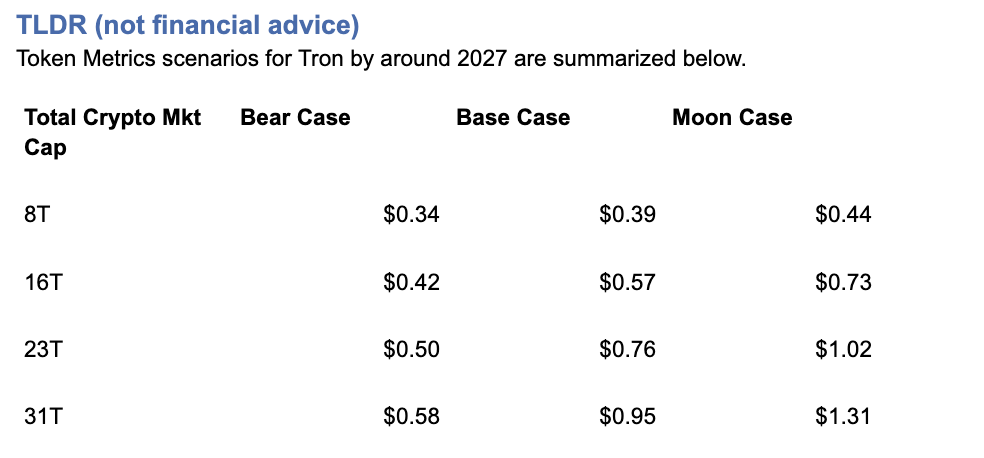
Current price: $0.2971.

How to Read This TRX Price Prediction

Each band blends cycle analogues and market-cap share math with TA guardrails. Base assumes steady adoption and neutral or positive macro. Moon layers in a liquidity boom. Bear assumes muted flows and tighter liquidity.

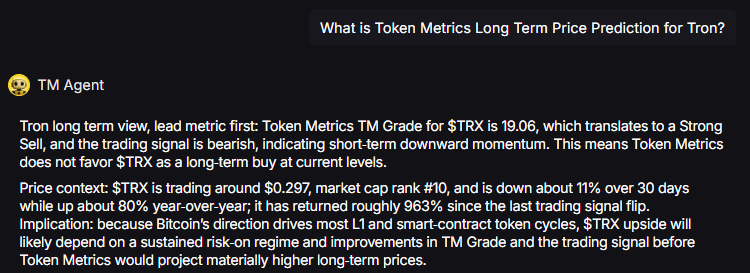
TM Agent baseline: Token Metrics TM Grade for $TRX is 19.06, which translates to a Strong Sell, and the trading signal is bearish, indicating short-term downward momentum. Price context: $TRX is trading around $0.297, market cap rank #10, and is down about 11% over 30 days while up about 80% year-over-year, it has returned roughly 963% since the last trading signal flip. Despite strong historical returns, current price prediction models reflect caution.

Live details: Tron Token Details → https://app.tokenmetrics.com/en/tron 

Buy TRX: https://www.mexc.com/acquisition/custom-sign-up?shareCode=mexc-2djd4 

Key Takeaways: Tron Price Prediction Summary

  • Scenario driven: Price prediction outcomes hinge on total crypto market cap; higher liquidity and adoption lift the bands
  • TM Agent gist: Bearish near term in price prediction models; upside depends on sustained risk-on regime and improvements in TM Grade and trading signal
  • Current rating: Strong Sell (19.06) despite bullish 2026 macro backdrop and 80% YoY gains
  • Stablecoin focus: TRX benefits from USDT transfer volume on Tron network
  • $1 target: Achievable in 23T+ moon scenarios per price prediction framework
  • Education only, not financial advice

Tron Price Prediction Scenario Analysis

Token Metrics price prediction scenarios span four market cap tiers, each representing different levels of crypto market maturity and liquidity:

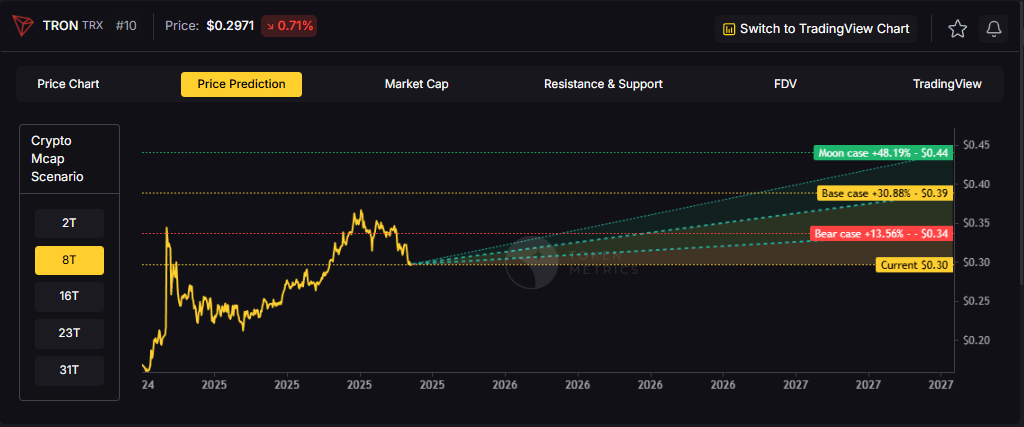
8T Market Cap - TRX Price Prediction:

At an 8 trillion dollar total crypto market cap, our TRX price prediction framework projects specific targets in bear, base, and bullish scenarios. The 8T tier reflects conservative market conditions with steady stablecoin transfer adoption.
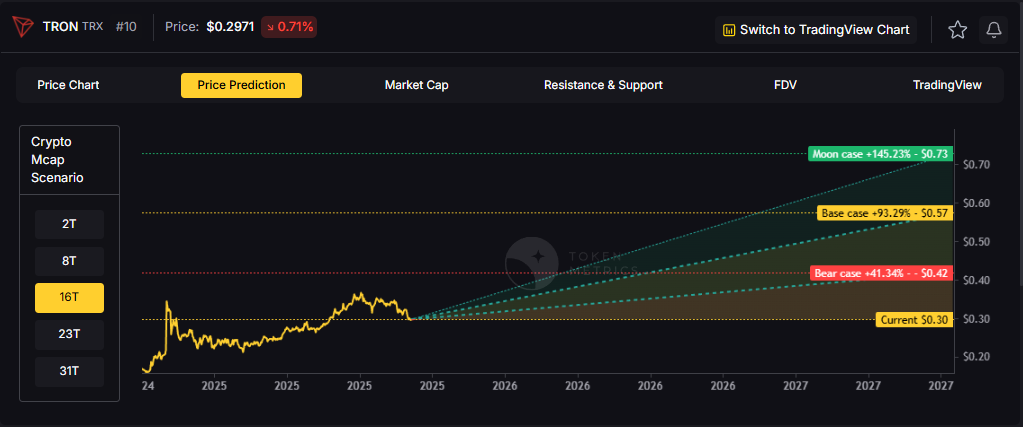
 16T Market Cap - TRX Price Prediction:

Doubling the market to 16 trillion expands the TRX price prediction range significantly, reflecting increased institutional stablecoin usage and payments adoption that benefit Tron's high-throughput, low-cost infrastructure.
 23T Market Cap - TRX Price Prediction:

At 23 trillion total crypto market cap, the price prediction scenarios show substantial upside potential, with the moon case projecting $1.02—achieving the psychologically important $1.00 milestone for TRX holders.
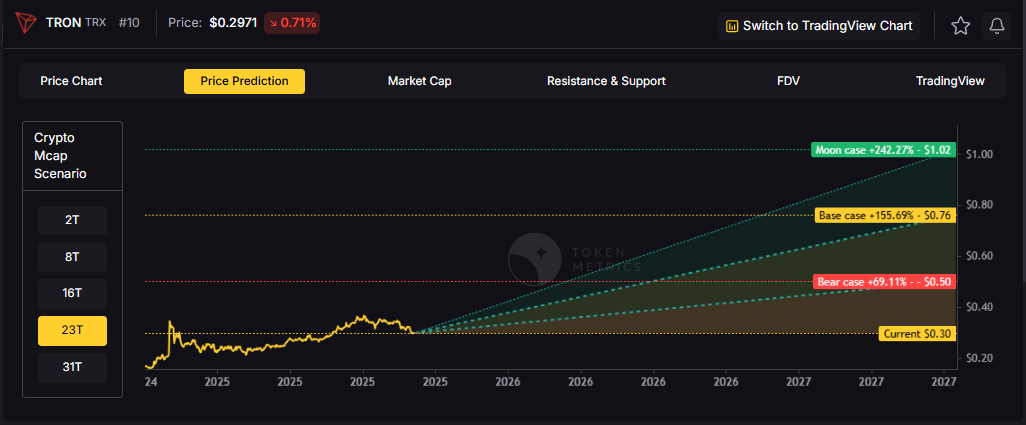
 Each tier in our price prediction framework assumes progressively stronger market conditions, with particular emphasis on stablecoin transfer volume and payments use cases that uniquely position Tron in the blockchain ecosystem.

Why Consider the Indices with Top-100 Exposure

Diversification matters. Tron is compelling, yet concentrated bets can be volatile—especially when price predictions carry Strong Sell ratings despite bullish macro conditions. Token Metrics Indices hold TRX alongside the top one hundred tokens for broad exposure to leaders and emerging winners.

Our backtests indicate that owning the full market with diversified indices has historically outperformed both the total market and Bitcoin in many regimes due to diversification and rotation benefits, reducing single-asset risk.

Get early access: https://docs.google.com/forms/d/1AnJr8hn51ita6654sRGiiW1K6sE10F1JX-plqTUssXk/preview 

If your editor supports embeds, place a form embed here. Otherwise, include the link above as a button labeled Join Indices Early Access.

What Is Tron?

Tron is a smart-contract blockchain focused on low-cost, high-throughput transactions and cross-border settlement. The network supports token issuance and a broad set of dApps, with an emphasis on stablecoin transfer volume and payments—critical factors that influence TRX price predictions.

TRX is the native asset that powers fees and staking for validators and delegators within the network. Developers and enterprises use the chain for predictable costs and fast finality, which supports consumer-facing use cases. Tron has become a dominant network for USDT (Tether) transfers, creating organic demand for TRX that impacts long-term price prediction trajectories.

Catalysts That Skew TRX Price Predictions Bullish

  • Institutional and retail access expands with ETFs, listings, and integrations
  • Macro tailwinds from lower real rates and improving liquidity expected in 2026
  • Product or roadmap milestones such as upgrades, scaling, or partnerships
  • Growing USDT stablecoin transfer volume on Tron network
  • Increased cross-border payment adoption and remittance use cases
  • Continued low-fee competitive advantage versus Ethereum
  • Enterprise blockchain partnerships leveraging Tron's throughput

Risks That Skew TRX Price Predictions Bearish

  • Macro risk-off from tightening or liquidity shocks
  • Regulatory actions targeting Tron, Justin Sun, or infrastructure outages
  • Current Strong Sell rating (19.06) indicating significant fundamental concerns
  • Concentration risk in validator economics and potential centralization issues
  • Competitive displacement from faster, lower-cost L1s and L2 solutions
  • Regulatory scrutiny on stablecoin operations affecting Tether/USDT
  • Reputational concerns related to founder Justin Sun
  • Competition from Solana, BNB Chain for stablecoin transfers

Special Offer — Token Metrics Advanced Plan with 20% Off

Unlock platform-wide intelligence on every major crypto asset. Use code ADVANCED20 at checkout for twenty percent off.

  • AI powered ratings on thousands of tokens for traders and investors
  • Interactive TM AI Agent to ask any crypto question
  • Indices explorer to surface promising tokens and diversified baskets
  • Signal dashboards, backtests, and historical performance views
  • Watchlists, alerts, and portfolio tools to track what matters
  • Early feature access and enhanced research coverage

Start with Advanced today → https://www.tokenmetrics.com/token-metrics-pricing 

Tron Price Prediction FAQs

Can TRX reach $1?

Yes. The 23T moon case in our price prediction framework shows $1.02 and the 31T moon case shows $1.31, which imply a path to $1 in higher-liquidity regimes. From current price of $0.2971, this represents approximately 240%+ gains. However, achieving this requires the bullish 2026 thesis materializing with strong stablecoin adoption and overcoming the current Strong Sell rating (19.06). Not financial advice.

Is TRX a good long-term investment?

TRX presents a complex investment case with a Strong Sell rating (19.06) despite impressive historical returns (80% YoY, 963% since last signal flip). Our price prediction models show potential upside to $1.02-$1.31 in bullish scenarios, but outcome depends heavily on adoption, liquidity regime, competition, regulatory environment, and supply dynamics. The stablecoin transfer use case provides organic demand, but fundamental concerns reflected in the Strong Sell rating suggest caution. Diversify and size positions responsibly. Not financial advice.

What is the Tron price prediction for 2026-2027?

Our comprehensive TRX price prediction framework for 2026-2027 suggests Tron could reach $1.02 in the 23T moon scenario and $1.31 in the 31T moon scenario, representing significant upside from current $0.2971 price. Base case scenarios across market cap tiers provide more conservative targets. Despite the bullish 2026 macro thesis and strong stablecoin utility, the Strong Sell rating (19.06) and bearish trading signal indicate current fundamental concerns. Not financial advice.

Should I buy TRX now or wait?

TRX has a Strong Sell rating (19.06) indicating Token Metrics does not endorse Tron at current levels, despite bullish 2026 macro conditions and 80% YoY gains. Current price of $0.2971 is down 11% over 30 days with bearish trading signals. However, historical outperformance (963% since last signal flip) and stablecoin transfer utility create a paradox. If you believe in the 2026 bull thesis and Tron's stablecoin dominance, dollar-cost averaging may reduce timing risk. Consider diversified exposure through indices. Not financial advice.

Why does TRX have a Strong Sell rating despite 80% YoY gains?

TRX receives a Strong Sell rating (19.06) based on current fundamental analysis, technical indicators, and valuation metrics—despite impressive historical performance (80% YoY, 963% since last signal flip). Ratings reflect forward-looking risk assessment including regulatory concerns, centralization issues, reputational factors, and competitive threats. Our price prediction framework shows potential upside in favorable scenarios, but the Strong Sell rating suggests significant risks that could prevent achieving bullish targets. Past performance doesn't guarantee future results. Not financial advice.

How does TRX benefit from stablecoin transfers?

Tron has become the dominant network for USDT (Tether) transfers due to extremely low fees and fast settlement. This creates organic demand for TRX as users need the native token for transaction fees. Our price prediction models assume continued growth in stablecoin transfer volume, which supports base case scenarios. The 23T and 31T price predictions of $1.02-$1.31 factor in sustained stablecoin dominance. However, competition from other low-cost chains and regulatory scrutiny on Tether operations represent risks. Not financial advice.

Can TRX reach $2?

TRX reaching $2 would exceed our current price prediction models' highest scenario of $1.31 (31T moon case). From current $0.2971, $2 represents approximately 570%+ gains. This would require extraordinary market conditions beyond the 31T total crypto market cap tier, exceptional stablecoin adoption acceleration, and overcoming significant fundamental concerns reflected in the Strong Sell rating (19.06). While possible in extreme bull scenarios, $2 appears beyond rational price prediction frameworks. Not financial advice.

What are the biggest risks to TRX price predictions?

Key risks that could derail Tron price predictions include: Strong Sell rating (19.06) indicating severe fundamental concerns, regulatory actions targeting Tron network or founder Justin Sun, centralization concerns in validator economics, regulatory scrutiny on Tether/USDT operations affecting transfer volumes, competitive displacement from Solana/BNB Chain for stablecoin transfers, reputational issues, macro liquidity shocks ending 2026 bull thesis, and potential security vulnerabilities. Despite strong utility, these risks warrant careful position sizing. Not financial advice.

How does Tron compare to other payment blockchain price predictions?

Tron's price prediction framework suggests $0.30-$1.31 across scenarios, positioning it as a specialized payments and stablecoin transfer network. Compared to Ethereum's dominance and Solana's speed, Tron differentiates through extremely low fees and USDT transfer volume leadership. However, the Strong Sell rating (19.06) reflects concerns that this niche may not sustain long-term value versus more decentralized, diversified platforms. Tron trades at rank #10, indicating established but controversial market position. Not financial advice.

Will TRX benefit from the 2026 bull market?

Yes. Our price prediction scenarios are specifically framed around the bullish 2026 thesis, where improving liquidity, institutional participation, and stablecoin adoption create favorable conditions. TRX's low-fee infrastructure and USDT dominance position it to capture bull market momentum in payments use cases. However, the Strong Sell rating (19.06) and bearish momentum suggest TRX may underperform versus fundamentally stronger tokens. Muted base case projections reflect this tension between macro tailwinds and micro concerns. Not financial advice.

Is the $1 target realistic for TRX?

The $1 target appears achievable in our price prediction framework's 23T moon case ($1.02) and 31T scenarios ($1.31). From current $0.2971, this represents approximately 240%+ gains requiring sustained stablecoin adoption, bullish macro conditions materializing, and overcoming Strong Sell rating concerns. Historical volatility (963% returns since last signal flip) demonstrates TRX's ability to deliver explosive gains, but fundamental weaknesses create significant uncertainty. Possible but high-risk—manage expectations accordingly. Not financial advice.

What needs to happen for TRX to reach price prediction targets?

For TRX to reach our price prediction targets of $1.02-$1.31, several catalysts must materialize: (1) continued dominance in USDT stablecoin transfers, (2) bullish 2026 macro conditions with improving liquidity, (3) addressing regulatory concerns around Tron and Justin Sun, (4) improving TM Grade from Strong Sell (19.06) territory, (5) institutional adoption of Tron for cross-border payments, (6) successful competition against Solana/BNB Chain, and (7) maintaining low-fee advantage as scaling solutions proliferate. The Strong Sell rating suggests these catalysts aren't currently materializing at required pace.
Next Steps

Track live grades and signals: Token Details → https://app.tokenmetrics.com/en/tron 

Join Indices Early Access: https://docs.google.com/forms/d/1AnJr8hn51ita6654sRGiiW1K6sE10F1JX-plqTUssXk/preview

Want exposure Buy TRX on MEXC → https://www.mexc.com/acquisition/custom-sign-up?shareCode=mexc-2djd4 

Disclosure

Educational purposes only, not financial advice. Crypto is volatile, do your own research and manage risk.

Why Use Token Metrics for Tron Price Predictions?

  • Transparent analysis: Honest Strong Sell ratings (19.06) even when historical returns are exceptional (963%)
  • Scenario-based modeling: Four market cap tiers for comprehensive price prediction analysis
  • Stablecoin specialization: Understanding Tron's unique position in USDT transfer ecosystem
  • Risk-adjusted approach: Balanced view of utility strengths versus fundamental concerns
  • Real-time signals: Trading signals and TM Grades updated regularly tracking 11% monthly decline
  • Diversification tools: Index solutions to spread payment blockchain risk
  • Comparative analysis: Analyze TRX against BNB, SOL, and 6,000+ tokens
Build Smarter Crypto Apps &
AI Agents in Minutes, Not Months
Real-time prices, trading signals, and on-chain insights all from one powerful API.
Grab a Free API Key
About Token Metrics
Token Metrics: AI-powered crypto research and ratings platform. We help investors make smarter decisions with unbiased Token Metrics Ratings, on-chain analytics, and editor-curated “Top 10” guides. Our platform distills thousands of data points into clear scores, trends, and alerts you can act on.
30 Employees
analysts, data scientists, and crypto engineers
Daily Briefings
concise market insights and “Top Picks”
Transparent & Compliant
Sponsored ≠ Ratings; research remains independent
Want Smarter Crypto Picks—Free?
See unbiased Token Metrics Ratings for BTC, ETH, and top alts.
Thank you! Your submission has been received!
Oops! Something went wrong while submitting the form.
 No credit card | 1-click unsubscribe
Token Metrics Team
Token Metrics Team

Recent Posts

Crypto Basics

How to Make Money Trading Crypto?

Token Metrics Team
8 min

Cryptocurrency trading has become an increasingly popular way for investors and traders to generate profits by leveraging the dynamic and often volatile nature of the crypto market. Unlike traditional currencies controlled by central banks, digital currencies operate on decentralized blockchain networks, offering unique opportunities and challenges. If you're interested in how to make money trading crypto, this article will guide you through the essential concepts, strategies, and tools needed to succeed in this exciting market.

Understanding Crypto Trading and the Cryptocurrency Market

Crypto trading involves buying and selling digital assets such as bitcoin, ethereum, and other popular cryptocurrencies on various cryptocurrency exchanges or crypto platforms. The cryptocurrency market operates 24/7, unlike traditional markets, providing continuous opportunities to trade and capitalize on value changes.

To successfully trade cryptocurrency, it's crucial to have a good understanding of how the crypto market functions. This includes knowing how price movements are influenced by market conditions, news, technological developments, and broader economic factors. Since virtual currency prices can be highly volatile, traders must stay informed about market trends and recognize patterns that could indicate optimal entry or exit points.

Setting Up Your Crypto Account and Choosing a Crypto Exchange

Before you can trade crypto, you need to set up a crypto account on a reputable crypto exchange or platform. These exchanges act as intermediaries where you can buy cryptocurrencies using fiat currency like the US dollar or other traditional currencies. Many crypto exchanges offer low fees, robust security measures, and user-friendly interfaces, making it easier for both beginners and experienced traders to buy and sell digital assets.

When selecting a crypto platform, consider factors such as security protocols, available cryptocurrencies, trading tools, and customer support. Some exchanges also provide additional features like debit cards linked to your crypto account, allowing you to spend your digital currency more conveniently.

Key Strategies to Trade Crypto Profitably

To make money trading crypto, it’s essential to develop effective strategies that align with your risk tolerance and investment goals. One common approach is day trading, where traders capitalize on short-term price fluctuations within a single day. Day traders use technical analysis to predict price movements by studying charts, recognizing patterns, and analyzing historical data.

Another strategy involves setting limit orders to buy or sell cryptocurrencies at predetermined prices, helping traders manage risk and execute trades at optimal entry points. Additionally, understanding market trends and how they relate to broader economic indicators can help you anticipate opportunities before they arise.

Leveraging Technical Analysis and Market Trends

Technical analysis plays a pivotal role in cryptocurrency trading. By analyzing price charts and market data, traders can identify trends, support and resistance levels, and potential reversals. This approach allows traders to predict price movements more accurately and make informed decisions about when to buy or sell.

Recognizing patterns such as head and shoulders, double tops, or triangles can provide valuable insights into market sentiment. Combining technical analysis with an understanding of market conditions enhances your ability to respond quickly and capitalize on favorable price changes.

Managing Risks and Maximizing Profits in Crypto Trading

Trading crypto comes with inherent risks due to the market's volatility and the unique characteristics of digital assets. To protect your investment, it’s important to manage risk by diversifying your portfolio, setting stop-loss orders, and only investing what you can afford to lose.

Understanding your risk tolerance will help you determine the best trading style, whether that’s conservative buy and hold strategies or more aggressive day trading. Staying disciplined and avoiding emotional decisions are critical to long-term success.

Moreover, keeping up with developments in blockchain technology and cryptocurrency mining can provide additional context for market movements and help you anticipate shifts in the value of crypto assets.

The Role of Blockchain Technology and Digital Currency

At the core of all cryptocurrencies is blockchain technology, a decentralized ledger that records all transactions securely and transparently. This innovation ensures the integrity of digital currency and enables peer-to-peer transactions without the need for intermediaries like banks.

Unlike traditional currencies, cryptocurrencies are not issued or controlled by a central bank, which can lead to significant fluctuations in value. However, this decentralization also offers advantages such as lower transaction fees and faster settlement times, making crypto trading an attractive option for many investors.

Getting Started on Your Crypto Journey

Embarking on your crypto journey requires education, practice, and a strategic approach. Start by familiarizing yourself with popular cryptocurrencies like bitcoin, bitcoin cash, and ethereum. Open a crypto account on a trusted exchange, and consider starting with small investments to gain experience.

As you dive deeper into cryptocurrency trading, continue to refine your skills in technical analysis, stay updated on market trends, and learn how to predict price movements effectively. By combining knowledge with disciplined trading practices, you can increase your chances of earning rewards and achieving profits in the cryptocurrency market.

In conclusion, making money trading crypto involves understanding the intricacies of the cryptocurrency market, setting up the right accounts and platforms, applying strategic trading methods, and managing risks effectively. With the right tools and mindset, you can navigate the dynamic world of digital assets and capitalize on the many opportunities that arise in crypto trading.

Crypto Basics

How to Get Into Crypto Trading in 2025: A Step-by-Step Beginner’s Guide

Token Metrics Team
8 min

Cryptocurrency trading has surged in popularity, presenting a fast-paced and potentially rewarding avenue for growing your wealth. If you’re wondering how to get into crypto trading, you’re not alone. With thousands of digital assets available, dozens of cryptocurrency exchanges to choose from, and a market that operates 24/7, diving into the crypto market can feel overwhelming at first. This beginner-friendly guide will walk you through the essential steps to confidently start your crypto trading journey in 2025.

What Is Crypto Trading?

Crypto trading refers to the process of buying and selling digital currencies such as Bitcoin (BTC), Ethereum (ETH), and thousands of other crypto assets with the aim of profiting from their price movements. Unlike traditional markets, the cryptocurrency market never sleeps—trading happens around the clock, every day of the week. This continuous operation offers traders greater flexibility and more frequent opportunities to capitalize on market trends.

Moreover, crypto trading leverages blockchain technology, which underpins digital currencies and ensures secure, transparent transactions. Unlike traditional currencies issued by central banks, digital currencies operate on decentralized blockchain networks, making them unique assets that can experience rapid value changes. This volatility can present both lucrative opportunities and significant risks, making it essential for traders to develop a good understanding of the market dynamics before getting started.

Step-by-Step Guide to Get Into Crypto Trading

Step 1: Learn the Basics of Cryptocurrency

Before you start trading, it’s crucial to grasp the fundamentals of what you’re dealing with. Cryptocurrency is a form of digital currency secured by cryptography and often powered by blockchain technology. These digital assets come in various types:

  • Coins like Bitcoin and Ethereum, which operate on their own blockchains.
  • Tokens, which can represent assets or utilities within decentralized finance (DeFi) projects or non-fungible tokens (NFTs).
  • Stablecoins such as USDC or USDT, designed to maintain a stable value by pegging to fiat currencies like the US dollar.

The crypto market is known for its high volatility, meaning prices can swing dramatically in short periods. This volatility creates opportunities for profits but also increases risk. To build a solid foundation, explore educational resources such as Token Metrics’ blog, YouTube tutorials, and crypto-focused communities on Reddit and Twitter (now X). These platforms can help you understand key concepts and stay updated on market conditions.

Step 2: Choose the Right Exchange

A crypto exchange is your gateway to the market, enabling you to buy, sell, and trade digital assets. Selecting the right crypto platform is essential for a smooth trading experience. In 2025, some of the top cryptocurrency exchanges include:

  • Binance, known for its low fees and extensive selection of crypto assets.
  • Coinbase, which offers a beginner-friendly interface ideal for new traders.
  • Kraken, favored for its advanced trading tools and robust security.
  • Token Metrics, which combines research, AI-powered trading signals, and AI crypto trading.

When choosing an exchange, consider factors like high liquidity (ensuring you can buy and sell assets easily), strong security measures, regulatory compliance, and a wide range of trading pairs. These elements help ensure your trades execute efficiently and your funds remain safe.

Step 3: Create and Secure Your Account

Once you’ve selected an exchange, the next step is to create your crypto account. This typically involves:

  1. Signing up with your email and creating a secure password.
  2. Completing KYC (Know Your Customer) verification to comply with regulatory standards.
  3. Enabling 2-Factor Authentication (2FA) to add an extra layer of security.

After setting up, you can fund your account using fiat currency such as US dollars or euros through bank transfers, debit cards, or other payment methods supported by the platform. Having a secure and verified account is vital to protect your assets and ensure smooth transactions.

Step 4: Choose a Trading Style

Your trading style should align with your financial goals, available time, and risk tolerance. Common approaches include:

  • Day Trading: Making multiple trades within a single day to capitalize on short-term price fluctuations.
  • Swing Trading: Holding positions for several days or weeks to benefit from medium-term trends.
  • Scalping: Executing rapid trades to profit from small price movements.
  • HODLing: Long-term holding based on confidence in a project’s future.
  • AI-Powered Trading: Utilizing platforms like Token Metrics that use artificial intelligence to automate and optimize trading decisions.

Understanding your preferred style helps you develop a consistent strategy and manage risk effectively.

Step 5: Learn Technical and Fundamental Analysis

Successful cryptocurrency trading hinges on your ability to analyze the market. Two primary methods are:

  • Technical Analysis (TA): This involves studying charts, indicators like RSI (Relative Strength Index), MACD (Moving Average Convergence Divergence), and Bollinger Bands to recognize patterns, support and resistance levels, and predict price movements based on historical data and volume.
  • Fundamental Analysis (FA): This focuses on evaluating the underlying value of a crypto asset by examining the project’s use case, team, tokenomics (such as supply and utility), and overall market sentiment influenced by news and developments.

Platforms like Token Metrics simplify these analyses by providing AI-generated grades and insights that combine technicals, fundamentals, and sentiment, helping traders make informed decisions.

Step 6: Place Your First Trade

With your research complete and your crypto account funded, you’re ready to place your first trade. Start by selecting a trading pair, such as ETH/USDT, depending on the assets you want to buy or sell. Then, choose an order type:

  • Market Order: Executes instantly at the current market price.
  • Limit Order: Executes only when the price reaches a specified level.
  • Stop-Limit Order: Triggers a limit order once a certain price condition is met.

To manage risk, set a stop-loss order to automatically sell if the price drops to a certain point, and consider take-profit orders to lock in gains when the price reaches your target. It’s wise to start small, using only funds you can afford to lose while you learn the ropes.

Step 7: Track Performance and Learn from Mistakes

Trading is a continuous learning process. Keep a trading journal or use analytics tools to record your entry and exit points, profits and losses, and emotions or events that influenced your decisions. This practice helps you identify patterns in your behavior and refine your strategy over time. Tools like Token Metrics offer backtesting features, AI signal alerts, and portfolio performance tracking to support your growth as a trader.

Tools That Make Crypto Trading Easier in 2025

Token Metrics

Token Metrics stands out as a powerful crypto research and trading platform designed to assist both beginners and experienced traders. It uses AI to grade crypto assets, sends bullish or bearish alerts, and offers auto-managed portfolios known as Indices. Users gain access to real-time market insights and advanced features like the Moonshots tab and AI Agent (crypto chatbot), which help identify optimal entry points and predict price movements. A 7-day free trial allows you to explore these premium tools risk-free.

Wallets

Securing your digital currency is crucial. Hot wallets like MetaMask and Trust Wallet provide easy access for regular trading, while cold wallets such as Ledger and Trezor offer maximum security by storing assets offline, protecting them from hacks and theft.

Tips for Success as a New Crypto Trader

  1. Start Small: Begin with modest investments and gradually increase as you gain confidence.
  2. Manage Risk: Never invest more than you can afford to lose, and always use stop-loss orders.
  3. Avoid Emotional Trading: Stick to your plan and avoid impulsive decisions driven by fear or greed.
  4. Stay Informed: Keep up with market trends, news, and macroeconomic factors that affect the cryptocurrency market.
  5. Leverage AI Tools: Utilize platforms like Token Metrics to reduce guesswork and enhance your trading strategies.

Common Mistakes to Avoid

New traders often fall into pitfalls such as:

  • Chasing Pumps: Buying after a cryptocurrency’s price has already surged, which can lead to losses.
  • Overtrading: Making excessive trades without a clear strategy, increasing fees and risk.
  • Neglecting Security: Failing to use 2FA or hardware wallets can expose your funds to theft.
  • FOMO and Panic Selling: Reacting emotionally to price swings instead of following a disciplined approach.

By relying on research-backed tools and maintaining discipline, you can navigate the crypto market more effectively.

Final Thoughts

Entering the world of crypto trading in 2025 is more accessible than ever but also highly competitive. Success requires more than enthusiasm; it demands strategy, the right tools, and disciplined execution. Whether you’re aiming to trade full-time or simply capitalize on market opportunities, platforms like Token Metrics provide AI-powered research, real-time alerts, and dynamic indices that simplify decision-making and enhance your ability to trade smarter.

Are you ready to begin your crypto journey? Sign up for Token Metrics today and unlock the power of AI-driven cryptocurrency trading to maximize your potential profits in this exciting digital market.

Crypto Basics

How Does Crypto Trading Work? A Complete Beginner’s Guide (2025)

Token Metrics Team
8 min

Cryptocurrency trading has rapidly evolved into one of the most dynamic and potentially rewarding forms of digital asset investing. Cryptocurrencies are rooted in blockchain technology, which serves as a public ledger that is distributed across a decentralized network. As a form of virtual currency, cryptocurrency exists entirely online and is not the same as physical money, meaning it cannot be held or exchanged in person like cash. The encryption used in cryptocurrency ensures that transactions are secure and the data exchanged is verified. For many newcomers, however, the question remains: how does crypto trading work? This comprehensive guide will break down the essential mechanics, strategies, risks, and platforms involved in crypto trading, providing you with a clear understanding of how to get started and trade smart in 2025. Additionally, we will explore the different types of cryptocurrency available in the market.

Introduction to Cryptocurrency

Cryptocurrency is a revolutionary form of digital currency that relies on advanced cryptography to secure financial transactions and control the creation of new units. Since the launch of the first cryptocurrency, Bitcoin, in 2009, the cryptocurrency market has expanded rapidly, introducing a wide variety of digital currencies and investment opportunities. Crypto trading, or cryptocurrency trading, involves buying and selling these digital currencies on a crypto exchange, with the aim of profiting from price fluctuations. For anyone interested in cryptocurrency investing, understanding how the cryptocurrency market operates and recognizing emerging trends is essential. At the heart of this innovation is blockchain technology, which ensures that every transaction is secure, transparent, and resistant to tampering. As digital currencies continue to reshape the financial landscape, learning the basics of cryptocurrency and how to navigate the crypto market is the first step toward successful investing.

Understanding the Cryptocurrency Market

The cryptocurrency market operates as a decentralized ecosystem, free from the direct control of central banks and traditional financial institutions. In this market, crypto trading involves exchanging digital assets like Bitcoin, Ethereum, and other digital currencies for fiat currency or other cryptocurrencies. One of the defining features of the crypto market is its high volatility—price movements can be swift and dramatic, creating both risks and opportunities for traders. To navigate these fluctuations, many traders rely on technical analysis and trend trading strategies to predict price movements and identify optimal entry and exit points. Staying informed about market trends, news, and global events is crucial for anyone trading cryptocurrency, as these factors can significantly impact the value of digital assets. By understanding the unique dynamics of the cryptocurrency market, traders can make more informed decisions and better manage their investments.

Blockchain Technology Explained

Blockchain technology is the backbone of the cryptocurrency market, providing a secure and transparent way to record and verify transactions. At its core, blockchain is a distributed ledger system that stores transaction data across a network of computers, making it nearly impossible to alter or tamper with records. Each transaction is verified using sophisticated cryptographic techniques, ensuring the integrity and authenticity of the data. This decentralized approach eliminates the need for a central authority, reducing the risk of censorship and fraud. For anyone interested in cryptocurrency, understanding how blockchain technology works is essential—not only does it enable secure transactions, but it also underpins the trust and transparency that make digital currencies possible. As blockchain technology continues to evolve, it remains a critical component of the cryptocurrency ecosystem and a key driver of innovation in the financial sector.

What are Crypto Transactions?

Crypto transactions are the process by which digital assets, such as cryptocurrencies, are exchanged between parties. Every crypto transaction is recorded on a public ledger known as the blockchain, where it is verified by a decentralized network of computers. This system ensures that each transaction is secure, transparent, and resistant to tampering. Cryptographic techniques, including the use of private keys and public keys, play a vital role in maintaining the integrity of crypto transactions. When trading cryptocurrency, it’s important to understand how to verify transactions and safeguard your digital assets. By mastering the basics of crypto transactions, traders can participate confidently in the cryptocurrency market and ensure that their trades are both secure and reliable.

Security Measures for Crypto Traders

Protecting your digital assets is a top priority when trading cryptocurrency. To keep your investments safe, always use a secure digital wallet—hardware wallets are especially effective for long-term storage, as they keep your private keys offline and out of reach from hackers. Enable two-factor authentication (2FA) on your crypto exchange accounts to add an extra layer of security, and make sure your software and devices are regularly updated to guard against vulnerabilities. It’s also crucial to choose a reputable crypto exchange with a strong track record for security and to remain vigilant against phishing scams and suspicious links. By following these security measures, crypto traders can significantly reduce the risk of theft and ensure their digital assets remain protected throughout their trading journey.

Transaction Security: Keeping Your Trades Safe

Ensuring the security of each trade is essential when trading cryptocurrency. Always access your crypto exchange through a secure, encrypted connection (look for HTTPS in your browser’s address bar) to prevent unauthorized interception of your data. Before making a trade, verify the legitimacy of both the exchange and your counterparty to avoid falling victim to scams. Store your digital assets in a secure digital wallet, and consider using cold storage solutions for added protection, especially for larger holdings. Stay alert for unusual price movements or unexpected transactions, as these can be signs of suspicious activity. By prioritizing transaction security and following best practices, you can safeguard your digital assets and enjoy a safer, more reliable trading experience in the cryptocurrency market.

What Is Crypto Trading?

At its core, crypto trading involves buying and selling digital assets such as Bitcoin, Ethereum, and various altcoins with the goal of profiting from price movements. A cryptocurrency exchange is a digital marketplace where users can buy, sell, and trade cryptocurrencies. Bitcoin is the most commonly traded cryptocurrency, but traders also seek out valuable cryptocurrency assets like Ethereum and other altcoins. Cryptocurrencies represent a new class of financial assets. Each transaction in a blockchain represents a ‘block’ of data about ownership and is linked to the previous block, forming a chain. Cryptocurrency is considered a non-fiat medium of exchange functioning independently of any government or central bank. Unlike traditional stock markets, the cryptocurrency market operates 24/7 and is accessible globally, often through decentralized or centralized platforms. Users can trade cryptocurrencies on various exchanges, and choosing reputable cryptocurrency exchanges is essential for safe and secure transactions.

There are two primary types of crypto trading to be aware of:

  • Spot Trading: This involves the immediate purchase or sale of crypto assets, with settlement happening instantly. When you buy Bitcoin on a spot market, you own the actual digital coins. Traders often seek out valuable cryptocurrency assets. Trading pairs may include BTC/ETH or BTC/USDC, with USD Coin (USDC) being a stablecoin commonly used in such pairs.
  • Derivatives Trading: Instead of owning the underlying crypto asset, traders buy contracts such as futures, options, or perpetual swaps that derive their value from the price of the cryptocurrency. These contracts are based on the underlying asset, such as Bitcoin or Ethereum. This allows for strategies like leverage trading without holding the actual crypto.

Understanding these key distinctions helps clarify the different ways you can engage with the crypto market.

How Crypto Trading Works: Step-by-Step

1. Choose a Crypto Exchange or Platform

To begin trading, you first need to gain access to a crypto exchange or trading platform. Binance, Coinbase, and Kraken are examples of centralized exchanges, which function as middlemen between buyers and sellers and hold your deposited money. These exchanges often list a wide range of cryptocurrency projects, giving users access to various digital assets. When choosing a platform, it's important to compare transaction fees, as centralized exchanges may charge higher fees than other options. Some platforms also support cryptocurrency payments for goods and services, adding flexibility for users. Be aware that regulations may differ for virtual currencies in different jurisdictions, and users should understand local regulations and reporting requirements related to trading activity. Popular choices in 2025 include Binance, Coinbase, Kraken, and innovative platforms like Token Metrics that incorporate AI-powered research and trading signals with AI crypto trading. The first cryptocurrency ever created was Bitcoin, launched in 2009.

Opening a trading account typically requires you to register, complete identity verification (known as KYC), and deposit funds—either fiat currency like USD or digital coins. You should verify your identity to fund your account on an exchange or broker. When funding your account, ensure the security of your online payments to protect your digital assets. Users store cryptocurrencies in digital wallets that require a private key to access. This process grants you the ability to trade crypto assets securely and efficiently.

2. Pick a Trading Pair

In the crypto market, assets are traded in pairs, meaning you exchange one digital asset for another. Common pairs include:

  • BTC/USD (Bitcoin to US Dollar)
  • ETH/BTC (Ethereum to Bitcoin)
  • SOL/USDT (Solana to Tether)

Trading pairs allow you to speculate on the relative value between two assets, whether between a cryptocurrency and a traditional fiat currency or between two different digital coins. Each cryptocurrency transaction is recorded and cannot be counterfeited, providing a secure method for asset transfer.

3. Understand the Order Book

The order book is a real-time list of all buy (bid) and sell (ask) orders on the exchange. It shows the demand and supply dynamics for a given trading pair.

You can place different types of orders:

  • Market Orders: Buy or sell immediately at the current market price.
  • Limit Orders: Set a specific price at which you want to buy or sell, which executes only when the market reaches that level. Traders often use average prices, such as moving averages, to help determine optimal price levels for placing these orders.
  • Stop-Limit or Stop-Market Orders: Automated orders triggered when the price hits a certain point, helping manage risk or lock in profits.

For traders who place frequent orders, such as scalpers, low fees are important to maximize gains by minimizing transaction costs.

Mastering these order types allows you to control your entry and exit points in the market, crucial for effective trading.

4. Analyze the Market with Technical Analysis

Successful traders use a blend of approaches to predict price movements and identify profitable opportunities: The value of a cryptocurrency is influenced by the quality of its underlying technology and market demand.

  • Technical Analysis (TA): This involves studying price charts, indicators like MACD and RSI, and recognizing patterns in candlestick charts to forecast future price trends. Day traders rely heavily on technical indicators and the ability to recognize patterns to make quick decisions. Understanding price movement is especially important in range trading, where identifying support and resistance zones helps traders operate in stable, non-trending markets.
  • Fundamental Analysis (FA): Evaluating the underlying value of a project by examining its technology, tokenomics, use cases, broader market news, and factors such as mining cryptocurrency, which plays a key role in the creation and sustainability of many digital assets.
  • AI-Powered Tools: Platforms such as Token Metrics leverage machine learning to grade cryptocurrencies and generate real-time trading signals, offering an edge beyond traditional analysis.

By combining these methods, traders make informed decisions rather than relying solely on speculation or hype. In addition, opportunities arise for arbitrage when price differences exist across exchanges, allowing traders to capitalize on these discrepancies. Effective risk management also involves monitoring for price drops and setting rules to limit losses.

5. Make the Trade

After thorough analysis and identifying an optimal entry point, you can execute your trade. Key considerations include:

  • Position sizing: Determine how much capital to allocate.
  • Risk-to-reward ratio: Assess potential gains relative to possible losses.
  • Stop-loss and take-profit targets: Set automated exit points to manage risk.

For example, if you anticipate Ethereum rising from $3,000 to $3,500, you might place a buy order and set a stop-loss at $2,900 to limit potential losses.

6. Monitor and Manage Risk

Given the high volatility of the crypto market, managing risk is essential:

  • Limit exposure to 1–2% of your total capital per trade.
  • Use stop-loss orders to prevent significant losses.
  • Regularly rebalance your portfolio based on evolving market trends.
  • Track your capital gains from cryptocurrency transactions for tax purposes, as proper reporting is crucial for legal compliance.

High volatility creates opportunities for profit within short periods in cryptocurrency trading. Effective risk management is crucial for successful crypto investments, helping you achieve your financial goals while minimizing potential losses.

AI-driven platforms like Token Metrics can assist by offering automated portfolio management tailored to different risk profiles and trading styles.

Types of Crypto Trading Strategies

There are various trading styles suited to different goals and risk appetites: Day trading strategies are based on technical analysis, awareness of market sentiment, and perception of news that may affect volatility. These strategies allow users to trade cryptocurrencies in various ways depending on their preferences and objectives.

  • Day Trading: Involves multiple trades within a single day to capitalize on short-term price fluctuations. This style requires discipline, fast decision-making, and strong technical analysis skills.
  • Swing Trading: Traders hold positions for days or weeks, aiming to profit from medium-term trends by analyzing support and resistance levels, trading volume, and market sentiment.
  • Scalping: A rapid-fire strategy targeting small price changes, with trades lasting seconds or minutes.
  • HODLing: A long-term strategy where investors hold crypto assets believing they will appreciate significantly over time. It's important to know how to store cryptocurrency securely for the long term, using appropriate crypto wallets to protect your assets.
  • AI-Based Trading: Emerging in 2025, AI-powered platforms like Token Metrics automate strategy execution by detecting trend shifts, scanning thousands of tokens, and issuing real-time bullish or bearish alerts. Understanding how cryptocurrency work can help in choosing the right automated strategy and interpreting AI-driven signals.

Understanding these strategies helps you choose the approach that aligns best with your investment goals.

Where Does Crypto Trading Happen in the Cryptocurrency Market?

Crypto trading takes place on several types of platforms:

  • Centralized Exchanges (CEXs): These are traditional, regulated platforms like Binance and Coinbase. They offer high liquidity, user-friendly interfaces, and the ability to deposit and withdraw fiat currency.
  • Decentralized Exchanges (DEXs): Platforms such as Uniswap and PancakeSwap operate on blockchain technology using smart contracts. They allow users to trade directly from their digital wallets without needing to create accounts, promoting secure transactions and privacy.
  • AI Trading Platforms: Innovative services like Token Metrics provide advanced tools including AI-generated grades, real-time trading signals, and dynamic indices that adapt to market trends.

Each platform type offers unique advantages depending on your trading preferences and security requirements.

Benefits of Crypto Trading

Engaging in crypto trading offers several advantages:

  • High Potential Returns: The volatility of digital assets creates opportunities for significant profits.
  • 24/7 Market Access: Unlike traditional markets, the crypto market never closes, allowing trading at any hour.
  • Global Participation: Anyone with internet access can open a crypto account and participate, democratizing investing. Users can make cryptocurrency payments without needing a traditional bank account, making it easier for the unbanked to access financial services. Virtual currency enables participation from anywhere in the world, removing geographic barriers.
  • Technological Innovation: The integration of AI, blockchain technology, and decentralized finance (DeFi) protocols enhances trading capabilities and strategies.

These benefits make crypto trading an attractive option for both novice and experienced investors.

Risks of Crypto Trading

Despite its appeal, crypto trading carries inherent risks: * High Volatility: Sudden and unpredictable value changes can result in rapid losses. * Regulatory Uncertainty: Many regions lack clear oversight, and some exchanges operate without stringent regulation. * Security Threats: Exchanges and wallets can be vulnerable to hacks, risking your crypto holdings. While blockchain technology offers tamper-proof records and features like two-factor authentication, the question "is cryptocurrency safe?" remains, as risks such as hacking incidents, market volatility, and compromised cryptocurrency transactions on exchanges persist. * Emotional Trading: Fear of missing out (FOMO) and panic selling can lead to poor decisions. Proper research on exchanges and storage methods is essential to protect cryptocurrency investments from theft and loss. Investors should only invest what they can afford to lose due to the high risk of investment loss. Virtual currencies are also frequently targeted by scammers, making vigilance against fraud crucial.

  • High Volatility: Sudden and unpredictable value changes can result in rapid losses.
  • Regulatory Uncertainty: Many regions lack clear oversight, and some exchanges operate without stringent regulation.
  • Security Threats: Exchanges and wallets can be vulnerable to hacks, risking your crypto holdings. Blockchain security features like tamper-proof transaction records and two-factor authentication help, but cryptocurrency transactions on exchanges remain at risk from hacking and other threats.
  • Emotional Trading: Fear of missing out (FOMO) and panic selling can lead to poor decisions.

Utilizing AI-powered platforms like Token Metrics can help mitigate these risks by providing data-driven insights and reducing emotional bias.

How Token Metrics Enhances Crypto Trading

For traders seeking an edge in 2025, platforms like Token Metrics are transforming the way people trade cryptocurrency by:

  • Offering AI grades that evaluate coins based on technical indicators, fundamentals, and market sentiment.
  • Delivering real-time alerts for significant price movements and trend changes.
  • Providing auto-managed indices that automatically rebalance portfolios according to token performance and market conditions.
  • Integrating seamlessly with your wallet or exchange to execute trades efficiently.

Whether you’re a beginner or a seasoned day trader, leveraging AI can simplify complex analysis and improve your trading outcomes.

Final Thoughts

Understanding how crypto trading works—from selecting exchanges and order types to adopting effective strategies and managing risk—is essential for trading smarter in the fast-paced digital currency landscape. While the crypto market remains volatile, tools like Token Metrics empower traders to make informed, data-driven decisions, helping to reduce risk and enhance profitability.

Ready to explore AI-powered crypto trading? Start your 7-day free trial with Token Metrics today and experience how smart trading works in 2025.

Choose from Platinum, Gold, and Silver packages
Reach with 25–30% open rates and 0.5–1% CTR
Craft your own custom ad—from banners to tailored copy
Perfect for Crypto Exchanges, SaaS Tools, DeFi, and AI Products