





Understanding Crypto Market Microstructure: Lessons from a $19 Billion Liquidation Event
%201.svg)
%201.svg)


The cryptocurrency markets recently experienced their largest single-day liquidation event in history—$19 billion in leveraged positions eliminated within hours. Beyond the immediate impact on traders and portfolios, this event offers a masterclass in market microstructure, liquidity dynamics, and systemic risk. This analysis explores the mechanics of what happened and the broader implications for understanding how digital asset markets function under stress.
The Anatomy of Market Liquidity
What Is Market Depth?
Market depth refers to the market's ability to sustain large orders without significant price impact. It's visualized through order books—the collection of buy and sell orders at various price levels.
Consider a practical example: If a cryptocurrency has $370,000 in orders within 2% of the current price, this represents the "2% depth." A sell order of this size would move the price down by 2%. During normal market conditions, market makers continuously replenish these orders, maintaining depth.
However, during last week's event, this depth evaporated. Some assets saw their 2% depth collapse from hundreds of thousands to mere tens of thousands—a 10x reduction in market resilience.
The Role of Market Makers
Market makers serve as the plumbing of financial markets. They:
- Continuously quote both buy and sell prices
- Provide liquidity for traders entering and exiting positions
- Hedge their exposure through various instruments
- Use automated algorithms to manage thousands of positions simultaneously
Their profitability comes from the bid-ask spread, but this model requires:
- Connectivity: Reliable data feeds from exchanges
- Hedging capability: Access to instruments for offsetting risk
- Capital efficiency: Ability to maintain positions across multiple venues
When any of these breaks down, market makers protect themselves by withdrawing—exactly what occurred last Friday.
The Leverage Cascade: A Systems Perspective
Perpetual Futures Architecture
Perpetual futures contracts have become the dominant trading vehicle in crypto, surpassing spot volume on most assets. Unlike traditional futures, perpetuals don't expire. Instead, they use a funding rate mechanism to keep prices anchored to spot markets.
This structure creates several unique characteristics:
- Capital Efficiency: Traders can control large positions with relatively small collateral. A 10x leveraged position allows $10,000 to control $100,000 in exposure.
- Liquidation Mechanisms: When collateral falls below maintenance requirements, positions are automatically closed. In centralized exchanges, this happens through the liquidation engine. In decentralized perpetual DEXs, smart contracts execute liquidations.
- Socialized Losses: If liquidations can't be executed at prices that cover losses, many platforms employ "auto-deleveraging" (ADL), where profitable traders on the opposite side are automatically closed to balance the system.
The Cascade Effect
The $19 billion liquidation followed a predictable but devastating pattern:
- Stage 1: Initial Trigger Geopolitical news created uncertainty, prompting large traders to reduce exposure. A whale allegedly opened significant short positions ahead of a major policy announcement.
- Stage 2: Price Movement Initial selling pushed prices down, triggering stop-losses and liquidations of over-leveraged long positions.
- Stage 3: Liquidity Withdrawal Critical exchange APIs experienced disruptions. Unable to hedge or access reliable pricing, market makers stopped quoting.
- Stage 4: Liquidity Void With minimal order book depth, liquidation orders had exponentially larger price impacts, triggering additional liquidations.
- Stage 5: Cross-Margining Failure Traders using multiple positions as collateral (cross-margin) found themselves exposed when individual positions were liquidated, leaving other positions unhedged.
- Stage 6: Auto-Deleveraging Even profitable positions were forcibly closed to rebalance the system, affecting traders who thought they were protected.
Comparative Analysis: COVID-19 vs. The Recent Event
March 2020 COVID Crash
The March 12, 2020 crash ("Black Thursday") represented systemic risk-off behavior:
- Bitcoin: -50%
- Ethereum: -43 to -45%
- Broad-based selling across all asset classes
Driven by unprecedented global uncertainty. Recovery took months.
October 2025 Event
The recent event showed different characteristics:
- Bitcoin: -9%
- Ethereum: -10%
- Selective altcoin devastation (some -90%+)
- Leverage-driven rather than sentiment-driven
- Partial recovery within days
Key Insight: This was a microstructure event, not a macro repricing. The difference is critical for understanding market health and recovery dynamics.
The Perpetual DEX Revolution and Its Risks
Decentralization of Derivatives
The emergence of perpetual DEXs (Hyperliquid, GMX, dYdX v4) represents a significant market structure evolution:
Advantages:
- Non-custodial trading
- Transparent on-chain settlement
- Reduced counterparty risk
- Composability with DeFi protocols
Challenges:
- Concentrated liquidity pools
- Less sophisticated market-making
- Smart contract risk
- Oracle dependencies for liquidations
- Limited circuit breakers
The proliferation of these platforms contributed to the unprecedented leverage in the system. Open interest across perpetual DEXs had reached all-time highs, creating vulnerability to coordinated liquidation cascades.
Information Asymmetry and Market Timing
The Insider Trading Question
The timing of large short positions immediately preceding policy announcements raises important questions about information flow in crypto markets:
- Information Hierarchy: True insiders (policymakers, direct contacts)
- Well-connected individuals (lobbyists, industry leaders)
- Professional traders monitoring news feeds
- Retail traders reading headlines
In traditional markets, insider trading is legally defined and enforced. In crypto's global, 24/7 market, jurisdictional ambiguity and pseudonymity complicate enforcement.
Market Efficiency Implications: The rapid price movement suggests either:
- Exceptional timing and risk appetite
- Access to non-public information
- Sophisticated analysis of geopolitical developments
Regardless of the mechanism, it demonstrates that information advantages remain a powerful edge in supposedly "democratized" markets.
Real-World Asset Integration: A Stabilizing Force?
Maple Finance Case Study
Amid the carnage, platforms focused on real-world assets (RWAs) showed resilience. Maple Finance reported:
- Zero liquidations during the event
- Continued TVL growth (10x year-over-year)
- Stable yields throughout volatility
Why RWAs Performed Differently:
- Lower Leverage: RWA protocols typically don't offer high leverage ratios
- Real Collateral: Backed by off-chain assets with independent value
- Institutional Borrowers: More stable, less speculative user base
- Different Risk Profile: Credit risk versus market risk
This suggests a potential future where crypto markets bifurcate:
- Speculative layer: High leverage, high velocity, narrative-driven
- Productive layer: RWAs, yield generation, institutional capital
Risk Management in Volatile Markets
Position Sizing Mathematics
The Kelly Criterion provides a mathematical framework for position sizing:
f = (bp - q) / bWhere:
- f = optimal fraction of capital to risk
- b = odds received on bet
- p = probability of winning
- q = probability of losing
In crypto's volatile environment, even sophisticated traders often overallocate. The recent event demonstrated that even with positive expected value, overleveraged positions face ruin through path dependency.
The Volatility Paradox
Crypto's appeal partly stems from volatility—the opportunity for significant returns. However, this same volatility creates:
- Leverage Incompatibility: High volatility means small price movements can trigger liquidations. A 5x leveraged position can be liquidated with a 20% adverse move—common in crypto.
- Correlation Breakdown: Assets assumed to be uncorrelated often converge during stress, eliminating diversification benefits.
- Liquidity Illusion: Markets appear liquid until everyone tries to exit simultaneously.
Hedging Challenges
Traditional hedging strategies face unique challenges in crypto:
- Delta Hedging: Requires continuous rebalancing in a 24/7 market with variable liquidity.
- Options Strategies: Crypto options markets have limited depth and wide spreads, making sophisticated strategies expensive.
- Cross-Asset Hedging: Macro hedges (short equities, long gold) often fail to activate or provide insufficient offset.
The Institutional Risk: Who Went Under?
Previous cycles saw major institutional failures:
- 2022: Celsius, Voyager, BlockFi, FTX/Alameda
- 2021: Multiple leveraged funds during May crash
- 2018: Various ICO-era projects and funds
Each followed a similar pattern:
- Overleveraged positions
- Illiquid collateral
- Inability to meet margin calls
- Cascading liquidations
- Eventual insolvency
Current Speculation
Several indicators suggest potential institutional distress:
- Market Maker Silence: Prominent firms haven't issued statements—unusual given the event's magnitude.
- Withdrawal Delays: Anecdotal reports of delayed withdrawals from certain platforms.
- Unusual Price Dislocations: Persistent basis spreads suggesting forced deleveraging.
- Liquidity Patterns: Sustained reduction in market depth even post-event.
History suggests revelations of institutional failures often emerge weeks or months after the triggering event, as liquidity issues compound.
Behavioral Dynamics: The Human Element
Cognitive Biases in Crisis
The event highlighted several psychological factors:
- Recency Bias: Many traders, having experienced months of upward price action, underestimated downside risks.
- Overconfidence: Success in bull markets often leads to excessive risk-taking, particularly with leverage.
- Loss Aversion: Instead of cutting losses early, many traders added to positions, compounding losses.
- Herding: Once liquidations began, panic selling accelerated the cascade.
Social Media Amplification
Crypto's real-time social media ecosystem amplified volatility:
- Liquidation alerts trending on X (Twitter)
- Telegram groups sharing losses, creating contagion fear
- Influencers calling for further downside
- Misinformation about exchange solvency
This feedback loop between price action and social sentiment accelerates both crashes and recoveries.
Technical Infrastructure Vulnerabilities
API Reliability as Systemic Risk
The role of Binance API disruptions cannot be overstated. As the dominant exchange by volume, Binance serves as:
- Primary price discovery venue
- Critical hedging platform for market makers
- Reference for perpetual funding rates
- Liquidity hub for arbitrage
When its APIs became unreliable, the entire market's plumbing failed. This centralization risk persists despite crypto's decentralization ethos.
Circuit Breakers: The Debate
Traditional markets employ circuit breakers—trading halts during extreme volatility. Crypto's 24/7, decentralized nature complicates implementation:
Arguments For:
- Prevents cascade liquidations
- Allows time for rational assessment
- Protects retail from algos
Arguments Against:
- Who has authority to halt trading?
- Increases uncertainty and exit rushing when resumed
- Antithetical to crypto's permissionless nature
- Centralized venues would need coordination
The lack of circuit breakers contributed to the cascade but also allowed for rapid price discovery and recovery.
Market Cycle Positioning: Strategic Framework
Identifying Market Phases
The document referenced an accumulation phase. Understanding market cycles requires multiple indicators:
- Momentum Indicators: Price trends across multiple timeframes, volume patterns, volatility regimes
- Sentiment Metrics: Funding rates (bullish when positive), open interest growth or decline, social media sentiment analysis
- On-Chain Data: Exchange flows (accumulation vs. distribution), dormant coin circulation, miner behavior
The Trader vs. Investor Dichotomy
Current market conditions favor trading over investing:
Trading Approach
- Narrative-driven entries (AI, RWAs, privacy, etc.)
- Defined exit criteria
- Risk management through position sizing
- Frequent portfolio turnover
Investing Approach
- Fundamental analysis of technology and adoption
- Multi-year hold periods
- Conviction through volatility
- Network effect accumulation
The challenge: most altcoins lack the fundamentals for long-term holding, yet trading requires timing and execution that most cannot consistently achieve.
Alternative Strategies: Defensive Positioning
Yield-Bearing Stablecoins
For risk-off periods, yield-generating strategies offer protection:
- Options: Staked stablecoins (sUSDS, sDAI): 4-5% APY
- Delta-neutral strategies (Ethena): 5-8% APY
- Lending protocols (Aave, Compound): 3-12% depending on asset
Risk Considerations:
- Smart contract risk
- Protocol solvency
- Depeg risk for synthetic stables
- Opportunity cost versus appreciation assets
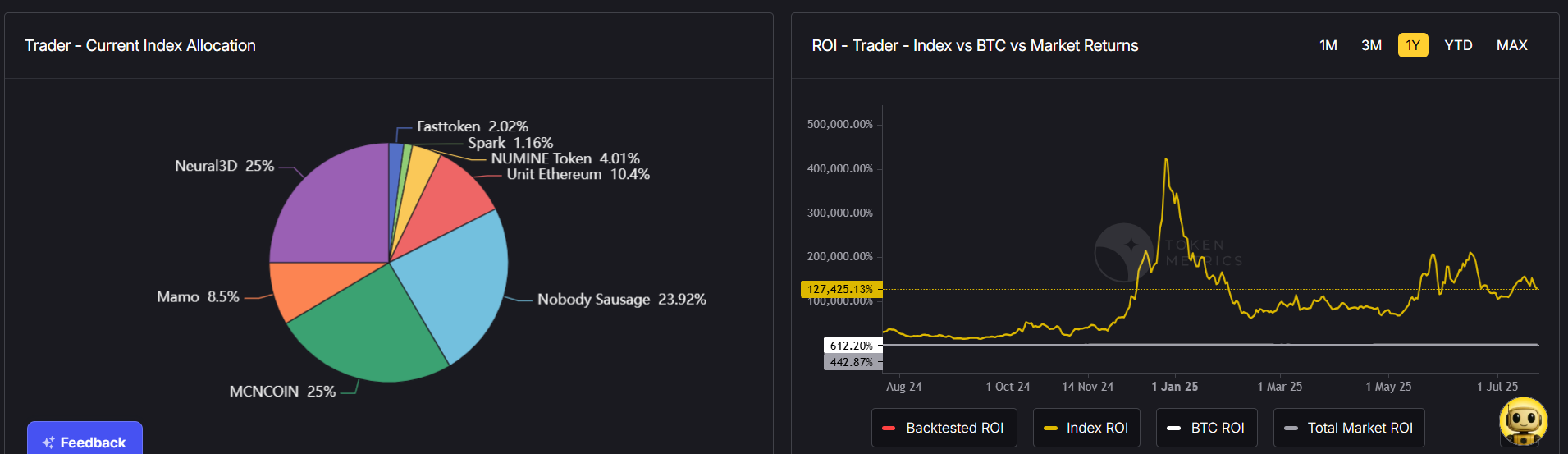
The Index Approach
Systematized exposure through index products offers advantages:
- Benefits:
- Eliminates Selection Risk: Own the market rather than picking winners
- Rebalancing Discipline: Automated position management
- Risk Management: Systematic entry/exit based on market conditions
- Compounding: Consistent moderate returns compound over time
- Trade-offs:
- Lower ceiling than identifying individual winners
- Fees and rebalancing costs
- Still subject to overall market direction
- Requires discipline during bull markets
Historical Outperformers in Bear Markets
Previous cycles identified categories that maintained relative strength:
- 2018-2019 Bear Market: Chainlink: Infrastructure play, oracle adoption
- Binance Coin: Exchange utility, launchpad value
- Synthetix: Innovation in synthetic assets
Common Characteristics:
- Real usage and adoption
- Revenue generation
- Solving specific problems
- Community and developer activity
The challenge: identifying these requires foresight that's obvious only in retrospect.
Future Market Structure Evolution
Potential Developments
- Institutional Infrastructure: Better custody, prime brokerage services, and institutional-grade derivatives will reduce some forms of market instability while potentially introducing others (e.g., complex derivatives).
- Regulatory Clarity: Clearer frameworks may reduce certain risks (fraud, manipulation) but could introduce others (compliance costs, reduced access).
- Improved Oracle Networks: More reliable price feeds will reduce liquidation errors and improve DeFi stability.
- Cross-Chain Liquidity: Better interoperability could distribute liquidity more evenly, reducing concentration risk.
- RWA Integration: Tokenized real-world assets may provide ballast to purely speculative markets.
Persistent Challenges
- Volatility Will Remain: The crypto market's youth, global accessibility, and 24/7 nature ensure ongoing volatility.
- Leverage Will Persist: The demand for capital efficiency means leveraged products will continue to exist and evolve.
- Information Asymmetry: Some participants will always have better information, analysis, or execution.
- Technical Fragility: As systems grow more complex, new vulnerabilities emerge.
Practical Takeaways
For Traders
- Leverage Is Optional: Most traders would perform better without it
- Liquidity Matters: Trade assets where you can exit quickly
- Position Sizing: Risk per trade should reflect volatility
- Diversify Exchanges: Don't keep all funds in one venue
- Plan Before Crisis: Know your exits before entering
For Investors
- Fundamentals Still Matter: Technology and adoption outlast hype
- Time Horizon Clarity: Match holdings to investment timeframe
- Understand Tokenomics: Supply dynamics affect long-term value
- Diversification Limits: Most altcoins are highly correlated
- Emotional Discipline: Volatility is the price of admission
For Market Observers
- Microstructure Drives Macro: Short-term moves often reflect technical factors rather than fundamental repricing
- Liquidity Is Fragile: Order book depth can vanish instantly
- Interconnectedness: Crypto's ecosystem is highly interconnected despite appearing diverse
- Innovation Pace: Market structure evolves rapidly, requiring continuous learning
- Regulatory Impact: Policy decisions increasingly influence market behavior
Conclusion: The Maturation Paradox
The recent $19 billion liquidation event reveals a paradox in crypto market evolution. Markets have simultaneously become more sophisticated (complex derivatives, institutional participation, integrated infrastructure) and more fragile (concentrated leverage, technical dependencies, correlated liquidations).
This isn't a bug—it's a feature of financial market development. Traditional markets experienced similar growing pains: the 1987 crash, the 1998 LTCM crisis, the 2008 financial crisis. Each revealed vulnerabilities in market structure, leading to reforms, regulations, and evolution.
Crypto's path will likely parallel this trajectory: periodic crises exposing weaknesses, followed by improvements in infrastructure, risk management, and participant sophistication. The difference is tempo—crypto's 24/7, global, permissionless nature compresses decades of traditional market evolution into years.
For participants, the imperative is clear: understand the mechanics underlying market movements, not just price action. Liquidity dynamics, leverage mechanics, information flow, and technical infrastructure aren't peripheral concerns—they're central to navigating these markets successfully.
The $19 billion question isn't whether such events will recur—they will. It's whether each iteration teaches lessons that improve individual decision-making and collective market resilience. Based on history, both in crypto and traditional finance, the answer is cautiously optimistic: markets do learn, but slowly, and often at significant cost to those who fail to adapt.
AI Agents in Minutes, Not Months

.svg)


%201.svg)


.png)




.svg)
No Credit Card Required


Online Payment


SSL Encrypted
.png)
Token Metrics Media LLC is a regular publication of information, analysis, and commentary focused especially on blockchain technology and business, cryptocurrency, blockchain-based tokens, market trends, and trading strategies.
Token Metrics Media LLC does not provide individually tailored investment advice and does not take a subscriber’s or anyone’s personal circumstances into consideration when discussing investments; nor is Token Metrics Advisers LLC registered as an investment adviser or broker-dealer in any jurisdiction.
Information contained herein is not an offer or solicitation to buy, hold, or sell any security. The Token Metrics team has advised and invested in many blockchain companies. A complete list of their advisory roles and current holdings can be viewed here: https://tokenmetrics.com/disclosures.html/
Token Metrics Media LLC relies on information from various sources believed to be reliable, including clients and third parties, but cannot guarantee the accuracy and completeness of that information. Additionally, Token Metrics Media LLC does not provide tax advice, and investors are encouraged to consult with their personal tax advisors.
All investing involves risk, including the possible loss of money you invest, and past performance does not guarantee future performance. Ratings and price predictions are provided for informational and illustrative purposes, and may not reflect actual future performance.