Back to blog
Research

Understanding Crypto Market Microstructure: Lessons from a $19 Billion Liquidation Event

Explore the mechanics behind the recent $19 billion crypto liquidation, market microstructure risks, liquidity dynamics, and lessons for traders and investors in this deep analysis.
Token Metrics Team
12
Want Smarter Crypto Picks—Free?
See unbiased Token Metrics Ratings for BTC, ETH, and top alts.
Thank you! Your submission has been received!
Oops! Something went wrong while submitting the form.
 No credit card | 1-click unsubscribe

The cryptocurrency markets recently experienced their largest single-day liquidation event in history—$19 billion in leveraged positions eliminated within hours. Beyond the immediate impact on traders and portfolios, this event offers a masterclass in market microstructure, liquidity dynamics, and systemic risk. This analysis explores the mechanics of what happened and the broader implications for understanding how digital asset markets function under stress.

The Anatomy of Market Liquidity

What Is Market Depth?

Market depth refers to the market's ability to sustain large orders without significant price impact. It's visualized through order books—the collection of buy and sell orders at various price levels.

Consider a practical example: If a cryptocurrency has $370,000 in orders within 2% of the current price, this represents the "2% depth." A sell order of this size would move the price down by 2%. During normal market conditions, market makers continuously replenish these orders, maintaining depth.

However, during last week's event, this depth evaporated. Some assets saw their 2% depth collapse from hundreds of thousands to mere tens of thousands—a 10x reduction in market resilience.

The Role of Market Makers

Market makers serve as the plumbing of financial markets. They:

  • Continuously quote both buy and sell prices
  • Provide liquidity for traders entering and exiting positions
  • Hedge their exposure through various instruments
  • Use automated algorithms to manage thousands of positions simultaneously

Their profitability comes from the bid-ask spread, but this model requires:

  • Connectivity: Reliable data feeds from exchanges
  • Hedging capability: Access to instruments for offsetting risk
  • Capital efficiency: Ability to maintain positions across multiple venues

When any of these breaks down, market makers protect themselves by withdrawing—exactly what occurred last Friday.

The Leverage Cascade: A Systems Perspective

Perpetual Futures Architecture

Perpetual futures contracts have become the dominant trading vehicle in crypto, surpassing spot volume on most assets. Unlike traditional futures, perpetuals don't expire. Instead, they use a funding rate mechanism to keep prices anchored to spot markets.

This structure creates several unique characteristics:

  1. Capital Efficiency: Traders can control large positions with relatively small collateral. A 10x leveraged position allows $10,000 to control $100,000 in exposure.
  2. Liquidation Mechanisms: When collateral falls below maintenance requirements, positions are automatically closed. In centralized exchanges, this happens through the liquidation engine. In decentralized perpetual DEXs, smart contracts execute liquidations.
  3. Socialized Losses: If liquidations can't be executed at prices that cover losses, many platforms employ "auto-deleveraging" (ADL), where profitable traders on the opposite side are automatically closed to balance the system.

The Cascade Effect

The $19 billion liquidation followed a predictable but devastating pattern:

  1. Stage 1: Initial Trigger Geopolitical news created uncertainty, prompting large traders to reduce exposure. A whale allegedly opened significant short positions ahead of a major policy announcement.
  2. Stage 2: Price Movement Initial selling pushed prices down, triggering stop-losses and liquidations of over-leveraged long positions.
  3. Stage 3: Liquidity Withdrawal Critical exchange APIs experienced disruptions. Unable to hedge or access reliable pricing, market makers stopped quoting.
  4. Stage 4: Liquidity Void With minimal order book depth, liquidation orders had exponentially larger price impacts, triggering additional liquidations.
  5. Stage 5: Cross-Margining Failure Traders using multiple positions as collateral (cross-margin) found themselves exposed when individual positions were liquidated, leaving other positions unhedged.
  6. Stage 6: Auto-Deleveraging Even profitable positions were forcibly closed to rebalance the system, affecting traders who thought they were protected.

Comparative Analysis: COVID-19 vs. The Recent Event

March 2020 COVID Crash

The March 12, 2020 crash ("Black Thursday") represented systemic risk-off behavior:

  • Bitcoin: -50%
  • Ethereum: -43 to -45%
  • Broad-based selling across all asset classes

Driven by unprecedented global uncertainty. Recovery took months.

October 2025 Event

The recent event showed different characteristics:

  • Bitcoin: -9%
  • Ethereum: -10%
  • Selective altcoin devastation (some -90%+)
  • Leverage-driven rather than sentiment-driven
  • Partial recovery within days

Key Insight: This was a microstructure event, not a macro repricing. The difference is critical for understanding market health and recovery dynamics.

The Perpetual DEX Revolution and Its Risks

Decentralization of Derivatives

The emergence of perpetual DEXs (Hyperliquid, GMX, dYdX v4) represents a significant market structure evolution:

Advantages:

  • Non-custodial trading
  • Transparent on-chain settlement
  • Reduced counterparty risk
  • Composability with DeFi protocols

Challenges:

  • Concentrated liquidity pools
  • Less sophisticated market-making
  • Smart contract risk
  • Oracle dependencies for liquidations
  • Limited circuit breakers

The proliferation of these platforms contributed to the unprecedented leverage in the system. Open interest across perpetual DEXs had reached all-time highs, creating vulnerability to coordinated liquidation cascades.

Information Asymmetry and Market Timing

The Insider Trading Question

The timing of large short positions immediately preceding policy announcements raises important questions about information flow in crypto markets:

  • Information Hierarchy: True insiders (policymakers, direct contacts)
  • Well-connected individuals (lobbyists, industry leaders)
  • Professional traders monitoring news feeds
  • Retail traders reading headlines

In traditional markets, insider trading is legally defined and enforced. In crypto's global, 24/7 market, jurisdictional ambiguity and pseudonymity complicate enforcement.

Market Efficiency Implications: The rapid price movement suggests either:

  • Exceptional timing and risk appetite
  • Access to non-public information
  • Sophisticated analysis of geopolitical developments

Regardless of the mechanism, it demonstrates that information advantages remain a powerful edge in supposedly "democratized" markets.

Real-World Asset Integration: A Stabilizing Force?

Maple Finance Case Study

Amid the carnage, platforms focused on real-world assets (RWAs) showed resilience. Maple Finance reported:

  • Zero liquidations during the event
  • Continued TVL growth (10x year-over-year)
  • Stable yields throughout volatility

Why RWAs Performed Differently:

  • Lower Leverage: RWA protocols typically don't offer high leverage ratios
  • Real Collateral: Backed by off-chain assets with independent value
  • Institutional Borrowers: More stable, less speculative user base
  • Different Risk Profile: Credit risk versus market risk

This suggests a potential future where crypto markets bifurcate:

  • Speculative layer: High leverage, high velocity, narrative-driven
  • Productive layer: RWAs, yield generation, institutional capital

Risk Management in Volatile Markets

Position Sizing Mathematics

The Kelly Criterion provides a mathematical framework for position sizing:

f = (bp - q) / b

Where:

  • f = optimal fraction of capital to risk
  • b = odds received on bet
  • p = probability of winning
  • q = probability of losing

In crypto's volatile environment, even sophisticated traders often overallocate. The recent event demonstrated that even with positive expected value, overleveraged positions face ruin through path dependency.

The Volatility Paradox

Crypto's appeal partly stems from volatility—the opportunity for significant returns. However, this same volatility creates:

  1. Leverage Incompatibility: High volatility means small price movements can trigger liquidations. A 5x leveraged position can be liquidated with a 20% adverse move—common in crypto.
  2. Correlation Breakdown: Assets assumed to be uncorrelated often converge during stress, eliminating diversification benefits.
  3. Liquidity Illusion: Markets appear liquid until everyone tries to exit simultaneously.

Hedging Challenges

Traditional hedging strategies face unique challenges in crypto:

  • Delta Hedging: Requires continuous rebalancing in a 24/7 market with variable liquidity.
  • Options Strategies: Crypto options markets have limited depth and wide spreads, making sophisticated strategies expensive.
  • Cross-Asset Hedging: Macro hedges (short equities, long gold) often fail to activate or provide insufficient offset.

The Institutional Risk: Who Went Under?

Previous cycles saw major institutional failures:

  • 2022: Celsius, Voyager, BlockFi, FTX/Alameda
  • 2021: Multiple leveraged funds during May crash
  • 2018: Various ICO-era projects and funds

Each followed a similar pattern:

  • Overleveraged positions
  • Illiquid collateral
  • Inability to meet margin calls
  • Cascading liquidations
  • Eventual insolvency

Current Speculation

Several indicators suggest potential institutional distress:

  • Market Maker Silence: Prominent firms haven't issued statements—unusual given the event's magnitude.
  • Withdrawal Delays: Anecdotal reports of delayed withdrawals from certain platforms.
  • Unusual Price Dislocations: Persistent basis spreads suggesting forced deleveraging.
  • Liquidity Patterns: Sustained reduction in market depth even post-event.

History suggests revelations of institutional failures often emerge weeks or months after the triggering event, as liquidity issues compound.

Behavioral Dynamics: The Human Element

Cognitive Biases in Crisis

The event highlighted several psychological factors:

  • Recency Bias: Many traders, having experienced months of upward price action, underestimated downside risks.
  • Overconfidence: Success in bull markets often leads to excessive risk-taking, particularly with leverage.
  • Loss Aversion: Instead of cutting losses early, many traders added to positions, compounding losses.
  • Herding: Once liquidations began, panic selling accelerated the cascade.

Social Media Amplification

Crypto's real-time social media ecosystem amplified volatility:

  • Liquidation alerts trending on X (Twitter)
  • Telegram groups sharing losses, creating contagion fear
  • Influencers calling for further downside
  • Misinformation about exchange solvency

This feedback loop between price action and social sentiment accelerates both crashes and recoveries.

Technical Infrastructure Vulnerabilities

API Reliability as Systemic Risk

The role of Binance API disruptions cannot be overstated. As the dominant exchange by volume, Binance serves as:

  • Primary price discovery venue
  • Critical hedging platform for market makers
  • Reference for perpetual funding rates
  • Liquidity hub for arbitrage

When its APIs became unreliable, the entire market's plumbing failed. This centralization risk persists despite crypto's decentralization ethos.

Circuit Breakers: The Debate

Traditional markets employ circuit breakers—trading halts during extreme volatility. Crypto's 24/7, decentralized nature complicates implementation:

Arguments For:

  • Prevents cascade liquidations
  • Allows time for rational assessment
  • Protects retail from algos

Arguments Against:

  • Who has authority to halt trading?
  • Increases uncertainty and exit rushing when resumed
  • Antithetical to crypto's permissionless nature
  • Centralized venues would need coordination

The lack of circuit breakers contributed to the cascade but also allowed for rapid price discovery and recovery.

Market Cycle Positioning: Strategic Framework

Identifying Market Phases

The document referenced an accumulation phase. Understanding market cycles requires multiple indicators:

  1. Momentum Indicators: Price trends across multiple timeframes, volume patterns, volatility regimes
  2. Sentiment Metrics: Funding rates (bullish when positive), open interest growth or decline, social media sentiment analysis
  3. On-Chain Data: Exchange flows (accumulation vs. distribution), dormant coin circulation, miner behavior

The Trader vs. Investor Dichotomy

Current market conditions favor trading over investing:

Trading Approach
  • Narrative-driven entries (AI, RWAs, privacy, etc.)
  • Defined exit criteria
  • Risk management through position sizing
  • Frequent portfolio turnover
Investing Approach
  • Fundamental analysis of technology and adoption
  • Multi-year hold periods
  • Conviction through volatility
  • Network effect accumulation

The challenge: most altcoins lack the fundamentals for long-term holding, yet trading requires timing and execution that most cannot consistently achieve.

Alternative Strategies: Defensive Positioning

Yield-Bearing Stablecoins

For risk-off periods, yield-generating strategies offer protection:

  • Options: Staked stablecoins (sUSDS, sDAI): 4-5% APY
  • Delta-neutral strategies (Ethena): 5-8% APY
  • Lending protocols (Aave, Compound): 3-12% depending on asset

Risk Considerations:

  • Smart contract risk
  • Protocol solvency
  • Depeg risk for synthetic stables
  • Opportunity cost versus appreciation assets

The Index Approach

Systematized exposure through index products offers advantages:

  • Benefits:
    • Eliminates Selection Risk: Own the market rather than picking winners
    • Rebalancing Discipline: Automated position management
    • Risk Management: Systematic entry/exit based on market conditions
    • Compounding: Consistent moderate returns compound over time
  • Trade-offs:
    • Lower ceiling than identifying individual winners
    • Fees and rebalancing costs
    • Still subject to overall market direction
    • Requires discipline during bull markets

Historical Outperformers in Bear Markets

Previous cycles identified categories that maintained relative strength:

  • 2018-2019 Bear Market: Chainlink: Infrastructure play, oracle adoption
  • Binance Coin: Exchange utility, launchpad value
  • Synthetix: Innovation in synthetic assets

Common Characteristics:

  • Real usage and adoption
  • Revenue generation
  • Solving specific problems
  • Community and developer activity

The challenge: identifying these requires foresight that's obvious only in retrospect.

Future Market Structure Evolution

Potential Developments

  1. Institutional Infrastructure: Better custody, prime brokerage services, and institutional-grade derivatives will reduce some forms of market instability while potentially introducing others (e.g., complex derivatives).
  2. Regulatory Clarity: Clearer frameworks may reduce certain risks (fraud, manipulation) but could introduce others (compliance costs, reduced access).
  3. Improved Oracle Networks: More reliable price feeds will reduce liquidation errors and improve DeFi stability.
  4. Cross-Chain Liquidity: Better interoperability could distribute liquidity more evenly, reducing concentration risk.
  5. RWA Integration: Tokenized real-world assets may provide ballast to purely speculative markets.

Persistent Challenges

  1. Volatility Will Remain: The crypto market's youth, global accessibility, and 24/7 nature ensure ongoing volatility.
  2. Leverage Will Persist: The demand for capital efficiency means leveraged products will continue to exist and evolve.
  3. Information Asymmetry: Some participants will always have better information, analysis, or execution.
  4. Technical Fragility: As systems grow more complex, new vulnerabilities emerge.

Practical Takeaways

For Traders

  • Leverage Is Optional: Most traders would perform better without it
  • Liquidity Matters: Trade assets where you can exit quickly
  • Position Sizing: Risk per trade should reflect volatility
  • Diversify Exchanges: Don't keep all funds in one venue
  • Plan Before Crisis: Know your exits before entering

For Investors

  • Fundamentals Still Matter: Technology and adoption outlast hype
  • Time Horizon Clarity: Match holdings to investment timeframe
  • Understand Tokenomics: Supply dynamics affect long-term value
  • Diversification Limits: Most altcoins are highly correlated
  • Emotional Discipline: Volatility is the price of admission

For Market Observers

  • Microstructure Drives Macro: Short-term moves often reflect technical factors rather than fundamental repricing
  • Liquidity Is Fragile: Order book depth can vanish instantly
  • Interconnectedness: Crypto's ecosystem is highly interconnected despite appearing diverse
  • Innovation Pace: Market structure evolves rapidly, requiring continuous learning
  • Regulatory Impact: Policy decisions increasingly influence market behavior

Conclusion: The Maturation Paradox

The recent $19 billion liquidation event reveals a paradox in crypto market evolution. Markets have simultaneously become more sophisticated (complex derivatives, institutional participation, integrated infrastructure) and more fragile (concentrated leverage, technical dependencies, correlated liquidations).

This isn't a bug—it's a feature of financial market development. Traditional markets experienced similar growing pains: the 1987 crash, the 1998 LTCM crisis, the 2008 financial crisis. Each revealed vulnerabilities in market structure, leading to reforms, regulations, and evolution.

Crypto's path will likely parallel this trajectory: periodic crises exposing weaknesses, followed by improvements in infrastructure, risk management, and participant sophistication. The difference is tempo—crypto's 24/7, global, permissionless nature compresses decades of traditional market evolution into years.

For participants, the imperative is clear: understand the mechanics underlying market movements, not just price action. Liquidity dynamics, leverage mechanics, information flow, and technical infrastructure aren't peripheral concerns—they're central to navigating these markets successfully.

The $19 billion question isn't whether such events will recur—they will. It's whether each iteration teaches lessons that improve individual decision-making and collective market resilience. Based on history, both in crypto and traditional finance, the answer is cautiously optimistic: markets do learn, but slowly, and often at significant cost to those who fail to adapt.

Build Smarter Crypto Apps &
AI Agents in Minutes, Not Months
Real-time prices, trading signals, and on-chain insights all from one powerful API.
Grab a Free API Key
About Token Metrics
Token Metrics: AI-powered crypto research and ratings platform. We help investors make smarter decisions with unbiased Token Metrics Ratings, on-chain analytics, and editor-curated “Top 10” guides. Our platform distills thousands of data points into clear scores, trends, and alerts you can act on.
30 Employees
analysts, data scientists, and crypto engineers
Daily Briefings
concise market insights and “Top Picks”
Transparent & Compliant
Sponsored ≠ Ratings; research remains independent
Want Smarter Crypto Picks—Free?
See unbiased Token Metrics Ratings for BTC, ETH, and top alts.
Thank you! Your submission has been received!
Oops! Something went wrong while submitting the form.
 No credit card | 1-click unsubscribe
Token Metrics Team
Token Metrics Team

Recent Posts

Crypto Basics

Best Crypto Exchanges: No KYC Platforms for Anonymous Trading in 2025

Token Metrics Team
8 min

As privacy concerns intensify and global regulations around cryptocurrency tighten, many users in 2025 are actively seeking the best no KYC crypto exchanges—platforms that allow them to trade crypto or buy crypto without the need to upload identification documents. Whether motivated by privacy, geographical restrictions, or simply convenience, the demand for anonymous crypto trading has surged significantly. Users are encouraged to avoid storing assets on exchanges unless they are actively trading them to minimize risk.

Know Your Customer (KYC) protocols are designed to prevent fraud and money laundering, but they often come at the cost of user privacy. Fortunately, many decentralized and semi-centralized cryptocurrency exchanges now offer users the ability to buy, sell, and swap a wide range of cryptos without KYC, especially for smaller transactions or when using decentralized protocols. Decentralized exchanges require more technical expertise to navigate than centralized exchanges, but they provide a higher level of privacy. Cryptocurrency trading fees vary by exchange and are categorized as maker and taker fees. In this article, we will explore the best no-KYC crypto exchanges in 2025, highlighting their features, advantages, investing, and why they are ideal for anonymous or pseudonymous crypto trading.

Introduction to Crypto Trading

Crypto trading is the process of buying and selling digital assets—such as Bitcoin, Ethereum, and a wide range of altcoins—on specialized online platforms known as crypto exchanges. As the crypto market has expanded rapidly, many crypto exchanges have emerged to meet the needs of both new and experienced traders. Centralized exchanges usually offer a user-friendly interface suitable for beginners, making it easier for them to start trading. These platforms allow users to trade crypto with ease, offering access to a diverse selection of assets and trading pairs.

Top crypto exchanges are designed to provide high liquidity, low fees, and advanced order types, making it possible for traders to execute strategies efficiently and at scale. Many exchanges now go beyond simple spot trading, offering additional services like futures contracts, copy trading, and margin trading to attract advanced traders and retail investors alike. The average trading costs among top crypto exchanges include both trading fees and spreads, which can significantly impact overall trading expenses. This evolution has made it easier than ever to buy, sell, and manage digital assets, whether you’re looking to build a crypto portfolio, hedge your positions, or simply explore the fast-moving world of digital currencies.

With so many exchanges available, crypto traders can choose platforms that best fit their needs—whether they prioritize low fees, a wide range of supported coins, or innovative trading features. As the industry continues to grow, the competition among platforms ensures that users benefit from better services, improved security, and more opportunities to trade crypto in the global market. Maker fees range typically from 0.00% to 0.40%, while taker fees range from 0.05% to 0.60%, depending on the exchange and user trading volume. Exchanges with higher trading volumes tend to offer lower spreads based on market liquidity, which can be an important factor for cost-conscious traders.

⚠️ A Quick Note on No-KYC Exchanges

Before diving into the list, it’s important to understand a few key points about no-KYC crypto platforms:

  • Most no-KYC exchanges are decentralized exchanges (DEXs), which operate without a central authority.
  • Some centralized exchanges (CEXs) may allow limited trading without KYC below certain withdrawal or transaction thresholds.
  • Regulations are evolving rapidly, so always verify the current compliance status of any platform you use.
  • For maximum security and privacy, use a secure, non-custodial digital wallet when interacting with these platforms.

Benefits of No KYC Crypto Exchanges

No KYC crypto exchanges offer a distinct advantage for crypto traders who value privacy and want to access the crypto market without the hassle of identity verification. By removing the requirement to submit personal identification documents, these platforms make it easier for users to buy and sell digital assets quickly and anonymously. However, if your exchange fails, you could lose your investment, as U.S. Securities Investor Protection Corp. insurance does not apply to cryptocurrency. Exchanges protect users from losses due to site-wide hacks, but individual account attacks are the user's responsibility. This is especially appealing for those who wish to trade crypto without leaving a digital footprint or who face restrictions on traditional exchanges.

One of the key benefits of no KYC exchanges is the flexibility they provide. Users can often start trading immediately, using convenient payment methods such as debit card or bank transfer, without waiting for lengthy approval processes. Many exchanges feature a mobile app, which can enhance the user experience for traders on the go. This streamlined access allows traders to respond quickly to market movements and take advantage of new opportunities in the crypto market.

While some no KYC platforms may have higher fees or lower liquidity compared to their fully regulated counterparts, many crypto traders are willing to accept these trade-offs in exchange for greater privacy and control over their assets. The best crypto exchanges in this category are designed to balance ease of use with robust security, giving users the freedom to trade crypto on their own terms. Storing crypto in an exchange's wallet can leave you vulnerable to losses if the exchange suffers a cyberattack or fails. Whether you’re looking to buy, sell, or simply explore new digital assets, no KYC exchanges offer a valuable gateway to the world of anonymous crypto trading.

1. Token Metrics (via Self-Custody Integration)

Best For: Anonymous Traders Who Want AI-Powered Insights Before Using DEXs

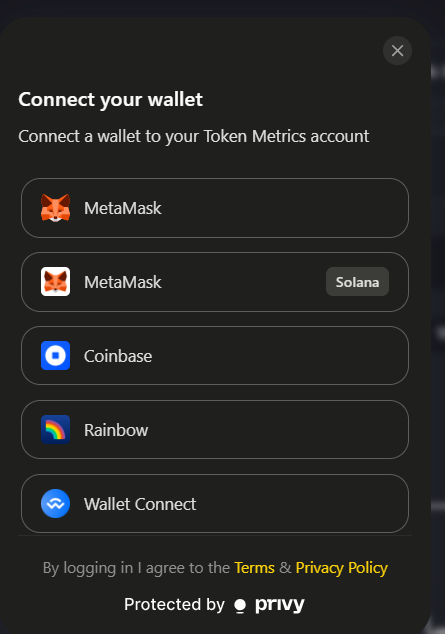
Token Metrics is not a traditional cryptocurrency exchange but rather a cutting-edge crypto analytics and AI trading platform. In 2025, it stands out as one of the most powerful tools for users who prefer no-KYC trading. Token Metrics connects seamlessly with your self-custodial wallet—such as MetaMask, Ledger, or Trust Wallet—allowing you to retain full control of your digital assets while benefiting from AI-powered bullish and bearish signals.

This platform helps traders spot promising crypto assets, including meme coins and emerging altcoins, before they pump in the market. Token Metrics offers comprehensive research, alerts, portfolio suggestions, and educational resources that help users understand crypto trading, all without requiring any personal information, making it an excellent companion for anyone planning to trade on decentralized exchanges like Uniswap or PancakeSwap.

Key Features:

  • AI-based trading signals without needing an exchange account
  • Compatible with popular self-custody wallets
  • Helps identify potential moonshots and trading opportunities
  • No KYC required to access core features
  • Ideal for privacy-focused traders seeking data-driven insights

By using Token Metrics, crypto traders can make informed decisions while maintaining anonymity and security.

2. Uniswap (Ethereum & Layer-2 DEX)

Best For: Anonymous ERC-20 Token Swaps

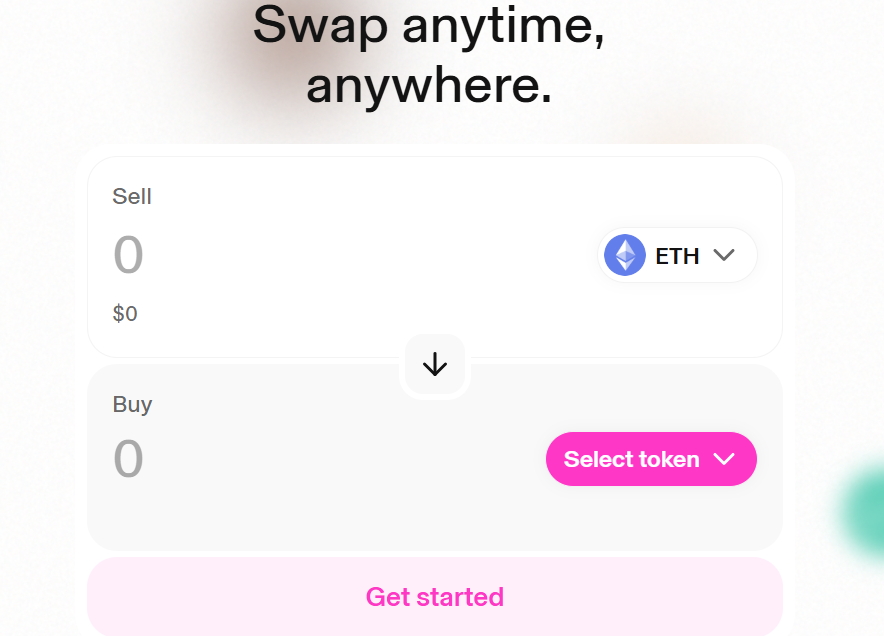
Uniswap remains the dominant decentralized exchange on Ethereum and its Layer-2 scaling solutions such as Optimism and Arbitrum. It offers users the ability to trade ERC-20 tokens directly from their wallets with no sign-up, no KYC, and no limits—perfect for anonymous crypto trading.

To trade on Uniswap, all you need is a self-custodial wallet like MetaMask or WalletConnect. Trading on Layer-2 chains reduces gas fees significantly, and Uniswap provides deep liquidity across a vast array of assets, including stablecoins, altcoins, and popular meme coins. Uniswap's consistently high trading volume further ensures efficient trades and competitive pricing. This makes it a top choice for users seeking to swap tokens without relying on centralized intermediaries.

Key Features:

  • No KYC or account required
  • Deep liquidity for ERC-20 tokens
  • Available on Ethereum mainnet and Layer-2 networks (Arbitrum, Optimism, Base)
  • Supports trading of stablecoins, meme coins, and other coins anonymously

Uniswap offers crypto traders a secure and efficient platform to access a broad range of digital currencies while safeguarding their privacy.

3. PancakeSwap (BNB Chain DEX)

Best For: Fast, Cheap, No-KYC Trading on BNB Smart Chain

PancakeSwap is the leading decentralized exchange on the Binance Smart Chain (BNB Chain), delivering one of the best experiences for anonymous crypto trading with exceptionally low gas fees. No account creation or identity verification is necessary—simply connect your digital wallet and start trading.

PancakeSwap supports a wide variety of tokens, including popular meme coins, NFTs, and synthetic assets. Beyond trading, it offers features such as yield farming, staking, an NFT marketplace, and lottery integrations, making it a versatile platform for users who want to grow their crypto portfolio without compromising privacy.

Key Features:

  • No KYC required to trade
  • Supports BNB, BUSD, stablecoins, and numerous altcoins
  • Extremely low transaction fees on BNB Smart Chain
  • Additional crypto services like yield farming and staking
  • NFT marketplace and lottery features integrated

PancakeSwap is ideal for users seeking low-cost, no-KYC trading combined with opportunities to earn rewards on the BNB Chain.

4. MEXC

Best For: Centralized Exchange With No KYC for Low Volumes

MEXC is one of the few centralized cryptocurrency exchanges that continues to allow users to trade crypto without completing KYC verification, albeit within certain daily withdrawal limits. In 2025, MEXC remains a favorite among traders who want access to centralized exchange features—such as leverage trading, limit orders, and a wide selection of token listings—without sharing personal identification. MEXC secures user accounts with robust security measures, including multi-factor authentication, to help protect assets and ensure account safety.

While KYC is mandatory for large withdrawals and fiat onramps, MEXC is well-suited for altcoin hunting and leverage trading for users who wish to maintain privacy within the platform’s withdrawal thresholds.

Key Features:

  • Spot and futures trading available without KYC (within withdrawal limits)
  • Extensive selection of tokens and frequent new listings
  • Competitive low fees and taker fees
  • Good liquidity on major trading pairs

MEXC offers a balanced solution for crypto traders who want the benefits of a centralized platform without fully compromising their anonymity.

5. dYdX (v4 Decentralized)

Best For: Anonymous Perpetual Trading on a DEX

In 2025, dYdX has transformed into a fully decentralized perpetual trading platform powered by the Cosmos SDK, eliminating reliance on centralized infrastructure. This upgrade enables users to trade with leverage, no KYC, and full custody of their crypto assets.

With dYdX v4, traders can engage in advanced financial instruments and margin trading with up to 20x leverage, all while maintaining privacy by connecting their self-custodial wallets. The platform also allows users to execute trades with high speed and efficiency, and offers professional-level analytics, making it the top choice for advanced traders who prioritize security and anonymity.

Key Features:

  • No KYC required for trading
  • Perpetual contracts with up to 20x leverage
  • Fully decentralized and self-custodial
  • High-performance execution on Cosmos infrastructure
  • Advanced user interface and analytics tools

dYdX is the best crypto exchange for traders seeking decentralized margin trading without sacrificing privacy or security.

6. Bisq

Best For: Peer-to-Peer Bitcoin Trading with No KYC

Bisq is a peer-to-peer decentralized Bitcoin exchange that enables users to buy and sell bitcoin for fiat currencies or altcoins without any KYC requirements. It supports various payment methods, including bank transfer, Revolut, wire transfer, and even cash, making it highly versatile.

Operating as a desktop application integrated with the Tor network, Bisq offers one of the most privacy-preserving crypto trading experiences available. Its decentralized design means there is no centralized order book, and it incorporates built-in escrow and dispute resolution to protect users.

Key Features:

  • Peer-to-peer BTC trading with no KYC
  • Payment methods include bank transfers, wire transfer, and cash
  • Tor network integration for enhanced privacy
  • No centralized order book or control
  • Secure escrow and dispute resolution mechanisms

Bisq is especially useful for users who want to buy or sell bitcoin anonymously and securely using traditional payment methods.

Final Thoughts: Choose Wisely When Going No-KYC

While no-KYC exchanges offer enhanced privacy and convenience, they come with certain risks. These include potential scams on decentralized platforms, limited customer support, and lack of recourse if issues arise. No-KYC exchanges may not offer the same level of protection or assistance to customers as regulated platforms. Phishing attacks can lead to individual account compromises, where users may unwittingly reveal passwords to cybercriminals. To minimize these risks, always:

  • Use a secure digital wallet such as Ledger, MetaMask, or Rabby.
  • Double-check contract addresses before initiating transactions.
  • Avoid phishing links and suspicious websites.
  • Leverage platforms like Token Metrics for thorough research before buying or selling crypto assets.

By combining informed decision-making with secure practices, you can navigate the no-KYC crypto market safely and effectively.

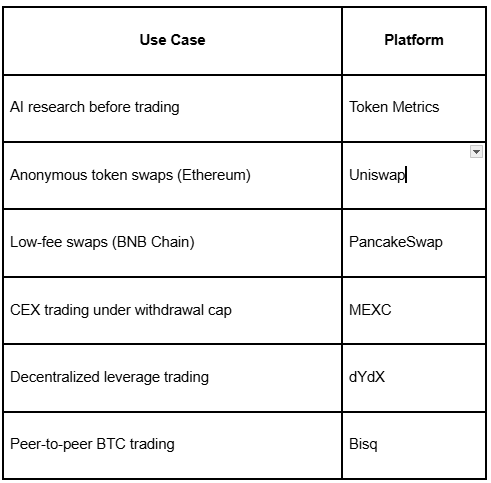
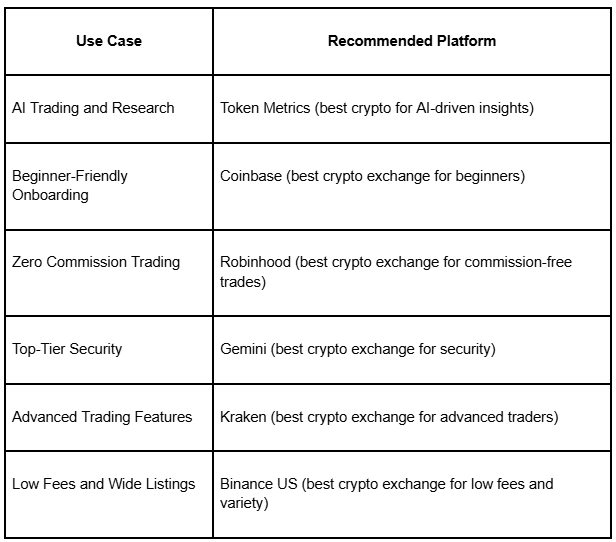
Top Picks by Use Case

Using Token Metrics alongside one of these top crypto exchanges enables you to make data-backed decisions while preserving your privacy—an ideal strategy for crypto traders and investors in 2025.

By choosing from these best no-KYC crypto exchanges, users can maintain control over their crypto assets, access a diverse range of digital currencies, and enjoy secure, anonymous trading experiences tailored to their needs. Whether you are a retail investor, an advanced trader, or simply privacy-conscious, these platforms offer the tools and services necessary to thrive in the evolving crypto market. These platforms are selected not only for privacy but also for the quality of service they provide to users.

Crypto Basics

Top 10 Crypto Exchanges in USA in 2025 | Secure and Affordable Trading

Sam Monac
6 min

As the crypto market continues to expand rapidly across the United States, crypto traders and investors are on the lookout for the best crypto exchanges that combine security, low fees, a wide range of digital assets, and intelligent trading tools to optimize their investment strategies. These exchanges operate as business entities that facilitate the trading, buying, and custody of cryptocurrencies, playing a crucial role in the financial ecosystem. In 2025, the competition among U.S.-based cryptocurrency exchanges is fiercer than ever. From well-established platforms like Coinbase and Kraken to innovative AI-powered solutions such as Token Metrics, users have a wealth of options—and compelling reasons to choose carefully.

This article explores the best cryptocurrency exchanges in the USA in 2025, highlighting their standout features, benefits, and what differentiates each platform. Whether you are a retail investor just starting to buy crypto or an advanced trader seeking sophisticated analytics, this guide will help you find the right exchange to meet your needs by focusing on how these platforms serve their customers, emphasizing the importance of customer support and safety.

Introduction to Crypto Trading

Crypto trading is the process of buying and selling digital assets—such as bitcoin and other cryptocurrencies—on specialized online platforms known as crypto exchanges. As the crypto market has matured, many crypto exchanges have emerged, each offering unique features to meet the needs of a diverse range of traders. Whether you’re a newcomer or a seasoned trader, selecting the best crypto exchange is essential for maximizing your trading potential and safeguarding your assets.

Top crypto exchanges provide access to a wide variety of trading pairs, allowing users to trade between different cryptocurrencies and even fiat currencies. These platforms are designed to offer high liquidity, ensuring that trades can be executed quickly and at competitive prices. Security is a major focus, with leading exchanges implementing advanced protocols to protect users’ assets and personal information.

Another key consideration is the fee structure. The best crypto exchanges are transparent about their fees, offering low fees for trading and withdrawals to help traders keep more of their profits. Many exchanges also provide advanced order types, such as limit and stop orders, giving traders greater control over their trades. For those looking to expand their knowledge, educational resources are often available, covering everything from basic trading strategies to in-depth market analysis.

Ultimately, understanding the fundamentals of crypto trading, the available trading pairs, and the fee structure of each exchange will empower you to make informed decisions and succeed in the dynamic world of digital assets.

Token Metrics: One of the Best Crypto Exchanges and AI-Powered Trading Platforms in the USA (2025)

Token Metrics is not a conventional cryptocurrency exchange but rather a comprehensive crypto research, analytics, and AI trading platform. In 2025, it has emerged as a top choice among crypto traders and investors who prioritize smart insights before making any trade. Unlike many crypto exchanges that compete mainly on token listings or low fees, Token Metrics distinguishes itself by empowering users with data-driven decision-making.

The platform connects to your preferred cryptocurrency exchange accounts via API or wallet integration, offering seamless compatibility with major exchanges such as Coinbase and Binance US. Token Metrics offers access across web, desktop, and mobile devices for maximum convenience. It provides AI-generated bullish and bearish signals, investor and trader grades, and custom alerts for thousands of tokens, covering a broad spectrum of crypto assets and a wide variety of cryptos available for analysis and trading. The spectrum of assets includes those with varying market cap, an important metric for assessing the prominence of different digital assets. This powerful approach helps users avoid hype traps and spot moonshots before they pump, enhancing the potential for profitable trades.

Key Features of Token Metrics:

  • AI signals and token ratings based on over 80 on-chain and off-chain data points
  • Embedded secure wallet giving users full control over their digital assets
  • 24/7 Telegram alerts delivering real-time trade setups and market signals
  • Integration with multiple crypto exchanges for easy trade execution
  • Cross-device and regional access for maximum convenience
  • Educational webinars and in-depth research reports to support informed investing
  • Portfolio builder and backtesting tools to refine trading strategies

Token Metrics is best suited for traders and investors who want to supercharge their trading decisions with AI analytics and comprehensive crypto services. The platform offers a free plan, while premium subscriptions start at $199.99 per month with a 7-day free trial.

Coinbase – The Most Beginner-Friendly U.S. Crypto Exchange

Coinbase remains the most popular cryptocurrency exchange for beginners and casual investors in the USA due to its intuitive user interface, stringent U.S. regulatory compliance, and strong security protocols. As one of the best crypto exchanges widely used across the country, Coinbase’s public listing has helped it gain mainstream credibility and trust, supported by a large customer base. The platform places a strong emphasis on serving and protecting its customers, offering reliable customer support and robust safety measures.

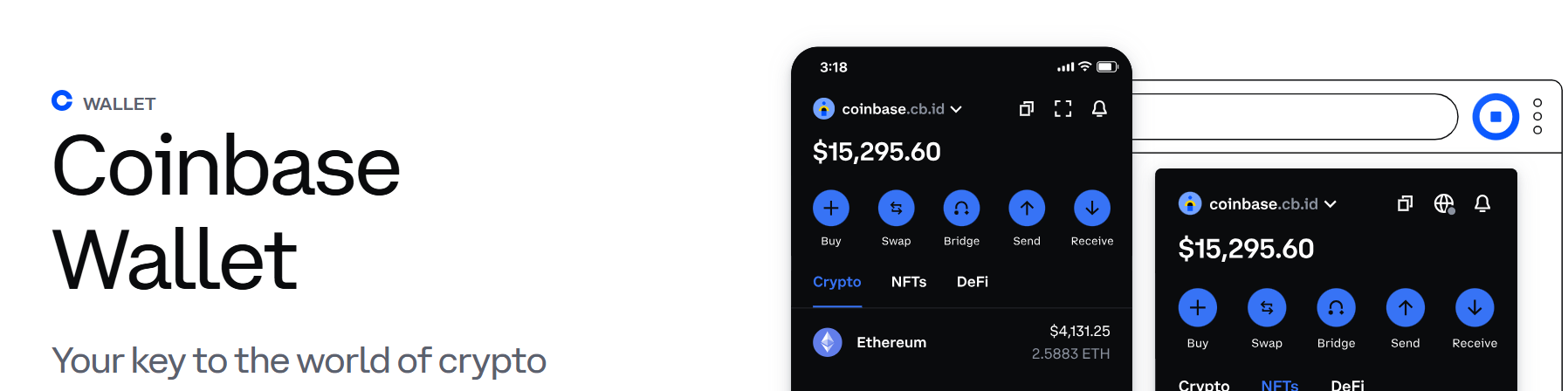
In 2025, Coinbase continues to expand its offerings with features like Coinbase Advanced, catering to pro traders, and Coinbase Wallet, a secure digital wallet for storing and managing your crypto assets. Users can safely store their cryptocurrencies in Coinbase Wallet, ensuring their assets are protected. The platform also supports staking options, allowing users to earn rewards on their holdings. Integration with analytical platforms like Token Metrics enables users to analyze tokens before buying, enhancing decision-making.

Key Features of Coinbase:

  • Simple buy/sell interface for major cryptocurrencies with multiple payment methods
  • Supports bank transfers and debit card payments for buying cryptocurrencies
  • Fully regulated and compliant with U.S. laws
  • FDIC-insured USD storage for added security
  • Access to staking, DeFi, and NFTs through Coinbase Wallet
  • Extensive educational resources and crypto rewards for learning

Coinbase is best for first-time crypto buyers and long-term holders in the U.S. It charges no subscription fees, with trading fees starting around 1.49% per transaction.

Robinhood Crypto – Zero-Fee Crypto Trading for U.S. Investors

Robinhood Crypto has made a significant impact by offering zero-commission crypto trading, making it an attractive option for retail investors seeking to trade crypto without incurring high fees. In 2025, Robinhood supports a growing list of coins, offers recurring buys, and provides access to its self-custody wallet introduced in 2024.

Users can quickly sign up or sign in to their Robinhood accounts to start trading crypto right away. The platform regularly experiences high trading volume, reflecting its popularity among both beginners and advanced users. While Robinhood lacks advanced analytics and complex order types, its clean interface and no-fee model make it ideal for cost-conscious traders who want to start

Key Features of Robinhood Crypto:

  • Commission-free trading for bitcoin, Ethereum, and other major digital currencies
  • Fractional investing and recurring buy options
  • Integrated self-custody wallet with NFT support
  • Instant deposits and withdrawals for verified users
  • Unified UI synced with stock and options accounts

Robinhood Crypto is best for retail traders who want zero-fee crypto trading and who may already use Robinhood for stocks. The platform is completely free for basic crypto trades.

Gemini – Regulated and Security-First U.S. Crypto Exchange

Gemini has earned a reputation as one of the most compliant and security-focused cryptocurrency exchanges in the U.S. It stands out in 2025 as a preferred platform for institutional investors and users who prioritize regulatory transparency and peace of mind.

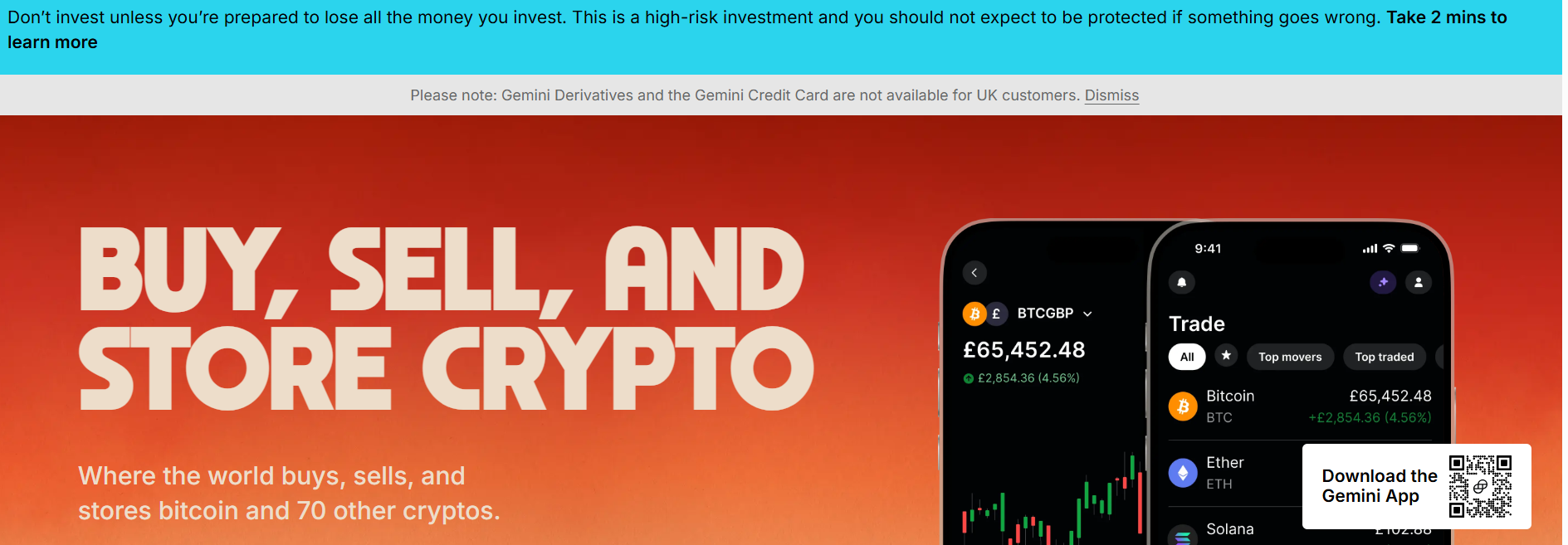
Gemini offers a comprehensive suite of crypto services, including spot trading, staking, a crypto credit card with rewards, and high-yield accounts. Its user-friendly mobile app and secure custody solutions cater to both retail and institutional clients. Users can trade cryptocurrencies with varying market caps, gaining access to both established and emerging digital assets.

Key Features of Gemini:

  • NYDFS-regulated exchange with strong compliance standards
  • Gemini Earn for generating yield on crypto holdings (subject to regulations)
  • Cold storage with insurance-backed custody for enhanced security
  • Full range of crypto services including staking and custody
  • Gemini Credit Card offering crypto rewards on purchases
  • Industry-leading security protocols including two-factor authentication (2FA)

Gemini is best for users and institutions seeking top-tier security and regulatory assurance. Its fee structure is competitive, with discounts available for high-volume traders.

Kraken – Advanced Crypto Trading with a Trusted U.S. Exchange

Kraken is a long-standing favorite among professional traders in the U.S. due to its robust trading engine, deep liquidity, and extensive range of advanced order types. The platform consistently sees a large volume of digital assets traded, reflecting high activity and liquidity across its markets. In 2025, Kraken supports staking, futures, and margin trading, positioning itself as a full-service platform for experienced users.

Kraken Pro offers high-speed trading, API integrations, and customizable dashboards, appealing to advanced traders and institutions alike. The exchange is renowned for its top-tier security and regulatory transparency. Kraken also has a strong global presence, serving users in key international markets such as Singapore and South Korea.

Key Features of Kraken:

  • Support for over 200 cryptocurrencies and numerous trading pairs
  • High-yield staking options for major tokens
  • Advanced charting tools, order types, and API access
  • 24/7 customer support and extensive educational resources
  • Fully regulated and compliant with U.S. laws

Kraken is best suited for advanced traders, institutions, and staking enthusiasts. Kraken Pro offers low fees, typically 0.16% maker and 0.26% taker fees, with minimal additional costs.

Binance US – Low Fees and Broad Access for American Traders

Binance US, the American branch of the global Binance exchange, is known for offering some of the lowest fees in the U.S. crypto market along with a broad selection of cryptocurrencies. The platform offers access to a wide variety of cryptos, including some that may be difficult to find elsewhere. While more limited in features than its global counterpart, Binance US provides a powerful platform for traders seeking low trading costs and extensive asset availability.

In 2025, Binance US continues to enhance its mobile app, expand coin listings, and add support for staking and recurring buys. It also integrates well with third-party analytics platforms such as Token Metrics, allowing users to combine smart research with execution.

Key Features of Binance US:

  • Among the lowest fees in the U.S. crypto market (0.1% maker/taker fees)
  • Large selection of cryptocurrencies for spot trading
  • Advanced charting and trading tools for active traders
  • Multiple payment methods including ACH, wire transfer, and debit cards
  • Integration with analytics platforms for enhanced decision-making

Binance US is ideal for active traders looking for low fees and a wide variety of tokens. Discounts are available for users holding the BNB token.

Institutional Investors and Crypto Trading in the USA

Institutional investors are playing an increasingly prominent role in the U.S. crypto market, bringing significant capital and credibility to the space. With the rise of digital assets like bitcoin and Ethereum, many institutions are seeking new ways to diversify their portfolios and tap into the growth potential of crypto trading. The integration of crypto services by established names in traditional finance, such as Fidelity Crypto, has made it easier than ever for institutions to access and trade crypto.

These investors benefit from platforms that offer advanced trading features, including copy trading, futures, and robust security measures tailored to large-scale operations. High trading volumes and deep liquidity on leading exchanges ensure that institutions can execute large trades efficiently without impacting market prices. Additionally, specialized services such as dedicated account management, enhanced reporting, and compliance support are often available to meet the unique needs of institutional clients.

However, institutional investors must also navigate a complex regulatory environment and address security concerns to protect their assets. Despite these challenges, the potential for strong returns and portfolio diversification continues to drive institutional interest in digital assets. As more institutions enter the market, their participation is expected to boost overall trading volumes and liquidity, further solidifying the role of crypto trading in the broader financial ecosystem. The ongoing evolution of the crypto market suggests that institutional investors will remain key players in shaping its future.

Final Thoughts: Which U.S. Crypto Exchange Is Best in 2025?

With many crypto exchanges available in the U.S., choosing the best cryptocurrency exchange depends on your specific needs and trading style. Here’s a quick summary to help you decide:

For optimal performance, many U.S. crypto traders combine Token Metrics with one or more of these best crypto exchanges. Token Metrics acts as a decision engine, using AI to identify top tokens, while the exchanges provide the execution layer for trades.=

In a landscape with many crypto exchanges to choose from, selecting the best crypto platform based on your individual goals is critical. Pairing your favorite exchange with powerful research tools like Token Metrics may well be the smartest move you make in 2025, helping you navigate the dynamic crypto market with confidence and success.

Crypto Basics

What Is ETF Investing? A Complete Guide for Beginners in 2025

Token Metrics Team
6 min

ETF investing is one of the smartest and most accessible ways to grow your wealth in 2025. With over $12 trillion in assets globally, Exchange-Traded Funds (ETFs) have become a go-to strategy for investors seeking low-cost, diversified, and flexible exposure to a wide range of markets — including stocks, bonds, commodities, and even cryptocurrencies.

In this guide, we’ll explore:

  • What is ETF investing?
  • How ETFs work
  • Different types of ETFs
  • Benefits and risks of ETF investing
  • How to use platforms like Token Metrics to make better investment decisions, especially with crypto ETFs

📌 What Is ETF Investing?

ETF investing refers to buying and holding shares of an Exchange-Traded Fund (ETF) — a marketable security that tracks a collection of assets such as stocks, bonds, or digital currencies. ETFs are traded on public exchanges just like individual stocks, meaning you can buy or sell them anytime during market hours.

Unlike mutual funds, ETFs are passively managed and aim to replicate the performance of a particular index or sector. For example, the SPY ETF tracks the S&P 500, giving you exposure to 500 of the largest U.S. companies with a single investment.

🔍 How Does an ETF Work?

An ETF is managed by an investment company that holds the actual basket of assets. This company issues shares that represent fractional ownership of the entire portfolio.

Here’s how ETF investing works in practice:

  1. You buy ETF shares on a stock exchange through a broker (just like buying a stock).
  2. The ETF provider holds the underlying assets (e.g., stocks, bonds, crypto).
  3. You gain exposure to all assets in the fund with one transaction.
  4. ETF price moves with the market value of its underlying assets.

This model provides instant diversification, reducing risk and simplifying portfolio construction.

🔍 What Are the Types of ETFs?

In 2025, ETF investing is more versatile than ever. Investors can choose from a variety of ETFs depending on their risk appetite, market outlook, and investment goals.

1. Equity ETFs

Track a group of stocks, either broadly (e.g., S&P 500, Nasdaq) or thematically (e.g., AI, electric vehicles, cybersecurity).

2. Bond ETFs

Offer exposure to government or corporate bonds, ideal for income investors seeking lower volatility.

3. Commodity ETFs

Provide access to raw materials like gold, silver, oil, or agricultural goods — useful as inflation hedges.

4. Thematic ETFs

Focus on emerging trends like blockchain, green energy, Web3, or metaverse industries.

5. Crypto ETFs

New in 2025, these ETFs give regulated exposure to digital assets like Bitcoin, Ethereum, and altcoins without managing wallets or private keys.

✅ Benefits of ETF Investing

ETF investing offers many benefits for both beginners and experienced investors:

1. Diversification

One ETF share exposes you to dozens or even hundreds of assets, reducing portfolio risk.

2. Low Fees

ETFs typically have lower expense ratios (0.03%–0.75%) compared to mutual funds (1%+), allowing you to keep more of your returns.

3. Liquidity

ETFs are traded on public exchanges, so you can buy and sell throughout the day, unlike mutual funds that settle once daily.

4. Transparency

Most ETFs disclose holdings daily, so you know exactly what you own.

5. Tax Efficiency

Due to their structure, ETFs are often more tax-friendly than other pooled investment vehicles.

⚠️ Risks of ETF Investing

While ETF investing has many advantages, there are a few risks to consider:

1. Market Risk

Your ETF will rise or fall with the market it tracks. If the S&P 500 drops, so does the SPY ETF.

2. Tracking Error

An ETF may not perfectly match the index it tracks due to fees or poor asset replication.

3. Over-Concentration

Some ETFs are heavily weighted in a few assets, which can increase volatility.

4. Liquidity Risk

Smaller or niche ETFs may have lower trading volume, making it harder to exit positions quickly.

📈 What Is Crypto ETF Investing?

In 2025, crypto ETF investing has gained significant traction. Thanks to regulatory clarity in major markets like the U.S., investors can now access:

  • Bitcoin spot ETFs (e.g., IBIT by BlackRock)
  • Ethereum ETFs
  • Altcoin basket ETFs
  • Thematic ETFs focused on DeFi, NFTs, or AI crypto

These ETFs make it easier to gain exposure to crypto assets through traditional brokerages and tax-advantaged accounts — without handling the complexity of wallets or exchanges.

🤖 How Token Metrics Enhances ETF Investing

Token Metrics is an AI-powered crypto analytics and research platform that can be used alongside ETF investing, especially when evaluating or managing crypto ETF exposure.

1. AI Price Predictions

Token Metrics uses machine learning models to forecast future prices of top cryptocurrencies — helping investors anticipate ETF performance tied to those assets.

2. Trader and Investor Grades

Each token tracked by Token Metrics receives a Trader Grade (short-term signal) and Investor Grade (long-term strength), allowing users to compare underlying assets of ETFs.

3. Real-Time Market Signals

If a crypto asset in your ETF becomes bullish or bearish, Token Metrics alerts you in real time — helping you decide whether to hold or rotate exposure.

4. Portfolio Tracking

You can sync your wallet or exchange accounts and use Token Metrics to monitor how ETF-related tokens are performing in your overall crypto portfolio.

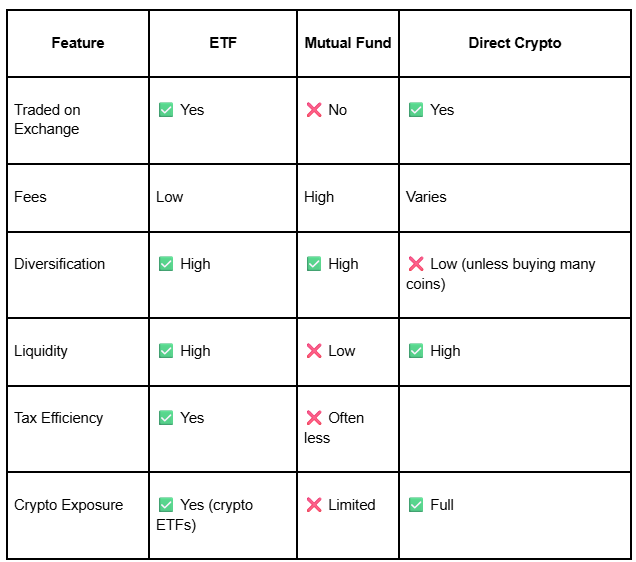
💬 ETF Investing vs. Mutual Funds vs. Crypto

For most retail investors in 2025, ETF investing offers the best balance between simplicity, diversification, and risk management — especially when paired with tools like Token Metrics.

🧠 Final Thoughts

ETF investing is one of the most powerful tools for building long-term wealth in today’s fast-moving markets. It provides instant access to diversified portfolios across traditional and emerging sectors — including cryptocurrency.

By combining ETF investing with AI-powered insights from Token Metrics, you gain an edge in identifying opportunities, managing risk, and adapting your strategy as markets evolve.

Whether you're buying your first ETF or exploring the future of finance through crypto ETFs, now is the perfect time to put ETF investing at the core of your portfolio strategy.

Choose from Platinum, Gold, and Silver packages
Reach with 25–30% open rates and 0.5–1% CTR
Craft your own custom ad—from banners to tailored copy
Perfect for Crypto Exchanges, SaaS Tools, DeFi, and AI Products